
Categories
Uncategorized

Freelance vs Agency for Web Development: The 2026 Strategic Guide

By early 2026, 41% of all code is AI-generated, which has completely changed the stakes for your next digital project. Choosing between a freelance vs agency for web development is no longer just about comparing hourly rates. It’s about deciding who will protect your brand from project abandonment and technical debt. You’ve probably felt the anxiety of wondering if a solo developer can handle the complexity of modern security. Managing multiple specialists is exhausting.

You deserve a high-performance website that converts and grows with your business. This strategic guide will help you discover whether a freelance developer or a full-service agency is the right choice for your digital growth and long-term security. We’ll explore the latest UAE market trends, the impact of AI automation, and how to build a reliable technical partnership that ensures your site integrates perfectly with your SEO and marketing goals from day one.

Key Takeaways

  • Understand the fundamental differences between execution-focused individuals and strategy-driven multidisciplinary teams in the 2026 digital market.
  • Evaluate the critical trade-offs of freelance vs agency for web development, focusing on project risk, communication speed, and execution complexity.
  • Learn why integrating SEO, PPC, and UI/UX design from the initial development phase is essential for long-term conversion and search visibility.
  • Identify your specific project triggers, such as technical complexity and internal management capacity, to determine the right partnership model.
  • Discover how a strategic partnership provides the AI automation and scalability required to future-proof your digital presence against rapid technological shifts.

The Web Development Landscape in 2026: Freelance vs Agency

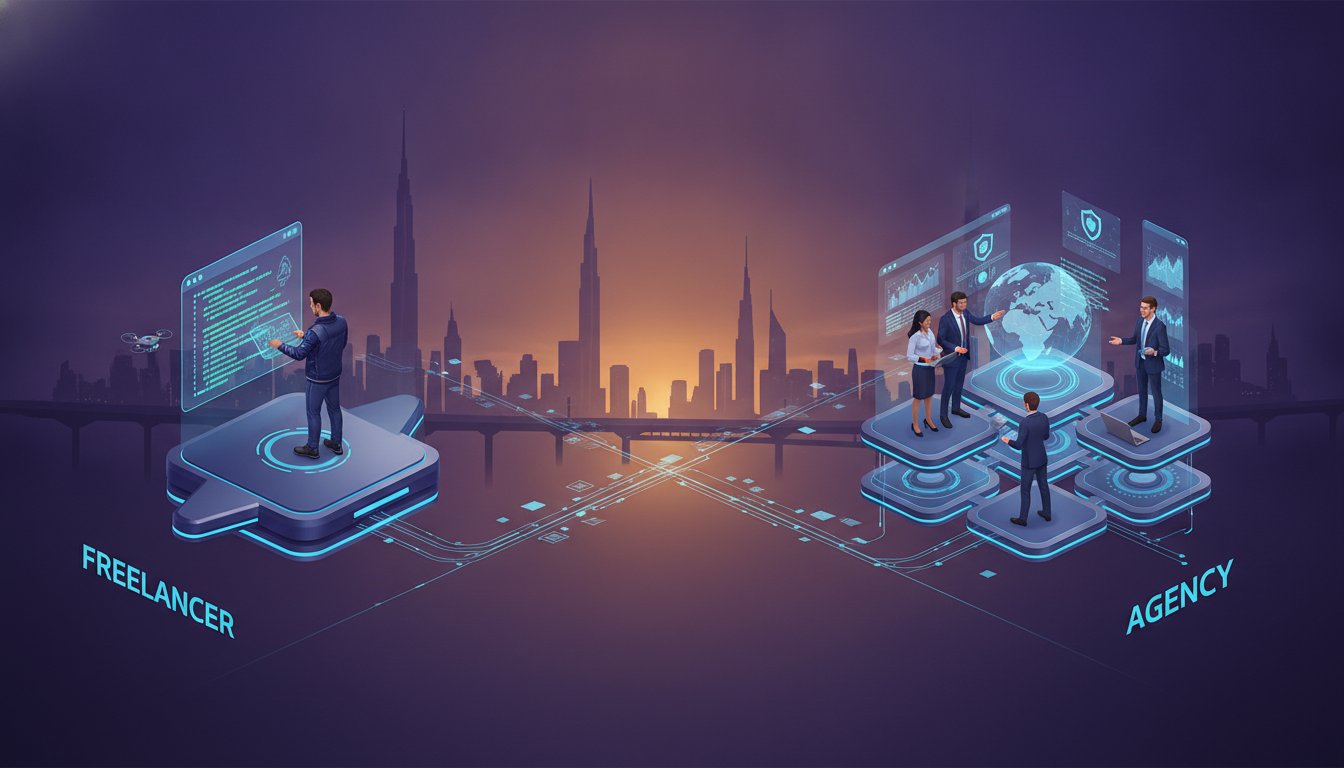
The 2026 digital environment is vastly different from the simple “brochureware” era. Today, Web development involves complex integrations of AI, real-time data, and strict accessibility standards. When you weigh the choice of a freelance vs agency for web development, you’re choosing the structural foundation of your business. A freelancer is typically an individual specialist who focuses on specific execution tasks. They’re the “hands” that build the features you request. An agency acts as a multidisciplinary team. They provide end-to-end digital strategy, ensuring your site doesn’t just exist but actually performs.

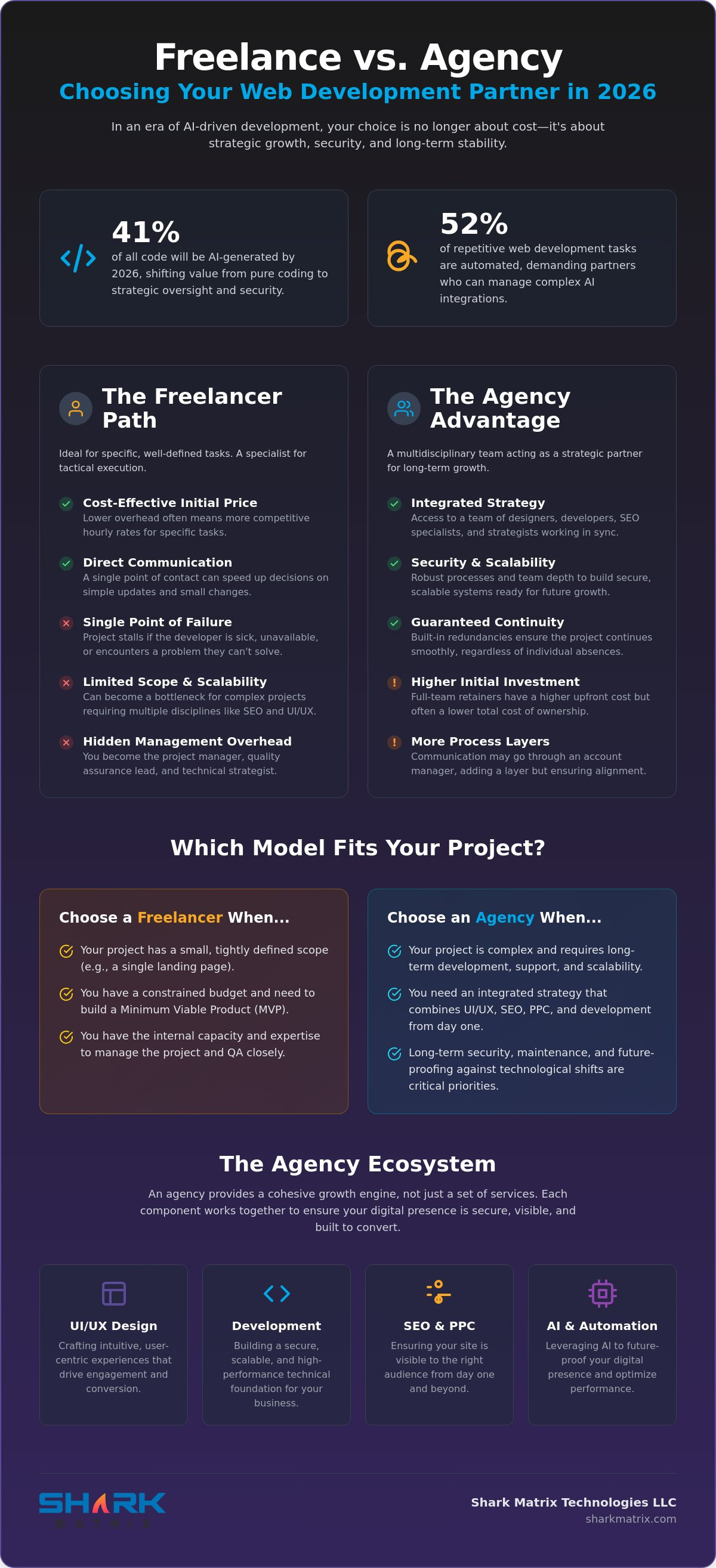
This decision impacts your business far beyond the initial launch. In 2026, where AI automates roughly 52% of repetitive coding tasks, the value of a partner has shifted from “how fast can you code” to “how well can you architect a secure ecosystem.” With 41% of all code now being AI-generated, the real work lies in strategic oversight and security. If your site breaks three months after launch, a solo freelancer might be unavailable or busy with another client. An agency offers the infrastructure to handle long-term maintenance, ensuring your digital assets remain secure and scalable.

The Freelance Developer: Agile and Specialized

Freelancers are ideal for niche tasks or small-scale, short-term project executions where the scope is tightly defined. You get direct access to the technician without navigating through account management layers. This direct line can speed up communication for simple updates. Since they have lower overheads, their initial pricing is often more competitive. It’s a viable path for a startup needing a basic landing page. However, you’re reliant on a single point of failure. If that individual is sick or moves on to a higher-paying project, your development pipeline stops immediately.

The Digital Agency: A Multidisciplinary Growth Partner

Agencies provide access to a collective brain trust. You aren’t just hiring a coder; you’re hiring designers, SEO specialists, and marketing strategists who work in sync. They view website design and development services as one piece of a larger brand strategy. With built-in redundancies, project continuity is guaranteed regardless of individual absences. Since its founding in 2010, Shark Matrix has seen how this multidisciplinary approach prevents the fragmentation that often ruins freelance projects. Agencies are better equipped to handle the 2026 shift toward integrated AI and automation, providing a level of long-term security that individuals rarely can match.

Evaluating the Freelance Path: Cost, Speed, and Risk

Hiring a freelancer often feels like the most direct route to launching a project. In the UAE market for 2026, freelance rates vary significantly based on seniority and technical specialization. On paper, these rates look attractive compared to full-team retainers. However, when deciding between a freelance vs agency for web development, you have to look at the total cost of ownership. A lower hourly rate doesn’t account for the hours you’ll spend acting as a project manager, quality assurance lead, and technical translator.

Speed is another double-edged sword. Communication with a solo developer is usually instant. You have their direct WhatsApp or Slack, which works well for minor tweaks. But complex execution often hits a wall. A single person, even one using AI tools to automate 52% of repetitive web development tasks, only has so many hours in a day. If your project requires custom AI integrations or advanced agency for web design expertise to scale, a solo freelancer becomes a bottleneck rather than a catalyst.

When Freelancing Wins: Small Scopes and Tight Budgets

Freelancers are excellent choices for projects with a finite end and low technical risk. If you need a simple landing page or basic maintenance on a standard CMS, an independent contractor is efficient. This model works best when you have the internal capacity to manage them closely. For budget-constrained startups building a Minimum Viable Product (MVP), a freelancer provides the agility needed to test a concept without the commitment of a full-service contract. It’s about matching the tool to the task.

The Hidden Costs of Managing Individuals

The real risk in the freelance model is the “single point of failure.” If your developer faces a personal emergency or a technical hurdle they can’t solve, your entire project stalls. Managing multiple freelancers to create a cohesive platform often results in “spaghetti code” and fragmented documentation. You might save money upfront, but you’ll spend it later on refactoring. If you’re tired of juggling separate vendors, exploring integrated web development solutions can save you dozens of management hours every month.

  • Vetting Time: Expect to spend 10 to 15 hours interviewing and checking portfolios for every reliable hire.
  • Inconsistent Quality: Without agency-level peer reviews, code quality depends entirely on one person’s discipline.
  • Onboarding Friction: Every new freelancer requires a fresh round of briefings and access management.
Freelance vs Agency for Web Development: The 2026 Strategic Guide

The Agency Advantage: Security, Scalability, and AI

While freelancers offer agility for isolated tasks, the true agency advantage lies in treating your website as a living ecosystem rather than a static digital brochure. In 2026, a successful platform requires more than just clean code; it demands a synergy between security, user experience, and growth marketing. When you evaluate the freelance vs agency for web development debate, you must consider the value of a multi-specialist team. An agency provides a holistic approach to search engine optimization seo services, ensuring that your site is visible to your target audience the moment it goes live. This integrated perspective prevents the common pitfall of building a beautiful site that no one can find.

Beyond visibility, agencies prioritize UI/UX design to drive actual conversions. It isn’t enough for a site to “look good” in 2026. It must be accessible, following standards like the UAE’s National Digital Accessibility Policy, and optimized for the 52.8% of global traffic coming from mobile devices. Agencies implement rigorous security protocols and long-term maintenance agreements. These protect your business assets from evolving cyber threats. By leveraging ai automation and development, agencies can also streamline user journeys, making your platform faster and more intuitive than a solo developer could achieve alone.

Integrating SEO and PPC from Day One

Launching a website without consulting an seo agency often leads to expensive reworks six months down the line. Agencies build technical foundations, such as schema markup and optimized site speed, into the core architecture. This proactive approach ensures your web structure aligns with future ppc agency dubai landing page requirements. When your development and marketing teams work under one roof, your paid campaigns and organic search efforts benefit from a unified data strategy. This creates a seamless transition from click to conversion.

Custom AI and Machine Learning Capabilities

The shift from static pages to intelligent platforms is the hallmark of 2026 web development. Agencies implement generative AI and advanced chatbots to enhance user engagement in real-time. While AI now automates 52% of repetitive coding tasks, the agency’s role is to architect how these tools interact with your customers. We use AI for predictive analytics and lead generation, turning your website into a tool that anticipates user needs. This level of technical depth allows your business to scale rapidly while maintaining a personalized experience for every visitor.

Selection Framework: Choosing the Right Partner for Your UAE Project

Making the right choice between a freelance vs agency for web development starts with an honest assessment of your project’s technical DNA. If you’re building a standard business site with five pages, a freelancer is a viable tool. However, if your roadmap includes custom e-commerce or a complex SaaS platform, you need the architectural foresight that only a team provides. You must also evaluate your internal capacity. Do you have 10 hours a week to manage a developer? Most business owners don’t. An agency includes dedicated project management in its delivery, which frees you to focus on your core operations.

Your long-term goals should dictate your partnership model. A one-off build might suit a solo contractor, but a growing digital brand requires a partner that can scale. When comparing costs, look at the total cost of ownership (TCO) over a 24-month period. A freelancer might offer a lower initial quote, but an agency’s structured maintenance and security protocols prevent the expensive technical debt that often follows fragmented development. If you’re ready to move beyond temporary fixes, consult with our web development team to build a scalable digital foundation.

A Checklist for Vetting Web Development Partners

Success depends on due diligence. When reviewing portfolios, look for specific industry experience and technical complexity that matches your own needs. Don’t just look at the design; ask about the backend architecture. You should also assess their communication protocols. Professional teams use established project management tools like Jira or Asana to track progress. Finally, verify their references for reliability. You need to know how they handle deadlines and whether they provide consistent support after the site goes live.

Strategic Considerations for National Growth

In the UAE, local context is a major competitive advantage. You need a partner with deep expertise in professional Arabic digital marketing to reach your target audience effectively. Compliance with national data protection laws and TDRA hosting standards is non-negotiable for 2026. Your site architecture should also be designed to support online reputation management dubai. This ensures that as your brand grows, your digital presence remains protected and your search results remain positive across the region.

Shark Matrix: Your Strategic Partner for Scalable Digital Growth

Deciding between a freelance vs agency for web development is ultimately a choice about the future of your business. Since 2010, Shark Matrix Technologies LLC has functioned as a high-impact technology firm that replaces fragmented vendor management with a unified strategy. Our 15-year legacy in delivering mobile app development services and custom software allows us to build platforms that last. We bridge the critical gap between technical engineering and marketing performance. This ensures every line of code supports your long-term lead generation and brand authority.

We understand the specific requirements of the UAE national market. From professional Arabic digital marketing expertise to compliance with local hosting standards, our team ensures your digital presence is culturally and technically relevant. We don’t just provide a vendor relationship; we act as a strategic growth partner. This means your website is designed to integrate seamlessly with your sales funnel and customer service tools from the moment of launch. We focus on protecting your brand authority while expanding your digital footprint across the region.

End-to-End Digital Transformation

Our methodology covers every touchpoint of the user journey. We transition your brand from a basic web presence to a sophisticated digital ecosystem through expert UI/UX design and custom AI chatbot implementation. These tools automate engagement without sacrificing the personal touch your customers expect. For national enterprises, we develop custom software solutions tailored to specific industry needs. We maintain this momentum through continuous optimization, using integrated SEO and PPC strategies to keep your platform at the top of search results in an increasingly competitive market.

Ready to Scale Your Digital Presence?

Established businesses choose the security and depth of an agency because they can’t afford the risks of project abandonment or technical debt. We provide the multi-specialist team needed to navigate the complexities of 2026 web standards. Our experts are ready to audit your current digital assets and plan a roadmap for your national expansion. Don’t leave your digital security to chance. Partner with Shark Matrix for High-Impact Web Development and build a foundation that scales with your ambition.

Secure Your Digital Future in 2026

The choice between a freelance vs agency for web development ultimately dictates how well your business survives rapid technical shifts. You’ve seen that while solo developers offer quick execution for small tasks, they often lack the long-term support and cross-functional expertise required for complex growth. A professional agency ensures that security, scalability, and AI automation are part of your site’s DNA, not just an afterthought. This holistic approach prevents technical debt and protects your brand authority as you expand.

Shark Matrix has been a trusted technology partner since 2010. We specialize in custom AI and machine learning, helping you build intelligent platforms that anticipate user needs. With our deep expertise in Arabic digital marketing, we ensure your message resonates across the UAE market. Don’t leave your digital security to chance. Build Your Scalable Digital Ecosystem with Shark Matrix and start your journey toward sustainable digital success today.

Frequently Asked Questions

Is it cheaper to hire a freelance web developer than an agency?

Freelancers usually offer lower upfront costs because they don’t have office overhead or large teams. However, when you weigh the choice of a freelance vs agency for web development, you’ve got to consider your own time. Managing an individual takes hours away from your core business. Agencies provide a project manager who handles all technical coordination, often making the agency more cost-effective over a full 24-month cycle.

What are the main risks of hiring a freelance developer for a corporate project?

The biggest risk is a single point of failure. If a solo developer becomes ill or takes another job, your project hits a dead end. Corporate projects require high security and consistent documentation. Freelancers often lack the peer-review systems that agencies use to ensure code quality. This can lead to technical debt that costs more to fix later than the original build.

Can a web development agency handle small business websites?

Many agencies offer specialized services for small businesses that need a professional edge. While a freelancer might build a basic site, an agency builds a scalable foundation. This means you won’t have to start from scratch when your business grows. You get access to the same expert designers and SEO specialists who work on larger accounts, ensuring high performance from day one.

How does an agency integrate SEO into the web development process?

Integration begins during the site mapping phase. Agencies ensure that technical elements like site speed, core web vitals, and schema markup are part of the initial build. This prevents the need for expensive reworks after the site is live. By aligning development with SEO from the start, your platform is built to rank and convert immediately rather than waiting months for post-launch optimization.

What happens if my freelance developer stops responding mid-project?

Project abandonment is a common pain point when working with individuals. If a freelancer stops responding, you’re often left with fragmented code and locked out of your own hosting. Agencies operate under corporate contracts and maintain multi-specialist teams. This structure guarantees that someone is always available to manage your project, providing a level of security and accountability that a solo contractor simply can’t match.

Why is UI/UX design more important in 2026 than in previous years?

In 2026, UI/UX isn’t just about aesthetics; it’s about compliance and conversion. New standards like the UAE’s National Digital Accessibility Policy make inclusive design a legal necessity for many entities. Additionally, users now expect instant, personalized experiences. High-quality design reduces friction and ensures your site performs across all devices, which is critical since mobile traffic now dominates the global web landscape.

Do agencies provide better long-term support than freelancers?

Agencies are built for long-term partnerships. They offer structured Annual Maintenance Contracts (AMCs) that cover security patches, updates, and performance monitoring. Freelancers often prioritize new project builds over maintenance tasks. When you choose a freelance vs agency for web development, remember that an agency has the staff redundancy to provide consistent support even during peak periods or individual staff changes.

How can AI automation improve my business website?

AI automation transforms your site from a static page into an active sales tool. It can power intelligent chatbots that handle lead generation 24/7 and use machine learning to personalize the user journey. By automating repetitive tasks, AI allows your site to load faster and respond more accurately to customer queries. This technology helps your business scale without significantly increasing your manual workload.

Categories
Uncategorized

Building a Compelling Business Case for Website Redesign in 2026: The Executive Guide

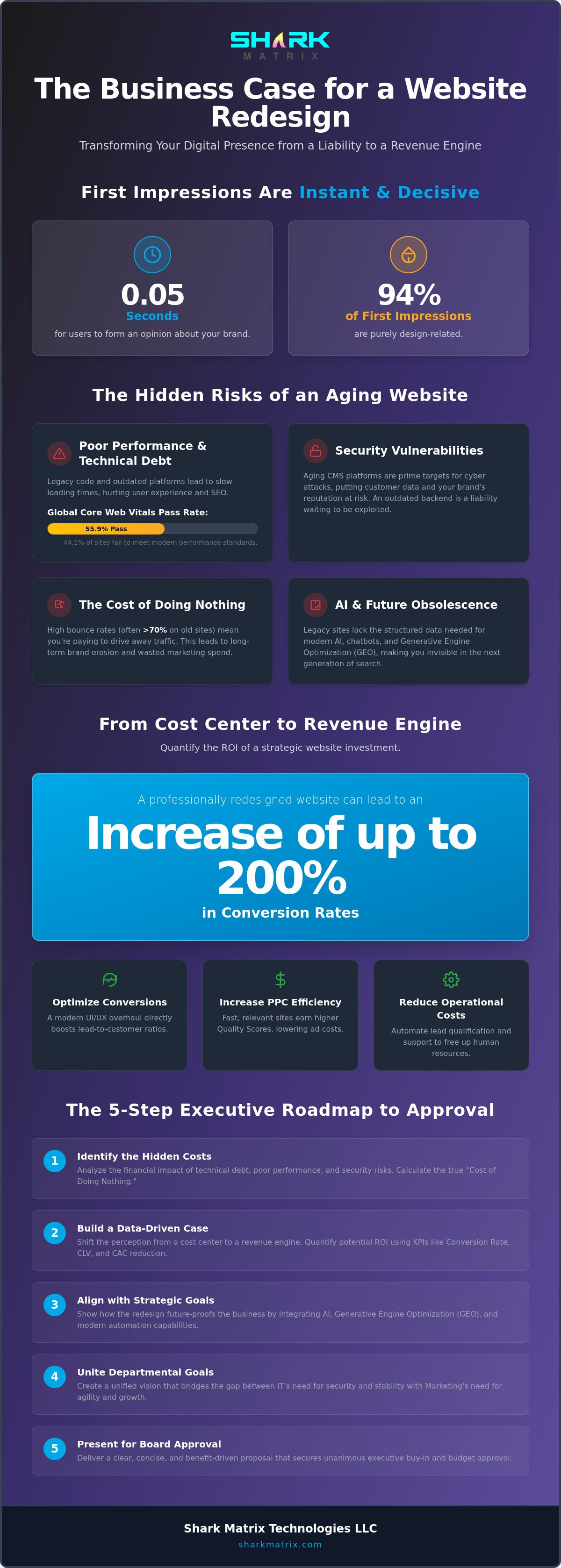
Did you know that users form an opinion about your brand in just 0.05 seconds, and 94% of those first impressions are purely design-related? If your conversion rates are stalling despite high traffic, you’re likely feeling the weight of an aging digital infrastructure. Building a strong business case for website redesign is no longer about aesthetics; it’s about fixing the technical debt that prevents you from integrating modern AI tools or meeting the 55.9% global pass rate for Core Web Vitals.

You probably agree that your website should be a performance asset rather than a cost center. We’ll show you how to quantify the ROI of a total overhaul, align your digital strategy with national growth goals, and secure board-level approval. This guide provides a clear roadmap to move from declining engagement to a high-performing site that meets WCAG 2.2 standards and drives measurable revenue. You’ll learn exactly how to bridge the gap between IT requirements and marketing agility to ensure your brand doesn’t fall behind national competitors.

Key Takeaways

  • Identify the hidden costs of digital stagnation and how technical debt actively limits your team’s marketing flexibility.
  • Shift your project’s perception from a cost center to a revenue engine by building a data-driven business case for website redesign.
  • Learn how to future-proof your digital presence by integrating Generative Engine Optimization (GEO) and modern AI automation directly into your site’s architecture.
  • Follow a proven five-step executive roadmap to align departmental goals and secure unanimous board-level approval for your budget.
  • Discover how to scale your national presence with a partner who understands the intersection of development, marketing, and brand protection.

The Hidden Risks of Digital Stagnation: Why Your Current Site is a Liability

Digital stagnation isn’t just about an old logo or clashing colors. It’s the widening gap between your site’s current capabilities and the rising expectations of modern users. When your digital presence fails to keep pace with innovation, it becomes a liability that drains resources and slows growth. Building a strong business case for website redesign requires identifying these hidden risks before they permanently impact your bottom line.

Technical debt is often the silent killer of marketing agility. Every patch or workaround added to legacy code makes the next update more expensive and time-consuming. This friction directly impacts your national SEO performance and search visibility. With the global pass rate for Core Web Vitals currently at 55.9%, failing to meet loading speed and visual stability standards means you’re losing visibility to more agile competitors. Adhering to foundational web design principles ensures your site remains a functional asset rather than a fragile collection of outdated scripts.

Security is another critical pillar that executives cannot afford to ignore. Aging CMS platforms are prime targets in an increasingly complex cyber landscape. An outdated backend doesn’t just slow down your team; it exposes your customer data to unnecessary risk. If your infrastructure can’t support modern security protocols, your brand reputation is one vulnerability away from a total collapse.

The “Cost of Doing Nothing” (CODN) Analysis

Calculating the CODN helps stakeholders see the financial impact of inaction. If your current bounce rate exceeds 70%, you’re effectively paying to drive traffic that leaves instantly. These abandoned interactions lead to long-term brand erosion, especially when national competitors offer seamless, high-speed experiences. The Cost of Doing Nothing is the cumulative lost opportunity cost of maintaining an obsolete digital interface.

Technical Obsolescence in the Age of AI

Your backend architecture determines your ability to compete in 2026. Legacy sites often lack the structured data required by modern answer engines, which limits your reach in generative search results. If your site can’t integrate with AI automation or real-time chatbots, you’re missing out on critical efficiency gains. “Looking fine” is no longer enough if your site cannot communicate with modern API ecosystems or support generative engine optimization (GEO).

Quantifying ROI: Transforming Your Website from a Cost Center to a Revenue Engine

Presenting a financial argument to the board requires a fundamental shift in perspective. You aren’t just asking for a budget to update graphics. You’re proposing a strategic capital investment (CapEx) designed to drive national brand growth. A compelling business case for website redesign demonstrates how modernizing your infrastructure reduces long-term operational costs while maximizing revenue potential. By treating your site as a performance asset, you move away from the “cost center” trap that keeps many businesses stuck with underperforming digital tools.

Efficiency is a primary driver of ROI. Utilizing professional website design and development services allows you to automate lead qualification and streamline the sales funnel. When your site answers common questions through a superior self-service UI/UX, you significantly reduce the volume of low-value inquiries hitting your customer support desk. This allows your team to focus on high-priority tasks while the website handles the heavy lifting of initial customer education, ultimately lowering your customer acquisition costs (CAC) and increasing average order value (AOV).

Key Performance Indicators (KPIs) for the Board

Executives need hard numbers to justify a project. According to 2026 data from Quickupp Softech, a well-designed website can increase conversion rates by up to 200%. This isn’t just a cosmetic gain; it’s a direct multiplier for your marketing spend. This also impacts your Pay Per Click (PPC) efficiency. Google rewards fast, relevant sites with higher quality scores, which lowers your cost-per-click and stretches your ad spend further. To secure approval, highlight these three metrics:

  • Conversion Rate Optimization (CRO): Focus on the measurable jump in lead-to-customer ratios following a UI/UX overhaul.
  • Customer Lifetime Value (CLV): Use better engagement tools and personalized content to foster long-term loyalty and repeat business.
  • Site Speed Impact: Address the 53% of mobile users who abandon pages taking longer than three seconds to load, as reported by Visual Identity Studio in 2026.

The Arabic Localization Advantage

In a competitive national market, ignoring localization is a massive revenue leak. Moving from an English-only platform to a high-quality, culturally nuanced Arabic interface expands your reachable audience significantly. Regional users convert at much higher rates when they can interact with a brand in their primary language. This builds a layer of trust that generic translation tools simply cannot replicate. By integrating professional Arabic digital marketing into your redesign, you capture a larger slice of the national market share and establish your brand as a local authority. If you’re ready to see how these metrics apply to your specific industry, you can explore our strategic development approach to start your transformation.

Building a Compelling Business Case for Website Redesign in 2026: The Executive Guide

Strategic Alignment: Integrating AI, GEO, and Modern UI/UX into Your Redesign

In 2026, the digital environment has shifted from traditional keyword matching to intent-based discovery. A simple visual refresh won’t suffice when the underlying architecture of your site determines whether you appear in AI-generated search results. Developing a robust business case for website redesign often hinges on your ability to adopt Generative Engine Optimization (GEO). This isn’t just a trend; it’s a fundamental change in how your brand communicates with both humans and machines. A redesign provides the only viable path to implement a modern search engine optimization seo services strategy that accounts for these architectural shifts.

User behavior also demands a nuanced approach to mobile accessibility. With mobile devices accounting for 53% to 64% of global web traffic, your site must be more than just responsive. We’ve moved beyond “Mobile-First” into a “Mobile-Only” reality for many national segments. If your current site was built on a desktop-first legacy system, it likely carries bloated code that slows down mobile load times. Every second of delay erodes trust. Since users form an opinion about your brand in just 0.05 seconds, your technical infrastructure must be optimized for instantaneous, high-relevance interactions across every device type.

From SEO to GEO: Preparing for Answer Engines

Traditional keyword stuffing has been replaced by entity-based architecture. Answer engines now prioritize sites that provide a clean data structure which AI crawlers can easily parse. A redesign allows you to overhaul your schema markup and structured content from the ground up. This ensures your brand is the primary source for AI-generated snippets rather than a buried link on page two. By aligning your backend with these new standards, you secure a competitive edge that legacy sites simply cannot match without a total architectural rebuild.

UI/UX as a Competitive Differentiator

High-end UI design has a profound psychological impact on brand authority. In B2B and E-commerce environments, streamlining the user journey is the most effective way to reduce friction and increase session duration. Modern redesigns also allow for the integration of custom AI development, such as interactive tools or personalized content engines. These features don’t just look impressive; they provide genuine value-add experiences that keep visitors engaged longer. When your site functions as an intuitive partner rather than a static brochure, you transform user relevance into measurable loyalty and higher conversion rates.

The Executive Roadmap: 5 Essential Steps to Secure Board Approval

Securing a budget for a large-scale digital project requires more than a list of technical requirements. You need a structured approach that speaks the language of the boardroom. Following a clear roadmap ensures your business case for website redesign addresses both growth opportunities and operational risks. By breaking the process into these five essential steps, you can transform a complex technical proposal into a compelling strategic initiative.

  • Step 1: Internal Audit & Benchmarking: Don’t just look at your own data. Compare your current metrics, like the high bounce rates mentioned earlier, against national industry leaders. This highlights exactly where you’re losing market share to more agile competitors.
  • Step 2: Stakeholder Interviews: Gather insights from Sales, IT, and Customer Service. Identifying their specific pain points, such as slow lead processing or high support ticket volumes, ensures the project delivers value across the entire organization.
  • Step 3: Solution Prototyping: Define the high-level features that solve these problems. This might include AI-driven automation, advanced e-commerce flows, or full Arabic localization to capture regional demand.
  • Step 4: Financial Modeling: Present a 24-month forecast. Contrast the Cost of Doing Nothing (CODN) with the projected ROI from increased conversion rates and lower acquisition costs.
  • Step 5: Risk Mitigation Plan: Address the board’s fears head-on. Detail your strategy for SEO migration, data security, and meeting project timelines to build confidence in the execution.

Building the “Vision” Document

Abstract technical concepts often fail to resonate with non-technical executives. Use visual mood boards and low-fidelity wireframes to make the redesign feel tangible. Shift the focus from “Design Features” like color palettes to “Business Outcomes” like reduced friction in the checkout process. The project vision is a strategic pivot toward digital leadership. When the board can see how a new interface directly correlates with national growth, approval becomes a logical next step.

Addressing the #1 Objection: SEO Preservation

The fear of losing hard-earned search rankings is the most common reason projects stall. You must demonstrate a rigorous 301 redirect strategy and a comprehensive content mapping process. Partnering with a professional seo agency ensures that your transition is managed with precision to prevent traffic dips. Instead of viewing the move as a risk, position it as an opportunity for a massive post-launch ranking boost through cleaner code and better Core Web Vitals. If you’re ready to start building your roadmap, you can consult with our strategic planning team to refine your vision.

Executing the Vision: Scaling Your National Presence with a Strategic Partner

Scaling a national presence requires more than just a functional site. It demands a digital ecosystem where code, marketing, and artificial intelligence intersect seamlessly. When you finalize your business case for website redesign, the choice of a strategic partner becomes the most critical factor in your project’s success. You need a team that doesn’t just build pages but engineers a high-performance asset capable of handling complex integrations and cultural nuances. A partner who understands the backend as well as the frontend ensures your vision translates into a scalable reality.

Maintaining trust during a major transition is vital. Implementing professional online reputation management dubai ensures your brand’s digital footprint remains protected as you migrate to a new platform. This is especially important for national brands where public perception can shift rapidly during a redesign. A “National-First” strategy accounts for regional cultural nuances, ensuring your messaging resonates across diverse demographics. It’s about more than translation; it’s about cultural alignment that builds lasting trust with your audience.

Your new website serves as the bedrock for all future growth initiatives. It’s the destination for every click from your social media campaigns and the high-converting landing page for your ppc agency dubai efforts. Without a modern, fast, and accessible foundation, your advertising spend won’t reach its full potential. A redesign ensures that every dollar spent on traffic is supported by a site built to convert.

The Shark Matrix Technologies LLC Advantage: End-to-End Digital Engineering

We don’t just design websites. We integrate custom software engineering with advanced digital marketing to ensure every build is a revenue driver. Our approach leverages AI automation to future-proof your asset, making it ready for the next decade of technological shifts. With deep expertise in Arabic digital marketing, Shark Matrix Technologies LLC helps you capture the full national market by speaking directly to your audience. This comprehensive service model eliminates the friction of managing multiple vendors and ensures a cohesive digital strategy from day one.

Next Steps: From Business Case to Kickoff

The path to a successful launch starts with hard data. Initiating a professional site audit is the best way to gather the specific metrics needed to finalize your business case for website redesign. This audit identifies current bottlenecks and provides a clear baseline for measuring future ROI. Setting realistic timelines is also essential. A national-scale project requires careful planning, from initial stakeholder interviews to the final security sweep. Don’t let digital stagnation hold your brand back. Schedule a strategic consultation with Shark Matrix Technologies LLC to build your data-driven business case and take the first step toward a dominant national presence.

Taking the Next Step Toward Digital Leadership

Your website is no longer just a digital business card; it’s the engine that powers your national growth. We’ve explored how moving away from technical debt and embracing Generative Engine Optimization (GEO) turns your site into a high-performance asset. It’s about more than aesthetics. It’s about building a foundation that supports AI-driven discovery and high-velocity lead generation. By following a structured roadmap, you can present a data-driven business case for website redesign that aligns marketing agility with financial performance.

Since 2010, Shark Matrix Technologies LLC has provided over a decade of national market expertise to help brands navigate these complex transitions. We specialize in AI automation and custom software engineering, ensuring your new infrastructure is ready for the demands of 2026. Our deep expertise in professional Arabic digital marketing and localization ensures your message resonates with every segment of the national audience. Ready to build your business case? Contact Shark Matrix Technologies LLC for a comprehensive digital audit. Your brand’s next chapter of growth starts with a foundation built for the future.

Frequently Asked Questions

How much does a website redesign typically cost for a national brand in 2026?

Costs for a national-scale project vary significantly based on the complexity of custom software engineering, AI integrations, and the depth of localization required. While simpler platforms have lower entry points, enterprise projects require a budget that covers high-traffic infrastructure, security protocols, and advanced marketing automation. You should evaluate your investment based on the specific revenue goals and technical debt identified during your initial site audit.

How long does the website redesign process take from business case to launch?

A national redesign project typically requires three to six months to move from the initial discovery phase to a live launch. This timeline accounts for stakeholder interviews, architectural planning, custom development, and rigorous cross-device testing. Planning for this duration ensures your team has enough time to align the new digital infrastructure with your long-term business goals without compromising on quality assurance.

Will a redesign hurt my current search engine rankings?

A redesign won’t hurt your rankings if you implement a precise migration strategy that includes 301 redirects and careful content mapping. In many cases, fixing legacy code and improving Core Web Vitals leads to a measurable ranking boost shortly after launch. Working with specialists ensures your current search visibility is protected while building a foundation that’s optimized for the latest generative search standards.

What is the difference between a website refresh and a full redesign?

A website refresh focuses on cosmetic updates like colors, fonts, and imagery, whereas a full redesign overhauls the site’s underlying architecture and user journey. A redesign is necessary when your current backend can’t support modern AI tools or meet accessibility standards like WCAG 2.2. This deeper structural change is what allows you to build a truly effective business case for website redesign.

How do I measure the success of a website redesign after it launches?

You measure success by tracking key performance indicators like conversion rates, customer acquisition costs, and average session duration. Compare these post-launch metrics against the benchmarks established during your internal audit to quantify the return on investment. A successful project should show a clear reduction in bounce rates and a significant increase in lead quality, proving the site’s value as a revenue-generating asset.

Why is Arabic localization critical for a business case in the UAE market?

Arabic localization is essential because it builds immediate trust and cultural relevance with a massive segment of the regional audience. Simply translating text isn’t enough; you need a localized interface that accounts for regional nuances to drive higher conversion rates. Including this in your business case for website redesign ensures you don’t leave revenue on the table by ignoring the primary language of the UAE market.

What role does AI play in a 2026 website redesign?

AI plays a central role through personalized content delivery, automated customer service chatbots, and backend optimization for generative answer engines. Modern sites use machine learning to adapt the user experience in real-time based on visitor behavior. Integrating these tools during a redesign allows your business to stay ahead of competitors who are still relying on static, non-interactive templates that can’t communicate with modern API ecosystems.

How often should a business redesign its website to stay competitive?

Most industry professionals suggest a major redesign every three to five years to keep up with shifting technical standards and user expectations. However, with the rapid rise of AI and new search behaviors, you might need to update your architecture sooner if your current site fails to pass Core Web Vitals. Regular audits help you determine if your digital presence is still a performance asset or if it’s become a liability to your growth.