

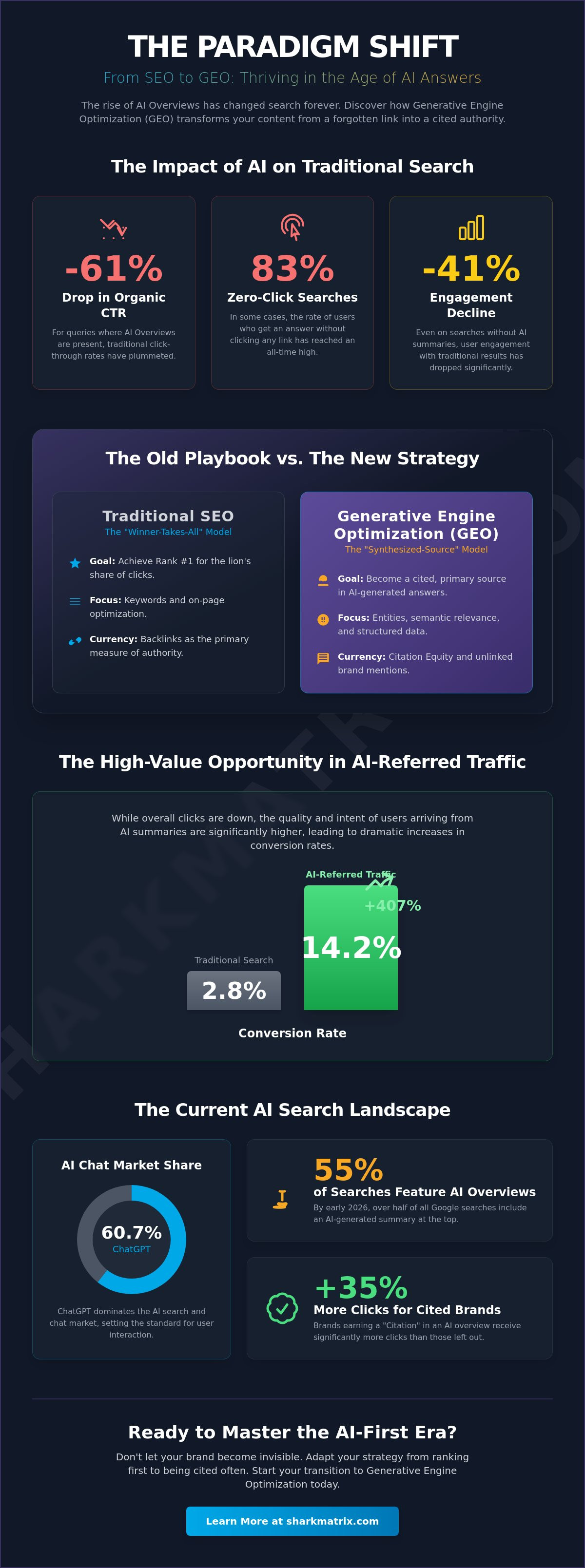
Organic click-through rates have plummeted by 61% for queries where AI Overviews appear, leaving many brands wondering if their traditional rankings even matter anymore. With zero-click rates reaching as high as 83% for some searches, the digital landscape has fundamentally shifted. To stay relevant, you must understand what is generative engine optimization and how it transforms your content from a simple search result into a cited source for AI models like GPT-5.5 and Gemini 3.5 Pro.
You’ve likely felt the frustration of seeing your traffic dip while AI engines synthesize your information for the user. It’s a common fear that traditional SEO efforts are becoming obsolete as LLMs take center stage. However, while the mechanics are changing, the opportunity for high-value traffic remains. AI-referred traffic currently converts at 14.2%, which is significantly higher than the 2.8% average for traditional search.
This guide promises to help you master the transition from ranking first to being cited often. You’ll learn a clear roadmap for adapting your content for LLMs and how to maintain brand authority when the user never leaves the search page. We will also dive into the metrics you need to track to measure success in this new, zero-click environment.
Key Takeaways
- Learn exactly what is generative engine optimization and how to pivot from competing for rankings to becoming a trusted source for AI-synthesized answers.
- Understand the role of Retrieval-Augmented Generation (RAG) in AI search and how to structure your technical data for better visibility.
- Discover the specific content formats, such as conversational Q&A and expert citations, that AI engines prioritize when generating summaries.
- Find out how to balance traditional SEO with new GEO tactics to protect your brand authority as search transitions into agentic “Action Engines.”
Demystifying Generative Engine Optimization (GEO) in 2026
By June 2026, the digital marketing world has moved beyond the traditional list of blue links. Understanding what is generative engine optimization starts with recognizing that search engines have evolved into “Answer Engines.” Generative engine optimization (GEO) is the strategic practice of structuring and optimizing your digital content so it is easily digestible by Large Language Models (LLMs). Instead of just trying to rank on page one, you’re now trying to ensure your brand’s expertise is part of the final answer an AI provides.
Platforms like ChatGPT, which holds a 60.7% share of the AI search market, and Google Gemini have changed how users interact with information. In early 2026, Google AI Overviews appeared in nearly 55% of all searches. Users no longer want to click through five different websites to find a solution. They want a single, synthesized response that answers their query immediately. This shift has birthed a new metric: Citation Equity. This refers to the value your brand gains by being cited as a primary source within an AI-generated summary. Brands cited in these overviews earn 35% more organic clicks than those that are left out.
The Core Difference: Answer Engines vs. Search Engines
Traditional search engines acted like a librarian pointing you to a shelf. Answer engines act like the expert who has already read the books and is summarizing the key points for you. User intent has shifted from simply “finding” information to “understanding” complex topics and “executing” tasks. Conversational queries are now the standard. People ask questions like “How do I scale my SaaS in a high-interest environment?” rather than typing “SaaS scaling tips.” This requires content that doesn’t just list facts but provides a narrative that AI models can easily process and relay.
Terminology Breakdown: GEO, AEO, and LLMO
The industry uses several terms that often overlap, which can lead to confusion for many business owners. Answer Engine Optimization (AEO) is a specific subset of GEO focused on providing direct, concise answers to specific questions. Large Language Model Optimization (LLMO) focuses more on the technical side, ensuring models can crawl and interpret your data efficiently. While national digital agencies often use these terms interchangeably, they all fall under the umbrella of making your brand visible in an AI-driven world. GEO is the most comprehensive term, covering the entire transition from search rankings to AI citations.
The Paradigm Shift: How GEO Differs from Traditional SEO
Traditional SEO was built on a “Winner Takes All” ranking system where businesses optimized for position one to capture the lion’s share of traffic. However, the rise of generative search has introduced a “Synthesized Source” model. In this environment, AI engines pull data from multiple authoritative sites to create a single, cohesive answer. This shift is critical to understanding what is generative engine optimization. Instead of a single winner, the AI selects the most reliable contributors to build its response, making your brand’s role as a primary data source more valuable than a simple link.
The impact on user behavior is measurable. While AI Overviews directly claim the top of the page, even queries without these summaries saw a 41% decline in traditional engagement as users shifted their expectations toward direct answers. This data underscores why relying solely on legacy ranking strategies is a risky move in 2026. Modern marketing requires a focus on semantic relevance and relationship mapping. It is no longer just about keyword density; it’s about how your information connects to the broader web of knowledge. This practical guide to Generative Engine Optimization highlights how brands must now optimize for the “black box” of AI algorithms.
Unlinked brand mentions have also gained significant weight in AI visibility. In the past, a backlink was the primary currency of authority. Today, LLMs process the entire web to understand your reputation. If a reputable industry report discusses your expertise without linking to your site, the AI still recognizes that association and may use it to inform its answers. This semantic understanding means your digital footprint across the entire web, not just your own domain, determines your visibility in AI-generated summaries.
From Keywords to Entities: The Semantic Evolution
AI models interpret the world through “Entities”—concepts, brands, and people—rather than simple text strings. By building a robust Knowledge Graph, you help these engines understand exactly how your business relates to specific industry solutions. Modern search engine optimization seo services now prioritize this entity-based approach. If you’re looking to integrate these advanced strategies into your workflow, exploring our generative ai development services can help automate the creation of the structured data that LLMs crave.
Measuring Success in a Zero-Click World
Position 1 is no longer the only KPI that matters for growth. In a zero-click environment where the majority of users find their answers without leaving the search page, you need new metrics. Understanding what is generative engine optimization success involves tracking Share of Model (SoM) and Citation Frequency. These metrics measure how often your brand is mentioned or cited by models like GPT-5.5. Shark Matrix Technologies LLC helps brands track these metrics alongside brand sentiment to ensure your reputation remains positive in an automated search world.
The Anatomy of AI Visibility: How Generative Engines Process Content
To truly master what is generative engine optimization, you must understand the technical bridge between a static AI model and the live web. This bridge is known as Retrieval-Augmented Generation (RAG). While traditional search engines simply retrieve a list of relevant pages, RAG allows models like GPT-5.5 and Gemini 3.5 Pro to fetch real-time information from the internet and synthesize it with their internal training data. This means your latest industry report or service update can appear in an AI response even if it wasn’t part of the model’s original training set released months ago.
AI models crawl the web differently than the traditional bots of the early 2020s. Traditional search bots like Googlebot focus on indexing pages based on keyword density and link equity. In contrast, AI “fast-bots” are designed to extract semantic meaning and intent. They don’t just look for words; they look for the relationships between concepts. This makes structured data, specifically Schema.org and JSON-LD, the Rosetta Stone of the 2026 search landscape. By providing clear, machine-readable context, you’re giving the AI the exact “ingredients” it needs to bake your brand into its final answer.
Another critical component of what is generative engine optimization is the distinction between a model’s training set and live search capabilities. A model’s training set is its foundation, but live search is how it stays current. When a user asks a question about a trending topic, the AI doesn’t just rely on its memory; it performs a rapid search to find the most authoritative, recent data available. If your site isn’t technically optimized for these high-speed retrieval agents, you’ll be left out of the synthesis entirely.
E-E-A-T in the Age of Artificial Intelligence
Experience, Expertise, Authoritativeness, and Trust (E-E-A-T) are more vital now than ever before. AI engines verify “Trust” by cross-referencing your content against thousands of other authoritative sources. If your site makes a claim that contradicts the consensus of other high-authority domains, the AI will likely flag it as unreliable. Maintaining a consistent narrative through national brand protection strategies ensures that AI agents don’t receive conflicting information about your business from third-party sources.
Technical Infrastructure for GEO-Ready Websites
Optimizing for AI agents requires a shift in technical priorities. Site speed is no longer just about user experience; it’s about making your content accessible to AI “fast-bots” that need to pull data in milliseconds. Implementing advanced JSON-LD is essential to define complex business relationships, such as how your leadership’s expertise connects to your core services. Many forward-thinking brands are also moving toward API-first content delivery, ensuring their data is structured and ready for AI agents to consume without the “noise” of traditional web design elements.
Core Strategies for Optimizing Content for Generative AI
Building a GEO strategy requires moving beyond the “set it and forget it” mentality of old SEO. When businesses ask what is generative engine optimization in a practical sense, they’re often looking for a checklist of content changes. The most effective change is adopting a conversational, Q&A-style structure for your primary service pages. This mirrors how users interact with AI assistants, making it easier for models like GPT-5.5 to extract and present your information as a direct answer. Natural language headers should replace rigid, keyword-stuffed titles to better reflect the way real people speak to their devices.
AI engines prioritize primary sources. By March 2026, data showed that AI-referred traffic converted 42% better than non-AI traffic for US retail sites. To capture this high-intent audience, you must integrate original statistics, proprietary research, and expert quotes into your articles. This turns your content into a “Primary Source” that LLMs cite to add credibility to their synthesized responses. Consistent brand messaging across all digital touchpoints is equally vital. When your message is uniform, it reinforces the AI’s learning and increases the likelihood of your brand being recognized as an authority in its field.
The Power of Citations and Secondary Sources
Brand citations are the new backlinks in 2026. AI doesn’t just look at who links to you; it looks at who talks about you. High-authority industry mentions reinforce your brand’s footprint even without a direct hyperlink. Digital PR is now a core component of GEO, ensuring your brand appears in the training sets and live search results of major AI engines. This strategy builds a digital footprint that AI engines can’t ignore, positioning your brand as a consensus-backed expert.
Optimizing for Multi-Modal AI Search
Search is no longer just text. Users are using voice and images to find solutions. Descriptive alt-text and structured video data help AI models “see” and “hear” your content. This is especially important for “Agentic Commerce,” where AI agents make purchasing decisions on behalf of users. If your technical data isn’t structured for these agents, you’re missing out on a massive segment of automated transactions. If you’re ready to build an AI-ready infrastructure, explore our generative ai development services to get started.
Future-Proofing Your Digital Presence with AI-First Marketing
Survival in the 2026 market demands a hybrid approach. You can’t abandon traditional SEO, but you also can’t ignore the generative shift. A successful strategy balances the “blue links” that still drive roughly 80% of total digital queries with the high-converting citations found in AI Overviews. This balance is the true answer to what is generative engine optimization. It is about maintaining visibility across the entire spectrum of user intent, from casual browsing to specific, high-intent questions that require synthesized answers.
The Role of Custom AI Development
Staying Ahead of the Algorithm: What’s Next After GEO?
The “Post-Search” era is approaching. This is a world where AI proactively delivers information before a user even types a query. Your smart assistant might suggest a specific service because it knows your business needs based on previous interaction patterns. In this highly automated world, maintaining human-centric authority is your greatest asset. AI can synthesize data, but it can’t replicate lived experience or a unique brand voice. Mastering what is generative engine optimization ensures your human expertise remains at the core of every automated response. Partnering with an agency that understands the full AI stack is no longer optional; it is a requirement for longevity in an agentic world.
Leading the AI Search Evolution
The digital landscape of 2026 demands more than just traditional visibility. You’ve seen how the transition from simple search results to synthesized AI citations has changed the rules of engagement. Success now depends on your ability to feed LLMs structured, authoritative data that they can trust. By mastering what is generative engine optimization, you position your brand at the center of the AI’s final answer rather than at the bottom of a forgotten list of links.
Adapting to this agentic world requires a partner that understands both the technical and creative sides of artificial intelligence. Shark Matrix Technologies LLC provides the expertise in AI automation and development needed to navigate these shifts. Our national-scale SEO strategies are designed specifically for the 2026 market, focusing on a data-driven approach to online reputation and citation growth. Shark Matrix Technologies LLC ensures your business isn’t just found; it’s recommended by the very engines your customers use every day.
Future-proof your brand with Shark Matrix Technologies LLC and our AI-driven SEO services and take control of your digital narrative. The era of generative search is full of potential for those ready to lead. Let’s build your future-ready platform together.
Frequently Asked Questions
Is Generative Engine Optimization (GEO) replacing traditional SEO?
No, GEO is not a replacement for traditional SEO. It’s an evolution that expands your strategy to include how Large Language Models synthesize your information. While traditional SEO still manages site health and link equity, GEO focuses on making your content digestible for AI agents. You must integrate both to maintain visibility in the 2026 search market.
How do I know if my website is appearing in AI Overviews?
You can track AI visibility by monitoring Google Search Console’s performance reports or using specialized AI-tracking dashboards. Look for impressions and clicks specifically attributed to AI Overviews. Since these summaries appear in approximately 55% of searches as of early 2026, tracking your citation frequency is essential for measuring your brand’s digital reach.
Will AI search engines stop sending traffic to my website entirely?
AI search engines will not stop sending traffic, but they will change the volume and intent of your visitors. While zero-click searches have increased, AI-referred traffic converts at a rate of 14.2%, which is much higher than the 2.8% average for traditional search. The focus has shifted from high-volume clicks to capturing high-intent users who need deeper expertise.
What are the most important ‘ranking factors’ for GEO in 2026?
The most critical factors for understanding what is generative engine optimization success include citation frequency, entity relationship mapping, and structured data. AI engines prioritize content that provides original data, statistics, and expert quotes. Being recognized as a primary source is now the most important benchmark for digital authority and visibility.
Do I need a special technical setup to optimize for ChatGPT and Gemini?
Yes, you need a technical infrastructure that prioritizes machine readability. This involves implementing advanced JSON-LD schema to define complex business relationships and ensuring your site is accessible to AI “fast-bots.” An API-first content delivery model is also recommended to help these engines retrieve your data more efficiently than traditional crawling methods allow.
How does conversational AI change the way I should write my blog posts?
Conversational AI requires you to structure your blog posts to mirror natural human dialogue. Use headers that phrase topics as specific questions and provide direct, authoritative answers in the following paragraphs. This Q&A-style format makes it easier for AI models to extract your expertise and present it as a cited answer to a user query.
Can I use AI to generate the content I’m trying to optimize for AI engines?
You can use AI as a tool, but purely AI-generated content often fails the E-E-A-T requirements that generative engines prioritize. LLMs cross-reference information across multiple sources to verify trust. If your content lacks original insights or human expert perspectives, it’s unlikely to be cited. Human oversight is mandatory to maintain your status as a reliable primary source.
How much does a professional GEO strategy cost for a national brand?
The investment for a professional GEO strategy varies based on the size of your digital footprint and the complexity of your industry. National brands typically require a deep audit of their technical infrastructure and a complete overhaul of their content strategy to meet AI standards. You should consult with a specialist to determine the specific scope and resources needed for your brand’s growth.
 OpenAI
 Codex
Codex
 Vertex AI
 Cloud Vision
 OpenCV
 TensorFlow
 IBM Watson
 Cloud Natural Language
 Cognitive Services
 Bot Framework
 Mistral
 LLama
LLama
 Gemini
 Anthropic
 N8N
N8N