Categories
GEO

Mastering Generative Engine Optimization: Your 2026 Strategy Guide

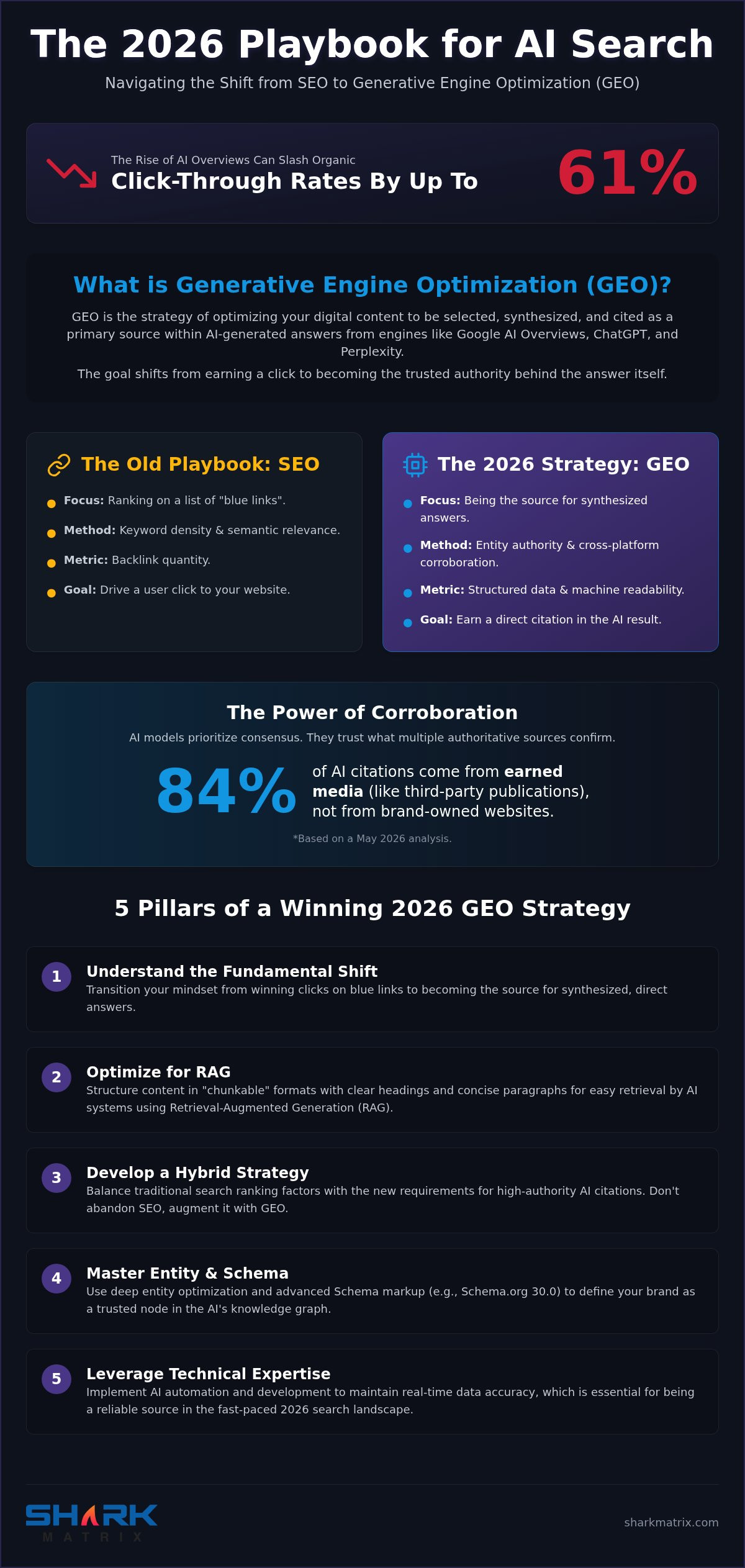
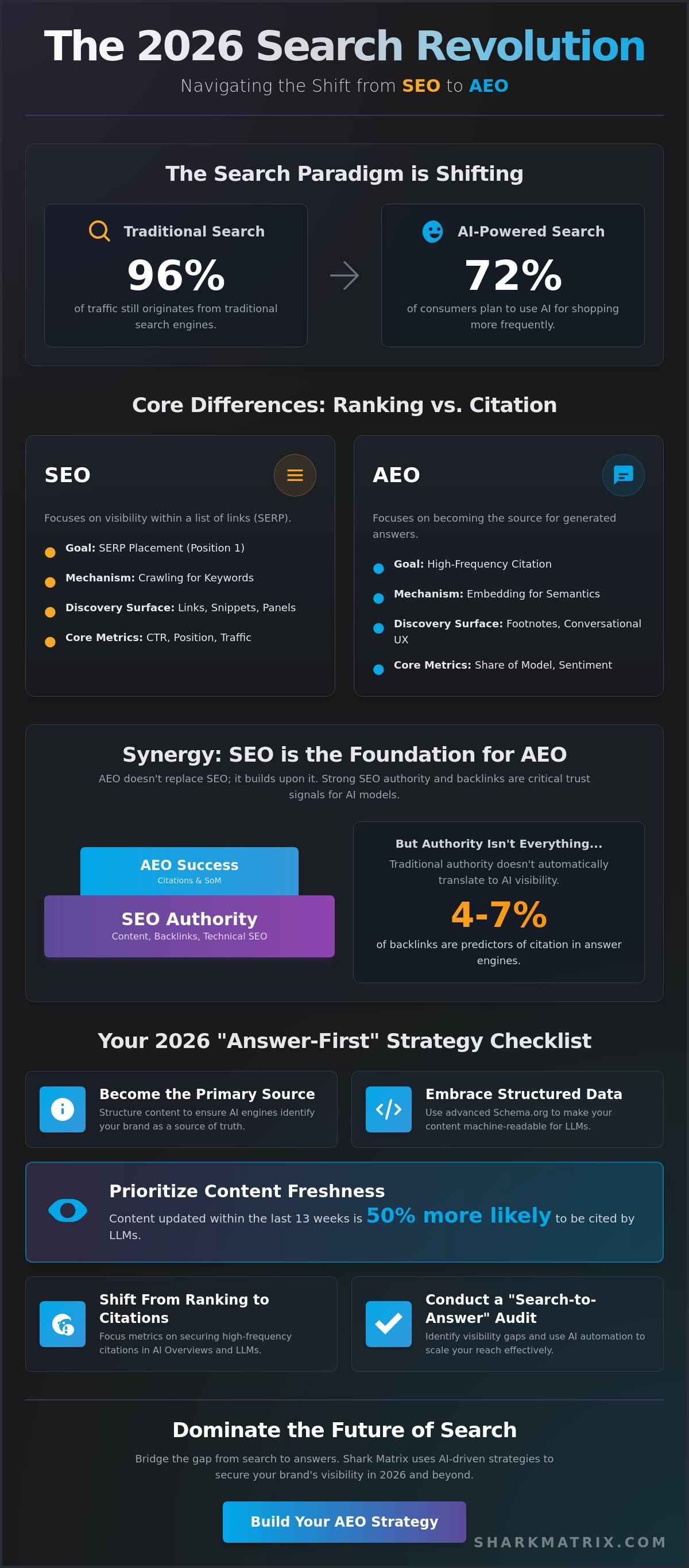
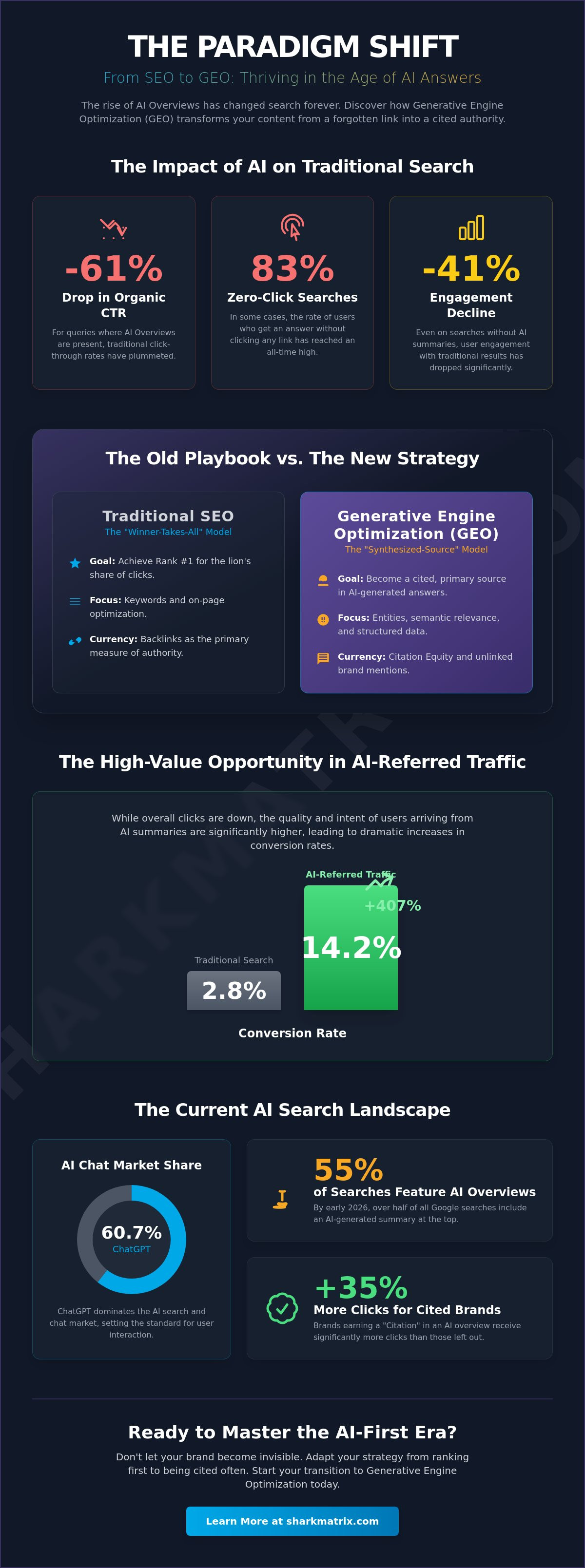
Did you know that the presence of a Google AI Overview can slash your organic click-through rate by as much as 61%? It is a startling reality for many digital marketers who find their hard-earned content buried behind automated summaries. As we look toward the future, sticking to old playbooks is no longer an option. You need a comprehensive generative engine optimization strategy 2026 to ensure your brand remains visible in a world where ChatGPT and Gemini now dominate search behavior.

It is completely understandable to feel concerned that LLMs are hiding your expertise from the very people you want to reach. You have likely noticed that traditional search traffic is harder to capture, and the way AI engines choose their sources can feel like a total mystery. This article will help you transition from traditional SEO to a high-impact strategy that secures brand citations directly within AI-driven results. We will provide a clear roadmap for 2026 visibility, covering everything from Schema.org 30.0 updates to the importance of earned media in securing those coveted AI mentions.

Key Takeaways

  • Understand the fundamental shift from traditional blue links to synthesized answers and why 2026 is the critical tipping point for your digital presence.
  • Learn how Retrieval-Augmented Generation (RAG) works so you can optimize your content for real-time AI retrieval and cross-platform corroboration.
  • Develop a high-impact generative engine optimization strategy 2026 that balances traditional search rankings with the need for high-authority AI citations.
  • Master the pillars of visibility, including deep entity optimization and advanced Schema markup that defines your brand as a trusted node in the knowledge graph.
  • Discover why technical expertise in AI automation and development is essential for maintaining real-time data accuracy in the complex 2026 search landscape.

What is Generative Engine Optimization (GEO) in 2026?

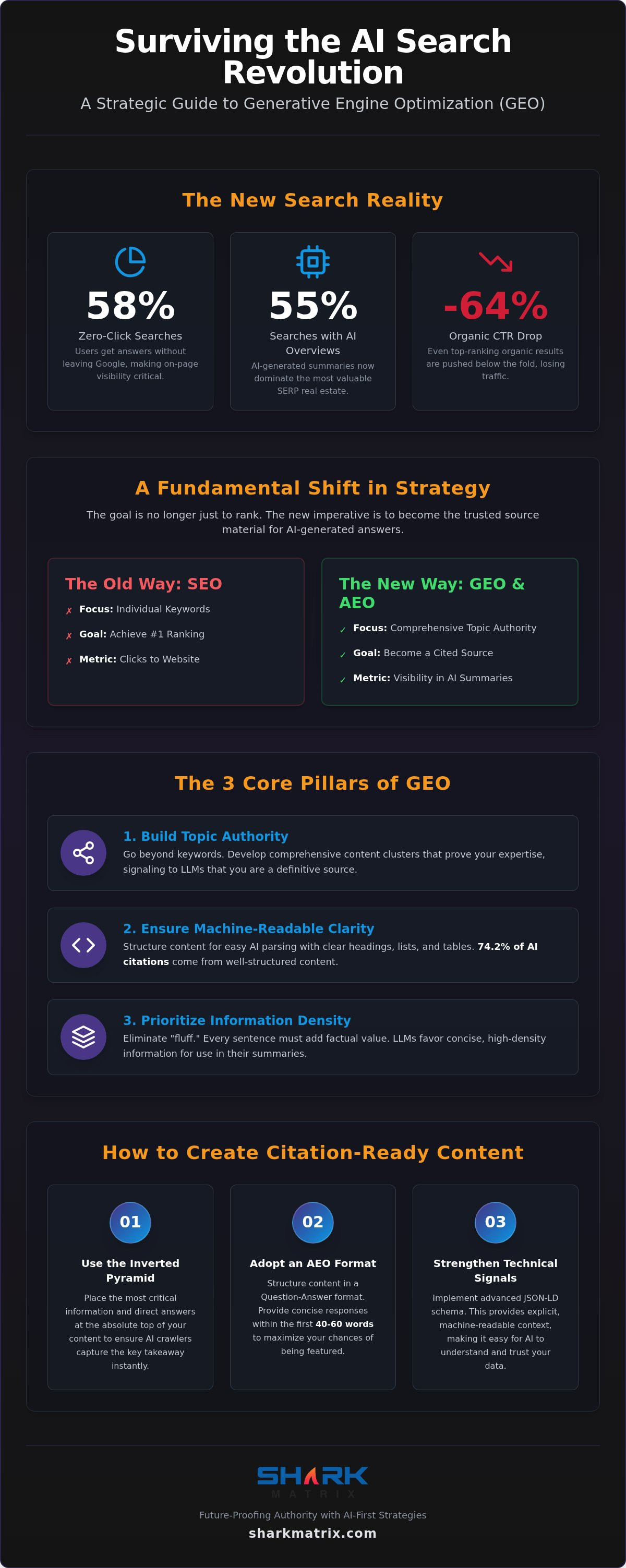
By 2026, the digital landscape has fundamentally shifted from a list of “blue links” to a stream of synthesized answers. Generative Engine Optimization, or GEO, is the strategic process of optimizing your digital assets specifically for Large Language Models (LLMs) and Answer Engines. While traditional search engines once directed users to a variety of websites, today’s AI engines aim to provide the answer directly on the results page. Developing a comprehensive generative engine optimization strategy 2026 is the only way to ensure your brand is the one being synthesized into those answers.

The primary players in this space, including Google AI Overviews, Perplexity, ChatGPT Search, and Gemini, don’t just look for keywords. They look for authoritative entities that can corroborate a claim. Traditional ranking factors like backlink quantity or keyword density are no longer sufficient. AI engines require content that is structured for machine consumption while maintaining deep human expertise. If your brand isn’t cited by these engines, you simply don’t exist for a significant portion of your audience.

The Evolution from SEO to GEO

The transition from SEO to GEO represents a move from semantic relevance to entity relationship. In the past, you might have optimized for “best coffee maker.” Today, you must define your product as a specific node within a broader knowledge graph. This shift is driven by natural language processing services that allow engines to understand the “why” behind a query. Users no longer want to find a site; they want a solution. To understand the foundational concepts, many experts look at What is Generative Engine Optimization? to see how the industry has matured from simple indexing to complex synthesis.

The Business Impact of AI Citations

AI search results are often “winner-takes-all” scenarios. If an AI engine provides a single, definitive answer and cites your brand as the source, the intent of that traffic is significantly higher than a standard organic click. These users aren’t just browsing; they are consuming a recommendation from a platform they trust. Generative Engine Optimization serves as the bridge between technical data and AI understanding, and eCommerce businesses can discover eComQB for specialized strategies to thrive in this new environment.

A May 2026 analysis found that 84% of AI citations come from earned media, such as third party publications, rather than brand owned websites. This underscores why your generative engine optimization strategy 2026 must extend beyond your own domain. By aligning your content with the way LLMs retrieve information, you position your brand to capture high-value citations that competitors using outdated methods will miss. It’s about building a digital footprint that AI engines can’t ignore.

How AI Engines Process and Cite Content

AI engines don’t simply “rank” websites in a list. They ingest, synthesize, and reason through data to build a coherent response for the user. To stay visible, your generative engine optimization strategy 2026 must focus on technical accessibility. If an LLM cannot parse your site efficiently, it will simply skip over your expertise in favor of a source that is easier to “digest.” This process is largely driven by how models distinguish between their static training data and the real-time information they pull from the live web.

A critical part of this process is corroboration. AI models are trained to prioritize consensus. If multiple authoritative platforms mention your brand in a consistent context, the AI is more likely to trust and cite you as a factual source. This is why appearing in third-party publications is so vital; a May 2026 analysis found that 84% of AI citations come from earned media rather than brand-owned sites. You aren’t just optimizing for a bot; you’re optimizing for a global network of digital trust.

Retrieval-Augmented Generation (RAG) Explained

Engines like Perplexity and ChatGPT Search rely on Retrieval-Augmented Generation (RAG) to provide up-to-date answers. Instead of relying solely on what they learned during training, they use a search index to find current facts and then use the LLM to explain them. For your content to be selected, it needs to be “chunkable.” This means using clear headings and concise paragraphs that allow the engine to pull specific “vectors” of information. Understanding GEO vs. SEO: The Hybrid Search Strategy is essential here, as it highlights how traditional indexing still supports these modern retrieval methods.

Knowledge Graphs and Entity Authority

AI engines build a “Brand Memory” by connecting dots across the internet. They look for entities, which are unique people, places, or brands, and map the relationships between them. To help these engines understand your brand’s role, you should utilize natural language processing services to structure your data correctly. This technical footprint tells the AI exactly who you are and what you are an expert in. If you’re struggling to map your existing data to these new formats, exploring specialized ai automation services can help bridge the gap between your content and AI reasoning.

Crawlability is the final piece of the puzzle. With ChatGPT dominating 76.85% of the AI search market as of April 2026, ensuring that GPTBot has access to your site via your Robots.txt file is non-negotiable. Additionally, the tone of your content matters more than ever. Models now prioritize “Expert Advice” blocks that pull from content with high sentiment and first-hand experience. Maintaining a helpful, unbiased, and authoritative tone ensures that when an engine retrieves your data, it views your brand as a safe and reliable recommendation for the end user.

Mastering Generative Engine Optimization: Your 2026 Strategy Guide

GEO vs. SEO: The Hybrid Search Strategy

Traditional SEO isn’t going away. Instead, it’s becoming the bedrock upon which AI discovery is built. You can’t have a successful generative engine optimization strategy 2026 without a robust SEO foundation. AI engines like Perplexity and Google’s AI Overviews still rely on traditional search indexes to find the information they synthesize. If your site isn’t indexed or lacks authority in the eyes of standard algorithms, it won’t make it into the retrieval pipeline. The two disciplines now exist in a symbiotic relationship where one provides the traffic and the other provides the authority.

The primary difference lies in the end goal. SEO focuses on Click-Through Rate (CTR) by making your link the most attractive option for a human user. GEO focuses on Citation Optimization, ensuring the AI model views your brand as the definitive source. Implementing a dual-purpose generative engine optimization strategy 2026 allows you to capture both traditional clicks and AI citations. As of early 2026, informational queries trigger AI Overviews about 50% of the time. This means your visibility depends on being the “expert” the AI quotes, rather than just a link in a list.

Technical SEO as the Foundation for GEO

AI crawlers require a clean technical environment to ingest data without friction. Site speed and mobile optimization remain critical benchmarks for bot efficiency. However, the real power lies in structured data. By March 2026, the latest version of Schema.org is 30.0. Using this version to mark up datasets and expert advice blocks is essential for AI engines to verify your claims. Internal linking also acts as a roadmap for LLMs. It helps models understand the hierarchy and context of your information, allowing them to “chunk” your content more effectively for real-time retrieval.

Measuring Success in the AI Era

Success in 2026 is measured by “Share of Model” (SoM). This involves tracking how frequently an AI engine cites your brand compared to your competitors for specific topics. You should also monitor the sentiment of these citations. Google’s updated AI Overviews now include specific “Expert Advice” blocks that pull directly from authoritative voices. If your brand is featured but the context is neutral or negative, your authority is at risk. Partnering with an experienced seo company dubai can help you navigate these new metrics while accounting for the specific dynamics of the Middle Eastern market and Arabic language processing.

5 Pillars of a Winning 2026 GEO Strategy

Building a successful generative engine optimization strategy 2026 requires moving from passive content creation to active technical authority. You can’t rely on keywords alone when AI models are looking for verified entities and corroborated facts. To secure your place in the synthesized answers of tomorrow, you must treat your digital presence as a structured knowledge base rather than a collection of pages.

  • Step 1: Entity Optimization. Define your brand as a unique node in the global knowledge graph. AI engines need to understand your relationship to other high-authority entities in your industry.
  • Step 2: Structured Data Supremacy. Go beyond basic tags. Use the latest Schema.org version 30.0, published on March 19, 2026, to provide deep context that AI crawlers can digest instantly.
  • Step 3: Authoritative Citations. Since 84% of AI citations come from earned media, your strategy must include high-trust third-party platforms to validate your brand’s expertise.
  • Step 4: Direct Answer Optimization. Structure your content with clear “Question-Answer” pairs. This makes it easier for RAG-based systems to extract your expertise for real-time queries.
  • Step 5: Technical AI Alignment. Integrate generative ai development to optimize how your internal data is presented to external models.

Optimizing for Specific Engines

Each engine has its own “personality” and retrieval preferences. Google AI Overviews, following the May 6, 2026 update, place a heavy emphasis on “Expert Advice” blocks and first-hand experience. You should leverage your E-E-A-T signals to win these spots. For Perplexity, focus on academic-style citations and real-time data accuracy. ChatGPT currently dominates the market with a 76.85% share as of April 2026. To win here, your content must provide conversational value and a clear brand narrative that the model can easily summarize for the user.

Content Structuring for AI Extraction

LLMs use H-tags as semantic signposts to “chunk” your information. Use an “Inverted Pyramid 2.0” approach by leading every section with a direct, concise answer before diving into the details. This increases the likelihood of your content being captured as a featured snippet or AI citation. Implementing these structures across thousands of pages is a massive task. Utilizing professional ai development services helps automate this content structuring at scale, ensuring your entire site is machine-readable without losing its human appeal. If you want to future-proof your brand authority, explore how ai automation services can transform your technical SEO into a high-impact generative engine strategy.

Implementing GEO: Why a Technical Partner is Essential

By 2026, the sheer volume of data processed by Large Language Models makes it impossible to manage a generative engine optimization strategy 2026 through manual effort alone. Traditional SEO was often a game of patience and spreadsheets, but the AI landscape moves at the speed of compute. AI search engines are dynamic; they require real-time content updates and technical precision that only specialized software and engineering can provide. This is where ai automation services become indispensable. They ensure your brand’s data remains fresh and ready for retrieval by engines that update their indexes in minutes rather than weeks.

Shark Matrix Technologies serves as the critical bridge between software engineering and digital marketing. In a world where 76.85% of AI search usage is dominated by a single platform, you can’t afford technical friction. We specialize in building the infrastructure that allows AI crawlers to “read” your brand’s authority without ambiguity. Our expertise in Middle Eastern market dynamics and Arabic digital marketing adds another layer of complexity that generalist agencies often miss. We don’t just optimize for a bot; we build a technical ecosystem where your brand is the most logical answer for any engine to cite.

Custom AI Development for Search Dominance

Winning in the AI era requires more than just following best practices; it requires building your own tools. Advanced machine learning development services allow businesses to predict which content pieces are most likely to be cited based on current LLM behavior. Instead of guessing, you can use custom models to audit your site’s “chunkability” and entity authority. This technical approach extends to automating the deployment of Schema.org 30.0 across thousands of pages instantly, ensuring no manual errors slow down your visibility. By integrating ai chatbot-development services, you can also capture zero-click search intent directly on your own platform, keeping users engaged with your brand rather than a third-party engine.

Future-Proofing Your National Brand

For national-scale brands, the stakes are incredibly high. A drop in organic visibility due to AI Overviews can cripple revenue if you aren’t prepared to pivot. Shark Matrix is the preferred partner for national-scale execution because we treat your generative engine optimization strategy 2026 as a long-term technical roadmap. We focus on building a “Brand Memory” that persists across different models and updates. If you’re ready to secure your brand’s future and ensure your expertise isn’t hidden behind a wall of generated text, contact Shark Matrix for a 2026 GEO Audit today. Our team will help you transition from traditional search to AI-driven authority with a clear, data-backed plan.

Secure Your Brand’s Authority in the AI Era

The search landscape of 2026 demands more than just traditional keyword optimization. It requires a deep understanding of how Large Language Models retrieve and synthesize information. By prioritizing entity authority and technical accessibility, you can ensure your brand isn’t just indexed but cited as a primary source. Success now hinges on balancing human-centric expertise with machine-readable data structures that AI engines trust. You don’t have to navigate this transition alone.

Implementing a high-impact generative engine optimization strategy 2026 is a technical challenge that goes beyond standard marketing. Shark Matrix has been a leader in digital strategy since 2010, bringing deep roots in software engineering to the world of search. As specialists in AI and machine learning development, we provide the comprehensive national SEO and digital strategy needed for large-scale visibility. It’s time to bridge the gap between your content and the engines that define your brand’s reputation.

Partner with Shark Matrix for a Technical GEO Strategy and secure your place in the next generation of search. The future is automated, and your brand is ready to lead it.

Frequently Asked Questions

What is the main difference between SEO and GEO?

SEO focuses on ranking your website in traditional search results to drive direct clicks from human users. In contrast, GEO aims to have your brand cited and recommended within the synthesized answers generated by AI models. While SEO optimizes for users browsing blue links, GEO optimizes for LLMs that ingest and summarize your data into conversational responses.

How do I get my website cited by ChatGPT or Google AI Overviews?

Getting cited requires a strong presence on third-party authoritative platforms because AI models prioritize corroborated facts. A May 2026 analysis found that 84% of AI citations come from earned media rather than brand-owned sites. You must also ensure your site is technically accessible to crawlers like GPTBot and structured in a way that AI can easily “chunk” and retrieve your information.

Does traditional SEO still matter in 2026?

Traditional SEO is more important than ever because it provides the indexable data that AI engines rely on for real-time retrieval. A successful generative engine optimization strategy 2026 uses technical SEO as a foundation. Without high site speed, mobile optimization, and proper indexing, your content won’t even reach the stage where an AI can consider it for a citation.

How can AI development services improve my search visibility?

Custom ai development services allow you to build proprietary tools that audit your content’s entity authority and “chunkability.” These services can automate the implementation of advanced Schema markup and use machine learning to predict which content structures will perform best in AI search results. This technical edge is essential for managing large-scale digital footprints that manual SEO can’t handle effectively.

What are the best metrics to track for Generative Engine Optimization?

You should track Share of Model (SoM) to see how often you are cited compared to your direct competitors. Additionally, monitoring the sentiment of AI-generated answers and the frequency of “Expert Advice” block appearances provides a clearer picture of your digital authority. Traditional metrics like organic traffic are still useful, but they no longer tell the full story of your brand’s reach in an AI-dominated market.

How does structured data help with AI search engines?

Structured data provides the explicit context that AI engines need to verify facts and understand entity relationships. By implementing the latest Schema.org 30.0 markup, you reduce the chance of AI engines misinterpreting your data or “hallucinating” details about your brand. This technical clarity makes your website a much safer and more attractive source for an LLM to cite in its synthesized answers.

Can I use AI to optimize my content for GEO?

Yes, you can use generative tools to identify semantic gaps and reformat your content for better machine extraction. AI is particularly helpful for creating concise “Question-Answer” pairs and ensuring your headers act as clear signposts for retrieval bots. Using AI to optimize for AI creates a feedback loop that aligns your content with the specific way modern models process and summarize human language.

What is Share of Model (SoM) and why is it important?

Share of Model measures the percentage of times an AI engine mentions or recommends your brand for a specific category of queries. It’s the 2026 equivalent of “share of voice” in traditional media. A high SoM indicates that the AI’s training and retrieval data consistently point to your brand as a trusted authority, which is vital for maintaining visibility when AI Overviews appear in 50% of informational searches.

Categories
Digital Marketing

2026 Guide: Optimizing Websites for AI Overviews

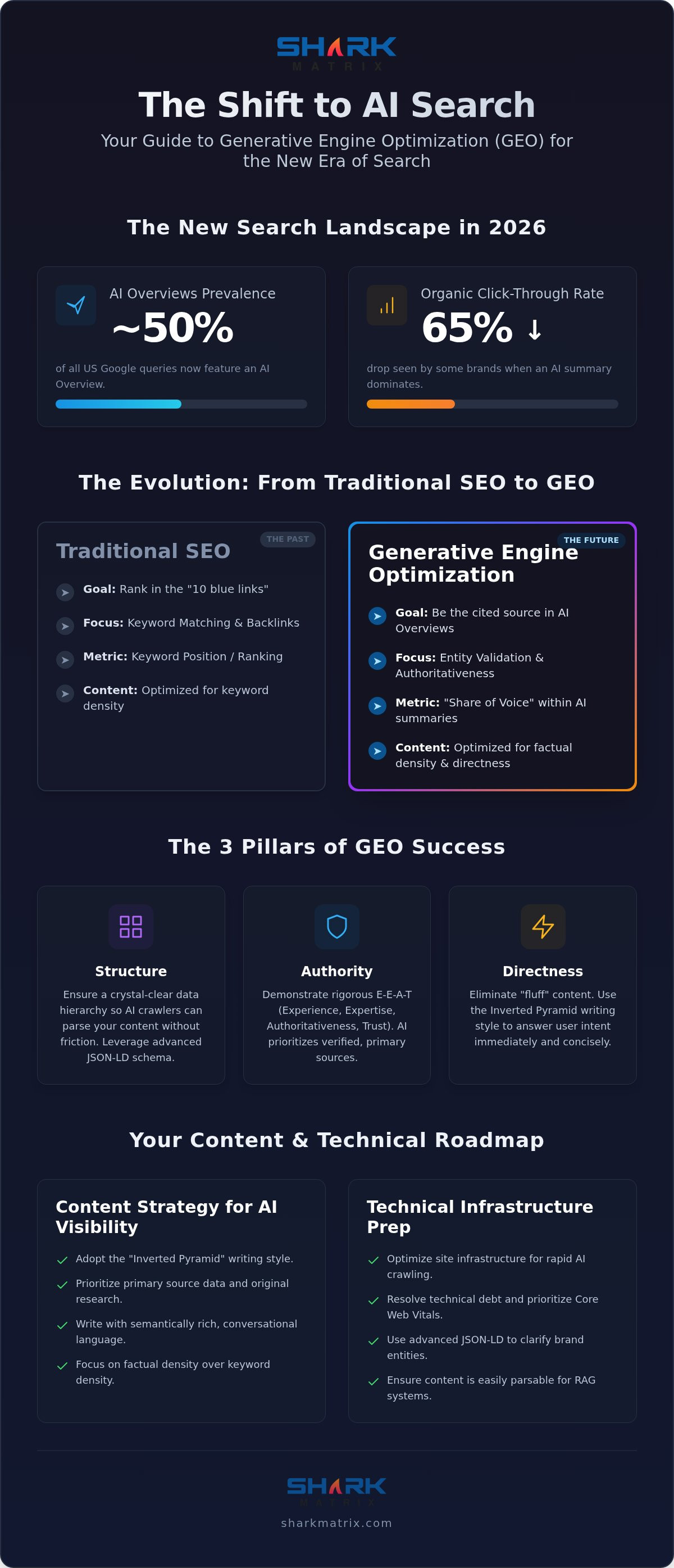
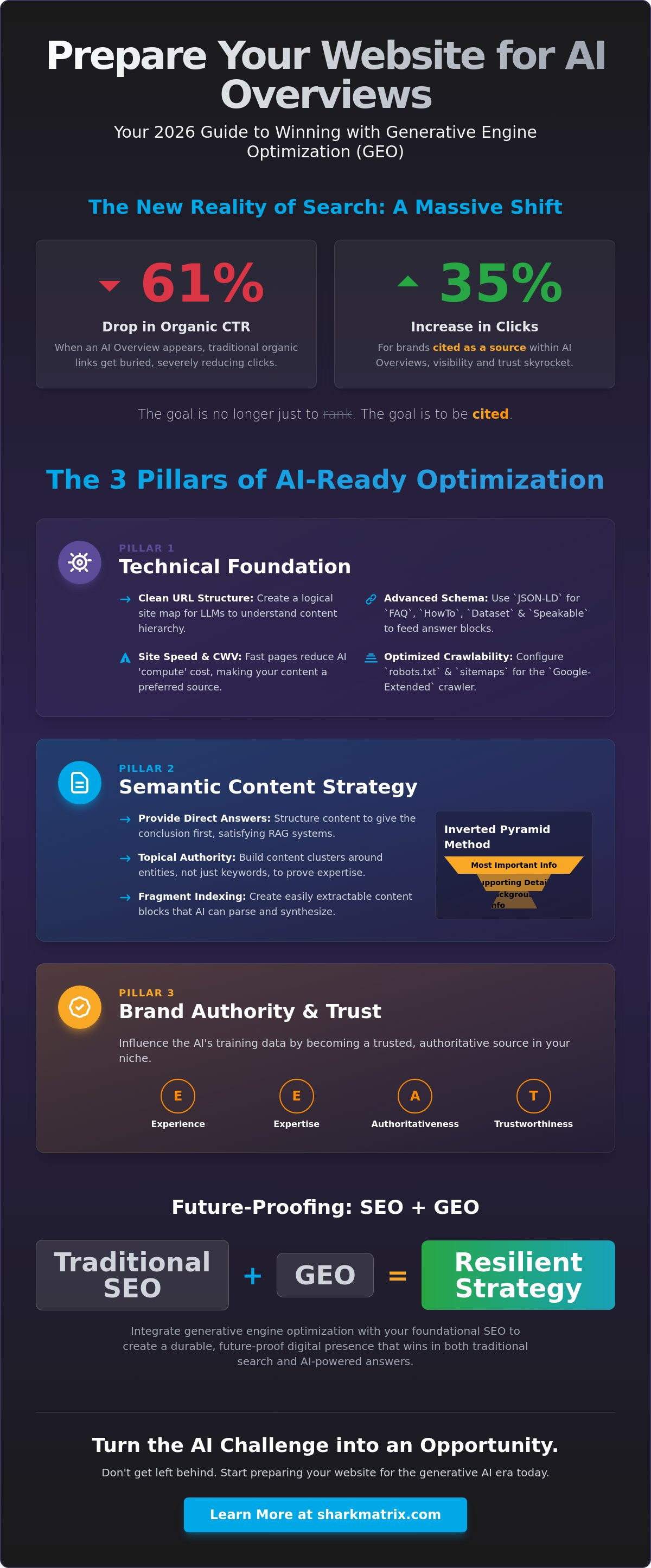
Did you know that as of early 2026, AI Overviews now appear in nearly 50% of all US Google queries? For many brands, this shift has triggered a sharp decline in organic click-through rates, with some studies showing a 65% drop when an AI summary dominates the screen. You’re likely feeling the pressure of this transition as traditional search evolves into a generative experience. Successfully preparing website for ai overviews is no longer optional; it’s a critical technical requirement to ensure your brand remains visible.

We understand the confusion surrounding the leap from SEO to Generative Engine Optimization (GEO). This guide provides a technical roadmap to secure your brand’s place in Google AI Overviews and master the shift from keyword matching to authoritative entity validation. We’ll examine how to resolve technical debt, leverage structured data, and align your content with the latest E-E-A-T standards to turn AI summaries into your primary traffic driver.

Key Takeaways

  • Understand the shift from traditional search rankings to “share of voice” metrics within the mature 2026 AI Overview ecosystem.
  • Learn the technical essentials for preparing website for ai overviews, including advanced JSON-LD schema markup to clarify your brand’s entities.
  • Adopt the “Inverted Pyramid” writing style and prioritize primary source data to ensure your content is selected by AI synthesizers.
  • Optimize your site infrastructure for rapid AI crawling by addressing technical debt and prioritizing Core Web Vitals.
  • Discover how bridging the gap between digital marketing and generative AI development helps future-proof your brand against further search engine changes.

The Evolution of Search: Why AI Overviews Dominate in 2026

In 2026, the search bar has moved past the era of the “ten blue links.” Most users now interact with AI Overviews (AIO) as their primary interface for complex queries. The Evolution of Search has transformed the result page from a directory into a conversational engine. While the Search Generative Experience (SGE) was once an experimental feature, it’s now a mature ecosystem handling 48-50% of US Google queries as of early 2026. This shift has fundamentally changed user behavior. Instead of clicking through to multiple sites, users get synthesized answers immediately. This shift has led to a significant 65% drop in organic click-through rates for some queries. In this new environment, securing a citation within the AI summary is the new “Rank 1.”

How Google Selects Sources for AI Summaries

Google uses a process called Retrieval-Augmented Generation (RAG) to build these summaries. It doesn’t just guess; it retrieves specific data from the web and synthesizes it using advanced models like Gemini 3.6 Flash. Factual density and source reliability are the primary filters for selection. For “Your Money or Your Life” (YMYL) topics, such as healthcare where AIO prevalence hits 88%, Google prioritizes high-authority national sites. If you’re preparing website for ai overviews, you must focus on being a “Primary Source” that provides original research or proprietary data that the RAG process can’t find elsewhere.

The Shift from Keywords to Entities

Success in 2026 requires moving beyond simple keyword matching. Google now organizes information through the Knowledge Graph. The Knowledge Graph is the database of real-world objects and their relationships. Being a recognized “entity” in this graph is more valuable than ranking for a high-volume keyword. When Google’s natural language processing systems identify your brand as an authority on a specific topic, you’re more likely to be cited. Preparing website for ai overviews involves clarifying these entity relationships through technical infrastructure. This ensures the AI models understand exactly who you are and what expertise you provide, making your content the logical choice for a synthesized response.

Mastering Generative Engine Optimization (GEO) vs. Traditional SEO

In 2026, digital marketing has split into two parallel tracks: traditional SEO and Generative Engine Optimization (GEO). While SEO still handles the foundational aspects of site health and blue-link rankings, GEO is the specific discipline of optimizing for Large Language Models (LLMs) and AI synthesizers. When you are preparing website for ai overviews, you aren’t just trying to “rank” in the old sense. You are trying to become the definitive source the AI uses to build its summary. This shift has changed how we measure success. Traditional metrics like “position” are becoming less relevant as AI Overviews occupy the most valuable real estate on the screen. Instead, brands now track “share of voice” within these AI responses.

Conversational language is the new standard for content. Search prompts are getting longer and more complex, with 60% of question-style queries now triggering an AI summary. This makes Answer Engine Optimization (AEO) a critical subset of your strategy. You need to provide direct, concise answers to the specific questions your audience is asking. If you want to see how this works in practice, this AI Overviews optimization guide offers a deeper look at these new ranking factors.

The GEO Framework: Structure, Authority, and Directness

Success in GEO relies on three pillars. First, structure. Your data hierarchy must be crystal clear so AI crawlers can parse it without friction. Second, authority. The 2026 version of E-E-A-T is more rigorous than ever. Google’s systems look for verified experience and expertise before citing a source in an AIO. Finally, directness. “Fluff” content is the biggest enemy of AI citations. If your content takes too long to get to the point, the AI will simply skip it in favor of a more direct source that answers the user’s intent immediately.

Adapting Content for LLM Consumption

LLMs read content differently than traditional crawlers. They don’t just look for keyword matches; they use natural language processing to understand the underlying intent and semantic relevance of your writing. This means keyword density is officially a relic of the past. To win, your content must be semantically rich and contextually accurate. Preparing website for ai overviews requires a technical partner who understands these AI models from the inside out. If you’re struggling to adapt, exploring professional SEO services can help align your technical infrastructure with these new requirements.

2026 Guide: Optimizing Websites for AI Overviews

The Content Strategy for AI Visibility: Quality Over Quantity

Successfully preparing website for ai overviews requires a departure from the high-volume content mills of the past. In 2026, AI synthesizers don’t need thousands of words of filler to understand a topic. They need “Primary Source” content. This includes original research, proprietary case studies, and unique data sets that your brand owns. When Google’s Retrieval-Augmented Generation (RAG) systems scan the web, they prioritize information that isn’t already duplicated across a thousand other sites. If you’re providing fresh, verified data, you’re much more likely to earn that coveted citation in an AI summary.

Your writing style must also adapt to the “Inverted Pyramid” format. Traditional SEO often buried the answer at the bottom of a page to increase dwell time. In the age of AI Overviews, this strategy fails. You must provide the answer first and the context later. AI models are programmed to find the most efficient response for the user. If your introductory paragraph doesn’t directly address the search intent, the model will likely pass you over for a competitor who gets straight to the point.

Focus on creating “Un-AI-able” content. These are human insights, nuanced perspectives, and first-hand experiences that a large language model cannot simply hallucinate or replicate. By emphasizing the “Experience” part of E-E-A-T, you provide a level of depth that adds value beyond a basic factual summary. This human element is what keeps users clicking through to your site even after they’ve read the AI’s brief overview.

Structuring Articles for Answer Extraction

To help AI models parse your site efficiently, treat your H2 and H3 tags as “query-answer” pairs. Each heading should represent a specific question, followed immediately by a fact-dense paragraph that provides a clear solution. This structure makes it easy for crawlers to identify exactly which part of your page solves the user’s problem. Bulleted lists act as “hooks” for AI summary generators by providing clearly delineated data points that the model can easily extract and present to the user. When you’re preparing website for ai overviews, these structural cues are just as important as the words themselves.

Building Brand Authority Through Digital PR

AI models don’t just look at your website; they look at what the rest of the internet says about you. External citations in national news outlets and high-authority industry platforms act as a validation layer for Google’s AI. There’s a direct connection between online reputation management and your performance in AIO. If your brand is mentioned frequently across multiple trusted platforms, the AI is more likely to view your site as a safe, authoritative source to cite. This multi-platform trust is the backbone of search visibility in 2026.

Technical Roadmap: Preparing Your Website Infrastructure

A high-performance technical foundation acts as the bridge between your content and the AI models that synthesize it. When you’re preparing website for ai overviews, the goal is to eliminate any friction that prevents AI agents from parsing your data. This roadmap focuses on five critical steps to modernize your infrastructure for the 2026 search environment.

  • Step 1: Implementing Advanced Schema Markup. Use JSON-LD to provide explicit entity clarification, helping Google’s Knowledge Graph connect your brand to specific topics.
  • Step 2: Optimizing Site Speed. AI models like Gemini 3.6 Flash require rapid access to content. High Core Web Vitals scores ensure that retrieval processes don’t time out during the synthesis phase.
  • Step 3: AI-Friendly Sitemaps. Create a specialized sitemap that highlights your highest-value informational pages, making it easier for AI-specific crawlers to find your primary research.
  • Step 4: Automated Auditing. Utilize ai automation services to audit and tag your content library at scale. This ensures every page has the correct semantic metadata without manual bottlenecking.
  • Step 5: Mobile-First Excellence. Since most conversational search interactions happen on mobile devices, your site must provide a seamless experience for mobile-based AI agents.

Advanced Schema for 2026: Beyond the Basics

Schema markup has evolved into a sophisticated tool for voice and AI compatibility. Implementing Speakable Schema and FAQ Schema helps AI engines identify parts of your text that are suitable for verbal or summarized responses. You should also use “SameAs” properties to link your brand’s digital identity to established nodes in the Knowledge Graph. For businesses in the commercial space, Product and Review schema are essential. These tags help secure commercial AIO placements by providing structured data on pricing, availability, and user sentiment that AI models can verify and trust.

API-First Content and Technical Accessibility

The way you deliver data is just as important as the data itself. Headless CMS architectures are increasingly effective because they provide an API-first approach to content delivery. This allows search engines to pull raw data without wading through heavy front-end code. You must also update your robots.txt file to ensure it allows access for both standard Googlebot and newer AI-specific agents. Investing in generative ai development can help you build custom site tools, like interactive calculators or data synthesizers, that AI engines love to cite as authoritative sources.

If technical debt is holding back your AI visibility, you need a partner that understands the engineering behind the search engine. Explore our ai development services to modernize your infrastructure for the generative era.

Future-Proofing Your Brand with Shark Matrix Technologies LLC

Partnering with an AI-native agency is essential for maintaining search visibility in 2026. Traditional marketing firms often struggle with the technical complexities of software engineering and digital visibility. Shark Matrix Technologies LLC bridges this gap by combining specialized SEO services with deep AI engineering expertise. This dual approach is necessary because modern search engines are complex generative platforms rather than simple directories. Our national approach ensures your brand remains dominant as the search landscape shifts toward AI-driven results. We focus on the underlying mechanics of the models to ensure your site is built for the way systems like Gemini 3.6 Flash process and retrieve information.

Ongoing monitoring is the cornerstone of our strategy. AI algorithms change at a significantly faster pace than traditional search ranking factors. A strategy that earns a citation today might need adjustment tomorrow as Google updates its structural layouts or source selection logic. By maintaining a constant pulse on these shifts, Shark Matrix Technologies LLC helps you maintain brand authority in a landscape where traditional rankings have been replaced by generative dominance.

Data-Driven GEO Strategies

We move beyond guesswork by using proprietary tools to track your brand’s “AI Share of Voice” across diverse query types. This data allows for the continuous optimization of your content based on real-time AI citation patterns. To maximize the value of the traffic you receive, Shark Matrix Technologies LLC integrates ai chatbot development to engage users the moment they land on your site. This ensures that high-intent visitors driven by AI citations find the answers they need immediately, reducing bounce rates and improving conversion through personalized interactions.

Start Your AI Search Transformation

The first step in preparing website for ai overviews is a comprehensive AI-readiness audit. We analyze your technical debt, entity clarity, and factual density to identify exactly what’s preventing your content from being synthesized into AIO results. Transitioning to an AI-first digital presence requires a structural shift in how your website communicates with search agents. Preparing website for ai overviews today is the only way to safeguard your traffic against the rise of zero-click searches. Reach out to Shark Matrix Technologies LLC for a national consultation on search dominance and secure your brand’s place at the top of the generative era.

Lead the Generative Search Revolution

The transition to a generative search environment isn’t a temporary trend; it’s the new standard for digital visibility. Success now depends on moving beyond surface-level keyword matching to focus on deep technical infrastructure and verified entity authority. By prioritizing original research and structured JSON-LD data, you ensure that AI models recognize your site as a trusted source. Successfully preparing website for ai overviews is the most effective way to turn the rise of zero-click searches into a long-term advantage for your brand.

Shark Matrix Technologies LLC acts as your technical partner in this new era. As national brand growth specialists, we provide the specialized engineering required to integrate AI and SEO seamlessly. Our expertise in Generative Engine Optimization (GEO) ensures your brand isn’t just visible but dominant in the summaries your customers read every day. Secure your brand’s future in AI search with Shark Matrix Technologies LLC and lead the shift toward a more intelligent search presence. The future of search has arrived, and it’s time to claim your place at the top.

Frequently Asked Questions

What is the main difference between SEO and GEO in 2026?

Traditional SEO focuses on ranking factors for standard blue links, while Generative Engine Optimization (GEO) optimizes for Large Language Model synthesis. SEO aims for a specific position on the page. In contrast, GEO aims for “share of voice” within a generated summary. It’s a fundamental shift from being a suggested link to being the actual source of the answer.

Will AI Overviews reduce my website traffic?

AI Overviews often reduce total organic clicks for simple informational queries that result in zero-click searches. However, being cited in an AIO frequently drives higher-intent traffic to your site. Users who click a citation link are usually further along in their journey. This makes preparing website for ai overviews essential for maintaining high-quality lead generation.

How long does it take to see results from AI Overview optimization?

You can often see changes in AI citations within a few weeks of implementing technical updates. Google’s AI agents re-evaluate entity relationships much faster than traditional ranking systems. If you update your schema and content structure correctly, your brand can appear in new summaries as soon as the next crawl cycle finishes.

Do I need to change my existing content to rank in AI Overviews?

Most existing content requires restructuring to follow an “answer-first” format. You should prioritize direct, factual answers at the beginning of your sections and remove unnecessary filler. AI models prioritize factual density and concise delivery. If your current articles are too long or vague, they’re less likely to be selected as a primary source for a summary.

Is structured data more important for AI than it was for traditional search?

Structured data is now the primary tool for providing explicit entity clarification to AI models. In traditional search, schema was largely used for rich snippets. In 2026, JSON-LD acts as the blueprint that tells Large Language Models exactly how your data relates to the Knowledge Graph. Without it, the AI might misinterpret your expertise or ignore your site.

Can I opt out of my website being used in Google AI Overviews?

There’s currently no way to opt out of AI Overviews without also removing your pages from Google Search results entirely. Using `noindex` tags will stop the AI from citing you, but it also hides your site from traditional rankings. Google treats indexing and AI synthesis as a package deal. Most brands find it more effective to optimize for the citation instead.

How does Google verify the facts in its AI-generated summaries?

Google’s systems use Retrieval-Augmented Generation (RAG) to cross-reference your content against other high-authority data points. The model prioritizes information that is consistent across multiple trusted platforms. This is why building digital PR and external citations is critical. If your facts are corroborated by national news or industry journals, the AI views your content as more reliable.

What role does mobile optimization play in AI search results?

Mobile optimization is critical because most conversational AI searches happen on mobile devices. Since over 60% of question-style queries occur on mobile, your site must load instantly for mobile-based AI agents. Preparing website for ai overviews requires a mobile-first approach to ensure that technical data delivery is never interrupted by slow speeds or poor responsive design.

Categories
SEO

AI SEO Strategy for UAE Businesses: The 2026 Guide to Dominating Generative Search

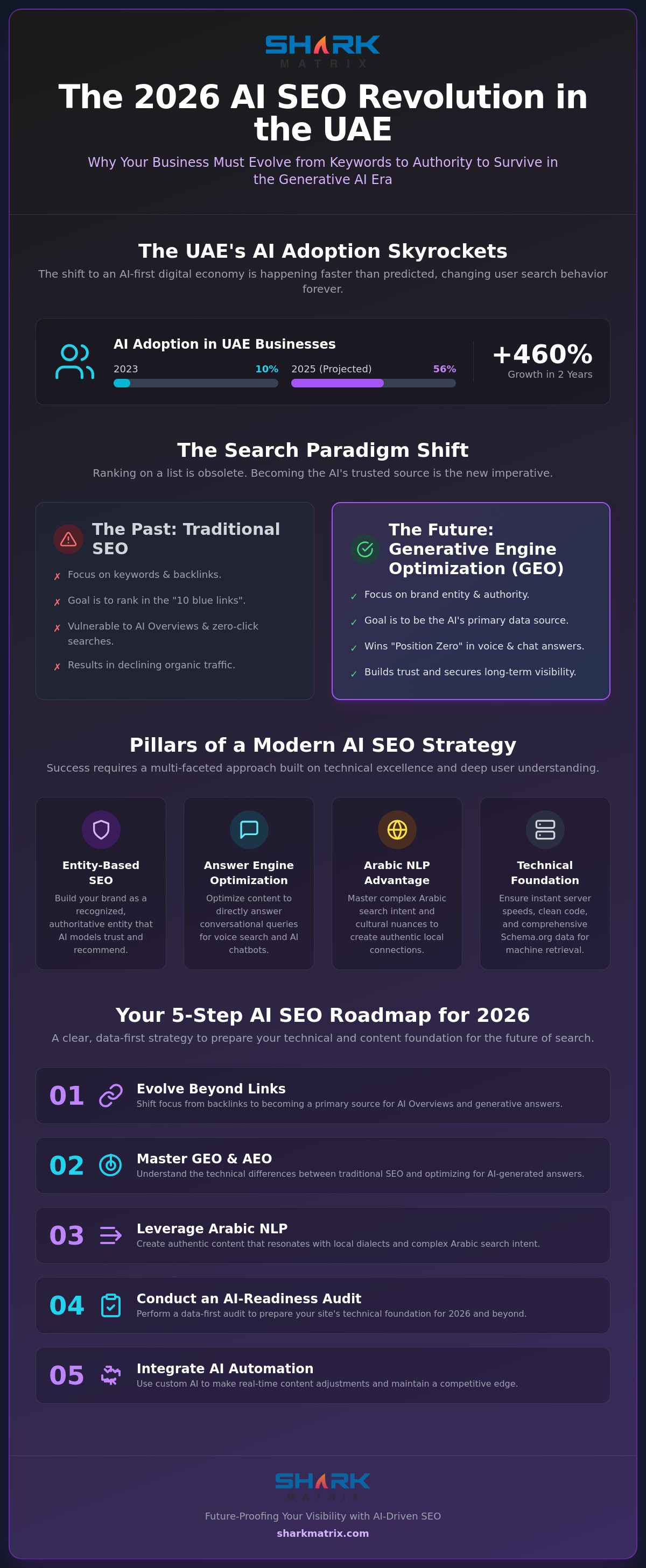
Did you know that AI adoption in the UAE skyrocketed from just 10% in 2023 to a massive 56% by 2025? As the National Artificial Intelligence System takes its seat as an advisory member of the UAE Cabinet this year, the competition to build a dominant ai seo strategy for uae businesses has reached a critical tipping point. Traditional search rankings are no longer enough when Google’s AI Overviews and SearchGPT provide the answers before a user even has a chance to click a link.

You’ve likely noticed your organic traffic dipping as generative engines take over the search results page. It’s frustrating to manage complex Arabic and English queries while technical shifts like GEO and AEO keep moving the goalposts. This guide will show you exactly how to pivot from outdated keyword tactics to brand entity recognition. We’ll explore a clear roadmap for 2026 that masters Generative Engine Optimization, ensuring your brand isn’t just listed, but is the specific source AI recommends to your customers across the Emirates.

Key Takeaways

  • Understand why moving beyond traditional links is essential as AI Overviews redefine how users in the Emirates discover and interact with brands.
  • Learn the technical differences between traditional SEO and Generative Engine Optimization (GEO) to ensure your content is the primary source for AI-generated answers.
  • Discover the importance of Natural Language Processing (NLP) for mastering complex Arabic search intent and creating authentic local connections.
  • Implement a data-first ai seo strategy for uae businesses by conducting an AI-readiness audit that prepares your technical foundation for 2026.
  • See how custom AI automation and SEO integration can help your business make real-time content adjustments to maintain a competitive edge.

The Evolution of Search: Why UAE Businesses Need an AI SEO Strategy in 2026

The search landscape has fundamentally shifted. An ai seo strategy for uae businesses isn’t just about chasing keywords anymore; it’s the strategic integration of machine learning and generative models to ensure your brand remains visible where users are actually looking. As of early 2026, the UAE has moved beyond the traditional list of “Ten Blue Links.” With the National Artificial Intelligence System now an advisory member of the UAE Cabinet, the push for digital efficiency and AI integration is at an all-time high across all federal entities.

This transformation is a direct result of the UAE Vision 2031, which positions the nation as a global hub for the new digital economy. Because the Emirates has one of the highest mobile penetration rates in the world, users have pivoted rapidly toward voice and AI-driven search. They expect immediate, conversational answers on their devices. They don’t want to browse through pages of advertisements and fragmented links. They want the answer, and they want it now.

From Keywords to Entities: The New Search Paradigm

In 2026, search engines don’t just see strings of text; they understand “entities,” which include brands, people, and specific locations. This shift means that Search Engine Optimization (SEO) has evolved to prioritize brand authority above all else. If an AI model doesn’t recognize your business as a trusted authority in its niche, it simply won’t recommend you. Entity-Based SEO is the practice of structuring your digital data so that AI models can clearly identify, categorize, and verify your brand’s unique identity and expertise.

The Impact of AI on User Behavior in the Emirates

The way people in Dubai, Abu Dhabi, and the Northern Emirates search has become inherently conversational. We’ve seen a massive rise in long-tail, natural language queries where users ask their phones complex questions. This has led to an increase in zero-click searches, where the AI provides the full answer directly on the result page. To maintain a competitive edge, businesses must pivot their focus toward appearing in the citations and sources that these AI agents use to build their answers. If your content isn’t the data source for the AI, your organic traffic will continue to decline.

Mastering Generative Engine Optimization (GEO) and AEO

Traditional SEO focused on ranking a website in a simple list of results. In 2026, Generative Engine Optimization (GEO) is about becoming the primary data source for AI models. As the region embraces AI-Driven Marketing in the UAE, businesses must adapt to how Large Language Models (LLMs) like GPT-4 and Gemini ingest information. A successful ai seo strategy for uae businesses ensures your site isn’t just indexed, but is understood as a reliable authority by these complex systems. This requires a shift from simple keyword targeting to technical excellence and brand visibility across the entire AI ecosystem.

Answer Engine Optimization (AEO) goes a step further by targeting the direct answers provided in conversational search. Whether it’s a voice query on a smartphone or a detailed prompt in an AI chat, AEO is what helps you win the new “Position Zero.” It demands a technical foundation that prioritizes clarity, speed, and directness. In the UAE’s fast-paced market, being the first answer provided by an AI agent can be the difference between a conversion and being ignored by your target audience.

The technical requirements for GEO are more demanding than old-school search. Speed is no longer just for user experience; it’s for machine retrieval. Generative engines favor sites that provide clear digital proof and rapid accessibility. Key technical factors include:

  • Instant server response times for rapid AI data retrieval and processing.
  • Comprehensive structured data using the latest Schema.org protocols for context.
  • Authoritative citations from UAE government portals or national news outlets.

These elements tell the AI that your business is a legitimate entity within the local regulatory framework. If an AI engine can’t verify your data instantly, it will move to a competitor’s source.

Optimizing for Large Language Models (LLMs)

LLMs analyze the relationships between data points, making data cleanliness a top priority. Clean code ensures AI bots parse your core message without distraction. Use Schema.org markup to provide a clear map of your business entity and services. This structured data gives generative engines the context they need to categorize your brand correctly. Aim for mentions in high-authority third-party datasets to build trust with AI models during their training phases.

Winning the Answer Box: AEO Best Practices

Structure your content around specific user questions using clear headings and concise answers. This mirrors the natural language intent of modern searchers in the Emirates. AI engines prioritize E-E-A-T, so verify your facts and demonstrate deep industry expertise. For a broader perspective on these shifts, read our Comprehensive Search Engine Optimization (SEO) Services: The 2026 Business Guide. Our specialized answer engine optimization services can help secure your spot in these vital conversational results.

AI SEO Strategy for UAE Businesses: The 2026 Guide to Dominating Generative Search

The Arabic NLP Advantage: Localizing AI SEO for the UAE

While many brands focus on English content, a truly effective ai seo strategy for uae businesses recognizes that Arabic is the heart of the national digital identity. Simple machine translation is no longer sufficient in 2026. Generative engines now use Natural Language Processing (NLP) to evaluate the cultural context and linguistic nuances of content before recommending it to users. If your content feels like a generic translation, AI models will likely flag it as low quality and pass over it in favor of more authentic, localized sources.

The UAE is a unique linguistic environment. Users often switch between Modern Standard Arabic, local Khaleeji dialects, and “Arabizi,” where Arabic words are written using Latin characters and numbers. If your technical SEO doesn’t account for these variations, AI agents will struggle to match your content with user intent. Successful optimization requires training your site’s data to be recognizable across these diverse linguistic patterns, ensuring the AI understands exactly what you offer regardless of the script used.

Technical SEO for Right-to-Left (RTL) languages is equally vital in an AI-first environment. AI crawlers require clean, semantically correct HTML to interpret Arabic text flow without errors. Ensuring your site’s code supports RTL standards allows AI models to parse and index your data with the same precision they apply to English sites. This technical clarity prevents the AI from misinterpreting your brand’s message during the indexing process.

Bilingual Brand Authority

Maintaining a consistent brand entity across both languages is a prerequisite for ranking in 2026. Generative engines look for localized citations from trusted national media outlets and government portals to verify your brand’s authority. Arabic NLP models prioritize semantic context over direct keyword matches to decipher the underlying intent of complex linguistic structures. By securing mentions in high-authority Arabic publications, you signal to the AI that your business is a legitimate and trusted leader within the local market.

Arabic Voice Search Optimization

The prevalence of voice notes and voice-driven commands in the Emirates has changed how we optimize for search. People don’t type keywords; they speak naturally and conversationally. Optimizing for the phonetics of Arabic queries in AI assistants ensures your brand is the one retrieved during a hands-free search. This is especially important for SEO for Brand Reputation Management Dubai: The 2026 National Brand Protection Guide, as voice search results often prioritize brand sentiment and local reviews. Aligning your content with the way people actually speak ensures you capture this high-intent traffic.

Building Your 2026 AI SEO Roadmap: A 5-Step Strategy

Transitioning to a data-first mindset is the first requirement for any successful ai seo strategy for uae businesses. In 2026, content is no longer just for human readers; it’s fuel for generative models. Business leaders in the Emirates are already ahead of the curve, with 93% expecting a measurable ROI from AI within two years. To capture this growth, your roadmap must move from static optimization to a dynamic, entity-focused approach that prioritizes how AI agents perceive your brand across the digital ecosystem.

  • Step 1: Conduct an AI-Readiness Audit. Evaluate your technical infrastructure and content library. Identify gaps where your information is too thin or unstructured for AI models to extract meaningful facts about your services.
  • Step 2: Implement Advanced Schema and Structured Data. Use nested JSON-LD to define the specific relationships between your products, regional locations, and key personnel.
  • Step 3: Develop a Conversational Content Strategy. Focus on Answer Engine Optimization (AEO) by answering the specific, complex questions your customers ask via voice notes or AI chat interfaces.
  • Step 4: Build Digital PR and Credible Mentions. Focus on Generative Engine Optimization (GEO) by earning mentions in high-authority UAE datasets, national news portals, and industry-specific directories.
  • Step 5: Continuous Monitoring. Track your “Share of Model.” This metric measures how often AI agents cite your brand as a primary source compared to your direct competitors.

Phase 1: Technical Foundation and Schema

Your technical setup must move beyond basic meta tags. In 2026, AI crawlers prioritize efficiency and semantic clarity. By using semantic HTML and advanced JSON-LD, you provide a clear, machine-readable map of your business entity. This level of technical precision is a core part of The 2026 Guide to Website Design and Development Services for UAE Enterprises. A fast, well-structured site isn’t just for users; it’s for AI bots that need to parse your data instantly to keep their generative models updated with your latest offerings.

Phase 2: Content Strategy and Digital PR

AI models want to cite sources that provide unique value. To become a cited authority, national brands must produce original research and data-driven insights that don’t exist elsewhere on the web. This “source-worthy” content is what earns you a spot in AI Overviews and conversational answers. You can use ai automation services to scale your content production, but the core insights must remain authentic to your brand’s unique expertise. Scaling quality ensures you maintain visibility as generative engines continue to redefine the search landscape.

Future-Proofing with Shark Matrix Technologies LLC: AI Automation and SEO Integration

Execution determines the winners in this new digital economy. Shark Matrix Technologies LLC doesn’t just offer standard marketing; we bridge the technical gap between software engineering and strategic growth. For an effective ai seo strategy for uae businesses, you need more than just blog posts. You need a custom-built infrastructure that talks directly to generative models. Our team integrates generative ai development services with advanced data architecture to ensure your brand remains a primary source for the engines that now define consumer discovery.

We’ve moved beyond traditional agency models to master Answer Engine Optimization (AEO) and Generative Engine Optimization (GEO). By utilizing real-time AI automation services, Shark Matrix Technologies LLC adjusts your site’s semantic data as Large Language Models update their parameters. This proactive approach is essential for maintaining a dominant national market share. It’s about being the first and most trusted answer in a market that’s moving toward 65% AI adoption among enterprise organizations this year.

Our national focus is critical. We understand the specific regulatory environment of the UAE and the cultural nuances required to win in Dubai, Abu Dhabi, and beyond. By combining technical machine learning development services with high-impact SEO, we create a feedback loop that constantly improves your brand’s authority in AI-generated answers.

Custom AI Solutions for National Brands

Shark Matrix Technologies LLC develops proprietary AI tools designed to monitor your “Share of Model” across various LLMs. This allows us to see exactly how often generative engines cite your brand compared to your competitors. We also integrate sophisticated ai chatbot-development services with your SEO data to capture conversational leads directly from search results. If you’re looking to expand your reach even further, check out our guide on Choosing the Right PPC Agency in Dubai: A 2026 Guide to National Growth to see how we balance paid and organic AI strategies.

The Shark Matrix Technologies LLC Advantage

What sets us apart is the combination of engineering excellence and deep SEO expertise. We are Arabic digital marketing specialists who understand how to leverage natural language processing services to dominate complex bilingual searches. Shark Matrix Technologies LLC doesn’t just guess what the AI wants; we build the technical tools to provide it. This ensures your business isn’t just a participant in the UAE’s digital transformation but a leader of it. Ready to secure your brand’s future? Partner with Shark Matrix Technologies LLC for your AI SEO Strategy and start dominating generative search today.

Securing Your Dominance in the Generative Search Era

The transition to generative engines is a definitive shift in how consumers in the Emirates discover information. Implementing a robust ai seo strategy for uae businesses is the only way to ensure your brand remains visible as traditional search results shrink. By focusing on entity-based authority and technical data structure, you move from being a simple link to becoming a primary source for AI models.

Since 2010, Shark Matrix Technologies LLC has specialized in bridging the gap between advanced technology and digital visibility. As national experts in Arabic NLP and AEO, we help businesses navigate the complexities of bilingual search and generative engine optimization. Our focus remains on high-impact technology that delivers measurable results in an increasingly AI-driven market.

The 2026 search landscape belongs to those who adapt. By aligning your digital presence with the technical requirements of generative engines, you secure a lasting competitive edge. Scale your national brand with the AI SEO and automation services of Shark Matrix Technologies LLC and lead the transformation of your industry.

Frequently Asked Questions

What is the difference between traditional SEO and AI SEO?

Traditional SEO focuses on keyword rankings and backlinks to move a website up the “Ten Blue Links” on a results page. AI SEO focuses on how generative models understand and synthesize your brand information. It’s about ensuring your business is the authoritative source cited in AI-generated answers. This requires a deeper focus on technical data structure and brand entity recognition across the digital ecosystem.

How does Generative Engine Optimization (GEO) work for UAE businesses?

Generative Engine Optimization (GEO) works by making your content more “retrievable” and “source-worthy” for Large Language Models. For UAE companies, this involves using advanced schema to connect your brand to local landmarks, government regulations, and national events. When an AI agent generates a response about your industry, GEO ensures your business is the one it cites as a reference for the user.

Will AI-generated content help or hurt my SEO in the national market?

AI-generated content can hurt your visibility if it lacks original insights or cultural context. While AI tools help scale production, search engines in the Emirates prioritize high-quality, expert-led content that demonstrates real-world experience. To succeed, you must use AI for efficiency but rely on human expertise to ensure your data is accurate and localized for the specific UAE audience and their needs.

What is Answer Engine Optimization (AEO) and why is it important now?

Answer Engine Optimization (AEO) is the practice of tailoring your content to provide direct, concise answers to conversational questions. It’s essential in 2026 because more users are getting their information directly from AI interfaces without clicking through to a website. By winning the “answer box,” you maintain brand visibility even when traditional organic traffic declines due to zero-click search behavior.

How do I optimize my website for Arabic voice search in 2026?

Optimizing for Arabic voice search requires a focus on phonetics and local dialect patterns like Khaleeji. Since many people in the Emirates use voice commands, your ai seo strategy for uae businesses should prioritize long-tail, conversational queries. You should structure your content to answer specific questions in both Modern Standard Arabic and common regional dialects to capture this growing hands-free traffic.

What are the best AI tools for SEO strategy in the UAE?

The most effective tools are those that provide deep insights into Large Language Model behavior and Arabic Natural Language Processing. While standard SEO platforms remain useful, national brands are increasingly turning to custom AI automation services to track their presence in generative summaries. These specialized tools help you understand which parts of your content are being cited and where you need to improve your authority.

How can I track if my business is being recommended by AI agents like Gemini?

You can track recommendations by manually testing industry prompts in agents like Gemini or by using automated “Share of Model” tracking tools. These tools analyze how often your brand is mentioned as a primary source compared to your competitors. Monitoring these citations helps you adjust your technical strategy to ensure you remain a preferred reference for AI models during their data retrieval process.

Does my business need a custom AI agent to improve its SEO?

While not every company needs one, a custom AI agent can boost your brand’s authority by providing structured, real-time data to search engines. Integrating an agent into your broader ai seo strategy for uae businesses helps you capture conversational leads and keeps users on your site longer. This high level of engagement signals to search engines that your brand is a trusted and helpful entity.

Categories
AEO SEO

The 2026 Answer Engine Optimization Checklist: Mastering AI-Driven Search

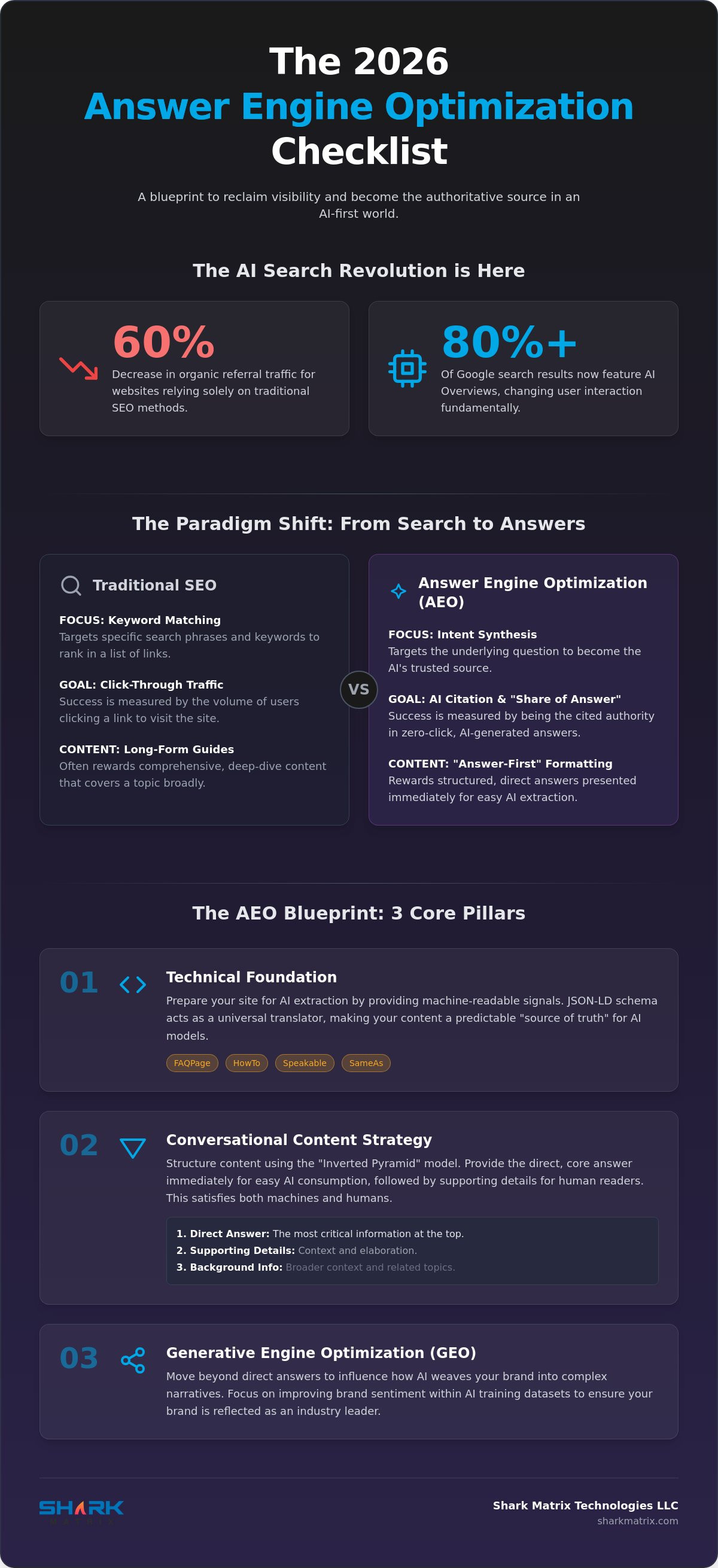
Did you know that websites relying solely on traditional SEO methods have seen a 60% decrease in organic referral traffic over the last 18 months? It’s a sobering reality for many digital marketers who are watching their hard-earned rankings yield fewer clicks. You’ve likely noticed that Google AI Overviews now appear in more than 80% of search results, fundamentally changing how users interact with the web. If you feel like the goalposts are moving, you aren’t alone.

This article provides the definitive 2026 answer engine optimization checklist to help you reclaim your visibility. You’ll get a step-by-step blueprint to optimize your brand for LLMs, Google’s AI Overviews, and conversational search engines to ensure you stay authoritative in an AI-first world. We’ll explore how to implement technical structured data, structure your content for instant answers, and future-proof your digital strategy against the next wave of generative engine updates. By the end, you’ll know exactly how to make your brand the primary source of truth for the world’s most advanced AI models.

Key Takeaways

  • Learn how AEO bridges the gap between traditional keywords and conversational intent to capture visibility in AI “answer engines.”
  • Discover the essential role of advanced Schema.org markup in serving as a “source of truth” for AI crawlers like ChatGPT and Gemini.
  • Master the “Inverted Pyramid” content structure to ensure your brand provides the direct, extractable answers that AI models prioritize.
  • Access a comprehensive answer engine optimization checklist to audit your site’s snippet potential and technical readiness for 2026 search trends.
  • Understand why scaling AEO requires integrating AI automation and development to manage complex data extraction and natural language processing at scale.

What is Answer Engine Optimization (AEO) and Why Does It Matter in 2026?

By 2026, the search landscape has transitioned from a directory of links to a network of synthesized answers. While traditional Search Engine Optimization (SEO) focuses on visibility within a list, Answer Engine Optimization (AEO) aims for something more specific: becoming the definitive source cited by AI models. AEO is the process of making your content easily extractable for “answer engines” like ChatGPT, Perplexity, and Google Gemini. Simply put, AEO is the optimization of content for synthesis by large language models (LLMs).

The impact on organic traffic is undeniable. As Google AI Overviews now appear in more than 80% of search results, the traditional “blue link” click-through model is being replaced by generative responses. This shift means your answer engine optimization checklist must account for how machines read, summarize, and attribute information. Instead of just ranking for a keyword, your goal is to be the authoritative entity that the AI trusts to answer the user’s query directly. When an AI synthesizes an answer, it chooses the most structured, clear, and authoritative source. If your content isn’t built for extraction, it effectively doesn’t exist in the generative era.

The Rise of Generative Engine Optimization (GEO)

Generative Engine Optimization (GEO) takes AEO a step further by focusing on the “creative” and narrative side of AI responses. While AEO targets the direct answer, GEO is about influencing how the AI weaves your brand into complex, multi-step explanations. Brand sentiment within AI training datasets is now a critical factor; if the training data views your brand as a leader, the generative engine will reflect that. 2026 marks the tipping point where “Answer-First” search behavior is the norm, requiring brands to use specialized AI automation and development to manage their digital footprint across various LLMs.

AEO vs. Traditional SEO: A Comparative Overview

Traditional SEO is built on keyword matching, whereas AEO relies on intent synthesis. In the old model, you optimized for a click. In the AEO model, you optimize for a citation. This doesn’t mean SEO is dead, but it has evolved into a technical foundation for AEO.

  • Keyword vs. Intent: SEO targets specific search phrases. AEO targets the underlying question the user is trying to solve.
  • Click-Through vs. Zero-Click: SEO measures success by traffic to the site. AEO measures success by “Share of Answer” and whether your brand is the cited authority in a zero-click environment.
  • Content Structure: SEO often rewards long-form, comprehensive guides. AEO rewards “answer-first” formatting where the core solution is presented immediately for easy bot consumption.

Balancing both strategies is essential for maintaining brand authority. By following a modern answer engine optimization checklist, you can ensure your content satisfies the deep-dive needs of human readers while providing the bite-sized, structured data points that AI engines crave. This dual approach prevents you from doubling your workload while maximizing your presence across all search modalities.

The Technical Foundation: Preparing Your Site for AI Extraction

AI agents are the new primary “users” of your website. While humans enjoy sleek visuals, large language models (LLMs) and autonomous agents look for machine-readable signals. This makes technical infrastructure the most critical part of your answer engine optimization checklist. If an AI agent can’t parse your data in milliseconds, it will simply move to a source that it can understand. You’re no longer just building for a browser; you’re building for a processor.

JSON-LD schema acts as a universal translator that allows AI agents to map your content directly to known entities and facts. This structured format provides a “source of truth” that reduces the risk of AI hallucinations, making your site a more reliable candidate for citations. When your data is predictable, AI models are more likely to trust and display it in generative responses.

Advanced Schema Markup for AEO

Standard SEO used to focus on basic metadata, but AEO requires a more granular approach. Implementing “FAQPage”, “HowTo”, and “Speakable” schema types is no longer optional. These tags tell AI exactly which parts of your page are the “answers.” Using “SameAs” attributes is equally vital. It connects your brand entities across the web, from LinkedIn to Wikipedia, helping AI build a comprehensive knowledge graph of your authority. Because these requirements are highly technical, professional technical seo services are the backbone of any successful strategy. They ensure your code is clean and compliant with the latest 2026 standards.

API-First Content Delivery

Speed and accessibility define the AI era. Traditional monolithic sites often struggle with slow ingestion speeds. Headless CMS architectures solve this by offering API-first content delivery, allowing AI bots to pull data directly without rendering heavy front-end elements. This efficiency directly impacts your “trust score.” AI models prioritize sources that respond quickly and reliably. As noted in HubSpot’s AEO Guide, content structure is just as important as the content itself. Your site architecture must facilitate real-time answer retrieval to stay competitive.

You must also audit your robots.txt file. In 2026, you shouldn’t just block all bots; you need to selectively allow reputable AI crawlers while protecting your proprietary data. Managing these permissions requires a delicate balance between visibility and security. If you find these technical configurations overwhelming, you might consider consulting with an expert team to streamline your AI readiness. High-speed API responses and optimized site architecture ensure you remain visible as search engines move toward instant, generative results.

The 2026 Answer Engine Optimization Checklist: Mastering AI-Driven Search

Conversational Content Strategy: Writing for Machines and Humans

If technical SEO is the engine, your content strategy is the fuel that determines where the vehicle goes. In 2026, writing for visibility requires a dual-focus approach. You must satisfy the human reader’s need for depth while providing AI models with the clear, extractable data they crave. Your answer engine optimization checklist isn’t complete without a radical shift in how you draft sentences and structure your arguments. LLMs don’t “read” like people; they synthesize patterns and look for the most direct path to a solution.

The “Inverted Pyramid” of AEO is your most powerful tool. This strategy demands that you answer the core question of any section within the first 50 words. By front-loading the answer, you provide a ready-made snippet that AI agents can easily lift and cite. Natural Language Processing (NLP) friendly syntax is also vital. Use active voice and “Subject-Verb-Object” structures. This clarity improves the probability that an AI will correctly interpret your intent and attribute the information to your brand. When you write with precision, you aren’t just creating content; you’re building a reputation as a canonical source of truth.

The ‘Answer-First’ Formatting Rule

Structure your pages using H2 and H3 tags that mirror the questions users actually ask. After each header, provide a direct answer between 40 and 60 words. This specific length is the “sweet spot” for AI snippet extraction. Use bulleted lists to break down complex data or multi-step processes. Lists are highly digestible for LLM synthesis, making it much easier for a generative engine to weave your data into a larger, multi-source response. This formatting mirrors the “People Also Ask” (PAA) patterns that dominate modern search results.

Bilingual AEO: Optimizing for a National Audience

For brands operating in the UAE, a monolingual strategy is no longer sufficient. High-quality Arabic localization is essential because AI agents now handle English-to-Arabic intent translation with remarkable sophistication. However, nuances in dialect and cultural context can still trip up a machine. This is why Arabic digital marketing requires specific AEO refinements. You must ensure that your Arabic content is as structured and entity-rich as your English version. By providing clear, localized answers in both languages, you increase your “Share of Answer” across a broader demographic, ensuring your brand remains the primary authority in the regional knowledge graph.

The 2026 Answer Engine Optimization Checklist

Moving from theory to execution requires a structured approach that addresses both technical and creative content needs. This answer engine optimization checklist serves as your roadmap to visibility in an era dominated by Google AI Overviews and conversational agents. You’ve already established the technical foundation and conversational tone. Now, it’s time to audit your existing digital footprint to ensure every page is an “extractable” asset. Success in 2026 isn’t about the volume of pages you publish; it’s about the precision of the answers you provide.

  • Audit Snippet Potential: Review your top 20% of traffic-driving pages. Identify sections where a direct answer can be inserted to capture featured snippets and AI citations.
  • Implement Advanced Schema: Move beyond basic tags. Every service and product page must use microdata that defines specific attributes, helping AI models categorize your offerings accurately.
  • Enforce the 50-Word Rule: Restructure your introductory paragraphs to lead with a concise, direct answer. This satisfies the “answer-first” requirement of modern LLMs.
  • Voice Search Optimization: Adapt your long-tail keyword strategy to mirror natural speech patterns. People ask questions differently when speaking than when typing.
  • Knowledge Graph Verification: Use Online Reputation Management (ORM) to ensure your brand’s facts are consistent across Wikipedia, social profiles, and industry directories.

Step 1: Entity and Authority Mapping

AI models understand the world through entities. You must clearly identify your primary business entities, including your CEO, core products, and physical locations. Consistency is vital here, especially for bilingual markets. For UAE enterprises, your Name, Address, and Phone (NAP) data must be identical across English and Arabic directories. Linking these entities via Wikidata or official social profiles helps AI engines build a reliable knowledge graph of your brand’s authority.

Step 2: Technical and Structural Alignment

Your site’s backend must be as fast as the AI models that crawl it. Mobile-first responsiveness is a baseline requirement, but lightning-fast load times are what secure a high trust score. Ensure that your custom web development supports modern SEO standards, including efficient API-first content delivery. Testing your site using AI-simulated crawlers can reveal extraction bottlenecks that traditional SEO tools might miss.

Step 3: Monitoring and Iteration

AEO is not a “set and forget” strategy. You need to track your “Citation Share” in AI Overviews and ChatGPT responses to measure real-world performance. Tools like Perplexity are excellent for testing how well your brand answers specific industry queries. As “People Also Ask” trends evolve, you must adjust your content to address emerging questions. If you want to ensure your site meets every requirement on this answer engine optimization checklist, it’s time to partner with Shark Matrix for a professional AEO audit.

Future-Proofing with AI Automation and Expert SEO

Implementing an answer engine optimization checklist across a handful of pages is a manageable task, but scaling these efforts for an enterprise-level website is a different challenge. Manual updates for thousands of product descriptions or service pages simply don’t work in a fast-moving AI environment. To maintain a competitive “Share of Answer,” you need a system that adapts in real-time. This is where automation becomes the essential bridge between a static website and a dynamic, AI-ready asset, and Mkhaya MK provides the digital transformation expertise to build these scalable environments. You can’t rely on human speed when search engines are synthesizing data in milliseconds.

Shark Matrix integrates AI automation and development directly into your SEO workflow to solve the problem of scale. By leveraging custom software and machine learning, we can automate the generation of high-fidelity schema markup and “answer-first” content summaries across your entire domain. This technical-first approach ensures that every page on your site is optimized for extraction without requiring thousands of manual man-hours. It’s about working smarter by letting machines communicate with other machines effectively.

Integrating AI into Your Marketing Stack

Modern marketing stacks must include machine learning to predict shifts in search intent before they impact your referral traffic. By analyzing vast datasets, we can identify which “Question” keywords are gaining traction and automate the deployment of FAQ schema to meet that demand. This level of agility is only possible with a technical-first digital agency that understands the intersection of code and content marketing. Custom AI chatbots also play a strategic role here; they act as interactive data points that help train LLMs about your specific business logic, products, and services.

Next Steps: Your AEO Roadmap

Your journey toward search dominance in 2026 starts with a clear, actionable plan. Don’t wait for your organic traffic to decline further before taking action. The transition from “blue links” to generative answers is already happening.

  • Start with a Technical Audit: Conduct a comprehensive review of your site’s crawlability by non-traditional AI agents.
  • Prioritize ‘Question’ Keywords: Focus on high-intent queries that trigger AI Overviews and “People Also Ask” boxes.
  • Connect Your Entities: Ensure your brand’s metadata and facts are consistent across all global and regional directories.

The search landscape has fundamentally changed, but your brand’s authority can thrive in this new environment. By combining the points in this answer engine optimization checklist with advanced machine learning, you can secure your place as the definitive answer in your industry. If you’re ready to future-proof your digital presence and lead the market, contact Shark Matrix today for a tailored AEO strategy that puts your brand at the center of the AI conversation.

Securing Your Brand’s Future in the Generative Search Era

The shift from traditional search to generative answers isn’t just a trend; it’s a fundamental change in how the world accesses information. You’ve seen how a robust technical foundation and “answer-first” content are the keys to surviving the decline in organic click-through rates. Implementing every step of this answer engine optimization checklist ensures your website doesn’t just exist but leads the conversation. Don’t let your brand become a hidden footnote in an AI-generated summary when it could be the primary citation.

Shark Matrix has delivered high-impact digital solutions since 2010. Our specialists in AI automation and machine learning are uniquely prepared to manage the complex data structures LLMs demand. Whether you’re targeting a local or national audience, our comprehensive digital marketing coverage keeps your brand authoritative. It’s time to move beyond the simple blue link and become the definitive answer that machines and humans both trust.

Future-proof your brand with Shark Matrix AEO Services and start dominating the next era of search today.

Frequently Asked Questions

Is Answer Engine Optimization different from regular SEO?

AEO is a specialized refinement of SEO that focuses on providing direct, extractable answers for AI-driven engines rather than just ranking in a list of links. While traditional SEO helps your site get indexed and ranked, AEO ensures your content is selected as the definitive answer cited by large language models. It requires a much more granular focus on technical data structures and conversational sentence patterns.

How do I show up in ChatGPT or Google AI Overviews?

You appear in these generative responses by becoming a highly authoritative and structured source for specific entities and questions. This involves implementing every item on an answer engine optimization checklist, such as leading with concise answers and using JSON-LD schema. AI models prioritize sources that are easy to parse and consistently cited across other reputable platforms like industry directories and social profiles.

Does AEO require a website redesign?

A full redesign isn’t always necessary, but your site architecture must support rapid data ingestion and mobile-first responsiveness. You might need to optimize your backend for high-speed API responses or adjust your CMS to deliver content in a more structured format. The focus is primarily on how your data is delivered to bots rather than the visual elements seen by human visitors.

Which schema types are most important for AEO in 2026?

In 2026, “FAQPage”, “HowTo”, and “Speakable” schema types are the most critical for signaling extractable answers to AI crawlers. You should also use “SameAs” attributes to link your brand’s digital entities across the web. These tags act as a universal translator, helping AI agents understand the relationships between your products, services, and leadership team without any ambiguity.

How can I track the ROI of my AEO efforts?

Tracking AEO ROI involves measuring “Share of Answer” and citation volume in generative engines instead of just traditional click-through rates. You should monitor how often your brand is cited as a source in Google AI Overviews and ChatGPT responses. While traditional organic traffic might fluctuate, the increase in brand authority and high-intent conversions from these citations provides a more accurate measure of success.

Can AI automation help with my AEO checklist implementation?

AI automation is essential for managing a comprehensive answer engine optimization checklist at scale across a large website. Automated tools can generate schema markup for thousands of pages and predict shifts in search intent using machine learning. This allows your team to focus on high-level strategy while the technical heavy lifting of data structuring and extraction optimization is handled by custom software.

What is the impact of voice search on AEO?

Voice search has pushed AEO toward more natural, conversational language patterns and long-tail query optimization. Since voice queries are typically phrased as complete questions, your content must provide complete, bite-sized answers that are easily read aloud by virtual assistants. This shift reinforces the need for clear H2 and H3 headers that mirror the way people actually speak in daily life.

Is AEO relevant for B2B companies in the UAE?

AEO is highly relevant for UAE-based B2B firms because it establishes authority in a market that values technical expertise and bilingual accessibility. Providing clear, localized answers in both English and Arabic helps you capture market share in regional AI searches. It positions your company as the canonical source for industry-specific queries, which is vital for building trust with corporate decision-makers in the region.

Categories
GEO

Preparing Your Website for AI Overviews: The 2026 SEO Checklist

Did you know that organic click-through rates drop by as much as 61% when an AI Overview appears at the top of the search results? It’s a sobering reality for digital marketers who see their traditional rankings buried under synthesized answers. If you feel like you’re losing the battle against zero-click searches, you aren’t alone. That’s why preparing website for ai overviews has become the most critical task for any brand wanting to stay visible in 2026.

We’ll help you turn this challenge into an opportunity by showing you how to become a cited, primary source within Gemini-powered summaries. You’ll learn the exact technical and content adjustments needed to satisfy Retrieval-Augmented Generation (RAG) systems and ensure your data is parsed correctly. This article provides a clear roadmap through the confusion of Generative Engine Optimization (GEO) to help you clear technical debt and future-proof your site against the next wave of algorithm shifts.

Key Takeaways

  • Learn why optimizing your technical infrastructure with advanced schema and rapid site speed is essential for AI bot processing.
  • Discover how to structure your content using the “Inverted Pyramid” method to provide the direct answers LLMs look for.
  • Understand the process of preparing website for ai overviews by building semantic depth and topical authority through clustering.
  • Strengthen your brand’s credibility by leveraging E-E-A-T and digital PR to influence the training data of generative models.
  • Explore how integrating traditional SEO with generative engine optimization (GEO) creates a resilient, future-proof digital strategy.

Understanding the Shift from Search Engines to Answer Engines

Google search isn’t what it used to be. For decades, the goal was to secure a spot in the “ten blue links” that dominated the first page. Today, that layout is being replaced by synthesized summaries that provide immediate answers. This evolution turns Google from a directory into an answer engine. Because of this, preparing website for ai overviews is now the most important part of a modern digital strategy. Users no longer need to click through to multiple sites when the answer is presented right at the top of their screen.

This shift has a massive impact on click-through rates. In 2026, research shows that organic CTR can drop by as much as 58% when an AI Overview is present. However, there’s a silver lining for those who adapt. Brands cited within these AI summaries often see a 35% increase in clicks compared to those that aren’t. The game has changed from fighting for a rank to fighting for a citation. You’re no longer just trying to be the first link; you’re trying to be the source that the AI trusts most, and you can check out RANE Digital to see how they help brands navigate these performance shifts.

The Mechanism of AI Citations

How does Gemini decide which websites to cite? It uses a process called Retrieval-Augmented Generation (RAG). Instead of just relying on its pre-trained data, the AI “fans out” a query to its search index to find the most relevant, up-to-date information. AI Overviews are a synthesis of top-tier authoritative data nodes. To get noticed, your site needs to be one of those nodes. This requires moving beyond traditional keyword density. AI crawlers now look for semantic relevance and clear entity relationships within a knowledge graph to determine which content is truly authoritative.

SEO vs. GEO: What Has Changed?

Traditional Search engine optimization (SEO) is still the foundation, but it’s evolving into Generative Engine Optimization (GEO). While SEO focuses on visibility in a list, GEO focuses on visibility within a generated response. For many national brands, this also includes Answer Engine Optimization (AEO), which specifically targets direct-response queries. You need a strategy that balances both worlds. By leveraging comprehensive search engine optimization seo services, you can ensure your technical foundation is strong enough to support these advanced AI requirements while maintaining your traditional search presence. It’s about being visible where the users are looking, whether that’s a blue link or a Gemini summary.

Technical Optimization: The AI-Ready Infrastructure Checklist

Many site owners make the mistake of treating AI visibility as a content-only problem. In reality, your technical foundation determines whether an AI crawler can even understand your data. If your site is bogged down by technical debt, Gemini or other LLMs might skip your content entirely. Preparing website for ai overviews requires a shift toward “fragment indexing.” This means structuring your site so AI can easily extract specific answers without needing to parse through irrelevant code blocks or messy scripts.

A clean, hierarchical URL structure is the first step in this process. It acts as a map for LLMs, helping them understand the relationship between different topics and subtopics. When your URLs follow a logical path, you’re essentially building a knowledge graph for the search engine. This clarity allows AI to identify your brand as an authority in specific niches much faster than a disorganized structure. It also reduces the risk where AI might misattribute information due to poor site architecture.

Advanced Schema and Structured Data

Schema markup has evolved from a “nice-to-have” feature into a mandatory requirement for AI visibility. By using advanced JSON-LD, you provide the entity recognition that AI models crave. Focus on Speakable, FAQ, and How-To schema to feed directly into AI response blocks. If you publish research or data, implementing Dataset schema is vital for becoming a primary source for statistical queries. You can verify these implementations using the updated 2026 Google Search Console tools to ensure your entities are correctly identified and ready for synthesis.

Backend Readiness for AI Crawlers

AI bots don’t crawl the web like traditional spiders. They are looking for high-quality data nodes they can synthesize quickly. This makes site speed and Core Web Vitals more important than ever. Slow pages consume more “compute” for the AI, making them less attractive as sources for real-time summaries. Your robots.txt and sitemaps must also be optimized for the Google-Extended crawler to ensure your most valuable assets are prioritized. Professional website design and development services play a key role here by creating clean, AI-parsable code. If you want to stay ahead of the curve, it might be time to review your technical SEO performance with an expert team.

Preparing Your Website for AI Overviews: The 2026 SEO Checklist

Semantic Content Strategy: Optimizing for LLM Extraction

Writing for search engines used to mean repeating keywords in strategic places. In 2026, the priority is semantic clarity. AI models like Gemini don’t just scan for words; they parse meaning. This makes preparing website for ai overviews a task of information architecture as much as writing. To succeed, you must adopt the ‘Inverted Pyramid’ of AI writing. This means placing the most important information at the very beginning of your sections. Give the AI the answer it needs immediately, then expand on the details for the human reader who chooses to click through.

Topic clustering is your primary tool for proving niche authority. Instead of writing isolated blog posts, create a web of interconnected content that covers a subject from every angle. This builds semantic depth, signaling to AI crawlers that your site is a definitive source. Use headers and lists that are friendly to Natural Language Processing (NLP). Clear, descriptive headings help the AI map your content more effectively. Most importantly, eliminate fluff. Conversational filler and vague introductory sentences are ignored by AI Overviews. If a sentence doesn’t add factual value, it shouldn’t be there.

Crafting the “Perfect Answer” Block

The key to winning a citation is the “Perfect Answer” block. These are concise 40-60 word summaries placed directly under H2 or H3 headers. Use factual, declarative sentences to increase your citation probability. AI models prioritize content that provides immediate, verifiable utility. By providing a clear, high-level summary at the start of each section, you make it easy for the LLM to extract your data without needing to synthesize it from scratch.

Visual and Multimedia Integration

AI is increasingly multimodal, meaning it processes images and videos alongside text. Optimizing your image alt-text and providing detailed video transcripts is essential. Tables and infographics are particularly valuable because they provide structured data that AI can easily parse into summaries. These elements should be responsive and optimized for cross-platform visibility. For businesses focusing on mobile users, integrating these assets with mobile app development services ensures your content remains accessible and citation-ready across all devices.

Building Brand Authority: The Trust and Citation Checklist

In 2026, E-E-A-T (Experience, Expertise, Authoritativeness, and Trustworthiness) is the primary filter AI uses to separate high-quality sources from mass-produced clutter. Google’s official documentation stresses the importance of content that demonstrates real-world experience. Preparing website for ai overviews means you must prove your brand isn’t just another generic voice. AI models look for “non-commodity” content. These are unique insights and expert-led data that can’t be easily generated by a machine. If your content provides common knowledge, the AI will summarize it without citing you. To win the citation, you must offer something the model can’t replicate on its own.

Your brand’s presence in the Knowledge Graph is crucial for long-term visibility. This is how AI identifies entities and their relationships. If your brand is mentioned across authoritative sources, social media, and third-party review sites, the AI’s trust score for your domain increases. Social proof acts as a validation layer for generative models. Since 70% of consumers report having some level of trust in Google’s generative AI results, you must ensure those results reflect a trustworthy brand image. This requires auditing your digital footprint across national industry databases to ensure consistency and authority.

Digital PR and External Mentions

Digital PR is no longer just about building backlinks for rankings. In the AI era, non-linked brand mentions are equally powerful. LLMs use industry-specific “seed sites” as trusted foundations for their training data. If your brand is mentioned frequently on these platforms, you become part of the AI’s core knowledge base. Leveraging seo for brand reputation management dubai helps you control these narratives and protect your reputation across influential databases. This ensures that when an AI generates a summary, your brand is the one it recommends as a trusted authority.

Author Verification and Transparency

Transparency is the ultimate trust signal for 2026 search. You should implement robust author bios that link to external credentials, LinkedIn profiles, and professional certifications. This provides a “human-in-the-loop” signal. It proves that your content is guided by human expertise rather than being 100% AI-generated. AI crawlers check these signals to verify that the information comes from a reliable source. If you want to strengthen your brand’s authority and secure your place in AI summaries, consult with our SEO experts today to build a custom citation and authority strategy.

Future-Proofing with Generative Engine Optimization (GEO)

Success in the AI era isn’t a one-time achievement. As Google recalibrates its systems, the strategies that work today will need to evolve. Preparing website for ai overviews is a continuous process of monitoring, testing, and refining. At Shark Matrix, we treat Generative Engine Optimization (GEO) as a distinct discipline that goes beyond traditional search. We integrate AI automation with our core SEO workflows to ensure your brand remains the preferred source for Gemini-powered summaries. This proactive approach allows us to stay ahead of algorithm shifts that might otherwise lead to sudden traffic drops.

In a zero-click environment, your metrics for success must shift. If 60% of searches don’t result in a click, you need to find value in the citation itself. This is where data-driven lead generation becomes vital. Even if a user doesn’t visit your site immediately, appearing as the primary authority in an AI Overview builds brand recall and trust. We track citation rates and AI visibility with the same rigor we apply to traditional rankings. By understanding which queries trigger these summaries, you can prioritize content that captures the highest-value citations in your industry.

Shark Matrix’s GEO Framework

Our framework relies on sophisticated technology to keep your brand at the forefront of search. We use our internal ai development services to build custom tools that monitor how AI models perceive your site’s data. These tools use predictive analytics to anticipate which long-tail queries are most likely to trigger an AI response. This allows us to optimize your content before the competition even notices the shift. To bridge the traffic gap caused by zero-click results, we often recommend consulting with a ppc agency dubai to maintain a dominant presence through paid search while your organic AI authority grows.

Next Steps for Your Business

The first step in securing your digital future is conducting a comprehensive AI-Readiness Audit. This audit evaluates your technical infrastructure, semantic depth, and E-E-A-T signals to identify gaps in your current strategy. From there, you can build a multi-channel digital roadmap that survives search disruption. Don’t wait for your organic traffic to decline before you start preparing website for ai overviews. Contact Shark Matrix today to develop a specialized Generative Engine strategy that protects your visibility and ensures your brand is the voice Google trusts most in 2026.

The transition from blue links to synthesized summaries is no longer a distant possibility; it’s the current standard. You’ve seen how a combination of technical precision, semantic content strategy, and robust E-E-A-T signals can turn the threat of zero-click searches into a powerful citation opportunity. By preparing website for ai overviews now, you position your brand as a trusted authority that Google’s Gemini-powered systems will prioritize. Success in this landscape requires moving beyond simple rankings to focus on becoming a primary source for AI synthesis.

Shark Matrix is the leading AI automation and development agency in the UAE, specializing in Generative Engine Optimization (GEO). We provide data-driven SEO strategies designed for national brand protection and long-term growth in a volatile market. Don’t let your traffic disappear as search behavior shifts toward answer engines. It’s time to Book your 2026 AI-Readiness Audit with Shark Matrix and ensure your site is ready for what comes next. The future of search belongs to those who adapt today. Your brand has a story that deserves to be told, and we have the tools to make sure the AI engines tell it correctly.

Frequently Asked Questions

What is the difference between SEO and GEO?

Traditional SEO focuses on optimizing your site to rank in a list of links, while Generative Engine Optimization (GEO) focuses on being cited within an AI-generated answer. SEO builds the technical and content foundation. GEO layers on strategies like semantic depth and entity recognition to ensure LLMs like Gemini retrieve your data during synthesis. Both are necessary to maintain visibility in 2026.

Will AI Overviews stop people from clicking on my website?

AI Overviews do increase zero-click searches, which now account for approximately 60% of Google queries. However, being cited as a source can actually help. Research shows that brands cited within an AI Overview see a 35% increase in clicks compared to those that aren’t. While overall CTR might drop for top links, the citation becomes the new “position zero” for traffic.

How do I know if my website is being cited by Google Gemini?

You can monitor your citations through the updated performance reports in Google Search Console. These reports now distinguish between traditional organic clicks and those originating from generative features. You can also use specialized third-party monitoring tools that track your brand’s appearance and citation rate within AI-generated summaries across different industries and query types.

Is structured data still important for AI Overviews in 2026?

Structured data is more critical than ever because it provides the explicit context that AI models need to identify entities. Preparing website for ai overviews requires advanced JSON-LD to act as a bridge between your content and the AI’s knowledge graph. Without clear schema, an LLM might struggle to verify your data, making it less likely to use your site as a primary source.

Can small businesses compete with national brands in AI summaries?

Small businesses have a unique advantage because AI Overviews pull from a much wider source pool than traditional search results. You don’t always have to be in the top 10 blue links to get cited. By focusing on “non-commodity” content and hyper-local expertise, smaller sites can win citations that national brands might lose by being too general or broad.

How often does Google update the sources for its AI Overviews?

Google updates these sources in real-time or near real-time through its search index. Because the system uses Retrieval-Augmented Generation (RAG), the AI “fans out” to the index to find the most current and authoritative information available at the moment of the search. This means your latest expert insights can be cited almost as soon as they are indexed.

Should I block AI crawlers from my website to protect my content?

Blocking crawlers like Google-Extended prevents your data from being used to train models, but it also removes you from AI Overviews. If you block these bots, your brand will not be cited in the summaries that now appear in up to 60% of searches. For most businesses, the loss of visibility and citations outweighs the benefits of content protection.

What are the most important schema types for AI visibility?

The most effective types are FAQ, How-To, and Speakable schema, as they directly match the answer-based intent of AI queries. Additionally, Dataset schema is vital if you publish original research or statistics. These structured formats help AI crawlers quickly identify your content as a high-value data node, which is essential when preparing website for ai overviews and securing citations.

Categories
AEO

Answer Engine Optimization vs SEO: Navigating the Future of Visibility in 2026

96% of total traffic volume still originates from traditional search, yet 72% of consumers plan to use AI for shopping more frequently this year. You’ve likely seen your organic click-through rates dip as AI Overviews occupy the top of the results page. Understanding the balance of answer engine optimization vs seo is no longer optional if you want to protect your visibility. It’s a stressful time to manage legacy content, especially when you aren’t sure which specific engines are even citing your brand. You know the rules of the game are changing, but you don’t want to abandon the strategies that still drive the majority of your leads.

We’re here to bridge that gap. This article provides a clear roadmap for 2026 search visibility, showing you how to integrate both strategies to dominate search results and AI citations. You’ll discover why content updated within the last 13 weeks is 50% more likely to be cited by LLMs and how to restructure your data for maximum impact. We’ll show you how to maintain traffic while building authoritative brand presence within AI-generated answers. It’s time to move from simply ranking to becoming the definitive answer across the entire digital ecosystem.

Key Takeaways

  • Understand the critical balance of answer engine optimization vs seo to maintain visibility as search behavior shifts from clicking to delegating.
  • Master the transition from traditional keyword ranking to securing high-frequency citations within Large Language Models and AI Overviews.
  • Learn how to use advanced Schema.org and structured content to ensure AI engines identify your brand as a primary source of truth.
  • Discover why your existing SEO authority is the foundation for AEO success and how to leverage backlinks as trust signals for AI models.
  • Find out how a dedicated “Search-to-Answer” audit identifies visibility gaps and uses AI automation to scale your reach in 2026.

The Evolution of Search: Defining SEO and AEO in 2026

The digital landscape has shifted from a library of links to a network of answers. In 2026, the debate surrounding answer engine optimization vs seo often frames them as rivals; however, for national brands, this is a false dichotomy. Traditional Search Engine Optimization (SEO) has matured beyond simple keyword targeting into intent-based ecosystem management. It’s no longer just about where you rank on a list. It’s about how your brand exists within the entire search environment. While SEO builds the foundation of authority and discoverability, Answer Engine Optimization (AEO) focuses on becoming the definitive source of truth that Large Language Models (LLMs) rely on when synthesizing responses.

We’ve moved past the “index-and-rank” era. Modern search platforms use “understand-and-synthesize” models. These systems don’t just point users toward a page; they ingest content, weigh its credibility, and present a summarized conclusion. For businesses, understanding the interplay of answer engine optimization vs seo is the only way to stay ahead of these algorithmic shifts. You can’t ignore the technical requirements of one without damaging the performance of the other.

What Constitutes an Answer Engine?

Answer engines represent a diverse group of platforms including Perplexity, ChatGPT, Claude, and Google’s AI Overviews. Unlike traditional crawlers that primarily look for keywords and backlink patterns, these engines consume data to build semantic relationships. They use real-time web access to verify facts and provide current insights. This means your content must be structured for machine readability. If an engine can’t parse your data quickly, it won’t cite you as the primary source for a user’s prompt. It’s about clarity and structured data over mere volume.

Why 2026 is the Tipping Point for AEO

User expectations have fundamentally changed. Most people no longer want to hunt through ten blue links; they want a direct answer immediately. This shift has led to a surge in zero-click searches, where the user journey begins and ends on the search results page. To combat declining organic click-through rates, professional search engine optimization seo services have evolved to prioritize AI-readiness. Success in 2026 requires a hybrid approach. You must maintain traditional rankings to drive high-intent traffic while simultaneously optimizing for the AI-generated summaries that now dominate the top of the screen.

Core Differences: Ranking vs. Citation Mechanics

To master the balance of answer engine optimization vs seo, you must first understand that the goalposts have moved. Traditional SEO focuses on SERP placement, aiming for that coveted “Position 1” in a list of results. AEO, however, prioritizes citation frequency and accuracy. It’s the difference between being a link on a page and being the data source that powers an AI’s response. While a high ranking in Google remains valuable, research indicates that backlinks are only predictors of citations in answer engines in the 4-7% range. This means your traditional authority doesn’t automatically translate to AI visibility.

The technical process also differs significantly. SEO relies on “crawling for keywords,” where bots identify specific strings of text. AEO relies on “embedding for semantic meaning,” where neural networks analyze how concepts relate to one another. Users are shifting from browsing a list of links to consuming a generated summary. This changes how we measure success. Instead of just tracking Click-Through Rate (CTR) and Position, digital leaders now track Share of Model (SoM) and brand sentiment within AI outputs. If you’re struggling to track these new metrics, our ai automation services can help you monitor your brand’s presence across generative platforms.

The Discovery Surface: Links vs. Conversational UX

In traditional search, users interact with featured snippets, local packs, and knowledge panels. These are static elements designed to drive clicks. Answer engine outputs are different; they feature footnotes, inline citations, and follow-up prompts. The “first page” of Google is no longer the only battleground. Instead, the “context window” of the AI model determines what information is included in the final answer. If your content isn’t structured to fit this window, it won’t be cited, regardless of its traditional rank.

Data Processing: Algorithms vs. Neural Networks

Traditional search engines like Google still use evolved versions of PageRank to weigh authority based on link structures. In contrast, answer engines use transformer architectures and neural networks to process data. These systems prioritize “entities” (concepts and objects) over “strings” (literal text matches). This represents a fundamental move from lexical matching to semantic understanding, where the engine evaluates the underlying meaning of your content rather than just the words used.

Answer Engine Optimization vs SEO: Navigating the Future of Visibility in 2026

The Synergy: Why AEO Cannot Exist Without SEO

A common mistake in current digital strategy is treating answer engine optimization vs seo as a choice between two different paths. In reality, they are two sides of the same coin. AI engines don’t generate facts out of thin air; they ground their responses in high-authority sources they find through traditional search indexing. If your site lacks the foundational authority that SEO provides, an answer engine is unlikely to trust your content enough to cite it. You can’t have one without the other if you want to maintain a dominant online presence.

Traditional backlinks still play a vital role here. While they aren’t the only factor for AI discovery, they act as essential trust signals. Generative models use these signals to verify that a piece of information is credible and widely recognized. This creates a powerful feedback loop. High SEO rankings lead to more AI citations. These citations, in turn, increase brand visibility and search volume, which further reinforces your SEO standing. Protecting this visibility is especially critical for national brands, which is why seo for brand reputation management dubai has become a core component of modern search strategies.

The Authority Factor in AI Citations

Large Language Models often prioritize the top five organic results when answering factual queries. This makes your E-E-A-T (Experience, Expertise, Authoritativeness, and Trustworthiness) profile more important than ever. It’s not just about having the right keywords anymore. It’s about your brand mentions across the web acting as a decentralized knowledge graph. Research shows that content published or updated within the last 13 weeks is roughly 50% more likely to be cited by answer engines. When multiple authoritative sites mention your brand in connection with fresh, updated data, AI engines are far more likely to synthesize that information into a cited answer.

Solving the Zero-Click Challenge

The rise of zero-click searches doesn’t mean traffic is dead. It means you need a two-tiered approach. Use AEO to capture the immediate “answer” within the AI summary, positioning your brand as the primary expert. Then, use SEO to capture the “deep dive” traffic from users who want more than a summary. Click-through optimization within AI responses involves using clear, compelling language that encourages users to click the citation link for more detail. You should balance your concise, AI-friendly summaries with high-value gated content or long-form guides that provide the depth an AI summary simply can’t replicate.

The 2026 AEO Checklist: Building an Answer-First Strategy

Succeeding in the current climate requires more than just adding a few FAQs to your blog posts. It demands a structural shift in how you present data to both humans and machines. When evaluating answer engine optimization vs seo, the most successful brands are those that treat their website as a structured database rather than a collection of documents. This checklist outlines the essential steps to ensure your brand is the first choice for AI synthesis.

Implementing this shift requires a specialized approach to digital architecture. Companies like PurpleCow Digital Marketing provide the strategic website design and development necessary to ensure your site functions as a high-performance database for AI engines.

  • Step 1: Implement advanced Schema.org markup like Speakable, FAQ, and HowTo to define your content’s purpose clearly.
  • Step 2: Transition to an “Answer-First” architecture where the primary value proposition is delivered immediately.
  • Step 3: Optimize for natural language and conversational long-tail queries that reflect how people actually speak to AI agents.
  • Step 4: Build a robust entity-based internal linking structure that maps the relationships between your core business concepts.
  • Step 5: Monitor “Share of Model” (SoM) using emerging AI tracking tools to see how often your brand is cited compared to competitors.

The interplay of answer engine optimization vs seo means your technical foundation must support both discovery and citation. If you are ready to modernize your digital infrastructure, our ai automation and development services can help you implement these advanced data structures at scale.

Technical Foundations: Schema and Structured Data

Basic JSON-LD is no longer sufficient for high-level visibility. You must optimize for semantic triplets, which define specific relationships between entities in a way that AI models can easily ingest. By using technical SEO to “label” every component of your page, you reduce the computational effort required for an engine to understand your expertise. Structured data is the language of AEO. It transforms your prose into a machine-readable format that answer engines can trust and verify in real-time.

Content Framework: The Q&A Hierarchy

Content architecture must now follow a strict hierarchy designed for quick extraction. Start your articles with a 40 to 60 word “direct answer” that provides immediate value. Use H2 and H3 headings as explicit question-answer pairs. This structure mirrors how LLMs search for information within their context windows. Additionally, prioritize factual density and “first-hand experience.” This emphasis on unique expertise ensures your content isn’t just another generic summary, but a unique contribution that AI engines find worth citing over competitors.

Shark Matrix: Bridging the Gap Between Search and Answers

Scaling a visibility strategy that balances answer engine optimization vs seo requires more than just manual content updates. It demands technical integration. At Shark Matrix, we use custom AI automation to help brands transition from static pages to dynamic, machine-readable data sources. This isn’t just about following a checklist; it’s about building an infrastructure where your brand assets are “AI-native” from the moment they’re created. By leveraging our generative ai development services, we ensure your content is structured to be ingested, understood, and cited by the world’s most advanced LLMs.

Our proprietary “Search-to-Answer” audit process is designed specifically for national UAE brands looking to protect their authority. We don’t just look at where you rank on a traditional results page. We analyze how your brand is represented in conversational prompts and AI summaries. This dual-focus approach ensures you don’t lose traditional organic traffic while you’re busy building a presence in the new answer-first ecosystem. A national strategy needs a partner who understands both the nuances of search engine algorithms and the complexities of AI engineering.

AI-Native Digital Marketing

Future-proofing your brand involves using machine learning development services to predict which queries are most likely to trigger AI Overviews. We help you stay ahead of the curve by identifying these high-value “answer targets” before your competitors do. Beyond external visibility, we develop custom ai chatbot-development services that act as internal answer engines for your proprietary data. This allows you to maintain a unified brand voice across every touchpoint, whether a user is talking to your site’s bot or asking a global engine like ChatGPT about your services.

Measuring Success in an AI-Driven World

Success metrics are undergoing a fundamental transformation. While we still monitor traditional traffic, we’ve moved toward “Inclusion” as a primary KPI for our clients. This means tracking how often your brand is the cited source in a generated summary. We use natural language processing services to monitor brand sentiment within LLM outputs, ensuring the AI isn’t just mentioning you, but positioning you as the expert. Ready to dominate the answer engines? Contact Shark Matrix for a 2026 Strategy Audit and secure your brand’s future in the next era of search.

Securing Your Brand’s Authority in the AI Era

The transition from a link-based web to an answer-first ecosystem is well underway. You now have the tools to understand that the dynamic between answer engine optimization vs seo is one of mutual reinforcement. Success in 2026 requires more than just high rankings; it demands a presence within the context windows of the world’s most powerful AI models. By combining the trust signals of traditional search with the structured clarity of AEO, you ensure your brand remains the primary source of truth for both human users and digital agents.

Navigating this shift alone is a complex task for any national market leader. As a pioneering AI automation agency in the UAE, Shark Matrix specializes in national-scale SEO strategies and holds deep expertise in Generative Engine Optimization (GEO). We help you bridge the technical gap between discovery and citation to maintain your competitive edge. Future-proof your brand with Shark Matrix AEO & SEO services to ensure you aren’t just found, but cited. The future of search is conversational, and it’s time for your brand to lead the conversation.

Frequently Asked Questions

Will AEO replace traditional SEO by the end of 2026?

No, AEO won’t replace traditional SEO by the end of 2026. Instead, it serves as a natural evolution of search strategy. While AEO focuses on getting cited in AI summaries, traditional SEO still drives the vast majority of web traffic. You need SEO to build the site authority that AI engines use to verify your brand’s credibility before they cite you as a source of truth.

How do I track my website’s performance in answer engines like ChatGPT?

You can track performance by monitoring Share of Model (SoM) and brand sentiment within AI outputs. Unlike traditional rank tracking, this involves using specialized tools that query LLMs to see how often your brand appears in generated answers. It’s also helpful to look at referral traffic from AI sources in your analytics, though this data is often still grouped under direct or referral sources.

What is the most important technical factor for Answer Engine Optimization?

The most important technical factor is implementing advanced Schema.org markup to label your content for machine ingestion. Structured data acts as a translator for AI engines, allowing them to parse your facts, entities, and relationships without ambiguity. When comparing answer engine optimization vs seo, this technical layer is what moves you from being a link to being a verifiable fact in an AI’s memory.

Can I optimize a single page for both Google Search and AI answer engines?

Yes, you can and should optimize a single page for both environments. A hybrid structure leads with a concise direct answer for AI engines while following up with the deep dive analysis that traditional searchers value. This dual approach ensures you capture the AI summary citation at the top of the page while maintaining your organic ranking for users who want to click through and read more.

How does AEO affect my organic click-through rate (CTR)?

AEO often leads to a lower click-through rate for simple informational queries because the AI provides the answer directly. However, it significantly boosts your brand authority and trust. Being the cited source in an AI Overview creates a halo effect that can drive higher quality, high intent traffic from users who need more than just a quick summary. It’s a shift from quantity to quality.

What role does Schema markup play in AEO compared to SEO?

In traditional SEO, Schema markup is primarily used to win rich snippets like star ratings or FAQ boxes. In AEO, its role is much deeper; it provides the semantic triplets that AI models use to understand the relationship between different entities. It’s the difference between decorating a search result and feeding a neural network the specific data it needs to synthesize an accurate answer.

Is AEO only for informational queries, or does it work for commercial intent?

AEO works for both informational and commercial queries. While it started with simple “what is” questions, users now use AI to compare products, find local services, and seek professional advice. Optimizing for commercial intent in 2026 means ensuring your product specifications and service details are structured so AI engines can include your brand in “best of” summaries or comparison tables.

How often should I update my content to stay relevant for AI engines?

You should update your core content at least every 13 weeks to maintain its relevance. Research shows that content updated within this timeframe is 50% more likely to be cited by answer engines. AI models prioritize fresh data and recent insights to ensure their summaries are current. Frequent updates to your proprietary metrics and factual data help maintain your status as a reliable source of truth.

Categories
GEO

What is Generative Engine Optimization? The 2026 Guide to GEO

Organic click-through rates have plummeted by 61% for queries where AI Overviews appear, leaving many brands wondering if their traditional rankings even matter anymore. With zero-click rates reaching as high as 83% for some searches, the digital landscape has fundamentally shifted. To stay relevant, you must understand what is generative engine optimization and how it transforms your content from a simple search result into a cited source for AI models like GPT-5.5 and Gemini 3.5 Pro.

You’ve likely felt the frustration of seeing your traffic dip while AI engines synthesize your information for the user. It’s a common fear that traditional SEO efforts are becoming obsolete as LLMs take center stage. However, while the mechanics are changing, the opportunity for high-value traffic remains. AI-referred traffic currently converts at 14.2%, which is significantly higher than the 2.8% average for traditional search.

This guide promises to help you master the transition from ranking first to being cited often. You’ll learn a clear roadmap for adapting your content for LLMs and how to maintain brand authority when the user never leaves the search page. We will also dive into the metrics you need to track to measure success in this new, zero-click environment.

Key Takeaways

  • Learn exactly what is generative engine optimization and how to pivot from competing for rankings to becoming a trusted source for AI-synthesized answers.
  • Understand the role of Retrieval-Augmented Generation (RAG) in AI search and how to structure your technical data for better visibility.
  • Discover the specific content formats, such as conversational Q&A and expert citations, that AI engines prioritize when generating summaries.
  • Find out how to balance traditional SEO with new GEO tactics to protect your brand authority as search transitions into agentic “Action Engines.”

Demystifying Generative Engine Optimization (GEO) in 2026

By June 2026, the digital marketing world has moved beyond the traditional list of blue links. Understanding what is generative engine optimization starts with recognizing that search engines have evolved into “Answer Engines.” Generative engine optimization (GEO) is the strategic practice of structuring and optimizing your digital content so it is easily digestible by Large Language Models (LLMs). Instead of just trying to rank on page one, you’re now trying to ensure your brand’s expertise is part of the final answer an AI provides.

Platforms like ChatGPT, which holds a 60.7% share of the AI search market, and Google Gemini have changed how users interact with information. In early 2026, Google AI Overviews appeared in nearly 55% of all searches. Users no longer want to click through five different websites to find a solution. They want a single, synthesized response that answers their query immediately. This shift has birthed a new metric: Citation Equity. This refers to the value your brand gains by being cited as a primary source within an AI-generated summary. Brands cited in these overviews earn 35% more organic clicks than those that are left out.

The Core Difference: Answer Engines vs. Search Engines

Traditional search engines acted like a librarian pointing you to a shelf. Answer engines act like the expert who has already read the books and is summarizing the key points for you. User intent has shifted from simply “finding” information to “understanding” complex topics and “executing” tasks. Conversational queries are now the standard. People ask questions like “How do I scale my SaaS in a high-interest environment?” rather than typing “SaaS scaling tips.” This requires content that doesn’t just list facts but provides a narrative that AI models can easily process and relay.

Terminology Breakdown: GEO, AEO, and LLMO

The industry uses several terms that often overlap, which can lead to confusion for many business owners. Answer Engine Optimization (AEO) is a specific subset of GEO focused on providing direct, concise answers to specific questions. Large Language Model Optimization (LLMO) focuses more on the technical side, ensuring models can crawl and interpret your data efficiently. While national digital agencies often use these terms interchangeably, they all fall under the umbrella of making your brand visible in an AI-driven world. GEO is the most comprehensive term, covering the entire transition from search rankings to AI citations.

The Paradigm Shift: How GEO Differs from Traditional SEO

Traditional SEO was built on a “Winner Takes All” ranking system where businesses optimized for position one to capture the lion’s share of traffic. However, the rise of generative search has introduced a “Synthesized Source” model. In this environment, AI engines pull data from multiple authoritative sites to create a single, cohesive answer. This shift is critical to understanding what is generative engine optimization. Instead of a single winner, the AI selects the most reliable contributors to build its response, making your brand’s role as a primary data source more valuable than a simple link.

The impact on user behavior is measurable. While AI Overviews directly claim the top of the page, even queries without these summaries saw a 41% decline in traditional engagement as users shifted their expectations toward direct answers. This data underscores why relying solely on legacy ranking strategies is a risky move in 2026. Modern marketing requires a focus on semantic relevance and relationship mapping. It is no longer just about keyword density; it’s about how your information connects to the broader web of knowledge. This practical guide to Generative Engine Optimization highlights how brands must now optimize for the “black box” of AI algorithms.

Unlinked brand mentions have also gained significant weight in AI visibility. In the past, a backlink was the primary currency of authority. Today, LLMs process the entire web to understand your reputation. If a reputable industry report discusses your expertise without linking to your site, the AI still recognizes that association and may use it to inform its answers. This semantic understanding means your digital footprint across the entire web, not just your own domain, determines your visibility in AI-generated summaries.

From Keywords to Entities: The Semantic Evolution

AI models interpret the world through “Entities”—concepts, brands, and people—rather than simple text strings. By building a robust Knowledge Graph, you help these engines understand exactly how your business relates to specific industry solutions. Modern search engine optimization seo services now prioritize this entity-based approach. If you’re looking to integrate these advanced strategies into your workflow, exploring our generative ai development services can help automate the creation of the structured data that LLMs crave.

Measuring Success in a Zero-Click World

Position 1 is no longer the only KPI that matters for growth. In a zero-click environment where the majority of users find their answers without leaving the search page, you need new metrics. Understanding what is generative engine optimization success involves tracking Share of Model (SoM) and Citation Frequency. These metrics measure how often your brand is mentioned or cited by models like GPT-5.5. Shark Matrix Technologies LLC helps brands track these metrics alongside brand sentiment to ensure your reputation remains positive in an automated search world.

What is Generative Engine Optimization? The 2026 Guide to GEO

The Anatomy of AI Visibility: How Generative Engines Process Content

To truly master what is generative engine optimization, you must understand the technical bridge between a static AI model and the live web. This bridge is known as Retrieval-Augmented Generation (RAG). While traditional search engines simply retrieve a list of relevant pages, RAG allows models like GPT-5.5 and Gemini 3.5 Pro to fetch real-time information from the internet and synthesize it with their internal training data. This means your latest industry report or service update can appear in an AI response even if it wasn’t part of the model’s original training set released months ago.

AI models crawl the web differently than the traditional bots of the early 2020s. Traditional search bots like Googlebot focus on indexing pages based on keyword density and link equity. In contrast, AI “fast-bots” are designed to extract semantic meaning and intent. They don’t just look for words; they look for the relationships between concepts. This makes structured data, specifically Schema.org and JSON-LD, the Rosetta Stone of the 2026 search landscape. By providing clear, machine-readable context, you’re giving the AI the exact “ingredients” it needs to bake your brand into its final answer.

Another critical component of what is generative engine optimization is the distinction between a model’s training set and live search capabilities. A model’s training set is its foundation, but live search is how it stays current. When a user asks a question about a trending topic, the AI doesn’t just rely on its memory; it performs a rapid search to find the most authoritative, recent data available. If your site isn’t technically optimized for these high-speed retrieval agents, you’ll be left out of the synthesis entirely.

E-E-A-T in the Age of Artificial Intelligence

Experience, Expertise, Authoritativeness, and Trust (E-E-A-T) are more vital now than ever before. AI engines verify “Trust” by cross-referencing your content against thousands of other authoritative sources. If your site makes a claim that contradicts the consensus of other high-authority domains, the AI will likely flag it as unreliable. Maintaining a consistent narrative through national brand protection strategies ensures that AI agents don’t receive conflicting information about your business from third-party sources.

Technical Infrastructure for GEO-Ready Websites

Optimizing for AI agents requires a shift in technical priorities. Site speed is no longer just about user experience; it’s about making your content accessible to AI “fast-bots” that need to pull data in milliseconds. Implementing advanced JSON-LD is essential to define complex business relationships, such as how your leadership’s expertise connects to your core services. Many forward-thinking brands are also moving toward API-first content delivery, ensuring their data is structured and ready for AI agents to consume without the “noise” of traditional web design elements.

Core Strategies for Optimizing Content for Generative AI

Building a GEO strategy requires moving beyond the “set it and forget it” mentality of old SEO. When businesses ask what is generative engine optimization in a practical sense, they’re often looking for a checklist of content changes. The most effective change is adopting a conversational, Q&A-style structure for your primary service pages. This mirrors how users interact with AI assistants, making it easier for models like GPT-5.5 to extract and present your information as a direct answer. Natural language headers should replace rigid, keyword-stuffed titles to better reflect the way real people speak to their devices.

AI engines prioritize primary sources. By March 2026, data showed that AI-referred traffic converted 42% better than non-AI traffic for US retail sites. To capture this high-intent audience, you must integrate original statistics, proprietary research, and expert quotes into your articles. This turns your content into a “Primary Source” that LLMs cite to add credibility to their synthesized responses. Consistent brand messaging across all digital touchpoints is equally vital. When your message is uniform, it reinforces the AI’s learning and increases the likelihood of your brand being recognized as an authority in its field.

The Power of Citations and Secondary Sources

Brand citations are the new backlinks in 2026. AI doesn’t just look at who links to you; it looks at who talks about you. High-authority industry mentions reinforce your brand’s footprint even without a direct hyperlink. Digital PR is now a core component of GEO, ensuring your brand appears in the training sets and live search results of major AI engines. This strategy builds a digital footprint that AI engines can’t ignore, positioning your brand as a consensus-backed expert.

Optimizing for Multi-Modal AI Search

Search is no longer just text. Users are using voice and images to find solutions. Descriptive alt-text and structured video data help AI models “see” and “hear” your content. This is especially important for “Agentic Commerce,” where AI agents make purchasing decisions on behalf of users. If your technical data isn’t structured for these agents, you’re missing out on a massive segment of automated transactions. If you’re ready to build an AI-ready infrastructure, explore our generative ai development services to get started.

Future-Proofing Your Digital Presence with AI-First Marketing

Survival in the 2026 market demands a hybrid approach. You can’t abandon traditional SEO, but you also can’t ignore the generative shift. A successful strategy balances the “blue links” that still drive roughly 80% of total digital queries with the high-converting citations found in AI Overviews. This balance is the true answer to what is generative engine optimization. It is about maintaining visibility across the entire spectrum of user intent, from casual browsing to specific, high-intent questions that require synthesized answers.

The Role of Custom AI Development

Staying Ahead of the Algorithm: What’s Next After GEO?

The “Post-Search” era is approaching. This is a world where AI proactively delivers information before a user even types a query. Your smart assistant might suggest a specific service because it knows your business needs based on previous interaction patterns. In this highly automated world, maintaining human-centric authority is your greatest asset. AI can synthesize data, but it can’t replicate lived experience or a unique brand voice. Mastering what is generative engine optimization ensures your human expertise remains at the core of every automated response. Partnering with an agency that understands the full AI stack is no longer optional; it is a requirement for longevity in an agentic world.

Leading the AI Search Evolution

The digital landscape of 2026 demands more than just traditional visibility. You’ve seen how the transition from simple search results to synthesized AI citations has changed the rules of engagement. Success now depends on your ability to feed LLMs structured, authoritative data that they can trust. By mastering what is generative engine optimization, you position your brand at the center of the AI’s final answer rather than at the bottom of a forgotten list of links.

Adapting to this agentic world requires a partner that understands both the technical and creative sides of artificial intelligence. Shark Matrix Technologies LLC provides the expertise in AI automation and development needed to navigate these shifts. Our national-scale SEO strategies are designed specifically for the 2026 market, focusing on a data-driven approach to online reputation and citation growth. Shark Matrix Technologies LLC ensures your business isn’t just found; it’s recommended by the very engines your customers use every day.

Future-proof your brand with Shark Matrix Technologies LLC and our AI-driven SEO services and take control of your digital narrative. The era of generative search is full of potential for those ready to lead. Let’s build your future-ready platform together.

Frequently Asked Questions

Is Generative Engine Optimization (GEO) replacing traditional SEO?

No, GEO is not a replacement for traditional SEO. It’s an evolution that expands your strategy to include how Large Language Models synthesize your information. While traditional SEO still manages site health and link equity, GEO focuses on making your content digestible for AI agents. You must integrate both to maintain visibility in the 2026 search market.

How do I know if my website is appearing in AI Overviews?

You can track AI visibility by monitoring Google Search Console’s performance reports or using specialized AI-tracking dashboards. Look for impressions and clicks specifically attributed to AI Overviews. Since these summaries appear in approximately 55% of searches as of early 2026, tracking your citation frequency is essential for measuring your brand’s digital reach.

Will AI search engines stop sending traffic to my website entirely?

AI search engines will not stop sending traffic, but they will change the volume and intent of your visitors. While zero-click searches have increased, AI-referred traffic converts at a rate of 14.2%, which is much higher than the 2.8% average for traditional search. The focus has shifted from high-volume clicks to capturing high-intent users who need deeper expertise.

What are the most important ‘ranking factors’ for GEO in 2026?

The most critical factors for understanding what is generative engine optimization success include citation frequency, entity relationship mapping, and structured data. AI engines prioritize content that provides original data, statistics, and expert quotes. Being recognized as a primary source is now the most important benchmark for digital authority and visibility.

Do I need a special technical setup to optimize for ChatGPT and Gemini?

Yes, you need a technical infrastructure that prioritizes machine readability. This involves implementing advanced JSON-LD schema to define complex business relationships and ensuring your site is accessible to AI “fast-bots.” An API-first content delivery model is also recommended to help these engines retrieve your data more efficiently than traditional crawling methods allow.

How does conversational AI change the way I should write my blog posts?

Conversational AI requires you to structure your blog posts to mirror natural human dialogue. Use headers that phrase topics as specific questions and provide direct, authoritative answers in the following paragraphs. This Q&A-style format makes it easier for AI models to extract your expertise and present it as a cited answer to a user query.

Can I use AI to generate the content I’m trying to optimize for AI engines?

You can use AI as a tool, but purely AI-generated content often fails the E-E-A-T requirements that generative engines prioritize. LLMs cross-reference information across multiple sources to verify trust. If your content lacks original insights or human expert perspectives, it’s unlikely to be cited. Human oversight is mandatory to maintain your status as a reliable primary source.

How much does a professional GEO strategy cost for a national brand?

The investment for a professional GEO strategy varies based on the size of your digital footprint and the complexity of your industry. National brands typically require a deep audit of their technical infrastructure and a complete overhaul of their content strategy to meet AI standards. You should consult with a specialist to determine the specific scope and resources needed for your brand’s growth.