

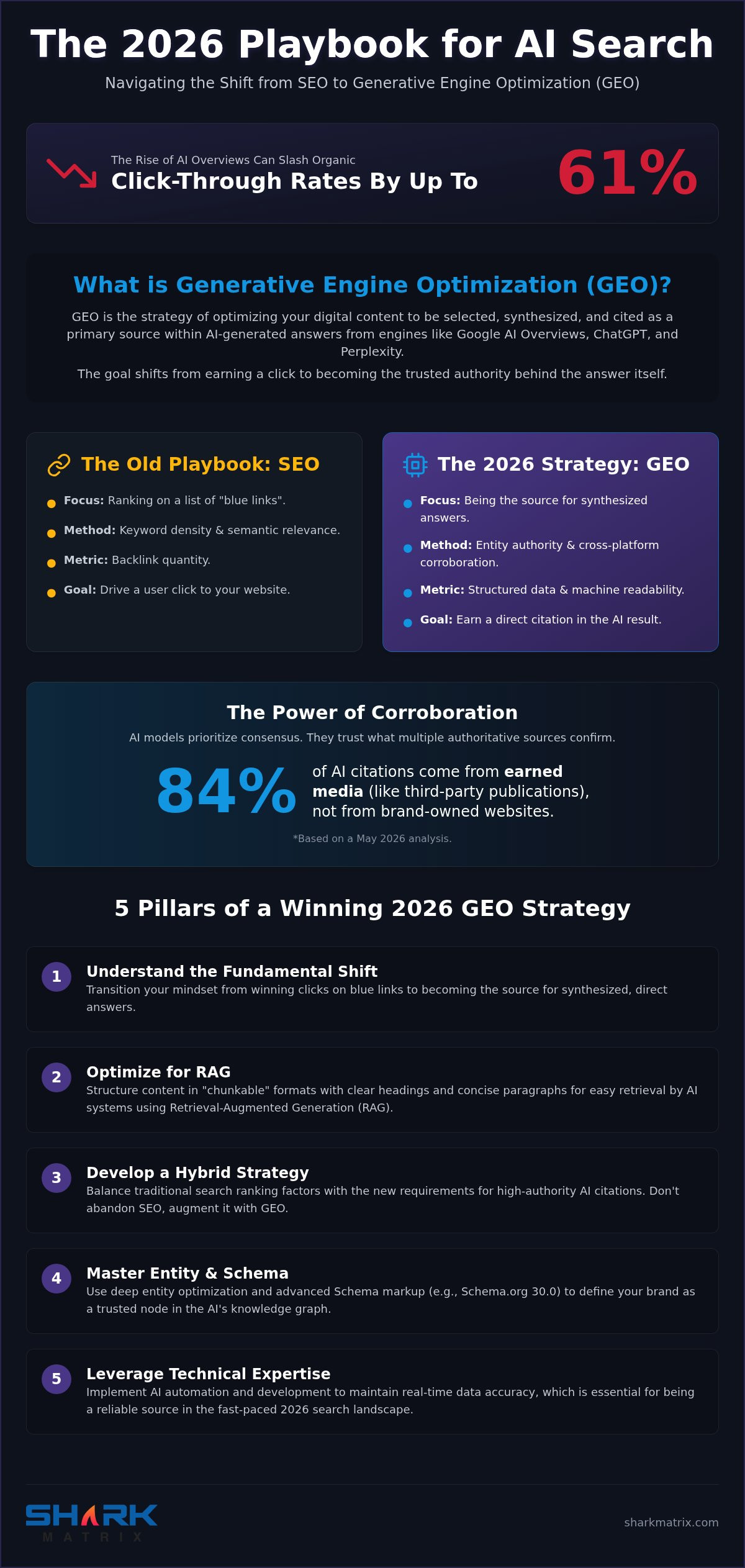
Did you know that the presence of a Google AI Overview can slash your organic click-through rate by as much as 61%? It is a startling reality for many digital marketers who find their hard-earned content buried behind automated summaries. As we look toward the future, sticking to old playbooks is no longer an option. You need a comprehensive generative engine optimization strategy 2026 to ensure your brand remains visible in a world where ChatGPT and Gemini now dominate search behavior.
It is completely understandable to feel concerned that LLMs are hiding your expertise from the very people you want to reach. You have likely noticed that traditional search traffic is harder to capture, and the way AI engines choose their sources can feel like a total mystery. This article will help you transition from traditional SEO to a high-impact strategy that secures brand citations directly within AI-driven results. We will provide a clear roadmap for 2026 visibility, covering everything from Schema.org 30.0 updates to the importance of earned media in securing those coveted AI mentions.
Key Takeaways
- Understand the fundamental shift from traditional blue links to synthesized answers and why 2026 is the critical tipping point for your digital presence.
- Learn how Retrieval-Augmented Generation (RAG) works so you can optimize your content for real-time AI retrieval and cross-platform corroboration.
- Develop a high-impact generative engine optimization strategy 2026 that balances traditional search rankings with the need for high-authority AI citations.
- Master the pillars of visibility, including deep entity optimization and advanced Schema markup that defines your brand as a trusted node in the knowledge graph.
- Discover why technical expertise in AI automation and development is essential for maintaining real-time data accuracy in the complex 2026 search landscape.
What is Generative Engine Optimization (GEO) in 2026?
By 2026, the digital landscape has fundamentally shifted from a list of “blue links” to a stream of synthesized answers. Generative Engine Optimization, or GEO, is the strategic process of optimizing your digital assets specifically for Large Language Models (LLMs) and Answer Engines. While traditional search engines once directed users to a variety of websites, today’s AI engines aim to provide the answer directly on the results page. Developing a comprehensive generative engine optimization strategy 2026 is the only way to ensure your brand is the one being synthesized into those answers.
The primary players in this space, including Google AI Overviews, Perplexity, ChatGPT Search, and Gemini, don’t just look for keywords. They look for authoritative entities that can corroborate a claim. Traditional ranking factors like backlink quantity or keyword density are no longer sufficient. AI engines require content that is structured for machine consumption while maintaining deep human expertise. Specialist firms like AISEOAgency SG help brands structure their digital presence for these conversational systems. If your brand isn’t cited by these engines, you simply don’t exist for a significant portion of your audience.
The Evolution from SEO to GEO
The transition from SEO to GEO represents a move from semantic relevance to entity relationship. In the past, you might have optimized for “best coffee maker.” Today, you must define your product as a specific node within a broader knowledge graph. This shift is driven by natural language processing services that allow engines to understand the “why” behind a query. Users no longer want to find a site; they want a solution. To understand the foundational concepts, many experts look at What is Generative Engine Optimization? to see how the industry has matured from simple indexing to complex synthesis.
The Business Impact of AI Citations
AI search results are often “winner-takes-all” scenarios. If an AI engine provides a single, definitive answer and cites your brand as the source, the intent of that traffic is significantly higher than a standard organic click. These users aren’t just browsing; they are consuming a recommendation from a platform they trust. Generative Engine Optimization serves as the bridge between technical data and AI understanding, and eCommerce businesses can discover eComQB for specialized strategies to thrive in this new environment.
A May 2026 analysis found that 84% of AI citations come from earned media, such as third party publications, rather than brand owned websites. This underscores why your generative engine optimization strategy 2026 must extend beyond your own domain. By aligning your content with the way LLMs retrieve information, you position your brand to capture high-value citations that competitors using outdated methods will miss. It’s about building a digital footprint that AI engines can’t ignore.
How AI Engines Process and Cite Content
AI engines don’t simply “rank” websites in a list. They ingest, synthesize, and reason through data to build a coherent response for the user. To stay visible, your generative engine optimization strategy 2026 must focus on technical accessibility. If an LLM cannot parse your site efficiently, it will simply skip over your expertise in favor of a source that is easier to “digest.” This process is largely driven by how models distinguish between their static training data and the real-time information they pull from the live web.
A critical part of this process is corroboration. AI models are trained to prioritize consensus. If multiple authoritative platforms mention your brand in a consistent context, the AI is more likely to trust and cite you as a factual source. This is why appearing in third-party publications is so vital; a May 2026 analysis found that 84% of AI citations come from earned media rather than brand-owned sites. You aren’t just optimizing for a bot; you’re optimizing for a global network of digital trust.
Retrieval-Augmented Generation (RAG) Explained
Engines like Perplexity and ChatGPT Search rely on Retrieval-Augmented Generation (RAG) to provide up-to-date answers. Instead of relying solely on what they learned during training, they use a search index to find current facts and then use the LLM to explain them. For your content to be selected, it needs to be “chunkable.” This means using clear headings and concise paragraphs that allow the engine to pull specific “vectors” of information. Understanding GEO vs. SEO: The Hybrid Search Strategy is essential here, as it highlights how traditional indexing still supports these modern retrieval methods.
Knowledge Graphs and Entity Authority
AI engines build a “Brand Memory” by connecting dots across the internet. They look for entities, which are unique people, places, or brands, and map the relationships between them. To help these engines understand your brand’s role, you should utilize natural language processing services to structure your data correctly. This technical footprint tells the AI exactly who you are and what you are an expert in. If you’re struggling to map your existing data to these new formats, exploring specialized ai automation services can help bridge the gap between your content and AI reasoning.
Crawlability is the final piece of the puzzle. With ChatGPT dominating 76.85% of the AI search market as of April 2026, ensuring that GPTBot has access to your site via your Robots.txt file is non-negotiable. Additionally, the tone of your content matters more than ever. Models now prioritize “Expert Advice” blocks that pull from content with high sentiment and first-hand experience. Maintaining a helpful, unbiased, and authoritative tone ensures that when an engine retrieves your data, it views your brand as a safe and reliable recommendation for the end user.
GEO vs. SEO: The Hybrid Search Strategy
Traditional SEO isn’t going away. Instead, it’s becoming the bedrock upon which AI discovery is built. You can’t have a successful generative engine optimization strategy 2026 without a robust SEO foundation. AI engines like Perplexity and Google’s AI Overviews still rely on traditional search indexes to find the information they synthesize. If your site isn’t indexed or lacks authority in the eyes of standard algorithms, it won’t make it into the retrieval pipeline. The two disciplines now exist in a symbiotic relationship where one provides the traffic and the other provides the authority.
The primary difference lies in the end goal. SEO focuses on Click-Through Rate (CTR) by making your link the most attractive option for a human user. GEO focuses on Citation Optimization, ensuring the AI model views your brand as the definitive source. Implementing a dual-purpose generative engine optimization strategy 2026 allows you to capture both traditional clicks and AI citations. As of early 2026, informational queries trigger AI Overviews about 50% of the time. This means your visibility depends on being the “expert” the AI quotes, rather than just a link in a list.
Technical SEO as the Foundation for GEO
AI crawlers require a clean technical environment to ingest data without friction. Site speed and mobile optimization remain critical benchmarks for bot efficiency. However, the real power lies in structured data. By March 2026, the latest version of Schema.org is 30.0. Using this version to mark up datasets and expert advice blocks is essential for AI engines to verify your claims. Internal linking also acts as a roadmap for LLMs. It helps models understand the hierarchy and context of your information, allowing them to “chunk” your content more effectively for real-time retrieval.
Measuring Success in the AI Era
Success in 2026 is measured by “Share of Model” (SoM). This involves tracking how frequently an AI engine cites your brand compared to your competitors for specific topics. You should also monitor the sentiment of these citations. Google’s updated AI Overviews now include specific “Expert Advice” blocks that pull directly from authoritative voices. If your brand is featured but the context is neutral or negative, your authority is at risk. Partnering with an experienced seo company dubai can help you navigate these new metrics while accounting for the specific dynamics of the Middle Eastern market and Arabic language processing.
5 Pillars of a Winning 2026 GEO Strategy
Building a successful generative engine optimization strategy 2026 requires moving from passive content creation to active technical authority. You can’t rely on keywords alone when AI models are looking for verified entities and corroborated facts. To secure your place in the synthesized answers of tomorrow, you must treat your digital presence as a structured knowledge base rather than a collection of pages.
- Step 1: Entity Optimization. Define your brand as a unique node in the global knowledge graph. AI engines need to understand your relationship to other high-authority entities in your industry.
- Step 2: Structured Data Supremacy. Go beyond basic tags. Use the latest Schema.org version 30.0, published on March 19, 2026, to provide deep context that AI crawlers can digest instantly.
- Step 3: Authoritative Citations. Since 84% of AI citations come from earned media, your strategy must include high-trust third-party platforms to validate your brand’s expertise.
- Step 4: Direct Answer Optimization. Structure your content with clear “Question-Answer” pairs. This makes it easier for RAG-based systems to extract your expertise for real-time queries.
- Step 5: Technical AI Alignment. Integrate generative ai development to optimize how your internal data is presented to external models.
Optimizing for Specific Engines
Each engine has its own “personality” and retrieval preferences. Google AI Overviews, following the May 6, 2026 update, place a heavy emphasis on “Expert Advice” blocks and first-hand experience. You should leverage your E-E-A-T signals to win these spots. For Perplexity, focus on academic-style citations and real-time data accuracy. ChatGPT currently dominates the market with a 76.85% share as of April 2026. To win here, your content must provide conversational value and a clear brand narrative that the model can easily summarize for the user.
Content Structuring for AI Extraction
LLMs use H-tags as semantic signposts to “chunk” your information. Use an “Inverted Pyramid 2.0” approach by leading every section with a direct, concise answer before diving into the details. This increases the likelihood of your content being captured as a featured snippet or AI citation. Implementing these structures across thousands of pages is a massive task. Utilizing professional ai development services helps automate this content structuring at scale, ensuring your entire site is machine-readable without losing its human appeal. If you want to future-proof your brand authority, explore how ai automation services can transform your technical SEO into a high-impact generative engine strategy.
Implementing GEO: Why a Technical Partner is Essential
By 2026, the sheer volume of data processed by Large Language Models makes it impossible to manage a generative engine optimization strategy 2026 through manual effort alone. Traditional SEO was often a game of patience and spreadsheets, but the AI landscape moves at the speed of compute. AI search engines are dynamic; they require real-time content updates and technical precision that only specialized software and engineering can provide. This is where ai automation services become indispensable. They ensure your brand’s data remains fresh and ready for retrieval by engines that update their indexes in minutes rather than weeks.
Shark Matrix Technologies serves as the critical bridge between software engineering and digital marketing. In a world where 76.85% of AI search usage is dominated by a single platform, you can’t afford technical friction. We specialize in building the infrastructure that allows AI crawlers to “read” your brand’s authority without ambiguity. Our expertise in Middle Eastern market dynamics and Arabic digital marketing adds another layer of complexity that generalist agencies often miss. We don’t just optimize for a bot; we build a technical ecosystem where your brand is the most logical answer for any engine to cite.
Custom AI Development for Search Dominance
Winning in the AI era requires more than just following best practices; it requires building your own tools. Advanced machine learning development services allow businesses to predict which content pieces are most likely to be cited based on current LLM behavior. Instead of guessing, you can use custom models to audit your site’s “chunkability” and entity authority. This technical approach extends to automating the deployment of Schema.org 30.0 across thousands of pages instantly, ensuring no manual errors slow down your visibility. By integrating ai chatbot-development services, you can also capture zero-click search intent directly on your own platform, keeping users engaged with your brand rather than a third-party engine.
Future-Proofing Your National Brand
For national-scale brands, the stakes are incredibly high. A drop in organic visibility due to AI Overviews can cripple revenue if you aren’t prepared to pivot. Shark Matrix is the preferred partner for national-scale execution because we treat your generative engine optimization strategy 2026 as a long-term technical roadmap. We focus on building a “Brand Memory” that persists across different models and updates. If you’re ready to secure your brand’s future and ensure your expertise isn’t hidden behind a wall of generated text, contact Shark Matrix for a 2026 GEO Audit today. Our team will help you transition from traditional search to AI-driven authority with a clear, data-backed plan.
Secure Your Brand’s Authority in the AI Era
The search landscape of 2026 demands more than just traditional keyword optimization. It requires a deep understanding of how Large Language Models retrieve and synthesize information. By prioritizing entity authority and technical accessibility, you can ensure your brand isn’t just indexed but cited as a primary source. Success now hinges on balancing human-centric expertise with machine-readable data structures that AI engines trust. You don’t have to navigate this transition alone.
Implementing a high-impact generative engine optimization strategy 2026 is a technical challenge that goes beyond standard marketing. Shark Matrix has been a leader in digital strategy since 2010, bringing deep roots in software engineering to the world of search. As specialists in AI and machine learning development, we provide the comprehensive national SEO and digital strategy needed for large-scale visibility. It’s time to bridge the gap between your content and the engines that define your brand’s reputation.
Partner with Shark Matrix for a Technical GEO Strategy and secure your place in the next generation of search. The future is automated, and your brand is ready to lead it.
Frequently Asked Questions
What is the main difference between SEO and GEO?
SEO focuses on ranking your website in traditional search results to drive direct clicks from human users. In contrast, GEO aims to have your brand cited and recommended within the synthesized answers generated by AI models. While SEO optimizes for users browsing blue links, GEO optimizes for LLMs that ingest and summarize your data into conversational responses.
How do I get my website cited by ChatGPT or Google AI Overviews?
Getting cited requires a strong presence on third-party authoritative platforms because AI models prioritize corroborated facts. A May 2026 analysis found that 84% of AI citations come from earned media rather than brand-owned sites. You must also ensure your site is technically accessible to crawlers like GPTBot and structured in a way that AI can easily “chunk” and retrieve your information.
Does traditional SEO still matter in 2026?
Traditional SEO is more important than ever because it provides the indexable data that AI engines rely on for real-time retrieval. A successful generative engine optimization strategy 2026 uses technical SEO as a foundation. Without high site speed, mobile optimization, and proper indexing, your content won’t even reach the stage where an AI can consider it for a citation.
How can AI development services improve my search visibility?
Custom ai development services allow you to build proprietary tools that audit your content’s entity authority and “chunkability.” These services can automate the implementation of advanced Schema markup and use machine learning to predict which content structures will perform best in AI search results. This technical edge is essential for managing large-scale digital footprints that manual SEO can’t handle effectively.
What are the best metrics to track for Generative Engine Optimization?
You should track Share of Model (SoM) to see how often you are cited compared to your direct competitors. Additionally, monitoring the sentiment of AI-generated answers and the frequency of “Expert Advice” block appearances provides a clearer picture of your digital authority. Traditional metrics like organic traffic are still useful, but they no longer tell the full story of your brand’s reach in an AI-dominated market.
How does structured data help with AI search engines?
Structured data provides the explicit context that AI engines need to verify facts and understand entity relationships. By implementing the latest Schema.org 30.0 markup, you reduce the chance of AI engines misinterpreting your data or “hallucinating” details about your brand. This technical clarity makes your website a much safer and more attractive source for an LLM to cite in its synthesized answers.
Can I use AI to optimize my content for GEO?
Yes, you can use generative tools to identify semantic gaps and reformat your content for better machine extraction. AI is particularly helpful for creating concise “Question-Answer” pairs and ensuring your headers act as clear signposts for retrieval bots. Using AI to optimize for AI creates a feedback loop that aligns your content with the specific way modern models process and summarize human language.
What is Share of Model (SoM) and why is it important?
Share of Model measures the percentage of times an AI engine mentions or recommends your brand for a specific category of queries. It’s the 2026 equivalent of “share of voice” in traditional media. A high SoM indicates that the AI’s training and retrieval data consistently point to your brand as a trusted authority, which is vital for maintaining visibility when AI Overviews appear in 50% of informational searches.
 OpenAI
 Codex
Codex
 Vertex AI
 Cloud Vision
 OpenCV
 TensorFlow
 IBM Watson
 Cloud Natural Language
 Cognitive Services
 Bot Framework
 Mistral
 LLama
LLama
 Gemini
 Anthropic
 N8N
N8N