

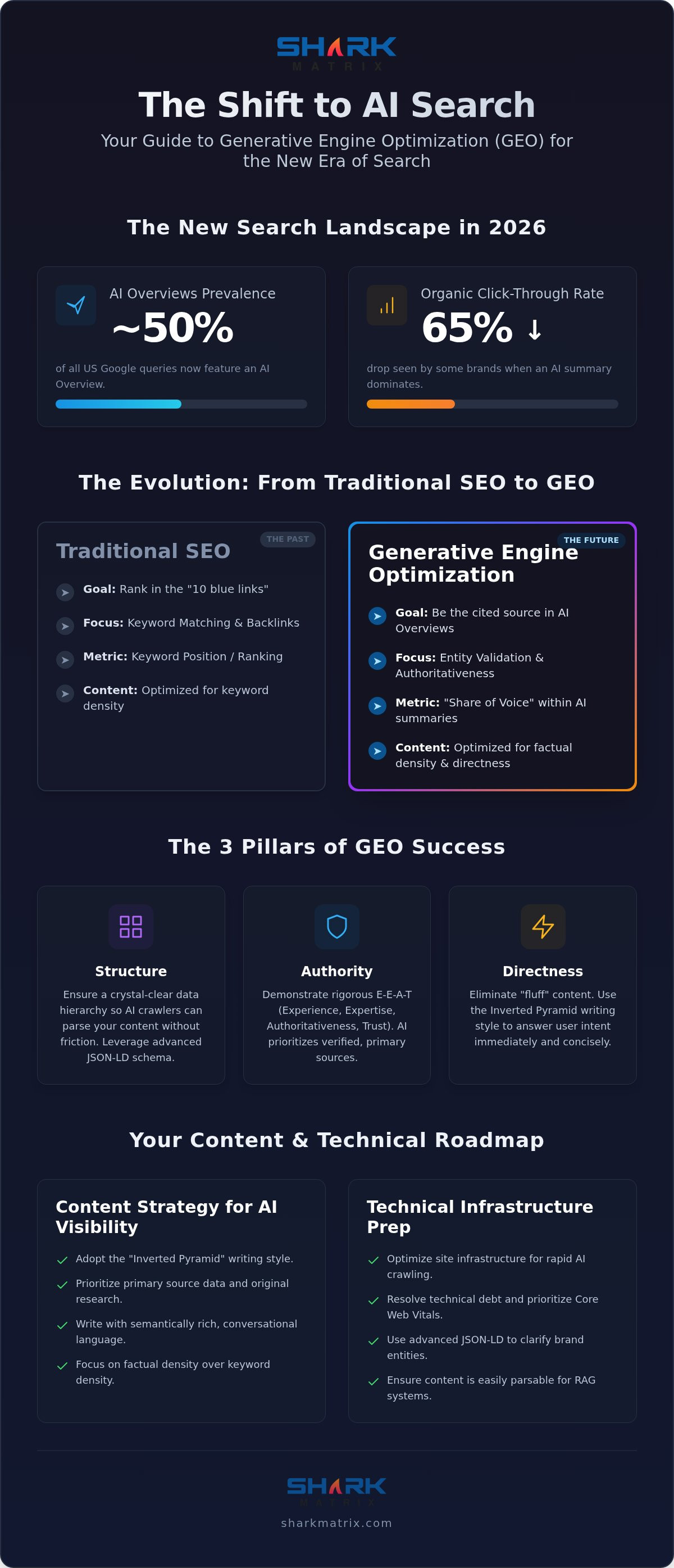
Did you know that as of early 2026, AI Overviews now appear in nearly 50% of all US Google queries? For many brands, this shift has triggered a sharp decline in organic click-through rates, with some studies showing a 65% drop when an AI summary dominates the screen. You’re likely feeling the pressure of this transition as traditional search evolves into a generative experience. Successfully preparing website for ai overviews is no longer optional; it’s a critical technical requirement to ensure your brand remains visible.
We understand the confusion surrounding the leap from SEO to Generative Engine Optimization (GEO). This guide provides a technical roadmap to secure your brand’s place in Google AI Overviews and master the shift from keyword matching to authoritative entity validation. We’ll examine how to resolve technical debt, leverage structured data, and align your content with the latest E-E-A-T standards to turn AI summaries into your primary traffic driver.
Key Takeaways
- Understand the shift from traditional search rankings to “share of voice” metrics within the mature 2026 AI Overview ecosystem.
- Learn the technical essentials for preparing website for ai overviews, including advanced JSON-LD schema markup to clarify your brand’s entities.
- Adopt the “Inverted Pyramid” writing style and prioritize primary source data to ensure your content is selected by AI synthesizers.
- Optimize your site infrastructure for rapid AI crawling by addressing technical debt and prioritizing Core Web Vitals.
- Discover how bridging the gap between digital marketing and generative AI development helps future-proof your brand against further search engine changes.
The Evolution of Search: Why AI Overviews Dominate in 2026
In 2026, the search bar has moved past the era of the “ten blue links.” Most users now interact with AI Overviews (AIO) as their primary interface for complex queries. The Evolution of Search has transformed the result page from a directory into a conversational engine. While the Search Generative Experience (SGE) was once an experimental feature, it’s now a mature ecosystem handling 48-50% of US Google queries as of early 2026. This shift has fundamentally changed user behavior. Instead of clicking through to multiple sites, users get synthesized answers immediately. This shift has led to a significant 65% drop in organic click-through rates for some queries. In this new environment, securing a citation within the AI summary is the new “Rank 1.”
How Google Selects Sources for AI Summaries
Google uses a process called Retrieval-Augmented Generation (RAG) to build these summaries. It doesn’t just guess; it retrieves specific data from the web and synthesizes it using advanced models like Gemini 3.6 Flash. Factual density and source reliability are the primary filters for selection. For “Your Money or Your Life” (YMYL) topics, such as healthcare where AIO prevalence hits 88%, Google prioritizes high-authority national sites. If you’re preparing website for ai overviews, you must focus on being a “Primary Source” that provides original research or proprietary data that the RAG process can’t find elsewhere.
The Shift from Keywords to Entities
Success in 2026 requires moving beyond simple keyword matching. Google now organizes information through the Knowledge Graph. The Knowledge Graph is the database of real-world objects and their relationships. Being a recognized “entity” in this graph is more valuable than ranking for a high-volume keyword. When Google’s natural language processing systems identify your brand as an authority on a specific topic, you’re more likely to be cited. Preparing website for ai overviews involves clarifying these entity relationships through technical infrastructure. This ensures the AI models understand exactly who you are and what expertise you provide, making your content the logical choice for a synthesized response.
Mastering Generative Engine Optimization (GEO) vs. Traditional SEO
In 2026, digital marketing has split into two parallel tracks: traditional SEO and Generative Engine Optimization (GEO). While SEO still handles the foundational aspects of site health and blue-link rankings, GEO is the specific discipline of optimizing for Large Language Models (LLMs) and AI synthesizers. When you are preparing website for ai overviews, you aren’t just trying to “rank” in the old sense. You are trying to become the definitive source the AI uses to build its summary. This shift has changed how we measure success. Traditional metrics like “position” are becoming less relevant as AI Overviews occupy the most valuable real estate on the screen. Instead, brands now track “share of voice” within these AI responses.
Conversational language is the new standard for content. Search prompts are getting longer and more complex, with 60% of question-style queries now triggering an AI summary. This makes Answer Engine Optimization (AEO) a critical subset of your strategy. You need to provide direct, concise answers to the specific questions your audience is asking. If you want to see how this works in practice, this AI Overviews optimization guide offers a deeper look at these new ranking factors.
The GEO Framework: Structure, Authority, and Directness
Success in GEO relies on three pillars. First, structure. Your data hierarchy must be crystal clear so AI crawlers can parse it without friction. Second, authority. The 2026 version of E-E-A-T is more rigorous than ever. Google’s systems look for verified experience and expertise before citing a source in an AIO. Finally, directness. “Fluff” content is the biggest enemy of AI citations. If your content takes too long to get to the point, the AI will simply skip it in favor of a more direct source that answers the user’s intent immediately.
Adapting Content for LLM Consumption
LLMs read content differently than traditional crawlers. They don’t just look for keyword matches; they use natural language processing to understand the underlying intent and semantic relevance of your writing. This means keyword density is officially a relic of the past. To win, your content must be semantically rich and contextually accurate. Preparing website for ai overviews requires a technical partner who understands these AI models from the inside out. If you’re struggling to adapt, exploring professional SEO services can help align your technical infrastructure with these new requirements.
The Content Strategy for AI Visibility: Quality Over Quantity
Successfully preparing website for ai overviews requires a departure from the high-volume content mills of the past. In 2026, AI synthesizers don’t need thousands of words of filler to understand a topic. They need “Primary Source” content. This includes original research, proprietary case studies, and unique data sets that your brand owns. When Google’s Retrieval-Augmented Generation (RAG) systems scan the web, they prioritize information that isn’t already duplicated across a thousand other sites. If you’re providing fresh, verified data, you’re much more likely to earn that coveted citation in an AI summary.
Your writing style must also adapt to the “Inverted Pyramid” format. Traditional SEO often buried the answer at the bottom of a page to increase dwell time. In the age of AI Overviews, this strategy fails. You must provide the answer first and the context later. AI models are programmed to find the most efficient response for the user. If your introductory paragraph doesn’t directly address the search intent, the model will likely pass you over for a competitor who gets straight to the point.
Focus on creating “Un-AI-able” content. These are human insights, nuanced perspectives, and first-hand experiences that a large language model cannot simply hallucinate or replicate. By emphasizing the “Experience” part of E-E-A-T, you provide a level of depth that adds value beyond a basic factual summary. This human element is what keeps users clicking through to your site even after they’ve read the AI’s brief overview.
Structuring Articles for Answer Extraction
To help AI models parse your site efficiently, treat your H2 and H3 tags as “query-answer” pairs. Each heading should represent a specific question, followed immediately by a fact-dense paragraph that provides a clear solution. This structure makes it easy for crawlers to identify exactly which part of your page solves the user’s problem. Bulleted lists act as “hooks” for AI summary generators by providing clearly delineated data points that the model can easily extract and present to the user. When you’re preparing website for ai overviews, these structural cues are just as important as the words themselves.
Building Brand Authority Through Digital PR
AI models don’t just look at your website; they look at what the rest of the internet says about you. External citations in national news outlets and high-authority industry platforms act as a validation layer for Google’s AI. There’s a direct connection between online reputation management and your performance in AIO. If your brand is mentioned frequently across multiple trusted platforms, the AI is more likely to view your site as a safe, authoritative source to cite. This multi-platform trust is the backbone of search visibility in 2026.
Technical Roadmap: Preparing Your Website Infrastructure
A high-performance technical foundation acts as the bridge between your content and the AI models that synthesize it. When you’re preparing website for ai overviews, the goal is to eliminate any friction that prevents AI agents from parsing your data. This roadmap focuses on five critical steps to modernize your infrastructure for the 2026 search environment.
- Step 1: Implementing Advanced Schema Markup. Use JSON-LD to provide explicit entity clarification, helping Google’s Knowledge Graph connect your brand to specific topics.
- Step 2: Optimizing Site Speed. AI models like Gemini 3.6 Flash require rapid access to content. High Core Web Vitals scores ensure that retrieval processes don’t time out during the synthesis phase.
- Step 3: AI-Friendly Sitemaps. Create a specialized sitemap that highlights your highest-value informational pages, making it easier for AI-specific crawlers to find your primary research.
- Step 4: Automated Auditing. Utilize ai automation services to audit and tag your content library at scale. This ensures every page has the correct semantic metadata without manual bottlenecking.
- Step 5: Mobile-First Excellence. Since most conversational search interactions happen on mobile devices, your site must provide a seamless experience for mobile-based AI agents.
Advanced Schema for 2026: Beyond the Basics
Schema markup has evolved into a sophisticated tool for voice and AI compatibility. Implementing Speakable Schema and FAQ Schema helps AI engines identify parts of your text that are suitable for verbal or summarized responses. You should also use “SameAs” properties to link your brand’s digital identity to established nodes in the Knowledge Graph. For businesses in the commercial space, Product and Review schema are essential. These tags help secure commercial AIO placements by providing structured data on pricing, availability, and user sentiment that AI models can verify and trust.
API-First Content and Technical Accessibility
The way you deliver data is just as important as the data itself. Headless CMS architectures are increasingly effective because they provide an API-first approach to content delivery. This allows search engines to pull raw data without wading through heavy front-end code. You must also update your robots.txt file to ensure it allows access for both standard Googlebot and newer AI-specific agents. Investing in generative ai development can help you build custom site tools, like interactive calculators or data synthesizers, that AI engines love to cite as authoritative sources.
If technical debt is holding back your AI visibility, you need a partner that understands the engineering behind the search engine. Explore our ai development services to modernize your infrastructure for the generative era.
Future-Proofing Your Brand with Shark Matrix Technologies LLC
Partnering with an AI-native agency is essential for maintaining search visibility in 2026. Traditional marketing firms often struggle with the technical complexities of software engineering and digital visibility. Shark Matrix Technologies LLC bridges this gap by combining specialized SEO services with deep AI engineering expertise. This dual approach is necessary because modern search engines are complex generative platforms rather than simple directories. Our national approach ensures your brand remains dominant as the search landscape shifts toward AI-driven results. We focus on the underlying mechanics of the models to ensure your site is built for the way systems like Gemini 3.6 Flash process and retrieve information.
Ongoing monitoring is the cornerstone of our strategy. AI algorithms change at a significantly faster pace than traditional search ranking factors. A strategy that earns a citation today might need adjustment tomorrow as Google updates its structural layouts or source selection logic. By maintaining a constant pulse on these shifts, Shark Matrix Technologies LLC helps you maintain brand authority in a landscape where traditional rankings have been replaced by generative dominance.
Data-Driven GEO Strategies
We move beyond guesswork by using proprietary tools to track your brand’s “AI Share of Voice” across diverse query types. This data allows for the continuous optimization of your content based on real-time AI citation patterns. To maximize the value of the traffic you receive, Shark Matrix Technologies LLC integrates ai chatbot development to engage users the moment they land on your site. This ensures that high-intent visitors driven by AI citations find the answers they need immediately, reducing bounce rates and improving conversion through personalized interactions.
Start Your AI Search Transformation
The first step in preparing website for ai overviews is a comprehensive AI-readiness audit. We analyze your technical debt, entity clarity, and factual density to identify exactly what’s preventing your content from being synthesized into AIO results. Transitioning to an AI-first digital presence requires a structural shift in how your website communicates with search agents. Preparing website for ai overviews today is the only way to safeguard your traffic against the rise of zero-click searches. Reach out to Shark Matrix Technologies LLC for a national consultation on search dominance and secure your brand’s place at the top of the generative era.
Lead the Generative Search Revolution
The transition to a generative search environment isn’t a temporary trend; it’s the new standard for digital visibility. Success now depends on moving beyond surface-level keyword matching to focus on deep technical infrastructure and verified entity authority. By prioritizing original research and structured JSON-LD data, you ensure that AI models recognize your site as a trusted source. Successfully preparing website for ai overviews is the most effective way to turn the rise of zero-click searches into a long-term advantage for your brand.
Shark Matrix Technologies LLC acts as your technical partner in this new era. As national brand growth specialists, we provide the specialized engineering required to integrate AI and SEO seamlessly. Our expertise in Generative Engine Optimization (GEO) ensures your brand isn’t just visible but dominant in the summaries your customers read every day. Secure your brand’s future in AI search with Shark Matrix Technologies LLC and lead the shift toward a more intelligent search presence. The future of search has arrived, and it’s time to claim your place at the top.
Frequently Asked Questions
What is the main difference between SEO and GEO in 2026?
Traditional SEO focuses on ranking factors for standard blue links, while Generative Engine Optimization (GEO) optimizes for Large Language Model synthesis. SEO aims for a specific position on the page. In contrast, GEO aims for “share of voice” within a generated summary. It’s a fundamental shift from being a suggested link to being the actual source of the answer.
Will AI Overviews reduce my website traffic?
AI Overviews often reduce total organic clicks for simple informational queries that result in zero-click searches. However, being cited in an AIO frequently drives higher-intent traffic to your site. Users who click a citation link are usually further along in their journey. This makes preparing website for ai overviews essential for maintaining high-quality lead generation.
How long does it take to see results from AI Overview optimization?
You can often see changes in AI citations within a few weeks of implementing technical updates. Google’s AI agents re-evaluate entity relationships much faster than traditional ranking systems. If you update your schema and content structure correctly, your brand can appear in new summaries as soon as the next crawl cycle finishes.
Do I need to change my existing content to rank in AI Overviews?
Most existing content requires restructuring to follow an “answer-first” format. You should prioritize direct, factual answers at the beginning of your sections and remove unnecessary filler. AI models prioritize factual density and concise delivery. If your current articles are too long or vague, they’re less likely to be selected as a primary source for a summary.
Is structured data more important for AI than it was for traditional search?
Structured data is now the primary tool for providing explicit entity clarification to AI models. In traditional search, schema was largely used for rich snippets. In 2026, JSON-LD acts as the blueprint that tells Large Language Models exactly how your data relates to the Knowledge Graph. Without it, the AI might misinterpret your expertise or ignore your site.
Can I opt out of my website being used in Google AI Overviews?
There’s currently no way to opt out of AI Overviews without also removing your pages from Google Search results entirely. Using `noindex` tags will stop the AI from citing you, but it also hides your site from traditional rankings. Google treats indexing and AI synthesis as a package deal. Most brands find it more effective to optimize for the citation instead.
How does Google verify the facts in its AI-generated summaries?
Google’s systems use Retrieval-Augmented Generation (RAG) to cross-reference your content against other high-authority data points. The model prioritizes information that is consistent across multiple trusted platforms. This is why building digital PR and external citations is critical. If your facts are corroborated by national news or industry journals, the AI views your content as more reliable.
What role does mobile optimization play in AI search results?
Mobile optimization is critical because most conversational AI searches happen on mobile devices. Since over 60% of question-style queries occur on mobile, your site must load instantly for mobile-based AI agents. Preparing website for ai overviews requires a mobile-first approach to ensure that technical data delivery is never interrupted by slow speeds or poor responsive design.
 OpenAI
 Codex
Codex
 Vertex AI
 Cloud Vision
 OpenCV
 TensorFlow
 IBM Watson
 Cloud Natural Language
 Cognitive Services
 Bot Framework
 Mistral
 LLama
LLama
 Gemini
 Anthropic
 N8N
N8N