
Categories
Digital Marketing

2026 Guide: Optimizing Websites for AI Overviews

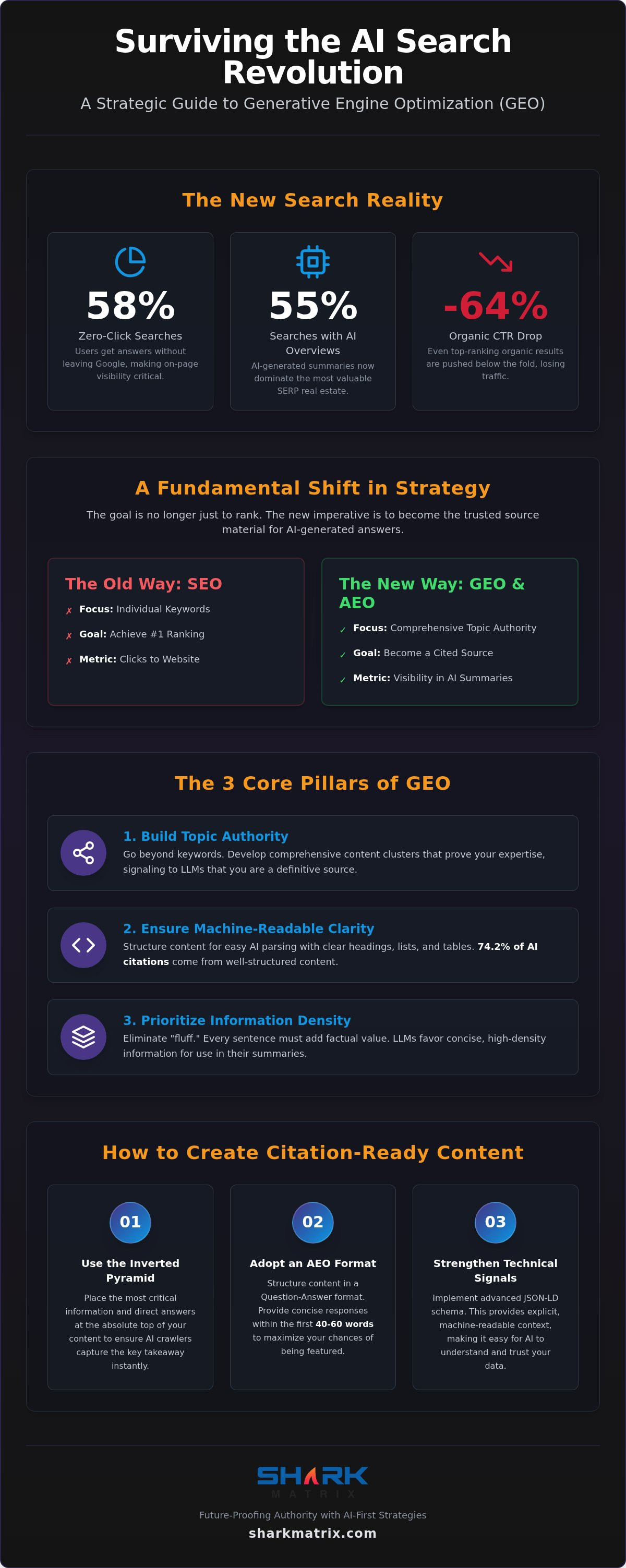
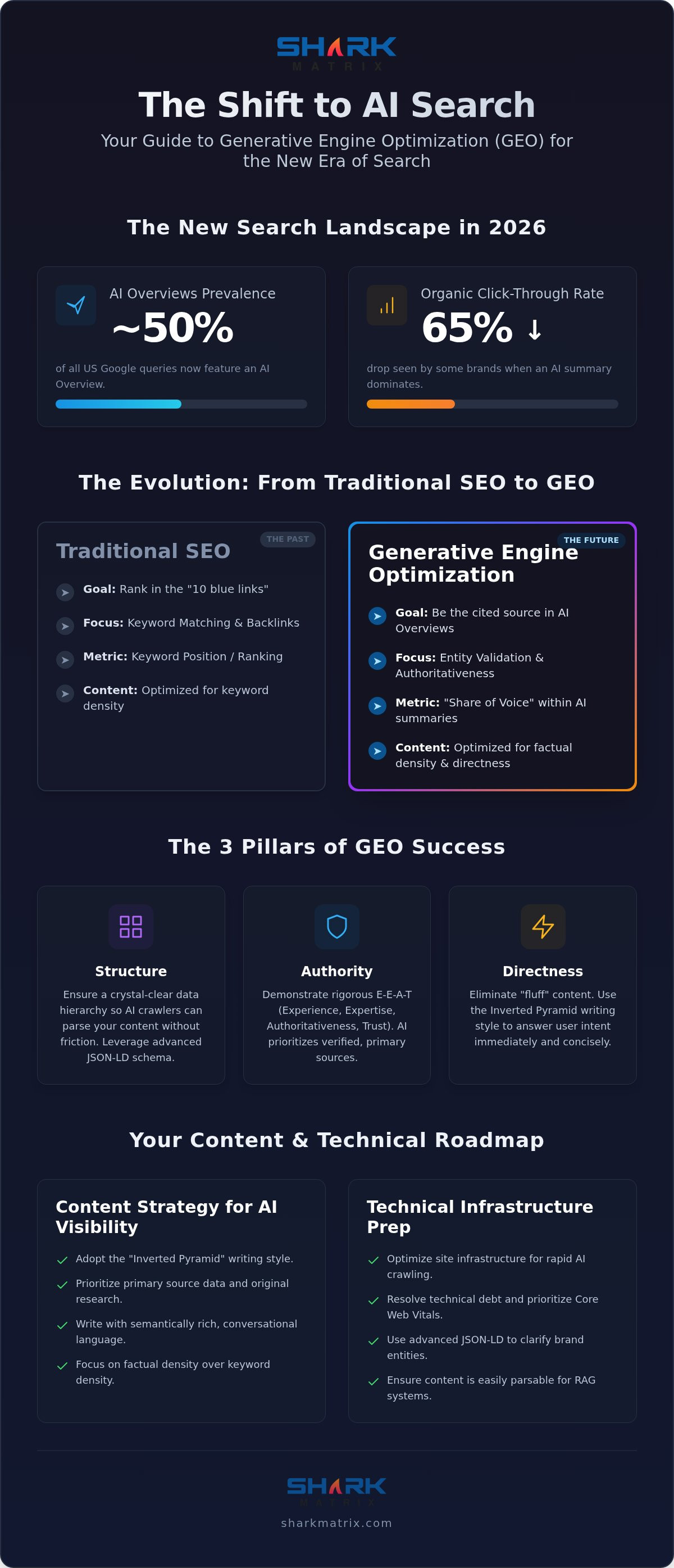
Did you know that as of early 2026, AI Overviews now appear in nearly 50% of all US Google queries? For many brands, this shift has triggered a sharp decline in organic click-through rates, with some studies showing a 65% drop when an AI summary dominates the screen. You’re likely feeling the pressure of this transition as traditional search evolves into a generative experience. Successfully preparing website for ai overviews is no longer optional; it’s a critical technical requirement to ensure your brand remains visible.

We understand the confusion surrounding the leap from SEO to Generative Engine Optimization (GEO). This guide provides a technical roadmap to secure your brand’s place in Google AI Overviews and master the shift from keyword matching to authoritative entity validation. We’ll examine how to resolve technical debt, leverage structured data, and align your content with the latest E-E-A-T standards to turn AI summaries into your primary traffic driver.

Key Takeaways

  • Understand the shift from traditional search rankings to “share of voice” metrics within the mature 2026 AI Overview ecosystem.
  • Learn the technical essentials for preparing website for ai overviews, including advanced JSON-LD schema markup to clarify your brand’s entities.
  • Adopt the “Inverted Pyramid” writing style and prioritize primary source data to ensure your content is selected by AI synthesizers.
  • Optimize your site infrastructure for rapid AI crawling by addressing technical debt and prioritizing Core Web Vitals.
  • Discover how bridging the gap between digital marketing and generative AI development helps future-proof your brand against further search engine changes.

The Evolution of Search: Why AI Overviews Dominate in 2026

In 2026, the search bar has moved past the era of the “ten blue links.” Most users now interact with AI Overviews (AIO) as their primary interface for complex queries. The Evolution of Search has transformed the result page from a directory into a conversational engine. While the Search Generative Experience (SGE) was once an experimental feature, it’s now a mature ecosystem handling 48-50% of US Google queries as of early 2026. This shift has fundamentally changed user behavior. Instead of clicking through to multiple sites, users get synthesized answers immediately. This shift has led to a significant 65% drop in organic click-through rates for some queries. In this new environment, securing a citation within the AI summary is the new “Rank 1.”

How Google Selects Sources for AI Summaries

Google uses a process called Retrieval-Augmented Generation (RAG) to build these summaries. It doesn’t just guess; it retrieves specific data from the web and synthesizes it using advanced models like Gemini 3.6 Flash. Factual density and source reliability are the primary filters for selection. For “Your Money or Your Life” (YMYL) topics, such as healthcare where AIO prevalence hits 88%, Google prioritizes high-authority national sites. If you’re preparing website for ai overviews, you must focus on being a “Primary Source” that provides original research or proprietary data that the RAG process can’t find elsewhere.

The Shift from Keywords to Entities

Success in 2026 requires moving beyond simple keyword matching. Google now organizes information through the Knowledge Graph. The Knowledge Graph is the database of real-world objects and their relationships. Being a recognized “entity” in this graph is more valuable than ranking for a high-volume keyword. When Google’s natural language processing systems identify your brand as an authority on a specific topic, you’re more likely to be cited. Preparing website for ai overviews involves clarifying these entity relationships through technical infrastructure. This ensures the AI models understand exactly who you are and what expertise you provide, making your content the logical choice for a synthesized response.

Mastering Generative Engine Optimization (GEO) vs. Traditional SEO

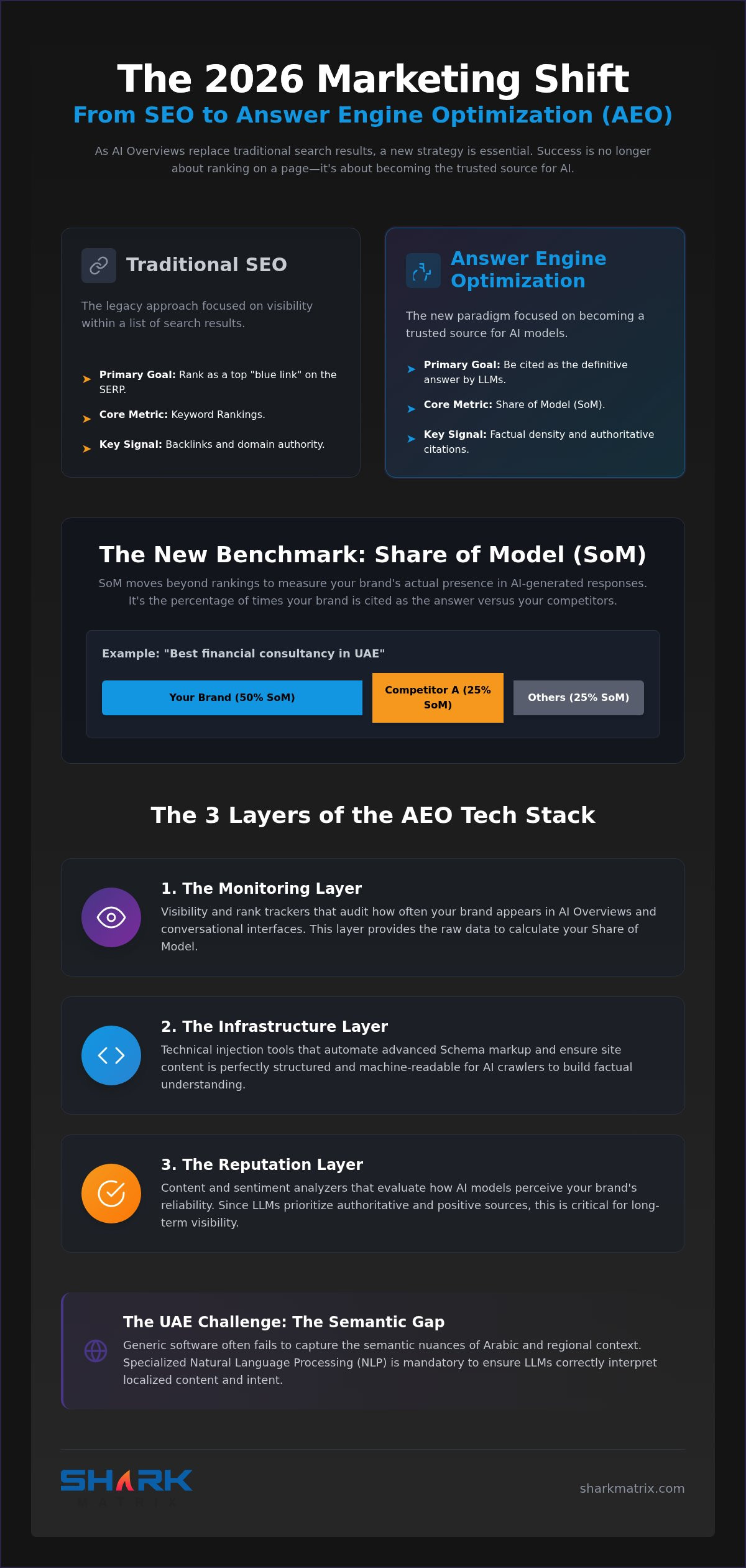
In 2026, digital marketing has split into two parallel tracks: traditional SEO and Generative Engine Optimization (GEO). While SEO still handles the foundational aspects of site health and blue-link rankings, GEO is the specific discipline of optimizing for Large Language Models (LLMs) and AI synthesizers. When you are preparing website for ai overviews, you aren’t just trying to “rank” in the old sense. You are trying to become the definitive source the AI uses to build its summary. This shift has changed how we measure success. Traditional metrics like “position” are becoming less relevant as AI Overviews occupy the most valuable real estate on the screen. Instead, brands now track “share of voice” within these AI responses.

Conversational language is the new standard for content. Search prompts are getting longer and more complex, with 60% of question-style queries now triggering an AI summary. This makes Answer Engine Optimization (AEO) a critical subset of your strategy. You need to provide direct, concise answers to the specific questions your audience is asking. If you want to see how this works in practice, this AI Overviews optimization guide offers a deeper look at these new ranking factors.

The GEO Framework: Structure, Authority, and Directness

Success in GEO relies on three pillars. First, structure. Your data hierarchy must be crystal clear so AI crawlers can parse it without friction. Second, authority. The 2026 version of E-E-A-T is more rigorous than ever. Google’s systems look for verified experience and expertise before citing a source in an AIO. Finally, directness. “Fluff” content is the biggest enemy of AI citations. If your content takes too long to get to the point, the AI will simply skip it in favor of a more direct source that answers the user’s intent immediately.

Adapting Content for LLM Consumption

LLMs read content differently than traditional crawlers. They don’t just look for keyword matches; they use natural language processing to understand the underlying intent and semantic relevance of your writing. This means keyword density is officially a relic of the past. To win, your content must be semantically rich and contextually accurate. Preparing website for ai overviews requires a technical partner who understands these AI models from the inside out. If you’re struggling to adapt, exploring professional SEO services can help align your technical infrastructure with these new requirements.

2026 Guide: Optimizing Websites for AI Overviews

The Content Strategy for AI Visibility: Quality Over Quantity

Successfully preparing website for ai overviews requires a departure from the high-volume content mills of the past. In 2026, AI synthesizers don’t need thousands of words of filler to understand a topic. They need “Primary Source” content. This includes original research, proprietary case studies, and unique data sets that your brand owns. When Google’s Retrieval-Augmented Generation (RAG) systems scan the web, they prioritize information that isn’t already duplicated across a thousand other sites. If you’re providing fresh, verified data, you’re much more likely to earn that coveted citation in an AI summary.

Your writing style must also adapt to the “Inverted Pyramid” format. Traditional SEO often buried the answer at the bottom of a page to increase dwell time. In the age of AI Overviews, this strategy fails. You must provide the answer first and the context later. AI models are programmed to find the most efficient response for the user. If your introductory paragraph doesn’t directly address the search intent, the model will likely pass you over for a competitor who gets straight to the point.

Focus on creating “Un-AI-able” content. These are human insights, nuanced perspectives, and first-hand experiences that a large language model cannot simply hallucinate or replicate. By emphasizing the “Experience” part of E-E-A-T, you provide a level of depth that adds value beyond a basic factual summary. This human element is what keeps users clicking through to your site even after they’ve read the AI’s brief overview.

Structuring Articles for Answer Extraction

To help AI models parse your site efficiently, treat your H2 and H3 tags as “query-answer” pairs. Each heading should represent a specific question, followed immediately by a fact-dense paragraph that provides a clear solution. This structure makes it easy for crawlers to identify exactly which part of your page solves the user’s problem. Bulleted lists act as “hooks” for AI summary generators by providing clearly delineated data points that the model can easily extract and present to the user. When you’re preparing website for ai overviews, these structural cues are just as important as the words themselves.

Building Brand Authority Through Digital PR

AI models don’t just look at your website; they look at what the rest of the internet says about you. External citations in national news outlets and high-authority industry platforms act as a validation layer for Google’s AI. There’s a direct connection between online reputation management and your performance in AIO. If your brand is mentioned frequently across multiple trusted platforms, the AI is more likely to view your site as a safe, authoritative source to cite. This multi-platform trust is the backbone of search visibility in 2026.

Technical Roadmap: Preparing Your Website Infrastructure

A high-performance technical foundation acts as the bridge between your content and the AI models that synthesize it. When you’re preparing website for ai overviews, the goal is to eliminate any friction that prevents AI agents from parsing your data. This roadmap focuses on five critical steps to modernize your infrastructure for the 2026 search environment.

  • Step 1: Implementing Advanced Schema Markup. Use JSON-LD to provide explicit entity clarification, helping Google’s Knowledge Graph connect your brand to specific topics.
  • Step 2: Optimizing Site Speed. AI models like Gemini 3.6 Flash require rapid access to content. High Core Web Vitals scores ensure that retrieval processes don’t time out during the synthesis phase.
  • Step 3: AI-Friendly Sitemaps. Create a specialized sitemap that highlights your highest-value informational pages, making it easier for AI-specific crawlers to find your primary research.
  • Step 4: Automated Auditing. Utilize ai automation services to audit and tag your content library at scale. This ensures every page has the correct semantic metadata without manual bottlenecking.
  • Step 5: Mobile-First Excellence. Since most conversational search interactions happen on mobile devices, your site must provide a seamless experience for mobile-based AI agents.

Advanced Schema for 2026: Beyond the Basics

Schema markup has evolved into a sophisticated tool for voice and AI compatibility. Implementing Speakable Schema and FAQ Schema helps AI engines identify parts of your text that are suitable for verbal or summarized responses. You should also use “SameAs” properties to link your brand’s digital identity to established nodes in the Knowledge Graph. For businesses in the commercial space, Product and Review schema are essential. These tags help secure commercial AIO placements by providing structured data on pricing, availability, and user sentiment that AI models can verify and trust.

API-First Content and Technical Accessibility

The way you deliver data is just as important as the data itself. Headless CMS architectures are increasingly effective because they provide an API-first approach to content delivery. This allows search engines to pull raw data without wading through heavy front-end code. You must also update your robots.txt file to ensure it allows access for both standard Googlebot and newer AI-specific agents. Investing in generative ai development can help you build custom site tools, like interactive calculators or data synthesizers, that AI engines love to cite as authoritative sources.

If technical debt is holding back your AI visibility, you need a partner that understands the engineering behind the search engine. Explore our ai development services to modernize your infrastructure for the generative era.

Future-Proofing Your Brand with Shark Matrix Technologies LLC

Partnering with an AI-native agency is essential for maintaining search visibility in 2026. Traditional marketing firms often struggle with the technical complexities of software engineering and digital visibility. Shark Matrix Technologies LLC bridges this gap by combining specialized SEO services with deep AI engineering expertise. This dual approach is necessary because modern search engines are complex generative platforms rather than simple directories. Our national approach ensures your brand remains dominant as the search landscape shifts toward AI-driven results. We focus on the underlying mechanics of the models to ensure your site is built for the way systems like Gemini 3.6 Flash process and retrieve information.

Ongoing monitoring is the cornerstone of our strategy. AI algorithms change at a significantly faster pace than traditional search ranking factors. A strategy that earns a citation today might need adjustment tomorrow as Google updates its structural layouts or source selection logic. By maintaining a constant pulse on these shifts, Shark Matrix Technologies LLC helps you maintain brand authority in a landscape where traditional rankings have been replaced by generative dominance.

Data-Driven GEO Strategies

We move beyond guesswork by using proprietary tools to track your brand’s “AI Share of Voice” across diverse query types. This data allows for the continuous optimization of your content based on real-time AI citation patterns. To maximize the value of the traffic you receive, Shark Matrix Technologies LLC integrates ai chatbot development to engage users the moment they land on your site. This ensures that high-intent visitors driven by AI citations find the answers they need immediately, reducing bounce rates and improving conversion through personalized interactions.

Start Your AI Search Transformation

The first step in preparing website for ai overviews is a comprehensive AI-readiness audit. We analyze your technical debt, entity clarity, and factual density to identify exactly what’s preventing your content from being synthesized into AIO results. Transitioning to an AI-first digital presence requires a structural shift in how your website communicates with search agents. Preparing website for ai overviews today is the only way to safeguard your traffic against the rise of zero-click searches. Reach out to Shark Matrix Technologies LLC for a national consultation on search dominance and secure your brand’s place at the top of the generative era.

Lead the Generative Search Revolution

The transition to a generative search environment isn’t a temporary trend; it’s the new standard for digital visibility. Success now depends on moving beyond surface-level keyword matching to focus on deep technical infrastructure and verified entity authority. By prioritizing original research and structured JSON-LD data, you ensure that AI models recognize your site as a trusted source. Successfully preparing website for ai overviews is the most effective way to turn the rise of zero-click searches into a long-term advantage for your brand.

Shark Matrix Technologies LLC acts as your technical partner in this new era. As national brand growth specialists, we provide the specialized engineering required to integrate AI and SEO seamlessly. Our expertise in Generative Engine Optimization (GEO) ensures your brand isn’t just visible but dominant in the summaries your customers read every day. Secure your brand’s future in AI search with Shark Matrix Technologies LLC and lead the shift toward a more intelligent search presence. The future of search has arrived, and it’s time to claim your place at the top.

Frequently Asked Questions

What is the main difference between SEO and GEO in 2026?

Traditional SEO focuses on ranking factors for standard blue links, while Generative Engine Optimization (GEO) optimizes for Large Language Model synthesis. SEO aims for a specific position on the page. In contrast, GEO aims for “share of voice” within a generated summary. It’s a fundamental shift from being a suggested link to being the actual source of the answer.

Will AI Overviews reduce my website traffic?

AI Overviews often reduce total organic clicks for simple informational queries that result in zero-click searches. However, being cited in an AIO frequently drives higher-intent traffic to your site. Users who click a citation link are usually further along in their journey. This makes preparing website for ai overviews essential for maintaining high-quality lead generation.

How long does it take to see results from AI Overview optimization?

You can often see changes in AI citations within a few weeks of implementing technical updates. Google’s AI agents re-evaluate entity relationships much faster than traditional ranking systems. If you update your schema and content structure correctly, your brand can appear in new summaries as soon as the next crawl cycle finishes.

Do I need to change my existing content to rank in AI Overviews?

Most existing content requires restructuring to follow an “answer-first” format. You should prioritize direct, factual answers at the beginning of your sections and remove unnecessary filler. AI models prioritize factual density and concise delivery. If your current articles are too long or vague, they’re less likely to be selected as a primary source for a summary.

Is structured data more important for AI than it was for traditional search?

Structured data is now the primary tool for providing explicit entity clarification to AI models. In traditional search, schema was largely used for rich snippets. In 2026, JSON-LD acts as the blueprint that tells Large Language Models exactly how your data relates to the Knowledge Graph. Without it, the AI might misinterpret your expertise or ignore your site.

Can I opt out of my website being used in Google AI Overviews?

There’s currently no way to opt out of AI Overviews without also removing your pages from Google Search results entirely. Using `noindex` tags will stop the AI from citing you, but it also hides your site from traditional rankings. Google treats indexing and AI synthesis as a package deal. Most brands find it more effective to optimize for the citation instead.

How does Google verify the facts in its AI-generated summaries?

Google’s systems use Retrieval-Augmented Generation (RAG) to cross-reference your content against other high-authority data points. The model prioritizes information that is consistent across multiple trusted platforms. This is why building digital PR and external citations is critical. If your facts are corroborated by national news or industry journals, the AI views your content as more reliable.

What role does mobile optimization play in AI search results?

Mobile optimization is critical because most conversational AI searches happen on mobile devices. Since over 60% of question-style queries occur on mobile, your site must load instantly for mobile-based AI agents. Preparing website for ai overviews requires a mobile-first approach to ensure that technical data delivery is never interrupted by slow speeds or poor responsive design.

Categories
AEO

AEO Marketing Strategy: The 2026 Guide to AI Search Visibility

Your content is ranking. Your traffic is dropping. That’s the quiet crisis hitting digital marketers right now, and a smarter aeo marketing strategy is the clearest path out of it. Zero-click searches, AI-generated summaries, and chatbot responses are answering user questions before a single link gets clicked, and brands that haven’t adapted are watching their visibility erode in real time.

You already know something has shifted. The search results page you optimized for last year looks nothing like the one your customers see today. Google’s AI Overviews, ChatGPT, Perplexity, and a growing list of answer engines are now the first stop for millions of queries, and they don’t rank ten blue links. They cite one authoritative source, or none at all.

This guide is built to change that for your brand. You’ll learn how Answer Engine Optimization works, why it’s a technical infrastructure play as much as a content strategy, and exactly how to position your business as the definitive source that AI engines cite by default. From structured data and entity authority to NLP signals and brand trust, here’s everything you need to future-proof your digital presence heading into 2026.

Key Takeaways

  • A well-executed aeo marketing strategy requires both a technical foundation — including Schema.org and JSON-LD implementation — and a content architecture built around conversational question-answer pairs that AI engines can cite directly.
  • The KPIs that define search success are changing: citations and brand mentions in AI-generated answers are becoming more valuable signals than traditional clicks and impressions.
  • Backlinks are evolving from “link juice” into “source validation” — the brands AI engines trust most are those with authoritative, consistently structured information across the web.
  • Running an Answer Audit on your existing content is the critical first step to identifying gaps between what your brand currently answers and what AI engines are actually being asked.
  • Integrating AI automation capabilities with AEO execution — rather than treating them as separate disciplines — is what separates brands that get cited from those that get ignored entirely.

What is Answer Engine Optimization (AEO) in 2026?

Answer Engine Optimization is the practice of structuring your content, technical infrastructure, and brand authority so that AI-powered platforms select your business as the definitive source when answering a user’s query. It’s not about ranking higher in a list. It’s about being the answer itself.

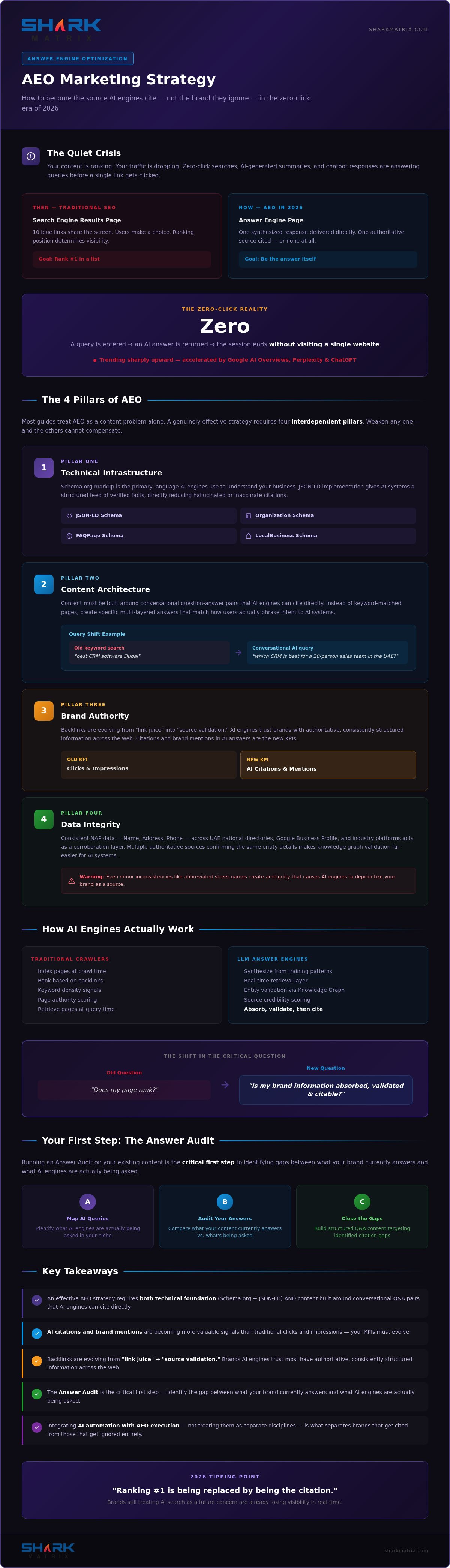
That distinction matters more than most brands realize. Traditional SEO competed for position on a Search Engine Results Page, where ten links shared the screen and users made a choice. The emerging reality is an Answer Engine Page, where a single synthesized response is delivered directly to the user, often without a clickable link in sight. The brands that don’t adapt their aeo marketing strategy to this shift aren’t losing ground slowly. They’re becoming invisible.

The Rise of the Zero-Click Search

Zero-click search is the dominant 2026 user behavior: a query is entered, an AI-generated answer is returned, and the session ends without a single website being visited. According to data cited by SparkToro and others tracking SERP behavior, zero-click outcomes have been trending upward for years, accelerating sharply as Google AI Overviews, Perplexity, and ChatGPT’s search functionality have matured.

The behavioral shift runs deeper than convenience. Conversational AI has changed how users frame their intent. Instead of typing “best CRM software Dubai,” a user now asks “which CRM is best for a 20-person sales team in the UAE?” That’s a specific, multi-layered question that a traditional keyword-matched result handles poorly. An LLM-powered answer engine handles it precisely, pulling from sources it has already validated as authoritative.

Answer Engines vs. Traditional Search Engines

Traditional search crawlers index pages and rank them based on signals like backlinks, keyword density, and page authority. Large Language Models work differently. They don’t retrieve pages at query time the way a crawler does. Instead, they synthesize responses from patterns learned during training, supplemented by real-time retrieval layers in tools like Perplexity and SearchGPT. The question isn’t whether your page ranks. The question is whether your brand’s information has been absorbed, validated, and deemed citable.

Google’s Knowledge Graph plays a critical role here. It acts as a verification layer, cross-referencing structured entity data to confirm that a brand is what it claims to be. For UAE-based businesses, this matters acutely: as national brands compete for AI citations in a market where local search authority is still being established, the brands with the clearest entity footprint win the citation.

Ranking number one is being replaced by being the citation. That’s the core logic driving every element of a modern aeo marketing strategy, and it’s why 2026 represents a genuine tipping point for brands across the UAE that have been treating AI search as a future concern rather than a present priority.

The Pillars of a Winning AEO Marketing Strategy

Most guides treat AEO as a content problem. Write better answers, structure your FAQs, and the citations will follow. That’s a partial truth that leads to incomplete execution. A genuinely effective aeo marketing strategy is built on four interdependent pillars: technical infrastructure, content architecture, brand authority, and data integrity. Weaken any one of them, and the others can’t compensate.

Structured Data and Knowledge Graphs

Schema.org markup isn’t a nice-to-have in 2026. It’s the primary language AI engines use to understand what your business is, what it does, and whether it’s trustworthy enough to cite. Implementing Organization, FAQPage, HowTo, and LocalBusiness schema in JSON-LD format gives AI systems a structured feed of verified facts about your brand, directly reducing the risk of hallucinated or inaccurate citations.

Consistent NAP data, your Name, Address, and Phone number, across UAE national directories, Google Business Profile, and industry-specific platforms acts as a corroboration layer. When multiple authoritative sources confirm the same entity details, knowledge graph validation becomes far easier for AI systems to complete. Inconsistencies, even minor ones like abbreviated street names, create ambiguity that causes AI engines to deprioritize a source in favor of one that’s cleaner.

This is where natural language processing capabilities become operationally valuable. NLP models parse the semantic context around your brand mentions, not just the entity name itself. A business described consistently as a “UAE-based AI development and SEO agency” across structured and unstructured sources builds a richer, more citable entity profile than one whose descriptions vary by platform.

Conversational Content Design

Voice search and AI-generated verbal responses share a common requirement: answers that sound natural when spoken aloud. That means writing in plain, direct language, front-loading the answer before the explanation, and avoiding the dense, qualifier-heavy prose that reads well on a page but fails when a device reads it back to a user.

Structuring H2s and H3s as direct questions is one of the highest-leverage changes a content team can make. Headings like “What schema types does Google use for AI Overviews?” map precisely to how users phrase queries to AI assistants. That alignment increases the probability of triggering a featured snippet or AI Overview citation.

Long-form content also needs a structural rethink. Leading with a concise answer block, a genuine TL;DR that resolves the core question in two or three sentences, serves two audiences simultaneously: the AI engine scanning for a citable response and the human reader who wants the conclusion before the argument.

Across all four pillars, the underlying principle is the same: make it effortless for AI systems to find, parse, and trust your information. Brands building this infrastructure now are the ones that will own citations as AI search continues to mature. If you’re assessing where your current content and technical setup stand against these requirements, exploring a structured SEO and AEO audit is a practical starting point.

The final pillar, data cleanliness, ties everything together. Contradictory information across your own site, outdated service descriptions, and unresolved entity conflicts are the inputs that produce AI hallucinations. Clean, consistent, structured data isn’t just good hygiene; it’s what separates a brand that gets cited accurately from one that gets cited incorrectly, or not at all.

AEO Marketing Strategy: The 2026 Guide to AI Search Visibility

AEO vs. Traditional SEO: Navigating the Zero-Click Era

The metrics that defined search success for the past decade are no longer telling the full story. Clicks, impressions, and average position made sense when the goal was to earn a spot on a results page that users actually scrolled through. That page is disappearing. As AI-generated answers absorb more of the query-response cycle, the brands still optimizing exclusively for click-through rates are measuring the wrong thing with increasing precision.

This isn’t an argument for abandoning traditional SEO. It’s an argument for expanding what success looks like. A hybrid approach that integrates search engine optimization SEO services with a structured AEO layer is the practical reality for 2026. SEO still governs how crawlers index your content and how human users navigate organic results. AEO governs whether AI systems trust your content enough to cite it. Both matter. Neither is sufficient alone.

The role of backlinks has shifted in a way that’s easy to misread. Links haven’t lost their value; their function has changed. In traditional SEO, a backlink passed authority in a relatively mechanical way. In an AI-citation context, backlinks function as source validation signals. When multiple credible, topically relevant domains reference your brand in consistent, structured ways, AI systems interpret that pattern as evidence of genuine expertise. The quantity-over-quality link-building strategies of earlier SEO eras actively work against this. What AI engines reward is corroboration, not volume.

Content frequency is another area where the old playbook misleads. Publishing at high velocity to capture trending keywords was a defensible strategy when freshness was a significant ranking factor. In an answer engine context, accuracy outweighs recency. A well-structured, factually precise answer published six months ago will be cited over a hastily produced piece published yesterday if the former is cleaner, better validated, and more consistent with what other trusted sources confirm. Being right matters more than being first.

The Death of the Keyword?

Exact-match keywords aren’t dead, but their dominance is over. Semantic search has shifted the optimization target from specific phrases to entities and topics: the people, places, concepts, and relationships that AI systems map into knowledge structures. A piece of content optimized around the entity “AI-powered CRM for SMEs” will serve a wider range of natural language queries than one built around a single high-volume phrase. Critically, AI connects related concepts without needing specific keyword prompts at all; an LLM can infer that a question about “automating follow-ups for a small sales team” is semantically adjacent to CRM functionality, even if neither phrase appears in the query.

Measuring Success in AEO

The emerging measurement framework centers on three shifts. First, Share of Model (SoM) is replacing Share of Voice: instead of tracking how often your brand appears in paid or organic search results, you track how often it appears in AI-generated responses across platforms like ChatGPT, Perplexity, and Google AI Overviews. Tools designed specifically for this monitoring are maturing quickly, and building SoM tracking into your reporting stack now is a competitive advantage.

Second, assisted conversions deserve more weight in your attribution model. A user who encounters your brand in a Perplexity citation, visits your site two days later through a direct search, and converts will appear in your analytics as a direct or branded organic conversion. That first AI-citation touchpoint is invisible in standard attribution but was arguably the most influential moment in the journey.

A sound aeo marketing strategy treats these measurement gaps as solvable problems, not acceptable blind spots. Tagging branded search volume trends alongside SoM data gives a clearer picture of how AI visibility is actually driving downstream behavior, even when the click never happens.

Implementation: How to Optimize for AI Overviews and Chatbots

Knowing why AEO matters is one thing. Building the execution layer is another. What follows isn’t a list of abstract principles; it’s a sequential implementation framework that takes your brand from audit to citation-ready infrastructure.

Step 1: Conduct an Answer Audit. Before producing a single new piece of content, map what your brand currently answers against what AI engines are actually being asked. Pull your top 50 organic landing pages and cross-reference them with conversational query data from tools like AlsoAsked, Google’s People Also Ask clusters, and Perplexity’s auto-suggest. Where your content answers questions that nobody is asking in 2026, or fails to answer questions that AI engines are fielding daily, those gaps are your highest-priority content targets.

Step 2: Deploy FAQ blocks with structured microdata across every high-value page. Each FAQ block should use FAQPage schema in JSON-LD, with questions written exactly as a user would speak them to an AI assistant. A question like “What does an AEO audit include?” is more citable than “Our AEO services overview.” The format matters as much as the content.

Step 3: Build niche authority through strategic placement. AI engines don’t just crawl your site; they absorb information from across the web. Getting your brand cited in industry-specific publications, authoritative UAE business directories, and topically relevant third-party content creates the corroboration pattern that validates your expertise in an AI system’s training and retrieval layers.

Step 4: Use generative AI development capabilities to scale content production without sacrificing structure. The bottleneck for most brands isn’t strategy; it’s execution volume. Generative AI tools, when properly configured with brand guidelines, schema templates, and answer-first formatting rules, can produce structured, citable content at a pace that manual workflows can’t match. The key is building the governance layer first so that AI-generated content meets AEO standards rather than diluting them.

Step 5: Monitor AI response accuracy continuously. Query your brand across ChatGPT, Perplexity, and Google AI Overviews at least monthly. When AI systems cite you incorrectly, that’s a signal that your structured data, entity descriptions, or on-page content contains contradictions that need resolving. Accurate citations don’t happen by accident; they’re maintained through ongoing data hygiene.

Optimizing for Multilingual Answer Engines

The UAE’s Arabic-English search environment creates a challenge that most AEO guides ignore entirely. NLP models process Arabic and English through different tokenization and semantic mapping systems. A brand that’s well-structured in English but inconsistently described in Arabic creates entity ambiguity that causes AI engines to deprioritize it in bilingual query contexts. Semantic consistency across both languages isn’t a translation task; it’s a technical one. Every core claim, service description, and entity attribute needs to carry the same meaning in both languages, not just the same words.

AI chatbot development is directly relevant here. A well-built multilingual chatbot doesn’t just serve users; it trains AI systems to associate your brand with accurate, consistent information in both languages. Every structured interaction your chatbot handles is a data point that reinforces your entity profile across the Arabic-English query landscape.

Technical Checklist for AEO Readiness

Content quality means nothing if AI crawlers can’t access and parse your site cleanly. Before any content work, confirm these technical foundations are solid:

  • Site speed and mobile-first indexing: AI crawlers respect the same performance signals as Googlebot. Core Web Vitals failures that slow human users also degrade how efficiently AI systems can retrieve and process your content.
  • robots.txt configuration: Review your robots.txt to confirm you’re not inadvertently blocking AI user-agents, including those used by Perplexity, OpenAI’s crawler (GPTBot), and Anthropic’s ClaudeBot. Blocking these agents removes your content from consideration entirely.
  • Speakable schema implementation: Google’s Speakable schema type designates specific page sections as optimized for audio playback via voice-activated answer engines. Implementing it on your most answer-dense pages directly increases your eligibility for voice search citations.

A complete aeo marketing strategy treats these technical elements as non-negotiable prerequisites, not optional enhancements. If you want an expert assessment of where your current setup stands, explore Shark Matrix’s AEO and SEO audit services as a structured starting point.

Shark Matrix: Integrating AI Automation with AEO Excellence

Most AEO guides stop at content recommendations. Rewrite your FAQs, add schema markup, and wait for citations to appear. That’s not a strategy; it’s a checklist. The gap most brands fall into isn’t a lack of information about AEO principles. It’s the absence of a technical partner who can actually build the infrastructure those principles require. That’s the problem Shark Matrix is built to solve.

As a UAE-based agency with deep roots in both national SEO campaigns and end-to-end AI automation services, Shark Matrix operates at the intersection that most digital agencies can’t reach: where software engineering meets search visibility. Building an “Answer-Ready” digital infrastructure for a national brand isn’t a content project. It requires NLP expertise to validate semantic consistency, machine learning capabilities to monitor citation accuracy, and structured data engineering to ensure that what AI engines read about your brand is exactly what you intend them to read.

The Shark Matrix approach to AEO treats your brand’s digital presence as a living data system, not a static website. Custom monitoring tools track how your brand is cited across ChatGPT, Perplexity, and Google AI Overviews, flagging inaccuracies before they compound into entrenched misinformation. That continuous feedback loop is what separates brands that maintain citation authority over time from those that earn it once and gradually lose it to cleaner competitors.

Reputation management in the AI era is also a data discipline. Consistent, structured, authoritative information distributed across UAE national directories, industry publications, and your own properties creates the corroboration pattern that AI systems interpret as trustworthiness. Shark Matrix coordinates that distribution as part of a unified aeo marketing strategy, not as a series of disconnected tactics.

Beyond Search: The Future of Agentic Marketing

The next disruption is already taking shape. AI agents, software systems that autonomously browse the web, compare options, and execute decisions on a user’s behalf, are moving from early adoption into mainstream commercial use. When an AI agent evaluates vendors for a procurement decision, it doesn’t read ten results. It queries structured data, validates entity credibility, and selects based on the clarity and consistency of available information. Brands whose data isn’t agent-readable won’t be considered at all.

Preparing for this shift requires more than updated schema. It requires industry-specific AI solutions that account for how your sector’s data is structured, queried, and validated by autonomous systems. A logistics company, a financial services firm, and a real estate developer each face different agent-query patterns. Generic AEO preparation won’t address those differences. Sector-specific data architecture will.

This is precisely why a technical partner isn’t optional in 2026. The agentic era rewards brands that have invested in structured, machine-readable infrastructure before the shift fully arrives, not those scrambling to retrofit it afterward.

Get Started with a National AEO Audit

For UAE enterprises, the starting point is a structured audit that maps your current digital infrastructure against the citation requirements of modern answer engines. That means evaluating your schema implementation, entity consistency across platforms, content architecture, and technical crawlability, not as separate workstreams, but as a unified system. Shark Matrix bridges the gap between software engineering and digital marketing to deliver that assessment with the depth a national brand actually needs.

If your brand’s visibility strategy hasn’t been stress-tested against AI search yet, now is the right time to change that. Contact Shark Matrix for a comprehensive AEO and SEO strategy audit and find out exactly where your current setup stands, and what it will take to lead in the answer engine era.

The Brands That Act Now Will Own the Citations That Matter

AI search isn’t arriving. It’s already here, reshaping how buyers find information, evaluate vendors, and make decisions. The brands that treat an aeo marketing strategy as urgent infrastructure work today are the ones that will dominate citations tomorrow. Those that wait are ceding ground that gets harder to reclaim with every passing quarter.

Three things to carry forward: structured data isn’t optional, it’s the language AI engines speak. Entity consistency across every platform you touch determines whether AI systems trust you enough to cite you. And measurement has to evolve beyond clicks to capture the brand visibility that now happens before a user ever visits your site.

Shark Matrix brings together over a decade of UAE market expertise, full-stack AI engineering, and deep NLP specialization to build the kind of answer-ready infrastructure that actually earns citations at scale. You don’t have to figure this out alone.

Scale your AI visibility with Shark Matrix’s AEO services and position your brand where it belongs: as the answer.

Frequently Asked Questions About AEO Marketing Strategy

What is the difference between SEO and AEO?

SEO optimizes your content to rank on a traditional search results page where users choose from multiple links. AEO optimizes your content, structured data, and brand authority so that AI-powered platforms select your business as the source when generating a direct answer. The goal shifts from earning a position in a list to becoming the answer itself.

In practice, the two disciplines share a technical foundation but diverge in execution. SEO prioritizes crawlability, keyword relevance, and link authority. AEO adds entity consistency, conversational content structure, and schema markup that AI systems can parse and cite with confidence. Neither replaces the other in 2026.

How do I get my business cited in ChatGPT or SearchGPT?

Getting cited by LLM-powered tools requires your brand’s information to be accurate, consistent, and widely corroborated across authoritative sources. That means implementing structured schema markup on your site, maintaining consistent entity data across directories and third-party platforms, and earning mentions in credible, topically relevant publications that AI systems treat as trusted inputs.

There’s no direct submission process for ChatGPT or SearchGPT the way there is for Google Search Console. Instead, you build the conditions that make citation likely: clean structured data, a strong entity footprint, and content that directly answers the specific questions your audience is asking AI tools today.

Will AEO replace traditional SEO by 2026?

No. AEO won’t replace SEO, but it’s becoming an equally critical discipline alongside it. Traditional SEO still governs how search crawlers index your content and how human users navigate organic results for queries that don’t trigger AI-generated answers. Those queries still represent a significant share of search volume, particularly for complex, commercial, and navigational intent.

The smarter framing is that a complete aeo marketing strategy sits on top of a solid SEO foundation, not in place of one. Brands that abandon SEO to chase AEO exclusively will lose organic traffic. Brands that ignore AEO while doubling down on traditional SEO will lose citation visibility. Both disciplines need to run in parallel.

Does AEO work for B2B companies in the UAE?

AEO is arguably more valuable for B2B companies than for consumer brands. B2B buyers increasingly use AI tools like Perplexity and ChatGPT during early-stage research, asking specific questions about vendors, capabilities, and industry solutions before ever visiting a company website. If your brand isn’t being cited during that research phase, you’re invisible at the most influential point in the buying journey.

For UAE-based B2B businesses, this matters acutely because national entity authority in the Gulf market is still being established across AI platforms. Companies that build a clear, consistent, structured digital presence now will have a significant citation advantage over competitors who treat AEO as a future concern.

How do I measure the ROI of AEO if I’m getting fewer clicks?

Measuring AEO ROI requires expanding your attribution model beyond last-click analytics. The most practical starting point is tracking branded search volume over time. When AI citations increase, users who encounter your brand in an AI-generated answer often follow up with a direct branded search, so rising branded query volume is a reliable downstream signal of growing AI visibility.

Alongside that, monitor your Share of Model: how frequently your brand appears in AI-generated responses across ChatGPT, Perplexity, and Google AI Overviews for your target queries. Tracking assisted conversions, where a user’s journey began with an AI touchpoint before converting through another channel, also helps quantify the influence that doesn’t show up in standard click-based reporting.

What role does structured data play in Answer Engine Optimization?

Structured data is the primary mechanism through which AI systems verify what your business is, what it does, and whether it’s credible enough to cite. Schema types like Organization, FAQPage, HowTo, and LocalBusiness implemented in JSON-LD give AI engines a structured feed of verified facts rather than forcing them to infer meaning from unstructured prose.

Without structured data, AI systems rely on contextual signals from across the web to construct their understanding of your brand. That introduces the risk of inaccurate or incomplete citations. Clean, comprehensive schema markup reduces that ambiguity directly, making your brand a more reliable source that AI systems can cite with confidence.

Can I optimize for both Google AI Overviews and ChatGPT at the same time?

Yes, and the good news is that the core optimization principles overlap significantly. Both systems reward content that’s clearly structured, factually accurate, and consistently corroborated across authoritative sources. Implementing strong schema markup, writing in direct question-answer format, and maintaining entity consistency across your digital presence benefits your visibility across all major AI platforms simultaneously.

The differences are mostly technical. Google AI Overviews pull from indexed web content, so traditional crawlability and page authority still matter. ChatGPT’s retrieval layer is influenced by the breadth of authoritative sources that reference your brand. Optimizing both means combining solid on-site technical SEO with a deliberate off-site authority-building strategy.

Is voice search optimization part of an AEO strategy?

Voice search optimization is a core component of any effective aeo marketing strategy, not a separate discipline. Voice queries are inherently conversational, phrased the way people actually speak rather than how they type, and AI answer engines handle both formats through the same underlying language models. Content that’s structured to answer spoken questions well is also content that AI systems find easy to cite in text-based responses.

Practically, this means writing answers in plain, natural language that sounds coherent when read aloud, implementing Google’s Speakable schema on your most answer-dense pages, and structuring headings as direct questions that mirror how users phrase voice queries. These adjustments serve voice search and AI citation readiness at the same time.

Categories
AEO SEO

The 2026 Answer Engine Optimization Checklist: Mastering AI-Driven Search

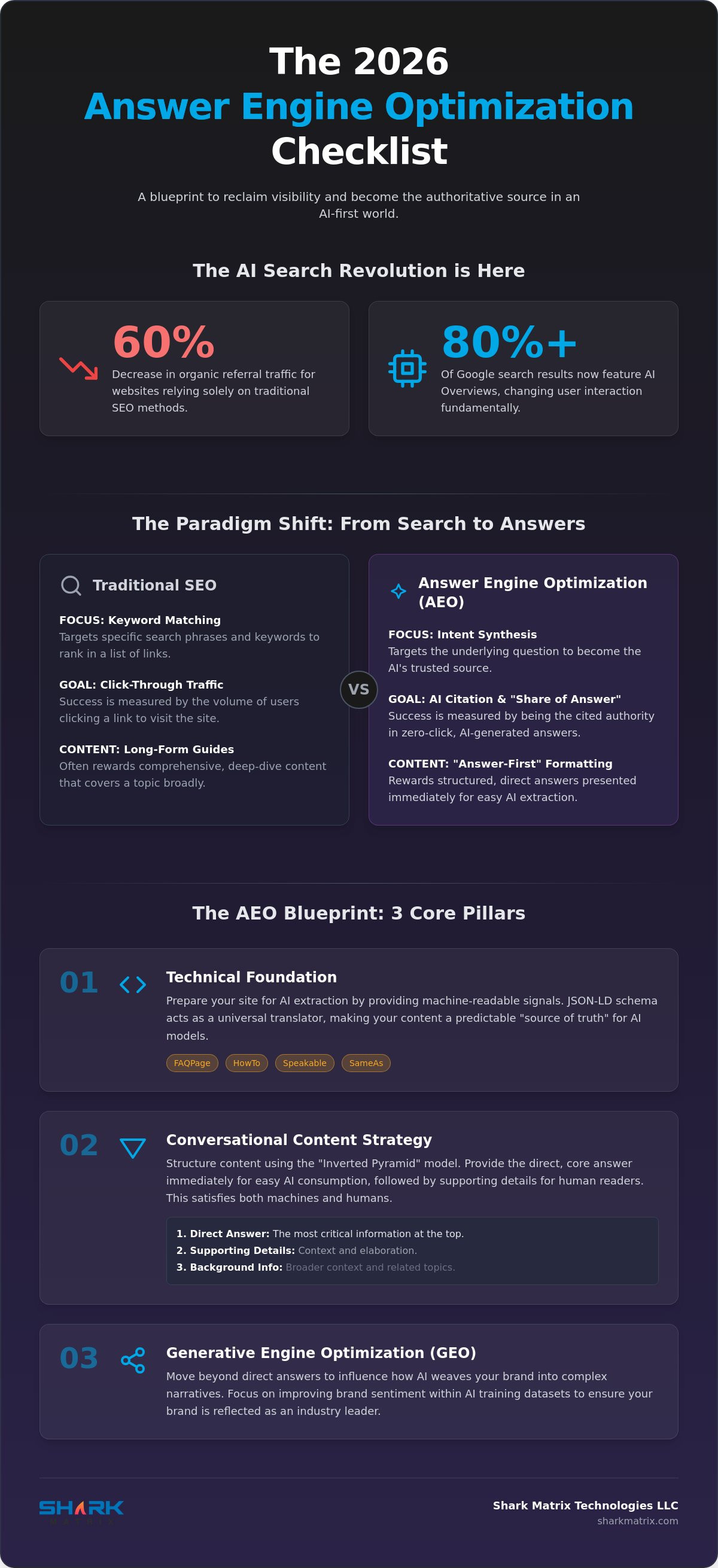
Did you know that websites relying solely on traditional SEO methods have seen a 60% decrease in organic referral traffic over the last 18 months? It’s a sobering reality for many digital marketers who are watching their hard-earned rankings yield fewer clicks. You’ve likely noticed that Google AI Overviews now appear in more than 80% of search results, fundamentally changing how users interact with the web. If you feel like the goalposts are moving, you aren’t alone.

This article provides the definitive 2026 answer engine optimization checklist to help you reclaim your visibility. You’ll get a step-by-step blueprint to optimize your brand for LLMs, Google’s AI Overviews, and conversational search engines to ensure you stay authoritative in an AI-first world. We’ll explore how to implement technical structured data, structure your content for instant answers, and future-proof your digital strategy against the next wave of generative engine updates. By the end, you’ll know exactly how to make your brand the primary source of truth for the world’s most advanced AI models.

Key Takeaways

  • Learn how AEO bridges the gap between traditional keywords and conversational intent to capture visibility in AI “answer engines.”
  • Discover the essential role of advanced Schema.org markup in serving as a “source of truth” for AI crawlers like ChatGPT and Gemini.
  • Master the “Inverted Pyramid” content structure to ensure your brand provides the direct, extractable answers that AI models prioritize.
  • Access a comprehensive answer engine optimization checklist to audit your site’s snippet potential and technical readiness for 2026 search trends.
  • Understand why scaling AEO requires integrating AI automation and development to manage complex data extraction and natural language processing at scale.

What is Answer Engine Optimization (AEO) and Why Does It Matter in 2026?

By 2026, the search landscape has transitioned from a directory of links to a network of synthesized answers. While traditional Search Engine Optimization (SEO) focuses on visibility within a list, Answer Engine Optimization (AEO) aims for something more specific: becoming the definitive source cited by AI models. AEO is the process of making your content easily extractable for “answer engines” like ChatGPT, Perplexity, and Google Gemini. Simply put, AEO is the optimization of content for synthesis by large language models (LLMs).

The impact on organic traffic is undeniable. As Google AI Overviews now appear in more than 80% of search results, the traditional “blue link” click-through model is being replaced by generative responses. This shift means your answer engine optimization checklist must account for how machines read, summarize, and attribute information. Instead of just ranking for a keyword, your goal is to be the authoritative entity that the AI trusts to answer the user’s query directly. When an AI synthesizes an answer, it chooses the most structured, clear, and authoritative source. If your content isn’t built for extraction, it effectively doesn’t exist in the generative era.

The Rise of Generative Engine Optimization (GEO)

Generative Engine Optimization (GEO) takes AEO a step further by focusing on the “creative” and narrative side of AI responses. While AEO targets the direct answer, GEO is about influencing how the AI weaves your brand into complex, multi-step explanations. Brand sentiment within AI training datasets is now a critical factor; if the training data views your brand as a leader, the generative engine will reflect that. 2026 marks the tipping point where “Answer-First” search behavior is the norm, requiring brands to use specialized AI automation and development to manage their digital footprint across various LLMs.

AEO vs. Traditional SEO: A Comparative Overview

Traditional SEO is built on keyword matching, whereas AEO relies on intent synthesis. In the old model, you optimized for a click. In the AEO model, you optimize for a citation. This doesn’t mean SEO is dead, but it has evolved into a technical foundation for AEO.

  • Keyword vs. Intent: SEO targets specific search phrases. AEO targets the underlying question the user is trying to solve.
  • Click-Through vs. Zero-Click: SEO measures success by traffic to the site. AEO measures success by “Share of Answer” and whether your brand is the cited authority in a zero-click environment.
  • Content Structure: SEO often rewards long-form, comprehensive guides. AEO rewards “answer-first” formatting where the core solution is presented immediately for easy bot consumption.

Balancing both strategies is essential for maintaining brand authority. By following a modern answer engine optimization checklist, you can ensure your content satisfies the deep-dive needs of human readers while providing the bite-sized, structured data points that AI engines crave. This dual approach prevents you from doubling your workload while maximizing your presence across all search modalities.

The Technical Foundation: Preparing Your Site for AI Extraction

AI agents are the new primary “users” of your website. While humans enjoy sleek visuals, large language models (LLMs) and autonomous agents look for machine-readable signals. This makes technical infrastructure the most critical part of your answer engine optimization checklist. If an AI agent can’t parse your data in milliseconds, it will simply move to a source that it can understand. You’re no longer just building for a browser; you’re building for a processor.

JSON-LD schema acts as a universal translator that allows AI agents to map your content directly to known entities and facts. This structured format provides a “source of truth” that reduces the risk of AI hallucinations, making your site a more reliable candidate for citations. When your data is predictable, AI models are more likely to trust and display it in generative responses.

Advanced Schema Markup for AEO

Standard SEO used to focus on basic metadata, but AEO requires a more granular approach. Implementing “FAQPage”, “HowTo”, and “Speakable” schema types is no longer optional. These tags tell AI exactly which parts of your page are the “answers.” Using “SameAs” attributes is equally vital. It connects your brand entities across the web, from LinkedIn to Wikipedia, helping AI build a comprehensive knowledge graph of your authority. Because these requirements are highly technical, professional technical seo services are the backbone of any successful strategy. They ensure your code is clean and compliant with the latest 2026 standards.

API-First Content Delivery

Speed and accessibility define the AI era. Traditional monolithic sites often struggle with slow ingestion speeds. Headless CMS architectures solve this by offering API-first content delivery, allowing AI bots to pull data directly without rendering heavy front-end elements. This efficiency directly impacts your “trust score.” AI models prioritize sources that respond quickly and reliably. As noted in HubSpot’s AEO Guide, content structure is just as important as the content itself. Your site architecture must facilitate real-time answer retrieval to stay competitive.

You must also audit your robots.txt file. In 2026, you shouldn’t just block all bots; you need to selectively allow reputable AI crawlers while protecting your proprietary data. Managing these permissions requires a delicate balance between visibility and security. If you find these technical configurations overwhelming, you might consider consulting with an expert team to streamline your AI readiness. High-speed API responses and optimized site architecture ensure you remain visible as search engines move toward instant, generative results.

The 2026 Answer Engine Optimization Checklist: Mastering AI-Driven Search

Conversational Content Strategy: Writing for Machines and Humans

If technical SEO is the engine, your content strategy is the fuel that determines where the vehicle goes. In 2026, writing for visibility requires a dual-focus approach. You must satisfy the human reader’s need for depth while providing AI models with the clear, extractable data they crave. Your answer engine optimization checklist isn’t complete without a radical shift in how you draft sentences and structure your arguments. LLMs don’t “read” like people; they synthesize patterns and look for the most direct path to a solution.

The “Inverted Pyramid” of AEO is your most powerful tool. This strategy demands that you answer the core question of any section within the first 50 words. By front-loading the answer, you provide a ready-made snippet that AI agents can easily lift and cite. Natural Language Processing (NLP) friendly syntax is also vital. Use active voice and “Subject-Verb-Object” structures. This clarity improves the probability that an AI will correctly interpret your intent and attribute the information to your brand. When you write with precision, you aren’t just creating content; you’re building a reputation as a canonical source of truth.

The ‘Answer-First’ Formatting Rule

Structure your pages using H2 and H3 tags that mirror the questions users actually ask. After each header, provide a direct answer between 40 and 60 words. This specific length is the “sweet spot” for AI snippet extraction. Use bulleted lists to break down complex data or multi-step processes. Lists are highly digestible for LLM synthesis, making it much easier for a generative engine to weave your data into a larger, multi-source response. This formatting mirrors the “People Also Ask” (PAA) patterns that dominate modern search results.

Bilingual AEO: Optimizing for a National Audience

For brands operating in the UAE, a monolingual strategy is no longer sufficient. High-quality Arabic localization is essential because AI agents now handle English-to-Arabic intent translation with remarkable sophistication. However, nuances in dialect and cultural context can still trip up a machine. This is why Arabic digital marketing requires specific AEO refinements. You must ensure that your Arabic content is as structured and entity-rich as your English version. By providing clear, localized answers in both languages, you increase your “Share of Answer” across a broader demographic, ensuring your brand remains the primary authority in the regional knowledge graph.

The 2026 Answer Engine Optimization Checklist

Moving from theory to execution requires a structured approach that addresses both technical and creative content needs. This answer engine optimization checklist serves as your roadmap to visibility in an era dominated by Google AI Overviews and conversational agents. You’ve already established the technical foundation and conversational tone. Now, it’s time to audit your existing digital footprint to ensure every page is an “extractable” asset. Success in 2026 isn’t about the volume of pages you publish; it’s about the precision of the answers you provide.

  • Audit Snippet Potential: Review your top 20% of traffic-driving pages. Identify sections where a direct answer can be inserted to capture featured snippets and AI citations.
  • Implement Advanced Schema: Move beyond basic tags. Every service and product page must use microdata that defines specific attributes, helping AI models categorize your offerings accurately.
  • Enforce the 50-Word Rule: Restructure your introductory paragraphs to lead with a concise, direct answer. This satisfies the “answer-first” requirement of modern LLMs.
  • Voice Search Optimization: Adapt your long-tail keyword strategy to mirror natural speech patterns. People ask questions differently when speaking than when typing.
  • Knowledge Graph Verification: Use Online Reputation Management (ORM) to ensure your brand’s facts are consistent across Wikipedia, social profiles, and industry directories.

Step 1: Entity and Authority Mapping

AI models understand the world through entities. You must clearly identify your primary business entities, including your CEO, core products, and physical locations. Consistency is vital here, especially for bilingual markets. For UAE enterprises, your Name, Address, and Phone (NAP) data must be identical across English and Arabic directories. Linking these entities via Wikidata or official social profiles helps AI engines build a reliable knowledge graph of your brand’s authority.

Step 2: Technical and Structural Alignment

Your site’s backend must be as fast as the AI models that crawl it. Mobile-first responsiveness is a baseline requirement, but lightning-fast load times are what secure a high trust score. Ensure that your custom web development supports modern SEO standards, including efficient API-first content delivery. Testing your site using AI-simulated crawlers can reveal extraction bottlenecks that traditional SEO tools might miss.

Step 3: Monitoring and Iteration

AEO is not a “set and forget” strategy. You need to track your “Citation Share” in AI Overviews and ChatGPT responses to measure real-world performance. Tools like Perplexity are excellent for testing how well your brand answers specific industry queries. As “People Also Ask” trends evolve, you must adjust your content to address emerging questions. If you want to ensure your site meets every requirement on this answer engine optimization checklist, it’s time to partner with Shark Matrix for a professional AEO audit.

Future-Proofing with AI Automation and Expert SEO

Implementing an answer engine optimization checklist across a handful of pages is a manageable task, but scaling these efforts for an enterprise-level website is a different challenge. Manual updates for thousands of product descriptions or service pages simply don’t work in a fast-moving AI environment. To maintain a competitive “Share of Answer,” you need a system that adapts in real-time. This is where automation becomes the essential bridge between a static website and a dynamic, AI-ready asset, and Mkhaya MK provides the digital transformation expertise to build these scalable environments. You can’t rely on human speed when search engines are synthesizing data in milliseconds.

Shark Matrix integrates AI automation and development directly into your SEO workflow to solve the problem of scale. By leveraging custom software and machine learning, we can automate the generation of high-fidelity schema markup and “answer-first” content summaries across your entire domain. This technical-first approach ensures that every page on your site is optimized for extraction without requiring thousands of manual man-hours. It’s about working smarter by letting machines communicate with other machines effectively.

Integrating AI into Your Marketing Stack

Modern marketing stacks must include machine learning to predict shifts in search intent before they impact your referral traffic. By analyzing vast datasets, we can identify which “Question” keywords are gaining traction and automate the deployment of FAQ schema to meet that demand. This level of agility is only possible with a technical-first digital agency that understands the intersection of code and content marketing. Custom AI chatbots also play a strategic role here; they act as interactive data points that help train LLMs about your specific business logic, products, and services.

Next Steps: Your AEO Roadmap

Your journey toward search dominance in 2026 starts with a clear, actionable plan. Don’t wait for your organic traffic to decline further before taking action. The transition from “blue links” to generative answers is already happening.

  • Start with a Technical Audit: Conduct a comprehensive review of your site’s crawlability by non-traditional AI agents.
  • Prioritize ‘Question’ Keywords: Focus on high-intent queries that trigger AI Overviews and “People Also Ask” boxes.
  • Connect Your Entities: Ensure your brand’s metadata and facts are consistent across all global and regional directories.

The search landscape has fundamentally changed, but your brand’s authority can thrive in this new environment. By combining the points in this answer engine optimization checklist with advanced machine learning, you can secure your place as the definitive answer in your industry. If you’re ready to future-proof your digital presence and lead the market, contact Shark Matrix today for a tailored AEO strategy that puts your brand at the center of the AI conversation.

Securing Your Brand’s Future in the Generative Search Era

The shift from traditional search to generative answers isn’t just a trend; it’s a fundamental change in how the world accesses information. You’ve seen how a robust technical foundation and “answer-first” content are the keys to surviving the decline in organic click-through rates. Implementing every step of this answer engine optimization checklist ensures your website doesn’t just exist but leads the conversation. Don’t let your brand become a hidden footnote in an AI-generated summary when it could be the primary citation.

Shark Matrix has delivered high-impact digital solutions since 2010. Our specialists in AI automation and machine learning are uniquely prepared to manage the complex data structures LLMs demand. Whether you’re targeting a local or national audience, our comprehensive digital marketing coverage keeps your brand authoritative. It’s time to move beyond the simple blue link and become the definitive answer that machines and humans both trust.

Future-proof your brand with Shark Matrix AEO Services and start dominating the next era of search today.

Frequently Asked Questions

Is Answer Engine Optimization different from regular SEO?

AEO is a specialized refinement of SEO that focuses on providing direct, extractable answers for AI-driven engines rather than just ranking in a list of links. While traditional SEO helps your site get indexed and ranked, AEO ensures your content is selected as the definitive answer cited by large language models. It requires a much more granular focus on technical data structures and conversational sentence patterns.

How do I show up in ChatGPT or Google AI Overviews?

You appear in these generative responses by becoming a highly authoritative and structured source for specific entities and questions. This involves implementing every item on an answer engine optimization checklist, such as leading with concise answers and using JSON-LD schema. AI models prioritize sources that are easy to parse and consistently cited across other reputable platforms like industry directories and social profiles.

Does AEO require a website redesign?

A full redesign isn’t always necessary, but your site architecture must support rapid data ingestion and mobile-first responsiveness. You might need to optimize your backend for high-speed API responses or adjust your CMS to deliver content in a more structured format. The focus is primarily on how your data is delivered to bots rather than the visual elements seen by human visitors.

Which schema types are most important for AEO in 2026?

In 2026, “FAQPage”, “HowTo”, and “Speakable” schema types are the most critical for signaling extractable answers to AI crawlers. You should also use “SameAs” attributes to link your brand’s digital entities across the web. These tags act as a universal translator, helping AI agents understand the relationships between your products, services, and leadership team without any ambiguity.

How can I track the ROI of my AEO efforts?

Tracking AEO ROI involves measuring “Share of Answer” and citation volume in generative engines instead of just traditional click-through rates. You should monitor how often your brand is cited as a source in Google AI Overviews and ChatGPT responses. While traditional organic traffic might fluctuate, the increase in brand authority and high-intent conversions from these citations provides a more accurate measure of success.

Can AI automation help with my AEO checklist implementation?

AI automation is essential for managing a comprehensive answer engine optimization checklist at scale across a large website. Automated tools can generate schema markup for thousands of pages and predict shifts in search intent using machine learning. This allows your team to focus on high-level strategy while the technical heavy lifting of data structuring and extraction optimization is handled by custom software.

What is the impact of voice search on AEO?

Voice search has pushed AEO toward more natural, conversational language patterns and long-tail query optimization. Since voice queries are typically phrased as complete questions, your content must provide complete, bite-sized answers that are easily read aloud by virtual assistants. This shift reinforces the need for clear H2 and H3 headers that mirror the way people actually speak in daily life.

Is AEO relevant for B2B companies in the UAE?

AEO is highly relevant for UAE-based B2B firms because it establishes authority in a market that values technical expertise and bilingual accessibility. Providing clear, localized answers in both English and Arabic helps you capture market share in regional AI searches. It positions your company as the canonical source for industry-specific queries, which is vital for building trust with corporate decision-makers in the region.

Categories
AEO

Answer Engine Optimization vs SEO: Navigating the Future of Visibility in 2026

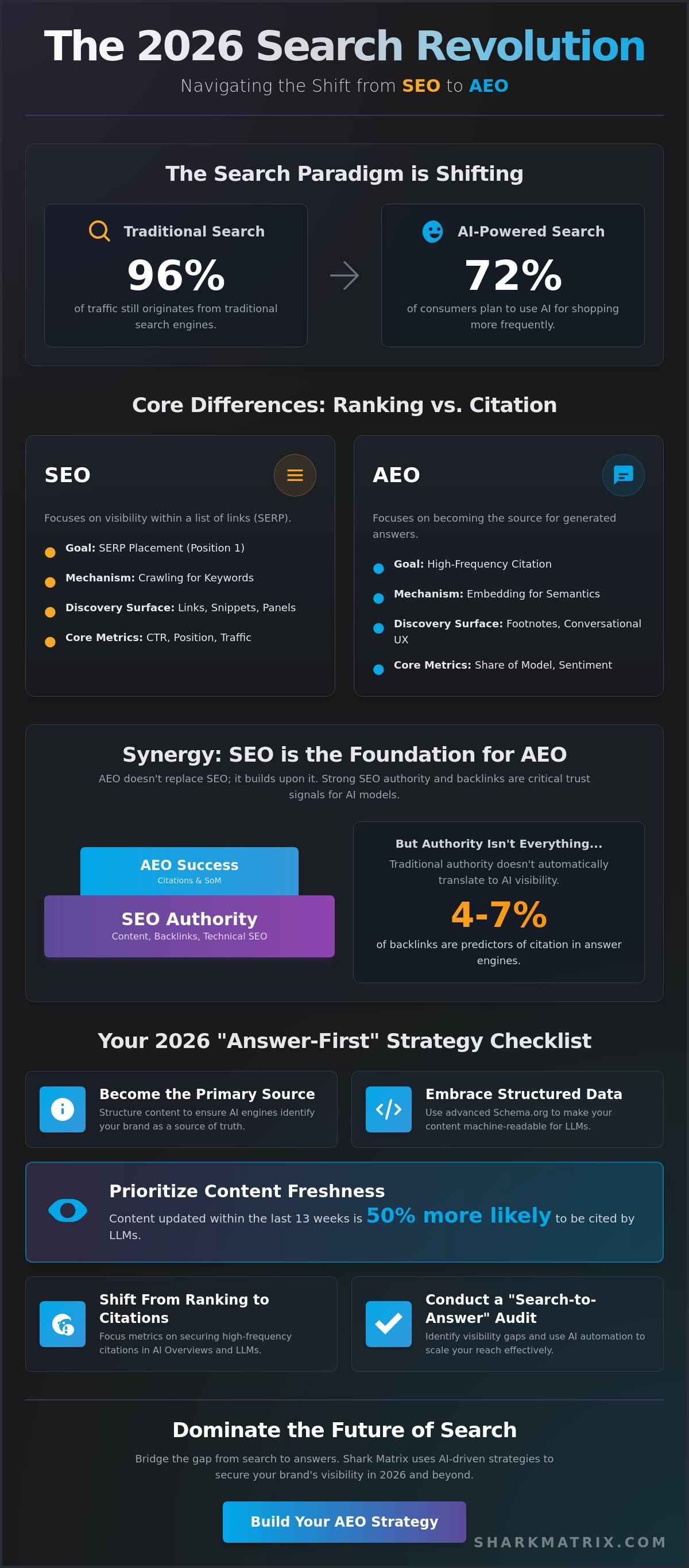
96% of total traffic volume still originates from traditional search, yet 72% of consumers plan to use AI for shopping more frequently this year. You’ve likely seen your organic click-through rates dip as AI Overviews occupy the top of the results page. Understanding the balance of answer engine optimization vs seo is no longer optional if you want to protect your visibility. It’s a stressful time to manage legacy content, especially when you aren’t sure which specific engines are even citing your brand. You know the rules of the game are changing, but you don’t want to abandon the strategies that still drive the majority of your leads.

We’re here to bridge that gap. This article provides a clear roadmap for 2026 search visibility, showing you how to integrate both strategies to dominate search results and AI citations. You’ll discover why content updated within the last 13 weeks is 50% more likely to be cited by LLMs and how to restructure your data for maximum impact. We’ll show you how to maintain traffic while building authoritative brand presence within AI-generated answers. It’s time to move from simply ranking to becoming the definitive answer across the entire digital ecosystem.

Key Takeaways

  • Understand the critical balance of answer engine optimization vs seo to maintain visibility as search behavior shifts from clicking to delegating.
  • Master the transition from traditional keyword ranking to securing high-frequency citations within Large Language Models and AI Overviews.
  • Learn how to use advanced Schema.org and structured content to ensure AI engines identify your brand as a primary source of truth.
  • Discover why your existing SEO authority is the foundation for AEO success and how to leverage backlinks as trust signals for AI models.
  • Find out how a dedicated “Search-to-Answer” audit identifies visibility gaps and uses AI automation to scale your reach in 2026.

The Evolution of Search: Defining SEO and AEO in 2026

The digital landscape has shifted from a library of links to a network of answers. In 2026, the debate surrounding answer engine optimization vs seo often frames them as rivals; however, for national brands, this is a false dichotomy. Traditional Search Engine Optimization (SEO) has matured beyond simple keyword targeting into intent-based ecosystem management. It’s no longer just about where you rank on a list. It’s about how your brand exists within the entire search environment. While SEO builds the foundation of authority and discoverability, Answer Engine Optimization (AEO) focuses on becoming the definitive source of truth that Large Language Models (LLMs) rely on when synthesizing responses.

We’ve moved past the “index-and-rank” era. Modern search platforms use “understand-and-synthesize” models. These systems don’t just point users toward a page; they ingest content, weigh its credibility, and present a summarized conclusion. For businesses, understanding the interplay of answer engine optimization vs seo is the only way to stay ahead of these algorithmic shifts. You can’t ignore the technical requirements of one without damaging the performance of the other.

What Constitutes an Answer Engine?

Answer engines represent a diverse group of platforms including Perplexity, ChatGPT, Claude, and Google’s AI Overviews. Unlike traditional crawlers that primarily look for keywords and backlink patterns, these engines consume data to build semantic relationships. They use real-time web access to verify facts and provide current insights. This means your content must be structured for machine readability. If an engine can’t parse your data quickly, it won’t cite you as the primary source for a user’s prompt. It’s about clarity and structured data over mere volume.

Why 2026 is the Tipping Point for AEO

User expectations have fundamentally changed. Most people no longer want to hunt through ten blue links; they want a direct answer immediately. This shift has led to a surge in zero-click searches, where the user journey begins and ends on the search results page. To combat declining organic click-through rates, professional search engine optimization seo services have evolved to prioritize AI-readiness. Success in 2026 requires a hybrid approach. You must maintain traditional rankings to drive high-intent traffic while simultaneously optimizing for the AI-generated summaries that now dominate the top of the screen.

Core Differences: Ranking vs. Citation Mechanics

To master the balance of answer engine optimization vs seo, you must first understand that the goalposts have moved. Traditional SEO focuses on SERP placement, aiming for that coveted “Position 1” in a list of results. AEO, however, prioritizes citation frequency and accuracy. It’s the difference between being a link on a page and being the data source that powers an AI’s response. While a high ranking in Google remains valuable, research indicates that backlinks are only predictors of citations in answer engines in the 4-7% range. This means your traditional authority doesn’t automatically translate to AI visibility.

The technical process also differs significantly. SEO relies on “crawling for keywords,” where bots identify specific strings of text. AEO relies on “embedding for semantic meaning,” where neural networks analyze how concepts relate to one another. Users are shifting from browsing a list of links to consuming a generated summary. This changes how we measure success. Instead of just tracking Click-Through Rate (CTR) and Position, digital leaders now track Share of Model (SoM) and brand sentiment within AI outputs. If you’re struggling to track these new metrics, our ai automation services can help you monitor your brand’s presence across generative platforms.

The Discovery Surface: Links vs. Conversational UX

In traditional search, users interact with featured snippets, local packs, and knowledge panels. These are static elements designed to drive clicks. Answer engine outputs are different; they feature footnotes, inline citations, and follow-up prompts. The “first page” of Google is no longer the only battleground. Instead, the “context window” of the AI model determines what information is included in the final answer. If your content isn’t structured to fit this window, it won’t be cited, regardless of its traditional rank.

Data Processing: Algorithms vs. Neural Networks

Traditional search engines like Google still use evolved versions of PageRank to weigh authority based on link structures. In contrast, answer engines use transformer architectures and neural networks to process data. These systems prioritize “entities” (concepts and objects) over “strings” (literal text matches). This represents a fundamental move from lexical matching to semantic understanding, where the engine evaluates the underlying meaning of your content rather than just the words used.

Answer Engine Optimization vs SEO: Navigating the Future of Visibility in 2026

The Synergy: Why AEO Cannot Exist Without SEO

A common mistake in current digital strategy is treating answer engine optimization vs seo as a choice between two different paths. In reality, they are two sides of the same coin. AI engines don’t generate facts out of thin air; they ground their responses in high-authority sources they find through traditional search indexing. If your site lacks the foundational authority that SEO provides, an answer engine is unlikely to trust your content enough to cite it. You can’t have one without the other if you want to maintain a dominant online presence.

Traditional backlinks still play a vital role here. While they aren’t the only factor for AI discovery, they act as essential trust signals. Generative models use these signals to verify that a piece of information is credible and widely recognized. This creates a powerful feedback loop. High SEO rankings lead to more AI citations. These citations, in turn, increase brand visibility and search volume, which further reinforces your SEO standing. Protecting this visibility is especially critical for national brands, which is why seo for brand reputation management dubai has become a core component of modern search strategies.

The Authority Factor in AI Citations

Large Language Models often prioritize the top five organic results when answering factual queries. This makes your E-E-A-T (Experience, Expertise, Authoritativeness, and Trustworthiness) profile more important than ever. It’s not just about having the right keywords anymore. It’s about your brand mentions across the web acting as a decentralized knowledge graph. Research shows that content published or updated within the last 13 weeks is roughly 50% more likely to be cited by answer engines. When multiple authoritative sites mention your brand in connection with fresh, updated data, AI engines are far more likely to synthesize that information into a cited answer.

Solving the Zero-Click Challenge

The rise of zero-click searches doesn’t mean traffic is dead. It means you need a two-tiered approach. Use AEO to capture the immediate “answer” within the AI summary, positioning your brand as the primary expert. Then, use SEO to capture the “deep dive” traffic from users who want more than a summary. Click-through optimization within AI responses involves using clear, compelling language that encourages users to click the citation link for more detail. You should balance your concise, AI-friendly summaries with high-value gated content or long-form guides that provide the depth an AI summary simply can’t replicate.

The 2026 AEO Checklist: Building an Answer-First Strategy

Succeeding in the current climate requires more than just adding a few FAQs to your blog posts. It demands a structural shift in how you present data to both humans and machines. When evaluating answer engine optimization vs seo, the most successful brands are those that treat their website as a structured database rather than a collection of documents. This checklist outlines the essential steps to ensure your brand is the first choice for AI synthesis.

Implementing this shift requires a specialized approach to digital architecture. Companies like PurpleCow Digital Marketing provide the strategic website design and development necessary to ensure your site functions as a high-performance database for AI engines.

  • Step 1: Implement advanced Schema.org markup like Speakable, FAQ, and HowTo to define your content’s purpose clearly.
  • Step 2: Transition to an “Answer-First” architecture where the primary value proposition is delivered immediately.
  • Step 3: Optimize for natural language and conversational long-tail queries that reflect how people actually speak to AI agents.
  • Step 4: Build a robust entity-based internal linking structure that maps the relationships between your core business concepts.
  • Step 5: Monitor “Share of Model” (SoM) using emerging AI tracking tools to see how often your brand is cited compared to competitors.

The interplay of answer engine optimization vs seo means your technical foundation must support both discovery and citation. If you are ready to modernize your digital infrastructure, our ai automation and development services can help you implement these advanced data structures at scale.

Technical Foundations: Schema and Structured Data

Basic JSON-LD is no longer sufficient for high-level visibility. You must optimize for semantic triplets, which define specific relationships between entities in a way that AI models can easily ingest. By using technical SEO to “label” every component of your page, you reduce the computational effort required for an engine to understand your expertise. Structured data is the language of AEO. It transforms your prose into a machine-readable format that answer engines can trust and verify in real-time.

Content Framework: The Q&A Hierarchy

Content architecture must now follow a strict hierarchy designed for quick extraction. Start your articles with a 40 to 60 word “direct answer” that provides immediate value. Use H2 and H3 headings as explicit question-answer pairs. This structure mirrors how LLMs search for information within their context windows. Additionally, prioritize factual density and “first-hand experience.” This emphasis on unique expertise ensures your content isn’t just another generic summary, but a unique contribution that AI engines find worth citing over competitors.

Shark Matrix: Bridging the Gap Between Search and Answers

Scaling a visibility strategy that balances answer engine optimization vs seo requires more than just manual content updates. It demands technical integration. At Shark Matrix, we use custom AI automation to help brands transition from static pages to dynamic, machine-readable data sources. This isn’t just about following a checklist; it’s about building an infrastructure where your brand assets are “AI-native” from the moment they’re created. By leveraging our generative ai development services, we ensure your content is structured to be ingested, understood, and cited by the world’s most advanced LLMs.

Our proprietary “Search-to-Answer” audit process is designed specifically for national UAE brands looking to protect their authority. We don’t just look at where you rank on a traditional results page. We analyze how your brand is represented in conversational prompts and AI summaries. This dual-focus approach ensures you don’t lose traditional organic traffic while you’re busy building a presence in the new answer-first ecosystem. A national strategy needs a partner who understands both the nuances of search engine algorithms and the complexities of AI engineering.

AI-Native Digital Marketing

Future-proofing your brand involves using machine learning development services to predict which queries are most likely to trigger AI Overviews. We help you stay ahead of the curve by identifying these high-value “answer targets” before your competitors do. Beyond external visibility, we develop custom ai chatbot-development services that act as internal answer engines for your proprietary data. This allows you to maintain a unified brand voice across every touchpoint, whether a user is talking to your site’s bot or asking a global engine like ChatGPT about your services.

Measuring Success in an AI-Driven World

Success metrics are undergoing a fundamental transformation. While we still monitor traditional traffic, we’ve moved toward “Inclusion” as a primary KPI for our clients. This means tracking how often your brand is the cited source in a generated summary. We use natural language processing services to monitor brand sentiment within LLM outputs, ensuring the AI isn’t just mentioning you, but positioning you as the expert. Ready to dominate the answer engines? Contact Shark Matrix for a 2026 Strategy Audit and secure your brand’s future in the next era of search.

Securing Your Brand’s Authority in the AI Era

The transition from a link-based web to an answer-first ecosystem is well underway. You now have the tools to understand that the dynamic between answer engine optimization vs seo is one of mutual reinforcement. Success in 2026 requires more than just high rankings; it demands a presence within the context windows of the world’s most powerful AI models. By combining the trust signals of traditional search with the structured clarity of AEO, you ensure your brand remains the primary source of truth for both human users and digital agents.

Navigating this shift alone is a complex task for any national market leader. As a pioneering AI automation agency in the UAE, Shark Matrix specializes in national-scale SEO strategies and holds deep expertise in Generative Engine Optimization (GEO). We help you bridge the technical gap between discovery and citation to maintain your competitive edge. Future-proof your brand with Shark Matrix AEO & SEO services to ensure you aren’t just found, but cited. The future of search is conversational, and it’s time for your brand to lead the conversation.

Frequently Asked Questions

Will AEO replace traditional SEO by the end of 2026?

No, AEO won’t replace traditional SEO by the end of 2026. Instead, it serves as a natural evolution of search strategy. While AEO focuses on getting cited in AI summaries, traditional SEO still drives the vast majority of web traffic. You need SEO to build the site authority that AI engines use to verify your brand’s credibility before they cite you as a source of truth.

How do I track my website’s performance in answer engines like ChatGPT?

You can track performance by monitoring Share of Model (SoM) and brand sentiment within AI outputs. Unlike traditional rank tracking, this involves using specialized tools that query LLMs to see how often your brand appears in generated answers. It’s also helpful to look at referral traffic from AI sources in your analytics, though this data is often still grouped under direct or referral sources.

What is the most important technical factor for Answer Engine Optimization?

The most important technical factor is implementing advanced Schema.org markup to label your content for machine ingestion. Structured data acts as a translator for AI engines, allowing them to parse your facts, entities, and relationships without ambiguity. When comparing answer engine optimization vs seo, this technical layer is what moves you from being a link to being a verifiable fact in an AI’s memory.

Can I optimize a single page for both Google Search and AI answer engines?

Yes, you can and should optimize a single page for both environments. A hybrid structure leads with a concise direct answer for AI engines while following up with the deep dive analysis that traditional searchers value. This dual approach ensures you capture the AI summary citation at the top of the page while maintaining your organic ranking for users who want to click through and read more.

How does AEO affect my organic click-through rate (CTR)?

AEO often leads to a lower click-through rate for simple informational queries because the AI provides the answer directly. However, it significantly boosts your brand authority and trust. Being the cited source in an AI Overview creates a halo effect that can drive higher quality, high intent traffic from users who need more than just a quick summary. It’s a shift from quantity to quality.

What role does Schema markup play in AEO compared to SEO?

In traditional SEO, Schema markup is primarily used to win rich snippets like star ratings or FAQ boxes. In AEO, its role is much deeper; it provides the semantic triplets that AI models use to understand the relationship between different entities. It’s the difference between decorating a search result and feeding a neural network the specific data it needs to synthesize an accurate answer.

Is AEO only for informational queries, or does it work for commercial intent?

AEO works for both informational and commercial queries. While it started with simple “what is” questions, users now use AI to compare products, find local services, and seek professional advice. Optimizing for commercial intent in 2026 means ensuring your product specifications and service details are structured so AI engines can include your brand in “best of” summaries or comparison tables.

How often should I update my content to stay relevant for AI engines?

You should update your core content at least every 13 weeks to maintain its relevance. Research shows that content updated within this timeframe is 50% more likely to be cited by answer engines. AI models prioritize fresh data and recent insights to ensure their summaries are current. Frequent updates to your proprietary metrics and factual data help maintain your status as a reliable source of truth.