

Your current ROI reports might be lying to you. In an era of fragmented touchpoints and AI-driven search, relying on last-click attribution is like trying to navigate a city with a decade-old map. You’ve likely felt the frustration of seeing high engagement numbers that don’t seem to translate to the bottom line, leaving you wondering how to calculate digital marketing roi with actual precision. It’s a common pain point for even the most seasoned marketing teams when stakeholders demand proof of profitability for every dollar spent.
We’re here to bridge that gap by providing a masterclass on measuring performance for the 2026 landscape. You’ll master the precise formulas needed to track success across SEO, PPC, and generative engine optimization. We’ll also dive into the critical differences between ROAS and ROI while providing a technical framework to help you use AI automation to track every conversion accurately. By the end of this guide, you’ll have a clear strategy to turn your historical data into a predictive tool for future growth.
Key Takeaways
- Adapt to the 2026 landscape by shifting your focus from traditional search metrics to the emerging value of Answer Engine Optimization (AEO).
- Master how to calculate digital marketing roi using comprehensive formulas that accurately isolate organic growth from your paid campaign efforts.
- Build a robust technical infrastructure using GA4 and closed-loop reporting to ensure every marketing lead is tracked through to the final sale.
- Learn how strategic investments in mobile app development and landing page A/B testing can lower your acquisition costs while boosting retention.
- Move beyond basic historical reporting by implementing AI-driven strategies that turn your data into a predictive tool for future profitability.
What is Digital Marketing ROI and Why is it Changing in 2026?
Digital marketing ROI is the percentage of profit gained relative to the total investment across your digital channels. It’s the ultimate metric that tells you if your marketing spend is actually growing your business or just keeping it afloat. Understanding Return on marketing investment (ROMI) is essential for any modern brand. As we look toward 2026, the complexity of this calculation is increasing because the digital ecosystem is no longer just about clicks and sessions. It’s about the entire ecosystem of influence.
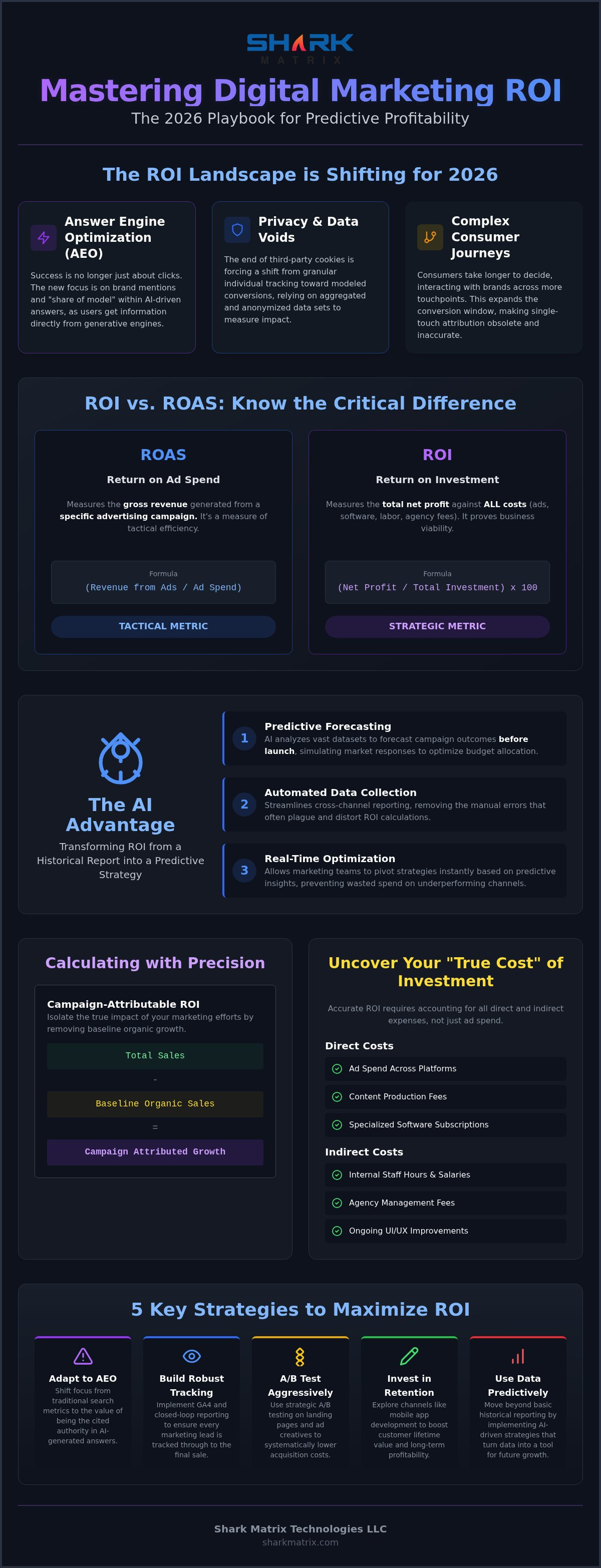
The shift from traditional search engines to Answer Engine Optimization (AEO) has fundamentally changed how we track success. Instead of users clicking through to a website, they often get their answers directly from an AI interface. This means traditional traffic metrics are losing their weight. To understand how to calculate digital marketing roi in this new environment, you have to account for brand mentions and “share of model” alongside standard lead generation. Measuring performance now requires looking at how often your brand is cited as the preferred solution by generative engines.
Privacy regulations and the death of third-party cookies have also forced a change in how we collect data. We’re moving away from granular individual tracking toward modeled conversions. Additionally, consumer behavior has shifted. People are taking longer to decide, interacting with brands across more touchpoints before converting. This expands the conversion window, making it harder to attribute a sale to a single campaign without sophisticated tracking. National consumer behavior now reflects a deeper skepticism, requiring more trust-building interactions before the final purchase happens.
ROI vs. ROAS: Knowing the Difference
Return on Ad Spend (ROAS) is often confused with ROI, but they serve different purposes. ROAS measures the gross revenue generated from a specific advertising spend; it’s a great metric for campaign-level efficiency. However, it doesn’t account for your total overhead. Genuine ROI factors in everything: software costs, agency fees, and internal labor. When reporting to national stakeholders, use ROAS for tactical adjustments and ROI to prove long-term business viability and overall profitability.
The Impact of AI on ROI Forecasting
Machine learning is transforming ROI from a historical report into a forward-looking strategy. By analyzing vast datasets, AI can now predict the potential outcome of a campaign before you even launch it. Our ai automation services streamline this data collection, removing the manual errors that often plague cross-channel reporting. Predictive ROI in 2026 utilizes real-time generative engine data to simulate market responses and optimize budget allocation instantly. This allows marketing teams to pivot strategies before a single dollar is wasted on underperforming channels.
The Essential Formulas: Calculating Simple vs. Comprehensive ROI
To move from guesswork to precision, you need a solid mathematical foundation. The most basic way to understand how to calculate digital marketing roi is the simple formula: (Net Profit / Total Investment) x 100. While this provides a quick snapshot, it often paints an incomplete picture. For a truly realistic view of how to calculate digital marketing roi, you must use your Gross Profit Margin rather than total revenue. If you’re calculating ROI based on top-line sales without accounting for the cost of goods sold, you’re overestimating your success.
Campaign-attributable ROI takes this further by isolating the impact of specific marketing efforts. To do this, you subtract your baseline organic growth from the total sales generated during a campaign period. This helps you see what your paid efforts actually contributed versus what would have happened anyway. It’s a vital step for brands that already have a strong organic presence. If you need assistance setting up these complex tracking parameters, our team at Shark Matrix can help you build a technical framework that captures every nuance of your data.
Defining Your “True Cost” Checklist
Most marketers forget that “Total Investment” includes much more than just your monthly ad spend. You need to account for both direct and indirect costs to get an honest figure. Your checklist should include:
- Direct costs: Ad spend across all platforms, content production fees, and specialized software subscriptions.
- Indirect costs: Internal staff hours, agency management fees, and ongoing UI/UX improvements.
You should also integrate the initial costs from your web development agency into your ROI model. The performance and speed of your site directly dictate your conversion rate, meaning your technical infrastructure is a core part of your marketing investment.
The CLV-Based ROI Model
Measuring success based on a single transaction is a short-sighted approach that often devalues your marketing efforts. The CLV-based model looks at the long-term value of a customer rather than just the initial acquisition. To calculate this, use the formula: (Average Purchase Value x Purchase Frequency) x Customer Lifespan. By adjusting your ROI based on retention rates and brand loyalty, you gain a clearer understanding of how much you can afford to spend on acquiring a new customer today. This perspective shifts marketing from a simple cost center to a long-term strategy for sustainable growth.
Measuring ROI Across Diverse Digital Channels
Each digital channel requires a unique lens to determine its true contribution to your profit margins. While the core formulas remain the same, the way you gather data changes depending on whether you’re looking at a long-term asset or an immediate lead generator. Understanding these nuances is the only way to master how to calculate digital marketing roi with accuracy across a multi-channel strategy. Without this granular view, you risk over-investing in high-volume, low-margin channels that don’t support your long-term growth.
Organic Search and SEO ROI
SEO isn’t a one-off expense; it’s a compounding asset that builds equity over time. When tracking ROI for search engine optimization seo services, you must look beyond keyword rankings. In 2026, Answer Engine visibility is paramount. If your content is the source for a generative AI’s response, that visibility carries high conversion intent. Calculate this by comparing content costs against the lifetime value of organic leads, using a rolling 6 to 12-month window to capture the full impact of your investment.
Social Media and Engagement ROI
Vanity metrics like likes and shares are misleading. To find the real value of a social media agency campaign, track users through the entire funnel using UTM parameters. This attributes revenue directly to social interactions. In the UAE market, localized Arabic digital marketing acts as a unique ROI booster, building deeper cultural trust and significantly improving engagement rates compared to generic English campaigns. This cultural alignment turns your social presence into a measurable profit driver.
Pay Per Click (PPC) offers the most direct path to real-time tracking. When you’re refining how to calculate digital marketing roi for paid campaigns, monitoring conversion efficiency and lead generation costs daily is essential. This allows for rapid budget reallocation to the highest-performing ad sets. However, the real innovation in 2026 comes from ai chatbot development. These tools don’t just provide 24/7 support; they act as high-performance sales agents that qualify leads before they ever reach your CRM. You calculate the ROI of an AI chatbot based on:
- Cost Reduction: Decreased reliance on human support for repetitive, top-of-funnel queries.
- Conversion Lift: Higher lead capture rates through instant, personalized engagement that prevents bounce.
- Data Accuracy: Automated tracking of user intent and interaction history for better attribution.
This dual impact on both cost-savings and revenue makes AI integration one of the most measurable ROI boosters available today. By connecting these technical tools to your broader marketing strategy, you ensure that every interaction is accounted for in your final profitability reports.
Practical Steps to Implementing a Robust Tracking System
Precision in measurement requires a technical foundation that captures data at every stage of the funnel. You can’t master how to calculate digital marketing roi if your data is siloed or incomplete. The first step is a comprehensive GA4 setup that prioritizes cross-platform event tracking. This allows you to see how a user moves from a mobile app interaction to a desktop conversion. When combined with consistent UTM tagging across every campaign, you create a transparent trail that links specific marketing dollars to individual user actions.
Implementing closed-loop reporting is what truly separates high-performance teams from the rest. This process involves connecting your marketing platforms directly to your CRM to track a lead until the final sale is closed. Without this connection, you’re only measuring potential, not actual profit. To identify where ROI is being lost, utilize heatmaps and UI/UX data. These tools reveal friction points in your funnel, such as a confusing checkout process or a slow-loading landing page, that might be killing your conversion rates despite high-quality traffic.
Attribution Modeling: Who Gets the Credit?
Choosing the right attribution model is critical for national campaigns where customer journeys are often complex. While first-touch and last-touch models offer simplicity, they’re often too narrow for the 2026 landscape. Data-driven attribution has become the gold standard because it uses machine learning to distribute credit based on how each touchpoint actually influenced the conversion. This model helps account for dark social and offline conversions by analyzing patterns that traditional tracking might miss. If your current tracking feels fragmented, Shark Matrix can implement the technical infrastructure needed to unify your data streams.
Leveraging AI for Data Accuracy
AI doesn’t just predict outcomes; it cleans and analyzes the data you already have. By using natural language processing, you can analyze customer feedback and sentiment as a qualitative ROI metric, giving you insight into brand health that numbers alone can’t provide. Automating your report generation also removes the risk of human error in cost tracking, ensuring your stakeholders see the most accurate figures possible. By integrating these tools, AI significantly reduces the time-to-insight for marketing teams, allowing you to make budget adjustments in hours rather than weeks. This agility is essential when you’re refining how to calculate digital marketing roi for fast-moving markets.
Maximizing ROI with Strategic Growth and Optimization
Calculating your returns is only half the battle. Once you understand how to calculate digital marketing roi, your focus must shift toward protecting and expanding those margins. Strategic optimization ensures that you aren’t just measuring performance but actively improving it through data-driven decisions. This involves identifying your highest-performing segments and doubling down on what works while trimming the fat from underperforming channels. It’s about moving from a reactive stance to a proactive growth strategy.
A/B testing your landing pages is a fundamental step in this process. By testing different headlines, layouts, or calls-to-action, you can systematically improve your conversion rate, which directly lowers your Cost Per Acquisition (CPA). Additionally, investing in mobile app development can significantly increase customer retention and Lifetime Value (CLV). An app provides a direct, high-engagement channel that keeps your brand top-of-mind, turning one-time buyers into loyal advocates through personalized push notifications and seamless user experiences.
Scaling your efforts requires real-time data. When you see a campaign delivering exceptional returns, you need the agility to reallocate your budget instantly. In the UAE market, localized Arabic digital marketing acts as a unique ROI booster, allowing you to capture specific search intent that generic campaigns often miss. However, even the best campaigns can suffer from ROI leakage caused by a poor online reputation. Negative reviews or unresolved customer complaints can act as a silent killer for your conversion rates, making Online Reputation Management essential for protecting your investment.
Technical Optimization for Higher Returns
Technical excellence is the bedrock of marketing profitability. Every second of delay in site speed or a lack of mobile responsiveness can chip away at the ROI of every dirham you spend. There’s also a powerful synergy between generative ai development and content scaling. Using AI to produce high-quality, intent-focused content allows you to cover more ground without a proportional increase in costs. When you align your UI/UX design with specific user intent, you shorten the sales cycle and maximize the efficiency of your funnel.
Next Steps: From Calculation to Execution
Turning data into action requires a structured approach. Conduct a quarterly ROI audit to review your performance and reallocate budgets based on the latest market trends and internal data. When pitching budget increases to executive leadership, focus on the predictive models you’ve built rather than just historical wins. Show them how to calculate digital marketing roi for future scenarios to prove that marketing is a revenue engine, not a cost center. To further support high-level financial oversight, you can discover Swiss Alpha Matrix for specialized due diligence on complex investment programs. Partnering with a full-service agency like Shark Matrix allows you to manage both the technical infrastructure and the strategic execution needed to maintain long-term growth.
Future-Proof Your Marketing Profitability
Mastering the shift toward Answer Engine Optimization and predictive analytics is no longer optional for brands aiming to lead. You now have the technical foundation to move beyond basic reporting by integrating hidden costs and long-term customer value into your financial models. Understanding how to calculate digital marketing roi with this level of precision allows you to stop guessing and start scaling your budget with absolute confidence. By combining technical excellence in web development with advanced AI automation, you can finally close the loop between initial clicks and final sales across every channel.
Ready to transform your data into a high-performance growth engine? Get a Data-Driven Strategy to Boost Your ROI with Shark Matrix. Our specialists provide 2026-ready AI and SEO strategies backed by deep national expertise in UAE brand growth. We offer end-to-end technical and marketing integration to ensure your measurement systems are as sophisticated as your execution. It’s time to take control of your margins and build a more profitable future for your business.
Frequently Asked Questions
What is a good ROI for digital marketing in 2026?
A 5:1 ratio is generally considered a strong benchmark for most industries, meaning you earn five dollars for every one dollar spent. An exceptional ROI would be 10:1 or higher. However, these figures vary depending on your business stage and industry. In 2026, you should also consider your brand’s visibility in generative search results as a key indicator of long-term value alongside immediate revenue.
How do I calculate the ROI of a brand awareness campaign?
Track “brand lift” metrics such as branded search volume, direct website traffic, and social media mentions. You can assign a monetary value to these by comparing the cost of acquiring that same traffic through paid search. While awareness doesn’t always result in an instant sale, it significantly shortens future conversion windows and improves the efficiency of your direct-response campaigns over time.
Which digital marketing channel typically has the highest ROI?
SEO and email marketing consistently deliver the highest long-term returns. SEO is especially powerful because it’s a compounding asset that drives traffic long after the initial investment is made. In the current landscape, Answer Engine Optimization (AEO) is a vital part of this success. While PPC offers faster results, its ROI is always limited by your ongoing ad spend and rising bid costs.
How long does it take to see a positive ROI from SEO?
It usually takes four to nine months to see a positive ROI from SEO efforts. This timeline depends on your website’s current authority, the level of competition in your niche, and your technical health. You might notice early improvements in rankings within two months, but the compounding nature of organic growth means the most significant financial returns typically happen after the first year of consistent optimization.
Can AI help in improving my marketing ROI?
Yes, AI improves ROI by automating data analysis and optimizing budget allocation in real-time. Our ai automation services help identify high-performing audience segments much faster than manual processes. By using machine learning to predict customer behavior, you can shift your budget toward the channels and creatives most likely to convert, which reduces wasted spend and boosts your overall profitability.
What are the most common mistakes when calculating marketing ROI?
The most frequent error when learning how to calculate digital marketing roi is failing to include all costs, such as internal staff hours and software subscriptions. Many marketers also rely too heavily on last-click attribution, which ignores early touchpoints that influenced the buyer. Another mistake is treating ROAS and ROI as the same metric, which leads to a skewed understanding of actual business profit.
How do I account for agency fees in my ROI formula?
Include all agency fees as part of your “Total Investment” in the formula. When you’re determining how to calculate digital marketing roi for a specific project, divide the agency’s retainer by the number of campaigns they manage. This ensures your profit figures reflect the true cost of outsourcing your marketing and technical development, providing a more honest view of your campaign’s success. For instance, when evaluating costs from an AI digital marketing agency NYC, ensure you factor in the specific tiers of their maintenance packages to see the full impact on your bottom line.
Is ROAS more important than ROI for e-commerce businesses?
ROAS is useful for daily tactical adjustments, but ROI is the ultimate measure of your business’s health. E-commerce brands often focus on ROAS because it’s easy to track within ad platforms. However, if your margins are thin, a high ROAS could still result in a net loss after you factor in shipping, returns, and management fees. Always use ROI for long-term strategic planning.
 OpenAI
 Codex
Codex
 Vertex AI
 Cloud Vision
 OpenCV
 TensorFlow
 IBM Watson
 Cloud Natural Language
 Cognitive Services
 Bot Framework
 Mistral
 LLama
LLama
 Gemini
 Anthropic
 N8N
N8N