
Categories
Uncategorized

10 Strategic Benefits of Outsourcing SEO for Business Growth in 2026

Building an in-house SEO team in 2026 is no longer the gold standard for scaling; for many, it’s a fast track to technical debt and stagnant rankings. You’ve likely felt the frustration of watching organic traffic plateau while Google’s March 2026 spam updates and the rise of Generative Engine Optimization (GEO) move the goalposts. It’s exhausting to try and keep up with AI-driven search changes while managing the high overhead of specialized talent, which is why the strategic benefits of outsourcing seo have become a necessity for sustainable growth.

We understand that your primary goal isn’t just traffic, but predictable, scalable revenue. This article reveals why moving your search strategy to specialists is the fastest way to master the new era of AI-driven search and Answer Engine Optimization (AEO). You’ll discover how to leverage high-end technical infrastructure and AI automation without the operational complexity of building it yourself.

We will break down ten strategic advantages of this model, from accessing proprietary machine learning tools to navigating national market dynamics with precision. It’s time to stop chasing the algorithm and start leading it through expert-led technical engineering.

Key Takeaways

  • Understand why search visibility in 2026 requires transitioning from traditional keywords to complex Answer Engine Optimization (AEO) and deep technical integration.
  • Discover how the strategic benefits of outsourcing seo provide immediate access to specialized AI tools and a full stack of experts at a fraction of the cost of in-house hiring.
  • Evaluate the “Bus Factor” and the financial risks of relying on internal managers versus the stability and scalability of an established agency model.
  • Learn how to select a technical partner capable of managing national market dynamics while integrating advanced AI automation into your search strategy.

The Evolution of Search: Why In-House SEO is Harder in 2026

The search environment changed forever following the major Google spam update in March 2026. Gone are the days when a generalist marketer could manage a site’s visibility with basic keyword placement. Modern Search engine optimization (SEO) now demands a deep, technical integration that bridges the gap between code and content. As search engines transition toward Answer Engine Optimization (AEO) and Generative Engine Optimization (GEO), the complexity has scaled beyond the reach of most internal teams. This shift makes the benefits of outsourcing seo a critical consideration for brands that want to maintain a competitive edge.

The Complexity of Modern Technical SEO

Technical SEO isn’t a side task anymore; it’s a full-time engineering discipline. Core Web Vitals have evolved into strict performance benchmarks that require developer-level expertise to satisfy. In 2026, businesses must manage massive datasets that require AI automation services to process and act upon in real-time. Without access to an agency-level technology stack, internal teams often find themselves reacting to algorithm volatility instead of anticipating it. Shark Matrix handles the heavy lifting of this technical engineering, ensuring your infrastructure supports, rather than hinders, your growth.

Why DIY SEO Often Leads to Stagnation

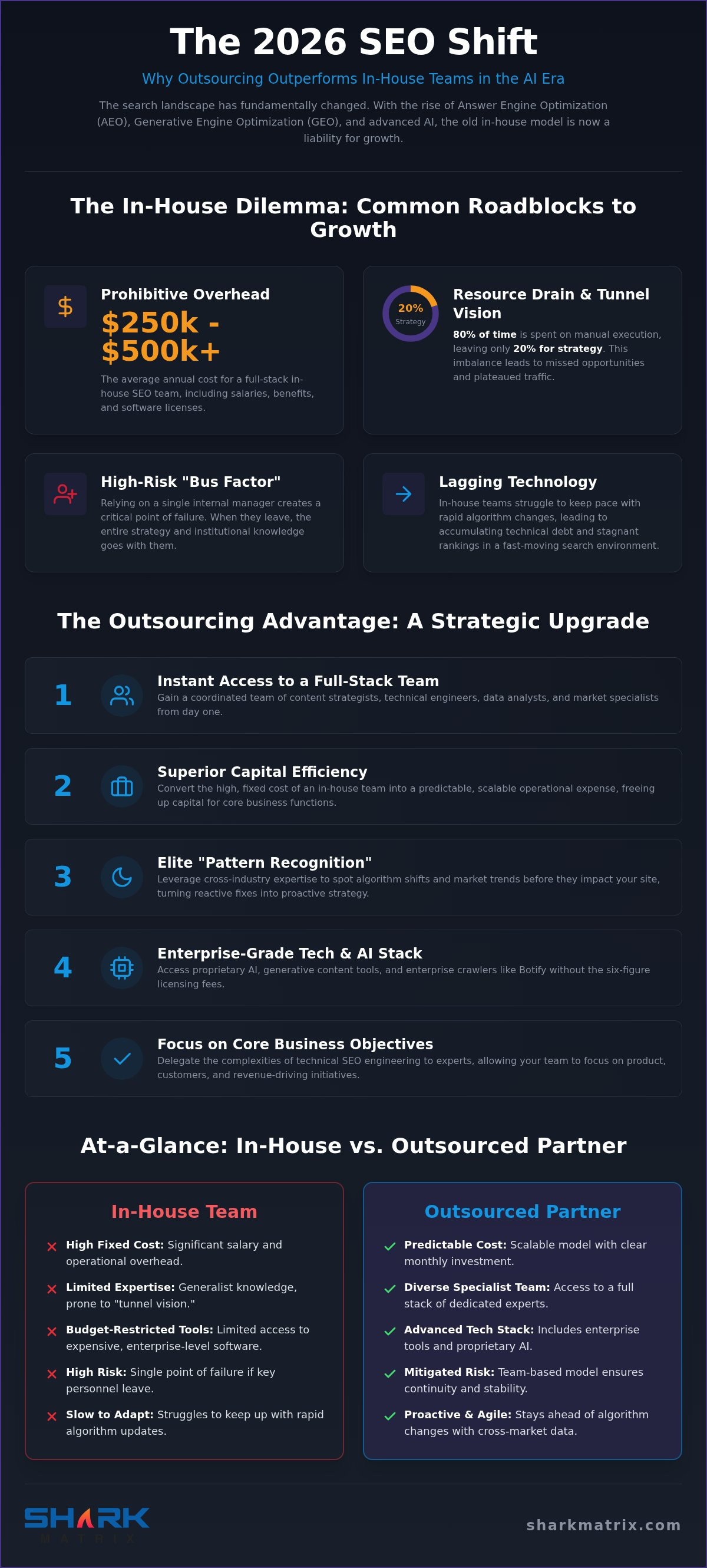
In-house teams frequently suffer from “tunnel vision,” where they become so focused on internal priorities that they miss broader market shifts. It’s a common resource drain: marketers spend 80% of their time on manual execution and only 20% on high-level strategy. This imbalance leads to plateaued traffic while competitors move ahead. SEO outsourcing is the strategic transfer of technical responsibility to specialized experts who possess the cross-market data needed to drive results. By partnering with specialists who understand national market dynamics, you unlock one of the primary benefits of outsourcing seo: the ability to focus on your core business while experts manage your digital authority.

5 Critical Benefits of Outsourcing SEO to a Specialized Agency

Outsourcing your search strategy isn’t just a cost-cutting measure; it’s an infrastructure upgrade. One of the primary benefits of outsourcing SEO is the immediate injection of a full-stack team into your business. Instead of one overstretched manager, you gain a collective of content strategists, technical engineers, and data analysts. This model allows for rapid scalability, letting you ramp up visibility for seasonal peaks or product launches without the friction of hiring. Since a full in-house team can cost between $250,000 and $500,000 per year, shifting to an agency model provides significant capital efficiency and predictable monthly costs.

Access to Elite Industry Expertise

Agencies offer a level of “pattern recognition” that internal teams simply cannot replicate. Specialists who handle numerous accounts across different industries can spot algorithm shifts before they become site-wide disasters. For instance, managing SEO for brand reputation management requires a nuanced understanding of sentiment and authority that comes from years of cross-market experience. Because agencies invest heavily in continuous training, their staff stays at the cutting edge of 2026 trends. They solve problems faster because they’ve likely seen the same issue on five other accounts this month. This collective intelligence ensures your brand isn’t just following old playbooks but is actively leading the market.

Advanced Toolsets and AI Infrastructure

The technology stack required to compete in 2026 is prohibitively expensive for most mid-sized firms. When you outsource, the high costs of enterprise-level tools like Botify or specialized AI crawlers are absorbed by the partner. We leverage generative AI development to scale content without sacrificing the “Information Gain” that Google now prioritizes. This infrastructure includes proprietary reporting dashboards that offer total ROI transparency. You get clear, data-driven insights rather than messy spreadsheets. Internal teams often struggle with tunnel vision, but an outsourced partner provides an unbiased, third-party perspective. They use data from across the UAE market to benchmark your performance against hard realities. If you’re ready to stop managing tools and start seeing results, exploring our SEO company services is the logical next step.

  • Immediate Specialist Access: Get a team of analysts and engineers from day one.
  • Cost Efficiency: Eliminate the overhead of salaries, benefits, and software licenses.
  • Scalability: Adjust your SEO resources based on business needs and seasonal demand.
  • AI-Driven Insights: Utilize proprietary technology for competitive Generative Engine Optimization (GEO).
  • Unbiased Strategy: Rely on data-driven decisions from experts who see the broader market landscape.

10 Strategic Benefits of Outsourcing SEO for Business Growth in 2026

Comparing SEO Models: In-House Team vs. Outsourced Agency

Choosing between an internal hire and an agency partner isn’t just about the monthly bill; it’s about risk management. When you hire a single Senior SEO Manager, you’re betting your digital growth on one person’s knowledge. If they leave, your strategy stalls. This “Bus Factor” is a major risk that highlights the benefits of outsourcing seo, where you’re protected by a team of specialists rather than a single point of failure. An agency provides continuity that an individual employee simply cannot guarantee.

The financial disparity between these models is also stark. A full in-house SEO team can cost between $250,000 and $500,000 per year. In contrast, a comparable agency engagement is estimated to be between $60,000 and $180,000 per year. This massive gap allows you to reinvest capital into other growth channels while maintaining a high-impact search presence. Agencies don’t just save you money; they provide a higher level of accountability through performance-based reporting that internal roles often lack.

The Hidden Costs of In-House SEO

Recruitment isn’t cheap. Between headhunter fees and the months spent training a new hire on your specific tech stack, the first half-year is often a net loss. You also have to factor in software overhead. Enterprise-level tools for crawling, rank tracking, and data analysis can add thousands of dollars to your monthly expenses. When an internal team is overloaded, implementation slows down. This opportunity cost is invisible but deadly. Every week your technical fixes sit in a development queue is a week of lost organic revenue that your competitors are likely capturing.

The Agency Efficiency Advantage

Agencies operate on standardized processes that eliminate the trial and error phases common with solo hires. They have direct lines to industry insiders and test new strategies across dozens of accounts simultaneously. By leveraging AI automation services, professional agencies have reduced the cost of routine SEO tasks by 20% to 30%. This efficiency means your budget goes toward strategy and growth rather than manual data entry. The agility of an agency allows for rapid pivots, whereas internal departments often face months of bureaucratic delays before a single technical change is approved. This speed to market is one of the most overlooked benefits of outsourcing seo in a fast-moving AI search environment.

How to Evaluate and Select the Right SEO Outsourcing Partner

Choosing an SEO partner decides your digital trajectory for years. It isn’t just about finding a vendor; it’s about finding a technical extension of your team that understands your specific market. In the UAE, for example, national market dynamics require a partner who understands local search intent and regional competition. One of the primary benefits of outsourcing seo is tapping into specialized infrastructure that would be too costly to build alone. You should prioritize agencies that offer integrated web development services. SEO often requires deep code changes, and having a partner who can implement technical fixes directly prevents the bottleneck of waiting for your internal developers.

Transparency is the foundation of any successful partnership. You need clear communication protocols and a partner who explains the “why” behind every technical move. In 2026, this includes a clear strategy for Generative Engine Optimization (GEO) and Answer Engine Optimization (AEO). If an agency can’t explain how they plan to keep you visible in AI-generated search summaries, they aren’t prepared for the current era. To ensure you’re making the right choice, consult with our SEO experts to see how we align search strategy with your bottom-line revenue.

Questions to Ask During the RFP Process

The Request for Proposal (RFP) phase is your best opportunity to stress-test an agency’s expertise. Don’t settle for generic sales decks; look for specific methodologies. Ask these three critical questions:

  • How do you handle Google Core Updates and AI search shifts? A prepared agency will have a proactive monitoring system and a history of recovering or maintaining rankings during volatility.
  • Can you show documented case studies with long-term organic growth? Look for sustained success over 12 to 18 months rather than short-term spikes that might indicate high-risk tactics.
  • What is your process for technical SEO and site speed optimization? Ensure they have the engineering talent to handle Core Web Vitals and complex schema deployments.

Red Flags to Avoid in SEO Outsourcing

The SEO industry still has players using outdated or deceptive practices. Identifying these early can save your brand from long-term search penalties. Be wary of any agency that promises “Guaranteed #1 rankings.” Search algorithms are third-party platforms, and no one can guarantee a specific spot. Another major red flag is a lack of transparency regarding backlink sources or technical changes. If they won’t show you where your links are coming from, they’re likely using low-quality networks that will eventually trigger a spam manual action. Finally, avoid agencies that don’t ask about your business KPIs. If they only talk about traffic and not revenue, they don’t understand the true benefits of outsourcing seo for business growth.

Scaling Your Digital Authority with Shark Matrix Technologies LLC SEO Solutions

Shark Matrix Technologies LLC bridges the gap between traditional search and the AI-powered future. With over 15 years of market experience since our founding in 2010, we’ve navigated every major algorithm shift from the early days of keyword density to the complex requirements of 2026. We provide national-scale SEO that handles the heavy lifting of technical engineering, allowing your team to focus on core business operations. One of the greatest benefits of outsourcing seo to a partner with our technical DNA is the ability to manage complex e-commerce and enterprise environments that generalist agencies often struggle to support.

Our end-to-end approach starts with exhaustive technical audits and extends into advanced content strategies. We utilize natural language processing to ensure your content isn’t just readable, but optimized for the way modern search engines and AI models interpret information. By combining human expertise with proprietary AI automation, Shark Matrix Technologies LLC helps brands dominate the search landscape across the entire country, ensuring visibility in both traditional results and emerging AI answer surfaces.

Integrated Digital Growth Strategies

Search visibility doesn’t exist in a silo. We synchronize your SEO efforts with PPC and social media management to create a 360-degree digital presence. This integrated approach ensures that your brand captures intent at every stage of the customer journey. Our technical department goes beyond standard software by building customized AI tools designed to give our clients a distinct edge in the SERPs. These industry specific ai solutions allow us to automate routine data analysis while focusing our human energy on high-level strategy and measurable ROI. We don’t just report on traffic; we focus on the high-quality lead generation that fuels business expansion.

Your Partner for the Future of Search

The transition to AI-first search experiences, including Generative Engine Optimization (GEO), requires a partner who stays ahead of the curve. Shark Matrix Technologies LLC is committed to a transparent, data-backed growth model that protects your brand reputation while maximizing reach. As search engines continue to prioritize “Information Gain” and original authority, our team ensures your digital assets are prepared for the long term. We provide the stability of a decade and a half of experience paired with the agility of a modern AI development firm. If you’re ready to move beyond stagnant traffic and embrace a technical search strategy, it’s time to act. Scale your organic growth with Shark Matrix Technologies LLC SEO services today.

The search landscape of 2026 doesn’t reward generalists. To thrive, businesses must navigate the technical complexities of Generative Engine Optimization and AI-driven answer surfaces discussed throughout this guide. One of the most significant benefits of outsourcing seo is the ability to bypass the high overhead and operational risks of in-house hiring while gaining immediate access to enterprise-level AI infrastructure. A technical partner handles the heavy lifting of code-level fixes and data-driven content scaling, ensuring your brand remains visible where it matters most.

Shark Matrix Technologies LLC brings over 15 years of digital marketing excellence and a proven track record with national brands to every engagement. We specialize in the AI-driven strategies that define modern search dominance. Don’t let your organic growth plateau because of internal resource constraints. Partner with a leading SEO agency to dominate your market in 2026. With the right technical DNA behind your strategy, your business is ready to lead the conversation in a rapidly evolving digital world.

Frequently Asked Questions

Is it cheaper to outsource SEO or hire someone in-house?

Outsourcing is significantly more capital-efficient than hiring internally. While a senior SEO manager’s salary is just the starting point, an agency retainer covers a whole team of specialists. You eliminate recruitment fees, employee benefits, and the massive monthly overhead of enterprise software licenses. This model allows you to scale your search presence without the long-term liability of increasing your headcount, making it the smarter financial choice for most growth-focused firms.

What are the main benefits of outsourcing SEO to an agency?

One of the core benefits of outsourcing seo is the ability to leverage an agency’s technical infrastructure and collective experience. You gain immediate access to AI-driven tools and specialists in technical SEO, content marketing, and link building. This breadth of expertise is difficult to replicate in a single hire. It ensures your strategy is proactive rather than reactive to algorithm changes, providing a level of pattern recognition that only comes from managing multiple accounts.

How long does it take to see results when you outsource SEO?

You should expect a timeline of 6 to 12 months for significant traffic improvements. While technical audits and immediate fixes can happen within weeks, search engines take time to re-index and re-rank your content. A full ROI typically matures around the 12 to 18 month mark. Professional agencies use standardized processes to ensure that implementation happens as fast as possible, helping you move through the initial growth phases more efficiently than an unguided internal team.

Can I outsource SEO if I already have an in-house marketing team?

Many businesses find success by using an agency as a technical extension of their existing marketing department. One of the strategic benefits of outsourcing seo is that your in-house team can focus on brand-specific messaging while experts handle the specialized AI automation and technical engineering. This partnership allows your internal staff to focus on high-level brand strategy while experts handle the complex backend optimizations and the heavy lifting of modern search requirements.

What should I look for in an SEO outsourcing contract?

Prioritize transparency and performance-based reporting in any agreement. A solid contract should outline specific deliverables for technical SEO, content creation, and monthly reporting protocols. It’s vital to ensure there is no ambiguity regarding backlink sources or technical changes. Look for a partner who aligns their success with your bottom-line revenue and provides a clear roadmap for navigating AI search updates like Generative Engine Optimization (GEO) and Answer Engine Optimization (AEO).

How does an agency stay updated with SEO changes better than an individual?

Agencies maintain a competitive edge through cross-account data analysis and dedicated research departments. When an algorithm update occurs, an agency sees the impact across multiple industries simultaneously, allowing for faster pattern recognition. Individual managers are often limited to the data of one site. This collective intelligence ensures your brand adapts to changes before they impact your rankings. Agencies invest in continuous training and R&D because their business depends on staying ahead of the search curve.

What is the risk of outsourcing SEO to the wrong provider?

Hiring the wrong partner can lead to severe search penalties and long-term reputational damage. If a provider uses manipulative tactics or low-quality link networks, Google’s 2026 spam updates may flag your site, causing a total loss of visibility. There is also the opportunity cost of stagnant growth. An agency without technical DNA may fail to implement the complex schema or site speed fixes required for modern search, leaving your business behind more agile competitors.

Will an outsourced SEO agency understand my specific business niche?

Yes, because expert agencies specialize in rapid market research and competitor benchmarking. They use advanced tools to analyze search intent and industry-specific terminology within your niche. A partner with 15 years of experience, like Shark Matrix, understands how to adapt strategies for different sectors across the UAE. This objective, data-driven approach often uncovers growth opportunities that internal teams might overlook due to industry tunnel vision or a lack of cross-market data.

Categories
AEO

How to Optimize Content for AI Search: 2026 Guide

What if the top spot on Google no longer guarantees a single click to your website? It’s a frustrating reality for many digital marketers who see their organic traffic dipping as AI summaries provide instant answers directly on the search page. You likely feel the pressure of this shift from traditional lists to synthesized responses, fearing your brand might become invisible in a sea of AI-generated text. Understanding the difference between traditional SEO and Answer Engine Optimization (AEO) is now the only way to protect your digital footprint.

Learning how to optimize content for ai search is no longer a futuristic goal; it’s a survival requirement for 2026. This guide will help you master Generative Engine Optimization (GEO) to ensure your brand isn’t just indexed, but actively cited as a trusted authority by AI engines. We’ll explore the technical shift toward natural language processing, the importance of intent-aligned entities, and the specific data structures you need to win citations in AI-driven results.

Key Takeaways

  • Understand the critical shift from traditional search lists to synthesized AI summaries and how it changes user behavior.
  • Leverage entity-based SEO and Natural Language Processing to ensure AI engines correctly interpret your brand’s expertise.
  • Learn how to optimize content for ai search by moving your strategy from simple keyword matching to earning authoritative citations.
  • Identify the practical steps for conducting an AI visibility audit and restructuring pages for better data extraction.
  • Discover how to build a technical, AI-ready infrastructure that supports long-term brand visibility in a generative search environment.

From Keywords to Conversations: What is AI Search Optimization?

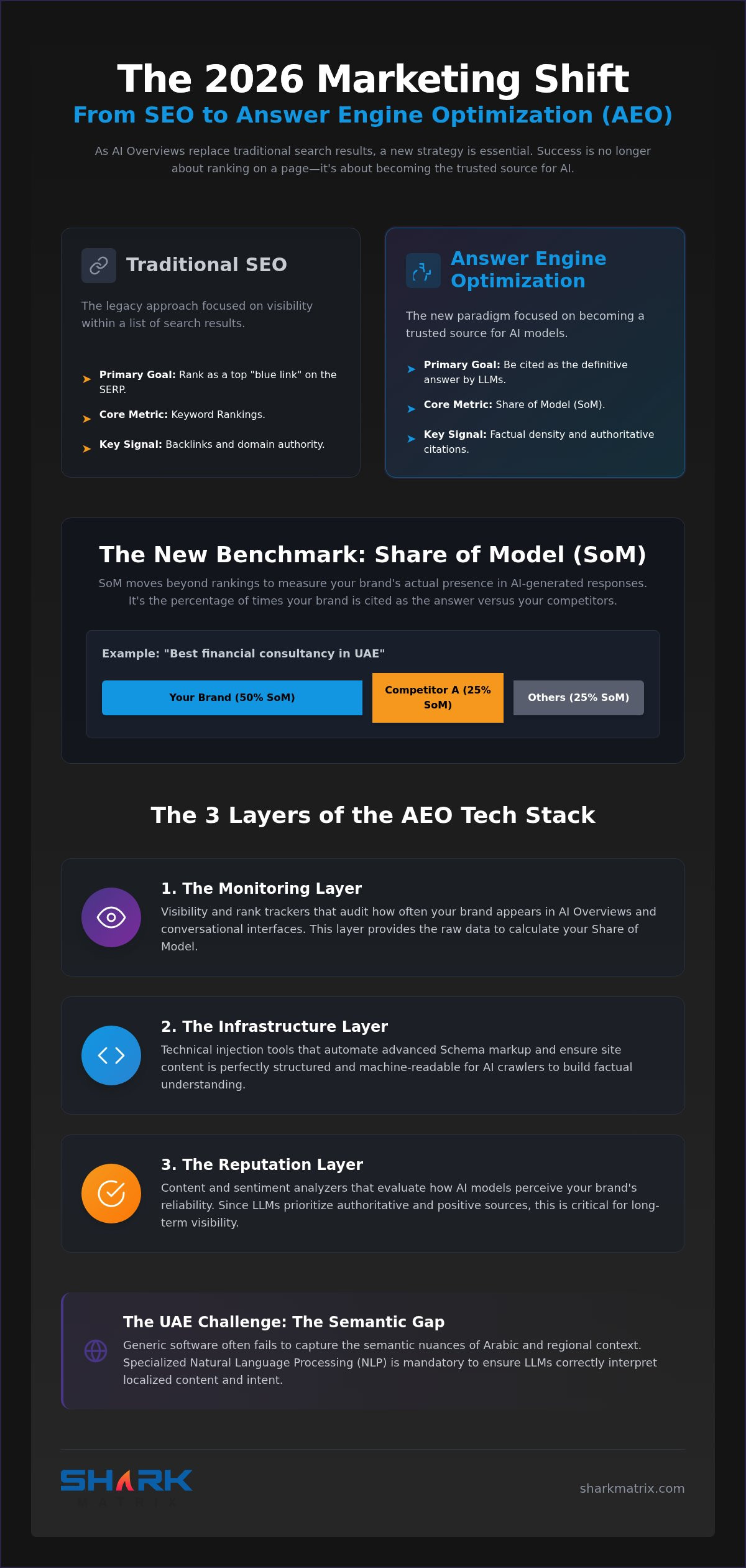
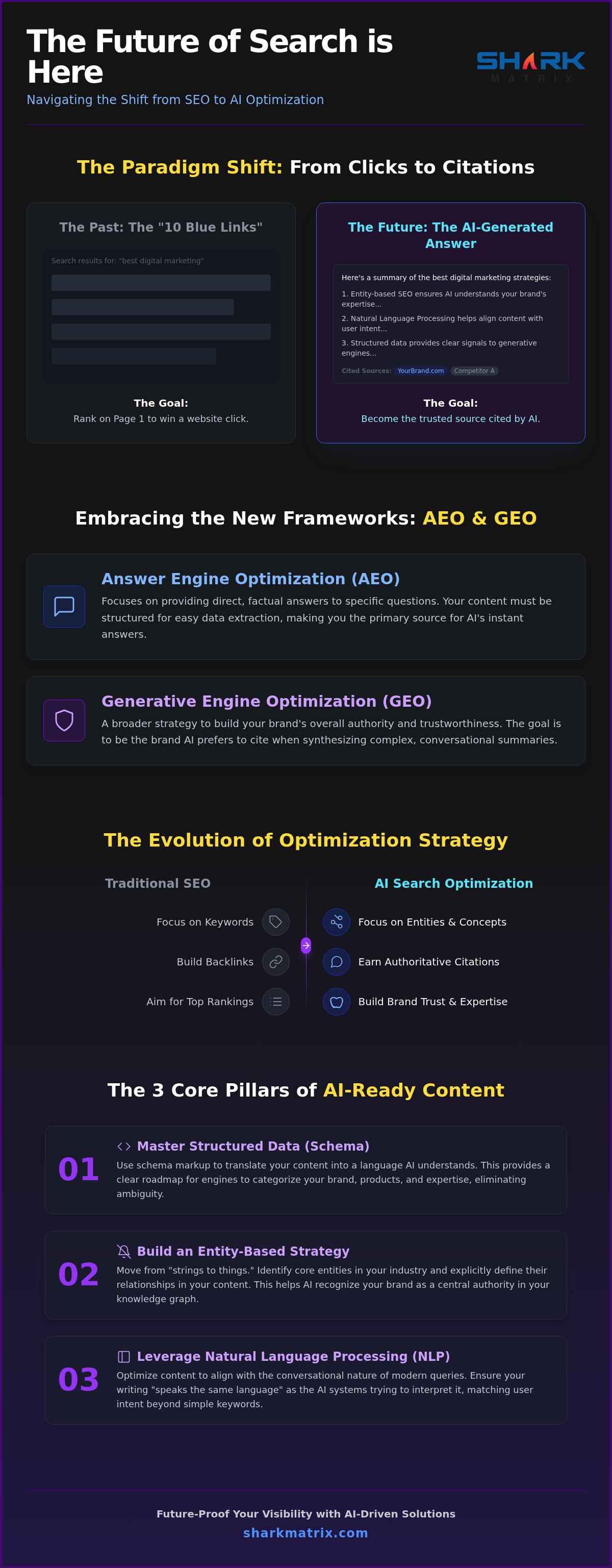
Search has undergone its most significant transformation since the invention of the crawler. For decades, Traditional SEO focused on a predictable goal: securing a spot in the “10 blue links” on a results page. In 2026, that model is no longer the primary driver of digital discovery. We’ve entered a period where Large Language Models (LLMs) act as the definitive gatekeepers between your brand and your audience. Understanding how to optimize content for ai search means moving beyond simple keyword strings and embracing the conversational nature of modern queries.

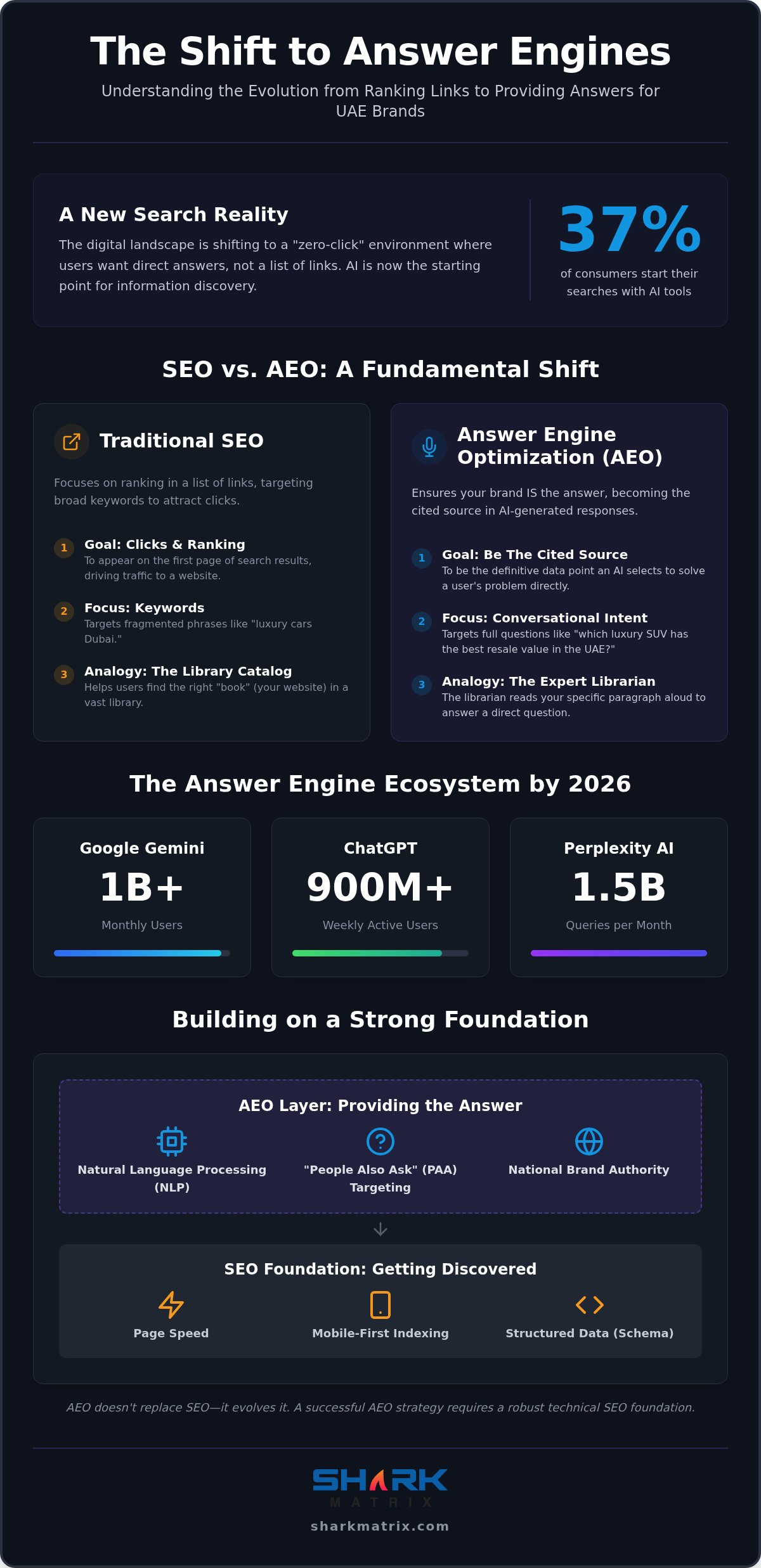
Two new frameworks define this evolution: Answer Engine Optimization (AEO) and Generative Engine Optimization (GEO). While they overlap, they serve distinct roles in a brand’s visibility. AEO focuses on providing direct, factual answers to specific user questions. GEO is broader, focusing on how your brand’s entire digital presence is perceived and cited by generative AI when it creates a synthesized summary. Instead of clicking through to your site, users now receive the information they need directly from the AI, making your status as a cited source the new benchmark for success.

The Mechanics of Answer Engine Optimization (AEO)

AI engines don’t just look for matches; they extract concepts. When a user asks a question, the engine scans high-authority content to find the most concise, accurate response. This has turned “position zero” into the only position that truly matters for many informational queries. To win here, your content must be structured for easy extraction. AI prefers clear hierarchies and data that’s presented without unnecessary fluff. If your information is buried under layers of flowery prose, the algorithm will likely skip it in favor of a competitor who provides a direct answer. Using natural language processing techniques ensures your content speaks the same language as the systems trying to read it.

Why Your Brand Needs a GEO Strategy Now

Waiting to adapt is a recipe for digital invisibility. As organic click-through rates from traditional search results fluctuate, brands in competitive markets like the UAE are finding that being an early adopter of GEO provides a massive advantage. AI search is proactive. It doesn’t just wait for a query; it anticipates intent based on previous interactions. By building an AI-ready infrastructure today, you ensure your brand is the one the LLM trusts to cite when a user asks for a recommendation or a solution. Shark Matrix Technologies LLC specializes in bridging the gap between technical AI development and strategic marketing through our SEO company Dubai services, helping national brands stay relevant as search logic evolves from simple matching to complex reasoning.

The Core Pillars of Generative Engine Optimization (GEO)

If the previous section established the “why” of the AI shift, this section focuses on the technical architecture of success. Success in 2026 requires more than just high-quality writing; it demands a deep understanding of how to optimize content for ai search through structural and semantic precision. AI models no longer view your pages as a collection of keywords. Instead, they see a web of interconnected entities and facts that must be verified for accuracy and relevance.

Schema markup remains the most critical bridge between your human-readable content and an AI’s processing requirements. By using structured data, you provide a clear map that Large Language Models (LLMs) use to categorize your brand, products, and expertise. This technical layer removes ambiguity, ensuring that when an AI engine synthesizes an answer, it pulls from your verified data rather than making an educated guess. To effectively Optimize Your Content for AI Citations, you must prioritize this factual transparency alongside authoritative sourcing.

Mastering Entity-Based Content Strategy

Building an entity-based strategy means moving from “strings to things.” You need to identify the core entities in your industry and define their relationships using semantic triples, which consist of a subject, a predicate, and an object. AI models map relationships between entities by analyzing the context and frequency of their co-occurrence across diverse datasets to build a structured knowledge graph. By explicitly stating these relationships in your content, you make it easier for AI to recognize your brand as a primary authority in your niche.

Leveraging NLP for Better AI Recognition

Language is the interface for AI search, so your content must align with how machines interpret human speech. This doesn’t mean writing like a robot; it means using clear, conversational language that answers specific long-tail queries without unnecessary jargon. Clarity and factual density are your best tools for winning citations in AI summaries. Our natural language processing services enhance content discoverability by aligning your brand’s voice with the specific linguistic patterns and intent-based structures that AI engines prefer. If you’re looking to scale these technical improvements across your entire site, exploring ai automation services can help streamline the implementation of these pillars at a national level.

How to Optimize Content for AI Search: 2026 Guide

Traditional SEO vs. AI Search Optimization: A 2026 Comparison

Traditional SEO isn’t obsolete; it’s the bedrock upon which AI visibility is built. While the old goal was matching a user’s query with a keyword-rich page, 2026 search logic focuses on the underlying intent. AI models don’t just look for words; they look for the reason those words were typed. This shift changes how to optimize content for ai search from a game of density to a game of relevance. You aren’t just competing for a spot in a list. You’re competing to be the definitive answer that an AI synthesizes for the user.

Backlinks remain a signal of authority, but citations are the new currency of visibility. In a traditional search environment, a link from a high-authority site boosts your rank. In an AI summary, a citation proves to the LLM that your brand is a reliable source for a specific fact. Similarly, while page speed is vital for user retention, AI engines prioritize fact density. They want to extract the maximum amount of verified information in the shortest possible crawl. Understanding how to optimize content for ai search requires a mindset shift from static pages to dynamic data sources that provide high value per kilobyte.

The Evolution of E-E-A-T for AI

AI engines have refined the concept of Experience, Expertise, Authoritativeness, and Trustworthiness (E-E-A-T). In 2026, they favor first-party data and original research over recycled content. If your brand publishes unique case studies or proprietary data, you’re more likely to be cited. AI models look for consistent mentions across multiple platforms to verify your authority. It’s not enough to say you’re an expert; you need a digital footprint that proves it through verified facts and cross-referenced citations across the web.

Integrating SEO and GEO for National Brands

Successful national brands don’t choose between SEO and GEO. They integrate them. You still need traditional rankings to capture users who prefer manual browsing, but you also need to be AI-ready for those using conversational search. Using comprehensive SEO services ensures your site serves both masters. Shark Matrix Technologies LLC bridges this gap by building digital infrastructures that maintain legacy rankings while preparing content for AI extraction. This dual approach ensures you don’t lose traffic as search behaviors continue to shift toward AI-driven answers in the UAE.

Step-by-Step: How to Optimize Your Content for AI Citations

Moving from theory to practice requires a systematic approach to your existing digital assets. Learning how to optimize content for ai search begins with a thorough AI visibility audit. Instead of checking traditional rank trackers, you must query major LLMs to see if they recognize your brand and what specific sources they cite when answering industry-related questions. If the AI currently pulls data from a competitor, you’ve identified a citation gap. This audit provides a baseline for your strategy, allowing you to target the exact queries where your brand is currently invisible or misrepresented.

Once you’ve identified these gaps, the next step involves implementing advanced Schema markup that goes beyond standard organization tags. For national brands in the UAE, this means using industry-specific properties that define your unique value proposition and verified data points. Monitoring these mentions is an ongoing task because AI models are updated frequently. A source cited today might be replaced tomorrow if a more factual or better-structured alternative emerges. Staying ahead requires constant refinement of your data layers to ensure you remain the most reliable option for AI extraction.

Structuring Content for AI Extraction

AI engines prefer content that mirrors the natural way humans ask questions. Use your H2 and H3 headings to state these questions directly, followed immediately by a fact-dense summary sentence. An AI-optimized summary should lead with a direct definition or answer, followed by two supporting facts and a concluding piece of evidence, all within a 50-word limit. This specific structure makes it incredibly easy for an engine to identify your text as a “snippet-ready” candidate for a generative summary. By removing the preamble and leading with the answer, you increase the likelihood of being cited as the authoritative source.

Technical Optimization for Generative Engines

The technical side of how to optimize content for ai search often involves moving toward headless CMS environments and API-driven content delivery. These setups allow AI crawlers to access your data without the noise of traditional front-end code. Shark Matrix Technologies LLC helps brands build these search-ready infrastructures from the ground up, ensuring that technical SEO basics like XML sitemaps and robots.txt files are explicitly configured for AI agents. Our expertise in generative ai development ensures your content is delivered in a format that machines can process with maximum efficiency. If you’re ready to secure your place in AI results, our team can help you implement these technical standards through our ai automation services.

Future-Proofing Your Visibility with Shark Matrix AI Solutions

National brands in the UAE face a unique challenge as we move through 2026. The convergence of AI automation and digital growth means that your infrastructure must be as intelligent as the engines crawling it. Shark Matrix specializes in building these AI-ready foundations from the ground up. We don’t just help you understand how to optimize content for ai search; we provide the technical architecture required to sustain that visibility over the long term. This involves custom AI development that addresses industry-specific search challenges, ensuring your brand remains a primary source in AI-generated answers regardless of how the underlying models evolve.

Building a future-proof brand requires more than just following trends. It requires an infrastructure that can handle the demands of generative engines while maintaining the core principles of brand authority. We help you bridge the gap between technical data science and creative content marketing, ensuring your digital presence is both human-centric and machine-readable. By focusing on verified first-party data and clear entity relationships, we turn your website into a high-density information source that AI engines trust and prefer.

End-to-End AI and SEO Integration

Success in the generative era requires a multi-disciplinary strategy that traditional agencies often miss. You can’t rely on high-quality content alone if your technical backend doesn’t support rapid, structured data extraction for Large Language Models (LLMs). By combining our AI automation services with strategic content marketing, we ensure every piece of data on your site is optimized for both human readers and machine processors. This holistic approach is why national leaders consult with our SEO company to build a sustainable GEO roadmap. We act as the bridge between technical machine learning development and consumer-facing messaging, ensuring your expertise is never lost in translation.

Staying Ahead of the Generative Curve

The search market moves with incredible speed. Algorithm shifts and changing citation patterns mean your digital strategy must be inherently agile. Continuous monitoring of how different LLMs interpret and cite your brand is essential for identifying new citation gaps before they impact your bottom line. Technical agility isn’t just a buzzword; it’s the primary difference between being a cited authority and becoming digitally invisible. We help you stay ahead by integrating AI automation into your marketing workflows, allowing for real-time adjustments to your content structure. Mastering how to optimize content for ai search is an ongoing commitment to data accuracy and semantic precision.

Your next step is clear. Auditing your brand for the 2026 AI search landscape is the only way to protect your market share. Contact Shark Matrix today for a comprehensive AI search readiness assessment. We’ll evaluate your current visibility, identify technical bottlenecks, and build a customized plan to ensure your brand remains the preferred source for AI summaries across every major engine.

The search landscape has fundamentally transitioned from simple keyword matching to complex, conversational AI summaries. Winning citations in 2026 requires a technical shift toward entity-based content and structured data that Large Language Models can easily extract. Mastering how to optimize content for ai search is now the most critical step in protecting your national visibility and ensuring your expertise isn’t lost in a sea of synthesized answers.

Shark Matrix leads the market as a national UAE leader in SEO, backed by specialized NLP and AI automation teams. Our expertise in generative AI development allows us to build the technical bridges your brand needs to stay relevant. We don’t just react to algorithm shifts; we build the infrastructures that define them. Ready to dominate the AI search landscape? Contact Shark Matrix for a GEO Strategy Audit today. The future of search is conversational, and your brand deserves to be the definitive answer.

Frequently Asked Questions

What is the difference between SEO and GEO?

Traditional SEO targets rankings in the standard list of search results, while GEO (Generative Engine Optimization) focuses on winning citations in AI-generated summaries. SEO is about being found in a list; GEO is about being the source the AI trusts to build its synthesized response. This requires a deeper focus on entity relationships and how Large Language Models perceive your brand’s authority across the entire web.

How do I get my website cited by AI search engines like ChatGPT or Perplexity?

You get cited by providing factual, high-density responses that AI models can easily verify and extract. These engines prioritize first-party data, original research, and unique insights over recycled content. Consistency across multiple platforms also helps the AI verify your brand as a trusted authority, making it more likely to quote you in its summaries.

Is traditional keyword research still relevant for AI search?

Keyword research is still necessary, but the focus has shifted to conversational intent and semantic entities. You need to understand how users phrase questions to AI assistants rather than just typing short, static phrases. Understanding how to optimize content for ai search in 2026 involves targeting these natural language patterns and identifying the entities your audience is most interested in.

How does structured data help with AI search optimization?

Structured data provides a clear, machine-readable map of your website’s information using Schema.org. It helps AI models identify entities like people, places, products, and facts without ambiguity. This technical layer reduces the risk of the AI misinterpreting your data, making your content a much more attractive candidate for AI extraction and citation.

Can AI-generated content rank well in AI search engines?

AI-generated content can rank, but only if it provides significant information gain. Search engines prioritize E-E-A-T, meaning they look for signs of real-world experience and proprietary expertise. If your content is just a generic summary of existing web data, it’s unlikely to be cited as a primary source by a generative engine.

What are the most important factors for Answer Engine Optimization (AEO)?

The core pillars of AEO are clarity, factual accuracy, and directness. You should place the most important information at the beginning of your sections to help AI bots find the answer quickly. Mastering how to optimize content for ai search through AEO means removing unnecessary fluff and focusing on high-value facts that answer specific user questions.

How often should I update my content to stay relevant for AI engines?

Content should be updated as soon as new facts, data points, or industry shifts occur. AI models are updated frequently and often have access to the live web to provide the most current answers possible. To maintain your position as a cited authority, your content must always be more accurate and up-to-date than the competing sources.

Does site speed affect my visibility in AI search summaries?

Site speed impacts how efficiently AI bots can crawl and process your data. While the final AI summary is text-based, technical issues or slow load times can prevent an engine from indexing your latest updates. A fast, clean technical structure ensures your optimized content is always accessible to the AI when it needs to verify a fact.

Categories
AEO

AEO Marketing Strategy: The 2026 Guide to AI Search Visibility

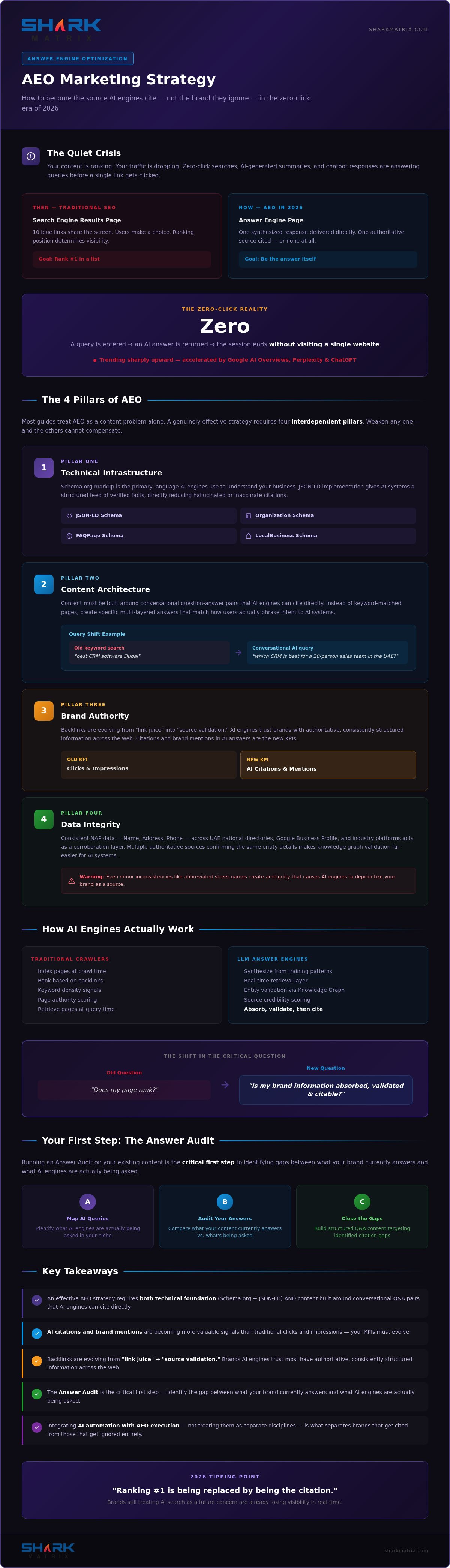
Your content is ranking. Your traffic is dropping. That’s the quiet crisis hitting digital marketers right now, and a smarter aeo marketing strategy is the clearest path out of it. Zero-click searches, AI-generated summaries, and chatbot responses are answering user questions before a single link gets clicked, and brands that haven’t adapted are watching their visibility erode in real time.

You already know something has shifted. The search results page you optimized for last year looks nothing like the one your customers see today. Google’s AI Overviews, ChatGPT, Perplexity, and a growing list of answer engines are now the first stop for millions of queries, and they don’t rank ten blue links. They cite one authoritative source, or none at all.

This guide is built to change that for your brand. You’ll learn how Answer Engine Optimization works, why it’s a technical infrastructure play as much as a content strategy, and exactly how to position your business as the definitive source that AI engines cite by default. From structured data and entity authority to NLP signals and brand trust, here’s everything you need to future-proof your digital presence heading into 2026.

Key Takeaways

  • A well-executed aeo marketing strategy requires both a technical foundation — including Schema.org and JSON-LD implementation — and a content architecture built around conversational question-answer pairs that AI engines can cite directly.
  • The KPIs that define search success are changing: citations and brand mentions in AI-generated answers are becoming more valuable signals than traditional clicks and impressions.
  • Backlinks are evolving from “link juice” into “source validation” — the brands AI engines trust most are those with authoritative, consistently structured information across the web.
  • Running an Answer Audit on your existing content is the critical first step to identifying gaps between what your brand currently answers and what AI engines are actually being asked.
  • Integrating AI automation capabilities with AEO execution — rather than treating them as separate disciplines — is what separates brands that get cited from those that get ignored entirely.

What is Answer Engine Optimization (AEO) in 2026?

Answer Engine Optimization is the practice of structuring your content, technical infrastructure, and brand authority so that AI-powered platforms select your business as the definitive source when answering a user’s query. It’s not about ranking higher in a list. It’s about being the answer itself.

That distinction matters more than most brands realize. Traditional SEO competed for position on a Search Engine Results Page, where ten links shared the screen and users made a choice. The emerging reality is an Answer Engine Page, where a single synthesized response is delivered directly to the user, often without a clickable link in sight. The brands that don’t adapt their aeo marketing strategy to this shift aren’t losing ground slowly. They’re becoming invisible.

The Rise of the Zero-Click Search

Zero-click search is the dominant 2026 user behavior: a query is entered, an AI-generated answer is returned, and the session ends without a single website being visited. According to data cited by SparkToro and others tracking SERP behavior, zero-click outcomes have been trending upward for years, accelerating sharply as Google AI Overviews, Perplexity, and ChatGPT’s search functionality have matured.

The behavioral shift runs deeper than convenience. Conversational AI has changed how users frame their intent. Instead of typing “best CRM software Dubai,” a user now asks “which CRM is best for a 20-person sales team in the UAE?” That’s a specific, multi-layered question that a traditional keyword-matched result handles poorly. An LLM-powered answer engine handles it precisely, pulling from sources it has already validated as authoritative.

Answer Engines vs. Traditional Search Engines

Traditional search crawlers index pages and rank them based on signals like backlinks, keyword density, and page authority. Large Language Models work differently. They don’t retrieve pages at query time the way a crawler does. Instead, they synthesize responses from patterns learned during training, supplemented by real-time retrieval layers in tools like Perplexity and SearchGPT. The question isn’t whether your page ranks. The question is whether your brand’s information has been absorbed, validated, and deemed citable.

Google’s Knowledge Graph plays a critical role here. It acts as a verification layer, cross-referencing structured entity data to confirm that a brand is what it claims to be. For UAE-based businesses, this matters acutely: as national brands compete for AI citations in a market where local search authority is still being established, the brands with the clearest entity footprint win the citation.

Ranking number one is being replaced by being the citation. That’s the core logic driving every element of a modern aeo marketing strategy, and it’s why 2026 represents a genuine tipping point for brands across the UAE that have been treating AI search as a future concern rather than a present priority.

The Pillars of a Winning AEO Marketing Strategy

Most guides treat AEO as a content problem. Write better answers, structure your FAQs, and the citations will follow. That’s a partial truth that leads to incomplete execution. A genuinely effective aeo marketing strategy is built on four interdependent pillars: technical infrastructure, content architecture, brand authority, and data integrity. Weaken any one of them, and the others can’t compensate.

Structured Data and Knowledge Graphs

Schema.org markup isn’t a nice-to-have in 2026. It’s the primary language AI engines use to understand what your business is, what it does, and whether it’s trustworthy enough to cite. Implementing Organization, FAQPage, HowTo, and LocalBusiness schema in JSON-LD format gives AI systems a structured feed of verified facts about your brand, directly reducing the risk of hallucinated or inaccurate citations.

Consistent NAP data, your Name, Address, and Phone number, across UAE national directories, Google Business Profile, and industry-specific platforms acts as a corroboration layer. When multiple authoritative sources confirm the same entity details, knowledge graph validation becomes far easier for AI systems to complete. Inconsistencies, even minor ones like abbreviated street names, create ambiguity that causes AI engines to deprioritize a source in favor of one that’s cleaner.

This is where natural language processing capabilities become operationally valuable. NLP models parse the semantic context around your brand mentions, not just the entity name itself. A business described consistently as a “UAE-based AI development and SEO agency” across structured and unstructured sources builds a richer, more citable entity profile than one whose descriptions vary by platform.

Conversational Content Design

Voice search and AI-generated verbal responses share a common requirement: answers that sound natural when spoken aloud. That means writing in plain, direct language, front-loading the answer before the explanation, and avoiding the dense, qualifier-heavy prose that reads well on a page but fails when a device reads it back to a user.

Structuring H2s and H3s as direct questions is one of the highest-leverage changes a content team can make. Headings like “What schema types does Google use for AI Overviews?” map precisely to how users phrase queries to AI assistants. That alignment increases the probability of triggering a featured snippet or AI Overview citation.

Long-form content also needs a structural rethink. Leading with a concise answer block, a genuine TL;DR that resolves the core question in two or three sentences, serves two audiences simultaneously: the AI engine scanning for a citable response and the human reader who wants the conclusion before the argument.

Across all four pillars, the underlying principle is the same: make it effortless for AI systems to find, parse, and trust your information. Brands building this infrastructure now are the ones that will own citations as AI search continues to mature. If you’re assessing where your current content and technical setup stand against these requirements, exploring a structured SEO and AEO audit is a practical starting point.

The final pillar, data cleanliness, ties everything together. Contradictory information across your own site, outdated service descriptions, and unresolved entity conflicts are the inputs that produce AI hallucinations. Clean, consistent, structured data isn’t just good hygiene; it’s what separates a brand that gets cited accurately from one that gets cited incorrectly, or not at all.

AEO Marketing Strategy: The 2026 Guide to AI Search Visibility

AEO vs. Traditional SEO: Navigating the Zero-Click Era

The metrics that defined search success for the past decade are no longer telling the full story. Clicks, impressions, and average position made sense when the goal was to earn a spot on a results page that users actually scrolled through. That page is disappearing. As AI-generated answers absorb more of the query-response cycle, the brands still optimizing exclusively for click-through rates are measuring the wrong thing with increasing precision.

This isn’t an argument for abandoning traditional SEO. It’s an argument for expanding what success looks like. A hybrid approach that integrates search engine optimization SEO services with a structured AEO layer is the practical reality for 2026. SEO still governs how crawlers index your content and how human users navigate organic results. AEO governs whether AI systems trust your content enough to cite it. Both matter. Neither is sufficient alone.

The role of backlinks has shifted in a way that’s easy to misread. Links haven’t lost their value; their function has changed. In traditional SEO, a backlink passed authority in a relatively mechanical way. In an AI-citation context, backlinks function as source validation signals. When multiple credible, topically relevant domains reference your brand in consistent, structured ways, AI systems interpret that pattern as evidence of genuine expertise. The quantity-over-quality link-building strategies of earlier SEO eras actively work against this. What AI engines reward is corroboration, not volume.

Content frequency is another area where the old playbook misleads. Publishing at high velocity to capture trending keywords was a defensible strategy when freshness was a significant ranking factor. In an answer engine context, accuracy outweighs recency. A well-structured, factually precise answer published six months ago will be cited over a hastily produced piece published yesterday if the former is cleaner, better validated, and more consistent with what other trusted sources confirm. Being right matters more than being first.

The Death of the Keyword?

Exact-match keywords aren’t dead, but their dominance is over. Semantic search has shifted the optimization target from specific phrases to entities and topics: the people, places, concepts, and relationships that AI systems map into knowledge structures. A piece of content optimized around the entity “AI-powered CRM for SMEs” will serve a wider range of natural language queries than one built around a single high-volume phrase. Critically, AI connects related concepts without needing specific keyword prompts at all; an LLM can infer that a question about “automating follow-ups for a small sales team” is semantically adjacent to CRM functionality, even if neither phrase appears in the query.

Measuring Success in AEO

The emerging measurement framework centers on three shifts. First, Share of Model (SoM) is replacing Share of Voice: instead of tracking how often your brand appears in paid or organic search results, you track how often it appears in AI-generated responses across platforms like ChatGPT, Perplexity, and Google AI Overviews. Tools designed specifically for this monitoring are maturing quickly, and building SoM tracking into your reporting stack now is a competitive advantage.

Second, assisted conversions deserve more weight in your attribution model. A user who encounters your brand in a Perplexity citation, visits your site two days later through a direct search, and converts will appear in your analytics as a direct or branded organic conversion. That first AI-citation touchpoint is invisible in standard attribution but was arguably the most influential moment in the journey.

A sound aeo marketing strategy treats these measurement gaps as solvable problems, not acceptable blind spots. Tagging branded search volume trends alongside SoM data gives a clearer picture of how AI visibility is actually driving downstream behavior, even when the click never happens.

Implementation: How to Optimize for AI Overviews and Chatbots

Knowing why AEO matters is one thing. Building the execution layer is another. What follows isn’t a list of abstract principles; it’s a sequential implementation framework that takes your brand from audit to citation-ready infrastructure.

Step 1: Conduct an Answer Audit. Before producing a single new piece of content, map what your brand currently answers against what AI engines are actually being asked. Pull your top 50 organic landing pages and cross-reference them with conversational query data from tools like AlsoAsked, Google’s People Also Ask clusters, and Perplexity’s auto-suggest. Where your content answers questions that nobody is asking in 2026, or fails to answer questions that AI engines are fielding daily, those gaps are your highest-priority content targets.

Step 2: Deploy FAQ blocks with structured microdata across every high-value page. Each FAQ block should use FAQPage schema in JSON-LD, with questions written exactly as a user would speak them to an AI assistant. A question like “What does an AEO audit include?” is more citable than “Our AEO services overview.” The format matters as much as the content.

Step 3: Build niche authority through strategic placement. AI engines don’t just crawl your site; they absorb information from across the web. Getting your brand cited in industry-specific publications, authoritative UAE business directories, and topically relevant third-party content creates the corroboration pattern that validates your expertise in an AI system’s training and retrieval layers.

Step 4: Use generative AI development capabilities to scale content production without sacrificing structure. The bottleneck for most brands isn’t strategy; it’s execution volume. Generative AI tools, when properly configured with brand guidelines, schema templates, and answer-first formatting rules, can produce structured, citable content at a pace that manual workflows can’t match. The key is building the governance layer first so that AI-generated content meets AEO standards rather than diluting them.

Step 5: Monitor AI response accuracy continuously. Query your brand across ChatGPT, Perplexity, and Google AI Overviews at least monthly. When AI systems cite you incorrectly, that’s a signal that your structured data, entity descriptions, or on-page content contains contradictions that need resolving. Accurate citations don’t happen by accident; they’re maintained through ongoing data hygiene.

Optimizing for Multilingual Answer Engines

The UAE’s Arabic-English search environment creates a challenge that most AEO guides ignore entirely. NLP models process Arabic and English through different tokenization and semantic mapping systems. A brand that’s well-structured in English but inconsistently described in Arabic creates entity ambiguity that causes AI engines to deprioritize it in bilingual query contexts. Semantic consistency across both languages isn’t a translation task; it’s a technical one. Every core claim, service description, and entity attribute needs to carry the same meaning in both languages, not just the same words.

AI chatbot development is directly relevant here. A well-built multilingual chatbot doesn’t just serve users; it trains AI systems to associate your brand with accurate, consistent information in both languages. Every structured interaction your chatbot handles is a data point that reinforces your entity profile across the Arabic-English query landscape.

Technical Checklist for AEO Readiness

Content quality means nothing if AI crawlers can’t access and parse your site cleanly. Before any content work, confirm these technical foundations are solid:

  • Site speed and mobile-first indexing: AI crawlers respect the same performance signals as Googlebot. Core Web Vitals failures that slow human users also degrade how efficiently AI systems can retrieve and process your content.
  • robots.txt configuration: Review your robots.txt to confirm you’re not inadvertently blocking AI user-agents, including those used by Perplexity, OpenAI’s crawler (GPTBot), and Anthropic’s ClaudeBot. Blocking these agents removes your content from consideration entirely.
  • Speakable schema implementation: Google’s Speakable schema type designates specific page sections as optimized for audio playback via voice-activated answer engines. Implementing it on your most answer-dense pages directly increases your eligibility for voice search citations.

A complete aeo marketing strategy treats these technical elements as non-negotiable prerequisites, not optional enhancements. If you want an expert assessment of where your current setup stands, explore Shark Matrix’s AEO and SEO audit services as a structured starting point.

Shark Matrix: Integrating AI Automation with AEO Excellence

Most AEO guides stop at content recommendations. Rewrite your FAQs, add schema markup, and wait for citations to appear. That’s not a strategy; it’s a checklist. The gap most brands fall into isn’t a lack of information about AEO principles. It’s the absence of a technical partner who can actually build the infrastructure those principles require. That’s the problem Shark Matrix is built to solve.

As a UAE-based agency with deep roots in both national SEO campaigns and end-to-end AI automation services, Shark Matrix operates at the intersection that most digital agencies can’t reach: where software engineering meets search visibility. Building an “Answer-Ready” digital infrastructure for a national brand isn’t a content project. It requires NLP expertise to validate semantic consistency, machine learning capabilities to monitor citation accuracy, and structured data engineering to ensure that what AI engines read about your brand is exactly what you intend them to read.

The Shark Matrix approach to AEO treats your brand’s digital presence as a living data system, not a static website. Custom monitoring tools track how your brand is cited across ChatGPT, Perplexity, and Google AI Overviews, flagging inaccuracies before they compound into entrenched misinformation. That continuous feedback loop is what separates brands that maintain citation authority over time from those that earn it once and gradually lose it to cleaner competitors.

Reputation management in the AI era is also a data discipline. Consistent, structured, authoritative information distributed across UAE national directories, industry publications, and your own properties creates the corroboration pattern that AI systems interpret as trustworthiness. Shark Matrix coordinates that distribution as part of a unified aeo marketing strategy, not as a series of disconnected tactics.

Beyond Search: The Future of Agentic Marketing

The next disruption is already taking shape. AI agents, software systems that autonomously browse the web, compare options, and execute decisions on a user’s behalf, are moving from early adoption into mainstream commercial use. When an AI agent evaluates vendors for a procurement decision, it doesn’t read ten results. It queries structured data, validates entity credibility, and selects based on the clarity and consistency of available information. Brands whose data isn’t agent-readable won’t be considered at all.

Preparing for this shift requires more than updated schema. It requires industry-specific AI solutions that account for how your sector’s data is structured, queried, and validated by autonomous systems. A logistics company, a financial services firm, and a real estate developer each face different agent-query patterns. Generic AEO preparation won’t address those differences. Sector-specific data architecture will.

This is precisely why a technical partner isn’t optional in 2026. The agentic era rewards brands that have invested in structured, machine-readable infrastructure before the shift fully arrives, not those scrambling to retrofit it afterward.

Get Started with a National AEO Audit

For UAE enterprises, the starting point is a structured audit that maps your current digital infrastructure against the citation requirements of modern answer engines. That means evaluating your schema implementation, entity consistency across platforms, content architecture, and technical crawlability, not as separate workstreams, but as a unified system. Shark Matrix bridges the gap between software engineering and digital marketing to deliver that assessment with the depth a national brand actually needs.

If your brand’s visibility strategy hasn’t been stress-tested against AI search yet, now is the right time to change that. Contact Shark Matrix for a comprehensive AEO and SEO strategy audit and find out exactly where your current setup stands, and what it will take to lead in the answer engine era.

The Brands That Act Now Will Own the Citations That Matter

AI search isn’t arriving. It’s already here, reshaping how buyers find information, evaluate vendors, and make decisions. The brands that treat an aeo marketing strategy as urgent infrastructure work today are the ones that will dominate citations tomorrow. Those that wait are ceding ground that gets harder to reclaim with every passing quarter.

Three things to carry forward: structured data isn’t optional, it’s the language AI engines speak. Entity consistency across every platform you touch determines whether AI systems trust you enough to cite you. And measurement has to evolve beyond clicks to capture the brand visibility that now happens before a user ever visits your site.

Shark Matrix brings together over a decade of UAE market expertise, full-stack AI engineering, and deep NLP specialization to build the kind of answer-ready infrastructure that actually earns citations at scale. You don’t have to figure this out alone.

Scale your AI visibility with Shark Matrix’s AEO services and position your brand where it belongs: as the answer.

Frequently Asked Questions About AEO Marketing Strategy

What is the difference between SEO and AEO?

SEO optimizes your content to rank on a traditional search results page where users choose from multiple links. AEO optimizes your content, structured data, and brand authority so that AI-powered platforms select your business as the source when generating a direct answer. The goal shifts from earning a position in a list to becoming the answer itself.

In practice, the two disciplines share a technical foundation but diverge in execution. SEO prioritizes crawlability, keyword relevance, and link authority. AEO adds entity consistency, conversational content structure, and schema markup that AI systems can parse and cite with confidence. Neither replaces the other in 2026.

How do I get my business cited in ChatGPT or SearchGPT?

Getting cited by LLM-powered tools requires your brand’s information to be accurate, consistent, and widely corroborated across authoritative sources. That means implementing structured schema markup on your site, maintaining consistent entity data across directories and third-party platforms, and earning mentions in credible, topically relevant publications that AI systems treat as trusted inputs.

There’s no direct submission process for ChatGPT or SearchGPT the way there is for Google Search Console. Instead, you build the conditions that make citation likely: clean structured data, a strong entity footprint, and content that directly answers the specific questions your audience is asking AI tools today.

Will AEO replace traditional SEO by 2026?

No. AEO won’t replace SEO, but it’s becoming an equally critical discipline alongside it. Traditional SEO still governs how search crawlers index your content and how human users navigate organic results for queries that don’t trigger AI-generated answers. Those queries still represent a significant share of search volume, particularly for complex, commercial, and navigational intent.

The smarter framing is that a complete aeo marketing strategy sits on top of a solid SEO foundation, not in place of one. Brands that abandon SEO to chase AEO exclusively will lose organic traffic. Brands that ignore AEO while doubling down on traditional SEO will lose citation visibility. Both disciplines need to run in parallel.

Does AEO work for B2B companies in the UAE?

AEO is arguably more valuable for B2B companies than for consumer brands. B2B buyers increasingly use AI tools like Perplexity and ChatGPT during early-stage research, asking specific questions about vendors, capabilities, and industry solutions before ever visiting a company website. If your brand isn’t being cited during that research phase, you’re invisible at the most influential point in the buying journey.

For UAE-based B2B businesses, this matters acutely because national entity authority in the Gulf market is still being established across AI platforms. Companies that build a clear, consistent, structured digital presence now will have a significant citation advantage over competitors who treat AEO as a future concern.

How do I measure the ROI of AEO if I’m getting fewer clicks?

Measuring AEO ROI requires expanding your attribution model beyond last-click analytics. The most practical starting point is tracking branded search volume over time. When AI citations increase, users who encounter your brand in an AI-generated answer often follow up with a direct branded search, so rising branded query volume is a reliable downstream signal of growing AI visibility.

Alongside that, monitor your Share of Model: how frequently your brand appears in AI-generated responses across ChatGPT, Perplexity, and Google AI Overviews for your target queries. Tracking assisted conversions, where a user’s journey began with an AI touchpoint before converting through another channel, also helps quantify the influence that doesn’t show up in standard click-based reporting.

What role does structured data play in Answer Engine Optimization?

Structured data is the primary mechanism through which AI systems verify what your business is, what it does, and whether it’s credible enough to cite. Schema types like Organization, FAQPage, HowTo, and LocalBusiness implemented in JSON-LD give AI engines a structured feed of verified facts rather than forcing them to infer meaning from unstructured prose.

Without structured data, AI systems rely on contextual signals from across the web to construct their understanding of your brand. That introduces the risk of inaccurate or incomplete citations. Clean, comprehensive schema markup reduces that ambiguity directly, making your brand a more reliable source that AI systems can cite with confidence.

Can I optimize for both Google AI Overviews and ChatGPT at the same time?

Yes, and the good news is that the core optimization principles overlap significantly. Both systems reward content that’s clearly structured, factually accurate, and consistently corroborated across authoritative sources. Implementing strong schema markup, writing in direct question-answer format, and maintaining entity consistency across your digital presence benefits your visibility across all major AI platforms simultaneously.

The differences are mostly technical. Google AI Overviews pull from indexed web content, so traditional crawlability and page authority still matter. ChatGPT’s retrieval layer is influenced by the breadth of authoritative sources that reference your brand. Optimizing both means combining solid on-site technical SEO with a deliberate off-site authority-building strategy.

Is voice search optimization part of an AEO strategy?

Voice search optimization is a core component of any effective aeo marketing strategy, not a separate discipline. Voice queries are inherently conversational, phrased the way people actually speak rather than how they type, and AI answer engines handle both formats through the same underlying language models. Content that’s structured to answer spoken questions well is also content that AI systems find easy to cite in text-based responses.

Practically, this means writing answers in plain, natural language that sounds coherent when read aloud, implementing Google’s Speakable schema on your most answer-dense pages, and structuring headings as direct questions that mirror how users phrase voice queries. These adjustments serve voice search and AI citation readiness at the same time.

Categories
Digital Marketing

How to Calculate Digital Marketing ROI: The 2026 Guide to Measuring Performance

Your current ROI reports might be lying to you. In an era of fragmented touchpoints and AI-driven search, relying on last-click attribution is like trying to navigate a city with a decade-old map. You’ve likely felt the frustration of seeing high engagement numbers that don’t seem to translate to the bottom line, leaving you wondering how to calculate digital marketing roi with actual precision. It’s a common pain point for even the most seasoned marketing teams when stakeholders demand proof of profitability for every dollar spent.

We’re here to bridge that gap by providing a masterclass on measuring performance for the 2026 landscape. You’ll master the precise formulas needed to track success across SEO, PPC, and generative engine optimization. We’ll also dive into the critical differences between ROAS and ROI while providing a technical framework to help you use AI automation to track every conversion accurately. By the end of this guide, you’ll have a clear strategy to turn your historical data into a predictive tool for future growth.

Key Takeaways

  • Adapt to the 2026 landscape by shifting your focus from traditional search metrics to the emerging value of Answer Engine Optimization (AEO).
  • Master how to calculate digital marketing roi using comprehensive formulas that accurately isolate organic growth from your paid campaign efforts.
  • Build a robust technical infrastructure using GA4 and closed-loop reporting to ensure every marketing lead is tracked through to the final sale.
  • Learn how strategic investments in mobile app development and landing page A/B testing can lower your acquisition costs while boosting retention.
  • Move beyond basic historical reporting by implementing AI-driven strategies that turn your data into a predictive tool for future profitability.

What is Digital Marketing ROI and Why is it Changing in 2026?

Digital marketing ROI is the percentage of profit gained relative to the total investment across your digital channels. It’s the ultimate metric that tells you if your marketing spend is actually growing your business or just keeping it afloat. Understanding Return on marketing investment (ROMI) is essential for any modern brand. As we look toward 2026, the complexity of this calculation is increasing because the digital ecosystem is no longer just about clicks and sessions. It’s about the entire ecosystem of influence.

The shift from traditional search engines to Answer Engine Optimization (AEO) has fundamentally changed how we track success. Instead of users clicking through to a website, they often get their answers directly from an AI interface. This means traditional traffic metrics are losing their weight. To understand how to calculate digital marketing roi in this new environment, you have to account for brand mentions and “share of model” alongside standard lead generation. Measuring performance now requires looking at how often your brand is cited as the preferred solution by generative engines.

Privacy regulations and the death of third-party cookies have also forced a change in how we collect data. We’re moving away from granular individual tracking toward modeled conversions. Additionally, consumer behavior has shifted. People are taking longer to decide, interacting with brands across more touchpoints before converting. This expands the conversion window, making it harder to attribute a sale to a single campaign without sophisticated tracking. National consumer behavior now reflects a deeper skepticism, requiring more trust-building interactions before the final purchase happens.

ROI vs. ROAS: Knowing the Difference

Return on Ad Spend (ROAS) is often confused with ROI, but they serve different purposes. ROAS measures the gross revenue generated from a specific advertising spend; it’s a great metric for campaign-level efficiency. However, it doesn’t account for your total overhead. Genuine ROI factors in everything: software costs, agency fees, and internal labor. When reporting to national stakeholders, use ROAS for tactical adjustments and ROI to prove long-term business viability and overall profitability.

The Impact of AI on ROI Forecasting

Machine learning is transforming ROI from a historical report into a forward-looking strategy. By analyzing vast datasets, AI can now predict the potential outcome of a campaign before you even launch it. Our ai automation services streamline this data collection, removing the manual errors that often plague cross-channel reporting. Predictive ROI in 2026 utilizes real-time generative engine data to simulate market responses and optimize budget allocation instantly. This allows marketing teams to pivot strategies before a single dollar is wasted on underperforming channels.

The Essential Formulas: Calculating Simple vs. Comprehensive ROI

To move from guesswork to precision, you need a solid mathematical foundation. The most basic way to understand how to calculate digital marketing roi is the simple formula: (Net Profit / Total Investment) x 100. While this provides a quick snapshot, it often paints an incomplete picture. For a truly realistic view of how to calculate digital marketing roi, you must use your Gross Profit Margin rather than total revenue. If you’re calculating ROI based on top-line sales without accounting for the cost of goods sold, you’re overestimating your success.

Campaign-attributable ROI takes this further by isolating the impact of specific marketing efforts. To do this, you subtract your baseline organic growth from the total sales generated during a campaign period. This helps you see what your paid efforts actually contributed versus what would have happened anyway. It’s a vital step for brands that already have a strong organic presence. If you need assistance setting up these complex tracking parameters, our team at Shark Matrix can help you build a technical framework that captures every nuance of your data.

Defining Your “True Cost” Checklist

Most marketers forget that “Total Investment” includes much more than just your monthly ad spend. You need to account for both direct and indirect costs to get an honest figure. Your checklist should include:

  • Direct costs: Ad spend across all platforms, content production fees, and specialized software subscriptions.
  • Indirect costs: Internal staff hours, agency management fees, and ongoing UI/UX improvements.

You should also integrate the initial costs from your web development agency into your ROI model. The performance and speed of your site directly dictate your conversion rate, meaning your technical infrastructure is a core part of your marketing investment.

The CLV-Based ROI Model

Measuring success based on a single transaction is a short-sighted approach that often devalues your marketing efforts. The CLV-based model looks at the long-term value of a customer rather than just the initial acquisition. To calculate this, use the formula: (Average Purchase Value x Purchase Frequency) x Customer Lifespan. By adjusting your ROI based on retention rates and brand loyalty, you gain a clearer understanding of how much you can afford to spend on acquiring a new customer today. This perspective shifts marketing from a simple cost center to a long-term strategy for sustainable growth.

How to Calculate Digital Marketing ROI: The 2026 Guide to Measuring Performance

Measuring ROI Across Diverse Digital Channels

Each digital channel requires a unique lens to determine its true contribution to your profit margins. While the core formulas remain the same, the way you gather data changes depending on whether you’re looking at a long-term asset or an immediate lead generator. Understanding these nuances is the only way to master how to calculate digital marketing roi with accuracy across a multi-channel strategy. Without this granular view, you risk over-investing in high-volume, low-margin channels that don’t support your long-term growth.

Organic Search and SEO ROI

SEO isn’t a one-off expense; it’s a compounding asset that builds equity over time. When tracking ROI for search engine optimization seo services, you must look beyond keyword rankings. In 2026, Answer Engine visibility is paramount. If your content is the source for a generative AI’s response, that visibility carries high conversion intent. Calculate this by comparing content costs against the lifetime value of organic leads, using a rolling 6 to 12-month window to capture the full impact of your investment.

Social Media and Engagement ROI

Vanity metrics like likes and shares are misleading. To find the real value of a social media agency campaign, track users through the entire funnel using UTM parameters. This attributes revenue directly to social interactions. In the UAE market, localized Arabic digital marketing acts as a unique ROI booster, building deeper cultural trust and significantly improving engagement rates compared to generic English campaigns. This cultural alignment turns your social presence into a measurable profit driver.

Pay Per Click (PPC) offers the most direct path to real-time tracking. When you’re refining how to calculate digital marketing roi for paid campaigns, monitoring conversion efficiency and lead generation costs daily is essential. This allows for rapid budget reallocation to the highest-performing ad sets. However, the real innovation in 2026 comes from ai chatbot development. These tools don’t just provide 24/7 support; they act as high-performance sales agents that qualify leads before they ever reach your CRM. You calculate the ROI of an AI chatbot based on:

  • Cost Reduction: Decreased reliance on human support for repetitive, top-of-funnel queries.
  • Conversion Lift: Higher lead capture rates through instant, personalized engagement that prevents bounce.
  • Data Accuracy: Automated tracking of user intent and interaction history for better attribution.

This dual impact on both cost-savings and revenue makes AI integration one of the most measurable ROI boosters available today. By connecting these technical tools to your broader marketing strategy, you ensure that every interaction is accounted for in your final profitability reports.

Practical Steps to Implementing a Robust Tracking System

Precision in measurement requires a technical foundation that captures data at every stage of the funnel. You can’t master how to calculate digital marketing roi if your data is siloed or incomplete. The first step is a comprehensive GA4 setup that prioritizes cross-platform event tracking. This allows you to see how a user moves from a mobile app interaction to a desktop conversion. When combined with consistent UTM tagging across every campaign, you create a transparent trail that links specific marketing dollars to individual user actions.

Implementing closed-loop reporting is what truly separates high-performance teams from the rest. This process involves connecting your marketing platforms directly to your CRM to track a lead until the final sale is closed. Without this connection, you’re only measuring potential, not actual profit. To identify where ROI is being lost, utilize heatmaps and UI/UX data. These tools reveal friction points in your funnel, such as a confusing checkout process or a slow-loading landing page, that might be killing your conversion rates despite high-quality traffic.

Attribution Modeling: Who Gets the Credit?

Choosing the right attribution model is critical for national campaigns where customer journeys are often complex. While first-touch and last-touch models offer simplicity, they’re often too narrow for the 2026 landscape. Data-driven attribution has become the gold standard because it uses machine learning to distribute credit based on how each touchpoint actually influenced the conversion. This model helps account for dark social and offline conversions by analyzing patterns that traditional tracking might miss. If your current tracking feels fragmented, Shark Matrix can implement the technical infrastructure needed to unify your data streams.

Leveraging AI for Data Accuracy

AI doesn’t just predict outcomes; it cleans and analyzes the data you already have. By using natural language processing, you can analyze customer feedback and sentiment as a qualitative ROI metric, giving you insight into brand health that numbers alone can’t provide. Automating your report generation also removes the risk of human error in cost tracking, ensuring your stakeholders see the most accurate figures possible. By integrating these tools, AI significantly reduces the time-to-insight for marketing teams, allowing you to make budget adjustments in hours rather than weeks. This agility is essential when you’re refining how to calculate digital marketing roi for fast-moving markets.

Maximizing ROI with Strategic Growth and Optimization

Calculating your returns is only half the battle. Once you understand how to calculate digital marketing roi, your focus must shift toward protecting and expanding those margins. Strategic optimization ensures that you aren’t just measuring performance but actively improving it through data-driven decisions. This involves identifying your highest-performing segments and doubling down on what works while trimming the fat from underperforming channels. It’s about moving from a reactive stance to a proactive growth strategy.

A/B testing your landing pages is a fundamental step in this process. By testing different headlines, layouts, or calls-to-action, you can systematically improve your conversion rate, which directly lowers your Cost Per Acquisition (CPA). Additionally, investing in mobile app development can significantly increase customer retention and Lifetime Value (CLV). An app provides a direct, high-engagement channel that keeps your brand top-of-mind, turning one-time buyers into loyal advocates through personalized push notifications and seamless user experiences.

Scaling your efforts requires real-time data. When you see a campaign delivering exceptional returns, you need the agility to reallocate your budget instantly. In the UAE market, localized Arabic digital marketing acts as a unique ROI booster, allowing you to capture specific search intent that generic campaigns often miss. However, even the best campaigns can suffer from ROI leakage caused by a poor online reputation. Negative reviews or unresolved customer complaints can act as a silent killer for your conversion rates, making Online Reputation Management essential for protecting your investment.

Technical Optimization for Higher Returns

Technical excellence is the bedrock of marketing profitability. Every second of delay in site speed or a lack of mobile responsiveness can chip away at the ROI of every dirham you spend. There’s also a powerful synergy between generative ai development and content scaling. Using AI to produce high-quality, intent-focused content allows you to cover more ground without a proportional increase in costs. When you align your UI/UX design with specific user intent, you shorten the sales cycle and maximize the efficiency of your funnel.

Next Steps: From Calculation to Execution

Turning data into action requires a structured approach. Conduct a quarterly ROI audit to review your performance and reallocate budgets based on the latest market trends and internal data. When pitching budget increases to executive leadership, focus on the predictive models you’ve built rather than just historical wins. Show them how to calculate digital marketing roi for future scenarios to prove that marketing is a revenue engine, not a cost center. To further support high-level financial oversight, you can discover Swiss Alpha Matrix for specialized due diligence on complex investment programs. Partnering with a full-service agency like Shark Matrix allows you to manage both the technical infrastructure and the strategic execution needed to maintain long-term growth.

Future-Proof Your Marketing Profitability

Mastering the shift toward Answer Engine Optimization and predictive analytics is no longer optional for brands aiming to lead. You now have the technical foundation to move beyond basic reporting by integrating hidden costs and long-term customer value into your financial models. Understanding how to calculate digital marketing roi with this level of precision allows you to stop guessing and start scaling your budget with absolute confidence. By combining technical excellence in web development with advanced AI automation, you can finally close the loop between initial clicks and final sales across every channel.

Ready to transform your data into a high-performance growth engine? Get a Data-Driven Strategy to Boost Your ROI with Shark Matrix. Our specialists provide 2026-ready AI and SEO strategies backed by deep national expertise in UAE brand growth. We offer end-to-end technical and marketing integration to ensure your measurement systems are as sophisticated as your execution. It’s time to take control of your margins and build a more profitable future for your business.

Frequently Asked Questions

What is a good ROI for digital marketing in 2026?

A 5:1 ratio is generally considered a strong benchmark for most industries, meaning you earn five dollars for every one dollar spent. An exceptional ROI would be 10:1 or higher. However, these figures vary depending on your business stage and industry. In 2026, you should also consider your brand’s visibility in generative search results as a key indicator of long-term value alongside immediate revenue.

How do I calculate the ROI of a brand awareness campaign?

Track “brand lift” metrics such as branded search volume, direct website traffic, and social media mentions. You can assign a monetary value to these by comparing the cost of acquiring that same traffic through paid search. While awareness doesn’t always result in an instant sale, it significantly shortens future conversion windows and improves the efficiency of your direct-response campaigns over time.

Which digital marketing channel typically has the highest ROI?

SEO and email marketing consistently deliver the highest long-term returns. SEO is especially powerful because it’s a compounding asset that drives traffic long after the initial investment is made. In the current landscape, Answer Engine Optimization (AEO) is a vital part of this success. While PPC offers faster results, its ROI is always limited by your ongoing ad spend and rising bid costs.

How long does it take to see a positive ROI from SEO?

It usually takes four to nine months to see a positive ROI from SEO efforts. This timeline depends on your website’s current authority, the level of competition in your niche, and your technical health. You might notice early improvements in rankings within two months, but the compounding nature of organic growth means the most significant financial returns typically happen after the first year of consistent optimization.

Can AI help in improving my marketing ROI?

Yes, AI improves ROI by automating data analysis and optimizing budget allocation in real-time. Our ai automation services help identify high-performing audience segments much faster than manual processes. By using machine learning to predict customer behavior, you can shift your budget toward the channels and creatives most likely to convert, which reduces wasted spend and boosts your overall profitability.

What are the most common mistakes when calculating marketing ROI?

The most frequent error when learning how to calculate digital marketing roi is failing to include all costs, such as internal staff hours and software subscriptions. Many marketers also rely too heavily on last-click attribution, which ignores early touchpoints that influenced the buyer. Another mistake is treating ROAS and ROI as the same metric, which leads to a skewed understanding of actual business profit.

How do I account for agency fees in my ROI formula?

Include all agency fees as part of your “Total Investment” in the formula. When you’re determining how to calculate digital marketing roi for a specific project, divide the agency’s retainer by the number of campaigns they manage. This ensures your profit figures reflect the true cost of outsourcing your marketing and technical development, providing a more honest view of your campaign’s success. For instance, when evaluating costs from an AI digital marketing agency NYC, ensure you factor in the specific tiers of their maintenance packages to see the full impact on your bottom line.

Is ROAS more important than ROI for e-commerce businesses?

ROAS is useful for daily tactical adjustments, but ROI is the ultimate measure of your business’s health. E-commerce brands often focus on ROAS because it’s easy to track within ad platforms. However, if your margins are thin, a high ROAS could still result in a net loss after you factor in shipping, returns, and management fees. Always use ROI for long-term strategic planning.

Categories
AEO SEO

The 2026 Answer Engine Optimization Checklist: Mastering AI-Driven Search

Did you know that websites relying solely on traditional SEO methods have seen a 60% decrease in organic referral traffic over the last 18 months? It’s a sobering reality for many digital marketers who are watching their hard-earned rankings yield fewer clicks. You’ve likely noticed that Google AI Overviews now appear in more than 80% of search results, fundamentally changing how users interact with the web. If you feel like the goalposts are moving, you aren’t alone.

This article provides the definitive 2026 answer engine optimization checklist to help you reclaim your visibility. You’ll get a step-by-step blueprint to optimize your brand for LLMs, Google’s AI Overviews, and conversational search engines to ensure you stay authoritative in an AI-first world. We’ll explore how to implement technical structured data, structure your content for instant answers, and future-proof your digital strategy against the next wave of generative engine updates. By the end, you’ll know exactly how to make your brand the primary source of truth for the world’s most advanced AI models.

Key Takeaways

  • Learn how AEO bridges the gap between traditional keywords and conversational intent to capture visibility in AI “answer engines.”
  • Discover the essential role of advanced Schema.org markup in serving as a “source of truth” for AI crawlers like ChatGPT and Gemini.
  • Master the “Inverted Pyramid” content structure to ensure your brand provides the direct, extractable answers that AI models prioritize.
  • Access a comprehensive answer engine optimization checklist to audit your site’s snippet potential and technical readiness for 2026 search trends.
  • Understand why scaling AEO requires integrating AI automation and development to manage complex data extraction and natural language processing at scale.

What is Answer Engine Optimization (AEO) and Why Does It Matter in 2026?

By 2026, the search landscape has transitioned from a directory of links to a network of synthesized answers. While traditional Search Engine Optimization (SEO) focuses on visibility within a list, Answer Engine Optimization (AEO) aims for something more specific: becoming the definitive source cited by AI models. AEO is the process of making your content easily extractable for “answer engines” like ChatGPT, Perplexity, and Google Gemini. Simply put, AEO is the optimization of content for synthesis by large language models (LLMs).

The impact on organic traffic is undeniable. As Google AI Overviews now appear in more than 80% of search results, the traditional “blue link” click-through model is being replaced by generative responses. This shift means your answer engine optimization checklist must account for how machines read, summarize, and attribute information. Instead of just ranking for a keyword, your goal is to be the authoritative entity that the AI trusts to answer the user’s query directly. When an AI synthesizes an answer, it chooses the most structured, clear, and authoritative source. If your content isn’t built for extraction, it effectively doesn’t exist in the generative era.

The Rise of Generative Engine Optimization (GEO)

Generative Engine Optimization (GEO) takes AEO a step further by focusing on the “creative” and narrative side of AI responses. While AEO targets the direct answer, GEO is about influencing how the AI weaves your brand into complex, multi-step explanations. Brand sentiment within AI training datasets is now a critical factor; if the training data views your brand as a leader, the generative engine will reflect that. 2026 marks the tipping point where “Answer-First” search behavior is the norm, requiring brands to use specialized AI automation and development to manage their digital footprint across various LLMs.

AEO vs. Traditional SEO: A Comparative Overview

Traditional SEO is built on keyword matching, whereas AEO relies on intent synthesis. In the old model, you optimized for a click. In the AEO model, you optimize for a citation. This doesn’t mean SEO is dead, but it has evolved into a technical foundation for AEO.

  • Keyword vs. Intent: SEO targets specific search phrases. AEO targets the underlying question the user is trying to solve.
  • Click-Through vs. Zero-Click: SEO measures success by traffic to the site. AEO measures success by “Share of Answer” and whether your brand is the cited authority in a zero-click environment.
  • Content Structure: SEO often rewards long-form, comprehensive guides. AEO rewards “answer-first” formatting where the core solution is presented immediately for easy bot consumption.

Balancing both strategies is essential for maintaining brand authority. By following a modern answer engine optimization checklist, you can ensure your content satisfies the deep-dive needs of human readers while providing the bite-sized, structured data points that AI engines crave. This dual approach prevents you from doubling your workload while maximizing your presence across all search modalities.

The Technical Foundation: Preparing Your Site for AI Extraction

AI agents are the new primary “users” of your website. While humans enjoy sleek visuals, large language models (LLMs) and autonomous agents look for machine-readable signals. This makes technical infrastructure the most critical part of your answer engine optimization checklist. If an AI agent can’t parse your data in milliseconds, it will simply move to a source that it can understand. You’re no longer just building for a browser; you’re building for a processor.

JSON-LD schema acts as a universal translator that allows AI agents to map your content directly to known entities and facts. This structured format provides a “source of truth” that reduces the risk of AI hallucinations, making your site a more reliable candidate for citations. When your data is predictable, AI models are more likely to trust and display it in generative responses.

Advanced Schema Markup for AEO

Standard SEO used to focus on basic metadata, but AEO requires a more granular approach. Implementing “FAQPage”, “HowTo”, and “Speakable” schema types is no longer optional. These tags tell AI exactly which parts of your page are the “answers.” Using “SameAs” attributes is equally vital. It connects your brand entities across the web, from LinkedIn to Wikipedia, helping AI build a comprehensive knowledge graph of your authority. Because these requirements are highly technical, professional technical seo services are the backbone of any successful strategy. They ensure your code is clean and compliant with the latest 2026 standards.

API-First Content Delivery

Speed and accessibility define the AI era. Traditional monolithic sites often struggle with slow ingestion speeds. Headless CMS architectures solve this by offering API-first content delivery, allowing AI bots to pull data directly without rendering heavy front-end elements. This efficiency directly impacts your “trust score.” AI models prioritize sources that respond quickly and reliably. As noted in HubSpot’s AEO Guide, content structure is just as important as the content itself. Your site architecture must facilitate real-time answer retrieval to stay competitive.

You must also audit your robots.txt file. In 2026, you shouldn’t just block all bots; you need to selectively allow reputable AI crawlers while protecting your proprietary data. Managing these permissions requires a delicate balance between visibility and security. If you find these technical configurations overwhelming, you might consider consulting with an expert team to streamline your AI readiness. High-speed API responses and optimized site architecture ensure you remain visible as search engines move toward instant, generative results.

The 2026 Answer Engine Optimization Checklist: Mastering AI-Driven Search

Conversational Content Strategy: Writing for Machines and Humans

If technical SEO is the engine, your content strategy is the fuel that determines where the vehicle goes. In 2026, writing for visibility requires a dual-focus approach. You must satisfy the human reader’s need for depth while providing AI models with the clear, extractable data they crave. Your answer engine optimization checklist isn’t complete without a radical shift in how you draft sentences and structure your arguments. LLMs don’t “read” like people; they synthesize patterns and look for the most direct path to a solution.

The “Inverted Pyramid” of AEO is your most powerful tool. This strategy demands that you answer the core question of any section within the first 50 words. By front-loading the answer, you provide a ready-made snippet that AI agents can easily lift and cite. Natural Language Processing (NLP) friendly syntax is also vital. Use active voice and “Subject-Verb-Object” structures. This clarity improves the probability that an AI will correctly interpret your intent and attribute the information to your brand. When you write with precision, you aren’t just creating content; you’re building a reputation as a canonical source of truth.

The ‘Answer-First’ Formatting Rule

Structure your pages using H2 and H3 tags that mirror the questions users actually ask. After each header, provide a direct answer between 40 and 60 words. This specific length is the “sweet spot” for AI snippet extraction. Use bulleted lists to break down complex data or multi-step processes. Lists are highly digestible for LLM synthesis, making it much easier for a generative engine to weave your data into a larger, multi-source response. This formatting mirrors the “People Also Ask” (PAA) patterns that dominate modern search results.

Bilingual AEO: Optimizing for a National Audience

For brands operating in the UAE, a monolingual strategy is no longer sufficient. High-quality Arabic localization is essential because AI agents now handle English-to-Arabic intent translation with remarkable sophistication. However, nuances in dialect and cultural context can still trip up a machine. This is why Arabic digital marketing requires specific AEO refinements. You must ensure that your Arabic content is as structured and entity-rich as your English version. By providing clear, localized answers in both languages, you increase your “Share of Answer” across a broader demographic, ensuring your brand remains the primary authority in the regional knowledge graph.

The 2026 Answer Engine Optimization Checklist

Moving from theory to execution requires a structured approach that addresses both technical and creative content needs. This answer engine optimization checklist serves as your roadmap to visibility in an era dominated by Google AI Overviews and conversational agents. You’ve already established the technical foundation and conversational tone. Now, it’s time to audit your existing digital footprint to ensure every page is an “extractable” asset. Success in 2026 isn’t about the volume of pages you publish; it’s about the precision of the answers you provide.

  • Audit Snippet Potential: Review your top 20% of traffic-driving pages. Identify sections where a direct answer can be inserted to capture featured snippets and AI citations.
  • Implement Advanced Schema: Move beyond basic tags. Every service and product page must use microdata that defines specific attributes, helping AI models categorize your offerings accurately.
  • Enforce the 50-Word Rule: Restructure your introductory paragraphs to lead with a concise, direct answer. This satisfies the “answer-first” requirement of modern LLMs.
  • Voice Search Optimization: Adapt your long-tail keyword strategy to mirror natural speech patterns. People ask questions differently when speaking than when typing.
  • Knowledge Graph Verification: Use Online Reputation Management (ORM) to ensure your brand’s facts are consistent across Wikipedia, social profiles, and industry directories.

Step 1: Entity and Authority Mapping

AI models understand the world through entities. You must clearly identify your primary business entities, including your CEO, core products, and physical locations. Consistency is vital here, especially for bilingual markets. For UAE enterprises, your Name, Address, and Phone (NAP) data must be identical across English and Arabic directories. Linking these entities via Wikidata or official social profiles helps AI engines build a reliable knowledge graph of your brand’s authority.

Step 2: Technical and Structural Alignment

Your site’s backend must be as fast as the AI models that crawl it. Mobile-first responsiveness is a baseline requirement, but lightning-fast load times are what secure a high trust score. Ensure that your custom web development supports modern SEO standards, including efficient API-first content delivery. Testing your site using AI-simulated crawlers can reveal extraction bottlenecks that traditional SEO tools might miss.

Step 3: Monitoring and Iteration

AEO is not a “set and forget” strategy. You need to track your “Citation Share” in AI Overviews and ChatGPT responses to measure real-world performance. Tools like Perplexity are excellent for testing how well your brand answers specific industry queries. As “People Also Ask” trends evolve, you must adjust your content to address emerging questions. If you want to ensure your site meets every requirement on this answer engine optimization checklist, it’s time to partner with Shark Matrix for a professional AEO audit.

Future-Proofing with AI Automation and Expert SEO

Implementing an answer engine optimization checklist across a handful of pages is a manageable task, but scaling these efforts for an enterprise-level website is a different challenge. Manual updates for thousands of product descriptions or service pages simply don’t work in a fast-moving AI environment. To maintain a competitive “Share of Answer,” you need a system that adapts in real-time. This is where automation becomes the essential bridge between a static website and a dynamic, AI-ready asset, and Mkhaya MK provides the digital transformation expertise to build these scalable environments. You can’t rely on human speed when search engines are synthesizing data in milliseconds.

Shark Matrix integrates AI automation and development directly into your SEO workflow to solve the problem of scale. By leveraging custom software and machine learning, we can automate the generation of high-fidelity schema markup and “answer-first” content summaries across your entire domain. This technical-first approach ensures that every page on your site is optimized for extraction without requiring thousands of manual man-hours. It’s about working smarter by letting machines communicate with other machines effectively.

Integrating AI into Your Marketing Stack

Modern marketing stacks must include machine learning to predict shifts in search intent before they impact your referral traffic. By analyzing vast datasets, we can identify which “Question” keywords are gaining traction and automate the deployment of FAQ schema to meet that demand. This level of agility is only possible with a technical-first digital agency that understands the intersection of code and content marketing. Custom AI chatbots also play a strategic role here; they act as interactive data points that help train LLMs about your specific business logic, products, and services.

Next Steps: Your AEO Roadmap

Your journey toward search dominance in 2026 starts with a clear, actionable plan. Don’t wait for your organic traffic to decline further before taking action. The transition from “blue links” to generative answers is already happening.

  • Start with a Technical Audit: Conduct a comprehensive review of your site’s crawlability by non-traditional AI agents.
  • Prioritize ‘Question’ Keywords: Focus on high-intent queries that trigger AI Overviews and “People Also Ask” boxes.
  • Connect Your Entities: Ensure your brand’s metadata and facts are consistent across all global and regional directories.

The search landscape has fundamentally changed, but your brand’s authority can thrive in this new environment. By combining the points in this answer engine optimization checklist with advanced machine learning, you can secure your place as the definitive answer in your industry. If you’re ready to future-proof your digital presence and lead the market, contact Shark Matrix today for a tailored AEO strategy that puts your brand at the center of the AI conversation.

Securing Your Brand’s Future in the Generative Search Era

The shift from traditional search to generative answers isn’t just a trend; it’s a fundamental change in how the world accesses information. You’ve seen how a robust technical foundation and “answer-first” content are the keys to surviving the decline in organic click-through rates. Implementing every step of this answer engine optimization checklist ensures your website doesn’t just exist but leads the conversation. Don’t let your brand become a hidden footnote in an AI-generated summary when it could be the primary citation.

Shark Matrix has delivered high-impact digital solutions since 2010. Our specialists in AI automation and machine learning are uniquely prepared to manage the complex data structures LLMs demand. Whether you’re targeting a local or national audience, our comprehensive digital marketing coverage keeps your brand authoritative. It’s time to move beyond the simple blue link and become the definitive answer that machines and humans both trust.

Future-proof your brand with Shark Matrix AEO Services and start dominating the next era of search today.

Frequently Asked Questions

Is Answer Engine Optimization different from regular SEO?

AEO is a specialized refinement of SEO that focuses on providing direct, extractable answers for AI-driven engines rather than just ranking in a list of links. While traditional SEO helps your site get indexed and ranked, AEO ensures your content is selected as the definitive answer cited by large language models. It requires a much more granular focus on technical data structures and conversational sentence patterns.

How do I show up in ChatGPT or Google AI Overviews?

You appear in these generative responses by becoming a highly authoritative and structured source for specific entities and questions. This involves implementing every item on an answer engine optimization checklist, such as leading with concise answers and using JSON-LD schema. AI models prioritize sources that are easy to parse and consistently cited across other reputable platforms like industry directories and social profiles.

Does AEO require a website redesign?

A full redesign isn’t always necessary, but your site architecture must support rapid data ingestion and mobile-first responsiveness. You might need to optimize your backend for high-speed API responses or adjust your CMS to deliver content in a more structured format. The focus is primarily on how your data is delivered to bots rather than the visual elements seen by human visitors.

Which schema types are most important for AEO in 2026?

In 2026, “FAQPage”, “HowTo”, and “Speakable” schema types are the most critical for signaling extractable answers to AI crawlers. You should also use “SameAs” attributes to link your brand’s digital entities across the web. These tags act as a universal translator, helping AI agents understand the relationships between your products, services, and leadership team without any ambiguity.

How can I track the ROI of my AEO efforts?

Tracking AEO ROI involves measuring “Share of Answer” and citation volume in generative engines instead of just traditional click-through rates. You should monitor how often your brand is cited as a source in Google AI Overviews and ChatGPT responses. While traditional organic traffic might fluctuate, the increase in brand authority and high-intent conversions from these citations provides a more accurate measure of success.

Can AI automation help with my AEO checklist implementation?

AI automation is essential for managing a comprehensive answer engine optimization checklist at scale across a large website. Automated tools can generate schema markup for thousands of pages and predict shifts in search intent using machine learning. This allows your team to focus on high-level strategy while the technical heavy lifting of data structuring and extraction optimization is handled by custom software.

What is the impact of voice search on AEO?

Voice search has pushed AEO toward more natural, conversational language patterns and long-tail query optimization. Since voice queries are typically phrased as complete questions, your content must provide complete, bite-sized answers that are easily read aloud by virtual assistants. This shift reinforces the need for clear H2 and H3 headers that mirror the way people actually speak in daily life.

Is AEO relevant for B2B companies in the UAE?

AEO is highly relevant for UAE-based B2B firms because it establishes authority in a market that values technical expertise and bilingual accessibility. Providing clear, localized answers in both English and Arabic helps you capture market share in regional AI searches. It positions your company as the canonical source for industry-specific queries, which is vital for building trust with corporate decision-makers in the region.

Categories
SEO

Justifying Your SEO Budget to Management: The 2026 ROI Framework

If nearly 60% of Google searches now end without a single click, why should your board keep funding a strategy built on traditional traffic? You’ve likely felt the heat in the boardroom when executives label SEO a black box or suggest shifting your hard-earned funds into short-term PPC wins. The challenge of justifying seo budget to management has become even steeper after the March and May 2026 core updates fundamentally changed how rankings are calculated. It’s frustrating to defend a long-term strategy when the pressure to deliver instant revenue has never been higher.

This guide will show you how to move past the marketing cost stigma by transforming organic search into a defensible business asset. You’ll learn a specific framework for proving ROI that accounts for the rise of Generative Engine Optimization (GEO) and Answer Engine Optimization (AEO). We’ll cover how to demonstrate that organic visibility isn’t just about clicks anymore; it’s about protecting your brand’s future market share in an era dominated by AI-curated summaries and generative search results.

Key Takeaways

  • Learn how to translate technical SEO metrics into CFO-friendly language like Customer Acquisition Cost (CAC) and Lifetime Value (LTV).
  • Discover a step-by-step framework for justifying seo budget to management by treating organic visibility as an appreciating digital asset rather than a monthly expense.
  • Understand the hidden costs of “digital decay” and how reducing investment allows competitors to seize your existing market share.
  • See how to align SEO goals with core departmental KPIs to prove that search authority directly drives lead generation and brand awareness.
  • Find out why modern resource allocation must bridge the gap between traditional search and the emerging world of AI-driven answer engines.

The Shifting Value Proposition: Why SEO is a Defensive Asset in 2026

Management teams often ask if traditional search is losing ground to generative AI. The answer isn’t just that it’s still relevant; it’s that search has evolved into the foundational layer of all digital discovery. When you’re justifying seo budget to management, you aren’t just asking for money to rank for keywords. You’re securing your brand’s authority within the AI models that now dictate consumer choices. Think of Search engine optimization (SEO) as building digital real estate. Unlike PPC, where you stop appearing the moment you stop paying, SEO builds equity. It’s the difference between renting a temporary storefront and owning the land it sits on. As your domain authority grows, the cost per lead naturally drops, creating a defensible asset that appreciates over time.

The “SEO is dead” narrative falls apart when you look at how consumers actually behave in 2026. While it’s true that nearly 60% of Google searches now result in no click due to AI Overviews, this hasn’t erased the value of organic visibility. Research from July 2, 2026, shows that 59% of consumers are likely to visit a brand’s website after it’s mentioned in an AI chatbot response. This means that being the cited source for an AI agent is the new gold standard for traffic. SEO is no longer a “nice to have” marketing channel; it’s the bridge that connects your brand to the AI-driven answer engines of the future.

From Search Engines to Answer Engines (AEO & GEO)

Modern strategies must account for Answer Engine Optimization (AEO). This ensures your brand is the primary source when AI agents like ChatGPT or Gemini provide solutions to users. Generative Engine Optimization (GEO) is the process of optimizing content to be included in AI-generated summaries. By focusing on GEO, you ensure your brand mentions are prioritized in the summaries that users now trust as much as traditional links. This shift is critical for justifying seo budget to management because it proves you’re future-proofing the company’s digital presence against ongoing algorithm shifts.

De-risking the Marketing Mix

Heavy reliance on paid search is a risky bet in a volatile economy. SEO provides a vital buffer against rising PPC auction costs and platform instability. It functions as a multi-channel traffic safety net. If an ad account is flagged or a social platform changes its algorithm, your organic foundation keeps the leads flowing. This organic strength is also the primary driver for online reputation management dubai. When management can see that SEO protects the brand’s image while lowering the overall marketing risk, the budget becomes a strategic necessity rather than an optional expense.

Translating Organic Metrics into CFO-Ready Financial Language

CFOs rarely care about being #1 on a search result page unless that position translates into a lower Customer Acquisition Cost (CAC). When you’re justifying seo budget to management, the conversation must pivot from visibility to financial efficiency. While PPC offers immediate results, it’s a variable cost that scales linearly with volume. SEO, by contrast, is a capital investment that builds a compounding asset. By focusing on justifying your SEO budget in 2026, you can demonstrate how organic search assists conversions across your entire marketing mix. This attribution is vital because organic leads often show higher intent and a superior Lifetime Value (LTV) compared to cold traffic from social ads.

The compounding nature of search is its greatest financial strength. A dollar spent on SEO today continues to drive traffic long after the initial investment, whereas a dollar spent on ads disappears the moment the campaign ends. This long-term efficiency lowers the blended CAC across the entire marketing department. As search algorithms become more sophisticated, the value of high-quality organic authority increases relative to the rising costs of paid auctions. If you’re unsure how to calculate these numbers for your specific niche, Shark Matrix Technologies LLC can help you build a custom ROI projection based on your current performance data.

The Efficiency Gap: SEO vs. PPC Management

In competitive markets like the UAE, the cost-per-click (CPC) for top-tier keywords can be staggering. Relying solely on paid search creates a “PPC Cliff” where lead flow drops to zero the second you stop the spend. Working with a qualified ppc agency dubai is essential for short-term wins, but that strategy is most effective when supported by an organic foundation. This dual approach ensures you aren’t held hostage by rising auction prices and provides a sustainable stream of traffic that doesn’t require a constant increase in ad spend.

Calculating the Long-Term ROI of Search Authority

To speak the language of the board, you should calculate the “Media Value” of your organic traffic. This is the amount you would have to pay in PPC to get the same volume of visitors. When justifying seo budget to management, show them how this Media Value grows month over month while your retainer remains relatively stable. While PPC offers instant entry, a robust organic lead engine typically reaches maturity within 12 to 24 months of consistent investment. By this stage, the organic channel often becomes the most profitable part of the marketing department, providing high-quality leads at a fraction of the cost of paid alternatives.

Justifying Your SEO Budget to Management: The 2026 ROI Framework

The Risk of Inaction: The True Cost of Cutting the SEO Budget

Stopping your organic search investment might look like a quick win for the quarterly balance sheet. It’s actually a decision that triggers a process of “digital decay” that’s incredibly expensive to reverse. When justifying seo budget to management, it’s vital to explain that search visibility isn’t a static trophy you win once. It’s a living ecosystem that requires constant attention. Google’s March and May 2026 core updates proved that the algorithm is now more fluid and AI-driven than ever. If you stop optimizing, your site’s technical health and content relevance begin to erode immediately. This isn’t just about losing a few spots in the rankings; it’s about the compounding loss of brand trust. If customers don’t see your brand in the search results or AI summaries, they often assume you’ve been surpassed by more innovative rivals.

The “Competitor Vacuum” is perhaps the most dangerous consequence of a budget cut. Nature abhors a vacuum, and so does the search results page. When you step back, you create an opening that your rivals will aggressively fill. Reclaiming a top position is often three times harder than maintaining one. You aren’t just starting from zero; you’re fighting against the momentum of a competitor who has already secured the click-through data and user signals you once owned. This “re-entry” cost often dwarfs the original budget you sought to save, making a pause in services a poor long-term financial move. Justifying seo budget to management becomes much easier when you frame it as a necessary expense to protect your existing market share from aggressive conquesting.

Technical Debt and Site Performance

Maintaining high-performance website design and development services is a non-negotiable part of search health. Without regular audits, technical debt accumulates, slowing down site speed and damaging Core Web Vitals. Google’s 2026 updates have placed an even greater emphasis on user experience (UX) as a direct ranking factor. These technical foundations are also a prerequisite for mobile app development services visibility. If your underlying site architecture fails, your entire digital presence, including your app’s discoverability, suffers alongside it.

Competitor Displacement in the UAE Market

National brands in the UAE are aggressively scaling their organic presence to capture a redistribution of search behavior. If you aren’t active, you risk losing “Brand Search” results to competitors running aggressive conquesting campaigns. These rivals often create content specifically designed to intercept your potential customers at the point of intent. Reclaiming the #1 spot in a saturated national market requires far more resources than simply staying there. Consistency is the only way to ensure your brand remains the authoritative voice in your industry.

Building the Business Case: A Framework for Resource Allocation

To move from a defensive stance to an offensive growth strategy, you need a pitch that speaks to market share rather than just rankings. Start by auditing your “Organic Market Share” against the total addressable market. If your top three competitors are capturing 40% of the search volume while you’re at 5%, you have a clear gap to exploit. This data makes justifying seo budget to management much simpler because it highlights a tangible loss of opportunity. Align these findings with departmental KPIs; if the sales team needs to increase lead volume by 15%, show exactly how an expanded SEO footprint provides the most cost-effective path to that goal. Presenting a tiered budget helps management choose their level of aggression: a maintenance tier to protect current assets, a growth tier to capture new keywords, or a leadership tier to dominate the AI-driven search results of 2026.

The Arabic Search Moat

For national brands in the UAE, the “Arabic Search Advantage” is a massive, underutilized asset. Many global competitors focus solely on English, leaving a blue ocean of opportunity for those who invest in high-quality localized content. Arabic search authority creates a defensible barrier that international rivals can’t easily replicate with simple translation tools. By securing this regional authority, you build a “moat” around your brand that protects your market share across the GCC. This localized strategy is essential for capturing high-intent users who prefer searching in their native language, providing a level of brand loyalty that English-only sites simply can’t match.

Integrating AI Automation into the SEO Budget

Modern resource allocation must include Ai automation and development to remain competitive. AI-powered tools have been found to reduce the cost of routine SEO tasks by 20-30%, allowing your budget to stretch further into high-impact creative work. Using AI for large-scale technical audits and data analysis isn’t just an efficiency play; it’s an innovation play that appeals to forward-thinking management teams. When you show that your strategy uses machine learning to predict algorithm shifts and optimize content at scale, you position SEO as a high-tech business driver rather than a legacy marketing tactic. If you’re ready to see how these technologies can transform your performance, request a custom search authority audit to identify your biggest growth opportunities.

Success in the first six months should be measured through clear milestones. Months one through three should focus on technical remediation and Answer Engine Optimization (AEO) to secure quick wins in AI summaries. Months four through six should shift toward building content authority and measuring the growth in “Organic Market Share” compared to your initial audit. By setting these expectations early, you build the trust necessary to sustain long-term investment. Clear milestones prevent management from viewing SEO as a “slow” channel and instead frame it as a disciplined, phased approach to market leadership.

Partnering for Performance: How Shark Matrix Technologies LLC Secures Your Search Authority

Shark Matrix Technologies LLC approaches search as a performance marketing channel rather than a simple traffic generator. We understand that justifying seo budget to management requires more than just ranking reports; it requires clear, data-backed evidence of business growth and financial efficiency. We focus on building AI-ready content structures that satisfy both traditional search algorithms and modern generative engines. Our team specializes in the technical nuances that ensure your site is readable for both humans and AI agents. By providing CFO-ready ROI dashboards, we make it easy to show how every dirham spent translates into long-term digital equity and a lower blended Customer Acquisition Cost (CAC).

Our specialized Arabic digital marketing gives national brands a distinct edge in the UAE market. We don’t just translate content; we build authority in the native language of your primary audience. This deep market penetration is a key component in justifying seo budget to management, as it targets high-value segments that global competitors often overlook. We combine this regional expertise with transparent reporting that highlights your growing “Organic Market Share,” giving your board the confidence to sustain and scale their investment through 2026 and beyond.

End-to-End Search Strategy

A successful search strategy doesn’t exist in a silo. It requires a seamless integration of technical audits, content marketing, and online reputation management. Shark Matrix Technologies LLC works closely with our clients to align their search goals with high-performance website design and development services. This holistic approach ensures that your technical foundation is strong enough to support your content ambitions and user experience requirements. We’re committed to long-term brand growth in the UAE, helping you build a digital presence that remains resilient through every major algorithm update.

Ready to Secure Your 2026 SEO Budget?

Building an internal business case for SEO can be a daunting task when faced with pressure for short-term results. Shark Matrix Technologies LLC is here to help you navigate the boardroom by providing customized ROI projections tailored to your brand’s specific market position and goals. We provide the data, the frameworks, and the strategic insights you need to win management approval and secure the resources your brand deserves. Don’t let your digital authority decay while competitors move forward with aggressive conquesting campaigns. Contact Shark Matrix Technologies LLC for a Strategic SEO Consultation and let’s transform your search strategy into a defensible business asset today.

Secure Your Brand’s Digital Real Estate for 2026

The shift from chasing clicks to building search authority requires a new way of thinking about ROI. You’ve seen how justifying seo budget to management works best when you treat organic search as a compounding business asset rather than a monthly marketing cost. By focusing on financial language like Customer Acquisition Cost and protecting against digital decay, you can demonstrate the true value of your search presence. Don’t let your brand’s visibility fade as competitors move into the AI-generated summaries and Arabic search spaces you should own.

Since 2010, Shark Matrix Technologies LLC has provided national brands with the tools to dominate their niche. Our expertise in Arabic digital marketing and full-stack AI automation ensures your content isn’t just seen; it’s cited as the authoritative source. We’re ready to help you build a defensible search strategy that wins management approval every single time. It’s about more than rankings. It’s about protecting your digital future.

Secure your brand’s future with a data-driven SEO strategy from Shark Matrix Technologies LLC

You have the framework and the data to make your case. Now is the time to turn your search strategy into a permanent competitive advantage that drives growth for years to come.

Frequently Asked Questions

How long does it realistically take to see ROI from an SEO budget?

You should expect to see measurable ROI from an SEO budget within 6 to 12 months of consistent investment. While technical fixes can provide quick wins in site speed and indexation, building the search authority needed to dominate competitive niches is a gradual process. This timeline is essential when justifying seo budget to management as a long-term capital investment rather than a short-term expense.

Why should we invest in SEO if we are already seeing success with PPC?

Investing in SEO alongside PPC lowers your blended Customer Acquisition Cost (CAC) and protects you from rising auction prices. PPC is a variable cost that stops delivering leads the moment you stop paying. SEO builds a permanent digital asset that continues to drive traffic over time. This creates a diversified marketing mix that isn’t entirely dependent on ever-increasing ad budgets to maintain lead flow.

Is AI search going to make our SEO budget obsolete by 2027?

AI search won’t make your budget obsolete; it will simply shift your focus toward new optimization standards. Research from July 2, 2026, shows that 59% of consumers are likely to visit a brand’s website after it appears in an AI chatbot response. Your budget will evolve to cover Generative Engine Optimization (GEO) to ensure your brand remains the primary cited source for these AI agents.

How much of our total marketing budget should be allocated to SEO?

Most high-growth companies allocate between 10% and 20% of their total marketing budget to organic search. This allocation provides enough resources for technical maintenance, AI-ready content, and regional authority building. For many small businesses, this translates to a monthly spend of $2,500 to $5,000, while enterprise-level campaigns generally start at $10,000 per month to maintain a competitive edge in saturated markets.

What are the most important SEO KPIs for senior management to track?

Senior management should focus on Organic Market Share, Customer Acquisition Cost (CAC), and Lifetime Value (LTV) of organic leads. These metrics are far more effective for justifying seo budget to management than simple keyword rankings. By tracking how organic search assists conversions in other channels, you can prove that SEO is a performance driver that improves the efficiency of the entire marketing department.

Can we do SEO in-house, or do we need a specialized agency?

While some basic tasks can be handled in-house, the complexity of 2026 search requirements often necessitates a specialized agency. Modern search strategies require a mix of technical web development, AI automation, and specialized Arabic marketing expertise. An agency provides access to enterprise-level data tools and a broad team of specialists that would be significantly more expensive to hire as full-time internal staff.

How does SEO impact our brand’s online reputation in the UAE?

SEO is the foundation of online reputation management because it allows you to control the first page of search results for your brand name. By outranking irrelevant or negative content, you ensure that potential clients see your authoritative voice first. In the UAE market, localized search authority is particularly vital for building trust and establishing your brand as a leader within the regional digital ecosystem.

What is the difference between SEO and Generative Engine Optimization (GEO)?

SEO focuses on ranking links within traditional search engine results pages, while GEO focuses on being included and cited within AI-generated summaries. GEO is a newer discipline that prioritizes machine readability and structured data so that AI models can easily interpret your content. Both strategies are necessary in 2026 to capture users who still use traditional search bars and those who prefer AI-powered chatbots.

Categories
AEO

AI in SEO UAE: Navigating the Generative Search Era in 2026

Did you know that 70.1% of the working-age population in the Emirates already uses artificial intelligence? According to the Microsoft AI Diffusion Report for Q1 2026, the UAE now leads the world in AI adoption, which is why mastering ai in seo uae has become a survival skill for local brands. If you’ve noticed your organic click-through rates dipping as AI Overviews take over the search results page, you aren’t alone. It’s frustrating to see traditional rankings lose ground to generative answers, especially when you’re trying to figure out how Arabic NLP fits into this new technical puzzle.

This guide provides a strategic roadmap to help you shift your focus from simple keywords to becoming a trusted entity that LLMs like ChatGPT and Gemini prioritize. You’ll learn how to maintain your search authority and get your brand mentioned directly within AI responses. We explore how to stay compliant with the UAE AI Act 2026 while leveraging Generative Engine Optimization (GEO) to reduce costs and increase your digital output.

Key Takeaways

  • Learn how to transition from traditional keyword ranking to Answer Engine Optimization to secure citations in AI-generated responses.
  • Discover a strategic roadmap for implementing ai in seo uae that balances advanced machine learning with specific regional requirements.
  • Understand why 100% synthetic content fails and how the human-in-the-loop model preserves your brand’s unique authority.
  • Follow a step-by-step audit process to ensure your digital assets are optimized for entity-based search and LLM discovery.
  • Explore how generative ai development services can streamline your keyword intelligence and scale your digital presence efficiently.

The Evolution of Search: Why AI in SEO Matters for UAE Brands

Search is no longer a simple game of matching keywords to indices. In 2026, we’ve entered the era of the answer engine. Platforms like Google Gemini, Perplexity, and ChatGPT have fundamentally altered how users discover information. For national enterprises, this shift means that traditional organic traffic patterns are changing. AI Overviews now dominate the top of the search results page, often providing the complete answer without the user ever needing to click through to a website. This isn’t just a global trend; it’s a local reality. With the UAE ranking first globally in AI adoption at 70.1%, your audience is already interacting with these systems daily.

This transformation is driven by Generative artificial intelligence (GenAI), which allows search engines to synthesize information from multiple sources into a single, cohesive response. To stay visible, ai in seo uae strategies must prioritize semantic intent over keyword density. It’s about demonstrating that your brand is the authoritative source for the specific topics AI models are trained on. You need to prove to the algorithm that your content provides the most contextually relevant value for the user’s specific query. Old tactics of repeating a phrase ten times won’t work when the engine is looking for deep, verifiable expertise.

From Indexing to Retrieval-Augmented Generation (RAG)

Traditional search relied on crawling and indexing pages. Today, engines use Retrieval-Augmented Generation (RAG) to pull real-time data and generate accurate answers. If your brand isn’t perceived as a high-authority entity, the AI simply won’t “retrieve” your content to build its answer. This has made “zero-click” searches the new baseline for informational queries. Your goal is no longer just the click. It’s being the cited source within the AI’s response to build trust and long-term brand recognition. This requires a shift toward entity-based optimization and structured data that AI can easily interpret.

The Rise of Conversational Search in the UAE

The way people in the Emirates search is changing rapidly. With a smartphone penetration rate of over 97% and a 70.1% AI adoption rate, users are moving away from short, choppy keywords. They’re asking long-form, natural language questions, often via voice search while on the move in cities like Dubai or Abu Dhabi. Your ai in seo uae strategy must account for this dialogue-based nature. Instead of targeting “real estate Dubai,” you need to optimize for “what are the new property regulations for expatriates in Dubai for 2026?” This requires a deep understanding of natural language processing and user intent. Brands that fail to adapt to this conversational shift will find themselves invisible in the voice-activated and AI-driven ecosystem of the future.

Beyond Keywords: Mastering AEO and Generative Engine Optimization (GEO)

The search landscape in the Emirates is shifting from a list of blue links to a single, synthesized answer. Success with ai in seo uae now requires a dual approach: Answer Engine Optimization (AEO) and Generative Engine Optimization (GEO). While traditional SEO focuses on ranking a page, AEO focuses on getting your brand’s data cited as a primary source by Large Language Models. As MIT explains generative AI, these models function by predicting sequences based on patterns. This means they favor content that is structured, logical, and demonstrably authoritative. If your content doesn’t provide “Information Gain,” which is unique data or a fresh perspective that isn’t already in the training set, AI engines will likely ignore it in favor of more established sources.

To win the citation game, you must move beyond simple keyword matching. You’re now optimizing for “Share of Model.” This involves ensuring your brand is mentioned across a variety of high-authority platforms that AI models use for training and real-time retrieval. It’s about becoming a recognized entity rather than just a collection of web pages. If your technical team is looking for a way to stay ahead, exploring professional generative engine optimization (geo) with Shark Matrix Technologies LLC can provide the framework needed to secure these valuable AI citations.

Technical Prerequisites for AEO

You can’t expect an AI to cite you if it can’t parse your data. Advanced Schema Markup is the foundation of AEO. You must go beyond basic “Article” tags to define specific entities, their relationships, and their relevance to UAE-specific contexts. An API-first content delivery strategy also helps, making your data easily accessible to the specialized crawlers used by Perplexity and Gemini. Site speed remains a critical factor. AI engines prioritize sources that load quickly and provide structured data in a clean, machine-readable format. This technical readiness ensures your brand is “retrieval-ready” when an AI looks for an answer.

GEO Strategy: Ranking in AI Overviews

Ranking within an AI-generated summary requires a different content structure. Use lists, tables, and concise, declarative claims that AI models can easily extract and rephrase. Building “Entity Authority” is equally important. This is achieved through strategic internal and external linking that connects your brand to other recognized experts in your field. Once implemented, you should monitor your visibility using “Share of Model” metrics. This allows you to track how often your brand is recommended in conversational search compared to your competitors, giving you a clear picture of your ai in seo uae performance.

AI in SEO UAE: Navigating the Generative Search Era in 2026

The AI Content Paradox: Human Authority in a Synthetic World

Many brands mistakenly think 100% AI-generated content is a shortcut to the top of the search results. In reality, relying solely on synthetic text is a recipe for SEO failure. Search engines and LLMs are increasingly sophisticated at detecting “hollow” content that lacks real-world experience. This is where E-E-A-T (Experience, Expertise, Authoritativeness, and Trustworthiness) becomes your strongest shield. While an AI can summarize existing data, it can’t share the unique insights of a Dubai-based project manager or the specific nuances of the local market. For those mastering ai in seo uae, the winning formula is a human-in-the-loop model. In this setup, AI handles the heavy lifting of research and data processing while humans provide the critical authority, original perspective, and verification that algorithms crave.

The risk of “AI content decay” is real. When everyone uses the same models to generate similar articles, the internet becomes an echo chamber of generic information. To stand out, you need to offer something the training data doesn’t already have. This might include proprietary case studies, local market observations, or expert interviews. By focusing on high-value, human-vetted information, you ensure that your brand remains a primary source that AI engines want to cite rather than a secondary source they ignore.

Developing an AI-Assisted Content Strategy

Success starts with using machine learning to identify content gaps and perform deep semantic research. Instead of guessing what your audience wants, you can use AI to analyze search patterns and discover the specific questions your competitors aren’t answering. Integrating professional search engine optimization seo services with AI automation allows you to scale this research without losing the human touch. You should focus on identifying “unanswered” long-tail questions in the UAE market and using AI to cluster topics into comprehensive entity maps that search models can easily digest.

Arabic AI SEO: The Next Frontier

One of the biggest hurdles for ai in seo uae is the complexity of Arabic natural language processing. Most global LLMs are trained primarily on English data, which leads to struggles with Arabic dialects, right-to-left formatting, and cultural context. If you simply translate English AI content into Arabic, you’ll likely end up with awkward, robotic text that fails to resonate with a local audience. Shark Matrix Technologies LLC leverages custom AI tools and natural language processing services to ensure high-accuracy Arabic SEO. This involves fine-tuning models to understand Khaleeji nuances and ensuring that your content feels culturally relevant while remaining technically optimized for both traditional and generative search engines.

A Strategic Roadmap for Implementing AI in SEO

Transitioning from traditional keyword targeting to a model-ready digital presence requires more than just new software. It demands a fundamental shift in how your enterprise structures information. National brands in the Emirates must adopt a structured approach to ai in seo uae to ensure they aren’t left behind by the rapid shift toward generative answers. This roadmap focuses on turning your existing digital assets into authoritative data sources that AI engines trust and cite.

  • Step 1: Conduct an AI-Readiness Audit. Analyze your current site architecture to see if LLM crawlers can easily parse your data. This involves checking robots.txt permissions and ensuring your content isn’t trapped behind complex JavaScript.
  • Step 2: Implement Advanced Schema and Entity-based Optimization. Machines don’t just read words; they identify entities. Use structured data to define the relationships between your brand, your products, and the specific UAE regions you serve.
  • Step 3: Pivot to ‘Answer-First’ Content. Structure your articles so the most important information appears in the first paragraph. This makes it easier for AI Overviews to extract your claims and present them to users.
  • Step 4: Launch a Citation Building Campaign. AI models learn from more than just your website. They digest data from Reddit, YouTube, and industry journals. Getting your brand mentioned on these high-authority platforms is critical for being recommended by ChatGPT or Gemini.
  • Step 5: Monitor ‘Share of Model’ Metrics. Stop focusing solely on position one. Track how often your brand appears in AI-generated responses for your target queries.

If you’re ready to begin this transition, you can consult with our specialists for a tailored AI SEO audit to identify your immediate growth opportunities.

Measuring Success in the AI Era

Success metrics have changed. While traditional rankings still matter, “AI Impression” tracking is becoming the new standard. This involves monitoring the sentiment of AI responses when your brand is mentioned. Are the models recommending your services or simply listing you as a secondary option? Tools that track brand citations within LLMs are now essential. They help you understand if your ai in seo uae efforts are actually influencing the training data and real-time retrieval systems that your customers use every day.

Protecting Your Digital Reputation

The rise of generative search introduces a new risk: AI hallucinations. Sometimes, an engine might associate your brand with incorrect information or outdated data. This is where modern optimization intersects with seo for brand reputation management dubai. By providing search models with a consistent, data-driven “source of truth” through structured feeds and verified citations, you can steer the narrative. Proactive reputation management ensures that when an AI generates an answer about your business, it’s factual, positive, and aligned with your current brand identity.

Future-Proofing Your Brand with Shark Matrix AI Solutions

Shark Matrix stands at the intersection of technical innovation and digital visibility. As the generative search era matures, we’ve developed proprietary AI automation tools that go beyond basic content generation. Our focus is on machine learning-based keyword intelligence, which allows us to predict search trends before they hit the mainstream. For national market leaders, this means staying ahead of the curve in ai in seo uae. We don’t just optimize for Google; we optimize for the entire ecosystem of answer engines through specialized GEO and AEO services tailored for the local market.

Our approach is holistic. We understand that your digital presence extends beyond your website. That’s why we integrate our SEO strategies with broader technical solutions, including our mobile app development services. By ensuring your apps and custom software are optimized for AI discovery, we create a unified brand entity that LLMs can easily recognize and recommend. This multi-channel approach ensures your brand remains visible regardless of how or where a user chooses to search.

Custom AI Development for Marketing Excellence

Predictive SEO is the new standard for enterprises that want to dominate their niche. By leveraging our machine learning development services, we help you identify emerging intent patterns in the UAE market before your competitors do. We also build custom AI chatbots that do more than just answer basic questions; they’re designed to enhance site engagement and send positive behavioral signals back to search engines. Our natural language processing services ensure that every interaction is culturally relevant and technically sound, driving higher quality leads through advanced, data-driven analysis.

Get Started with a 2026 AI SEO Audit

The landscape of ai in seo uae is now governed by strict regulations, including the UAE AI Act 2026. With the mandatory AI self-assessment deadline approaching in September 2026, there’s no better time to evaluate your digital readiness and compliance. A Shark Matrix AI SEO audit provides a comprehensive look at your current assets, identifying gaps in your schema, entity authority, and technical infrastructure. We bridge the gap between technical AI development and practical digital marketing, ensuring your brand is both compliant and competitive.

Secure your brand’s future in the generative search landscape today. Whether you need generative ai development services or a complete SEO overhaul, our team is ready to help you dominate the answer engines of tomorrow. Contact Shark Matrix now to schedule your initial consultation and take control of your AI visibility in the Emirates.

Dominate the Answer Engine Era

The transition to AI-driven discovery is a significant shift for national brands, but it also provides a clear path to market leadership. By moving from a keyword-focused mindset to an entity-based approach, you’ll ensure your business remains the primary authority that LLMs cite. Mastering ai in seo uae requires more than just technical updates. It demands a commitment to high-value, human-led content that resonates with the local market. This strategy ensures you stay visible in AI Overviews while maintaining the trust of your audience. It’s about being the most reliable source in a crowded digital space.

Shark Matrix Technologies LLC has been at the forefront of AI automation since 2010. As specialists in Arabic natural language processing and custom SEO integration, we understand the technical hurdles of the 2026 search landscape. Our team helps you navigate the complexities of the UAE AI Act while future-proofing your digital assets. We bridge the gap between complex machine learning and effective marketing results.

Secure Your Brand’s Future and Get an AI SEO Audit from Shark Matrix Technologies LLC. Your journey toward becoming an AI-cited authority starts today.

Frequently Asked Questions

What is the difference between traditional SEO and AI SEO in the UAE?

Traditional SEO focuses on matching specific keywords to rank a web page in a list of search results. In contrast, AI SEO prioritizes entity relationships and semantic intent to ensure your brand is cited within generative summaries. It’s a shift from optimizing for a search index to optimizing for a large language model’s training and retrieval systems.

Will using AI content for SEO get my UAE business penalized by Google?

Google doesn’t penalize content simply because it’s generated by AI. However, you’ll face ranking drops if your content lacks original value or fails to meet E-E-A-T standards. The key is using a human-in-the-loop model to ensure every piece of content includes local UAE context and verifiable data that automated tools might miss.

How can I get my brand mentioned in ChatGPT or Google Gemini answers?

You can secure these mentions by becoming a high-authority “entity” that LLMs trust. This involves implementing advanced schema markup and earning citations on the platforms these models use for verification, such as industry journals and major news outlets. When your brand is consistently linked to specific topics, the AI is more likely to recommend you as a source.

What is Answer Engine Optimization (AEO) and is it relevant for my business?

AEO is the practice of optimizing content specifically for conversational “answer engines” like Perplexity or Google Gemini. It’s highly relevant for UAE brands because 70.1% of the working-age population in the Emirates already uses AI tools. If your business answers customer questions, AEO ensures you’re the one providing the solution in an AI Overview.

How does AI impact Arabic language SEO for the national market?

AI has significantly improved the ability to process complex Arabic dialects and right-to-left formatting. However, successful ai in seo uae requires specialized natural language processing to ensure translations don’t become robotic. Brands must fine-tune their models to understand Khaleeji nuances to remain culturally relevant to a local audience.

What are the costs associated with implementing an AI-driven SEO strategy?

The investment for an AI-driven strategy depends on the complexity of your digital footprint and the level of automation required. While foundational audits focus on technical readiness, enterprise-level growth often involves ongoing retainers for machine learning development and GEO services. Costs are generally scaled based on the volume of data and the competitive nature of your industry.

Can AI help with technical SEO audits for large-scale websites?

Yes, AI tools are exceptionally efficient at performing deep technical audits for sites with thousands of pages. They can identify broken links, duplicate content, and schema errors in a fraction of the time it takes a human. This is essential for large UAE e-commerce platforms that must maintain a clean structure for AI crawlers to navigate.

How do I measure the ROI of AI in SEO compared to traditional methods?

Measuring ROI now involves tracking “Share of Model” alongside traditional traffic metrics. You should look at how often your brand appears in AI responses and the sentiment of those mentions. Additionally, ROI is reflected in the increased efficiency of content production and the reduction in manual research time through AI automation services.

Categories
AEO

Common AEO Mistakes to Avoid: Why You Need the Right Tools for Answer Engine Optimization in 2026

What if the top spot on Google no longer guarantees a single click? You’ve likely spent years perfecting your rankings, yet you’re still asking why your website isn’t being cited as a source by AI engines like Perplexity or Gemini. In 2026, the game has shifted from ranking for humans to becoming the primary “Trusted Source” for Large Language Models. Understanding the common aeo mistakes to avoid is now the difference between being the definitive answer or being completely ignored by conversational search results.

It’s frustrating to watch organic click-through rates decline as AI Overviews take over the screen. You know your content is valuable, but the bridge between your data and AI understanding often feels broken. This guide will show you how to fix those structural errors and reclaim your authority in the generative era. We’ll explore the essential tools and technical roadmaps needed to turn your site into an AI-ready powerhouse for the UAE market.

Key Takeaways

  • Learn why legacy SEO metrics like keyword density fail and how to pivot toward conversational AI optimization.
  • Identify the common aeo mistakes to avoid, such as neglecting long-tail question structures and direct answer formatting.
  • Discover how to use entity-based markup and Knowledge Graphs to ensure Large Language Models recognize your brand as a primary source.
  • Explore specialized tools for competitive intelligence to see how AI engines like Perplexity and Gemini interpret your content.
  • Prepare for the next frontier by integrating Generative Engine Optimization (GEO) with advanced AI automation services.

Why Traditional Search Tactics Fail in Answer Engine Optimization (AEO)

Search is changing at a breakneck pace. For years, digital marketing focused on climbing a list of blue links. Today, that is no longer enough to stay relevant. Answer Engine Optimization (AEO) is the specific process of optimizing your content so AI models can understand, synthesize, and cite it as a definitive answer. One of the most common aeo mistakes to avoid is clinging to the belief that what worked for Google in 2010 will work for Gemini or Perplexity in 2026. Treating modern AI like a simple crawler is a recipe for digital obscurity.

Keyword density has officially become a legacy metric. It fails because conversational AI does not look for keyword frequency; it looks for semantic relevance. If your content is bloated with repetitive phrases, you are actually making it harder for Natural Language Processing (NLP) systems to categorize your brand. Unlike traditional search tactics, AEO requires a focus on entities rather than strings. The AI wants to know exactly what your business represents and the specific problems it solves, not how many times you can type a primary keyword.

In the competitive UAE market, the focus has shifted from winning a click to winning a citation. When a user asks an AI about the best e-commerce development in Dubai, or seeks an elite entertainer like Thomas McElroy, they do not want a list of websites. They want a recommendation. If your site is not structured to provide that direct answer, you are invisible to the conversational user.

AEO vs. SEO: Understanding the Fundamental Shift

Traditional SEO relies heavily on link-based authority. While links still matter, AEO prioritizes citation-based trust. Large Language Models (LLMs) value information density over word count. A 500-word article that answers a question precisely is more valuable to an AI than a 3,000-word “ultimate guide” filled with fluff. NLP allows these models to interpret the nuance of your site, mapping your data to specific user intents with surgical precision. This is why being among the common aeo mistakes to avoid includes prioritizing length over clarity.

The Cost of Ignoring Answer Engine Visibility

The 5 Most Common AEO Mistakes Sabotaging Your AI Visibility

Building a website that ranks is one thing; building one that speaks to an AI agent is another. If your brand isn’t appearing in AI Overviews, you’re likely falling victim to several common aeo mistakes to avoid. These errors often stem from a misunderstanding of how LLMs process information compared to traditional search engines. While Google might reward a well-linked page, a generative engine rewards a page that answers a specific question without making the user hunt for it.

Mistake number two involves neglecting conversational intent. Users no longer type fragmented keywords; they ask full questions. If your content doesn’t mimic these long-tail structures, AI scrapers will bypass your site. Closely related is mistake three: the lack of “Direct Answer” formatting. High-authority pages often hide their best insights deep in the text. To win the citation, you must place the most critical answer at the top of the section, making it easily extractable for GPT-4 or Gemini. For more context on these shifts, HubSpot’s guide to AEO offers an excellent deep dive into how these engines prioritize information.

Mistake four centers on failing to establish E-E-A-T for AI agents. AI models look for clear signals of experience and authoritativeness. If your author bios are missing or your citations are weak, the AI won’t trust you as a source. Finally, mistake five is poor information architecture. If your site’s code is cluttered or your internal linking is non-semantic, LLM scrapers will struggle to map your content. Identifying these common aeo mistakes to avoid is the first step toward a future-proof digital presence in a competitive market like the UAE.

The “Fluff” Trap: Why Long-Form Content Can Hurt AEO

Filler content dilutes the signal for AI answer engines. In the past, “more is better” was the rule for word counts. Now, wordiness creates noise that confuses the AI. You should adopt the “Inverted Pyramid” style. Put your most important conclusion first. Supporting details and background info should follow. This structure allows Gemini to grab the essential facts immediately, increasing your chances of becoming the featured citation.

Ignoring the “People Also Ask” Ecosystem

The “People Also Ask” (PAA) section on Google is a goldmine for AEO strategy. These questions represent the exact conversational loops users perform. By mapping your content to these specific queries, you create a natural path for AI models to follow. Integrating search engine optimization seo services with AEO logic ensures your site maintains traditional rankings while simultaneously capturing AI real estate. If you’re unsure where to start, our team at Shark Matrix can help you audit your current architecture for AI readiness.

Common AEO Mistakes to Avoid: Why You Need the Right Tools for Answer Engine Optimization in 2026

Technical Oversight: Failing to Use Schema and Entities for LLM Discovery

While content quality is the heart of visibility, technical infrastructure is the nervous system that carries your message to AI models. Many businesses assume that having a fast site is enough. In reality, one of the most common aeo mistakes to avoid is relying on generic Schema markup. Basic code tells a crawler what a page is about; advanced entity-based markup tells an AI model exactly what your brand is and how it relates to the real world. If your structured data is broken or vague, LLM scrapers will fail to verify your claims, leading to a loss of citation trust.

Technical SEO in 2026 requires dedicated “LLM-readability” audits. These audits ensure that your data is presented in a way that Large Language Models can digest without ambiguity. For a deeper dive into the foundational concepts, Coursera’s explanation of Answer Engine Optimization provides a helpful framework for understanding how these systems prioritize structured information. Without this technical clarity, your brand remains a set of unverified strings of text rather than a recognized entity in a Knowledge Graph. This graph acts as a digital ID card; it’s how AI understands “who” you are and “what” authority you hold in your specific industry.

Beyond Basic Markup: Advanced Schema for AEO

To win in conversational search, you need to go beyond standard article tags. Implementing Speakable, FAQ, and How-To Schema is essential for answer engines that provide verbal or step-by-step responses. You should also use “SameAs” properties within your code to link your brand to established national entities, such as government registries or major industry associations in the UAE. Ensuring these foundations are rock-solid often starts with professional website design and development services that prioritize semantic code over purely aesthetic elements. If the code is messy, the AI’s understanding will be too.

Entity-Relationship Mapping for UAE Brands

AI models connect your brand to specific industries through entity-relationship mapping. This process relies on consistency across your entire digital footprint. Your Name, Address, and Phone (NAP) data must be identical everywhere, from your website to local directories and social profiles. In 2026, an entity is essentially a “fact” that an AI can verify through multiple cross-references. If your data is inconsistent, the AI views your brand as an unreliable source. This lack of technical cohesion is another one of those common aeo mistakes to avoid that can silently tank your visibility in generative search results across the region.

Essential Tools for Answer Engine Optimization in 2026

Measurement is the cornerstone of any digital strategy. If you rely solely on traditional rank trackers, you’re missing the vast majority of the conversation. One of the most common aeo mistakes to avoid is assuming your standard SEO dashboard tells the whole story. While those tools track keywords, they often fail to track citations within generative engines like Perplexity or the “Search” feature in ChatGPT. To stay ahead, you need a specialized toolkit designed for the generative era. These tools focus on how AI models interpret your data rather than just how many links point to your domain.

Perplexity Pages and ChatGPT Search have become essential for competitive intelligence. You should use these platforms to query your own brand and your competitors regularly. If the AI is hallucinating about your services or providing outdated facts, it’s a clear sign your data sources are inconsistent. Monitoring these platforms helps you identify exactly where your content lacks the clarity needed for a definitive citation. Standard SEO tools are beginning to offer AI-specific plugins, but these are often reactive rather than proactive. The real advantage lies in dedicated Generative Engine Tracking (GET) platforms that alert you the moment your citation frequency drops or your brand sentiment shifts within an AI’s training data.

Top Tools for Intent Analysis and Question Research

Understanding user intent has moved beyond simple keyword volume. Tools like AnswerThePublic are useful for initial brainstorming, but specialized AI-intent crawlers now allow you to see how Large Language Models cluster topics and intents. By using AI-driven content marketing tools, you can predict the specific questions your audience will ask before they even type them. This predictive power helps you capture a higher “Share of Voice” in AI-generated answers. It ensures your brand is the one being recommended when a user asks for a specific solution in the UAE market.

Technical AEO Audit Tools

Technical foundations require more than just a passing grade on site speed. You need Schema validators that specifically check for entity-relationship mapping to ensure your brand is correctly identified in the Knowledge Graph. LLM-simulators are also becoming indispensable; they allow you to see how an AI “reads” and summarizes your page before the search engine indexers ever arrive. For businesses looking to scale these efforts, partnering with an ai automation agency dubai can streamline real-time content updates. This ensures your data remains fresh and accurate for the scrapers, preventing the outdated information errors that plague many regional brands. If you want to audit your current stack and identify which tools will actually drive visibility, contact us for a Shark Matrix AEO audit today.

Success in the conversational era requires more than just fixing technical bugs. While identifying common aeo mistakes to avoid is a strong start, true market dominance in the UAE requires a shift toward Generative Engine Optimization (GEO). GEO is the next frontier. It focuses on how AI models synthesize your brand’s data to create comprehensive narratives. It’s not just about providing an answer; it’s about ensuring the AI represents your brand accurately and favorably in every generated response. This is where a specialized partner like Shark Matrix Technologies LLC becomes indispensable for national brands looking to maintain a competitive edge.

Shark Matrix Technologies LLC integrates advanced AI automation with bespoke AEO strategies to keep your brand at the forefront of LLM discovery. Our deep expertise in natural language processing services and generative ai development ensures your content isn’t just readable; it’s authoritative. We understand that visibility is closely tied to trust. That’s why we emphasize seo for brand reputation management dubai to protect your digital identity from inaccuracies. By combining these efforts with the precision of a top ppc agency dubai, we create a multi-channel presence that AI engines cannot ignore.

The Shark Matrix Technologies LLC Approach to AI-First Growth

Our methodology goes beyond basic search tactics. Shark Matrix Technologies LLC leverages custom AI development and industry specific ai solutions to build content architectures that AI agents trust. We don’t just guess what the AI wants; we use data-driven insights to map your brand’s expertise to the specific intents of your audience. This synergy ensures that whether a user is searching via a traditional bar or a voice assistant, your brand remains the definitive source of truth. Avoiding common aeo mistakes to avoid is just the baseline; we aim for total market saturation.

Get Started with an AEO Readiness Audit

Transitioning from traditional search to an answer-first model requires a clear roadmap. Our technical team at Shark Matrix Technologies LLC optimizes mobile and web platforms for LLM scrapers, ensuring every piece of data is structured for immediate extraction. To help you navigate this transition, we offer a comprehensive AI-visibility assessment. This audit identifies gaps in your entity mapping and provides a roadmap for total optimization. Use this final checklist to prepare your brand for the generative era:

  • Audit your site for legacy SEO tactics that hinder AI readability.
  • Implement advanced entity-based Schema markup.
  • Map content to the “People Also Ask” ecosystem.
  • Establish clear E-E-A-T signals for AI agents.
  • Monitor citation frequency across Perplexity, Gemini, and GPT-4.

Don’t let your brand disappear as AI Overviews take over the search landscape. Contact Shark Matrix Technologies LLC for Answer Engine Optimization Expertise and secure your place as the trusted authority in the 2026 digital economy.

Securing Your Brand in the Generative Search Era

The transition from traditional search to answer-driven results is no longer a choice; it’s a survival strategy for the 2026 digital landscape. By addressing the common aeo mistakes to avoid, you’ve already taken the first step toward reclaiming your brand’s authority. Success now depends on moving beyond simple metadata to embrace entity-based relationships and conversational intent. If your data is structured correctly, AI engines will reward you with the citations your brand deserves.

You don’t have to navigate this technical shift alone. Shark Matrix has been at the forefront of search since 2010, bringing over 15 years of deep expertise to every project. Our specialized AI and machine learning development department ensures your technical foundation is ready for the world’s most advanced LLMs. With end-to-end Arabic and English digital marketing capability, we’re uniquely positioned to help UAE brands dominate both local and global answer engines.

Master the future of search with Shark Matrix AEO Services. Your brand has a powerful story to tell; let’s make sure the AI engines are listening.

Frequently Asked Questions

What is the difference between SEO and AEO?

SEO is designed to drive traffic to your website through a list of blue search results. AEO focuses on making your content the primary answer provided by an AI assistant like Gemini or Perplexity. While traditional SEO values backlinks and keyword frequency, AEO prioritizes information density and entity trust. You aren’t just trying to rank; you’re trying to be the definitive source the AI cites in its conversation.

Do I need a different strategy for ChatGPT Search and Google Gemini?

Yes, because each engine uses distinct algorithms and weights for its citations. Google Gemini relies heavily on the Google Knowledge Graph and traditional authority signals. ChatGPT Search often prioritizes real-time data and high-density, factual summaries from reputable domains. A successful strategy requires you to optimize for the specific way each model scrapes and synthesizes information across the web to ensure maximum visibility for your brand.

How much does Answer Engine Optimization cost for a UAE business?

Optimization costs vary significantly based on your website’s current technical structure and the competitiveness of your UAE industry. A simple site audit might require a different investment than a full-scale entity-mapping project. You should speak with a specialized agency to determine the specific scope of work required to align your digital presence with the requirements of modern generative answer engines and your specific commercial goals.

Can I use AI to write my AEO content?

You can use AI as a drafting tool, but relying on it for final output is one of the common aeo mistakes to avoid. AI models look for unique, verified insights that haven’t been synthesized a thousand times already. If you only publish generic AI-generated fluff, you’ll lack the experience and expertise signals that these engines require to trust you as a primary source for their users.

How long does it take to see results from AEO?

Technical results from Schema updates can appear in as little as a few weeks. However, building the citation trust needed to appear in competitive AI Overviews often takes several months of consistent optimization. It depends on how frequently AI agents re-crawl your site and how effectively you establish your brand as a verified entity within the broader digital ecosystem through high-quality, authoritative content updates.

Which tools for answer engine optimization are best for beginners?

Beginners should focus on accessibility and technical transparency. Using Perplexity to see how your brand is currently summarized provides immediate insight into your visibility. Additionally, specialized tools for answer engine optimization like Schema validators help you ensure your code is readable for LLMs. These tools allow you to verify that your data is correctly mapped before you invest in more complex automation or high-end generative development services.

Is Schema markup really necessary for AI search engines?

Schema markup is absolutely necessary because it provides the structural “facts” that AI models use to verify your identity. Without it, an AI agent has to guess the relationship between your services and your brand. This ambiguity often leads to a lack of citations. Structured data acts as a translator that ensures your business information is interpreted correctly by every major generative engine during the scraping process.

What is Generative Engine Optimization (GEO)?

Generative Engine Optimization (GEO) is the next evolution of digital visibility. It focuses on influencing the overall narrative and sentiment that an AI model produces about your brand. While AEO is about being the answer to a specific question, GEO is about shaping how the AI describes your reputation, services, and value compared to your competitors when it generates a synthesized response for a user.

Categories
AEO

Mastering AEO Marketing Strategy: The 2026 Guide to Answer Engine Optimization

When a Google AI Overview appears, the top-ranking organic result doesn’t just lose a few visitors; it loses an estimated 58% of its clicks. With zero-click rates for these searches hitting 83% as of June 2026, a traditional search approach is no longer enough. You need a robust aeo marketing strategy to sustain your brand’s growth. You’ve likely noticed your organic click-through rates dipping despite maintaining your rankings. It’s frustrating to see AI engines summarize your hard-earned expertise while keeping users on the search page, making it harder than ever to measure the ROI of your content.

This guide will show you how to reclaim your visibility and become the definitive source for AI-driven answers. You’ll learn how to transition from traditional search rankings to becoming a trusted citation in generative engine responses. We’ll explore the specific requirements for answer engine optimization, from leveraging proprietary data to securing the high-converting traffic that now flows through AI platforms. By the end, you’ll have a future-proof plan to maintain your brand authority in an AI-first world.

Key Takeaways

  • Understand why the rise of zero-click searches makes transitioning from traditional SEO to citation-based optimization essential for 2026.
  • Learn to build a high-impact aeo marketing strategy by structuring your content for clarity and machine extraction to establish definitive brand authority.
  • Identify high-value question queries and audit your existing content to secure prominent placements in Google AI Overviews and other generative engines.
  • Discover how to convert AI-driven visibility into tangible business results by leveraging the “halo effect” of being a cited expert.
  • Explore how leveraging professional generative AI development services can help you create the proprietary data sources needed to dominate future search landscapes.

The Evolution of Search: Why AEO Marketing Strategy is Essential in 2026

Search behavior has undergone a radical transformation. For decades, the goal was simple: rank in the top three results to capture clicks. In 2026, the landscape looks different. When Google triggers an AI Overview, the top organic result loses an estimated 58% of its clicks. This shift has turned the “zero-click” search from a minor concern into a dominant reality. Zero-click rates now reach approximately 83% for AI-enhanced queries, fundamentally altering national organic traffic patterns. To survive this, businesses must adopt an aeo marketing strategy that prioritizes becoming the definitive answer rather than just another link in the list.

AEO is the process of structuring and refining content so it is easily “digestible” for artificial intelligence. Unlike traditional SEO, which focuses on ranking for website visits, AEO focuses on earning citations. The Evolution of Search shows us that as algorithms become more sophisticated, they rely less on keyword matches and more on verified, authoritative data. If an AI engine uses your data to answer a user, your brand gains a level of authority that a standard click can’t replicate. It’s why 94% of CMOs and digital leaders plan to increase their AEO investment this year. They recognize that being the answer is now more valuable than being the third link on a page.

From Keywords to Conversational Intent

Natural Language Processing (NLP) has fundamentally changed how we interact with search engines. Users no longer type fragmented phrases; they ask complex, multi-step questions. This transition from short-tail keywords to conversational intent means your content structure must change. It’s no longer about how many times you mention a term. It’s about how clearly you answer the specific problem. Intent now dictates content structure more than keyword density ever did. This requires content that provides immediate, extractable value for both the machine and the human reader. If the AI can’t parse your solution in seconds, it won’t cite you.

The Rise of Generative Engines

The discovery journey now frequently starts and ends within platforms like ChatGPT, Perplexity, and Claude. These generative engines form a new ecosystem encompassing search, voice assistants, and chat interfaces. They prioritize factual, authoritative citations because their reputation depends on accuracy. Since 94% of AI citations come from third-party sources rather than a brand’s own site, your aeo marketing strategy must focus on building a reputation that these engines can’t ignore. Whether through voice search or a desktop chat, being the “source of truth” is the new gold standard for digital marketing. These engines are looking for expert answers and proprietary data that they cannot generate on their own.

The Core Pillars of a High-Impact AEO Marketing Strategy

A successful aeo marketing strategy rests on the foundation of perceived expertise. Large Language Models (LLMs) don’t just pick random snippets; they prioritize sources that demonstrate deep authority. Since 94% of AI citations come from third-party sources rather than your own site, your brand must exist as a verified entity across the web. This shift represents The Evolution of Search, where the goal isn’t just a high rank, but becoming the “source of truth” that an AI can’t ignore. For companies operating nationally, this authority must be maintained across both English and Arabic content to capture the full scope of conversational queries. When you secure these citations, the rewards are high; website traffic from AI search converts at 14.2%, which is five times higher than traditional organic search.

Technical readiness acts as the “API” for these engines. You’re no longer just building pages for humans; you’re providing a structured data feed that AI can parse instantly. This technical layer ensures that your expert insights aren’t buried under layers of fluff. If you want to see how these elements combine, partnering with an expert in answer engine optimization can help bridge the gap between traditional content and AI-native delivery. By treating your website as a data source, you make it easier for machines to extract facts, definitions, and unique perspectives that LLMs can’t generate on their own.

Content Structuring for Machine Readability

To win, adopt the Inverted Pyramid style by leading with the core answer immediately. AI engines value efficiency, so using Q&A blocks and “TL;DR” summaries provides the exact “extractable” facts they need. Answer-First Content, defined as the practice of delivering a direct, factual solution to a user’s query within the first 100 words of a page, serves as the primary requirement for AEO success. This format allows machines to identify your site as the primary source for a specific answer without wading through unnecessary context.

Advanced Schema and Structured Data

Structured data is the primary bridge to the global Knowledge Graph. You should implement specific markups to clearly define your information for AI scrapers, such as:

  • Dataset Markup: To highlight proprietary research and unique data points.
  • FAQ Markup: To provide direct answers to common industry questions.
  • Speakable Markup: To optimize for voice-activated answer engines and assistants.

These technical signals tell the engine exactly what your content is and why it’s a verifiable fact. Integrating these elements with professional technical SEO services ensures your site’s architecture is ready for the demands of generative engines and the future of search discovery.

Mastering AEO Marketing Strategy: The 2026 Guide to Answer Engine Optimization

Optimizing for AI Overviews and Generative Engine Optimization (GEO)

AI Overviews appear in approximately 25% to 60% of Google searches. This high prevalence means your aeo marketing strategy must prioritize visibility within these generative summaries. Winning a citation isn’t just about traditional rankings. Only 17% to 38% of pages cited in AI Overviews actually rank in the top 10 organic results. This proves that Optimizing for AI Overviews requires a different set of tactics than standard SEO. You should start by auditing your existing high-performing pages to identify facts and definitions that an AI can easily extract.

A key component of GEO is the implementation of “Nugget” content. These are small, highly factual blocks of text designed for machine consumption. Instead of burying a key definition in the middle of a narrative, you place it in a standalone, clear sentence. This makes it easier for LLMs to cite your brand as the primary source of truth. You’ll need to monitor your citation frequency using modern AI-tracking tools to see which “nuggets” are gaining traction and which need refinement. If your data isn’t being picked up, it’s likely not structured clearly enough for the engine’s scraper.

Winning the AI Citation: A Step-by-Step Approach

Securing a spot in a generative response requires a disciplined editorial workflow. Follow these steps to improve your chances:

  • Step 1: Identify the “Seed Question” behind the user intent. What specific problem is the user trying to solve?
  • Step 2: Provide a concise, 40 to 60 word answer at the top of the page. This is the prime real estate for AI extraction.
  • Step 3: Support the answer with data, expert quotes, and unique insights that a machine cannot invent.
  • Step 4: Use clear H3 headings to break down complex sub-topics, allowing the AI to parse the hierarchy of your information.

The Role of Digital Reputation in AEO

LLMs don’t just look at your website; they look at what the rest of the web says about you. Since 94% of AI citations come from third-party sources, your digital reputation is a primary ranking factor for AEO. This makes brand reputation management a critical part of your optimization workflow. If third-party reviews or industry mentions are negative or inconsistent, an AI is less likely to trust your content as a factual source. You must manage the sentiment of the data sources that LLMs use to train their responses to ensure your brand is perceived as an authority.

Converting AEO Visibility into Business Results

Gaining visibility in an AI Overview is only half the battle. The real challenge lies in turning that citation into revenue. While the high zero-click rate might seem discouraging, 97% of digital leaders reported a positive impact from AEO on their marketing funnel in 2025. This success stems from the “Halo Effect,” where being cited as an authoritative source builds top-of-mind awareness that transcends a single search session. A comprehensive aeo marketing strategy ensures that when a user is ready to buy, your name is the first they recall, even if they didn’t visit your site during the initial research phase.

In the B2B buyer journey, research often happens within generative engines long before a lead ever lands on your website. By dominating these answers, you position your brand as the industry standard. Success here isn’t just measured by clicks; it’s measured by “Share of Model.” This metric tracks how often an LLM suggests your brand versus your competitors. Tracking brand sentiment within these AI responses is equally vital. If the AI describes your solution as “reliable” or “industry-leading,” you’ve already won the trust battle before the first sales conversation even begins. This early authority makes your aeo marketing strategy a powerful tool for lead generation.

Capturing the “Invisible” Lead

An “invisible” lead is a user who learns about your brand through an AI answer but doesn’t click through immediately. To capture these users, your brand name must be optimized for easy recall and distinct identity. Consistent messaging across web, social, and AI platforms ensures that your value proposition remains clear regardless of the discovery channel. A smart way to close this loop is by linking your AEO efforts with professional PPC management. By running targeted ads for the specific questions you answer in AI results, you create a second touchpoint that captures high-intent users who are ready to move from the research phase to a conversion.

AEO for E-commerce and Lead Gen

For e-commerce, answer engines are becoming the primary tool for product comparisons and “Best of” queries. To compete, your web development must prioritize fast, crawlable, and highly structured product data. If your site architecture doesn’t allow an AI to instantly extract prices, features, and reviews, you’ll be left out of the comparison entirely. We’re moving toward a future of “Action Engines,” where AI agents will book meetings or complete purchases directly for the user. Preparing your technical foundation now is the only way to stay relevant in this automated landscape. These systems rely on high-quality data feeds to make decisions on behalf of the consumer. If you’re ready to modernize your funnel, our team can help you maximize your visibility in AI search results today.

Future-Proofing Your Strategy with Shark Matrix AI Solutions

Adopting a forward-thinking aeo marketing strategy requires more than just high-quality writing. It demands a technical foundation that aligns with how Large Language Models (LLMs) process information. Shark Matrix takes an AI-native approach to digital marketing, moving beyond traditional content silos to build a 360-degree presence. As 93% of business leaders choose to build their AEO and GEO capabilities in-house or through specialized partners, the need for a technical-first agency has never been greater. We focus on transforming your brand from a participant in search to a primary data source for the next generation of discovery engines.

A critical gap in many global strategies is the lack of bilingual optimization. For national markets like the UAE, your aeo marketing strategy must be effective in both English and Arabic. LLMs use different tokenization patterns and training sets for these languages, meaning a citation in one doesn’t guarantee visibility in the other. Shark Matrix specializes in bridging this linguistic divide, ensuring your brand authority remains consistent across regional generative responses. We combine our deep understanding of natural language processing services with local market expertise to protect your share of voice in every relevant language.

Proprietary data is the ultimate currency in an AI-first world. AI models prioritize verified, unique information that they cannot synthesize on their own. Our team provides generative ai development services to help you build and structure these data sources, making your brand indispensable to answer engines. By creating original research and structured datasets, you move from competing for keywords to owning the facts that define your industry. This technical excellence, paired with strategic content marketing, ensures your brand is ready for the next decade of search evolution.

Beyond Search: AI Automation and Custom Solutions

The future of brand discovery extends into private AI environments. Leveraging our ai automation services allows you to streamline content production while maintaining the strict data structures required for AEO. We help national enterprises build “Brand-Owned” GPTs and custom assistants that serve as internal and external answer engines. These custom solutions ensure that when users interact with AI, they receive accurate, brand-aligned information directly from your proprietary knowledge base.

Your National Partner for Digital Growth

The Shark Matrix advantage lies in the intersection of technical mastery and marketing strategy. We don’t just optimize for today’s algorithms; we build the infrastructure for tomorrow’s AI agents. Whether you need machine learning development services to analyze search patterns or a complete overhaul of your structured data, our team provides the expertise needed to stay ahead. The transition to an AI-first search landscape is happening now. Contact our experts to audit your AEO readiness and secure your brand’s place as a definitive source of truth in the generative era.

The shift from organic clicks to AI-driven citations represents a permanent evolution in digital discovery. To maintain authority, you must transition from traditional keyword targeting to a structured, data-first approach that prioritizes machine readability. Success in 2026 requires a flawless digital reputation and the technical infrastructure to serve as an authoritative source for both search engines and generative models. Embracing these changes now allows your brand to capture high-intent users who are moving away from traditional list-based results.

Integrating a comprehensive aeo marketing strategy is the most effective way to secure your brand’s visibility in a zero-click world. Shark Matrix has been at the forefront of technical marketing since 2010, helping high-growth brands scale through deep expertise in AI automation and generative engine optimization. We provide the national digital marketing solutions necessary to thrive in an increasingly automated landscape. Our team’s technical focus ensures that your content isn’t just seen, but cited as the primary source of truth.

Partner with Shark Matrix for a future-proof AEO and SEO strategy today. Your brand’s journey toward becoming the definitive answer starts here. We’re ready to help you lead the way.

Frequently Asked Questions

What is the main difference between SEO and AEO?

SEO focuses on ranking web pages to drive traffic, while AEO focuses on providing clear, extractable answers to earn citations in AI-driven responses. While traditional SEO aims for the click, AEO aims to be the “source of truth” that a machine summarizes. It’s a fundamental shift from positioning your website as a final destination to positioning your content as a reliable data provider for AI models.

How do I measure the success of an AEO strategy if clicks are decreasing?

You should measure success through “Share of Model” and citation frequency rather than relying solely on organic click-through rates. Track how often your brand appears in AI Overviews and the sentiment of those responses. High-quality citations build brand authority that leads to direct searches later, even if the initial query doesn’t result in an immediate website visit.

Does AEO replace traditional SEO in 2026?

No, AEO complements traditional SEO by addressing the rise of zero-click searches and generative summaries. Traditional SEO still handles transactional and navigational queries where users need to interact with a full website. An effective aeo marketing strategy works alongside SEO to ensure you capture users at every stage of the discovery journey, whether they need a quick fact or a deep-dive page.

How can I get my brand cited in ChatGPT or Google AI Overviews?

You get cited by providing clear, factual blocks of information that AI scrapers can easily parse and verify. Use the Inverted Pyramid style to lead with direct answers and support them with unique, proprietary data. Since 94% of citations come from third-party sources, building a strong presence on industry-relevant sites and review platforms is also essential for earning trust from Large Language Models.

Is structured data really necessary for AEO?

Yes, structured data acts as the technical bridge for answer engines, making your content instantly readable for machine scrapers. Using Schema markups like FAQ, Dataset, and Speakable helps AI understand the context and reliability of your information. Without these technical signals, engines may struggle to verify your data, which significantly reduces your chances of becoming a primary citation in generative responses.

How does voice search fit into an AEO marketing strategy?

Voice search is a primary delivery method for answer engines, as digital assistants rely on AEO to provide verbal responses. Integrating an aeo marketing strategy ensures your content is optimized for the conversational, long-tail questions typical of voice queries. By structuring your data for machine extraction, you increase the likelihood that assistants will read your brand’s answer aloud to the user.

Can AEO help with my brand’s online reputation?

AEO directly impacts your reputation by influencing the narrative that AI engines summarize for users. When an AI cites your brand as an expert source, it reinforces your authority and builds trust with the audience. Managing the data sources LLMs use to train their responses ensures that the sentiment surrounding your brand remains positive and professional across all AI platforms.

What is Generative Engine Optimization (GEO)?

GEO is a specialized subset of AEO that focuses on optimizing content specifically for generative AI platforms like ChatGPT, Claude, and Perplexity. It involves refining content so it’s not just factual, but also formatted to be the most “helpful” response for an LLM to synthesize. GEO emphasizes the use of authoritative citations and unique perspectives that distinguish your brand from generic, AI-generated filler.

Categories
GEO

How to Get Cited by ChatGPT: The 2026 Guide to Generative Engine Optimization (GEO)

Did you know that 40% of B2B research queries that used to start on Google now begin directly in ChatGPT, Claude, or Perplexity? If your brand isn’t appearing in these AI-generated answers, you’re effectively invisible to a huge segment of high-intent buyers. Learning how to get cited by ChatGPT is no longer an experimental tactic; it’s the core of survival for modern digital marketing in 2026.

It’s frustrating to watch your traditional organic click-through rates decline while the “black box” of Large Language Models decides which sources to trust. You’ve likely felt the uncertainty of not knowing why a competitor gets the mention while your expert content stays buried. We’re here to fix that. This article provides the precise technical frameworks and content traits needed to earn those coveted brand mentions and citations.

We’ll explore how to optimize your site using tools like llms.txt files and specific Schema markup to ensure AI crawlers prioritize your data. You’ll discover why a high fact-to-word ratio is the new gold standard for Generative Engine Optimization (GEO) and how to structure content that AI answer engines can’t help but quote.

Key Takeaways

  • Understand why Generative Engine Optimization (GEO) is the essential evolution of search marketing for maintaining visibility in a zero-click environment.
  • Learn how to engineer “Answer Capsules” that transform your brand’s unique insights into easily extractable data for AI models.
  • Master the technical frameworks and content traits that explain how to get cited by ChatGPT to drive high-intent referral traffic.
  • Shift your focus from keyword-centric ranking to entity-based authority to ensure your brand is recognized as a trusted source by LLMs.
  • Explore how leveraging AEO and AI automation services can future-proof your digital presence and protect your brand reputation.

From SEO to GEO: Why ChatGPT Citations Matter in 2026

The search landscape has fundamentally shifted. For years, digital marketing focused on ranking in the top three results of a Google search page. Now, Generative Engine Optimization (GEO) has emerged as the essential evolution of that strategy. It’s no longer enough to just appear on a list. You need to be the source the AI trusts and references to maintain visibility.

By early 2026, zero-click searches reached a staggering 68%. This means the majority of users get their information directly from the AI response without ever clicking through to a website. For national brands, this shift is catastrophic if you aren’t the one providing the data. The “ten blue links” model is dying, replaced by a “single authoritative answer” model where the AI synthesizes information from a few select sources. If you want to know how to get cited by chatgpt, you have to accept that the AI is now the primary gatekeeper of information.

Being cited by ChatGPT is the new Position Zero. It’s the ultimate validation of your brand’s authority in a crowded digital space. The goal isn’t just traffic; it’s becoming the foundational knowledge for the AI’s response. When an AI cites your brand, it transfers its perceived neutrality and intelligence to your business, creating a high-trust connection with the user before they even visit your site.

The Rise of Answer Engine Optimization (AEO)

AEO is a specialized discipline within the GEO framework that focuses on providing direct, structured answers to complex queries. It moves beyond simple keyword matching and prioritizes intent-based semantic fulfillment. While comprehensive search engine optimization seo services provide the technical foundation, AEO refines your content to be instantly digestible by large language models (LLMs). It’s about making your data so clear and structured that the AI can’t ignore it.

How LLMs Choose Their Sources

ChatGPT uses a process called Retrieval-Augmented Generation (RAG) to find information. It doesn’t just rely on its original training data; it crawls the live web to find the most relevant, trustworthy sources in real time. In the 2026 ecosystem, source trust is built on technical signals like GPTBot permissions and content traits like high fact density. Understanding how to get cited by chatgpt requires a deep dive into how these models differentiate between static training data and the high-value, real-time citations that drive modern high-intent referral traffic.

The Anatomy of a ChatGPT Citation: Key Content Traits

Learning how to get cited by ChatGPT requires looking past the surface of your website. AI models don’t care about your brand’s color palette or high-resolution imagery. They prioritize the structural integrity of your HTML and the density of verifiable facts within your paragraphs. Research from the 2026 State of AI Search shows that 68.7% of pages cited by ChatGPT use a clean H1-H2-H3 heading hierarchy. If your technical foundation is messy, the AI’s retrieval layer will simply skip over your content in favor of a more readable source.

The concept of the “Answer Capsule” is central to this shift. These are self-contained blocks of information that provide immediate value without requiring additional context. While traditional SEO often encourages long-form content to keep users on the page, GEO requires you to be concise. Understanding how to optimize for generative engines involves stripping away the fluff and focusing on data accessibility. If you’re looking to improve your visibility, our generative engine optimization services can help you audit your current content structure.

While internal linking is a staple of traditional search strategy, it presents a unique paradox for AI citations. If a potential citation block is cluttered with too many links, the AI might struggle to parse the primary facts. This “Link Density” paradox means that over-optimizing for user navigation can actually hurt your citation chances. Keeping your core answer blocks clean and text-heavy is a critical step in mastering how to get cited by ChatGPT.

Structuring the Perfect Answer Capsule

An Answer Capsule should ideally appear within the first 150 words of a section to ensure the AI crawler identifies it early. Clarity is your most important metric here. Avoid marketing jargon or ambiguous language that could lead to model hallucinations. An answer capsule is a 40-60 word block of factual, non-promotional text. By placing these blocks strategically under clear H3 headings, you make it significantly easier for ChatGPT to extract and attribute your insights.

The Value of Proprietary Data and Insights

Proprietary data is the ultimate moat in the AI era. AI engines prioritize unique statistics and original research over repurposed “how-to” content that exists in thousands of other places. Data from Fuel Online in 2026 found that pages with a fact-to-word ratio higher than 1:80 are 4.2 times more likely to be cited in results. Using case studies and internal reports triggers the “Expertise, Authoritativeness, and Trustworthiness” (E-A-T) signals that LLMs use to verify sources. When you provide a specific number or a documented result, you become an irreplaceable source that the AI cannot simply synthesize from general knowledge.

Consider how the AI-powered hiring platform Darriker uses proprietary recruitment insights to build its own data moat, making it a prime example of a brand optimized for AI citations.

How to Get Cited by ChatGPT: The 2026 Guide to Generative Engine Optimization (GEO)

AEO vs. Traditional SEO: Comparing the Strategies

Traditional SEO focuses on matching strings of text to specific search queries. Generative Engine Optimization (GEO) focuses on establishing your brand as a recognized entity. This is a seismic shift. Instead of just ranking for a term, you’re aiming to be cited as an authority. When you master how to get cited by chatgpt, you move from competing for a list of links to owning the narrative within a synthesized answer.

Backlink quantity, once the gold standard of digital marketing, is losing ground to citation quality and co-occurrence. AI models look for “consensus filters” to verify information. If your brand name consistently appears alongside specific facts on authoritative third-party sites like Reddit or Wikipedia, the model builds a stronger semantic association. User intent mapping also changes because you’re now optimizing for an AI bot that needs to parse your data in milliseconds to fulfill a user’s request.

The “user” in 2026 is often a retrieval agent. These agents don’t browse; they extract. This means your content strategy must pivot from engagement-first to extraction-first. If a bot can’t quickly identify the core facts of your page, it won’t include you in its response. Understanding how to get cited by chatgpt requires a deep commitment to entity-centric optimization where your brand is inextricably linked to the topics you want to own.

Technical Requirements for Generative Engines

Schema.org in 2026 is about more than just earning a few stars in a search result. It’s the primary language for defining entity relationships for LLMs. Using `FAQPage`, `Article`, and `Organization` markup helps models understand exactly who you are and what expertise you provide. Site speed and bot crawlability are non-negotiable. If GPTBot or OAI-SearchBot can’t access your content instantly, you won’t be part of the real-time synthesis. This is why modern website design and development services must prioritize technical AEO over mere visual aesthetics.

Measuring Success in the AI Era

Success in the age of AI requires new KPIs. Moving from “Position” tracking to “Share of Model” (SoM) allows you to see how often your brand is mentioned across various AI platforms. You can’t rely on traditional search consoles alone to see the full picture. You must identify referral traffic coming from ChatGPT, Claude, and Gemini by analyzing your server logs and specific referral strings. Brand sentiment within these responses is equally vital. If an AI cites you but frames your service incorrectly, your GEO strategy needs adjustment to refine the data the models are consuming.

5 Steps to Get Your Content Cited by ChatGPT

Execution is where many brands fail in the AI era. While understanding the theory of GEO is helpful, you need a repeatable process to secure your place in ChatGPT’s responses. This five-step framework transforms your existing expertise into a format that AI models can easily retrieve and attribute. If you’re wondering how to get cited by chatgpt, the answer lies in decreasing the “cognitive load” for the model. You must make it easier for the bot to find, verify, and quote your information than it is to synthesize a generic answer from other sources.

  • Step 1: Identify High-Probability Citation Queries in your niche.
  • Step 2: Engineer Answer Capsules with minimal internal link friction.
  • Step 3: Implement Advanced Schema for LLM Contextualisation.
  • Step 4: Publish Original Research or Data-Driven Insights.
  • Step 5: Monitor and Optimise based on AI Referral Data.

Step 1 & 2: Identifying and Engineering Content

Begin by identifying citation gaps in your niche. Use “People Also Ask” sections in search engines and direct AI prompts like “What are the most common misconceptions about [Topic]?” to find areas where current AI answers are vague or outdated. Once you’ve identified a query, you must engineer an Answer Capsule. Craft a citation-ready summary of 40-60 words at the very top of every pillar page to serve as the primary extraction target for LLM crawlers. This block should use an objective, neutral tone. AI models are programmed to avoid bias; therefore, promotional language or superlative claims will often disqualify your content from being used as a source.

Step 3 & 4: Technical and Data Foundations

In 2026, basic Schema is the bare minimum. To stand out, implement advanced types like FactCheck and Dataset. These signals tell the LLM exactly what kind of data you’re providing and why it should be trusted. If you’re publishing original research, format your data into clean HTML tables rather than images or complex PDFs. LLMs ingest structured tables with much higher accuracy than unstructured text. Partnering with a specialized content marketing agency uae can help ensure your research is both high-quality and technically optimized for these engines. Original data remains the most powerful trigger for citations because it provides a unique fact that the AI cannot find elsewhere.

Finally, monitor your AI referral data. Despite the importance of GEO, only 16% of brands systematically track their performance in AI search according to 2026 Erlin data. Use your server logs to track hits from GPTBot and analyze the specific queries driving traffic from AI interfaces. This allows you to refine your Answer Capsules based on what is actually working. If you’re ready to future-proof your digital presence, explore our generative ai development services to start building your own data moat today. Mastering how to get cited by chatgpt is a continuous process of testing, measuring, and refining your brand’s digital footprint.

Future-Proofing Your Brand Authority with Shark Matrix Technologies LLC

In 2026, brand authority isn’t just about what you say; it’s about what the AI says about you. As organic traffic continues to shift toward AI-synthesized answers, national brands must pivot to an AI-first digital strategy. Integrating seo for brand reputation management dubai into your GEO efforts ensures that when an AI cites your brand, it does so in a way that protects and enhances your reputation. This intersection is where long-term visibility is won or lost in an increasingly automated world. Shark Matrix Technologies LLC serves as a strategic partner in this transition, moving beyond simple ranking to total brand protection.

Advanced AI Development and SEO Integration

Custom AI automation tools are no longer optional. They’re necessary to audit your digital footprint for citation readiness at scale. In the regional landscape, the importance of Arabic digital marketing cannot be overstated. AI models are increasingly sophisticated in processing regional languages, and brands that optimize for both English and Arabic will see a significant advantage in the Middle East. By leveraging ai automation and development, Shark Matrix Technologies LLC helps you scale your AEO efforts across multiple channels and languages without sacrificing precision or technical compliance.

Getting Started with GEO

Your journey toward AI authority begins with a comprehensive SEO audit. This isn’t just about finding broken links; it’s about evaluating how an LLM perceives your entity. Technical baselines like robots.txt updates and llms.txt implementation can often be completed within a month. However, the content work required to build consistent citations is a longer effort, typically taking half a year to a full year to show significant results. Mastering how to get cited by chatgpt now creates a foundation that will withstand the next wave of model updates scheduled for late 2026. Shark Matrix Technologies LLC is ready to guide your enterprise through this evolution.

The search landscape has fundamentally changed. We’ve moved from competing for clicks to competing for citations. To win, brands must shift from keyword density to fact density and implement technical frameworks like llms.txt and advanced Schema. Mastering how to get cited by chatgpt is the only way to ensure your brand remains visible in a world of synthesized answers. By engineering Answer Capsules and prioritizing original data, you secure a position that traditional SEO can no longer reach.

Shark Matrix Technologies LLC is a pioneering AI automation agency with deep expertise in Answer Engine Optimization and technical SEO specifically for the UAE market. We help you navigate these complex shifts to ensure your brand’s voice is the one the AI chooses to amplify. Master AEO and GEO with Shark Matrix Technologies LLC today to future-proof your digital presence. The era of AI search is here. Don’t let your brand get left behind in the archives of the old web; start building your data moat now.

Frequently Asked Questions

What is Generative Engine Optimization (GEO)?

GEO is the process of optimizing web content to be retrieved, synthesized, and cited by AI models like ChatGPT or Claude. It shifts the focus from traditional ranking to becoming a trusted source for generative AI responses. This involves technical signals like llms.txt and content strategies that prioritize factual density and clear semantic structure. By making your data more accessible, you ensure that AI agents can accurately parse your brand’s unique insights.

Does ChatGPT use my current SEO keywords to find citations?

ChatGPT uses semantic relevance and entity recognition rather than simple keyword matching to select its sources. While keywords help define the topic, the AI prioritizes content that provides a direct answer to the user’s intent. Traditional keyword stuffing can actually hinder your chances by lowering the fact density the model looks for when deciding how to get cited by chatgpt. Instead, focus on providing high-value information that fulfills specific user needs.

How long does it take to see citations from ChatGPT after optimizing?

Technical updates like robots.txt or llms.txt changes can be crawled within days, but earning consistent citations usually takes 6 to 12 months. This timeline reflects the time needed for the AI to verify your brand’s authority through third-party consensus and updated retrieval cycles. It’s a long-term strategy focused on building a durable data moat. You should monitor your server logs to track how frequently AI bots are accessing your updated content.

Can I pay to get cited by ChatGPT or other AI engines?

No, there is no “pay-to-play” model for organic citations within ChatGPT’s main chat interface as of mid-2026. Citations are earned based on the quality, relevance, and technical accessibility of your content. While you can use PPC management for traditional search visibility, AI engine citations remain purely merit-based and tied to your brand’s established authority. This ensures that the AI provides the most accurate and helpful information to its users without commercial bias.

Why is my brand mentioned by ChatGPT but not linked to?

Mentions without links often occur when the AI synthesizes your brand name from its internal training data rather than a real-time web search. To turn a mention into a citation with a link, you must ensure your content is accessible to GPTBot and structured for live retrieval. This is a key part of learning how to get cited by chatgpt through active web browsing. Technical signals help the AI bridge the gap between its training memory and the live web.

Do I need special Schema markup to get cited by LLMs?

Yes, specific Schema types like Organization, FAQPage, and Dataset are essential for helping LLMs parse your site’s structure. These tags act as a translation layer that defines your data for the AI’s retrieval system. Without this structured data, the model might struggle to identify your brand as the definitive source for a specific fact or dataset. Proper implementation ensures your content is categorized correctly during the retrieval-augmented generation process.