
Categories
Digital Marketing SEO

Top Arabic Keyword Research Tools: The 2026 Guide to National SEO Success

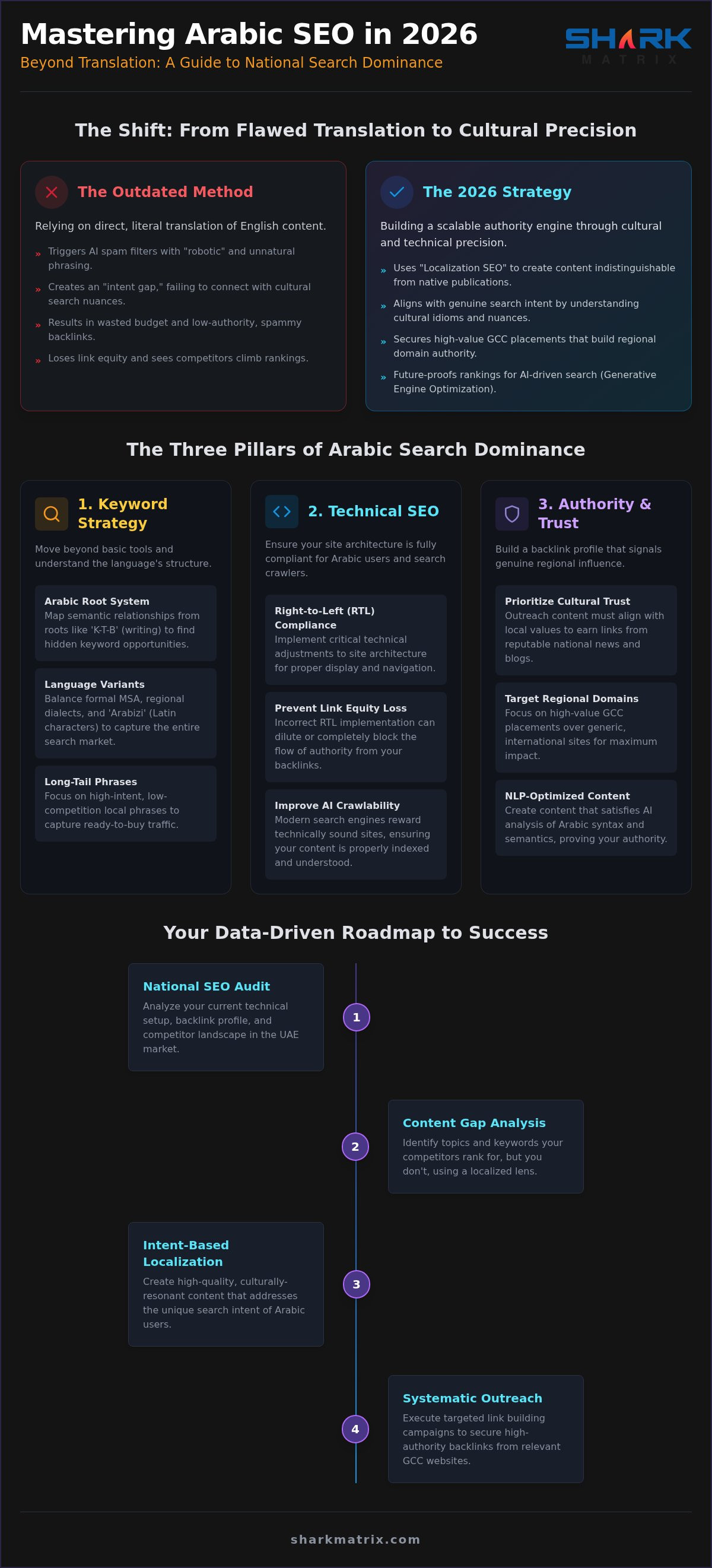
Total digital advertising spend across the MENA region is projected to reach $8.4 billion in 2026, yet many brands are still missing out on this growth due to fragmented data. Most marketers realize that generic software often fails to handle the nuances of Right-to-Left script or the distinct shift between Khaleeji and Modern Standard Arabic. If you’re tired of seeing inaccurate search volumes in your spreadsheets, choosing the right arabic keyword research tools is the first step toward reclaiming your national search presence.

We agree that navigating these linguistic hurdles shouldn’t feel like a guessing game. This guide promises to equip you with a reliable toolkit and the strategies needed to dominate the Arabic market in 2026. You’ll discover how to achieve higher rankings for localized terms and improve your ROI through advanced AI-driven discovery. We’ll preview the latest updates from powerhouses like Semrush and Ahrefs, while showing you how to adapt to the rise of Answer Engine Optimization (AEO) for a truly modern SEO strategy.

Key Takeaways

  • Understand why standard software often fails Arabic SEO by misinterpreting root words and prefixes through poor tokenization.
  • Identify the most reliable arabic keyword research tools in 2026, comparing global giants like SEMrush with specialized autocomplete software.
  • Learn how to leverage AI models for sophisticated keyword clustering and identifying high-intent long-tail phrases in regional dialects.
  • Implement a two-step strategic framework that combines native linguistic brainstorming with data-driven expansion for maximum search visibility.
  • Discover how custom AI automation and professional SEO services can bridge the technical gap between global tools and regional language nuances.

Why Standard Keyword Tools Often Fail the Arabic Language

Arabic keyword research is the specialized process of identifying search terms across both Modern Standard Arabic (MSA) and diverse regional dialects. Most global SEO platforms were built with Latin languages in mind. They often fail to capture the nuances of the Middle Eastern market because they treat Arabic as a direct translation of English. This leads to missed opportunities and skewed data. Understanding Arabic SEO fundamentals helps clarify why these technical barriers exist for most arabic keyword research tools today.

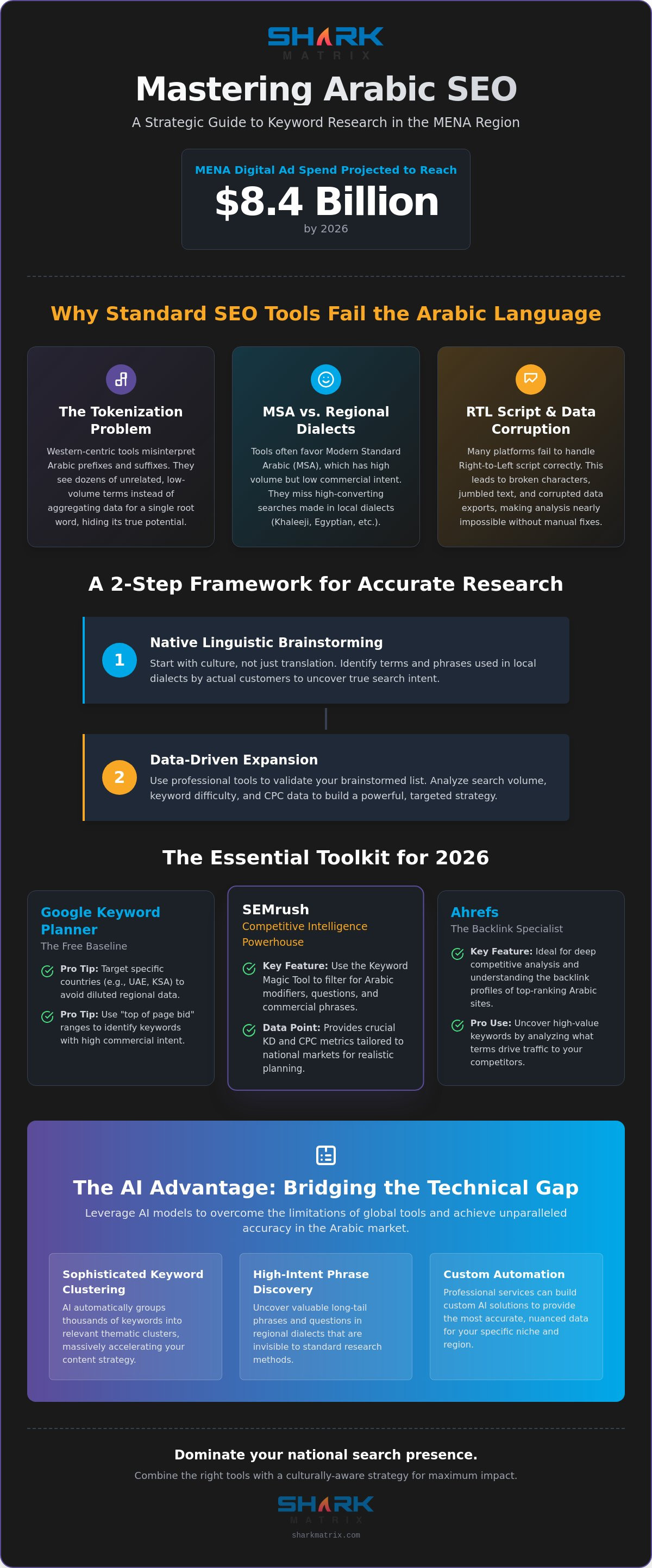
A primary technical hurdle is the ‘Tokenization’ problem. Arabic is a highly inflected language where a single root word can have hundreds of variations based on prefixes, suffixes, and infixes. Western-centric tools often misinterpret these components. Instead of recognizing a common root, they see dozens of unrelated strings. This fragments your search volume data. You might see low volume for a specific term simply because the tool isn’t aggregating all its grammatical forms correctly.

Search volume discrepancies also arise from a reliance on “translated” keywords. Many marketers simply translate their English list into Arabic. This rarely matches actual user behavior. A literal translation might give you an MSA term that nobody uses in a commercial context. Users search with their culture and their local habits. If your tools don’t account for this, your strategy is built on a foundation of ghost data.

MSA vs. Regional Dialects: The Search Intent Divide

Modern Standard Arabic is the language of academia, news, and formal literature. However, commercial searches often happen in local dialects like Khaleeji, Levantine, or Egyptian. A keyword with high volume in MSA might indicate a user looking for information or news, which often results in zero conversion intent. In contrast, a dialect term might have lower tracked volume but represents a customer ready to buy. For instance, while ‘Aqar’ is a standard term for real estate, specific regional terms for ‘apartment’ or ‘villa’ vary wildly. Choosing the wrong one means targeting the wrong audience entirely.

This intent divide is particularly visible in the automotive market. To see how a local leader manages this, check out Marhaba Auctions and observe how they target specific search behaviors for used and salvage vehicles in the UAE.

The Technical Challenge of RTL Script in SEO Tools

Right-to-Left (RTL) script is more than just a visual alignment. It changes how data is processed and visualized. Many tool interfaces struggle with Arabic characters and ligatures, often displaying them as broken boxes or reversed text. This makes data analysis exhausting for native specialists. Exporting this data to CSV or Excel frequently results in jumbled characters that require manual cleaning. RTL compatibility is a non-negotiable feature for national SEO success. Without it, your team spends more time fixing spreadsheets than optimizing content. Reliable arabic keyword research tools must handle these scripts natively to provide actionable insights.

The Best Global Arabic Keyword Research Tools in 2026

With the MENA digital advertising market hitting $8.4 billion in 2026, choosing the right arabic keyword research tools isn’t just a technical choice; it’s a financial one. While local nuances are vital, global enterprise tools provide the scale needed to compete. These platforms have evolved to better handle the complexities of the Arabic language, offering deeper databases for the Gulf and North African regions than ever before.

Google Keyword Planner: The Free Baseline

Google Keyword Planner remains the foundation for many national campaigns. To get the most out of it, you must set specific location parameters, such as targeting the UAE or Saudi Arabia specifically, rather than the entire region. This avoids diluted data. A common frustration is the “grouped” search volumes in the free version, which can hide the difference between a high-intent dialect term and a broad MSA phrase. You can often uncover “hidden” keywords by looking at the “top of page bid” ranges; high bids usually signal commercial intent that the volume numbers alone might mask.

SEMrush and Ahrefs: Data Depth for Professionals

SEMrush is often the preferred choice for competitive intelligence in the Middle East. Its Keyword Magic Tool allows for specific Arabic modifier filtering, helping you isolate questions or commercial intent phrases. For those managing complex budgets, SEMrush offers plans like the Pro version at $139.95 per month or the Business plan at $499.95 for larger operations. You’ll want to focus on Keyword Difficulty (KD) and CPC metrics tailored to the national market to ensure your content strategy is realistic.

Ahrefs shines in backlink analysis and identifying keyword gaps between your site and local competitors. Their Standard plan at $249 per month is a solid middle ground for businesses scaling their reach. By analyzing which Arabic terms your competitors rank for, you can spot opportunities they’ve neglected. If the raw data from these tools feels overwhelming, our team at Shark Matrix can help you interpret these metrics through a native linguistic lens.

The cost-to-value ratio depends on your scale. Ahrefs’ Starter plan at $29 per month is great for small businesses, but serious national SEO requires the Lite or Standard tiers to access historical data. SEMrush provides a more comprehensive suite for PPC and SEO combined, making its Guru plan ($249.95/month) a strong investment for brands aiming for total market dominance. Both tools have significantly improved their RTL support in 2026, though manual verification of dialect nuances remains essential for accuracy.

Top Arabic Keyword Research Tools: The 2026 Guide to National SEO Success

While global databases offer a broad view, specialized arabic keyword research tools provide the linguistic nuance required for national dominance. In 2026, tools like KeywordTool.io have become essential for capturing long-tail intent that standard tools often miss. By scraping autocomplete data from platforms like YouTube and Amazon, these tools reveal how users search in their native dialects rather than formal Modern Standard Arabic. This approach aligns perfectly with international SEO best practices, ensuring your content resonates with local cultural habits.

Specialized arabic keyword research tools like tool4seller also cater to specific niches such as Middle Eastern e-commerce marketplaces. With plans ranging from a $19.99 Startup tier to a $299.99 Premium option, these tools offer insights into regional buyer behavior that general platforms can’t match. They bridge the gap between broad data and the specific needs of local consumers.

Leveraging Autocomplete for Long-Tail Arabic Keywords

Standard tools often ignore the conversational nature of Arabic search. Autocomplete data is more reflective of real-world dialect usage than the rigid terms found in traditional planners. In KeywordTool.io, using filters for ‘prepositions’ and ‘questions’ allows you to see exactly how users in the UAE or Saudi Arabia phrase their queries. For example, a user might search for ‘best way to’ in a local dialect that a global tool wouldn’t recognize. Mapping these long-tail terms to professional search engine optimization seo services ensures your content strategy targets high-intent traffic that competitors are likely overlooking.

The Role of NLP and AI in 2026 Keyword Analysis

The integration of Generative AI has changed the workflow for SEO specialists. Advanced models like ChatGPT and Claude 3.5 handle complex Arabic keyword clustering, which was once a manual, error-prone task. Natural Language Processing (NLP) helps these tools understand the sentiment behind a query, distinguishing between a user looking for a complaint forum and one ready to make a purchase. Specialized AI-focused platforms like SEMAI are also gaining traction, focusing on visibility in AI-powered search results for a monthly fee mentioned at $99. Our ai development services are revolutionizing keyword data processing by creating custom models that interpret these complex linguistic patterns at scale. This allows brands to categorize thousands of regional search terms into logical topic clusters in seconds, providing a massive competitive advantage in the national market.

A Strategic Framework for Arabic Keyword Research

Successful SEO in the Middle Eastern market requires moving beyond simple lists. A strategic workflow ensures that you aren’t just ranking for high-volume terms, but for terms that actually convert. By combining arabic keyword research tools with a structured, five-step approach, you can bridge the gap between technical data and cultural relevance. This framework moves from broad ideas to highly targeted, national search terms.

  • Step 1: Seed Keyword Generation. Start with native intuition. While AI brainstorming is excellent for scale, native speakers identify the slang and colloquialisms that tools often miss.
  • Step 2: Expansion. Input your seeds into global arabic keyword research tools to identify search volume and competition levels. This is where you find the related terms that broaden your reach.
  • Step 3: Dialect Validation. Cross-reference your list to ensure terms match national cultural nuances. A term used in Egypt might not resonate with a Khaleeji audience.
  • Step 4: Intent Mapping. Categorize your keywords into Informational, Commercial, or Transactional buckets to align with the Arabic buyer journey.
  • Step 5: Competitor Gap Analysis. Use your data to find what national brands are failing to target. This is where you find the low-competition, high-reward opportunities.

Mapping Search Intent for the Arabic Consumer

High-intent transactional keywords are the backbone of ecommerce seo services dubai. Arabic consumers often prioritize “Trust” keywords, such as phrases including “guaranteed” or “official,” especially when shopping online. For “How-to” queries, keep in mind that video content often outperforms text in this region. Since over 70% of website traffic in the UAE originates from mobile devices, your keywords must reflect how people speak into their phones, which is often more conversational than typed text.

Validating Keywords Against National Trends

Google Trends for the UAE is a goldmine for spotting seasonal spikes, such as during Ramadan or national holidays. Since 46% of Google searches in the UAE have explicit local intent, validating your list against real-world behavior is critical. You shouldn’t rely on data alone; cross-referencing your list with social media listening tools provides a clearer picture of current trends. A professional content marketing agency uae can help turn these raw data points into high-performing assets that speak directly to the local audience. If you’re ready to build a data-backed strategy, our experts at Shark Matrix can help you refine your keyword list for maximum national impact.

Maximizing Your National Reach with Shark Matrix

Dominating the Arabic search market in 2026 requires more than a subscription to a software platform. While standard arabic keyword research tools provide a baseline of data, they often lack the cultural depth needed to capture high-intent traffic across different dialects. Shark Matrix bridges this technical gap by combining elite global tools with native linguistic expertise. We don’t just look at numbers. We analyze the “why” behind the search. Since 2010, we’ve helped national brands navigate these complexities by interpreting data from arabic keyword research tools through a native lens that accounts for both Modern Standard Arabic and regional nuances.

Our approach goes beyond traditional SEO. By leveraging custom ai development uae, we build proprietary systems that process complex Arabic search data with precision. This allows us to identify emerging patterns that generic tools overlook. We also integrate these insights into a comprehensive ppc agency dubai strategy, ensuring that your paid and organic efforts work in harmony. A national focus requires a strategic partnership that understands the intersection of technology and culture.

Data-Driven SEO and AI Automation

Shark Matrix uses machine learning to predict search trends before they reach their peak. This proactive stance is essential for maintaining a competitive edge in a fast-moving digital economy. Our expertise in seo for brand reputation management dubai allows us to monitor Arabic search sentiment in real time. We protect your brand by identifying how users perceive your business across various regional dialects. Our commitment to end-to-end digital transformation ensures that your keyword strategy isn’t an isolated task but a core driver of your national growth. We use AI automation to clean and cluster datasets, turning raw information into actionable marketing assets.

Ready to Dominate the National Search Landscape?

Professional Arabic SEO is a necessity for any brand serious about the MENA region in 2026. The days of simple translations and generic keywords are over. Success now depends on specialized tools, AI-enhanced analysis, and a deep understanding of local search intent. Don’t let your brand get lost in translation. Consult with our specialists at Shark Matrix to develop a tailored keyword strategy that reflects your business goals. We’re ready to help you scale. Contact us today to start your journey toward total national search dominance and measurable ROI.

Future-Proofing Your Arabic SEO Strategy

Mastering the Middle Eastern market in 2026 demands a shift from simple translation to deep linguistic intelligence. You’ve seen how global platforms provide the data foundation, while specialized AI models bridge the gap between Modern Standard Arabic and regional dialects. By applying a structured framework, you can move beyond raw volume and focus on the high-intent terms that drive real commercial growth. Success in this region isn’t just about being found; it’s about being understood by your local audience.

Selecting the right arabic keyword research tools is only half the battle. To truly dominate, you need a partner who understands how to turn these insights into a cohesive content and PPC strategy. Shark Matrix has been a leading national SEO agency since 2010, specializing in AI-driven digital marketing that respects the nuances of the local market. We combine over a decade of experience with cutting-edge automation to ensure your brand stays ahead of the curve.

Scale your national reach with expert Arabic SEO from Shark Matrix. We’re here to help you navigate these complexities and achieve lasting visibility. Your journey to national search dominance starts with a single, data-backed step.

Frequently Asked Questions

What is the best free Arabic keyword research tool?

Google Keyword Planner remains the most reliable free option because it pulls data directly from Google’s own database. While it provides a solid baseline for search volume, it often groups similar terms together, which can hide specific dialect nuances. It’s most effective when you have an active Google Ads account to unlock more precise data ranges for the MENA region.

How do I find keywords in specific Arabic dialects?

You can find dialect-specific keywords by using autocomplete scrapers and social media monitoring tools. Software like KeywordTool.io scrapes real-time queries from YouTube and Google, revealing how people actually speak in the Gulf or Levant. Manual research on local forums and TikTok comments also helps identify slang that standard arabic keyword research tools might miss during automated scans.

Does Google Keyword Planner work for Arabic SEO?

Yes, Google Keyword Planner is a foundational tool for Arabic SEO campaigns. To get accurate results, you must filter your search by specific countries like Saudi Arabia or the UAE rather than the entire Middle East. This helps you avoid broad, diluted metrics that don’t reflect the unique search habits of your target national audience.

Why is search volume lower for Arabic keywords compared to English?

Search volume often appears lower because the Arabic language is fragmented into various dialects and multiple spelling variations. Many users also practice code-mixing, which is the habit of using both English and Arabic in a single query. This splits the total search volume across several different terms, making individual keywords look less popular than their English equivalents.

Can AI tools like ChatGPT be used for Arabic keyword research?

AI tools are excellent for the heavy lifting of keyword clustering and intent categorization. While they don’t provide live search volume, models like ChatGPT and Claude can process exports from arabic keyword research tools to identify semantic relationships. This helps you organize thousands of regional terms into a coherent content strategy in a fraction of the time it takes manually.

What is the difference between MSA and regional dialect keywords?

Modern Standard Arabic (MSA) is the formal version used in news and official documents, while regional dialects are conversational and informal. For example, a user looking for a house might use an MSA term in a formal search but switch to a Khaleeji dialect when asking for recommendations. Understanding this split is crucial for matching the user’s specific search intent.

How often should I update my Arabic keyword list?

You should update your list at least every quarter to stay aligned with shifting consumer trends in the region. Major cultural events like Ramadan or national holidays cause massive, temporary spikes in specific search behaviors. Regular updates ensure you aren’t wasting your marketing budget on terms that have lost their relevance or commercial value in the current market.

Is it better to target MSA or local dialects for e-commerce?

A hybrid approach is usually the most effective strategy for e-commerce brands. Use MSA to build authority and trust in your technical specifications, formal policies, and product descriptions. However, you should focus on local dialects for your headlines and social media content, as these conversational terms often signal a higher intent to purchase among local shoppers.

Categories
SEO

Technical Guide: Hreflang Implementation for Arabic Sites in 2026

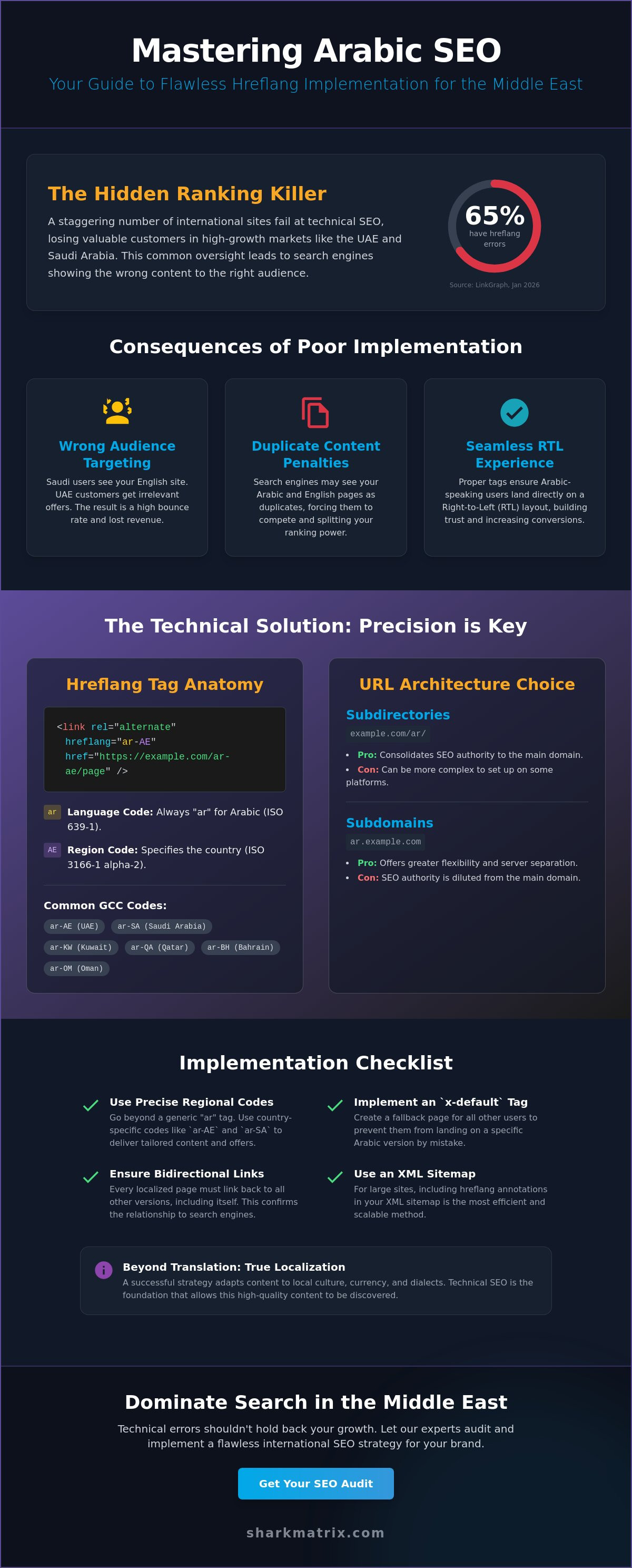
Over 65% of international websites currently struggle with significant errors in their hreflang tags according to January 2026 data from LinkGraph. For businesses targeting the Middle East, a flawed hreflang implementation for arabic sites often means your high-value Saudi audience sees English content while your UAE landing pages fail to rank entirely. It’s frustrating to invest in quality content only to have search engines serve the wrong version. Between the complexities of Right-to-Left (RTL) architecture and the confusion of ISO codes like ar-AE versus ar-SA, the technical barriers can feel overwhelming.

We’re here to help you master these technical nuances so you can dominate search results across the Middle East. You’ll gain a clear roadmap for implementation that ensures your regional targeting is precise and your site avoids duplicate content penalties. We’ll walk through the essential steps for mapping regional codes, managing bidirectional links, and leveraging XML sitemaps to ensure your localized versions perform exactly as intended.

Key Takeaways

  • Identify the correct ISO 639-1 “ar” language codes and regional modifiers to build precise tags that signal your target market to search engines.
  • Evaluate the SEO authority of subdirectories against the flexibility of subdomains to find the ideal URL architecture for your localized Arabic pages.
  • Discover how a proper hreflang implementation for arabic sites protects your brand from duplicate content penalties while supporting Right-to-Left (RTL) layout stability.
  • Understand the impact of Arabic site architecture on Core Web Vitals to ensure your technical SEO supports a seamless mobile experience.
  • Prepare for the future of search by aligning your technical signals with emerging AI and Generative Engine Optimization (GEO) trends in the MENA region.

Why Arabic Hreflang Implementation is Critical for UAE Brands

The hreflang attribute serves as a technical signal that tells search engines exactly which language and geographic region a page is designed for. In a market like the UAE, where internet penetration reached 99.0% by June 2026 according to DataReportal, the stakes for technical precision are incredibly high. Without a robust hreflang implementation for arabic sites, your content might exist, but it won’t be visible to the right people. It’s the difference between a user in Riyadh seeing your Saudi-specific pricing and a user in Dubai seeing your UAE-specific offers.

Localization offers a massive return on investment, yet many brands stop at simple translation. Digital advertising spend in the MENA region reached $8.18 billion in 2025, making it the fastest-growing digital ad region in the world. To capture this growth, you need more than just translated text. You need technical signals that consolidate your ranking power. Hreflang tags help search engines understand that your Arabic and English pages are versions of the same content rather than duplicate pages. This prevents your different regional versions from competing against each other in search results.

User experience is equally vital. When an Arabic-speaking user clicks a link from a search engine, they expect a seamless Right-to-Left (RTL) experience. If they land on an English page or a poorly formatted Arabic version because your technical signals were crossed, they’ll likely leave immediately. Proper implementation ensures they land on the correct version the first time, boosting your conversion rates and building trust with your audience.

The Difference Between Translation and Localisation

Modern search engines prioritize pages that offer a truly localized experience. Translation just changes the words; localization adapts the entire context, including currency, regional dialects, and cultural nuances. Technical SEO provides the foundation for this high-quality content to succeed. At Shark Matrix Technologies LLC, we integrate these signals into our search engine optimization seo services to ensure your brand doesn’t just speak Arabic, but speaks the right version of Arabic for every target market. An “Arabic-first” strategy supported by technical tags consistently outperforms generic translated sites.

Preventing Common Ranking Errors

It’s a common frustration for Middle Eastern brands when their English pages outrank their Arabic versions in local search results. This happens because search engines lack the technical “hint” to prefer the Arabic page for local queries. Data from LinkGraph in early 2026 showed that 65% of international websites have significant implementation errors, often leading to the wrong page appearing in SERPs. A correct hreflang implementation for arabic sites solves this problem. By mapping your pages correctly, you’ll see a significant drop in bounce rates as users are automatically directed to the RTL layout they expect.

Mastering Hreflang Syntax for the Middle Eastern Market

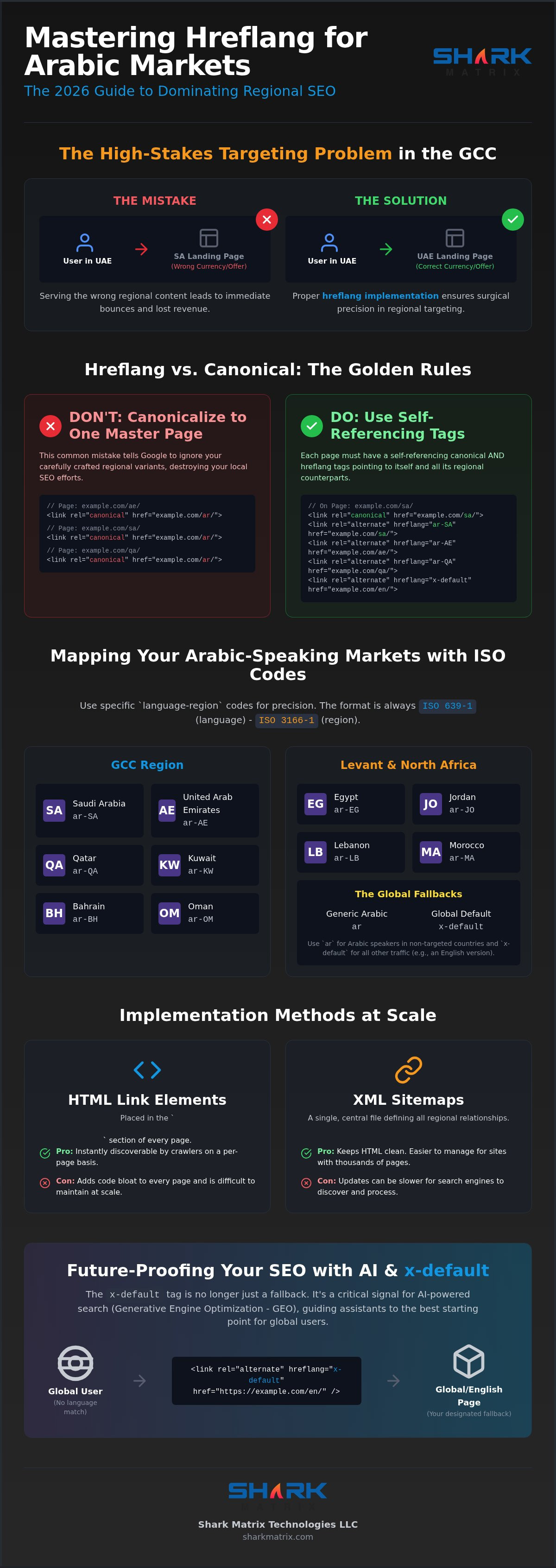
Precision in your code is the difference between a successful expansion and a technical mess. The basic anatomy of an hreflang tag follows a strict pattern: rel="alternate" hreflang="language-country". For any hreflang implementation for arabic sites, the language component always uses the ISO 639-1 code “ar”. While this tells Google the content is in Arabic, it doesn’t specify which version of your site a user in Dubai should see compared to a user in Riyadh. To solve this, you must append the ISO 3166-1 alpha-2 country code to the language tag.

Adhering to W3C internationalization standards ensures your site handles these regional variations correctly. Beyond regional tags, you must include an “x-default” attribute. This acts as a fallback for users whose language or location doesn’t match any of your specific targets. If a user in London searches for your brand, the x-default tag directs them to your global English page or a neutral landing page, preventing them from landing on a regional Arabic version by mistake.

If you’re unsure if your current site architecture supports these complex technical requirements, Shark Matrix Technologies LLC can help through professional SEO services that audit and refine your international targeting.

Regional Code Combinations for the GCC

The Gulf Cooperation Council (GCC) represents some of the most digitally active markets in the world. To target them effectively, you need specific combinations. Use “ar-AE” for the United Arab Emirates, where internet penetration is nearly 100%. For Saudi Arabia, use “ar-SA”, and for Qatar, “ar-QA”. Other essential codes include “ar-KW” (Kuwait) and “ar-BH” (Bahrain). Use a generic “ar” tag only when the content is universal and not tied to specific regional pricing or local laws. This specificity ensures Google serves the most relevant content to users in each distinct market.

The Reciprocal Link Rule

Google requires a bidirectional handshake for hreflang to work. If your UAE page (ar-AE) points to your Saudi page (ar-SA), the Saudi page must point back to the UAE page. If this link is broken or one-way, Google will likely ignore the signal entirely. This rule applies to every single localized version on your site. Every page must also include a self-referencing tag that points to itself. To verify your implementation, use a technical SEO audit tool to identify “return tag” errors where a localized page fails to point back to its source.

Technical Guide: Hreflang Implementation for Arabic Sites in 2026

Choosing Your Arabic URL Architecture

Selecting the right URL structure is a foundational step in your hreflang implementation for arabic sites. The way you organize your localized content dictates how search engines distribute authority and how easily your site can scale across the Middle East. Most businesses choose between subdirectories, subdomains, or country-code top-level domains (ccTLDs). Each approach has distinct technical implications for your SEO performance and long-term maintenance.

Subdirectories, such as example.com/ar/, are often the most effective choice for growing brands. They allow your Arabic pages to inherit the domain authority of your main site, which can lead to faster rankings for new content. However, for large-scale operations with localized logistics or separate server requirements, subdomains like ar.example.com might be necessary. While ccTLDs like .ae or .sa provide the strongest possible geographic signal to search engines, they require significant resources to manage. We often address these complexities within our website design and development services to ensure that technical debt doesn’t hinder your regional growth.

Subdirectory vs. Subdomain: The SEO Debate

The choice between a subdirectory and a subdomain often comes down to authority versus independence. Subdirectories consolidate your backlink profile, making it easier for your Arabic pages to benefit from your global marketing efforts. Subdomains, on the other hand, are treated as semi-independent entities by Google. This can lead to a fragmented crawl budget, where search engine bots spend more time jumping between domains rather than indexing your content efficiently. For most UAE-based enterprises, the subdirectory model offers a more streamlined path to ranking in a competitive market.

Implementing Hreflang via XML Sitemaps

While many sites place hreflang tags directly in the HTML <head>, this can lead to bloated code and slower page load speeds, especially when you’re targeting ten or more regions. Moving your hreflang implementation for arabic sites into an XML sitemap is a cleaner, more professional alternative. This method keeps your front-end code lean while providing a centralized map for search engines to follow.

An internationalized XML sitemap lists every URL and its corresponding localized versions in a structured format. According to Google’s official hreflang guidelines, this is a highly effective way to manage large-scale deployments without impacting the user-facing performance of your site. It simplifies the auditing process, as your technical team can verify all regional handshakes in one file rather than scanning thousands of individual pages. This approach is particularly beneficial for e-commerce platforms where page speed is a critical factor in conversion rates.

Technical Challenges: RTL Layouts and Hreflang

Implementing Right-to-Left (RTL) layouts is often viewed as a simple design choice, but it carries significant technical weight for search performance. Success in hreflang implementation for arabic sites requires more than just translating strings; you must align your site’s physical structure with the signals you’re sending to Google. If your CSS causes layout shifts when switching from LTR to RTL, your Core Web Vitals will suffer. In a region where mobile connections are equivalent to 202% of the population, performance is non-negotiable. Technical SEO for Arabic pages must account for how mirrored layouts impact Cumulative Layout Shift (CLS) and Largest Contentful Paint (LCP).

This technical synergy extends to how your web presence interacts with your mobile platforms. Our mobile app development services often rely on these web-based technical signals to ensure deep-linking and user transitions feel native and localized. When your web hreflang tags are correctly mapped, it creates a predictable environment for mobile crawlers and app indexing bots to understand regional content variations.

Canonical Tags vs. Hreflang

The most frequent error we see is the “master version” trap. Many developers incorrectly set the canonical tag of an Arabic page to point back to the English version, thinking it consolidates authority. This actually tells Google to ignore the Arabic page entirely. On localized sites, each regional page must have a self-referencing canonical tag. A canonical tag tells search engines which single URL is the authoritative master version, while a hreflang tag specifies which localized version of that page should be shown to a user based on their language and region. Using them together correctly ensures that your hreflang implementation for arabic sites doesn’t lead to your localized pages being dropped from the index.

RTL Technical Audit Checklist

Auditing an Arabic site requires a specific lens that standard SEO tools often miss. You need to validate that the bot’s view of the RTL structure matches what the user sees. Use this checklist to ensure your technical foundation is solid:

  • Layout Shift Validation: Test that your mirrored CSS doesn’t cause elements to jump during loading, which can trigger CLS penalties.
  • Font Optimization: Ensure that heavy Arabic web fonts are optimized for fast rendering to maintain high page speed scores.
  • Bot Rendering: Use Google Search Central to “Inspect URL” and verify that the RTL layout renders correctly for mobile crawlers.
  • Bidirectional Integrity: Double-check that every RTL page points back to its LTR counterpart and vice versa.

If your RTL site is experiencing indexing issues or poor ranking, our team can provide a technical deep-dive through our SEO and web development services to fix your regional targeting.

Scaling Your National Brand with Professional Technical SEO

Scaling a brand across the Middle East requires more than just launching new pages. It demands a rigorous commitment to technical excellence. While automated translation plugins might seem like a quick fix, they often create a mess of broken signals and cultural inaccuracies that damage your national reputation. A successful hreflang implementation for arabic sites isn’t a “set and forget” task. It’s a strategic asset that needs continuous monitoring to ensure your Saudi, Emirati, and Qatari audiences always see the content designed specifically for them. In a region where digital competition is intensifying, you can’t afford to let technical errors drain your marketing budget.

Success in this competitive landscape often comes down to choosing the right digital partner who understands both the code and the culture. At Shark Matrix Technologies LLC, we integrate technical SEO with your broader growth strategy to ensure your site remains healthy as you expand. We move beyond basic tags to help you navigate the complexities of regional authority and user intent across the GCC.

Generative Engine Optimization (GEO) for Arabic

AI-driven search is fundamentally changing how users find information in the Middle East. With 88% of UAE organizations now using AI in at least one business function as of June 2026, search engines are becoming more sophisticated in how they verify regional authority. AI search engines don’t just look at keywords; they analyze technical signals like hreflang and structured data to confirm your site is a legitimate local source. Preparing your Arabic site for this shift means ensuring your technical foundation is beyond reproach. High-quality hreflang implementation for arabic sites provides the trust signal that generative engines need to cite your brand as an authority in the region.

Custom Technical SEO Solutions

Off-the-shelf SEO solutions often fail when faced with the unique requirements of the Arabic language and Middle Eastern site architecture. Whether it’s managing complex RTL layout shifts or coordinating content across multiple regions, a custom approach is essential. Working with a national agency provides you with a team that understands the local tech stack and the specific browsing habits of users from Dubai to Riyadh. Generic tools can’t replace the nuanced auditing required to catch the technical errors that typically plague international sites. Your next step should be a comprehensive technical audit to identify where your regional targeting might be leaking authority and to build a roadmap for long-term search dominance.

Securing Your Future in the Arabic Digital Landscape

Dominating the Middle Eastern search market in 2026 requires more than just high-quality content. It demands a flawless technical foundation where your site architecture, RTL layouts, and regional signals work in perfect harmony. By correctly mapping your ISO codes and prioritizing bidirectional links, you ensure that every user from Cairo to Kuwait City lands exactly where they should.

Mastering your hreflang implementation for arabic sites isn’t just about avoiding errors. It’s about building authority in an AI-driven search era. Moving your tags to XML sitemaps and aligning your canonical strategy with your regional goals will protect your site from duplicate content penalties while improving page load speeds.

Shark Matrix has been helping brands navigate the MENA market since 2010. Our team combines deep expertise in Arabic digital marketing with custom software and AI automation capabilities to solve your most complex technical challenges. Ready to ensure your regional targeting is precise? Contact Shark Matrix for a Technical SEO Audit and let’s secure your brand’s place at the top of the search results. Your growth across the Middle East starts with a site that search engines can trust.

Frequently Asked Questions

What is the most common mistake in Arabic hreflang implementation?

The most frequent error is the missing “return tag,” where one page links to a localized version that fails to link back. This breaks the bidirectional handshake Google requires to validate the relationship. Another widespread issue in hreflang implementation for arabic sites is using incorrect regional codes, such as “uae” instead of the standardized “AE,” which causes search engines to ignore the signal entirely.

Do I need hreflang if I only have one version of my site in Arabic?

You don’t need hreflang if your site is only available in a single Arabic version without any other language counterparts. Hreflang is specifically designed to help search engines choose between multiple localized versions of the same content. If no other versions exist, Google will simply use its standard language detection algorithms to index and serve the page correctly for Arabic speakers.

Can I use hreflang for different Arabic dialects like Emirati vs. Egyptian?

Yes, you can and should use hreflang to target specific dialects like Emirati (ar-AE) and Egyptian (ar-EG). This is particularly useful for e-commerce sites where pricing, currency, and local terminology differ significantly between markets. Using these specific regional codes ensures that users in Cairo see your Egyptian offers while users in Dubai see your UAE-specific landing pages and Gulf Arabic content.

How long does it take for Google to recognize hreflang changes?

Google typically takes anywhere from a few days to several weeks to process hreflang changes. The exact timing depends on your site’s crawl frequency and how often Googlebot visits your pages. You can monitor the progress through Google Search Central to ensure the signals are being picked up without errors after your initial hreflang implementation for arabic sites is live.

Is it better to put hreflang in the HTML head or the XML sitemap?

Using an XML sitemap is generally better for large-scale enterprise sites with many language and regional variations. It prevents the HTML head from becoming bloated, which helps maintain faster page load speeds for your users. For smaller sites with only two or three versions, placing the tags directly in the HTML head is often easier to manage and remains highly effective.

How does hreflang affect my SEO for brand reputation management in the UAE?

Hreflang protects your brand reputation in the UAE by ensuring users don’t land on irrelevant regional pages with different pricing or legal terms. If a customer in Dubai lands on a page meant for the North African market, it can lead to confusion and a loss of trust. Correct targeting ensures a professional, localized experience that aligns perfectly with your regional brand identity.

What happens if my Arabic and English pages have different content structures?

Your Arabic and English pages don’t need to be identical in structure, but they must serve the same purpose and offer essentially the same information. While you might adapt the layout for RTL requirements or cultural preferences, the core message should remain consistent. If the content is too different, Google may decide the pages aren’t true alternates and ignore the hreflang signal altogether.

Do I need to implement hreflang for my mobile app as well?

While traditional hreflang tags are for web pages, you should implement similar logic for your mobile app using deep linking and app indexing. This ensures that users searching on mobile are directed to the correct localized version of your app content. Aligning your web signals with your mobile app architecture provides a consistent, professional experience across all digital touchpoints in the MENA region.

Categories
SEO

E-commerce SEO for the Arabic Market: The 2026 UAE National Guide

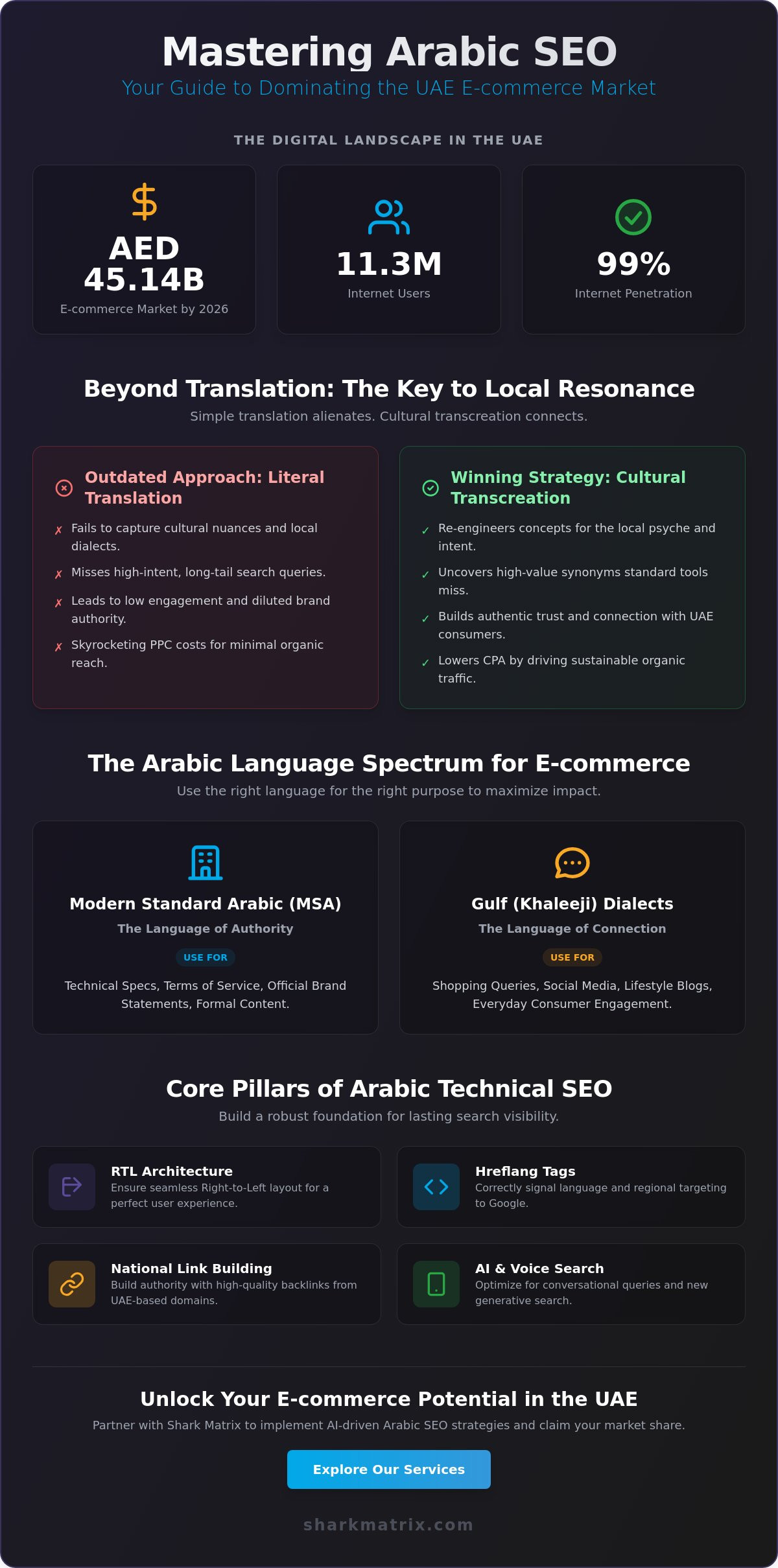
With the UAE e-commerce market surging to over د.إ45.14 billion in 2026, why are so many local brands still losing the battle for search visibility to international platforms? You’ve likely noticed that your bilingual PPC costs are skyrocketing while your organic reach for Arabic queries remains stubbornly low. The truth is that e-commerce seo for arabic market dominance isn’t achieved through simple translation; it requires a deep technical and cultural re-engineering of your digital presence to satisfy both Google’s March 2026 core update and the 11.3 million internet users across the Emirates.

In addition to SEO strategy, having a correctly built store is crucial; كود كرافت للحلول الرقمية specializes in developing digital stores on Shopify and Salla that meet these rigorous technical and RTL standards.

It’s frustrating to see your brand authority diluted by translated content that doesn’t resonate with local sensibilities or capture high-intent search traffic. This guide promises to show you exactly how to master the complexities of RTL technical SEO and Arabic search intent to claim your share of the national market. We’ll explore how to lower your CPA through organic traffic, optimize for the latest Gemini AI search features, and implement AI-driven strategies to stay ahead of the competition in the UAE’s rapidly evolving digital economy.

Key Takeaways

  • Learn to distinguish between Modern Standard Arabic and local dialects to align your content with specific UAE search intent.
  • Move beyond simple translation by using transcreation to identify high-intent synonyms that standard keyword tools often overlook.
  • Master the technical requirements of Right-to-Left (RTL) site architecture and hreflang tags to ensure seamless performance for Arabic users.
  • Execute a specialized strategy for e-commerce seo for arabic market success by building authority through high-quality, national backlinks from UAE-based domains.
  • Prepare for the future of search by integrating AI-driven trend prediction and Generative Engine Optimization (GEO) into your e-commerce framework.

Understanding the Arabic Digital Landscape in the UAE

The UAE’s digital maturity has reached a peak in 2026. With internet penetration at 99%, the way users interact with search engines has fundamentally shifted. Early e-commerce efforts focused on English, but the real growth now lies in capturing the nuances of the local population. Understanding e-commerce seo for arabic market success starts with recognizing that Arabic isn’t a monolith. You’re dealing with Modern Standard Arabic (MSA) for formal documentation and regional dialects, specifically Khaleeji, for everyday shopping queries. While MSA is essential for technical specifications, the conversational heart of UAE commerce beats in dialect.

The opportunity here is massive. While English search results are saturated with international competitors, many high-value Arabic keywords remain surprisingly underserved. By 2026, the UAE e-commerce market has reached د.إ45.14 billion, yet a significant portion of the Arabic digital landscape is still waiting for brands to provide high-quality, localized content. Businesses that bridge this gap don’t just gain visibility; they capture a audience that is often ignored by global giants.

The ROI of Arabic Localization for National Brands

Localized platforms in the Emirates see significant conversion deltas compared to English-only sites. It’s about more than just words; it’s about cultural trust. National stakeholders and local consumers feel a stronger resonance with brands that speak their language fluently. While PPC for bilingual keywords across the UAE can cost a fortune, ranking organically for high-value Arabic terms provides a sustainable path to lower acquisition costs. Investing in e-commerce seo for arabic market visibility allows brands to build a long-term asset rather than perpetually renting space on a results page through expensive ad spend.

Search Intent Nuances: How UAE Users Search

UAE consumers have moved toward a conversational search style. They don’t just type short phrases; they ask questions. This shift is driven by the 23 million mobile connections in the country, where voice search and mobile-first queries are the default. Direct translation often misses the mark because it ignores the informational journey. A user might search for a specific product benefit using a dialect term that a standard translation tool would never suggest. Mapping these conversational paths is the key to dominating local SERPs. You must understand how the UAE consumer moves from curiosity to purchase, ensuring your content answers their specific regional concerns at every step.

Beyond Translation: The Nuances of Arabic Keyword Research

Literal translation is the quickest way to alienate a local audience. In the UAE, search behavior is deeply rooted in cultural context. Transcreation isn’t just swapping words; it’s about re-engineering your brand’s core concepts to fit the local psyche. As the UAE e-commerce market continues its double-digit expansion, the gap between basic translation and true transcreation becomes a competitive moat for national brands. You’re not just translating keywords; you’re translating intent.

Standard SEO tools frequently fail to capture high-intent Arabic synonyms. A user in Dubai might search for a specific product using very different modifiers than a user in another region. If you only target the most obvious terms, you’re missing out on a massive volume of long-tail traffic. Effective e-commerce seo for arabic market growth requires identifying these hidden gems that global tools overlook. Semantic search has become critical since Google’s 2026 updates. Search engines now prioritize the “why” behind a query, moving beyond simple string matching to understand the specific intent of the Arabic shopper.

Successful brands often rely on specialized content marketing experts to bridge this linguistic gap and ensure every piece of content serves a strategic purpose.

Modern Standard Arabic vs. Gulf Dialects

Modern Standard Arabic (MSA) is your foundation for trust. Use it for technical product descriptions, terms of service, and official brand statements. It signals professionalism and corporate authority. However, for lifestyle blogs, social media integration, and consumer engagement, Gulf phrasing is king. Using Khaleeji nuances in your copy makes your brand feel like a local neighbor rather than a foreign entity. This dialectal precision directly impacts how search engines categorize your relevance to UAE-specific results pages, especially as voice search adoption grows among national users who speak naturally to their devices.

Arabic Keyword Mapping Strategy

Don’t treat your Arabic keywords as a separate list. Map them directly to your sales funnel to ensure a cohesive user journey. Start by aligning broad MSA terms with the awareness stage. For the consideration phase, leverage dialect-heavy “how-to” queries and comparison terms. Finally, use specific transactional phrases and long-tail product names for the conversion stage. You must also prevent keyword cannibalization by ensuring your English and Arabic pages have distinct metadata and headers. Integrating these terms into image alt-text is a neglected tactic that can significantly boost your visibility in image search, which remains highly popular among UAE mobile shoppers.

E-commerce SEO for the Arabic Market: The 2026 UAE National Guide

Technical SEO for Arabic: Mastering RTL and Site Architecture

Technical SEO for the Arabic market is often where English-centric strategies crumble. It’s not enough to simply translate your copy; you must re-engineer the digital skeleton of your store. Right-to-Left (RTL) implementation is more than just flipping a CSS property. It requires a total reconfiguration of how your site loads and how users navigate. According to a UAE e-commerce market overview, consumer expectations for seamless digital experiences are at an all-time high, making technical stability a primary ranking factor in 2026.

Hreflang tags are the traffic controllers for your bilingual site. They tell Google exactly which version of a page to serve based on the user’s language settings and location. For national scalability in the UAE, getting this right is non-negotiable. If your tags are misconfigured, you risk keyword cannibalization where your English and Arabic pages fight for the same spot in search results. This technical foundation is essential for e-commerce seo for arabic market success, ensuring that search engines recognize your site as a localized authority rather than a generic global platform.

Google’s March 2026 core update placed heavy emphasis on holistic Core Web Vitals, specifically Interaction to Next Paint (INP). For Arabic sites, complex RTL layouts can sometimes slow down browser rendering. You must optimize your site speed to accommodate diverse connectivity across the Emirates, from high-speed fiber in Dubai to mobile connections on the move. Ensuring that your complex Arabic interface remains responsive and fast is the only way to maintain high rankings in a mobile-first market.

RTL Design and UX Signal Optimization

Layout direction fundamentally changes how users process information. In the UAE, Arabic readers follow a right-to-left scanning pattern, which is the mirror image of the Western “F-pattern.” If your call-to-action buttons or navigation menus aren’t aligned with these reading habits, your bounce rates will climb. High bounce rates send negative signals to search engines, dragging down your rankings. Proper Arabic typography is also critical. Standard fonts often appear cramped or illegible on mobile screens, so choosing a font like “Dubai Font” or “Amiri” can improve dwell time and overall user engagement.

URL Structure and Domain Strategy for the UAE

When targeting the UAE, you must choose between subfolders (example.ae/ar/), subdomains (ar.example.ae), or separate ccTLDs. For most national brands, subfolders are the superior choice as they consolidate link equity into a single domain. While using Arabic script in URLs (Internationalized Domain Names) can look more “local,” they often appear as long strings of gibberish when shared on social media or in emails. This can hurt click-through rates. Before finalizing your architecture, conducting a professional SEO audit report is vital to catch these technical pitfalls before they impact your e-commerce seo for arabic market performance.

Authority in the UAE digital space is earned through local recognition. While international backlinks are useful, Google’s 2026 algorithms prioritize regional relevance for Arabic queries. A backlink from a major UAE-based news portal or a specialized Arabic industry blog carries significantly more weight than a generic global site. This local validation signals to search engines that your store is a trusted entity within the Emirates. Building this trust is a core pillar of e-commerce seo for arabic market success, as it establishes your brand as a national leader rather than a foreign visitor.

To attract these high-value links, you need link-bait content that speaks to the Middle Eastern corporate and consumer landscape. Think about publishing original data reports on local shopping trends or white papers on the UAE’s 2026 digital economy goals. These resources are highly shareable among local journalists and business influencers. Combining these efforts with strategic Arabic PR and guest posting on reputable .ae domains creates a powerful synergy. Many brands find that partnering with a content marketing agency UAE allows them to craft these narratives with the cultural precision required to earn national attention.

Arabic Content Clusters for National Dominance

Topical authority is built through structure, not just volume. Create Arabic pillar pages that cover broad industry topics, then support them with detailed cluster content addressing specific long-tail queries. This approach ensures you capture users at every stage of their search journey. You must maintain a consistent brand voice across both English and Arabic versions of your site to prevent brand dilution. Freshness is also a critical ranking factor in the UAE. Regularly updating your Arabic blog with news about local events or regulatory changes shows search engines that your content is current and relevant to the national audience.

E-commerce SEO for the Arabic Market

Your product pages are where the conversion happens. Optimize your Arabic product descriptions by focusing on high-intent keywords and specific cultural pain points. Don’t forget the power of user-generated content. Arabic reviews provide authentic social proof and inject natural long-tail keywords into your pages, boosting visibility. By integrating national e-commerce SEO strategies with localized Arabic terms, you create a search presence that is both technically sound and culturally resonant. This dual focus is what separates market leaders from those who merely exist online.

Ready to dominate the local search results? Let our team help you build a high-authority content marketing strategy that puts your brand at the center of the UAE’s Arabic digital landscape.

The Shark Matrix Approach: AI-Powered Arabic SEO Services

The UAE’s strategy to increase the digital economy’s contribution to non-oil GDP over the next decade has set a high bar for local businesses. Staying competitive in 2026 requires more than just standard optimization; it demands a shift toward predictive analytics. The Shark Matrix Technologies LLC approach uses machine learning to identify shifting Arabic search trends before they become mainstream. By analyzing data patterns from the 11.3 million internet users across the Emirates, we help you pivot your strategy in real time. This forward-looking methodology is the only way to maintain e-commerce seo for arabic market leadership in a landscape that changes weekly.

Google’s expansion of the Gemini AI search experience to include Arabic in late 2025 has fundamentally changed user behavior. Search is no longer just about a list of links; it’s about being the definitive answer in an AI-generated summary. Our Generative Engine Optimization (GEO) and Answer Engine Optimization (AEO) services ensure your brand remains the primary source for these AI responses. This is why comprehensive search engine optimization (SEO) services have become vital for national brands that want to dominate the new search reality.

Integrating AI and Automation in Arabic SEO

We use Natural Language Processing (NLP) to ensure your Arabic content isn’t just grammatically correct but contextually relevant to UAE dialects. Automation allows us to perform technical audits on massive enterprise sites, catching RTL layout errors or broken hreflang tags instantly. With 8.4 billion active voice assistants worldwide in 2026, we also focus on future-proofing your store for Arabic voice search. This involves optimizing for conversational long-tail queries that UAE shoppers use when speaking to their mobile devices, ensuring your brand is always the first answer they hear.

Protecting Your National Brand Reputation

In a hyper-connected market, your digital reputation is your most valuable asset. There is a critical synergy between national brand reputation management and your Arabic search presence. We monitor Arabic sentiment across social media and search results to ensure your brand name remains untarnished by misinformation or negative trends. By controlling the narrative in both English and Arabic, you build a resilient brand that commands respect across the entire UAE. This holistic approach ensures that your e-commerce seo for arabic market efforts result in both high rankings and high trust.

Don’t let your brand get left behind in the age of generative search. Contact Shark Matrix Technologies LLC for a National Arabic SEO Strategy and start dominating the UAE market today.

Future-Proof Your National E-commerce Strategy

Dominating the Emirates’ digital landscape in 2026 requires a shift from passive translation to active cultural re-engineering. You’ve seen how mastering RTL technical architecture and identifying high-intent dialectal keywords can transform your visibility. By moving beyond basic search tactics and embracing AI-driven Generative Engine Optimization, your brand can provide the definitive answers that local shoppers are looking for. Achieving total e-commerce seo for arabic market success is no longer an optional expansion; it’s the foundation of national brand longevity.

Shark Matrix has been a fixture in the UAE market since 2010, combining deep local expertise with cutting-edge technical capabilities. Our team of native Arabic linguists and senior technical SEO consultants specializes in navigating the complexities of the regional search market. We don’t just optimize for bots; we optimize for the cultural nuances that drive real human conversion. Take the first step toward reclaiming your organic reach and lowering your acquisition costs today. Request a Comprehensive Arabic SEO Audit for Your National Brand and lead your industry into the future of search.

Frequently Asked Questions

Is Arabic SEO different from English SEO in the UAE?

Arabic SEO is fundamentally different because it requires navigating right-to-left (RTL) technical layouts and distinct linguistic variations like Khaleeji dialects. While the underlying search engine principles remain the same, the way UAE users interact with queries is more conversational and mobile-centric. You can’t simply translate English keywords; you must re-engineer content to match the specific cultural intent of the local population.

How long does it take to see results from Arabic SEO services?

Most UAE businesses start seeing measurable organic growth within three to six months of implementing a consistent strategy. Initial gains often appear in long-tail query rankings, while high-competition head terms take longer to secure. Factors like your current domain authority and the technical health of your RTL site architecture will influence how quickly search engines recognize your localized relevance.

Do I need a separate domain for the Arabic version of my website?

You don’t need a separate domain, as subfolders like example.ae/ar/ are typically better for consolidating your site’s link equity. This structure allows your Arabic content to inherit the authority of your primary domain while clearly signaling the language target to Google. While separate ccTLDs can offer a slight local trust signal, they require significantly more resources to manage and build authority from scratch.

Can I use automated translation for my Arabic SEO content?

Raw automated translation is a major risk because it often fails to capture the cultural nuances and dialects essential for e-commerce seo for arabic market success. Machine-translated text frequently results in unnatural phrasing that alienates UAE shoppers and increases bounce rates. For high-converting pages, you need a transcreation process where native speakers adapt the message to resonate with local consumer behavior and search intent.

How do you handle Right-to-Left (RTL) technical issues?

We address RTL issues by mirroring the entire user interface and adjusting the CSS to ensure a seamless right-to-left navigation experience. This isn’t just about text alignment; it involves flipping the placement of logos, menus, and call-to-action buttons. Proper RTL execution ensures that your site meets the March 2026 Core Web Vitals standards, providing a fast and intuitive experience for mobile users across the Emirates.

What is the role of AI in Arabic SEO for 2026?

AI in 2026 is used to power Generative Engine Optimization (GEO) and predict emerging search patterns across the UAE. It helps us understand how generative search models summarize your content for users. By optimizing for these AI-driven summaries, your brand can capture the zero-click traffic that now dominates mobile search results, ensuring you stay ahead of competitors who rely on traditional methods.

How do you measure the success of an Arabic SEO campaign in the UAE?

Campaign success is measured by tracking organic traffic from Arabic-speaking regions, keyword ranking improvements, and the total conversion value in UAE Dirham (د.إ). We also look at the reduction in bilingual PPC spend as your organic visibility grows. These metrics provide a clear picture of your ROI and help us refine your content clusters to target the most profitable search intents.

Can Arabic SEO help with my brand reputation management?

Arabic SEO is a critical component of brand reputation management because it allows you to control the narrative on the first page of search results. By ranking authoritative, positive content for your brand name in Arabic, you push down negative or irrelevant mentions. This proactive approach is a cornerstone of any robust e-commerce seo for arabic market strategy, ensuring your national reputation remains protected and professional.