

A fixed PPC split can make a budget look organised while quietly starving your strongest opportunities. The right ppc budget allocation model isn’t a universal percentage chart. It helps you direct spend towards the campaigns and funnel stages most likely to support your business goals.
If you’re unsure how much to assign to each channel, or worried that a standard percentage rule will limit growth, you’re not alone. The decision gets harder when conversion history is limited: forecasts are less certain, and performance comparisons can be difficult. A useful plan makes room for what the data shows without pretending every decision is backed by perfect evidence.
This guide compares practical budget models and explains how to choose one that fits your goals and available data. You’ll learn how to turn targets and campaign performance into an actionable allocation, then set review rules for adjusting spend with discipline rather than reacting to every short-term change. The central idea is simple: allocate by potential marginal returns, not by fixed channel percentages.
Key Takeaways
- Choose a ppc budget allocation model that reflects your business goals and the evidence available, rather than defaulting to fixed channel percentages.
- Turn your desired outcomes into an allocation plan by defining acceptable economics, estimating demand, and validating assumptions.
- Compare goal-based, historical-performance, and other practical models by their input needs, risks, and review signals.
- Use campaign tracking, pacing checks, and scheduled reviews to guide adjustments based on conversion quality and performance data.
- Document your assumptions, measure results, and refine the plan as part of a disciplined PPC management process.
Why a PPC Budget Allocation Model Beats Fixed Spending Splits
Setting a total advertising budget answers one question: how much can the business spend? It doesn’t answer how that amount should be distributed across platforms, campaigns, audiences, or stages of the customer journey. A ppc budget allocation model helps answer that second question by connecting spend to business and campaign objectives, such as generating qualified leads, driving sales, or building awareness.
Allocation is a decision framework shaped by goals, evidence, and constraints. It accounts for conversion economics, available demand, campaign capacity, and the reliability of your data. It also recognises that paid search, social campaigns, and other PPC activity may play different roles. As a foundation, Pay-per-click (PPC) describes advertising in which advertisers pay when users click. The value of a click depends on what happens next.
A fixed percentage split can be a useful starting point for planning or testing, but it isn’t a universal performance formula. If one campaign has a clear path to valuable conversions and another supports discovery, dividing spend equally may ignore their different jobs. The aim isn’t to give every channel the same share. It’s to make each allocation defensible against the objective it serves.
What decisions does a PPC allocation model guide?
The model guides distribution after the total budget is set. It helps determine which platforms and campaigns receive funding, which audiences to prioritise, and how much to reserve for discovery versus high-intent activity. Base each decision on target outcomes, the economics of a conversion, and the demand each campaign can realistically reach, rather than an automatic equal split.
Why do fixed budget percentages often fall short
Accounts differ in goals, customer journeys, campaign maturity, and available evidence. A split that suits a sales campaign may not suit lead generation or awareness activity. Weak tracking can misattribute conversions, while small samples can make a channel look unusually strong or weak. Treat early results as signals to investigate, not proof that the apparent winner deserves every extra dollar.
For a practical allocation, assess each proposed share against a few questions:
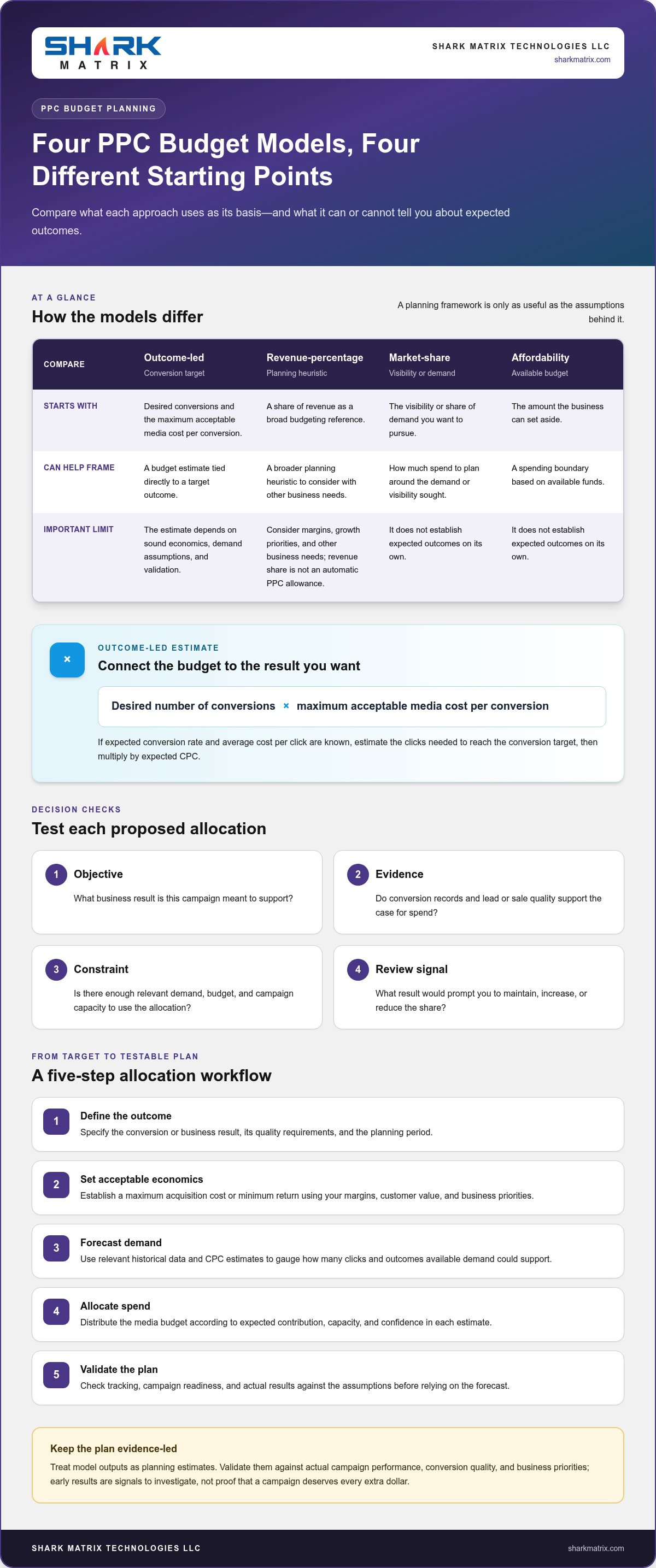
- Objective: What business result is this campaign meant to support?
- Evidence: Do conversion records and lead or sale quality support the case for spend?
- Constraint: Is there enough relevant demand, budget, and campaign capacity to use the allocation?
- Review signal: What result would prompt you to maintain, increase, or reduce the share?
These checks make assumptions visible and give teams a consistent basis for comparison. They also help prevent budget shifts driven by isolated results, especially when campaigns have different conversion paths or times to outcome. Treat every model output as a planning estimate, then validate it against actual campaign performance. As results accumulate, revisit the assumptions and adjust distribution based on conversion quality and business priorities.
How to Calculate a PPC Budget Allocation Model
Build the allocation from business outcomes, not from a channel split chosen for convenience. A useful ppc budget allocation model makes its assumptions visible: what result you want, what that result can reasonably cost, how much demand may be available, and what evidence will tell you whether the plan needs adjustment.
Start with a goal-based or revenue-based calculation
For an outcome-led estimate, multiply the desired number of conversions by the maximum acceptable media cost per conversion. If you know your expected conversion rate and average cost per click, estimate the clicks needed to reach the conversion target, then multiply by expected CPC. Both approaches connect budget to outcomes. Revenue-percentage budgeting is a broader planning heuristic. Use it alongside margin, growth priorities, and other business needs, rather than treating a revenue share as an automatic PPC allowance.
Market-share budgeting starts with the visibility or share of demand you want to pursue. Affordability budgeting starts with the amount the business can set aside. Neither establishes expected outcomes on its own. Practical PPC budget planning can compare these approaches, but the assumptions still need to fit your economics and campaign conditions.
Use this five-step workflow:
- Define the outcome. Specify the conversion or business result, its quality requirements, and the planning period.
- Set acceptable economics. Establish a maximum acquisition cost or minimum return using your own margins, customer value, and business priorities.
- Forecast demand. Use relevant historical data and CPC estimates to gauge how many clicks and outcomes the available demand could support.
- Allocate spend. Distribute the media budget across campaigns according to expected contribution, capacity, and confidence in each estimate.
- Validate the plan. Check tracking, campaign readiness, and actual results against the assumptions before treating the forecast as a reliable guide.
Turn assumptions into a forecast you can test
Gather historical clicks, spend, conversions, conversion quality, and conversion value where available. Add estimated CPC, expected conversion rate, campaign capacity, and the target outcome. Separate media spend from the complete budget: management, tools, and creative production are supporting costs, not click spend. Keep both views so the campaign allocation doesn’t hide the resources needed to run it.
Label the variables before calculating: B = media budget, CPC = estimated cost per click, CVR = expected conversion rate, and V = average value per conversion. Then estimate:
- Forecast clicks = B ÷ CPC
- Forecast conversions = forecast clicks × CVR
- Forecast conversion value = forecast conversions × V
A forecast is a planning estimate, not a performance guarantee. Compare actual delivery with these estimates, investigate gaps in tracking or demand, and revise assumptions before shifting budgets. For support with planning, managing, and evaluating campaigns, explore PPC management support.
Which PPC Budget Allocation Model Fits Your Situation?
The right model depends on the decision you need to make and the evidence you can trust. Use a goal-based approach when conversion economics are clear, forecasting when historical results are useful, and simpler constraints when data is thin or the business needs a defined spending limit. A ppc budget allocation model can combine approaches, such as setting an affordability ceiling before distributing spend according to campaign forecasts.
Choose a model based on your data maturity
For a new campaign, plan conservative scenarios and treat initial spend as a controlled test. Set a clear learning objective and decide what evidence would justify expanding. Established campaigns can use validated CPA or ROAS targets to compare opportunities, but only when conversion tracking and lead or sale quality are dependable. In complex accounts, cross-channel attribution may not clearly show each touchpoint’s contribution, so avoid treating reported channel credit as complete proof of incremental impact.
| Model | Useful conditions | Required inputs | Main risk | Review signal |
|---|---|---|---|---|
| Goal-based | Conversion economics are clear | Target conversions, allowable CPA or ROAS | Targets may ignore available demand | Qualified outcomes against target |
| Forecasting | Historical data is usable | Spend, clicks, CPC, conversions, value | Past patterns may not persist | Actual results versus forecast |
| Revenue percentage | Useful as a broad planning limit | Revenue, margin, growth priorities | Revenue share may not reflect profitability | Return and business affordability |
| Market share | Visibility or demand coverage is a priority | Market opportunity, impression or reach goals | More exposure may not create efficient outcomes | Incremental reach and conversion quality |
| Affordability | Cash flow sets a firm ceiling | Available budget and operating constraints | Spend limit isn’t an outcome forecast | Pacing and value generated within the limit |
| Full-funnel | Campaigns support different journey stages | Stage roles, audience and outcome signals | Allocation can imply impact that hasn’t been measured | Stage-specific indicators and downstream quality |
Revenue-percentage, market-share, and affordability models are best treated as planning constraints, not proof that a particular spend level will perform. They can establish a workable envelope, then goal-based or forecast evidence can guide distribution inside it.
Compare channel, campaign, and funnel-level allocation
Platform-level budgets set the broad division between advertising channels. Campaign-level decisions prioritise specific products, services, or objectives within a platform. Funnel allocation instead assigns roles by journey stage, such as discovery, consideration, or high intent. It organises investment, but doesn’t by itself prove that an upper-funnel activity caused later conversions.
Branded searches capture people already looking for a business, while non-branded searches can reach audiences exploring a category or solution. Their intent and measurement needs differ, so assess them separately before comparing results. When PPC management is part of the plan, define the objectives, reporting needs, and review signals that will guide campaign decisions.
How to Implement, Monitor, and Reallocate Your PPC Budget
A budget model only becomes useful when it shapes day-to-day campaign decisions. Put the ppc budget allocation model into operation with clear campaign roles, reliable measurement, and agreed rules for changing spend. This turns allocation from a one-time forecast into a managed process, without letting every short-term performance swing trigger a budget change.
Set pacing and review rules before campaigns launch
Start by mapping each campaign to its platform, objective, audience, funnel role, planned allocation, and target metric. Check that conversion actions are configured correctly and that lead quality or sales value can be assessed, not just clicks and form submissions. Then establish pacing checks and review timing based on campaign volume, sales cycles, and how quickly conversion data becomes dependable.
Agree in advance who can approve changes and where decisions will be recorded. Set thresholds from business targets and account baselines, rather than borrowing universal benchmarks. Routine pacing adjustments can correct delivery against plan. Material allocation changes should include a reason, the evidence behind it, the expected effect, and a date to review the result.
Reallocate based on evidence, not short-term swings
Before moving budget towards a reported winner, check whether tracking is working, attribution is comparable, and conversions reflect genuine business quality. A campaign with a lower reported CPA may be generating weaker leads, or its recent result may rest on too few conversions to support a confident decision. Compare like with like and account for the time between ad interaction and business outcome.
Use structured tests to learn what drives a difference. Change one major factor at a time, such as the channel, campaign, audience, or funnel allocation, while keeping the objective and measurement consistent. Define the test question and review signal before launch. If several factors change together, results may not reveal which change influenced performance.
For each review, distinguish between three decisions: keep the allocation, adjust pacing within the agreed plan, or propose a material reallocation. Document the evidence and revisit the decision after enough relevant data has accumulated. If tracking is incomplete or conversion volume is too limited, record the uncertainty and avoid presenting a tentative signal as a confirmed improvement.
Monitoring checklist
- Confirm planned spend and actual pacing by platform and campaign.
- Check conversion tracking, attribution settings, and any unusual changes in recorded activity.
- Review conversion quality alongside CPA or ROAS, using the metric that matches the campaign goal.
- Assess whether there’s enough reliable data for a decision, considering conversion delays and sales cycles.
- Record the change, rationale, approver, and review point before making a significant shift.
This disciplined cycle connects campaign management with measurable business objectives and supports data-led evaluation. Discuss a data-led PPC strategy to bring planning, campaign execution, and performance review into one process.
Turn Your PPC Budget Allocation Model into a Managed Growth Plan
A budget model earns its place when it guides consistent decisions, not just the initial split. Choose an approach that fits your goals and evidence, document its assumptions, launch campaigns with reliable measurement, then review results and refine the plan. This turns a ppc budget allocation model into a working process your team can revisit as business priorities and campaign data evolve.
What a disciplined PPC management process should connect
Effective management links business objectives to budget assumptions, campaign structure, conversion tracking, and reporting. Platform metrics such as clicks and conversions help diagnose delivery, but lead quality and commercial outcomes show whether the activity is valuable to the business. Cross-channel context can inform priorities across PPC, SEO, and social media without requiring equal spending across them.
Shark Matrix Technologies LLC provides PPC management and digital marketing strategy to support campaign planning, execution, and evaluation. A connected approach helps teams assess whether each campaign is serving its intended role and whether reported performance aligns with measurable business objectives. It should inform decisions, not promise a particular result.
Prepare a budget brief your team can act on
Before launch, create a concise brief that makes the plan understandable to everyone involved. Record what the budget is meant to achieve, how the allocation was chosen, which data supports it, and what conditions would prompt a review. This creates a shared reference point when campaign performance or priorities change.
- Objectives and constraints: State the business outcome, planning period, budget limit, and any campaign or capacity restrictions.
- Target economics: Document the CPA, ROAS, conversion value, or other measure that will guide decisions.
- Evidence and confidence: Name the data sources, note gaps in tracking or conversion history, and record how confident the team is in its assumptions.
- Model and allocation logic: Explain why the selected model fits the goal and how it informs platform, campaign, or funnel investment.
- Ownership and review conditions: Identify decision owners and specify which changes require approval, along with the signals that trigger a reassessment.
Keep the brief current as actual results replace planning assumptions. Review whether platform reporting reflects the quality of leads or sales, and consider wider channel activity when interpreting changes in PPC performance. Cross-channel insight adds context. It doesn’t mean every channel deserves the same share or that one channel caused every observed result.
With a documented plan, teams can move from model selection to measured implementation and informed refinement. PPC management support can bring campaign planning, management, and performance review into a broader digital marketing strategy.
Make Your Next Budget Decision More Deliberate
Your next step doesn’t need to be a complete account overhaul. Choose one upcoming allocation decision, write down the business outcome it should support, and identify what evidence would change your mind. That small discipline makes your ppc budget allocation model more useful over time: each review can build on what the team has learned instead of restarting from assumptions.
Shark Matrix Technologies LLC brings PPC management together with digital marketing strategy across PPC, SEO, and social media. Its data-driven lead generation supports a focus on meaningful business signals, not just platform activity. When planning, campaign execution, and performance evaluation work together, you can make budget decisions with clearer rationale while adapting as priorities and evidence evolve.
Ready to put a goal-led plan into practice? Explore PPC management support and take the next step towards a more disciplined approach to campaign growth. Start with the evidence you have, keep learning, and let each decision make the next one stronger.
Frequently Asked Questions
How much should a business allocate to PPC advertising?
Set a PPC budget based on the business outcome you need and the amount you can afford to invest while assessing results. For a lead campaign, estimate how many qualified enquiries you need, then use your acceptable acquisition cost to model a starting media budget. Check that the target is commercially viable and that campaigns can reach enough relevant demand. Treat the first allocation as a testable plan, not a fixed rule.
Can I use the same PPC budget allocation model across every advertising platform?
You can use the same decision principles across platforms, but avoid copying identical budget shares without checking how each platform supports your goals. Audience intent, campaign formats, available targeting, conversion tracking, and demand can differ. For example, a search campaign may capture active interest while a social campaign introduces an offer to a broader audience. Set platform-specific expectations, then compare results using suitable measures and consistent business outcomes.
What happens if a PPC campaign has no conversion history?
Without conversion history, use estimates cautiously and make the first phase a controlled learning exercise. Check whether tracking records the actions that matter, then use available information such as search demand, planned campaign reach, and relevant business data to form an initial scenario. Set a spending limit and define what you need to learn, such as which searches produce qualified enquiries. Avoid judging success on clicks alone while conversion evidence develops.
Should PPC budget include agency management fees and marketing tools?
Track media spend separately from the full cost of running PPC. The broader budget may include management, analytics tools, and creative production, depending on how your business accounts for these resources. Separating them makes platform performance easier to interpret and shows the total investment needed to operate campaigns. For internal planning, record each cost category consistently so comparisons between campaigns or planning periods don’t mistake operating expenses for advertising spend.
How often should a PPC budget allocation be reviewed?
Choose a review rhythm that reflects how quickly campaigns spend, how long customers take to convert, and when reliable outcome data becomes available. Check pacing often enough to spot delivery problems, but assess performance over a period that gives delayed conversions time to appear. A sudden tracking disruption or major business change may call for an earlier review. Record decisions so routine checks don’t lead to repeated, unnecessary reallocations.
Is a percentage-of-revenue PPC budget model reliable?
A percentage of revenue can provide a convenient planning boundary, but it doesn’t show whether a campaign can acquire customers profitably. Revenue may rise while margins tighten, or growth priorities may justify a different level of investment. Use the percentage as one input, then assess profitability, customer value, available demand, and business capacity. The ppc budget allocation model should ultimately reflect the commercial objective, not revenue alone.
 OpenAI
 Codex
Codex
 Vertex AI
 Cloud Vision
 OpenCV
 TensorFlow
 IBM Watson
 Cloud Natural Language
 Cognitive Services
 Bot Framework
 Mistral
 LLama
LLama
 Gemini
 Anthropic
 N8N
N8N