
Categories
Uncategorized

Paid Media Campaign Management: Set Budgets and Plan Campaigns

Paid visibility is a choice, not a blank cheque. Paid media is promotion a business funds to reach a selected audience. Effective paid media campaign management connects that spend to a clear goal, such as awareness, leads or sales. Search ads, for example, can appear when someone searches for a relevant phrase, and advertisers often pay when a person clicks.

It’s understandable to want more control over advertising spend and a clearer sense of what it can achieve. You can set and adjust a campaign budget, while performance data shows which ads and keywords are attracting attention and which need refinement. The right approach depends on your objective, audience and platform, not on spending for its own sake.

This guide explains what paid media includes, how search advertising works and how to plan campaigns around flexible budgets. You’ll learn how to define a useful goal, choose relevant targeting, match ads with suitable landing pages and assess results using clicks, conversions and cost per acquisition.

Key Takeaways

  • Match social platforms and audience targeting to the people you want to reach, using relevant attributes such as interests, location and behaviour.
  • Choose search terms for relevance and intent, then make sure each landing page delivers on the ad’s message.
  • Compare paid placements by how they charge, such as per click or per thousand impressions, and select a format that fits your campaign goal.
  • Set a spending limit and use performance data to adjust bids, targeting and creative as the campaign runs.
  • Define the outcome you want before launch, then track meaningful measures such as conversions and cost per acquisition.

What is paid media?

Paid media is promotion a business funds to reach a selected audience through advertising placements. In the UAE, campaigns must comply with applicable advertising and privacy requirements, as well as the policies of each platform.

Audience Targeting Across Platforms

Audience targeting means choosing who sees an ad and where it appears, using platform options such as location, interests, demographics and behaviour. A retailer serving customers across the UAE, for example, needs different targeting from a business focused on one audience segment. Paid media campaign management links those choices to the campaign objective instead of treating every platform user as a potential customer.

For example, Facebook Ads can target customers using demographics and purchase history. A UAE-wide retailer could focus on people interested in its product category, while a business promoting a specialist service might target audiences based on relevant professional interests. Choose platforms that match the audience’s habits, and tailor the creative to the format, such as an image or video ad.

Reach and Brand Awareness

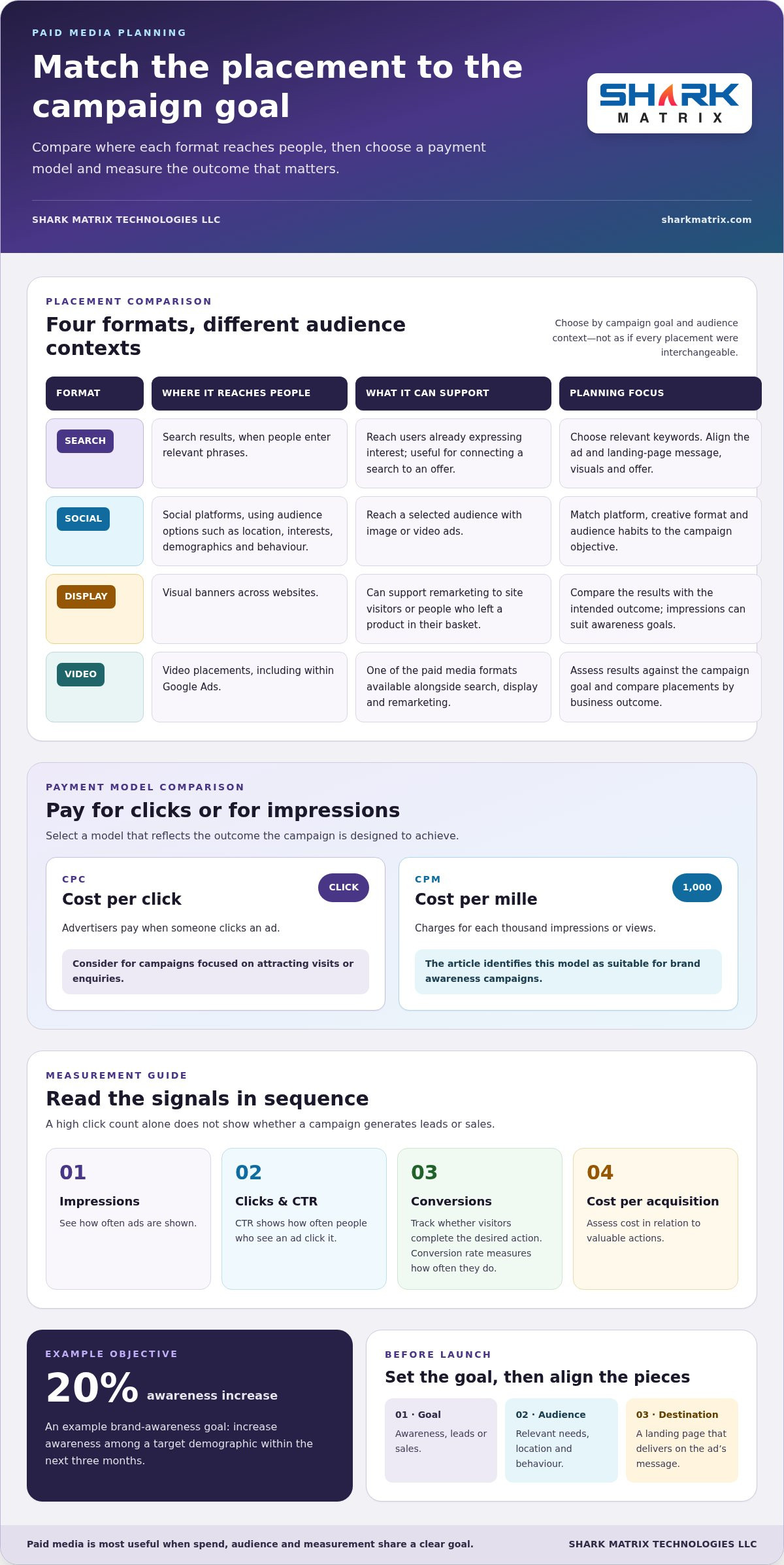
Paid media can increase visibility by placing promotional content in front of people who may not find a business through organic efforts. A brand awareness campaign, for example, could aim to increase awareness by 20% among a target demographic within the next three months. That specific objective gives the business a clear audience, outcome and timeframe to assess.

Reach alone doesn’t show whether an ad is relevant. A UAE business can compare audience responses across platforms and formats, then refine targeting or creative to better fit the people it wants to reach. Paid placements can also complement organic marketing: advertising amplifies a message, while SEO and useful content support visibility through unpaid channels.

Start with the desired outcome, then research the audience. Awareness, lead generation and sales each call for a different message and measurement approach. For awareness, track whether the campaign reaches the intended audience. For leads, focus on actions that show interest, such as a completed enquiry form. A clear goal makes subsequent campaign decisions more useful.

Audience research should identify the people a business wants to reach and the problem its offer addresses. A UAE business might distinguish between customers seeking a service available nationwide and decision-makers evaluating a business solution. Those groups may use different platforms and respond to different messages. Define the target audience by relevant needs, location and behaviour, not assumptions about the whole market.

Choose platforms and formats that fit audience habits. Social media ads can use images or videos, with advertisers selecting an audience and budget. A professional offer may need a different context from a consumer product, while a nationwide promotion benefits from relevant location targeting. Matching platform, format and audience keeps digital marketing focused on the campaign goal.

Search engine advertising

Search ads place paid messages on search engine results pages when people enter relevant phrases. Other formats, including display and social media ads, reach audiences in different contexts.

Search Ads and Captured Intent

Search advertising shows keyword-based ads to people searching for specific phrases, making it useful for reaching users already expressing interest. For example, a UAE customer searching for a particular service may see a related Google Ads placement. Choose relevant keywords that connect search intent with the offer, rather than pursuing unrelated traffic.

Build each ad around its selected keywords, then align the landing page’s message, visuals and offer with the ad. If an ad promises information about a service, its destination should explain that service clearly. Sitelink, call and location extensions can add useful information or options to eligible search ads. Conversion tracking shows which campaigns and keywords lead to valuable actions.

Evaluate search advertising through impressions, clicks, conversions and cost per acquisition. Click-through rate shows how often people who see an ad click it; conversion rate shows how often visitors complete the desired action. These measures answer different questions. A high click count alone doesn’t show whether a campaign is generating leads or sales.

Paid Media Advertising Formats

Paid media formats include search ads, social media ads, display banners and video placements. The format determines where people encounter the message and what action they can take. Choose based on the campaign goal and audience context, rather than treating every placement as interchangeable.

Social media advertising can use image or video ads, with advertisers selecting an audience and budget. Display advertising places visual ads across websites and can support remarketing to people who visited a site or left a product in their basket. These formats let a business reconnect with interested visitors after their original search.

Pricing varies by format and payment model. With cost per click, advertisers pay for ad clicks. Cost per mille charges for each thousand impressions or views, making it suitable for brand awareness campaigns. Choose a model that reflects the outcome the campaign is designed to achieve.

For example, a business focused on visibility may use display placements priced by impressions, while a campaign seeking enquiries may prioritize search ads and conversion tracking. Google Ads can include search, display, remarketing and video placements. Compare results by format to see which placements support the intended business outcome.

Definition and forms of paid marketing

Paid media is promotional content a business funds to reach a chosen audience. It can attract attention, generate traffic, build awareness or encourage conversions. For example, a UAE retailer might promote a seasonal offer to people interested in its product category. Payment buys an advertising placement; campaign strategy determines its audience, message and intended outcome.

Paid marketing can appear across search engines, social media, websites, newsletters and other channels. Formats include sponsored posts, banner ads, video ads, pop-ups and promoted articles. A business might use a sponsored social post to introduce a new service, then show a display banner to people who previously visited its website. Each format gives the message a different context.

Payment models also vary. With cost-per-click advertising, charges depend on how often people click an ad. Cost-per-mille pricing charges for each thousand impressions or views, making it suitable for brand awareness goals. Campaigns can also be structured around conversions. The model affects what the business pays for, so it should match the outcome being measured.

Paid media differs from owned media, which uses a company’s own channels. A business website, social media pages and email newsletter are examples of owned media. These channels give the business space to publish messages, while paid placements can extend their visibility. For instance, an ad can direct an audience to a product page on the company website.

Earned media is exposure gained through public relations or word of mouth. Online reviews, articles and search rankings can all contribute. Unlike a paid placement, a review is not an ad purchased by the business. A practical strategy can combine all three: promote an offer through paid media, explain it on an owned page, and attract attention through useful coverage or customer recommendations.

Organic marketing uses unpaid methods such as SEO, content marketing and social media engagement. Paid advertising can create immediate visibility, while organic efforts help build a lasting presence. For example, a UAE service business could publish an informative guide, then promote it to an audience likely to need that service. The paid placement attracts relevant visitors, and the guide provides useful detail.

Choose the mix by identifying the desired action and audience behaviour. Awareness may call for broad visibility and impression-based measurement; lead generation needs a clear next step and conversion tracking. If a campaign brings traffic but no enquiries, the message or destination may need improvement. Separating paid, owned and earned activity makes it easier to see how each contributes to the marketing objective.
Paid Media Campaign Management: Set Budgets and Plan Campaigns

Budget and campaign flexibility

Paid campaigns let businesses set spending limits and adjust delivery as performance data comes in. Budget decisions work best when tied to a clear goal, such as visibility, leads or sales.

In the UAE, paid media campaign management costs depend on campaign scope and are provided after a quote request. Factors include the platforms, campaign complexity, targeting and level of management required.

Campaign Budget Flexibility

A flexible campaign budget lets a business control spending and adapt campaigns to results. This matters when audience response or market conditions shift: budgets and placements can be adjusted instead of left unchanged.

Set a spending limit that reflects the campaign objective and the amount the business can allocate to advertising. Then monitor delivery and performance. For example, a UAE retailer promoting a seasonal offer can review which placements engage relevant shoppers and adjust the campaign as demand changes.

Flexibility doesn’t mean changing direction without evidence. Review the campaign objective alongside impressions, clicks and conversions. If visibility is the goal, impressions help show delivery; if enquiries matter, conversion tracking provides a more useful signal. These measures distinguish a campaign that is spending from one contributing to growth.

Bid and Budget Optimization

Bid and budget optimization means adjusting bids and spending based on campaign data to improve delivery against the chosen goal. It matters because a placement that attracts clicks without valuable outcomes may need different targeting or a lower bid.

Review audience, location and keyword performance before making adjustments. On LinkedIn, manual cost-per-click bidding is described as the cheapest way to pay for traffic 90% of the time. Advertisers using this approach can start with a lower bid, then raise it only enough to spend their daily budget by day’s end.

Across platforms such as Google, compare clicks with conversions and cost per acquisition. Remove search terms that spend without converting, and shift budget toward placements that produce meaningful actions. Regular monitoring helps businesses respond to campaign performance instead of relying on initial bid settings.

Paid Media Management Costs in the UAE

Paid media management costs in the UAE vary according to the work required, so the campaign’s scope is the key consideration. The management fee and the advertising budget are distinct parts of planning: one covers campaign work, while the other funds ad placements.

Platforms, campaign formats, targeting requirements and ongoing optimization all shape the work involved. A focused search campaign and a program spanning search, display and social placements have different management needs. Keep advertising budget separate from management costs when assessing overall spend.

Track both areas against the campaign objective. A business seeking brand visibility can assess impressions and reach, while one seeking leads can focus on conversions and acquisition costs. This makes budget reviews more useful: evaluate spending against the outcome it was intended to support, not just the number of ads shown.

Paid media campaign management includes setting objectives, selecting channels, defining audiences, allocating budgets and improving campaigns using performance data. Strong planning links each decision to a specific outcome, from brand awareness to qualified leads or sales.

Common risks include paying for irrelevant clicks, reaching the wrong audience and sending visitors to a mismatched landing page. Reduce them with relevant targeting, conversion tracking, consistent ad-to-page messaging and regular optimization.

Paid Media Management Components

Campaign management is the coordinated work of planning, launching, measuring and optimizing paid placements. Each part affects whether the budget supports the intended outcome.

Begin with a defined objective, such as lead generation, then select channels that fit the audience. LinkedIn can target professional attributes such as company, role, seniority and industry when reaching business buyers. Search ads can target relevant keywords, while social placements can support audience discovery. Conversion tracking connects campaign activity to valuable outcomes.

Planning also covers ad creative, destination pages, budget allocation and reporting. For example, an ad promising a product demonstration should lead to a page where visitors can take that action. Review clicks, conversions and cost per acquisition together, rather than treating traffic alone as success. A 90-day strategic plan can provide a framework for reviewing objectives and optimization over time.

Organic marketing can complement paid channels. SEO and useful content can build visibility beyond advertising placements, while paid promotion brings a message to selected audiences. Choose the combination according to the campaign goal and available resources, then assess each channel’s contribution separately.

Campaign Risks and Risk Reduction

Campaign risks are problems that waste spend or distort performance, such as irrelevant traffic, weak tracking or an ad that doesn’t match its landing page. Reducing these risks keeps campaign decisions tied to meaningful results.

For search campaigns, review keyword relevance and exclude terms that spend without converting. For social campaigns, refine targeting when audience response suggests the selected group is too broad. A 1% lookalike audience based on previous customers is one targeting approach described for campaign testing, but it should still be assessed against the campaign’s own conversion data.

Measurement gaps create another risk: without conversion tracking, clicks may look successful even when they produce no enquiries or sales. Track the action that matters, then compare outcomes across campaigns and keywords. Test creative in a controlled sequence: start with the image or video, then headlines, and finally the primary ad text.

Check that mobile users can read the ad and use its landing page easily. A responsive page with matching copy helps maintain continuity from placement to action. Paid media programs typically take about three months to complete their foundation phase, so build time for measurement and refinement into the plan rather than judging performance on clicks alone.

Shark Matrix Technologies: Search Engine Optimization (SEO)

Shark Matrix Technologies LLC helps businesses connect paid campaigns with longer-term visibility through Search Engine Optimization (SEO) and Pay Per Click (PPC) Management. This combination can suit businesses across the UAE that need search ads while building organic presence over time.

Campaign results also depend on what happens after someone clicks. If a landing page doesn’t support the ad’s message or next step, Web Design and Development can help improve the experience. The right focus depends on your goals, channels and website needs.

For support aligning search advertising with organic visibility or improving the pages behind your campaigns, contact Shark Matrix Technologies LLC to discuss your needs.

Make Your Next Campaign a Measured Step Forward

Give your next campaign a clear role in your wider business strategy. Decide what you want advertising to contribute, who needs to act and how the experience should continue after a click. This keeps paid media campaign management connected to customer needs, rather than treating each campaign as an isolated activity.

Shark Matrix offers Pay Per Click (PPC) Management for paid campaigns, Search Engine Optimization (SEO) to support organic visibility, and Web Design and Development for the pages visitors land on. These services address different parts of your digital presence, depending on your priorities.

If you’re ready to plan your next step, contact Shark Matrix Technologies to discuss your campaign goals and digital marketing needs. A focused conversation can help you decide where to put your attention next. Move forward with a plan that gives every campaign a clear purpose.

Frequently Asked Questions

How do you keep ad spend efficient?

Keep ad spend efficient by judging campaigns against valuable actions, not clicks alone. For example, a service business can compare which audience segments produce completed enquiry forms, then prioritize the stronger-performing segments. Review search terms and landing-page behaviour together: irrelevant searches or pages that fail to guide visitors can consume budget without supporting the campaign objective. Use those findings to refine where ads appear and what they communicate.

What is paid marketing?

Paid marketing is the use of purchased advertising placements to promote a business, product or service. A company might pay to show an ad to a selected audience, then direct interested people to a page or offer. It differs from publishing on the company’s own channels, where the business controls the content but does not buy that specific placement. The campaign may aim to build awareness, generate enquiries or drive sales.

Which platforms and campaign types do you manage?

Shark Matrix offers Pay Per Click (PPC) Management and social media campaigns. Formats can include paid search and social advertising, selected to suit the audience and business goal. Platform choice shapes targeting and placement, so campaign plans should link the channel to the intended result. For a UAE business, consider whether the audience and message fit the platform, not simply how many platforms are included.

What are the steps for managing a paid media campaign?

Managing a campaign involves setting its objective, choosing an audience and channel, preparing ads and landing pages, launching, then measuring and refining performance. Before launch, define a useful result, such as a qualified enquiry rather than any form submission. After launch, review whether the audience takes that action and whether the landing page supports it. Use those findings to guide adjustments.

What are typical paid media management fees and ad spend budgets?

Management fees and advertising budgets are separate costs, and both depend on the campaign’s scope. In the UAE, management pricing is provided after a quote request; relevant factors include platform mix, campaign complexity, targeting and ongoing optimization needs. Ad spend is the amount allocated to placements, and businesses can set spending limits. Decide that allocation according to campaign goals, audience size and the channels selected.

How do you set goals, KPIs, and budgets for paid media campaigns?

Start with the business outcome, then choose a KPI that measures it directly. For example, a lead-generation campaign can prioritize qualified enquiries, while an awareness campaign can assess reach and impressions. Set a budget around the goal and the platforms needed to reach the intended audience. Review the KPI alongside spend, so budget changes reflect progress toward the outcome rather than activity alone.

How do you choose between Google Ads, Meta Ads, LinkedIn Ads, and TikTok Ads?

Choose the platform that best fits the audience and campaign intent. Google Ads can reach people searching for specific phrases; Meta advertising can use audience attributes such as demographics and interests. LinkedIn suits campaigns where professional details, such as role or industry, matter. For TikTok, assess whether its audience and ad formats fit your campaign. Compare each option with the desired action and available performance data.

What tools are used to manage and measure paid media campaigns?

Campaign teams use advertising-platform analytics and reporting tools to review delivery and outcomes. Pair those reports with conversion tracking that records meaningful actions, such as a submitted enquiry or completed purchase. This connects campaign activity to business results instead of relying on impressions or clicks alone. A consistent reporting view also makes it easier to compare platforms, audiences and campaign periods using the same outcome definitions.

Categories
Uncategorized

PPC Budget Allocation Model: Build a Smarter, Goal-Led Plan

A fixed PPC split can make a budget look organised while quietly starving your strongest opportunities. The right ppc budget allocation model isn’t a universal percentage chart. It helps you direct spend towards the campaigns and funnel stages most likely to support your business goals.

If you’re unsure how much to assign to each channel, or worried that a standard percentage rule will limit growth, you’re not alone. The decision gets harder when conversion history is limited: forecasts are less certain, and performance comparisons can be difficult. A useful plan makes room for what the data shows without pretending every decision is backed by perfect evidence.

This guide compares practical budget models and explains how to choose one that fits your goals and available data. You’ll learn how to turn targets and campaign performance into an actionable allocation, then set review rules for adjusting spend with discipline rather than reacting to every short-term change. The central idea is simple: allocate by potential marginal returns, not by fixed channel percentages.

Key Takeaways

  • Choose a ppc budget allocation model that reflects your business goals and the evidence available, rather than defaulting to fixed channel percentages.
  • Turn your desired outcomes into an allocation plan by defining acceptable economics, estimating demand, and validating assumptions.
  • Compare goal-based, historical-performance, and other practical models by their input needs, risks, and review signals.
  • Use campaign tracking, pacing checks, and scheduled reviews to guide adjustments based on conversion quality and performance data.
  • Document your assumptions, measure results, and refine the plan as part of a disciplined PPC management process.

Why a PPC Budget Allocation Model Beats Fixed Spending Splits

Setting a total advertising budget answers one question: how much can the business spend? It doesn’t answer how that amount should be distributed across platforms, campaigns, audiences, or stages of the customer journey. A ppc budget allocation model helps answer that second question by connecting spend to business and campaign objectives, such as generating qualified leads, driving sales, or building awareness.

Allocation is a decision framework shaped by goals, evidence, and constraints. It accounts for conversion economics, available demand, campaign capacity, and the reliability of your data. It also recognises that paid search, social campaigns, and other PPC activity may play different roles. As a foundation, Pay-per-click (PPC) describes advertising in which advertisers pay when users click. The value of a click depends on what happens next.

A fixed percentage split can be a useful starting point for planning or testing, but it isn’t a universal performance formula. If one campaign has a clear path to valuable conversions and another supports discovery, dividing spend equally may ignore their different jobs. The aim isn’t to give every channel the same share. It’s to make each allocation defensible against the objective it serves.

What decisions does a PPC allocation model guide?

The model guides distribution after the total budget is set. It helps determine which platforms and campaigns receive funding, which audiences to prioritise, and how much to reserve for discovery versus high-intent activity. Base each decision on target outcomes, the economics of a conversion, and the demand each campaign can realistically reach, rather than an automatic equal split.

Why do fixed budget percentages often fall short

Accounts differ in goals, customer journeys, campaign maturity, and available evidence. A split that suits a sales campaign may not suit lead generation or awareness activity. Weak tracking can misattribute conversions, while small samples can make a channel look unusually strong or weak. Treat early results as signals to investigate, not proof that the apparent winner deserves every extra dollar.

For a practical allocation, assess each proposed share against a few questions:

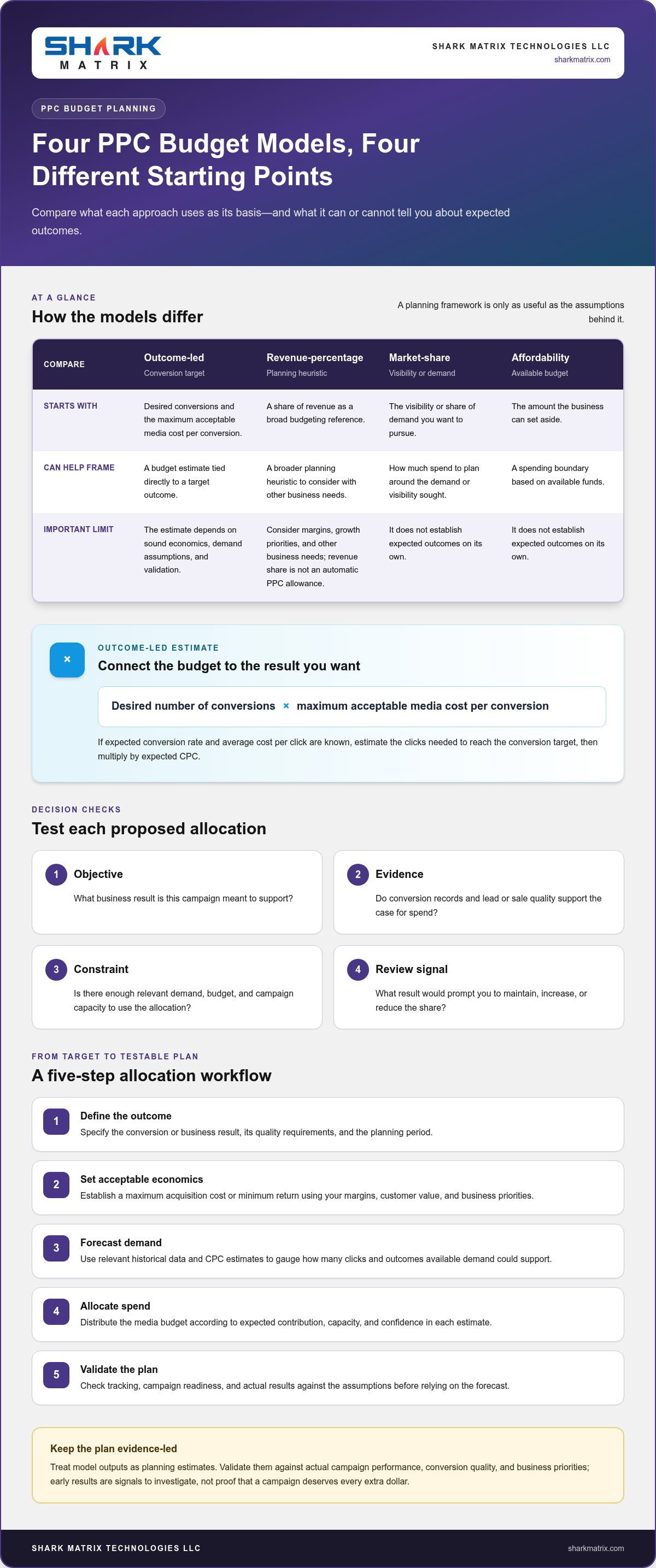
  • Objective: What business result is this campaign meant to support?
  • Evidence: Do conversion records and lead or sale quality support the case for spend?
  • Constraint: Is there enough relevant demand, budget, and campaign capacity to use the allocation?
  • Review signal: What result would prompt you to maintain, increase, or reduce the share?

These checks make assumptions visible and give teams a consistent basis for comparison. They also help prevent budget shifts driven by isolated results, especially when campaigns have different conversion paths or times to outcome. Treat every model output as a planning estimate, then validate it against actual campaign performance. As results accumulate, revisit the assumptions and adjust distribution based on conversion quality and business priorities.

How to Calculate a PPC Budget Allocation Model

Build the allocation from business outcomes, not from a channel split chosen for convenience. A useful ppc budget allocation model makes its assumptions visible: what result you want, what that result can reasonably cost, how much demand may be available, and what evidence will tell you whether the plan needs adjustment.

Start with a goal-based or revenue-based calculation

For an outcome-led estimate, multiply the desired number of conversions by the maximum acceptable media cost per conversion. If you know your expected conversion rate and average cost per click, estimate the clicks needed to reach the conversion target, then multiply by expected CPC. Both approaches connect budget to outcomes. Revenue-percentage budgeting is a broader planning heuristic. Use it alongside margin, growth priorities, and other business needs, rather than treating a revenue share as an automatic PPC allowance.

Market-share budgeting starts with the visibility or share of demand you want to pursue. Affordability budgeting starts with the amount the business can set aside. Neither establishes expected outcomes on its own. Practical PPC budget planning can compare these approaches, but the assumptions still need to fit your economics and campaign conditions.

Use this five-step workflow:

  1. Define the outcome. Specify the conversion or business result, its quality requirements, and the planning period.
  2. Set acceptable economics. Establish a maximum acquisition cost or minimum return using your own margins, customer value, and business priorities.
  3. Forecast demand. Use relevant historical data and CPC estimates to gauge how many clicks and outcomes the available demand could support.
  4. Allocate spend. Distribute the media budget across campaigns according to expected contribution, capacity, and confidence in each estimate.
  5. Validate the plan. Check tracking, campaign readiness, and actual results against the assumptions before treating the forecast as a reliable guide.

Turn assumptions into a forecast you can test

Gather historical clicks, spend, conversions, conversion quality, and conversion value where available. Add estimated CPC, expected conversion rate, campaign capacity, and the target outcome. Separate media spend from the complete budget: management, tools, and creative production are supporting costs, not click spend. Keep both views so the campaign allocation doesn’t hide the resources needed to run it.

Label the variables before calculating: B = media budget, CPC = estimated cost per click, CVR = expected conversion rate, and V = average value per conversion. Then estimate:

  • Forecast clicks = B ÷ CPC
  • Forecast conversions = forecast clicks × CVR
  • Forecast conversion value = forecast conversions × V

A forecast is a planning estimate, not a performance guarantee. Compare actual delivery with these estimates, investigate gaps in tracking or demand, and revise assumptions before shifting budgets. For support with planning, managing, and evaluating campaigns, explore PPC management support.

Which PPC Budget Allocation Model Fits Your Situation?

The right model depends on the decision you need to make and the evidence you can trust. Use a goal-based approach when conversion economics are clear, forecasting when historical results are useful, and simpler constraints when data is thin or the business needs a defined spending limit. A ppc budget allocation model can combine approaches, such as setting an affordability ceiling before distributing spend according to campaign forecasts.

Choose a model based on your data maturity

For a new campaign, plan conservative scenarios and treat initial spend as a controlled test. Set a clear learning objective and decide what evidence would justify expanding. Established campaigns can use validated CPA or ROAS targets to compare opportunities, but only when conversion tracking and lead or sale quality are dependable. In complex accounts, cross-channel attribution may not clearly show each touchpoint’s contribution, so avoid treating reported channel credit as complete proof of incremental impact.

Model Useful conditions Required inputs Main risk Review signal
Goal-based Conversion economics are clear Target conversions, allowable CPA or ROAS Targets may ignore available demand Qualified outcomes against target
Forecasting Historical data is usable Spend, clicks, CPC, conversions, value Past patterns may not persist Actual results versus forecast
Revenue percentage Useful as a broad planning limit Revenue, margin, growth priorities Revenue share may not reflect profitability Return and business affordability
Market share Visibility or demand coverage is a priority Market opportunity, impression or reach goals More exposure may not create efficient outcomes Incremental reach and conversion quality
Affordability Cash flow sets a firm ceiling Available budget and operating constraints Spend limit isn’t an outcome forecast Pacing and value generated within the limit
Full-funnel Campaigns support different journey stages Stage roles, audience and outcome signals Allocation can imply impact that hasn’t been measured Stage-specific indicators and downstream quality

Revenue-percentage, market-share, and affordability models are best treated as planning constraints, not proof that a particular spend level will perform. They can establish a workable envelope, then goal-based or forecast evidence can guide distribution inside it.

Compare channel, campaign, and funnel-level allocation

Platform-level budgets set the broad division between advertising channels. Campaign-level decisions prioritise specific products, services, or objectives within a platform. Funnel allocation instead assigns roles by journey stage, such as discovery, consideration, or high intent. It organises investment, but doesn’t by itself prove that an upper-funnel activity caused later conversions.

Branded searches capture people already looking for a business, while non-branded searches can reach audiences exploring a category or solution—such as car shoppers researching vehicle options on sites like carseek.com. Their intent and measurement needs differ, so assess them separately before comparing results. When PPC management is part of the plan, define the objectives, reporting needs, and review signals that will guide campaign decisions.

PPC Budget Allocation Model: Build a Smarter, Goal-Led Plan

How to Implement, Monitor, and Reallocate Your PPC Budget

A budget model only becomes useful when it shapes day-to-day campaign decisions. Put the ppc budget allocation model into operation with clear campaign roles, reliable measurement, and agreed rules for changing spend. This turns allocation from a one-time forecast into a managed process, without letting every short-term performance swing trigger a budget change.

Set pacing and review rules before campaigns launch

Start by mapping each campaign to its platform, objective, audience, funnel role, planned allocation, and target metric. Check that conversion actions are configured correctly and that lead quality or sales value can be assessed, not just clicks and form submissions. Then establish pacing checks and review timing based on campaign volume, sales cycles, and how quickly conversion data becomes dependable.

Agree in advance who can approve changes and where decisions will be recorded. Set thresholds from business targets and account baselines, rather than borrowing universal benchmarks. Routine pacing adjustments can correct delivery against plan. Material allocation changes should include a reason, the evidence behind it, the expected effect, and a date to review the result.

Reallocate based on evidence, not short-term swings

Before moving budget towards a reported winner, check whether tracking is working, attribution is comparable, and conversions reflect genuine business quality. A campaign with a lower reported CPA may be generating weaker leads, or its recent result may rest on too few conversions to support a confident decision. Compare like with like and account for the time between ad interaction and business outcome.

Use structured tests to learn what drives a difference. Change one major factor at a time, such as the channel, campaign, audience, or funnel allocation, while keeping the objective and measurement consistent. Define the test question and review signal before launch. If several factors change together, results may not reveal which change influenced performance.

For each review, distinguish between three decisions: keep the allocation, adjust pacing within the agreed plan, or propose a material reallocation. Document the evidence and revisit the decision after enough relevant data has accumulated. If tracking is incomplete or conversion volume is too limited, record the uncertainty and avoid presenting a tentative signal as a confirmed improvement.

Monitoring checklist

  • Confirm planned spend and actual pacing by platform and campaign.
  • Check conversion tracking, attribution settings, and any unusual changes in recorded activity.
  • Review conversion quality alongside CPA or ROAS, using the metric that matches the campaign goal.
  • Assess whether there’s enough reliable data for a decision, considering conversion delays and sales cycles.
  • Record the change, rationale, approver, and review point before making a significant shift.

This disciplined cycle connects campaign management with measurable business objectives and supports data-led evaluation. Discuss a data-led PPC strategy to bring planning, campaign execution, and performance review into one process.

Turn Your PPC Budget Allocation Model into a Managed Growth Plan

A budget model earns its place when it guides consistent decisions, not just the initial split. Choose an approach that fits your goals and evidence, document its assumptions, launch campaigns with reliable measurement, then review results and refine the plan. This turns a ppc budget allocation model into a working process your team can revisit as business priorities and campaign data evolve.

What a disciplined PPC management process should connect

Effective management links business objectives to budget assumptions, campaign structure, conversion tracking, and reporting. Platform metrics such as clicks and conversions help diagnose delivery, but lead quality and commercial outcomes show whether the activity is valuable to the business. Cross-channel context can inform priorities across PPC, SEO, and social media without requiring equal spending across them.

Shark Matrix Technologies LLC provides PPC management and digital marketing strategy to support campaign planning, execution, and evaluation. A connected approach helps teams assess whether each campaign is serving its intended role and whether reported performance aligns with measurable business objectives. It should inform decisions, not promise a particular result.

Prepare a budget brief your team can act on

Before launch, create a concise brief that makes the plan understandable to everyone involved. Record what the budget is meant to achieve, how the allocation was chosen, which data supports it, and what conditions would prompt a review. This creates a shared reference point when campaign performance or priorities change.

  • Objectives and constraints: State the business outcome, planning period, budget limit, and any campaign or capacity restrictions.
  • Target economics: Document the CPA, ROAS, conversion value, or other measure that will guide decisions.
  • Evidence and confidence: Name the data sources, note gaps in tracking or conversion history, and record how confident the team is in its assumptions.
  • Model and allocation logic: Explain why the selected model fits the goal and how it informs platform, campaign, or funnel investment.
  • Ownership and review conditions: Identify decision owners and specify which changes require approval, along with the signals that trigger a reassessment.

Keep the brief current as actual results replace planning assumptions. Review whether platform reporting reflects the quality of leads or sales, and consider wider channel activity when interpreting changes in PPC performance. Cross-channel insight adds context. It doesn’t mean every channel deserves the same share or that one channel caused every observed result.

With a documented plan, teams can move from model selection to measured implementation and informed refinement. PPC management support can bring campaign planning, management, and performance review into a broader digital marketing strategy.

Make Your Next Budget Decision More Deliberate

Your next step doesn’t need to be a complete account overhaul. Choose one upcoming allocation decision, write down the business outcome it should support, and identify what evidence would change your mind. That small discipline makes your ppc budget allocation model more useful over time: each review can build on what the team has learned instead of restarting from assumptions.

Shark Matrix Technologies LLC brings PPC management together with digital marketing strategy across PPC, SEO, and social media. Its data-driven lead generation supports a focus on meaningful business signals, not just platform activity. When planning, campaign execution, and performance evaluation work together, you can make budget decisions with clearer rationale while adapting as priorities and evidence evolve.

Ready to put a goal-led plan into practice? Explore PPC management support and take the next step towards a more disciplined approach to campaign growth. Start with the evidence you have, keep learning, and let each decision make the next one stronger.

Frequently Asked Questions

How much should a business allocate to PPC advertising?

Set a PPC budget based on the business outcome you need and the amount you can afford to invest while assessing results. For a lead campaign, estimate how many qualified enquiries you need, then use your acceptable acquisition cost to model a starting media budget. Check that the target is commercially viable and that campaigns can reach enough relevant demand. Treat the first allocation as a testable plan, not a fixed rule.

Can I use the same PPC budget allocation model across every advertising platform?

You can use the same decision principles across platforms, but avoid copying identical budget shares without checking how each platform supports your goals. Audience intent, campaign formats, available targeting, conversion tracking, and demand can differ. For example, a search campaign may capture active interest while a social campaign introduces an offer to a broader audience. Set platform-specific expectations, then compare results using suitable measures and consistent business outcomes.

What happens if a PPC campaign has no conversion history?

Without conversion history, use estimates cautiously and make the first phase a controlled learning exercise. Check whether tracking records the actions that matter, then use available information such as search demand, planned campaign reach, and relevant business data to form an initial scenario. Set a spending limit and define what you need to learn, such as which searches produce qualified enquiries. Avoid judging success on clicks alone while conversion evidence develops.

Should PPC budget include agency management fees and marketing tools?

Track media spend separately from the full cost of running PPC. The broader budget may include management, analytics tools, and creative production, depending on how your business accounts for these resources. For instance, teams collaborating with an agency like I Search Marketing for creative development and brand strategy should account for those professional services alongside direct media spend. Separating them makes platform performance easier to interpret and shows the total investment needed to operate campaigns. For internal planning, record each cost category consistently so comparisons between campaigns or planning periods don’t mistake operating expenses for advertising spend.

How often should a PPC budget allocation be reviewed?

Choose a review rhythm that reflects how quickly campaigns spend, how long customers take to convert, and when reliable outcome data becomes available. Check pacing often enough to spot delivery problems, but assess performance over a period that gives delayed conversions time to appear. A sudden tracking disruption or major business change may call for an earlier review. Record decisions so routine checks don’t lead to repeated, unnecessary reallocations.

Is a percentage-of-revenue PPC budget model reliable?

A percentage of revenue can provide a convenient planning boundary, but it doesn’t show whether a campaign can acquire customers profitably. Revenue may rise while margins tighten, or growth priorities may justify a different level of investment. Use the percentage as one input, then assess profitability, customer value, available demand, and business capacity. The ppc budget allocation model should ultimately reflect the commercial objective, not revenue alone.

Categories
Digital Marketing

How to Reduce Wasted Ad Spend: 2026 Optimization Guide

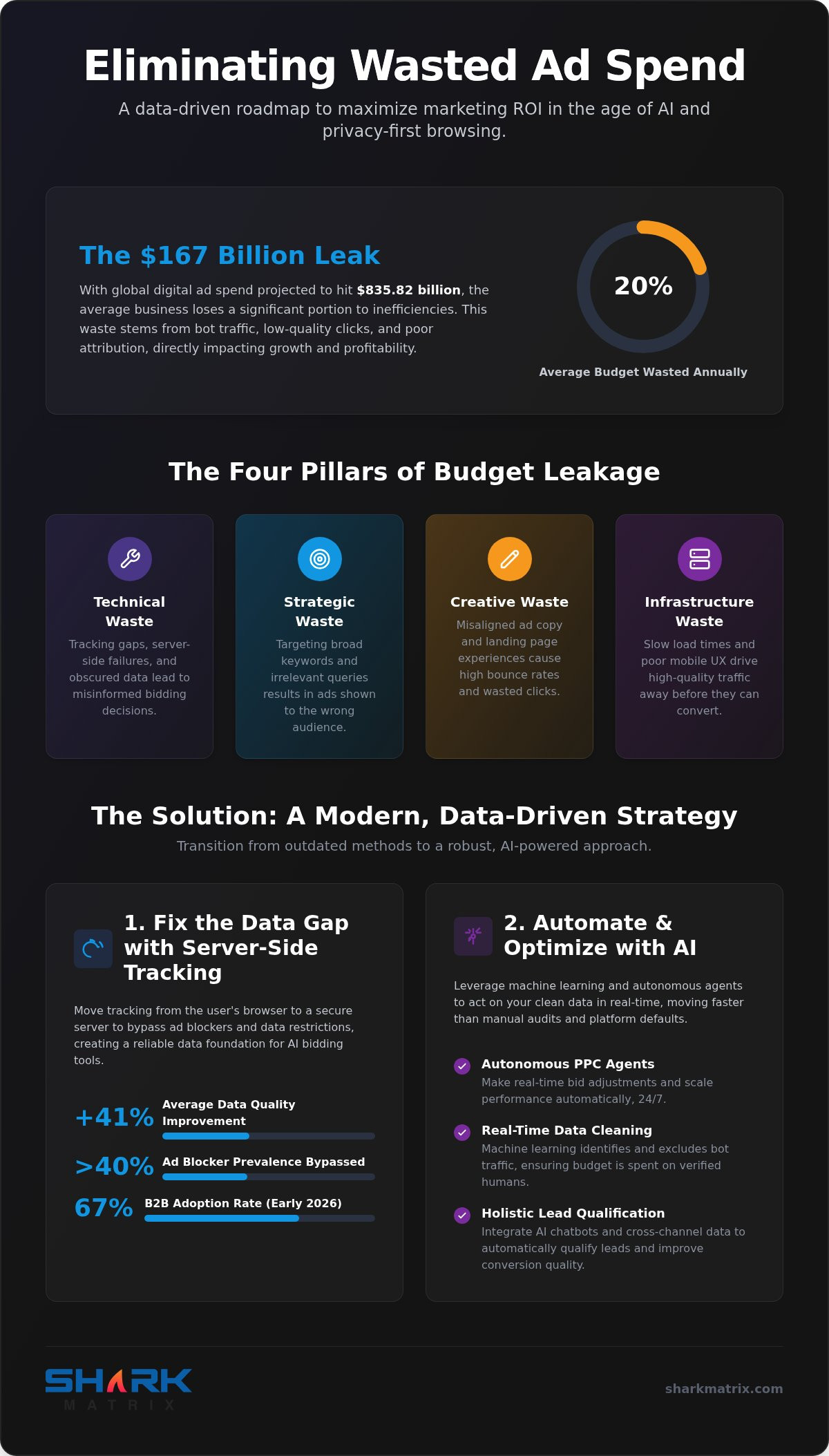
Did you know that in 2026, the average business loses approximately 20% of its annual digital marketing budget to inefficiency? With global digital ad spend projected to reach $835.82 billion this year, that leakage represents a staggering amount of capital disappearing into bot traffic and low-quality clicks. You’ve likely noticed that rising costs per click on platforms like Google and Meta are making it harder to maintain your margins. If you’re searching for how to reduce wasted ad spend, you’re facing a challenge shared by marketers who are struggling with inaccurate attribution and privacy restrictions.

We understand how frustrating it is to watch your budget drain while clear results feel out of reach. This guide provides a data-driven roadmap to eliminate budget leakage and maximize your marketing ROI using the latest AI-powered tactics. You’ll discover how to leverage server-side tracking to improve data quality by 41% and use machine learning to reclaim your ad spend. We’ll explore everything from technical infrastructure to UI/UX optimizations that turn your existing traffic into high-quality leads for the same or less investment.

Key Takeaways

  • Understand why 2026 privacy regulations and AI-driven search require a new definition of budget efficiency.
  • Transition to server-side tracking to reclaim lost data and bypass the limitations of traditional cookie-based measurement.
  • Discover how to reduce wasted ad spend by leveraging autonomous PPC agents for real-time bid adjustments and performance scaling.
  • Optimize your technical infrastructure and UX design to prevent high-quality traffic from bouncing on slow-loading landing pages.
  • Learn the benefits of a holistic approach that integrates AI chatbots and cross-channel data to qualify leads automatically.

What is Wasted Ad Spend and Why Does it Happen in 2026?

Wasted ad spend is any part of your marketing budget that pays for interactions with zero chance of converting into a customer. In the Pay-per-click (PPC) model, this usually means paying for clicks from bots, accidental taps, or users whose intent doesn’t align with your offer. In 2026, global digital ad spend is reaching $835.82 billion, making up nearly 69% of all advertising. Research indicates that the average business loses about 20% of its annual digital marketing spend to these inefficiencies. Every dollar lost to a “zombie” campaign or a mismatched search query is a dollar that could’ve fueled growth.

The 2026 landscape presents unique challenges. Privacy-first browsing and the rise of generative AI search engines have shifted how data flows. When attribution models fail to account for these shifts, businesses often make the mistake of killing their most effective campaigns because they don’t see the direct path to conversion. This is a primary reason why learning how to reduce wasted ad spend is now a survival skill for digital marketers. Understanding the hidden cost of poor attribution is the first step toward reclaiming your budget.

The Four Pillars of Budget Leakage

Most budget waste falls into four specific categories that require constant monitoring:

  • Technical waste: Tracking gaps and server-side failures that obscure your data and lead to misinformed bidding decisions.
  • Strategic waste: Targeting broad keywords without aggressive negative keyword lists, causing your ads to show for irrelevant queries.
  • Creative waste: Ad copy that doesn’t align with the landing page experience, leading to high bounce rates and wasted clicks.
  • Infrastructure waste: Slow load times and poor mobile responsiveness that drive users away before they can engage with your brand.

These pillars represent the foundation of any performance audit. Ignoring even one can lead to significant budget bleed over time.

Why Traditional Audits Fail in the Modern Market

Static audits are no longer enough. Waiting for monthly reviews is a recipe for disaster when AI-driven markets move this fast. Many brands rely too heavily on platform-native “auto-apply” recommendations that often prioritize spending over efficiency. In the Middle East, consumer behavior requires localized strategy adjustments that generic algorithms often miss. Shark Matrix uses ai automation services to provide real-time optimization that static audits can’t match. Mastering how to reduce wasted ad spend requires moving beyond generic settings that don’t account for the specific conversion funnels and language nuances that work best for Middle Eastern audiences.

Fixing the Data Gap with Server-Side Tracking and AI

The transition from client-side to server-side tracking (SST) isn’t just a technical upgrade. It’s a necessity for survival. Traditional tracking relies on the user’s browser, but with ad blocker prevalence exceeding 40% on desktop computers as of February 2026, much of your conversion data never reaches your dashboard. SST moves the tracking process to a secure server, bypassing these restrictions and providing nearly 100% data clarity. If you’re looking for how to reduce wasted ad spend, you must start with the integrity of the data you’re feeding your bidding algorithms. As of early 2026, the adoption rate for server-side tracking among B2B companies has already reached 67%, reflecting its role as a standard industry requirement.

Research shows that data quality improves by an average of 41% after migrating to server-side tracking. This cleaner data is essential for modern AI bidding tools that rely on accurate signals to decide which clicks are worth the cost. By integrating ai automation services, you can clean your data in real-time, stripping out anomalies and ensuring your budget only targets verified human interactions. When your bidding engine has a clear view of the customer journey, it stops overpaying for low-intent traffic that would otherwise go unflagged. If you want to see how these technologies can transform your performance, consider exploring ai development services to secure your data pipeline.

The Role of Machine Learning in Data Integrity

Machine learning acts as a gatekeeper for your budget. By analyzing patterns in real-time, machine learning development services can identify and exclude bot traffic before it drains your daily limit. Predictive modeling takes this further by identifying high-value users based on early behavior signals. Instead of waiting for a final purchase, the system recognizes a “quality” visitor within seconds and adjusts bids accordingly. This proactive approach ensures your budget is focused on users with the highest propensity to convert, rather than being spread thin across generic traffic.

Implementing Conversions API (CAPI) for Meta and Google

For national brands in 2026, implementing Conversions API (CAPI) for Meta and Google is non-negotiable. CAPI creates a direct link between your marketing data and the platform, reducing the gap between “clicked” and “converted” in your dashboard. When your tracking reflects 100% of your successful outcomes, the platform’s algorithm learns significantly faster. This leads to lower CPAs because the AI isn’t guessing which users converted; it has the hard data required for precise optimization. This infrastructure fix is one of the most effective ways to understand how to reduce wasted ad spend at scale.

Moving from Manual Management to AI-Driven PPC Automation

The landscape of digital advertising in 2026 has moved beyond manual spreadsheets and hourly bid checks. Autonomous PPC agents now dominate the field, executing real-time bid adjustments based on thousands of live signals. This shift is a primary answer to how to reduce wasted ad spend because AI identifies underperforming segments far faster than any human analyst. While a manager might spend hours identifying a high-CPC keyword that isn’t converting, an automated system can pause or adjust that bid in milliseconds. This precision ensures that your budget isn’t drained by a sudden spike in low-quality traffic or bot activity.

Comparing manual oversight to AI-managed performance marketing reveals a clear efficiency gap. AI excels at processing granular data across multiple platforms simultaneously. It can detect that a specific audience segment on mobile is underperforming during evening hours and reallocate that budget to a higher-converting window. For national brands looking to scale, Choosing the Right PPC Agency in Dubai: A 2026 Guide highlights how professional management now focuses on strategic oversight rather than manual execution. By letting machines handle the repetitive optimization, your team can focus on the creative direction that drives real growth.

Autonomous Optimization vs. Human Strategy

AI wins the battle of scale. With 46% of marketers now using AI to scale creative, the ability to generate and test hundreds of ad variations is no longer a luxury. It handles keyword expansion, complex bid management, and multi-variate A/B testing with ease. However, human expertise remains vital for defining brand voice and high-level business goals. The most effective approach is a hybrid model. This involves human-led strategy powered by custom AI development. By setting strategic guardrails, you allow the machine to optimize within your brand’s specific parameters, ensuring that automation never compromises your core message.

Localized Performance: Navigating the Middle Eastern Market

Success in the Middle Eastern market requires more than just high-tech tools. It demands a deep understanding of Arabic digital marketing. Waste often occurs when campaigns aren’t properly localized for regional nuances. Direct translation of ad copy is a common culprit for high bounce rates. Users expect messaging that resonates with their cultural context and linguistic preferences. Adapting ad schedules to account for local time zones and cultural observances is another critical step in how to reduce wasted ad spend. Without this localization, you risk paying for clicks during times when your target audience is inactive, leading to unnecessary budget leakage.

How to Reduce Wasted Ad Spend: 2026 Optimization Guide

Auditing Your Infrastructure: Why UX is an Ad Spend Issue

A click is only a “win” if the visitor takes action. Many marketers focus so heavily on the ad platform that they forget the destination is where the money is actually made. If your landing page fails to convert a qualified visitor, that initial click cost is a total loss. This is a fundamental aspect of how to reduce wasted ad spend. In 2026, user expectations for speed and design are at an all-time high. Research from May 2026 shows that a one-second e-commerce page load can deliver up to 2.5 times higher conversion rates than a five-second load. If your site is slow, you’re essentially paying a “speed tax” on every click through higher bounce rates and lower Quality Scores.

Investing in your site’s infrastructure isn’t just about aesthetics; it’s about performance marketing. Every $1 invested in UX design yields an estimated return of $100. A well-designed user interface can increase a website’s conversion rate by up to 200%, while a superior UX can push that uplift to 400%. When your conversion rate doubles, your cost per acquisition (CPA) effectively drops by half without changing a single setting in your ad account. Partnering with a professional web development agency ensures your digital storefront is optimized to capture every cent of your traffic investment.

The Landing Page Checklist for Ad Efficiency

To stop the bleed, your landing pages must pass a strict efficiency audit. Message match is the most common failure point. If your ad promises a specific solution but the page shows a generic home screen, users will leave immediately. Frictionless forms are equally important. Every additional field you require reduces the likelihood of a conversion. Finally, national brand authority requires visible trust signals and social proof. Reviews, certifications, and clear contact information reassure the user that their click was well-spent. If you’re struggling with high bounce rates, optimizing your web presence is the fastest way to reclaim your budget.

Technical SEO and Ad Performance

There’s a powerful synergy between organic search and paid search. High organic authority, built through seo company dubai services, signals to ad platforms that your site is a relevant, high-quality destination. This often results in higher Quality Scores, which directly lower your cost-per-click. In 2026, we also see the rise of Answer Engine Optimization (AEO). By capturing top-of-funnel intent through AEO and Generative Engine Optimization (GEO), you build brand familiarity before the user even clicks a paid ad. This holistic approach is the ultimate strategy for how to reduce wasted ad spend across the entire digital ecosystem.

The Shark Matrix Approach: Holistic Performance Marketing

Shark Matrix integrates PPC, SEO, and AI into a unified, waste-proof marketing ecosystem. Instead of treating these channels as separate silos, we use them as a combined force where data from one informs the strategy of the others. This holistic approach is the definitive answer to how to reduce wasted ad spend. When your organic authority is high, your paid campaigns benefit from lower costs and increased trust. Since our founding in 2010, we’ve focused on this synergy to help national brands achieve sustainable growth. In 2026, with 33% of marketers now using AI across creative, media, and measurement, a fragmented strategy is simply a recipe for budget leakage.

Our framework relies on a continuous auditing cycle that adapts to real-time market shifts. It’s not enough to set a campaign and walk away. We use machine learning development services to identify changes in consumer behavior before they negatively impact your ROI. This proactive stance ensures that your investment always flows toward the highest-quality segments. By aligning your technical infrastructure with your strategic goals, you create a system that naturally filters out inefficiency.

AI Chatbots as Conversion Accelerators

One of the most effective ways to stop budget waste is to ensure that a click never goes cold. Through ai chatbot-development services, we deploy custom agents that qualify leads the moment they land on your site. These chatbots provide 24/7 engagement for national audiences, regardless of time zones. They don’t just answer basic questions; they filter out low-intent visitors and capture valuable first-party data. This direct data enrichment allows your bidding algorithms to become even more precise, further teaching your automated systems how to reduce wasted ad spend by focusing only on visitors with a high propensity to convert.

Building for Scalability and Long-Term ROI

Performance marketing in 2026 requires a focus on long-term digital dominance rather than short-term fixes. This involves protecting your brand’s reputation and organic reach through professional search engine optimization. When users see your brand consistently at the top of both paid and organic results, the likelihood of a conversion rises significantly. Partnering with a full-service agency provides the end-to-end excellence needed to manage complex data pipelines and creative assets. You can reclaim your budget today by moving toward a comprehensive strategy that prioritizes data integrity and user experience across every touchpoint.

Reclaiming Your Digital Growth in 2026

The path to peak performance in 2026 is paved with data integrity and automated precision. You’ve seen that modern efficiency isn’t just about picking the right keywords; it’s about building a robust infrastructure that bridges the gap between a click and a conversion. By implementing server-side tracking and leveraging autonomous bidding agents, you can finally gain a clear answer to how to reduce wasted ad spend across your entire portfolio. Don’t let technical gaps or slow landing pages drain your resources when AI-powered solutions can optimize your ROI in real-time.

Shark Matrix brings over 15 years of digital marketing expertise and a specialized AI department to help you master the national UAE market. We provide the end-to-end strategy needed to turn every marketing dollar into a measurable result. Whether you need a technical audit or a complete campaign overhaul, we’re here to ensure your brand dominates the digital landscape. It’s time to move beyond manual guesswork and embrace a holistic approach that prioritizes long-term scalability and lead quality.

Stop wasting your budget and start scaling with Shark Matrix. Your future growth depends on the strategic decisions you make today.

Frequently Asked Questions

What is the industry average for wasted ad spend?

In 2026, research indicates that the average business loses approximately 20% of its annual digital marketing budget to inefficiency. This leakage often stems from bot traffic, accidental clicks, and poor attribution models. With global digital ad spend reaching $835.82 billion this year, these losses are substantial for any brand. Understanding how to reduce wasted ad spend starts with identifying these gaps through detailed audits and real-time monitoring of your campaign performance.

How often should I perform a PPC audit?

You should perform a comprehensive PPC audit at least once per quarter, but real-time dynamic optimization is the standard for 2026. While a deep dive into your account structure and strategy is necessary every few months, AI-driven automation tools should be monitoring your bids and segments daily. Frequent checks ensure your negative keyword lists are updated and that your budget isn’t being drained by sudden shifts in market intent or competitor behavior.

Can AI really manage my ads better than a human?

AI excels at processing vast amounts of data and making real-time bid adjustments that are impossible for humans to execute manually. However, the best results come from a hybrid model. While machines handle keyword expansion and A/B testing at scale, human experts provide the strategic guardrails, brand voice, and cultural nuance. AI is a powerful tool for efficiency, but it requires human oversight to align with high-level business goals and complex market dynamics.

How does server-side tracking reduce my costs?

Server-side tracking reduces costs by providing more accurate conversion data, which improves your bidding algorithm’s precision. Traditional tracking is often blocked by ad blockers, which affect over 40% of desktop users in 2026. By moving tracking to a server, you reclaim lost signals and improve data quality by an average of 41%. This cleaner data prevents you from overpaying for low-intent traffic and helps the platform find higher-quality leads for less investment.

Why is my CPC increasing even though my targeting hasn’t changed?

Rising costs per click are often driven by increased market competition and shifts in how ad platforms prioritize quality. In 2026, total global advertising spend has surpassed $1 trillion, leading to more crowded auctions. Additionally, if your landing page experience or ad relevance has declined, your Quality Score may drop, forcing you to pay more for the same position. Technical issues like slow mobile load times also contribute to higher costs by signaling poor user experience.

What are negative keywords and how do they save money?

Negative keywords are specific terms that prevent your ads from appearing for irrelevant search queries. By excluding these terms, you ensure your budget isn’t spent on clicks from users who have no intention of buying your product. For example, if you sell premium software, adding “free” as a negative keyword prevents wasted spend on bargain hunters. Similarly, when evaluating comparison-focused search queries, understanding how prospective buyers research options on platforms like Alternative Radar can help you filter out purely informational traffic from high-intent searches. This is one of the most direct ways to understand how to reduce wasted ad spend and improve your ROAS.

How does website speed affect my Google Ads budget?

Website speed directly impacts your Quality Score and conversion rate. A one-second page load can deliver up to 2.5 times higher conversion rates than a five-second load. If your site is slow, Google penalizes you with higher CPCs because the user experience is poor. High bounce rates caused by slow loading mean you are paying for clicks that never even see your offer, effectively throwing away a large portion of your ad budget before users engage.

Is Arabic digital marketing necessary for my national UAE campaigns?

Yes, professional Arabic digital marketing is essential for reaching a broad national audience in the UAE. While many residents speak English, localized messaging in Arabic builds trust and resonates more deeply with a significant segment of the population. Campaigns that rely solely on direct translations often suffer from high bounce rates and poor engagement. Proper localization ensures your creative assets are culturally relevant, which is a critical step in maximizing your conversion rates.

Categories
Digital Marketing

Maximising ROI: The Definitive Guide to PPC Audit Services in 2026

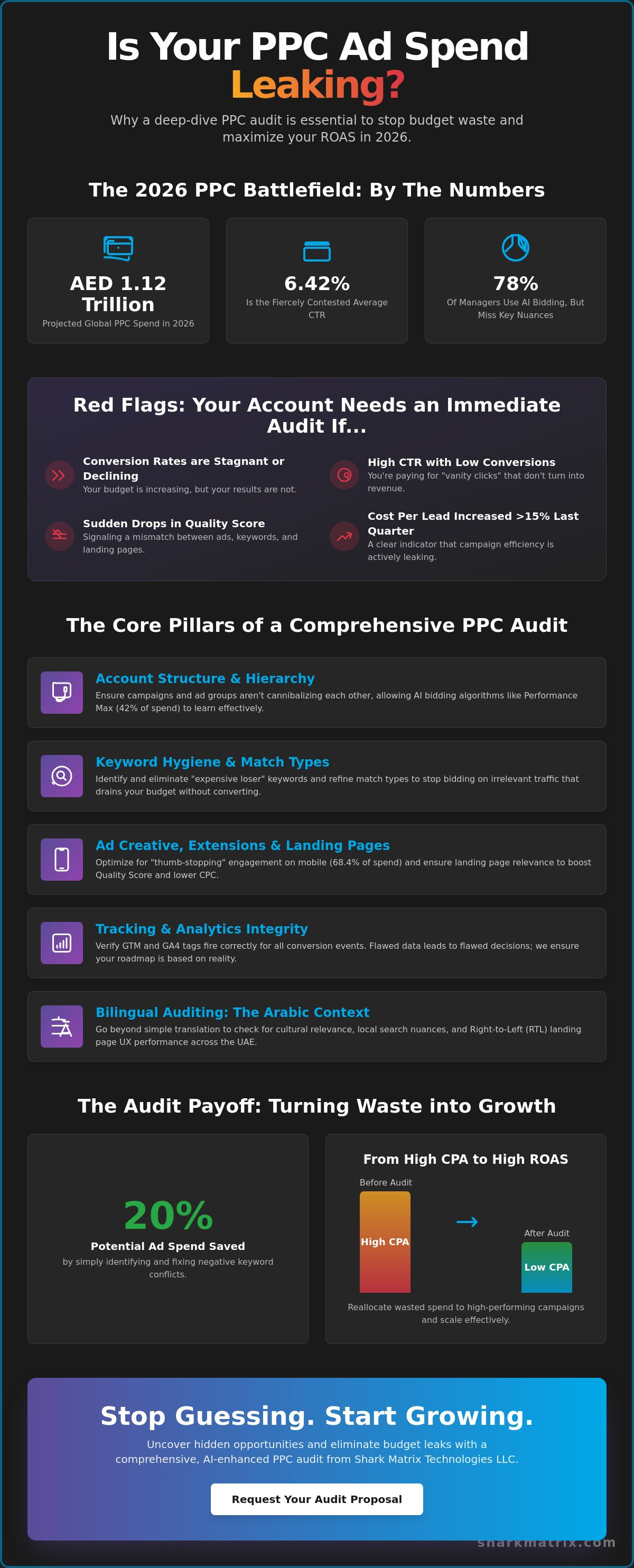
Why is your monthly ad spend climbing while your lead quality hits an all-time low? With global PPC spending projected to reach AED 1.12 trillion in 2026, the battle for the average 6.42% click-through rate is fiercer than ever. If you’re seeing “bleeding” campaigns or irrelevant clicks draining your budget, you’re not alone. Many UAE businesses struggle to bridge the gap between automated Performance Max campaigns and actual revenue. Professional ppc audit services are no longer just a luxury health check; they’re a technical necessity to ensure your human strategy isn’t being overruled by aggressive AI bidding algorithms.

You likely feel that your current Google Ads setup should be performing better, especially since 78% of managers have now adopted smart bidding. It’s frustrating to watch your Cost Per Acquisition (CPA) rise while competitors dominate the local market. This guide provides a clear, data-driven roadmap to stop the waste. You’ll learn how a comprehensive audit, which typically costs between AED 1,100 and AED 9,200 in 2026, identifies tracking gaps and improves Quality Scores. We’ll explore the exact steps to turn your underperforming accounts into high-ROAS machines that scale effectively across the Emirates.

Key Takeaways

  • Learn why deep-dive audits are essential to stop budget leakage that routine monthly optimizations often miss.
  • Discover how professional ppc audit services evaluate account hierarchy and eliminate “expensive loser” keywords to improve Quality Scores.
  • Understand the shift to AI-enhanced auditing in 2026, using predictive analytics to forecast the impact of changes before you spend a single Dirham.
  • Get a clear framework for categorizing audit findings into immediate “Quick Wins” and long-term strategic shifts to lower your CPA.
  • Explore the Shark Matrix Technologies LLC methodology, a proprietary system designed to scale UAE national campaigns through local expertise and AI automation.

Understanding PPC Audit Services: Why Your Ad Spend Might Be Leaking

A PPC audit is a diagnostic tool that identifies technical gaps and strategic opportunities to improve ROAS. While routine optimization focuses on daily bid adjustments and minor copy tweaks, professional ppc audit services provide a comprehensive health check of your entire paid strategy. Think of it as an engine overhaul rather than a simple oil change; routine management keeps the car running, but an audit ensures the engine is actually capable of winning the race. Before diving into the technicalities, it’s helpful to have a solid foundation in Understanding Pay-Per-Click mechanics to see how small errors compound into massive losses.

Even successful campaigns need a “fresh eyes” review every six months. In 2026, the digital landscape moves too fast for a “set it and forget it” mentality. With 92% of managers now using AI for ad copy and 78% adopting smart bidding, your account can drift into inefficiency without you noticing. An external audit breaks the “echo chamber” of internal management. It uncovers where automation might be overspending on low-intent traffic or where your Arabic digital marketing efforts aren’t aligning with local search nuances across the country. Staying informed about the latest UAE digital marketing trends is essential to understanding how shifting consumer behaviors and new platform regulations directly impact your paid search performance.

Red Flags: When to Request an External Review

If your conversion rates have remained stagnant or declined while your monthly budget increases, you’re likely facing diminishing returns. A high click-through rate (CTR) above the 6.42% industry average is usually a positive sign, but if that traffic doesn’t convert, you’re just paying for “vanity” clicks. Sudden drops in Quality Score across your primary keyword clusters are another major trigger. These drops often signal that your landing page relevance has slipped or your ad relevance no longer matches user intent. Don’t wait for your ROAS to hit zero before seeking professional ppc audit services; if your cost per lead has climbed by more than 15% in a single quarter, the leak is already active.

The ROI of Auditing: Turning Waste into Growth

The financial impact of a deep-dive audit is immediate. Identifying and fixing negative keyword conflicts can save up to 20% of your total ad spend. That’s money that can be instantly reallocated to high-performing campaigns. Furthermore, improving landing page relevance lowers your cost per click, making every Dirham work harder. With mobile devices accounting for 68.4% of search spend in 2026, an audit often reveals missed opportunities in mobile-specific audience segments. By identifying these “expensive losers” and untapped pockets of demand, you transform wasted spend into a scalable roadmap for national UAE growth. To ensure those recovered budgets are channeled effectively, understanding the full mechanics of PPC for lead generation is essential for building campaigns that convert clicks into sales-ready prospects.

The Core Pillars of a Comprehensive PPC Performance Review

A professional review starts with the skeletal frame of your account. We evaluate the hierarchy of campaigns and ad groups to ensure they aren’t competing against each other. In 2026, with Performance Max accounting for 42% of all Google Ads spend, your structure must allow AI to learn without being constrained by overlapping targets. Keyword hygiene is equally vital. We identify “expensive losers,” keywords that eat up your budget without delivering the average 7.04% conversion rate seen across industries today. Auditing match types ensures you aren’t bidding on broad terms that attract irrelevant traffic. If your current ppc audit services don’t look at the structural integrity of your account, you’re likely missing the root cause of high CPAs.

Ad creative and extensions need to resonate with current trends. In a market where mobile devices account for 68.4% of total global search ad spend, your ad extensions must be optimized for thumb-stopping engagement. If your tracking isn’t 100% accurate, your audit will be based on flawed data. We verify that GTM and GA4 tags fire correctly for every event, from button clicks to form submissions. This ensures you’re making decisions based on reality, not assumptions. This technical foundation is what allows for a truly data-driven roadmap to scale your UAE campaigns.

Bilingual Auditing: The Arabic Context

The UAE is a melting pot, and English-only audits often miss significant revenue streams. We check the cultural relevance and translation accuracy of your Arabic ad copy. It’s not just about translation; it’s about resonance. We also audit right-to-left (RTL) landing page performance. A UX flaw on an Arabic page can drive up bounce rates, even if the ad itself is perfect. Ensuring your Arabic digital marketing strategy is technically sound is a key part of our review process.

Technical Tracking and Attribution

With the total phase-out of third-party cookies, server-side tracking is no longer optional. We audit your attribution models to see if you’re over-valuing “Last Click” and ignoring the “Data-driven” insights that reflect how users actually convert. Our audit ensures lead-to-sale data loops back into the ad platform. This allows smart bidding to optimize for actual revenue rather than just lead volume. Without this loop, your ppc audit services are only seeing half the picture, leading to skewed ROI calculations.

Maximising ROI: The Definitive Guide to PPC Audit Services in 2026

AI-Enhanced Auditing vs. Traditional Methods: Navigating the 2026 Landscape

In 2026, the gap between traditional manual reviews and AI-enhanced ppc audit services has widened significantly. Traditional methods often rely on a human auditor scanning spreadsheets for obvious errors, but AI tools now identify micro-patterns in bidding that the human eye simply misses. These tools can analyze thousands of variables simultaneously, such as how humidity levels in Dubai or public holidays in Abu Dhabi affect specific search behaviors. Predictive analytics goes a step further by forecasting the outcome of audit recommendations. Instead of guessing, we can project that adjusting a specific bidding threshold will likely improve your ROAS before you commit a single Dirham of your budget.

While AI identifies patterns, human specialists provide the strategic context for the UAE business environment. You can’t rely solely on a machine to understand the nuances of the local market or the competitive landscape of the Emirates. Human expertise is required to interpret AI-generated data points and filter them through a lens of business reality. Understanding the broader UAE digital marketing trends for 2026, including the rise of Generative Engine Optimization and new advertiser regulations, is critical context for interpreting what your audit data truly means. Our ppc audit services combine these high-speed calculations with the tactical oversight needed to ensure your account doesn’t just look good on paper but actually drives profit.

Auditing Automated Bidding Strategies

Automation is a double-edged sword. We examine whether “Target ROAS” or “Maximize Conversions” strategies are truly aligned with your bottom line. It’s common to find “Algorithm Drift,” where the AI begins to over-optimize for low-value traffic just to hit a numerical target. With Performance Max campaigns now accounting for 42% of all Google Ads spend, setting the right guardrails is essential. We audit your asset groups and audience signals to ensure the machine isn’t wasting your AED on placements that don’t convert. Our review ensures that the 78% of managers using smart bidding are actually seeing a return on that automation.

The Human Element: Strategic Interpretation

The final stage of any audit is translating technical data into growth strategies. We look at how your PPC findings can bolster your broader Search Engine Optimization (SEO) and Social Media Marketing efforts. For instance, if a specific keyword converts at a high rate in paid search, it should become a priority for your organic content strategy. We prioritize audit findings based on immediate impact versus long-term effort, ensuring you tackle the “bleeding” campaigns first. This holistic approach ensures your digital ecosystem works as a single, cohesive unit, turning technical audit points into a roadmap for national expansion.

Step-by-Step: Implementing Findings from Your PPC Audit

Receiving your audit report is only the beginning. To transform those insights into actual revenue, you must categorize findings into three distinct buckets: “Quick Wins,” “Structural Changes,” and “Strategic Shifts.” Before you change a single bid, establish a clear baseline using your current metrics, such as your existing Cost Per Acquisition (CPA) and the average 7.04% conversion rate benchmark for 2026. This allows you to measure the precise impact of every adjustment. Avoid the temptation to make bulk changes across the entire account. Instead, use incremental A/B testing to ensure that each optimization actually moves the needle in the right direction.

Professional ppc audit services often reveal that the most significant gains come from disciplined execution rather than radical pivots. By focusing on one variable at a time, you isolate what works. This methodical approach is especially important for UAE businesses targeting high-competition areas like Dubai and Abu Dhabi, where ad space is expensive. Once the initial round of fixes is complete, schedule follow-up reviews every 90 days to ensure that “algorithm drift” hasn’t pulled your campaigns off course again.

Phase 1: Immediate Efficiency Gains

Your first priority is to stop the bleeding. Start by removing conflicting negative keywords that might be blocking your best-performing ads. It’s a common error that can stifle reach and drive up costs. Next, fix any broken tracking links or landing page errors that result in a poor user experience. If your audit shows that certain geographic segments are underperforming, reallocate that budget toward higher-converting regions within the Emirates. These immediate fixes can often recover a significant portion of the 20% spend typically wasted on keyword conflicts. If you’re unsure where to start, a professional PPC management partner can help prioritize these tasks.

Phase 2: Structural and Strategic Overhauls

After the quick fixes, move toward deeper structural changes. This involves restructuring ad groups to achieve better Quality Score alignment, which directly lowers your CPC. Refresh your ad copy to reflect 2026 market sentiments, ensuring your messaging resonates with a post-AI consumer base that values transparency and speed. For your Performance Max campaigns, update your audience signals with fresh first-party data. Since mobile devices now account for 68.4% of search spend, ensure every structural change is optimized for a mobile-first user journey. This phase turns the technical data from your ppc audit services into a long-term engine for growth. Pairing these structural improvements with a robust high-intent PPC for lead generation strategy ensures your restructured campaigns are engineered to attract and convert the right prospects at every stage of the funnel.

Shark Matrix: Advanced PPC Auditing for National Growth

Shark Matrix delivers a proprietary audit framework that merges high-speed AI automation with deep local insights. This combination is critical for UAE brands because generic algorithms often miss the cultural nuances of the Dubai and Abu Dhabi markets. Our ppc audit services focus on high-quality lead generation and transparent ROI reporting. We don’t just hand you a static PDF and walk away. We’re a full-service partner. We find the leaks. Then we plug them. This proactive approach ensures your campaigns aren’t just theoretically better but are actively driving more profit into your business.

Optimizing for the UAE requires a bilingual strategy that most global tools can’t handle effectively. We specialize in Arabic digital marketing and English campaign optimization, ensuring your ads resonate with the diverse demographic of the Emirates. Whether it’s adjusting for right-to-left UX or refining Arabic ad copy for local dialects, our audits cover the technical and cultural details that others overlook. We turn complex data points into a clear, actionable roadmap that scales your performance across the entire country.

Why National Brands Trust Our Performance Experts

National brands choose us because of our decade-long track record. We’ve navigated the UAE’s digital shifts for over 10 years, managing accounts through every major algorithm update. Our team consists of certified experts across Google Ads, Meta, LinkedIn, and TikTok. We don’t look at PPC in a vacuum. We strategically integrate findings from our ppc audit services with your Search Engine Optimization (SEO) and Social Media Marketing to create a unified growth engine. This holistic view ensures that a win in paid search becomes a win for your entire digital ecosystem.

Request Your Comprehensive PPC Health Check

Ready to stop the budget drain? Our health check process is rigorous and transparent. During your initial consultation, we’ll walk you through a report that highlights exactly where your budget is “bleeding.” We prioritize data security and account integrity above all else, ensuring your first-party data remains protected under the latest UAE regulations. You’ll receive a prioritized list of fixes, from immediate technical repairs to long-term strategic overhauls. Don’t let another month of ad spend go to waste on irrelevant clicks. Get a detailed PPC audit to scale your performance today and start seeing the ROI your business deserves.

Secure Your Competitive Edge in the 2026 UAE Market

The digital landscape in the Emirates is evolving faster than ever. By now, you understand that professional ppc audit services are the only way to stop budget leakage and align your campaigns with the AI-driven realities of 2026. You’ve seen how identifying “expensive losers” and fixing technical tracking gaps can turn stagnant accounts into high-performance engines. Transitioning from a basic manual review to an AI-enhanced framework ensures your strategy remains resilient against algorithm shifts and rising competition across the Seven Emirates.

Shark Matrix has been deeply rooted in the UAE market since 2010. We specialize in the complex intersection of Arabic Digital Marketing and AI automation to deliver high-quality lead generation for national brands. We don’t just identify technical flaws; we provide the local expertise needed to fix them. Your ad spend should be a measurable investment, not a mysterious expense. Take control of your ROI and ensure your brand dominates search results from Dubai to Fujairah.

Book Your Expert PPC Audit with Shark Matrix and start scaling your national campaigns with confidence today.

Frequently Asked Questions

How long does a professional PPC audit take to complete?

A professional audit typically takes between 5 and 10 business days to complete. This timeline depends on the complexity of your account and the volume of data generated over the last 12 months. Large-scale national campaigns with multiple ad groups require more time for deep-dive analysis compared to smaller, local lead generation setups.

Will a PPC audit interfere with my live campaigns?

No, an audit doesn’t interfere with your live campaigns or day-to-day operations. We conduct the review using “read-only” access to evaluate your current settings, keyword bids, and historical performance. This ensures your active ads continue to run in the UAE market without interruption while we identify opportunities for improvement.

What is the difference between a PPC audit and monthly management?

An audit is a one-time diagnostic snapshot designed to find hidden technical gaps and strategic flaws. Monthly management involves the ongoing execution of bid adjustments, ad copy testing, and budget shifts. While management keeps the engine running, our ppc audit services provide the overhaul needed to ensure that engine is actually efficient.

Can you audit platforms other than Google Ads, such as LinkedIn or TikTok?

Yes, we audit all major paid platforms including Meta, LinkedIn, and TikTok. Each platform requires a specific lens; for instance, a LinkedIn audit focuses on professional targeting accuracy, while a TikTok review prioritizes creative fatigue and engagement rates. This multi-platform approach ensures your entire social media marketing ecosystem is optimized for the UAE’s unique user behavior.

How often should my business conduct a full PPC audit?

You should conduct a full audit every six months to stay ahead of platform updates and competitor shifts. In a fast-moving market like Dubai, waiting longer can lead to budget waste as AI bidding models drift. Regular reviews catch these inefficiencies before they impact your quarterly ROI.

Do I need to give you full access to my ad accounts for an audit?

You only need to provide “Read-only” or “Standard” access to your ad accounts and GA4 property. We don’t require administrative control to perform a comprehensive review. This level of access allows our team to export data and analyze settings securely without having the ability to make changes to your billing or user permissions.

What specific documents or data will I receive at the end of the audit?

You’ll receive a detailed PDF report containing a prioritized checklist of immediate fixes and long-term structural recommendations. This document includes a breakdown of wasted spend, Quality Score analysis, and tracking verification results. We also provide a data-driven roadmap that outlines the exact steps needed to lower your CPA across the Emirates.

Is a PPC audit worth it if my campaigns are already profitable?

Yes, because being profitable doesn’t mean you’re maximizing your potential. Even high-performing accounts often harbor “expensive loser” keywords or tracking errors that inflate costs. Utilizing ppc audit services can reveal how to squeeze more value from your existing budget, potentially turning a good ROAS into an industry-leading one.