

Categories
Uncategorized

Improving PPC Conversion Rates Through Stronger Campaign Structure

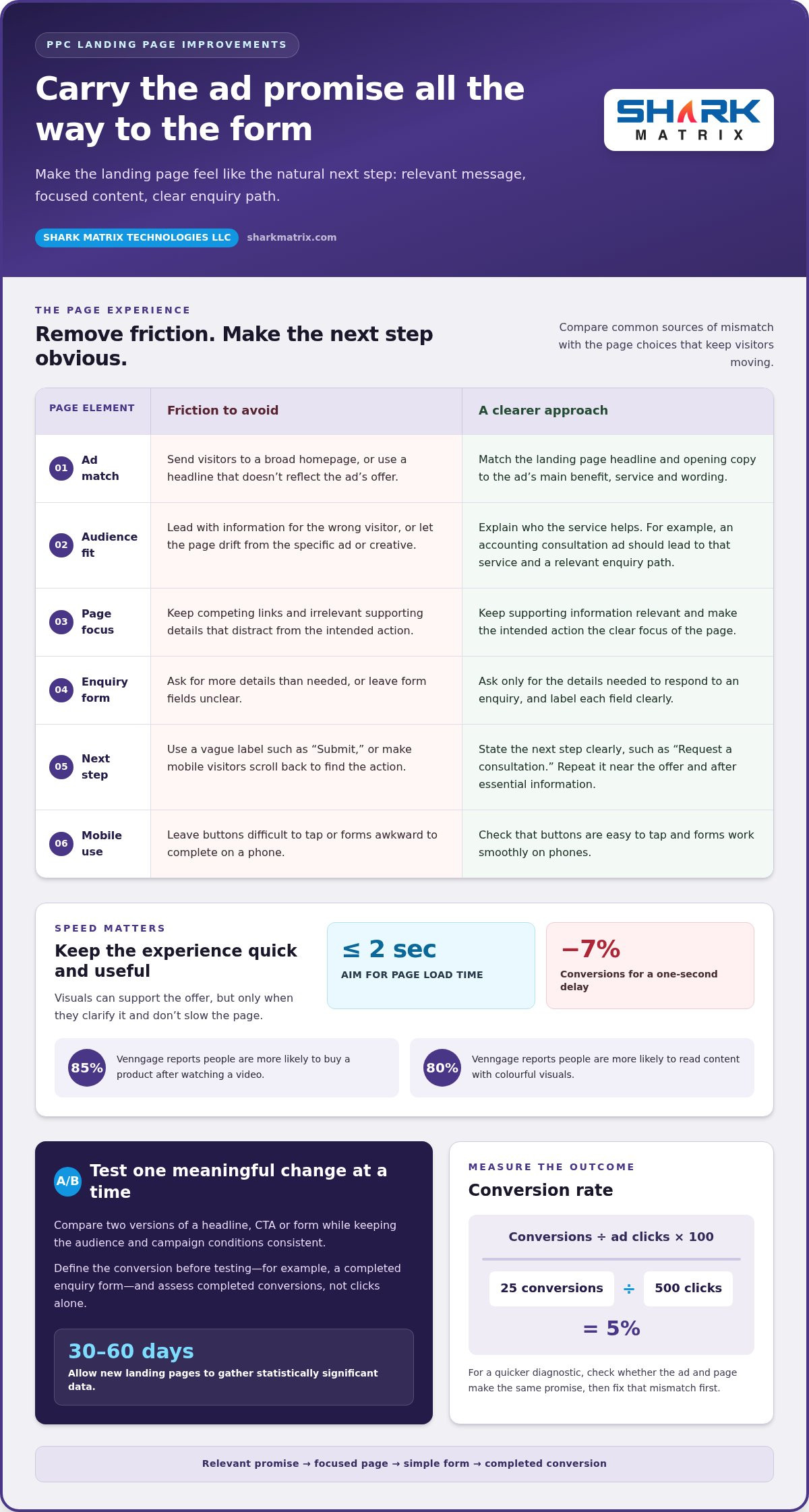
More clicks won’t fix a form that visitors abandon. Improving PPC conversion rates starts with matching each ad to a focused landing page, the right audience and a simple form; the conversion rate is calculated by dividing conversions by ad clicks and multiplying by 100. For example, 25 conversions from 500 clicks equals a 5% conversion rate.

It’s frustrating to pay for traffic that doesn’t turn into enquiries, especially when the problem may be what happens after the click. This guide explains how to improve PPC conversion rates by reducing form abandonment, making landing pages more relevant and usable, refining audience targeting, and organising campaigns around clear goals. You’ll also learn how to read conversion data and choose tests based on visitor behaviour rather than guesswork. From matching ads to landing pages to structuring campaigns, each improvement can make the next step clearer for potential customers across the UAE.

Key Takeaways

  • Make each landing page reflect the ad’s promise, keep its form focused, and make the next step clear on mobile.
  • Separate audiences by intent and tailor ad messages and landing pages to what each group needs.
  • Organise campaigns around distinct goals and relevant keywords so performance data can guide specific changes.
  • Track completed conversions alongside clicks to identify where visitors drop off and which adjustments improve results.
  • Use industry and platform benchmarks as context, then judge performance against your own campaign goals and lead quality.

1. Landing page improvements

A landing page should deliver on the promise made in its ad. If a Google ad promotes an accounting consultation, the page should lead with that service, explain who it helps, and present a clear enquiry form. Sending visitors to a broad homepage makes them search again, adding effort that can interrupt the path from interest to action.

Start by aligning the message. Match the ad’s main benefit, service, and wording to the landing page headline and opening copy. Then check that the content fits the intended audience: a page for business owners seeking support shouldn’t lead with information for job seekers. For Facebook campaigns, make sure the page reflects the specific offer or creative that brought visitors there. Keep supporting details relevant and remove competing links that distract from the intended action.

Use a focused form and a visible call to action (CTA). Ask only for the details needed to respond to an enquiry, and label each field clearly. Describe the next step in the CTA, for example, “Request a consultation,” rather than using a vague “Submit.” Repeat the CTA near the offer and after essential supporting information, so mobile visitors don’t have to scroll back to find it. Check that buttons are easy to tap and forms work smoothly on phones.

Test one meaningful change at a time. Compare two versions of a headline, CTA or form, while keeping the audience and campaign conditions consistent. Define the conversion before the test begins, such as a completed enquiry form, and assess completed conversions rather than clicks alone. Allow new landing pages 30-60 days to gather statistically significant data. For a quicker diagnostic, check whether the ad and page make the same promise, then fix that mismatch first.

Page speed and useful content also shape the experience. Aim for a load time of two seconds or less; a one-second delay can reduce conversions by 7%. Venngage reports that people are 85% more likely to buy a product after watching a video, and 80% more likely to read content with colourful visuals. Use video or visuals only when they clarify the offer, and keep them from slowing the page. A practical route to improving PPC conversion rates is to make every element support the same action, from the ad’s first claim to the form’s final button.

2. Audience targeting

Relevant targeting starts with what a person wants to do, not just who they are. Separate searches for “buy office chairs” from “office chair repair,” because they signal different needs. Match each keyword group to its own ad and conversion goal. Review search terms regularly, then exclude irrelevant queries that use budget without attracting suitable visitors.

Keyword targeting and search intent can improve conversions by connecting each query to an ad that addresses its underlying need. Someone comparing providers needs different information from someone ready to request a quote. Use search-term reports and conversion analytics to group queries by intent, refine ad messages, and direct each group to a relevant next step.

Build audience segments around meaningful differences, such as past enquiries, existing customers, or first-time visitors. Tailor retargeting for existing customers to their purchase history, product lifecycle, and needs between purchases. PPC retargeting of existing customers typically generates conversion rates three to five times higher than cold traffic. Keep each offer relevant to its segment instead of showing every visitor the same message.

Micro-moment targeting addresses a need when it arises. For example, someone searching for an urgent service on a mobile device may need a direct way to get in touch, while a researcher may need clear comparisons. Use the query, device, location targeting, and time context available in campaign analytics to shape the message. Make the ad’s next step fit the person’s immediate task to reduce friction.

Remarketing can reconnect with people who visited a key page but didn’t complete an enquiry. In a Mazda retargeting example, retargeted customers converted at a 53% higher rate and spent 98% more. Treat those figures as an example, not a forecast for every campaign. Create audience lists based on useful actions, such as viewing a service page, and exclude people who have already completed the intended conversion.

Email list targeting can help campaigns reach known customers or leads with messages suited to their relationship with the business. Segment lists by previous purchase, enquiry topic, or lifecycle stage, then tailor the ad and landing-page offer accordingly. Keep the goal consistent across channels: an existing customer may need a related service, while an unconverted lead may need a clear answer to a previous concern.

Audit conversion tracking by testing a real form submission and confirming that the intended conversion records once in campaign analytics. Compare ad-platform totals with website records, check that tags fire on the correct completion event, and review attribution settings for duplicate or missing credit. These checks help reveal whether a targeting change attracts qualified leads or simply shifts reported conversions. For stronger keyword planning across paid and organic search, explore SEO and keyword strategy.

3. Account structure and campaign strategy

Organise Google Ads campaigns around distinct business goals rather than using a catch-all account structure. A UAE firm could separate campaigns for service enquiries, branded searches, and competitor comparisons. Within each campaign, group closely related keywords so the ad clearly answers the search. This structure makes it easier to see which intent, message, or audience brings useful leads, then adjust that area without changing unrelated campaigns.

Keep each ad group focused. If a campaign targets “commercial cleaning” and “office cleaning,” separate the themes when their search intent or landing pages differ. Align keywords, ad messaging, and destination pages. Google’s Quality Score considers click-through rate, ad relevance, the landing page, and overall AdWords performance. Improving these connected elements gives account reviews a practical focus instead of treating each metric in isolation.

Kevin Brkal reported an 81% lift in conversion rate for a client after optimizing its advertising account. That result illustrates why structure deserves attention, but it isn’t a forecast for every account. Review campaign and ad-group performance together: a high-click ad with few qualified enquiries may need tighter targeting, while a relevant ad with low traffic may need broader keyword coverage or revised messaging.

Bidding strategies and campaign budgets affect conversions by shaping which auctions an account can enter and how consistently its ads appear. Choose a bidding approach that fits the measured goal, such as completed enquiries, and make sure conversion tracking reflects that action. Prioritise budgets according to campaign value and lead quality, then review spend alongside completed conversions. Increasing the budget alone won’t fix a weak match between searches, ads, and offers.

Separate campaigns when they need different goals, audiences, or budget decisions. For example, campaigns targeting distinct customer groups may need different settings and locally relevant messaging across the UAE. Keep campaigns together when their keywords, conversion goals, and landing-page experiences genuinely match. This balance gives account managers enough control without scattering similar data across numerous small campaigns.

Review performance regularly and make changes to answer a specific question. Compare search terms, conversion actions, device performance, and campaign results before changing bids or budgets. For LinkedIn campaigns, assess whether professional audience criteria fit the offer; for Google Ads, examine query intent and keyword relevance. Record each change and its result so the next strategy decision builds on evidence rather than guesswork.
Improving PPC Conversion Rates Through Stronger Campaign Structure

4. Reasons to optimize PPC conversion rates

Clicks measure attention, but completed actions show whether paid traffic supports a business goal. A campaign can attract visitors who leave without calling, enquiring, booking, or downloading a guide. Reviewing the conversion rate helps distinguish useful traffic from visits that use budget without producing the intended result. That distinction matters when deciding whether to change targeting, messaging, or the offer.

Optimization can also reveal friction between the ad and the next step. For example, a visitor who clicks an offer for a service may abandon a form that asks for unnecessary details. Review the journey from ad click to completed action and find where people stop. Addressing that specific barrier makes campaign decisions more practical than simply trying to generate more clicks.

Common PPC tracking mistakes include counting button clicks as completed leads, firing a conversion tag more than once, or overlooking broken tracking after a website change. These errors can distort bidding decisions and make weak traffic appear successful. Test the full action, such as submitting a form, and confirm that the recorded event represents a genuine completion.

Conversion data can also help prioritise campaigns. Compare lead quality alongside recorded actions: a campaign producing many low-value enquiries may matter less than one generating fewer suitable prospects. In Google’s cited data, the average advertiser doubles their return. Treat return as a business measure, not a substitute for checking whether leads progress to meaningful outcomes.

For context, a typical PPC conversion rate is between 2% and 5%, while exceptionally strong campaigns can exceed 10%. These are broad benchmarks, not a UAE-specific target or a promise for an individual account. In the UAE, compare campaigns with similar goals, platforms, audiences, and conversion definitions. A search campaign for urgent services should not be judged against a social campaign promoting a guide download.

Best practice starts with a reliable baseline. Define the conversion clearly, confirm the tracking event, and review results by campaign and device. Then change one factor at a time, such as the bid strategy, keyword focus, or form requirements. Record what changed and whether qualified conversions shifted. This makes each optimization easier to assess and prevents simultaneous edits from obscuring the cause.

Running PPC without reviewing completed actions can hide wasted spend and missed opportunities. Use conversion evidence to decide whether to refine the audience, improve the offer, or shift campaign priorities. If clicks rise while qualified conversions remain flat, investigate relevance and tracking before increasing traffic. A measured approach keeps optimization tied to business outcomes rather than surface-level activity.

5. What is a good PPC conversion rate by industry and platform?

A useful benchmark depends on the campaign’s industry, platform, audience, and conversion definition. For context, WordStream reported an average PPC conversion rate of 7.52% in its November 2025 update, while Ruler Analytics reported 5.4% in May 2026. These figures differ, so treat them as reference points, not interchangeable targets for UAE campaigns.

Industry differences matter, too. The reported median paid search conversion rate for ecommerce is about 3.5%, while SaaS averages about 2%. Agencies have a 2.4% benchmark, and business services have a 3.5% benchmark. These distinctions show why a UAE retailer should compare like with like, rather than judging its campaign against an unrelated service business.

Legal figures also vary by source and date. WordStream’s 2025 benchmark reports 5.09% for Attorneys & Legal Services, while Ruler Analytics reported 7.8% for Legal in May 2026. The gap underlines the importance of matching geography, campaign type, and conversion measurement before using a benchmark to set expectations.

Platform averages offer another reference, but they don’t remove the need for context. Reported averages are 2.85% for Google Ads and 2.94% for Bing across sectors. Facebook Ads range from 9% to 10%, LinkedIn Ads from 5% to 15%, and Instagram averages 1.08%. Compare the same objective and conversion action, since platforms can attract visitors at different stages of decision-making.

Some platform figures also shift by industry. Facebook Ads conversion rates are reported at 14.29% for fitness products and services, compared with 2.31% for technology. A UAE fitness campaign and a technology lead campaign therefore need different comparison sets. Look for benchmarks that resemble the campaign’s offer and audience, then use internal results to assess whether leads are relevant.

For a practical evaluation, calculate conversions using the same action and reporting period across campaigns. Separate enquiry submissions from calls, purchases, or downloads, then compare each category with its closest benchmark. Review the source, date, industry, and platform behind every reference. If definitions differ, treat the figure as broad context rather than a direct performance comparison.

A “good” rate is one that supports the campaign’s commercial goal and attracts suitable prospects. A higher percentage can still mislead if it counts low-quality actions, while a lower rate may bring more valuable enquiries. In the UAE, assess lead quality and campaign outcomes alongside the conversion rate, then use relevant benchmarks to guide, not replace, decisions. For a broader search visibility strategy, explore SEO strategy.

Shark Matrix Technologies: Search Engine Optimization (SEO)

Shark Matrix Technologies LLC can help when paid campaigns attract clicks but campaign management, organic visibility, or website experience needs attention. Its Pay Per Click (PPC) Management supports campaign planning and optimization, while Search Engine Optimization (SEO) helps strengthen visibility beyond paid ads. If the landing page creates friction, Web Design and Development can improve the site experience that contributes to conversion.

These services can work together to support the same business goals: relevant traffic, clear messaging, and meaningful actions. Consider this next step when your campaign data points to issues across targeting, search visibility, or the website rather than one isolated ad. To discuss your marketing needs, contact Shark Matrix Technologies LLC or visit sharkmatrix.com.

Build Your Next Campaign Around What You Learn

Make the next campaign decision deliberately. Choose a clear business outcome, then use incoming results to decide what needs attention. This keeps improving PPC conversion rates focused on meaningful progress, not change for its own sake. A useful review asks whether the campaign attracts the right prospects and whether the website supports their next step.

When paid campaigns, search visibility, and website experience need to work together, Shark Matrix Technologies offers Pay Per Click (PPC) Management, Search Engine Optimization (SEO), and Web Design and Development. These services can address connected parts of the visitor journey, from campaign traffic to the pages where prospects take action.

Bring your campaign goals and priorities into the next planning conversation. Contact Shark Matrix Technologies to discuss a practical next step for your digital marketing. Clear goals make it easier to keep learning, refine your approach, and move forward with confidence.

Frequently Asked Questions

How can I reduce form abandonment in PPC campaigns?

Reduce abandonment by making the form easy to complete and fixing errors that interrupt submission. On a UAE service enquiry form, label required fields clearly and show an understandable message beside any field needing correction. If the form has several steps, explain what comes next and show visitors their progress. Review analytics for the last completed field to find where people stop, then test a focused adjustment.

Should I create separate PPC campaigns for existing customers?

Create a separate campaign when existing customers need a different message, offer, or conversion goal from new prospects. For example, a business could separate a campaign encouraging repeat purchases from one focused on first-time enquiries. This makes each group’s results easier to interpret and helps avoid showing acquisition ads to people who have already converted. Keep campaigns together if their goals and audience treatment are genuinely the same.

What is a PPC conversion rate?

A PPC conversion rate is the percentage of ad clicks that result in a defined conversion. Depending on the campaign’s goal, a conversion might be a completed purchase, a submitted enquiry, or a completed download. Define the action before comparing campaigns: a rate based on form submissions cannot be compared directly with one based on purchases. Consistent definitions make performance reporting more meaningful.

What is the fastest way to improve PPC conversion rates?

Fix the clearest disconnect between a search, its ad, and the action visitors are asked to take. A message-match correction can show results in 7-14 days. For example, if an ad promotes a specific service but the destination discusses several services, make the relevant offer prominent. Then monitor completed conversions and lead quality to see whether the change improved the campaign’s outcome.

Why is call-to-action placement important for PPC conversions?

CTA placement matters because visitors need a clear next step when they’re ready to act. Place an action near the main offer, then consider another after supporting details for readers who need more information first. Keep the page’s primary action consistent, so a consultation button and a download button don’t compete. Track each CTA separately to learn which placement leads to completed conversions.

How do you calculate PPC conversion rate and conversion value?

Calculate conversion rate by dividing conversions by ad clicks and multiplying by 100. Conversion value is the total value assigned to the recorded conversions, such as transaction revenue for purchases. For lead campaigns, use a consistent internal valuation method rather than treating every form submission as equal. Keep conversion value distinct from conversion count, so reporting shows both how often people act and the business value attributed to those actions.

Which PPC landing page changes improve conversion rates?

Prioritise changes that remove uncertainty or help visitors assess the offer. Make service eligibility, included details, and the next step easy to find. Add relevant proof, such as customer reviews, where it supports the decision, and answer common objections near the enquiry form. For a UAE campaign, make sure the service wording on the page matches the audience and offer in the ad instead of relying on generic copy.

What A/B tests should you run to improve PPC conversion rates?

Test a specific decision point, such as whether a short form or one with an additional qualifying question produces more suitable leads. Other useful tests include different offer framing, the order of supporting information, or customer proof near the CTA. Keep the audience, campaign goal, and measurement consistent when comparing versions. Judge the winner by completed conversions and lead relevance, not clicks alone.

Categories
Uncategorized

PPC Budget Allocation Model: Build a Smarter, Goal-Led Plan

A fixed PPC split can make a budget look organised while quietly starving your strongest opportunities. The right ppc budget allocation model isn’t a universal percentage chart. It helps you direct spend towards the campaigns and funnel stages most likely to support your business goals.

If you’re unsure how much to assign to each channel, or worried that a standard percentage rule will limit growth, you’re not alone. The decision gets harder when conversion history is limited: forecasts are less certain, and performance comparisons can be difficult. A useful plan makes room for what the data shows without pretending every decision is backed by perfect evidence.

This guide compares practical budget models and explains how to choose one that fits your goals and available data. You’ll learn how to turn targets and campaign performance into an actionable allocation, then set review rules for adjusting spend with discipline rather than reacting to every short-term change. The central idea is simple: allocate by potential marginal returns, not by fixed channel percentages.

Key Takeaways

  • Choose a ppc budget allocation model that reflects your business goals and the evidence available, rather than defaulting to fixed channel percentages.
  • Turn your desired outcomes into an allocation plan by defining acceptable economics, estimating demand, and validating assumptions.
  • Compare goal-based, historical-performance, and other practical models by their input needs, risks, and review signals.
  • Use campaign tracking, pacing checks, and scheduled reviews to guide adjustments based on conversion quality and performance data.
  • Document your assumptions, measure results, and refine the plan as part of a disciplined PPC management process.

Why a PPC Budget Allocation Model Beats Fixed Spending Splits

Setting a total advertising budget answers one question: how much can the business spend? It doesn’t answer how that amount should be distributed across platforms, campaigns, audiences, or stages of the customer journey. A ppc budget allocation model helps answer that second question by connecting spend to business and campaign objectives, such as generating qualified leads, driving sales, or building awareness.

Allocation is a decision framework shaped by goals, evidence, and constraints. It accounts for conversion economics, available demand, campaign capacity, and the reliability of your data. It also recognises that paid search, social campaigns, and other PPC activity may play different roles. As a foundation, Pay-per-click (PPC) describes advertising in which advertisers pay when users click. The value of a click depends on what happens next.

A fixed percentage split can be a useful starting point for planning or testing, but it isn’t a universal performance formula. If one campaign has a clear path to valuable conversions and another supports discovery, dividing spend equally may ignore their different jobs. The aim isn’t to give every channel the same share. It’s to make each allocation defensible against the objective it serves.

What decisions does a PPC allocation model guide?

The model guides distribution after the total budget is set. It helps determine which platforms and campaigns receive funding, which audiences to prioritise, and how much to reserve for discovery versus high-intent activity. Base each decision on target outcomes, the economics of a conversion, and the demand each campaign can realistically reach, rather than an automatic equal split.

Why do fixed budget percentages often fall short

Accounts differ in goals, customer journeys, campaign maturity, and available evidence. A split that suits a sales campaign may not suit lead generation or awareness activity. Weak tracking can misattribute conversions, while small samples can make a channel look unusually strong or weak. Treat early results as signals to investigate, not proof that the apparent winner deserves every extra dollar.

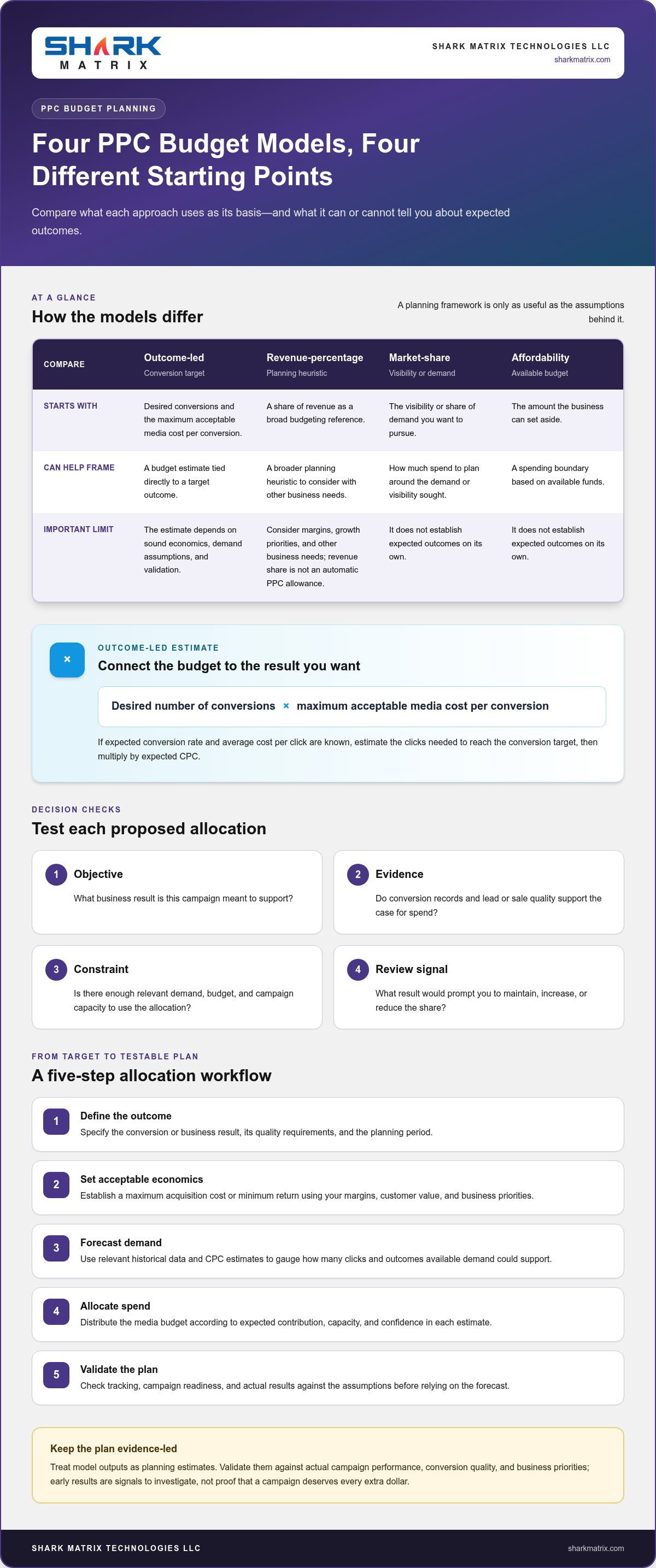
For a practical allocation, assess each proposed share against a few questions:

  • Objective: What business result is this campaign meant to support?
  • Evidence: Do conversion records and lead or sale quality support the case for spend?
  • Constraint: Is there enough relevant demand, budget, and campaign capacity to use the allocation?
  • Review signal: What result would prompt you to maintain, increase, or reduce the share?

These checks make assumptions visible and give teams a consistent basis for comparison. They also help prevent budget shifts driven by isolated results, especially when campaigns have different conversion paths or times to outcome. Treat every model output as a planning estimate, then validate it against actual campaign performance. As results accumulate, revisit the assumptions and adjust distribution based on conversion quality and business priorities.

How to Calculate a PPC Budget Allocation Model

Build the allocation from business outcomes, not from a channel split chosen for convenience. A useful ppc budget allocation model makes its assumptions visible: what result you want, what that result can reasonably cost, how much demand may be available, and what evidence will tell you whether the plan needs adjustment.

Start with a goal-based or revenue-based calculation

For an outcome-led estimate, multiply the desired number of conversions by the maximum acceptable media cost per conversion. If you know your expected conversion rate and average cost per click, estimate the clicks needed to reach the conversion target, then multiply by expected CPC. Both approaches connect budget to outcomes. Revenue-percentage budgeting is a broader planning heuristic. Use it alongside margin, growth priorities, and other business needs, rather than treating a revenue share as an automatic PPC allowance.

Market-share budgeting starts with the visibility or share of demand you want to pursue. Affordability budgeting starts with the amount the business can set aside. Neither establishes expected outcomes on its own. Practical PPC budget planning can compare these approaches, but the assumptions still need to fit your economics and campaign conditions.

Use this five-step workflow:

  1. Define the outcome. Specify the conversion or business result, its quality requirements, and the planning period.
  2. Set acceptable economics. Establish a maximum acquisition cost or minimum return using your own margins, customer value, and business priorities.
  3. Forecast demand. Use relevant historical data and CPC estimates to gauge how many clicks and outcomes the available demand could support.
  4. Allocate spend. Distribute the media budget across campaigns according to expected contribution, capacity, and confidence in each estimate.
  5. Validate the plan. Check tracking, campaign readiness, and actual results against the assumptions before treating the forecast as a reliable guide.

Turn assumptions into a forecast you can test

Gather historical clicks, spend, conversions, conversion quality, and conversion value where available. Add estimated CPC, expected conversion rate, campaign capacity, and the target outcome. Separate media spend from the complete budget: management, tools, and creative production are supporting costs, not click spend. Keep both views so the campaign allocation doesn’t hide the resources needed to run it.

Label the variables before calculating: B = media budget, CPC = estimated cost per click, CVR = expected conversion rate, and V = average value per conversion. Then estimate:

  • Forecast clicks = B ÷ CPC
  • Forecast conversions = forecast clicks × CVR
  • Forecast conversion value = forecast conversions × V

A forecast is a planning estimate, not a performance guarantee. Compare actual delivery with these estimates, investigate gaps in tracking or demand, and revise assumptions before shifting budgets. For support with planning, managing, and evaluating campaigns, explore PPC management support.

Which PPC Budget Allocation Model Fits Your Situation?

The right model depends on the decision you need to make and the evidence you can trust. Use a goal-based approach when conversion economics are clear, forecasting when historical results are useful, and simpler constraints when data is thin or the business needs a defined spending limit. A ppc budget allocation model can combine approaches, such as setting an affordability ceiling before distributing spend according to campaign forecasts.

Choose a model based on your data maturity

For a new campaign, plan conservative scenarios and treat initial spend as a controlled test. Set a clear learning objective and decide what evidence would justify expanding. Established campaigns can use validated CPA or ROAS targets to compare opportunities, but only when conversion tracking and lead or sale quality are dependable. In complex accounts, cross-channel attribution may not clearly show each touchpoint’s contribution, so avoid treating reported channel credit as complete proof of incremental impact.

Model Useful conditions Required inputs Main risk Review signal
Goal-based Conversion economics are clear Target conversions, allowable CPA or ROAS Targets may ignore available demand Qualified outcomes against target
Forecasting Historical data is usable Spend, clicks, CPC, conversions, value Past patterns may not persist Actual results versus forecast
Revenue percentage Useful as a broad planning limit Revenue, margin, growth priorities Revenue share may not reflect profitability Return and business affordability
Market share Visibility or demand coverage is a priority Market opportunity, impression or reach goals More exposure may not create efficient outcomes Incremental reach and conversion quality
Affordability Cash flow sets a firm ceiling Available budget and operating constraints Spend limit isn’t an outcome forecast Pacing and value generated within the limit
Full-funnel Campaigns support different journey stages Stage roles, audience and outcome signals Allocation can imply impact that hasn’t been measured Stage-specific indicators and downstream quality

Revenue-percentage, market-share, and affordability models are best treated as planning constraints, not proof that a particular spend level will perform. They can establish a workable envelope, then goal-based or forecast evidence can guide distribution inside it.

Compare channel, campaign, and funnel-level allocation

Platform-level budgets set the broad division between advertising channels. Campaign-level decisions prioritise specific products, services, or objectives within a platform. Funnel allocation instead assigns roles by journey stage, such as discovery, consideration, or high intent. It organises investment, but doesn’t by itself prove that an upper-funnel activity caused later conversions.

Branded searches capture people already looking for a business, while non-branded searches can reach audiences exploring a category or solution—such as car shoppers researching vehicle options on sites like carseek.com. Their intent and measurement needs differ, so assess them separately before comparing results. When PPC management is part of the plan, define the objectives, reporting needs, and review signals that will guide campaign decisions.

PPC Budget Allocation Model: Build a Smarter, Goal-Led Plan

How to Implement, Monitor, and Reallocate Your PPC Budget

A budget model only becomes useful when it shapes day-to-day campaign decisions. Put the ppc budget allocation model into operation with clear campaign roles, reliable measurement, and agreed rules for changing spend. This turns allocation from a one-time forecast into a managed process, without letting every short-term performance swing trigger a budget change.

Set pacing and review rules before campaigns launch

Start by mapping each campaign to its platform, objective, audience, funnel role, planned allocation, and target metric. Check that conversion actions are configured correctly and that lead quality or sales value can be assessed, not just clicks and form submissions. Then establish pacing checks and review timing based on campaign volume, sales cycles, and how quickly conversion data becomes dependable.

Agree in advance who can approve changes and where decisions will be recorded. Set thresholds from business targets and account baselines, rather than borrowing universal benchmarks. Routine pacing adjustments can correct delivery against plan. Material allocation changes should include a reason, the evidence behind it, the expected effect, and a date to review the result.

Reallocate based on evidence, not short-term swings

Before moving budget towards a reported winner, check whether tracking is working, attribution is comparable, and conversions reflect genuine business quality. A campaign with a lower reported CPA may be generating weaker leads, or its recent result may rest on too few conversions to support a confident decision. Compare like with like and account for the time between ad interaction and business outcome.

Use structured tests to learn what drives a difference. Change one major factor at a time, such as the channel, campaign, audience, or funnel allocation, while keeping the objective and measurement consistent. Define the test question and review signal before launch. If several factors change together, results may not reveal which change influenced performance.

For each review, distinguish between three decisions: keep the allocation, adjust pacing within the agreed plan, or propose a material reallocation. Document the evidence and revisit the decision after enough relevant data has accumulated. If tracking is incomplete or conversion volume is too limited, record the uncertainty and avoid presenting a tentative signal as a confirmed improvement.

Monitoring checklist

  • Confirm planned spend and actual pacing by platform and campaign.
  • Check conversion tracking, attribution settings, and any unusual changes in recorded activity.
  • Review conversion quality alongside CPA or ROAS, using the metric that matches the campaign goal.
  • Assess whether there’s enough reliable data for a decision, considering conversion delays and sales cycles.
  • Record the change, rationale, approver, and review point before making a significant shift.

This disciplined cycle connects campaign management with measurable business objectives and supports data-led evaluation. Discuss a data-led PPC strategy to bring planning, campaign execution, and performance review into one process.

Turn Your PPC Budget Allocation Model into a Managed Growth Plan

A budget model earns its place when it guides consistent decisions, not just the initial split. Choose an approach that fits your goals and evidence, document its assumptions, launch campaigns with reliable measurement, then review results and refine the plan. This turns a ppc budget allocation model into a working process your team can revisit as business priorities and campaign data evolve.

What a disciplined PPC management process should connect

Effective management links business objectives to budget assumptions, campaign structure, conversion tracking, and reporting. Platform metrics such as clicks and conversions help diagnose delivery, but lead quality and commercial outcomes show whether the activity is valuable to the business. Cross-channel context can inform priorities across PPC, SEO, and social media without requiring equal spending across them.

Shark Matrix Technologies LLC provides PPC management and digital marketing strategy to support campaign planning, execution, and evaluation. A connected approach helps teams assess whether each campaign is serving its intended role and whether reported performance aligns with measurable business objectives. It should inform decisions, not promise a particular result.

Prepare a budget brief your team can act on

Before launch, create a concise brief that makes the plan understandable to everyone involved. Record what the budget is meant to achieve, how the allocation was chosen, which data supports it, and what conditions would prompt a review. This creates a shared reference point when campaign performance or priorities change.

  • Objectives and constraints: State the business outcome, planning period, budget limit, and any campaign or capacity restrictions.
  • Target economics: Document the CPA, ROAS, conversion value, or other measure that will guide decisions.
  • Evidence and confidence: Name the data sources, note gaps in tracking or conversion history, and record how confident the team is in its assumptions.
  • Model and allocation logic: Explain why the selected model fits the goal and how it informs platform, campaign, or funnel investment.
  • Ownership and review conditions: Identify decision owners and specify which changes require approval, along with the signals that trigger a reassessment.

Keep the brief current as actual results replace planning assumptions. Review whether platform reporting reflects the quality of leads or sales, and consider wider channel activity when interpreting changes in PPC performance. Cross-channel insight adds context. It doesn’t mean every channel deserves the same share or that one channel caused every observed result.

With a documented plan, teams can move from model selection to measured implementation and informed refinement. PPC management support can bring campaign planning, management, and performance review into a broader digital marketing strategy.

Make Your Next Budget Decision More Deliberate

Your next step doesn’t need to be a complete account overhaul. Choose one upcoming allocation decision, write down the business outcome it should support, and identify what evidence would change your mind. That small discipline makes your ppc budget allocation model more useful over time: each review can build on what the team has learned instead of restarting from assumptions.

Shark Matrix Technologies LLC brings PPC management together with digital marketing strategy across PPC, SEO, and social media. Its data-driven lead generation supports a focus on meaningful business signals, not just platform activity. When planning, campaign execution, and performance evaluation work together, you can make budget decisions with clearer rationale while adapting as priorities and evidence evolve.

Ready to put a goal-led plan into practice? Explore PPC management support and take the next step towards a more disciplined approach to campaign growth. Start with the evidence you have, keep learning, and let each decision make the next one stronger.

Frequently Asked Questions

How much should a business allocate to PPC advertising?

Set a PPC budget based on the business outcome you need and the amount you can afford to invest while assessing results. For a lead campaign, estimate how many qualified enquiries you need, then use your acceptable acquisition cost to model a starting media budget. Check that the target is commercially viable and that campaigns can reach enough relevant demand. Treat the first allocation as a testable plan, not a fixed rule.

Can I use the same PPC budget allocation model across every advertising platform?

You can use the same decision principles across platforms, but avoid copying identical budget shares without checking how each platform supports your goals. Audience intent, campaign formats, available targeting, conversion tracking, and demand can differ. For example, a search campaign may capture active interest while a social campaign introduces an offer to a broader audience. Set platform-specific expectations, then compare results using suitable measures and consistent business outcomes.

What happens if a PPC campaign has no conversion history?

Without conversion history, use estimates cautiously and make the first phase a controlled learning exercise. Check whether tracking records the actions that matter, then use available information such as search demand, planned campaign reach, and relevant business data to form an initial scenario. Set a spending limit and define what you need to learn, such as which searches produce qualified enquiries. Avoid judging success on clicks alone while conversion evidence develops.

Should PPC budget include agency management fees and marketing tools?

Track media spend separately from the full cost of running PPC. The broader budget may include management, analytics tools, and creative production, depending on how your business accounts for these resources. For instance, teams collaborating with an agency like I Search Marketing for creative development and brand strategy should account for those professional services alongside direct media spend. Separating them makes platform performance easier to interpret and shows the total investment needed to operate campaigns. For internal planning, record each cost category consistently so comparisons between campaigns or planning periods don’t mistake operating expenses for advertising spend.

How often should a PPC budget allocation be reviewed?

Choose a review rhythm that reflects how quickly campaigns spend, how long customers take to convert, and when reliable outcome data becomes available. Check pacing often enough to spot delivery problems, but assess performance over a period that gives delayed conversions time to appear. A sudden tracking disruption or major business change may call for an earlier review. Record decisions so routine checks don’t lead to repeated, unnecessary reallocations.

Is a percentage-of-revenue PPC budget model reliable?

A percentage of revenue can provide a convenient planning boundary, but it doesn’t show whether a campaign can acquire customers profitably. Revenue may rise while margins tighten, or growth priorities may justify a different level of investment. Use the percentage as one input, then assess profitability, customer value, available demand, and business capacity. The ppc budget allocation model should ultimately reflect the commercial objective, not revenue alone.