

Did you know that over 60% of internet searches in the UAE are now conducted in Arabic, even as smartphone penetration hits a staggering 99%? If you’re seeing low conversion rates from poorly translated content or fighting technical errors in RTL site indexing, you’re likely missing out on a massive portion of the market. Implementing a robust multilingual seo strategy for middle east markets is no longer optional. It’s the difference between regional dominance and digital invisibility in a GCC e-commerce market projected to exceed AED 183 billion this year.
It’s exhausting to manage separate campaigns for every GCC country only to find your visibility stalling at the border. You’ll learn how to master the complexities of Modern Standard Arabic and English search landscapes to dominate regional rankings in 2026. This guide provides a scalable technical framework for high-ranking visibility in both languages. We’ll explore how to fix indexing issues, leverage Natural Language Processing for better intent matching, and build a digital ecosystem that commands authority across the entire region.
Key Takeaways
- Learn how to balance Modern Standard Arabic for B2B authority with English for technical reach across the diverse GCC landscape.
- Implement a robust multilingual seo strategy for middle east markets by mastering RTL site architecture and localized URL subdirectories.
- Discover the transcreation framework to ensure your content resonates culturally while remaining compliant with regional data protection regulations.
- Understand how to tailor your approach for distinct markets like Saudi Arabia and Qatar to drive high-ranking visibility across the entire region.
- Leverage AI automation and Natural Language Processing to scale your localized content production efficiently without losing brand quality.
The Linguistic Landscape of Middle Eastern Search in 2026
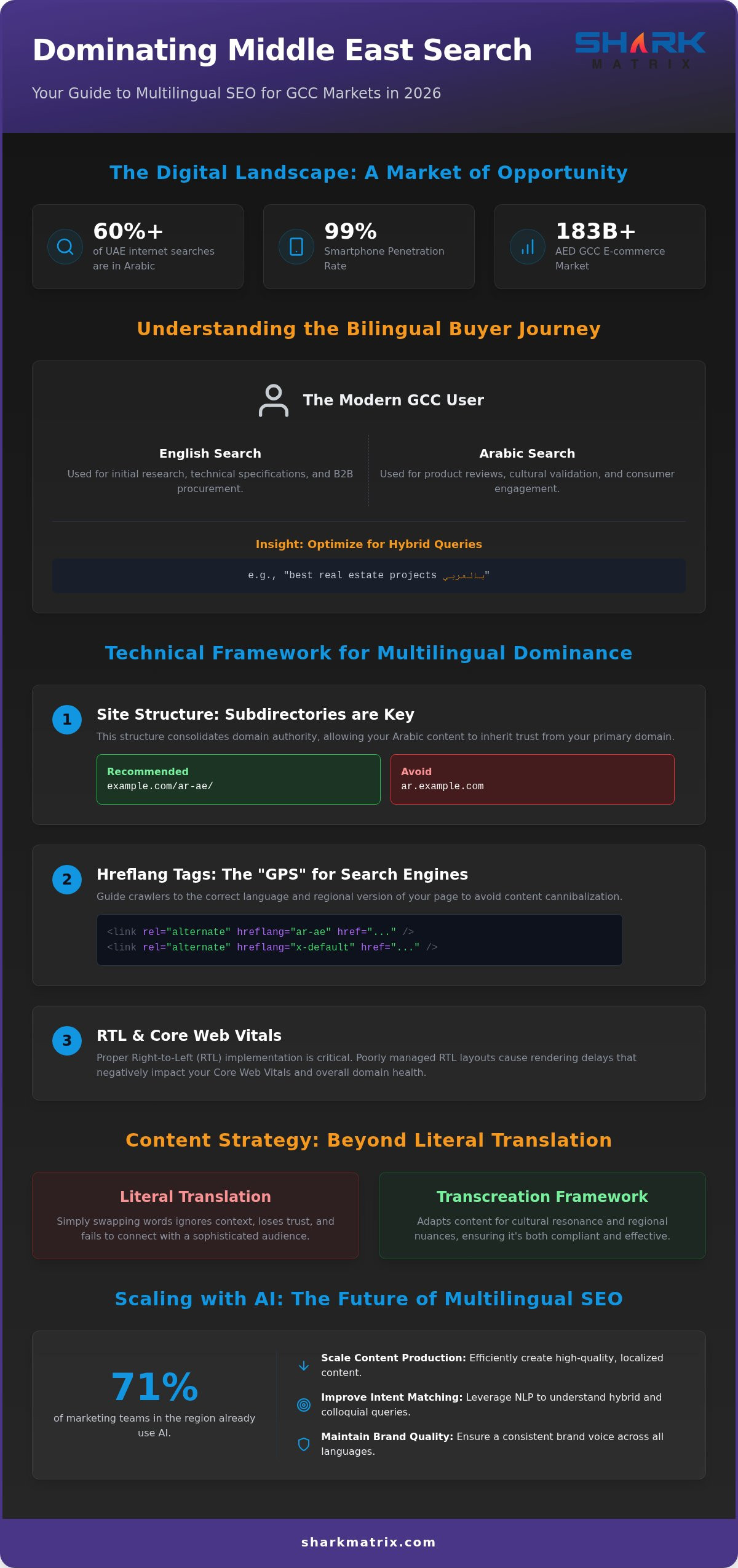
As of March 2026, over 60% of internet searches in the UAE are performed in Arabic. This represents a significant shift in how regional audiences engage with digital content. A successful multilingual seo strategy for middle east markets can’t treat English and Arabic as isolated silos. Users here move fluidly between languages, often starting a query in English for technical specifications and switching to Arabic for reviews or cultural validation. With 71% of marketing teams in the region already adopting AI by early 2026, the competition for linguistic accuracy has never been higher.
Literal 1:1 translation strategies fail because they ignore the nuances of internationalization and localization. If you simply swap words without adapting the context, you’ll lose the trust of a highly sophisticated audience. We’re also seeing a surge in visual and voice search driven by a 99% smartphone penetration rate. Users often use colloquial terms or hybrid phrasing that standard dictionaries don’t recognize, making traditional keyword matching obsolete.
Modern Standard Arabic vs. Regional Dialects
Modern Standard Arabic (MSA) remains the gold standard for B2B SEO and formal procurement. It’s what decision makers use when they want authority and professional clarity. However, consumer engagement often thrives on regional dialects or “Arabizi”, the use of Latin characters and numbers to represent Arabic sounds. Mapping search intent requires understanding these layers. For example, a user might use MSA to research “digital transformation” but switch to informal phrasing when looking for an ai chatbot-development solution that speaks their local dialect. Brands must balance formal authority with the relatable phrasing that drives social sharing and community trust.
The Bilingual Search Duality
The buyer journey in the region is rarely monolingual. Users often toggle between languages during a single session. You might see mixed-language queries like “best real estate projects بالعربي” (in Arabic). Brands that fail to optimize for these hybrid searches lose visibility at the most critical conversion points. Maintaining a consistent brand voice across these linguistic divides is a technical challenge. It requires sophisticated natural language processing services to ensure that your multilingual seo strategy for middle east scales without losing the specific cultural resonance that drives results. By 2026, the most successful brands are those that treat bilingualism as a unified experience rather than two separate websites.
Technical Architecture for RTL and Multilingual SEO
Designing a robust technical foundation is the cornerstone of any effective multilingual seo strategy for middle east markets. By 2026, the debate between subdomains and subdirectories has largely settled in favor of subdirectories (e.g., example.com/ar-ae/). This structure consolidates domain authority, which is vital for competing in the high-growth UAE e-commerce sector. A unified subdirectory approach allows your Arabic content to inherit the “trust” of your English pages, rather than forcing search engines to treat them as entirely separate entities.
Technical SEO in this region requires more than just flipping a CSS switch. Search engine crawlers must understand the relationship between your English and Arabic versions without getting lost in “Right-to-Left” (RTL) layout complexities. The Google March 2026 core update introduced holistic Core Web Vitals scoring, which means your Arabic site’s performance now directly impacts your aggregate domain health. Poorly managed RTL layouts often trigger rendering delays that hurt these composite scores. If you’re building a complex site, partnering with a team that offers specialized web development services ensures your code is clean and crawler-friendly from day one.
Hreflang Implementation for Regional Accuracy
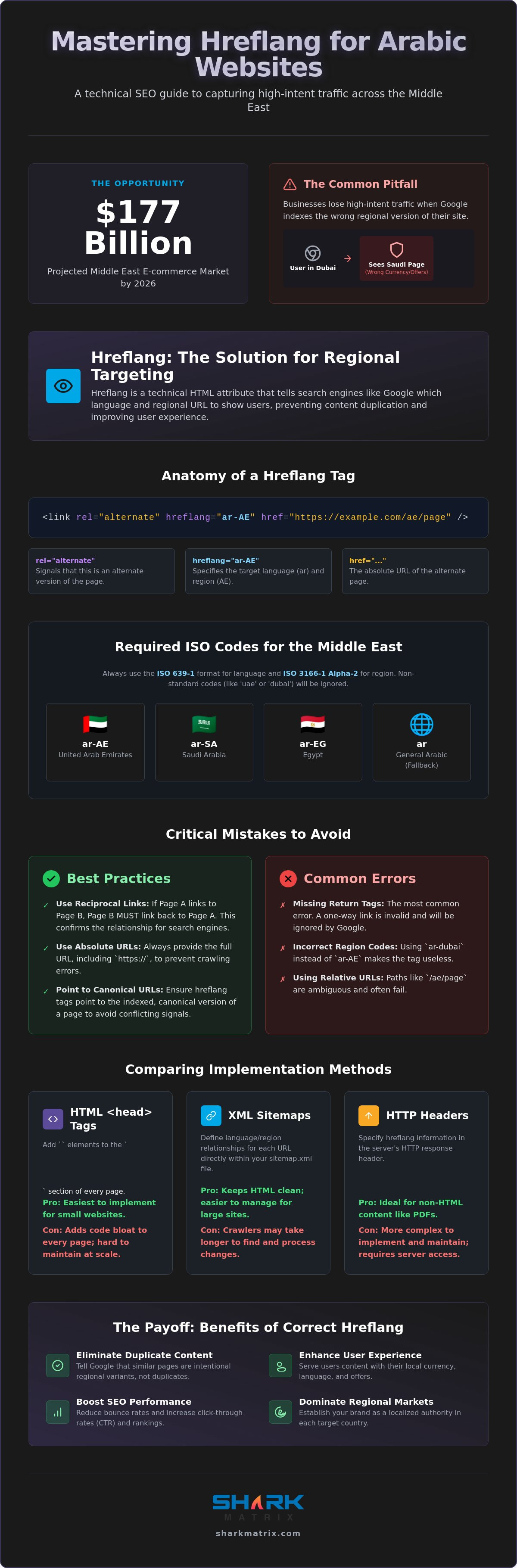
Correct hreflang tags are the “GPS” for search engines. In the Middle East, it’s not enough to target the language (ar); you must target the region (ar-ae) to align with specific MENA consumer insights and purchasing behaviors. A common pitfall is failing to implement the x-default tag on your homepage, which tells Google which version to show users from unspecified regions. Without these precise signals, your English and Arabic pages may end up competing against each other in the search results, a phenomenon known as content cannibalization that dilutes your rankings.
RTL UI/UX and Core Web Vitals
RTL optimization is a critical performance factor. Arabic typography often uses complex scripts that require larger font files, which can slow down your Largest Contentful Paint (LCP) and Interaction to Next Paint (INP). Furthermore, “Cumulative Layout Shift” (CLS) is a major risk when elements flip from left-to-right to right-to-left. If your buttons or images jump during the loading process, your rankings will suffer under 2026’s strict performance standards. You must ensure mobile-first indexing parity; your Arabic mobile site must contain the exact same structured data and high-quality assets as its English counterpart. Neglecting this parity is one of the fastest ways to lose visibility in a market where smartphone penetration exceeds 99%.
Content Localization Strategy: Beyond Literal Translation
Success in 2026 requires a shift from translation to transcreation. It’s about adapting the core message to fit local values rather than just swapping words. For instance, a global campaign focusing on “individual independence” might need to pivot toward “family legacy” or “community growth” to resonate within the UAE. This conceptual shift is vital for a high-performing multilingual seo strategy for middle east markets. Cultural compliance is also a legal necessity; the UAE Federal Personal Data Protection Law and regional consumer rights decrees require transparent, localized communication that feels native, not imported.
Visuals are just as important as text. Images should reflect local attire and architecture, and layouts must account for the way eyes scan Right-to-Left content. In a market where the GCC e-commerce sector is projected to exceed AED 183 billion by the end of 2026, getting the aesthetic right can make or break your conversion rates. While Modern Standard Arabic (MSA) is essential for B2B procurement and ranking for high-volume head terms, regional dialects are winning the battle for engagement and voice search accuracy among younger demographics.
Keyword Research for the Arabic Web
Standard keyword tools often struggle with the complexity of Arabic script and its many variations. You need to look beyond direct translations of English terms. Effective research involves uncovering long-tail keywords used during seasonal peaks like Ramadan and Eid, where search behavior shifts toward gifting and travel. Integrating natural language processing services helps identify semantic entities that search engines now use to understand topical authority in Arabic, moving beyond simple keyword density to grasp true user intent.
Localized Link Building and Authority
Authority isn’t just about the number of links; it’s about regional relevance. Earning mentions from high-authority UAE news portals or industry-specific regional journals provides a much stronger ranking signal than generic global links. This local PR effort validates your brand within the regional digital ecosystem. Social signals also play a massive role here, given the 99% smartphone penetration. A well-rounded multilingual seo strategy for middle east integrates influencer collaborations and community engagement to build a diverse backlink profile. Scaling these efforts often requires advanced SEO strategies that use AI to identify trending regional topics before the competition catches on.
Navigating Cross-Border SEO in the GCC
Cross-border SEO is more than just technical configuration; it’s about respecting national digital borders. A successful multilingual seo strategy for middle east markets must account for the specific legal and cultural requirements of each GCC state. For instance, Kuwait’s Decree 10/2026 now mandates Arabic-language invoicing and specific 14-day return windows for digital commerce. Failure to comply can lead to penalties and a loss of search visibility as localized algorithms increasingly prioritize businesses that meet national standards. Managing multi-regional inventory and pricing also requires precision to ensure users see costs in AED or their local currency directly in the search results.
Data privacy is another critical pillar. Saudi Arabia’s Personal Data Protection Law (PDPL) has been strictly enforced since 2024, and Oman’s data protection law becomes fully enforceable in 2026. Your technical architecture must handle data localization requirements without sacrificing site speed. This balance between compliance and performance is where technical engineering meets regional marketing expertise. If you’re looking to scale across these borders, Shark Matrix Technologies LLC provides comprehensive national SEO services that help you align your technical foundation with regional regulations.
Market-Specific Content Nuances
Terminology often shifts at the border. While Modern Standard Arabic acts as a bridge, consumer queries for the same product can vary significantly between markets. In the UAE, you might optimize for “smartphones,” whereas specific local terms carry more weight in neighboring countries. National holidays like UAE National Day or Saudi National Day create massive localized search spikes that require pre-planned content calendars. Building regional trust also involves localized contact signals. Providing customer support numbers with the correct country code and local physical addresses signals to search engines that your brand is truly invested in that specific market.
The Role of Online Reputation Management
Expanding across the GCC brings the challenge of managing brand sentiment across different linguistic nuances. A review written in Kuwait might use different slang or idioms than one from Qatar. Monitoring these signals is essential for maintaining topical authority and consumer trust. You can use SEO for brand reputation management to protect your regional growth and ensure that localized feedback doesn’t negatively impact your rankings in new markets. Handling cross-border customer reviews effectively requires a native understanding of regional etiquette to turn potential friction into brand loyalty.
Scaling with AI: The Future of Multilingual SEO
By 2026, the volume of digital content required to maintain a presence across the GCC has reached a point where manual localization is no longer sustainable. Scaling a multilingual seo strategy for middle east markets now requires a transition from traditional translation to AI-driven content engineering. The global AI marketing market has reached approximately AED 213 billion, and businesses that don’t integrate these technologies risk falling behind in search visibility. Shark Matrix Technologies LLC has moved beyond simple automation to focus on high-impact digital marketing that maintains brand integrity while managing thousands of localized pages across different linguistic registers.
AI-Driven Natural Language Processing
Arabic syntax presents unique challenges for standard search algorithms due to its morphological richness and root-based structure. We leverage natural language processing services to decode these complexities, ensuring that both formal Modern Standard Arabic and regional dialects are accurately indexed. This technology allows for automated entity extraction, which is essential for building the multilingual knowledge graphs that search engines now prioritize over simple keyword density. Beyond search rankings, integrating ai chatbot-development services ensures that your bilingual users receive instant, culturally relevant support; this boosts the engagement signals that search engines use to determine topical authority.
Generative Engine Optimization (GEO) for 2026
Search has evolved into a conversational experience where AI models summarize answers for users instantly. Preparing your content for these AI-driven search snapshots in Arabic is the new frontier of technical SEO. This process, known as Generative Engine Optimization (GEO), focuses on making your data digestible for the Large Language Models (LLMs) that power modern search interfaces. By integrating generative ai development services into your workflow, you can create structured, authoritative content that dominates Answer Engines (AEO). It’s about ensuring your brand remains the primary source for the bilingual answers generated by AI search assistants.
Our approach at Shark Matrix Technologies LLC bridges the gap between technical software engineering and regional marketing expertise. We don’t just generate content; we engineer it to resonate with the specific cultural nuances of the UAE and the wider GCC. By using AI to handle high-volume production while our linguistic experts refine the cultural soul of the message, we provide a framework where your multilingual seo strategy for middle east thrives. This balance ensures your brand gains visibility without sacrificing the quality that builds long-term regional authority in the 2026 digital ecosystem.
Future-Proof Your Middle Eastern Digital Authority
The path to regional dominance requires a unified approach that respects both technical standards and cultural nuances. Success in 2026 isn’t just about ranking; it’s about building a digital ecosystem that speaks the language of your customers while navigating the complex regulatory landscape of the GCC. By implementing a robust multilingual seo strategy for middle east, your brand can move beyond simple visibility to establish lasting authority across the region.
Shark Matrix Technologies LLC provides the specialized technical engineering and Arabic marketing expertise needed to thrive in this competitive environment. With over 15 years of experience in national brand growth and AI automation, we help you transform linguistic challenges into scalable opportunities. Partner with a leading SEO company to scale your Middle East presence and secure your place at the top of the search results. The digital frontier is shifting, and now is the time to lead.
Frequently Asked Questions
What is the best URL structure for a multilingual website in the Middle East?
Subdirectories are the most effective URL structure for a multilingual seo strategy for middle east. This approach, such as using example.com/ar-ae/, allows your website to consolidate domain authority across all languages. Unlike subdomains, subdirectories ensure that the SEO trust earned by your English pages directly benefits your Arabic content. It’s a scalable framework that simplifies tracking and management for enterprise sites operating across the diverse GCC digital landscape.
How does RTL (Right-to-Left) design affect my SEO rankings?
RTL design affects your rankings primarily through Core Web Vitals performance metrics. If your layout flips from left-to-right to right-to-left incorrectly, it causes Cumulative Layout Shift (CLS) issues. Search engines in 2026 use composite performance scores that penalize sites with unstable UI elements. Ensuring that your Arabic typography and navigation are optimized for mobile-first indexing is crucial. Proper RTL implementation prevents rendering delays that could otherwise hurt your visibility in competitive regional markets.
Should I use Modern Standard Arabic or a dialect for my SEO content?
The choice depends on your target audience and search intent. Modern Standard Arabic (MSA) is the gold standard for B2B procurement and formal brand authority because it resonates across all Arab countries. However, regional dialects are increasingly important for B2C engagement and voice search accuracy. A high-performing multilingual seo strategy for middle east often uses MSA for core service pages while leveraging localized dialects for blog content and social media interaction to build community trust.
How do I manage Hreflang tags for different GCC countries?
Managing hreflang tags requires precise language and region codes to avoid content cannibalization. You should use “ar-ae” for the UAE and “ar-sa” for Saudi Arabia to signal specific regional targeting to search engines. Don’t forget to implement the “x-default” tag for your global homepage to guide users from unspecified regions. Correct implementation ensures that Google serves the right language version to the right audience, maximizing your conversion potential across the GCC.
Is machine translation good enough for Arabic SEO in 2026?
Machine translation has improved, but it isn’t sufficient for high-stakes Arabic SEO in 2026. While AI can handle initial drafts, it often misses cultural nuances and specific regional idioms. Successful brands use a transcreation approach that combines AI efficiency with human expertise. This ensures your content isn’t just linguistically correct but also culturally resonant. Relying solely on raw machine output can lead to low conversion rates and potential brand reputation risks.
What are the most important SEO ranking factors for the Middle East market?
The most critical factors include mobile-first optimization, linguistic accuracy, and topical authority. With smartphone penetration exceeding 99% in the UAE, your site must perform flawlessly on mobile devices. Search engines also prioritize content that demonstrates deep regional expertise through Natural Language Processing (NLP). Building high-quality backlinks from authoritative regional news portals and maintaining a stable RTL architecture are equally vital for dominating the Middle Eastern search landscape in 2026.
How can AI help scale my multilingual SEO strategy?
AI is essential for scaling high-volume localized content without losing quality. You can use advanced natural language processing services to understand complex Arabic syntax and automate entity extraction. AI also supports Generative Engine Optimization (GEO), helping your brand appear in AI-driven search snapshots. By blending AI automation with human refinement, you can manage complex multilingual requirements across multiple GCC markets while maintaining a consistent and authoritative brand voice.
How do search trends change during Ramadan and other regional holidays?
Search behavior shifts significantly during Ramadan and Eid. Users prioritize queries related to gifting, festive recipes, travel, and religious activities. There is also a notable change in active search hours, with peak activity often occurring late at night or before dawn. To capture this traffic, you must develop seasonal content calendars that align with these cultural peaks. Optimizing for these trends allows you to build brand loyalty during the most important consumer periods in the region.

 OpenAI
 Codex
Codex
 Vertex AI
 Cloud Vision
 OpenCV
 TensorFlow
 IBM Watson
 Cloud Natural Language
 Cognitive Services
 Bot Framework
 Mistral
 LLama
LLama
 Gemini
 Anthropic
 N8N
N8N