

Why is Google serving your Saudi Arabian landing page to users in the UAE when you’ve spent months perfecting localized content? It’s a common frustration for brands across the GCC and Levant. Managing right-to-left architecture while ensuring search engines understand regional nuances is incredibly difficult. You’re likely tired of manual maintenance and the constant fear of duplicate content penalties. We understand that flawless regional targeting is the backbone of your national digital strategy.
This 2026 guide will show you how to master hreflang implementation for arabic websites to eliminate indexing errors and dominate regional search results. We’ll explore the technical requirements for bidirectional links, the role of x-default in generative search, and how AI automation can handle the heavy lifting of maintaining thousands of tags at scale. Let’s turn your technical debt into a competitive advantage for the year ahead.
Key Takeaways
- Identify the exact ISO 639-1 and ISO 3166-1 Alpha-2 combinations needed to distinguish between high-value markets like Saudi Arabia, the UAE, and Qatar.
- Determine the best technical path for hreflang implementation for arabic websites by evaluating the pros and cons of XML sitemaps versus HTML link elements.
- Eliminate indexing errors by ensuring every regional page contains a self-referencing tag and a valid return link from its counterparts.
- Prepare for the shift toward Generative Engine Optimization (GEO) by using x-default tags to guide AI-powered search assistants in 2026.
- Move beyond a single Arabic version to a multi-regional architecture that targets specific cultural nuances and high-intent keywords in the GCC and Levant.
The Strategic Importance of Hreflang for Arabic Markets in 2026
Hreflang isn’t just a technical tag; it’s the primary signal for regional intent across the Middle East. In 2026, the e-commerce market in the GCC has matured into a hyper-competitive arena where indexing errors translate directly to lost revenue. If your site serves a Kuwaiti price point to a shopper in Egypt, you’ve lost the conversion before the page even loads. The Hreflang attribute tells search engines exactly which version of your content belongs to which user. It bridges the gap between technical architecture and user experience.
Many brands mistakenly believe that an “Arabic-only” version is sufficient for the entire region. This approach ignores the vast differences in currency, shipping regulations, and consumer behavior between nations like Saudi Arabia and the UAE. Proper hreflang implementation for arabic websites ensures that your regional targeting is surgical. It moves beyond simple language detection to address the specific geographic needs of your audience. Without these signals, search engines often default to the version with the most backlinks, regardless of its relevance to the local user.
Why Arabic Websites Face Unique SEO Challenges
Hreflang vs. Canonical Tags: Clearing the Confusion
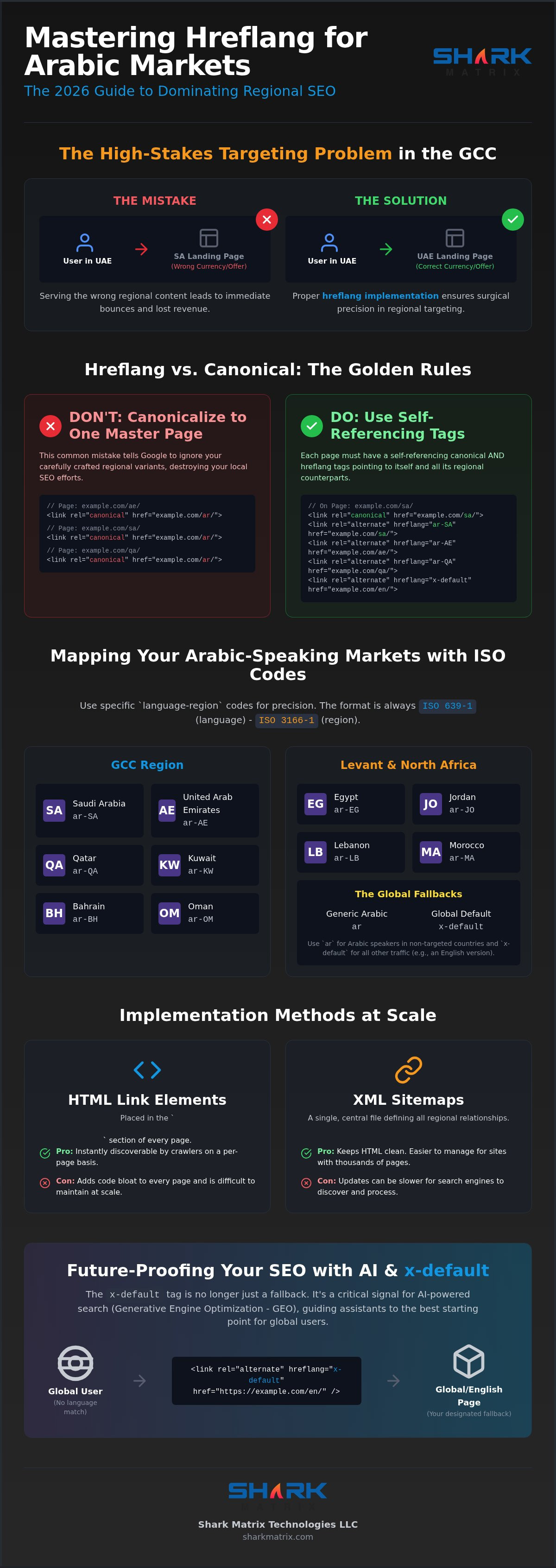
Hreflang and rel=canonical tags must work in tandem; they aren’t interchangeable. A common mistake is using a canonical tag to point all regional versions to a single “master” page. This effectively tells Google to ignore your regional variants. Instead, every page must follow the self-reference rule. This means each page must point to itself as the primary version for its specific region while simultaneously acknowledging its regional siblings. Organizations managing vast catalogs often utilize ai automation services to handle these complex mapping rules without manual error.
- Hreflang identifies the correct regional version for a specific user based on their location.
- Canonical tags identify the single source of truth for search engines to prevent duplicate content penalties.
- Self-referencing tags are mandatory to ensure search engines validate the entire cluster of regional pages.
Hreflang signals which version a user should see, whereas a canonical tag signals which page is the master source for ranking.
Mapping ISO Codes for Arabic-Speaking Regions
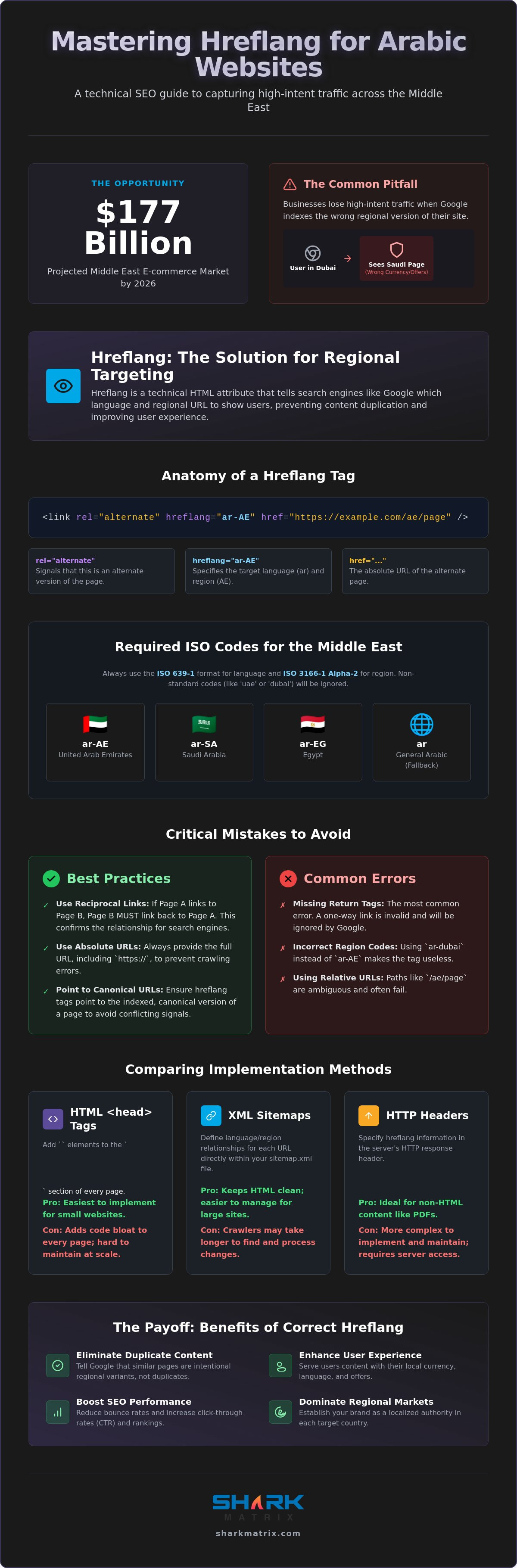
Precision in mapping ISO codes determines whether your site serves the right localized content or triggers a crawl error. The anatomy of an hreflang tag follows a strict protocol: the language code (ISO 639-1) followed by an optional region code (ISO 3166-1 Alpha-2). While developers can reference the official ISO 639-2 language codes for broader context, hreflang specifically utilizes the two-letter ISO 639-1 variants to communicate with search engines.
For the GCC, mapping requires total accuracy to capture high-intent traffic in markets with near-total internet penetration. Use ar-AE for the United Arab Emirates, ar-SA for Saudi Arabia, ar-KW for Kuwait, ar-BH for Bahrain, ar-OM for Oman, and ar-QA for Qatar. Expanding your reach into the Levant and North Africa involves implementing codes like ar-JO (Jordan), ar-LB (Lebanon), ar-EG (Egypt), and ar-MA (Morocco). A frequent debate involves using a generic ‘ar’ tag versus region-specific tags like ‘ar-EG’. In 2026, the best practice is to use specific language-region tags for every country where you have distinct commercial offerings, such as localized pricing or unique shipping terms. Use the generic ‘ar’ tag only as a catch-all for Arabic speakers in non-targeted countries.
The x-default Tag: Your Global Fallback Strategy
The x-default tag serves as your global safety net. It identifies the page users should land on when their browser settings don’t match any of your specified language or region codes. For most Middle Eastern brands, this fallback is either a global English version or a neutral Modern Standard Arabic landing page. In the 2026 search landscape, x-default has become even more vital. AI-driven search engines use it to understand the primary intent of a site when specific regional data is unavailable. Correct hreflang implementation for arabic websites must include this tag to maintain a consistent brand reputation across international borders.
Handling Dialectal Nuances in Technical SEO
Technical SEO for Arabic regions must account for more than just codes; it must reflect how people actually search. For instance, a user in Saudi Arabia might search for ‘jawwal’, while someone in the UAE uses ‘mobile’ or ‘hatif’. Your site architecture, whether you choose subfolders (example.com/sa/) or subdomains (sa.example.com), should reflect these linguistic variations. Subfolders are generally preferred for consolidating domain authority, but subdomains can offer better flexibility for localized hosting. Professional Shark Matrix SEO services can help you audit these mappings to ensure your technical structure aligns perfectly with regional search behavior and cultural nuances.
Implementation Methods for Arabic Websites at Scale
Choosing the right method for hreflang implementation for arabic websites depends largely on your site’s complexity and the number of regional variants you manage. In 2026, the three primary methods remain HTML link tags, XML sitemaps, and HTTP headers. While HTML tags in the head are easy to implement for smaller sites, they quickly become a maintenance nightmare for enterprise platforms. They add weight to every page, which can impact load speeds in regions where mobile connectivity fluctuates. Every byte counts when you’re targeting users across diverse infrastructure.
XML sitemaps have become the gold standard for large scale e-commerce in the Middle East. This method keeps your page source clean and offloads the regional mapping logic to a separate file. According to Google’s hreflang documentation, sitemaps allow you to manage thousands of URLs without bloating your site’s code. For non-HTML content like regional price lists in PDF format or dynamic outputs, HTTP headers provide a necessary alternative that ensures every file type signals its regional intent correctly.
XML Sitemap Implementation for Multi-Regional Sites
When you structure your sitemap, each URL entry must include an xhtml:link attribute for every regional version, including the page itself. This bidirectional requirement ensures that search engines recognize the relationship between your UAE, Saudi, and Egyptian pages. By centralizing this in a sitemap, you reduce the processing load on the user’s browser, which is vital for maintaining high performance on mobile devices. A typical XML entry for an Arabic page with three regional variants looks like this:
- Location: https://example.com/ae/product
- Alternate (ar-ae): https://example.com/ae/product
- Alternate (ar-sa): https://example.com/sa/product
- Alternate (ar-eg): https://example.com/eg/product
- Alternate (x-default): https://example.com/product
Scaling with AI-Driven Automation
Manually maintaining these tags across thousands of SKUs is no longer viable for modern businesses. Leading brands now use ai automation services to programmatically generate and validate these mappings in real time. This often involves using edge SEO tools to inject tags dynamically at the server level, ensuring your hreflang logic is always up to date without requiring manual developer intervention for every new page. By integrating natural language processing, these systems can even detect regional intent in user queries to suggest the most relevant regional variant automatically. This level of technical precision reduces technical debt and protects your brand reputation across the entire GCC and Levant.
Troubleshooting Common Hreflang Mistakes
Auditing Your Implementation in 2026
Auditing hreflang implementation for arabic websites at scale requires more than manual spot checks. In 2026, technical teams use tools like Screaming Frog and SEMrush alongside custom AI scripts to validate thousands of regional mappings simultaneously. These tools can quickly flag mismatched language-region pairs or missing self-referencing tags. Shark Matrix recently resolved a major regional cannibalization issue for a national brand where Saudi users were consistently seeing UAE pricing. By restructuring their technical signals and fixing non-reciprocal errors, the brand saw a significant recovery in regional organic visibility. If you’re struggling with complex indexing issues, a technical SEO audit can pinpoint exactly where your regional signals are failing.
Future-Proofing Your Regional SEO with AI and Shark Matrix
The landscape of search is shifting from traditional lists to generative responses. In 2026, Generative Engine Optimization (GEO) has become the standard for brands looking to appear in AI-driven summaries. These engines don’t just crawl text; they look for structured signals to determine which regional data to serve. A precise hreflang implementation for arabic websites acts as a roadmap for these AI models. It ensures that when a user asks about local availability, the answer is pulled from the correct regional variant rather than a generic global page. This technical precision is what separates market leaders from those lost in the noise of misindexed content.
Scaling this across the Middle East requires more than just manual updates. By leveraging generative ai development, businesses can produce localized content that matches the specific cultural intent of each market while maintaining technical compliance. This synergy between content and code is why technical SEO must be the starting point for any web development project. Building a site without these regional signals in 2026 is like building a storefront without a door. You might exist, but your customers won’t find their way in through the right entrance.
Integrating AI Chatbots with Multi-Regional SEO
Modern customer service relies on ai chatbots that understand the user’s specific context. When these bots are aligned with your hreflang metadata, they can accurately distinguish between a customer in Kuwait and one in Oman. They recognize the user’s location through these technical signals to provide localized answers regarding currency, shipping, and regional promotions. This creates a seamless transition from search discovery to personalized interaction. It improves the user experience by ensuring that AI interactions are as localized and relevant as the landing pages themselves.
Partnering with Shark Matrix for National Success
Navigating the complexities of the Middle Eastern digital market requires a partner with deep technical expertise. Shark Matrix provides custom SEO audits that go beyond surface-level checks to address the root causes of regional indexing failures. Our expertise spans from mobile app development to comprehensive search strategies that ensure your brand is visible across all platforms. We help you move from basic technical compliance to becoming a regional authority. Don’t let technical debt or manual errors hold back your regional growth. Contact Shark Matrix today to optimize your Arabic website and secure your place at the top of Middle Eastern search results for 2026.
Master Your Regional Search Presence for 2026
Achieving flawless regional visibility across the GCC and Levant requires more than just translating content. It demands a technical architecture that search engines and AI assistants can trust. By mastering the bidirectional link rule and choosing the right automation methods, you eliminate the duplicate content issues that often plague multi-regional brands. Precise hreflang implementation for arabic websites is the key to ensuring your Saudi customers don’t land on UAE pages, protecting both your brand reputation and your conversion rates.
Shark Matrix has been a leader in the Middle Eastern market since 2010. Our specialized Arabic digital marketing team combines deep regional expertise with custom AI automation tools to solve the most complex technical SEO challenges. Whether you’re managing a handful of pages or an enterprise e-commerce catalog, we provide the technical foundation needed to dominate regional search results. Scale your regional reach with Shark Matrix SEO experts and ensure your business is ready for the next era of generative search. Your path to regional authority starts with technical excellence.
Frequently Asked Questions
What is the most common mistake in Arabic hreflang implementation?
The most common error is the lack of reciprocal links between regional pages. If your Saudi Arabian page identifies the UAE version as an alternate, the UAE page must reciprocate that link exactly. Failure to do so causes search engines to ignore the entire cluster. Additionally, developers often use incorrect ISO codes, such as ‘ua’ for the Emirates instead of ‘ae’. These technical oversights prevent a successful hreflang implementation for arabic websites and lead to significant indexing failures.
Should I use subdomains or subdirectories for different Arabic regions?
Subdirectories are typically the preferred choice for most Middle Eastern brands because they consolidate your domain authority into a single root. Using a structure like example.com/sa/ or example.com/ae/ allows your regional pages to benefit from the site’s overall ranking power. While subdomains offer flexibility for localized hosting or separate server management, they often require more effort to build individual authority. Subdirectories remain the standard for clean technical SEO in 2026.
How do hreflang tags impact my website’s loading speed?
Hreflang tags can impact page weight if you implement them directly in the HTML head section of every page. For a site targeting twelve different Arabic-speaking nations, this metadata adds significant bulk to the source code. To maintain the world-leading mobile speeds seen in the UAE, large-scale sites should use XML sitemaps instead. This offloads the regional mapping logic from the page itself, ensuring your site remains fast and responsive for mobile-first users.
Can I use hreflang if my content is identical across different countries?
Yes, using these tags is actually essential when your content is identical across different country versions. Without them, search engines may flag your regional pages as duplicate content and choose only one version to index. By correctly executing hreflang implementation for arabic websites, you signal that these pages are intended for different audiences. This allows you to maintain unique pricing and regional contact details even if the core Modern Standard Arabic text remains the same.
Do I need to include English versions in my Arabic hreflang set?
You should include English versions if they are part of your regional content strategy. Many users in the GCC prefer browsing in English, so linking your English and Arabic pages within the same cluster is vital. This ensures that a user searching in English from Qatar finds the English-Qatar page rather than a generic version. Every language and region variant must be mapped together to provide a seamless experience across your entire digital ecosystem.
How long does it take for Google to recognize hreflang changes?
Google typically takes anywhere from a few days to several weeks to process changes to your regional tags. The exact timing depends on how frequently your site is crawled and the depth of your site architecture. You can accelerate this process by submitting updated XML sitemaps through Search Console and using the Request Indexing tool. Monitoring the International Targeting report will help you verify when the tags are successfully recognized and if any return-tag errors require your attention.
Is hreflang still relevant for AI search engines in 2026?
Hreflang remains highly relevant in 2026 because AI search engines use these signals to source accurate regional data. Generative Engine Optimization (GEO) relies on structured metadata to distinguish between regional nuances in pricing, availability, and cultural context. Without these tags, AI assistants might serve outdated or geographically incorrect information to users. Maintaining technical compliance ensures your brand appears accurately in AI-generated summaries and answer engine results across the Middle East.
Can I implement hreflang using Google Tag Manager?
While it’s technically possible to inject these tags using Google Tag Manager, it’s not the recommended approach for technical SEO. Search engines prefer to find regional signals in the initial HTML response or within an XML sitemap. Relying on JavaScript injection can lead to inconsistencies if the crawler doesn’t execute the script before indexing the page. For reliable results, you should implement your regional mapping at the server level or through your site’s core template.

 OpenAI
 Codex
Codex
 Vertex AI
 Cloud Vision
 OpenCV
 TensorFlow
 IBM Watson
 Cloud Natural Language
 Cognitive Services
 Bot Framework
 Mistral
 LLama
LLama
 Gemini
 Anthropic
 N8N
N8N