

Did you know the e-commerce market in the Middle East is projected to reach a staggering $177 billion in 2026? Even with this massive growth, many businesses still lose high-intent traffic because Google indexes the wrong regional version of their site. It’s a common pain point for brands trying to scale across the GCC. You might find your Saudi Arabian landing page appearing for users in Dubai, or worse, your site might be flagged for duplicate content across different domains.
We understand how frustrating it’s to manage complex technical SEO when the stakes are this high. This guide will teach you how to master hreflang implementation for arabic websites to eliminate these errors and ensure your pages land in the correct regional search results. We’ll cover everything from precise ISO 639-1 and 3166-1 Alpha-2 code mapping to the latest 2026 standards for reciprocal links and AI-driven search optimization. By the end, you’ll have a clean, error-free foundation to dominate specific Middle Eastern markets and capture the organic traffic your brand deserves.
Key Takeaways
- Learn how to prevent duplicate content penalties by correctly signaling regional intent across your Middle Eastern domains.
- Discover the exact ISO 639-1 and 3166-1 Alpha-2 codes needed for a flawless hreflang implementation for arabic websites.
- Compare the pros and cons of using HTML head tags, XML sitemaps, and HTTP headers to manage regional targeting at scale.
- Identify and resolve common technical errors like non-reciprocal links and incorrect region codes that block your organic growth.
- Explore how AI-driven technical SEO audits can simplify the maintenance of complex hreflang sets for large-scale enterprise sites.
The Strategic Importance of Hreflang for Arabic Digital Marketing
Hreflang is more than just a line of code. It’s a technical directive that ensures search engines serve the most relevant version of your site to users based on their specific geographic location and language settings. In a region as diverse as the Middle East, where Modern Standard Arabic is the unifying language but local dialects and currencies vary, the Hreflang attribute (RFC 8288) becomes the backbone of your digital presence. Precise hreflang implementation for arabic websites allows you to target users in Riyadh, Dubai, or Cairo with surgical accuracy. This ensures they see content tailored specifically for their market, rather than a generic version that might not meet their needs.
Without this technical foundation, your international SEO strategy is built on shaky ground. Search engines often struggle to distinguish between regional variants of the same language. This leads to poor click-through rates (CTR). A user in Kuwait might be served a landing page featuring prices in Saudi Riyals, causing them to bounce immediately. By explicitly mapping these relationships, you signal to Google that your site is a localized authority in each specific market. This clarity is essential for scaling across the Arab world, where e-commerce is projected to hit $177 billion by 2026.
Solving the Duplicate Content Issue in the Middle East
Arabic websites are uniquely prone to “near-duplicate” content issues. Because the core text on an Egyptian service page (ar-EG) and a UAE service page (ar-AE) is often identical, Google may perceive them as duplicates and index only one version. This forces your regional pages to compete against each other, diluting your ranking power. Correct implementation prevents this cannibalization by telling Google these pages are intended for different audiences. To maintain a clean index, ensure your hreflang tags only point to canonical URLs to avoid conflicting signals that confuse search crawlers.
Enhancing User Experience for RTL Audiences
Technical SEO directly impacts how your brand is perceived by Right-to-Left (RTL) audiences. When a user lands on a page that reflects their local dialect and currency, it builds immediate trust. It isn’t just about translation; it’s about context. A shopper in Dubai expects to see prices in AED and mentions of local shipping carriers. By routing users to the correct version, you significantly reduce bounce rates and improve engagement. This seamless transition from the search results to a locally relevant RTL interface establishes your site as a high-authority destination in the competitive Middle Eastern market.
Technical Requirements for Arabic Hreflang Implementation
Executing a successful hreflang implementation for arabic websites requires strict adherence to a specific HTML syntax. The standard format, rel="alternate" hreflang="language-country", acts as a map for search engine crawlers. While the “ar” language code represents Arabic, it’s rarely enough on its own for businesses operating across the Middle East. Search engines need to know if your content is tailored for a user in Riyadh or a shopper in Dubai. Following Google’s official hreflang guidelines ensures that your technical signals are clear and actionable. You must use absolute URLs in every tag, as relative paths often lead to crawling errors and indexing confusion.
Precision is everything in technical SEO. Beyond the basic syntax, every implementation must be bidirectional. This means if your Saudi Arabian page links to your UAE version, the UAE version must reciprocate that link. Without this “return tag,” Google will likely ignore the annotations entirely. It’s a common point of failure for large-scale sites. If you find managing these complex clusters overwhelming, seeking professional technical SEO services in the UAE can help automate and validate your site’s architecture.
Choosing the Correct ISO Language and Region Codes
In 2026, the industry standard remains ISO 639-1 for languages and ISO 3166-1 alpha-2 for regions. For general Arabic content intended for any speaker, “ar” is sufficient. However, for national targeting, you must combine them. Use ar-AE for the United Arab Emirates, ar-SA for Saudi Arabia, and ar-EG for Egypt. A frequent mistake is using city names or non-standard abbreviations like “uae” or “dubai.” These aren’t recognized by search algorithms. While Modern Standard Arabic (MSA) is the written norm, using region codes helps search engines connect your pages to local search intent, currencies, and regional dialects.
The Mandatory Rules: Bidirectionality and Self-Reference
Every page in your hreflang set must include a self-referencing tag. This means the Saudi Arabian page must have a tag pointing to itself as the “ar-SA” version. If it doesn’t, the cluster is technically incomplete. Bidirectionality is equally critical. If Page A points to Page B, but Page B doesn’t point back to Page A, you’ll see “missing return link” errors in your SEO audits. This reciprocal relationship confirms to search engines that the pages are verified alternates of one another. It prevents unauthorized sites from trying to associate themselves with your domain’s authority.
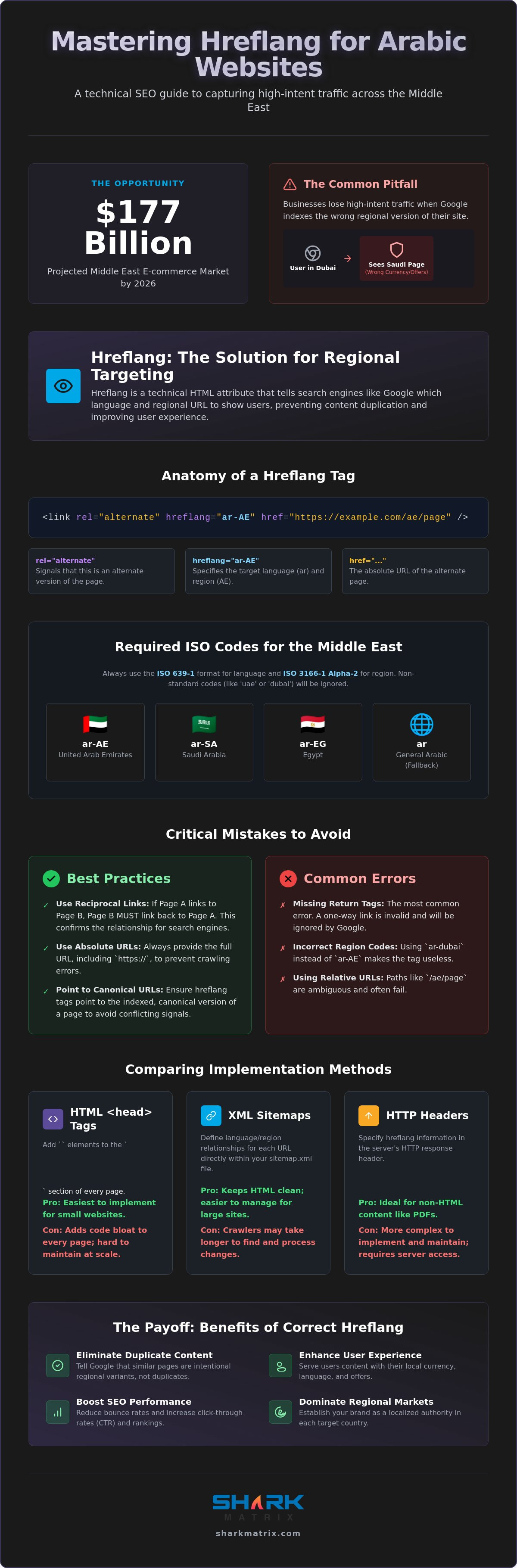
Comparison of Hreflang Implementation Methods for Scale
Choosing how to deploy your tags is just as critical as the code itself. For high-performance enterprise platforms, the method you select affects both crawl efficiency and page speed. When we provide website design and development services, we prioritize integrating these signals during the initial architecture phase. This proactive approach ensures that your regional targeting is baked into the site’s DNA rather than being a late-stage patch. It’s about building a scalable framework that can handle dozens of regional variants without breaking.
A solid hreflang implementation for arabic websites requires a decision framework based on your site’s complexity. If you’re managing a handful of pages, simple on-page tags might suffice. However, for e-commerce giants serving the entire GCC, you’ll need a more robust solution that doesn’t compromise the user experience. The goal is to provide clear instructions to search engines while keeping your site’s performance lean and fast.
HTML Head Tags vs. XML Sitemaps
Most developers start with HTML head tags because they’re easy to see and verify. You simply drop the link elements into the <head> of each page. While this works well for smaller sites, it can become a burden for large-scale implementations. If you have twenty different regional versions, you’re adding twenty lines of code to every single page. This bloats your HTML and can negatively impact load times, especially for mobile users in regions with slower connectivity. It’s a trade-off between ease of implementation and technical efficiency.
Enterprise platforms often pivot to XML sitemaps to keep their technical debt low. By placing the hreflang annotations in your sitemap, you keep your page source clean and lightweight. This is a staple of professional search engine optimization seo services because it consolidates all regional mapping into a single, manageable file. It’s much easier to audit and update a sitemap than it’s to modify thousands of individual HTML files. If your site structure is dynamic or has a high volume of SKUs across multiple Middle Eastern markets, the sitemap method is almost always the superior choice.
When to Use HTTP Headers for Non-HTML Files
Not everything on your site is an HTML page. You might have product manuals, whitepapers, or contracts in PDF format that need to be served to specific Arabic-speaking regions. Since you can’t put a tag inside a PDF, you must use HTTP headers. This method requires server-side configuration, typically through your server config file or a custom script. A typical syntax example would look like: Link: <https://example.com/sa/brochure.pdf>; rel="alternate"; hreflang="ar-SA". It’s a powerful way to ensure your non-HTML assets are correctly indexed for the right audience. Just keep in mind that this requires more technical oversight to ensure the server response remains fast.
Avoiding Common Hreflang Mistakes on Arabic Websites
Even seasoned developers encounter pitfalls when managing the technical nuances of Middle Eastern search markets. The most frequent error in hreflang implementation for arabic websites involves the use of non-standard ISO codes. It’s common to see “uae” or “ksa” within the code because these abbreviations are standard in regional business communication. However, search engines strictly adhere to ISO 3166-1 Alpha-2 codes. If your tag is set to hreflang="ar-uae", Google will simply ignore the directive. You must use ar-ae for the United Arab Emirates and ar-sa for Saudi Arabia to ensure your regional targeting actually functions as intended.
Technical hygiene beyond the codes is equally vital. Another recurring failure is the use of relative URLs in your annotations. Your tags must always utilize absolute paths, such as https://example.com/ar/. If you use relative paths like /ar/, you risk the crawler misinterpreting the target, particularly if your site architecture involves complex subdomains or subdirectories. Additionally, every URL in your hreflang set must return a 200 OK status. Including a 404 page or a URL that triggers a redirect breaks the entire cluster. This leaves your regional pages competing against each other instead of working in harmony.
Managing RTL Layout Conflicts and Script Variations
Script choice is a subtle but critical factor that many automated tools miss. While “ar” covers the Arabic language, it’s important not to confuse it with Persian (fa) or Urdu (ur), which share similar characters but require different ISO codes. Your technical tags must point to pages where the dir="rtl" attribute is correctly set in the HTML. Automated translation plugins are notorious for this; they often translate the text but fail to update the hreflang tags or the layout direction dynamically. This creates a jarring user experience where a visitor from Egypt lands on a page with broken, left-aligned text. If you want to ensure your technical foundation is solid, you can get a professional audit from Shark Matrix Technologies LLC to resolve these RTL site structure issues.
Setting the x-default for Global Arabic Traffic
The x-default tag acts as your safety net for global traffic. It tells search engines which page to show when a user’s settings don’t match any of your specific regional tags. For an Arabic site, this usually points to the version written in Modern Standard Arabic (MSA) or a generic landing page. Without it, a user in Morocco might be served your Saudi-specific page simply because it has higher authority, even if the currency and shipping information aren’t relevant to them. A standard markup looks like this: <link rel="alternate" href="https://example.com/ar/" hreflang="x-default" />. This ensures that no matter where your audience is located, they land on a relevant page that maintains your brand’s professional image across the MENA region.
Optimizing Technical SEO with Shark Matrix Technologies LLC
Shark Matrix Technologies LLC approaches regional targeting with a focus on technical precision and local expertise. Our technical seo services uae are designed to handle the intricate demands of the MENA market, where language and region often overlap in complex ways. Our specialized approach to hreflang implementation for arabic websites combines human expertise with machine learning to eliminate the risk of duplicate content penalties. We don’t just set up tags and hope for the best. Instead, we treat technical SEO as a dynamic pillar of your digital infrastructure. Our team ensures that every regional version of your site serves its intended audience without causing indexing conflicts that could stall your growth.
Managing a hreflang implementation for arabic websites at scale requires more than manual spreadsheets. We use proprietary AI automation to audit and maintain these sets for large-scale e-commerce and enterprise platforms. This technology identifies “no return tag” errors and broken URLs in real-time, preventing the technical decay that often plagues international sites. While we use Google Search Console for ongoing monitoring, our automated systems provide a deeper layer of verification. By automating the validation process, Shark Matrix Technologies LLC keeps your site’s architecture clean and ensures that search engines always have a clear map of your regional content.
Correct technical signals are also a vital part of seo for brand reputation management dubai. If a user in the UAE is served an Egyptian version of your site with different pricing and dialects, it creates a fragmented brand image. Trust is built on consistency. By ensuring users land on the correctly localized page, Shark Matrix Technologies LLC helps you maintain a professional and authoritative presence across every Middle Eastern market you target.
Integrating AI and GEO with International SEO
By 2026, search engines have shifted toward Generative Engine Optimization (GEO) to provide synthesized answers to user queries. These AI-driven models don’t just look for keywords; they seek the most relevant regional context to cite in their responses. Your hreflang tags provide the “ground truth” for these AI bots. They act as the definitive signal that helps AI assistants understand which version of your content is the authoritative source for a specific country. Shark Matrix Technologies LLC uses AI-driven SEO strategies to ensure your site is the one being cited in these next-generation search results.
Professional SEO Audits for National Success
A technical seo consultant from our team begins every project with a deep-dive audit of your existing international setup. We look for the subtle errors that standard tools often miss, such as script variations or RTL layout conflicts that drive away users. This process is especially critical during site migrations or when you’re expanding into new territories like Saudi Arabia or Kuwait. We provide a roadmap to fix existing issues and a framework for future growth. Contact Shark Matrix Technologies LLC today for a comprehensive technical SEO review to protect your traffic and dominate the Middle Eastern search results.
Future-Proofing Your Regional SEO Strategy
Achieving regional dominance in 2026 requires more than basic translation. It demands a technical foundation that search engines and AI assistants can trust. By mastering hreflang implementation for arabic websites, you ensure that your brand reaches the correct audience in Saudi Arabia, the UAE, and beyond without the risk of duplicate content penalties. These technical signals are the bridge between your localized content and the users searching for your services in their specific markets.
Managing complex technical clusters at scale can be challenging for even the most experienced internal teams. Shark Matrix Technologies LLC has been a leader in the Middle Eastern market since 2010. As Dubai-based specialists in AI-driven SEO and custom software development, we help brands navigate the nuances of RTL layouts and regional search intent. Don’t let technical errors hold back your growth in one of the world’s fastest-growing e-commerce markets.
Get a Professional Technical SEO Audit from Shark Matrix Technologies LLC to secure your search rankings and protect your brand’s reputation across the region. With the right technical strategy in place, your site can dominate the local SERPs and provide a seamless experience for every user.
Frequently Asked Questions
What is the correct hreflang code for an Arabic website in the UAE?
The correct code for an Arabic website in the UAE is ar-ae. This follows the mandatory ISO 639-1 standard for the language and ISO 3166-1 alpha-2 for the country. Using non-standard codes like “ar-uae” or “ar-dubai” will cause search engines to ignore your instructions entirely. It’s vital to use the exact two-letter region code to ensure your content reaches the local audience in the Emirates correctly.
Do I need a separate hreflang tag for every Arabic-speaking country?
You only need separate tags for countries where you have dedicated, localized content. If your site offers specific pricing for Saudi Arabia and different shipping terms for Kuwait, you should use ar-sa and ar-kw respectively. However, if you provide a single version of your content for the entire Middle East, a generic ar tag is sufficient. This simplifies your hreflang implementation for arabic websites while maintaining regional relevance.
How does hreflang differ from a canonical tag on multi-language sites?
Hreflang and canonical tags serve two different technical purposes. A canonical tag identifies the master version of a page to prevent duplicate content issues in the search index. Hreflang, on the other hand, is a mapping tool that tells Google which localized version to serve to a specific user. On international sites, each regional page should typically be its own canonical while using hreflang to link to its counterparts in other regions.
Can I implement hreflang using a WordPress plugin for my Arabic site?
You can use popular SEO or translation plugins to manage these tags, but they often require careful oversight. Plugins like WPML or Polylang can automate much of the hreflang implementation for arabic websites, but they sometimes default to incorrect codes for specific Middle Eastern regions. You must verify that the output matches ISO standards. For large-scale e-commerce sites, a custom technical solution is often more reliable than relying on a standard plugin.
What happens if I forget the self-referencing hreflang tag?
Forgetting a self-referencing tag usually results in Google ignoring the entire hreflang cluster for that page. Every page in a set must link to itself as well as its alternates. Without this self-reference, the technical signal is considered incomplete or invalid. This error often leads to the wrong regional version appearing in search results, which can confuse users and increase bounce rates across your different country-specific domains.
Does hreflang help with ranking in different regions of the Middle East?
Hreflang doesn’t act as a direct ranking factor in the traditional sense of building link authority. Instead, it helps your site dominate national search results by ensuring the most relevant version of your content is served to the right user. When a user in Egypt sees a page tailored to their dialect and currency, they’re more likely to click. These improved engagement signals tell search engines your content is highly relevant to that specific market.
How do I test if my Arabic hreflang tags are working correctly?
You can test your tags using technical SEO crawlers like Screaming Frog or specialized hreflang validation tools. Since Google Search Console no longer provides a dedicated International Targeting report, these third-party tools are essential for identifying “no return tag” errors. They simulate a search engine crawl to verify that every regional page links back to its counterparts. Regular audits help you catch broken links or redirect chains that could invalidate your entire technical setup.
Is x-default mandatory for Arabic websites?
While not strictly mandatory, the x-default tag is a best practice for managing global Arabic traffic. It serves as a fallback for users whose language and region settings don’t match any of your specific country tags. For example, a user in Morocco might be served your Modern Standard Arabic version instead of a Saudi-specific page. This ensures a better user experience and prevents search engines from making an incorrect guess about which version to show to your audience.

 OpenAI
 Codex
Codex
 Vertex AI
 Cloud Vision
 OpenCV
 TensorFlow
 IBM Watson
 Cloud Natural Language
 Cognitive Services
 Bot Framework
 Mistral
 LLama
LLama
 Gemini
 Anthropic
 N8N
N8N