

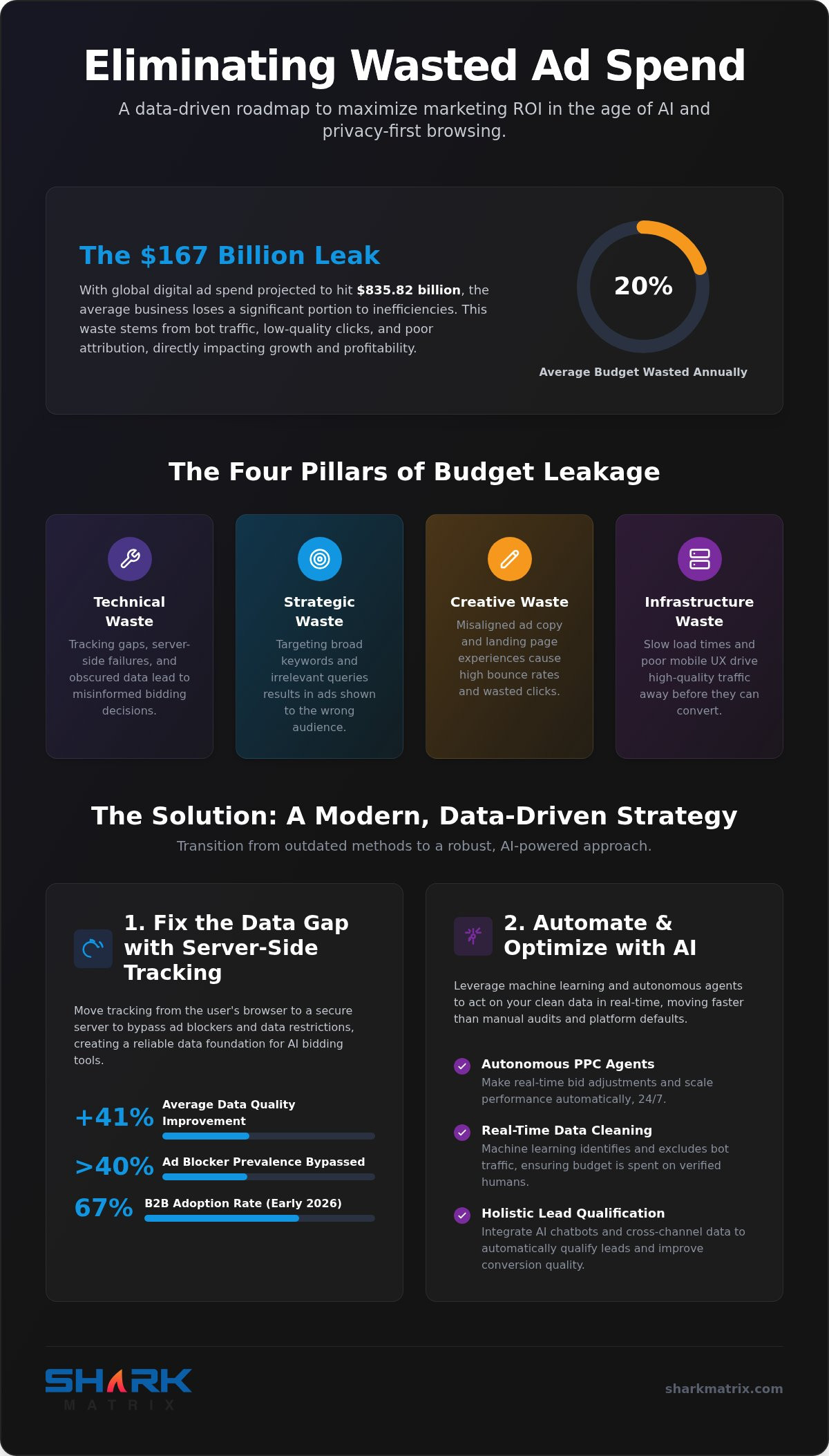
Did you know that in 2026, the average business loses approximately 20% of its annual digital marketing budget to inefficiency? With global digital ad spend projected to reach $835.82 billion this year, that leakage represents a staggering amount of capital disappearing into bot traffic and low-quality clicks. You’ve likely noticed that rising costs per click on platforms like Google and Meta are making it harder to maintain your margins. If you’re searching for how to reduce wasted ad spend, you’re facing a challenge shared by marketers who are struggling with inaccurate attribution and privacy restrictions.
We understand how frustrating it is to watch your budget drain while clear results feel out of reach. This guide provides a data-driven roadmap to eliminate budget leakage and maximize your marketing ROI using the latest AI-powered tactics. You’ll discover how to leverage server-side tracking to improve data quality by 41% and use machine learning to reclaim your ad spend. We’ll explore everything from technical infrastructure to UI/UX optimizations that turn your existing traffic into high-quality leads for the same or less investment.
Key Takeaways
- Understand why 2026 privacy regulations and AI-driven search require a new definition of budget efficiency.
- Transition to server-side tracking to reclaim lost data and bypass the limitations of traditional cookie-based measurement.
- Discover how to reduce wasted ad spend by leveraging autonomous PPC agents for real-time bid adjustments and performance scaling.
- Optimize your technical infrastructure and UX design to prevent high-quality traffic from bouncing on slow-loading landing pages.
- Learn the benefits of a holistic approach that integrates AI chatbots and cross-channel data to qualify leads automatically.
What is Wasted Ad Spend and Why Does it Happen in 2026?
Wasted ad spend is any part of your marketing budget that pays for interactions with zero chance of converting into a customer. In the Pay-per-click (PPC) model, this usually means paying for clicks from bots, accidental taps, or users whose intent doesn’t align with your offer. In 2026, global digital ad spend is reaching $835.82 billion, making up nearly 69% of all advertising. Research indicates that the average business loses about 20% of its annual digital marketing spend to these inefficiencies. Every dollar lost to a “zombie” campaign or a mismatched search query is a dollar that could’ve fueled growth.
The 2026 landscape presents unique challenges. Privacy-first browsing and the rise of generative AI search engines have shifted how data flows. When attribution models fail to account for these shifts, businesses often make the mistake of killing their most effective campaigns because they don’t see the direct path to conversion. This is a primary reason why learning how to reduce wasted ad spend is now a survival skill for digital marketers. Understanding the hidden cost of poor attribution is the first step toward reclaiming your budget.
The Four Pillars of Budget Leakage
Most budget waste falls into four specific categories that require constant monitoring:
- Technical waste: Tracking gaps and server-side failures that obscure your data and lead to misinformed bidding decisions.
- Strategic waste: Targeting broad keywords without aggressive negative keyword lists, causing your ads to show for irrelevant queries.
- Creative waste: Ad copy that doesn’t align with the landing page experience, leading to high bounce rates and wasted clicks.
- Infrastructure waste: Slow load times and poor mobile responsiveness that drive users away before they can engage with your brand.
These pillars represent the foundation of any performance audit. Ignoring even one can lead to significant budget bleed over time.
Why Traditional Audits Fail in the Modern Market
Static audits are no longer enough. Waiting for monthly reviews is a recipe for disaster when AI-driven markets move this fast. Many brands rely too heavily on platform-native “auto-apply” recommendations that often prioritize spending over efficiency. In the Middle East, consumer behavior requires localized strategy adjustments that generic algorithms often miss. Shark Matrix uses ai automation services to provide real-time optimization that static audits can’t match. Mastering how to reduce wasted ad spend requires moving beyond generic settings that don’t account for the specific conversion funnels and language nuances that work best for Middle Eastern audiences.
Fixing the Data Gap with Server-Side Tracking and AI
The transition from client-side to server-side tracking (SST) isn’t just a technical upgrade. It’s a necessity for survival. Traditional tracking relies on the user’s browser, but with ad blocker prevalence exceeding 40% on desktop computers as of February 2026, much of your conversion data never reaches your dashboard. SST moves the tracking process to a secure server, bypassing these restrictions and providing nearly 100% data clarity. If you’re looking for how to reduce wasted ad spend, you must start with the integrity of the data you’re feeding your bidding algorithms. As of early 2026, the adoption rate for server-side tracking among B2B companies has already reached 67%, reflecting its role as a standard industry requirement.
Research shows that data quality improves by an average of 41% after migrating to server-side tracking. This cleaner data is essential for modern AI bidding tools that rely on accurate signals to decide which clicks are worth the cost. By integrating ai automation services, you can clean your data in real-time, stripping out anomalies and ensuring your budget only targets verified human interactions. When your bidding engine has a clear view of the customer journey, it stops overpaying for low-intent traffic that would otherwise go unflagged. If you want to see how these technologies can transform your performance, consider exploring ai development services to secure your data pipeline.
The Role of Machine Learning in Data Integrity
Machine learning acts as a gatekeeper for your budget. By analyzing patterns in real-time, machine learning development services can identify and exclude bot traffic before it drains your daily limit. Predictive modeling takes this further by identifying high-value users based on early behavior signals. Instead of waiting for a final purchase, the system recognizes a “quality” visitor within seconds and adjusts bids accordingly. This proactive approach ensures your budget is focused on users with the highest propensity to convert, rather than being spread thin across generic traffic.
Implementing Conversions API (CAPI) for Meta and Google
For national brands in 2026, implementing Conversions API (CAPI) for Meta and Google is non-negotiable. CAPI creates a direct link between your marketing data and the platform, reducing the gap between “clicked” and “converted” in your dashboard. When your tracking reflects 100% of your successful outcomes, the platform’s algorithm learns significantly faster. This leads to lower CPAs because the AI isn’t guessing which users converted; it has the hard data required for precise optimization. This infrastructure fix is one of the most effective ways to understand how to reduce wasted ad spend at scale.
Moving from Manual Management to AI-Driven PPC Automation
The landscape of digital advertising in 2026 has moved beyond manual spreadsheets and hourly bid checks. Autonomous PPC agents now dominate the field, executing real-time bid adjustments based on thousands of live signals. This shift is a primary answer to how to reduce wasted ad spend because AI identifies underperforming segments far faster than any human analyst. While a manager might spend hours identifying a high-CPC keyword that isn’t converting, an automated system can pause or adjust that bid in milliseconds. This precision ensures that your budget isn’t drained by a sudden spike in low-quality traffic or bot activity.
Comparing manual oversight to AI-managed performance marketing reveals a clear efficiency gap. AI excels at processing granular data across multiple platforms simultaneously. It can detect that a specific audience segment on mobile is underperforming during evening hours and reallocate that budget to a higher-converting window. For national brands looking to scale, Choosing the Right PPC Agency in Dubai: A 2026 Guide highlights how professional management now focuses on strategic oversight rather than manual execution. By letting machines handle the repetitive optimization, your team can focus on the creative direction that drives real growth.
Autonomous Optimization vs. Human Strategy
AI wins the battle of scale. With 46% of marketers now using AI to scale creative, the ability to generate and test hundreds of ad variations is no longer a luxury. It handles keyword expansion, complex bid management, and multi-variate A/B testing with ease. However, human expertise remains vital for defining brand voice and high-level business goals. The most effective approach is a hybrid model. This involves human-led strategy powered by custom AI development. By setting strategic guardrails, you allow the machine to optimize within your brand’s specific parameters, ensuring that automation never compromises your core message.
Localized Performance: Navigating the Middle Eastern Market
Success in the Middle Eastern market requires more than just high-tech tools. It demands a deep understanding of Arabic digital marketing. Waste often occurs when campaigns aren’t properly localized for regional nuances. Direct translation of ad copy is a common culprit for high bounce rates. Users expect messaging that resonates with their cultural context and linguistic preferences. Adapting ad schedules to account for local time zones and cultural observances is another critical step in how to reduce wasted ad spend. Without this localization, you risk paying for clicks during times when your target audience is inactive, leading to unnecessary budget leakage.
Auditing Your Infrastructure: Why UX is an Ad Spend Issue
A click is only a “win” if the visitor takes action. Many marketers focus so heavily on the ad platform that they forget the destination is where the money is actually made. If your landing page fails to convert a qualified visitor, that initial click cost is a total loss. This is a fundamental aspect of how to reduce wasted ad spend. In 2026, user expectations for speed and design are at an all-time high. Research from May 2026 shows that a one-second e-commerce page load can deliver up to 2.5 times higher conversion rates than a five-second load. If your site is slow, you’re essentially paying a “speed tax” on every click through higher bounce rates and lower Quality Scores.
Investing in your site’s infrastructure isn’t just about aesthetics; it’s about performance marketing. Every $1 invested in UX design yields an estimated return of $100. A well-designed user interface can increase a website’s conversion rate by up to 200%, while a superior UX can push that uplift to 400%. When your conversion rate doubles, your cost per acquisition (CPA) effectively drops by half without changing a single setting in your ad account. Partnering with a professional web development agency ensures your digital storefront is optimized to capture every cent of your traffic investment.
The Landing Page Checklist for Ad Efficiency
To stop the bleed, your landing pages must pass a strict efficiency audit. Message match is the most common failure point. If your ad promises a specific solution but the page shows a generic home screen, users will leave immediately. Frictionless forms are equally important. Every additional field you require reduces the likelihood of a conversion. Finally, national brand authority requires visible trust signals and social proof. Reviews, certifications, and clear contact information reassure the user that their click was well-spent. If you’re struggling with high bounce rates, optimizing your web presence is the fastest way to reclaim your budget.
Technical SEO and Ad Performance
There’s a powerful synergy between organic search and paid search. High organic authority, built through seo company dubai services, signals to ad platforms that your site is a relevant, high-quality destination. This often results in higher Quality Scores, which directly lower your cost-per-click. In 2026, we also see the rise of Answer Engine Optimization (AEO). By capturing top-of-funnel intent through AEO and Generative Engine Optimization (GEO), you build brand familiarity before the user even clicks a paid ad. This holistic approach is the ultimate strategy for how to reduce wasted ad spend across the entire digital ecosystem.
The Shark Matrix Approach: Holistic Performance Marketing
Shark Matrix integrates PPC, SEO, and AI into a unified, waste-proof marketing ecosystem. Instead of treating these channels as separate silos, we use them as a combined force where data from one informs the strategy of the others. This holistic approach is the definitive answer to how to reduce wasted ad spend. When your organic authority is high, your paid campaigns benefit from lower costs and increased trust. Since our founding in 2010, we’ve focused on this synergy to help national brands achieve sustainable growth. In 2026, with 33% of marketers now using AI across creative, media, and measurement, a fragmented strategy is simply a recipe for budget leakage.
Our framework relies on a continuous auditing cycle that adapts to real-time market shifts. It’s not enough to set a campaign and walk away. We use machine learning development services to identify changes in consumer behavior before they negatively impact your ROI. This proactive stance ensures that your investment always flows toward the highest-quality segments. By aligning your technical infrastructure with your strategic goals, you create a system that naturally filters out inefficiency.
AI Chatbots as Conversion Accelerators
One of the most effective ways to stop budget waste is to ensure that a click never goes cold. Through ai chatbot-development services, we deploy custom agents that qualify leads the moment they land on your site. These chatbots provide 24/7 engagement for national audiences, regardless of time zones. They don’t just answer basic questions; they filter out low-intent visitors and capture valuable first-party data. This direct data enrichment allows your bidding algorithms to become even more precise, further teaching your automated systems how to reduce wasted ad spend by focusing only on visitors with a high propensity to convert.
Building for Scalability and Long-Term ROI
Performance marketing in 2026 requires a focus on long-term digital dominance rather than short-term fixes. This involves protecting your brand’s reputation and organic reach through professional search engine optimization. When users see your brand consistently at the top of both paid and organic results, the likelihood of a conversion rises significantly. Partnering with a full-service agency provides the end-to-end excellence needed to manage complex data pipelines and creative assets. You can reclaim your budget today by moving toward a comprehensive strategy that prioritizes data integrity and user experience across every touchpoint.
Reclaiming Your Digital Growth in 2026
The path to peak performance in 2026 is paved with data integrity and automated precision. You’ve seen that modern efficiency isn’t just about picking the right keywords; it’s about building a robust infrastructure that bridges the gap between a click and a conversion. By implementing server-side tracking and leveraging autonomous bidding agents, you can finally gain a clear answer to how to reduce wasted ad spend across your entire portfolio. Don’t let technical gaps or slow landing pages drain your resources when AI-powered solutions can optimize your ROI in real-time.
Shark Matrix brings over 15 years of digital marketing expertise and a specialized AI department to help you master the national UAE market. We provide the end-to-end strategy needed to turn every marketing dollar into a measurable result. Whether you need a technical audit or a complete campaign overhaul, we’re here to ensure your brand dominates the digital landscape. It’s time to move beyond manual guesswork and embrace a holistic approach that prioritizes long-term scalability and lead quality.
Stop wasting your budget and start scaling with Shark Matrix. Your future growth depends on the strategic decisions you make today.
Frequently Asked Questions
What is the industry average for wasted ad spend?
In 2026, research indicates that the average business loses approximately 20% of its annual digital marketing budget to inefficiency. This leakage often stems from bot traffic, accidental clicks, and poor attribution models. With global digital ad spend reaching $835.82 billion this year, these losses are substantial for any brand. Understanding how to reduce wasted ad spend starts with identifying these gaps through detailed audits and real-time monitoring of your campaign performance.
How often should I perform a PPC audit?
You should perform a comprehensive PPC audit at least once per quarter, but real-time dynamic optimization is the standard for 2026. While a deep dive into your account structure and strategy is necessary every few months, AI-driven automation tools should be monitoring your bids and segments daily. Frequent checks ensure your negative keyword lists are updated and that your budget isn’t being drained by sudden shifts in market intent or competitor behavior.
Can AI really manage my ads better than a human?
AI excels at processing vast amounts of data and making real-time bid adjustments that are impossible for humans to execute manually. However, the best results come from a hybrid model. While machines handle keyword expansion and A/B testing at scale, human experts provide the strategic guardrails, brand voice, and cultural nuance. AI is a powerful tool for efficiency, but it requires human oversight to align with high-level business goals and complex market dynamics.
How does server-side tracking reduce my costs?
Server-side tracking reduces costs by providing more accurate conversion data, which improves your bidding algorithm’s precision. Traditional tracking is often blocked by ad blockers, which affect over 40% of desktop users in 2026. By moving tracking to a server, you reclaim lost signals and improve data quality by an average of 41%. This cleaner data prevents you from overpaying for low-intent traffic and helps the platform find higher-quality leads for less investment.
Why is my CPC increasing even though my targeting hasn’t changed?
Rising costs per click are often driven by increased market competition and shifts in how ad platforms prioritize quality. In 2026, total global advertising spend has surpassed $1 trillion, leading to more crowded auctions. Additionally, if your landing page experience or ad relevance has declined, your Quality Score may drop, forcing you to pay more for the same position. Technical issues like slow mobile load times also contribute to higher costs by signaling poor user experience.
What are negative keywords and how do they save money?
Negative keywords are specific terms that prevent your ads from appearing for irrelevant search queries. By excluding these terms, you ensure your budget isn’t spent on clicks from users who have no intention of buying your product. For example, if you sell premium software, adding “free” as a negative keyword prevents wasted spend on bargain hunters. This is one of the most direct ways to understand how to reduce wasted ad spend and improve your ROAS.
How does website speed affect my Google Ads budget?
Website speed directly impacts your Quality Score and conversion rate. A one-second page load can deliver up to 2.5 times higher conversion rates than a five-second load. If your site is slow, Google penalizes you with higher CPCs because the user experience is poor. High bounce rates caused by slow loading mean you are paying for clicks that never even see your offer, effectively throwing away a large portion of your ad budget before users engage.
Is Arabic digital marketing necessary for my national UAE campaigns?
Yes, professional Arabic digital marketing is essential for reaching a broad national audience in the UAE. While many residents speak English, localized messaging in Arabic builds trust and resonates more deeply with a significant segment of the population. Campaigns that rely solely on direct translations often suffer from high bounce rates and poor engagement. Proper localization ensures your creative assets are culturally relevant, which is a critical step in maximizing your conversion rates.
 OpenAI
 Codex
Codex
 Vertex AI
 Cloud Vision
 OpenCV
 TensorFlow
 IBM Watson
 Cloud Natural Language
 Cognitive Services
 Bot Framework
 Mistral
 LLama
LLama
 Gemini
 Anthropic
 N8N
N8N