

Categories
Development

How UI/UX Design Impacts Conversion Rates: The 2026 Strategic Guide

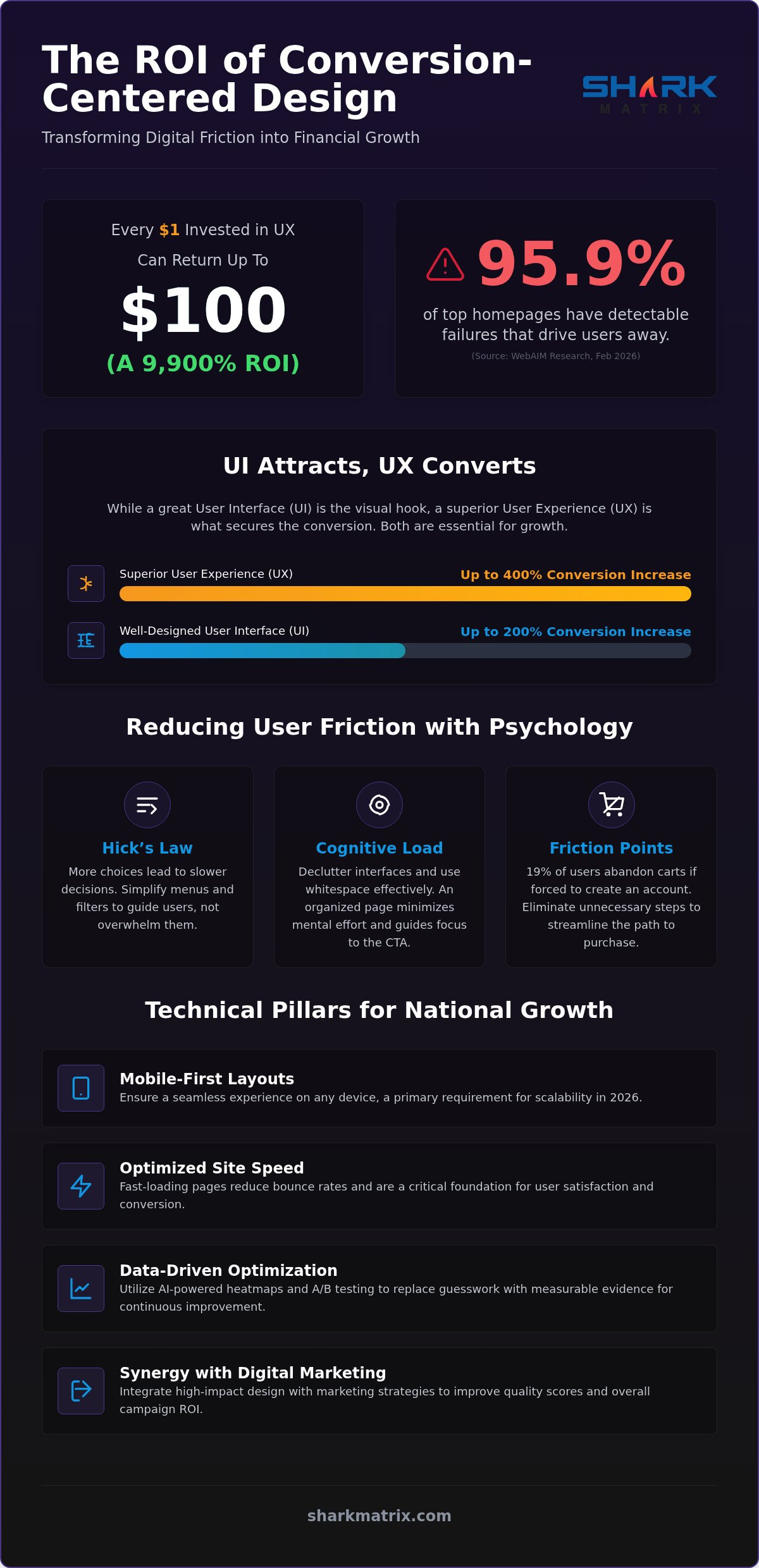
Every single dollar you invest in user experience can return up to $100. That is a 9,900% ROI that many national brands in the UAE are leaving on the table because of hidden friction points. Understanding how ui/ux design impacts conversion rates is no longer just a design concern; it’s a financial imperative. It’s frustrating to watch high-quality traffic hit your landing pages only to bounce seconds later. You might feel the pressure of justifying design spend when the difference between UI and UX still feels blurry. According to WebAIM research from February 2026, 95.9% of top homepages still suffer from detectable failures that drive users away.

This strategic guide provides a clear framework for conversion-centered design that transforms passive visitors into loyal customers. You will learn how to drive measurable ROI from your digital marketing spend by reducing cognitive load and simplifying the path to purchase. We’ll look at how superior UX can increase conversion rates by up to 400% and how AI automation is now essential for creating faster, more intuitive user journeys. By the end, you’ll have the data needed to turn your digital presence into a high-performing sales engine for your national brand.

Key Takeaways

  • Learn why a visually stunning interface requires a functional user journey to prevent high bounce rates on key landing pages.
  • Understand how ui/ux design impacts conversion rates by applying psychological principles like Hick’s Law to minimize user friction.
  • Discover why mobile-first layouts and optimized site speed are the primary technical pillars for national scalability in 2026.
  • Master data-driven optimization using AI-powered heatmaps and A/B testing to replace design guesswork with measurable evidence.
  • Explore the synergy between high-impact design and digital marketing strategies to improve quality scores and overall campaign ROI.

The relationship between aesthetics and functionality is often misunderstood as a choice between beauty and brains. In reality, understanding how ui/ux design impacts conversion rates requires viewing them as a unified force. While User Interface (UI) focuses on the visual touchpoints, User Experience (UX) governs the logic behind every click. A site can look stunning, but if the checkout process is a maze, customers will leave. Research from Forrester highlights this impact clearly. A well-designed UI can increase conversion rates by up to 200%, but superior UX design can lead to a 400% increase.

Success in conversion rate optimization relies on balancing the “Friction vs. Motivation” equation. Your marketing efforts build motivation, but poor design creates friction. If the friction outweighs the motivation, the user abandons the site. High-impact web development for national brands ensures that design elements actively remove barriers rather than creating them. By integrating technical AI capabilities, brands can now predict friction points before they impact the bottom line.

UI vs. UX: Two Sides of the Conversion Coin

UI serves as the visual hook. It uses color palettes, typography, and imagery to build immediate brand trust. In a competitive national market, a professional appearance is the baseline for credibility. It’s the “skin” of your digital product. Conversely, UX is the structural logic that guides the user toward the “Buy” or “Contact” button. UX maps the journey, ensuring that information is where a user expects it to be. For national brands to scale, these two elements must work in tandem. UI attracts the eye, but UX satisfies the intent. Without this balance, even the most expensive traffic will fail to convert.

The ROI of User-Centric Design in 2026

Investing in professional design directly reduces customer acquisition costs (CAC). When your site converts a higher percentage of visitors, every marketing dirham goes further. Beyond immediate sales, effortless experiences drive long-term brand loyalty. According to a 2025 Forrester study, organizations implementing continuous UX testing saw up to a 10.8% increase in revenue retention over three years. Analyzing how ui/ux design impacts conversion rates reveals that it’s a long-term financial strategy, not a one-time expense. Conversion-Centered Design is the strategic practice of aligning every visual and structural element of a digital interface with a specific business goal.

The Psychology of Design: Reducing Friction in the User Journey

Psychological principles aren’t just theory; they’re the engine of a high-converting site. Hick’s Law is a prime example. It suggests that increasing the number of choices exponentially increases the time required to make a decision. For a national brand in the UAE, this means simplifying navigation menus and product filters. If you overwhelm a visitor with thirty options on a landing page, they’ll likely choose none and leave. Understanding how ui/ux design impacts conversion rates involves looking deep into these human decision-making patterns.

Micro-interactions also play a silent but vital role in the journey. These are small animations or feedback loops, like a button changing color when hovered over or a progress bar during a file upload. They provide instant reassurance that the system is responding to the user’s intent. This reduces the “waiting anxiety” that often kills potential sales. Clear, transparent UI elements combined with social proof, like verified customer reviews and trust badges, build the psychological safety necessary for a user to share their credit card details.

Managing Cognitive Load for Faster Decision Making

Decluttering is essential for modern interfaces. You don’t need to remove information, just organize it to prevent cognitive overload. Whitespace is a powerful tool here; it forces the eye toward your call-to-action (CTA) rather than letting it wander. Nielsen Norman Group defines conversion rate as the percentage of users who complete a desired action. To keep this percentage high, you must minimize friction. For instance, requiring account creation before purchase is a major barrier. In 2025, Baymard Institute found that 19% of shoppers abandoned carts for this very reason. Consistency in navigation patterns also helps, as users don’t have to “re-learn” how to use your site on every new page.

Visual Hierarchy and the “Golden Path”

Every page needs a “Golden Path,” which is the ideal route you want a user to take from entry to checkout. Visual hierarchy uses size, contrast, and directional cues to light this path. Your primary CTA should be the most visually prominent element on the page, often using a high-contrast color that stands out from the background. Keeping crucial information above the fold ensures that users don’t have to scroll to find the value proposition. When analyzing how ui/ux design impacts conversion rates, it’s clear that guiding the eye is just as important as the offer itself. If you’re looking to scale your digital presence, investing in web development agency services that prioritize these psychological frameworks is a critical step for national growth.
How UI/UX Design Impacts Conversion Rates: The 2026 Strategic Guide

Technical UI/UX Pillars That Drive National Business Growth

While psychology influences intent, technical pillars provide the infrastructure for conversion. National brands must realize that good UX design means better business because it ensures stability and inclusivity across all devices. In 2026, accessibility is no longer optional. The European Accessibility Act became effective in June 2025, and while it’s an EU mandate, it has set a global benchmark for WCAG 2.2 AA compliance. Failing to meet these standards limits your reach and alienates a significant portion of your potential audience.

For national UAE growth, localized UX is a non-negotiable pillar. This goes beyond simple translation. It requires designing for bilingual expectations, ensuring that Right-to-Left (RTL) layouts for Arabic are as intuitive as Left-to-Right (LTR) English versions. Mirroring interfaces correctly prevents cognitive friction for local users. When you respect linguistic and cultural navigation habits, you build the trust necessary for high-value transactions.

Optimizing for a Mobile-Dominant National Audience

The UAE market is mobile-first. Responsive layouts that simply shrink desktop elements are no longer sufficient. True mobile-first design prioritizes thumb-friendly navigation and places call-to-action (CTA) buttons within natural reach zones. You should simplify forms for small screens to prevent the high drop-off rates associated with complex data entry. Leveraging native mobile features, such as biometric authentication or integrated payment wallets, creates a seamless checkout experience. This technical precision is a core part of how ui/ux design impacts conversion rates in a mobile-dominant landscape.

Performance Engineering and UX

Site speed is a critical UX metric that dictates whether a user stays or bounces. In 2026, users expect sub-second load times. Even a slight delay can trigger a significant spike in abandonment. This is why performance engineering is central to any web development agency dubai strategy. Google’s Core Web Vitals continue to be the standard for measuring user experience through loading performance, interactivity, and visual stability. By optimizing these technical metrics, you improve both your SEO rankings and your user retention. Understanding how ui/ux design impacts conversion rates means recognizing that a beautiful site is useless if it doesn’t load fast enough to be seen. High-performing code is the silent partner of creative design.

Data-Driven UX Optimization: Testing, AI, and Iteration

Design in 2026 is no longer a matter of opinion. Moving from “I think” to “I know” requires a rigorous commitment to data. Analyzing how ui/ux design impacts conversion rates requires a shift from subjective aesthetics to objective performance metrics. Tools like heatmaps and session recordings allow you to visualize exactly where users get stuck or abandon their journey. If a heatmap shows users clicking on a non-interactive element, you’ve identified a friction point that’s actively costing you revenue. A/B testing then allows you to pit two design solutions against each other to see which one drives more sales in real-time.

Continuous feedback loops are the backbone of any successful digital strategy. By August 2026, research from Maze shows that 69% of researchers now use AI in their projects to speed up data analysis. This rapid iteration cycle means national brands can identify and fix UX flaws in days rather than months. Instead of waiting for a quarterly review, businesses use live data to make incremental changes that compound into significant ROI. This constant refinement ensures that your digital presence evolves alongside your customers’ changing habits.

The Role of AI in UX Personalization

AI has transformed personalization from a luxury into a standard expectation. Machine learning models now predict user intent by analyzing past behavior, allowing the interface to adjust content dynamically. For example, a returning visitor might see a streamlined checkout while a first-time visitor receives more educational content. Integrating ai automation services helps national brands manage these complex, real-time adjustments at scale. Additionally, AI chatbots significantly improve the “Time to Value” for new visitors by providing instant answers, which prevents them from bouncing due to confusion.

Establishing an Optimization Framework

To see measurable growth, you need a structured approach to design changes. First, audit your current conversion funnels using analytics to find the biggest drop-off points. Second, formulate a hypothesis based on user pain points; for instance, “Reducing form fields will increase sign-ups.” Third, execute split tests and implement the winning designs. This framework ensures that every update is grounded in evidence. If you’re ready to move beyond guesswork, you can partner with Shark Matrix Technologies LLC to build a data-driven UI/UX strategy that scales with your business goals.

Integrating UI/UX with a Comprehensive Digital Growth Strategy

UI/UX design doesn’t exist in a vacuum. It’s a critical component of your overall digital growth strategy. When you understand how ui/ux design impacts conversion rates, you start to see its influence on every other marketing channel. For instance, your Pay Per Click (PPC) campaigns rely heavily on landing page performance. A well-designed page increases your Quality Score, which directly lowers your cost per click and improves your ad placement. By aligning your visual identity with your advertising intent, you create a cohesive journey that reduces abandonment and maximizes your marketing budget.

Professional design also serves as a shield for your national brand reputation. In a market as competitive as the UAE, users associate a polished, intuitive interface with reliability and quality. If your digital platform feels dated or clunky, that negative perception bleeds into your brand’s core identity. Scaling custom solutions from simple web apps to complex enterprise platforms requires a design system that can grow with your ambitions. When you analyze how ui/ux design impacts conversion rates across different traffic sources, the value of a unified strategy becomes clear.

SEO and UX: Designing for Humans and Search Engines

Modern search algorithms prioritize user satisfaction. Search engines track engagement signals like dwell time and click-through rates to determine the relevance of a page. If your design is confusing, users will bounce back to the search results, signaling that your site didn’t meet their needs. This is why partnering with a professional seo company dubai involves more than just keyword placement; it requires a deep focus on the user journey. High-quality UI/UX keeps visitors on your site longer, which naturally boosts your search rankings. You can find more detail on this synergy in our Comprehensive Search Engine Optimization (SEO) Services: The 2026 Business Guide.

Next Steps: Partnering for National Success

National growth demands scalability that generic templates simply can’t provide. Custom software engineering ensures that your platform can handle increased traffic and complex data without compromising on speed or user experience. While templates might offer a quick start, they often lead to technical debt and limited flexibility as your brand evolves. Building a roadmap for your next design evolution means looking at the long-term goals of your enterprise. For a deeper look at these requirements, refer to The 2026 Guide to Website Design and Development Services for UAE Enterprises. Shark Matrix Technologies LLC combines creative design with technical AI capabilities to ensure your digital assets are ready for the future.

Future-Proofing Your Digital Conversion Strategy

Scientific design principles and technical performance metrics create a seamless path to purchase. From managing cognitive load to leveraging AI-powered personalization, every element of the user journey must be optimized for intent. National brands that prioritize these pillars don’t just see a prettier website; they see a measurable impact on their bottom line. Understanding how ui/ux design impacts conversion rates is the first step toward reclaiming lost revenue and building lasting brand loyalty in a mobile-first market.

Shark Matrix Technologies LLC was founded in 2010 and brings over a decade of digital expertise to the UAE market. As specialists in AI-driven digital marketing and custom software engineering, we help national enterprises scale with technical precision and creative clarity. It’s time to turn your passive traffic into a measurable competitive advantage. Transform your website into a high-converting asset with Shark Matrix and ensure your digital presence is ready for the demands of 2026 and beyond.

Frequently Asked Questions

How much does UI/UX design typically improve conversion rates?

A well-designed UI can increase conversion rates by up to 200%, while superior UX design can lead to a 400% increase. These statistics from Forrester highlight that logic often has a larger impact than aesthetics alone. For national brands, this translates to significant revenue recovery from previously abandoned carts. Continuous testing ensures these gains remain stable as user expectations evolve in 2026, turning your digital presence into a high-performance sales engine.

What is the difference between UI and UX design for conversions?

UI focuses on the visual interface, using colors and layouts to build immediate brand trust. UX governs the structural logic and user journey that guides a visitor to the final action. While UI captures attention, UX removes the friction that prevents a sale. Both must work together to maximize results. If you have a beautiful site with a confusing checkout, your UI is succeeding but your UX is failing your conversion goals and ROI.

How long does it take to see results from a UX redesign?

You can often see initial results within days of a launch, especially if you’re tracking real-time engagement data. Significant trends usually emerge after one to three months of consistent traffic. This period allows for enough data to reach statistical significance in A/B tests. Ongoing iteration is essential in 2026. National brands often implement continuous UX testing to see a 10.8% increase in revenue retention over a three-year period, according to 2025 research.

Can AI automation really improve my website’s user experience?

Yes, AI automation significantly improves user experience by enabling real-time personalization and predictive navigation. Machine learning models analyze visitor behavior to adjust content dynamically, making the journey feel intuitive. AI-powered chatbots also reduce “Time to Value” by answering queries instantly, and solutions such as plutoai.automindstech.com further enhance this by providing voice and live video conversations for higher lead conversion. These technologies allow national enterprises to scale complex user journeys without manual intervention. This efficiency is a major factor in how ui/ux design impacts conversion rates for high-growth brands in the competitive UAE market.

The most damaging mistakes include forced account creation, slow load times, and cluttered navigation. A 2025 Baymard Institute survey found that 19% of shoppers abandon carts because they’re forced to create an account. Other frequent errors involve:

  • Lack of clear visual hierarchy for primary calls-to-action
  • Inconsistent navigation patterns that confuse returning visitors
  • Ignoring accessibility standards like WCAG 2.2 AA requirements

Fixing these errors leads to immediate improvements in your overall conversion efficiency.

Is mobile-first design mandatory for national UAE businesses in 2026?

Mobile-first design is absolutely mandatory for UAE businesses because the vast majority of national traffic originates from smartphones. Simple responsiveness isn’t enough; you must prioritize thumb-friendly layouts and mobile-specific payment integrations. Failing to optimize for small screens leads to massive drop-off rates during the checkout process. In 2026, a desktop-only focus is a direct path to losing market share to more agile, mobile-centric competitors who understand local user habits and expectations.

How do I measure the success of a new UI/UX design?

Success is measured through a combination of conversion rates, bounce rates, and dwell time. You should also track specific engagement signals like heatmaps to see where friction remains. Analyzing how ui/ux design impacts conversion rates requires looking at your cost per acquisition and customer lifetime value. If your design is working, you’ll see a direct correlation between improved user satisfaction scores and your total revenue growth. Consistent monitoring ensures your platform stays ahead of national market shifts.

Categories
Development

The Role of a UI/UX Design Agency in Driving National Business Growth in 2026

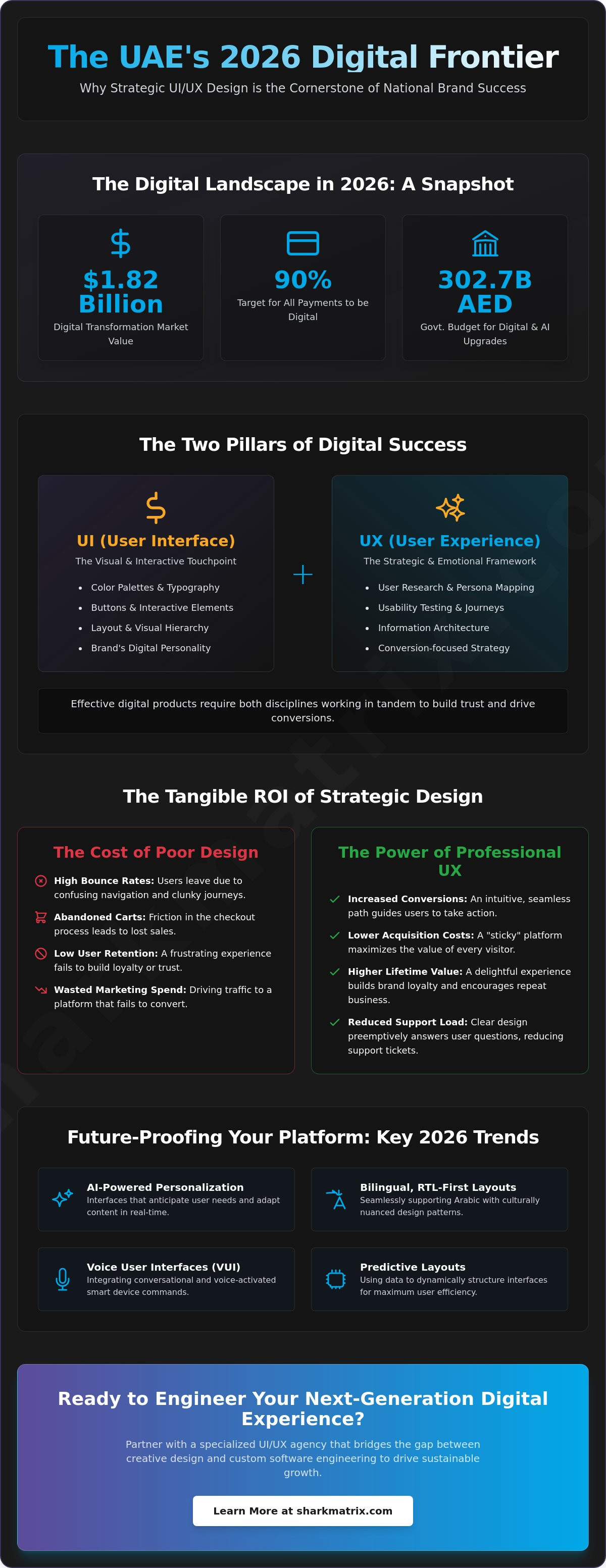
Did you know the UAE’s digital transformation market has surged to a value of $1.82 billion in 2026? As the government pushes to double the digital economy’s contribution to the non-oil GDP, the competition for user attention has never been more intense. Partnering with a specialized ui/ux design agency dubai is no longer just about aesthetics; it’s a strategic necessity for any enterprise looking to thrive in a landscape where 90% of all payments are now digital.

You’ve likely noticed how a clunky user journey or a high bounce rate can quietly erode your bottom line. It’s frustrating to watch potential sales vanish because your mobile and web platforms don’t feel cohesive or intuitive. We understand that maintaining brand consistency while trying to keep up with rapid technological shifts is a significant challenge for modern businesses.

This article discovers how strategic UI/UX design transforms your digital products into high-conversion assets that drive measurable revenue growth. We’ll explore the essential trends for 2026, including AI-powered personalization and bilingual, RTL-first layouts, to show you how to build a future-proof experience that keeps your customers coming back.

Key Takeaways

  • Understand the critical distinction between visual UI and strategic UX to ensure your digital platforms are built for high-conversion performance.
  • Discover how a specialized ui/ux design agency dubai helps national brands maximize ROI by aligning digital journeys with the UAE’s evolving digital economy.
  • Learn the modernized 2026 design process that integrates AI automation and user research to create personalized, future-proof products.
  • Identify the essential criteria for choosing a partner, including the ability to manage complex Arabic linguistic requirements and cultural nuances.
  • Explore how bridging the gap between creative design and custom software engineering drives sustainable growth for local enterprises.

What is a UI/UX Design Agency and Why Does Your National Brand Need One?

In 2026, the UAE is no longer just participating in the digital economy; it is leading it. With the government’s 302.7 billion AED budget allocation for digital infrastructure and AI upgrades, national brands face a sophisticated new reality. A specialized ui/ux design agency dubai provides the technical depth needed to turn a simple website into a high-performance engine. While a generalist graphic designer might focus on making a page look attractive, a dedicated agency engineers the interaction to meet the high expectations of a tech-savvy local population. This distinction is vital for maintaining brand authority in a market where consumers transition seamlessly between mobile apps, web portals, and voice-activated smart devices.

Digital expectations have shifted toward hyper-personalization. Users no longer tolerate generic experiences. They want interfaces that anticipate their needs, offer bilingual support natively, and reflect the cultural nuances of the region. A professional agency bridges the gap between raw technology and human behavior, ensuring your digital presence feels like a natural extension of your physical brand; to establish your physical headquarters, check out BizCity Group for flexible workspace solutions in Dubai.

The Critical Difference Between UI and UX

UI, or User Interface, is the visual touchpoint of your product. It encompasses the typography, color palettes, and interactive elements that define your brand’s digital personality. In contrast, UX, or User Experience, is the strategic framework behind those visuals. It involves deep research, usability testing, and the emotional response of the user as they move through a journey. You cannot have an effective digital product without both disciplines working in tandem. A beautiful interface that is hard to navigate results in high bounce rates. Conversely, a functional app that looks dated fails to build trust. Mastery of user experience design ensures that every click serves a purpose and every interaction leads toward a conversion.

The Business Case for Professional Design in 2026

UX maturity is the single greatest predictor of digital profitability for UAE enterprises today.

Bad design is expensive. It manifests as abandoned carts, low user retention, and a heavy burden on customer support teams who must explain clunky workflows. By investing in a professional ui/ux design agency dubai, brands future-proof their digital assets against rapid technological shifts. This includes integrating next-gen features like Voice User Interfaces (VUI) and AI-driven predictive layouts. As Dubai moves toward its goal of 90% digital payments by the end of 2026, your design strategy becomes the primary driver of national market perception and long-term revenue growth. This level of design sophistication is especially critical for specialized enterprise platforms like AiRentoSoft, where automated fleet and car rental management requires a seamless user experience to maintain operational efficiency.

The ROI of Strategic Design: How UX Impacts the National Digital Economy

Many business leaders still view design as a cosmetic expense rather than a core revenue driver. This perspective is a costly mistake in 2026. With the full rollout of the Digital Dirham and Dubai’s target of 90% digital payments, every interaction on your platform is a high-stakes financial transaction. Strategic design directly influences Conversion Rate Optimization (CRO) by removing the cognitive friction that leads to abandoned carts and incomplete forms. When a user finds what they need effortlessly, the likelihood of conversion increases exponentially. This efficiency significantly lowers Customer Acquisition Costs (CAC). You stop wasting your marketing budget on driving traffic to a “leaky” funnel that cannot retain interest.

Investing in a professional ui/ux design agency dubai ensures your digital infrastructure is built for performance. Beyond simple aesthetics, strategic UX is about engineering paths that lead users to take action. For a broader look at how these elements integrate into your overall presence, see our pillar article on website design and development services. High-quality design pays for itself by reducing the need for expensive customer support and increasing the lifetime value of every user who interacts with your brand.

Arabic Localization and Cultural Design Patterns

In the UAE, “global” design templates often fall short because they ignore the fundamental logic of Right-to-Left (RTL) interfaces. True localization isn’t just about translating text. It’s about mirroring the entire layout, from navigation menus to the placement of call-to-action buttons. Cultural aesthetics also play a massive role. National audiences respond better to specific visual hierarchies and imagery that reflect local values. Integrating your design strategy with professional Arabic digital marketing during the initial phase prevents the disjointed experience that occurs when cultural nuances are added as an afterthought.

Measuring Success: UX Metrics That Matter

Data-driven lead generation requires more than just tracking clicks. You must look at Task Success Rate, which measures the percentage of users who successfully complete a specific goal, such as a checkout or a sign-up. Time on Task is another vital KPI. If users take too long to find basic information, your interface is failing them. A specialized ui/ux design agency dubai uses these metrics to refine the user journey constantly. Intuitive navigation leads to higher user retention, creating a sustainable digital ecosystem where users return because the experience was seamless. If you aren’t sure how your current platform measures up, it might be time to evaluate your digital strategy with a focus on user-centric engineering.

The Role of a UI/UX Design Agency in Driving National Business Growth in 2026

The 2026 UI/UX Design Process: From Discovery to AI Integration

The workflow at a premier ui/ux design agency dubai has shifted from static layouts to dynamic, data-driven ecosystems. By 2026, the process is no longer a linear path but a continuous loop of innovation. It begins with Discovery and User Research, where designers analyze the specific habits of the UAE’s multicultural demographic. This stage now includes studying how local users interact with the Digital Dirham and Dubai’s smart city services to ensure the product fits into their daily lives. Next comes Information Architecture and Wireframing. This is the skeleton of your journey, mapping out how information flows in both English and Arabic to cater to the nation’s linguistic diversity.

The third phase is Prototyping and Interaction Design. Here, we build high-fidelity simulations that allow stakeholders to feel the product’s rhythm before any code is written. This is followed by UI Design and Brand Integration, where the visual identity is applied across all touchpoints, ensuring a premium look that commands authority. The final stage, Testing and Iteration, uses AI-driven heatmaps and real-time user feedback loops. This ensures the digital asset evolves based on actual human behavior rather than assumptions. This rigorous approach is what separates a world-class ui/ux design agency dubai from agencies that only offer surface-level visuals.

Integrating AI and Automation in Modern UX

AI development services and automation are now native components of the design phase. We’ve moved beyond simple widgets to “Anticipatory Design,” where machine learning predicts user needs based on past behavior. For example, an e-commerce platform might rearrange its interface in real-time to highlight a user’s preferred payment method or language. These sophisticated features require a robust technical foundation. You can explore the implementation of these technologies in our guide on custom web development dubai. This integration ensures that automation serves the user experience rather than complicating it.

The Design-to-Development Handoff

A brilliant design is useless if it cannot be executed perfectly. Seamless communication between designers and engineers is the backbone of project success in 2026. We use advanced documentation tools and shared component libraries to ensure the final product matches the approved design to the pixel. This precision is especially critical for responsive web design dubai. With over 16 million 5G smartphones active in the region, your platform must perform flawlessly across a massive range of screen sizes and device types. A unified handoff process prevents the “translation errors” that often lead to broken layouts or sluggish performance on mobile devices.

Choosing the Right UI/UX Partner: Key Criteria for National Enterprises

Finding the right ui/ux design agency dubai isn’t just about looking at pretty pictures. In 2026, the stakes are too high for a partner that only offers superficial aesthetics. You need to dig into the functional complexity of their previous work. Does their portfolio show they can handle intricate user logic, such as multi-step financial checkouts or complex data dashboards? A diverse portfolio proves an agency can adapt to different business models while maintaining high standards of usability. If they don’t understand the logic of RTL (Right-to-Left) navigation or the specific cultural preferences of the UAE market, your brand will struggle to gain traction with a local audience.

Technical synergy is another vital factor. A design agency that also excels in mobile app development or e-commerce development provides a significant advantage. They understand the technical limitations and possibilities of the code that will eventually house their designs. This prevents the “unbuildable design” trap where beautiful concepts fail in the development phase. Finally, ask about their testing methodology. Professional agencies don’t rely on internal opinions. They use real users and data-driven insights to validate every button placement and menu structure. If you want to ensure your investment delivers measurable results, evaluate your project requirements with a team that prioritizes data over guesswork.

The Vetting Checklist for 2026

Before signing a contract, you must ensure the agency is equipped for the current technological climate. Ask these specific questions:

  • Do they have a proven track record with AI and machine learning development services?
  • Can they show case studies where their design directly improved conversion rates or ROI?
  • How do they handle the design-to-development handoff to ensure pixel-perfect execution?

Modern enterprises require partners who can integrate sophisticated automation without sacrificing the user experience. For a deeper dive into these criteria, consult our comprehensive vetting guide. This resource helps you filter out generalists and focus on specialists who understand the national digital landscape.

Transparency and Communication

Professional ui/ux design agency dubai teams don’t work in a vacuum. A “black box” design process, where you see nothing until the final reveal, is a major red flag. Instead, look for a collaborative approach built on clear milestones and feedback loops. Transparent agencies provide regular updates and are willing to pivot based on user data or shifting business goals. They manage expectations through detailed timelines and ensure that every stakeholder is aligned before moving to the next phase. This open communication style reduces the risk of project delays and ensures the final digital product truly reflects your brand’s vision and the needs of your customers.

Shark Matrix: Engineering Next-Generation Digital Experiences

Shark Matrix stands at the forefront of the UAE’s digital evolution as a leader in end-to-end digital transformation and custom software engineering. We don’t believe in design for the sake of design. Instead, our team functions as a premier ui/ux design agency dubai by blending high-level creativity with sophisticated AI automation. This integration allows us to build interfaces that aren’t just visually stunning but are also intelligent enough to adapt to user needs in real-time. By leveraging our deep expertise in professional Arabic digital marketing, we ensure that national brands resonate deeply with the local population while maintaining a global standard of excellence.

Our data-driven approach removes the guesswork from the creative process. We use concrete user evidence, from AI-powered heatmaps to rigorous interaction testing, to back every design choice we make. This ensures that the final product isn’t just a vision; it’s a high-conversion asset specifically engineered for national business growth. We focus on building digital products that are robust, scalable, and ready to meet the demands of Dubai’s rapidly expanding digital economy.

Beyond Design: A Full-Service Digital Partner

A great interface only works if people can find it. We integrate Search Engine Optimization (SEO) and lead generation into the foundational design of every website we build. This means your platform is optimized for visibility from the very first wireframe. Our team also manages high-impact Pay Per Click (PPC) and social media campaigns to drive targeted traffic to your new interface immediately after launch. To protect your investment, we offer online reputation management to ensure your brand authority remains high as you scale. This holistic approach ensures that your digital presence is a self-sustaining engine for revenue.

Ready to Transform Your Digital Presence?

The digital landscape of 2026 demands more than just a functional website. It requires a partner that understands the intersection of culture, technology, and commerce. We invite you to consult with our experts for a comprehensive UI/UX audit to identify friction points in your current journey. Whether you need advanced mobile app development or a complete overhaul of your e-commerce platform, our commitment is to deliver culturally resonant products that drive innovation. Partner with a leading ui/ux design agency dubai to future-proof your brand and achieve national business excellence. Contact Shark Matrix today to start your transformation.

Securing Your Lead in the UAE’s Digital Future

The UAE’s shift toward a fully digital economy means your platform’s usability is now a direct reflection of your brand’s authority. It isn’t just about looks. We’ve explored how a conversion-centric approach turns digital products into high-performing assets while lowering customer acquisition costs. By mastering the 2026 design process, from AI-driven heatmaps to native Arabic localization, you create a seamless journey that meets the high expectations of tech-savvy users. These strategic improvements ensure your business remains resilient as digital payments become the national standard.

Securing long-term growth requires a partner that bridges the gap between creative vision and technical execution. Selecting an experienced ui/ux design agency dubai is the most critical step in this transformation. Shark Matrix has been a regional leader since 2010, offering over 15 years of specialized expertise in RTL design and Arabic digital marketing. Our unique blend of software engineering and AI automation ensures your digital presence remains robust as the market evolves. Now is the time to turn your digital challenges into competitive advantages.

Elevate your brand with Shark Matrix’s expert UI/UX design services today.

Frequently Asked Questions

What does a UI/UX design agency actually do?

A UI/UX design agency bridges the gap between digital strategy and user interaction. They conduct deep research to understand user behavior and then architect interfaces that guide people toward specific goals. Unlike simple design studios, a professional ui/ux design agency dubai integrates technical requirements like AI automation and bilingual layouts to ensure the product is both beautiful and functionally superior across all touchpoints.

How long does a typical UI/UX design project take in 2026?

Most enterprise-level UI/UX projects in 2026 take between 8 and 20 weeks to complete. This timeline includes discovery, wireframing, high-fidelity prototyping, and rigorous user testing. Smaller projects or specific feature updates might be faster, but comprehensive digital transformations require significant time for research and cultural localization to ensure the product succeeds in the competitive UAE market.

Can professional UI/UX design help improve my SEO rankings?

Yes, strategic design is a fundamental pillar of Search Engine Optimization. Search engines prioritize platforms with fast load times, low bounce rates, and high user engagement. By improving the user experience, you satisfy Core Web Vitals and encourage visitors to stay longer. A well-structured interface makes it easier for search bots to crawl your content and for users to convert, directly boosting your rankings.

Why is Arabic localization critical for UX in the UAE?

Arabic localization is essential because it respects the linguistic logic and cultural expectations of the UAE’s primary demographic. It goes beyond simple translation; it requires a complete Right-to-Left (RTL) layout overhaul. If your platform feels like a translated afterthought, you lose trust. A native-feeling Arabic interface ensures your brand is perceived as a local authority rather than a foreign entity.

What is the difference between a freelance designer and a UI/UX agency?

An agency provides a multidisciplinary team that includes researchers, strategists, and engineers. While a freelancer might excel at visuals, a ui/ux design agency dubai offers the technical depth needed for AI integration and complex software engineering. Agencies provide the scalability and long-term support that large enterprises require for mission-critical digital assets, ensuring the design is technically feasible and business-aligned.

How much does UI/UX design cost for a national enterprise?

The cost of a professional UI/UX redesign varies significantly based on the project’s scope and technical complexity. Factors such as the number of unique user journeys, the depth of AI integration, and the requirement for bilingual support influence the final investment. Enterprises should view this as a strategic capital expenditure that drives revenue growth rather than a one-time marketing cost.

Will a new UI/UX design work on both mobile and desktop?

Every modern UI/UX design is built to be fully responsive across all device types. Given that the UAE has over 16 million 5G smartphones in operation, we prioritize a mobile-first approach. This ensures that your platform is lightning-fast and intuitive on a phone while still providing a robust, feature-rich experience for desktop users. Consistency across all screens is non-negotiable for brand authority.

How do you measure the success of a UI/UX redesign?

Success is measured through specific data points like Conversion Rate Optimization (CRO) and Task Success Rate. We track how easily users complete a purchase or sign up for a service compared to the previous design. Other vital metrics include a reduction in customer support inquiries and an increase in user retention. These numbers provide concrete evidence of the redesign’s impact on your bottom line.