
Categories
Digital Marketing

Landing Page Optimization for PPC Campaigns: The 2026 Strategic Playbook

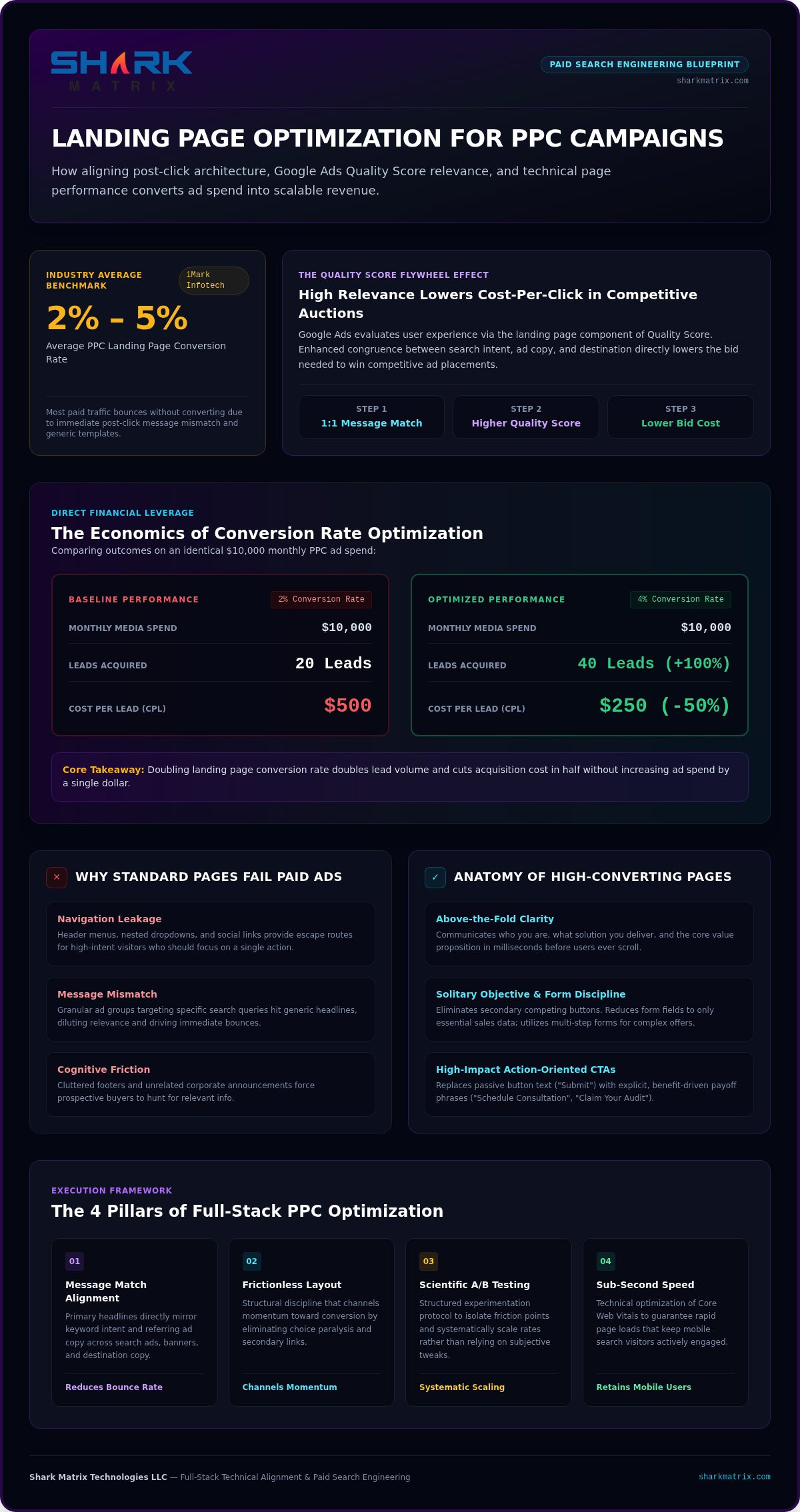
Most paid campaigns don’t fail because of targeting or bidding strategy; they collapse the second a visitor hits a post-click message mismatch. According to September 2026 data from iMark Infotech, the average PPC landing page converts at just 2% to 5%. In competitive search auctions across the United Arab Emirates, running traffic to generic templates without dedicated landing page optimization for ppc campaigns rapidly drains budgets while driving up customer acquisition costs.

It’s frustrating to watch thousands of AED vanish into paid clicks that bounce without converting, especially when low Quality Scores inflate your bids. You don’t have to rely on guesswork or superficial template tweaks to fix leaking funnels. In this guide, you will discover how to transform wasted ad spend into measurable revenue through full-stack technical alignment and structured experimentation. Here is your tactical playbook to engineer high-converting paid search destinations that systematically scale.

Key Takeaways

  • Master landing page optimization for ppc campaigns by aligning ad copy directly with post-click intent to reduce wasted ad spend and elevate Google Ads Quality Scores.
  • Structure high-performing page layouts that communicate core value propositions and drive clear actions before users ever need to scroll.
  • Implement a scientific A/B testing protocol to isolate friction points and systematically scale conversion rates instead of relying on subjective design tweaks.
  • Optimize Core Web Vitals and technical performance to ensure sub-second page loads that keep mobile visitors engaged.
  • Bridge the operational gap between paid search strategy and full-stack web engineering to build flexible, high-converting digital destinations.

What Is Landing Page Optimization for PPC Campaigns and Why Does It Matter?

Every paid click represents an upfront financial investment. While search engine marketing captures active user intent, the landing page determines whether that click converts into qualified revenue or becomes wasted spend. Landing page optimization (LPO) establishes structural, visual, and architectural congruence between your paid ad copy and the final web destination. Generic drag-and-drop templates often fail because they treat all web visitors identically. In contrast, rigorous landing page optimization for ppc campaigns focuses on visitors with immediate commercial intent who expect instant solutions rather than casual exploration.

When user expectations clash with your post-click environment, bounce rates surge. That disconnect inflates your average cost-per-acquisition (CPA) and signals to ad platforms that your page provides poor utility. Google Ads evaluates this experience directly through the landing page component of Quality Score. Higher historical conversion rates and tight relevance improve this score, systematically reducing the cost required to win competitive ad auctions.

The Economics of PPC Conversion Rate Optimization

Conversion rate optimization acts as direct financial leverage for ad budgets, multiplying the revenue generated by every paid visitor without requiring a single extra dollar in media spend. If your campaign spends $10,000 per month to acquire 20 leads at a 2% conversion rate, the resulting cost-per-lead is $500. Doubling that page conversion rate to 4% yields 40 leads from the exact same spend, instantly slashing your cost-per-lead to $250.

Beyond lead volume, this efficiency creates a compounding advantage in paid auctions. Enhanced user relevance increases expected click-through rates and landing page ratings, allowing smart advertisers to secure prime ad positions above competitors while bidding significantly less per click.

Why Traditional Website Pages Fail Paid Ad Campaigns

Sending paid campaign traffic to a standard homepage or general corporate service page reliably destroys campaign profitability. Standard website structures are built for general discovery, not focused conversion. They introduce friction that drives away high-intent traffic:

  • Navigation leakage: Header menus, nested dropdowns, and social links provide easy escape routes for prospects who should be focused entirely on a single action.
  • Message mismatch: Granular ad groups targeting specific user queries need matching headlines and proof points, which generic service pages dilute.
  • Cognitive friction: Cluttered footers and unrelated site announcements force prospective buyers to hunt for relevant information, triggering immediate bounces.

The Anatomy of a High-Converting PPC Landing Page

Every high-converting paid search destination requires razor-sharp visual balance, cognitive clarity, and structural discipline. When prospective clients click an ad, they form an impression in milliseconds. If your above-the-fold space fails to clarify who you are, what solution you deliver, and why your offer deserves attention, visitors leave immediately. Successful landing page optimization for ppc campaigns relies on a solitary, unambiguous objective. Eliminating conflicting secondary buttons prevents choice paralysis and channels user momentum toward conversion. Achieving this level of structural precision requires strategic engineering from an experienced web design and development team that knows how to eliminate user friction.

Perfecting the Message Match Between Ad Copy and Headlines

Your primary headline must directly mirror the query intent and language of the referring paid ad. If an ad promotes enterprise pipeline management, the landing page headline cannot switch to vague branding like “Innovative Solutions for Tomorrow.” Subheadings should immediately expand on the core promise with clear, benefit-driven context. Maintaining identical terms across search ads, banners, and landing copy reassures prospects they landed in the right place.

Designing High-Impact Conversion Forms and CTAs

Forms represent the highest barrier to entry on any paid landing page. Every additional input field lowers conversion probability, making it vital to collect only what sales teams need to initiate contact. Replace passive button text like “Submit” or “Click Here” with action-oriented phrases that emphasize immediate payoff, such as “Claim Your Audit” or “Schedule Consultation.” For high-ticket B2B offers requiring deeper discovery, multi-step forms break data collection into digestible steps that feel approachable.

  • Single-focus fields: Request minimal initial data (such as name and corporate email) to secure the initial lead.
  • Dynamic progress indicators: Display completion percentages on multi-step forms to encourage completion.
  • High-contrast buttons: Use striking, distinct palette choices so your primary call-to-action stands out instantly.

Structuring Authentic Trust Signals and Social Proof

Trust assets should neutralize hesitation right at the point of conversion. Position recognizable partner badges, industry credentials, and verified star ratings alongside your primary form. Testimonials should highlight concrete business metrics and overcome explicit customer objections instead of offering generic praise. Prominent data privacy statements ensure corporate buyers know their contact details remain secure throughout the sales process.
Landing Page Optimization for PPC Campaigns: The 2026 Strategic Playbook

How to Implement a Structured A/B Testing Framework for PPC

Random layout adjustments waste budget and obscure actionable insights. Sustainable performance demands a disciplined scientific methodology. Instead of making haphazard visual tweaks, structured landing page optimization for ppc campaigns isolates specific user friction points to validate their financial impact. High-intent paid visitors respond to clarity, not arbitrary redesigns. When you combine systematic experimentation with strategic PPC management, every marketing budget works toward verified conversion gains rather than speculative hunches.

Step 1: Baseline Data Auditing and Bottleneck Identification

Before launching an experiment, verify your tracking infrastructure. Check that Google Analytics 4 custom events, ad platform conversion pixels, and server-side tracking pipelines record conversions accurately without duplicates. Then, evaluate scroll depth maps and session replays to pinpoint where user momentum stalls. Are mobile users abandoning the page at the third form field? Do visitors ignore your primary value propositions? Calculating baseline conversion metrics for each individual ad campaign highlights the exact drop-off points that need structural intervention.

Step 2: Hypothesis Development and Variable Prioritization

Unfocused testing produces inconclusive data. Don’t squander early experimentation cycles on subtle aesthetic details like button colors. Prioritize radical structural transformations first. Replace passive text blocks with interactive questionnaires, or swap lengthy single-page forms for progressive lead capture flows. Formulate every hypothesis with strict logic: modifying a specific element will solve a documented visitor issue, producing a measurable lift. Score potential tests using the ICE framework, ranking each idea on Impact, Confidence, and Ease to build a high-leverage roadmap.

Step 3: Test Execution, Statistical Significance, and Iteration

Direct incoming paid traffic evenly between the control and variant pages using reliable server-side routing or testing tools. Keep bidding strategies, keyword match types, and ad creatives completely untouched throughout the testing window to prevent sample pollution. Let the test run until it achieves at least 95% statistical confidence across a significant volume of conversions. Ending tests early on temporary spikes leads to costly false positives. Once a variant wins, make it the new baseline control and immediately prepare your next iteration.

Advanced Technical Optimization: Speed, Dynamic Text, and AI Personalization

Modern paid traffic demands flawless technical execution. If your destination page takes several seconds to render or serves static, one-size-fits-all copy, conversion rates drop dramatically. High-performance landing page optimization for ppc campaigns requires engineering pages that load near-instantly while dynamically adapting to user intent. By pairing custom development with advanced AI automation services, marketing teams can deploy real-time post-click experiences that dramatically outperform generic templates.

Optimizing Mobile Performance and Core Web Vitals

Google Ads treats post-click page experience as a critical quality signal, making mobile Core Web Vitals an essential operational benchmark. A slow destination destroys ad efficiency; every single second of page load delay reduces mobile conversion rates by double digits. Keep your Largest Contentful Paint (LCP) under 2.5 seconds by serving next-gen image formats, utilizing modern CDNs, and eliminating render-blocking scripts. Interaction to Next Paint (INP) must remain under 200 milliseconds to guarantee instant touch feedback, while Cumulative Layout Shift (CLS) must stay below 0.1 by reserving layout dimensions for hero banners and dynamic elements.

Dynamic Keyword Insertion and Query-Level Alignment

Generic pages cannot address the nuanced needs of segmented paid search ad groups. Dynamic text replacement reads URL parameters passed from your ad platform and inserts the exact search phrase into your headline and body copy in real time. For national campaigns spanning diverse commercial sectors, dynamic insertion tailors value propositions to corporate buyers or retail customers seamlessly. Always establish clean fallback text in your template logic so headlines read naturally even if URL query parameters fail to pass.

AI-Powered Chat and Automated Lead Qualification

Static contact forms often fail to capture prospects who want immediate answers. Embedding real-time conversational agents through specialized AI chatbot development transforms standard pages into interactive lead qualification engines. Instead of waiting for a callback, visitors answer targeted qualification questions naturally within a fluid chat interface.

  • Interactive data capture: Chat assistants collect intent signals, budget parameters, and contact information without overwhelming visitors.
  • Intelligent routing: High-value enterprise prospects get flagged and routed directly to sales teams instantly.
  • Continuous lead collection: Conversational bots qualify inbound paid traffic smoothly around the clock.

Ready to upgrade your conversion infrastructure? Connect with Shark Matrix to deploy custom-engineered landing page architectures that maximize every Dirham of your media investment.

Scaling PPC Results: Unifying Creative Strategy and Engineering Execution

Overcoming the Limitations of Generic Page Builders

Drag-and-drop page builders promise rapid deployment, but they introduce hidden performance costs. These platforms often generate bloated DOM structures and heavy script bundles that degrade Core Web Vitals and inflate your acquisition costs. Custom-engineered architectures give developers total control over script execution, database connections, and server-side rendering. Owning your codebase also allows seamless integration with enterprise CRM pipelines and bespoke tracking APIs without paying recurring third-party software licenses. For brands seeking clean, purpose-built sites that avoid unnecessary template bloat, learn more about New Wave Digital Designs to explore professional website design services.

Establishing Continuous Monitoring and CRO Hygiene

Conversion optimization isn’t a one-time project. High-volume ad spend demands systematic quality assurance to protect marketing budgets against silent revenue leaks:

  • Form and API audits: Verify that webhooks, backend lead endpoints, and autoresponders fire correctly across major browser updates.
  • Viewport validation: Check mobile rendering and touch targets regularly to ensure layouts remain frictionless on diverse screen sizes.
  • Strategic roadmapping: Align landing page experiments directly with quarterly commercial targets rather than running disconnected tests.

Accelerating Campaign Returns with Professional Support

Unifying creative media buying with technical web execution generates compounding financial returns. Partnering with an integrated team that combines PPC management and custom web development eliminates handoff delays and technical bottlenecks. By treating ongoing landing page optimization for ppc campaigns as a core revenue engine, businesses across the United Arab Emirates can capture higher market share and protect their bottom line.

Transform Your Paid Search Traffic into Measurable Growth

Winning in competitive search auctions requires more than aggressive bidding and persuasive ad copy. Sustainable profitability demands dedicated landing page optimization for ppc campaigns that eliminates post-click friction, accelerates mobile load speeds, and tests radical architectural variations systematically. Relying on bloated, one-size-fits-all page builders only inflates acquisition costs and restricts your long-term campaign scalability.

True efficiency happens when paid media strategy unites seamlessly with technical web engineering and custom AI automation. By controlling your underlying codebase and aligning ad intent directly with high-converting user flows, you protect marketing budgets across the United Arab Emirates from wasted ad spend. Ready to scale your commercial pipeline without technical bottlenecks? Partner with Shark Matrix Technologies LLC for High-Performance PPC and Web Solutions to build high-converting post-click experiences that systematically increase conversion rates and compound your advertising returns.

Frequently Asked Questions

What is the difference between standard SEO pages and PPC landing pages?

SEO pages focus on comprehensive topic coverage and broad discovery, while PPC landing pages target a single commercial outcome. Standard organic pages feature site navigation, internal links, and long-form educational context to rank in search results. In contrast, paid landing pages remove navigation menus and secondary links, aligning directly with specific ad copy to eliminate friction and drive immediate conversions.

How much does landing page optimization improve PPC campaign conversion rates?

Rigorous optimization often doubles or triples baseline performance, shifting standard 2% conversion rates toward 6% or higher. Dedicated landing page optimization for ppc campaigns removes conversion bottlenecks, accelerates page rendering, and sharpens value propositions. Because every conversion increase lowers your cost-per-acquisition without requiring additional ad budget, systematic improvements compound campaign profitability across your entire media spend.

Can I use dynamic keyword insertion without hurting user experience?

Yes, dynamic keyword insertion works smoothly when supported by grammatical controls and dependable fallback text. This technique mirrors search intent by updating page headlines to match search queries in real time. To protect the user experience, apply dynamic insertion to tightly themed ad groups rather than raw search terms, and always code natural fallback copy if URL query parameters fail to load.

How long should an A/B test run on a paid search landing page?

An A/B test should run until it achieves at least 95% statistical confidence, which usually requires two to four full weeks of traffic. Running tests across full business cycles captures fluctuating buyer behavior across both weekdays and weekends. Never end an experiment early because of initial performance spikes. Reliable conclusions demand adequate sample sizes and sufficient conversion volumes.

What is a good conversion rate benchmark for PPC landing pages in 2026?

A typical conversion rate for paid search landing pages hovers between 2% and 5%, while top-performing destinations reach 10% or higher. Performance varies across business sectors. Lead generation pages commonly convert at 2% to 4%, whereas software trial funnels average 5% to 7%. Reaching top-tier benchmarks requires custom technical architectures rather than rigid, generic templates.

Why should businesses avoid sending Google Ads traffic to their homepage?

Homepages dilute paid traffic efficiency because they encourage general exploration rather than a single decisive action. Standard homepages contain navigation links, company news, and competing offers that create decision fatigue for high-intent buyers. Running paid traffic into dedicated environments designed for landing page optimization for ppc campaigns keeps prospects focused strictly on your core offer and primary conversion form.

Categories
Development

How UI/UX Design Impacts Conversion Rates: The 2026 Strategic Guide

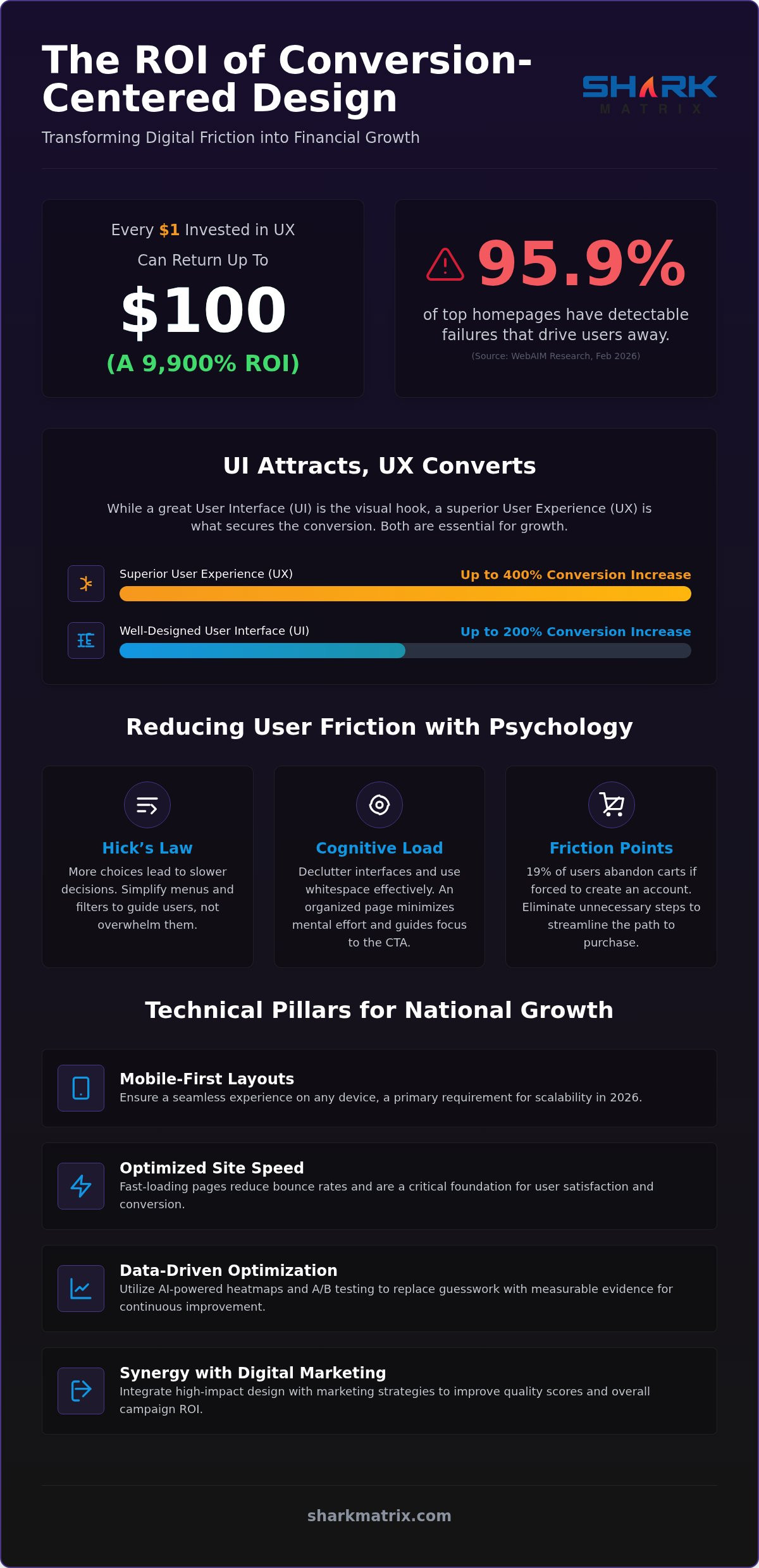
Every single dollar you invest in user experience can return up to $100. That is a 9,900% ROI that many national brands in the UAE are leaving on the table because of hidden friction points. Understanding how ui/ux design impacts conversion rates is no longer just a design concern; it’s a financial imperative. It’s frustrating to watch high-quality traffic hit your landing pages only to bounce seconds later. You might feel the pressure of justifying design spend when the difference between UI and UX still feels blurry. According to WebAIM research from February 2026, 95.9% of top homepages still suffer from detectable failures that drive users away.

This strategic guide provides a clear framework for conversion-centered design that transforms passive visitors into loyal customers. You will learn how to drive measurable ROI from your digital marketing spend by reducing cognitive load and simplifying the path to purchase. We’ll look at how superior UX can increase conversion rates by up to 400% and how AI automation is now essential for creating faster, more intuitive user journeys. By the end, you’ll have the data needed to turn your digital presence into a high-performing sales engine for your national brand.

Key Takeaways

  • Learn why a visually stunning interface requires a functional user journey to prevent high bounce rates on key landing pages.
  • Understand how ui/ux design impacts conversion rates by applying psychological principles like Hick’s Law to minimize user friction.
  • Discover why mobile-first layouts and optimized site speed are the primary technical pillars for national scalability in 2026.
  • Master data-driven optimization using AI-powered heatmaps and A/B testing to replace design guesswork with measurable evidence.
  • Explore the synergy between high-impact design and digital marketing strategies to improve quality scores and overall campaign ROI.

The relationship between aesthetics and functionality is often misunderstood as a choice between beauty and brains. In reality, understanding how ui/ux design impacts conversion rates requires viewing them as a unified force. While User Interface (UI) focuses on the visual touchpoints, User Experience (UX) governs the logic behind every click. A site can look stunning, but if the checkout process is a maze, customers will leave. Research from Forrester highlights this impact clearly. A well-designed UI can increase conversion rates by up to 200%, but superior UX design can lead to a 400% increase.

Success in conversion rate optimization relies on balancing the “Friction vs. Motivation” equation. Your marketing efforts build motivation, but poor design creates friction. If the friction outweighs the motivation, the user abandons the site. High-impact web development for national brands ensures that design elements actively remove barriers rather than creating them. By integrating technical AI capabilities, brands can now predict friction points before they impact the bottom line.

UI vs. UX: Two Sides of the Conversion Coin

UI serves as the visual hook. It uses color palettes, typography, and imagery to build immediate brand trust. In a competitive national market, a professional appearance is the baseline for credibility. It’s the “skin” of your digital product. Conversely, UX is the structural logic that guides the user toward the “Buy” or “Contact” button. UX maps the journey, ensuring that information is where a user expects it to be. For national brands to scale, these two elements must work in tandem. UI attracts the eye, but UX satisfies the intent. Without this balance, even the most expensive traffic will fail to convert.

The ROI of User-Centric Design in 2026

Investing in professional design directly reduces customer acquisition costs (CAC). When your site converts a higher percentage of visitors, every marketing dirham goes further. Beyond immediate sales, effortless experiences drive long-term brand loyalty. According to a 2025 Forrester study, organizations implementing continuous UX testing saw up to a 10.8% increase in revenue retention over three years. Analyzing how ui/ux design impacts conversion rates reveals that it’s a long-term financial strategy, not a one-time expense. Conversion-Centered Design is the strategic practice of aligning every visual and structural element of a digital interface with a specific business goal.

The Psychology of Design: Reducing Friction in the User Journey

Psychological principles aren’t just theory; they’re the engine of a high-converting site. Hick’s Law is a prime example. It suggests that increasing the number of choices exponentially increases the time required to make a decision. For a national brand in the UAE, this means simplifying navigation menus and product filters. If you overwhelm a visitor with thirty options on a landing page, they’ll likely choose none and leave. Understanding how ui/ux design impacts conversion rates involves looking deep into these human decision-making patterns.

Micro-interactions also play a silent but vital role in the journey. These are small animations or feedback loops, like a button changing color when hovered over or a progress bar during a file upload. They provide instant reassurance that the system is responding to the user’s intent. This reduces the “waiting anxiety” that often kills potential sales. Clear, transparent UI elements combined with social proof, like verified customer reviews and trust badges, build the psychological safety necessary for a user to share their credit card details.

Managing Cognitive Load for Faster Decision Making

Decluttering is essential for modern interfaces. You don’t need to remove information, just organize it to prevent cognitive overload. Whitespace is a powerful tool here; it forces the eye toward your call-to-action (CTA) rather than letting it wander. Nielsen Norman Group defines conversion rate as the percentage of users who complete a desired action. To keep this percentage high, you must minimize friction. For instance, requiring account creation before purchase is a major barrier. In 2025, Baymard Institute found that 19% of shoppers abandoned carts for this very reason. Consistency in navigation patterns also helps, as users don’t have to “re-learn” how to use your site on every new page.

Visual Hierarchy and the “Golden Path”

Every page needs a “Golden Path,” which is the ideal route you want a user to take from entry to checkout. Visual hierarchy uses size, contrast, and directional cues to light this path. Your primary CTA should be the most visually prominent element on the page, often using a high-contrast color that stands out from the background. Keeping crucial information above the fold ensures that users don’t have to scroll to find the value proposition. When analyzing how ui/ux design impacts conversion rates, it’s clear that guiding the eye is just as important as the offer itself. If you’re looking to scale your digital presence, investing in web development agency services that prioritize these psychological frameworks is a critical step for national growth.

How UI/UX Design Impacts Conversion Rates: The 2026 Strategic Guide

Technical UI/UX Pillars That Drive National Business Growth

While psychology influences intent, technical pillars provide the infrastructure for conversion. National brands must realize that good UX design means better business because it ensures stability and inclusivity across all devices. In 2026, accessibility is no longer optional. The European Accessibility Act became effective in June 2025, and while it’s an EU mandate, it has set a global benchmark for WCAG 2.2 AA compliance. Failing to meet these standards limits your reach and alienates a significant portion of your potential audience.

For national UAE growth, localized UX is a non-negotiable pillar. This goes beyond simple translation. It requires designing for bilingual expectations, ensuring that Right-to-Left (RTL) layouts for Arabic are as intuitive as Left-to-Right (LTR) English versions. Mirroring interfaces correctly prevents cognitive friction for local users. When you respect linguistic and cultural navigation habits, you build the trust necessary for high-value transactions.

Optimizing for a Mobile-Dominant National Audience

The UAE market is mobile-first. Responsive layouts that simply shrink desktop elements are no longer sufficient. True mobile-first design prioritizes thumb-friendly navigation and places call-to-action (CTA) buttons within natural reach zones. You should simplify forms for small screens to prevent the high drop-off rates associated with complex data entry. Leveraging native mobile features, such as biometric authentication or integrated payment wallets, creates a seamless checkout experience. This technical precision is a core part of how ui/ux design impacts conversion rates in a mobile-dominant landscape.

Performance Engineering and UX

Site speed is a critical UX metric that dictates whether a user stays or bounces. In 2026, users expect sub-second load times. Even a slight delay can trigger a significant spike in abandonment. This is why performance engineering is central to any web development agency dubai strategy. Google’s Core Web Vitals continue to be the standard for measuring user experience through loading performance, interactivity, and visual stability. By optimizing these technical metrics, you improve both your SEO rankings and your user retention. Understanding how ui/ux design impacts conversion rates means recognizing that a beautiful site is useless if it doesn’t load fast enough to be seen. High-performing code is the silent partner of creative design.

Data-Driven UX Optimization: Testing, AI, and Iteration

Design in 2026 is no longer a matter of opinion. Moving from “I think” to “I know” requires a rigorous commitment to data. Analyzing how ui/ux design impacts conversion rates requires a shift from subjective aesthetics to objective performance metrics. Tools like heatmaps and session recordings allow you to visualize exactly where users get stuck or abandon their journey. If a heatmap shows users clicking on a non-interactive element, you’ve identified a friction point that’s actively costing you revenue. A/B testing then allows you to pit two design solutions against each other to see which one drives more sales in real-time.

Continuous feedback loops are the backbone of any successful digital strategy. By August 2026, research from Maze shows that 69% of researchers now use AI in their projects to speed up data analysis. This rapid iteration cycle means national brands can identify and fix UX flaws in days rather than months. Instead of waiting for a quarterly review, businesses use live data to make incremental changes that compound into significant ROI. This constant refinement ensures that your digital presence evolves alongside your customers’ changing habits.

The Role of AI in UX Personalization

AI has transformed personalization from a luxury into a standard expectation. Machine learning models now predict user intent by analyzing past behavior, allowing the interface to adjust content dynamically. For example, a returning visitor might see a streamlined checkout while a first-time visitor receives more educational content. Integrating ai automation services helps national brands manage these complex, real-time adjustments at scale. Additionally, AI chatbots significantly improve the “Time to Value” for new visitors by providing instant answers, which prevents them from bouncing due to confusion.

Establishing an Optimization Framework

To see measurable growth, you need a structured approach to design changes. First, audit your current conversion funnels using analytics to find the biggest drop-off points. Second, formulate a hypothesis based on user pain points; for instance, “Reducing form fields will increase sign-ups.” Third, execute split tests and implement the winning designs. This framework ensures that every update is grounded in evidence. If you’re ready to move beyond guesswork, you can partner with Shark Matrix Technologies LLC to build a data-driven UI/UX strategy that scales with your business goals.

Integrating UI/UX with a Comprehensive Digital Growth Strategy

UI/UX design doesn’t exist in a vacuum. It’s a critical component of your overall digital growth strategy. When you understand how ui/ux design impacts conversion rates, you start to see its influence on every other marketing channel. For instance, your Pay Per Click (PPC) campaigns rely heavily on landing page performance. A well-designed page increases your Quality Score, which directly lowers your cost per click and improves your ad placement. By aligning your visual identity with your advertising intent, you create a cohesive journey that reduces abandonment and maximizes your marketing budget.

Professional design also serves as a shield for your national brand reputation. In a market as competitive as the UAE, users associate a polished, intuitive interface with reliability and quality. If your digital platform feels dated or clunky, that negative perception bleeds into your brand’s core identity. Scaling custom solutions from simple web apps to complex enterprise platforms requires a design system that can grow with your ambitions. When you analyze how ui/ux design impacts conversion rates across different traffic sources, the value of a unified strategy becomes clear.

SEO and UX: Designing for Humans and Search Engines

Modern search algorithms prioritize user satisfaction. Search engines track engagement signals like dwell time and click-through rates to determine the relevance of a page. If your design is confusing, users will bounce back to the search results, signaling that your site didn’t meet their needs. This is why partnering with a professional seo company dubai involves more than just keyword placement; it requires a deep focus on the user journey. High-quality UI/UX keeps visitors on your site longer, which naturally boosts your search rankings. You can find more detail on this synergy in our Comprehensive Search Engine Optimization (SEO) Services: The 2026 Business Guide.

Next Steps: Partnering for National Success

National growth demands scalability that generic templates simply can’t provide. Custom software engineering ensures that your platform can handle increased traffic and complex data without compromising on speed or user experience. While templates might offer a quick start, they often lead to technical debt and limited flexibility as your brand evolves. Building a roadmap for your next design evolution means looking at the long-term goals of your enterprise. For a deeper look at these requirements, refer to The 2026 Guide to Website Design and Development Services for UAE Enterprises. Shark Matrix Technologies LLC combines creative design with technical AI capabilities to ensure your digital assets are ready for the future.

Future-Proofing Your Digital Conversion Strategy

Scientific design principles and technical performance metrics create a seamless path to purchase. From managing cognitive load to leveraging AI-powered personalization, every element of the user journey must be optimized for intent. National brands that prioritize these pillars don’t just see a prettier website; they see a measurable impact on their bottom line. Understanding how ui/ux design impacts conversion rates is the first step toward reclaiming lost revenue and building lasting brand loyalty in a mobile-first market.

Shark Matrix Technologies LLC was founded in 2010 and brings over a decade of digital expertise to the UAE market. As specialists in AI-driven digital marketing and custom software engineering, we help national enterprises scale with technical precision and creative clarity. It’s time to turn your passive traffic into a measurable competitive advantage. Transform your website into a high-converting asset with Shark Matrix and ensure your digital presence is ready for the demands of 2026 and beyond.

Frequently Asked Questions

How much does UI/UX design typically improve conversion rates?

A well-designed UI can increase conversion rates by up to 200%, while superior UX design can lead to a 400% increase. These statistics from Forrester highlight that logic often has a larger impact than aesthetics alone. For national brands, this translates to significant revenue recovery from previously abandoned carts. Continuous testing ensures these gains remain stable as user expectations evolve in 2026, turning your digital presence into a high-performance sales engine.

What is the difference between UI and UX design for conversions?

UI focuses on the visual interface, using colors and layouts to build immediate brand trust. UX governs the structural logic and user journey that guides a visitor to the final action. While UI captures attention, UX removes the friction that prevents a sale. Both must work together to maximize results. If you have a beautiful site with a confusing checkout, your UI is succeeding but your UX is failing your conversion goals and ROI.

How long does it take to see results from a UX redesign?

You can often see initial results within days of a launch, especially if you’re tracking real-time engagement data. Significant trends usually emerge after one to three months of consistent traffic. This period allows for enough data to reach statistical significance in A/B tests. Ongoing iteration is essential in 2026. National brands often implement continuous UX testing to see a 10.8% increase in revenue retention over a three-year period, according to 2025 research.

Can AI automation really improve my website’s user experience?

Yes, AI automation significantly improves user experience by enabling real-time personalization and predictive navigation. Machine learning models analyze visitor behavior to adjust content dynamically, making the journey feel intuitive. AI-powered chatbots also reduce “Time to Value” by answering queries instantly, and solutions such as plutoai.automindstech.com further enhance this by providing voice and live video conversations for higher lead conversion. These technologies allow national enterprises to scale complex user journeys without manual intervention. This efficiency is a major factor in how ui/ux design impacts conversion rates for high-growth brands in the competitive UAE market.

The most damaging mistakes include forced account creation, slow load times, and cluttered navigation. A 2025 Baymard Institute survey found that 19% of shoppers abandon carts because they’re forced to create an account. Other frequent errors involve:

  • Lack of clear visual hierarchy for primary calls-to-action
  • Inconsistent navigation patterns that confuse returning visitors
  • Ignoring accessibility standards like WCAG 2.2 AA requirements

Fixing these errors leads to immediate improvements in your overall conversion efficiency.

Is mobile-first design mandatory for national UAE businesses in 2026?

Mobile-first design is absolutely mandatory for UAE businesses because the vast majority of national traffic originates from smartphones. Simple responsiveness isn’t enough; you must prioritize thumb-friendly layouts and mobile-specific payment integrations. Failing to optimize for small screens leads to massive drop-off rates during the checkout process. In 2026, a desktop-only focus is a direct path to losing market share to more agile, mobile-centric competitors who understand local user habits and expectations.

How do I measure the success of a new UI/UX design?

Success is measured through a combination of conversion rates, bounce rates, and dwell time. You should also track specific engagement signals like heatmaps to see where friction remains. Analyzing how ui/ux design impacts conversion rates requires looking at your cost per acquisition and customer lifetime value. If your design is working, you’ll see a direct correlation between improved user satisfaction scores and your total revenue growth. Consistent monitoring ensures your platform stays ahead of national market shifts.