
Most paid campaigns don’t fail because of targeting or bidding strategy; they collapse the second a visitor hits a post-click message mismatch. According to September 2026 data from iMark Infotech, the average PPC landing page converts at just 2% to 5%. In competitive search auctions across the United Arab Emirates, running traffic to generic templates without dedicated landing page optimization for ppc campaigns rapidly drains budgets while driving up customer acquisition costs.
It’s frustrating to watch thousands of AED vanish into paid clicks that bounce without converting, especially when low Quality Scores inflate your bids. You don’t have to rely on guesswork or superficial template tweaks to fix leaking funnels. In this guide, you will discover how to transform wasted ad spend into measurable revenue through full-stack technical alignment and structured experimentation. Here is your tactical playbook to engineer high-converting paid search destinations that systematically scale.
Key Takeaways
- Master landing page optimization for ppc campaigns by aligning ad copy directly with post-click intent to reduce wasted ad spend and elevate Google Ads Quality Scores.
- Structure high-performing page layouts that communicate core value propositions and drive clear actions before users ever need to scroll.
- Implement a scientific A/B testing protocol to isolate friction points and systematically scale conversion rates instead of relying on subjective design tweaks.
- Optimize Core Web Vitals and technical performance to ensure sub-second page loads that keep mobile visitors engaged.
- Bridge the operational gap between paid search strategy and full-stack web engineering to build flexible, high-converting digital destinations.
What Is Landing Page Optimization for PPC Campaigns and Why Does It Matter?
Every paid click represents an upfront financial investment. While search engine marketing captures active user intent, the landing page determines whether that click converts into qualified revenue or becomes wasted spend. Landing page optimization (LPO) establishes structural, visual, and architectural congruence between your paid ad copy and the final web destination. Generic drag-and-drop templates often fail because they treat all web visitors identically. In contrast, rigorous landing page optimization for ppc campaigns focuses on visitors with immediate commercial intent who expect instant solutions rather than casual exploration.
When user expectations clash with your post-click environment, bounce rates surge. That disconnect inflates your average cost-per-acquisition (CPA) and signals to ad platforms that your page provides poor utility. Google Ads evaluates this experience directly through the landing page component of Quality Score. Higher historical conversion rates and tight relevance improve this score, systematically reducing the cost required to win competitive ad auctions.
The Economics of PPC Conversion Rate Optimization
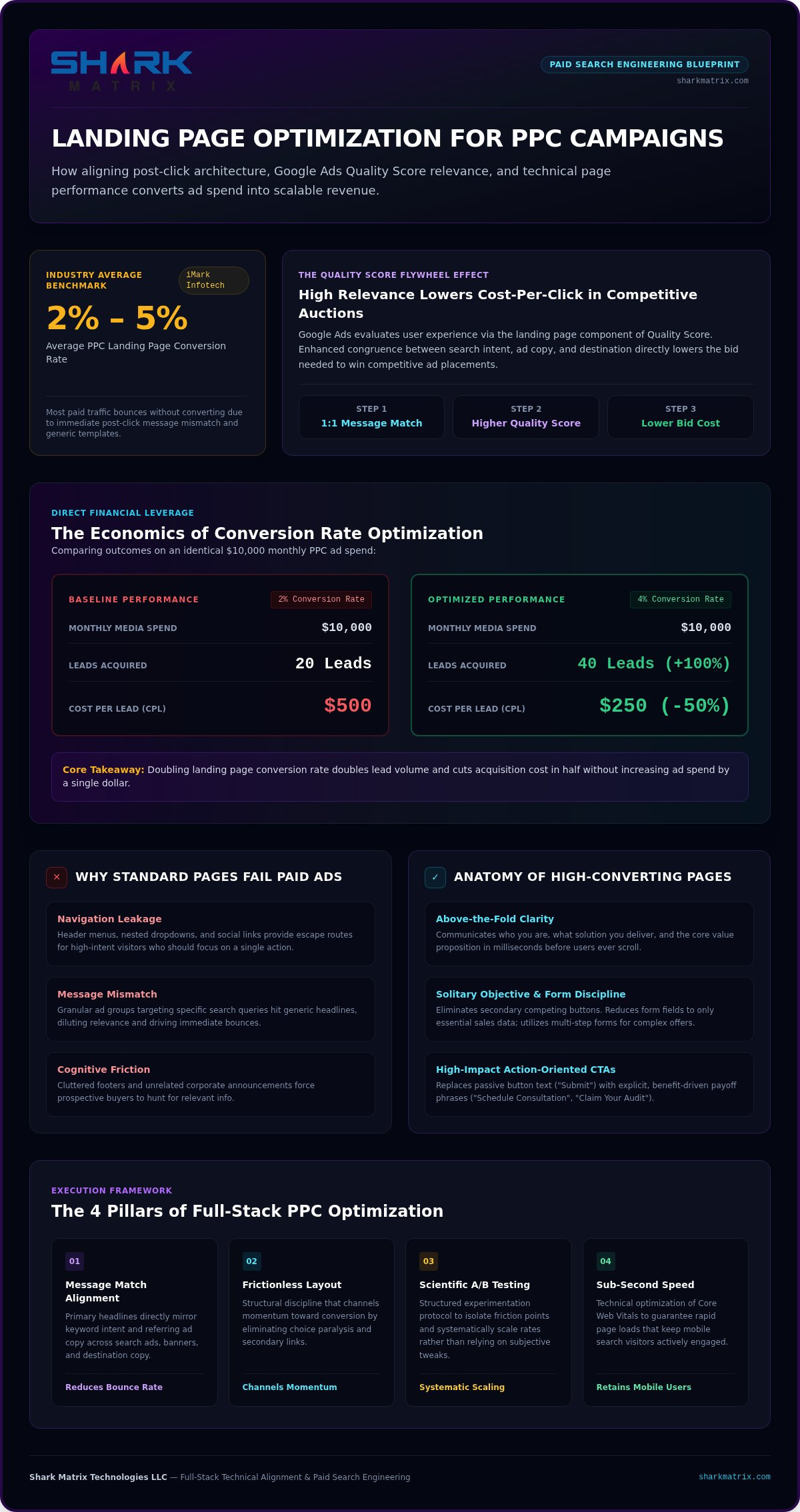
Conversion rate optimization acts as direct financial leverage for ad budgets, multiplying the revenue generated by every paid visitor without requiring a single extra dollar in media spend. If your campaign spends $10,000 per month to acquire 20 leads at a 2% conversion rate, the resulting cost-per-lead is $500. Doubling that page conversion rate to 4% yields 40 leads from the exact same spend, instantly slashing your cost-per-lead to $250.
Beyond lead volume, this efficiency creates a compounding advantage in paid auctions. Enhanced user relevance increases expected click-through rates and landing page ratings, allowing smart advertisers to secure prime ad positions above competitors while bidding significantly less per click.
Why Traditional Website Pages Fail Paid Ad Campaigns
Sending paid campaign traffic to a standard homepage or general corporate service page reliably destroys campaign profitability. Standard website structures are built for general discovery, not focused conversion. They introduce friction that drives away high-intent traffic:
- Navigation leakage: Header menus, nested dropdowns, and social links provide easy escape routes for prospects who should be focused entirely on a single action.
- Message mismatch: Granular ad groups targeting specific user queries need matching headlines and proof points, which generic service pages dilute.
- Cognitive friction: Cluttered footers and unrelated site announcements force prospective buyers to hunt for relevant information, triggering immediate bounces.
The Anatomy of a High-Converting PPC Landing Page
Every high-converting paid search destination requires razor-sharp visual balance, cognitive clarity, and structural discipline. When prospective clients click an ad, they form an impression in milliseconds. If your above-the-fold space fails to clarify who you are, what solution you deliver, and why your offer deserves attention, visitors leave immediately. Successful landing page optimization for ppc campaigns relies on a solitary, unambiguous objective. Eliminating conflicting secondary buttons prevents choice paralysis and channels user momentum toward conversion. Achieving this level of structural precision requires strategic engineering from an experienced web design and development team that knows how to eliminate user friction.
Perfecting the Message Match Between Ad Copy and Headlines
Your primary headline must directly mirror the query intent and language of the referring paid ad. If an ad promotes enterprise pipeline management, the landing page headline cannot switch to vague branding like “Innovative Solutions for Tomorrow.” Subheadings should immediately expand on the core promise with clear, benefit-driven context. Maintaining identical terms across search ads, banners, and landing copy reassures prospects they landed in the right place.
Designing High-Impact Conversion Forms and CTAs
Forms represent the highest barrier to entry on any paid landing page. Every additional input field lowers conversion probability, making it vital to collect only what sales teams need to initiate contact. Replace passive button text like “Submit” or “Click Here” with action-oriented phrases that emphasize immediate payoff, such as “Claim Your Audit” or “Schedule Consultation.” For high-ticket B2B offers requiring deeper discovery, multi-step forms break data collection into digestible steps that feel approachable.
- Single-focus fields: Request minimal initial data (such as name and corporate email) to secure the initial lead.
- Dynamic progress indicators: Display completion percentages on multi-step forms to encourage completion.
- High-contrast buttons: Use striking, distinct palette choices so your primary call-to-action stands out instantly.
Structuring Authentic Trust Signals and Social Proof
Trust assets should neutralize hesitation right at the point of conversion. Position recognizable partner badges, industry credentials, and verified star ratings alongside your primary form. Testimonials should highlight concrete business metrics and overcome explicit customer objections instead of offering generic praise. Prominent data privacy statements ensure corporate buyers know their contact details remain secure throughout the sales process.
How to Implement a Structured A/B Testing Framework for PPC
Random layout adjustments waste budget and obscure actionable insights. Sustainable performance demands a disciplined scientific methodology. Instead of making haphazard visual tweaks, structured landing page optimization for ppc campaigns isolates specific user friction points to validate their financial impact. High-intent paid visitors respond to clarity, not arbitrary redesigns. When you combine systematic experimentation with strategic PPC management, every marketing budget works toward verified conversion gains rather than speculative hunches.
Step 1: Baseline Data Auditing and Bottleneck Identification
Before launching an experiment, verify your tracking infrastructure. Check that Google Analytics 4 custom events, ad platform conversion pixels, and server-side tracking pipelines record conversions accurately without duplicates. Then, evaluate scroll depth maps and session replays to pinpoint where user momentum stalls. Are mobile users abandoning the page at the third form field? Do visitors ignore your primary value propositions? Calculating baseline conversion metrics for each individual ad campaign highlights the exact drop-off points that need structural intervention.
Step 2: Hypothesis Development and Variable Prioritization
Unfocused testing produces inconclusive data. Don’t squander early experimentation cycles on subtle aesthetic details like button colors. Prioritize radical structural transformations first. Replace passive text blocks with interactive questionnaires, or swap lengthy single-page forms for progressive lead capture flows. Formulate every hypothesis with strict logic: modifying a specific element will solve a documented visitor issue, producing a measurable lift. Score potential tests using the ICE framework, ranking each idea on Impact, Confidence, and Ease to build a high-leverage roadmap.
Step 3: Test Execution, Statistical Significance, and Iteration
Direct incoming paid traffic evenly between the control and variant pages using reliable server-side routing or testing tools. Keep bidding strategies, keyword match types, and ad creatives completely untouched throughout the testing window to prevent sample pollution. Let the test run until it achieves at least 95% statistical confidence across a significant volume of conversions. Ending tests early on temporary spikes leads to costly false positives. Once a variant wins, make it the new baseline control and immediately prepare your next iteration.
Advanced Technical Optimization: Speed, Dynamic Text, and AI Personalization
Modern paid traffic demands flawless technical execution. If your destination page takes several seconds to render or serves static, one-size-fits-all copy, conversion rates drop dramatically. High-performance landing page optimization for ppc campaigns requires engineering pages that load near-instantly while dynamically adapting to user intent. By pairing custom development with advanced AI automation services, marketing teams can deploy real-time post-click experiences that dramatically outperform generic templates.
Optimizing Mobile Performance and Core Web Vitals
Google Ads treats post-click page experience as a critical quality signal, making mobile Core Web Vitals an essential operational benchmark. A slow destination destroys ad efficiency; every single second of page load delay reduces mobile conversion rates by double digits. Keep your Largest Contentful Paint (LCP) under 2.5 seconds by serving next-gen image formats, utilizing modern CDNs, and eliminating render-blocking scripts. Interaction to Next Paint (INP) must remain under 200 milliseconds to guarantee instant touch feedback, while Cumulative Layout Shift (CLS) must stay below 0.1 by reserving layout dimensions for hero banners and dynamic elements.
Dynamic Keyword Insertion and Query-Level Alignment
Generic pages cannot address the nuanced needs of segmented paid search ad groups. Dynamic text replacement reads URL parameters passed from your ad platform and inserts the exact search phrase into your headline and body copy in real time. For national campaigns spanning diverse commercial sectors, dynamic insertion tailors value propositions to corporate buyers or retail customers seamlessly. Always establish clean fallback text in your template logic so headlines read naturally even if URL query parameters fail to pass.
AI-Powered Chat and Automated Lead Qualification
Static contact forms often fail to capture prospects who want immediate answers. Embedding real-time conversational agents through specialized AI chatbot development transforms standard pages into interactive lead qualification engines. Instead of waiting for a callback, visitors answer targeted qualification questions naturally within a fluid chat interface.
- Interactive data capture: Chat assistants collect intent signals, budget parameters, and contact information without overwhelming visitors.
- Intelligent routing: High-value enterprise prospects get flagged and routed directly to sales teams instantly.
- Continuous lead collection: Conversational bots qualify inbound paid traffic smoothly around the clock.
Ready to upgrade your conversion infrastructure? Connect with Shark Matrix to deploy custom-engineered landing page architectures that maximize every Dirham of your media investment.
Scaling PPC Results: Unifying Creative Strategy and Engineering Execution
Overcoming the Limitations of Generic Page Builders
Drag-and-drop page builders promise rapid deployment, but they introduce hidden performance costs. These platforms often generate bloated DOM structures and heavy script bundles that degrade Core Web Vitals and inflate your acquisition costs. Custom-engineered architectures give developers total control over script execution, database connections, and server-side rendering. Owning your codebase also allows seamless integration with enterprise CRM pipelines and bespoke tracking APIs without paying recurring third-party software licenses. For brands seeking clean, purpose-built sites that avoid unnecessary template bloat, learn more about New Wave Digital Designs to explore professional website design services.
Establishing Continuous Monitoring and CRO Hygiene
Conversion optimization isn’t a one-time project. High-volume ad spend demands systematic quality assurance to protect marketing budgets against silent revenue leaks:
- Form and API audits: Verify that webhooks, backend lead endpoints, and autoresponders fire correctly across major browser updates.
- Viewport validation: Check mobile rendering and touch targets regularly to ensure layouts remain frictionless on diverse screen sizes.
- Strategic roadmapping: Align landing page experiments directly with quarterly commercial targets rather than running disconnected tests.
Accelerating Campaign Returns with Professional Support
Unifying creative media buying with technical web execution generates compounding financial returns. Partnering with an integrated team that combines PPC management and custom web development eliminates handoff delays and technical bottlenecks. By treating ongoing landing page optimization for ppc campaigns as a core revenue engine, businesses across the United Arab Emirates can capture higher market share and protect their bottom line.
Transform Your Paid Search Traffic into Measurable Growth
Winning in competitive search auctions requires more than aggressive bidding and persuasive ad copy. Sustainable profitability demands dedicated landing page optimization for ppc campaigns that eliminates post-click friction, accelerates mobile load speeds, and tests radical architectural variations systematically. Relying on bloated, one-size-fits-all page builders only inflates acquisition costs and restricts your long-term campaign scalability.
True efficiency happens when paid media strategy unites seamlessly with technical web engineering and custom AI automation. By controlling your underlying codebase and aligning ad intent directly with high-converting user flows, you protect marketing budgets across the United Arab Emirates from wasted ad spend. Ready to scale your commercial pipeline without technical bottlenecks? Partner with Shark Matrix Technologies LLC for High-Performance PPC and Web Solutions to build high-converting post-click experiences that systematically increase conversion rates and compound your advertising returns.
Frequently Asked Questions
What is the difference between standard SEO pages and PPC landing pages?
SEO pages focus on comprehensive topic coverage and broad discovery, while PPC landing pages target a single commercial outcome. Standard organic pages feature site navigation, internal links, and long-form educational context to rank in search results. In contrast, paid landing pages remove navigation menus and secondary links, aligning directly with specific ad copy to eliminate friction and drive immediate conversions.
How much does landing page optimization improve PPC campaign conversion rates?
Rigorous optimization often doubles or triples baseline performance, shifting standard 2% conversion rates toward 6% or higher. Dedicated landing page optimization for ppc campaigns removes conversion bottlenecks, accelerates page rendering, and sharpens value propositions. Because every conversion increase lowers your cost-per-acquisition without requiring additional ad budget, systematic improvements compound campaign profitability across your entire media spend.
Can I use dynamic keyword insertion without hurting user experience?
Yes, dynamic keyword insertion works smoothly when supported by grammatical controls and dependable fallback text. This technique mirrors search intent by updating page headlines to match search queries in real time. To protect the user experience, apply dynamic insertion to tightly themed ad groups rather than raw search terms, and always code natural fallback copy if URL query parameters fail to load.
How long should an A/B test run on a paid search landing page?
An A/B test should run until it achieves at least 95% statistical confidence, which usually requires two to four full weeks of traffic. Running tests across full business cycles captures fluctuating buyer behavior across both weekdays and weekends. Never end an experiment early because of initial performance spikes. Reliable conclusions demand adequate sample sizes and sufficient conversion volumes.
What is a good conversion rate benchmark for PPC landing pages in 2026?
A typical conversion rate for paid search landing pages hovers between 2% and 5%, while top-performing destinations reach 10% or higher. Performance varies across business sectors. Lead generation pages commonly convert at 2% to 4%, whereas software trial funnels average 5% to 7%. Reaching top-tier benchmarks requires custom technical architectures rather than rigid, generic templates.
Why should businesses avoid sending Google Ads traffic to their homepage?
Homepages dilute paid traffic efficiency because they encourage general exploration rather than a single decisive action. Standard homepages contain navigation links, company news, and competing offers that create decision fatigue for high-intent buyers. Running paid traffic into dedicated environments designed for landing page optimization for ppc campaigns keeps prospects focused strictly on your core offer and primary conversion form.

 OpenAI
 Codex
Codex
 Vertex AI
 Cloud Vision
 OpenCV
 TensorFlow
 IBM Watson
 Cloud Natural Language
 Cognitive Services
 Bot Framework
 Mistral
 LLama
LLama
 Gemini
 Anthropic
 N8N
N8N