
Categories
Digital Marketing

Landing Page Optimization for PPC Campaigns: The 2026 Strategic Playbook

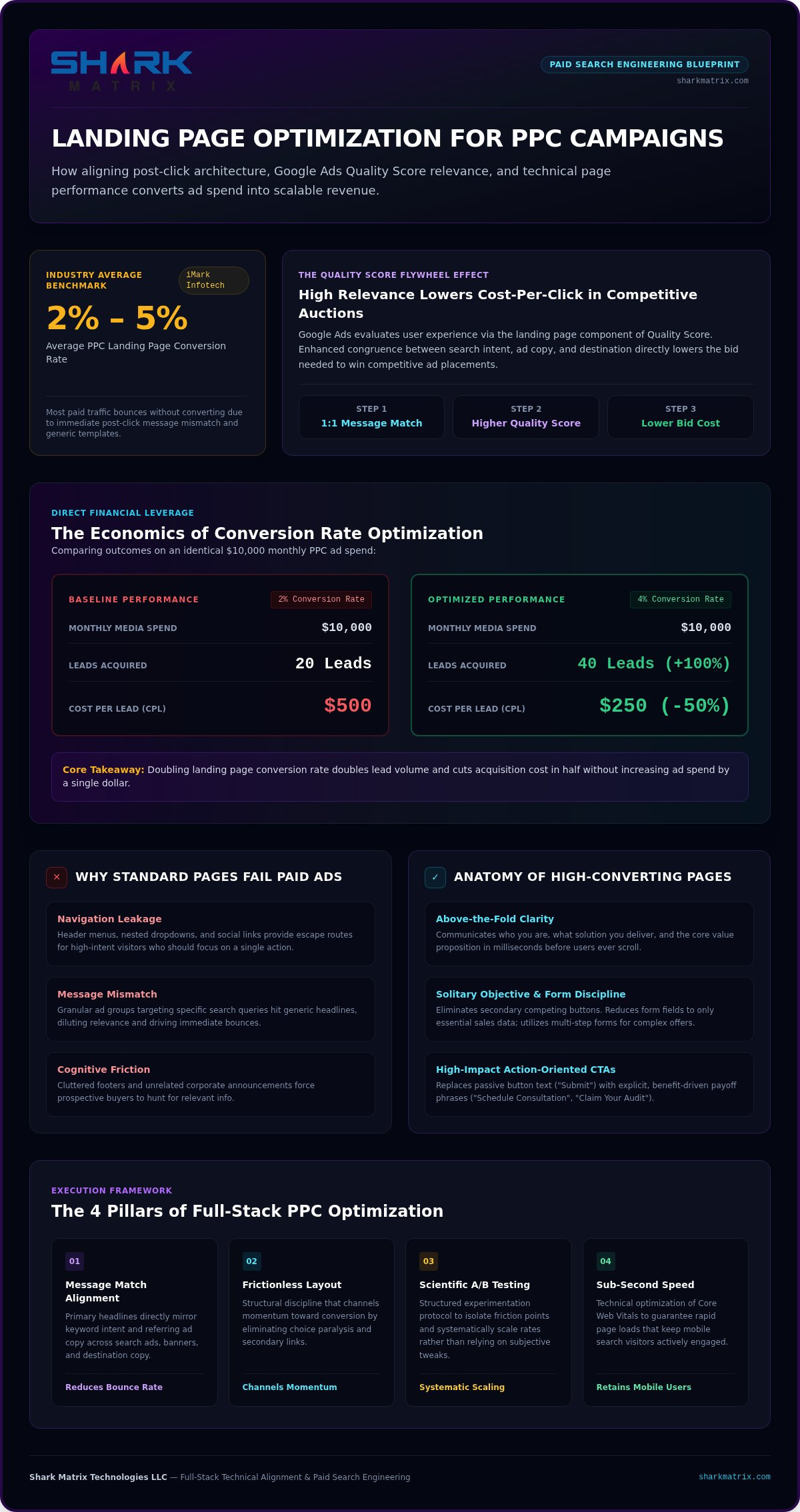
Most paid campaigns don’t fail because of targeting or bidding strategy; they collapse the second a visitor hits a post-click message mismatch. According to September 2026 data from iMark Infotech, the average PPC landing page converts at just 2% to 5%. In competitive search auctions across the United Arab Emirates, running traffic to generic templates without dedicated landing page optimization for ppc campaigns rapidly drains budgets while driving up customer acquisition costs.

It’s frustrating to watch thousands of AED vanish into paid clicks that bounce without converting, especially when low Quality Scores inflate your bids. You don’t have to rely on guesswork or superficial template tweaks to fix leaking funnels. In this guide, you will discover how to transform wasted ad spend into measurable revenue through full-stack technical alignment and structured experimentation. Here is your tactical playbook to engineer high-converting paid search destinations that systematically scale.

Key Takeaways

  • Master landing page optimization for ppc campaigns by aligning ad copy directly with post-click intent to reduce wasted ad spend and elevate Google Ads Quality Scores.
  • Structure high-performing page layouts that communicate core value propositions and drive clear actions before users ever need to scroll.
  • Implement a scientific A/B testing protocol to isolate friction points and systematically scale conversion rates instead of relying on subjective design tweaks.
  • Optimize Core Web Vitals and technical performance to ensure sub-second page loads that keep mobile visitors engaged.
  • Bridge the operational gap between paid search strategy and full-stack web engineering to build flexible, high-converting digital destinations.

What Is Landing Page Optimization for PPC Campaigns and Why Does It Matter?

Every paid click represents an upfront financial investment. While search engine marketing captures active user intent, the landing page determines whether that click converts into qualified revenue or becomes wasted spend. Landing page optimization (LPO) establishes structural, visual, and architectural congruence between your paid ad copy and the final web destination. Generic drag-and-drop templates often fail because they treat all web visitors identically. In contrast, rigorous landing page optimization for ppc campaigns focuses on visitors with immediate commercial intent who expect instant solutions rather than casual exploration.

When user expectations clash with your post-click environment, bounce rates surge. That disconnect inflates your average cost-per-acquisition (CPA) and signals to ad platforms that your page provides poor utility. Google Ads evaluates this experience directly through the landing page component of Quality Score. Higher historical conversion rates and tight relevance improve this score, systematically reducing the cost required to win competitive ad auctions.

The Economics of PPC Conversion Rate Optimization

Conversion rate optimization acts as direct financial leverage for ad budgets, multiplying the revenue generated by every paid visitor without requiring a single extra dollar in media spend. If your campaign spends $10,000 per month to acquire 20 leads at a 2% conversion rate, the resulting cost-per-lead is $500. Doubling that page conversion rate to 4% yields 40 leads from the exact same spend, instantly slashing your cost-per-lead to $250.

Beyond lead volume, this efficiency creates a compounding advantage in paid auctions. Enhanced user relevance increases expected click-through rates and landing page ratings, allowing smart advertisers to secure prime ad positions above competitors while bidding significantly less per click.

Why Traditional Website Pages Fail Paid Ad Campaigns

Sending paid campaign traffic to a standard homepage or general corporate service page reliably destroys campaign profitability. Standard website structures are built for general discovery, not focused conversion. They introduce friction that drives away high-intent traffic:

  • Navigation leakage: Header menus, nested dropdowns, and social links provide easy escape routes for prospects who should be focused entirely on a single action.
  • Message mismatch: Granular ad groups targeting specific user queries need matching headlines and proof points, which generic service pages dilute.
  • Cognitive friction: Cluttered footers and unrelated site announcements force prospective buyers to hunt for relevant information, triggering immediate bounces.

The Anatomy of a High-Converting PPC Landing Page

Every high-converting paid search destination requires razor-sharp visual balance, cognitive clarity, and structural discipline. When prospective clients click an ad, they form an impression in milliseconds. If your above-the-fold space fails to clarify who you are, what solution you deliver, and why your offer deserves attention, visitors leave immediately. Successful landing page optimization for ppc campaigns relies on a solitary, unambiguous objective. Eliminating conflicting secondary buttons prevents choice paralysis and channels user momentum toward conversion. Achieving this level of structural precision requires strategic engineering from an experienced web design and development team that knows how to eliminate user friction.

Perfecting the Message Match Between Ad Copy and Headlines

Your primary headline must directly mirror the query intent and language of the referring paid ad. If an ad promotes enterprise pipeline management, the landing page headline cannot switch to vague branding like “Innovative Solutions for Tomorrow.” Subheadings should immediately expand on the core promise with clear, benefit-driven context. Maintaining identical terms across search ads, banners, and landing copy reassures prospects they landed in the right place.

Designing High-Impact Conversion Forms and CTAs

Forms represent the highest barrier to entry on any paid landing page. Every additional input field lowers conversion probability, making it vital to collect only what sales teams need to initiate contact. Replace passive button text like “Submit” or “Click Here” with action-oriented phrases that emphasize immediate payoff, such as “Claim Your Audit” or “Schedule Consultation.” For high-ticket B2B offers requiring deeper discovery, multi-step forms break data collection into digestible steps that feel approachable.

  • Single-focus fields: Request minimal initial data (such as name and corporate email) to secure the initial lead.
  • Dynamic progress indicators: Display completion percentages on multi-step forms to encourage completion.
  • High-contrast buttons: Use striking, distinct palette choices so your primary call-to-action stands out instantly.

Structuring Authentic Trust Signals and Social Proof

Trust assets should neutralize hesitation right at the point of conversion. Position recognizable partner badges, industry credentials, and verified star ratings alongside your primary form. Testimonials should highlight concrete business metrics and overcome explicit customer objections instead of offering generic praise. Prominent data privacy statements ensure corporate buyers know their contact details remain secure throughout the sales process.
Landing Page Optimization for PPC Campaigns: The 2026 Strategic Playbook

How to Implement a Structured A/B Testing Framework for PPC

Random layout adjustments waste budget and obscure actionable insights. Sustainable performance demands a disciplined scientific methodology. Instead of making haphazard visual tweaks, structured landing page optimization for ppc campaigns isolates specific user friction points to validate their financial impact. High-intent paid visitors respond to clarity, not arbitrary redesigns. When you combine systematic experimentation with strategic PPC management, every marketing budget works toward verified conversion gains rather than speculative hunches.

Step 1: Baseline Data Auditing and Bottleneck Identification

Before launching an experiment, verify your tracking infrastructure. Check that Google Analytics 4 custom events, ad platform conversion pixels, and server-side tracking pipelines record conversions accurately without duplicates. Then, evaluate scroll depth maps and session replays to pinpoint where user momentum stalls. Are mobile users abandoning the page at the third form field? Do visitors ignore your primary value propositions? Calculating baseline conversion metrics for each individual ad campaign highlights the exact drop-off points that need structural intervention.

Step 2: Hypothesis Development and Variable Prioritization

Unfocused testing produces inconclusive data. Don’t squander early experimentation cycles on subtle aesthetic details like button colors. Prioritize radical structural transformations first. Replace passive text blocks with interactive questionnaires, or swap lengthy single-page forms for progressive lead capture flows. Formulate every hypothesis with strict logic: modifying a specific element will solve a documented visitor issue, producing a measurable lift. Score potential tests using the ICE framework, ranking each idea on Impact, Confidence, and Ease to build a high-leverage roadmap.

Step 3: Test Execution, Statistical Significance, and Iteration

Direct incoming paid traffic evenly between the control and variant pages using reliable server-side routing or testing tools. Keep bidding strategies, keyword match types, and ad creatives completely untouched throughout the testing window to prevent sample pollution. Let the test run until it achieves at least 95% statistical confidence across a significant volume of conversions. Ending tests early on temporary spikes leads to costly false positives. Once a variant wins, make it the new baseline control and immediately prepare your next iteration.

Advanced Technical Optimization: Speed, Dynamic Text, and AI Personalization

Modern paid traffic demands flawless technical execution. If your destination page takes several seconds to render or serves static, one-size-fits-all copy, conversion rates drop dramatically. High-performance landing page optimization for ppc campaigns requires engineering pages that load near-instantly while dynamically adapting to user intent. By pairing custom development with advanced AI automation services, marketing teams can deploy real-time post-click experiences that dramatically outperform generic templates.

Optimizing Mobile Performance and Core Web Vitals

Google Ads treats post-click page experience as a critical quality signal, making mobile Core Web Vitals an essential operational benchmark. A slow destination destroys ad efficiency; every single second of page load delay reduces mobile conversion rates by double digits. Keep your Largest Contentful Paint (LCP) under 2.5 seconds by serving next-gen image formats, utilizing modern CDNs, and eliminating render-blocking scripts. Interaction to Next Paint (INP) must remain under 200 milliseconds to guarantee instant touch feedback, while Cumulative Layout Shift (CLS) must stay below 0.1 by reserving layout dimensions for hero banners and dynamic elements.

Dynamic Keyword Insertion and Query-Level Alignment

Generic pages cannot address the nuanced needs of segmented paid search ad groups. Dynamic text replacement reads URL parameters passed from your ad platform and inserts the exact search phrase into your headline and body copy in real time. For national campaigns spanning diverse commercial sectors, dynamic insertion tailors value propositions to corporate buyers or retail customers seamlessly. Always establish clean fallback text in your template logic so headlines read naturally even if URL query parameters fail to pass.

AI-Powered Chat and Automated Lead Qualification

Static contact forms often fail to capture prospects who want immediate answers. Embedding real-time conversational agents through specialized AI chatbot development transforms standard pages into interactive lead qualification engines. Instead of waiting for a callback, visitors answer targeted qualification questions naturally within a fluid chat interface.

  • Interactive data capture: Chat assistants collect intent signals, budget parameters, and contact information without overwhelming visitors.
  • Intelligent routing: High-value enterprise prospects get flagged and routed directly to sales teams instantly.
  • Continuous lead collection: Conversational bots qualify inbound paid traffic smoothly around the clock.

Ready to upgrade your conversion infrastructure? Connect with Shark Matrix to deploy custom-engineered landing page architectures that maximize every Dirham of your media investment.

Scaling PPC Results: Unifying Creative Strategy and Engineering Execution

Overcoming the Limitations of Generic Page Builders

Drag-and-drop page builders promise rapid deployment, but they introduce hidden performance costs. These platforms often generate bloated DOM structures and heavy script bundles that degrade Core Web Vitals and inflate your acquisition costs. Custom-engineered architectures give developers total control over script execution, database connections, and server-side rendering. Owning your codebase also allows seamless integration with enterprise CRM pipelines and bespoke tracking APIs without paying recurring third-party software licenses. For brands seeking clean, purpose-built sites that avoid unnecessary template bloat, learn more about New Wave Digital Designs to explore professional website design services.

Establishing Continuous Monitoring and CRO Hygiene

Conversion optimization isn’t a one-time project. High-volume ad spend demands systematic quality assurance to protect marketing budgets against silent revenue leaks:

  • Form and API audits: Verify that webhooks, backend lead endpoints, and autoresponders fire correctly across major browser updates.
  • Viewport validation: Check mobile rendering and touch targets regularly to ensure layouts remain frictionless on diverse screen sizes.
  • Strategic roadmapping: Align landing page experiments directly with quarterly commercial targets rather than running disconnected tests.

Accelerating Campaign Returns with Professional Support

Unifying creative media buying with technical web execution generates compounding financial returns. Partnering with an integrated team that combines PPC management and custom web development eliminates handoff delays and technical bottlenecks. By treating ongoing landing page optimization for ppc campaigns as a core revenue engine, businesses across the United Arab Emirates can capture higher market share and protect their bottom line.

Transform Your Paid Search Traffic into Measurable Growth

Winning in competitive search auctions requires more than aggressive bidding and persuasive ad copy. Sustainable profitability demands dedicated landing page optimization for ppc campaigns that eliminates post-click friction, accelerates mobile load speeds, and tests radical architectural variations systematically. Relying on bloated, one-size-fits-all page builders only inflates acquisition costs and restricts your long-term campaign scalability.

True efficiency happens when paid media strategy unites seamlessly with technical web engineering and custom AI automation. By controlling your underlying codebase and aligning ad intent directly with high-converting user flows, you protect marketing budgets across the United Arab Emirates from wasted ad spend. Ready to scale your commercial pipeline without technical bottlenecks? Partner with Shark Matrix Technologies LLC for High-Performance PPC and Web Solutions to build high-converting post-click experiences that systematically increase conversion rates and compound your advertising returns.

Frequently Asked Questions

What is the difference between standard SEO pages and PPC landing pages?

SEO pages focus on comprehensive topic coverage and broad discovery, while PPC landing pages target a single commercial outcome. Standard organic pages feature site navigation, internal links, and long-form educational context to rank in search results. In contrast, paid landing pages remove navigation menus and secondary links, aligning directly with specific ad copy to eliminate friction and drive immediate conversions.

How much does landing page optimization improve PPC campaign conversion rates?

Rigorous optimization often doubles or triples baseline performance, shifting standard 2% conversion rates toward 6% or higher. Dedicated landing page optimization for ppc campaigns removes conversion bottlenecks, accelerates page rendering, and sharpens value propositions. Because every conversion increase lowers your cost-per-acquisition without requiring additional ad budget, systematic improvements compound campaign profitability across your entire media spend.

Can I use dynamic keyword insertion without hurting user experience?

Yes, dynamic keyword insertion works smoothly when supported by grammatical controls and dependable fallback text. This technique mirrors search intent by updating page headlines to match search queries in real time. To protect the user experience, apply dynamic insertion to tightly themed ad groups rather than raw search terms, and always code natural fallback copy if URL query parameters fail to load.

How long should an A/B test run on a paid search landing page?

An A/B test should run until it achieves at least 95% statistical confidence, which usually requires two to four full weeks of traffic. Running tests across full business cycles captures fluctuating buyer behavior across both weekdays and weekends. Never end an experiment early because of initial performance spikes. Reliable conclusions demand adequate sample sizes and sufficient conversion volumes.

What is a good conversion rate benchmark for PPC landing pages in 2026?

A typical conversion rate for paid search landing pages hovers between 2% and 5%, while top-performing destinations reach 10% or higher. Performance varies across business sectors. Lead generation pages commonly convert at 2% to 4%, whereas software trial funnels average 5% to 7%. Reaching top-tier benchmarks requires custom technical architectures rather than rigid, generic templates.

Why should businesses avoid sending Google Ads traffic to their homepage?

Homepages dilute paid traffic efficiency because they encourage general exploration rather than a single decisive action. Standard homepages contain navigation links, company news, and competing offers that create decision fatigue for high-intent buyers. Running paid traffic into dedicated environments designed for landing page optimization for ppc campaigns keeps prospects focused strictly on your core offer and primary conversion form.
Categories
Digital Marketing

Professional Page Speed Optimization Services in Dubai: Boosting UAE Business Performance

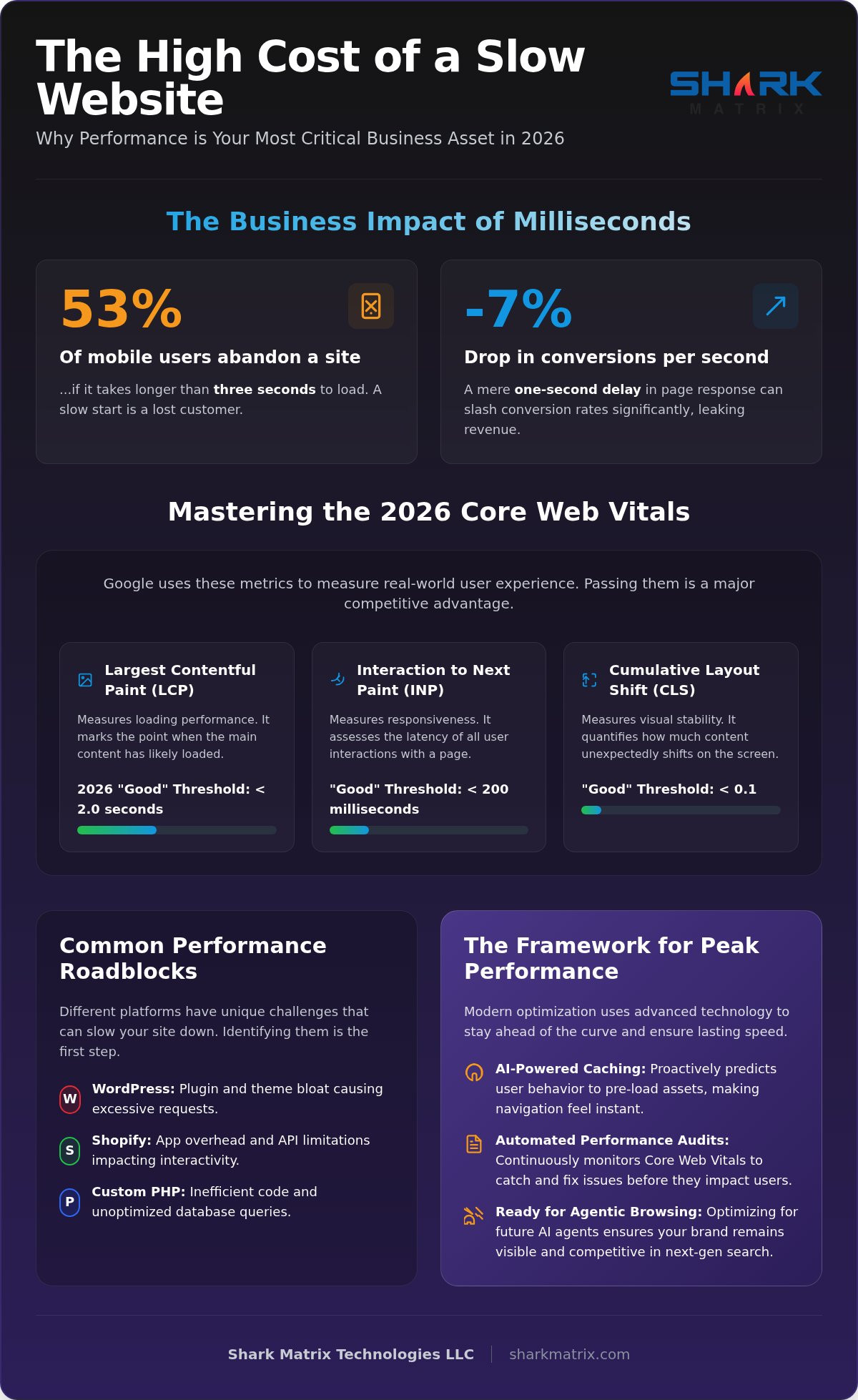
Did you know that 53% of mobile users nationwide will abandon your website if it takes longer than three seconds to load? In our fast-paced digital economy, a one-second delay can slash your conversion rates by 7%. It’s a harsh reality that a slow site isn’t just a technical glitch; it’s a direct leak in your revenue stream. Investing in professional page speed optimization services dubai is no longer optional if you want to stop losing customers to faster competitors. Many businesses struggle with low search rankings and confusing technical jargon, but your website’s performance should be your strongest asset.

It’s frustrating to see your hard work undermined by poor performance metrics, but there’s a clear path to recovery. We promise to show you how to transform your website into a high-speed conversion engine that dominates search results. You’ll learn how to master the 2026 Core Web Vitals standards, including the new 2.0-second LCP threshold and INP requirements. We’ll also preview how Shark Matrix Technologies LLC uses AI automation and advanced web development to maintain peak performance, ensuring your brand delivers the seamless mobile experience your customers expect. By the end of this guide, you’ll understand how to future-proof your site for the era of agentic browsing and national growth.

Key Takeaways

  • Understand why technical load times are a critical business asset for capturing high-intent mobile users across the country.
  • Learn how to meet the 2026 “Good” LCP threshold of 2.0 seconds and the vital Interaction to Next Paint (INP) scores for better rankings.
  • Identify how to resolve platform-specific performance issues like plugin bloat in WordPress or API limitations within Shopify environments.
  • Discover how professional page speed optimization services dubai integrate AI for predictive caching and automated performance auditing.
  • Gain insights into future-proofing your website for agentic browsing to maintain a competitive edge and national brand authority.

The Business Impact of Page Speed Optimization Services in Dubai

Page speed optimization is the technical process of reducing the time it takes for a website to load and become fully interactive. It involves a complex series of refinements to a site’s code, server configuration, and asset delivery to ensure a seamless user experience. In 2026, Google treats site speed as a primary ranking signal, meaning that a slow website is effectively invisible to high-intent searchers across the country. Utilizing professional page speed optimization services dubai ensures that your technical foundation supports your broader growth goals.

Slow performance leads to immediate revenue loss and increased bounce rates. When a page takes too long to respond, users don’t wait; they leave. Data indicates that a mere one-second delay can cause a 7% drop in conversions, while 53% of mobile users abandon sites that take longer than three seconds to load. For a national brand, this translates to significant lost opportunities every day. Implementing high-performance Web performance optimization (WPO) is not just a technical task. It’s a strategic move to protect your bottom line and improve your brand’s digital authority.

Why National Brands Prioritize Loading Times

Speed acts as a silent ambassador for your brand. When a site loads instantly, it signals professionalism and reliability to high-value clients across the Emirates. This builds immediate trust, which is essential for lead generation and e-commerce success. In a competitive market, outperforming slower legacy websites in search results gives you a massive advantage. Faster sites earn higher engagement metrics, which search engines reward with better visibility. Brands that ignore these metrics find themselves falling behind competitors who treat performance as a core business asset.

The Mobile-First Reality of the UAE Market

The UAE has one of the highest mobile penetration rates globally, with consumers expecting desktop-level speeds on their smartphones. While widespread 5G connectivity is the standard, it doesn’t fix a bloated website; it only highlights technical inefficiencies. Optimizing for diverse mobile hardware is essential because not every customer uses the latest flagship device. Success in 2026 depends on mobile performance scores rather than outdated desktop metrics. By focusing on web development that prioritizes mobile responsiveness, companies can reduce friction for on-the-go users and secure long-term national brand growth.

Decoding Core Web Vitals and Technical Performance Metrics

Measuring website performance requires looking beyond a simple loading bar. In 2026, Google evaluates user experience through a specific set of metrics known as Core Web Vitals. These benchmarks provide a standardized way to quantify how real people interact with your site. Only 47% to 53% of websites globally pass all three thresholds; achieving these scores is a significant competitive advantage. High-quality page speed optimization services dubai focus on these metrics to ensure your technical foundation supports national brand growth.

Largest Contentful Paint (LCP) measures how long it takes for the most substantial visual element on a page to appear. Following the March 2026 update, the “Good” threshold for LCP was tightened from 2.5 seconds to 2.0 seconds. If your hero image or primary headline takes longer than this to render, users perceive the site as sluggish. This perception directly impacts your bounce rate. We prioritize optimizing the critical rendering path to ensure these key elements load first, keeping users engaged from the very first second.

Interactivity is now measured primarily through Interaction to Next Paint (INP), which replaced First Input Delay (FID) as a primary ranking signal. For a “Good” rating, your site must respond to user actions, like clicking a lead generation button, in under 200 milliseconds. Visual stability is equally vital. Cumulative Layout Shift (CLS) tracks whether elements jump around as the page loads. A score of less than 0.1 prevents accidental clicks and ensures a frustration-free experience. Finally, Time to First Byte (TTFB) remains the gold standard for server-side health; it measures the initial connection speed before any content even starts to download.

Advanced Technical SEO Auditing

Effective optimization starts with a deep dive into your site’s current performance. We use automated tools to identify render-blocking resources that prevent your page from displaying content quickly. It’s vital to distinguish between lab data, which is collected in a controlled environment, and field data, which reflects the actual experiences of users across the Emirates. A comprehensive SEO audit uncovers these hidden bottlenecks, allowing for a targeted strategy that fixes real-world issues rather than just chasing theoretical scores.

Server-Side Optimization Strategies

Your server configuration is the backbone of your site’s speed. While global CDNs are excellent for scaling, local hosting often provides the lowest latency for a national audience. We implement Brotli compression, a modern alternative to Gzip that offers superior data transfer speeds for 2026 browsers. For resource-heavy e-commerce platforms, we optimize database queries to ensure that searching for products doesn’t strain your server. If you’re seeing performance lags, it might be time to consider how professional technical web development can stabilize your infrastructure.

Professional Page Speed Optimization Services in Dubai: Boosting UAE Business Performance

Platform-Specific Optimization: WordPress, Shopify, and Custom PHP

Every website platform presents a unique set of technical challenges and opportunities. SaaS solutions like Shopify offer a managed environment that handles server health, yet they often restrict deep access to the underlying infrastructure. In contrast, open-source systems like WordPress provide total control but frequently suffer from “plugin bloat.” This occurs when too many third-party tools are added, slowing down the database and front-end. Professional page speed optimization services dubai navigate these differences to ensure your technical stack remains lean and responsive, regardless of the platform you choose.

WordPress sites, particularly those running version 7.1, require a disciplined approach to asset management. It’s easy to fall into the trap of using heavy themes that include features you’ll never use. We focus on auditing every active plugin and removing redundant scripts that add unnecessary weight. For Shopify users, staying current with the latest stable API version, such as 2026-07, is essential for maintaining a fast connection between your store and external services. By cleaning up liquid files and optimizing app scripts, we help national brands maintain a competitive edge without sacrificing the convenience of their chosen CMS.

Optimizing E-commerce Performance

For online stores, script execution time is often the biggest hurdle to a fast user experience. Every tracking pixel, customer review widget, and marketing app adds a processing burden to the user’s browser. Our e-commerce development strategy integrates speed from the very beginning. We balance high-quality product imagery with aggressive compression using modern formats like WebP or AVIF. This ensures your products look stunning without forcing customers to wait for massive files to download. Specialized checkout speed optimization is also vital; a friction-free payment process is often the deciding factor in whether a customer completes a purchase or abandons their cart.

Custom Development and Performance Engineering

Custom PHP development offers the ultimate flexibility for achieving near-instant load times. Unlike off-the-shelf themes that are built to suit everyone, custom-built frameworks contain only the specific code your site needs to function. This reduces browser processing time significantly. We leverage modern CSS and JavaScript minification to strip away every redundant byte from your site’s codebase. By focusing on performance engineering, we turn your website into a high-speed business asset. This level of technical precision is why custom solutions often outperform generic templates in both search rankings and user retention. Tailored page speed optimization services dubai provide the technical edge required for sustained national brand growth in 2026.

The Shark Matrix Framework for High-Performance Websites

Shark Matrix Technologies LLC uses a structured, four-phase methodology to ensure every website reaches its maximum potential. Our framework for page speed optimization services dubai begins with Phase 1: Deep-dive technical discovery. We don’t just look at scores; we establish baseline benchmarks for real-world performance across the Emirates. Phase 2 involves production-safe implementation. We address both front-end and back-end fixes without disrupting your live business operations. This ensures your site remains functional while we refine its core architecture.

Phase 3 focuses on continuous testing. We simulate various network speeds and hardware types to ensure a consistent experience for every user. Finally, Phase 4 provides post-optimization reporting. We translate technical jargon into clear business impact metrics, showing exactly how speed improvements correlate with your growth. This systematic approach ensures that high-performance standards are maintained long after the initial fixes are applied. By monitoring these metrics in real-time, we help national brands stay ahead of performance decay.

UI/UX Alignment with Speed Goals

Design and performance are two sides of the same coin. A minimalist design supports faster rendering by reducing the number of elements the browser needs to process. This doesn’t mean sacrificing brand appeal; it means choosing high-impact visual elements that load efficiently. We also consider the “Psychology of Speed.” By managing user expectations during load, such as using skeleton screens, we reduce perceived wait times. There’s a deep synergy between professional UI/UX design and site performance. When your design is built for speed, users stay longer and engage more deeply with your content.

Data-Driven Lead Generation Through Speed

Speed is a silent driver of conversions. Improving load times directly leads to higher form completion rates, especially for national B2B brands where decision-makers are time-poor. By reducing friction in the customer journey, you make it easier for prospects to reach out. Speed also offers a direct ROI through enhanced PPC landing page quality scores. When your site loads instantly, your ad spend becomes more efficient, lowering your cost per lead. If you want to see these results for your own brand, partnering with an experienced SEO company dubai can help align your technical performance with your commercial objectives.

Integrating AI and Future-Proofing Performance for 2026

By 2026, the standard for web performance has shifted from reactive fixes to proactive, AI-driven management. Static code minification is just the beginning. Modern page speed optimization services dubai now leverage predictive caching to anticipate user behavior. By analyzing historical navigation patterns, AI models can pre-load specific assets before a user even clicks a link. This creates a near-instantaneous experience that mimics the speed of a local application rather than a remote server.

Automated image optimization has also evolved through machine learning algorithms. Instead of applying a blanket compression level, these systems analyze every pixel to find the perfect balance between visual fidelity and file size. Machine learning also powers continuous monitoring tools. These systems alert development teams to performance regressions in real-time, preventing slow code from reaching production. As Google continues to prioritize deep user engagement signals, staying ahead of these technical shifts is vital for national brand authority.

AI-Powered Optimization Services

Maintaining a high-speed infrastructure requires constant vigilance. We utilize AI automation services to handle repetitive performance tasks, such as database indexing and script cleanup. Natural Language Processing (NLP) plays a unique role here too. By understanding the search intent behind a user’s query, we can optimize the specific load paths that matter most for that interaction. Custom AI solutions allow for dynamic content delivery, ensuring that a user on a 5G connection receives a rich experience while someone on a limited network gets a streamlined, ultra-fast version of the site.

The Future of High-Speed Digital Experience

The rise of “Agentic Browsing” and Answer Engine Optimization (AEO) has changed the landscape. In May 2026, Lighthouse 13.3 introduced an experimental category to check for a site’s readiness for AI agents. These agents require structured, fast-loading data to provide accurate answers to users. Speed is no longer just about human eyes; it’s about being readable for the AI tools that drive modern search. Edge computing further supports this by moving processing power closer to the user, ensuring national-scale performance regardless of their location. If your site is struggling to keep up with these 2026 standards, it’s time to take action. Contact Shark Matrix for a comprehensive performance audit to secure your brand’s digital future.

Secure Your Competitive Edge in the High-Speed UAE Market

We’ve explored how technical load times directly impact your bottom line and why mastering the 2026 Core Web Vitals, including the 2.0-second LCP threshold, is non-negotiable for national brand growth. From resolving platform-specific bloat in WordPress or Shopify to integrating predictive AI caching, the path to a high-performance website requires a blend of development expertise and strategic automation. Your digital presence must be ready for both human users and the emerging era of agentic browsing.

Choosing professional page speed optimization services dubai ensures your site doesn’t just pass technical tests but actually converts high-intent mobile users across the country. Shark Matrix Technologies LLC brings over 15 years of technical SEO expertise and specialized AI integration to help you outpace the competition. We focus on national market growth, ensuring your infrastructure is resilient and future-proof. Elevate Your Site Speed with Shark Matrix Technologies and transform your website into a flawless, high-speed engine. It’s time to deliver the seamless experience your customers expect.

Frequently Asked Questions

How long does it take to see results from page speed optimization?

Technical improvements happen as soon as the code is deployed. However, Google’s field data for Core Web Vitals is based on a rolling 28-day average. You’ll usually see the full impact within a month. For national brand growth, these gains lead to higher conversion rates almost instantly. User friction decreases immediately, allowing your customers to navigate your product pages without any frustrating delays.

Will speed optimization change the look or design of my website?

Most optimizations happen in the background within the site’s code and server configuration. While the core design remains the same, you might notice subtle improvements like images loading smoothly or buttons responding faster. Professional page speed optimization services dubai focus on efficiency without compromising your brand’s visual identity. The goal is making your existing UI/UX design perform better across all devices.

Is page speed a direct ranking factor for Google in 2026?

Yes, page speed is a primary ranking signal in 2026. Following the March 2026 update, Google tightened the “Good” threshold for Largest Contentful Paint to 2.0 seconds. Interaction to Next Paint is also critical. Sites that fail these benchmarks often see a sharp decline in organic traffic. Search engines prioritize platforms that provide a flawless user experience across all mobile hardware types.

What is a good page load time for a business website in the UAE?

For a competitive business website, aim for a Largest Contentful Paint of 2.0 seconds or less. Mobile performance is the most important metric. Most users nationwide access the web via their phones. Achieving these speeds ensures you meet high consumer expectations and maintain compliance with the latest global web performance standards for 2026. It’s the best way to reduce bounce rates and increase engagement.

Can I optimize my website speed myself using plugins?

Plugins offer basic fixes like caching or image compression. However, they often lead to plugin bloat which can slow your site down. True performance engineering requires deep-dive technical discovery. Production-safe implementation is essential. For national brands, relying on automated tools isn’t enough to pass strict 2026 thresholds. You must also future-proof your digital presence to be ready for agentic browsing.

Why does my website score differently on mobile vs. desktop?

Mobile scores are usually lower. Mobile processors are less powerful than desktop ones and cellular networks can be less stable. Google uses mobile-first indexing. It prioritizes the mobile version of your site for ranking. Even with 5G connectivity, mobile devices require more efficient code. Lighter assets are necessary to achieve the same perceived speed as a desktop computer during a standard browsing session.

Does hosting location affect my site speed for national users?

Physical distance between your server and your users creates latency. For a national audience, hosting your website on local servers is essential. You can also use a Content Delivery Network with nodes across the country. This reduces the Time to First Byte. It ensures data travels the shortest possible distance. This is critical for meeting 2026 e-commerce standards and keeping your bounce rates low.

How often should I conduct a page speed audit?

Conduct a comprehensive audit at least once every quarter. Performance can decay over time as you grow. Adding new content, marketing pixels, or third-party scripts slows things down significantly. Regular monitoring catches regressions before they impact search rankings. Utilizing page speed optimization services dubai helps you stay ahead of the competition. You can adapt quickly to new search engine algorithm updates as they happen.

Categories
Development

How UI/UX Design Impacts Conversion Rates: The 2026 Strategic Guide

Every single dollar you invest in user experience can return up to $100. That is a 9,900% ROI that many nat