

Categories
Development

How UI/UX Design Impacts Conversion Rates: The 2026 Strategic Guide

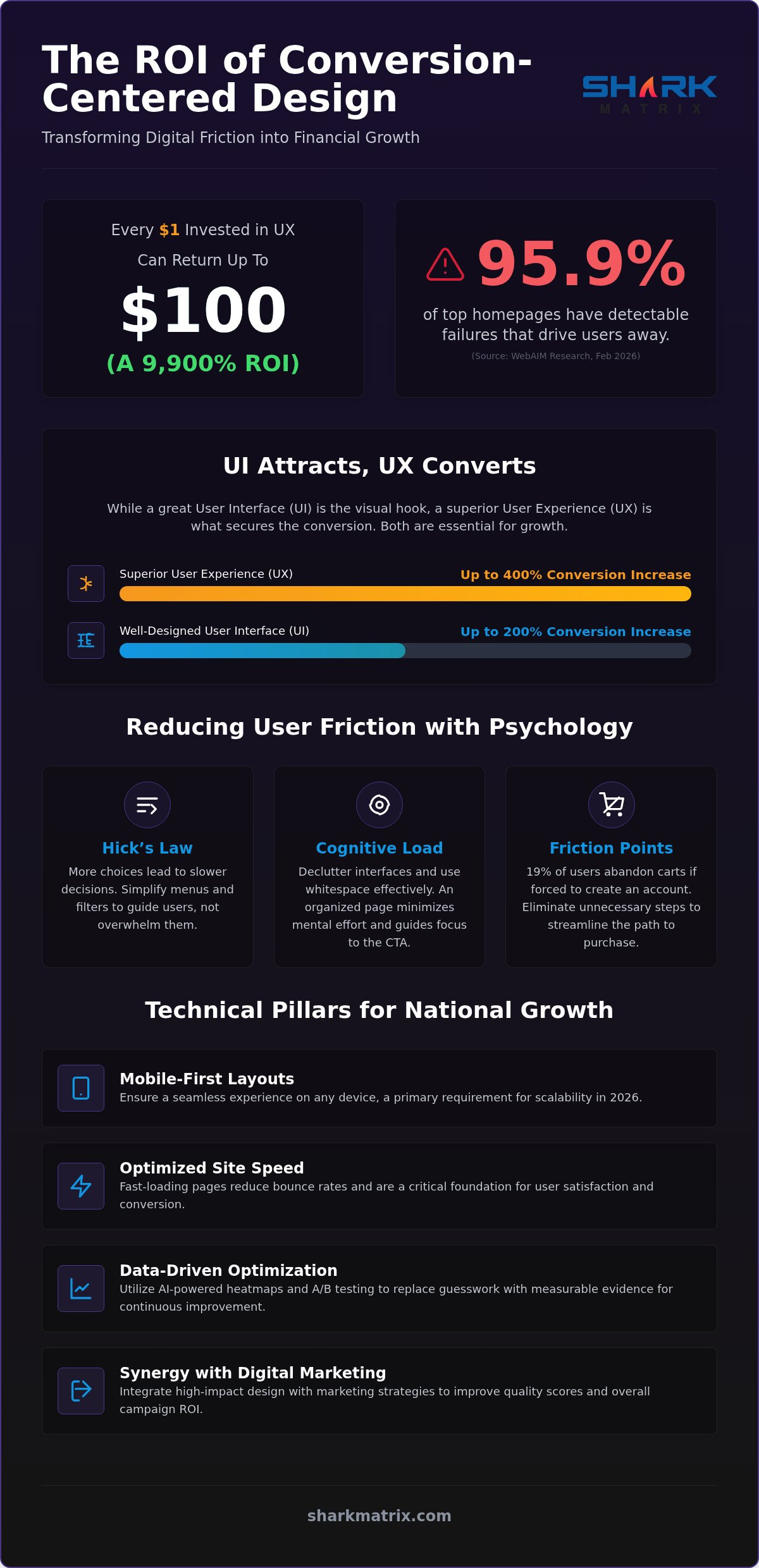
Every single dollar you invest in user experience can return up to $100. That is a 9,900% ROI that many national brands in the UAE are leaving on the table because of hidden friction points. Understanding how ui/ux design impacts conversion rates is no longer just a design concern; it’s a financial imperative. It’s frustrating to watch high-quality traffic hit your landing pages only to bounce seconds later. You might feel the pressure of justifying design spend when the difference between UI and UX still feels blurry. According to WebAIM research from February 2026, 95.9% of top homepages still suffer from detectable failures that drive users away.

This strategic guide provides a clear framework for conversion-centered design that transforms passive visitors into loyal customers. You will learn how to drive measurable ROI from your digital marketing spend by reducing cognitive load and simplifying the path to purchase. We’ll look at how superior UX can increase conversion rates by up to 400% and how AI automation is now essential for creating faster, more intuitive user journeys. By the end, you’ll have the data needed to turn your digital presence into a high-performing sales engine for your national brand.

Key Takeaways

  • Learn why a visually stunning interface requires a functional user journey to prevent high bounce rates on key landing pages.
  • Understand how ui/ux design impacts conversion rates by applying psychological principles like Hick’s Law to minimize user friction.
  • Discover why mobile-first layouts and optimized site speed are the primary technical pillars for national scalability in 2026.
  • Master data-driven optimization using AI-powered heatmaps and A/B testing to replace design guesswork with measurable evidence.
  • Explore the synergy between high-impact design and digital marketing strategies to improve quality scores and overall campaign ROI.

The relationship between aesthetics and functionality is often misunderstood as a choice between beauty and brains. In reality, understanding how ui/ux design impacts conversion rates requires viewing them as a unified force. While User Interface (UI) focuses on the visual touchpoints, User Experience (UX) governs the logic behind every click. A site can look stunning, but if the checkout process is a maze, customers will leave. Research from Forrester highlights this impact clearly. A well-designed UI can increase conversion rates by up to 200%, but superior UX design can lead to a 400% increase.

Success in conversion rate optimization relies on balancing the “Friction vs. Motivation” equation. Your marketing efforts build motivation, but poor design creates friction. If the friction outweighs the motivation, the user abandons the site. High-impact web development for national brands ensures that design elements actively remove barriers rather than creating them. By integrating technical AI capabilities, brands can now predict friction points before they impact the bottom line.

UI vs. UX: Two Sides of the Conversion Coin

UI serves as the visual hook. It uses color palettes, typography, and imagery to build immediate brand trust. In a competitive national market, a professional appearance is the baseline for credibility. It’s the “skin” of your digital product. Conversely, UX is the structural logic that guides the user toward the “Buy” or “Contact” button. UX maps the journey, ensuring that information is where a user expects it to be. For national brands to scale, these two elements must work in tandem. UI attracts the eye, but UX satisfies the intent. Without this balance, even the most expensive traffic will fail to convert.

The ROI of User-Centric Design in 2026

Investing in professional design directly reduces customer acquisition costs (CAC). When your site converts a higher percentage of visitors, every marketing dirham goes further. Beyond immediate sales, effortless experiences drive long-term brand loyalty. According to a 2025 Forrester study, organizations implementing continuous UX testing saw up to a 10.8% increase in revenue retention over three years. Analyzing how ui/ux design impacts conversion rates reveals that it’s a long-term financial strategy, not a one-time expense. Conversion-Centered Design is the strategic practice of aligning every visual and structural element of a digital interface with a specific business goal.

The Psychology of Design: Reducing Friction in the User Journey

Psychological principles aren’t just theory; they’re the engine of a high-converting site. Hick’s Law is a prime example. It suggests that increasing the number of choices exponentially increases the time required to make a decision. For a national brand in the UAE, this means simplifying navigation menus and product filters. If you overwhelm a visitor with thirty options on a landing page, they’ll likely choose none and leave. Understanding how ui/ux design impacts conversion rates involves looking deep into these human decision-making patterns.

Micro-interactions also play a silent but vital role in the journey. These are small animations or feedback loops, like a button changing color when hovered over or a progress bar during a file upload. They provide instant reassurance that the system is responding to the user’s intent. This reduces the “waiting anxiety” that often kills potential sales. Clear, transparent UI elements combined with social proof, like verified customer reviews and trust badges, build the psychological safety necessary for a user to share their credit card details.

Managing Cognitive Load for Faster Decision Making

Decluttering is essential for modern interfaces. You don’t need to remove information, just organize it to prevent cognitive overload. Whitespace is a powerful tool here; it forces the eye toward your call-to-action (CTA) rather than letting it wander. Nielsen Norman Group defines conversion rate as the percentage of users who complete a desired action. To keep this percentage high, you must minimize friction. For instance, requiring account creation before purchase is a major barrier. In 2025, Baymard Institute found that 19% of shoppers abandoned carts for this very reason. Consistency in navigation patterns also helps, as users don’t have to “re-learn” how to use your site on every new page.

Visual Hierarchy and the “Golden Path”

Every page needs a “Golden Path,” which is the ideal route you want a user to take from entry to checkout. Visual hierarchy uses size, contrast, and directional cues to light this path. Your primary CTA should be the most visually prominent element on the page, often using a high-contrast color that stands out from the background. Keeping crucial information above the fold ensures that users don’t have to scroll to find the value proposition. When analyzing how ui/ux design impacts conversion rates, it’s clear that guiding the eye is just as important as the offer itself. If you’re looking to scale your digital presence, investing in web development agency services that prioritize these psychological frameworks is a critical step for national growth.
How UI/UX Design Impacts Conversion Rates: The 2026 Strategic Guide

Technical UI/UX Pillars That Drive National Business Growth

While psychology influences intent, technical pillars provide the infrastructure for conversion. National brands must realize that good UX design means better business because it ensures stability and inclusivity across all devices. In 2026, accessibility is no longer optional. The European Accessibility Act became effective in June 2025, and while it’s an EU mandate, it has set a global benchmark for WCAG 2.2 AA compliance. Failing to meet these standards limits your reach and alienates a significant portion of your potential audience.

For national UAE growth, localized UX is a non-negotiable pillar. This goes beyond simple translation. It requires designing for bilingual expectations, ensuring that Right-to-Left (RTL) layouts for Arabic are as intuitive as Left-to-Right (LTR) English versions. Mirroring interfaces correctly prevents cognitive friction for local users. When you respect linguistic and cultural navigation habits, you build the trust necessary for high-value transactions.

Optimizing for a Mobile-Dominant National Audience

The UAE market is mobile-first. Responsive layouts that simply shrink desktop elements are no longer sufficient. True mobile-first design prioritizes thumb-friendly navigation and places call-to-action (CTA) buttons within natural reach zones. You should simplify forms for small screens to prevent the high drop-off rates associated with complex data entry. Leveraging native mobile features, such as biometric authentication or integrated payment wallets, creates a seamless checkout experience. This technical precision is a core part of how ui/ux design impacts conversion rates in a mobile-dominant landscape.

Performance Engineering and UX

Site speed is a critical UX metric that dictates whether a user stays or bounces. In 2026, users expect sub-second load times. Even a slight delay can trigger a significant spike in abandonment. This is why performance engineering is central to any web development agency dubai strategy. Google’s Core Web Vitals continue to be the standard for measuring user experience through loading performance, interactivity, and visual stability. By optimizing these technical metrics, you improve both your SEO rankings and your user retention. Understanding how ui/ux design impacts conversion rates means recognizing that a beautiful site is useless if it doesn’t load fast enough to be seen. High-performing code is the silent partner of creative design.

Data-Driven UX Optimization: Testing, AI, and Iteration

Design in 2026 is no longer a matter of opinion. Moving from “I think” to “I know” requires a rigorous commitment to data. Analyzing how ui/ux design impacts conversion rates requires a shift from subjective aesthetics to objective performance metrics. Tools like heatmaps and session recordings allow you to visualize exactly where users get stuck or abandon their journey. If a heatmap shows users clicking on a non-interactive element, you’ve identified a friction point that’s actively costing you revenue. A/B testing then allows you to pit two design solutions against each other to see which one drives more sales in real-time.

Continuous feedback loops are the backbone of any successful digital strategy. By August 2026, research from Maze shows that 69% of researchers now use AI in their projects to speed up data analysis. This rapid iteration cycle means national brands can identify and fix UX flaws in days rather than months. Instead of waiting for a quarterly review, businesses use live data to make incremental changes that compound into significant ROI. This constant refinement ensures that your digital presence evolves alongside your customers’ changing habits.

The Role of AI in UX Personalization

AI has transformed personalization from a luxury into a standard expectation. Machine learning models now predict user intent by analyzing past behavior, allowing the interface to adjust content dynamically. For example, a returning visitor might see a streamlined checkout while a first-time visitor receives more educational content. Integrating ai automation services helps national brands manage these complex, real-time adjustments at scale. Additionally, AI chatbots significantly improve the “Time to Value” for new visitors by providing instant answers, which prevents them from bouncing due to confusion.

Establishing an Optimization Framework

To see measurable growth, you need a structured approach to design changes. First, audit your current conversion funnels using analytics to find the biggest drop-off points. Second, formulate a hypothesis based on user pain points; for instance, “Reducing form fields will increase sign-ups.” Third, execute split tests and implement the winning designs. This framework ensures that every update is grounded in evidence. If you’re ready to move beyond guesswork, you can partner with Shark Matrix Technologies LLC to build a data-driven UI/UX strategy that scales with your business goals.

Integrating UI/UX with a Comprehensive Digital Growth Strategy

UI/UX design doesn’t exist in a vacuum. It’s a critical component of your overall digital growth strategy. When you understand how ui/ux design impacts conversion rates, you start to see its influence on every other marketing channel. For instance, your Pay Per Click (PPC) campaigns rely heavily on landing page performance. A well-designed page increases your Quality Score, which directly lowers your cost per click and improves your ad placement. By aligning your visual identity with your advertising intent, you create a cohesive journey that reduces abandonment and maximizes your marketing budget.

Professional design also serves as a shield for your national brand reputation. In a market as competitive as the UAE, users associate a polished, intuitive interface with reliability and quality. If your digital platform feels dated or clunky, that negative perception bleeds into your brand’s core identity. Scaling custom solutions from simple web apps to complex enterprise platforms requires a design system that can grow with your ambitions. When you analyze how ui/ux design impacts conversion rates across different traffic sources, the value of a unified strategy becomes clear.

SEO and UX: Designing for Humans and Search Engines

Modern search algorithms prioritize user satisfaction. Search engines track engagement signals like dwell time and click-through rates to determine the relevance of a page. If your design is confusing, users will bounce back to the search results, signaling that your site didn’t meet their needs. This is why partnering with a professional seo company dubai involves more than just keyword placement; it requires a deep focus on the user journey. High-quality UI/UX keeps visitors on your site longer, which naturally boosts your search rankings. You can find more detail on this synergy in our Comprehensive Search Engine Optimization (SEO) Services: The 2026 Business Guide.

Next Steps: Partnering for National Success

National growth demands scalability that generic templates simply can’t provide. Custom software engineering ensures that your platform can handle increased traffic and complex data without compromising on speed or user experience. While templates might offer a quick start, they often lead to technical debt and limited flexibility as your brand evolves. Building a roadmap for your next design evolution means looking at the long-term goals of your enterprise. For a deeper look at these requirements, refer to The 2026 Guide to Website Design and Development Services for UAE Enterprises. Shark Matrix Technologies LLC combines creative design with technical AI capabilities to ensure your digital assets are ready for the future.

Future-Proofing Your Digital Conversion Strategy

Scientific design principles and technical performance metrics create a seamless path to purchase. From managing cognitive load to leveraging AI-powered personalization, every element of the user journey must be optimized for intent. National brands that prioritize these pillars don’t just see a prettier website; they see a measurable impact on their bottom line. Understanding how ui/ux design impacts conversion rates is the first step toward reclaiming lost revenue and building lasting brand loyalty in a mobile-first market.

Shark Matrix Technologies LLC was founded in 2010 and brings over a decade of digital expertise to the UAE market. As specialists in AI-driven digital marketing and custom software engineering, we help national enterprises scale with technical precision and creative clarity. It’s time to turn your passive traffic into a measurable competitive advantage. Transform your website into a high-converting asset with Shark Matrix and ensure your digital presence is ready for the demands of 2026 and beyond.

Frequently Asked Questions

How much does UI/UX design typically improve conversion rates?

A well-designed UI can increase conversion rates by up to 200%, while superior UX design can lead to a 400% increase. These statistics from Forrester highlight that logic often has a larger impact than aesthetics alone. For national brands, this translates to significant revenue recovery from previously abandoned carts. Continuous testing ensures these gains remain stable as user expectations evolve in 2026, turning your digital presence into a high-performance sales engine.

What is the difference between UI and UX design for conversions?

UI focuses on the visual interface, using colors and layouts to build immediate brand trust. UX governs the structural logic and user journey that guides a visitor to the final action. While UI captures attention, UX removes the friction that prevents a sale. Both must work together to maximize results. If you have a beautiful site with a confusing checkout, your UI is succeeding but your UX is failing your conversion goals and ROI.

How long does it take to see results from a UX redesign?

You can often see initial results within days of a launch, especially if you’re tracking real-time engagement data. Significant trends usually emerge after one to three months of consistent traffic. This period allows for enough data to reach statistical significance in A/B tests. Ongoing iteration is essential in 2026. National brands often implement continuous UX testing to see a 10.8% increase in revenue retention over a three-year period, according to 2025 research.

Can AI automation really improve my website’s user experience?

Yes, AI automation significantly improves user experience by enabling real-time personalization and predictive navigation. Machine learning models analyze visitor behavior to adjust content dynamically, making the journey feel intuitive. AI-powered chatbots also reduce “Time to Value” by answering queries instantly, and solutions such as plutoai.automindstech.com further enhance this by providing voice and live video conversations for higher lead conversion. These technologies allow national enterprises to scale complex user journeys without manual intervention. This efficiency is a major factor in how ui/ux design impacts conversion rates for high-growth brands in the competitive UAE market.

The most damaging mistakes include forced account creation, slow load times, and cluttered navigation. A 2025 Baymard Institute survey found that 19% of shoppers abandon carts because they’re forced to create an account. Other frequent errors involve:

  • Lack of clear visual hierarchy for primary calls-to-action
  • Inconsistent navigation patterns that confuse returning visitors
  • Ignoring accessibility standards like WCAG 2.2 AA requirements

Fixing these errors leads to immediate improvements in your overall conversion efficiency.

Is mobile-first design mandatory for national UAE businesses in 2026?

Mobile-first design is absolutely mandatory for UAE businesses because the vast majority of national traffic originates from smartphones. Simple responsiveness isn’t enough; you must prioritize thumb-friendly layouts and mobile-specific payment integrations. Failing to optimize for small screens leads to massive drop-off rates during the checkout process. In 2026, a desktop-only focus is a direct path to losing market share to more agile, mobile-centric competitors who understand local user habits and expectations.

How do I measure the success of a new UI/UX design?

Success is measured through a combination of conversion rates, bounce rates, and dwell time. You should also track specific engagement signals like heatmaps to see where friction remains. Analyzing how ui/ux design impacts conversion rates requires looking at your cost per acquisition and customer lifetime value. If your design is working, you’ll see a direct correlation between improved user satisfaction scores and your total revenue growth. Consistent monitoring ensures your platform stays ahead of national market shifts.
Categories
Development

The 2026 Guide to Website Design and Development Services for UAE Enterprises

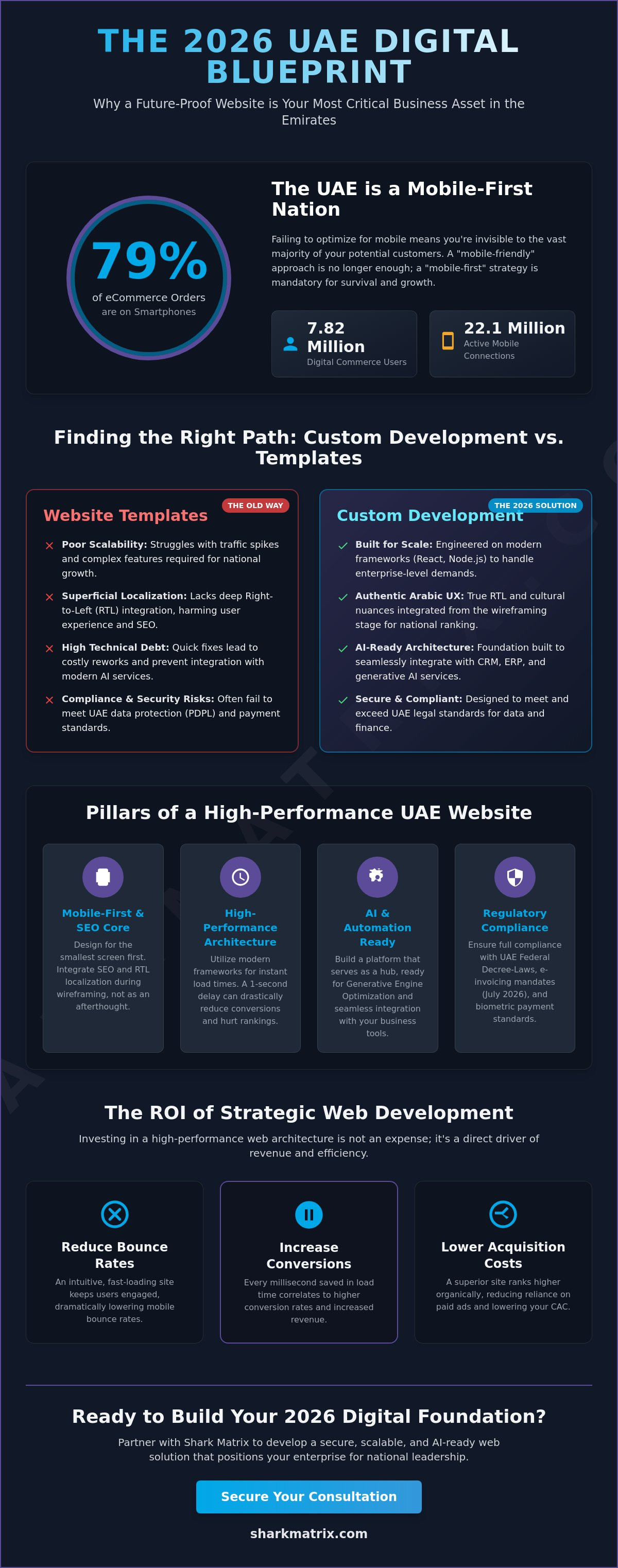
Did you know that smartphones processed nearly 79% of all e-commerce orders in the UAE last year? If your current platform suffers from high mobile bounce rates or lacks authentic Arabic localization, you’re likely losing a massive share of the 7.82 million digital commerce users active across the Emirates. Investing in professional website design and development services is no longer about having a digital business card. It’s about building a localized, AI-ready engine that complies with Federal Decree-Law No. 14 of 2023 and the latest biometric payment mandates.

You probably realize that keeping pace with rapid shifts like mandatory e-invoicing starting July 1, 2026, and the 9% corporate tax on profits over AED 375,000 requires more than just a template. This guide will show you how to evaluate and implement high-performance web solutions that drive national growth and seamless AI integration. We’ll explore the critical role of custom UX, data protection compliance under PDPL, and the strategies needed to scale a site that ranks for the UAE’s most competitive keywords.

Key Takeaways

  • Learn why shifting from mobile-friendly to mobile-first is essential for capturing the UAE’s high smartphone penetration.
  • Discover how to evaluate website design and development services based on technical frameworks and AI-ready architectures.
  • Understand the specific scenarios where custom development outperforms templates to provide better scalability for your enterprise.
  • See why integrating SEO and Right-to-Left (RTL) Arabic localization during the wireframing stage is non-negotiable for national rankings.
  • Explore how AI-powered development can transform your site from a static page into a high-converting growth engine.

Why Strategic Website Design and Development Services are Critical in 2026

Professional web development in 2026 is no longer a luxury; it’s the core of your business infrastructure. Many enterprises mistake a website for a static brochure, but modern strategic website design integrates user experience (UI/UX), robust technical architecture, and a clear commercial strategy. With over 22.1 million active mobile connections in the UAE, the market has shifted entirely to a mobile-first model. If your platform isn’t optimized for the 79% of shoppers using smartphones, you’re invisible to the majority of the 7.82 million digital commerce users projected by the end of this year.

A website serves as the foundation for all national digital marketing efforts. Whether you’re running PPC campaigns or focusing on content marketing, every lead eventually lands on your site. Relying on professional website design and development services ensures your site meets 2026 Core Web Vitals. Google’s ranking standards now prioritize page experience more than ever. Sites that fail to load instantly or provide a seamless mobile journey will see their organic visibility vanish in the face of local competition.

The ROI of High-Performance Web Architecture

Site speed isn’t just a technical metric. It’s a revenue driver. For national e-commerce brands, every millisecond of latency can lead to a drop in conversions. By investing in high-quality website design and development services, you reduce your customer acquisition costs (CAC). A faster, more intuitive site ranks higher organically and keeps users engaged longer, meaning you spend less on ads to get the same result. Technical debt represents the eventual cost of reworking a website because you chose a fast and easy solution during initial development instead of a scalable one. High-performance architecture avoids this trap by building for the future from day one.

Digital Transformation and UAE Vision 2031

Aligning your digital presence with the UAE Vision 2031 means building for innovation and national growth. High-growth sectors like fintech and logistics require platforms that are secure and compliant with Federal Decree-Law No. 45 of 2021 regarding personal data protection. As we move into an era of Generative Engine Optimization (GEO) and AI-driven search, your site must be structured to feed these systems accurate, high-quality data. Future-proofing your business involves:

  • Implementing secure, scalable platforms that handle rapid traffic spikes.
  • Integrating AI automation services to streamline customer interactions.
  • Ensuring full compliance with the July 1, 2026 e-invoicing mandates.
  • Adopting biometric payment authentication to meet UAE Central Bank standards.

By moving beyond city-level digital strategies and focusing on national scalability, UAE enterprises can secure a dominant position in a market projected to reach over USD 21 billion by 2031.

Essential Evaluation Criteria for Professional Web Services

Selecting a partner for website design and development services involves more than reviewing a portfolio of attractive homepages. You need to verify their proficiency in modern frameworks like React, Vue.js, or Node.js. These technologies ensure your site remains fast and responsive under heavy traffic. National-level projects demand a technical architecture that supports complex integrations with your existing CRM, ERP, or custom AI automation services. A partner who can’t demonstrate deep technical knowledge will likely struggle as your business scales across the Emirates.

Demand transparency regarding their integration capabilities. Your web solution should serve as a hub for your business operations. If an agency can’t explain how they’ll connect your front-end to back-office tools or generative AI development services, they aren’t the right fit for a 2026 enterprise. Checking a partner’s history with large-scale UAE projects provides proof they can handle local regulatory requirements and high-volume user data. Don’t settle for simple landing page experience when your goal is national growth.

UI/UX Design: More Than Just a Pretty Interface

Effective UI/UX design starts long before a single pixel is colored. It begins with user research and journey mapping to understand how your customers navigate. By integrating SEO and trust-based design choices into your wireframes, you ensure that the site isn’t just visually appealing but also functional. Accessibility standards are also vital. Your site must be usable for all members of the UAE’s diverse population; this directly impacts your long-term user engagement and conversion rates. Working with a specialized ui/ux design agency dubai enterprises trust ensures these principles are embedded from the earliest stages of your project, transforming your digital products into high-conversion assets.

Security, Compliance, and Data Protection

Security is a non-negotiable pillar of professional website design and development services. With the Federal Decree-Law No. 45 of 2021 (PDPL) in effect, your site must adhere to strict data residency and processing rules. This includes implementing SSL certificates, advanced encryption protocols, and regular security audits. Protecting your brand’s online reputation requires a proactive stance against data breaches. If you’re unsure where to start, looking at how a professional development team handles these compliance hurdles can save you from significant legal penalties later.

Beyond the code, look for a partner who understands the local culture. A site that looks great in London might fail in Riyadh or Dubai if it ignores the nuances of Right-to-Left (RTL) layouts or local consumer behavior. The right agency bridges this gap by blending global technical standards with local market insights. This ensures your platform isn’t just a digital asset but a localized engine for revenue.

The 2026 Guide to Website Design and Development Services for UAE Enterprises

Custom Development vs. Templates: Finding the Right Path

Choosing between a pre-built template and a custom-coded solution is the most significant financial decision you’ll make for your digital presence. Templates offer a fast route to market, which works for small businesses with limited budgets. However, for an enterprise aiming for national growth, a template often becomes a bottleneck. Custom website design and development services provide the flexibility to build features that don’t exist in off-the-shelf themes. This is particularly vital when you need deep AI automation to handle complex customer queries or automate back-end logistics.

The total cost of ownership (TCO) over a three-year period often reveals a surprising truth. While a template site is cheaper on day one, the costs of premium plugin subscriptions, security patches, and eventual “technical debt” rework can exceed the price of a custom build. Custom code is an investment in a permanent asset. It allows your platform to evolve without the constraints of a third-party developer’s update schedule or the risk of a theme becoming obsolete. Enterprises looking to extend their digital reach beyond the browser should also explore dedicated mobile app development services to complement their web presence and capture the UAE’s smartphone-first audience across every touchpoint.

The Custom Development Advantage for National Brands

Templates rely on generic plugins to add functionality. This creates “code bloat” that kills site speed and hurts your SEO rankings. Custom web development is the gold standard because it allows for a clean, purpose-built codebase. Academic research on effective website design highlights that user engagement and trust are directly tied to high-speed, intuitive interfaces. A custom CMS can be tailored to your specific internal workflows. This means your team spends less time fighting the software and more time managing growth.

E-commerce Considerations: Shopify vs. Magento vs. Custom

Your platform choice should depend on your SKU count and transaction volume. A small brand might thrive on Shopify, but a national enterprise with thousands of products and complex inventory needs the power of Magento or a custom headless solution. Headless commerce is gaining traction in the UAE. It decouples the front-end design from the back-end commerce engine, allowing for a seamless multi-channel experience across apps and web. You must also ensure your build supports local payment gateways like Telr or PayTabs. These integrations are smoother in custom environments, providing the frictionless checkout experience that modern UAE shoppers expect. Ensuring your storefront delivers a consistent experience on every screen size is equally critical, which is why investing in responsive web design Dubai enterprises rely on can directly reduce cart abandonment and boost conversions across mobile and desktop alike.

Integrating SEO and Arabic Localization into Your Web Project

Waiting until after launch to think about search rankings is a recipe for expensive reworks. High-performance website design and development services must prioritize search engine optimization during the wireframing phase. This ensures that site architecture, internal linking, and content hierarchies are built to satisfy both users and search engines from the start. In the UAE’s competitive national market, your strategy should map out keywords that capture intent across all seven emirates, not just localized pockets in Dubai or Abu Dhabi.

Localization goes far beyond translating text. It’s about building trust. A site that speaks naturally to an Arabic-speaking audience through professional transcreation will always outperform a generic English site. This cultural resonance directly impacts your conversion rates. When users see a platform that respects their language and cultural nuances, they’re more likely to engage with your brand and complete a purchase. It shows you’re committed to the local market. A strong web presence also forms the foundation of how your brand appears in search results, which is why pairing your development strategy with a robust approach to SEO for brand reputation management Dubai is essential for protecting your digital narrative across the Emirates.

Arabic Digital Marketing: Beyond Simple Translation

Transcreation involves adapting your brand’s voice and message to fit the GCC cultural context while maintaining its original intent. One of the biggest hurdles is Right-to-Left (RTL) design. You can’t just flip the layout. Icons, navigation menus, and form fields must be mirrored to match the natural eye-tracking patterns of Arabic readers. If you break this logic, you frustrate users and drive up bounce rates. Your design team must understand these linguistic variations to ensure the UX feels native rather than forced.

Technical SEO Best Practices for New Builds

Clean URL structures and XML sitemaps are the basics. For 2026, you also need robust schema markup to help search engines understand your products, reviews, and corporate data. If you’re migrating an old site, managing redirects is critical to preserving your hard-earned link equity. Losing authority during a launch can set your national growth back by months. You should refer to our how to choose a web design agency guide to ensure your partner has the technical depth to handle these requirements.

To ensure your brand captures the full potential of the UAE market, professional website design and development services are essential; reach out to Shark Matrix Technologies LLC to begin your national digital transformation. We focus on building sites that don’t just look good but dominate the local search landscape.

Partnering with Shark Matrix: Your National Web Development Solution

Shark Matrix provides more than just code. We deliver a comprehensive digital strategy that turns your online presence into a high-performance growth engine. Our end-to-end approach begins with strategic consulting to ensure your platform aligns with the UAE’s specific market conditions and national objectives. By bridging the gap between global technical standards and Middle Eastern cultural nuances, we ensure your brand resonates from Abu Dhabi to Ras Al Khaimah. We specialize in website design and development services that incorporate generative AI development services, turning a standard site into an intelligent business tool that understands your customers.

Launching your site is only the first step toward digital dominance. We provide dedicated post-launch support to keep your platform secure, fast, and fully optimized for performance. In a market where the e-commerce sector is projected to reach over USD 21 billion by 2031, staying stagnant is a risk you can’t afford. Our commitment to data-driven results means you receive transparent reporting that tracks your ROI. This helps you navigate the local business landscape, including the 9% corporate tax threshold and VAT requirements, with clear financial insights and a site that actually converts.

The Shark Matrix Development Lifecycle

  • Discovery and Strategy: we begin by aligning the build with your national business goals. This involves analyzing competitor gaps and identifying how to leverage machine learning development services to personalize the user journey.
  • Agile Development: our process ensures transparency through iterative feedback loops. You’ll see the project evolve in real-time, allowing for adjustments as market conditions or regulations shift.
  • Rigorous QA and Testing: we launch with zero-defect confidence. Every site undergoes stress testing to handle the traffic spikes common in high-growth UAE sectors like fintech and logistics.

Ready to Scale Your Digital Presence?

Our website design and development services don’t exist in a vacuum. They integrate seamlessly with our broader ecosystem of AI automation services and content marketing. Whether you need an e-commerce platform that handles thousands of SKUs or a corporate site designed to dominate national search engine optimization rankings, we have the technical depth to deliver. We invite you to book a consultation for your national-scale project to see how we can future-proof your digital assets.

Choosing a partner that understands the 2026 UAE landscape is the difference between a site that merely exists and one that leads. We focus on building secure, scalable, and localized solutions that drive national growth. Let’s build a platform that meets the high expectations of the UAE’s 7.82 million digital commerce users.

Future-Proof Your National Growth Today

The digital landscape across the Emirates is moving faster than ever. Succeeding in 2026 requires more than a functional site; it demands a localized, AI-ready architecture that complies with evolving data laws and payment standards. Transitioning from generic templates to high-performance website design and development services ensures your business remains scalable and secure. This approach allows you to capture a larger share of the country’s multi-billion dirham e-commerce market while maintaining a seamless user experience for the 7.82 million digital users active today.

Shark Matrix has been helping enterprises navigate these complexities since 2010. Our deep UAE market expertise and specialists in AI-integrated web development provide a significant competitive edge. With our comprehensive Arabic digital marketing capabilities, we ensure your brand speaks directly to the local audience. It’s time to stop reacting to digital trends and start leading them. Scale Your Brand with Shark Matrix Web Services and secure your place in the UAE’s digital future. Your journey toward a high-converting, national-scale platform starts here.

Frequently Asked Questions

How much do professional website design and development services cost in the UAE?

Project costs depend on the scope of work, technical complexity, and specific feature requirements. A custom enterprise solution involves various factors like the number of pages, e-commerce capabilities, and the depth of AI integrations. Rather than looking for a flat rate, businesses should evaluate the total cost of ownership, including hosting, security, and long-term maintenance needs.

What is the typical timeline for a custom enterprise web development project?

A custom enterprise project usually takes between 12 and 24 weeks to complete. This timeline allows for a thorough discovery phase, strategic UI/UX design, and complex coding requirements. Projects that require custom ai automation services or extensive third-party integrations may fall on the longer end of this spectrum to ensure every system works perfectly before the national launch.

Do I need a separate agency for Arabic localization and SEO?

You don’t need multiple partners if you choose an agency that provides integrated website design and development services. A single, full-service partner ensures that Right-to-Left (RTL) layouts and search engine optimization are built into the site’s foundation. This unified approach prevents technical errors that often occur when different teams handle development and localization separately.

Can you integrate AI chatbots and automation into my existing website?

Yes, we can integrate ai chatbot-development services and advanced automation into most modern websites. These tools are often connected via custom APIs or specialized modules, allowing your business to automate customer support and lead capture. This enhancement improves your site’s functionality without the need for a complete rebuild, provided your current platform’s architecture is flexible enough.

What is the difference between a web design agency and a web development company?

Web design focuses on the visual elements, branding, and user journey of your site. Web development involves the back-end coding, database management, and technical architecture that make those designs functional. Most successful UAE enterprises look for a partner that combines both disciplines to ensure their site is both visually compelling and technically superior.

How often should a business update its website design for optimal performance?

Enterprises should consider a major design refresh every two to three years. With the UAE’s rapid digital shift and new 2026 regulations like biometric payment mandates, staying updated is a matter of compliance as much as aesthetics. Regular technical audits should happen more frequently to ensure your site continues to meet Google’s Core Web Vitals and performance benchmarks.

Will my new website be mobile-responsive and SEO-friendly by default?

A professional build in 2026 must be mobile-responsive and SEO-friendly by default. Since smartphones process nearly 79% of e-commerce orders in the UAE, a mobile-first approach is the industry standard. You should verify that your development partner includes technical SEO features like schema markup and clean URL structures as part of their core delivery process. For enterprises ready to go beyond the browser, investing in dedicated mobile app development services ensures your brand maintains a high-performance presence across every device your customers use.

What kind of ongoing maintenance is required after the website launch?

Ongoing maintenance includes regular security patches, server monitoring, and software updates to protect against vulnerabilities. You’ll also need to manage domain renewals, SSL certificates, and periodic content updates to keep the site relevant. Regular performance checks are vital to ensure your platform remains compliant with Federal Decree-Law No. 45 of 2021 regarding personal data protection.