
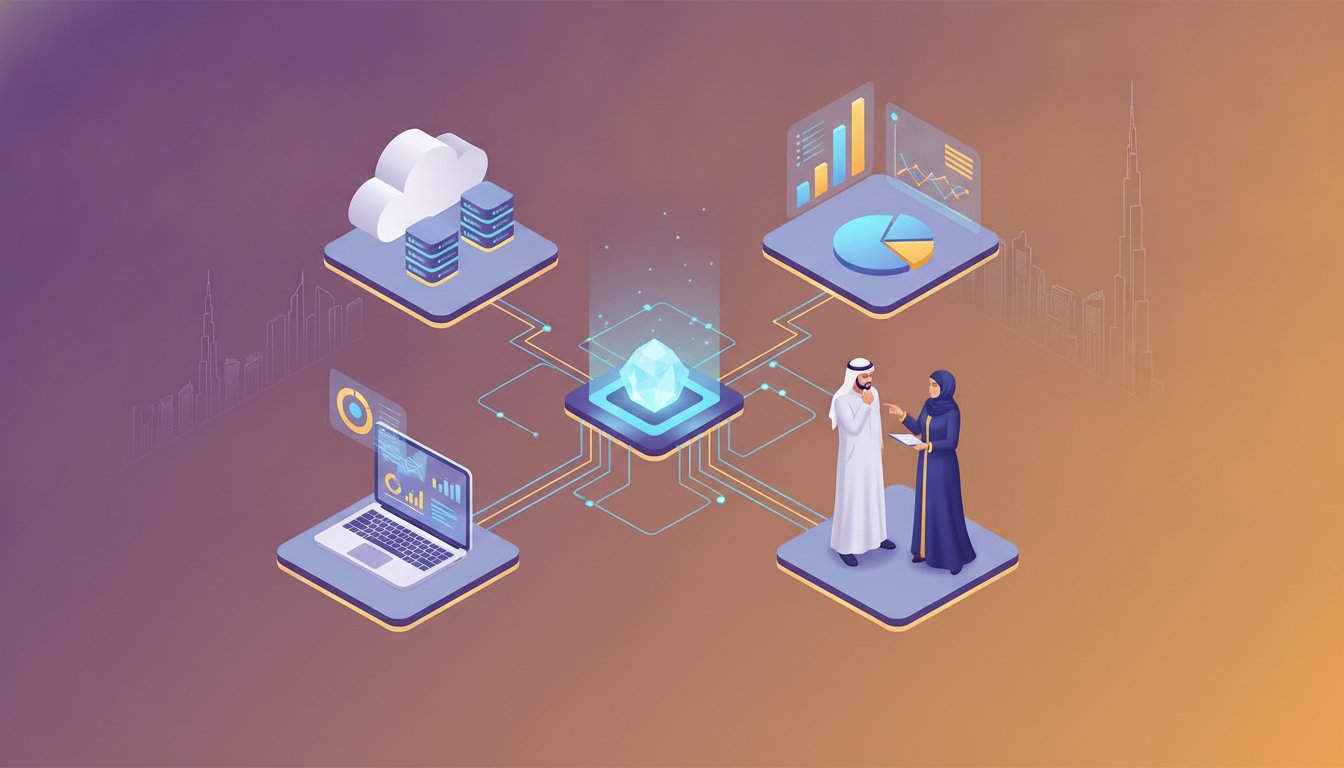
Did you know that while the number of available marketing tools has finally plateaued at 15,505 products, 61% of marketers still believe AI is causing the biggest industry disruption in 20 years? It’s a confusing time to be an architect of growth. You’re likely feeling the weight of data silos that prevent a true 360-degree customer view, all while paying for software seats that your team doesn’t even touch. Building a marketing tech stack 2026 isn’t about adding the newest shiny object anymore. It’s about creating a unified, strategic ecosystem that can handle complex data governance across 20 different state privacy laws and the rapid rise of AI agents.
We understand that integrating AI into your existing workflows feels like trying to change a tire while the car is moving at sixty miles per hour. This article will help you move past the friction. You’ll learn how to architect a high-performance ecosystem that leverages AI automation to improve lead generation and ensures compliance with new regulations like the California Delete Act. We’ll provide a streamlined list of essential 2026 tools and a clear roadmap for AI implementation so you can stop managing software and start driving national growth.
Key Takeaways
- Understand the shift from passive software to “Agentic AI” that executes marketing workflows autonomously and efficiently.
- Evaluate the pros and cons of monolithic suites versus composable architectures to ensure your ecosystem remains flexible as technology evolves.
- Master the step-by-step process of building a marketing tech stack 2026 by auditing underutilized licenses and defining your data “North Star.”
- Establish a robust data foundation with centralized CRM and governance to eliminate silos and power unified brand messaging across all channels.
- Discover why custom AI development is essential for a competitive advantage and how to integrate industry-specific automation into your ecosystem.
What is a Marketing Tech Stack in 2026?
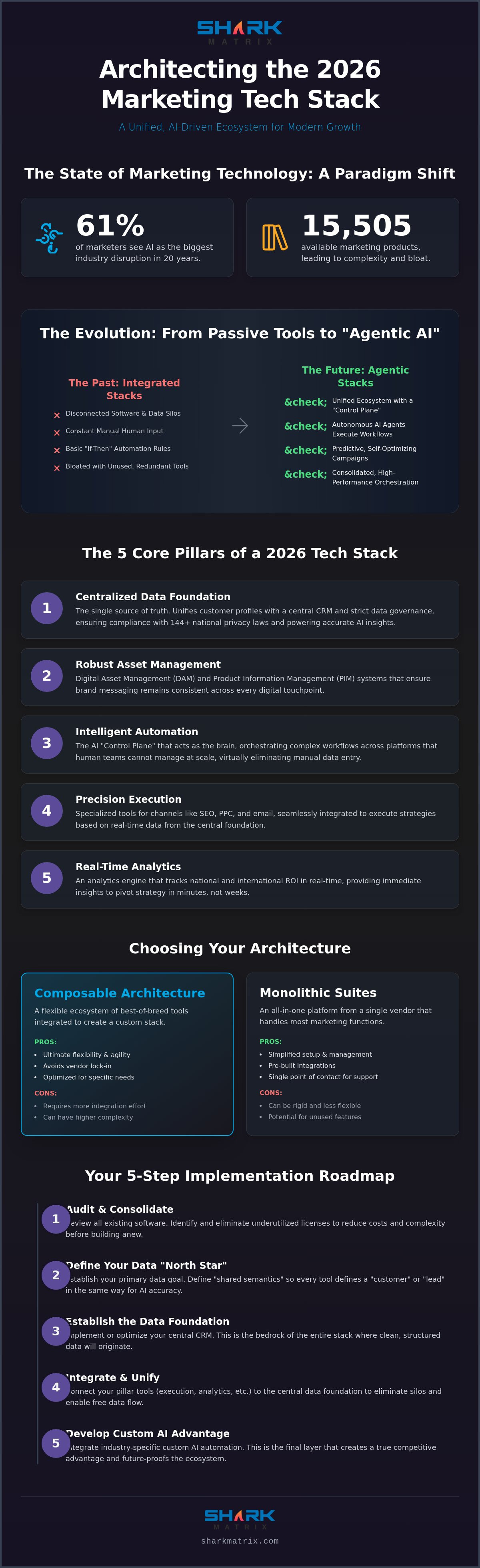
A marketing tech stack in 2026 is no longer just a collection of disconnected software subscriptions. It has matured into a unified, integrated ecosystem where software and AI agents work in tandem to execute complex marketing strategies. In previous years, stacks were often bloated with redundant tools. Today, the focus has shifted toward consolidation and high-performance orchestration. With the global landscape reaching over 15,505 products, the challenge isn’t finding a tool; it’s ensuring those tools talk to each other to create a single source of truth.
The most significant shift we see in 2026 is the transition from passive tools to “Agentic AI.” While older software required constant human input to move data from point A to point B, modern stacks use autonomous agents to execute workflows. For businesses targeting growth in the UAE market, this consolidation is vital. It reduces the high costs of unused software seats and ensures data accuracy across every customer touchpoint. Central to this is the “Control Plane,” a specialized AI layer that acts as the brain of your ecosystem, coordinating actions across your CRM, ad platforms, and email systems without manual intervention.
The Evolution from Integrated to Agentic Stacks
Modern stacks bridge the gap between your data and your execution. This shift moves beyond traditional Marketing automation where tools simply follow “if-then” rules. Instead, AI-coordinated workflows now predict customer needs and adjust campaigns in real-time. This sophisticated level of operation requires a solid foundation. High-quality website design and development services are the bedrock of this infrastructure, as your site must be capable of feeding clean, structured data into your AI agents. When building a marketing tech stack 2026, you’re moving away from managing individual tools and toward supervising an intelligent, self-optimizing system.
Core Benefits of a Modernized Tech Infrastructure
Upgrading your stack provides immediate competitive advantages for national and international campaigns. You’ll see a dramatic improvement in lead scoring and predictive analytics, allowing your team to focus only on high-value prospects. By implementing custom AI automation, you can virtually eliminate manual data entry, which reduces human error and frees up your creative talent. Perhaps most importantly, a modernized stack gives you the agility to pivot. When you have real-time data insights flowing through a unified ecosystem, you can adjust your strategy in minutes rather than weeks. Building a marketing tech stack 2026 ensures your business remains resilient in a fast-paced digital economy.
The 5 Core Pillars of a 2026 Marketing Tech Stack
Building a marketing tech stack 2026 involves more than selecting the most popular software subscriptions. It requires a structural blueprint that balances data integrity with rapid, automated execution. A strategic framework, similar to the concepts found in the CMO’s guide to marketing tech stacks, focuses on five core pillars: a centralized data foundation, robust asset management, intelligent automation, precision execution, and real-time analytics. Each pillar must be interconnected to ensure data flows freely without manual exports.
Your data foundation is the most critical layer. Without a centralized CRM and strict data governance, your AI will struggle with inaccurate insights. Content and asset management systems (DAM and PIM) follow closely, ensuring your brand messaging remains consistent across every digital touchpoint. For the automation layer, businesses are increasingly relying on specialized ai automation services to orchestrate complex workflows that human teams can’t manage at scale. Finally, your execution tools for SEO and PPC must feed directly into an analytics engine that tracks national ROI in real-time; partnering with experts like Tools N Tactics | Local SEO & Digital Marketing Solutions can help ensure these components are perfectly tuned for search engine dominance.
Data Governance and the Unified Customer Profile
In 2026, data governance is the prerequisite for effective AI scaling. With 144 countries now enforcing national data privacy laws, your stack must handle complex compliance rules automatically. Without “shared semantics,” where every tool in your stack defines a “customer” or “lead” the same way, your AI agents will inevitably suffer from hallucinations. Identity resolution has also become vital in our cookieless environment. You need systems that can stitch together fragmented data points into a single, unified customer profile while respecting the latest privacy regulations.
Localized Execution: Arabic Digital Marketing Integration
Many global platforms still struggle with the specific nuances of the Middle Eastern market. When building a marketing tech stack 2026, you must prioritize tools that offer native right-to-left (RTL) support and sophisticated Arabic sentiment analysis. This isn’t just about simple translation. It’s about integrating search engine optimization seo services with content engines that understand regional dialects and cultural context. If you’re looking to refine your regional digital presence, the specialists at Shark Matrix can help you integrate these localized tools effectively.
Reputation and Trust Layers
Trust is the primary currency of the digital economy. Your stack should include dedicated layers for seo for brand reputation management dubai to monitor brand health across the country. These tools use AI to detect subtle shifts in public sentiment before they escalate into larger issues. By automating social proof and monitoring mentions in real-time, you protect your brand’s integrity while streamlining the buyer journey for your customers.
Composable vs. Monolithic: Choosing Your Architecture
Deciding between a monolithic and a composable architecture is the most consequential choice you’ll make when building a marketing tech stack 2026. Monolithic stacks, such as all-in-one suites from Salesforce or Adobe, offer a unified interface and lower initial integration complexity. They’re often the preferred choice for teams with limited technical resources who need a reliable solution that works out of the box. However, these suites can sometimes feel like a walled garden, limiting your ability to adopt specialized AI tools that emerge mid-year.
Composable stacks, on the other hand, represent a best-of-breed approach. This architecture allows you to swap individual tools as AI technology evolves throughout 2026 without tearing down your entire infrastructure. While this provides maximum flexibility, it demands high-level technical expertise to maintain clean data flows. In the UAE market, we’re seeing a hybrid reality emerge. Most businesses choose a core monolith for their CRM and email while plugging in composable AI add-ons for specific tasks like predictive lead scoring or generative content creation.
Evaluating the Total Cost of Ownership (TCO)
Don’t let a low sticker price fool you. Many cheap tools carry significant hidden costs because they require expensive custom integration to function within your ecosystem. When you calculate ROI, you must look beyond license fees to the cost of manual data management and potential downtime. A well-integrated stack ensures that your external partnerships, such as those with a ppc agency dubai, are optimized. When your agency can access real-time data without friction, your ad spend works harder, and your reporting becomes more accurate.
Scalability for National Growth
As your business expands nationally, your tech stack must handle exponential increases in data volume without performance lag. Choosing tools with an API-first architecture is non-negotiable for future-proofing your operations. This ensures that as new data sources or AI agents are introduced, they can connect seamlessly to your existing pillars. API connectivity is the nervous system of the 2026 stack. Without robust integration points, your data becomes stagnant, and your AI agents will fail to deliver the real-time personalization that modern consumers expect. Building a marketing tech stack 2026 requires this focus on connectivity to ensure every new tool adds value rather than friction.
Step-by-Step: Building and Integrating Your Stack
Execution begins with a ruthless audit of your existing infrastructure. You can’t build a high-performance ecosystem on a foundation of redundant subscriptions and siloed data. When building a marketing tech stack 2026, the first goal is to identify overlapping tools and underutilized licenses that drain your budget without adding value. Once the waste is cleared, you can define your “North Star” metric. This is the single most important data point that guides your growth. Every tool you select from that point forward must contribute directly to tracking or improving that specific metric.
The selection process in 2026 requires a more rigorous RFP than in previous years. You must prioritize AI compatibility and native Arabic support to ensure your stack can handle the nuances of the regional market. After selection, focus on integration. Map your data flows meticulously and don’t settle for “good enough” native connectors. If a standard integration fails to move data accurately, build custom APIs to bridge the gap. Finally, prioritize enablement. Your team needs specific training to work alongside autonomous AI agents, shifting their focus from manual execution to strategic supervision.
Conducting a Technical Marketing Audit
Successful audits reveal “shadow IT,” which are those unauthorized software subscriptions purchased by individual teams without central oversight. These hidden tools often create security vulnerabilities and fragmented customer data. You should map your entire “Lead-to-Revenue” journey to see exactly where data drops off or becomes corrupted between platforms. This phase is also the time to evaluate your regional compliance. Ensure every tool in your stack meets the data handling requirements for the 20 states in the US with active privacy laws, as well as local regulations in the UAE.
Building the Integration Map
Your integration map defines your “Sources of Truth” for customer, product, and content data. In a modern ecosystem, you’ll likely use middleware or an Integration Platform as a Service (iPaaS) to connect these pillars. This middle layer ensures that data captured from your mobile app development services feeds directly into your central CRM without delay. When your mobile interactions, web behavior, and ad responses all flow into one place, your AI agents can make better decisions. If you need help architecting these complex data flows, contact Shark Matrix to speak with an integration specialist today.
Effective integration isn’t just about moving data; it’s about maintaining its integrity. You need to establish clear rules for which system “wins” if there is a data conflict. For example, your CRM should typically be the master for customer contact info, while your e-commerce platform remains the master for purchase history. By establishing these rules early, you prevent the data corruption that leads to AI hallucinations and poor customer experiences. Building a marketing tech stack 2026 is a technical challenge that requires a disciplined, step-by-step approach to ensure long-term scalability.
Future-Proofing with Shark Matrix: Custom AI and Integration
Buying the same software as your competitors won’t give you a market advantage. With the global martech landscape growing by a mere 0.79% to 15,505 products in 2026, the industry has reached a plateau of “off-the-shelf” capabilities. True differentiation in the UAE and beyond now comes from how you customize and connect these tools. Building a marketing tech stack 2026 requires moving past generic plugins and toward proprietary systems that reflect your unique business logic. Shark Matrix bridges the gap between high-level marketing strategy and the deep technical execution needed to turn a collection of apps into a high-performance ecosystem.
Generic tools often struggle with the specific data governance needs of national brands, especially when navigating the 144 countries that now have national data privacy laws. We focus on end-to-end digital transformation that prioritizes data integrity and autonomous execution. By building a custom “Control Plane” for your stack, we ensure your tools don’t just sit in silos but actually work together to drive growth. This strategic approach transforms your technology from a cost center into a scalable asset that adapts as fast as the market does.
Custom AI Development for National Brands
Proprietary AI models are the secret weapon for brands that have outgrown standard automation. While generic AI can draft basic copy, our custom AI development services focus on automating lead generation and high-context Arabic content that resonates with regional audiences. These bespoke models outperform generic plugins because they’re trained on your specific customer data and brand voice. For example, streamlining operations through AI-driven UI/UX ensures that your customer journey is frictionless, leading to a higher long-term ROI than any “one-size-fits-all” software could provide.
Strategic Partnership for Stack Management
The work doesn’t end once your tools are connected. Ongoing stack optimization is just as critical as the initial build to prevent “software rot” and ensure you aren’t paying for unused seats. Shark Matrix provides the technical backbone for national marketing teams, offering the expertise needed to manage complex integrations and API connections. We help you stay ahead of the curve, ensuring your infrastructure is always ready for the next shift in machine learning or data regulation. To ensure your business isn’t left behind by the rapid pace of change, partner with Shark Matrix to build your 2026 AI-ready tech stack and secure your competitive edge.
Mastering Your Marketing Architecture
We’ve explored how the martech landscape is shifting from fragmented tools to intelligent, integrated ecosystems. You now know that a solid data foundation and localized Arabic integration are non-negotiable for national growth in the coming years. Success in building a marketing tech stack 2026 requires balancing this technical precision with a clear strategy for AI orchestration and autonomous workflows. It’s about moving beyond simple software subscriptions to create a self-optimizing engine that drives measurable ROI.
Shark Matrix has been helping brands bridge the gap between high-level strategy and software engineering since 2010. Our deep technical expertise in Arabic digital marketing and AI automation ensures your infrastructure is built for regional dominance. We provide the end-to-end capabilities needed to transform complex data into actionable customer insights and streamlined operations. Architect your future-ready marketing stack with Shark Matrix. Your technology should empower your team rather than complicating their daily workflows. With a unified, future-proof architecture, you’re ready to lead your industry into a more automated and data-driven future.
Frequently Asked Questions
What is the most important tool in a marketing tech stack for 2026?
The Customer Relationship Management (CRM) platform remains the most critical tool in your ecosystem. It serves as the central source of truth for all customer interactions and provides the essential data that fuels your AI agents. Without a robust CRM, your automation efforts will lack the context needed to deliver personalized experiences across different digital touchpoints.
How much should a company spend on its MarTech stack?
Marketing technology spending typically fits within your broader marketing budget, which the U.S. Small Business Administration suggests should be 7% to 8% of gross revenue for businesses earning under $5 million annually. When building a marketing tech stack 2026, you must also factor in the rising costs of enterprise software. For example, some top-tier sales platforms now cost between $330 and $350 per user each month.
Can AI completely replace human marketing managers in 2026?
AI isn’t replacing managers, but it’s fundamentally shifting their roles from manual execution to strategic supervision. While 80% of marketers currently use AI for content creation, human oversight is still necessary to manage ethical data handling and brand voice. Managers now spend more time training AI agents and interpreting complex data insights rather than performing repetitive administrative tasks.
How do I integrate my tech stack with Arabic language requirements?
Integration requires choosing software that offers native right-to-left (RTL) support and specialized natural language processing services. It’s vital to use tools that can handle regional dialects and cultural nuances rather than relying on simple machine translation. Custom API connectors are often needed to ensure that localized data flows correctly between your global CRM and regional execution platforms.
What is a composable marketing tech stack?
A composable stack is a modular architecture where you select “best-of-breed” tools for specific functions instead of using one all-in-one suite. This approach allows you to swap individual components as technology evolves without disrupting your entire system. It’s an ideal strategy for businesses that want to integrate specialized AI automation services that monolithic platforms might not yet support.
How does data governance impact my marketing ROI?
Data governance directly impacts ROI by reducing the waste caused by inaccurate analytics and AI hallucinations. With 144 countries now enforcing national data privacy laws, strict governance also protects you from the heavy fines associated with non-compliance. Clean, well-governed data ensures that your lead scoring and predictive models are based on facts, leading to much higher conversion rates.
Is it better to use an all-in-one marketing suite or individual tools?
All-in-one suites are better for teams with limited technical resources who need a simplified, unified interface. However, when building a marketing tech stack 2026 for a larger organization, individual tools often provide a competitive edge through specialized features. The right choice depends on your internal technical expertise and the specific complexity of your data integration needs.
How often should I audit my marketing technology stack?
You should conduct a comprehensive technical audit at least every six months. Regular audits help you identify “shadow IT” and redundant software seats that drain your budget without providing value. Because 61% of marketers believe AI is the biggest industry disruption in 20 years, frequent reviews are necessary to ensure your stack remains compatible with the latest automation standards.
 OpenAI
 Codex
Codex
 Vertex AI
 Cloud Vision
 OpenCV
 TensorFlow
 IBM Watson
 Cloud Natural Language
 Cognitive Services
 Bot Framework
 Mistral
 LLama
LLama
 Gemini
 Anthropic
 N8N
N8N