

What if your number one ranking on Google suddenly resulted in zero clicks because an AI agent answered the query before the user even scrolled? It’s a reality many brands face as generative summaries begin to dominate the top of search results. You’ve likely felt the pressure of declining organic traffic and the frustration of trying to decode shifting technical standards. It’s clear that traditional SEO rules are evolving, and maintaining visibility now requires a more sophisticated approach.
This guide will show you exactly how to optimize content for ai search to ensure your brand remains a cited authority in 2026. By mastering Generative Engine Optimisation (GEO) and Answer Engine Optimization (AEO), you’ll learn to bridge the gap between traditional search and AI-driven synthesis. We’ll explore the specific technical requirements for AI citations and provide a clear roadmap to future-proof your content strategy against the next wave of digital transformation.
Key Takeaways
- Understand the fundamental shift from traditional SERPs to Generative Engine Optimisation to capture visibility in zero-click environments.
- Discover how to optimize content for ai search by leveraging Retrieval-Augmented Generation (RAG) and establishing high domain authority for LLM citations.
- Master the Answer Engine Optimization (AEO) framework to produce the data-dense, definitive statements that AI tools require for direct responses.
- Execute a 2026 technical audit that integrates multi-modal elements like voice and video to future-proof your national brand presence.
- Learn how custom AI development and natural language processing services provide a competitive edge in the evolving generative search landscape.
Understanding the Shift: From Traditional SERPs to AI Search Engines
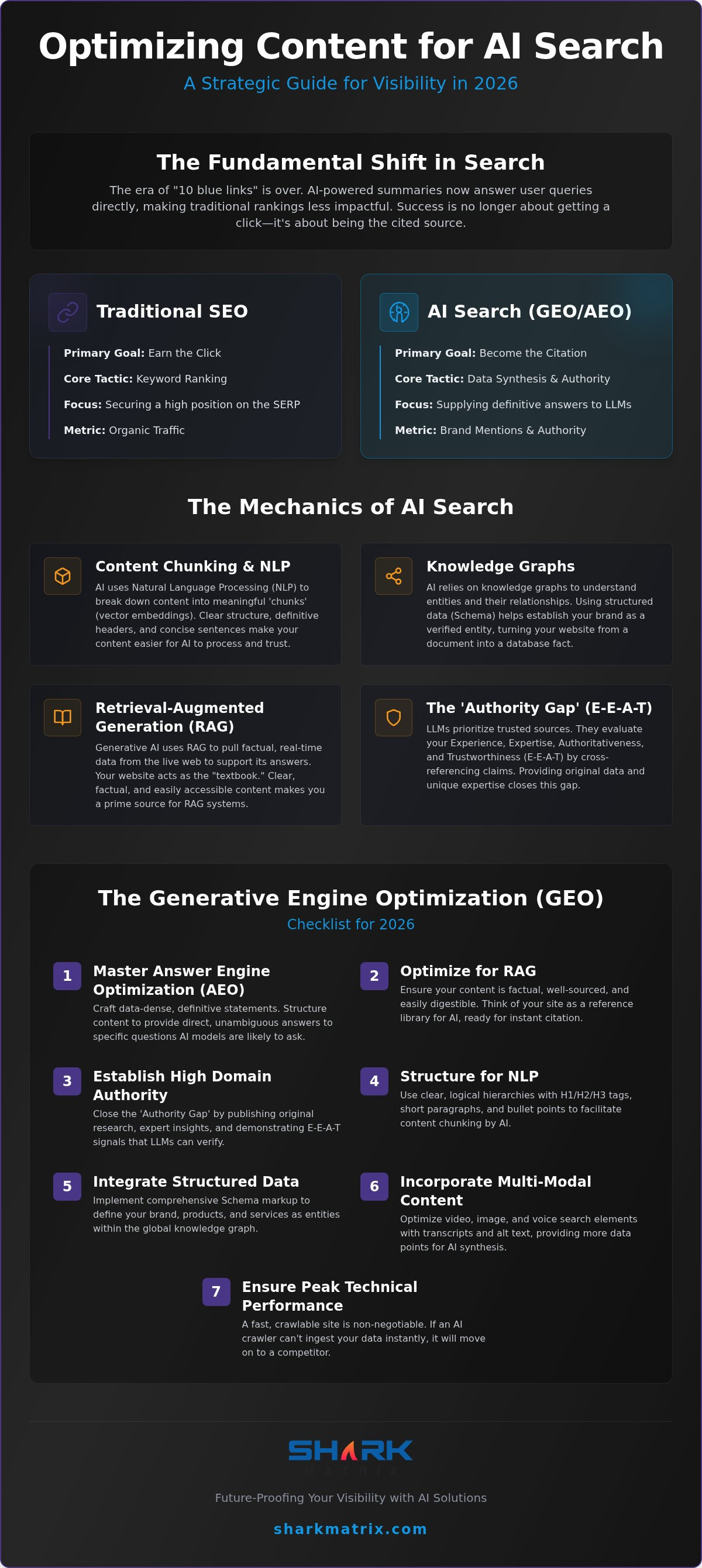
The digital landscape has crossed a threshold. Discovery is no longer a simple matter of matching a keyword to a URL. Instead, we’ve moved From Traditional SERPs to AI Search Engines, where the goal is synthesis rather than indexing. In 2026, search engines don’t just show you where information lives; they process it for you. This shift has birthed Generative Engine Optimization (GEO), a discipline that focuses on how your brand’s data is ingested and repeated by Large Language Models (LLMs).
Traditional SEO was built on the foundation of the “blue link.” You optimized for a high ranking to earn a click. The rise of zero-click searches has disrupted this model. National brands in the UAE now face a reality where the search engine provides the full answer directly on the results page. If your site isn’t the primary source for that answer, you lose visibility. Learning how to optimize content for ai search is no longer optional. It’s the only way to ensure your brand is cited rather than ignored. LLMs prioritize synthesis, which means your ranking matters less than your status as a trusted citation.
The Evolution of Search Intent in 2026
Search intent has matured into something far more complex than transactional or informational buckets. Users now engage in multi-step conversational queries that reflect specific “need states.” An AI doesn’t just look for “best logistics software.” It interprets a request for “a scalable logistics solution for a national retail chain that integrates with existing ERPs.” This requires content that addresses the nuance of a conversation. At Shark Matrix, our generative AI development services help brands build the technical infrastructure needed to feed these models high-quality, authoritative data that shapes brand sentiment within training sets.
Key Players in the AI Search Ecosystem
The ecosystem is no longer a Google monopoly. While Google’s Search Generative Experience (SGE) has completed its national rollout, other players like Perplexity, Claude, and ChatGPT have changed how users source real-time data. These platforms use Retrieval-Augmented Generation (RAG) to pull from the live web. In the B2B sector, specialized answer engines are also emerging, prioritizing technical accuracy over broad popularity. Winning in this environment means appearing across these diverse platforms as a consistent, reliable source of truth.
The Mechanics of AI Search: How LLMs Process and Cite Content
Understanding the underlying mechanics of Large Language Models (LLMs) is the first step for anyone learning how to optimize content for ai search. Unlike traditional bots that simply index pages, modern AI uses Retrieval-Augmented Generation (RAG). This process allows the model to pull specific data from the live web to anchor its responses in fact. It’s essentially an open-book test where your website is the textbook. If your content is clear and factual, the AI is more likely to cite you as the definitive source.
The ‘Authority Gap’ defines why AI prefers certain domains over others. In 2026, LLMs evaluate E-E-A-T by cross-referencing your claims against other trusted entities in their training data. If your site provides original data or unique expertise, you close this gap. High-speed technical performance also plays a role. If a crawler can’t ingest your data instantly, it will simply move to a faster competitor. Consistent, high-performance delivery ensures your content is always available for real-time synthesis.
NLP and Content Chunking
AI models don’t read sentences the way humans do. They use Natural Language Processing (NLP) to break your content into chunks or vector embeddings. These are mathematical representations of meaning. To help this process, your content should be structured with clear, logical paragraphing and definitive headers. Short, punchy sentences often perform better because they are easier for models to vectorize. If you need to refine how your site communicates with these machines, our Natural Language Processing Services provide the technical expertise to bridge this gap.
The Role of Knowledge Graphs
Your brand needs to exist as an Entity within a global knowledge base. AI uses knowledge graphs to understand how your services relate to specific industry problems. Using structured data helps define these relationships clearly for the LLM. When your brand is part of a knowledge graph, you aren’t just a search result; you’re a verified fact. This level of technical integration is a core part of our Generative AI Development strategies. For national brands looking to solidify their presence, investing in ai automation services can streamline the creation of this structured data at scale.
Answer Engine Optimisation (AEO): Designing Content for Direct Responses
Answer Engine Optimisation (AEO) is the tactical side of showing up in AI summaries. While GEO focuses on the engine’s synthesis, AEO focuses on the answer itself. To master how to optimize content for ai search, you must prioritize directness and data-density. “Fuzzy” content, which relies on vague adjectives and marketing fluff, fails in 2026. AI models are trained to find the most efficient answer. If your content is buried under layers of storytelling without clear data points, the engine will skip you. It’s no longer enough to be “good”; you must be the most mathematically relevant response to a specific prompt.
Balancing human-centric storytelling with machine-centric clarity is the secret. You don’t have to write like a robot, but you do need to provide quote-dense sentences. These are definitive statements that an AI can easily extract and cite. For national brands, this means moving away from generic claims to specific, verifiable facts. If you’re looking for a partner to manage this transition, our Comprehensive SEO Services Guide details how we integrate these strategies into national campaigns. We focus on the technical bridge between what humans want to read and what machines need to ingest.
Structuring Content for the ‘Answer’ Format
The inverted pyramid is your best friend. Start each section with the most critical information. AI search tools often scan the first paragraph for a summary. If the answer is there, you’re more likely to be cited. Use H3 headings as specific questions. For example, instead of “Our Process,” use “How Does Our National SEO Process Work?” This mirrors the conversational queries users type into LLMs. It’s about making the machine’s job as easy as possible. When the AI finds a direct answer immediately following a relevant question, the probability of becoming a featured citation increases significantly.
Optimizing for Conversational ROI
Winning the AI snippet requires identifying low-competition, high-intent questions. These are the specific “how-to” or “why” queries that competitors often ignore. FAQ sections are a goldmine for this. They provide a clear structure for the AI to ingest. To truly understand what your audience is asking, you can use AI Chatbot Development to capture real-time search intent data. This allows you to feed your content strategy with the exact phrases and problems your customers face daily. By integrating this data back into your content, you create a feedback loop that keeps your brand relevant across all generative platforms.
The Generative Engine Optimisation (GEO) Checklist for 2026
Winning in generative search requires more than just good writing. It demands a technical foundation that allows Large Language Models to ingest your data without friction. A comprehensive technical audit is the first step in learning how to optimize content for ai search. In 2026, this means moving beyond the traditional crawl-and-index cycle. Instead, brands must prioritize multi-modal optimization. AI agents now synthesize information from video transcripts, image metadata, and voice snippets simultaneously. If your brand’s video content doesn’t have structured transcripts, you’re invisible to a significant portion of the generative ecosystem.
Consistency is your greatest asset. LLMs prioritize ‘Brand Source’ status for domains that provide regular, high-velocity updates. Stale data is discarded in favor of real-time accuracy. Our AI Automation Services help national brands maintain this consistency by automating the technical updates required to stay relevant. By ensuring your data is always fresh, you reinforce your position as a primary source for AI synthesis. It’s about being the most reliable version of the truth at any given moment.
Technical GEO Requirements
Your schema markup needs to evolve. While basic article tags are still necessary, 2026 standards require ‘Dataset’ and ‘ClaimReview’ schema to provide the granular detail LLMs crave. This structured data acts as a translator between your website and the model’s training set. API-first content delivery is another critical requirement. LLMs often bypass traditional HTML scraping in favor of direct data feeds to ensure real-time accuracy. Finally, zero-latency mobile performance is non-negotiable. If an AI-integrated browser experiences a delay while fetching your site’s data, it’ll pivot to a faster source to maintain the conversational flow.
Content Verification and Fact-Checking
AI search engines are increasingly sensitive to conflicting information. If your website claims one fact while your national press releases claim another, the LLM will flag your domain as unreliable. Fact-checking is now a core SEO function. You must anchor your claims with external citations to high-authority national sources. This creates a web of trust that the AI can verify. For brands managing complex narratives, our national SEO services ensure that your digital footprint remains consistent and authoritative across all platforms. To secure your visibility across generative engines, explore our generative AI development services to automate your technical readiness.
Future-Proofing Your Visibility with Shark Matrix AI Solutions
Shark Matrix positions itself as the technical bridge between legacy search and the generative future. We integrate Custom AI Development with modern SEO to build a resilient digital presence. In 2026, national brands require more than just basic keyword targeting. They need a sophisticated system that updates data and citations in real-time. This hybrid approach pairs human creativity with deep technical optimization. Our proprietary workflows automate complex GEO tasks, allowing your team to focus on high-level narrative while our machines handle the granular citation management.
National expertise serves as a critical advantage in the generative search landscape. LLMs increasingly value localized accuracy and verified national data. When you understand the specific nuances of the UAE market, you can provide the data-dense responses that generative engines prioritize. We help brands scale their organic visibility through automated GEO workflows that align with evolving national search trends. Mastering how to optimize content for ai search is a continuous process of technical refinement and strategic adaptation.
Tailored AI Strategies for National Brands
We develop Industry-Specific AI Solutions designed for search dominance. Every sector faces unique citation requirements. A financial institution needs different technical markers than a retail group. By leveraging ML Development Services, we predict shifts in how generative engines prioritize different types of data. This proactive stance ensures your brand isn’t just reacting to algorithm changes but staying ahead of them.
Get Started with an AI Search Audit
Success in the current era is measured by ‘Citation Share.’ This metric quantifies how often AI tools recommend your brand as a primary source compared to your competitors. Our audit provides a comprehensive roadmap for transitioning from a legacy SEO mindset to a GEO-first strategy. We identify technical gaps in your current setup and provide a clear path to visibility. If you’re ready to secure your digital future, Contact Shark Matrix for a 2026 AI Search Strategy and ensure your brand remains at the center of every AI-generated answer.
Securing Your Brand’s Authority in the Age of AI
The transition to generative search isn’t just a trend; it’s a fundamental change in how information is consumed. You’ve learned that winning in 2026 requires a move from simple keyword density to deep citation optimization. By mastering the frameworks of Answer Engine Optimization and Generative Engine Optimization, you ensure your brand isn’t just found but cited as a definitive source. Understanding how to optimize content for ai search is the key to maintaining your national reach as Large Language Models take center stage.
Shark Matrix stands as a pioneer in these evolving GEO and AEO frameworks. Our expertise in custom AI and machine learning development allows us to bridge the gap between traditional SEO and the technical demands of modern LLMs. With a proven track record in national UAE campaigns, we provide the technical mastery needed to scale your visibility. Future-proof your brand with Shark Matrix AI & SEO services. The future of search belongs to those who adapt early. Start your transition today and lead your industry into the generative era.
Frequently Asked Questions
What is the difference between SEO and GEO in 2026?
SEO focuses on ranking in traditional search engine result pages using keywords and backlinks. GEO, or Generative Engine Optimization, prioritizes how Large Language Models synthesize and cite your content within their generated answers. While SEO targets clicks, GEO targets being the authoritative source that the AI mentions. It’s a fundamental shift from being a simple link to becoming a verified fact in a model’s output.
How can I check if my website is being cited by AI search engines?
You can check for citations by using AI-specific search tools like Perplexity or the generative overviews in Google. Look for footnote links or “Sources” sections at the bottom of the AI response. Tools that track Citation Share are becoming essential for national brands in the UAE. Monitoring these citations helps you understand how to optimize content for ai search by seeing which data points the models find most useful.
Will AI search replace traditional Google Search entirely?
AI search won’t replace traditional search entirely, but it has transformed it. By 2026, most searches are hybrid, where an AI summary appears above the traditional list of links. Users still rely on traditional search for deep research or transactional tasks. However, the top-of-page real estate is now dominated by generative answers. This makes it vital to adapt your visibility strategy to accommodate both formats simultaneously.
Does structured data still matter for AI search optimization?
Structured data is more important than ever because it acts as a direct translator for AI agents. Using Schema markup like Dataset or ClaimReview helps LLMs understand the relationship between your content and specific entities. This technical clarity reduces the hallucination risk for the AI. It makes the model much more likely to trust and cite your website as a verified source of information across the national landscape.
How do I optimize my content for Perplexity and ChatGPT search?
Optimizing for Perplexity and ChatGPT requires a focus on data-density and factual accuracy. These engines use Retrieval-Augmented Generation to pull real-time data. You should provide clear, definitive statements and cite high-authority national sources. Providing original research or unique data sets makes your content more attractive to these models. They prioritize original information over repeated general knowledge that exists elsewhere in their training data.
Can AI-generated content rank well in AI search engines?
AI-generated content can rank if it provides unique value or original insight. However, AI search engines prioritize experience and expertise. Simply recycling existing AI outputs often leads to a race to the bottom where the content lacks the specific nuance needed for a citation. High-quality, human-led content that incorporates technical SEO and machine learning development insights typically performs significantly better in these new generative environments.
How often should I update my content for AI search engines?
Content should be updated frequently to maintain Brand Source status. AI models prioritize real-time accuracy and fresh data. If your information is outdated, models will pivot to competitors who provide current stats. National brands often use AI automation services to ensure their most critical data points are updated across their digital footprint. This keeps them relevant for every new model training cycle and real-time query.
What is Answer Engine Optimization (AEO)?
Answer Engine Optimization (AEO) is a specific branch of digital marketing focused on providing direct, concise answers to user queries. While GEO deals with broader synthesis, AEO focuses on the format. It involves structuring content to fit the answer boxes used by voice assistants and AI summaries. Learning how to optimize content for ai search through AEO means prioritizing technical precision and clarity over long-form marketing fluff.
 OpenAI
 Codex
Codex
 Vertex AI
 Cloud Vision
 OpenCV
 TensorFlow
 IBM Watson
 Cloud Natural Language
 Cognitive Services
 Bot Framework
 Mistral
 LLama
LLama
 Gemini
 Anthropic
 N8N
N8N