
Categories
AEO

10 Essential Tools for Answer Engine Optimization (AEO) in 2026

What if the traditional search engine results page isn’t where your customers are looking anymore? For many UAE brands in 2026, the reality of declining organic click-through rates due to AI Overviews is a daily struggle. It’s frustrating to watch your hard-earned visibility vanish as Large Language Models summarize your content without a click. You likely feel the pressure of finding the right tools for answer engine optimization while manually updating Schema for bots or flying blind without knowing how ChatGPT actually perceives your brand.

You don’t have to guess your way through this shift. This guide reveals the advanced software and platforms required to reclaim your digital authority and secure vital citations in Gemini and Perplexity. We’ll walk through the software needed to automate structured data, track AI-specific rankings, and implement a framework to measure your Share of Model (SoM). From leveraging Arabic NLP for the national market to deploying custom AI automation, you’ll gain the technical stack necessary to dominate the generative search landscape.

Key Takeaways

  • Learn how to transition from traditional SERP tracking to “Share of Model” (SoM) metrics to accurately measure your brand’s presence in AI-generated responses.
  • Identify the most effective tools for answer engine optimization that provide deep-dive sentiment analytics and citation tracking for ChatGPT, Gemini, and Perplexity.
  • Discover how to automate advanced entity tagging and implement “AI-first” technical infrastructure to improve your content’s fact density for LLM crawlers.
  • Understand the importance of custom generative AI development for UAE enterprises requiring specialized Arabic NLP capabilities that generic software may overlook.
  • Gain a clear framework for auditing your current AI visibility and building a proprietary software stack to maintain a competitive edge in generative search.

The Evolution of Answer Engine Optimization Tools in 2026

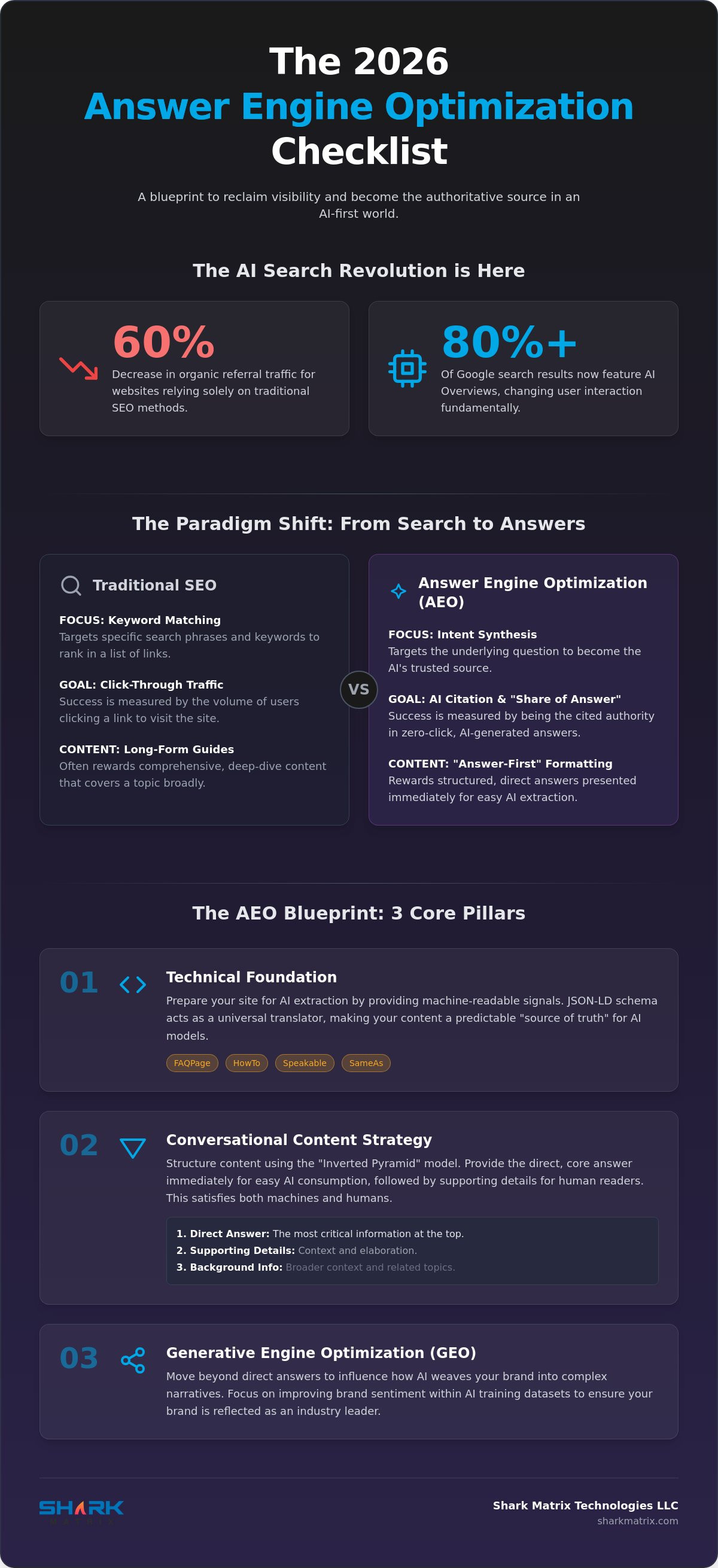
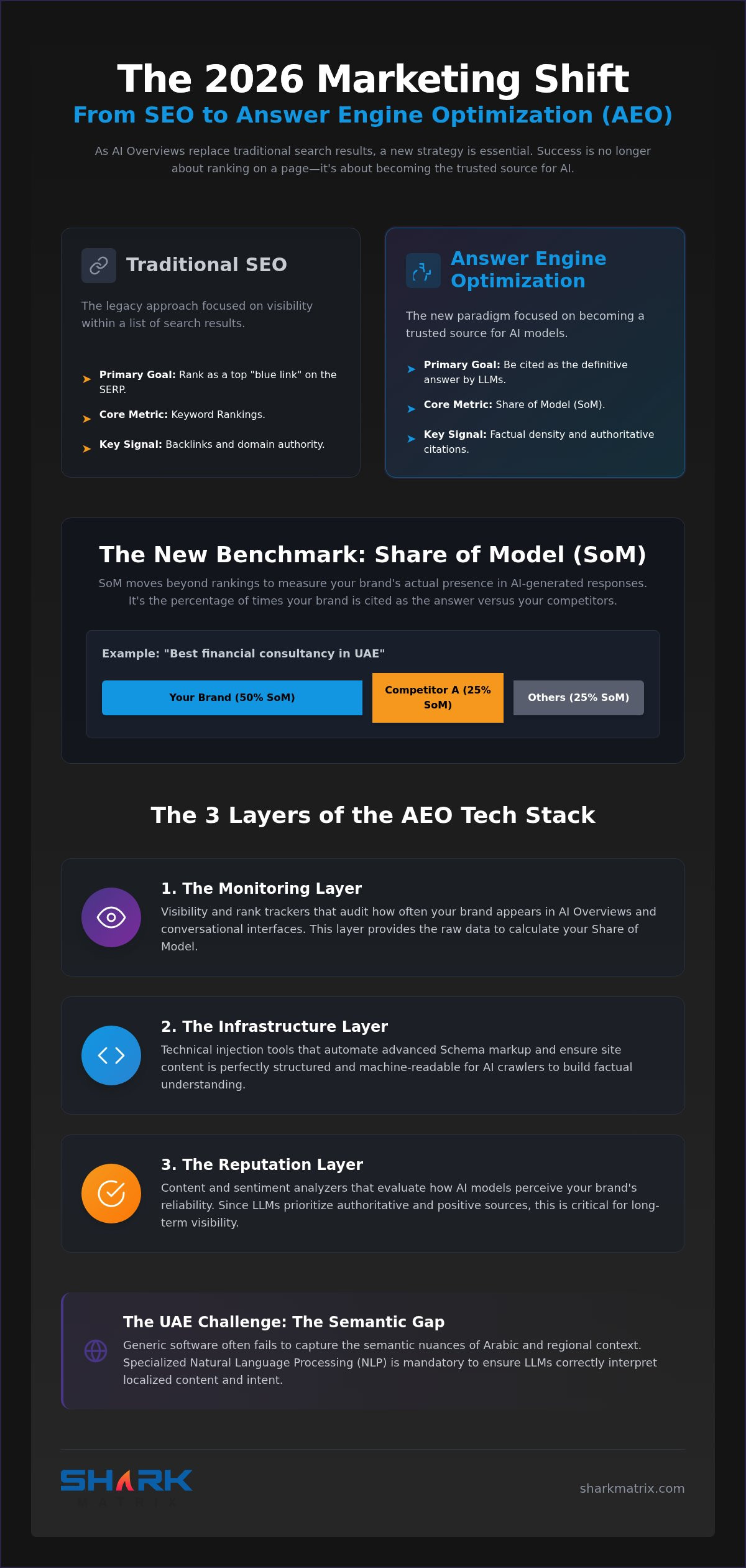
In 2026, the digital marketing stack has undergone a seismic shift from simple keyword matching to complex entity influence. The Evolution of Answer Engine Optimization Tools has necessitated a move toward software that doesn’t just track clicks, but monitors how Large Language Models (LLMs) perceive and cite your brand. These tools for answer engine optimization are now essential for any UAE firm looking to maintain its “Share of Model” (SoM). This metric has replaced traditional rank tracking, measuring the percentage of brand mentions and citations your business receives in AI-generated responses compared to your competitors. Success no longer depends on being a blue link on a page; it depends on being the definitive source an AI trusts.

Modern optimization relies heavily on sophisticated technology to decode how models interpret intent. For UAE brands, this is particularly complex due to the nuances of the Arabic language and regional context. Generic software often fails to capture the semantic weight of localized content. This is why specialized natural language processing services have become a mandatory part of the optimization stack. These services ensure your brand’s data is structured so that LLMs can process regional queries without losing the intended meaning or authority.

Why Traditional SEO Tools Aren’t Enough for AEO

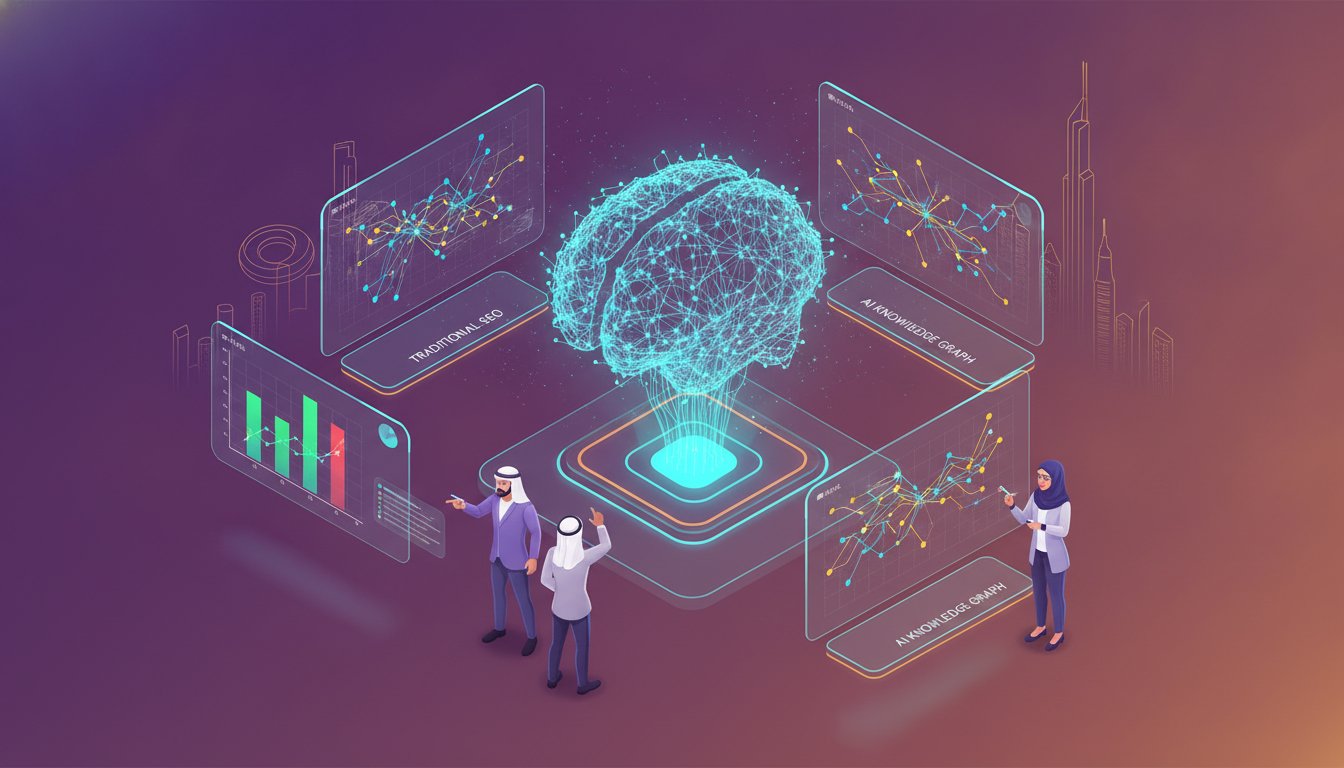
Traditional platforms like Ahrefs or Semrush were built for a link-based economy. While they’ve evolved to include AI features, they still primarily focus on keyword rankings and backlink profiles. AEO requires tracking semantic relationships rather than just hyperlinked votes. The “Semantic Gap” is the distance between a keyword ranking on a search page and an LLM understanding your brand as the authoritative entity for a specific solution. In a conversational search era, being “on page one” is irrelevant if ChatGPT or Gemini doesn’t cite you as the answer. AEO tools bridge this gap by analyzing how models synthesize your data into their knowledge graphs.

The Core Categories of the AEO Tech Stack

To dominate the generative search landscape in the UAE, businesses need a three-layered approach to their software stack:

  • The Monitoring Layer: These are visibility and rank trackers that audit how often your brand appears in AI Overviews and conversational interfaces. They provide the data needed to calculate your Share of Model.
  • The Infrastructure Layer: Technical injection tools focus on site architecture. They automate the deployment of advanced Schema and ensure your content is “machine-readable” for AI crawlers.
  • The Reputation Layer: Content sentiment analyzers evaluate how AI models perceive your brand’s reliability. Since LLMs prioritize authoritative and positive citations, this layer is critical for long-term visibility.

While off-the-shelf software provides a starting point, many UAE enterprises find that a custom approach is necessary. Shark Matrix serves as a technical partner in this space, offering generative AI development to build proprietary tools that cater specifically to the national market’s linguistic and competitive requirements.

Top AI Visibility and Rank Tracking Platforms

As search shifts toward synthesis, tools for answer engine optimization must provide more than just a list of rankings. They need to quantify how often your brand is the primary recommendation. SE Visible has emerged as a leader for multi-platform sentiment tracking, allowing users to see if their brand is mentioned favorably across different models. Geoptie excels at deep dives into ChatGPT and Perplexity; however, it often lacks the nuanced Arabic sentiment analysis critical for the UAE market. For firms requiring national precision, Shark Matrix provides custom tracking solutions that integrate localized NLP. These platforms calculate visibility scores based on citation frequency, helping you track competitor mentions within AI responses to see who is winning the recommendation war.

Monitoring Brand Mentions in ChatGPT and Gemini

Setting up automated prompts is the first step in auditing your presence. You shouldn’t just track your brand name. Focus on unbranded queries where your business should be the expert answer. If a user asks for the best financial consultancy in the region, does the model cite you? Daily refresh rates are vital here. LLMs update their internal weights and data access points frequently, so a weekly check is no longer sufficient to maintain an edge. It’s essential to identify these gaps early so you can adjust your content strategy before competitors claim the top citation spot.

Sentiment Analysis and Share of Model (SoM)

Visibility doesn’t always equal value. If an LLM mentions your brand in a negative context, it can damage your online reputation management dubai strategy. Advanced tools analyze whether answers are positive, neutral, or negative to protect your brand image. Calculating Share of Model involves comparing your total citations against the industry average. This data is essential for Future-Proofing with Shark Matrix AI Solutions, ensuring you aren’t just visible, but preferred. If you find your SoM is lagging, it might be time to consider ai automation services to refine your content delivery and improve how models synthesize your data. Shark Matrix serves as the premier technical partner for UAE firms needing these custom, Arabic-centric dashboards to monitor their digital authority.
10 Essential Tools for Answer Engine Optimization (AEO) in 2026

Technical and Content Optimization Software for AEO

Tracking visibility is only half the battle. To actually influence how AI models synthesize your brand information, you need specialized tools for answer engine optimization that focus on the technical “input” layer. In 2026, optimization has moved beyond simple metadata into the territory of entity relationships and fact density. While many platforms focus on the output of an answer, technical AEO software ensures your site architecture is optimized for LLM ingestion. This involves refining your code so that bots don’t just “crawl” your site but actually “understand” the hierarchical importance of your data.

Advanced Schema Markup for Entity Recognition

Standard JSON-LD is no longer sufficient for national UAE brands aiming for top citations. You must utilize advanced Schema types to provide clear signals to voice-activated answer engines and data-heavy models. Modern tools now automate the connection between your website’s content and the global Knowledge Graph, ensuring your brand is recognized as a distinct entity rather than just a collection of keywords. Key technical implementations include:

  • Speakable Schema: Identifies sections of your content specifically suited for text-to-speech conversion in AI assistants.
  • Dataset Schema: Highlights structured data sets that LLMs can use to provide factual, evidence-based answers.
  • Organization Entities: Connects your brand to verified industry databases to boost trust scores.

For businesses dealing with complex regional data, leveraging natural language processing services is essential to ensure that your technical markup accurately reflects the linguistic nuances of the UAE market. These tools bridge the gap between human intent and machine comprehension, making your site a preferred source for AI crawlers.

Fact-Density and Citation Optimization

LLMs in 2026 are programmed to prioritize “dense” information over marketing fluff. If your content is buried in adjectives and filler, AI models will likely skip it in favor of a competitor who provides verifiable data points. Specialized grading tools now analyze your content’s “cite-ability” by measuring its fact density. Authoritative Source Injection works by strategically placing verifiable, data-backed claims within your technical architecture so that LLM crawlers prioritize your domain as the primary source of truth for a specific topic. This technical approach ensures your content meets the strict E-E-A-T requirements that models use to filter out unreliable information.

To prevent being filtered out by AI “hallucination” safeguards, you should use fact-checking AI software to audit your claims against trusted records. This process is similar to how Top AI Visibility and Rank Tracking Platforms evaluate brand authority, but it happens at the content creation stage. By ensuring every claim is verifiable, you reduce the risk of models ignoring your site due to perceived inaccuracies. Shark Matrix provides the technical expertise to integrate these fact-density filters into your custom content management systems, positioning your brand as the most reliable authority in the national landscape.

Building a Custom AEO Stack for National Brands

Building a resilient digital presence in 2026 requires more than off-the-shelf software. For national UAE firms, a generic approach often leaves a massive data void in regional search results. You need a customized architecture that combines visibility tracking with technical injection. This process begins with an audit of your current standing across major LLMs to identify where your brand is being cited or ignored. Once you have a baseline, you must transition to an “AI-first” technical infrastructure. This involves using API-driven content delivery so that your data is immediately accessible to AI crawlers without the latency of traditional web rendering.

Your stack must also integrate these tools for answer engine optimization directly into your existing SEO and PPC dashboards. Siloed data is the enemy of agility. By viewing AEO metrics alongside your paid and organic performance, you can see exactly how AI Overviews are impacting your bottom line. This holistic view allows for rapid adjustments in sentiment monitoring and reputation management; it ensures that any negative hallucinations or inaccuracies are corrected before they scale.

Arabic Language Optimization in AEO

Most global tools for answer engine optimization struggle with the complexities of the Arabic language and its various regional dialects. National brands face a unique challenge: ensuring that Large Language Models perceive their content as authoritative in both Modern Standard Arabic and local vernaculars. Bridging the gap between English and Arabic brand mentions requires specialized Arabic digital marketing expertise. Without this localized layer, your brand risks being misinterpreted or entirely omitted by models that prioritize linguistically accurate sources.

Workflow Integration: From Data to Action

A successful AEO strategy is not static. You must connect your tracking tools directly to your Content Management System (CMS) to allow for real-time updates. If a sentiment analysis tool flags a drop in citation quality, your team should be able to push technical fixes or content adjustments instantly. Scaling these technical injections across thousands of pages is impossible to do manually. Leveraging ai automation services allows you to automate Schema updates and entity tagging at scale. If you are ready to build a proprietary stack that dominates the national market, Shark Matrix can help you develop industry specific ai solutions tailored to your enterprise needs.

Future-Proofing with Shark Matrix AI Solutions

Off-the-shelf tools for answer engine optimization often fall short for large UAE enterprises. While SaaS platforms provide broad data, they rarely account for proprietary data structures or the specific linguistic requirements of the national market. Relying on generic tools means you’re using the same data as your competitors. To gain a true advantage, you need custom generative ai development. This allows your brand to build its own monitoring ecosystem, ensuring your data is parsed and cited exactly how you intended. Standard software can’t always see the “Semantic Gap” in your specific industry, but custom engineering can.

Shark Matrix bridges this gap by engineering proprietary software that monitors brand-specific AI citations. By integrating AEO with custom ai chatbot-development services, you aren’t just hoping to be cited by others; you’re creating your own authoritative answer engine that feeds directly into the larger AI ecosystem. This creates a feedback loop where your owned AI assets reinforce your authority in third-party models like ChatGPT and Gemini. You own the data, you own the response, and you own the citation.

Custom AI Automation and Development

Standard dashboards often miss the nuances of niche industries. Shark Matrix develops internal tracking systems that measure “Brand Health” across all major LLMs in real time. These systems use custom scrapers and analyzers to identify how your specific industry data is being synthesized. By deploying industry specific ai solutions, you can target growth in sectors where generic tools for answer engine optimization lack depth. This level of technical precision ensures that your technical infrastructure is always aligned with the latest model updates, preventing your brand from being filtered out by hallucination filters.

The Shark Matrix AEO Advantage

Success in 2026 requires a partner that understands both the history of search and the future of AI. Shark Matrix combines over 15 years of SEO experience with cutting-edge AI engineering. We don’t just provide a tool; we deliver an end-to-end strategy. This starts with a comprehensive technical audit and moves into the development of custom tools designed to secure your digital authority. We focus on the national UAE market, ensuring your Arabic NLP is as strong as your English visibility. If you’re ready to secure your citations and dominate the generative search space, consult with our AEO experts today.

Securing Your Digital Authority in the Generative Era

The search landscape of 2026 demands more than traditional SEO. You’ve learned that dominating AI-driven results requires a “Double-Stack” approach: visibility tracking to monitor your Share of Model and technical injection to influence the knowledge graph. Relying on generic tools for answer engine optimization won’t suffice for national UAE brands that need specialized Arabic NLP and deep technical integration to truly stand out in ChatGPT or Gemini responses. It’s vital to move beyond the limitations of off-the-shelf software and generic SaaS platforms that often overlook regional nuances.

Shark Matrix is your dedicated technical partner in this digital evolution. Founded in 2010, our technical AI team specializes in Generative Engine Optimization and custom software engineering. We bridge the gap between human intent and machine understanding, ensuring your brand remains a primary source for LLMs across the region. Master the future of search with Shark Matrix AEO services and reclaim your digital authority. The transition to answer engines is a unique opportunity to lead your industry with data-backed precision and localized expertise. Don’t let your brand get left behind in the era of AI synthesis.

Frequently Asked Questions

What is the best tool for tracking ChatGPT rankings in 2026?

In 2026, platforms like Profound and Geoptie are popular for tracking ChatGPT citations. Profound offers deep engine coverage across multiple models, while Geoptie focuses on specific engine deep dives. However, for UAE brands, the best results often come from custom monitoring dashboards that account for regional linguistic nuances. Shark Matrix provides these custom tools for answer engine optimization, ensuring your brand’s specific citations are tracked accurately across conversational interfaces.

Can traditional SEO tools like Semrush help with AEO?

Traditional SEO tools still provide value for keyword research and backlink analysis, but they often lack the semantic depth required for AEO. They primarily track blue links rather than how an LLM synthesizes information. While they are evolving to include AI features, you should supplement them with specialized AEO software. This allows you to measure “Share of Model” and brand sentiment within generated answers to get a complete picture of your digital visibility.

How do I measure the ROI of AEO tools?

You measure the ROI of AEO tools by tracking the correlation between “Share of Model” (SoM) growth and assisted conversions. Since AI Overviews often reduce direct click-through rates, focus on brand lift and citation frequency as key performance indicators. High-quality tools for answer engine optimization provide data on how often your brand is recommended. This directly influences your online reputation and long-term customer trust in a generative search environment.

Are there specific tools for optimizing Arabic content for answer engines?

Most global SaaS platforms struggle with Arabic dialects and Modern Standard Arabic nuances. To succeed in the national UAE market, you need specialized natural language processing services. Shark Matrix offers custom-built tools designed specifically for the Arabic language, ensuring your content is machine-readable and authoritative for regional models. These localized solutions prevent your brand from being misinterpreted or entirely omitted by AI engines that prioritize linguistically accurate sources.

What is the difference between GEO tools and AEO tools?

While the terms are often used interchangeably, Generative Engine Optimization (GEO) specifically focuses on optimizing content for generative models like Gemini and ChatGPT. Answer Engine Optimization (AEO) is the broader strategy of making your brand the definitive answer across all conversational interfaces, including voice assistants. Both require specialized software to track how models synthesize your data, but AEO emphasizes the final answer delivered to the user regardless of the platform.

Do I need a custom AI developer to succeed in AEO?

Off-the-shelf tools provide a baseline, but custom AI development is often necessary for UAE enterprises with proprietary data or complex regional requirements. A custom developer can build proprietary scrapers and analyzers that generic software lacks. Shark Matrix acts as a technical partner, offering generative AI development to create internal dashboards that track brand health across LLMs. This gives you a competitive edge that standard subscription tools simply cannot match.

Is there a free tool to check if my brand is cited by AI?

Many AEO platforms offer limited free trials or freemium tiers to help you test their visibility tracking. You can also use manual automated prompts in ChatGPT or Gemini to audit your brand presence, though this is difficult to scale. For a comprehensive national audit, it’s more effective to use professional tools for answer engine optimization that provide aggregated data across multiple engines, ensuring you don’t miss critical mentions in the generative landscape.

How often should I use AEO tools to audit my website?

You should perform a deep AEO audit at least once a month, but monitor your “Share of Model” metrics daily. AI models update their internal weights and data access points frequently, meaning your visibility can shift overnight. Constant monitoring allows you to identify negative sentiment or factual inaccuracies quickly. Regular audits ensure your technical infrastructure and advanced Schema remain optimized for the latest LLM crawlers and regional search behavior shifts.

Categories
AEO GEO

How to Optimise Content for AI Search: The 2026 GEO & AEO Guide

What if your number one ranking on Google suddenly resulted in zero clicks because an AI agent answered the query before the user even scrolled? It’s a reality many brands face as generative summaries begin to dominate the top of search results. You’ve likely felt the pressure of declining organic traffic and the frustration of trying to decode shifting technical standards. It’s clear that traditional SEO rules are evolving, and maintaining visibility now requires a more sophisticated approach.

This guide will show you exactly how to optimize content for ai search to ensure your brand remains a cited authority in 2026. By mastering Generative Engine Optimisation (GEO) and Answer Engine Optimization (AEO), you’ll learn to bridge the gap between traditional search and AI-driven synthesis. We’ll explore the specific technical requirements for AI citations and provide a clear roadmap to future-proof your content strategy against the next wave of digital transformation.

Key Takeaways

  • Understand the fundamental shift from traditional SERPs to Generative Engine Optimisation to capture visibility in zero-click environments.
  • Discover how to optimize content for ai search by leveraging Retrieval-Augmented Generation (RAG) and establishing high domain authority for LLM citations.
  • Master the Answer Engine Optimization (AEO) framework to produce the data-dense, definitive statements that AI tools require for direct responses.
  • Execute a 2026 technical audit that integrates multi-modal elements like voice and video to future-proof your national brand presence.
  • Learn how custom AI development and natural language processing services provide a competitive edge in the evolving generative search landscape.

Understanding the Shift: From Traditional SERPs to AI Search Engines

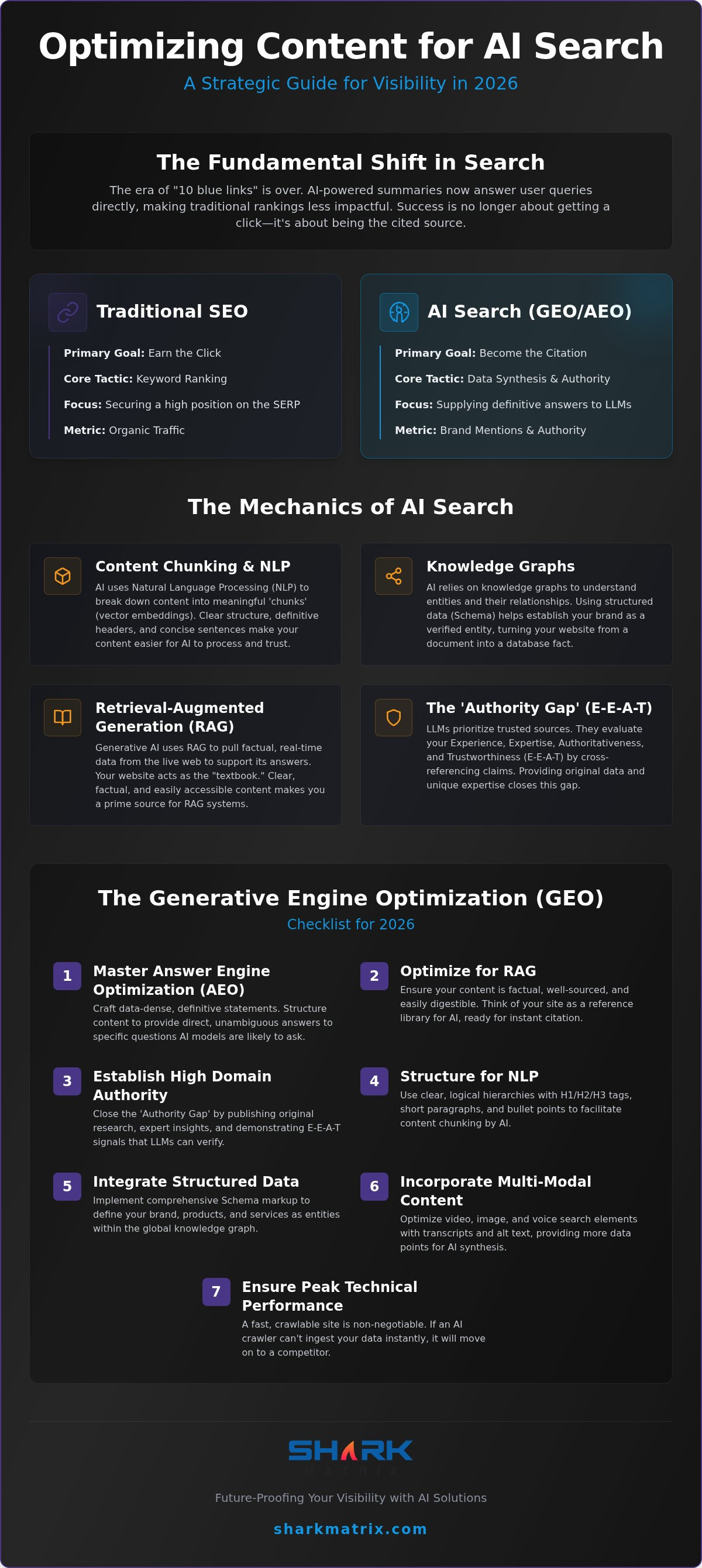
The digital landscape has crossed a threshold. Discovery is no longer a simple matter of matching a keyword to a URL. Instead, we’ve moved From Traditional SERPs to AI Search Engines, where the goal is synthesis rather than indexing. In 2026, search engines don’t just show you where information lives; they process it for you. This shift has birthed Generative Engine Optimization (GEO), a discipline that focuses on how your brand’s data is ingested and repeated by Large Language Models (LLMs).

Traditional SEO was built on the foundation of the “blue link.” You optimized for a high ranking to earn a click. The rise of zero-click searches has disrupted this model. National brands in the UAE now face a reality where the search engine provides the full answer directly on the results page. If your site isn’t the primary source for that answer, you lose visibility. Learning how to optimize content for ai search is no longer optional. It’s the only way to ensure your brand is cited rather than ignored. LLMs prioritize synthesis, which means your ranking matters less than your status as a trusted citation.

The Evolution of Search Intent in 2026

Search intent has matured into something far more complex than transactional or informational buckets. Users now engage in multi-step conversational queries that reflect specific “need states.” An AI doesn’t just look for “best logistics software.” It interprets a request for “a scalable logistics solution for a national retail chain that integrates with existing ERPs.” This requires content that addresses the nuance of a conversation. At Shark Matrix, our generative AI development services help brands build the technical infrastructure needed to feed these models high-quality, authoritative data that shapes brand sentiment within training sets.

Key Players in the AI Search Ecosystem

The ecosystem is no longer a Google monopoly. While Google’s Search Generative Experience (SGE) has completed its national rollout, other players like Perplexity, Claude, and ChatGPT have changed how users source real-time data. These platforms use Retrieval-Augmented Generation (RAG) to pull from the live web. In the B2B sector, specialized answer engines are also emerging, prioritizing technical accuracy over broad popularity. Winning in this environment means appearing across these diverse platforms as a consistent, reliable source of truth.

The Mechanics of AI Search: How LLMs Process and Cite Content

Understanding the underlying mechanics of Large Language Models (LLMs) is the first step for anyone learning how to optimize content for ai search. Unlike traditional bots that simply index pages, modern AI uses Retrieval-Augmented Generation (RAG). This process allows the model to pull specific data from the live web to anchor its responses in fact. It’s essentially an open-book test where your website is the textbook. If your content is clear and factual, the AI is more likely to cite you as the definitive source.

The ‘Authority Gap’ defines why AI prefers certain domains over others. In 2026, LLMs evaluate E-E-A-T by cross-referencing your claims against other trusted entities in their training data. If your site provides original data or unique expertise, you close this gap. High-speed technical performance also plays a role. If a crawler can’t ingest your data instantly, it will simply move to a faster competitor. Consistent, high-performance delivery ensures your content is always available for real-time synthesis.

NLP and Content Chunking

AI models don’t read sentences the way humans do. They use Natural Language Processing (NLP) to break your content into chunks or vector embeddings. These are mathematical representations of meaning. To help this process, your content should be structured with clear, logical paragraphing and definitive headers. Short, punchy sentences often perform better because they are easier for models to vectorize. If you need to refine how your site communicates with these machines, our Natural Language Processing Services provide the technical expertise to bridge this gap.

The Role of Knowledge Graphs

Your brand needs to exist as an Entity within a global knowledge base. AI uses knowledge graphs to understand how your services relate to specific industry problems. Using structured data helps define these relationships clearly for the LLM. When your brand is part of a knowledge graph, you aren’t just a search result; you’re a verified fact. This level of technical integration is a core part of our Generative AI Development strategies. For national brands looking to solidify their presence, investing in ai automation services can streamline the creation of this structured data at scale.

How to Optimise Content for AI Search: The 2026 GEO & AEO Guide

Answer Engine Optimisation (AEO): Designing Content for Direct Responses

Answer Engine Optimisation (AEO) is the tactical side of showing up in AI summaries. While GEO focuses on the engine’s synthesis, AEO focuses on the answer itself. To master how to optimize content for ai search, you must prioritize directness and data-density. “Fuzzy” content, which relies on vague adjectives and marketing fluff, fails in 2026. AI models are trained to find the most efficient answer. If your content is buried under layers of storytelling without clear data points, the engine will skip you. It’s no longer enough to be “good”; you must be the most mathematically relevant response to a specific prompt.

Balancing human-centric storytelling with machine-centric clarity is the secret. You don’t have to write like a robot, but you do need to provide quote-dense sentences. These are definitive statements that an AI can easily extract and cite. For national brands, this means moving away from generic claims to specific, verifiable facts. If you’re looking for a partner to manage this transition, our Comprehensive SEO Services Guide details how we integrate these strategies into national campaigns. We focus on the technical bridge between what humans want to read and what machines need to ingest.

Structuring Content for the ‘Answer’ Format

The inverted pyramid is your best friend. Start each section with the most critical information. AI search tools often scan the first paragraph for a summary. If the answer is there, you’re more likely to be cited. Use H3 headings as specific questions. For example, instead of “Our Process,” use “How Does Our National SEO Process Work?” This mirrors the conversational queries users type into LLMs. It’s about making the machine’s job as easy as possible. When the AI finds a direct answer immediately following a relevant question, the probability of becoming a featured citation increases significantly.

Optimizing for Conversational ROI

Winning the AI snippet requires identifying low-competition, high-intent questions. These are the specific “how-to” or “why” queries that competitors often ignore. FAQ sections are a goldmine for this. They provide a clear structure for the AI to ingest. To truly understand what your audience is asking, you can use AI Chatbot Development to capture real-time search intent data. This allows you to feed your content strategy with the exact phrases and problems your customers face daily. By integrating this data back into your content, you create a feedback loop that keeps your brand relevant across all generative platforms.

The Generative Engine Optimisation (GEO) Checklist for 2026

Winning in generative search requires more than just good writing. It demands a technical foundation that allows Large Language Models to ingest your data without friction. A comprehensive technical audit is the first step in learning how to optimize content for ai search. In 2026, this means moving beyond the traditional crawl-and-index cycle. Instead, brands must prioritize multi-modal optimization. AI agents now synthesize information from video transcripts, image metadata, and voice snippets simultaneously. If your brand’s video content doesn’t have structured transcripts, you’re invisible to a significant portion of the generative ecosystem.

Consistency is your greatest asset. LLMs prioritize ‘Brand Source’ status for domains that provide regular, high-velocity updates. Stale data is discarded in favor of real-time accuracy. Our AI Automation Services help national brands maintain this consistency by automating the technical updates required to stay relevant. By ensuring your data is always fresh, you reinforce your position as a primary source for AI synthesis. It’s about being the most reliable version of the truth at any given moment.

Technical GEO Requirements

Your schema markup needs to evolve. While basic article tags are still necessary, 2026 standards require ‘Dataset’ and ‘ClaimReview’ schema to provide the granular detail LLMs crave. This structured data acts as a translator between your website and the model’s training set. API-first content delivery is another critical requirement. LLMs often bypass traditional HTML scraping in favor of direct data feeds to ensure real-time accuracy. Finally, zero-latency mobile performance is non-negotiable. If an AI-integrated browser experiences a delay while fetching your site’s data, it’ll pivot to a faster source to maintain the conversational flow.

Content Verification and Fact-Checking

AI search engines are increasingly sensitive to conflicting information. If your website claims one fact while your national press releases claim another, the LLM will flag your domain as unreliable. Fact-checking is now a core SEO function. You must anchor your claims with external citations to high-authority national sources. This creates a web of trust that the AI can verify. For brands managing complex narratives, our national SEO services ensure that your digital footprint remains consistent and authoritative across all platforms. To secure your visibility across generative engines, explore our generative AI development services to automate your technical readiness.

Future-Proofing Your Visibility with Shark Matrix AI Solutions

Shark Matrix positions itself as the technical bridge between legacy search and the generative future. We integrate Custom AI Development with modern SEO to build a resilient digital presence. In 2026, national brands require more than just basic keyword targeting. They need a sophisticated system that updates data and citations in real-time. This hybrid approach pairs human creativity with deep technical optimization. Our proprietary workflows automate complex GEO tasks, allowing your team to focus on high-level narrative while our machines handle the granular citation management.

National expertise serves as a critical advantage in the generative search landscape. LLMs increasingly value localized accuracy and verified national data. When you understand the specific nuances of the UAE market, you can provide the data-dense responses that generative engines prioritize. We help brands scale their organic visibility through automated GEO workflows that align with evolving national search trends. Mastering how to optimize content for ai search is a continuous process of technical refinement and strategic adaptation.

Tailored AI Strategies for National Brands

We develop Industry-Specific AI Solutions designed for search dominance. Every sector faces unique citation requirements. A financial institution needs different technical markers than a retail group. By leveraging ML Development Services, we predict shifts in how generative engines prioritize different types of data. This proactive stance ensures your brand isn’t just reacting to algorithm changes but staying ahead of them.

Get Started with an AI Search Audit

Success in the current era is measured by ‘Citation Share.’ This metric quantifies how often AI tools recommend your brand as a primary source compared to your competitors. Our audit provides a comprehensive roadmap for transitioning from a legacy SEO mindset to a GEO-first strategy. We identify technical gaps in your current setup and provide a clear path to visibility. If you’re ready to secure your digital future, Contact Shark Matrix for a 2026 AI Search Strategy and ensure your brand remains at the center of every AI-generated answer.

Securing Your Brand’s Authority in the Age of AI

The transition to generative search isn’t just a trend; it’s a fundamental change in how information is consumed. You’ve learned that winning in 2026 requires a move from simple keyword density to deep citation optimization. By mastering the frameworks of Answer Engine Optimization and Generative Engine Optimization, you ensure your brand isn’t just found but cited as a definitive source. Understanding how to optimize content for ai search is the key to maintaining your national reach as Large Language Models take center stage.

Shark Matrix stands as a pioneer in these evolving GEO and AEO frameworks. Our expertise in custom AI and machine learning development allows us to bridge the gap between traditional SEO and the technical demands of modern LLMs. With a proven track record in national UAE campaigns, we provide the technical mastery needed to scale your visibility. Future-proof your brand with Shark Matrix AI & SEO services. The future of search belongs to those who adapt early. Start your transition today and lead your industry into the generative era.

Frequently Asked Questions

What is the difference between SEO and GEO in 2026?

SEO focuses on ranking in traditional search engine result pages using keywords and backlinks. GEO, or Generative Engine Optimization, prioritizes how Large Language Models synthesize and cite your content within their generated answers. While SEO targets clicks, GEO targets being the authoritative source that the AI mentions. It’s a fundamental shift from being a simple link to becoming a verified fact in a model’s output.

How can I check if my website is being cited by AI search engines?

You can check for citations by using AI-specific search tools like Perplexity or the generative overviews in Google. Look for footnote links or “Sources” sections at the bottom of the AI response. Tools that track Citation Share are becoming essential for national brands in the UAE. Monitoring these citations helps you understand how to optimize content for ai search by seeing which data points the models find most useful.

Will AI search replace traditional Google Search entirely?

AI search won’t replace traditional search entirely, but it has transformed it. By 2026, most searches are hybrid, where an AI summary appears above the traditional list of links. Users still rely on traditional search for deep research or transactional tasks. However, the top-of-page real estate is now dominated by generative answers. This makes it vital to adapt your visibility strategy to accommodate both formats simultaneously.

Does structured data still matter for AI search optimization?

Structured data is more important than ever because it acts as a direct translator for AI agents. Using Schema markup like Dataset or ClaimReview helps LLMs understand the relationship between your content and specific entities. This technical clarity reduces the hallucination risk for the AI. It makes the model much more likely to trust and cite your website as a verified source of information across the national landscape.

How do I optimize my content for Perplexity and ChatGPT search?

Optimizing for Perplexity and ChatGPT requires a focus on data-density and factual accuracy. These engines use Retrieval-Augmented Generation to pull real-time data. You should provide clear, definitive statements and cite high-authority national sources. Providing original research or unique data sets makes your content more attractive to these models. They prioritize original information over repeated general knowledge that exists elsewhere in their training data.

Can AI-generated content rank well in AI search engines?

AI-generated content can rank if it provides unique value or original insight. However, AI search engines prioritize experience and expertise. Simply recycling existing AI outputs often leads to a race to the bottom where the content lacks the specific nuance needed for a citation. High-quality, human-led content that incorporates technical SEO and machine learning development insights typically performs significantly better in these new generative environments.

How often should I update my content for AI search engines?

Content should be updated frequently to maintain Brand Source status. AI models prioritize real-time accuracy and fresh data. If your information is outdated, models will pivot to competitors who provide current stats. National brands often use AI automation services to ensure their most critical data points are updated across their digital footprint. This keeps them relevant for every new model training cycle and real-time query.

What is Answer Engine Optimization (AEO)?

Answer Engine Optimization (AEO) is a specific branch of digital marketing focused on providing direct, concise answers to user queries. While GEO deals with broader synthesis, AEO focuses on the format. It involves structuring content to fit the answer boxes used by voice assistants and AI summaries. Learning how to optimize content for ai search through AEO means prioritizing technical precision and clarity over long-form marketing fluff.

Categories
AEO

Preparing for AI Overviews: 2026 Generative Search Strategy

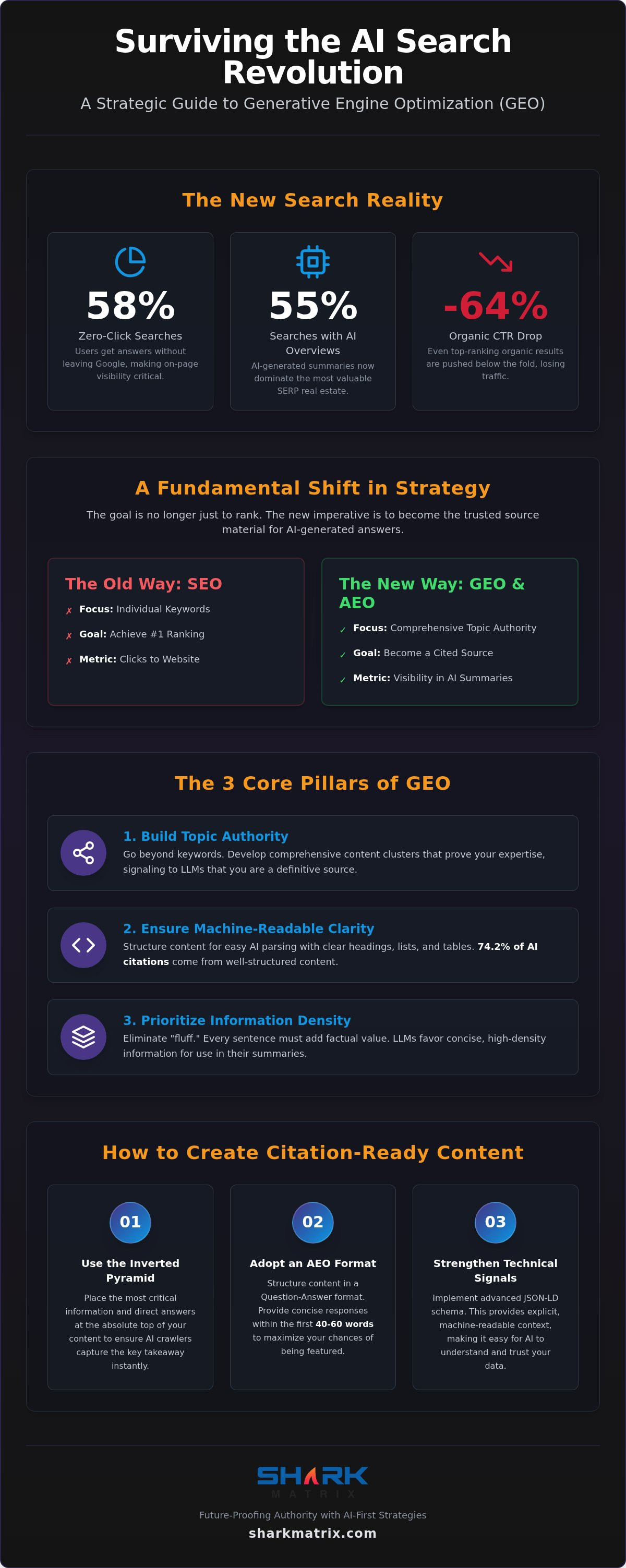
Did you know that 58% of Google searches now conclude without a single click? As of September 2026, AI Overviews appear in up to 55% of search results, causing organic click-through rates for top-ranking pages to plummet by as much as 64%. It’s a daunting shift that leaves many brands feeling invisible. You’ve likely spent years perfecting your rankings only to find them pushed below the fold by a generative summary. If you’re feeling the pressure, you aren’t alone. Preparing website for ai overviews is no longer an optional experiment; it’s a survival requirement for any brand that wants to remain relevant.

We’ll help you master the transition from traditional SEO to Generative Engine Optimization (GEO) and Answer Engine Optimization (AEO). You’ll learn how to position your brand as the definitive source of truth for large language models, ensuring you’re the one cited when AI answers a user’s query. This guide breaks down the shift toward AI-native search behavior, the importance of structured data, and the specific content strategies needed to drive high-intent traffic in this new era. By the end, you’ll have a clear roadmap to maintain visibility and authority as search evolves.

Key Takeaways

  • Understand how AI Overviews synthesize answers and why traditional ranking metrics are evolving into citation-based visibility.
  • Learn the practical steps for preparing website for ai overviews by shifting focus from individual keywords to building comprehensive topic authority.
  • Discover how to structure your content using the “inverted pyramid” method to ensure your data is the first choice for AI-generated summaries.
  • Identify the essential technical upgrades, such as advanced JSON-LD schema, required to support AI-first indexing in 2026.
  • Explore how leveraging specialized natural language processing and AI automation services can give your brand a competitive edge in generative search.

What are AI Overviews and Why Do They Matter for SEO?

AI Overviews represent the most significant shift in search history since the introduction of mobile indexing. Formerly known as Search Generative Experience (SGE), these AI-generated summaries now appear in approximately 47% to 55% of all searches as of September 2026. For national brands, this means the traditional goal of ranking in the top spot is no longer enough. When an AI summary occupies the top of the screen, the first organic result often loses up to 64.4% of its potential traffic. Effectively preparing website for ai overviews is now the only way to capture attention before a user scrolls past the fold.

The Evolution of the Search Result Page

The search engine results page (SERP) has transformed from a list of destinations into a destination itself. With 58% of searches now resulting in zero clicks, users are finding the answers they need without ever leaving the interface. This isn’t just about featured snippets anymore. While a standard snippet pulls a single quote, AI Overviews synthesize information from multiple sources to create a comprehensive answer. To survive this shift, brands must move toward Generative Engine Optimization (GEO), ensuring their data is the primary ingredient in these synthesized responses. Differentiating your brand requires moving beyond basic visibility and becoming a cited authority within the generative block.

The Business Case for AI Optimization

AI Overviews serve as the primary interface for modern information retrieval. For a national brand, being excluded from these summaries is equivalent to being invisible. Traditional SEO tactics focus on technical health and keyword density, but these methods don’t address how large language models (LLMs) interpret your authority. You need to secure citations within the AI’s response to capture high-intent users who are using search for complex decision-making. Shark Matrix offers specialized ai automation services to help brands bridge this gap. By aligning your digital footprint with the way AI models process information, you protect your share-of-voice in an increasingly consolidated market. Traditional tactics alone can’t combat the structural gap in click-through rates, making a proactive strategy for preparing website for ai overviews essential for long-term growth.

The Core Pillars of Generative Engine Optimization (GEO)

The transition from traditional SEO to Generative Engine Optimization requires a fundamental shift in how you view your website’s content. Instead of chasing individual keywords, your focus must pivot toward building comprehensive topic authority. Large Language Models (LLMs) don’t just look for matches; they interpret the relationships between concepts on your page. By leveraging natural language processing, these models evaluate your site’s relevance and expertise. If you’re preparing website for ai overviews, you need to understand that the goal is to become the most statistically probable answer for a given query.

A successful GEO strategy builds on the foundation of technical SEO but adds a layer of machine-readable clarity. Analysis from 2026 shows that 74.2% of AI citations come from structured, listicle-style content. This suggests that the way you present data is just as important as the data itself. You can find detailed technical guides on how to optimize for AI Overviews, but the strategic core involves making your site an undeniable source of truth. Brands that succeed here often integrate generative ai development into their marketing stacks to analyze how AI models perceive their brand’s authority.

Answer Engine Optimization (AEO) Fundamentals

AEO is the practice of structuring content to be immediately useful to an answer engine. Unlike traditional long-tail keyword optimization, which focuses on user intent for clicks, AEO focuses on extraction. You must provide direct, unambiguous answers to specific questions. Using a “Question-Answer” format within your content helps AI crawlers identify your site as a source of truth. It’s about being concise. If you can’t answer a user’s question in the first 40 to 60 words, you’re likely to lose the citation to a competitor who can.

Building Information Density and Factuality

LLMs prioritize high-density information. This means you should eliminate “fluff” and filler text that doesn’t add value. Every sentence should serve a purpose. There’s a strong correlation between structured data and AI citation probability because machine-readable formats like JSON-LD make it easier for models to verify facts. When preparing website for ai overviews, ensure your proprietary data is clearly labeled and easy to digest. Fact-checking is non-negotiable. AI models are designed to avoid hallucinations, so they’ll favor sources with verifiable, consistent information. If you need help refining your data structure, our team can provide ai automation services to streamline the process.

Preparing for AI Overviews: 2026 Generative Search Strategy

Content Strategy: Creating Citation-Ready Assets

To win the citation game in 2026, you must adopt the “Inverted Pyramid” content structure. This means placing your most critical information, the direct answer to the user’s query, in the first 40 to 60 words. AI crawlers prioritize pages that provide immediate value without requiring deep scrolling. When you’re preparing website for ai overviews, your goal is to make the extraction process as seamless as possible for the model. If the bot has to hunt for the answer, it’ll likely cite a competitor who served it on a silver platter.

Original research and proprietary data are the new gold standard for “Link Bait” in the AI era. Since LLMs are trained to avoid duplication, they’re constantly looking for unique data points to include in their summaries. By publishing first-party surveys or industry-specific case studies, you become an indispensable source. You can use professional SEO services to audit your current content depth and identify gaps where proprietary data could boost your authority. Following a comprehensive AI Overview optimization guide will help ensure these assets are technically discoverable.

The Role of Expert Citations and Attribution

Generic content is easily replaced by AI, but unique perspectives are not. Opinionated content that offers a specific “take” on industry trends helps your brand stand out from synthesized summaries. To support this, use structured bios and Person schema to verify author expertise. This reinforces the EEAT (Experience, Expertise, Authoritativeness, and Trustworthiness) signals that search engines use to filter out low-quality, AI-generated fluff. Getting mentioned in the datasets that train these models requires a consistent history of being cited by other high-authority experts.

Optimizing for Conversational Queries

User behavior has shifted toward longer, more conversational prompts. Your content must map to this journey, distinguishing between informational “how-to” prompts and decisional “best-for” queries. Adapting your tone for voice and chat-based interfaces is critical for maintaining relevance. Using a conversational tone improves NLP comprehension for AI models by mimicking the natural patterns of human dialogue. This makes it easier for the algorithm to parse your intent and match it with complex user questions. When preparing website for ai overviews, remember that the “ten blue links” are gone; you’re now participating in a global conversation.

Technical Infrastructure for AI-First Indexing

Technical SEO isn’t dead; it’s just evolved. When preparing website for ai overviews, your site’s foundation must be built for machines as much as humans. AI-first indexing builds on foundational SEO like mobile-first indexing and Core Web Vitals, but it demands higher precision in how data is labeled. If your technical infrastructure is messy, AI crawlers will struggle to parse your content, leading to lower confidence scores and fewer citations. You’re no longer just trying to get indexed; you’re trying to get understood by a large language model.

Schema Markup Beyond the Basics

Basic markup like “Article” or “Organization” is now the bare minimum. To stand out in 2026, you should implement Speakable schema for voice-activated queries and Dataset schema for your proprietary research. Linking entities within your own domain helps build a localized “Knowledge Graph” that LLMs use to verify facts. This semantic linking directly impacts your site’s confidence score. If an AI model can’t verify your data across your own entity structure, it’s less likely to cite you as a source of truth. Advanced JSON-LD allows you to define these relationships explicitly, making your site a preferred source for answer engines.

Managing AI Bot Interactions

You need to distinguish between standard Googlebot and AI-specific crawlers. Robots.txt best practices have changed to accommodate the resource-intensive nature of generative bots. You must ensure that AI bots have access to specific data clusters they need without draining your crawl budget. Research shows that maintaining content freshness with updates every 7 to 14 days is critical for AI visibility. Fast site speed and healthy Core Web Vitals ensure these bots can crawl and index your latest updates rapidly. If a bot encounters a slow-loading page, it might skip the deep analysis required for a generative summary.

Semantic architecture is the next step in your technical journey. Grouping related entities together through a clear internal linking structure helps AI models understand the full context of your expertise. Regular monitoring of these technical signals is vital to catch errors before they impact your visibility in search. If you want to ensure your site’s backend is ready for the future, our comprehensive SEO services can help you build an infrastructure optimized for the generative era.

Future-Proofing Authority with Shark Matrix AI Solutions

Integrating AI into your marketing workflow is the next logical step for brands that want to dominate the 2026 search landscape. Shark Matrix provides specialized ai automation services that remove the manual labor from content optimization. Instead of guessing what an LLM wants, we use natural language processing to analyze how your competitors appear in AI Overviews. This data-driven approach lets you see the structural patterns that lead to citations. When you’re preparing website for ai overviews, you can’t rely on intuition alone. You need tools that speak the same language as the search engines themselves.

There’s a critical link between AI search visibility and online reputation management. When an AI generates a summary of your brand, it pulls from a variety of sources. If negative or outdated information persists in the training data, the AI will present it as fact. A holistic approach that combines custom AI development with strategic SEO ensures that the “source of truth” remains accurate and positive. Protecting your brand’s digital identity in 2026 means managing how machines perceive you as much as how humans do.

Custom AI Tools for National Competitive Advantage

We use proprietary machine learning models to predict search trends before they hit the mainstream. This allows our clients to publish authoritative content while a topic is still emerging, securing that crucial first-mover citation. Automating the AEO formatting process at scale is another way we help national brands stay ahead. By transforming large volumes of legacy content into machine-readable formats, we’ve seen brands significantly increase their presence in generative summaries. It’s about moving from a reactive stance to a proactive one.

Getting Started with an AI-Ready Audit

The first step in preparing website for ai overviews is identifying the AI gaps in your current digital presence. Our audit process evaluates your site’s semantic structure, entity relationships, and information density. We prioritize high-impact pages that are most likely to be featured in generative results, ensuring your resources are spent where they’ll have the most effect. Don’t wait for your traffic to disappear before you act. Partner with Shark Matrix to lead the generative search revolution and secure your brand’s future in the AI era.

The search landscape has permanently shifted from simple rankings to complex AI citations. Success now depends on your ability to feed large language models the precise, structured data they require to synthesize answers. By mastering Generative Engine Optimization and adopting an answer-first content strategy, you ensure your brand remains a primary source of truth. Successfully preparing website for ai overviews isn’t just about technical tweaks; it’s about building a digital presence that AI models can trust and verify.

Shark Matrix leads the market as a pioneer in custom AI automation and development. We specialize in high-impact national SEO campaigns and data-driven strategies designed specifically for the 2026 search landscape. Our team helps you navigate the technical and strategic hurdles of generative search to keep your brand visible and authoritative. Secure your brand’s future in generative search with Shark Matrix AI-SEO services. The future of search is conversational, and it’s time for your brand to lead the discussion.

Frequently Asked Questions

Will AI Overviews completely replace organic search traffic?

AI Overviews won’t replace organic traffic entirely, but they’ve structurally changed the search landscape. With 58% of Google searches now ending without a click, the goal has shifted. You must focus on ensuring your brand is the cited source. High-intent queries still drive traffic, but informational queries are increasingly answered within the results page. Capturing the citations that appear alongside these generative summaries is the only way to maintain brand authority.

How long does it take to see results from Generative Engine Optimization?

Results from Generative Engine Optimization typically appear within a few weeks to several months. This timeline depends on how quickly search engines crawl your updates and how often the underlying large language models refresh their training data. Since maintaining content freshness with updates every 7 to 14 days is now a standard requirement, consistent optimization leads to faster recognition. Patience is necessary as AI models verify your site’s reliability across multiple data points.

Does structured data help my website appear in AI citations?

Structured data is a critical component when preparing website for ai overviews. Research from March 2026 indicates that 74.2% of all AI citations come from structured, listicle-style content. By using JSON-LD schema like Dataset or FAQPage, you make it easier for machine-learning models to parse and verify your information. This technical clarity significantly increases the statistical probability that an AI model will select your content as a definitive source for its generative summary.

Can I opt-out of having my content used in Google AI Overviews?

You can opt-out by using the nosnippet robots meta tag or the data-nosnippet HTML attribute. However, this is a double-edged sword. While it prevents your content from being used in AI summaries, it also removes your site from traditional featured snippets and search previews. Most national brands find that the loss in visibility outweighs the benefits of opting out. A better strategy involves optimizing your content to ensure you are cited accurately and prominently.

What is the difference between SEO and Answer Engine Optimization (AEO)?

SEO focuses on ranking a page for specific keywords to drive clicks. Answer Engine Optimization (AEO) focuses on providing a direct, concise response that an AI can easily extract and repeat. While SEO looks at backlinks and technical health, AEO prioritizes answer-first formatting in the first 40 to 60 words. Both are necessary in 2026, but AEO is what ensures your brand survives the shift toward zero-click search environments where the answer is delivered directly.

How do AI models determine which sources are the most trustworthy?

AI models determine trustworthiness by evaluating EEAT signals and cross-referencing information across high-authority domains. They look for consistency in facts and the reputation of the cited authors. If multiple reputable sources cite your proprietary data, the model’s confidence score for your brand increases. This is why building a localized Knowledge Graph through semantic internal linking and authoritative expert bios is essential for maintaining long-term visibility in generative search results across the country.

Is AI-generated content penalized in AI search results?

AI-generated content is not inherently penalized, but low-quality fluff is. Search engines prioritize helpful, original content that provides new insights or proprietary data. If your content is just a rehash of existing information that an LLM can already generate, it won’t be cited. The key is to use generative tools for efficiency while ensuring the final output contains the unique expertise and opinionated takes that machines cannot replicate on their own.

How can I track my brand’s visibility within AI-generated responses?

Tracking visibility involves monitoring citation frequency and your brand’s share of voice within the generative block. preparing website for ai overviews requires moving beyond traditional ranking reports to look at how often your site is cited as a source. You can use specialized AI-tracking tools or conduct manual audits of high-value conversational queries. Identifying which pages are being cited helps you refine your strategy and double down on successful content structures.

Categories
SEO

AI SEO Strategy for UAE Businesses: The 2026 Guide to Dominating Generative Search

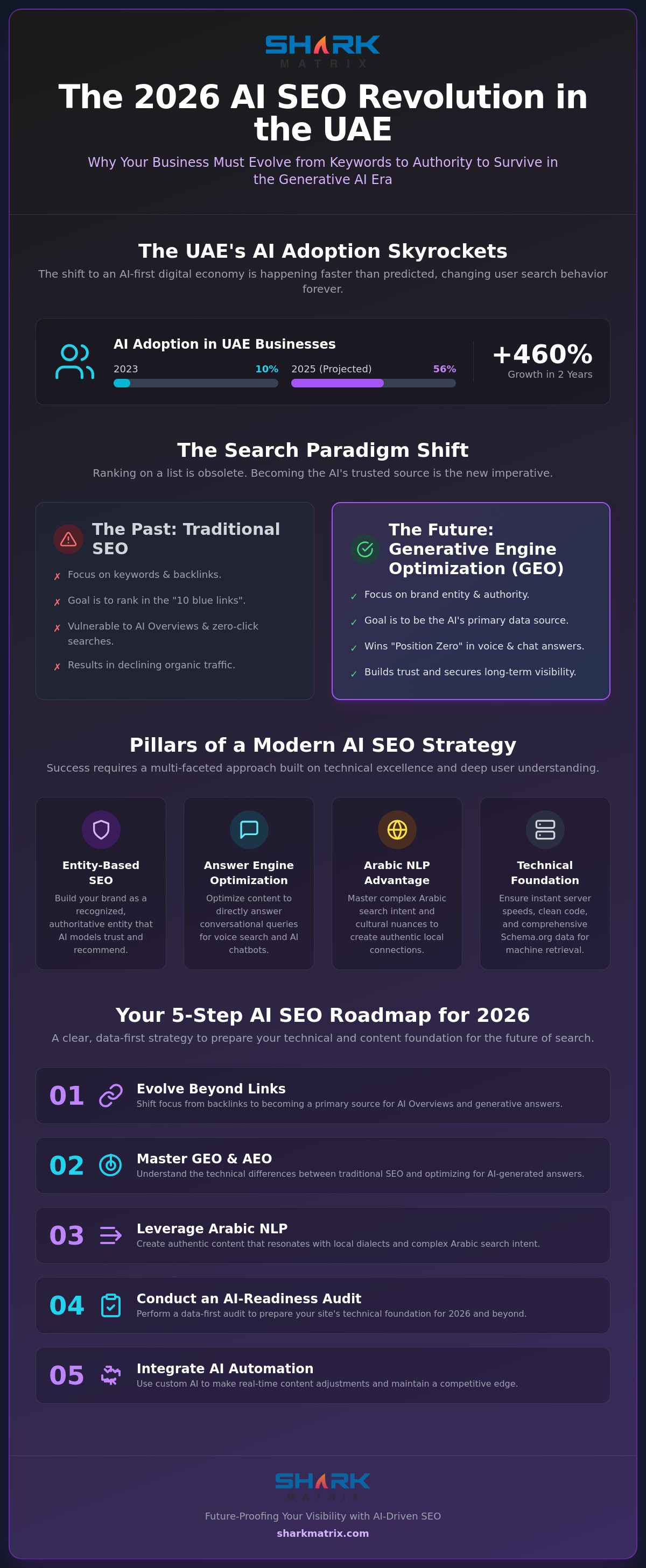
Did you know that AI adoption in the UAE skyrocketed from just 10% in 2023 to a massive 56% by 2025? As the National Artificial Intelligence System takes its seat as an advisory member of the UAE Cabinet this year, the competition to build a dominant ai seo strategy for uae businesses has reached a critical tipping point. Traditional search rankings are no longer enough when Google’s AI Overviews and SearchGPT provide the answers before a user even has a chance to click a link.

You’ve likely noticed your organic traffic dipping as generative engines take over the search results page. It’s frustrating to manage complex Arabic and English queries while technical shifts like GEO and AEO keep moving the goalposts. This guide will show you exactly how to pivot from outdated keyword tactics to brand entity recognition. We’ll explore a clear roadmap for 2026 that masters Generative Engine Optimization, ensuring your brand isn’t just listed, but is the specific source AI recommends to your customers across the Emirates.

Key Takeaways

  • Understand why moving beyond traditional links is essential as AI Overviews redefine how users in the Emirates discover and interact with brands.
  • Learn the technical differences between traditional SEO and Generative Engine Optimization (GEO) to ensure your content is the primary source for AI-generated answers.
  • Discover the importance of Natural Language Processing (NLP) for mastering complex Arabic search intent and creating authentic local connections.
  • Implement a data-first ai seo strategy for uae businesses by conducting an AI-readiness audit that prepares your technical foundation for 2026.
  • See how custom AI automation and SEO integration can help your business make real-time content adjustments to maintain a competitive edge.

The Evolution of Search: Why UAE Businesses Need an AI SEO Strategy in 2026

The search landscape has fundamentally shifted. An ai seo strategy for uae businesses isn’t just about chasing keywords anymore; it’s the strategic integration of machine learning and generative models to ensure your brand remains visible where users are actually looking. As of early 2026, the UAE has moved beyond the traditional list of “Ten Blue Links.” With the National Artificial Intelligence System now an advisory member of the UAE Cabinet, the push for digital efficiency and AI integration is at an all-time high across all federal entities.

This transformation is a direct result of the UAE Vision 2031, which positions the nation as a global hub for the new digital economy. Because the Emirates has one of the highest mobile penetration rates in the world, users have pivoted rapidly toward voice and AI-driven search. They expect immediate, conversational answers on their devices. They don’t want to browse through pages of advertisements and fragmented links. They want the answer, and they want it now.

From Keywords to Entities: The New Search Paradigm

In 2026, search engines don’t just see strings of text; they understand “entities,” which include brands, people, and specific locations. This shift means that Search Engine Optimization (SEO) has evolved to prioritize brand authority above all else. If an AI model doesn’t recognize your business as a trusted authority in its niche, it simply won’t recommend you. Entity-Based SEO is the practice of structuring your digital data so that AI models can clearly identify, categorize, and verify your brand’s unique identity and expertise.

The Impact of AI on User Behavior in the Emirates

The way people in Dubai, Abu Dhabi, and the Northern Emirates search has become inherently conversational. We’ve seen a massive rise in long-tail, natural language queries where users ask their phones complex questions. This has led to an increase in zero-click searches, where the AI provides the full answer directly on the result page. To maintain a competitive edge, businesses must pivot their focus toward appearing in the citations and sources that these AI agents use to build their answers. If your content isn’t the data source for the AI, your organic traffic will continue to decline.

Mastering Generative Engine Optimization (GEO) and AEO

Traditional SEO focused on ranking a website in a simple list of results. In 2026, Generative Engine Optimization (GEO) is about becoming the primary data source for AI models. As the region embraces AI-Driven Marketing in the UAE, businesses must adapt to how Large Language Models (LLMs) like GPT-4 and Gemini ingest information. A successful ai seo strategy for uae businesses ensures your site isn’t just indexed, but is understood as a reliable authority by these complex systems. This requires a shift from simple keyword targeting to technical excellence and brand visibility across the entire AI ecosystem.

Answer Engine Optimization (AEO) goes a step further by targeting the direct answers provided in conversational search. Whether it’s a voice query on a smartphone or a detailed prompt in an AI chat, AEO is what helps you win the new “Position Zero.” It demands a technical foundation that prioritizes clarity, speed, and directness. In the UAE’s fast-paced market, being the first answer provided by an AI agent can be the difference between a conversion and being ignored by your target audience.

The technical requirements for GEO are more demanding than old-school search. Speed is no longer just for user experience; it’s for machine retrieval. Generative engines favor sites that provide clear digital proof and rapid accessibility. Key technical factors include:

  • Instant server response times for rapid AI data retrieval and processing.
  • Comprehensive structured data using the latest Schema.org protocols for context.
  • Authoritative citations from UAE government portals or national news outlets.

These elements tell the AI that your business is a legitimate entity within the local regulatory framework. If an AI engine can’t verify your data instantly, it will move to a competitor’s source.

Optimizing for Large Language Models (LLMs)

LLMs analyze the relationships between data points, making data cleanliness a top priority. Clean code ensures AI bots parse your core message without distraction. Use Schema.org markup to provide a clear map of your business entity and services. This structured data gives generative engines the context they need to categorize your brand correctly. Aim for mentions in high-authority third-party datasets to build trust with AI models during their training phases.

Winning the Answer Box: AEO Best Practices

Structure your content around specific user questions using clear headings and concise answers. This mirrors the natural language intent of modern searchers in the Emirates. AI engines prioritize E-E-A-T, so verify your facts and demonstrate deep industry expertise. For a broader perspective on these shifts, read our Comprehensive Search Engine Optimization (SEO) Services: The 2026 Business Guide. Our specialized answer engine optimization services can help secure your spot in these vital conversational results.

AI SEO Strategy for UAE Businesses: The 2026 Guide to Dominating Generative Search

The Arabic NLP Advantage: Localizing AI SEO for the UAE

While many brands focus on English content, a truly effective ai seo strategy for uae businesses recognizes that Arabic is the heart of the national digital identity. Simple machine translation is no longer sufficient in 2026. Generative engines now use Natural Language Processing (NLP) to evaluate the cultural context and linguistic nuances of content before recommending it to users. If your content feels like a generic translation, AI models will likely flag it as low quality and pass over it in favor of more authentic, localized sources.

The UAE is a unique linguistic environment. Users often switch between Modern Standard Arabic, local Khaleeji dialects, and “Arabizi,” where Arabic words are written using Latin characters and numbers. If your technical SEO doesn’t account for these variations, AI agents will struggle to match your content with user intent. Successful optimization requires training your site’s data to be recognizable across these diverse linguistic patterns, ensuring the AI understands exactly what you offer regardless of the script used.

Technical SEO for Right-to-Left (RTL) languages is equally vital in an AI-first environment. AI crawlers require clean, semantically correct HTML to interpret Arabic text flow without errors. Ensuring your site’s code supports RTL standards allows AI models to parse and index your data with the same precision they apply to English sites. This technical clarity prevents the AI from misinterpreting your brand’s message during the indexing process.

Bilingual Brand Authority

Maintaining a consistent brand entity across both languages is a prerequisite for ranking in 2026. Generative engines look for localized citations from trusted national media outlets and government portals to verify your brand’s authority. Arabic NLP models prioritize semantic context over direct keyword matches to decipher the underlying intent of complex linguistic structures. By securing mentions in high-authority Arabic publications, you signal to the AI that your business is a legitimate and trusted leader within the local market.

Arabic Voice Search Optimization

The prevalence of voice notes and voice-driven commands in the Emirates has changed how we optimize for search. People don’t type keywords; they speak naturally and conversationally. Optimizing for the phonetics of Arabic queries in AI assistants ensures your brand is the one retrieved during a hands-free search. This is especially important for SEO for Brand Reputation Management Dubai: The 2026 National Brand Protection Guide, as voice search results often prioritize brand sentiment and local reviews. Aligning your content with the way people actually speak ensures you capture this high-intent traffic.

Building Your 2026 AI SEO Roadmap: A 5-Step Strategy

Transitioning to a data-first mindset is the first requirement for any successful ai seo strategy for uae businesses. In 2026, content is no longer just for human readers; it’s fuel for generative models. Business leaders in the Emirates are already ahead of the curve, with 93% expecting a measurable ROI from AI within two years. To capture this growth, your roadmap must move from static optimization to a dynamic, entity-focused approach that prioritizes how AI agents perceive your brand across the digital ecosystem.

  • Step 1: Conduct an AI-Readiness Audit. Evaluate your technical infrastructure and content library. Identify gaps where your information is too thin or unstructured for AI models to extract meaningful facts about your services.
  • Step 2: Implement Advanced Schema and Structured Data. Use nested JSON-LD to define the specific relationships between your products, regional locations, and key personnel.
  • Step 3: Develop a Conversational Content Strategy. Focus on Answer Engine Optimization (AEO) by answering the specific, complex questions your customers ask via voice notes or AI chat interfaces.
  • Step 4: Build Digital PR and Credible Mentions. Focus on Generative Engine Optimization (GEO) by earning mentions in high-authority UAE datasets, national news portals, and industry-specific directories.
  • Step 5: Continuous Monitoring. Track your “Share of Model.” This metric measures how often AI agents cite your brand as a primary source compared to your direct competitors.

Phase 1: Technical Foundation and Schema

Your technical setup must move beyond basic meta tags. In 2026, AI crawlers prioritize efficiency and semantic clarity. By using semantic HTML and advanced JSON-LD, you provide a clear, machine-readable map of your business entity. This level of technical precision is a core part of The 2026 Guide to Website Design and Development Services for UAE Enterprises. A fast, well-structured site isn’t just for users; it’s for AI bots that need to parse your data instantly to keep their generative models updated with your latest offerings.

Phase 2: Content Strategy and Digital PR

AI models want to cite sources that provide unique value. To become a cited authority, national brands must produce original research and data-driven insights that don’t exist elsewhere on the web. This “source-worthy” content is what earns you a spot in AI Overviews and conversational answers. You can use ai automation services to scale your content production, but the core insights must remain authentic to your brand’s unique expertise. Scaling quality ensures you maintain visibility as generative engines continue to redefine the search landscape.

Future-Proofing with Shark Matrix Technologies LLC: AI Automation and SEO Integration

Execution determines the winners in this new digital economy. Shark Matrix Technologies LLC doesn’t just offer standard marketing; we bridge the technical gap between software engineering and strategic growth. For an effective ai seo strategy for uae businesses, you need more than just blog posts. You need a custom-built infrastructure that talks directly to generative models. Our team integrates generative ai development services with advanced data architecture to ensure your brand remains a primary source for the engines that now define consumer discovery.

We’ve moved beyond traditional agency models to master Answer Engine Optimization (AEO) and Generative Engine Optimization (GEO). By utilizing real-time AI automation services, Shark Matrix Technologies LLC adjusts your site’s semantic data as Large Language Models update their parameters. This proactive approach is essential for maintaining a dominant national market share. It’s about being the first and most trusted answer in a market that’s moving toward 65% AI adoption among enterprise organizations this year.

Our national focus is critical. We understand the specific regulatory environment of the UAE and the cultural nuances required to win in Dubai, Abu Dhabi, and beyond. By combining technical machine learning development services with high-impact SEO, we create a feedback loop that constantly improves your brand’s authority in AI-generated answers.

Custom AI Solutions for National Brands

Shark Matrix Technologies LLC develops proprietary AI tools designed to monitor your “Share of Model” across various LLMs. This allows us to see exactly how often generative engines cite your brand compared to your competitors. We also integrate sophisticated ai chatbot-development services with your SEO data to capture conversational leads directly from search results. If you’re looking to expand your reach even further, check out our guide on Choosing the Right PPC Agency in Dubai: A 2026 Guide to National Growth to see how we balance paid and organic AI strategies.

The Shark Matrix Technologies LLC Advantage

What sets us apart is the combination of engineering excellence and deep SEO expertise. We are Arabic digital marketing specialists who understand how to leverage natural language processing services to dominate complex bilingual searches. Shark Matrix Technologies LLC doesn’t just guess what the AI wants; we build the technical tools to provide it. This ensures your business isn’t just a participant in the UAE’s digital transformation but a leader of it. Ready to secure your brand’s future? Partner with Shark Matrix Technologies LLC for your AI SEO Strategy and start dominating generative search today.

Securing Your Dominance in the Generative Search Era

The transition to generative engines is a definitive shift in how consumers in the Emirates discover information. Implementing a robust ai seo strategy for uae businesses is the only way to ensure your brand remains visible as traditional search results shrink. By focusing on entity-based authority and technical data structure, you move from being a simple link to becoming a primary source for AI models.

Since 2010, Shark Matrix Technologies LLC has specialized in bridging the gap between advanced technology and digital visibility. As national experts in Arabic NLP and AEO, we help businesses navigate the complexities of bilingual search and generative engine optimization. Our focus remains on high-impact technology that delivers measurable results in an increasingly AI-driven market.

The 2026 search landscape belongs to those who adapt. By aligning your digital presence with the technical requirements of generative engines, you secure a lasting competitive edge. Scale your national brand with the AI SEO and automation services of Shark Matrix Technologies LLC and lead the transformation of your industry.

Frequently Asked Questions

What is the difference between traditional SEO and AI SEO?

Traditional SEO focuses on keyword rankings and backlinks to move a website up the “Ten Blue Links” on a results page. AI SEO focuses on how generative models understand and synthesize your brand information. It’s about ensuring your business is the authoritative source cited in AI-generated answers. This requires a deeper focus on technical data structure and brand entity recognition across the digital ecosystem.

How does Generative Engine Optimization (GEO) work for UAE businesses?

Generative Engine Optimization (GEO) works by making your content more “retrievable” and “source-worthy” for Large Language Models. For UAE companies, this involves using advanced schema to connect your brand to local landmarks, government regulations, and national events. When an AI agent generates a response about your industry, GEO ensures your business is the one it cites as a reference for the user.

Will AI-generated content help or hurt my SEO in the national market?

AI-generated content can hurt your visibility if it lacks original insights or cultural context. While AI tools help scale production, search engines in the Emirates prioritize high-quality, expert-led content that demonstrates real-world experience. To succeed, you must use AI for efficiency but rely on human expertise to ensure your data is accurate and localized for the specific UAE audience and their needs.

What is Answer Engine Optimization (AEO) and why is it important now?

Answer Engine Optimization (AEO) is the practice of tailoring your content to provide direct, concise answers to conversational questions. It’s essential in 2026 because more users are getting their information directly from AI interfaces without clicking through to a website. By winning the “answer box,” you maintain brand visibility even when traditional organic traffic declines due to zero-click search behavior.

How do I optimize my website for Arabic voice search in 2026?

Optimizing for Arabic voice search requires a focus on phonetics and local dialect patterns like Khaleeji. Since many people in the Emirates use voice commands, your ai seo strategy for uae businesses should prioritize long-tail, conversational queries. You should structure your content to answer specific questions in both Modern Standard Arabic and common regional dialects to capture this growing hands-free traffic.

What are the best AI tools for SEO strategy in the UAE?

The most effective tools are those that provide deep insights into Large Language Model behavior and Arabic Natural Language Processing. While standard SEO platforms remain useful, national brands are increasingly turning to custom AI automation services to track their presence in generative summaries. These specialized tools help you understand which parts of your content are being cited and where you need to improve your authority.

How can I track if my business is being recommended by AI agents like Gemini?

You can track recommendations by manually testing industry prompts in agents like Gemini or by using automated “Share of Model” tracking tools. These tools analyze how often your brand is mentioned as a primary source compared to your competitors. Monitoring these citations helps you adjust your technical strategy to ensure you remain a preferred reference for AI models during their data retrieval process.

Does my business need a custom AI agent to improve its SEO?

While not every company needs one, a custom AI agent can boost your brand’s authority by providing structured, real-time data to search engines. Integrating an agent into your broader ai seo strategy for uae businesses helps you capture conversational leads and keeps users on your site longer. This high level of engagement signals to search engines that your brand is a trusted and helpful entity.

Categories
AEO SEO

The 2026 Answer Engine Optimization Checklist: Mastering AI-Driven Search

Did you know that websites relying solely on traditional SEO methods have seen a 60% decrease in organic referral traffic over the last 18 months? It’s a sobering reality for many digital marketers who are watching their hard-earned rankings yield fewer clicks. You’ve likely noticed that Google AI Overviews now appear in more than 80% of search results, fundamentally changing how users interact with the web. If you feel like the goalposts are moving, you aren’t alone.

This article provides the definitive 2026 answer engine optimization checklist to help you reclaim your visibility. You’ll get a step-by-step blueprint to optimize your brand for LLMs, Google’s AI Overviews, and conversational search engines to ensure you stay authoritative in an AI-first world. We’ll explore how to implement technical structured data, structure your content for instant answers, and future-proof your digital strategy against the next wave of generative engine updates. By the end, you’ll know exactly how to make your brand the primary source of truth for the world’s most advanced AI models.

Key Takeaways

  • Learn how AEO bridges the gap between traditional keywords and conversational intent to capture visibility in AI “answer engines.”
  • Discover the essential role of advanced Schema.org markup in serving as a “source of truth” for AI crawlers like ChatGPT and Gemini.
  • Master the “Inverted Pyramid” content structure to ensure your brand provides the direct, extractable answers that AI models prioritize.
  • Access a comprehensive answer engine optimization checklist to audit your site’s snippet potential and technical readiness for 2026 search trends.
  • Understand why scaling AEO requires integrating AI automation and development to manage complex data extraction and natural language processing at scale.

What is Answer Engine Optimization (AEO) and Why Does It Matter in 2026?

By 2026, the search landscape has transitioned from a directory of links to a network of synthesized answers. While traditional Search Engine Optimization (SEO) focuses on visibility within a list, Answer Engine Optimization (AEO) aims for something more specific: becoming the definitive source cited by AI models. AEO is the process of making your content easily extractable for “answer engines” like ChatGPT, Perplexity, and Google Gemini. Simply put, AEO is the optimization of content for synthesis by large language models (LLMs).

The impact on organic traffic is undeniable. As Google AI Overviews now appear in more than 80% of search results, the traditional “blue link” click-through model is being replaced by generative responses. This shift means your answer engine optimization checklist must account for how machines read, summarize, and attribute information. Instead of just ranking for a keyword, your goal is to be the authoritative entity that the AI trusts to answer the user’s query directly. When an AI synthesizes an answer, it chooses the most structured, clear, and authoritative source. If your content isn’t built for extraction, it effectively doesn’t exist in the generative era.

The Rise of Generative Engine Optimization (GEO)

Generative Engine Optimization (GEO) takes AEO a step further by focusing on the “creative” and narrative side of AI responses. While AEO targets the direct answer, GEO is about influencing how the AI weaves your brand into complex, multi-step explanations. Brand sentiment within AI training datasets is now a critical factor; if the training data views your brand as a leader, the generative engine will reflect that. 2026 marks the tipping point where “Answer-First” search behavior is the norm, requiring brands to use specialized AI automation and development to manage their digital footprint across various LLMs.

AEO vs. Traditional SEO: A Comparative Overview

Traditional SEO is built on keyword matching, whereas AEO relies on intent synthesis. In the old model, you optimized for a click. In the AEO model, you optimize for a citation. This doesn’t mean SEO is dead, but it has evolved into a technical foundation for AEO.

  • Keyword vs. Intent: SEO targets specific search phrases. AEO targets the underlying question the user is trying to solve.
  • Click-Through vs. Zero-Click: SEO measures success by traffic to the site. AEO measures success by “Share of Answer” and whether your brand is the cited authority in a zero-click environment.
  • Content Structure: SEO often rewards long-form, comprehensive guides. AEO rewards “answer-first” formatting where the core solution is presented immediately for easy bot consumption.

Balancing both strategies is essential for maintaining brand authority. By following a modern answer engine optimization checklist, you can ensure your content satisfies the deep-dive needs of human readers while providing the bite-sized, structured data points that AI engines crave. This dual approach prevents you from doubling your workload while maximizing your presence across all search modalities.

The Technical Foundation: Preparing Your Site for AI Extraction

AI agents are the new primary “users” of your website. While humans enjoy sleek visuals, large language models (LLMs) and autonomous agents look for machine-readable signals. This makes technical infrastructure the most critical part of your answer engine optimization checklist. If an AI agent can’t parse your data in milliseconds, it will simply move to a source that it can understand. You’re no longer just building for a browser; you’re building for a processor.

JSON-LD schema acts as a universal translator that allows AI agents to map your content directly to known entities and facts. This structured format provides a “source of truth” that reduces the risk of AI hallucinations, making your site a more reliable candidate for citations. When your data is predictable, AI models are more likely to trust and display it in generative responses.

Advanced Schema Markup for AEO

Standard SEO used to focus on basic metadata, but AEO requires a more granular approach. Implementing “FAQPage”, “HowTo”, and “Speakable” schema types is no longer optional. These tags tell AI exactly which parts of your page are the “answers.” Using “SameAs” attributes is equally vital. It connects your brand entities across the web, from LinkedIn to Wikipedia, helping AI build a comprehensive knowledge graph of your authority. Because these requirements are highly technical, professional technical seo services are the backbone of any successful strategy. They ensure your code is clean and compliant with the latest 2026 standards.

API-First Content Delivery

Speed and accessibility define the AI era. Traditional monolithic sites often struggle with slow ingestion speeds. Headless CMS architectures solve this by offering API-first content delivery, allowing AI bots to pull data directly without rendering heavy front-end elements. This efficiency directly impacts your “trust score.” AI models prioritize sources that respond quickly and reliably. As noted in HubSpot’s AEO Guide, content structure is just as important as the content itself. Your site architecture must facilitate real-time answer retrieval to stay competitive.

You must also audit your robots.txt file. In 2026, you shouldn’t just block all bots; you need to selectively allow reputable AI crawlers while protecting your proprietary data. Managing these permissions requires a delicate balance between visibility and security. If you find these technical configurations overwhelming, you might consider consulting with an expert team to streamline your AI readiness. High-speed API responses and optimized site architecture ensure you remain visible as search engines move toward instant, generative results.

The 2026 Answer Engine Optimization Checklist: Mastering AI-Driven Search

Conversational Content Strategy: Writing for Machines and Humans

If technical SEO is the engine, your content strategy is the fuel that determines where the vehicle goes. In 2026, writing for visibility requires a dual-focus approach. You must satisfy the human reader’s need for depth while providing AI models with the clear, extractable data they crave. Your answer engine optimization checklist isn’t complete without a radical shift in how you draft sentences and structure your arguments. LLMs don’t “read” like people; they synthesize patterns and look for the most direct path to a solution.

The “Inverted Pyramid” of AEO is your most powerful tool. This strategy demands that you answer the core question of any section within the first 50 words. By front-loading the answer, you provide a ready-made snippet that AI agents can easily lift and cite. Natural Language Processing (NLP) friendly syntax is also vital. Use active voice and “Subject-Verb-Object” structures. This clarity improves the probability that an AI will correctly interpret your intent and attribute the information to your brand. When you write with precision, you aren’t just creating content; you’re building a reputation as a canonical source of truth.

The ‘Answer-First’ Formatting Rule

Structure your pages using H2 and H3 tags that mirror the questions users actually ask. After each header, provide a direct answer between 40 and 60 words. This specific length is the “sweet spot” for AI snippet extraction. Use bulleted lists to break down complex data or multi-step processes. Lists are highly digestible for LLM synthesis, making it much easier for a generative engine to weave your data into a larger, multi-source response. This formatting mirrors the “People Also Ask” (PAA) patterns that dominate modern search results.

Bilingual AEO: Optimizing for a National Audience

For brands operating in the UAE, a monolingual strategy is no longer sufficient. High-quality Arabic localization is essential because AI agents now handle English-to-Arabic intent translation with remarkable sophistication. However, nuances in dialect and cultural context can still trip up a machine. This is why Arabic digital marketing requires specific AEO refinements. You must ensure that your Arabic content is as structured and entity-rich as your English version. By providing clear, localized answers in both languages, you increase your “Share of Answer” across a broader demographic, ensuring your brand remains the primary authority in the regional knowledge graph.

The 2026 Answer Engine Optimization Checklist

Moving from theory to execution requires a structured approach that addresses both technical and creative content needs. This answer engine optimization checklist serves as your roadmap to visibility in an era dominated by Google AI Overviews and conversational agents. You’ve already established the technical foundation and conversational tone. Now, it’s time to audit your existing digital footprint to ensure every page is an “extractable” asset. Success in 2026 isn’t about the volume of pages you publish; it’s about the precision of the answers you provide.

  • Audit Snippet Potential: Review your top 20% of traffic-driving pages. Identify sections where a direct answer can be inserted to capture featured snippets and AI citations.
  • Implement Advanced Schema: Move beyond basic tags. Every service and product page must use microdata that defines specific attributes, helping AI models categorize your offerings accurately.
  • Enforce the 50-Word Rule: Restructure your introductory paragraphs to lead with a concise, direct answer. This satisfies the “answer-first” requirement of modern LLMs.
  • Voice Search Optimization: Adapt your long-tail keyword strategy to mirror natural speech patterns. People ask questions differently when speaking than when typing.
  • Knowledge Graph Verification: Use Online Reputation Management (ORM) to ensure your brand’s facts are consistent across Wikipedia, social profiles, and industry directories.

Step 1: Entity and Authority Mapping

AI models understand the world through entities. You must clearly identify your primary business entities, including your CEO, core products, and physical locations. Consistency is vital here, especially for bilingual markets. For UAE enterprises, your Name, Address, and Phone (NAP) data must be identical across English and Arabic directories. Linking these entities via Wikidata or official social profiles helps AI engines build a reliable knowledge graph of your brand’s authority.

Step 2: Technical and Structural Alignment

Your site’s backend must be as fast as the AI models that crawl it. Mobile-first responsiveness is a baseline requirement, but lightning-fast load times are what secure a high trust score. Ensure that your custom web development supports modern SEO standards, including efficient API-first content delivery. Testing your site using AI-simulated crawlers can reveal extraction bottlenecks that traditional SEO tools might miss.

Step 3: Monitoring and Iteration

AEO is not a “set and forget” strategy. You need to track your “Citation Share” in AI Overviews and ChatGPT responses to measure real-world performance. Tools like Perplexity are excellent for testing how well your brand answers specific industry queries. As “People Also Ask” trends evolve, you must adjust your content to address emerging questions. If you want to ensure your site meets every requirement on this answer engine optimization checklist, it’s time to partner with Shark Matrix for a professional AEO audit.

Future-Proofing with AI Automation and Expert SEO

Implementing an answer engine optimization checklist across a handful of pages is a manageable task, but scaling these efforts for an enterprise-level website is a different challenge. Manual updates for thousands of product descriptions or service pages simply don’t work in a fast-moving AI environment. To maintain a competitive “Share of Answer,” you need a system that adapts in real-time. This is where automation becomes the essential bridge between a static website and a dynamic, AI-ready asset, and Mkhaya MK provides the digital transformation expertise to build these scalable environments. You can’t rely on human speed when search engines are synthesizing data in milliseconds.

Shark Matrix integrates AI automation and development directly into your SEO workflow to solve the problem of scale. By leveraging custom software and machine learning, we can automate the generation of high-fidelity schema markup and “answer-first” content summaries across your entire domain. This technical-first approach ensures that every page on your site is optimized for extraction without requiring thousands of manual man-hours. It’s about working smarter by letting machines communicate with other machines effectively.

Integrating AI into Your Marketing Stack

Modern marketing stacks must include machine learning to predict shifts in search intent before they impact your referral traffic. By analyzing vast datasets, we can identify which “Question” keywords are gaining traction and automate the deployment of FAQ schema to meet that demand. This level of agility is only possible with a technical-first digital agency that understands the intersection of code and content marketing. Custom AI chatbots also play a strategic role here; they act as interactive data points that help train LLMs about your specific business logic, products, and services.

Next Steps: Your AEO Roadmap

Your journey toward search dominance in 2026 starts with a clear, actionable plan. Don’t wait for your organic traffic to decline further before taking action. The transition from “blue links” to generative answers is already happening.

  • Start with a Technical Audit: Conduct a comprehensive review of your site’s crawlability by non-traditional AI agents.
  • Prioritize ‘Question’ Keywords: Focus on high-intent queries that trigger AI Overviews and “People Also Ask” boxes.
  • Connect Your Entities: Ensure your brand’s metadata and facts are consistent across all global and regional directories.

The search landscape has fundamentally changed, but your brand’s authority can thrive in this new environment. By combining the points in this answer engine optimization checklist with advanced machine learning, you can secure your place as the definitive answer in your industry. If you’re ready to future-proof your digital presence and lead the market, contact Shark Matrix today for a tailored AEO strategy that puts your brand at the center of the AI conversation.

Securing Your Brand’s Future in the Generative Search Era

The shift from traditional search to generative answers isn’t just a trend; it’s a fundamental change in how the world accesses information. You’ve seen how a robust technical foundation and “answer-first” content are the keys to surviving the decline in organic click-through rates. Implementing every step of this answer engine optimization checklist ensures your website doesn’t just exist but leads the conversation. Don’t let your brand become a hidden footnote in an AI-generated summary when it could be the primary citation.

Shark Matrix has delivered high-impact digital solutions since 2010. Our specialists in AI automation and machine learning are uniquely prepared to manage the complex data structures LLMs demand. Whether you’re targeting a local or national audience, our comprehensive digital marketing coverage keeps your brand authoritative. It’s time to move beyond the simple blue link and become the definitive answer that machines and humans both trust.

Future-proof your brand with Shark Matrix AEO Services and start dominating the next era of search today.

Frequently Asked Questions

Is Answer Engine Optimization different from regular SEO?

AEO is a specialized refinement of SEO that focuses on providing direct, extractable answers for AI-driven engines rather than just ranking in a list of links. While traditional SEO helps your site get indexed and ranked, AEO ensures your content is selected as the definitive answer cited by large language models. It requires a much more granular focus on technical data structures and conversational sentence patterns.

How do I show up in ChatGPT or Google AI Overviews?

You appear in these generative responses by becoming a highly authoritative and structured source for specific entities and questions. This involves implementing every item on an answer engine optimization checklist, such as leading with concise answers and using JSON-LD schema. AI models prioritize sources that are easy to parse and consistently cited across other reputable platforms like industry directories and social profiles.

Does AEO require a website redesign?

A full redesign isn’t always necessary, but your site architecture must support rapid data ingestion and mobile-first responsiveness. You might need to optimize your backend for high-speed API responses or adjust your CMS to deliver content in a more structured format. The focus is primarily on how your data is delivered to bots rather than the visual elements seen by human visitors.

Which schema types are most important for AEO in 2026?

In 2026, “FAQPage”, “HowTo”, and “Speakable” schema types are the most critical for signaling extractable answers to AI crawlers. You should also use “SameAs” attributes to link your brand’s digital entities across the web. These tags act as a universal translator, helping AI agents understand the relationships between your products, services, and leadership team without any ambiguity.

How can I track the ROI of my AEO efforts?

Tracking AEO ROI involves measuring “Share of Answer” and citation volume in generative engines instead of just traditional click-through rates. You should monitor how often your brand is cited as a source in Google AI Overviews and ChatGPT responses. While traditional organic traffic might fluctuate, the increase in brand authority and high-intent conversions from these citations provides a more accurate measure of success.

Can AI automation help with my AEO checklist implementation?

AI automation is essential for managing a comprehensive answer engine optimization checklist at scale across a large website. Automated tools can generate schema markup for thousands of pages and predict shifts in search intent using machine learning. This allows your team to focus on high-level strategy while the technical heavy lifting of data structuring and extraction optimization is handled by custom software.

What is the impact of voice search on AEO?

Voice search has pushed AEO toward more natural, conversational language patterns and long-tail query optimization. Since voice queries are typically phrased as complete questions, your content must provide complete, bite-sized answers that are easily read aloud by virtual assistants. This shift reinforces the need for clear H2 and H3 headers that mirror the way people actually speak in daily life.

Is AEO relevant for B2B companies in the UAE?

AEO is highly relevant for UAE-based B2B firms because it establishes authority in a market that values technical expertise and bilingual accessibility. Providing clear, localized answers in both English and Arabic helps you capture market share in regional AI searches. It positions your company as the canonical source for industry-specific queries, which is vital for building trust with corporate decision-makers in the region.

Categories
AEO

AI in SEO UAE: Navigating the Generative Search Era in 2026

Did you know that 70.1% of the working-age population in the Emirates already uses artificial intelligence? According to the Microsoft AI Diffusion Report for Q1 2026, the UAE now leads the world in AI adoption, which is why mastering ai in seo uae has become a survival skill for local brands. If you’ve noticed your organic click-through rates dipping as AI Overviews take over the search results page, you aren’t alone. It’s frustrating to see traditional rankings lose ground to generative answers, especially when you’re trying to figure out how Arabic NLP fits into this new technical puzzle.

This guide provides a strategic roadmap to help you shift your focus from simple keywords to becoming a trusted entity that LLMs like ChatGPT and Gemini prioritize. You’ll learn how to maintain your search authority and get your brand mentioned directly within AI responses. We explore how to stay compliant with the UAE AI Act 2026 while leveraging Generative Engine Optimization (GEO) to reduce costs and increase your digital output.

Key Takeaways

  • Learn how to transition from traditional keyword ranking to Answer Engine Optimization to secure citations in AI-generated responses.
  • Discover a strategic roadmap for implementing ai in seo uae that balances advanced machine learning with specific regional requirements.
  • Understand why 100% synthetic content fails and how the human-in-the-loop model preserves your brand’s unique authority.
  • Follow a step-by-step audit process to ensure your digital assets are optimized for entity-based search and LLM discovery.
  • Explore how generative ai development services can streamline your keyword intelligence and scale your digital presence efficiently, or discover AutoSEO to automate your search optimization.

The Evolution of Search: Why AI in SEO Matters for UAE Brands

Search is no longer a simple game of matching keywords to indices. In 2026, we’ve entered the era of the answer engine. Platforms like Google Gemini, Perplexity, and ChatGPT have fundamentally altered how users discover information. For national enterprises, this shift means that traditional organic traffic patterns are changing. AI Overviews now dominate the top of the search results page, often providing the complete answer without the user ever needing to click through to a website. This isn’t just a global trend; it’s a local reality. With the UAE ranking first globally in AI adoption at 70.1%, your audience is already interacting with these systems daily.

This transformation is driven by Generative artificial intelligence (GenAI), which allows search engines to synthesize information from multiple sources into a single, cohesive response. To stay visible, ai in seo uae strategies must prioritize semantic intent over keyword density. It’s about demonstrating that your brand is the authoritative source for the specific topics AI models are trained on. You need to prove to the algorithm that your content provides the most contextually relevant value for the user’s specific query. Old tactics of repeating a phrase ten times won’t work when the engine is looking for deep, verifiable expertise.

From Indexing to Retrieval-Augmented Generation (RAG)

Traditional search relied on crawling and indexing pages. Today, engines use Retrieval-Augmented Generation (RAG) to pull real-time data and generate accurate answers. If your brand isn’t perceived as a high-authority entity, the AI simply won’t “retrieve” your content to build its answer. This has made “zero-click” searches the new baseline for informational queries. Your goal is no longer just the click. It’s being the cited source within the AI’s response to build trust and long-term brand recognition. This requires a shift toward entity-based optimization and structured data that AI can easily interpret.

The Rise of Conversational Search in the UAE

The way people in the Emirates search is changing rapidly. With a smartphone penetration rate of over 97% and a 70.1% AI adoption rate, users are moving away from short, choppy keywords. They’re asking long-form, natural language questions, often via voice search while on the move in cities like Dubai or Abu Dhabi. Your ai in seo uae strategy must account for this dialogue-based nature. Instead of targeting “real estate Dubai,” you need to optimize for “what are the new property regulations for expatriates in Dubai for 2026?” This requires a deep understanding of natural language processing and user intent. Brands that fail to adapt to this conversational shift—for example, by utilizing an AI sales agent like DMClosed—will find themselves invisible in the voice-activated and AI-driven ecosystem of the future.

Beyond Keywords: Mastering AEO and Generative Engine Optimization (GEO)

The search landscape in the Emirates is shifting from a list of blue links to a single, synthesized answer. Success with ai in seo uae now requires a dual approach: Answer Engine Optimization (AEO) and Generative Engine Optimization (GEO). While traditional SEO focuses on ranking a page, AEO focuses on getting your brand’s data cited as a primary source by Large Language Models. As MIT explains generative AI, these models function by predicting sequences based on patterns. This means they favor content that is structured, logical, and demonstrably authoritative. If your content doesn’t provide “Information Gain,” which is unique data or a fresh perspective that isn’t already in the training set, AI engines will likely ignore it in favor of more established sources.

To win the citation game, you must move beyond simple keyword matching. You’re now optimizing for “Share of Model.” This involves ensuring your brand is mentioned across a variety of high-authority platforms that AI models use for training and real-time retrieval. It’s about becoming a recognized entity rather than just a collection of web pages. If your technical team is looking for a way to stay ahead, exploring professional generative engine optimization (geo) with Shark Matrix Technologies LLC can provide the framework needed to secure these valuable AI citations.

Technical Prerequisites for AEO

You can’t expect an AI to cite you if it can’t parse your data. Advanced Schema Markup is the foundation of AEO. You must go beyond basic “Article” tags to define specific entities, their relationships, and their relevance to UAE-specific contexts. An API-first content delivery strategy also helps, making your data easily accessible to the specialized crawlers used by Perplexity and Gemini. Site speed remains a critical factor. AI engines prioritize sources that load quickly and provide structured data in a clean, machine-readable format. This technical readiness ensures your brand is “retrieval-ready” when an AI looks for an answer.

GEO Strategy: Ranking in AI Overviews

Ranking within an AI-generated summary requires a different content structure. Use lists, tables, and concise, declarative claims that AI models can easily extract and rephrase. Building “Entity Authority” is equally important. This is achieved through strategic internal and external linking that connects your brand to other recognized experts in your field. Once implemented, you should monitor your visibility using “Share of Model” metrics. This allows you to track how often your brand is recommended in conversational search compared to your competitors, giving you a clear picture of your ai in seo uae performance.

AI in SEO UAE: Navigating the Generative Search Era in 2026

The AI Content Paradox: Human Authority in a Synthetic World

Many brands mistakenly think 100% AI-generated content is a shortcut to the top of the search results. In reality, relying solely on synthetic text is a recipe for SEO failure. Search engines and LLMs are increasingly sophisticated at detecting “hollow” content that lacks real-world experience. This is where E-E-A-T (Experience, Expertise, Authoritativeness, and Trustworthiness) becomes your strongest shield. While an AI can summarize existing data, it can’t share the unique insights of a Dubai-based project manager or the specific nuances of the local market. For those mastering ai in seo uae, the winning formula is a human-in-the-loop model. In this setup, AI handles the heavy lifting of research and data processing while humans provide the critical authority, original perspective, and verification that algorithms crave.

The risk of “AI content decay” is real. When everyone uses the same models to generate similar articles, the internet becomes an echo chamber of generic information. To stand out, you need to offer something the training data doesn’t already have. This might include proprietary case studies, local market observations, or expert interviews. By focusing on high-value, human-vetted information, you ensure that your brand remains a primary source that AI engines want to cite rather than a secondary source they ignore.

Developing an AI-Assisted Content Strategy

Success starts with using machine learning to identify content gaps and perform deep semantic research. Instead of guessing what your audience wants, you can use AI to analyze search patterns and discover the specific questions your competitors aren’t answering. Integrating professional search engine optimization seo services with AI automation allows you to scale this research without losing the human touch. You should focus on identifying “unanswered” long-tail questions in the UAE market and using AI to cluster topics into comprehensive entity maps that search models can easily digest.

Arabic AI SEO: The Next Frontier

One of the biggest hurdles for ai in seo uae is the complexity of Arabic natural language processing. Most global LLMs are trained primarily on English data, which leads to struggles with Arabic dialects, right-to-left formatting, and cultural context. If you simply translate English AI content into Arabic, you’ll likely end up with awkward, robotic text that fails to resonate with a local audience. Shark Matrix Technologies LLC leverages custom AI tools and natural language processing services to ensure high-accuracy Arabic SEO. This involves fine-tuning models to understand Khaleeji nuances and ensuring that your content feels culturally relevant while remaining technically optimized for both traditional and generative search engines.

A Strategic Roadmap for Implementing AI in SEO

Transitioning from traditional keyword targeting to a model-ready digital presence requires more than just new software. It demands a fundamental shift in how your enterprise structures information. National brands in the Emirates must adopt a structured approach to ai in seo uae to ensure they aren’t left behind by the rapid shift toward generative answers. This roadmap focuses on turning your existing digital assets into authoritative data sources that AI engines trust and cite.

  • Step 1: Conduct an AI-Readiness Audit. Analyze your current site architecture to see if LLM crawlers can easily parse your data. This involves checking robots.txt permissions and ensuring your content isn’t trapped behind complex JavaScript.
  • Step 2: Implement Advanced Schema and Entity-based Optimization. Machines don’t just read words; they identify entities. Use structured data to define the relationships between your brand, your products, and the specific UAE regions you serve.
  • Step 3: Pivot to ‘Answer-First’ Content. Structure your articles so the most important information appears in the first paragraph. This makes it easier for AI Overviews to extract your claims and present them to users.
  • Step 4: Launch a Citation Building Campaign. AI models learn from more than just your website. They digest data from Reddit, YouTube, and industry journals. Getting your brand mentioned on these high-authority platforms is critical for being recommended by ChatGPT or Gemini.
  • Step 5: Monitor ‘Share of Model’ Metrics. Stop focusing solely on position one. Track how often your brand appears in AI-generated responses for your target queries.

If you’re ready to begin this transition, you can consult with our specialists for a tailored AI SEO audit to identify your immediate growth opportunities.

Measuring Success in the AI Era

Success metrics have changed. While traditional rankings still matter, “AI Impression” tracking is becoming the new standard. This involves monitoring the sentiment of AI responses when your brand is mentioned. Are the models recommending your services or simply listing you as a secondary option? Tools that track brand citations within LLMs are now essential. They help you understand if your ai in seo uae efforts are actually influencing the training data and real-time retrieval systems that your customers use every day.

Protecting Your Digital Reputation

The rise of generative search introduces a new risk: AI hallucinations. Sometimes, an engine might associate your brand with incorrect information or outdated data. This is where modern optimization intersects with seo for brand reputation management dubai. By providing search models with a consistent, data-driven “source of truth” through structured feeds and verified citations, you can steer the narrative. Proactive reputation management ensures that when an AI generates an answer about your business, it’s factual, positive, and aligned with your current brand identity.

Future-Proofing Your Brand with Shark Matrix AI Solutions

Shark Matrix stands at the intersection of technical innovation and digital visibility. As the generative search era matures, we’ve developed proprietary AI automation tools that go beyond basic content generation. Our focus is on machine learning-based keyword intelligence, which allows us to predict search trends before they hit the mainstream. For national market leaders, this means staying ahead of the curve in ai in seo uae. We don’t just optimize for Google; we optimize for the entire ecosystem of answer engines through specialized GEO and AEO services tailored for the local market.

Our approach is holistic. We understand that your digital presence extends beyond your website. That’s why we integrate our SEO strategies with broader technical solutions, including our mobile app development services. By ensuring your apps and custom software are optimized for AI discovery, we create a unified brand entity that LLMs can easily recognize and recommend. This multi-channel approach ensures your brand remains visible regardless of how or where a user chooses to search.

Custom AI Development for Marketing Excellence

Predictive SEO is the new standard for enterprises that want to dominate their niche. By leveraging our machine learning development services, we help you identify emerging intent patterns in the UAE market before your competitors do. We also build custom AI chatbots that do more than just answer basic questions; they’re designed to enhance site engagement and send positive behavioral signals back to search engines. Our natural language processing services ensure that every interaction is culturally relevant and technically sound, driving higher quality leads through advanced, data-driven analysis.

Get Started with a 2026 AI SEO Audit

The landscape of ai in seo uae is now governed by strict regulations, including the UAE AI Act 2026. With the mandatory AI self-assessment deadline approaching in September 2026, there’s no better time to evaluate your digital readiness and compliance. A Shark Matrix AI SEO audit provides a comprehensive look at your current assets, identifying gaps in your schema, entity authority, and technical infrastructure. We bridge the gap between technical AI development and practical digital marketing, ensuring your brand is both compliant and competitive.

Secure your brand’s future in the generative search landscape today. Whether you need generative ai development services or a complete SEO overhaul, our team is ready to help you dominate the answer engines of tomorrow. Contact Shark Matrix now to schedule your initial consultation and take control of your AI visibility in the Emirates.

Dominate the Answer Engine Era

The transition to AI-driven discovery is a significant shift for national brands, but it also provides a clear path to market leadership. By moving from a keyword-focused mindset to an entity-based approach, you’ll ensure your business remains the primary authority that LLMs cite. Mastering ai in seo uae requires more than just technical updates. It demands a commitment to high-value, human-led content that resonates with the local market. This strategy ensures you stay visible in AI Overviews while maintaining the trust of your audience. It’s about being the most reliable source in a crowded digital space.

Shark Matrix Technologies LLC has been at the forefront of AI automation since 2010. As specialists in Arabic natural language processing and custom SEO integration, we understand the technical hurdles of the 2026 search landscape. Our team helps you navigate the complexities of the UAE AI Act while future-proofing your digital assets. We bridge the gap between complex machine learning and effective marketing results.

Secure Your Brand’s Future and Get an AI SEO Audit from Shark Matrix Technologies LLC. Your journey toward becoming an AI-cited authority starts today.

Frequently Asked Questions

What is the difference between traditional SEO and AI SEO in the UAE?

Traditional SEO focuses on matching specific keywords to rank a web page in a list of search results. In contrast, AI SEO prioritizes entity relationships and semantic intent to ensure your brand is cited within generative summaries. It’s a shift from optimizing for a search index to optimizing for a large language model’s training and retrieval systems.

Will using AI content for SEO get my UAE business penalized by Google?

Google doesn’t penalize content simply because it’s generated by AI. However, you’ll face ranking drops if your content lacks original value or fails to meet E-E-A-T standards. The key is using a human-in-the-loop model to ensure every piece of content includes local UAE context and verifiable data that automated tools might miss.

How can I get my brand mentioned in ChatGPT or Google Gemini answers?

You can secure these mentions by becoming a high-authority “entity” that LLMs trust. This involves implementing advanced schema markup and earning citations on the platforms these models use for verification, such as industry journals and major news outlets. When your brand is consistently linked to specific topics, the AI is more likely to recommend you as a source.

What is Answer Engine Optimization (AEO) and is it relevant for my business?

AEO is the practice of optimizing content specifically for conversational “answer engines” like Perplexity or Google Gemini. It’s highly relevant for UAE brands because 70.1% of the working-age population in the Emirates already uses AI tools. If your business answers customer questions, AEO ensures you’re the one providing the solution in an AI Overview.

How does AI impact Arabic language SEO for the national market?

AI has significantly improved the ability to process complex Arabic dialects and right-to-left formatting. However, successful ai in seo uae requires specialized natural language processing to ensure translations don’t become robotic. Brands must fine-tune their models to understand Khaleeji nuances to remain culturally relevant to a local audience.

What are the costs associated with implementing an AI-driven SEO strategy?

The investment for an AI-driven strategy depends on the complexity of your digital footprint and the level of automation required. While foundational audits focus on technical readiness, enterprise-level growth often involves ongoing retainers for machine learning development and GEO services. Costs are generally scaled based on the volume of data and the competitive nature of your industry.

Can AI help with technical SEO audits for large-scale websites?

Yes, AI tools are exceptionally efficient at performing deep technical audits for sites with thousands of pages. They can identify broken links, duplicate content, and schema errors in a fraction of the time it takes a human. This is essential for large UAE e-commerce platforms that must maintain a clean structure for AI crawlers to navigate.

How do I measure the ROI of AI in SEO compared to traditional methods?

Measuring ROI now involves tracking “Share of Model” alongside traditional traffic metrics. You should look at how often your brand appears in AI responses and the sentiment of those mentions. Additionally, ROI is reflected in the increased efficiency of content production and the reduction in manual research time through AI automation services.