

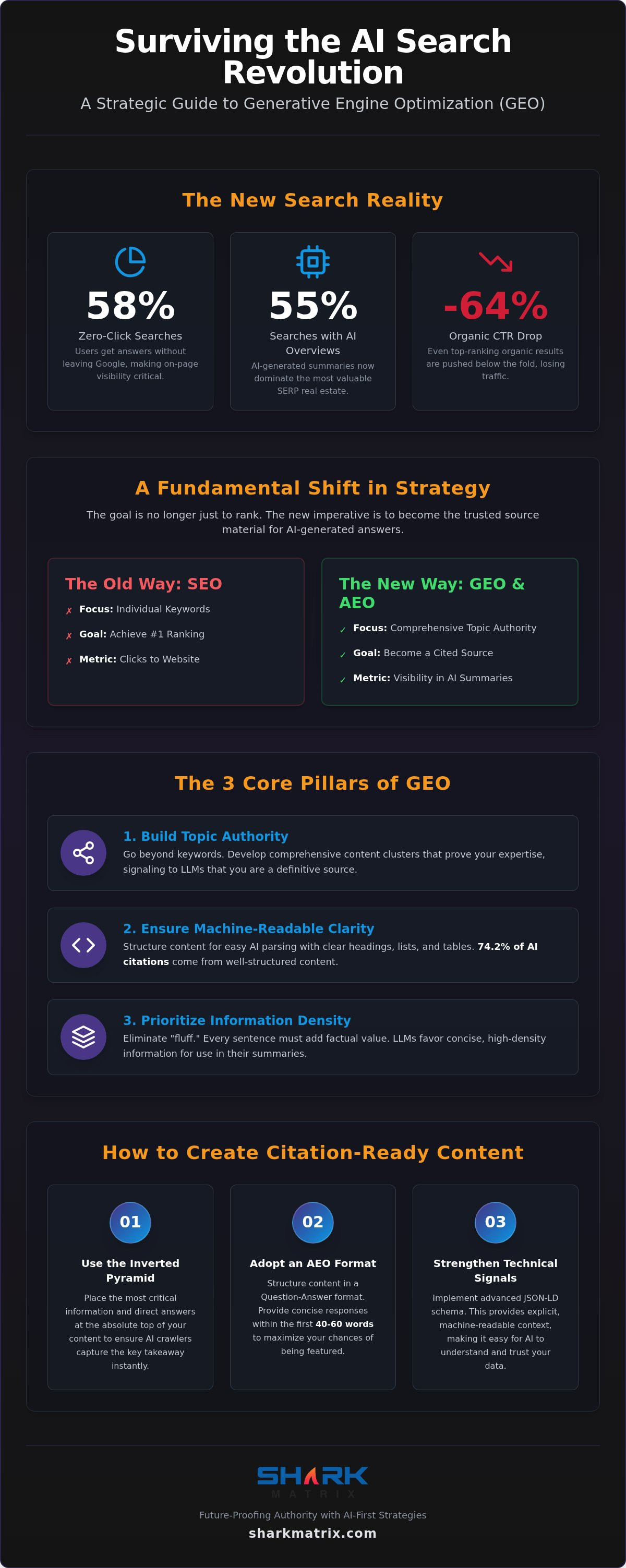
Did you know that 58% of Google searches now conclude without a single click? As of September 2026, AI Overviews appear in up to 55% of search results, causing organic click-through rates for top-ranking pages to plummet by as much as 64%. It’s a daunting shift that leaves many brands feeling invisible. You’ve likely spent years perfecting your rankings only to find them pushed below the fold by a generative summary. If you’re feeling the pressure, you aren’t alone. Preparing website for ai overviews is no longer an optional experiment; it’s a survival requirement for any brand that wants to remain relevant.
We’ll help you master the transition from traditional SEO to Generative Engine Optimization (GEO) and Answer Engine Optimization (AEO). You’ll learn how to position your brand as the definitive source of truth for large language models, ensuring you’re the one cited when AI answers a user’s query. This guide breaks down the shift toward AI-native search behavior, the importance of structured data, and the specific content strategies needed to drive high-intent traffic in this new era. By the end, you’ll have a clear roadmap to maintain visibility and authority as search evolves.
Key Takeaways
- Understand how AI Overviews synthesize answers and why traditional ranking metrics are evolving into citation-based visibility.
- Learn the practical steps for preparing website for ai overviews by shifting focus from individual keywords to building comprehensive topic authority.
- Discover how to structure your content using the “inverted pyramid” method to ensure your data is the first choice for AI-generated summaries.
- Identify the essential technical upgrades, such as advanced JSON-LD schema, required to support AI-first indexing in 2026.
- Explore how leveraging specialized natural language processing and AI automation services can give your brand a competitive edge in generative search.
What are AI Overviews and Why Do They Matter for SEO?
AI Overviews represent the most significant shift in search history since the introduction of mobile indexing. Formerly known as Search Generative Experience (SGE), these AI-generated summaries now appear in approximately 47% to 55% of all searches as of September 2026. For national brands, this means the traditional goal of ranking in the top spot is no longer enough. When an AI summary occupies the top of the screen, the first organic result often loses up to 64.4% of its potential traffic. Effectively preparing website for ai overviews is now the only way to capture attention before a user scrolls past the fold.
The Evolution of the Search Result Page
The search engine results page (SERP) has transformed from a list of destinations into a destination itself. With 58% of searches now resulting in zero clicks, users are finding the answers they need without ever leaving the interface. This isn’t just about featured snippets anymore. While a standard snippet pulls a single quote, AI Overviews synthesize information from multiple sources to create a comprehensive answer. To survive this shift, brands must move toward Generative Engine Optimization (GEO), ensuring their data is the primary ingredient in these synthesized responses. Differentiating your brand requires moving beyond basic visibility and becoming a cited authority within the generative block.
The Business Case for AI Optimization
AI Overviews serve as the primary interface for modern information retrieval. For a national brand, being excluded from these summaries is equivalent to being invisible. Traditional SEO tactics focus on technical health and keyword density, but these methods don’t address how large language models (LLMs) interpret your authority. You need to secure citations within the AI’s response to capture high-intent users who are using search for complex decision-making. Shark Matrix offers specialized ai automation services to help brands bridge this gap. By aligning your digital footprint with the way AI models process information, you protect your share-of-voice in an increasingly consolidated market. Traditional tactics alone can’t combat the structural gap in click-through rates, making a proactive strategy for preparing website for ai overviews essential for long-term growth.
The Core Pillars of Generative Engine Optimization (GEO)
The transition from traditional SEO to Generative Engine Optimization requires a fundamental shift in how you view your website’s content. Instead of chasing individual keywords, your focus must pivot toward building comprehensive topic authority. Large Language Models (LLMs) don’t just look for matches; they interpret the relationships between concepts on your page. By leveraging natural language processing, these models evaluate your site’s relevance and expertise. If you’re preparing website for ai overviews, you need to understand that the goal is to become the most statistically probable answer for a given query.
A successful GEO strategy builds on the foundation of technical SEO but adds a layer of machine-readable clarity. Analysis from 2026 shows that 74.2% of AI citations come from structured, listicle-style content. This suggests that the way you present data is just as important as the data itself. You can find detailed technical guides on how to optimize for AI Overviews, but the strategic core involves making your site an undeniable source of truth. Brands that succeed here often integrate generative ai development into their marketing stacks to analyze how AI models perceive their brand’s authority.
Answer Engine Optimization (AEO) Fundamentals
AEO is the practice of structuring content to be immediately useful to an answer engine. Unlike traditional long-tail keyword optimization, which focuses on user intent for clicks, AEO focuses on extraction. You must provide direct, unambiguous answers to specific questions. Using a “Question-Answer” format within your content helps AI crawlers identify your site as a source of truth. It’s about being concise. If you can’t answer a user’s question in the first 40 to 60 words, you’re likely to lose the citation to a competitor who can.
Building Information Density and Factuality
LLMs prioritize high-density information. This means you should eliminate “fluff” and filler text that doesn’t add value. Every sentence should serve a purpose. There’s a strong correlation between structured data and AI citation probability because machine-readable formats like JSON-LD make it easier for models to verify facts. When preparing website for ai overviews, ensure your proprietary data is clearly labeled and easy to digest. Fact-checking is non-negotiable. AI models are designed to avoid hallucinations, so they’ll favor sources with verifiable, consistent information. If you need help refining your data structure, our team can provide ai automation services to streamline the process.
Content Strategy: Creating Citation-Ready Assets
To win the citation game in 2026, you must adopt the “Inverted Pyramid” content structure. This means placing your most critical information, the direct answer to the user’s query, in the first 40 to 60 words. AI crawlers prioritize pages that provide immediate value without requiring deep scrolling. When you’re preparing website for ai overviews, your goal is to make the extraction process as seamless as possible for the model. If the bot has to hunt for the answer, it’ll likely cite a competitor who served it on a silver platter.
Original research and proprietary data are the new gold standard for “Link Bait” in the AI era. Since LLMs are trained to avoid duplication, they’re constantly looking for unique data points to include in their summaries. By publishing first-party surveys or industry-specific case studies, you become an indispensable source. You can use professional SEO services to audit your current content depth and identify gaps where proprietary data could boost your authority. Following a comprehensive AI Overview optimization guide will help ensure these assets are technically discoverable.
The Role of Expert Citations and Attribution
Generic content is easily replaced by AI, but unique perspectives are not. Opinionated content that offers a specific “take” on industry trends helps your brand stand out from synthesized summaries. To support this, use structured bios and Person schema to verify author expertise. This reinforces the EEAT (Experience, Expertise, Authoritativeness, and Trustworthiness) signals that search engines use to filter out low-quality, AI-generated fluff. Getting mentioned in the datasets that train these models requires a consistent history of being cited by other high-authority experts.
Optimizing for Conversational Queries
User behavior has shifted toward longer, more conversational prompts. Your content must map to this journey, distinguishing between informational “how-to” prompts and decisional “best-for” queries. Adapting your tone for voice and chat-based interfaces is critical for maintaining relevance. Using a conversational tone improves NLP comprehension for AI models by mimicking the natural patterns of human dialogue. This makes it easier for the algorithm to parse your intent and match it with complex user questions. When preparing website for ai overviews, remember that the “ten blue links” are gone; you’re now participating in a global conversation.
Technical Infrastructure for AI-First Indexing
Technical SEO isn’t dead; it’s just evolved. When preparing website for ai overviews, your site’s foundation must be built for machines as much as humans. AI-first indexing builds on foundational SEO like mobile-first indexing and Core Web Vitals, but it demands higher precision in how data is labeled. If your technical infrastructure is messy, AI crawlers will struggle to parse your content, leading to lower confidence scores and fewer citations. You’re no longer just trying to get indexed; you’re trying to get understood by a large language model.
Schema Markup Beyond the Basics
Basic markup like “Article” or “Organization” is now the bare minimum. To stand out in 2026, you should implement Speakable schema for voice-activated queries and Dataset schema for your proprietary research. Linking entities within your own domain helps build a localized “Knowledge Graph” that LLMs use to verify facts. This semantic linking directly impacts your site’s confidence score. If an AI model can’t verify your data across your own entity structure, it’s less likely to cite you as a source of truth. Advanced JSON-LD allows you to define these relationships explicitly, making your site a preferred source for answer engines.
Managing AI Bot Interactions
You need to distinguish between standard Googlebot and AI-specific crawlers. Robots.txt best practices have changed to accommodate the resource-intensive nature of generative bots. You must ensure that AI bots have access to specific data clusters they need without draining your crawl budget. Research shows that maintaining content freshness with updates every 7 to 14 days is critical for AI visibility. Fast site speed and healthy Core Web Vitals ensure these bots can crawl and index your latest updates rapidly. If a bot encounters a slow-loading page, it might skip the deep analysis required for a generative summary.
Semantic architecture is the next step in your technical journey. Grouping related entities together through a clear internal linking structure helps AI models understand the full context of your expertise. Regular monitoring of these technical signals is vital to catch errors before they impact your visibility in search. If you want to ensure your site’s backend is ready for the future, our comprehensive SEO services can help you build an infrastructure optimized for the generative era.
Future-Proofing Authority with Shark Matrix AI Solutions
Integrating AI into your marketing workflow is the next logical step for brands that want to dominate the 2026 search landscape. Shark Matrix provides specialized ai automation services that remove the manual labor from content optimization. Instead of guessing what an LLM wants, we use natural language processing to analyze how your competitors appear in AI Overviews. This data-driven approach lets you see the structural patterns that lead to citations. When you’re preparing website for ai overviews, you can’t rely on intuition alone. You need tools that speak the same language as the search engines themselves.
There’s a critical link between AI search visibility and online reputation management. When an AI generates a summary of your brand, it pulls from a variety of sources. If negative or outdated information persists in the training data, the AI will present it as fact. A holistic approach that combines custom AI development with strategic SEO ensures that the “source of truth” remains accurate and positive. Protecting your brand’s digital identity in 2026 means managing how machines perceive you as much as how humans do.
Custom AI Tools for National Competitive Advantage
We use proprietary machine learning models to predict search trends before they hit the mainstream. This allows our clients to publish authoritative content while a topic is still emerging, securing that crucial first-mover citation. Automating the AEO formatting process at scale is another way we help national brands stay ahead. By transforming large volumes of legacy content into machine-readable formats, we’ve seen brands significantly increase their presence in generative summaries. It’s about moving from a reactive stance to a proactive one.
Getting Started with an AI-Ready Audit
The first step in preparing website for ai overviews is identifying the AI gaps in your current digital presence. Our audit process evaluates your site’s semantic structure, entity relationships, and information density. We prioritize high-impact pages that are most likely to be featured in generative results, ensuring your resources are spent where they’ll have the most effect. Don’t wait for your traffic to disappear before you act. Partner with Shark Matrix to lead the generative search revolution and secure your brand’s future in the AI era.
Dominating the New Era of Search
The search landscape has permanently shifted from simple rankings to complex AI citations. Success now depends on your ability to feed large language models the precise, structured data they require to synthesize answers. By mastering Generative Engine Optimization and adopting an answer-first content strategy, you ensure your brand remains a primary source of truth. Successfully preparing website for ai overviews isn’t just about technical tweaks; it’s about building a digital presence that AI models can trust and verify.
Shark Matrix leads the market as a pioneer in custom AI automation and development. We specialize in high-impact national SEO campaigns and data-driven strategies designed specifically for the 2026 search landscape. Our team helps you navigate the technical and strategic hurdles of generative search to keep your brand visible and authoritative. Secure your brand’s future in generative search with Shark Matrix AI-SEO services. The future of search is conversational, and it’s time for your brand to lead the discussion.
Frequently Asked Questions
Will AI Overviews completely replace organic search traffic?
AI Overviews won’t replace organic traffic entirely, but they’ve structurally changed the search landscape. With 58% of Google searches now ending without a click, the goal has shifted. You must focus on ensuring your brand is the cited source. High-intent queries still drive traffic, but informational queries are increasingly answered within the results page. Capturing the citations that appear alongside these generative summaries is the only way to maintain brand authority.
How long does it take to see results from Generative Engine Optimization?
Results from Generative Engine Optimization typically appear within a few weeks to several months. This timeline depends on how quickly search engines crawl your updates and how often the underlying large language models refresh their training data. Since maintaining content freshness with updates every 7 to 14 days is now a standard requirement, consistent optimization leads to faster recognition. Patience is necessary as AI models verify your site’s reliability across multiple data points.
Does structured data help my website appear in AI citations?
Structured data is a critical component when preparing website for ai overviews. Research from March 2026 indicates that 74.2% of all AI citations come from structured, listicle-style content. By using JSON-LD schema like Dataset or FAQPage, you make it easier for machine-learning models to parse and verify your information. This technical clarity significantly increases the statistical probability that an AI model will select your content as a definitive source for its generative summary.
Can I opt-out of having my content used in Google AI Overviews?
You can opt-out by using the nosnippet robots meta tag or the data-nosnippet HTML attribute. However, this is a double-edged sword. While it prevents your content from being used in AI summaries, it also removes your site from traditional featured snippets and search previews. Most national brands find that the loss in visibility outweighs the benefits of opting out. A better strategy involves optimizing your content to ensure you are cited accurately and prominently.
What is the difference between SEO and Answer Engine Optimization (AEO)?
SEO focuses on ranking a page for specific keywords to drive clicks. Answer Engine Optimization (AEO) focuses on providing a direct, concise response that an AI can easily extract and repeat. While SEO looks at backlinks and technical health, AEO prioritizes answer-first formatting in the first 40 to 60 words. Both are necessary in 2026, but AEO is what ensures your brand survives the shift toward zero-click search environments where the answer is delivered directly.
How do AI models determine which sources are the most trustworthy?
AI models determine trustworthiness by evaluating EEAT signals and cross-referencing information across high-authority domains. They look for consistency in facts and the reputation of the cited authors. If multiple reputable sources cite your proprietary data, the model’s confidence score for your brand increases. This is why building a localized Knowledge Graph through semantic internal linking and authoritative expert bios is essential for maintaining long-term visibility in generative search results across the country.
Is AI-generated content penalized in AI search results?
AI-generated content is not inherently penalized, but low-quality fluff is. Search engines prioritize helpful, original content that provides new insights or proprietary data. If your content is just a rehash of existing information that an LLM can already generate, it won’t be cited. The key is to use generative tools for efficiency while ensuring the final output contains the unique expertise and opinionated takes that machines cannot replicate on their own.
How can I track my brand’s visibility within AI-generated responses?
Tracking visibility involves monitoring citation frequency and your brand’s share of voice within the generative block. preparing website for ai overviews requires moving beyond traditional ranking reports to look at how often your site is cited as a source. You can use specialized AI-tracking tools or conduct manual audits of high-value conversational queries. Identifying which pages are being cited helps you refine your strategy and double down on successful content structures.
 OpenAI
 Codex
Codex
 Vertex AI
 Cloud Vision
 OpenCV
 TensorFlow
 IBM Watson
 Cloud Natural Language
 Cognitive Services
 Bot Framework
 Mistral
 LLama
LLama
 Gemini
 Anthropic
 N8N
N8N