
Categories
AEO

AI in SEO UAE: Navigating the Generative Search Era in 2026

Did you know that 70.1% of the working-age population in the Emirates already uses artificial intelligence? According to the Microsoft AI Diffusion Report for Q1 2026, the UAE now leads the world in AI adoption, which is why mastering ai in seo uae has become a survival skill for local brands. If you’ve noticed your organic click-through rates dipping as AI Overviews take over the search results page, you aren’t alone. It’s frustrating to see traditional rankings lose ground to generative answers, especially when you’re trying to figure out how Arabic NLP fits into this new technical puzzle.

This guide provides a strategic roadmap to help you shift your focus from simple keywords to becoming a trusted entity that LLMs like ChatGPT and Gemini prioritize. You’ll learn how to maintain your search authority and get your brand mentioned directly within AI responses. We explore how to stay compliant with the UAE AI Act 2026 while leveraging Generative Engine Optimization (GEO) to reduce costs and increase your digital output.

Key Takeaways

  • Learn how to transition from traditional keyword ranking to Answer Engine Optimization to secure citations in AI-generated responses.
  • Discover a strategic roadmap for implementing ai in seo uae that balances advanced machine learning with specific regional requirements.
  • Understand why 100% synthetic content fails and how the human-in-the-loop model preserves your brand’s unique authority.
  • Follow a step-by-step audit process to ensure your digital assets are optimized for entity-based search and LLM discovery.
  • Explore how generative ai development services can streamline your keyword intelligence and scale your digital presence efficiently.

The Evolution of Search: Why AI in SEO Matters for UAE Brands

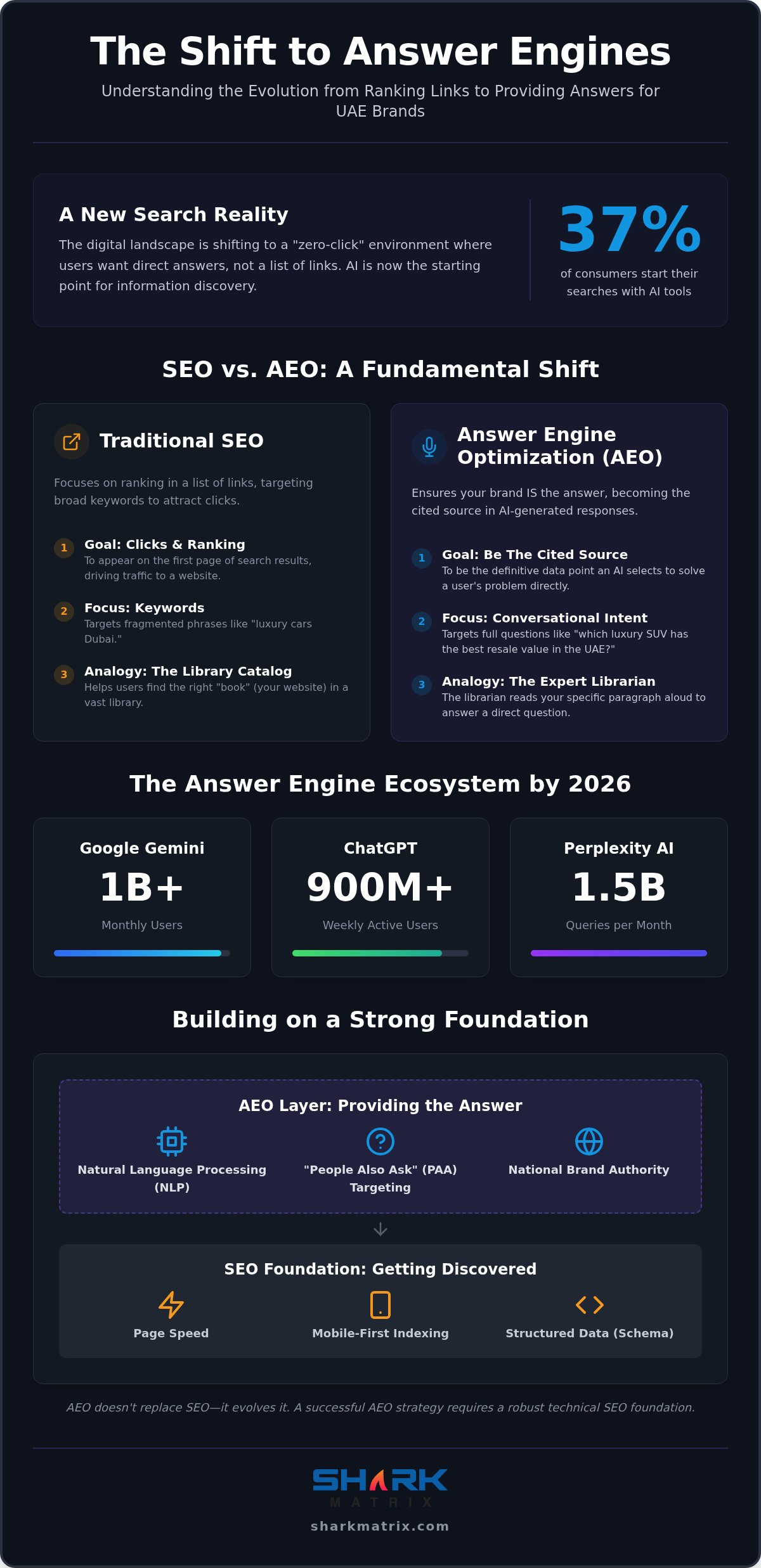
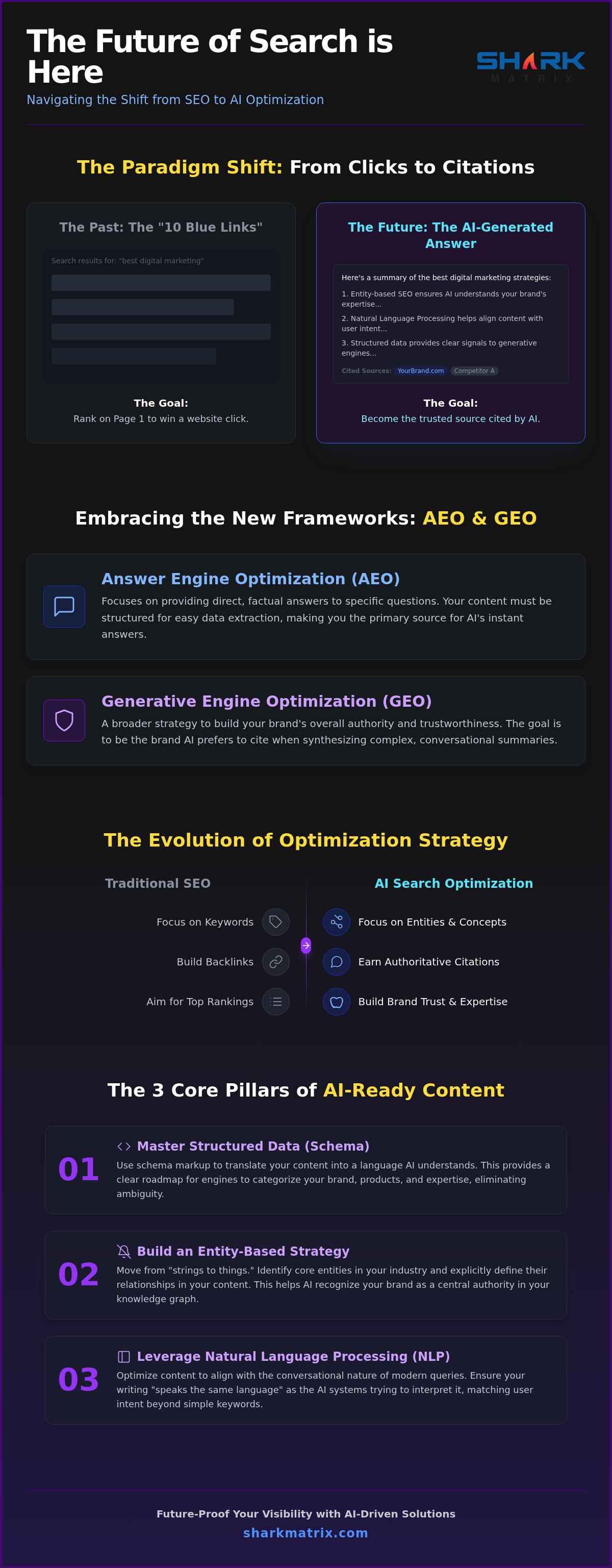
Search is no longer a simple game of matching keywords to indices. In 2026, we’ve entered the era of the answer engine. Platforms like Google Gemini, Perplexity, and ChatGPT have fundamentally altered how users discover information. For national enterprises, this shift means that traditional organic traffic patterns are changing. AI Overviews now dominate the top of the search results page, often providing the complete answer without the user ever needing to click through to a website. This isn’t just a global trend; it’s a local reality. With the UAE ranking first globally in AI adoption at 70.1%, your audience is already interacting with these systems daily.

This transformation is driven by Generative artificial intelligence (GenAI), which allows search engines to synthesize information from multiple sources into a single, cohesive response. To stay visible, ai in seo uae strategies must prioritize semantic intent over keyword density. It’s about demonstrating that your brand is the authoritative source for the specific topics AI models are trained on. You need to prove to the algorithm that your content provides the most contextually relevant value for the user’s specific query. Old tactics of repeating a phrase ten times won’t work when the engine is looking for deep, verifiable expertise.

From Indexing to Retrieval-Augmented Generation (RAG)

Traditional search relied on crawling and indexing pages. Today, engines use Retrieval-Augmented Generation (RAG) to pull real-time data and generate accurate answers. If your brand isn’t perceived as a high-authority entity, the AI simply won’t “retrieve” your content to build its answer. This has made “zero-click” searches the new baseline for informational queries. Your goal is no longer just the click. It’s being the cited source within the AI’s response to build trust and long-term brand recognition. This requires a shift toward entity-based optimization and structured data that AI can easily interpret.

The Rise of Conversational Search in the UAE

The way people in the Emirates search is changing rapidly. With a smartphone penetration rate of over 97% and a 70.1% AI adoption rate, users are moving away from short, choppy keywords. They’re asking long-form, natural language questions, often via voice search while on the move in cities like Dubai or Abu Dhabi. Your ai in seo uae strategy must account for this dialogue-based nature. Instead of targeting “real estate Dubai,” you need to optimize for “what are the new property regulations for expatriates in Dubai for 2026?” This requires a deep understanding of natural language processing and user intent. Brands that fail to adapt to this conversational shift will find themselves invisible in the voice-activated and AI-driven ecosystem of the future.

Beyond Keywords: Mastering AEO and Generative Engine Optimization (GEO)

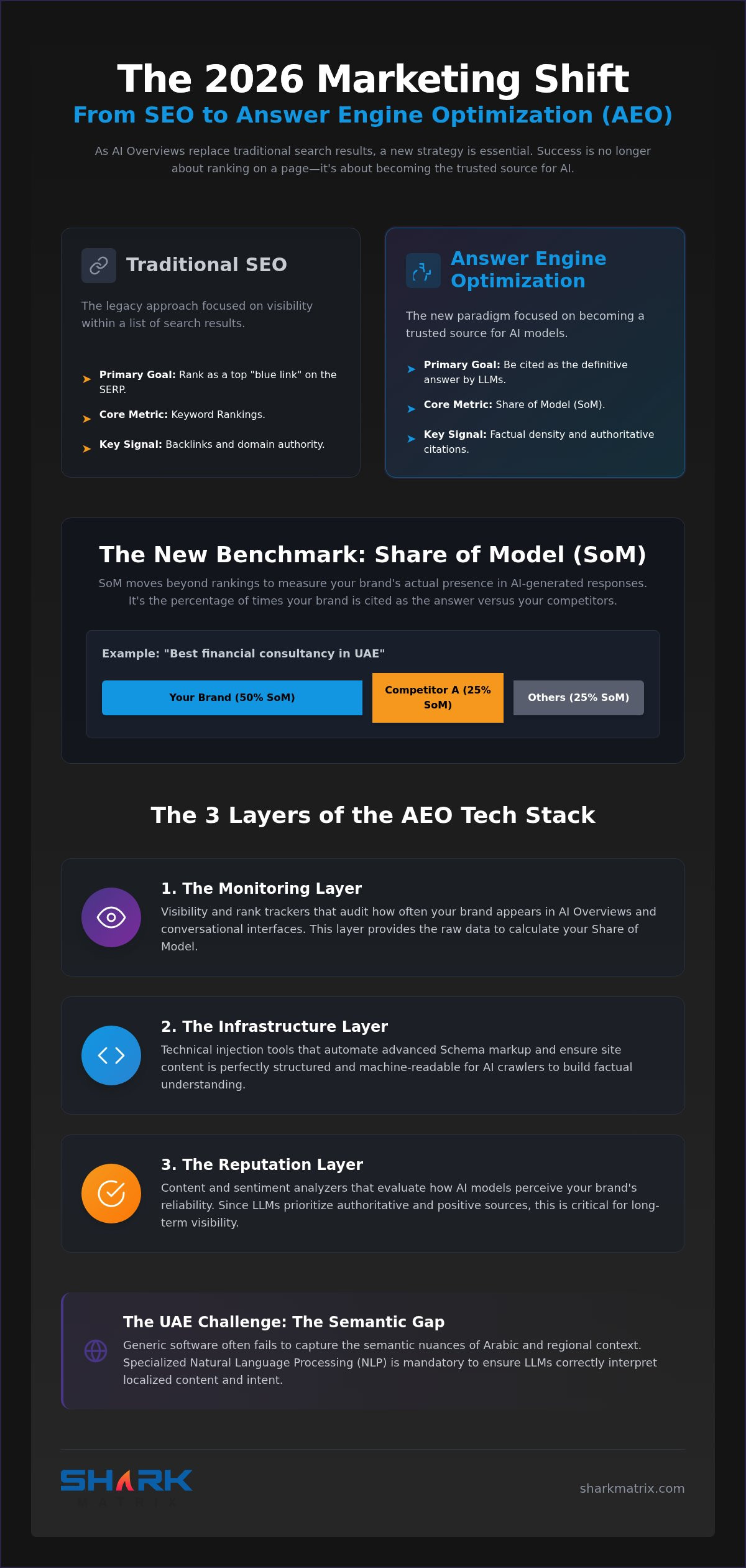
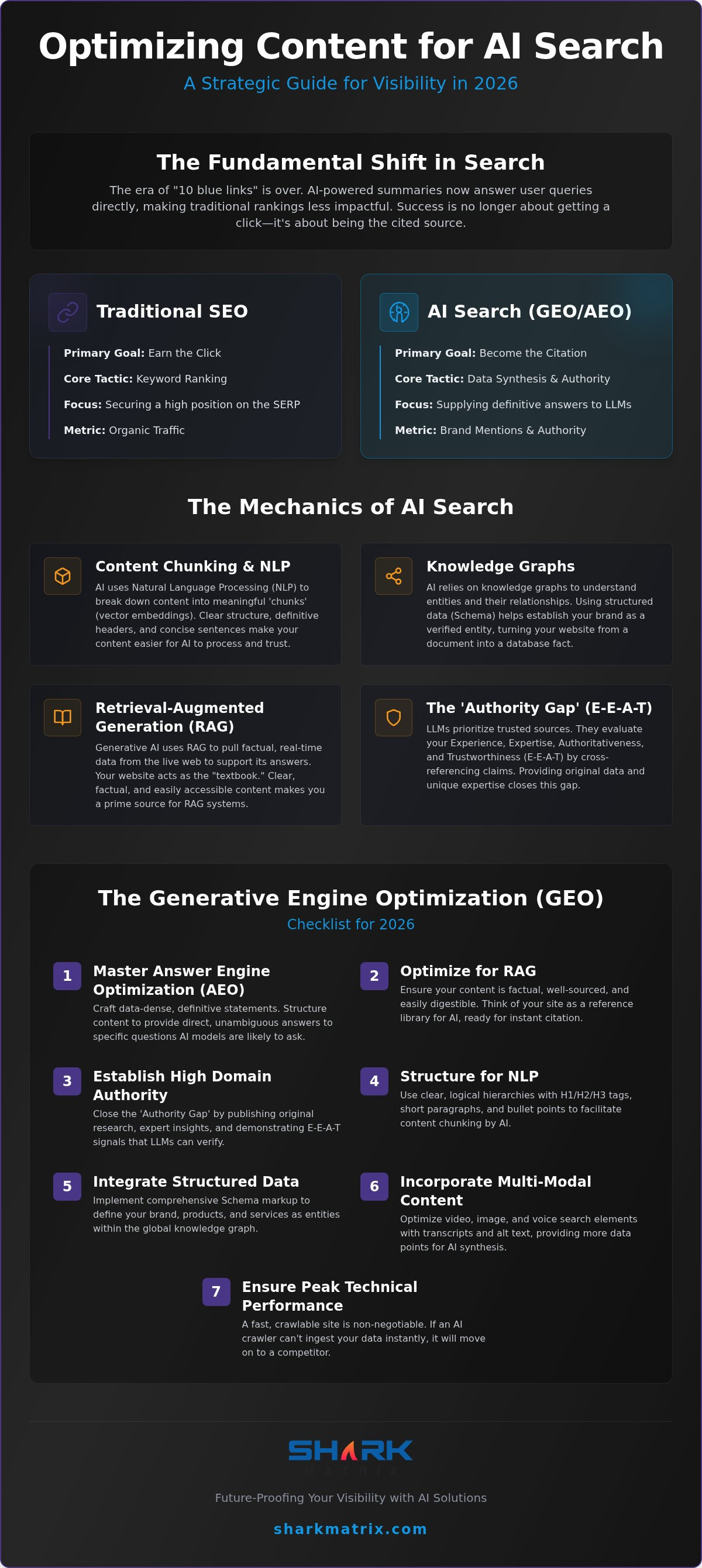
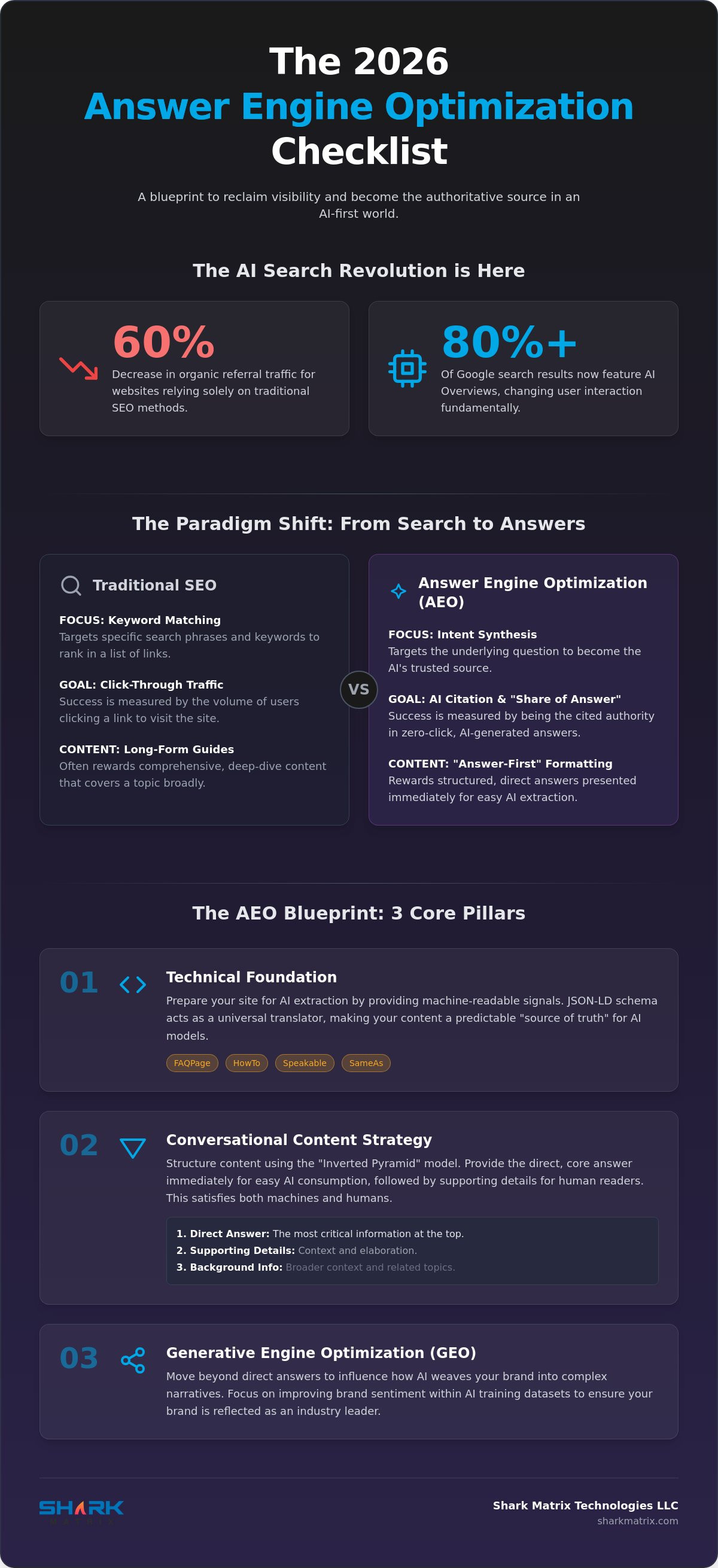
The search landscape in the Emirates is shifting from a list of blue links to a single, synthesized answer. Success with ai in seo uae now requires a dual approach: Answer Engine Optimization (AEO) and Generative Engine Optimization (GEO). While traditional SEO focuses on ranking a page, AEO focuses on getting your brand’s data cited as a primary source by Large Language Models. As MIT explains generative AI, these models function by predicting sequences based on patterns. This means they favor content that is structured, logical, and demonstrably authoritative. If your content doesn’t provide “Information Gain,” which is unique data or a fresh perspective that isn’t already in the training set, AI engines will likely ignore it in favor of more established sources.

To win the citation game, you must move beyond simple keyword matching. You’re now optimizing for “Share of Model.” This involves ensuring your brand is mentioned across a variety of high-authority platforms that AI models use for training and real-time retrieval. It’s about becoming a recognized entity rather than just a collection of web pages. If your technical team is looking for a way to stay ahead, exploring professional generative engine optimization (geo) with Shark Matrix Technologies LLC can provide the framework needed to secure these valuable AI citations.

Technical Prerequisites for AEO

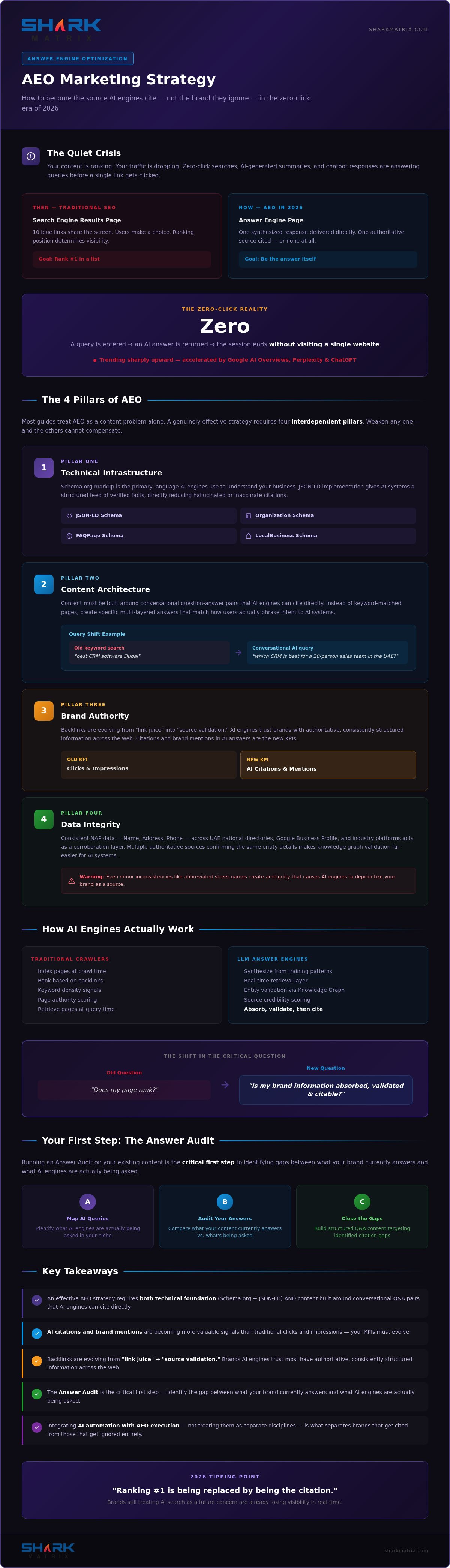
You can’t expect an AI to cite you if it can’t parse your data. Advanced Schema Markup is the foundation of AEO. You must go beyond basic “Article” tags to define specific entities, their relationships, and their relevance to UAE-specific contexts. An API-first content delivery strategy also helps, making your data easily accessible to the specialized crawlers used by Perplexity and Gemini. Site speed remains a critical factor. AI engines prioritize sources that load quickly and provide structured data in a clean, machine-readable format. This technical readiness ensures your brand is “retrieval-ready” when an AI looks for an answer.

GEO Strategy: Ranking in AI Overviews

Ranking within an AI-generated summary requires a different content structure. Use lists, tables, and concise, declarative claims that AI models can easily extract and rephrase. Building “Entity Authority” is equally important. This is achieved through strategic internal and external linking that connects your brand to other recognized experts in your field. Once implemented, you should monitor your visibility using “Share of Model” metrics. This allows you to track how often your brand is recommended in conversational search compared to your competitors, giving you a clear picture of your ai in seo uae performance.

AI in SEO UAE: Navigating the Generative Search Era in 2026

The AI Content Paradox: Human Authority in a Synthetic World

Many brands mistakenly think 100% AI-generated content is a shortcut to the top of the search results. In reality, relying solely on synthetic text is a recipe for SEO failure. Search engines and LLMs are increasingly sophisticated at detecting “hollow” content that lacks real-world experience. This is where E-E-A-T (Experience, Expertise, Authoritativeness, and Trustworthiness) becomes your strongest shield. While an AI can summarize existing data, it can’t share the unique insights of a Dubai-based project manager or the specific nuances of the local market. For those mastering ai in seo uae, the winning formula is a human-in-the-loop model. In this setup, AI handles the heavy lifting of research and data processing while humans provide the critical authority, original perspective, and verification that algorithms crave.

The risk of “AI content decay” is real. When everyone uses the same models to generate similar articles, the internet becomes an echo chamber of generic information. To stand out, you need to offer something the training data doesn’t already have. This might include proprietary case studies, local market observations, or expert interviews. By focusing on high-value, human-vetted information, you ensure that your brand remains a primary source that AI engines want to cite rather than a secondary source they ignore.

Developing an AI-Assisted Content Strategy

Success starts with using machine learning to identify content gaps and perform deep semantic research. Instead of guessing what your audience wants, you can use AI to analyze search patterns and discover the specific questions your competitors aren’t answering. Integrating professional search engine optimization seo services with AI automation allows you to scale this research without losing the human touch. You should focus on identifying “unanswered” long-tail questions in the UAE market and using AI to cluster topics into comprehensive entity maps that search models can easily digest.

Arabic AI SEO: The Next Frontier

One of the biggest hurdles for ai in seo uae is the complexity of Arabic natural language processing. Most global LLMs are trained primarily on English data, which leads to struggles with Arabic dialects, right-to-left formatting, and cultural context. If you simply translate English AI content into Arabic, you’ll likely end up with awkward, robotic text that fails to resonate with a local audience. Shark Matrix Technologies LLC leverages custom AI tools and natural language processing services to ensure high-accuracy Arabic SEO. This involves fine-tuning models to understand Khaleeji nuances and ensuring that your content feels culturally relevant while remaining technically optimized for both traditional and generative search engines.

A Strategic Roadmap for Implementing AI in SEO

Transitioning from traditional keyword targeting to a model-ready digital presence requires more than just new software. It demands a fundamental shift in how your enterprise structures information. National brands in the Emirates must adopt a structured approach to ai in seo uae to ensure they aren’t left behind by the rapid shift toward generative answers. This roadmap focuses on turning your existing digital assets into authoritative data sources that AI engines trust and cite.

  • Step 1: Conduct an AI-Readiness Audit. Analyze your current site architecture to see if LLM crawlers can easily parse your data. This involves checking robots.txt permissions and ensuring your content isn’t trapped behind complex JavaScript.
  • Step 2: Implement Advanced Schema and Entity-based Optimization. Machines don’t just read words; they identify entities. Use structured data to define the relationships between your brand, your products, and the specific UAE regions you serve.
  • Step 3: Pivot to ‘Answer-First’ Content. Structure your articles so the most important information appears in the first paragraph. This makes it easier for AI Overviews to extract your claims and present them to users.
  • Step 4: Launch a Citation Building Campaign. AI models learn from more than just your website. They digest data from Reddit, YouTube, and industry journals. Getting your brand mentioned on these high-authority platforms is critical for being recommended by ChatGPT or Gemini.
  • Step 5: Monitor ‘Share of Model’ Metrics. Stop focusing solely on position one. Track how often your brand appears in AI-generated responses for your target queries.

If you’re ready to begin this transition, you can consult with our specialists for a tailored AI SEO audit to identify your immediate growth opportunities.

Measuring Success in the AI Era

Success metrics have changed. While traditional rankings still matter, “AI Impression” tracking is becoming the new standard. This involves monitoring the sentiment of AI responses when your brand is mentioned. Are the models recommending your services or simply listing you as a secondary option? Tools that track brand citations within LLMs are now essential. They help you understand if your ai in seo uae efforts are actually influencing the training data and real-time retrieval systems that your customers use every day.

Protecting Your Digital Reputation

The rise of generative search introduces a new risk: AI hallucinations. Sometimes, an engine might associate your brand with incorrect information or outdated data. This is where modern optimization intersects with seo for brand reputation management dubai. By providing search models with a consistent, data-driven “source of truth” through structured feeds and verified citations, you can steer the narrative. Proactive reputation management ensures that when an AI generates an answer about your business, it’s factual, positive, and aligned with your current brand identity.

Future-Proofing Your Brand with Shark Matrix AI Solutions

Shark Matrix stands at the intersection of technical innovation and digital visibility. As the generative search era matures, we’ve developed proprietary AI automation tools that go beyond basic content generation. Our focus is on machine learning-based keyword intelligence, which allows us to predict search trends before they hit the mainstream. For national market leaders, this means staying ahead of the curve in ai in seo uae. We don’t just optimize for Google; we optimize for the entire ecosystem of answer engines through specialized GEO and AEO services tailored for the local market.

Our approach is holistic. We understand that your digital presence extends beyond your website. That’s why we integrate our SEO strategies with broader technical solutions, including our mobile app development services. By ensuring your apps and custom software are optimized for AI discovery, we create a unified brand entity that LLMs can easily recognize and recommend. This multi-channel approach ensures your brand remains visible regardless of how or where a user chooses to search.

Custom AI Development for Marketing Excellence

Predictive SEO is the new standard for enterprises that want to dominate their niche. By leveraging our machine learning development services, we help you identify emerging intent patterns in the UAE market before your competitors do. We also build custom AI chatbots that do more than just answer basic questions; they’re designed to enhance site engagement and send positive behavioral signals back to search engines. Our natural language processing services ensure that every interaction is culturally relevant and technically sound, driving higher quality leads through advanced, data-driven analysis.

Get Started with a 2026 AI SEO Audit

The landscape of ai in seo uae is now governed by strict regulations, including the UAE AI Act 2026. With the mandatory AI self-assessment deadline approaching in September 2026, there’s no better time to evaluate your digital readiness and compliance. A Shark Matrix AI SEO audit provides a comprehensive look at your current assets, identifying gaps in your schema, entity authority, and technical infrastructure. We bridge the gap between technical AI development and practical digital marketing, ensuring your brand is both compliant and competitive.

Secure your brand’s future in the generative search landscape today. Whether you need generative ai development services or a complete SEO overhaul, our team is ready to help you dominate the answer engines of tomorrow. Contact Shark Matrix now to schedule your initial consultation and take control of your AI visibility in the Emirates.

Dominate the Answer Engine Era

The transition to AI-driven discovery is a significant shift for national brands, but it also provides a clear path to market leadership. By moving from a keyword-focused mindset to an entity-based approach, you’ll ensure your business remains the primary authority that LLMs cite. Mastering ai in seo uae requires more than just technical updates. It demands a commitment to high-value, human-led content that resonates with the local market. This strategy ensures you stay visible in AI Overviews while maintaining the trust of your audience. It’s about being the most reliable source in a crowded digital space.

Shark Matrix Technologies LLC has been at the forefront of AI automation since 2010. As specialists in Arabic natural language processing and custom SEO integration, we understand the technical hurdles of the 2026 search landscape. Our team helps you navigate the complexities of the UAE AI Act while future-proofing your digital assets. We bridge the gap between complex machine learning and effective marketing results.

Secure Your Brand’s Future and Get an AI SEO Audit from Shark Matrix Technologies LLC. Your journey toward becoming an AI-cited authority starts today.

Frequently Asked Questions

What is the difference between traditional SEO and AI SEO in the UAE?

Traditional SEO focuses on matching specific keywords to rank a web page in a list of search results. In contrast, AI SEO prioritizes entity relationships and semantic intent to ensure your brand is cited within generative summaries. It’s a shift from optimizing for a search index to optimizing for a large language model’s training and retrieval systems.

Will using AI content for SEO get my UAE business penalized by Google?

Google doesn’t penalize content simply because it’s generated by AI. However, you’ll face ranking drops if your content lacks original value or fails to meet E-E-A-T standards. The key is using a human-in-the-loop model to ensure every piece of content includes local UAE context and verifiable data that automated tools might miss.

How can I get my brand mentioned in ChatGPT or Google Gemini answers?

You can secure these mentions by becoming a high-authority “entity” that LLMs trust. This involves implementing advanced schema markup and earning citations on the platforms these models use for verification, such as industry journals and major news outlets. When your brand is consistently linked to specific topics, the AI is more likely to recommend you as a source.

What is Answer Engine Optimization (AEO) and is it relevant for my business?

AEO is the practice of optimizing content specifically for conversational “answer engines” like Perplexity or Google Gemini. It’s highly relevant for UAE brands because 70.1% of the working-age population in the Emirates already uses AI tools. If your business answers customer questions, AEO ensures you’re the one providing the solution in an AI Overview.

How does AI impact Arabic language SEO for the national market?

AI has significantly improved the ability to process complex Arabic dialects and right-to-left formatting. However, successful ai in seo uae requires specialized natural language processing to ensure translations don’t become robotic. Brands must fine-tune their models to understand Khaleeji nuances to remain culturally relevant to a local audience.

What are the costs associated with implementing an AI-driven SEO strategy?

The investment for an AI-driven strategy depends on the complexity of your digital footprint and the level of automation required. While foundational audits focus on technical readiness, enterprise-level growth often involves ongoing retainers for machine learning development and GEO services. Costs are generally scaled based on the volume of data and the competitive nature of your industry.

Can AI help with technical SEO audits for large-scale websites?

Yes, AI tools are exceptionally efficient at performing deep technical audits for sites with thousands of pages. They can identify broken links, duplicate content, and schema errors in a fraction of the time it takes a human. This is essential for large UAE e-commerce platforms that must maintain a clean structure for AI crawlers to navigate.

How do I measure the ROI of AI in SEO compared to traditional methods?

Measuring ROI now involves tracking “Share of Model” alongside traditional traffic metrics. You should look at how often your brand appears in AI responses and the sentiment of those mentions. Additionally, ROI is reflected in the increased efficiency of content production and the reduction in manual research time through AI automation services.

Categories
AEO

Common AEO Mistakes to Avoid: Why You Need the Right Tools for Answer Engine Optimization in 2026

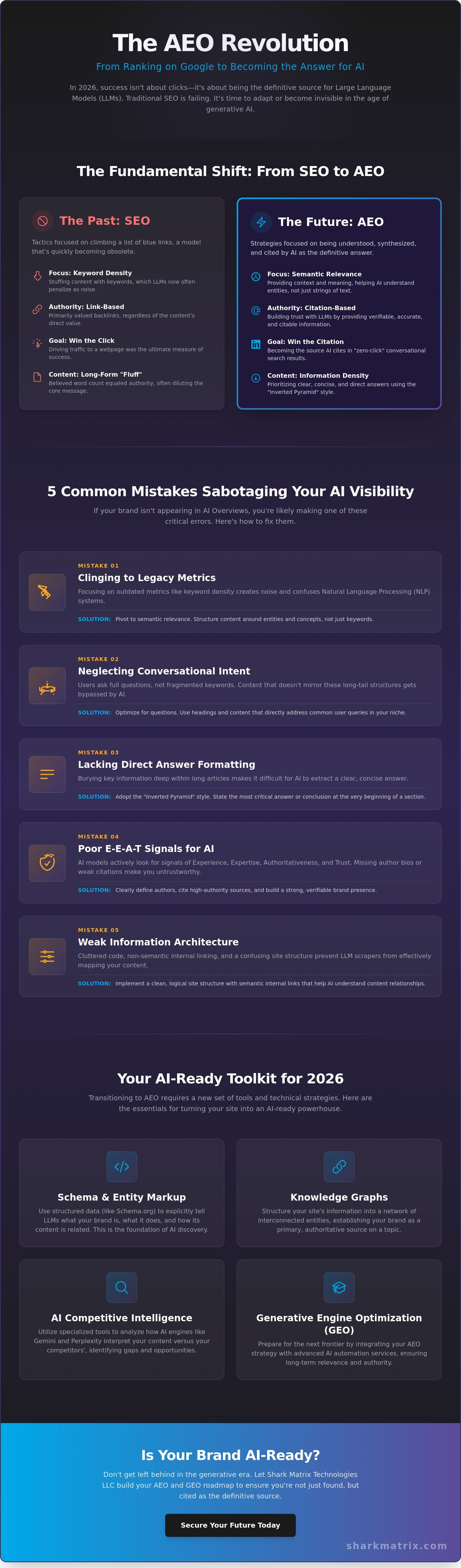
What if the top spot on Google no longer guarantees a single click? You’ve likely spent years perfecting your rankings, yet you’re still asking why your website isn’t being cited as a source by AI engines like Perplexity or Gemini. In 2026, the game has shifted from ranking for humans to becoming the primary “Trusted Source” for Large Language Models. Understanding the common aeo mistakes to avoid is now the difference between being the definitive answer or being completely ignored by conversational search results.

It’s frustrating to watch organic click-through rates decline as AI Overviews take over the screen. You know your content is valuable, but the bridge between your data and AI understanding often feels broken. This guide will show you how to fix those structural errors and reclaim your authority in the generative era. We’ll explore the essential tools and technical roadmaps needed to turn your site into an AI-ready powerhouse for the UAE market.

Key Takeaways

  • Learn why legacy SEO metrics like keyword density fail and how to pivot toward conversational AI optimization.
  • Identify the common aeo mistakes to avoid, such as neglecting long-tail question structures and direct answer formatting.
  • Discover how to use entity-based markup and Knowledge Graphs to ensure Large Language Models recognize your brand as a primary source.
  • Explore specialized tools for competitive intelligence to see how AI engines like Perplexity and Gemini interpret your content.
  • Prepare for the next frontier by integrating Generative Engine Optimization (GEO) with advanced AI automation services.

Why Traditional Search Tactics Fail in Answer Engine Optimization (AEO)

Search is changing at a breakneck pace. For years, digital marketing focused on climbing a list of blue links. Today, that is no longer enough to stay relevant. Answer Engine Optimization (AEO) is the specific process of optimizing your content so AI models can understand, synthesize, and cite it as a definitive answer. One of the most common aeo mistakes to avoid is clinging to the belief that what worked for Google in 2010 will work for Gemini or Perplexity in 2026. Treating modern AI like a simple crawler is a recipe for digital obscurity.

Keyword density has officially become a legacy metric. It fails because conversational AI does not look for keyword frequency; it looks for semantic relevance. If your content is bloated with repetitive phrases, you are actually making it harder for Natural Language Processing (NLP) systems to categorize your brand. Unlike traditional search tactics, AEO requires a focus on entities rather than strings. The AI wants to know exactly what your business represents and the specific problems it solves, not how many times you can type a primary keyword.

In the competitive UAE market, the focus has shifted from winning a click to winning a citation. When a user asks an AI about the best e-commerce development in Dubai, they do not want a list of websites. They want a recommendation. If your site is not structured to provide that direct answer, you are invisible to the conversational user.

AEO vs. SEO: Understanding the Fundamental Shift

Traditional SEO relies heavily on link-based authority. While links still matter, AEO prioritizes citation-based trust. Large Language Models (LLMs) value information density over word count. A 500-word article that answers a question precisely is more valuable to an AI than a 3,000-word “ultimate guide” filled with fluff. NLP allows these models to interpret the nuance of your site, mapping your data to specific user intents with surgical precision. This is why being among the common aeo mistakes to avoid includes prioritizing length over clarity.

The Cost of Ignoring Answer Engine Visibility

The rise of “zero-click” searches means fewer users are visiting websites to find basic information. For UAE brands, being left out of AI Overviews means losing massive top-of-funnel awareness. If you are not the source the AI cites, your competitors will be. Answer Engine Optimization is the mandatory evolution for any national digital strategy aiming to survive the generative era.

The 5 Most Common AEO Mistakes Sabotaging Your AI Visibility

Building a website that ranks is one thing; building one that speaks to an AI agent is another. If your brand isn’t appearing in AI Overviews, you’re likely falling victim to several common aeo mistakes to avoid. These errors often stem from a misunderstanding of how LLMs process information compared to traditional search engines. While Google might reward a well-linked page, a generative engine rewards a page that answers a specific question without making the user hunt for it.

Mistake number two involves neglecting conversational intent. Users no longer type fragmented keywords; they ask full questions. If your content doesn’t mimic these long-tail structures, AI scrapers will bypass your site. Closely related is mistake three: the lack of “Direct Answer” formatting. High-authority pages often hide their best insights deep in the text. To win the citation, you must place the most critical answer at the top of the section, making it easily extractable for GPT-4 or Gemini. For more context on these shifts, HubSpot’s guide to AEO offers an excellent deep dive into how these engines prioritize information.

Mistake four centers on failing to establish E-E-A-T for AI agents. AI models look for clear signals of experience and authoritativeness. If your author bios are missing or your citations are weak, the AI won’t trust you as a source. Finally, mistake five is poor information architecture. If your site’s code is cluttered or your internal linking is non-semantic, LLM scrapers will struggle to map your content. Identifying these common aeo mistakes to avoid is the first step toward a future-proof digital presence in a competitive market like the UAE.

The “Fluff” Trap: Why Long-Form Content Can Hurt AEO

Filler content dilutes the signal for AI answer engines. In the past, “more is better” was the rule for word counts. Now, wordiness creates noise that confuses the AI. You should adopt the “Inverted Pyramid” style. Put your most important conclusion first. Supporting details and background info should follow. This structure allows Gemini to grab the essential facts immediately, increasing your chances of becoming the featured citation.

Ignoring the “People Also Ask” Ecosystem

The “People Also Ask” (PAA) section on Google is a goldmine for AEO strategy. These questions represent the exact conversational loops users perform. By mapping your content to these specific queries, you create a natural path for AI models to follow. Integrating search engine optimization seo services with AEO logic ensures your site maintains traditional rankings while simultaneously capturing AI real estate. If you’re unsure where to start, our team at Shark Matrix can help you audit your current architecture for AI readiness.

Common AEO Mistakes to Avoid: Why You Need the Right Tools for Answer Engine Optimization in 2026

Technical Oversight: Failing to Use Schema and Entities for LLM Discovery

While content quality is the heart of visibility, technical infrastructure is the nervous system that carries your message to AI models. Many businesses assume that having a fast site is enough. In reality, one of the most common aeo mistakes to avoid is relying on generic Schema markup. Basic code tells a crawler what a page is about; advanced entity-based markup tells an AI model exactly what your brand is and how it relates to the real world. If your structured data is broken or vague, LLM scrapers will fail to verify your claims, leading to a loss of citation trust.

Technical SEO in 2026 requires dedicated “LLM-readability” audits. These audits ensure that your data is presented in a way that Large Language Models can digest without ambiguity. For a deeper dive into the foundational concepts, Coursera’s explanation of Answer Engine Optimization provides a helpful framework for understanding how these systems prioritize structured information. Without this technical clarity, your brand remains a set of unverified strings of text rather than a recognized entity in a Knowledge Graph. This graph acts as a digital ID card; it’s how AI understands “who” you are and “what” authority you hold in your specific industry.

Beyond Basic Markup: Advanced Schema for AEO

To win in conversational search, you need to go beyond standard article tags. Implementing Speakable, FAQ, and How-To Schema is essential for answer engines that provide verbal or step-by-step responses. You should also use “SameAs” properties within your code to link your brand to established national entities, such as government registries or major industry associations in the UAE. Ensuring these foundations are rock-solid often starts with professional website design and development services that prioritize semantic code over purely aesthetic elements. If the code is messy, the AI’s understanding will be too.

Entity-Relationship Mapping for UAE Brands

AI models connect your brand to specific industries through entity-relationship mapping. This process relies on consistency across your entire digital footprint. Your Name, Address, and Phone (NAP) data must be identical everywhere, from your website to local directories and social profiles. In 2026, an entity is essentially a “fact” that an AI can verify through multiple cross-references. If your data is inconsistent, the AI views your brand as an unreliable source. This lack of technical cohesion is another one of those common aeo mistakes to avoid that can silently tank your visibility in generative search results across the region.

Essential Tools for Answer Engine Optimization in 2026

Measurement is the cornerstone of any digital strategy. If you rely solely on traditional rank trackers, you’re missing the vast majority of the conversation. One of the most common aeo mistakes to avoid is assuming your standard SEO dashboard tells the whole story. While those tools track keywords, they often fail to track citations within generative engines like Perplexity or the “Search” feature in ChatGPT. To stay ahead, you need a specialized toolkit designed for the generative era. These tools focus on how AI models interpret your data rather than just how many links point to your domain.

Perplexity Pages and ChatGPT Search have become essential for competitive intelligence. You should use these platforms to query your own brand and your competitors regularly. If the AI is hallucinating about your services or providing outdated facts, it’s a clear sign your data sources are inconsistent. Monitoring these platforms helps you identify exactly where your content lacks the clarity needed for a definitive citation. Standard SEO tools are beginning to offer AI-specific plugins, but these are often reactive rather than proactive. The real advantage lies in dedicated Generative Engine Tracking (GET) platforms that alert you the moment your citation frequency drops or your brand sentiment shifts within an AI’s training data.

Top Tools for Intent Analysis and Question Research

Understanding user intent has moved beyond simple keyword volume. Tools like AnswerThePublic are useful for initial brainstorming, but specialized AI-intent crawlers now allow you to see how Large Language Models cluster topics and intents. By using AI-driven content marketing tools, you can predict the specific questions your audience will ask before they even type them. This predictive power helps you capture a higher “Share of Voice” in AI-generated answers. It ensures your brand is the one being recommended when a user asks for a specific solution in the UAE market.

Technical AEO Audit Tools

Technical foundations require more than just a passing grade on site speed. You need Schema validators that specifically check for entity-relationship mapping to ensure your brand is correctly identified in the Knowledge Graph. LLM-simulators are also becoming indispensable; they allow you to see how an AI “reads” and summarizes your page before the search engine indexers ever arrive. For businesses looking to scale these efforts, partnering with an ai automation agency dubai can streamline real-time content updates. This ensures your data remains fresh and accurate for the scrapers, preventing the outdated information errors that plague many regional brands. If you want to audit your current stack and identify which tools will actually drive visibility, contact us for a Shark Matrix AEO audit today.

Success in the conversational era requires more than just fixing technical bugs. While identifying common aeo mistakes to avoid is a strong start, true market dominance in the UAE requires a shift toward Generative Engine Optimization (GEO). GEO is the next frontier. It focuses on how AI models synthesize your brand’s data to create comprehensive narratives. It’s not just about providing an answer; it’s about ensuring the AI represents your brand accurately and favorably in every generated response. This is where a specialized partner like Shark Matrix Technologies LLC becomes indispensable for national brands looking to maintain a competitive edge.

Shark Matrix Technologies LLC integrates advanced AI automation with bespoke AEO strategies to keep your brand at the forefront of LLM discovery. Our deep expertise in natural language processing services and generative ai development ensures your content isn’t just readable; it’s authoritative. We understand that visibility is closely tied to trust. That’s why we emphasize seo for brand reputation management dubai to protect your digital identity from inaccuracies. By combining these efforts with the precision of a top ppc agency dubai, we create a multi-channel presence that AI engines cannot ignore.

The Shark Matrix Technologies LLC Approach to AI-First Growth

Our methodology goes beyond basic search tactics. Shark Matrix Technologies LLC leverages custom AI development and industry specific ai solutions to build content architectures that AI agents trust. We don’t just guess what the AI wants; we use data-driven insights to map your brand’s expertise to the specific intents of your audience. This synergy ensures that whether a user is searching via a traditional bar or a voice assistant, your brand remains the definitive source of truth. Avoiding common aeo mistakes to avoid is just the baseline; we aim for total market saturation.

Get Started with an AEO Readiness Audit

Transitioning from traditional search to an answer-first model requires a clear roadmap. Our technical team at Shark Matrix Technologies LLC optimizes mobile and web platforms for LLM scrapers, ensuring every piece of data is structured for immediate extraction. To help you navigate this transition, we offer a comprehensive AI-visibility assessment. This audit identifies gaps in your entity mapping and provides a roadmap for total optimization. Use this final checklist to prepare your brand for the generative era:

  • Audit your site for legacy SEO tactics that hinder AI readability.
  • Implement advanced entity-based Schema markup.
  • Map content to the “People Also Ask” ecosystem.
  • Establish clear E-E-A-T signals for AI agents.
  • Monitor citation frequency across Perplexity, Gemini, and GPT-4.

Don’t let your brand disappear as AI Overviews take over the search landscape. Contact Shark Matrix Technologies LLC for Answer Engine Optimization Expertise and secure your place as the trusted authority in the 2026 digital economy.

Securing Your Brand in the Generative Search Era

The transition from traditional search to answer-driven results is no longer a choice; it’s a survival strategy for the 2026 digital landscape. By addressing the common aeo mistakes to avoid, you’ve already taken the first step toward reclaiming your brand’s authority. Success now depends on moving beyond simple metadata to embrace entity-based relationships and conversational intent. If your data is structured correctly, AI engines will reward you with the citations your brand deserves.

You don’t have to navigate this technical shift alone. Shark Matrix has been at the forefront of search since 2010, bringing over 15 years of deep expertise to every project. Our specialized AI and machine learning development department ensures your technical foundation is ready for the world’s most advanced LLMs. With end-to-end Arabic and English digital marketing capability, we’re uniquely positioned to help UAE brands dominate both local and global answer engines.

Master the future of search with Shark Matrix AEO Services. Your brand has a powerful story to tell; let’s make sure the AI engines are listening.

Frequently Asked Questions

What is the difference between SEO and AEO?

SEO is designed to drive traffic to your website through a list of blue search results. AEO focuses on making your content the primary answer provided by an AI assistant like Gemini or Perplexity. While traditional SEO values backlinks and keyword frequency, AEO prioritizes information density and entity trust. You aren’t just trying to rank; you’re trying to be the definitive source the AI cites in its conversation.

Do I need a different strategy for ChatGPT Search and Google Gemini?

Yes, because each engine uses distinct algorithms and weights for its citations. Google Gemini relies heavily on the Google Knowledge Graph and traditional authority signals. ChatGPT Search often prioritizes real-time data and high-density, factual summaries from reputable domains. A successful strategy requires you to optimize for the specific way each model scrapes and synthesizes information across the web to ensure maximum visibility for your brand.

How much does Answer Engine Optimization cost for a UAE business?

Optimization costs vary significantly based on your website’s current technical structure and the competitiveness of your UAE industry. A simple site audit might require a different investment than a full-scale entity-mapping project. You should speak with a specialized agency to determine the specific scope of work required to align your digital presence with the requirements of modern generative answer engines and your specific commercial goals.

Can I use AI to write my AEO content?

You can use AI as a drafting tool, but relying on it for final output is one of the common aeo mistakes to avoid. AI models look for unique, verified insights that haven’t been synthesized a thousand times already. If you only publish generic AI-generated fluff, you’ll lack the experience and expertise signals that these engines require to trust you as a primary source for their users.

How long does it take to see results from AEO?

Technical results from Schema updates can appear in as little as a few weeks. However, building the citation trust needed to appear in competitive AI Overviews often takes several months of consistent optimization. It depends on how frequently AI agents re-crawl your site and how effectively you establish your brand as a verified entity within the broader digital ecosystem through high-quality, authoritative content updates.

Which tools for answer engine optimization are best for beginners?

Beginners should focus on accessibility and technical transparency. Using Perplexity to see how your brand is currently summarized provides immediate insight into your visibility. Additionally, specialized tools for answer engine optimization like Schema validators help you ensure your code is readable for LLMs. These tools allow you to verify that your data is correctly mapped before you invest in more complex automation or high-end generative development services.

Is Schema markup really necessary for AI search engines?

Schema markup is absolutely necessary because it provides the structural “facts” that AI models use to verify your identity. Without it, an AI agent has to guess the relationship between your services and your brand. This ambiguity often leads to a lack of citations. Structured data acts as a translator that ensures your business information is interpreted correctly by every major generative engine during the scraping process.

What is Generative Engine Optimization (GEO)?

Generative Engine Optimization (GEO) is the next evolution of digital visibility. It focuses on influencing the overall narrative and sentiment that an AI model produces about your brand. While AEO is about being the answer to a specific question, GEO is about shaping how the AI describes your reputation, services, and value compared to your competitors when it generates a synthesized response for a user.

Categories
AEO

Mastering AEO Marketing Strategy: The 2026 Guide to Answer Engine Optimization

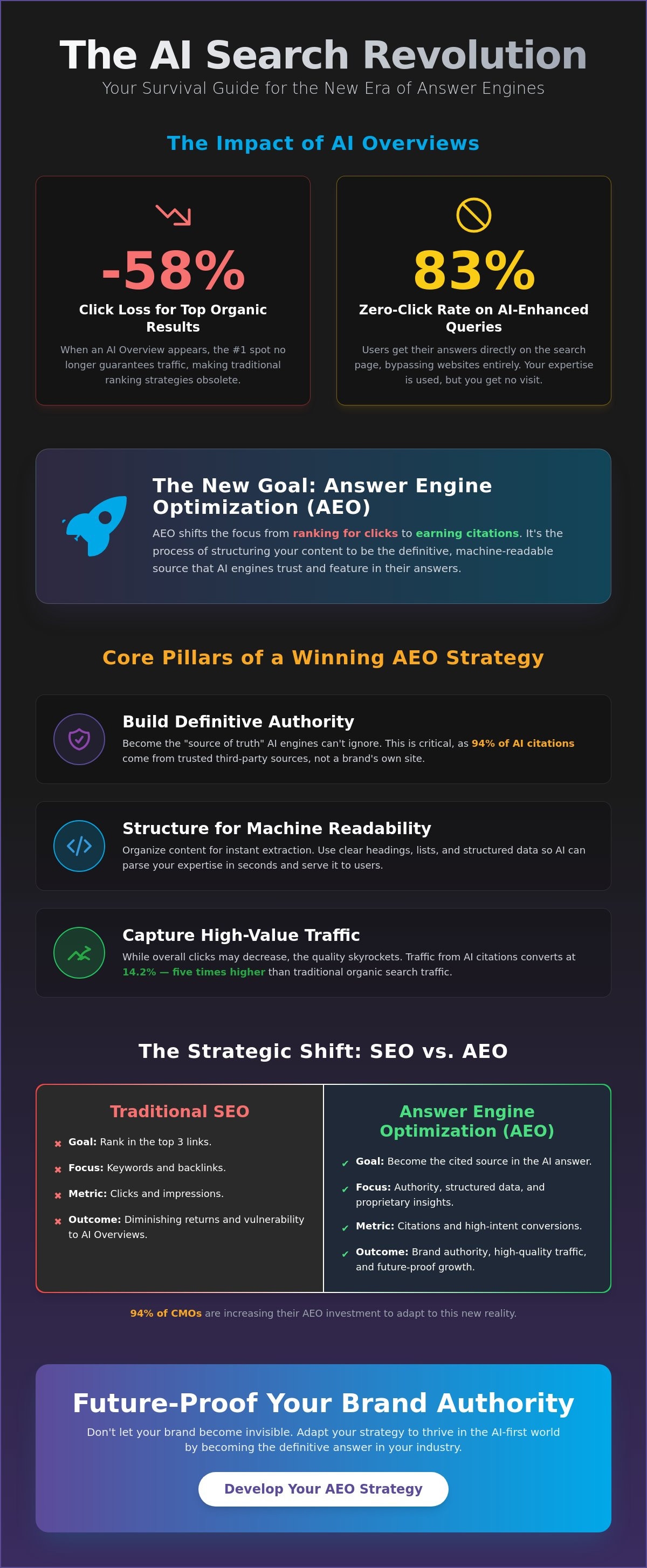
When a Google AI Overview appears, the top-ranking organic result doesn’t just lose a few visitors; it loses an estimated 58% of its clicks. With zero-click rates for these searches hitting 83% as of June 2026, a traditional search approach is no longer enough. You need a robust aeo marketing strategy to sustain your brand’s growth. You’ve likely noticed your organic click-through rates dipping despite maintaining your rankings. It’s frustrating to see AI engines summarize your hard-earned expertise while keeping users on the search page, making it harder than ever to measure the ROI of your content.

This guide will show you how to reclaim your visibility and become the definitive source for AI-driven answers. You’ll learn how to transition from traditional search rankings to becoming a trusted citation in generative engine responses. We’ll explore the specific requirements for answer engine optimization, from leveraging proprietary data to securing the high-converting traffic that now flows through AI platforms. By the end, you’ll have a future-proof plan to maintain your brand authority in an AI-first world.

Key Takeaways

  • Understand why the rise of zero-click searches makes transitioning from traditional SEO to citation-based optimization essential for 2026.
  • Learn to build a high-impact aeo marketing strategy by structuring your content for clarity and machine extraction to establish definitive brand authority.
  • Identify high-value question queries and audit your existing content to secure prominent placements in Google AI Overviews and other generative engines.
  • Discover how to convert AI-driven visibility into tangible business results by leveraging the “halo effect” of being a cited expert.
  • Explore how leveraging professional generative AI development services can help you create the proprietary data sources needed to dominate future search landscapes.

The Evolution of Search: Why AEO Marketing Strategy is Essential in 2026

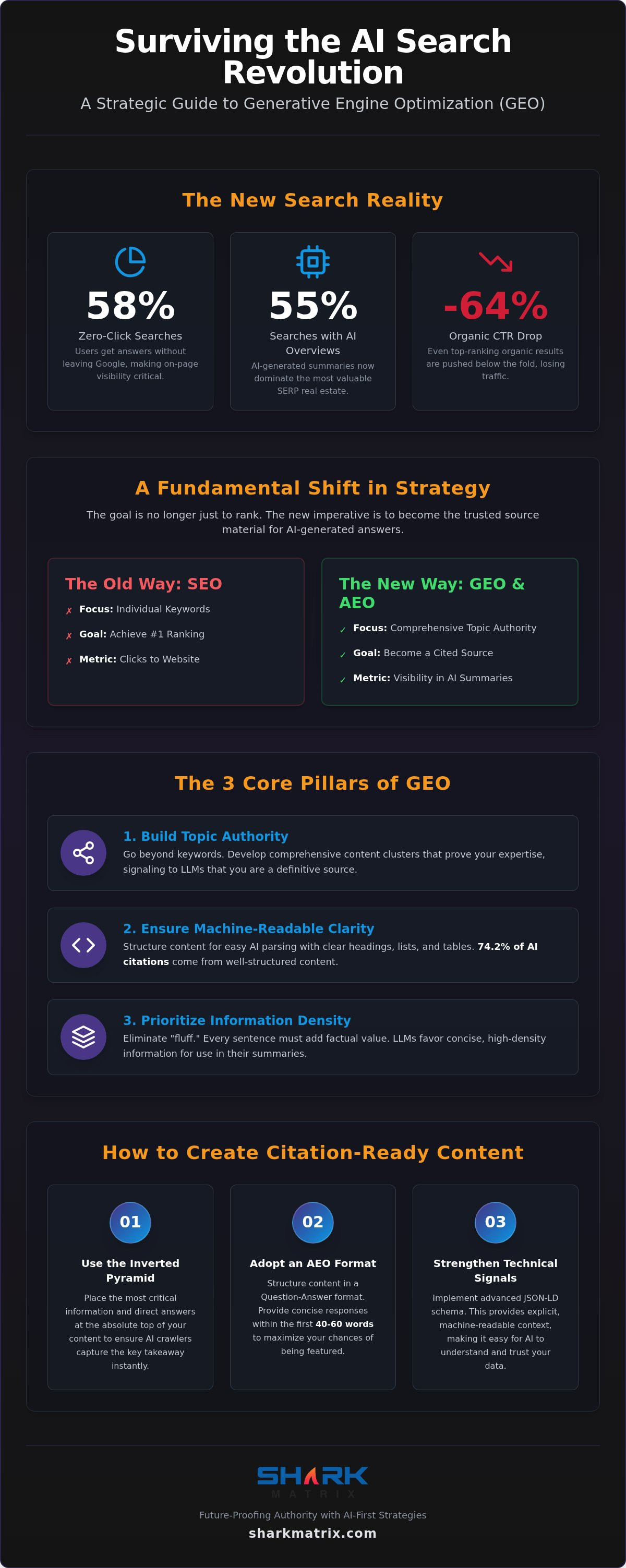
Search behavior has undergone a radical transformation. For decades, the goal was simple: rank in the top three results to capture clicks. In 2026, the landscape looks different. When Google triggers an AI Overview, the top organic result loses an estimated 58% of its clicks. This shift has turned the “zero-click” search from a minor concern into a dominant reality. Zero-click rates now reach approximately 83% for AI-enhanced queries, fundamentally altering national organic traffic patterns. To survive this, businesses must adopt an aeo marketing strategy that prioritizes becoming the definitive answer rather than just another link in the list.

AEO is the process of structuring and refining content so it is easily “digestible” for artificial intelligence. Unlike traditional SEO, which focuses on ranking for website visits, AEO focuses on earning citations. The Evolution of Search shows us that as algorithms become more sophisticated, they rely less on keyword matches and more on verified, authoritative data. If an AI engine uses your data to answer a user, your brand gains a level of authority that a standard click can’t replicate. It’s why 94% of CMOs and digital leaders plan to increase their AEO investment this year. They recognize that being the answer is now more valuable than being the third link on a page.

From Keywords to Conversational Intent

Natural Language Processing (NLP) has fundamentally changed how we interact with search engines. Users no longer type fragmented phrases; they ask complex, multi-step questions. This transition from short-tail keywords to conversational intent means your content structure must change. It’s no longer about how many times you mention a term. It’s about how clearly you answer the specific problem. Intent now dictates content structure more than keyword density ever did. This requires content that provides immediate, extractable value for both the machine and the human reader. If the AI can’t parse your solution in seconds, it won’t cite you.

The Rise of Generative Engines

The discovery journey now frequently starts and ends within platforms like ChatGPT, Perplexity, and Claude. These generative engines form a new ecosystem encompassing search, voice assistants, and chat interfaces. They prioritize factual, authoritative citations because their reputation depends on accuracy. Since 94% of AI citations come from third-party sources rather than a brand’s own site, your aeo marketing strategy must focus on building a reputation that these engines can’t ignore. Whether through voice search or a desktop chat, being the “source of truth” is the new gold standard for digital marketing. These engines are looking for expert answers and proprietary data that they cannot generate on their own.

The Core Pillars of a High-Impact AEO Marketing Strategy

A successful aeo marketing strategy rests on the foundation of perceived expertise. Large Language Models (LLMs) don’t just pick random snippets; they prioritize sources that demonstrate deep authority. Since 94% of AI citations come from third-party sources rather than your own site, your brand must exist as a verified entity across the web. This shift represents The Evolution of Search, where the goal isn’t just a high rank, but becoming the “source of truth” that an AI can’t ignore. For companies operating nationally, this authority must be maintained across both English and Arabic content to capture the full scope of conversational queries. When you secure these citations, the rewards are high; website traffic from AI search converts at 14.2%, which is five times higher than traditional organic search.

Technical readiness acts as the “API” for these engines. You’re no longer just building pages for humans; you’re providing a structured data feed that AI can parse instantly. This technical layer ensures that your expert insights aren’t buried under layers of fluff. If you want to see how these elements combine, partnering with an expert in answer engine optimization can help bridge the gap between traditional content and AI-native delivery. By treating your website as a data source, you make it easier for machines to extract facts, definitions, and unique perspectives that LLMs can’t generate on their own.

Content Structuring for Machine Readability

To win, adopt the Inverted Pyramid style by leading with the core answer immediately. AI engines value efficiency, so using Q&A blocks and “TL;DR” summaries provides the exact “extractable” facts they need. Answer-First Content, defined as the practice of delivering a direct, factual solution to a user’s query within the first 100 words of a page, serves as the primary requirement for AEO success. This format allows machines to identify your site as the primary source for a specific answer without wading through unnecessary context.

Advanced Schema and Structured Data

Structured data is the primary bridge to the global Knowledge Graph. You should implement specific markups to clearly define your information for AI scrapers, such as:

  • Dataset Markup: To highlight proprietary research and unique data points.
  • FAQ Markup: To provide direct answers to common industry questions.
  • Speakable Markup: To optimize for voice-activated answer engines and assistants.

These technical signals tell the engine exactly what your content is and why it’s a verifiable fact. Integrating these elements with professional technical SEO services ensures your site’s architecture is ready for the demands of generative engines and the future of search discovery.

Mastering AEO Marketing Strategy: The 2026 Guide to Answer Engine Optimization

Optimizing for AI Overviews and Generative Engine Optimization (GEO)

AI Overviews appear in approximately 25% to 60% of Google searches. This high prevalence means your aeo marketing strategy must prioritize visibility within these generative summaries. Winning a citation isn’t just about traditional rankings. Only 17% to 38% of pages cited in AI Overviews actually rank in the top 10 organic results. This proves that Optimizing for AI Overviews requires a different set of tactics than standard SEO. You should start by auditing your existing high-performing pages to identify facts and definitions that an AI can easily extract.

A key component of GEO is the implementation of “Nugget” content. These are small, highly factual blocks of text designed for machine consumption. Instead of burying a key definition in the middle of a narrative, you place it in a standalone, clear sentence. This makes it easier for LLMs to cite your brand as the primary source of truth. You’ll need to monitor your citation frequency using modern AI-tracking tools to see which “nuggets” are gaining traction and which need refinement. If your data isn’t being picked up, it’s likely not structured clearly enough for the engine’s scraper.

Winning the AI Citation: A Step-by-Step Approach

Securing a spot in a generative response requires a disciplined editorial workflow. Follow these steps to improve your chances:

  • Step 1: Identify the “Seed Question” behind the user intent. What specific problem is the user trying to solve?
  • Step 2: Provide a concise, 40 to 60 word answer at the top of the page. This is the prime real estate for AI extraction.
  • Step 3: Support the answer with data, expert quotes, and unique insights that a machine cannot invent.
  • Step 4: Use clear H3 headings to break down complex sub-topics, allowing the AI to parse the hierarchy of your information.

The Role of Digital Reputation in AEO

LLMs don’t just look at your website; they look at what the rest of the web says about you. Since 94% of AI citations come from third-party sources, your digital reputation is a primary ranking factor for AEO. This makes brand reputation management a critical part of your optimization workflow. If third-party reviews or industry mentions are negative or inconsistent, an AI is less likely to trust your content as a factual source. You must manage the sentiment of the data sources that LLMs use to train their responses to ensure your brand is perceived as an authority.

Converting AEO Visibility into Business Results

Gaining visibility in an AI Overview is only half the battle. The real challenge lies in turning that citation into revenue. While the high zero-click rate might seem discouraging, 97% of digital leaders reported a positive impact from AEO on their marketing funnel in 2025. This success stems from the “Halo Effect,” where being cited as an authoritative source builds top-of-mind awareness that transcends a single search session. A comprehensive aeo marketing strategy ensures that when a user is ready to buy, your name is the first they recall, even if they didn’t visit your site during the initial research phase.

In the B2B buyer journey, research often happens within generative engines long before a lead ever lands on your website. By dominating these answers, you position your brand as the industry standard. Success here isn’t just measured by clicks; it’s measured by “Share of Model.” This metric tracks how often an LLM suggests your brand versus your competitors. Tracking brand sentiment within these AI responses is equally vital. If the AI describes your solution as “reliable” or “industry-leading,” you’ve already won the trust battle before the first sales conversation even begins. This early authority makes your aeo marketing strategy a powerful tool for lead generation.

Capturing the “Invisible” Lead

An “invisible” lead is a user who learns about your brand through an AI answer but doesn’t click through immediately. To capture these users, your brand name must be optimized for easy recall and distinct identity. Consistent messaging across web, social, and AI platforms ensures that your value proposition remains clear regardless of the discovery channel. A smart way to close this loop is by linking your AEO efforts with professional PPC management. By running targeted ads for the specific questions you answer in AI results, you create a second touchpoint that captures high-intent users who are ready to move from the research phase to a conversion.

AEO for E-commerce and Lead Gen

For e-commerce, answer engines are becoming the primary tool for product comparisons and “Best of” queries. To compete, your web development must prioritize fast, crawlable, and highly structured product data. If your site architecture doesn’t allow an AI to instantly extract prices, features, and reviews, you’ll be left out of the comparison entirely. We’re moving toward a future of “Action Engines,” where AI agents will book meetings or complete purchases directly for the user. Preparing your technical foundation now is the only way to stay relevant in this automated landscape. These systems rely on high-quality data feeds to make decisions on behalf of the consumer. If you’re ready to modernize your funnel, our team can help you maximize your visibility in AI search results today.

Future-Proofing Your Strategy with Shark Matrix AI Solutions

Adopting a forward-thinking aeo marketing strategy requires more than just high-quality writing. It demands a technical foundation that aligns with how Large Language Models (LLMs) process information. Shark Matrix takes an AI-native approach to digital marketing, moving beyond traditional content silos to build a 360-degree presence. As 93% of business leaders choose to build their AEO and GEO capabilities in-house or through specialized partners, the need for a technical-first agency has never been greater. We focus on transforming your brand from a participant in search to a primary data source for the next generation of discovery engines.

A critical gap in many global strategies is the lack of bilingual optimization. For national markets like the UAE, your aeo marketing strategy must be effective in both English and Arabic. LLMs use different tokenization patterns and training sets for these languages, meaning a citation in one doesn’t guarantee visibility in the other. Shark Matrix specializes in bridging this linguistic divide, ensuring your brand authority remains consistent across regional generative responses. We combine our deep understanding of natural language processing services with local market expertise to protect your share of voice in every relevant language.

Proprietary data is the ultimate currency in an AI-first world. AI models prioritize verified, unique information that they cannot synthesize on their own. Our team provides generative ai development services to help you build and structure these data sources, making your brand indispensable to answer engines. By creating original research and structured datasets, you move from competing for keywords to owning the facts that define your industry. This technical excellence, paired with strategic content marketing, ensures your brand is ready for the next decade of search evolution.

Beyond Search: AI Automation and Custom Solutions

The future of brand discovery extends into private AI environments. Leveraging our ai automation services allows you to streamline content production while maintaining the strict data structures required for AEO. We help national enterprises build “Brand-Owned” GPTs and custom assistants that serve as internal and external answer engines. These custom solutions ensure that when users interact with AI, they receive accurate, brand-aligned information directly from your proprietary knowledge base.

Your National Partner for Digital Growth

The Shark Matrix advantage lies in the intersection of technical mastery and marketing strategy. We don’t just optimize for today’s algorithms; we build the infrastructure for tomorrow’s AI agents. Whether you need machine learning development services to analyze search patterns or a complete overhaul of your structured data, our team provides the expertise needed to stay ahead. The transition to an AI-first search landscape is happening now. Contact our experts to audit your AEO readiness and secure your brand’s place as a definitive source of truth in the generative era.

The shift from organic clicks to AI-driven citations represents a permanent evolution in digital discovery. To maintain authority, you must transition from traditional keyword targeting to a structured, data-first approach that prioritizes machine readability. Success in 2026 requires a flawless digital reputation and the technical infrastructure to serve as an authoritative source for both search engines and generative models. Embracing these changes now allows your brand to capture high-intent users who are moving away from traditional list-based results.

Integrating a comprehensive aeo marketing strategy is the most effective way to secure your brand’s visibility in a zero-click world. Shark Matrix has been at the forefront of technical marketing since 2010, helping high-growth brands scale through deep expertise in AI automation and generative engine optimization. We provide the national digital marketing solutions necessary to thrive in an increasingly automated landscape. Our team’s technical focus ensures that your content isn’t just seen, but cited as the primary source of truth.

Partner with Shark Matrix for a future-proof AEO and SEO strategy today. Your brand’s journey toward becoming the definitive answer starts here. We’re ready to help you lead the way.

Frequently Asked Questions

What is the main difference between SEO and AEO?

SEO focuses on ranking web pages to drive traffic, while AEO focuses on providing clear, extractable answers to earn citations in AI-driven responses. While traditional SEO aims for the click, AEO aims to be the “source of truth” that a machine summarizes. It’s a fundamental shift from positioning your website as a final destination to positioning your content as a reliable data provider for AI models.

How do I measure the success of an AEO strategy if clicks are decreasing?

You should measure success through “Share of Model” and citation frequency rather than relying solely on organic click-through rates. Track how often your brand appears in AI Overviews and the sentiment of those responses. High-quality citations build brand authority that leads to direct searches later, even if the initial query doesn’t result in an immediate website visit.

Does AEO replace traditional SEO in 2026?

No, AEO complements traditional SEO by addressing the rise of zero-click searches and generative summaries. Traditional SEO still handles transactional and navigational queries where users need to interact with a full website. An effective aeo marketing strategy works alongside SEO to ensure you capture users at every stage of the discovery journey, whether they need a quick fact or a deep-dive page.

How can I get my brand cited in ChatGPT or Google AI Overviews?

You get cited by providing clear, factual blocks of information that AI scrapers can easily parse and verify. Use the Inverted Pyramid style to lead with direct answers and support them with unique, proprietary data. Since 94% of citations come from third-party sources, building a strong presence on industry-relevant sites and review platforms is also essential for earning trust from Large Language Models.

Is structured data really necessary for AEO?

Yes, structured data acts as the technical bridge for answer engines, making your content instantly readable for machine scrapers. Using Schema markups like FAQ, Dataset, and Speakable helps AI understand the context and reliability of your information. Without these technical signals, engines may struggle to verify your data, which significantly reduces your chances of becoming a primary citation in generative responses.

How does voice search fit into an AEO marketing strategy?

Voice search is a primary delivery method for answer engines, as digital assistants rely on AEO to provide verbal responses. Integrating an aeo marketing strategy ensures your content is optimized for the conversational, long-tail questions typical of voice queries. By structuring your data for machine extraction, you increase the likelihood that assistants will read your brand’s answer aloud to the user.

Can AEO help with my brand’s online reputation?

AEO directly impacts your reputation by influencing the narrative that AI engines summarize for users. When an AI cites your brand as an expert source, it reinforces your authority and builds trust with the audience. Managing the data sources LLMs use to train their responses ensures that the sentiment surrounding your brand remains positive and professional across all AI platforms.

What is Generative Engine Optimization (GEO)?

GEO is a specialized subset of AEO that focuses on optimizing content specifically for generative AI platforms like ChatGPT, Claude, and Perplexity. It involves refining content so it’s not just factual, but also formatted to be the most “helpful” response for an LLM to synthesize. GEO emphasizes the use of authoritative citations and unique perspectives that distinguish your brand from generic, AI-generated filler.

Categories
AEO

Answer Engine Optimization vs SEO: Navigating the Future of Visibility in 2026

96% of total traffic volume still originates from traditional search, yet 72% of consumers plan to use AI for shopping more frequently this year. You’ve likely seen your organic click-through rates dip as AI Overviews occupy the top of the results page. Understanding the balance of answer engine optimization vs seo is no longer optional if you want to protect your visibility. It’s a stressful time to manage legacy content, especially when you aren’t sure which specific engines are even citing your brand. You know the rules of the game are changing, but you don’t want to abandon the strategies that still drive the majority of your leads.

We’re here to bridge that gap. This article provides a clear roadmap for 2026 search visibility, showing you how to integrate both strategies to dominate search results and AI citations. You’ll discover why content updated within the last 13 weeks is 50% more likely to be cited by LLMs and how to restructure your data for maximum impact. We’ll show you how to maintain traffic while building authoritative brand presence within AI-generated answers. It’s time to move from simply ranking to becoming the definitive answer across the entire digital ecosystem.

Key Takeaways

  • Understand the critical balance of answer engine optimization vs seo to maintain visibility as search behavior shifts from clicking to delegating.
  • Master the transition from traditional keyword ranking to securing high-frequency citations within Large Language Models and AI Overviews.
  • Learn how to use advanced Schema.org and structured content to ensure AI engines identify your brand as a primary source of truth.
  • Discover why your existing SEO authority is the foundation for AEO success and how to leverage backlinks as trust signals for AI models.
  • Find out how a dedicated “Search-to-Answer” audit identifies visibility gaps and uses AI automation to scale your reach in 2026.

The Evolution of Search: Defining SEO and AEO in 2026

The digital landscape has shifted from a library of links to a network of answers. In 2026, the debate surrounding answer engine optimization vs seo often frames them as rivals; however, for national brands, this is a false dichotomy. Traditional Search Engine Optimization (SEO) has matured beyond simple keyword targeting into intent-based ecosystem management. It’s no longer just about where you rank on a list. It’s about how your brand exists within the entire search environment. While SEO builds the foundation of authority and discoverability, Answer Engine Optimization (AEO) focuses on becoming the definitive source of truth that Large Language Models (LLMs) rely on when synthesizing responses.

We’ve moved past the “index-and-rank” era. Modern search platforms use “understand-and-synthesize” models. These systems don’t just point users toward a page; they ingest content, weigh its credibility, and present a summarized conclusion. For businesses, understanding the interplay of answer engine optimization vs seo is the only way to stay ahead of these algorithmic shifts. You can’t ignore the technical requirements of one without damaging the performance of the other.

What Constitutes an Answer Engine?

Answer engines represent a diverse group of platforms including Perplexity, ChatGPT, Claude, and Google’s AI Overviews. Unlike traditional crawlers that primarily look for keywords and backlink patterns, these engines consume data to build semantic relationships. They use real-time web access to verify facts and provide current insights. This means your content must be structured for machine readability. If an engine can’t parse your data quickly, it won’t cite you as the primary source for a user’s prompt. It’s about clarity and structured data over mere volume.

Why 2026 is the Tipping Point for AEO

User expectations have fundamentally changed. Most people no longer want to hunt through ten blue links; they want a direct answer immediately. This shift has led to a surge in zero-click searches, where the user journey begins and ends on the search results page. To combat declining organic click-through rates, professional search engine optimization seo services have evolved to prioritize AI-readiness. Success in 2026 requires a hybrid approach. You must maintain traditional rankings to drive high-intent traffic while simultaneously optimizing for the AI-generated summaries that now dominate the top of the screen.

Core Differences: Ranking vs. Citation Mechanics

To master the balance of answer engine optimization vs seo, you must first understand that the goalposts have moved. Traditional SEO focuses on SERP placement, aiming for that coveted “Position 1” in a list of results. AEO, however, prioritizes citation frequency and accuracy. It’s the difference between being a link on a page and being the data source that powers an AI’s response. While a high ranking in Google remains valuable, research indicates that backlinks are only predictors of citations in answer engines in the 4-7% range. This means your traditional authority doesn’t automatically translate to AI visibility.

The technical process also differs significantly. SEO relies on “crawling for keywords,” where bots identify specific strings of text. AEO relies on “embedding for semantic meaning,” where neural networks analyze how concepts relate to one another. Users are shifting from browsing a list of links to consuming a generated summary. This changes how we measure success. Instead of just tracking Click-Through Rate (CTR) and Position, digital leaders now track Share of Model (SoM) and brand sentiment within AI outputs. If you’re struggling to track these new metrics, our ai automation services can help you monitor your brand’s presence across generative platforms.

The Discovery Surface: Links vs. Conversational UX

In traditional search, users interact with featured snippets, local packs, and knowledge panels. These are static elements designed to drive clicks. Answer engine outputs are different; they feature footnotes, inline citations, and follow-up prompts. The “first page” of Google is no longer the only battleground. Instead, the “context window” of the AI model determines what information is included in the final answer. If your content isn’t structured to fit this window, it won’t be cited, regardless of its traditional rank.

Data Processing: Algorithms vs. Neural Networks

Traditional search engines like Google still use evolved versions of PageRank to weigh authority based on link structures. In contrast, answer engines use transformer architectures and neural networks to process data. These systems prioritize “entities” (concepts and objects) over “strings” (literal text matches). This represents a fundamental move from lexical matching to semantic understanding, where the engine evaluates the underlying meaning of your content rather than just the words used.

Answer Engine Optimization vs SEO: Navigating the Future of Visibility in 2026

The Synergy: Why AEO Cannot Exist Without SEO

A common mistake in current digital strategy is treating answer engine optimization vs seo as a choice between two different paths. In reality, they are two sides of the same coin. AI engines don’t generate facts out of thin air; they ground their responses in high-authority sources they find through traditional search indexing. If your site lacks the foundational authority that SEO provides, an answer engine is unlikely to trust your content enough to cite it. You can’t have one without the other if you want to maintain a dominant online presence.

Traditional backlinks still play a vital role here. While they aren’t the only factor for AI discovery, they act as essential trust signals. Generative models use these signals to verify that a piece of information is credible and widely recognized. This creates a powerful feedback loop. High SEO rankings lead to more AI citations. These citations, in turn, increase brand visibility and search volume, which further reinforces your SEO standing. Protecting this visibility is especially critical for national brands, which is why seo for brand reputation management dubai has become a core component of modern search strategies.

The Authority Factor in AI Citations

Large Language Models often prioritize the top five organic results when answering factual queries. This makes your E-E-A-T (Experience, Expertise, Authoritativeness, and Trustworthiness) profile more important than ever. It’s not just about having the right keywords anymore. It’s about your brand mentions across the web acting as a decentralized knowledge graph. Research shows that content published or updated within the last 13 weeks is roughly 50% more likely to be cited by answer engines. When multiple authoritative sites mention your brand in connection with fresh, updated data, AI engines are far more likely to synthesize that information into a cited answer.

Solving the Zero-Click Challenge

The rise of zero-click searches doesn’t mean traffic is dead. It means you need a two-tiered approach. Use AEO to capture the immediate “answer” within the AI summary, positioning your brand as the primary expert. Then, use SEO to capture the “deep dive” traffic from users who want more than a summary. Click-through optimization within AI responses involves using clear, compelling language that encourages users to click the citation link for more detail. You should balance your concise, AI-friendly summaries with high-value gated content or long-form guides that provide the depth an AI summary simply can’t replicate.

The 2026 AEO Checklist: Building an Answer-First Strategy

Succeeding in the current climate requires more than just adding a few FAQs to your blog posts. It demands a structural shift in how you present data to both humans and machines. When evaluating answer engine optimization vs seo, the most successful brands are those that treat their website as a structured database rather than a collection of documents. This checklist outlines the essential steps to ensure your brand is the first choice for AI synthesis.

Implementing this shift requires a specialized approach to digital architecture. Companies like PurpleCow Digital Marketing provide the strategic website design and development necessary to ensure your site functions as a high-performance database for AI engines.

  • Step 1: Implement advanced Schema.org markup like Speakable, FAQ, and HowTo to define your content’s purpose clearly.
  • Step 2: Transition to an “Answer-First” architecture where the primary value proposition is delivered immediately.
  • Step 3: Optimize for natural language and conversational long-tail queries that reflect how people actually speak to AI agents.
  • Step 4: Build a robust entity-based internal linking structure that maps the relationships between your core business concepts.
  • Step 5: Monitor “Share of Model” (SoM) using emerging AI tracking tools to see how often your brand is cited compared to competitors.

The interplay of answer engine optimization vs seo means your technical foundation must support both discovery and citation. If you are ready to modernize your digital infrastructure, our ai automation and development services can help you implement these advanced data structures at scale.

Technical Foundations: Schema and Structured Data

Basic JSON-LD is no longer sufficient for high-level visibility. You must optimize for semantic triplets, which define specific relationships between entities in a way that AI models can easily ingest. By using technical SEO to “label” every component of your page, you reduce the computational effort required for an engine to understand your expertise. Structured data is the language of AEO. It transforms your prose into a machine-readable format that answer engines can trust and verify in real-time.

Content Framework: The Q&A Hierarchy

Content architecture must now follow a strict hierarchy designed for quick extraction. Start your articles with a 40 to 60 word “direct answer” that provides immediate value. Use H2 and H3 headings as explicit question-answer pairs. This structure mirrors how LLMs search for information within their context windows. Additionally, prioritize factual density and “first-hand experience.” This emphasis on unique expertise ensures your content isn’t just another generic summary, but a unique contribution that AI engines find worth citing over competitors.

Shark Matrix: Bridging the Gap Between Search and Answers

Scaling a visibility strategy that balances answer engine optimization vs seo requires more than just manual content updates. It demands technical integration. At Shark Matrix, we use custom AI automation to help brands transition from static pages to dynamic, machine-readable data sources. This isn’t just about following a checklist; it’s about building an infrastructure where your brand assets are “AI-native” from the moment they’re created. By leveraging our generative ai development services, we ensure your content is structured to be ingested, understood, and cited by the world’s most advanced LLMs.

Our proprietary “Search-to-Answer” audit process is designed specifically for national UAE brands looking to protect their authority. We don’t just look at where you rank on a traditional results page. We analyze how your brand is represented in conversational prompts and AI summaries. This dual-focus approach ensures you don’t lose traditional organic traffic while you’re busy building a presence in the new answer-first ecosystem. A national strategy needs a partner who understands both the nuances of search engine algorithms and the complexities of AI engineering.

AI-Native Digital Marketing

Future-proofing your brand involves using machine learning development services to predict which queries are most likely to trigger AI Overviews. We help you stay ahead of the curve by identifying these high-value “answer targets” before your competitors do. Beyond external visibility, we develop custom ai chatbot-development services that act as internal answer engines for your proprietary data. This allows you to maintain a unified brand voice across every touchpoint, whether a user is talking to your site’s bot or asking a global engine like ChatGPT about your services.

Measuring Success in an AI-Driven World

Success metrics are undergoing a fundamental transformation. While we still monitor traditional traffic, we’ve moved toward “Inclusion” as a primary KPI for our clients. This means tracking how often your brand is the cited source in a generated summary. We use natural language processing services to monitor brand sentiment within LLM outputs, ensuring the AI isn’t just mentioning you, but positioning you as the expert. Ready to dominate the answer engines? Contact Shark Matrix for a 2026 Strategy Audit and secure your brand’s future in the next era of search.

Securing Your Brand’s Authority in the AI Era

The transition from a link-based web to an answer-first ecosystem is well underway. You now have the tools to understand that the dynamic between answer engine optimization vs seo is one of mutual reinforcement. Success in 2026 requires more than just high rankings; it demands a presence within the context windows of the world’s most powerful AI models. By combining the trust signals of traditional search with the structured clarity of AEO, you ensure your brand remains the primary source of truth for both human users and digital agents.

Navigating this shift alone is a complex task for any national market leader. As a pioneering AI automation agency in the UAE, Shark Matrix specializes in national-scale SEO strategies and holds deep expertise in Generative Engine Optimization (GEO). We help you bridge the technical gap between discovery and citation to maintain your competitive edge. Future-proof your brand with Shark Matrix AEO & SEO services to ensure you aren’t just found, but cited. The future of search is conversational, and it’s time for your brand to lead the conversation.

Frequently Asked Questions

Will AEO replace traditional SEO by the end of 2026?

No, AEO won’t replace traditional SEO by the end of 2026. Instead, it serves as a natural evolution of search strategy. While AEO focuses on getting cited in AI summaries, traditional SEO still drives the vast majority of web traffic. You need SEO to build the site authority that AI engines use to verify your brand’s credibility before they cite you as a source of truth.

How do I track my website’s performance in answer engines like ChatGPT?

You can track performance by monitoring Share of Model (SoM) and brand sentiment within AI outputs. Unlike traditional rank tracking, this involves using specialized tools that query LLMs to see how often your brand appears in generated answers. It’s also helpful to look at referral traffic from AI sources in your analytics, though this data is often still grouped under direct or referral sources.

What is the most important technical factor for Answer Engine Optimization?

The most important technical factor is implementing advanced Schema.org markup to label your content for machine ingestion. Structured data acts as a translator for AI engines, allowing them to parse your facts, entities, and relationships without ambiguity. When comparing answer engine optimization vs seo, this technical layer is what moves you from being a link to being a verifiable fact in an AI’s memory.

Can I optimize a single page for both Google Search and AI answer engines?

Yes, you can and should optimize a single page for both environments. A hybrid structure leads with a concise direct answer for AI engines while following up with the deep dive analysis that traditional searchers value. This dual approach ensures you capture the AI summary citation at the top of the page while maintaining your organic ranking for users who want to click through and read more.

How does AEO affect my organic click-through rate (CTR)?

AEO often leads to a lower click-through rate for simple informational queries because the AI provides the answer directly. However, it significantly boosts your brand authority and trust. Being the cited source in an AI Overview creates a halo effect that can drive higher quality, high intent traffic from users who need more than just a quick summary. It’s a shift from quantity to quality.

What role does Schema markup play in AEO compared to SEO?

In traditional SEO, Schema markup is primarily used to win rich snippets like star ratings or FAQ boxes. In AEO, its role is much deeper; it provides the semantic triplets that AI models use to understand the relationship between different entities. It’s the difference between decorating a search result and feeding a neural network the specific data it needs to synthesize an accurate answer.

Is AEO only for informational queries, or does it work for commercial intent?

AEO works for both informational and commercial queries. While it started with simple “what is” questions, users now use AI to compare products, find local services, and seek professional advice. Optimizing for commercial intent in 2026 means ensuring your product specifications and service details are structured so AI engines can include your brand in “best of” summaries or comparison tables.

How often should I update my content to stay relevant for AI engines?

You should update your core content at least every 13 weeks to maintain its relevance. Research shows that content updated within this timeframe is 50% more likely to be cited by answer engines. AI models prioritize fresh data and recent insights to ensure their summaries are current. Frequent updates to your proprietary metrics and factual data help maintain your status as a reliable source of truth.