

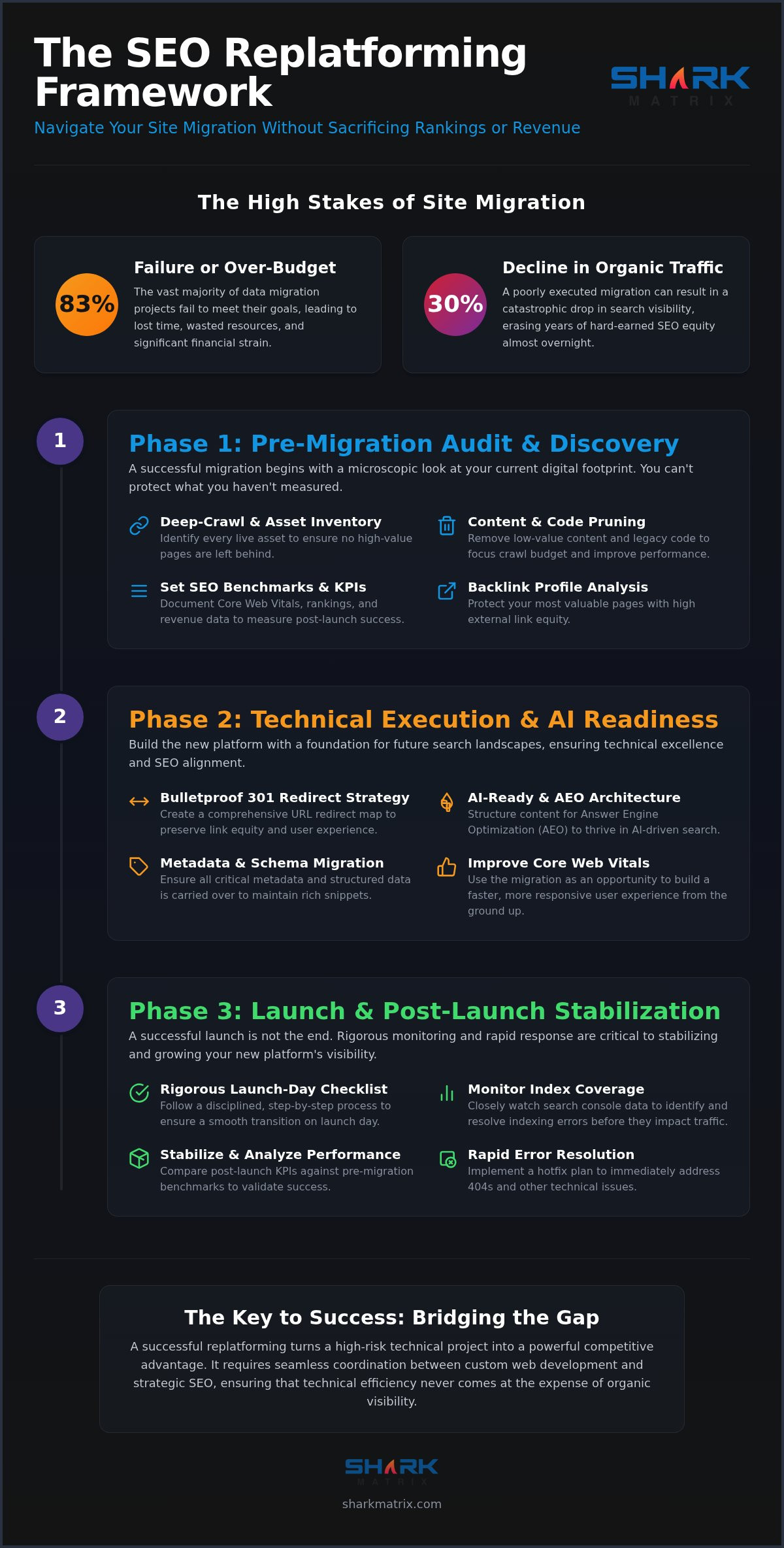
83% of data migration projects either fail or exceed their budgets, often leaving a trail of 404 errors and lost revenue in their wake. It’s a terrifying reality for enterprise leaders who know that a single month of tanking rankings can erase years of hard-earned search equity. You’ve likely felt that anxiety during planning meetings where technical developers and search specialists don’t always align, making a cohesive replatforming seo strategy feel out of reach.
This guide provides the framework to ensure your move to a modern tech stack is a growth engine rather than a recovery project. You’ll learn how to master the complex process of migrating your platform without sacrificing your organic traffic or revenue. We’ll explore how to protect your rankings, improve Core Web Vitals, and position your brand to thrive in the era of AI-driven search and answer engines. By bridging the gap between software engineering and search strategy, you can turn a risky migration into a powerful competitive advantage.
Key Takeaways
- Learn how to conduct a deep-crawl audit to identify every live asset, ensuring no legacy code or high-value pages are left behind during the move.
- Discover a bulletproof replatforming seo strategy that uses 301 redirects to preserve link equity and prevent post-launch ranking drops.
- Prepare your new site for the 2026 search landscape by integrating Answer Engine Optimization (AEO) and AI-ready architectural shifts.
- Follow a rigorous launch-day checklist to monitor index coverage and resolve technical errors before they impact your bottom line.
- Understand how bridging the gap between custom web development and strategic SEO creates a high-performance e-commerce ecosystem.
The High Stakes of Replatforming: Why Your SEO Strategy Matters
Replatforming is more than a digital facelift. It’s a fundamental software modernization process that rewrites how search engines interact with your business. While many teams treat a move to a new CMS as a simple checklist of URL updates, a truly effective replatforming seo strategy accounts for deep architectural shifts. If you ignore how your site hierarchy changes, you risk “invisible” disasters like crawl budget depletion or carrying over legacy code bloat that slows down your new, expensive platform from day one.
In 2026, the stakes have shifted. We’re no longer just optimizing for traditional blue links. The rise of Generative Engine Optimization (GEO) means your new site must be structured so AI “answer engines” can easily parse and cite your content. This requires seamless coordination between your web developers and SEO team. Shark Matrix acts as the bridge between these departments. We ensure that technical efficiency never comes at the expense of organic visibility, helping your team speak the same language from discovery to launch.
The Financial Impact of Migration Errors
The cost of failure is high. Research indicates that 83% of data migration projects either fail or exceed their budgets. For an enterprise, a poorly executed launch can lead to a 30% decline in organic traffic. If your site generates significant monthly revenue, even a temporary 20% dip over six months represents a massive financial hit that’s difficult to recover. Beyond the numbers, a spike in 404 errors and broken internal links erodes customer trust. In competitive national markets, once you lose that hard-earned authority, competitors are ready to fill the vacuum immediately.
Setting SEO Benchmarks and KPIs
You can’t protect what you haven’t measured. Before the first line of code is moved, you must identify your “Must-Win” keywords and high-revenue pages. These are the assets that sustain your business. Establishing clear metrics early prevents finger-pointing if issues arise post-launch.
- Capture Baselines: Document current Core Web Vitals. With 42% of sites failing the Interaction to Next Paint (INP) metric in 2026, you need a clear starting point to prove the new platform is an upgrade.
- Define Failure Thresholds: Establish a “red line” for post-launch monitoring. If organic sessions drop below a specific percentage, your team should have an immediate hotfix plan ready.
- Revenue Mapping: Connect your most valuable SEO pages to direct sales data. This allows you to prioritize technical fixes based on fiscal impact rather than just traffic volume.
Phase 1: The Pre-Migration SEO Audit & Discovery
Successful migrations don’t start with code. They start with a microscopic look at what you already own. A robust replatforming seo strategy begins with a comprehensive audit of your current digital ecosystem. You must conduct a deep crawl to identify every live asset, from legacy landing pages to forgotten PDF resources. This isn’t just about making a list. It’s about evaluating whether your current site hierarchy is actually ready for a modern platform. If your architecture is messy now, moving it to a faster tech stack won’t fix the underlying structural issues that confuse search engines.
Pruning is equally vital. Moving every single page is often a waste of resources. By identifying and removing low-value content, you streamline the migration and focus your crawl budget on pages that drive revenue. At the same time, you must analyze your backlink profile. High-authority pages with significant external equity need the most protection. If these aren’t prioritized, you risk losing the trust search engines have built in your brand since your site was first indexed. Using ai automation services can help streamline these discovery workflows, identifying patterns in your data that human audits might miss.
Mapping the Current SEO Footprint
Modern audits in 2026 leverage AI to categorize pages by search intent rather than just keywords. This ensures that your new site structure aligns with how users actually search in an “answer engine” environment. You need to identify critical metadata and Schema markup that must be preserved to maintain your rich snippet visibility. For those needing expert guidance on these technical requirements, our comprehensive SEO audit guide ensures no technical detail is overlooked during this discovery phase. We help you map out exactly which elements of your current success must be carried over to the new environment.
Platform Selection from an SEO Perspective
Your choice between a SaaS platform and a custom-built solution impacts your technical SEO flexibility for years. SaaS options offer speed but sometimes limit your control over server-side rendering or deep file structures. Custom builds, often supported by web development experts, allow for granular control over robots.txt and sitemaps. Your replatforming seo strategy must also account for CDN integration and 2026 Core Web Vitals standards, specifically the Interaction to Next Paint (INP) metric. With 42% of sites still struggling with INP, your choice of platform could be the difference between ranking and disappearing from the first page.
Phase 2: Technical Execution, Redirects, and AI Readiness
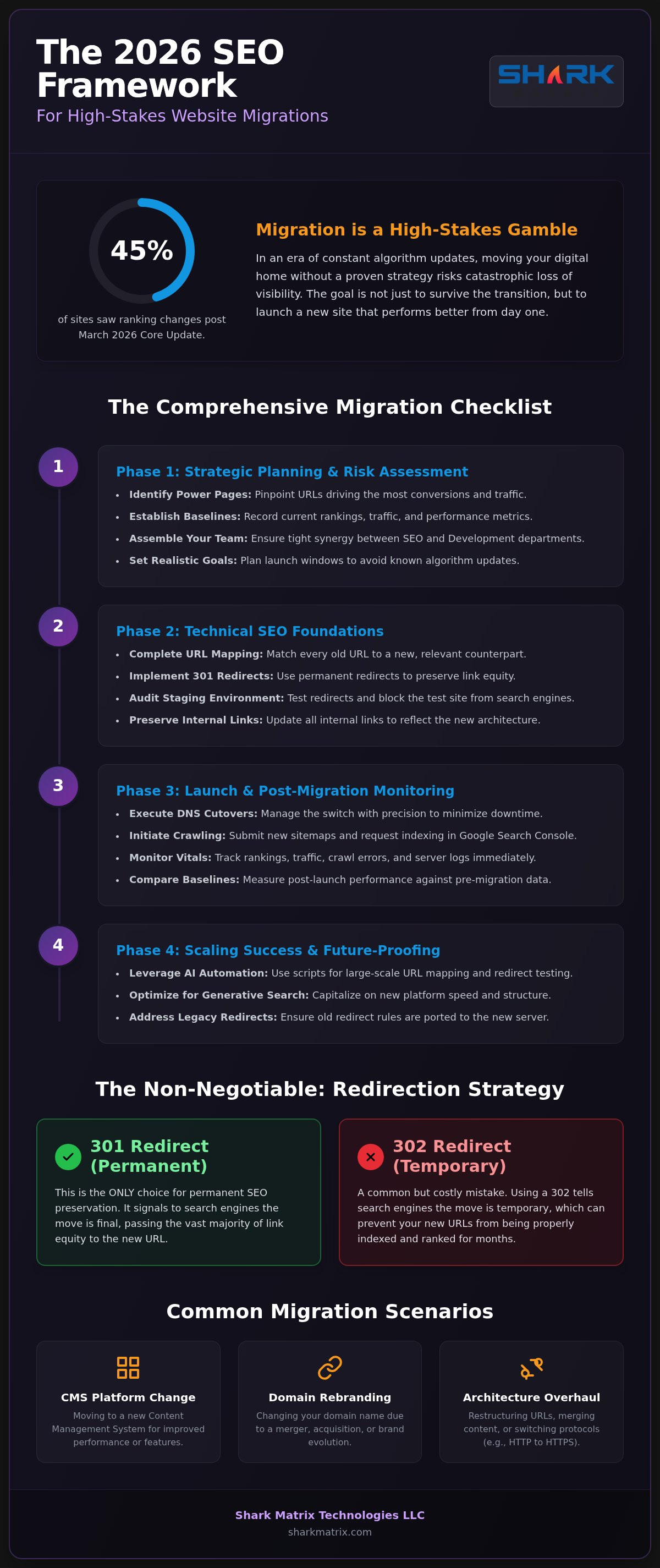
Technical execution is where your strategy meets the server. Precision is everything. Implementing a robust replatforming seo strategy during this phase ensures that your 301 redirect map is more than just a list of links. It is a signal to search engines that your brand authority has a new, permanent home. Without meticulous execution, you aren’t just changing addresses; you’re throwing away years of digital trust. Equity is fragile. A single broken link in a high-authority path can cause a ripple effect that tank rankings across your entire catalog.
Enterprise sites often manage tens of thousands of URLs, making manual mapping a recipe for disaster. Using ai automation services allows for precise, automated matching based on content similarity and metadata. This ensures that users and crawlers always find the most relevant new page. Beyond basic redirects, you must update your Schema.org markup. In 2026, search engines rely on structured data to verify your expertise and trustworthiness (E-E-A-T), especially when generating AI-led answers.
Meticulous URL Mapping and Redirect Chains
Choosing the right mapping approach depends on your scale and resources. While 1-to-1 mapping is the gold standard for preserving equity, it can be resource-intensive for massive catalogs. Category mapping is faster but risks diluting the specific relevance of deep pages. You must also guard against redirect loops and excessive chains. If a crawler has to pass through three or more redirects to find a page, it wastes your crawl budget and slows down the user experience. Don’t forget your assets. Managing redirects for images and PDFs is essential to preserve traffic from visual and document-based searches.
1-to-1 Mapping
- Pros: Full transfer of link equity; best for high-revenue pages.
- Cons: Extremely time-consuming for large sites; high technical overhead.
Category Mapping
- Pros: Rapid execution; simplifies the site structure.
- Cons: Potential loss of specific keyword rankings; less precise for users.
Optimizing for Generative Engine Optimization (GEO)
A successful replatforming seo strategy in 2026 requires a deeper understanding of how AI crawlers digest your site architecture. You must structure data so Large Language Models (LLMs) can easily parse and cite your content. This involves ensuring your new architecture supports fast, semantic content delivery. Integrating natural language processing elements into your new content strategy helps search engines understand the context of your offerings. By aligning your technical structure with these generative search requirements, you position your brand as a primary source for the “answer engines” that now dominate the search landscape.
Phase 3: Launch Day and Post-Launch Stabilization
Launch day is the most critical window for your replatforming seo strategy. It’s the moment months of planning meet the reality of live traffic. You must have a rigid checklist ready to execute the second the DNS switch occurs. First, verify that your robots.txt file isn’t still blocking crawlers from the staging phase. Update your XML sitemaps and submit them to Google Search Console immediately to trigger a re-crawl of your new URL structure. Don’t forget to validate that all tracking codes, including GA4 and GSC verification tags, are firing correctly on the new production environment.
Once the site is live, monitor your server logs in real-time. This allows you to spot and fix 404 errors before they impact your bounce rate or crawl budget. You should also watch the “Index Coverage” report in Search Console for any sudden spikes in excluded pages. Validating Core Web Vitals under a real-world load is also essential. Since 42% of sites still fail the Interaction to Next Paint (INP) metric in 2026, you need to ensure your new platform delivers on its performance promises when thousands of users hit the server at once.
Immediate Post-Launch Technical Checks
Check your canonical tags first. They must point to the new URL structure, not the old legacy paths or the staging subdomain. It’s a common, costly mistake to leave “Noindex” tags active after moving from staging to production. Perform a quick crawl of your top 100 revenue-generating pages to ensure they’re indexable and returning a 200 OK status. Finally, test site speed and mobile-friendliness on the actual production server. Server response times often differ significantly from staging environments; real-world testing is non-negotiable for maintaining ranking stability. To ensure your business platform is built for this level of performance, you can learn more about ProGroup.
Expect some turbulence. Minor ranking fluctuations are normal as search engines re-crawl your new architecture and process your 301 redirects. However, you must distinguish between this “normal” volatility and a catastrophic loss of traffic. If your sessions drop by more than 30% and don’t stabilize within 72 hours, you likely have a technical blockage. Use heatmaps and session recordings to see how users interact with the new interface. UX friction often mimics SEO issues in data reports, as poor engagement signals can negatively impact your rankings. For deeper insights into creating high-performance interfaces that convert, explore our guide on website design and development.
If your post-launch traffic isn’t recovering as expected, our specialists can perform a deep-dive analysis to find the root cause. Reach out to our SEO company to stabilize your organic visibility and protect your revenue.
Future-Proofing Your Migration with Shark Matrix
Shark Matrix stands at the intersection of technical excellence and strategic visibility. Precision matters. While most firms treat migration as either a coding task or a marketing project, we treat it as a unified engineering challenge. A successful replatforming seo strategy requires more than just 301 redirects; it demands a deep understanding of how your new backend infrastructure interacts with search engine crawlers. Since our founding in 2010, we’ve specialized in high-impact migrations that protect your organic equity while modernizing your tech stack.
Our approach integrates ai development services to automate the most complex parts of the transition. Instead of manual mapping that leads to human error, we use machine learning to ensure data integrity across thousands of URLs. We understand the UAE digital landscape and the national-level competition your brand faces. We don’t just help you survive the move. We build the foundation for your brand to dominate in the era of answer engines and generative search.
Custom Software Solutions for Complex Migrations
Enterprise migrations often involve legacy databases that don’t play well with modern SaaS platforms. We build custom middleware to ensure your data syncs perfectly without losing metadata or product history. To maintain customer satisfaction during the switch, we can deploy bespoke ai chatbots to guide users through the new interface. This technical layer ensures that even if your UI changes, your user experience remains seamless. We design scalable infrastructure that can handle the traffic spikes common in the national market, ensuring your site stays fast and responsive under any load.
Your Strategic Partner for Long-Term Growth
Once the technical hurdles are cleared and the redirects are stable, we shift from migration mode to growth mode. Your new platform is a powerful tool; we help you use it. By leveraging data-driven lead generation and advanced SEO management, we turn your high-performance site into a revenue engine. We focus on ongoing optimization that capitalizes on your new site’s speed and semantic structure. This ensures you aren’t just recovering lost ground but actively taking market share from less agile competitors.
Ready to protect your search equity? Schedule a replatforming SEO consultation with Shark Matrix today to start planning your seamless transition.
Dominating the 2026 Search Landscape After Your Move
Replatforming shouldn’t be a period of damage control. It’s a strategic pivot toward a faster, more intelligent digital presence. By prioritizing a deep pre-migration audit and aligning your technical execution with the requirements of modern answer engines, you turn a risky technical chore into a massive competitive advantage. A robust replatforming seo strategy ensures that your brand authority remains intact while your infrastructure evolves to meet the latest performance standards. Success lies in the details of your redirect mapping and the readiness of your schema for generative search.
Shark Matrix provides the technical bridge between custom software engineering and strategic search visibility. Our team brings a proven track record in national-scale website migrations and deep expertise in AI automation. We don’t just move your data; we future-proof your revenue by ensuring your new site is optimized for both users and AI crawlers from the moment it goes live.
Protect your rankings—consult with Shark Matrix for your enterprise replatforming strategy.
The transition to a new platform is a major milestone for any enterprise. With the right planning and a focus on technical precision, your business will emerge stronger, faster, and more visible than ever before.
Frequently Asked Questions
How long does SEO traffic take to recover after replatforming?
Traffic usually stabilizes within 4 to 12 weeks if your technical foundation is solid. Most sites experience minor fluctuations as search engines re-crawl the new architecture and process redirects. If your replatforming seo strategy includes a flawless redirect map, you might see a performance boost shortly after launch. Persistent traffic loss beyond the three month mark usually indicates deeper issues like crawl errors or lost internal link equity that require immediate technical intervention.
Is it possible to replatform without changing any URLs?
You can keep your URLs identical if your new platform supports custom slug structures that match your legacy site. This is often the safest path for SEO because it bypasses the need for 301 redirects entirely. However, many enterprise platforms enforce specific folder hierarchies that make this difficult. When identical URLs aren’t an option, you must prioritize a 1-to-1 redirect strategy to ensure search engines can still find and rank your most valuable content assets.
What is the most common SEO mistake during a website migration?
The most frequent mistake is using catch-all redirects that send all old traffic to the new homepage. This approach erases the specific keyword relevance and authority built into your deep product or service pages. Another critical error involves leaving technical blocks like robots.txt disallow rules or noindex tags active on the live site. These oversights can lead to a total loss of organic visibility within days if they aren’t caught during your immediate post-launch technical checks.
How does replatforming affect my existing backlinks?
Backlinks remain effective as long as a permanent 301 redirect connects the old URL to the new one. These redirects act as a bridge, passing authority and trust signals to the new platform. While redirects are powerful, they aren’t a perfect substitute for a direct link. For your most valuable referral sources, it’s worth contacting the site owners to request a direct update to your new URL, ensuring the fastest possible load times for your visitors.
Should I redesign my website at the same time I replatform?
Should I redesign my website at the same time I replatform?
Redesigning during a migration is a double-edged sword. It allows you to fix UX issues and improve Core Web Vitals, but it makes troubleshooting traffic drops more difficult. If your current design is mobile-friendly and fast, consider a staged approach. However, if your site fails the Interaction to Next Paint metric, a redesign is likely essential for 2026 growth. You can discover ThinkTank Creative to see how professional development can be integrated into your new platform. Just ensure your replatforming seo strategy balances technical migration with these significant on-page and architectural changes.
Multilingual sites require careful management of hreflang tags to ensure search engines serve the correct language version. For the national UAE market, this means mapping English and Arabic pages in pairs to maintain their relationship. Every redirected URL must have its hreflang attributes updated to point to the new structure. Failing to do this can lead to cross-language errors where searchers see the English page when they need the Arabic one, hurting your local conversion rates.
Can AI automation help with the 301 redirect mapping process?
AI automation significantly speeds up the redirect mapping process for enterprise sites with thousands of pages. These tools use natural language processing to match old pages with their most relevant new counterparts based on content and intent. Shark Matrix integrates these automated workflows to eliminate the manual errors that often plague large-scale migrations. This technology ensures that your link equity is preserved accurately, allowing your team to focus on growth rather than fixing thousands of broken links.

 OpenAI
 Codex
Codex
 Vertex AI
 Cloud Vision
 OpenCV
 TensorFlow
 IBM Watson
 Cloud Natural Language
 Cognitive Services
 Bot Framework
 Mistral
 LLama
LLama
 Gemini
 Anthropic
 N8N
N8N