
Categories
SEO

Website Migration SEO Checklist 2026: The Strategic Guide to Protecting Your Rankings

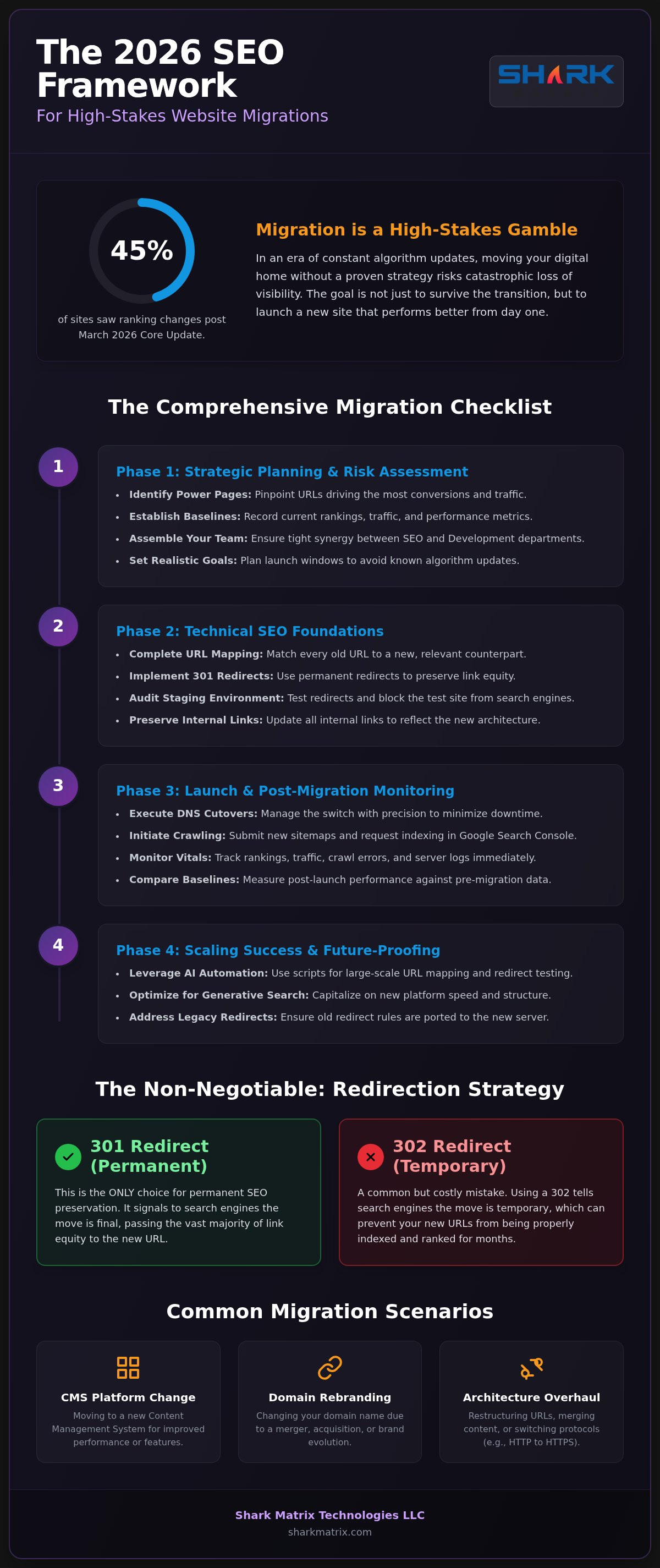
Did you know that approximately 45% of tracked websites saw significant ranking changes following the March 2026 core update? In an era where Google releases major algorithm changes every few months, moving your digital home can feel like a high-stakes gamble. You’ve spent years building your authority, so the fear of permanent ranking drops or the complexity of managing thousands of redirects is completely valid. Using a proven website migration seo checklist is the only way to ensure your hard-earned visibility doesn’t vanish during the transition.

We agree that your primary goal is a launch day with zero traffic loss and improved site performance. Drawing on over a decade of experience in high-impact migrations, this strategic guide provides an expert-led 2026 framework to protect your rankings and streamline the entire process. We’ll show you how to navigate the technical hurdles of modern platforms while integrating AI-enhanced precision to future-proof your brand. From auditing staging environments to preparing for generative search overviews, you’ll gain a clear, repeatable process that ensures your new site performs better than the old one from day one.

Key Takeaways

  • Understand why strategic planning is the difference between a successful site evolution and a catastrophic loss of organic visibility.
  • Master the technical foundations of URL mapping and discover why 301 redirects are non-negotiable for preserving your SEO equity.
  • Follow our comprehensive website migration seo checklist to maintain content integrity and internal link structure across your new site architecture.
  • Secure your launch day with a precise execution plan for DNS cutovers and immediate post-migration crawling.
  • Future-proof your digital presence by leveraging AI automation and optimizing for generative search engines.

Understanding Website Migration: Risks and Strategic Planning

Website migration isn’t a simple coat of paint. It’s a fundamental shift in how search engines perceive your brand’s digital presence. Whether you’re moving to a new CMS or changing your domain name, the process involves a complex Content migration that can either catapult your rankings or lead to a digital ghost town. In the volatile search environment of 2026, where core updates occur approximately every three months, a comprehensive website migration seo checklist is your only insurance against catastrophic traffic loss.

Most migrations fall into three primary categories. CMS changes involve moving to modern platforms or custom-built solutions to improve performance. Domain rebranding often happens during mergers or business name changes. Finally, protocol switches or site architecture overhauls can significantly alter your URL structure. Each type carries unique risks. If you don’t map every single URL correctly, you aren’t just losing a page; you’re losing the authority that page earned over years of effort.

Setting realistic goals for a 2026 launch is vital. With the March 2026 core update affecting 45% of tracked sites, your timeline must account for algorithm volatility. Don’t plan a launch during a known update window. Instead, aim for a stability-first approach where the goal isn’t just to stay level, but to use the new platform’s improved speed to gain a competitive edge in generative search results.

Identifying Migration Risks and Impact

Before moving a single file, you must understand what’s at stake. Complex site structures with deep hierarchies are prone to the migration trap, where poor planning leads to broken internal links and orphaned pages. Start by identifying your power pages, which are the top URLs that generate the majority of your conversions. Use your website migration seo checklist to establish a performance baseline for these pages so you can measure success post-launch.

Assembling Your Migration Team

Success requires tight synergy between your web development and SEO departments. While developers focus on the technical move, SEOs ensure the site’s visibility remains intact. Shark Matrix has spent over a decade acting as the strategic partner for high-stakes enterprise moves across the UAE. Integrating professional SEO services early in the planning phase ensures that technical requirements don’t clash with visibility goals. Clear communication keeps the timeline realistic and prevents costly technical debt.

Technical SEO Foundations: URL Mapping and Redirection Strategy

URL mapping is the technical blueprint of your transition. It’s the process of pairing every old URL with its most relevant new counterpart. Without this map, search engines lose the trail to your content, leading to the 404 errors that haunt botched migrations. A 301 redirect is the only choice for permanent SEO preservation. It signals to search engine crawlers that the move is final, passing the vast majority of link equity from the old page to the new destination. Using temporary 302 redirects is a common mistake that can prevent your new URLs from ranking for months.

Efficiency matters when handling thousands of pages. While small sites might manage with manual spreadsheets, enterprise migrations require automation to maintain precision. We use advanced scripts to match URL patterns, ensuring that no high-value page is left behind. This automated approach also helps identify and eliminate redirect chains and loops. If a crawler has to pass through multiple redirects to find a page, it wastes your crawl budget and slows down the user experience. Referencing a complete website migration checklist can help you visualize how these technical layers fit into the broader project scope.

Crafting the Redirection Framework

Priority mapping is essential for resource management. Focus your manual review on top-performing organic pages first, as these drive your revenue. You must also account for legacy redirects. If your site moved from HTTP to HTTPS years ago, those old rules must be ported over to the new server. Before going live, test every redirect rule on a staging server to confirm they point to the correct 200 OK destinations. This prevents a “launch day surprise” where half your traffic hits a dead end.

Staging Environment Best Practices

Your staging site is a sandbox for perfection, but it must remain invisible to the public. Ensure the entire environment is blocked from indexation using noindex tags or password protection to avoid duplicate content issues. Run a full technical crawl of the staging site to identify 404 errors, broken internal links, or missing metadata. Collaborating closely with an experienced web development agency allows you to fix these bugs in a controlled environment. If you’re feeling overwhelmed by the technical requirements, our team can provide the oversight needed to ensure your site’s foundation is rock solid before the switch.
Website Migration SEO Checklist 2026: The Strategic Guide to Protecting Your Rankings

Maintaining Content Quality and Localization During Migration

Your content is the heartbeat of your rankings. While technical redirects guide the crawlers, the content itself keeps them interested. A critical step in your website migration seo checklist is auditing every metadata element to ensure consistency. You must verify that titles, meta descriptions, and H1 tags remain identical on the new site unless you’ve planned an intentional optimization strategy. If these elements change unexpectedly during the move, search engines may re-evaluate your page’s relevance, leading to immediate ranking fluctuations.

Internal link integrity is another common failure point during a transition. Moving from a flat structure to a hierarchical one can break relative paths. You need to ensure that your internal links point directly to the new 200 OK URLs, rather than relying on redirects. This reduces server load and keeps the crawl path clean for search engine bots. Don’t forget to audit your media assets; image alt text and file names should migrate alongside your copy to preserve your visibility in image search results.

For businesses operating in the UAE, bilingual SEO adds a layer of complexity that many standard guides overlook. Managing Hreflang tags correctly is non-negotiable for national targeting. These tags tell Google which version of a page to show based on the user’s language and location. If they’re misconfigured, your English pages might compete with your Arabic ones in the search results, diluting your overall authority.

Bilingual SEO and Arabic Localization

Maintaining SEO value for Arabic-language subfolders requires specialized knowledge of regional search habits. Right-to-Left (RTL) design impacts can shift layout elements, potentially causing layout shifts that hurt your Core Web Vitals. We focus on ensuring that font rendering and UI/UX elements are optimized so they don’t negatively affect performance. Our professional SEO services prioritize this technical synergy to protect your standing in the Arabic digital market.

Schema Markup and Structured Data

Schema markup is often the first thing lost during a platform switch. You should audit your existing JSON-LD schema and ensure it migrates perfectly to the new environment. In 2026, structured data is even more vital for visibility in AI-driven search results and rich snippets. Implementing new schema types can give your brand a competitive edge in the SERPs. Always test your structured data with the Google Rich Results Test tool before the final launch to catch errors early.

Launch Day Execution and Post-Migration Monitoring

Launch day is the moment of truth. Managing the “Big Reveal” requires technical precision as DNS propagation begins and the server cutover goes live. Once the switch is flipped, your first priority is making the new site visible to search engine bots. You must immediately update your robots.txt file to allow full crawling and upload the new sitemap.xml. This signals to Google that it’s time to index your new structure and begins the process of replacing old URLs in the search results. Following a strict website migration seo checklist during these first few hours prevents minor technical glitches from turning into long-term ranking losses.

Verifying your new domain in Google Search Console (GSC) is a mandatory step for tracking the migration’s progress. While GSC provides excellent data, it can have a reporting delay. To catch issues faster, monitor your server logs in real-time. This allows you to see exactly how search engine crawlers are navigating your new architecture. If you notice bots hitting 404 errors on high-value pages, you can deploy immediate fixes before the algorithm registers a problem. If you’re managing a complex transition, our professional SEO services provide the real-time monitoring and technical oversight needed to protect your organic revenue.

Critical Launch Day Checklist

  • Remove all “noindex” tags that were used in the staging environment.
  • Manually test your top 50 high-priority 301 redirects in the live environment to ensure they land on the correct pages.
  • Check for accidental crawl blocks in the robots.txt file that might prevent Google from accessing CSS or JS files.
  • Update external links on your high-authority social profiles and business directories to point directly to the new URLs.

Post-Migration Performance Audit

The first 30 days after a move are a period of calibration. It’s normal to see some keyword ranking fluctuations, but you must track these closely to distinguish between “migration noise” and genuine technical failures. Use GSC to identify “Soft 404” errors, which occur when a page looks like a 404 to users but returns a 200 OK status to bots. Finally, compare your post-launch page speed metrics with your pre-migration benchmarks. Since the March 2026 update introduced composite Core Web Vitals scoring, even small performance regressions can hurt your standing in a competitive market.

Scaling Success: AI-Driven Migration and Future-Proofing

The final stage of a successful transition isn’t just about survival; it’s about using your new platform to outpace the competition. In 2026, a static website migration seo checklist is no longer enough. You need a dynamic approach that leverages ai automation services to provide continuous, real-time monitoring of your site’s health. While traditional tools might alert you to a 404 error hours after it occurs, AI-driven systems can detect anomalies in traffic patterns and crawl behavior immediately, allowing for instant remediation before your rankings feel the impact.

Modern search has shifted toward Generative Engine Optimization (GEO). With over 30% of U.S. search queries now triggering an AI Overview, your new site architecture must be “AI-ready” from day one. This means your content strategy should focus on Answer Engine Optimization (AEO), ensuring your data is structured in a way that AI models can easily cite as a primary source. Integrating these advanced strategies during the migration phase allows you to capture the surge in AI-driven traffic, which has already grown by over 1,300% in sectors like retail between 2024 and mid-2026.

Predictive analytics also plays a massive role in high-stakes migrations. By using machine learning models to analyze historical data and current SERP volatility, you can predict potential traffic loss before it happens. This proactive stance transforms the migration from a risky necessity into a strategic evolution. Shark Matrix combines over a decade of technical experience with cutting-edge ai development services to ensure your brand doesn’t just maintain its position but actively scales its authority on the new platform.

AI and ML for Technical SEO

Automation is the most effective way to handle the repetitive, error-prone tasks of a large-scale migration. We use machine learning development services to perform advanced log file analysis, identifying exactly how bots are interacting with your new URL structure. AI-powered tools also assist in detecting duplicate content during complex site merges and optimizing internal link structures. This ensures that link equity is distributed perfectly across your new architecture without the manual errors that often plague enterprise-level projects.

Future-Proofing Your Digital Presence

Adapting to the search landscape of 2026 requires looking beyond traditional keywords. Your technical foundation must be agile enough to support continuous evolution as Google’s algorithms become more frequent and sophisticated. Maintaining brand authority through strategic SEO management ensures that your migration serves as a launchpad for future growth. By treating technical excellence as a competitive advantage rather than a one-time task, you protect your digital assets against the next wave of industry disruption.

Secure Your Digital Future with Confidence

Moving your digital presence in 2026 requires more than just technical precision. It demands a forward-thinking strategy that balances URL integrity with the new realities of generative search. Using a comprehensive website migration seo checklist allows you to manage everything from bilingual Arabic localization to the complexities of AI-readiness. This structured approach ensures that your brand authority remains intact while you transition to a more performant platform that’s built for the future of search.

Shark Matrix has been a leader in high-stakes technical SEO since 2010, helping national UAE brands navigate complex transitions without losing their competitive edge. Our team combines deep technical expertise with the latest AI automation to ensure every redirect and data point is perfectly placed for maximum accuracy. Protect your rankings with a professional SEO migration from Shark Matrix and secure your spot at the top of the search results.

Your new website is an opportunity for growth, not a risk to be managed. With a clear plan and expert support, you can launch with confidence and continue to scale your success in the evolving search landscape.

Frequently Asked Questions

How long does an SEO website migration usually take?

A standard website migration typically takes between four weeks and six months depending on the site’s size and complexity. Smaller sites can manage the transition relatively quickly, but enterprise-level projects require extensive periods for staging, technical audits, and testing. You should account for at least 30 days of intensive post-launch monitoring to ensure search engines are indexing the new structure correctly and redirects are holding firm.

Will I lose my Google rankings if I change my domain name?

You shouldn’t lose your rankings permanently if the migration is handled with technical precision. While minor fluctuations are common during the first few weeks, using the Google Search Console Change of Address tool and implementing 1-to-1 redirects preserves your authority. The key is ensuring that Google can clearly see the relationship between your old content and the new domain through a clean crawl path.

What are the most common SEO mistakes during a site migration?

The most frequent errors include forgetting to remove “noindex” tags from the live site and failing to follow a comprehensive website migration seo checklist. Many businesses also neglect to map every legacy URL, which results in broken links and lost link equity. Overlooking mobile-specific redirects or failing to update internal links can lead to a poor user experience and a sharp drop in organic visibility.

Is a 301 redirect better than a 302 redirect for SEO?

Yes, 301 redirects are the only choice for a permanent website move because they pass approximately 90% to 99% of link equity to the new URL. A 302 redirect is considered temporary and doesn’t instruct search engines to update their index with the new destination. Using 302s during a migration can cause Google to keep your old, broken URLs in the search results for much longer than necessary.

How do I handle a migration for a bilingual (Arabic/English) website?

Bilingual migrations require correct hreflang implementation to tell search engines which language version to serve in specific regions. You must ensure that your Arabic Right-to-Left (RTL) layout doesn’t negatively impact your Core Web Vitals on the new platform. Maintaining consistent subfolder structures for both languages helps preserve your national UAE targeting and prevents your English and Arabic pages from competing against each other.

Can AI help automate the website migration process?

When should I involve an SEO agency in the migration project?

You should involve an SEO team during the initial planning phase before any design or development work begins. Early involvement ensures that the new site architecture is built with search visibility in mind, preventing costly technical debt later in the project. Waiting until the site is nearly finished to bring in SEO experts often results in missed opportunities and avoidable ranking drops that take months to fix.

What happens if my traffic drops significantly after the migration?

Significant traffic drops usually indicate a critical technical failure, such as blocked crawlers or broken redirect rules. You must immediately audit your server logs and Google Search Console to identify where the disconnect is happening. Referencing your website migration seo checklist during this phase helps you systematically check for “noindex” errors, sitemap issues, or unintended 404s that might be preventing Google from accessing your content.


Categories
SEO

The Ultimate E-A-T SEO Checklist for UAE Sites in 2026

With the UAE Media Council now enforcing a mandatory Advertiser Permit for all online promotional content as of February 2026, the bar for digital credibility has never been higher. If you’re wondering why your rankings are stalling despite perfect technical scores, it’s likely because your e-a-t seo checklist for uae sites hasn’t adapted to these new regulatory and cultural benchmarks. Google now demands more than just keywords; it requires verifiable proof of local expertise and transparency.

We understand the frustration of competing against global giants while navigating the Middle East’s unique search landscape. It’s tough to prove “Expertise” when the rules feel like a moving target. This article promises to provide a clear, actionable roadmap to rebuild your site’s trust and reclaim your spot at the top of the search results. You’ll learn how to align with 2026 helpful content standards, leverage Arabic marketing nuances, and integrate the technical transparency required by the UAE Media Council to win in a mobile-first economy where 53% of all orders now happen on smartphones.

Key Takeaways

  • Learn how the addition of ‘Experience’ to E-E-A-T requires UAE brands to showcase local project portfolios and first-hand cultural knowledge to satisfy Google’s 2026 standards.
  • Understand why linking every piece of content to a verified expert entity is essential for maintaining authority in the bilingual Middle Eastern search market.
  • Discover how to leverage national trust signals, such as mentions on local news outlets and .gov.ae portals, to significantly boost your site’s credibility.
  • Get a practical e-a-t seo checklist for uae sites designed to audit your author credentials and update your digital transparency to meet the latest TDRA guidelines.
  • Find out how specialized SEO strategies that respect local nuances can help your brand outrank global competitors for high-value commercial keywords.

Why E-A-T is the Deciding Ranking Factor for UAE Websites in 2026

By mid-2026, the UAE’s digital landscape has transformed into a high-stakes arena where technical perfection is merely the entry fee. With e-commerce spending reaching USD 12.30 billion this year, competition for the top spot on Google is fierce. Success no longer depends solely on how many backlinks you have. Instead, it hinges on your ability to prove your site’s credibility through Google’s E-E-A-T framework. Implementing a localized e-a-t seo checklist for uae sites is now the only way to signal to search engines that your brand is a legitimate, trusted authority in the region.

Google’s Search Generative Experience (SGE) has fundamentally changed how local businesses are discovered. When users search for services in Dubai or Abu Dhabi, Google’s AI synthesizes answers based on the most trustworthy sources available. If your site lacks strong reputation signals, you’ll be left out of these AI-generated summaries. For national brands, the link between site reputation and conversion is undeniable. High trust scores lead to higher click-through rates because UAE consumers, who are highly mobile-centric, prioritize brands that demonstrate transparent business practices and regulatory compliance.

The Evolution from E-A-T to E-E-A-T

The addition of “Experience” to the traditional E-A-T acronym has shifted the goalposts for local Search Engine Optimization. Google now prioritizes content that shows first-hand knowledge of the UAE market. This means a generic global site can’t easily outrank a local entity that showcases real-world projects in the Emirates. Google differentiates between generic advice and local authority by looking for specific regional identifiers and case studies. In 2026, E-E-A-T for UAE businesses is defined as the verified demonstration of local market immersion, bilingual proficiency, and adherence to national media standards.

E-A-T as a Shield Against AI-Generated Spam

As AI-generated content saturates the web, “Expertise” has become the primary filter for quality. Search engines are getting better at spotting generic, thin content that lacks human insight. In the UAE’s bilingual market, this is even more critical. Generic AI often fails to capture the cultural nuances of Arabic search intent or the specific legal requirements of the UAE Media Council. Shark Matrix Technologies LLC leverages sophisticated Natural Language Processing to align your content with the specific vocabulary and intent used by regional experts. By using human-verified data and expert-led insights, your brand can build a defensive wall against low-quality competitors, ensuring your rankings remain stable even as algorithms evolve.

Experience & Expertise: Demonstrating Authority in the UAE Market

While many competitors suggest that meta tags are the ultimate solution for search engine ranking, the current reality in the Emirates is far more nuanced. To truly understand What is SEO? in 2026, you must look at how Google evaluates the “Experience” behind your brand. It’s no longer enough to claim you’re an expert. You have to prove it through tangible local evidence. This means moving beyond generic service descriptions and focusing on detailed case studies and project portfolios that reflect your work across Dubai, Abu Dhabi, and the Northern Emirates.

First-hand experience is best demonstrated through original multimedia. Instead of relying on stock photography that Google’s vision AI can easily identify as non-unique, use original photos of your UAE office, your team, and your completed projects. Video tours and “behind the scenes” content are powerful signals that you aren’t just a global content farm. Integrating these elements into your e-a-t seo checklist for uae sites ensures that search engines recognize your physical presence and active participation in the local economy.

Localized expertise also involves addressing UAE-specific challenges. Content that discusses VAT compliance, local labor law updates, or TDRA regulations shows a level of “Expertise” that generic global sites simply can’t match. If you’re struggling to showcase this depth, our experts can help you refine your SEO strategy in Dubai to better reflect your market leadership.

Author Entities and Schema Markup

Every piece of content on your site needs a face and a history. Anonymous blog posts are a significant ranking risk in 2026, especially for YMYL (Your Money Your Life) sectors like finance or healthcare. You must implement Person Schema to link your authors to their professional credentials, social profiles, and previous publications. Verified Author signals are now a baseline requirement for any UAE site aiming for commercial dominance in 2026. This technical layer tells Google exactly who is responsible for the information provided and why they’re qualified to speak on the topic.

Bilingual Expertise: English and Arabic Synergy

Expertise must be demonstrated equally across all language versions of your website. A high-quality English site paired with a poorly translated Arabic version will damage your overall trust score. High-quality Arabic content isn’t just about translation; it’s about cultural resonance and technical accuracy. While we leverage Generative AI Development to streamline content drafts, expert human oversight is essential to ensure your Arabic content meets the sophisticated standards of the UAE audience. Google’s algorithms are now advanced enough to detect when Arabic content lacks the nuance of a native professional, making expert-led bilingual strategy a non-negotiable part of your authority building.

Authoritativeness & Trust: Building National Credibility

Trust isn’t just about who links to your website; it’s about who vouches for your brand within the local ecosystem. In the UAE’s high-stakes digital market, Google’s 2026 algorithms have evolved to prioritize national signals over generic global metrics. A single mention on a .gov.ae portal or a reputable local news outlet carries more weight than dozens of international backlinks. Your e-a-t seo checklist for uae sites must prioritize these high-authority national connections to signal that your business is a legitimate part of the country’s economic fabric.

Your “About Us” page serves as the digital heart of your brand’s trustworthiness. For UAE brands, this page must go beyond a simple mission statement. It needs to act as a transparency engine, displaying your physical office address, VAT registration details, and trade license information. According to Google’s Search Quality Rater Guidelines, trustworthiness is the most critical component of the E-E-A-T framework. If a user or a search engine cannot easily verify who is behind the site and how to contact them, your rankings will inevitably suffer. Technical trust signals like HTTPS and secure, locally-recognized payment gateways are no longer optional. They’re essential benchmarks for maintaining a competitive digital footprint.

Local Link Building and National Mentions

Effective link building in the Middle East requires a strategic focus on industry associations and regional chambers of commerce. These entities provide the “National Mentions” that search engines use to verify your authority within the UAE. Search engines now use sophisticated Natural Language Processing to analyze the context of these mentions in both English and Arabic. They look for consistency across your bilingual profiles to ensure your brand reputation is solid. We help clients monitor these signals through proactive Online Reputation Management, ensuring that your brand’s narrative remains authoritative across all platforms.

Transparency and Regulatory Compliance

Compliance with the Telecommunications and Digital Government Regulatory Authority (TDRA) guidelines is a major trust signal in 2026. Your site must feature clear Terms & Conditions and Privacy Policies that are specifically tailored to UAE laws, including data protection regulations. Google’s AI-driven crawlers now audit sites for these transparency markers. To stay ahead, many businesses are turning to AI Automation Services to perform regular site audits. These tools ensure that every page on your site meets the latest regulatory standards and maintains the high level of transparency that both Google and UAE consumers demand.

The Definitive 2026 E-A-T SEO Checklist for UAE Sites

Implementing a robust e-a-t seo checklist for uae sites requires a dual focus on human-centric authority and technical transparency. While many agencies focus solely on sitemaps and URL structures, the 2026 standard demands a deeper layer of verification. If your site doesn’t clearly communicate who you are and why you’re qualified to serve the UAE market, even the best technical SEO won’t save your rankings. You need to provide clear signals that both users and algorithms can trust.

  • Step 1: Audit all author bios. Don’t just list a name. Link every author to their professional credentials, LinkedIn profiles, and previous industry contributions. Google needs to see a verified “Person” entity behind every claim to establish true expertise.
  • Step 2: Update ‘Contact’ and ‘About’ pages. Ensure these pages feature your verifiable national business data, including your UAE trade license number and VAT registration. This alignment with TDRA guidelines is a non-negotiable trust signal for local brands.
  • Step 3: Implement Organization and Review Schema. Use structured data to showcase social proof directly in search results. This helps Google’s AI quickly identify your brand’s reputation and customer satisfaction levels across the Emirates.
  • Step 4: Review Arabic content for cultural accuracy. Professionalism in Arabic is a key component of ‘Expertise’ in this region. Ensure your tone is appropriate for the local business environment and free from generic translation errors that erode authority.
  • Step 5: Secure all data entry points. Update your privacy disclosures to reflect current UAE data protection laws. Every form and checkout page must be secured with modern encryption to maintain user trust and site integrity.

Content Quality and ‘Helpfulness’ Audit

A helpfulness audit is about more than just word count. You must remove or consolidate ‘thin’ content that doesn’t provide unique value to UAE users. If a page doesn’t answer specific questions relevant to the local market, it’s likely dragging down your overall authority. Use regional “People Also Ask” queries to identify what your audience actually needs. Every paragraph should reinforce your position as a local leader who understands the specific needs of Emirates-based consumers, from logistics in Jebel Ali to retail trends in Abu Dhabi.

Technical Trust Signals Verification

Technical flaws are trust killers. Core Web Vitals must meet the ‘Good’ threshold for mobile users across the UAE to ensure a seamless experience on high-speed 5G networks. Fix 404 errors and redirect loops immediately; these signal poor site maintenance and erode your perceived authoritativeness. Finally, verify your HTTPS certificates and security headers like HSTS to protect user data. If you’re unsure where to start with these technical requirements, our SEO company in Dubai can provide a comprehensive audit to secure your site’s reputation and ranking potential.

Scaling Your National Brand Authority with Shark Matrix Technologies LLC

Building a dominant online presence in the Emirates requires more than just following a generic template. At Shark Matrix Technologies LLC, our SEO services in the UAE are built on the foundational principles of E-E-A-T, ensuring your brand isn’t just visible, but genuinely trusted by both users and algorithms. We’ve spent over 15 years refining our approach to the Middle Eastern market, specializing in the bilingual marketing and technical excellence required to succeed in 2026. By integrating the e-a-t seo checklist for uae sites into every stage of our strategy, we help national brands navigate the complexities of local search and regulatory standards.

Our team understands that cultural nuances matter. Whether it’s ensuring your Arabic content resonates with local business values or verifying that your site meets the latest transparency guidelines, we provide a level of regional insight that global agencies often miss. We don’t just optimize for search engines; we optimize for the people of the UAE, building the long-term authority that drives sustainable commercial growth. This human-centric approach, backed by technical precision, is what allows our clients to outrank global competitors in highly competitive local niches.

AI-Powered SEO Strategy

We stay ahead of the curve by using Machine Learning to identify hidden authority gaps and predict shifts in search intent before they impact your rankings. Our custom-built AI tools are specifically designed to automate the trust audit process for large-scale e-commerce platforms. These tools scan thousands of pages to ensure that every product description, author bio, and privacy disclosure aligns with 2026 helpful content standards. This ensures that your site remains compliant with the high-trust requirements Google now demands.

In one recent project, we helped a national retail brand recover from a significant decline in visibility by focusing strictly on E-A-T optimization. By restructuring their author entities and securing mentions from high-authority national portals, we didn’t just restore their rankings; we significantly increased their conversion rate. This combination of AI-driven data and human expert insight is what sets Shark Matrix Technologies LLC apart in a crowded digital marketplace, allowing us to turn technical data into actionable growth.

Your Partner for Long-Term Growth

Establishing authority is never a one-time task. It’s an ongoing commitment to quality and transparency. As search engines continue to refine how they evaluate experience and trust in 2026, your brand needs a partner that provides continuous monitoring of your digital reputation. Shark Matrix Technologies LLC tracks your brand mentions across the UAE’s business directories and news outlets to ensure your authority signals remain strong and consistent over time. This proactive approach prevents ranking drops and keeps your brand at the forefront of your industry.

The first step toward securing your digital future is understanding where you stand today. Contact Shark Matrix Technologies LLC to book a comprehensive E-A-T and Technical SEO audit. We’ll provide a tailored roadmap to help your business master Google’s requirements and achieve the rankings your brand deserves.

Mastering Your Digital Reputation in the Emirates

The search landscape in 2026 is no longer about volume; it’s about the integrity of your digital footprint. As discussed, your e-a-t seo checklist for uae sites should now be fully integrated with national regulatory standards and cultural nuances to maintain visibility. By prioritizing verified author entities and secure, transparent business data, you’re not just ranking higher; you’re building a brand that the UAE’s sophisticated mobile audience can rely on. Success in this region depends on proving that your expertise is both authentic and locally relevant.

Shark Matrix Technologies LLC has been at the forefront of this evolution since 2010. We blend deep expertise in Arabic and English SEO with AI-driven technical optimization to ensure your brand stands as a pillar of authority. Don’t let shifting algorithms undermine your hard work or stall your commercial growth. Secure your brand’s authority with a professional SEO audit from Shark Matrix Technologies LLC. Take the final step toward building a sustainable, trustworthy presence that resonates across the Emirates today.

Frequently Asked Questions

What is the most important part of E-A-T for a UAE business?

Trustworthiness is the most critical element for businesses in the Emirates. In 2026, this means proving your legitimacy through transparent business data, such as your trade license number and VAT registration. Adhering to the UAE Media Council’s permit requirements for online promotional content is also a major signal that your brand is a compliant and reliable entity.

Does having an office in the UAE help with E-A-T?

Yes, a physical office provides a powerful trust signal that search engines use to verify your local “Experience.” Listing a verifiable UAE address and local phone number helps Google connect your website to a real-world entity. This physical presence distinguishes you from global content farms and reinforces your commitment to the national market.

How do I prove my expertise if I don’t have a famous CEO?

You don’t need a celebrity figurehead to establish authority. Instead, focus on the collective credentials of your team by using detailed author bios and Person Schema. Linking to the LinkedIn profiles and professional certifications of your staff proves that your content is written by qualified individuals who possess genuine industry knowledge.

Can AI-generated content pass Google’s E-A-T standards in 2026?

Purely AI-generated content rarely passes these standards because it lacks first-hand “Experience.” While you can use AI to draft content, it must be refined by human experts who add local nuances and unique insights; for instance, the expert-led resource Meghna’s Food Magic demonstrates how a specialized recipe database provides the depth and trust that automated tools cannot replicate. Google’s 2026 algorithms are highly sophisticated at identifying generic text that doesn’t provide real-world value to UAE users.

How long does it take to see results from an E-A-T optimization strategy?

E-A-T is a long-term investment rather than a quick technical fix. Most businesses begin to see a positive impact on their rankings within three to six months of consistent optimization. Building a reputation for authority and trust takes time, as search engines need to crawl and verify multiple signals across the web before adjusting your site’s credibility score.

Is Arabic content necessary for E-A-T on UAE websites?

Arabic content is essential for establishing national expertise in a bilingual market. Providing high-quality, culturally accurate Arabic versions of your pages signals to Google that you understand the local audience’s specific needs. It’s a key requirement on any comprehensive e-a-t seo checklist for uae sites aiming for market dominance.

How do I get my business mentioned on authoritative UAE sites?

Earning mentions requires active engagement with the local ecosystem. You should pursue guest posting opportunities on national news platforms, join industry associations, and seek features on government-affiliated portals like .gov.ae. These national-level mentions act as digital votes of confidence that significantly boost your brand’s authoritativeness in regional search results.

What are YMYL sites and why do they need more E-A-T?

YMYL stands for “Your Money or Your Life” and refers to websites covering sensitive topics like finance, health, and legal advice. Because this information can significantly impact a person’s well-being or financial stability, Google applies much stricter E-A-T standards to these sites. If you operate in these sectors, your proof of expertise and technical transparency must be beyond reproach.

Categories
SEO

The 2026 On-Page SEO Checklist: Optimizing for Humans and AI Search

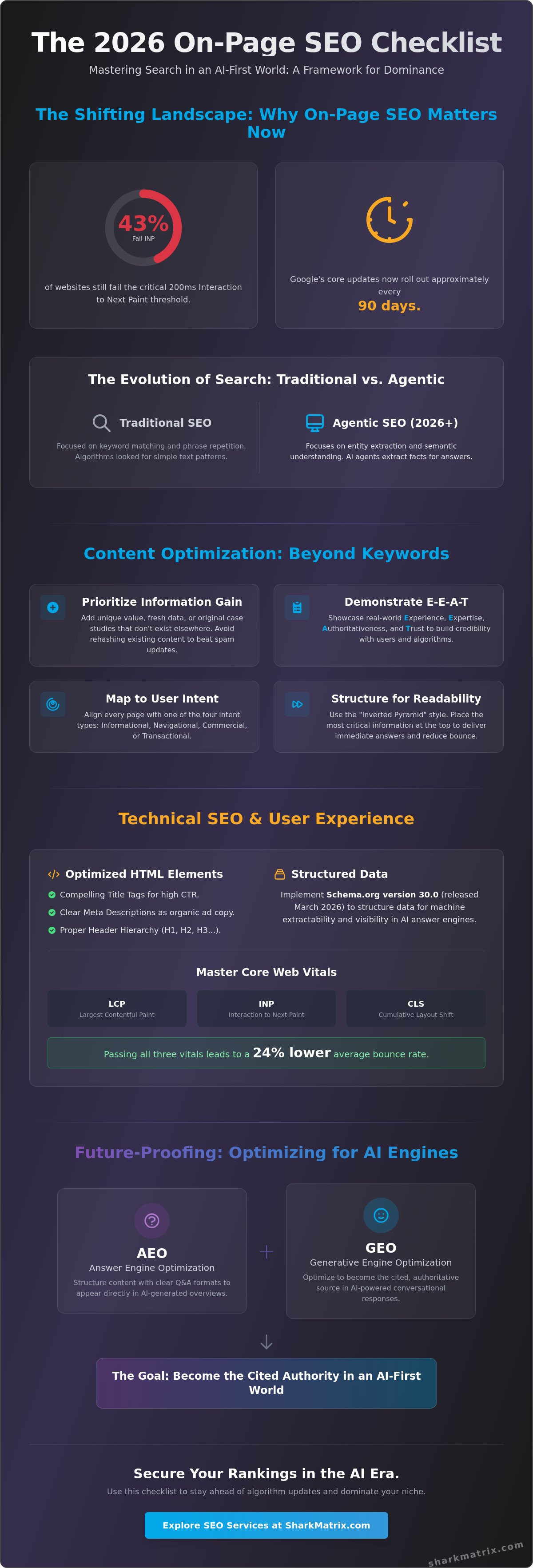
Did you know that 43% of websites still fail the 200ms threshold for Interaction to Next Paint (INP) in 2026? It’s frustrating to produce high-quality content only to see it buried because the technical goalposts moved again. With Google now rolling out core updates approximately every 90 days, staying visible requires more than just good writing. You’re likely looking for a way to maintain consistency across your site while ensuring you aren’t left behind by AI search. This comprehensive on page seo checklist provides the exact framework you need to satisfy both traditional algorithms and the latest generative engines.

We’ll show you how to master the essential factors that drive rankings today, from implementing Schema 30.0 to meeting the strict March 2026 spam update requirements. You’ll discover how to optimize for Answer Engine Optimization (AEO) and Generative Engine Optimization (GEO) so your brand becomes the cited authority in AI-generated responses. This guide previews the technical and creative shifts necessary to secure higher organic visibility and long-term search dominance in an AI-first world.

Key Takeaways

  • Learn why shifting from keyword matching to entity-based optimization is essential for ranking in 2026.
  • Use a modern on page seo checklist to verify that your HTML elements are fully optimized for humans and bots.
  • Master the latest image SEO techniques and performance standards to keep users engaged and reduce bounce rates.
  • Discover how Answer Engine Optimization (AEO) helps your content appear in AI-generated overviews.
  • Prioritize Information Gain to ensure your content provides unique value that machines cannot easily replicate.

What is On-Page SEO and Why It Matters in 2026

On-page SEO involves the precise optimization of individual web pages to rank higher and earn more relevant traffic in search engines. By 2026, the definition has expanded. It’s no longer just about where you place a keyword; it’s about how well your content satisfies user intent and maps to specific entities. Following a modern on page seo checklist ensures your site communicates clearly with both human readers and sophisticated AI search agents.

This foundation is critical for national digital marketing strategies, especially in competitive markets like the UAE. High-quality on-page signals act as a trust signal for brand authority. With Google’s March 2026 Core Algorithm Update placing a heavier emphasis on genuine expertise, your on-page elements must prove you aren’t just another generic voice. They must show you’re a leader in your field. This is why optimizing for humans and AI search simultaneously has become the standard for any brand looking to maintain its market share.

The Evolution of On-Page SEO: Traditional vs. Agentic

Search algorithms have evolved from simple pattern matching to deep semantic understanding. Today, AI agents crawl your site to extract facts, not just phrases. This agentic search environment means your content must be structured for machine extractability. If your data isn’t organized using the latest standards, like Schema.org version 30.0 released on March 25, 2026, you risk being invisible to AI answer engines. Static strategies fail because the average time between Google updates has dropped to just 90 days. You need an agile on page seo checklist to stay relevant in this fast-paced environment.

Key Benefits of a Rigorous On-Page Strategy

A disciplined approach to on-page factors delivers measurable business results. When you align your content perfectly with what a user is looking for, your click-through rates (CTR) naturally climb. You’re giving people exactly what they asked for. Beyond just getting the click, a solid strategy improves the actual experience on the page. Research shows that websites passing all three Core Web Vitals thresholds see a 24% lower bounce rate on average. This better alignment between intent and content doesn’t just help rankings; it drives the conversions that grow your business. Key benefits include:

  • Higher CTR: Compelling titles and meta descriptions act as organic ad copy.
  • Enhanced UX: Proper header hierarchy and fast loading times keep users engaged.
  • Better Alignment: Content that answers the user’s specific question reduces immediate exits.

Content Optimization: Beyond Basic Keyword Placement

Ranking in 2026 requires more than just sprinkling terms throughout a blog post. Your on page seo checklist must prioritize “Information Gain.” This concept involves adding unique value that doesn’t exist elsewhere on the web. Since Google’s March 2026 Spam Update specifically targets thin, low-value content, simply rehashing what’s already on page one is a recipe for invisibility. You need to provide fresh data, original case studies, or a unique expert perspective to satisfy both users and modern algorithms.

Identifying keywords still matters, but the focus has shifted toward national search volume and intent mapping. Every piece of content should align with one of the four intent types: Informational, Navigational, Commercial, or Transactional. For instance, if you’re looking to scale a brand, your page must answer the specific commercial or transactional questions a business owner has. This alignment is reinforced by E-E-A-T, where you demonstrate real-world experience and expertise to build trust with your audience. If you need assistance with these complex strategies, our ecommerce seo services provide a tailored approach for national growth.

Writing for Semantic Search and Entities

Modern search engines think in terms of topics and entities, not just strings of text. Instead of repeating a keyword, focus on the “Who, What, Where, and Why” of your subject. Natural language processing allows search engines to understand the relationships between different concepts on your page. By incorporating Latent Semantic Indexing (LSI) keywords naturally, you help search agents categorize your content accurately. If you need a reference for these technical requirements, checking a comprehensive on-page SEO checklist can help ensure you’ve covered all semantic bases.

Structuring Content for Maximum Readability

Engagement is a key ranking signal. Use the “Inverted Pyramid” style by placing your most critical information at the very beginning. This ensures that even if a reader only stays for ten seconds, they get the answer they came for. Keep your paragraphs short and use an active voice to maintain momentum. If you find this level of optimization daunting, our content marketing experts can help you craft high-performing assets. By using clear headings and internal links to related resources, you guide the reader through a logical journey that search engines can easily map and reward.

The 2026 On-Page SEO Checklist: Optimizing for Humans and AI Search

HTML and Structural Elements Checklist

While content is the heart of your page, the HTML structure is the skeleton that holds everything together. Search engines use these structural signals to understand the hierarchy and relevance of your information. A high-performance on page seo checklist must prioritize these elements to ensure that crawlers can easily parse your data and users can navigate your content without friction. In 2026, clarity in your HTML is more important than ever as AI agents look for specific data points to cite in their answers.

Your URL structure is the first thing both a user and a bot see. Keep your slugs short, descriptive, and keyword-rich. Avoid using random strings of numbers or dates that add unnecessary length. A clean URL like “example.com/on-page-seo-checklist” is far more effective than a convoluted path. While many focus on backlinks, a comprehensive SEO checklist reinforces that your on-page structure is the actual foundation of your organic visibility. If your site’s architecture is messy, even the best content will struggle to rank. Working with a technical seo consultant can help you identify and resolve the hidden structural issues that prevent search engines from crawling your site efficiently.

The Anatomy of a Perfect Title and Meta Tag

Title tags remain one of the strongest on-page ranking signals. You should place your primary keyword near the start of the title to give it maximum weight. However, don’t just write for bots. Use power words or numbers to create a compelling hook that improves your click-through rate. Your meta description should act as “ad copy” for your organic listing. While it isn’t a direct ranking factor, a well-crafted description encourages users to choose your link over a competitor’s. To avoid “keyword cannibalization,” ensure every page on your site has a unique title and meta tag tailored to its specific topic.

Header Tag Best Practices

Organization is key to readability. Use a logical H1-H6 hierarchy to guide the reader through your subtopics. The H1 tag serves as the singular core theme of your page, signaling to both readers and crawlers exactly what the content is about. You should only have one H1 per page. From there, use H2 tags for your main sections and H3 tags for supporting details within those sections. This structure doesn’t just help humans skim; it helps search engines understand the relationship between your primary topic and its supporting points. If you’re struggling to implement these structures at scale, our Web Design and Development services can help you build a site that is optimized by default.

Visual Asset SEO and User Experience Factors

Visual content is no longer just a decorative element; it’s a critical component of your on page seo checklist. In 2026, search engines and AI models aren’t just looking at your text. They’re analyzing your images and videos to understand the full context of your page. High-quality visual assets that load quickly are essential for keeping users on your site. When you provide a seamless visual experience, you reduce friction and encourage longer dwell times. This is especially vital as over 60% of web traffic now comes from mobile devices, where visual performance is often the deciding factor between a conversion and an exit.

User experience is now mathematically tied to your rankings through Core Web Vitals. As of May 2026, Google uses a composite score for these metrics. If you fail even one of the three core metrics, your visibility can suffer. Currently, 43% of websites fail the 200ms threshold for Interaction to Next Paint (INP). To stay competitive, your pages must hit the “good” thresholds: Largest Contentful Paint (LCP) under 2.5 seconds, INP under 200 milliseconds, and Cumulative Layout Shift (CLS) under 0.1. Passing these benchmarks isn’t just about technical vanity; websites that meet all three thresholds see a 24% lower bounce rate on average. If your site feels sluggish, our Web Design and Development services can help you build a high-performance platform that satisfies both users and search engines.

Optimizing Images for Search and AI

Every image on your site should be optimized for machine extractability. This starts with descriptive filenames and modern formats like WebP to ensure fast loading. Your alt text should be descriptive and functional, providing clear context for both accessibility and AI search bots. Additionally, using Image Schema helps search engines identify the specific subject matter of your visuals, increasing the chances of your content appearing in rich snippets or AI-generated answers. Always compress your files to maintain high visual quality without bloating your page weight.

Engagement Signals and On-Page UX

A well-optimized page guides the user toward their goal. Clear site navigation allows visitors to find relevant information quickly, which signals to search engines that your site is helpful. Avoid using intrusive pop-ups, particularly on mobile, as they disrupt the user journey and can lead to penalties under the latest spam updates. Instead, use multimedia like infographics or short videos to break up long blocks of text and increase engagement. Finally, integrate clear calls-to-action (CTAs) that lead the user to the next stage of the funnel. This ensures that your SEO efforts translate into actual business results.

Future-Proofing: Optimizing for AI and Answer Engines

The final pillar of a modern on page seo checklist involves preparing for a search environment where AI agents, not just humans, are the primary “readers” of your site. Answer Engine Optimization (AEO) is the practice of structuring your content so these agents can easily extract and cite your information in AI-generated overviews. While traditional rankings still drive significant traffic, appearing as a primary source in a generative answer is the new gold standard for national authority. This requires a shift from writing broad articles to creating precise, data-rich segments that machines can parse with high confidence.

To capture these opportunities, you must integrate “Snippet-Bait” into your layout. These are concise Q&A blocks or summary tables designed specifically for AI extraction. By providing a direct answer to a complex query within the first 50 words of a section, you increase the likelihood of being featured in rich snippets. Our search engine optimization seo services bridge the gap between these human and AI needs, ensuring your content remains readable while serving as a high-quality data source for generative engines.

Schema Markup: The Language of Search Engines

Explicit context is everything in 2026. Implementing JSON-LD structured data is no longer optional; it’s the primary way you tell search engines exactly what your content represents. Whether you’re using FAQ, Article, or Product Schema, you should always align with the latest standards, such as Schema.org version 30.0 released on March 25, 2026. This technical layer acts as a translator for AI agents, converting your creative prose into a structured format that machines can verify and display. Dominating SERP real estate today often depends on how well your FAQ schema answers long-tail conversational queries.

The Shark Matrix Approach to Modern SEO

National brands face the unique challenge of maintaining consistency across thousands of pages. We solve this by integrating ai automation services to audit and update on-page factors at scale, ensuring no page falls behind the 90-day algorithm update cycle. A bespoke on-page framework is necessary to balance brand voice with the technical rigors of generative engine optimization (geo). To ensure your audits translate into actionable growth strategies rather than overwhelming technical reports, review our seo audit report guide for national brand growth before your next site review. If you’re ready to ensure your site is fully optimized for the next generation of search, it’s time to take action. Audit your on-page SEO with the experts at Shark Matrix to secure your rankings and AI visibility.

Securing Your Search Presence in an AI-Driven Future

Success in the modern search landscape requires a dual focus on human engagement and machine readability. You’ve learned that mastering your on page seo checklist means more than just placing keywords; it’s about providing unique Information Gain and ensuring your site meets the strict Core Web Vitals thresholds. By aligning your content with Schema 30.0 and optimizing for Answer Engine Optimization (AEO), you position your brand as a primary source for both Google and generative AI agents.

Shark Matrix has been at the forefront of digital transformation since 2010. With 15+ years of regional expertise, we specialize in helping national UAE enterprises navigate complex algorithm shifts through AI-driven SEO and generative engine optimization. Don’t let your high-quality content go unnoticed by failing to adapt to these technical requirements. Download Our Full 2026 SEO Strategy Guide to stay ahead of the competition. The future of search is here, and with the right strategy, your brand can lead the way.

Frequently Asked Questions

What is the most important on-page SEO factor in 2026?

The most critical factor is satisfying user intent through original “Information Gain.” Search engines now prioritize content that adds unique value or fresh data to the conversation rather than simply rehashing existing information. While technical elements are vital, your ability to demonstrate genuine expertise and provide a clear answer to the user’s specific query is what ultimately drives rankings in a competitive landscape.

How long does it take for on-page SEO changes to reflect in rankings?

Most on-page changes begin to reflect in search results within a few days to several weeks. This timeline depends on your site’s crawl budget and how frequently search engines index your pages. High-authority sites with frequent updates often see changes faster. If you’ve implemented a comprehensive on page seo checklist, you can monitor your progress through search console tools to see how quickly bots pick up your structural improvements.

Can I do on-page SEO without technical knowledge?

You can certainly manage content-level optimizations, such as keyword placement and header organization, without deep technical skills. However, more advanced tasks like implementing JSON-LD Schema or optimizing for Core Web Vitals usually require professional assistance. For these structural elements, our web design and development team can ensure your site’s backend is as optimized as your front-end content.

How does on-page SEO differ for ecommerce websites?

Ecommerce SEO focuses heavily on product-specific data, faceted navigation, and transactional intent. You must ensure that every product page includes unique descriptions, high-quality images with descriptive alt text, and structured data for pricing and availability. This differs from informational content because the goal is to guide the user toward a purchase while helping AI shopping agents identify your inventory as the best match for a buyer’s needs.

Do I need to update my on-page SEO for AI search engines like Perplexity or ChatGPT?

Yes, you should adapt your strategy to include Answer Engine Optimization (AEO) and Generative Engine Optimization (GEO). These platforms look for highly structured, fact-dense content that they can easily extract and summarize. By following a modern on page seo checklist that includes Q&A blocks and clear data tables, you increase the chances of your brand being cited as a primary source in AI-generated answers.

What are the most common on-page SEO mistakes to avoid?

Common errors include keyword stuffing, using duplicate title tags, and neglecting the mobile user experience. Many businesses also forget to optimize their images or fail to use a logical heading hierarchy. These mistakes make it difficult for search engines to understand your page’s purpose and often lead to poor engagement from human visitors, which can negatively impact your long-term organic visibility. A thorough seo audit report can help you systematically identify and prioritize these issues before they compound into larger ranking problems.