
Your content is ranking. Your traffic is dropping. That’s the quiet crisis hitting digital marketers right now, and a smarter aeo marketing strategy is the clearest path out of it. Zero-click searches, AI-generated summaries, and chatbot responses are answering user questions before a single link gets clicked, and brands that haven’t adapted are watching their visibility erode in real time.
You already know something has shifted. The search results page you optimized for last year looks nothing like the one your customers see today. Google’s AI Overviews, ChatGPT, Perplexity, and a growing list of answer engines are now the first stop for millions of queries, and they don’t rank ten blue links. They cite one authoritative source, or none at all.
This guide is built to change that for your brand. You’ll learn how Answer Engine Optimization works, why it’s a technical infrastructure play as much as a content strategy, and exactly how to position your business as the definitive source that AI engines cite by default. From structured data and entity authority to NLP signals and brand trust, here’s everything you need to future-proof your digital presence heading into 2026.
Key Takeaways
- A well-executed aeo marketing strategy requires both a technical foundation — including Schema.org and JSON-LD implementation — and a content architecture built around conversational question-answer pairs that AI engines can cite directly.
- The KPIs that define search success are changing: citations and brand mentions in AI-generated answers are becoming more valuable signals than traditional clicks and impressions.
- Backlinks are evolving from “link juice” into “source validation” — the brands AI engines trust most are those with authoritative, consistently structured information across the web.
- Running an Answer Audit on your existing content is the critical first step to identifying gaps between what your brand currently answers and what AI engines are actually being asked.
- Integrating AI automation capabilities with AEO execution — rather than treating them as separate disciplines — is what separates brands that get cited from those that get ignored entirely.
What is Answer Engine Optimization (AEO) in 2026?
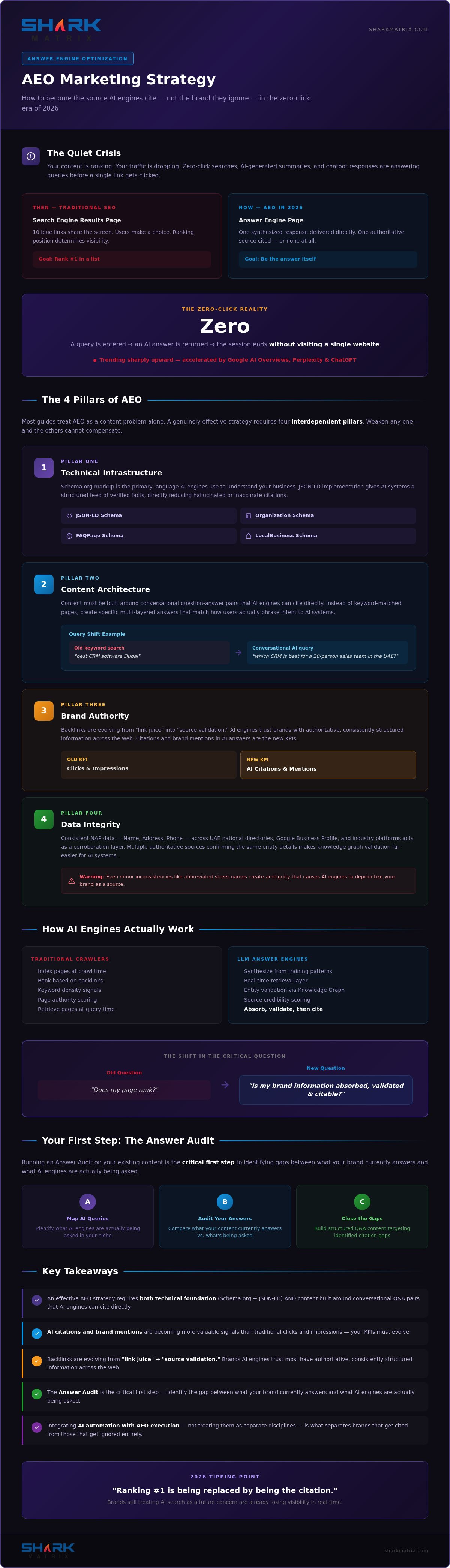
Answer Engine Optimization is the practice of structuring your content, technical infrastructure, and brand authority so that AI-powered platforms select your business as the definitive source when answering a user’s query. It’s not about ranking higher in a list. It’s about being the answer itself.
That distinction matters more than most brands realize. Traditional SEO competed for position on a Search Engine Results Page, where ten links shared the screen and users made a choice. The emerging reality is an Answer Engine Page, where a single synthesized response is delivered directly to the user, often without a clickable link in sight. The brands that don’t adapt their aeo marketing strategy to this shift aren’t losing ground slowly. They’re becoming invisible.
The Rise of the Zero-Click Search
Zero-click search is the dominant 2026 user behavior: a query is entered, an AI-generated answer is returned, and the session ends without a single website being visited. According to data cited by SparkToro and others tracking SERP behavior, zero-click outcomes have been trending upward for years, accelerating sharply as Google AI Overviews, Perplexity, and ChatGPT’s search functionality have matured.
The behavioral shift runs deeper than convenience. Conversational AI has changed how users frame their intent. Instead of typing “best CRM software Dubai,” a user now asks “which CRM is best for a 20-person sales team in the UAE?” That’s a specific, multi-layered question that a traditional keyword-matched result handles poorly. An LLM-powered answer engine handles it precisely, pulling from sources it has already validated as authoritative.
Answer Engines vs. Traditional Search Engines
Traditional search crawlers index pages and rank them based on signals like backlinks, keyword density, and page authority. Large Language Models work differently. They don’t retrieve pages at query time the way a crawler does. Instead, they synthesize responses from patterns learned during training, supplemented by real-time retrieval layers in tools like Perplexity and SearchGPT. The question isn’t whether your page ranks. The question is whether your brand’s information has been absorbed, validated, and deemed citable.
Google’s Knowledge Graph plays a critical role here. It acts as a verification layer, cross-referencing structured entity data to confirm that a brand is what it claims to be. For UAE-based businesses, this matters acutely: as national brands compete for AI citations in a market where local search authority is still being established, the brands with the clearest entity footprint win the citation.
Ranking number one is being replaced by being the citation. That’s the core logic driving every element of a modern aeo marketing strategy, and it’s why 2026 represents a genuine tipping point for brands across the UAE that have been treating AI search as a future concern rather than a present priority.
The Pillars of a Winning AEO Marketing Strategy
Most guides treat AEO as a content problem. Write better answers, structure your FAQs, and the citations will follow. That’s a partial truth that leads to incomplete execution. A genuinely effective aeo marketing strategy is built on four interdependent pillars: technical infrastructure, content architecture, brand authority, and data integrity. Weaken any one of them, and the others can’t compensate.
Structured Data and Knowledge Graphs
Schema.org markup isn’t a nice-to-have in 2026. It’s the primary language AI engines use to understand what your business is, what it does, and whether it’s trustworthy enough to cite. Implementing Organization, FAQPage, HowTo, and LocalBusiness schema in JSON-LD format gives AI systems a structured feed of verified facts about your brand, directly reducing the risk of hallucinated or inaccurate citations.
Consistent NAP data, your Name, Address, and Phone number, across UAE national directories, Google Business Profile, and industry-specific platforms acts as a corroboration layer. When multiple authoritative sources confirm the same entity details, knowledge graph validation becomes far easier for AI systems to complete. Inconsistencies, even minor ones like abbreviated street names, create ambiguity that causes AI engines to deprioritize a source in favor of one that’s cleaner.
This is where natural language processing capabilities become operationally valuable. NLP models parse the semantic context around your brand mentions, not just the entity name itself. A business described consistently as a “UAE-based AI development and SEO agency” across structured and unstructured sources builds a richer, more citable entity profile than one whose descriptions vary by platform.
Conversational Content Design
Voice search and AI-generated verbal responses share a common requirement: answers that sound natural when spoken aloud. That means writing in plain, direct language, front-loading the answer before the explanation, and avoiding the dense, qualifier-heavy prose that reads well on a page but fails when a device reads it back to a user.
Structuring H2s and H3s as direct questions is one of the highest-leverage changes a content team can make. Headings like “What schema types does Google use for AI Overviews?” map precisely to how users phrase queries to AI assistants. That alignment increases the probability of triggering a featured snippet or AI Overview citation.
Long-form content also needs a structural rethink. Leading with a concise answer block, a genuine TL;DR that resolves the core question in two or three sentences, serves two audiences simultaneously: the AI engine scanning for a citable response and the human reader who wants the conclusion before the argument.
Across all four pillars, the underlying principle is the same: make it effortless for AI systems to find, parse, and trust your information. Brands building this infrastructure now are the ones that will own citations as AI search continues to mature. If you’re assessing where your current content and technical setup stand against these requirements, exploring a structured SEO and AEO audit is a practical starting point.
The final pillar, data cleanliness, ties everything together. Contradictory information across your own site, outdated service descriptions, and unresolved entity conflicts are the inputs that produce AI hallucinations. Clean, consistent, structured data isn’t just good hygiene; it’s what separates a brand that gets cited accurately from one that gets cited incorrectly, or not at all.
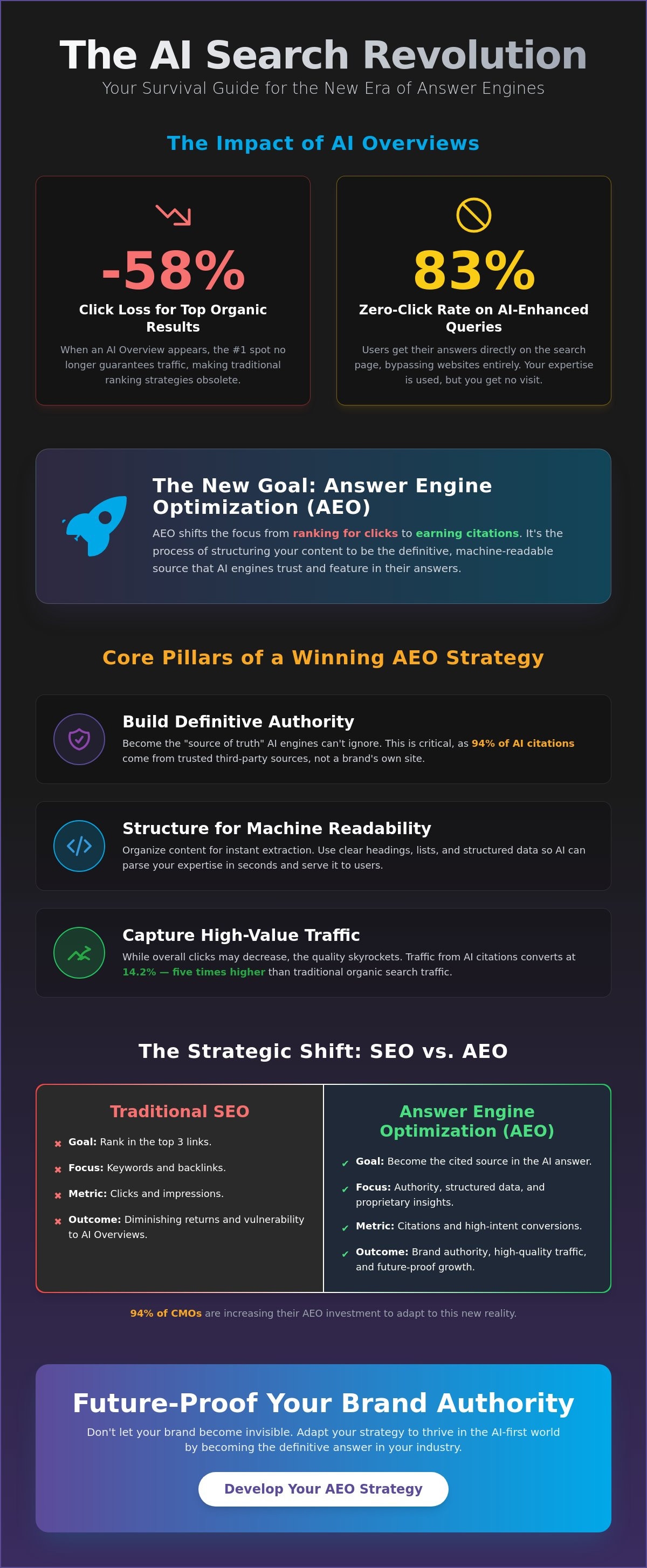
AEO vs. Traditional SEO: Navigating the Zero-Click Era
The metrics that defined search success for the past decade are no longer telling the full story. Clicks, impressions, and average position made sense when the goal was to earn a spot on a results page that users actually scrolled through. That page is disappearing. As AI-generated answers absorb more of the query-response cycle, the brands still optimizing exclusively for click-through rates are measuring the wrong thing with increasing precision.
This isn’t an argument for abandoning traditional SEO. It’s an argument for expanding what success looks like. A hybrid approach that integrates search engine optimization SEO services with a structured AEO layer is the practical reality for 2026. SEO still governs how crawlers index your content and how human users navigate organic results. AEO governs whether AI systems trust your content enough to cite it. Both matter. Neither is sufficient alone.
The role of backlinks has shifted in a way that’s easy to misread. Links haven’t lost their value; their function has changed. In traditional SEO, a backlink passed authority in a relatively mechanical way. In an AI-citation context, backlinks function as source validation signals. When multiple credible, topically relevant domains reference your brand in consistent, structured ways, AI systems interpret that pattern as evidence of genuine expertise. The quantity-over-quality link-building strategies of earlier SEO eras actively work against this. What AI engines reward is corroboration, not volume.
Content frequency is another area where the old playbook misleads. Publishing at high velocity to capture trending keywords was a defensible strategy when freshness was a significant ranking factor. In an answer engine context, accuracy outweighs recency. A well-structured, factually precise answer published six months ago will be cited over a hastily produced piece published yesterday if the former is cleaner, better validated, and more consistent with what other trusted sources confirm. Being right matters more than being first.
The Death of the Keyword?
Exact-match keywords aren’t dead, but their dominance is over. Semantic search has shifted the optimization target from specific phrases to entities and topics: the people, places, concepts, and relationships that AI systems map into knowledge structures. A piece of content optimized around the entity “AI-powered CRM for SMEs” will serve a wider range of natural language queries than one built around a single high-volume phrase. Critically, AI connects related concepts without needing specific keyword prompts at all; an LLM can infer that a question about “automating follow-ups for a small sales team” is semantically adjacent to CRM functionality, even if neither phrase appears in the query.
Measuring Success in AEO
The emerging measurement framework centers on three shifts. First, Share of Model (SoM) is replacing Share of Voice: instead of tracking how often your brand appears in paid or organic search results, you track how often it appears in AI-generated responses across platforms like ChatGPT, Perplexity, and Google AI Overviews. Tools designed specifically for this monitoring are maturing quickly, and building SoM tracking into your reporting stack now is a competitive advantage.
Second, assisted conversions deserve more weight in your attribution model. A user who encounters your brand in a Perplexity citation, visits your site two days later through a direct search, and converts will appear in your analytics as a direct or branded organic conversion. That first AI-citation touchpoint is invisible in standard attribution but was arguably the most influential moment in the journey.
A sound aeo marketing strategy treats these measurement gaps as solvable problems, not acceptable blind spots. Tagging branded search volume trends alongside SoM data gives a clearer picture of how AI visibility is actually driving downstream behavior, even when the click never happens.
Implementation: How to Optimize for AI Overviews and Chatbots
Knowing why AEO matters is one thing. Building the execution layer is another. What follows isn’t a list of abstract principles; it’s a sequential implementation framework that takes your brand from audit to citation-ready infrastructure.
Step 1: Conduct an Answer Audit. Before producing a single new piece of content, map what your brand currently answers against what AI engines are actually being asked. Pull your top 50 organic landing pages and cross-reference them with conversational query data from tools like AlsoAsked, Google’s People Also Ask clusters, and Perplexity’s auto-suggest. Where your content answers questions that nobody is asking in 2026, or fails to answer questions that AI engines are fielding daily, those gaps are your highest-priority content targets.
Step 2: Deploy FAQ blocks with structured microdata across every high-value page. Each FAQ block should use FAQPage schema in JSON-LD, with questions written exactly as a user would speak them to an AI assistant. A question like “What does an AEO audit include?” is more citable than “Our AEO services overview.” The format matters as much as the content.
Step 3: Build niche authority through strategic placement. AI engines don’t just crawl your site; they absorb information from across the web. For a specialized provider like Aqua Regia Technology, getting cited in industry-specific publications, authoritative UAE business directories, and topically relevant third-party content creates the corroboration pattern that validates expertise in an AI system’s training and retrieval layers.
Step 4: Use generative AI development capabilities to scale content production without sacrificing structure. The bottleneck for most brands isn’t strategy; it’s execution volume. Generative AI tools, when properly configured with brand guidelines, schema templates, and answer-first formatting rules, can produce structured, citable content at a pace that manual workflows can’t match. The key is building the governance layer first so that AI-generated content meets AEO standards rather than diluting them.
Step 5: Monitor AI response accuracy continuously. Query your brand across ChatGPT, Perplexity, and Google AI Overviews at least monthly. When AI systems cite you incorrectly, that’s a signal that your structured data, entity descriptions, or on-page content contains contradictions that need resolving. Accurate citations don’t happen by accident; they’re maintained through ongoing data hygiene.
Optimizing for Multilingual Answer Engines
The UAE’s Arabic-English search environment creates a challenge that most AEO guides ignore entirely. NLP models process Arabic and English through different tokenization and semantic mapping systems. A brand that’s well-structured in English but inconsistently described in Arabic creates entity ambiguity that causes AI engines to deprioritize it in bilingual query contexts. Semantic consistency across both languages isn’t a translation task; it’s a technical one. Every core claim, service description, and entity attribute needs to carry the same meaning in both languages, not just the same words.
AI chatbot development is directly relevant here. A well-built multilingual chatbot doesn’t just serve users; it trains AI systems to associate your brand with accurate, consistent information in both languages. Every structured interaction your chatbot handles is a data point that reinforces your entity profile across the Arabic-English query landscape.
Technical Checklist for AEO Readiness
Content quality means nothing if AI crawlers can’t access and parse your site cleanly. Before any content work, confirm these technical foundations are solid:
- Site speed and mobile-first indexing: AI crawlers respect the same performance signals as Googlebot. Core Web Vitals failures that slow human users also degrade how efficiently AI systems can retrieve and process your content.
- robots.txt configuration: Review your robots.txt to confirm you’re not inadvertently blocking AI user-agents, including those used by Perplexity, OpenAI’s crawler (GPTBot), and Anthropic’s ClaudeBot. Blocking these agents removes your content from consideration entirely.
- Speakable schema implementation: Google’s
Speakableschema type designates specific page sections as optimized for audio playback via voice-activated answer engines. Implementing it on your most answer-dense pages directly increases your eligibility for voice search citations.
A complete aeo marketing strategy treats these technical elements as non-negotiable prerequisites, not optional enhancements. If you want an expert assessment of where your current setup stands, explore Shark Matrix’s AEO and SEO audit services as a structured starting point.
Shark Matrix: Integrating AI Automation with AEO Excellence
Most AEO guides stop at content recommendations. Rewrite your FAQs, add schema markup, and wait for citations to appear. That’s not a strategy; it’s a checklist. The gap most brands fall into isn’t a lack of information about AEO principles. It’s the absence of a technical partner who can actually build the infrastructure those principles require. That’s the problem Shark Matrix is built to solve.
As a UAE-based agency with deep roots in both national SEO campaigns and end-to-end AI automation services, Shark Matrix operates at the intersection that most digital agencies can’t reach: where software engineering meets search visibility. Building an “Answer-Ready” digital infrastructure for a national brand isn’t a content project. It requires NLP expertise to validate semantic consistency, machine learning capabilities to monitor citation accuracy, and structured data engineering to ensure that what AI engines read about your brand is exactly what you intend them to read.
The Shark Matrix approach to AEO treats your brand’s digital presence as a living data system, not a static website. Custom monitoring tools track how your brand is cited across ChatGPT, Perplexity, and Google AI Overviews, flagging inaccuracies before they compound into entrenched misinformation. That continuous feedback loop is what separates brands that maintain citation authority over time from those that earn it once and gradually lose it to cleaner competitors.
Reputation management in the AI era is also a data discipline. Consistent, structured, authoritative information distributed across UAE national directories, industry publications, and your own properties creates the corroboration pattern that AI systems interpret as trustworthiness. Shark Matrix coordinates that distribution as part of a unified aeo marketing strategy, not as a series of disconnected tactics.
Beyond Search: The Future of Agentic Marketing
The next disruption is already taking shape. AI agents, software systems that autonomously browse the web, compare options, and execute decisions on a user’s behalf, are moving from early adoption into mainstream commercial use. When an AI agent evaluates vendors for a procurement decision, it doesn’t read ten results. It queries structured data, validates entity credibility, and selects based on the clarity and consistency of available information. Brands whose data isn’t agent-readable won’t be considered at all.
Preparing for this shift requires more than updated schema. It requires industry-specific AI solutions that account for how your sector’s data is structured, queried, and validated by autonomous systems. A logistics company, a financial services firm, and a real estate developer each face different agent-query patterns. Generic AEO preparation won’t address those differences. Sector-specific data architecture will.
For organizations in specialized fields, you can visit GEOTECH 3D to see how high-precision geospatial mapping and data acquisition are structured to maintain authority in an AI-driven search environment.
This is precisely why a technical partner isn’t optional in 2026. The agentic era rewards brands that have invested in structured, machine-readable infrastructure before the shift fully arrives, not those scrambling to retrofit it afterward.
Get Started with a National AEO Audit
For UAE enterprises, the starting point is a structured audit that maps your current digital infrastructure against the citation requirements of modern answer engines. That means evaluating your schema implementation, entity consistency across platforms, content architecture, and technical crawlability, not as separate workstreams, but as a unified system. Shark Matrix bridges the gap between software engineering and digital marketing to deliver that assessment with the depth a national brand actually needs.
If your brand’s visibility strategy hasn’t been stress-tested against AI search yet, now is the right time to change that. Contact Shark Matrix for a comprehensive AEO and SEO strategy audit and find out exactly where your current setup stands, and what it will take to lead in the answer engine era.
The Brands That Act Now Will Own the Citations That Matter
AI search isn’t arriving. It’s already here, reshaping how buyers find information, evaluate vendors, and make decisions. The brands that treat an aeo marketing strategy as urgent infrastructure work today are the ones that will dominate citations tomorrow. Those that wait are ceding ground that gets harder to reclaim with every passing quarter.
Three things to carry forward: structured data isn’t optional, it’s the language AI engines speak. Entity consistency across every platform you touch determines whether AI systems trust you enough to cite you. And measurement has to evolve beyond clicks to capture the brand visibility that now happens before a user ever visits your site.
Shark Matrix brings together over a decade of UAE market expertise, full-stack AI engineering, and deep NLP specialization to build the kind of answer-ready infrastructure that actually earns citations at scale. You don’t have to figure this out alone.
Scale your AI visibility with Shark Matrix’s AEO services and position your brand where it belongs: as the answer.
Frequently Asked Questions About AEO Marketing Strategy
What is the difference between SEO and AEO?
SEO optimizes your content to rank on a traditional search results page where users choose from multiple links. AEO optimizes your content, structured data, and brand authority so that AI-powered platforms select your business as the source when generating a direct answer. The goal shifts from earning a position in a list to becoming the answer itself.
In practice, the two disciplines share a technical foundation but diverge in execution. SEO prioritizes crawlability, keyword relevance, and link authority. AEO adds entity consistency, conversational content structure, and schema markup that AI systems can parse and cite with confidence. Neither replaces the other in 2026.
How do I get my business cited in ChatGPT or SearchGPT?
Getting cited by LLM-powered tools requires your brand’s information to be accurate, consistent, and widely corroborated across authoritative sources. That means implementing structured schema markup on your site, maintaining consistent entity data across directories and third-party platforms, and earning mentions in credible, topically relevant publications that AI systems treat as trusted inputs.
There’s no direct submission process for ChatGPT or SearchGPT the way there is for Google Search Console. Instead, you build the conditions that make citation likely: clean structured data, a strong entity footprint, and content that directly answers the specific questions your audience is asking AI tools today.
Will AEO replace traditional SEO by 2026?
No. AEO won’t replace SEO, but it’s becoming an equally critical discipline alongside it. Traditional SEO still governs how search crawlers index your content and how human users navigate organic results for queries that don’t trigger AI-generated answers. Those queries still represent a significant share of search volume, particularly for complex, commercial, and navigational intent.
The smarter framing is that a complete aeo marketing strategy sits on top of a solid SEO foundation, not in place of one. Brands that abandon SEO to chase AEO exclusively will lose organic traffic. Brands that ignore AEO while doubling down on traditional SEO will lose citation visibility. Both disciplines need to run in parallel.
Does AEO work for B2B companies in the UAE?
AEO is arguably more valuable for B2B companies than for consumer brands. B2B buyers increasingly use AI tools like Perplexity and ChatGPT during early-stage research, asking specific questions about vendors, capabilities, and industry solutions before ever visiting a company website. If your brand isn’t being cited during that research phase, you’re invisible at the most influential point in the buying journey.
For UAE-based B2B businesses, this matters acutely because national entity authority in the Gulf market is still being established across AI platforms. Companies that build a clear, consistent, structured digital presence now will have a significant citation advantage over competitors who treat AEO as a future concern.
How do I measure the ROI of AEO if I’m getting fewer clicks?
Measuring AEO ROI requires expanding your attribution model beyond last-click analytics. The most practical starting point is tracking branded search volume over time. When AI citations increase, users who encounter your brand in an AI-generated answer often follow up with a direct branded search, so rising branded query volume is a reliable downstream signal of growing AI visibility.
Alongside that, monitor your Share of Model: how frequently your brand appears in AI-generated responses across ChatGPT, Perplexity, and Google AI Overviews for your target queries. Tracking assisted conversions, where a user’s journey began with an AI touchpoint before converting through another channel, also helps quantify the influence that doesn’t show up in standard click-based reporting.
What role does structured data play in Answer Engine Optimization?
Structured data is the primary mechanism through which AI systems verify what your business is, what it does, and whether it’s credible enough to cite. Schema types like Organization, FAQPage, HowTo, and LocalBusiness implemented in JSON-LD give AI engines a structured feed of verified facts rather than forcing them to infer meaning from unstructured prose.
Without structured data, AI systems rely on contextual signals from across the web to construct their understanding of your brand. That introduces the risk of inaccurate or incomplete citations. Clean, comprehensive schema markup reduces that ambiguity directly, making your brand a more reliable source that AI systems can cite with confidence.
Can I optimize for both Google AI Overviews and ChatGPT at the same time?
Yes, and the good news is that the core optimization principles overlap significantly. Both systems reward content that’s clearly structured, factually accurate, and consistently corroborated across authoritative sources. Implementing strong schema markup, writing in direct question-answer format, and maintaining entity consistency across your digital presence benefits your visibility across all major AI platforms simultaneously.
The differences are mostly technical. Google AI Overviews pull from indexed web content, so traditional crawlability and page authority still matter. ChatGPT’s retrieval layer is influenced by the breadth of authoritative sources that reference your brand. Optimizing both means combining solid on-site technical SEO with a deliberate off-site authority-building strategy.
Is voice search optimization part of an AEO strategy?
Voice search optimization is a core component of any effective aeo marketing strategy, not a separate discipline. Voice queries are inherently conversational, phrased the way people actually speak rather than how they type, and AI answer engines handle both formats through the same underlying language models. Content that’s structured to answer spoken questions well is also content that AI systems find easy to cite in text-based responses.
Practically, this means writing answers in plain, natural language that sounds coherent when read aloud, implementing Google’s Speakable schema on your most answer-dense pages, and structuring headings as direct questions that mirror how users phrase voice queries. These adjustments serve voice search and AI citation readiness at the same time.

 OpenAI
 Codex
Codex
 Vertex AI
 Cloud Vision
 OpenCV
 TensorFlow
 IBM Watson
 Cloud Natural Language
 Cognitive Services
 Bot Framework
 Mistral
 LLama
LLama
 Gemini
 Anthropic
 N8N
N8N