

Categories
SEO

SEO KPIs for Business Growth: Measuring Success in the 2026 Search Landscape

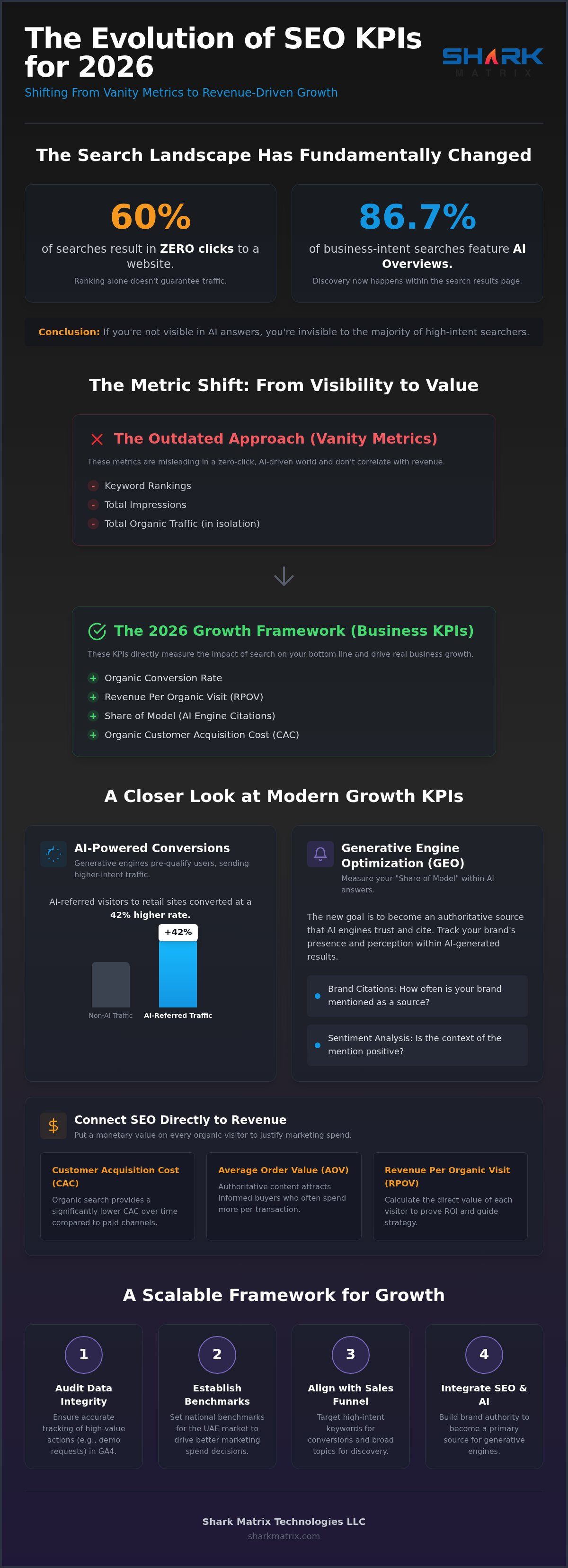
When 60% of searches result in no click to a website, the traditional “rank #1” goal feels like chasing a ghost. You’ve likely felt the frustration of seeing high keyword rankings on a monthly report while your actual revenue stays flat. It’s exhausting to justify marketing spend when the metrics don’t translate to the bottom line. To fix this, you need to identify the right seo kpis for business growth that reflect how people actually search in 2026.

You aren’t alone in feeling confused as AI Overviews now appear on 86.7% of business-intent searches, fundamentally changing how users find your brand. This article will show you how to move beyond vanity metrics and track the specific data points that directly fuel national revenue. You’ll discover a clear framework for measuring ROI in an era of generative engine optimization and zero-click results. We’ll look at how to track discovery within AI answer engines and provide the data you need to improve decision-making for your marketing spend across the UAE.

Key Takeaways

  • Learn why 2026 requires a shift from tracking simple keyword positions to measuring discovery across both traditional and generative search engines.
  • Identify the essential seo kpis for business growth, focusing on organic conversion rates and customer acquisition costs rather than vanity metrics.
  • Understand how to measure your “Share of Model” by tracking brand citations and sentiment analysis within AI-driven search results.
  • Follow a scalable framework to audit your data integrity and establish national benchmarks that drive better marketing spend decisions across the UAE.
  • Discover how technical excellence in web development and generative AI development creates the foundation for sustainable organic visibility.

In 2026, the search environment is more fragmented than ever. Relying on a single ranking number doesn’t tell the full story of your market presence. SEO KPIs are measurable values used by marketing teams to track the effectiveness of search strategies in driving revenue. We’ve moved away from simply chasing “Position 1” because discovery now happens in AI summaries, chat interfaces, and traditional results simultaneously. If your brand isn’t visible in the AI Overview, you’re missing out on the majority of high-intent searchers.

A hybrid approach is mandatory for national brands. You have to monitor how traditional Google search interacts with generative engines. Many teams get trapped by vanity metrics like total impressions, but these don’t always lead to profit. True seo kpis for business growth focus on qualified leads and revenue attribution. It’s better to have 100 visitors who are ready to buy than 10,000 who just want a quick definition. Shifting your focus toward user intent ensures that your marketing spend is working to build a sustainable lead generation engine. This philosophy of measurable scaling is a core component of the performance marketing approach advocated by Peter Montoya.

Why Traditional Rankings Aren’t Enough Anymore

The impact of zero-click searches has fundamentally changed the value of a “ranking.” With 60% of searches ending without a click to a website, your visibility strategy must evolve. AI Overviews now appear on 86.7% of business-intent searches, which means the user often gets the information they need directly on the results page. This shift requires you to measure Share of Voice within those AI summaries. If an AI engine synthesizes your content to answer a query, your brand authority grows even if the user doesn’t land on your page immediately. Tracking how often your brand is cited as a source is now more important than just checking your position in the blue links.

Aligning SEO with National Business Objectives

Your SEO strategy must mirror your sales funnel to be effective. Top-of-funnel activities should focus on broad discovery, while bottom-of-funnel efforts need to target high-intent conversion keywords. This alignment ensures that your SEO strategies drive national market penetration across the UAE. Strong brand authority acts as a catalyst for this growth. When generative engines recognize your brand as a primary source of truth, they’re more likely to cite your business in their answers. This builds a virtuous cycle of trust and discovery that supports long-term seo kpis for business growth and revenue goals.

Primary Metrics: Aligning Organic Performance with Revenue Goals

Organic traffic is a vanity metric if it doesn’t pay the bills. In 2026, the real value of search lies in how it moves the needle on your profit margins. The organic conversion rate is the most critical of all seo kpis for business growth because it filters out the noise of casual browsers. Data from March 2026 shows that AI-referred visitors to retail sites converted at a 42% higher rate than non-AI traffic. This proves that search intent is becoming more precise as generative engines refine the user path to purchase.

While paid channels offer immediate visibility, the Customer Acquisition Cost (CAC) for organic search remains significantly lower over time. You should also track Average Order Value (AOV). Organic visitors often spend more because they’ve found your brand through authoritative content rather than a disruptive advertisement. Don’t ignore assisted conversions either. SEO often acts as the initial discovery point in a multi-touch journey, even if the final click comes from a direct or email link. Understanding this helps you value the full search funnel.

Tracking Qualified Lead Generation

Success requires more than just counting form fills. You must set up custom events in GA4 to track high-value actions like demo requests, consultation bookings, or whitepaper downloads. It’s vital to differentiate between informational visitors looking for “how-to” guides and transactional buyers searching for specific services. High-impact SEO services focus on capturing these transactional users while nurturing informational traffic through the funnel. This approach ensures your lead generation remains sustainable even as market competition increases across the UAE.

Revenue Per Organic Visit (RPOV)

Calculating Revenue Per Organic Visit (RPOV) allows you to put a direct monetary value on every user. To find this, divide your total organic revenue by the total number of organic sessions. This metric is a powerful tool for justifying marketing spend to stakeholders. When you can prove that a specific keyword cluster generates a higher RPOV, you can confidently scale your national efforts. Identifying these high-revenue clusters helps you prioritize content that drives actual growth rather than just high traffic volume. If you want to refine your data strategy, consider exploring our advanced search engine optimization solutions.
SEO KPIs for Business Growth: Measuring Success in the 2026 Search Landscape

Generative Engine Optimization (GEO): The New Frontier of Discovery

Discovery in 2026 happens inside the chat box as much as the search bar. With ChatGPT reaching 900 million weekly active users in February 2026, brands can no longer rely solely on traditional click-through rates. The U.S. Generative Engine Optimization (GEO) market is projected to reach $365.4 million this year, reflecting a massive shift in how national brands allocate their budgets. Success now requires tracking “Share of Model,” a metric that measures how often an LLM cites your brand compared to your competitors. This is a foundational element of seo kpis for business growth because it determines your visibility in the answers users trust most.

Tracking inbound AI traffic from sources like Perplexity or Gemini is the new standard for measuring reach. Unlike traditional referral traffic, these visitors arrive with extremely high intent because an AI engine has already “vetted” your site as a credible source. You must also monitor Answer Engine Optimization (AEO) metrics to capture the growing volume of voice-driven queries. If your content isn’t structured to be easily parsed by these engines, your brand effectively disappears from the generative conversation.

Measuring Brand Mentions and Sentiment

To learn how Digitalix applies these generative search principles to international markets, read more.

In a generative landscape, what the AI says about you matters as much as where you rank. Using natural language processing services allows you to monitor brand health at scale across millions of data points. AI engines don’t just look for keywords; they evaluate the sentiment and context of every mention. There’s a direct correlation between positive brand citations and organic trust. High-impact SEO strategies now include managing how these models perceive your expertise. If the sentiment is negative or the data is outdated, the AI will simply stop recommending your business to users.

Optimizing for AI Overviews (AIOs)

Winning a spot in Google’s AI Overviews is the primary goal for high-intent keywords. Since AIOs appear on 86.7% of business searches, your visibility percentage in these summaries is a non-negotiable KPI. To win these citations, you must structure your content with clear, authoritative headers and data-rich tables that AI crawlers can easily digest. Technical excellence remains the backbone of this process. Without superior crawlability and clean site architecture, generative engines will struggle to index your most valuable insights. Focusing on these technical seo kpis for business growth ensures your brand remains the primary source of truth for AI-generated answers across the UAE.

How to Implement a Scalable SEO KPI Framework for Your Business

Building a reporting framework that scales requires moving beyond basic spreadsheets. For national brands, the challenge lies in aggregating data from various search touchpoints into a single source of truth. You must start with a rigorous audit of your data integrity. Ensure your GA4 property correctly identifies traffic from generative engines and that your conversion pixels fire accurately across all subdomains. Without clean data, your seo kpis for business growth will lead to flawed investment decisions.

A successful implementation follows a structured five-step process:

  • Step 1: Audit Data Integrity. Verify that tracking for AI-referred traffic and traditional organic clicks is segmented correctly.
  • Step 2: Establish National Benchmarks. Use your historical performance from 2025 to set realistic growth targets for the current year.
  • Step 3: Define North Star Metrics. Align departments by setting goals that matter to them. Sales needs qualified leads, while Marketing needs a higher Share of Search.
  • Step 4: Automate Dashboards. Remove manual entry by connecting your data sources to real-time visualization tools.
  • Step 5: Review and Pivot. Conduct a deep-dive ROI analysis every quarter to adjust your keyword targeting based on actual revenue performance.

Setting Realistic Benchmarks for National Growth

National growth across the UAE requires an understanding of how search behavior shifts throughout the year. You can’t set flat monthly goals. You have to account for seasonality, such as the surge in search activity during Ramadan or the shift in intent during the summer months. Analyzing competitor performance on a national level helps you set SMART goals for keyword expansion. Instead of trying to rank for everything, focus on building authority in specific high-value clusters that your competitors are neglecting. This targeted approach ensures your seo kpis for business growth remain achievable and impactful.

Data Visualization and Stakeholder Reporting

Stakeholders don’t want to see rows of keywords; they want to see the trajectory of their investment. Moving from static spreadsheets to interactive Looker Studio reports allows you to tailor the data to the viewer. A CEO needs a high-level view of organic revenue and market share, while an SEO Manager needs granular data on technical crawlability and click-through rates. Leveraging AI automation services can streamline this process by automatically pulling data from multiple APIs and highlighting significant trends. This ensures your reporting is always up to date and ready for executive review. If you’re ready to modernize your data strategy, contact our SEO specialists to build a custom growth framework for your brand.

Strategic SEO and AI Integration with Shark Matrix

Success in 2026 requires a partner who understands that search isn’t a silo. Shark Matrix Technologies LLC bridges the gap between technical execution and national market leadership by treating search as a data-driven lead generation engine. We recognize that the most effective seo kpis for business growth are built on a foundation of technical excellence. High-performance web development is the first step. If your site architecture isn’t optimized for both humans and AI crawlers, your organic visibility will always hit a ceiling regardless of your content quality.

We leverage generative AI development to help brands scale their content production while maintaining high authority. This isn’t about mass-producing text; it’s about creating structured, expert-led insights that generative engines prioritize. By integrating AI into the content workflow, we ensure your brand remains the primary source for AI Overviews and LLM citations. This holistic approach ensures every technical update directly serves your revenue goals across the UAE.

Beyond Search: A Multi-Channel Growth Engine

A truly modern strategy looks past the search bar. We integrate SEO with PPC management and social media to create a unified growth engine that captures intent at every stage of the funnel. For many national brands, mobile app development plays a crucial role in this ecosystem. Apps provide a direct channel for user retention and generate powerful engagement signals that reinforce your brand’s authority. By using custom AI solutions for predictive analysis, we identify emerging search trends before they become competitive. This allows you to capture market share early and maximize your marketing spend.

Partnering for Long-Term Scalability

Founded in 2010, Shark Matrix has spent over a decade specializing in end-to-end digital transformation for the GCC market. Our expertise in Arabic digital marketing ensures your brand connects with the local audience while maintaining a strong national presence. We provide the infrastructure needed to navigate the 2026 search landscape, from machine learning integration to advanced GEO strategies. To ensure your business is ready for the next evolution of search, we invite you to request a comprehensive SEO and growth audit. Our team will analyze your current performance and provide a roadmap for scaling your seo kpis for business growth over the coming quarters.

Future-Proof Your National Search Strategy

The search landscape of 2026 requires a departure from simple ranking reports. You’ve seen how tracking “Share of Model” and organic revenue provides a much clearer picture of success than vanity metrics ever could. By focusing on seo kpis for business growth that align with your bottom line, you can turn search into a predictable lead generation engine. Technical excellence in web development and a deep understanding of generative engines are now the non-negotiables for national market leaders across the UAE.

Shark Matrix Technologies LLC has a proven track record in national SEO growth since 2010. We specialize in AI-driven digital transformation and provide custom data dashboards for transparent ROI tracking. Scale your business with Shark Matrix’s expert SEO services to ensure your brand remains the primary source of truth in an evolving digital landscape. Your growth doesn’t have to be a guessing game. With the right framework and a focus on revenue-driven metrics, you’re ready to dominate the new frontier of search.

Frequently Asked Questions

What are the most important SEO KPIs for business owners in 2026?

The most critical seo kpis for business growth in 2026 include organic conversion rate, Customer Acquisition Cost (CAC), and Share of Model in AI results. Traditional rankings matter less than how often your brand is cited as a source in generative engines. You should prioritize metrics that link directly to revenue and lead quality. This shift ensures your marketing spend drives national market penetration rather than just generating empty traffic numbers.

How do I measure the ROI of my SEO campaign?

You measure SEO ROI by comparing the total revenue generated from organic search against your total investment in strategy and execution. It’s essential to include assisted conversions in this calculation. Many users discover your brand through a search query but convert later via direct or email channels. Tracking these multi-touch journeys provides a more accurate view of how search contributes to your bottom line across the UAE.

Is organic traffic still a reliable metric with the rise of AI search?

Total organic traffic is no longer a reliable standalone metric. With 60% of searches resulting in no click, focusing on raw session counts can be misleading. You should instead measure “qualified” traffic that interacts with high-value pages. High traffic volume is useless if it doesn’t lead to conversions. Successful brands now prioritize traffic quality and brand visibility within AI Overviews over total visitor counts.

How can I track my brand’s visibility in AI Overviews and LLMs?

Tracking brand visibility in LLMs requires monitoring your “Share of Model” and brand citation frequency. You can use specialized tools to see how often AI engines like Perplexity or Gemini cite your website as a primary source. Monitoring the sentiment of these mentions is also vital. If generative engines perceive your brand as an authority, they’re more likely to recommend your services to users during conversational search sessions.

What is the difference between vanity metrics and actionable SEO KPIs?

Vanity metrics like keyword positions and total impressions look good on paper but don’t guarantee revenue. Actionable seo kpis for business growth are data points that drive decision-making, such as organic lead volume and revenue per visit. If a metric doesn’t help you decide where to allocate your budget, it’s likely a vanity metric. Focus on indicators that prove the financial impact of your digital marketing efforts.

How often should my business review its SEO KPI reports?

Most businesses should review their detailed reports monthly to track short-term trends and technical health. However, a deep-dive ROI analysis is best performed quarterly. SEO is a long-term investment, and three months provide enough data to see the impact of strategy shifts. Regular reviews help you pivot your content and technical focus based on how national search patterns and AI algorithms are evolving in real-time.

Can SEO KPIs help me predict future business growth?

Yes, seo kpis for business growth are powerful predictors of future revenue. By analyzing the growth rate of non-branded search traffic and lead quality trends, you can forecast future earnings. Predictive SEO tools can also identify rising search demand in specific industries before your competitors notice. This allows you to build authority in new niches early, securing a larger share of the national market as demand peaks.

Why is technical SEO considered a critical KPI for national brands?

Technical SEO is a critical KPI because it determines how effectively AI engines and traditional crawlers can index your content. For national brands, technical excellence ensures that your digital infrastructure is robust enough to handle high traffic volumes and complex site architectures. Clean code and fast load times improve user retention and send positive signals to search engines. Without a solid technical foundation, even the best content will fail to rank.

Categories
SEO

Justifying Your SEO Budget to Management: The 2026 ROI Framework

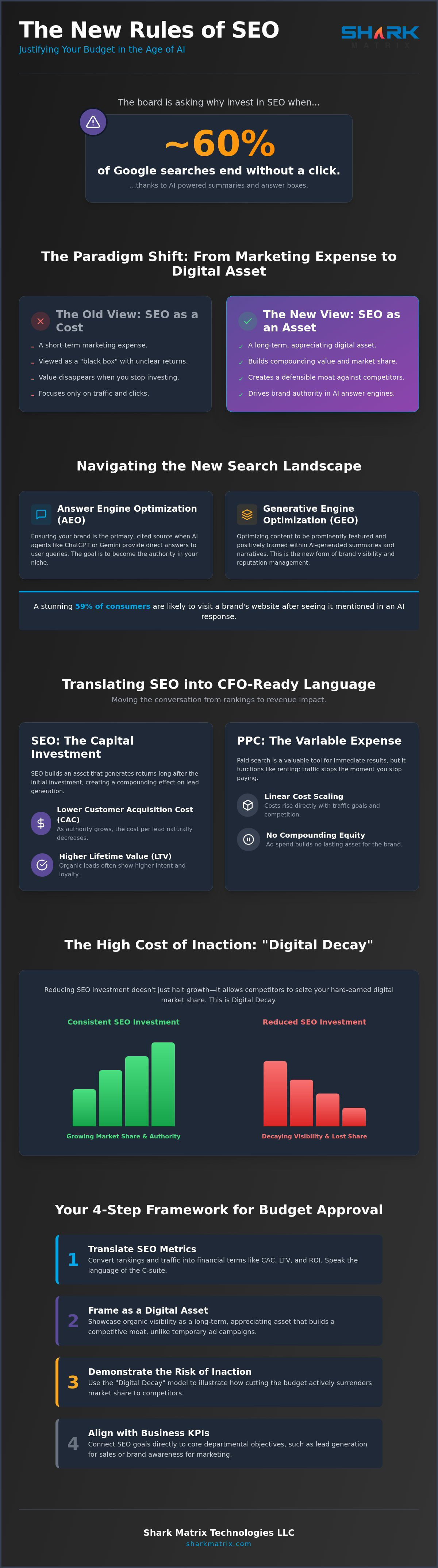
If nearly 60% of Google searches now end without a single click, why should your board keep funding a strategy built on traditional traffic? You’ve likely felt the heat in the boardroom when executives label SEO a black box or suggest shifting your hard-earned funds into short-term PPC wins. The challenge of justifying seo budget to management has become even steeper after the March and May 2026 core updates fundamentally changed how rankings are calculated. It’s frustrating to defend a long-term strategy when the pressure to deliver instant revenue has never been higher.

This guide will show you how to move past the marketing cost stigma by transforming organic search into a defensible business asset. You’ll learn a specific framework for proving ROI that accounts for the rise of Generative Engine Optimization (GEO) and Answer Engine Optimization (AEO). We’ll cover how to demonstrate that organic visibility isn’t just about clicks anymore; it’s about protecting your brand’s future market share in an era dominated by AI-curated summaries and generative search results.

Key Takeaways

  • Learn how to translate technical SEO metrics into CFO-friendly language like Customer Acquisition Cost (CAC) and Lifetime Value (LTV).
  • Discover a step-by-step framework for justifying seo budget to management by treating organic visibility as an appreciating digital asset rather than a monthly expense.
  • Understand the hidden costs of “digital decay” and how reducing investment allows competitors to seize your existing market share.
  • See how to align SEO goals with core departmental KPIs to prove that search authority directly drives lead generation and brand awareness.
  • Find out why modern resource allocation must bridge the gap between traditional search and the emerging world of AI-driven answer engines.

The Shifting Value Proposition: Why SEO is a Defensive Asset in 2026

Management teams often ask if traditional search is losing ground to generative AI. The answer isn’t just that it’s still relevant; it’s that search has evolved into the foundational layer of all digital discovery. When you’re justifying seo budget to management, you aren’t just asking for money to rank for keywords. You’re securing your brand’s authority within the AI models that now dictate consumer choices. Think of Search engine optimization (SEO) as building digital real estate. Unlike PPC, where you stop appearing the moment you stop paying, SEO builds equity. It’s the difference between renting a temporary storefront and owning the land it sits on. As your domain authority grows, the cost per lead naturally drops, creating a defensible asset that appreciates over time.

The “SEO is dead” narrative falls apart when you look at how consumers actually behave in 2026. While it’s true that nearly 60% of Google searches now result in no click due to AI Overviews, this hasn’t erased the value of organic visibility. Research from July 2, 2026, shows that 59% of consumers are likely to visit a brand’s website after it’s mentioned in an AI chatbot response. This means that being the cited source for an AI agent is the new gold standard for traffic. SEO is no longer a “nice to have” marketing channel; it’s the bridge that connects your brand to the AI-driven answer engines of the future.

From Search Engines to Answer Engines (AEO & GEO)

Modern strategies must account for Answer Engine Optimization (AEO). This ensures your brand is the primary source when AI agents like ChatGPT or Gemini provide solutions to users. Generative Engine Optimization (GEO) is the process of optimizing content to be included in AI-generated summaries. By focusing on GEO, you ensure your brand mentions are prioritized in the summaries that users now trust as much as traditional links. This shift is critical for justifying seo budget to management because it proves you’re future-proofing the company’s digital presence against ongoing algorithm shifts.

De-risking the Marketing Mix

Heavy reliance on paid search is a risky bet in a volatile economy. SEO provides a vital buffer against rising PPC auction costs and platform instability. It functions as a multi-channel traffic safety net. If an ad account is flagged or a social platform changes its algorithm, your organic foundation keeps the leads flowing. This organic strength is also the primary driver for online reputation management dubai. When management can see that SEO protects the brand’s image while lowering the overall marketing risk, the budget becomes a strategic necessity rather than an optional expense.

Translating Organic Metrics into CFO-Ready Financial Language

CFOs rarely care about being #1 on a search result page unless that position translates into a lower Customer Acquisition Cost (CAC). When you’re justifying seo budget to management, the conversation must pivot from visibility to financial efficiency. While PPC offers immediate results, it’s a variable cost that scales linearly with volume. SEO, by contrast, is a capital investment that builds a compounding asset. By focusing on justifying your SEO budget in 2026, you can demonstrate how organic search assists conversions across your entire marketing mix. This attribution is vital because organic leads often show higher intent and a superior Lifetime Value (LTV) compared to cold traffic from social ads.

The compounding nature of search is its greatest financial strength. A dollar spent on SEO today continues to drive traffic long after the initial investment, whereas a dollar spent on ads disappears the moment the campaign ends. This long-term efficiency lowers the blended CAC across the entire marketing department. As search algorithms become more sophisticated, the value of high-quality organic authority increases relative to the rising costs of paid auctions. If you’re unsure how to calculate these numbers for your specific niche, Shark Matrix Technologies LLC can help you build a custom ROI projection based on your current performance data.

The Efficiency Gap: SEO vs. PPC Management

In competitive markets like the UAE, the cost-per-click (CPC) for top-tier keywords can be staggering. Relying solely on paid search creates a “PPC Cliff” where lead flow drops to zero the second you stop the spend. Working with a qualified ppc agency dubai is essential for short-term wins, but that strategy is most effective when supported by an organic foundation. This dual approach ensures you aren’t held hostage by rising auction prices and provides a sustainable stream of traffic that doesn’t require a constant increase in ad spend.

Calculating the Long-Term ROI of Search Authority

To speak the language of the board, you should calculate the “Media Value” of your organic traffic. This is the amount you would have to pay in PPC to get the same volume of visitors. When justifying seo budget to management, show them how this Media Value grows month over month while your retainer remains relatively stable. While PPC offers instant entry, a robust organic lead engine typically reaches maturity within 12 to 24 months of consistent investment. By this stage, the organic channel often becomes the most profitable part of the marketing department, providing high-quality leads at a fraction of the cost of paid alternatives.

Justifying Your SEO Budget to Management: The 2026 ROI Framework

The Risk of Inaction: The True Cost of Cutting the SEO Budget

Stopping your organic search investment might look like a quick win for the quarterly balance sheet. It’s actually a decision that triggers a process of “digital decay” that’s incredibly expensive to reverse. When justifying seo budget to management, it’s vital to explain that search visibility isn’t a static trophy you win once. It’s a living ecosystem that requires constant attention. Google’s March and May 2026 core updates proved that the algorithm is now more fluid and AI-driven than ever. If you stop optimizing, your site’s technical health and content relevance begin to erode immediately. This isn’t just about losing a few spots in the rankings; it’s about the compounding loss of brand trust. If customers don’t see your brand in the search results or AI summaries, they often assume you’ve been surpassed by more innovative rivals.

The “Competitor Vacuum” is perhaps the most dangerous consequence of a budget cut. Nature abhors a vacuum, and so does the search results page. When you step back, you create an opening that your rivals will aggressively fill. Reclaiming a top position is often three times harder than maintaining one. You aren’t just starting from zero; you’re fighting against the momentum of a competitor who has already secured the click-through data and user signals you once owned. This “re-entry” cost often dwarfs the original budget you sought to save, making a pause in services a poor long-term financial move. Justifying seo budget to management becomes much easier when you frame it as a necessary expense to protect your existing market share from aggressive conquesting.

Technical Debt and Site Performance

Maintaining high-performance website design and development services is a non-negotiable part of search health. Without regular audits, technical debt accumulates, slowing down site speed and damaging Core Web Vitals. Google’s 2026 updates have placed an even greater emphasis on user experience (UX) as a direct ranking factor. These technical foundations are also a prerequisite for mobile app development services visibility. If your underlying site architecture fails, your entire digital presence, including your app’s discoverability, suffers alongside it.

Competitor Displacement in the UAE Market

National brands in the UAE are aggressively scaling their organic presence to capture a redistribution of search behavior. If you aren’t active, you risk losing “Brand Search” results to competitors running aggressive conquesting campaigns. These rivals often create content specifically designed to intercept your potential customers at the point of intent. Reclaiming the #1 spot in a saturated national market requires far more resources than simply staying there. Consistency is the only way to ensure your brand remains the authoritative voice in your industry.

Building the Business Case: A Framework for Resource Allocation

To move from a defensive stance to an offensive growth strategy, you need a pitch that speaks to market share rather than just rankings. Start by auditing your “Organic Market Share” against the total addressable market. If your top three competitors are capturing 40% of the search volume while you’re at 5%, you have a clear gap to exploit. This data makes justifying seo budget to management much simpler because it highlights a tangible loss of opportunity. Align these findings with departmental KPIs; if the sales team needs to increase lead volume by 15%, show exactly how an expanded SEO footprint provides the most cost-effective path to that goal. Presenting a tiered budget helps management choose their level of aggression: a maintenance tier to protect current assets, a growth tier to capture new keywords, or a leadership tier to dominate the AI-driven search results of 2026.

The Arabic Search Moat

For national brands in the UAE, the “Arabic Search Advantage” is a massive, underutilized asset. Many global competitors focus solely on English, leaving a blue ocean of opportunity for those who invest in high-quality localized content. Arabic search authority creates a defensible barrier that international rivals can’t easily replicate with simple translation tools. By securing this regional authority, you build a “moat” around your brand that protects your market share across the GCC. This localized strategy is essential for capturing high-intent users who prefer searching in their native language, providing a level of brand loyalty that English-only sites simply can’t match.

Integrating AI Automation into the SEO Budget

Modern resource allocation must include Ai automation and development to remain competitive. AI-powered tools have been found to reduce the cost of routine SEO tasks by 20-30%, allowing your budget to stretch further into high-impact creative work. Using AI for large-scale technical audits and data analysis isn’t just an efficiency play; it’s an innovation play that appeals to forward-thinking management teams. When you show that your strategy uses machine learning to predict algorithm shifts and optimize content at scale, you position SEO as a high-tech business driver rather than a legacy marketing tactic. If you’re ready to see how these technologies can transform your performance, request a custom search authority audit to identify your biggest growth opportunities.

Success in the first six months should be measured through clear milestones. Months one through three should focus on technical remediation and Answer Engine Optimization (AEO) to secure quick wins in AI summaries. Months four through six should shift toward building content authority and measuring the growth in “Organic Market Share” compared to your initial audit. By setting these expectations early, you build the trust necessary to sustain long-term investment. Clear milestones prevent management from viewing SEO as a “slow” channel and instead frame it as a disciplined, phased approach to market leadership.

Partnering for Performance: How Shark Matrix Technologies LLC Secures Your Search Authority

Shark Matrix Technologies LLC approaches search as a performance marketing channel rather than a simple traffic generator. We understand that justifying seo budget to management requires more than just ranking reports; it requires clear, data-backed evidence of business growth and financial efficiency. We focus on building AI-ready content structures that satisfy both traditional search algorithms and modern generative engines. Our team specializes in the technical nuances that ensure your site is readable for both humans and AI agents. By providing CFO-ready ROI dashboards, we make it easy to show how every dirham spent translates into long-term digital equity and a lower blended Customer Acquisition Cost (CAC).

Our specialized Arabic digital marketing gives national brands a distinct edge in the UAE market. We don’t just translate content; we build authority in the native language of your primary audience. This deep market penetration is a key component in justifying seo budget to management, as it targets high-value segments that global competitors often overlook. We combine this regional expertise with transparent reporting that highlights your growing “Organic Market Share,” giving your board the confidence to sustain and scale their investment through 2026 and beyond.

End-to-End Search Strategy

A successful search strategy doesn’t exist in a silo. It requires a seamless integration of technical audits, content marketing, and online reputation management. Shark Matrix Technologies LLC works closely with our clients to align their search goals with high-performance website design and development services. This holistic approach ensures that your technical foundation is strong enough to support your content ambitions and user experience requirements. We’re committed to long-term brand growth in the UAE, helping you build a digital presence that remains resilient through every major algorithm update.

Ready to Secure Your 2026 SEO Budget?

Building an internal business case for SEO can be a daunting task when faced with pressure for short-term results. Shark Matrix Technologies LLC is here to help you navigate the boardroom by providing customized ROI projections tailored to your brand’s specific market position and goals. We provide the data, the frameworks, and the strategic insights you need to win management approval and secure the resources your brand deserves. Don’t let your digital authority decay while competitors move forward with aggressive conquesting campaigns. Contact Shark Matrix Technologies LLC for a Strategic SEO Consultation and let’s transform your search strategy into a defensible business asset today.

Secure Your Brand’s Digital Real Estate for 2026

The shift from chasing clicks to building search authority requires a new way of thinking about ROI. You’ve seen how justifying seo budget to management works best when you treat organic search as a compounding business asset rather than a monthly marketing cost. By focusing on financial language like Customer Acquisition Cost and protecting against digital decay, you can demonstrate the true value of your search presence. Don’t let your brand’s visibility fade as competitors move into the AI-generated summaries and Arabic search spaces you should own.

Since 2010, Shark Matrix Technologies LLC has provided national brands with the tools to dominate their niche. Our expertise in Arabic digital marketing and full-stack AI automation ensures your content isn’t just seen; it’s cited as the authoritative source. We’re ready to help you build a defensible search strategy that wins management approval every single time. It’s about more than rankings. It’s about protecting your digital future.

Secure your brand’s future with a data-driven SEO strategy from Shark Matrix Technologies LLC

You have the framework and the data to make your case. Now is the time to turn your search strategy into a permanent competitive advantage that drives growth for years to come.

Frequently Asked Questions

How long does it realistically take to see ROI from an SEO budget?

You should expect to see measurable ROI from an SEO budget within 6 to 12 months of consistent investment. While technical fixes can provide quick wins in site speed and indexation, building the search authority needed to dominate competitive niches is a gradual process. This timeline is essential when justifying seo budget to management as a long-term capital investment rather than a short-term expense.

Why should we invest in SEO if we are already seeing success with PPC?

Investing in SEO alongside PPC lowers your blended Customer Acquisition Cost (CAC) and protects you from rising auction prices. PPC is a variable cost that stops delivering leads the moment you stop paying. SEO builds a permanent digital asset that continues to drive traffic over time. This creates a diversified marketing mix that isn’t entirely dependent on ever-increasing ad budgets to maintain lead flow.

Is AI search going to make our SEO budget obsolete by 2027?

AI search won’t make your budget obsolete; it will simply shift your focus toward new optimization standards. Research from July 2, 2026, shows that 59% of consumers are likely to visit a brand’s website after it appears in an AI chatbot response. Your budget will evolve to cover Generative Engine Optimization (GEO) to ensure your brand remains the primary cited source for these AI agents.

How much of our total marketing budget should be allocated to SEO?

Most high-growth companies allocate between 10% and 20% of their total marketing budget to organic search. This allocation provides enough resources for technical maintenance, AI-ready content, and regional authority building. For many small businesses, this translates to a monthly spend of $2,500 to $5,000, while enterprise-level campaigns generally start at $10,000 per month to maintain a competitive edge in saturated markets.

What are the most important SEO KPIs for senior management to track?

Senior management should focus on Organic Market Share, Customer Acquisition Cost (CAC), and Lifetime Value (LTV) of organic leads. These metrics are far more effective for justifying seo budget to management than simple keyword rankings. By tracking how organic search assists conversions in other channels, you can prove that SEO is a performance driver that improves the efficiency of the entire marketing department.

Can we do SEO in-house, or do we need a specialized agency?

While some basic tasks can be handled in-house, the complexity of 2026 search requirements often necessitates a specialized agency. Modern search strategies require a mix of technical web development, AI automation, and specialized Arabic marketing expertise. An agency provides access to enterprise-level data tools and a broad team of specialists that would be significantly more expensive to hire as full-time internal staff.

How does SEO impact our brand’s online reputation in the UAE?

SEO is the foundation of online reputation management because it allows you to control the first page of search results for your brand name. By outranking irrelevant or negative content, you ensure that potential clients see your authoritative voice first. In the UAE market, localized search authority is particularly vital for building trust and establishing your brand as a leader within the regional digital ecosystem.

What is the difference between SEO and Generative Engine Optimization (GEO)?

SEO focuses on ranking links within traditional search engine results pages, while GEO focuses on being included and cited within AI-generated summaries. GEO is a newer discipline that prioritizes machine readability and structured data so that AI models can easily interpret your content. Both strategies are necessary in 2026 to capture users who still use traditional search bars and those who prefer AI-powered chatbots.

Categories
SEO

How to Measure SEO ROI for UAE Businesses: A 2026 Framework

What if the reason you can’t prove your SEO’s value isn’t a lack of results, but a failure to account for t