
Categories
Uncategorized

20 Essential Questions to Ask a Potential PPC Agency in 2026

With Google Ads CPCs climbing by 12% in 2026 and new platform terms holding advertisers fully liable for AI-generated content, the margin for error in your digital strategy has vanished. You likely feel the pressure of rising costs and the frustration of “black box” reporting that hides where your money actually goes. It’s exhausting to worry about being locked out of your own accounts or hiring a firm that doesn’t grasp the linguistic and cultural nuances of the Middle Eastern market. Knowing the right questions to ask a potential ppc agency is no longer just a best practice; it’s a survival tactic for your marketing budget.

This article equips you with a rigorous vetting framework to identify a partner that acts as a technical extension of your team. You’ll learn how to spot agencies that leverage AI and automation for growth while maintaining the human strategic touch required for high-ROI results. We’ll preview the essential benchmarks for data ownership, privacy compliance, and future-proof strategies that ensure your brand thrives in an increasingly automated and cookieless world.

Key Takeaways

  • Learn the specific questions to ask a potential ppc agency to avoid budget hemorrhage in an era of automated, “black box” algorithms.
  • Discover how to protect your business by securing full administrative access and permanent ownership of your historical ad data.
  • Understand how to evaluate an agency’s ability to integrate Generative Engine Optimization (GEO) and AI automation without losing human strategic oversight.
  • Identify partners that offer technical depth in both English and Arabic digital marketing to ensure your campaigns resonate within the UAE market.
  • Gain a framework for selecting a partner that acts as a technical extension of your team, prioritizing data transparency and high-ROI growth.

Why Vetting Your PPC Partner is Critical for 2026 Success

The digital advertising space has moved far beyond simple bid adjustments. Google’s 2026 transition to AI-driven algorithms means the “black box” now makes most tactical decisions. If an agency still operates with a “set it and forget it” mindset, your budget will likely hemorrhage into low-intent traffic. Vetting your partner is no longer about checking their certifications; it’s about identifying a strategic consultant who understands the data layer. When building your foundation by understanding the fundamentals of PPC, you must look for a team that can audit AI outputs rather than just blindly accepting them.

A bad hire doesn’t just waste ad spend. It can lead to permanent brand damage through poorly generated AI ad copy and the loss of vital historical data if you don’t own your account. You need a partner that acts as a technical extension of your business, not a remote button-pusher who sends a monthly PDF report you don’t understand. One of the primary questions to ask a potential ppc agency is how they manage the liability of AI-generated content, especially since platform terms now place that burden entirely on the advertiser.

The Evolution of Paid Search in a National Market

National competition in the UAE has intensified, with CPCs rising 12% year-over-year. Standard Google Ads management is no longer sufficient when your competitors are using custom scripts and localized linguistic nuances. Success in 2026 requires more than just high bids. It requires a deep understanding of the local market context to ensure AI-driven campaigns don’t miss the mark. A high-performing agency must navigate both English and Arabic digital marketing with precision to capture high-value leads across diverse demographics.

What to Expect from a High-Tier Agency Relationship

A professional relationship should be proactive. Instead of reacting to a drop in conversions, a top-tier agency integrates with your internal sales data and CRM to predict shifts in the market. They don’t just report on clicks; they report on business growth. This level of technical depth is what separates a vendor from a partner. A modern PPC partnership is a data-first collaboration that prioritizes transparency and technical agility over manual maintenance.

Core Questions on Strategy, Industry Expertise, and ROI

To move beyond surface-level metrics, you must probe how an agency actually constructs a campaign. One of the most telling questions to ask a potential ppc agency is how they select platforms for your specific vertical. A cookie-cutter approach that puts every business on Google Search is a red flag. In 2026, high-performing strategies often involve a mix of visual formats on YouTube Shorts and intent-based targeting on Microsoft Ads, especially as 72% of agencies now utilize AI for management tasks. You need to know if they are following a trend or following your data.

Keyword research has also fundamentally changed. With the rise of generative search and AI-driven answer engines, you need to know how they plan for conversational queries rather than just static terms. Ask them to demonstrate a specific instance where they pivoted a failing campaign by analyzing the data layer. If they can’t explain the logic behind a strategy shift, they’re likely just letting the algorithm run on autopilot. Your goals must align with bottom-line revenue. Clicks are a vanity metric; actual growth comes from high-intent conversions and measurable ROI.

Vetting Their Strategic Depth

Depth is found in the details of audience segmentation. Ask how they use your first-party data to combat the 8-15% increase in privacy compliance costs seen across mid-market budgets. A strategic partner should have a clear roadmap for A/B testing and a rigorous process for negative keyword management to prevent budget waste. If you want a team that prioritizes these technical PPC strategies, look for those who understand the data layer behind every ad.

Industry Experience and Case Study Validation

Don’t take case studies at face value. Many agencies use “vanity metrics” like impressions or reach to hide a lack of actual sales. One of the vital questions to ask a potential ppc agency involves their experience with national-scale campaigns in your specific sector. This is particularly important in the UAE, where understanding the linguistic nuances of Arabic digital marketing is essential for resonance. A partner who understands your industry’s specific legal hurdles, such as the New York AI Disclosure Law or local privacy mandates, will protect your brand from costly compliance errors.

20 Essential Questions to Ask a Potential PPC Agency in 2026

The Transparency Test: Account Ownership and Data Privacy

Transparency is the bedrock of any successful digital partnership; yet, it remains the most common point of failure. When compiling your list of questions to ask a potential ppc agency, ownership of your digital assets should sit at the very top. Many businesses discover too late that their agency actually owns the Google Ads account. If the relationship ends, the business loses years of historical data and optimization history. You must insist on 100% account ownership and “Admin” level access from day one. It’s your brand and your budget. You should never be locked out of your own data.

Data privacy and compliance have also become significantly more complex in 2026. With privacy compliance costs now accounting for 8-15% of digital marketing budgets for many mid-market companies, you need to know how an agency handles GDPR, CCPA, and regional UAE data laws. Ask them specifically about their data handling protocols and how they secure your first-party data. You should also clarify their fee structure. Whether they charge a flat monthly retainer, a percentage of ad spend, or a performance-based fee, the model should be transparent and aligned with your growth.

Red Flags in PPC Contracts

Watch out for long-term lock-in clauses that don’t offer performance-based exits. A confident agency doesn’t need to trap you in a twelve-month contract. Another major red flag is the use of proprietary “black box” software that hides the actual work being done in your account. One of the essential questions to ask a potential ppc agency is whether you can see every change, bid adjustment, and AI-generated headline in real-time. Finally, ask who is actually managing your account. You don’t want to be sold by a senior strategist only to have your budget managed by a junior staff member with limited experience.

Reporting and Communication Cadence

Static PDF reports sent once a month are relics of the past. In 2026, you should expect a real-time data dashboard that allows you to see performance at any moment. Your strategic deep-dive meetings should focus on how technical metrics like CTR or CPC translate into actual business outcomes. If an agency can’t explain how a 12% increase in CPC inflation is being mitigated by better conversion quality, they aren’t looking at the big picture. Clear, frequent communication ensures your PPC partner remains a true extension of your internal team.

Future-Proofing: AI Integration and Cross-Channel Synergy

By 2026, 72% of agencies have adopted AI for at least one management task. However, the real differentiator is how they use it. You should prioritize questions to ask a potential ppc agency that reveal their “human-in-the-loop” strategy. With Google’s July 2026 terms of service holding you fully liable for AI-generated outputs, you cannot afford an agency that lets the machines run unsupervised. A high-tier partner uses machine learning for bid management and lead scoring while human experts vet the creative for brand safety and compliance with laws like New York’s AI disclosure mandate for synthetic performers.

Generative Engine Optimization (GEO) and AI search ads are the new frontiers of digital growth. Ask if they have a specific strategy for appearing in AI-generated search summaries and how they adapt ad copy for conversational search queries. This isn’t just about static keywords anymore; it’s about context, intent, and technical agility. You also need to know if they provide the creative assets or if your team must supply them. A technical agency should at least offer landing page optimization to ensure the traffic they buy actually converts into revenue.

The PPC and SEO Connection

PPC and SEO should never exist in silos. Your paid search data provides a gold mine of information on high-converting keywords that can inform your long-term organic strategy. Check out our Comprehensive Search Engine Optimization (SEO) Services: The 2026 Business Guide to see how these channels amplify each other. This integration is also vital for Online Reputation Management, where paid ads can protect your brand equity against competitors during sensitive periods. Ask how they plan to sync these departments to maximize your total search real estate.

Technical and Creative Capabilities

A partner must understand the technical layer of your campaigns. In the UAE, this means having the expertise to run sophisticated multi-language campaigns in both Arabic and English. One of the specific questions to ask a potential ppc agency is how they handle custom AI automation for bid adjustments based on your specific business cycles. They should also be able to audit your UI/UX design to ensure landing pages are optimized for the 2026 mobile-first user. If you are looking for a team that understands this technical depth, explore our AI-driven PPC solutions to see how we integrate data with creativity.

Making the Final Choice: Why Shark Matrix is Your Strategic Partner

Choosing a partner involves more than just checking a box on a list of requirements. It’s about finding a team that respects your data and understands the technical nuances of the 2026 market. When you use the questions to ask a potential ppc agency we’ve provided, you’ll find that many firms stumble on issues of ownership and AI liability. Shark Matrix stands apart by offering 100% account transparency and full administrative ownership from day one. We don’t just manage ads; we build the technical infrastructure, including AI automation and custom software integration, that ensures your campaigns remain profitable as CPCs continue to rise.

Our “Technical First” philosophy means we dive deep into the data layer. We understand that success in the UAE requires bilingual excellence. Our team navigates both Arabic and English digital marketing with a level of precision that generic, global agencies often lack. We treat your budget with professional care, focusing on high-impact lead generation rather than vanity metrics that don’t impact your bottom line. By positioning ourselves as a technical extension of your team, we ensure your marketing stack is fully integrated and ready for the generative search era.

The Shark Matrix Advantage

We provide direct access to senior strategists who understand the intersection of PPC, SEO, and machine learning development services. Our track record includes helping national brands scale by choosing the right PPC agency in Dubai that prioritizes long-term growth over short-term wins. We don’t hide behind automated reports. Instead, we offer clear, data-driven insights that help you make informed business decisions. This approach eliminates the fear of being locked out of your accounts or wasting spend on unoptimized traffic that doesn’t convert.

Your Next Steps

Ready to see the difference a technical approach makes? Start by preparing your current campaign data for a discovery call with our team. We’ll walk through our AI-driven PPC framework and show you exactly where your current strategy might be leaking budget. You can also download our comprehensive PPC vetting checklist to ensure you never miss the critical questions to ask a potential ppc agency during your search. Book a consultation today to secure a risk-free audit of your current performance and take the first step toward future-proof growth.

Take Control of Your Digital Growth in 2026

Navigating the complexities of modern advertising requires more than just a vendor; it requires a technical partner. By prioritizing data ownership and AI transparency, you protect your brand from the risks of “black box” management. These essential questions to ask a potential ppc agency serve as your shield against budget waste and data loss in an increasingly automated landscape. You now have the framework needed to distinguish strategic experts from simple button-pushers who don’t understand your bottom line.

Shark Matrix has been a national digital leader since 2010, bringing over a decade of expertise in AI-driven lead generation and Arabic digital marketing to every campaign. We believe in 100% transparency and client account ownership, ensuring you always have the keys to your own success. Don’t let your growth be limited by outdated strategies or restrictive contracts that hide your own data from you. The right partner acts as a technical extension of your team, not a barrier to your insights.

Ready to scale your ROI? Book a Strategic PPC Consultation with Shark Matrix and see how our technical-first approach can future-proof your business today. Your path to measurable, high-ROI results starts with asking the right questions.

Frequently Asked Questions

Should I hire a freelancer or a PPC agency?

The choice depends on your budget and the complexity of your campaigns. Freelancers are often suitable for small, local projects with limited budgets, but they lack the technical depth of a full team. A professional agency provides senior strategists, AI automation expertise, and the ability to manage complex, bilingual campaigns in both Arabic and English.

Agencies also offer better continuity and integrated strategies. While a freelancer might focus only on tactical execution, an agency acts as a technical extension of your team, ensuring your PPC data informs your broader SEO and web development efforts.

How much should a PPC agency charge for management fees?

Agencies typically use a flat monthly retainer or a percentage of your total monthly ad spend. Some firms also offer performance-based models where fees are tied to specific growth targets. These models ensure that the agency’s incentives align with your business outcomes.

When you prepare your list of questions to ask a potential ppc agency, make sure to clarify if there are any hidden setup fees or additional costs for creative assets. Transparency in the billing model is a key indicator of a trustworthy partner.

What is a good ROAS (Return on Ad Spend) for a national campaign?

A “good” ROAS is highly dependent on your industry and profit margins, though many businesses aim for a 4:1 ratio as a healthy baseline. E-commerce brands with high margins might target 6:1 or higher, whereas lead-generation campaigns focus more on the quality and cost of each acquisition.

Your agency should help you determine a realistic target based on your specific vertical. They’ll analyze your lifetime customer value and conversion rates to ensure your ad spend remains profitable as CPCs fluctuate in the national market.

How long does it take to see results from a new PPC agency?

You’ll see an immediate increase in traffic once campaigns go live, but it generally takes three months to see fully optimized results. This initial period allows the agency to gather enough data for AI algorithms to learn and for human strategists to refine targeting based on actual user behavior.

PPC is an iterative process. During the first 90 days, your partner will focus on identifying high-performing keywords and eliminating budget waste. This phase is essential for building a foundation that delivers sustainable, long-term ROI.

Do I need a separate agency for Google Ads and Meta Ads?

Hiring separate agencies often leads to fragmented data and inconsistent brand messaging across platforms. An integrated agency manages cross-channel synergy, allowing your Google Search data to inform your social media retargeting. This unified approach provides a more accurate view of the customer journey.

Managing all channels under one roof also simplifies reporting. It allows your strategists to shift budgets dynamically between platforms based on real-time performance, ensuring your money always goes where it works hardest.

What happens to my data if I cancel my PPC contract?

Your historical data should remain your property if you maintain 100% account ownership. If an agency insists on running ads through their own account, you’ll lose years of valuable optimization data if you decide to part ways. This is why administrative access is a non-negotiable requirement.

One of the vital questions to ask a potential ppc agency is whether they guarantee data portability. A transparent partner will ensure that all campaign history, audience lists, and conversion data stay with your business regardless of the contract status.

Can a PPC agency help with my website’s conversion rate (CRO)?

Technical PPC agencies often provide CRO services because buying traffic is useless if your website fails to convert visitors. They analyze landing page UI/UX, mobile responsiveness, and load speeds to identify friction points in the user journey. Improving these elements is the fastest way to lower your cost-per-acquisition.

By optimizing your landing pages, an agency ensures that the high-intent traffic they generate actually results in sales or leads. This end-to-end focus on the data layer is what separates a high-tier partner from a basic service provider.

Categories
Uncategorized

Justifying Your SEO Budget to Management: The 2026 ROI Framework

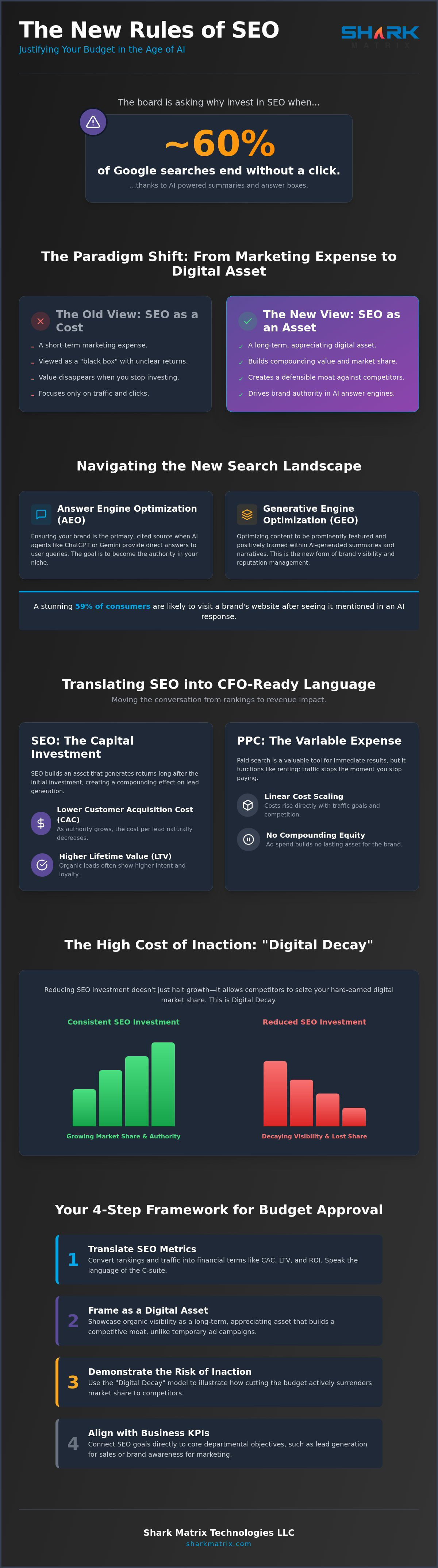
If nearly 60% of Google searches now end without a single click, why should your board keep funding a strategy built on traditional traffic? You’ve likely felt the heat in the boardroom when executives label SEO a black box or suggest shifting your hard-earned funds into short-term PPC wins. The challenge of justifying seo budget to management has become even steeper after the March and May 2026 core updates fundamentally changed how rankings are calculated. It’s frustrating to defend a long-term strategy when the pressure to deliver instant revenue has never been higher.

This guide will show you how to move past the marketing cost stigma by transforming organic search into a defensible business asset. You’ll learn a specific framework for proving ROI that accounts for the rise of Generative Engine Optimization (GEO) and Answer Engine Optimization (AEO). We’ll cover how to demonstrate that organic visibility isn’t just about clicks anymore; it’s about protecting your brand’s future market share in an era dominated by AI-curated summaries and generative search results.

Key Takeaways

  • Learn how to translate technical SEO metrics into CFO-friendly language like Customer Acquisition Cost (CAC) and Lifetime Value (LTV).
  • Discover a step-by-step framework for justifying seo budget to management by treating organic visibility as an appreciating digital asset rather than a monthly expense.
  • Understand the hidden costs of “digital decay” and how reducing investment allows competitors to seize your existing market share.
  • See how to align SEO goals with core departmental KPIs to prove that search authority directly drives lead generation and brand awareness.
  • Find out why modern resource allocation must bridge the gap between traditional search and the emerging world of AI-driven answer engines.

The Shifting Value Proposition: Why SEO is a Defensive Asset in 2026

Management teams often ask if traditional search is losing ground to generative AI. The answer isn’t just that it’s still relevant; it’s that search has evolved into the foundational layer of all digital discovery. When you’re justifying seo budget to management, you aren’t just asking for money to rank for keywords. You’re securing your brand’s authority within the AI models that now dictate consumer choices. Think of Search engine optimization (SEO) as building digital real estate. Unlike PPC, where you stop appearing the moment you stop paying, SEO builds equity. It’s the difference between renting a temporary storefront and owning the land it sits on. As your domain authority grows, the cost per lead naturally drops, creating a defensible asset that appreciates over time.

The “SEO is dead” narrative falls apart when you look at how consumers actually behave in 2026. While it’s true that nearly 60% of Google searches now result in no click due to AI Overviews, this hasn’t erased the value of organic visibility. Research from July 2, 2026, shows that 59% of consumers are likely to visit a brand’s website after it’s mentioned in an AI chatbot response. This means that being the cited source for an AI agent is the new gold standard for traffic. SEO is no longer a “nice to have” marketing channel; it’s the bridge that connects your brand to the AI-driven answer engines of the future.

From Search Engines to Answer Engines (AEO & GEO)

Modern strategies must account for Answer Engine Optimization (AEO). This ensures your brand is the primary source when AI agents like ChatGPT or Gemini provide solutions to users. Generative Engine Optimization (GEO) is the process of optimizing content to be included in AI-generated summaries. By focusing on GEO, you ensure your brand mentions are prioritized in the summaries that users now trust as much as traditional links. This shift is critical for justifying seo budget to management because it proves you’re future-proofing the company’s digital presence against ongoing algorithm shifts.

De-risking the Marketing Mix

Heavy reliance on paid search is a risky bet in a volatile economy. SEO provides a vital buffer against rising PPC auction costs and platform instability. It functions as a multi-channel traffic safety net. If an ad account is flagged or a social platform changes its algorithm, your organic foundation keeps the leads flowing. This organic strength is also the primary driver for online reputation management dubai. When management can see that SEO protects the brand’s image while lowering the overall marketing risk, the budget becomes a strategic necessity rather than an optional expense.

Translating Organic Metrics into CFO-Ready Financial Language

CFOs rarely care about being #1 on a search result page unless that position translates into a lower Customer Acquisition Cost (CAC). When you’re justifying seo budget to management, the conversation must pivot from visibility to financial efficiency. While PPC offers immediate results, it’s a variable cost that scales linearly with volume. SEO, by contrast, is a capital investment that builds a compounding asset. By focusing on justifying your SEO budget in 2026, you can demonstrate how organic search assists conversions across your entire marketing mix. This attribution is vital because organic leads often show higher intent and a superior Lifetime Value (LTV) compared to cold traffic from social ads.

The compounding nature of search is its greatest financial strength. A dollar spent on SEO today continues to drive traffic long after the initial investment, whereas a dollar spent on ads disappears the moment the campaign ends. This long-term efficiency lowers the blended CAC across the entire marketing department. As search algorithms become more sophisticated, the value of high-quality organic authority increases relative to the rising costs of paid auctions. If you’re unsure how to calculate these numbers for your specific niche, Shark Matrix Technologies LLC can help you build a custom ROI projection based on your current performance data.

The Efficiency Gap: SEO vs. PPC Management

In competitive markets like the UAE, the cost-per-click (CPC) for top-tier keywords can be staggering. Relying solely on paid search creates a “PPC Cliff” where lead flow drops to zero the second you stop the spend. Working with a qualified ppc agency dubai is essential for short-term wins, but that strategy is most effective when supported by an organic foundation. This dual approach ensures you aren’t held hostage by rising auction prices and provides a sustainable stream of traffic that doesn’t require a constant increase in ad spend.

Calculating the Long-Term ROI of Search Authority

To speak the language of the board, you should calculate the “Media Value” of your organic traffic. This is the amount you would have to pay in PPC to get the same volume of visitors. When justifying seo budget to management, show them how this Media Value grows month over month while your retainer remains relatively stable. While PPC offers instant entry, a robust organic lead engine typically reaches maturity within 12 to 24 months of consistent investment. By this stage, the organic channel often becomes the most profitable part of the marketing department, providing high-quality leads at a fraction of the cost of paid alternatives.
Justifying Your SEO Budget to Management: The 2026 ROI Framework

The Risk of Inaction: The True Cost of Cutting the SEO Budget

Stopping your organic search investment might look like a quick win for the quarterly balance sheet. It’s actually a decision that triggers a process of “digital decay” that’s incredibly expensive to reverse. When justifying seo budget to management, it’s vital to explain that search visibility isn’t a static trophy you win once. It’s a living ecosystem that requires constant attention. Google’s March and May 2026 core updates proved that the algorithm is now more fluid and AI-driven than ever. If you stop optimizing, your site’s technical health and content relevance begin to erode immediately. This isn’t just about losing a few spots in the rankings; it’s about the compounding loss of brand trust. If customers don’t see your brand in the search results or AI summaries, they often assume you’ve been surpassed by more innovative rivals.

The “Competitor Vacuum” is perhaps the most dangerous consequence of a budget cut. Nature abhors a vacuum, and so does the search results page. When you step back, you create an opening that your rivals will aggressively fill. Reclaiming a top position is often three times harder than maintaining one. You aren’t just starting from zero; you’re fighting against the momentum of a competitor who has already secured the click-through data and user signals you once owned. This “re-entry” cost often dwarfs the original budget you sought to save, making a pause in services a poor long-term financial move. Justifying seo budget to management becomes much easier when you frame it as a necessary expense to protect your existing market share from aggressive conquesting.

Technical Debt and Site Performance

Maintaining high-performance website design and development services is a non-negotiable part of search health. Without regular audits, technical debt accumulates, slowing down site speed and damaging Core Web Vitals. Google’s 2026 updates have placed an even greater emphasis on user experience (UX) as a direct ranking factor. These technical foundations are also a prerequisite for mobile app development services visibility. If your underlying site architecture fails, your entire digital presence, including your app’s discoverability, suffers alongside it.

Competitor Displacement in the UAE Market

National brands in the UAE are aggressively scaling their organic presence to capture a redistribution of search behavior. If you aren’t active, you risk losing “Brand Search” results to competitors running aggressive conquesting campaigns. These rivals often create content specifically designed to intercept your potential customers at the point of intent. Reclaiming the #1 spot in a saturated national market requires far more resources than simply staying there. Consistency is the only way to ensure your brand remains the authoritative voice in your industry.

Building the Business Case: A Framework for Resource Allocation

To move from a defensive stance to an offensive growth strategy, you need a pitch that speaks to market share rather than just rankings. Start by auditing your “Organic Market Share” against the total addressable market. If your top three competitors are capturing 40% of the search volume while you’re at 5%, you have a clear gap to exploit. This data makes justifying seo budget to management much simpler because it highlights a tangible loss of opportunity. Align these findings with departmental KPIs; if the sales team needs to increase lead volume by 15%, show exactly how an expanded SEO footprint provides the most cost-effective path to that goal. Presenting a tiered budget helps management choose their level of aggression: a maintenance tier to protect current assets, a growth tier to capture new keywords, or a leadership tier to dominate the AI-driven search results of 2026.

The Arabic Search Moat

For national brands in the UAE, the “Arabic Search Advantage” is a massive, underutilized asset. Many global competitors focus solely on English, leaving a blue ocean of opportunity for those who invest in high-quality localized content. Arabic search authority creates a defensible barrier that international rivals can’t easily replicate with simple translation tools. By securing this regional authority, you build a “moat” around your brand that protects your market share across the GCC. This localized strategy is essential for capturing high-intent users who prefer searching in their native language, providing a level of brand loyalty that English-only sites simply can’t match.

Integrating AI Automation into the SEO Budget

Modern resource allocation must include Ai automation and development to remain competitive. AI-powered tools have been found to reduce the cost of routine SEO tasks by 20-30%, allowing your budget to stretch further into high-impact creative work. Using AI for large-scale technical audits and data analysis isn’t just an efficiency play; it’s an innovation play that appeals to forward-thinking management teams. When you show that your strategy uses machine learning to predict algorithm shifts and optimize content at scale, you position SEO as a high-tech business driver rather than a legacy marketing tactic. If you’re ready to see how these technologies can transform your performance, request a custom search authority audit to identify your biggest growth opportunities.

Success in the first six months should be measured through clear milestones. Months one through three should focus on technical remediation and Answer Engine Optimization (AEO) to secure quick wins in AI summaries. Months four through six should shift toward building content authority and measuring the growth in “Organic Market Share” compared to your initial audit. By setting these expectations early, you build the trust necessary to sustain long-term investment. Clear milestones prevent management from viewing SEO as a “slow” channel and instead frame it as a disciplined, phased approach to market leadership.

Partnering for Performance: How Shark Matrix Technologies LLC Secures Your Search Authority

Shark Matrix Technologies LLC approaches search as a performance marketing channel rather than a simple traffic generator. We understand that justifying seo budget to management requires more than just ranking reports; it requires clear, data-backed evidence of business growth and financial efficiency. We focus on building AI-ready content structures that satisfy both traditional search algorithms and modern generative engines. Our team specializes in the technical nuances that ensure your site is readable for both humans and AI agents. By providing CFO-ready ROI dashboards, we make it easy to show how every dirham spent translates into long-term digital equity and a lower blended Customer Acquisition Cost (CAC).

Our specialized Arabic digital marketing gives national brands a distinct edge in the UAE market. We don’t just translate content; we build authority in the native language of your primary audience. This deep market penetration is a key component in justifying seo budget to management, as it targets high-value segments that global competitors often overlook. We combine this regional expertise with transparent reporting that highlights your growing “Organic Market Share,” giving your board the confidence to sustain and scale their investment through 2026 and beyond.

End-to-End Search Strategy

A successful search strategy doesn’t exist in a silo. It requires a seamless integration of technical audits, content marketing, and online reputation management. Shark Matrix Technologies LLC works closely with our clients to align their search goals with high-performance website design and development services. This holistic approach ensures that your technical foundation is strong enough to support your content ambitions and user experience requirements. We’re committed to long-term brand growth in the UAE, helping you build a digital presence that remains resilient through every major algorithm update.

Ready to Secure Your 2026 SEO Budget?

Building an internal business case for SEO can be a daunting task when faced with pressure for short-term results. Shark Matrix Technologies LLC is here to help you navigate the boardroom by providing customized ROI projections tailored to your brand’s specific market position and goals. We provide the data, the frameworks, and the strategic insights you need to win management approval and secure the resources your brand deserves. Don’t let your digital authority decay while competitors move forward with aggressive conquesting campaigns. Contact Shark Matrix Technologies LLC for a Strategic SEO Consultation and let’s transform your search strategy into a defensible business asset today.

Secure Your Brand’s Digital Real Estate for 2026

The shift from chasing clicks to building search authority requires a new way of thinking about ROI. You’ve seen how justifying seo budget to management works best when you treat organic search as a compounding business asset rather than a monthly marketing cost. By focusing on financial language like Customer Acquisition Cost and protecting against digital decay, you can demonstrate the true value of your search presence. Don’t let your brand’s visibility fade as competitors move into the AI-generated summaries and Arabic search spaces you should own.

Since 2010, Shark Matrix Technologies LLC has provided national brands with the tools to dominate their niche. Our expertise in Arabic digital marketing and full-stack AI automation ensures your content isn’t just seen; it’s cited as the authoritative source. We’re ready to help you build a defensible search strategy that wins management approval every single time. It’s about more than rankings. It’s about protecting your digital future.

Secure your brand’s future with a data-driven SEO strategy from Shark Matrix Technologies LLC

You have the framework and the data to make your case. Now is the time to turn your search strategy into a permanent competitive advantage that drives growth for years to come.

Frequently Asked Questions

How long does it realistically take to see ROI from an SEO budget?

You should expect to see measurable ROI from an SEO budget within 6 to 12 months of consistent investment. While technical fixes can provide quick wins in site speed and indexation, building the search authority needed to dominate competitive niches is a gradual process. This timeline is essential when justifying seo budget to management as a long-term capital investment rather than a short-term expense.

Why should we invest in SEO if we are already seeing success with PPC?

Investing in SEO alongside PPC lowers your blended Customer Acquisition Cost (CAC) and protects you from rising auction prices. PPC is a variable cost that stops delivering leads the moment you stop paying. SEO builds a permanent digital asset that continues to drive traffic over time. This creates a diversified marketing mix that isn’t entirely dependent on ever-increasing ad budgets to maintain lead flow.

Is AI search going to make our SEO budget obsolete by 2027?

AI search won’t make your budget obsolete; it will simply shift your focus toward new optimization standards. Research from July 2, 2026, shows that 59% of consumers are likely to visit a brand’s website after it appears in an AI chatbot response. Your budget will evolve to cover Generative Engine Optimization (GEO) to ensure your brand remains the primary cited source for these AI agents.

How much of our total marketing budget should be allocated to SEO?

Most high-growth companies allocate between 10% and 20% of their total marketing budget to organic search. This allocation provides enough resources for technical maintenance, AI-ready content, and regional authority building. For many small businesses, this translates to a monthly spend of $2,500 to $5,000, while enterprise-level campaigns generally start at $10,000 per month to maintain a competitive edge in saturated markets.

What are the most important SEO KPIs for senior management to track?

Senior management should focus on Organic Market Share, Customer Acquisition Cost (CAC), and Lifetime Value (LTV) of organic leads. These metrics are far more effective for justifying seo budget to management than simple keyword rankings. By tracking how organic search assists conversions in other channels, you can prove that SEO is a performance driver that improves the efficiency of the entire marketing department.

Can we do SEO in-house, or do we need a specialized agency?

While some basic tasks can be handled in-house, the complexity of 2026 search requirements often necessitates a specialized agency. Modern search strategies require a mix of technical web development, AI automation, and specialized Arabic marketing expertise. An agency provides access to enterprise-level data tools and a broad team of specialists that would be significantly more expensive to hire as full-time internal staff.

How does SEO impact our brand’s online reputation in the UAE?

SEO is the foundation of online reputation management because it allows you to control the first page of search results for your brand name. By outranking irrelevant or negative content, you ensure that potential clients see your authoritative voice first. In the UAE market, localized search authority is particularly vital for building trust and establishing your brand as a leader within the regional digital ecosystem.

What is the difference between SEO and Generative Engine Optimization (GEO)?

SEO focuses on ranking links within traditional search engine results pages, while GEO focuses on being included and cited within AI-generated summaries. GEO is a newer discipline that prioritizes machine readability and structured data so that AI models can easily interpret your content. Both strategies are necessary in 2026 to capture users who still use traditional search bars and those who prefer AI-powered chatbots.