

Categories
SEO

Technical SEO Audit Checklist: 5 Steps to Find and Prioritize Issues in 2026

A ranking dip may not be the real problem. Important pages might be difficult to crawl or may not be indexed as intended. A technical seo audit checklist helps you distinguish these technical barriers from ordinary fluctuations, so you can investigate the right issues before making changes.

Audit tools can return long lists of warnings without explaining what matters. Fixes may also involve developers, and changing the wrong setting can create new problems. Work through checks in a consistent order: begin with crawlability and indexability, then investigate architecture, performance, rendering, and lower impact refinements.

This guide takes you through five steps to assess affected pages, weigh potential impact against implementation risk, and turn verified findings into clear tasks. You’ll also learn how to validate fixes after deployment. The aim is a prioritized action plan, not another audit report full of issues you’re unsure how to handle.

Key Takeaways

  • Set an audit goal and select representative URLs and templates first, so your review focuses on pages that matter.
  • Use a technical seo audit checklist to examine crawl access, sitemap entries, canonical signals, and internal paths to priority pages.
  • Check Core Web Vitals, mobile behavior, and JavaScript rendered content for issues that may affect visitors or search engine understanding.
  • Verify tool warnings by checking evidence, the number and importance of affected URLs, and potential user impact.
  • Turn confirmed findings into a fix plan that considers severity, effort, and confidence, then retest key pages after changes go live.

Technical SEO Audit Checklist: Define Scope Before Checking the Site

Before opening a crawler or reviewing warnings, decide what the audit needs to answer. Are you investigating a drop in indexed pages, checking launch readiness, diagnosing an organic decline, or reviewing routine technical health? Your goal determines which pages and evidence deserve attention. Technical SEO can involve crawl access, indexing, site architecture, and rendering, so setting boundaries helps keep the review useful rather than endless.

How to scope a technical SEO audit

Record the audit date, the domains or subdomains in scope, and the page groups that matter to the business. For an online store, this might include key category and product pages, as well as the steps users take to complete a purchase. For a service site, include important service pages and the paths visitors use to reach enquiry forms.

Sample every important page template, but don’t treat a sample as a substitute for crawling the full accessible site. A shared template issue may affect many URLs, while a problem on one page may be isolated. Note the CMS, how much content depends on JavaScript, and any recent releases, redesigns, migrations, or other technical changes. Compare those events with known traffic or indexing changes to give findings useful context.

What evidence to collect before the checklist

Gather Google Search Console information related to your audit goal, including indexing signals, sitemap details, and performance trends. Save crawler exports and relevant analytics context, along with examples of affected URLs. If a category appears to have lost visibility, record representative URLs and compare them with pages on other templates. This helps you investigate patterns instead of reacting to a single warning.

Start a finding log before deciding what to fix. For each item, capture:

  • Evidence: The report, observation, or URL that supports the finding.
  • Impact: The important pages or user journeys potentially affected.
  • Confidence: Whether the finding is confirmed, a crawler warning, a hypothesis, or awaiting manual verification.
  • Owner and status: Who will investigate or implement the change, and where it stands.
  • Retest date: When to check the affected URLs again after a change.

This distinction prevents an automated warning from becoming a rushed developer task without verification. A practical technical seo audit checklist connects each issue to evidence and affected pages, while clearly marking uncertain findings for investigation. That shared record gives site owners, SEO specialists, and developers a common starting point for the checks that follow.

Crawlability and Indexability: Check Whether Search Engines Can Access Key Pages

First check whether search engines can reach the pages that matter. Then check whether those pages are eligible to appear in results. These are related but different questions: robots.txt can restrict crawling, while a noindex directive asks search engines not to index a page they can access. Google’s Google Search Essentials explains the core requirements for appearing in Google Search. Use it as a reference, then assess each finding against the site’s intended behavior.

Are important pages crawlable and indexable?

Check priority URLs individually and through a site crawl. Confirm that they return the expected response, usually 200, and aren’t blocked by a robots.txt rule, a meta robots directive, or an X-Robots-Tag response header. Review access rules for important sections, not just the homepage. A blocked page may still appear in search results without a snippet, so a robots.txt restriction isn’t a substitute for a noindex directive.

Next, compare Google Search Console’s indexing reports with the site owner’s intent. Use URL Inspection on representative pages to check Google’s reported indexing status and, where available, the tested live page. An excluded URL isn’t automatically an error: filters, duplicate pages, and intentionally removed content may be excluded by design. Investigate patterns, such as valuable category pages being excluded, and confirm whether those URLs can be reached through internal links.

Do canonicals, redirects, and sitemaps send consistent signals?

For each important page, compare its canonical target with its redirect destination, internal links, and XML sitemap entry. These signals should point to the same preferred, indexable URL. For example, if a sitemap lists a URL that redirects to another page, update the sitemap to list the final destination. Look for redirect chains, loops, and destinations that no longer serve users.

Check that sitemap URLs return successful responses, aren’t blocked or marked noindex, and identify themselves as canonical. Confirm that the sitemap is accessible and referenced in robots.txt where appropriate. A mismatch doesn’t always mean a page is broken, but it does need investigation.

  • Access: Can crawlers reach the intended page?
  • Indexability: Do page directives allow indexing?
  • Signals: Do canonicals, redirects, internal links, and sitemap entries agree?

Use this sequence in your technical seo audit checklist to distinguish genuine visibility barriers from intentional exclusions. When crawl or indexation issues involve complex site changes, professional SEO support from agencies like Web Media Grp. can help teams investigate findings and coordinate next steps.
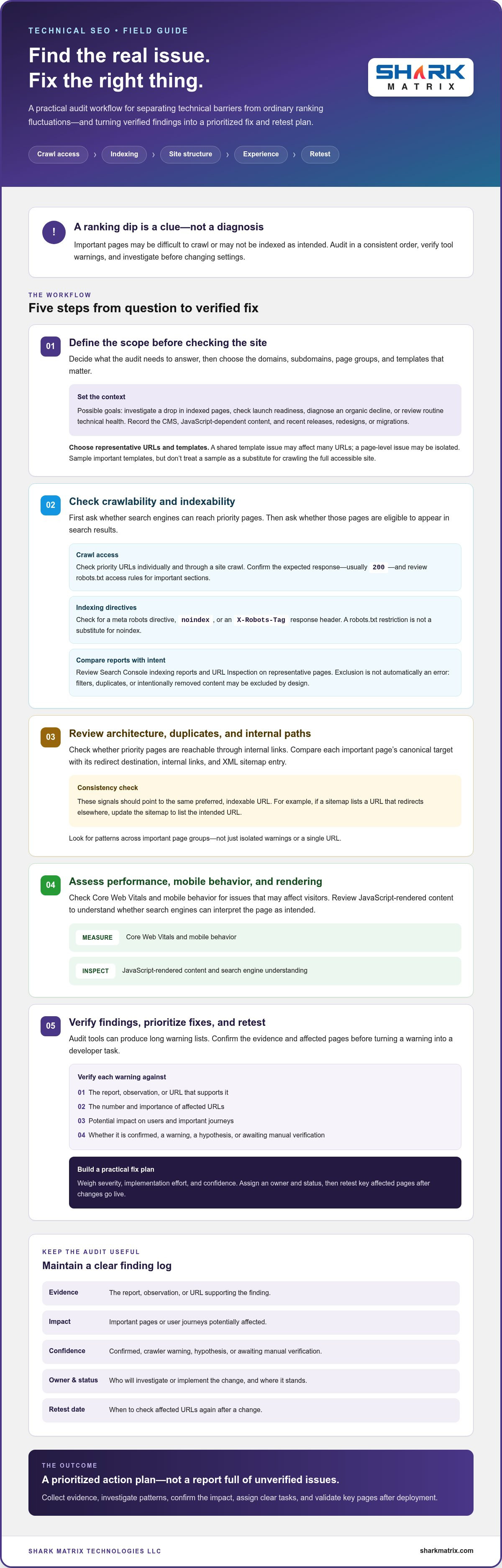
Technical SEO Audit Checklist: 5 Steps to Find and Prioritize Issues in 2026

A page may be crawlable but still difficult to discover if it sits deep in the site or has no internal links pointing to it. Map the main page templates and trace how visitors and crawlers can reach priority content through relevant navigation, category pages, or related resources. The goal isn’t to make every URL equally prominent. It’s to give valuable pages clear, useful paths.

How to find weak internal linking and orphan pages

Compare the URLs found in a site crawl with sitemap entries and your known priority pages. If a priority URL appears in the sitemap but not in the crawl, it may lack internal links or be inaccessible to the crawler. Check whether key pages receive contextual links from relevant sections, then inspect pagination and filters. Useful category links can help discovery, while endless combinations of filters may create many low value URLs.

Use click depth as a diagnostic, not a rigid pass or fail threshold. If an important page takes several navigation steps to reach, consider whether a relevant category, menu, or related page should link to it. Test internal links for broken destinations and inconsistent URL formats, such as links that alternate between trailing slash and non trailing slash versions.

How to assess duplicate URLs and canonical choices

Look for URL variations that may expose the same or near identical content: tracking or filter parameters, uppercase and lowercase paths, trailing slash differences, and HTTP versus HTTPS versions. Check that canonical tags point to the intended preferred URL, and that each target resolves correctly rather than redirecting, returning an error, or pointing to an unrelated page. Don’t apply a blanket canonical or noindex rule without checking how each template is designed to work and how its pages appear in search.

Use a compact evidence log to connect patterns to investigation and action:

  • Pattern: A priority page has no internal links.
  • Evidence: It appears in the sitemap but not among the crawl’s linked URLs.
  • Likely impact: Discovery may depend on the sitemap or external links instead of site navigation.
  • Verify: Check the page’s purpose, then add a relevant contextual link if it should be discoverable.

Other patterns to record: Parameter URLs with duplicate content, inconsistent canonical targets, and broken internal links. For each pattern, note the affected template, compare representative URLs, and confirm the intended behavior with the site owner before recommending a change. This makes the technical seo audit checklist more useful than a raw list of crawler alerts.

Technical SEO Checks for Core Web Vitals, Mobile, and JavaScript Rendering

Test actual page templates, not just the homepage. In Google Search Console, review Core Web Vitals field data where available. Google’s “Good” thresholds are LCP at or below 2.5 seconds, INP at or below 200 milliseconds, and CLS at or below 0.1, measured at the 75th percentile of real user page loads. Field data reflects users’ experience. A lab test is a controlled snapshot that helps reproduce and investigate a problem. Treat them as complementary evidence, not interchangeable scores.

How to investigate page experience and mobile issues

Group affected URLs by shared template before proposing a sitewide fix. If product pages show layout shifts, compare several products to see whether the cause is a shared image area, banner, or component. On mobile, check viewport behavior, text and navigation visibility, intrusive overlays, and key interactions such as opening menus or submitting forms. Google uses mobile versions for indexing and ranking, so confirm that important content and functionality are available on mobile too.

Use field reports to spot patterns and lab testing to investigate specific pages or interactions. After a performance or layout change, retest representative mobile pages and make sure the change hasn’t introduced new usability problems.

How to check JavaScript rendering and structured data

For templates that rely on JavaScript, compare the initial HTML with the rendered page. Confirm that essential text, links, titles, and other metadata are present after rendering, and that important content isn’t hidden behind an interaction or dependent on a failed script. Treat a crawler warning as a lead, not proof. Check the page as delivered and as rendered, then note the affected template and example URLs.

Review structured data for errors and confirm that it describes information users can actually see on the page. For example, don’t mark up a product detail that isn’t visible to visitors. Valid markup may make a page eligible for enhanced search appearances, but it doesn’t guarantee rich results.

  • Record: The affected template and representative URLs.
  • Compare: Field data, lab results, mobile behavior, and rendered content.
  • Verify: Retest after changes and check that visible content matches structured data.

These checks help your technical seo audit checklist distinguish template wide problems from isolated page issues. If resolving a rendering or mobile problem requires development work, coordinate with your development team to plan and validate the technical changes.

Turn Technical SEO Audit Findings into a Prioritized Fix and Retest Plan

An audit creates value when its findings lead to safe, verifiable changes. Start with confirmed blockers affecting valuable pages, then look for repeated problems across shared templates and issues that disrupt user journeys. A warning on a low value URL may matter less than a verified indexing problem affecting an important page. Keep severity, implementation effort, and confidence separate: a high impact issue may still need more investigation before anyone changes the site.

How to prioritize technical SEO issues

Group findings by root cause and affected template. One verified fix to a shared page template may resolve a pattern across many URLs, while unrelated symptoms may need separate tasks. Put access or indexability blockers on priority pages near the top of the queue. For each proposed change, record the evidence, example URLs, expected behavior, owner, and how the team can roll it back if a release causes an unexpected problem.

Write tickets that give a developer enough detail to act without guessing. Identify the affected template, show a representative URL, describe the current and intended behavior, and list the validation steps. Coordinate changes involving routing, rendering, or deployment with the people responsible for those systems. A tool’s severity label alone isn’t a reason to change production code.

When to get specialist technical SEO support

What to do after the audit

Retest changes in staging when appropriate, then verify them in production after release. Check the same URLs or templates against the original evidence, confirm the intended behavior, and update the finding log with the result and retest date. Continue monitoring important pages so a later release doesn’t quietly reintroduce the issue.

Use the technical seo audit checklist as a working record, not a one time scorecard. When a fix requires development work, coordinate with your development team to plan and validate the implementation. To discuss the next steps for your audit, discuss your technical SEO priorities.

Turn Your Audit into a Clear Next Step

A useful technical seo audit checklist does more than surface warnings. It helps you define what matters, verify whether key pages can be crawled and indexed, and identify patterns in site architecture, performance, mobile experience, and rendering. Then prioritize confirmed issues by impact and affected pages, give developers clear tasks, and set criteria for retesting.

Keep audit findings visible after implementation. Rechecking affected URLs and templates helps confirm that fixes worked and gives your team a practical reference for future releases. Technical SEO often involves collaboration between site owners, SEO specialists, and developers, especially when changes affect important templates or site behavior.

Shark Matrix Technologies LLC offers SEO services, along with web and e-commerce development services for businesses working on search and site implementation. If you’d like support assessing your findings or planning next steps, discuss your technical SEO priorities.

Start with the pages and issues that matter most, and turn each verified finding into a manageable improvement. A clear plan makes the next step easier to take.

Frequently Asked Questions

What should a technical SEO audit checklist include?

A technical SEO audit checklist should cover audit scope, crawl access, indexability, response codes, redirects, canonicals, sitemaps, site architecture, internal links, mobile usability, performance, JavaScript rendering, and structured data. Start with pages that matter to the business, then check representative templates and investigate patterns across the site. Record evidence and affected URLs for each finding so the audit leads to verified, prioritized tasks rather than an unfiltered list of tool warnings.

How do I check if a page is crawlable and indexable?

Check whether the page loads successfully, whether robots.txt allows crawling, and whether a meta robots directive or X-Robots-Tag header prevents indexing. Confirm that the page has a discoverable internal link and inspect its status in Google Search Console using URL Inspection. Compare the reported canonical with the URL you intend to appear in search. A page’s exclusion isn’t necessarily an error, so check whether it matches the site owner’s intent.

How often should I run a technical SEO audit?

There’s no single schedule that suits every website. Review technical health routinely, and run a focused audit after a migration, redesign, major release, or unexpected change in traffic or indexing. Large sites or websites with frequent technical updates may need more regular checks than a stable, smaller site. Between audits, monitor important URLs and Search Console reports so emerging patterns are noticed and investigated before the next full review.

Can technical SEO issues prevent a page from appearing in Google Search?

Yes. A page may be difficult to discover if internal links are missing, inaccessible if crawling is blocked, or ineligible for indexing if a noindex directive is present. Errors, redirect problems, and conflicting canonical signals can also affect how Google processes a URL. But not every excluded page signals a problem. Check the page’s purpose, directives, and Search Console status before deciding whether its absence from results needs a fix.

What is the difference between crawlability and indexability?

Crawlability is whether a search engine can access and fetch a URL. Indexability is whether the page can be considered for inclusion in search results. A robots.txt rule can prevent crawling, while a noindex directive tells a crawler not to index a page it can access. These controls serve different purposes. Check both, because a page that’s crawlable isn’t automatically indexable, and a page blocked from crawling may not communicate its other directives.

How do I prioritize technical SEO audit issues?

Start with confirmed access or indexability problems affecting valuable pages, then assess how many URLs or templates share the issue and whether it harms user journeys. Separate impact from implementation effort and confidence: a potentially serious finding may need verification before a developer acts. Record evidence, example URLs, an owner, expected behavior, and retest criteria. This turns an audit inventory into manageable tasks and helps teams avoid rushed changes based only on a tool’s severity label.

Do I need a technical SEO tool to audit my website?

How can I check whether Google can render JavaScript content?

Use URL Inspection in Google Search Console to test a live URL and review the rendered result where available. Compare what appears after rendering with the initial HTML, paying attention to essential text, links, and metadata. Google may process JavaScript after first crawling a page, so some content can take longer to be discovered. If key elements are missing, record the affected template and example URL, then investigate scripts or resources that may be preventing rendering.

Categories
SEO

The Strategic Role of a Technical SEO Consultant for National UAE Brands in 2026

Over 80% of local searches in Dubai now begin on a mobile device, according to Darwaish Technologies. If your site’s infrastructure isn’t flawless, you’re likely losing four out of five potential customers before they even see your homepage. You’ve probably noticed that traditional keyword strategies aren’t enough to sustain growth anymore. It’s common to feel a sense of friction when your development team doesn’t quite grasp SEO requirements, leading to performance bottlenecks that stall your rankings. Hiring a specialized technical seo consultant is the key to breaking through these plateaus. They identify the hidden structural issues that prevent search engines from crawling your site efficiently.

You likely agree that staying ahead of AI-driven search is the biggest challenge for national brands this year. This article promises to show you how a technical expert unlocks enterprise-scale growth and ensures your site is ready for Generative Engine Optimization (GEO). We’ll provide a clear roadmap for infrastructure optimization and explain how to maintain visibility while complying with the UAE Media Council’s mandatory Advertiser Permit regulations which took effect in February 2026.

Key Takeaways

  • Learn why your website’s backend architecture is the foundation for visibility in AI-driven search results like Generative Engine Optimization.
  • Understand how a professional technical seo consultant bridges the gap between your marketing strategy and web development team to eliminate performance bottlenecks.
  • Discover why log file analysis is essential for seeing exactly how modern search engines crawl and render your enterprise-scale content.
  • Gain a clear roadmap for infrastructure optimization that prepares your national brand for the high-speed demands of Answer Engine Optimization.
  • See how integrating custom AI automation and development can accelerate the implementation of complex technical fixes across your digital ecosystem.

What is a Technical SEO Consultant and Why Does a National Brand Need One?

A technical seo consultant serves as the vital link between your high-level marketing goals and the complex world of web engineering. While a content strategist focuses on what you say, the consultant ensures search engines can actually find, understand, and trust your digital assets. This role goes far beyond simple metadata. It’s about optimizing server responses, site architecture, and multilingual signals to ensure your brand remains visible across the entire Emirates. In a competitive market like the UAE, having a site that simply “exists” isn’t enough; it must be built to perform under the pressure of massive traffic and complex data sets.

Think of Search Engine Optimization (SEO) as a two-part system. Content-driven SEO builds the brand’s voice, but technical SEO builds the infrastructure that carries that voice. For national UAE brands, this distinction is critical. When you’re managing tens of thousands of pages across different regions, a single misconfiguration in your robots.txt or a slow-loading JavaScript framework can silence your entire organic presence. Establishing “Digital Health” is the mandatory starting point for all other search engine optimization seo services. Without it, your marketing budget is effectively wasted on a foundation that can’t support growth.

The Evolution of Technical SEO in 2026

By 2026, the landscape has shifted. Search engines aren’t just looking for keywords anymore; they’re feeding data into Large Language Models (LLMs). A technical seo consultant now focuses on data accessibility and semantic clarity. It’s no longer enough to have a site that loads. Your site must be structured so AI agents can extract information instantly. National enterprises can’t afford “set and forget” setups. With search algorithms updating almost weekly, your infrastructure needs constant tuning to ensure your brand stays at the top of AI-generated summaries and local search results.

Signs Your Business Has Outgrown General SEO

Many large UAE businesses find that their organic growth hits a wall despite producing high-quality content. This usually happens because of “Crawl Budget Waste.” If search engine bots are spending their limited time on low-value pages or getting stuck in redirect loops, they’ll never reach your newest product launches. You might also notice that your internal development team’s fixes are inadvertently hurting your rankings. Developer-led SEO often prioritizes code elegance over search visibility, creating technical debt that erodes your brand’s authority. When your site performance starts affecting user trust and conversion rates, a generalist approach is no longer sufficient for your national scale.

Core Pillars of Technical SEO: From Crawlability to GEO

The “Crawl, Index, Render” cycle remains the heartbeat of organic visibility. While many agencies focus only on the first two steps, a technical seo consultant understands that rendering is where modern search engines often stumble. If your site relies heavily on JavaScript, search bots might see a blank page where your content should be. This makes Server-Side Rendering (SSR) a critical requirement for national portals that need to ensure every page is fully visible to crawlers immediately. Without proper rendering, your most valuable content stays invisible to the algorithms that drive traffic.

The importance of technical optimization can’t be overstated when you’re managing thousands of URLs across the UAE. Even items on a standard on page seo checklist, such as title tags and internal links, are useless if the underlying code prevents them from being indexed. By 2026, technical health also dictates your success in Generative Engine Optimization (GEO). AI search engines require clean, structured data to extract your brand’s information accurately and present it in AI-generated overviews.

Optimizing for AI: AEO and GEO Readiness

AI agents don’t browse websites like humans; they consume data. Using Schema.org structured data is no longer optional. It’s the primary language for AI search. To appear in “Answer Boxes” or AI summaries, your data provenance must be clear and verifiable. A technical seo consultant ensures your brand is recognized as a distinct entity, providing the clarity needed for search engines to trust your information as a primary source. This entity-based approach is what separates national leaders from the rest of the market.

Performance and Core Web Vitals at Scale

For large-scale sites, speed is a ranking factor that directly impacts the bottom line. Core Web Vitals serve as the primary metric for user-centric technical health. Issues like Largest Contentful Paint (LCP) or Cumulative Layout Shift (CLS) often plague complex national portals with dynamic content. These performance gaps are especially damaging for ecommerce seo services dubai, where a one-second delay can lead to significant drops in conversion rates. If your site feels sluggish, it’s often a sign that your underlying web design and development needs a technical audit to ensure it supports rapid load times at scale.

The Strategic Role of a Technical SEO Consultant for National UAE Brands in 2026

Technical SEO Consultant vs. Generalist Agency: Why the Distinction Matters

Choosing between a generalist agency and a specialized technical seo consultant often determines whether a national brand scales or stalls. While generalists offer broad packages that cover everything from social media to blog posts, they often lack the forensic capabilities required for complex infrastructure. A consultant doesn’t just look at ranking reports. They dive into server logs and API-driven crawlers to understand exactly how Googlebot interacts with your site. This level of depth is vital for UAE enterprises that manage thousands of dynamic pages across diverse service areas.

A common question from leadership is why their existing development team can’t handle these tasks. Developers are experts at building functional, beautiful websites, but their priority is usually user experience and code stability. They don’t always realize that a perfectly functional feature might be invisible to a search engine. A technical seo consultant acts as the architect, ensuring that new code doesn’t create technical debt. They aren’t there to replace your developers; they’re there to provide the specific search-centric requirements that prevent traffic loss during site updates.

The Specialized Toolset of the Technical SEO Expert

Standard SaaS SEO tools often struggle with the sheer volume of data on a national brand’s website. They provide surface-level audits that miss deep-seated issues like render-blocking scripts or complex redirect chains. Experts use headless browsers to simulate how search engines see JavaScript and log file analyzers to track bot behavior in real-time. At Shark Matrix, we integrate ai automation services to monitor these technical health signals. This allows us to catch infrastructure shifts before they impact your rankings, providing a level of precision that generalist agencies can’t match.

Bridging the Gap Between Marketing and Development

The most effective consultants serve as a bridge between your marketing and engineering departments. They’re “SEO Translators” who understand business KPIs and can turn them into actionable technical specifications. Instead of overwhelming your team with a list of a thousand errors, a consultant prioritizes fixes based on ROI. They understand that fixing a sitewide indexing issue is more valuable than tweaking a few meta descriptions. This collaborative approach ensures that your development resources are spent on the tasks that will actually move the needle for your brand’s organic growth.

The Technical SEO Audit Framework: A Consultant’s Roadmap

A national-scale audit requires more than a standard checklist. It’s a forensic investigation into how search engines interact with your infrastructure. While basic tools provide a snapshot, hiring a technical seo consultant ensures you’re looking at the raw data found in server logs. Log File Analysis is the only way to see exactly how bots behave on your site. It reveals if they’re wasting time on irrelevant pages or if they’re failing to reach your high-priority service areas. This transparency allows you to restructure your internal linking hierarchy to prioritize the pages that actually drive revenue. Understanding how to translate these findings into a prioritized seo audit report that resonates with your C-suite is just as critical as the audit itself.

An effective roadmap moves from the server level up to the data layer. By aligning your site architecture with user intent and search engine requirements, you create a foundation for long-term growth. This process is essential when evaluating the best seo services in dubai, as a provider’s ability to execute a deep technical audit often dictates your brand’s national visibility.

Phase 1: Infrastructure and Server Analysis

The first phase focuses on the physical and virtual environment hosting your brand. We evaluate server response times and the adoption of modern protocols like HTTP/3 to ensure lightning-fast connectivity across the UAE. We also scrutinize SSL configurations and redirect patterns. Eliminating redirect chains is a priority here; these chains drain your crawl budget and frustrate users. For national brands, we specifically look for server-side errors that only trigger during high traffic loads, ensuring your site remains stable during major marketing campaigns.

Phase 2: Content Accessibility and Rendering

Phase two shifts to how search engines “see” your content. Many modern UAE websites use JavaScript-heavy frameworks that can be difficult for bots to render correctly. We test these elements to ensure your content isn’t trapped behind unreadable code. We also identify thin or duplicate content issues that often arise from complex URL parameters in large e-commerce or service directories. Canonical tags serve as a definitive signal to search engines, preventing ranking cannibalization by identifying the primary version of a page across vast national service directories.

Phase 3: Data Structuring and Schema Implementation

The final phase prepares your site for AI-driven search. We audit your existing Schema markup to ensure it’s error-free and comprehensive. By mapping out an entity-based SEO strategy, the expertise of a technical seo consultant allows your brand to be recognized as a topical authority by modern LLMs. We prioritize these technical fixes based on their potential ROI, focusing first on the sections of your site that generate the most business value. To begin optimizing your infrastructure, partner with an expert today.

Future-Proofing Your National Brand with Shark Matrix

Shark Matrix isn’t your typical marketing agency. We’ve built our reputation on a unique blend of custom software engineering and high-level search strategy. When you hire a technical seo consultant from our team, you’re getting someone who understands the code as well as the algorithm. Most agencies hand over a PDF of errors and leave your developers to figure it out. We don’t do that. Because we have deep expertise in engineering, we have the in-house capability to implement the very fixes we recommend. This seamless integration removes the friction that often stalls national growth.

National brands in the UAE face unique challenges. You’re managing data signals across seven emirates while navigating a rapidly changing regulatory environment. Our National Growth mindset focuses on building a digital architecture that isn’t just stable for today but scalable for the next decade. We treat SEO as a core piece of your business infrastructure. It’s the engine that drives your organic discovery; like any high-performance engine, it requires expert tuning from specialists who know how every component works together.

Why Shark Matrix for National Technical SEO?

Our background in custom engineering means we approach every audit with a builder’s perspective. When you work with a technical seo consultant at Shark Matrix, you benefit from our experience managing high-traffic portals for some of the region’s largest enterprises. This gives us deep insight into the specific bottlenecks that affect UAE-based servers. We use a data-first approach to ensure every recommendation is backed by evidence from your own log files and traffic patterns. By combining our specialized tools with traditional search strategies, we provide real-time monitoring that generalist agencies simply can’t offer.

Preparing for the Next Decade of Search

The future of search is conversational and generative. This is why our ai development services are so critical to our technical SEO process. We help you prepare for AEO and GEO by structuring your data for machine learning models to consume. This predictive maintenance approach ensures your brand remains a recognized authority as search engines evolve into answer engines. If you’re ready to stop reacting to algorithm updates and start leading your industry, it’s time to shift your strategy. Partner with Shark Matrix for a Technical SEO Consultation and build the foundation your national brand deserves.

Mastering the Digital Infrastructure of the Emirates

Winning the search landscape in 2026 requires more than high-quality content. It demands a flawless technical foundation that enables AI agents and search bots to navigate your brand’s data at scale. You’ve seen how specialized audits and log file analysis reveal the hidden bottlenecks that stall national growth. By focusing on infrastructure, you ensure your site remains visible in a market increasingly dominated by generative search results. This shift from keyword density to data accessibility is the defining factor for enterprise success this decade.

A professional technical seo consultant acts as the architect of this growth, bridging the gap between your marketing vision and your site’s engineering. Shark Matrix has been at the forefront of this evolution since 2010. With over 15 years of UAE market expertise and an in-house team dedicated to custom software and AI development, we provide the technical depth required for modern success. We specialize in AEO and GEO to keep your brand ahead of the curve as search behavior continues to change.

Elevate your brand’s digital architecture with Shark Matrix’s technical SEO experts.

Investing in your site’s health today ensures a dominant organic presence for years to come. Your journey toward technical excellence starts with a single step toward a more resilient infrastructure.

Frequently Asked Questions

What is the primary difference between a general SEO and a technical SEO consultant?

A generalist typically handles content strategy and keyword research, whereas a technical seo consultant manages the backend infrastructure. They focus on server logs, JavaScript rendering, and site architecture to ensure search engines can access your data. This role is about building the digital foundation that allows your content to rank in a competitive national market. They act as the bridge between your marketing goals and your web engineering team.

How long does it typically take to see results from a technical SEO audit?

Results from a technical audit usually become visible within 3 to 6 months. Some fixes, like repairing server errors, can provide immediate improvements in site stability. However, the full impact on rankings takes time as search engines re-crawl your updated architecture. For national brands with high page counts, the re-indexing process is a gradual phase that eventually leads to sustained organic growth and better performance.

Does a technical SEO consultant need access to my website’s source code?

Yes, a consultant needs access to your backend and source code to perform a thorough audit. They need to see how your server handles requests and how your code renders for bots. This access allows them to find deep-seated issues that surface-level tools can’t detect. By analyzing the raw code, they ensure your site is optimized from the inside out for both users and search engines.

Can technical SEO help my website rank better in AI search results like ChatGPT or Google Gemini?

Absolutely. Technical SEO is the primary driver for ranking in AI search results. By using structured data and clean code, you make it easier for AI agents to extract your information accurately. This readiness for Generative Engine Optimization (GEO) ensures your brand appears in AI-generated answers and summaries across platforms. It’s the best way to future-proof your visibility as search behavior shifts toward answer engines.

Is technical SEO a one-time project or an ongoing service?

It’s best viewed as an ongoing service rather than a one-time fix. Websites are dynamic and change constantly with new updates, content, and features. Regular monitoring ensures that new technical debt doesn’t accumulate over time. Ongoing support also helps your site remain compliant with the latest algorithm shifts and UAE Media Council regulations, such as the mandatory Advertiser Permit requirements introduced in February 2026.

How does technical SEO impact the mobile user experience for my national brand?

Mobile UX is heavily dependent on technical optimization. With over 80% of local searches in Dubai starting on mobile devices, according to Darwaish Technologies, performance is a priority. Technical SEO improves Core Web Vitals, ensuring that your site loads quickly and remains stable on smaller screens. This prevents user frustration and reduces bounce rates, which is essential for maintaining authority in a mobile-first market like the UAE.

What are the most common technical SEO issues found on large national websites in the UAE?

Common issues include crawl budget waste from excessive URL parameters and broken multilingual signals. Many large UAE portals also struggle with slow server response times and unoptimized JavaScript frameworks. A technical seo consultant often finds that these structural flaws prevent high-quality content from reaching its full potential. Fixing these issues allows search engines to prioritize your most important service pages and improve overall site visibility.

How much should a national business expect to invest in technical SEO consultancy?

National businesses should evaluate their investment based on the complexity of their digital infrastructure. While industry rates for specialized consultancy vary, the cost typically reflects the scale of the audit and the depth of ongoing support needed. It’s best to check with a provider for a customized quote that aligns with your specific enterprise requirements. Investing in specialized expertise ensures your national brand can scale without technical bottlenecks.