Categories
Development

Cross-Platform App Development in 2026: The Comprehensive Guide for Modern Enterprises

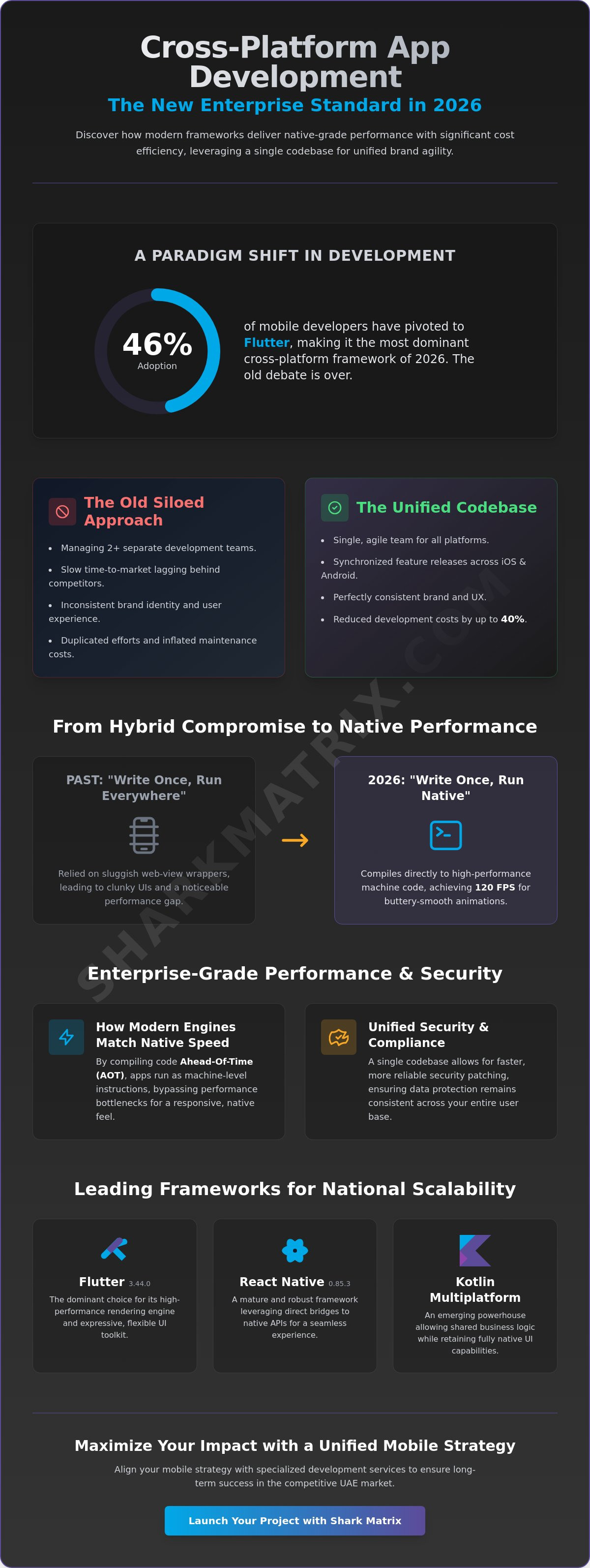
Did you know that 46% of mobile developers have now pivoted to Flutter, making it the most dominant framework of 2026? For modern enterprises in the UAE, the old debate between native and hybrid is officially over. Choosing cross platform app development is no longer a compromise on quality. It’s a strategic move toward unified brand agility. With stable tools like Flutter 3.44.0 and React Native 0.85.3, the performance gap has vanished for almost every business application.

You likely feel the frustration of managing two separate development teams while watching your time-to-market lag behind competitors. It’s difficult to maintain a consistent brand identity when iOS and Android versions don’t look or feel the same. Discover how modern frameworks deliver native-grade performance with significant cost efficiency for national brands. We’ll break down how to leverage a single codebase to reduce development costs by up to 40% and prepare your mobile strategy for an AI-native future.

Key Takeaways

  • Understand how the “Write Once, Run Everywhere” philosophy has evolved into a high-performance standard for modern enterprise SDKs.
  • Learn how JIT and AOT compilation have closed the performance gap, making cross platform app development a viable choice for high-demand applications.
  • Compare the maturity of Flutter, React Native, and Kotlin Multiplatform to determine which framework best supports your national scalability goals.
  • Discover a strategic framework to audit your feature requirements and developer expertise before choosing a tech stack.
  • Explore how aligning your mobile strategy with specialized development services ensures long-term success in the competitive UAE market.

What is Cross-Platform App Development in 2026?

The definition of cross platform app development has undergone a radical transformation over the last decade. In 2026, it refers to the practice of building high-performance applications for multiple operating systems using a single, shared codebase. This approach has moved far beyond the clunky, browser-based shells of the past. Today’s SDKs allow developers to tap into the broader ecosystem of Mobile app development while maintaining native-level fluidity. National brands in the UAE are leading this shift, moving away from platform-specific silos that once required separate teams for iOS and Android. By consolidating their efforts, these enterprises ensure that every user receives the same premium experience regardless of their device choice.

The core philosophy of “Write Once, Run Everywhere” (WORE) has evolved into a “Write Once, Run Native” reality. Early hybrid attempts often felt sluggish because they relied on web-view wrappers that couldn’t handle complex animations or heavy processing. By 2026, tools like Flutter and React Native have matured to the point where they bypass these limitations entirely. They use specialized rendering engines and direct bridges to native APIs; this ensures that business logic remains consistent while performance stays lightning-fast. For a modern enterprise, this means cross platform app development is no longer about settling for less. It’s about choosing the most efficient path to a high-quality product.

The Evolution from Hybrid to Unified Codebases

Technology has finally moved past the “web-view” limitations that plagued the 2010s. Modern rendering engines now enable 120 FPS performance, making scrolls and transitions feel as smooth as any native application. A unified codebase represents a single source of truth for business logic and UI styling that compiles directly into high-performance machine code for every target platform. This eliminates the “uncanny valley” effect where cross-platform apps felt slightly “off” compared to their native counterparts. By using a single source of truth, developers spend less time fixing platform-specific bugs and more time innovating on core features.

Why Modern Enterprises Prioritize Multi-Platform Strategies

Speed to market is the ultimate competitive advantage in the UAE digital landscape. When a national brand launches a new feature, they can’t afford to tell half their audience that the update is “coming soon” for their specific device. Synchronized feature releases across iOS, Android, and even the web are now the standard expectation. This strategy also simplifies the DevOps pipeline for national-scale applications. Instead of managing two distinct testing and deployment cycles, teams focus on a single, streamlined path to production. It’s a more efficient way to maintain a consistent brand identity while scaling rapidly across the region.

Performance vs. Cost: Debunking the Native-Only Myth

For years, the primary argument against choosing cross platform app development was a perceived lack of speed. Critics often claimed that non-native apps felt sluggish or couldn’t handle complex interactions. In 2026, these performance concerns are largely historical artifacts. Modern frameworks utilize Just-In-Time (JIT) compilation during development for fast iteration and Ahead-Of-Time (AOT) compilation for production. This means code is converted into machine-level instructions before the user even opens the app. The result is a smooth interface that matches the responsiveness of native Swift or Kotlin. For the vast majority of enterprise applications, the difference is now indistinguishable.

Security has also reached enterprise-grade standards. Frameworks like Flutter 3.44.0 and React Native 0.85.3 now include robust, built-in protections that meet the strict compliance requirements of UAE financial and government sectors. Because you’re managing a single codebase, applying security patches becomes a faster, more reliable process. You don’t have to worry about a vulnerability being fixed on iOS while remaining open on Android for several weeks. This unified approach ensures that your data protection remains consistent across the entire user base.

How Modern Engines Match Native Speed

Modern frameworks have evolved to bypass the CPU-intensive bridges that used to cause lag. By compiling directly to machine code, applications can now access GPU-accelerated graphics for complex UI animations without a performance hit. This shift is documented in a recent comparative study of cross-platform frameworks, which highlights how these tools achieve near-native execution speeds. Whether you’re building a data-heavy dashboard or a high-fidelity e-commerce platform, the rendering engines in 2026 handle 120 FPS transitions with ease. This level of fluidity is essential for maintaining the premium brand standards expected by UAE consumers.

The Economic Impact: ROI and Long-Term Maintenance

The financial logic for multi-platform strategies is hard to ignore. Research indicates that cross platform app development can reduce initial build costs by 30-40% compared to maintaining two separate native teams. When you analyze the app development cost uae, the savings extend far beyond the launch date. Managing a single source of truth significantly reduces technical debt and simplifies long-term maintenance. Instead of paying two teams to fix the same bug, one update solves the issue for everyone. Many enterprises choose to reallocate these saved funds into high-impact search engine optimization seo services to drive user acquisition. If you’re ready to streamline your digital presence, exploring professional mobile app development can provide the balance of performance and value your business needs.
Cross-Platform App Development in 2026: The Comprehensive Guide for Modern Enterprises

Leading Frameworks for National Scalability in 2026

Selecting a framework for cross platform app development requires balancing technical capabilities with your team’s existing expertise. By May 2026, three major players have emerged as the standard for enterprise-grade applications. Flutter, React Native, and Kotlin Multiplatform each offer unique advantages for national brands aiming to scale. These ecosystems have matured significantly; they now provide seamless access to device hardware like biometrics, Bluetooth low energy, and even AR/VR sensors without the friction seen in earlier years. Choosing between them often comes down to the specific user experience you want to deliver and the speed at which you need to deploy.

Flutter: The King of UI Consistency

Google’s toolkit has secured its spot as the most popular framework, holding over 40% of the global market share in 2026. Flutter 3.44.0 allows developers to build visually stunning interfaces that look identical on every screen. This is particularly valuable for UAE brands that prioritize a premium, high-fidelity aesthetic across their digital touchpoints. Because Flutter controls every pixel on the screen, it ensures that your brand’s identity remains intact regardless of OS updates. Additionally, Flutter’s structured metadata handling makes it easier to optimize app content for Answer Engine Optimization (AEO), ensuring your services are easily discoverable by AI-driven search tools.

React Native: The Power of the JavaScript Ecosystem

For enterprises with strong web development roots, React Native remains a powerhouse. The latest version, 0.85.3, fully leverages the “New Architecture” to provide high-speed interactions. It excels in complex, data-driven environments where you need to integrate with a headless CMS or existing web infrastructure. By using the vast library of React components, teams can achieve rapid development cycles without reinventing the wheel. It’s an ideal choice for businesses that want to share talent between their web and mobile divisions while maintaining a robust DevOps pipeline. This framework’s ability to handle complex data flows makes it a favorite for large-scale e-commerce and social platforms.

Kotlin Multiplatform (KMP): The New Frontier

Kotlin Multiplatform has transitioned from a niche tool to a production-ready enterprise solution with the release of Kotlin 2.3.21. Unlike other frameworks, KMP focuses on sharing business logic while allowing developers to build truly native UIs where necessary. This approach is becoming a preferred choice for high-security fintech apps that require deep integration with platform-specific security protocols. It offers a unique balance; you get the efficiency of a shared codebase for your core logic while retaining the absolute performance of native interface components. This ensures that your app feels 100% native to the user while your backend logic remains synchronized and easy to maintain.

A Strategic Framework for Choosing Your Tech Stack

Choosing the right path isn’t just about code; it’s about aligning technical choices with long-term commercial objectives in a market that moves at lightning speed. In 2026, cross platform app development has become the standard for most enterprises, but a structured audit is still necessary to ensure your choice supports future growth. A rushed decision here can lead to technical debt that slows down innovation for years. To avoid this, Shark Matrix Technologies LLC recommends a weighted decision matrix that considers more than just the initial launch.

  • Step 1: Audit your core feature requirements. Determine if your app needs heavy 3D rendering or if it primarily handles data entry and user interactions.
  • Step 2: Evaluate internal developer expertise. Assess whether your team is more comfortable with JavaScript, Dart, or Kotlin to minimize the learning curve.
  • Step 3: Analyze your scaling roadmap. Consider how quickly you plan to expand your feature set and user base across the GCC region.
  • Step 4: Assess the need for AI integration. Plan for the inclusion of machine learning models or automated chatbots from the start.
  • Step 5: Compare the total cost of ownership. Factor in both the initial development and the maintenance costs over a three-year period.

Assessing Project Complexity and Hardware Needs

Native development remains a niche requirement for applications that demand low-level Bluetooth communication or highly complex OS-level background tasks. However, for 90% of business use cases in the UAE, cross-platform frameworks are the superior option. They provide the UI/UX consistency required for a professional brand image across varied device screen sizes. Whether your customers are using a high-end tablet or a standard smartphone, the interface remains pixel-perfect. This consistency is vital for maintaining trust and brand authority in a competitive digital landscape. For brands that do require a dedicated Apple-first experience, working with a specialized iOS app development company in Dubai can complement your broader multi-platform strategy.

Future-Proofing with AI and Automation

With a vast majority of new app projects in 2026 featuring at least one AI-powered component, your tech stack must be flexible enough to handle rapid updates. Integrating cloud-based features like natural language processing or predictive analytics is often simpler within a unified codebase. Shark Matrix Technologies LLC leverages advanced ai automation and development to streamline the entire lifecycle, utilizing tools that can significantly reduce development time. This forward-thinking approach also prepares your brand for the era of Generative Engine Optimization (GEO), ensuring your content is ready for AI-driven discovery. If you’re ready to build a resilient and intelligent digital product, our team offers specialized ai development services to help you stay ahead of the curve.

Maximizing Impact with Shark Matrix Technologies LLC Development Services

Building a successful application requires more than just picking a framework. While cross platform app development provides the technical foundation, your app’s actual success depends on how well it integrates with your broader business goals. A high-performance app is useless if users can’t find it or if the experience doesn’t lead to conversions. At Shark Matrix Technologies LLC, we believe that high-performance code must meet data-driven marketing to achieve national-scale success. We don’t just write code; we build digital assets designed for growth and scalability in the competitive Middle Eastern market.

Our comprehensive mobile app development services go beyond the initial launch. We focus on creating a cohesive ecosystem where your mobile presence supports your e-commerce and lead generation efforts. By choosing a unified approach, you ensure that your brand remains agile and ready to adapt to new market trends without the friction of managing disconnected platforms. This strategic alignment is what separates a standard app from a market-leading digital product.

Beyond the Code: Integrating SEO and Digital Strategy

App visibility is just as critical as web visibility in 2026. National brand visibility relies heavily on app indexing, which allows your mobile content to appear directly in search engine results. This is why we connect your mobile strategy to our professional website design and development services. A seamless link between your site and your app improves user retention and boosts your overall authority. Additionally, the data gathered from your cross-platform app can be used to fuel hyper-targeted campaigns through a specialized ppc agency dubai. This integrated approach ensures that every dirham spent on development and marketing works toward a single, unified goal.

Launching for the National UAE Market

Success in the UAE requires a deep understanding of local user expectations and regulatory requirements. Arabic localization isn’t just about translating text; it’s about mirroring the entire UI to support right-to-left (RTL) reading patterns. Modern cross platform app development tools make this process more efficient, but it still requires a keen eye for cultural nuance. Shark Matrix Technologies LLC helps you navigate these complexities while ensuring your app remains compliant with local data privacy standards. Whether you’re a startup or an established enterprise, we’re here to help you scale your vision with precision. Contact our experts today to start your journey toward a more efficient and impactful mobile presence.

Secure Your Competitive Edge with Unified App Strategies

The shift toward unified codebases has fundamentally changed the digital landscape for UAE enterprises. Performance parity is no longer a distant goal but a current reality, leaving businesses with a clear path to operational efficiency. You can now deliver a consistent brand experience across all devices without the heavy overhead of maintaining separate development teams. Adopting cross platform app development allows your brand to stay agile and responsive to market changes while keeping technical debt to a minimum. It’s about building for today while remaining flexible enough for the innovations of tomorrow.

Success in this space requires a partner who understands the intersection of high-performance code and national-scale growth. With 14 years of digital innovation and a specialization in AI-driven mobile solutions, Shark Matrix Technologies LLC provides the end-to-end national UAE support your brand needs to thrive. We help you integrate advanced features that resonate with local users while ensuring your infrastructure is built to scale. Partner with Shark Matrix Technologies LLC for High-Performance App Development and transform your mobile vision into a market-leading reality. The digital future is unified, and your brand is ready to lead the way.

Frequently Asked Questions

Is cross-platform app development cheaper than native development?

Yes, choosing cross platform app development is generally 30% to 40% more cost-effective than building separate native apps. By maintaining a single codebase, you eliminate the need for two distinct development teams and streamline the testing process. This efficiency allows enterprises to reallocate their saved budget toward high-impact marketing or AI-driven feature enhancements.

Can cross-platform apps access device hardware like the camera or GPS?

Modern frameworks provide full, high-speed access to device hardware including cameras, GPS, and biometrics. In 2026, stable plugins and direct bridges ensure that these apps interact with hardware just as fluidly as native versions. You won’t face performance limitations when building apps that require real-time location tracking or advanced sensor integration.

Which framework is better in 2026: Flutter or React Native?

Neither framework is objectively superior; the right choice depends on your team’s existing skills and your specific project goals. Flutter is the leading choice for brands that prioritize pixel-perfect UI consistency across all devices. React Native remains a powerhouse for data-heavy applications that need to leverage the vast JavaScript ecosystem and existing web infrastructure.

Do cross-platform apps work offline?

Yes, these applications function perfectly without an active internet connection by utilizing local storage solutions. Developers use local databases like SQLite or Hive to store data on the device, which then syncs with the server once connectivity is restored. This capability is essential for enterprise tools used in environments with intermittent network access.

How long does it take to develop a cross-platform mobile app?

Development time is typically reduced by up to 40% when compared to native projects, with most enterprise MVPs launching within three to six months. This accelerated timeline is a primary reason why cross platform app development has become the standard for UAE brands. It allows companies to respond to market trends and competitor moves much faster than before.

Are cross-platform apps secure enough for banking and fintech?

Cross-platform frameworks are robust enough to meet the strict security standards of the banking and fintech sectors. They support advanced encryption, secure key storage, and multi-factor authentication out of the box. Since security patches are applied to a single codebase, your team can respond to emerging threats across all platforms simultaneously.

Can I convert an existing native app to a cross-platform one?

While you can’t automatically convert code with a single click, you can strategically migrate your business logic to a shared codebase. The UI usually requires a rewrite to match the framework’s architecture, but the backend integrations can often be adapted. This migration is a common strategy for brands looking to reduce long-term maintenance costs and technical debt. To understand the full performance and security trade-offs involved in this decision, reviewing a detailed breakdown of native app development versus cross-platform approaches can help you make the most informed choice.

Does cross-platform development affect my SEO ranking?

It doesn’t negatively impact your ranking; in fact, a well-structured app can significantly improve your overall digital visibility. Unified apps support app indexing, which allows your mobile content to appear directly in Google search results. When combined with professional Search Engine Optimization (SEO), your app becomes a vital tool for driving organic traffic and user acquisition.
Categories
Development

Strategic Mobile App Development Services for UAE Enterprises: The 2026 Guide

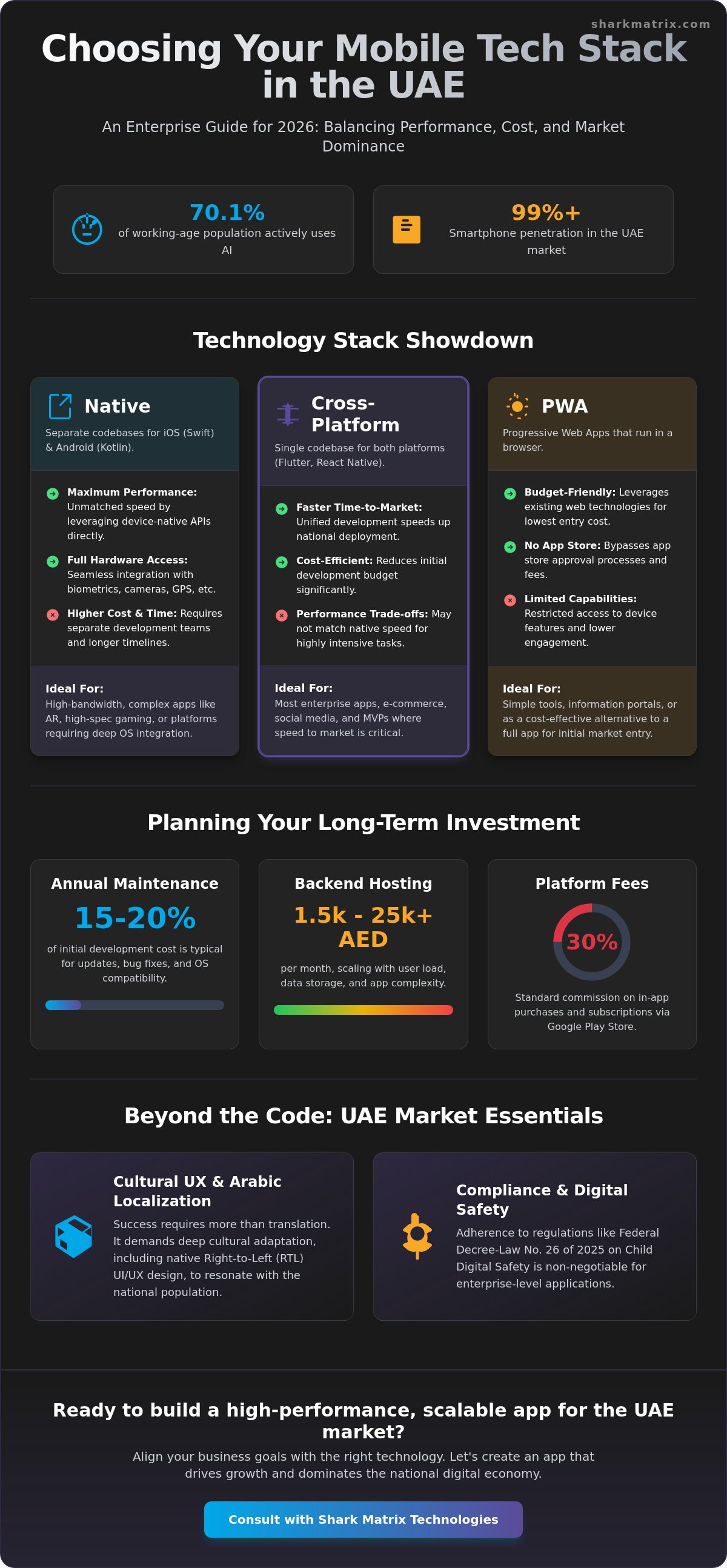
Did you know that 70.1% of the UAE’s working-age population is actively using AI technologies as of early 2026? In a market where smartphone penetration sits at over 99%, simply having a presence on a user’s home screen isn’t enough to guarantee success. To truly compete, enterprises require specialized mobile app development services that balance technical performance with the strict cultural and legal requirements of the Emirates. You’re likely looking for a way to maximize ROI while avoiding the technical debt that often comes from choosing the wrong framework or ignoring the nuances of the local market.

We understand the pressure of building a platform that resonates with Arabic-speaking users while staying compliant with the new Federal Decree-Law No. 26 of 2025 on Child Digital Safety. This guide will show you how to leverage cutting-edge mobile technologies and strategic Arabic localization to scale your brand across the national market. We’ll examine how to integrate AI for seamless user experiences, navigate the latest data privacy laws, and select the right cross-platform tools to ensure your app remains high-performing and scalable for years to come.

Key Takeaways

  • Understand the shift from basic web wrappers to AI-first mobile ecosystems to meet the demands of the UAE’s tech-forward market.
  • Evaluate the trade-offs between native performance and cross-platform speed to select the right mobile app development services for your scalability needs.
  • Discover how generative AI and machine learning personalization can drive higher user retention and engagement across the national population.
  • Learn why effective Arabic localization must go beyond simple translation to include deep cultural UX adaptations and Right-to-Left design.
  • Follow a structured development roadmap that prioritizes business alignment and iterative feedback to ensure a high-performance launch.

The Evolution of Mobile App Development Services in the UAE

The UAE has moved past the era of simple digital presence. By 2026, the evolution of mobile app development has reached a critical tipping point where national enterprises are abandoning basic web wrappers for sophisticated, AI-first ecosystems. This shift aligns with the UAE National AI Strategy 2031, which aims to position the country as a global leader in artificial intelligence. Enterprise leaders now understand that a basic mobile site cannot match the deep integration and processing power required by a population where 70.1% of working-age adults already use AI technologies daily.

Professional mobile app development services in the Emirates have transformed to meet these demands. It’s no longer just about having an app; it’s about owning a high-performance touchpoint that functions as a core driver of the national digital economy. Businesses that rely on generic solutions often find themselves struggling with technical debt and poor user retention. In contrast, custom-built applications offer the stability needed to integrate with complex national infrastructure and local payment gateways.

Mobile Apps as a Catalyst for National Brand Growth

Expanding a brand across the seven emirates requires more than just physical locations. High-performance mobile tools allow enterprises to transcend geographical boundaries, reaching users from Abu Dhabi to Ras Al Khaimah with equal precision. These platforms serve as powerful engines for data-driven lead generation, capturing user preferences that inform broader business strategies. In 2026, the UAE mobile landscape is defined by intelligent, hyper-localized ecosystems that prioritize user safety and cultural relevance.

Addressing the “App vs. Responsive Web” Debate

While responsive websites are essential for SEO and initial discovery, they often fall short when it comes to long-term ROI and customer loyalty. Mobile apps offer superior performance by leveraging native device features that a browser simply can’t access efficiently. Consider the impact of biometric security, real-time push notifications, and robust offline access on user trust. These features create a frictionless experience that keeps users coming back to your brand rather than searching for a competitor.

Enterprises should consider investing in dedicated mobile app development services when they identify specific business triggers:

  • Users require frequent, high-speed interactions that exceed browser capabilities.
  • The business needs to collect and process complex data securely on-device.
  • Personalization through machine learning is required to maintain a competitive edge.
  • Compliance with the latest Federal Decree-Law No. 26 of 2025 necessitates advanced parental controls and age verification.

Choosing a dedicated app over a web-only approach ensures that your brand remains an authoritative presence in a market with over 99% smartphone penetration. It’s a strategic move that secures your place in the user’s daily digital routine while providing the scalability needed for future growth.

Selecting the Right Technology Stack: Native vs. Cross-Platform

Deciding on a technology stack is one of the most significant hurdles for UAE enterprises. Native development involves building separate codebases for iOS and Android using Swift and Kotlin. This approach ensures maximum performance and seamless integration with hardware, which is vital for complex, high-bandwidth apps. However, it often requires a larger budget and longer timelines. For many, professional mobile app development services now lean toward cross-platform frameworks to achieve faster national deployment without sacrificing quality.

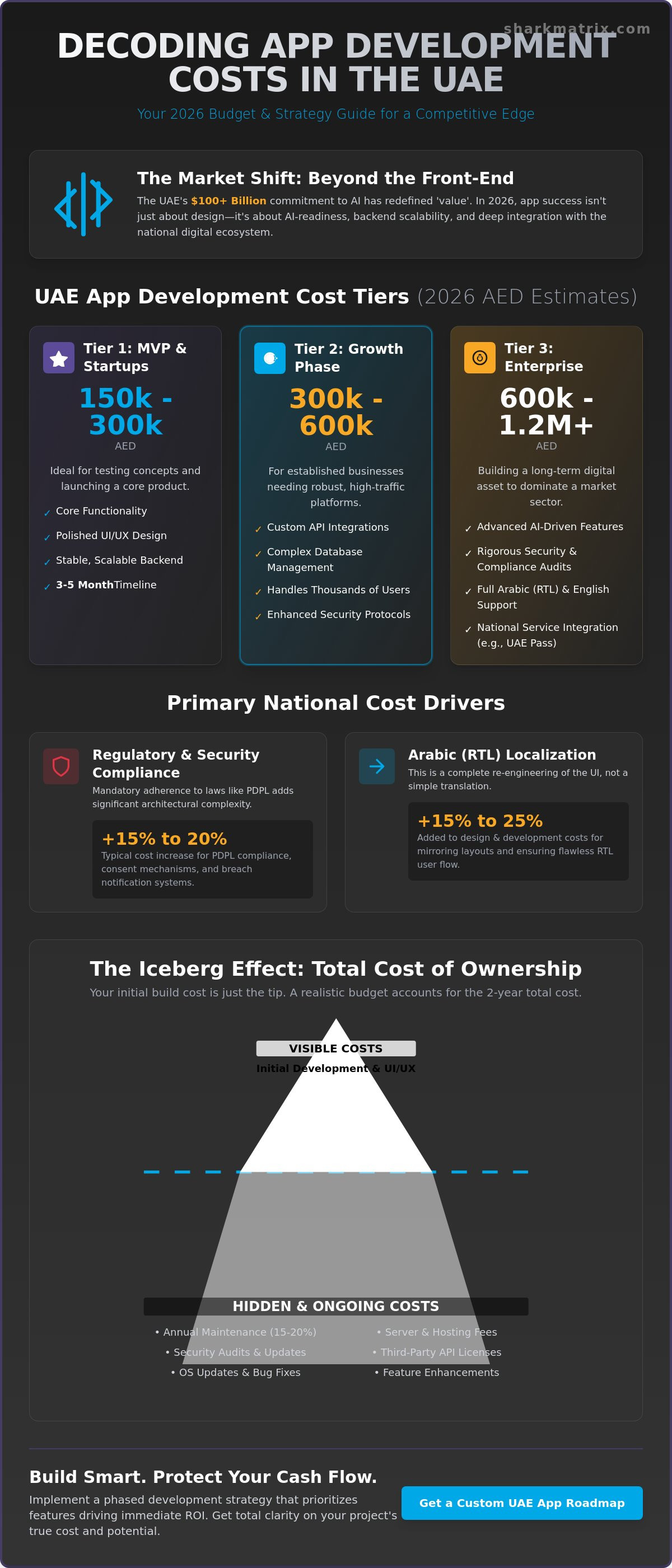
Cross platform app development tools like Flutter and React Native have become the leading technologies in 2026. They allow developers to maintain a single codebase that runs on both major operating systems. While this reduces initial development time, businesses must plan for ongoing costs. Typical annual app maintenance and updates usually range from 15% to 20% of the initial development cost. You also need to account for backend hosting, which can range from AED 1,500 to over AED 25,000 per month depending on complexity. Third-party SDKs and Google’s 30% commission on in-app purchases are other vital factors for your long-term budget.

For businesses with tighter budgets, Progressive Web Apps (PWAs) offer a middle ground. They work through a browser but mimic app functionality. However, they lack the deep integration required for 5G-enabled experiences or advanced AI features. Before committing, it’s wise to evaluate how your choice aligns with the broader Mobile Economy in the Middle East, where user expectations for speed and reliability are at an all-time high.

iOS and Android: Navigating the Dual-Platform Reality

The UAE market is unique because of its high-income demographic and diverse population, leading to significant user bases on both major platforms. You can’t afford to ignore either group. Achieving feature parity is essential so that an Android user in Sharjah has the same premium experience as an iPhone user in Abu Dhabi. If your strategy prioritizes Apple’s ecosystem, working with a qualified iOS app development company in Dubai ensures your application is built to the latest Swift and SDK standards while meeting local regulatory requirements. To better understand how these choices impact your budget, you should review our guide on App Development Cost in the UAE 2026.

Framework Selection for Enterprise Scalability

Flutter has emerged as a dominant force for enterprise applications in 2026. Its ability to deliver high-end UI/UX with a single codebase makes it ideal for the rapid pace of the UAE market. However, the “Write Once, Run Anywhere” promise has its limits. You’ll still need platform-specific tweaks to handle things like the new Child Digital Safety Law requirements or specific Right-to-Left (RTL) layout adjustments for Arabic users. If you’re ready to build a scalable solution, exploring specialized mobile app development services can help you navigate these technical nuances efficiently. For a deeper dive into how modern frameworks like Flutter and React Native can reduce your development costs by up to 40%, our comprehensive guide to cross platform app development in 2026 covers everything UAE enterprises need to know.

Strategic Mobile App Development Services for UAE Enterprises: The 2026 Guide

Integrating AI and Automation into Modern Mobile Applications

With 70.1% of the UAE’s working-age population already using AI technologies, the expectation for intelligent digital experiences has never been higher. Modern mobile app development services have shifted away from static interfaces toward dynamic, AI-first ecosystems. This transition means moving beyond simple buttons and menus to incorporate generative AI as a core feature. Whether it’s generating personalized travel itineraries or creating custom shopping lookbooks on the fly, generative AI allows your app to provide unique value to every individual user in real time.

Machine learning personalization engines are now the primary drivers of user engagement for national enterprises. These engines analyze user behavior to predict what a customer wants before they even search for it. In the B2B and e-commerce sectors, predictive analytics help streamline interfaces by surfacing relevant tools and products based on historical data. Beyond the user interface, AI automation works silently in the backend to reduce operational costs. By automating data entry, inventory tracking, and order processing, businesses can redirect their human capital toward higher-level strategic goals.

Custom AI Development for Mobile Ecosystems

Building a custom AI layer within your mobile app is essential for maintaining a competitive edge in the Emirates. Integrating Natural Language Processing (NLP) allows your application to understand the nuances of user search intent, including the various Arabic dialects common across the UAE. This level of sophistication significantly improves the user experience and builds brand authority. Furthermore, AI plays a critical role in security. AI-driven fraud detection systems can identify suspicious patterns in milliseconds, protecting both your business and your customers. Industry data shows that AI-driven apps can reduce churn rates by up to 20% by consistently delivering relevant, secure content.

AI Chatbots and Virtual Assistants

The days of frustrating, rule-based chatbots are over. In 2026, intelligent virtual assistants use generative models to provide context-aware support that feels natural and helpful. These assistants can handle complex queries, process returns, and even provide technical guidance without the need for human intervention. This shift improves customer support efficiency and ensures that your brand is available to assist users at any time of day. For enterprises looking to maintain a consistent AI strategy across all platforms, it’s helpful to see how these technologies align with web-based systems in The 2026 Guide to Website Design and Development. By choosing comprehensive mobile app development services that prioritize these automations, you ensure your platform is built for the future of the UAE’s digital economy.

Cultural UX and Arabic Localization: Dominating the National Market

Localization in the UAE is often misunderstood as a simple translation task. For national enterprises, true localization is a comprehensive UX strategy that respects cultural identity and user behavior. While English is widely spoken, Arabic remains the language of trust and cultural connection for the local population. High-quality mobile app development services must go beyond swapping text strings to create an environment that feels native to the user’s worldview. This includes everything from the way images are framed to the specific tone of voice used in push notifications.

Building trust within the app also depends on seamless integration with regional payment gateways like Network International or Telr. Users in the Emirates expect secure, familiar checkout experiences that support local cards and digital wallets. When your app reflects the local culture through high-quality digital marketing and localized content, it creates a sense of authority that generic, English-only platforms can’t match. This strategic approach ensures your brand isn’t just another icon on a screen but a trusted part of the user’s daily life. To amplify this cultural resonance beyond the app itself, partnering with a specialist social media advertising agency in Dubai can help you extend your localized messaging across TikTok, Instagram, and other high-traffic platforms where UAE audiences are most active.

RTL Design Mastery for Arabic Users

Right-to-Left (RTL) design is the foundation of any successful UAE mobile application. It’s not just about aligning text to the right; it’s about mirroring the entire user interface. Common pitfalls include failing to mirror icons that indicate direction, such as back arrows or progress bars. However, some elements like clocks and media playback controls should generally remain in their standard format to avoid confusing the user. Typography also requires careful attention. Arabic characters are more complex than Latin ones, requiring specialized font selection and increased line height to maintain legibility on mobile screens. A seamless bilingual switch allows users to toggle between English and Arabic without losing their place or breaking the layout.

Cultural Sensitivity in Mobile Interface Design

Visual storytelling must resonate with the UAE national audience to be effective. This means using imagery, icons, and color palettes that reflect regional preferences and social norms. For example, using local landmarks or culturally appropriate attire in your graphics can significantly boost brand affinity. Some businesses argue that “English is enough” because of the country’s large expat population. However, statistics consistently show that local engagement is higher when brands speak to users in their native language. While Modern Standard Arabic is ideal for formal banking or government apps, using local dialects can be far more effective for social engagement or marketing. If you want to build a platform that truly resonates with the national market, you need a partner who understands these nuances. Explore our specialized mobile app development services to start your localization journey.

From Discovery to Deployment: Your Strategic Development Roadmap

Launching a successful application in the Emirates requires more than just clean code. It demands a structured roadmap that bridges the gap between a conceptual idea and a high-performance digital asset. The process begins with a rigorous discovery phase. Here, we align your app’s core features with national business goals and the specific regulatory requirements of the UAE market. This stage ensures that every functional requirement serves a purpose, whether it’s driving lead generation or improving internal enterprise workflows.

Agile methodology is at the heart of modern mobile app development services. This iterative approach prioritizes transparency and regular feedback, allowing you to see progress in real time through scheduled sprints. It’s during this phase that we refine the user experience based on actual data rather than assumptions. Once the build is stable, our quality assurance team conducts rigorous testing across the diverse device market found in the UAE. From the latest flagship iPhones to high-end Android devices, we ensure your app performs flawlessly under various network conditions, particularly within the country’s extensive 5G infrastructure.

The Shark Matrix Technologies LLC End-to-End Delivery Model

Our approach is unique because we don’t treat development as an isolated silo. We integrate SEO and PPC strategy into the initial app architecture from day one. This proactive planning ensures that your platform is discoverable and ready for high-intent traffic the moment it hits the store. We also prioritize robust API and backend integration to ensure the app communicates perfectly with your existing enterprise CRM or ERP tools. To learn more about how we drive visibility for national brands, explore our Comprehensive SEO Services 2026.

Continuous Improvement and Maintenance

Deployment is just the beginning of your app’s lifecycle. Success in 2026 depends on continuous improvement through active monitoring of user behavior. This data allows us to drive meaningful feature updates that keep users engaged and prevent churn. We also manage the technical complexities of staying compliant with evolving App Store and Google Play guidelines. Remember that annual maintenance costs typically range from 15% to 20% of the initial development spend. This investment covers security patches, OS updates, and the integration of new technologies like Answer Engine Optimization (AEO) to stay ahead of generative search trends. If you’re ready to build a market-leading platform, you can partner with Shark Matrix Technologies LLC for your national mobile app strategy today.

Securing Your Digital Future in the UAE Market

Success in the Emirates isn’t just about launching a product; it’s about sustaining a high-performance ecosystem that evolves with its users. You’ve explored how technical framework choices, AI-driven personalization, and deep cultural UX form the pillars of a dominant mobile presence. When these elements align, your brand moves beyond being a simple utility to becoming a core part of your customers’ daily digital routines. Choosing professional mobile app development services is the most critical decision in this journey, ensuring your infrastructure is ready for the high-speed demands of the national market.

Shark Matrix Technologies LLC has spent over 15 years refining this balance for national enterprises. Since our founding in 2010, we’ve focused on the intersection of custom engineering and Arabic market dynamics. As experts in generative engine optimization (GEO) and AI automation, we ensure your platform remains visible and relevant in an increasingly intelligent search landscape. Our team brings the regional insight necessary to navigate local regulations while pushing the boundaries of what’s possible with modern mobile technology.

We’re ready to help you build a scalable, culturally resonant app that drives real growth across the UAE. Start Your Strategic Mobile App Project with Shark Matrix Technologies LLC and position your brand at the forefront of the national digital economy. Let’s create a mobile experience that truly resonates with your audience and delivers lasting value.

Frequently Asked Questions

How much do mobile app development services cost in the UAE?

Development costs vary based on the complexity and feature set of your application. Simple apps typically range from AED 20,000 to AED 50,000, while medium complexity projects with third-party integrations cost between AED 50,000 and AED 150,000. Complex, AI-powered enterprise solutions often start at AED 150,000 and can exceed AED 400,000. These figures reflect the specialized engineering required for secure, high-performance mobile app development services in the national market.

What is the difference between native and cross-platform app development?

Native development involves building separate applications for iOS and Android using platform-specific languages like Swift or Kotlin. This ensures maximum performance and hardware integration. Cross platform app development uses frameworks like Flutter or React Native to create a single codebase for both platforms. This approach is increasingly popular for UAE enterprises because it reduces development time and costs while maintaining a high-quality user experience across all devices.

How long does it take to develop a custom mobile application?

A standard timeline for a custom enterprise app usually spans three to nine months. Simple applications can reach deployment in approximately 12 weeks, while complex platforms with AI features or extensive backend integrations often require six months or more. This schedule includes the critical discovery phase, UI/UX design, development sprints, and rigorous testing to ensure the app meets local regulatory standards and performance expectations.

Do I need a separate app for iOS and Android devices?

You don’t need two separate codebases if you choose cross-platform mobile app development services. Modern frameworks allow you to build one application that runs seamlessly on both iOS and Android. This strategy is highly effective in the UAE, where smartphone penetration is over 99% and users are split between both operating systems. It ensures feature parity while simplifying your long-term maintenance and update cycles.

How does Arabic localization affect my app’s performance in the UAE?

Localization is a primary driver of user retention and brand trust. Apps that implement high-quality Arabic translation and Right-to-Left (RTL) layout adjustments see significantly higher engagement from the local population. Beyond mere translation, cultural localization involves adapting imagery and icons to regional preferences. This creates a more intuitive experience for users, helping your brand stand out in a competitive national market where cultural relevance is a key differentiator.

Can I integrate my existing AI or CRM tools into a new mobile app?

Yes, modern mobile architectures are built to integrate with existing enterprise ecosystems through secure APIs. You can connect your app to CRM systems like Salesforce or custom AI models to ensure real-time data synchronization. This integration allows your mobile platform to serve as a powerful extension of your current workflows, providing users with personalized content and allowing your business to maintain a single source of truth for customer data.

What are the ongoing costs for mobile app maintenance?

Annual maintenance costs generally range from 15% to 20% of the initial development investment. These costs cover essential security updates, hosting fees, and compatibility patches for new iOS and Android versions. Regular maintenance ensures your app remains compliant with the latest UAE data privacy laws and continues to perform at peak levels. Neglecting this aspect can lead to technical debt and a decline in user satisfaction over time.

Why should a UAE business choose a national agency over offshore developers?

National agencies provide essential expertise in the UAE’s specific regulatory and cultural landscape. They understand the nuances of the 2026 Child Digital Safety Law and have direct experience integrating with regional payment gateways. Working with a local partner ensures better communication during the discovery phase and guarantees that your app is optimized for the high-bandwidth 5G networks prevalent across the Emirates, which offshore teams may not fully account for. For businesses specifically targeting Apple device users, our detailed comparison of how to select the right iOS app development company in Dubai can help you identify a partner with the precise technical and cultural expertise your project demands.

Categories
Development

The 2026 Guide to Website Design and Development Services for UAE Enterprises

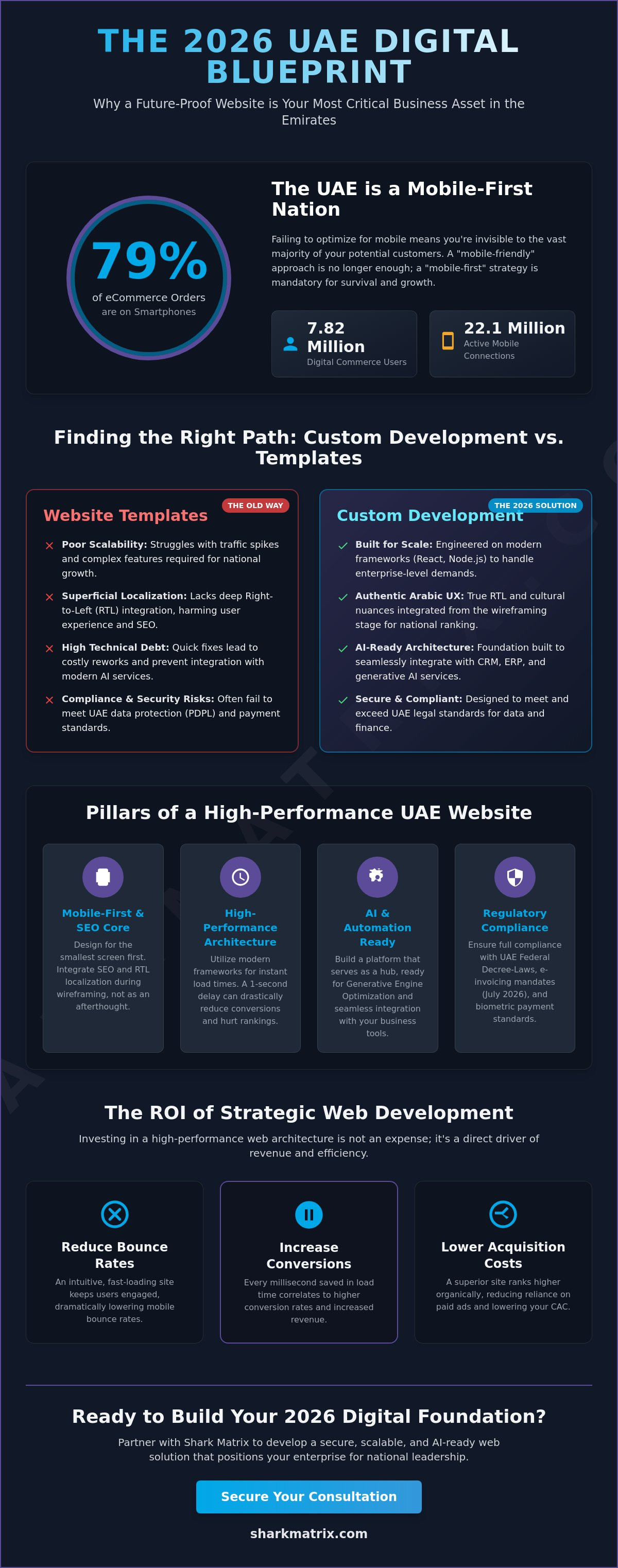
Did you know that smartphones processed nearly 79% of all e-commerce orders in the UAE last year? If your current platform suffers from high mobile bounce rates or lacks authentic Arabic localization, you’re likely losing a massive share of the 7.82 million digital commerce users active across the Emirates. Investing in professional website design and development services is no longer about having a digital business card. It’s about building a localized, AI-ready engine that complies with Federal Decree-Law No. 14 of 2023 and the latest biometric payment mandates.

You probably realize that keeping pace with rapid shifts like mandatory e-invoicing starting July 1, 2026, and the 9% corporate tax on profits over AED 375,000 requires more than just a template. This guide will show you how to evaluate and implement high-performance web solutions that drive national growth and seamless AI integration. We’ll explore the critical role of custom UX, data protection compliance under PDPL, and the strategies needed to scale a site that ranks for the UAE’s most competitive keywords.

Key Takeaways

  • Learn why shifting from mobile-friendly to mobile-first is essential for capturing the UAE’s high smartphone penetration.
  • Discover how to evaluate website design and development services based on technical frameworks and AI-ready architectures.
  • Understand the specific scenarios where custom development outperforms templates to provide better scalability for your enterprise.
  • See why integrating SEO and Right-to-Left (RTL) Arabic localization during the wireframing stage is non-negotiable for national rankings.
  • Explore how AI-powered development can transform your site from a static page into a high-converting growth engine.

Why Strategic Website Design and Development Services are Critical in 2026

Professional web development in 2026 is no longer a luxury; it’s the core of your business infrastructure. Many enterprises mistake a website for a static brochure, but modern strategic website design integrates user experience (UI/UX), robust technical architecture, and a clear commercial strategy. With over 22.1 million active mobile connections in the UAE, the market has shifted entirely to a mobile-first model. If your platform isn’t optimized for the 79% of shoppers using smartphones, you’re invisible to the majority of the 7.82 million digital commerce users projected by the end of this year.

A website serves as the foundation for all national digital marketing efforts. Whether you’re running PPC campaigns or focusing on content marketing, every lead eventually lands on your site. Relying on professional website design and development services ensures your site meets 2026 Core Web Vitals. Google’s ranking standards now prioritize page experience more than ever. Sites that fail to load instantly or provide a seamless mobile journey will see their organic visibility vanish in the face of local competition.

The ROI of High-Performance Web Architecture

Site speed isn’t just a technical metric. It’s a revenue driver. For national e-commerce brands, every millisecond of latency can lead to a drop in conversions. By investing in high-quality website design and development services, you reduce your customer acquisition costs (CAC). A faster, more intuitive site ranks higher organically and keeps users engaged longer, meaning you spend less on ads to get the same result. Technical debt represents the eventual cost of reworking a website because you chose a fast and easy solution during initial development instead of a scalable one. High-performance architecture avoids this trap by building for the future from day one.

Digital Transformation and UAE Vision 2031

Aligning your digital presence with the UAE Vision 2031 means building for innovation and national growth. High-growth sectors like fintech and logistics require platforms that are secure and compliant with Federal Decree-Law No. 45 of 2021 regarding personal data protection. As we move into an era of Generative Engine Optimization (GEO) and AI-driven search, your site must be structured to feed these systems accurate, high-quality data. Future-proofing your business involves:

  • Implementing secure, scalable platforms that handle rapid traffic spikes.
  • Integrating AI automation services to streamline customer interactions.
  • Ensuring full compliance with the July 1, 2026 e-invoicing mandates.
  • Adopting biometric payment authentication to meet UAE Central Bank standards.

By moving beyond city-level digital strategies and focusing on national scalability, UAE enterprises can secure a dominant position in a market projected to reach over USD 21 billion by 2031.

Essential Evaluation Criteria for Professional Web Services

Selecting a partner for website design and development services involves more than reviewing a portfolio of attractive homepages. You need to verify their proficiency in modern frameworks like React, Vue.js, or Node.js. These technologies ensure your site remains fast and responsive under heavy traffic. National-level projects demand a technical architecture that supports complex integrations with your existing CRM, ERP, or custom AI automation services. A partner who can’t demonstrate deep technical knowledge will likely struggle as your business scales across the Emirates.

Demand transparency regarding their integration capabilities. Your web solution should serve as a hub for your business operations. If an agency can’t explain how they’ll connect your front-end to back-office tools or generative AI development services, they aren’t the right fit for a 2026 enterprise. Checking a partner’s history with large-scale UAE projects provides proof they can handle local regulatory requirements and high-volume user data. Don’t settle for simple landing page experience when your goal is national growth.

UI/UX Design: More Than Just a Pretty Interface

Effective UI/UX design starts long before a single pixel is colored. It begins with user research and journey mapping to understand how your customers navigate. By integrating SEO and trust-based design choices into your wireframes, you ensure that the site isn’t just visually appealing but also functional. Accessibility standards are also vital. Your site must be usable for all members of the UAE’s diverse population; this directly impacts your long-term user engagement and conversion rates. Working with a specialized ui/ux design agency dubai enterprises trust ensures these principles are embedded from the earliest stages of your project, transforming your digital products into high-conversion assets.

Security, Compliance, and Data Protection

Security is a non-negotiable pillar of professional website design and development services. With the Federal Decree-Law No. 45 of 2021 (PDPL) in effect, your site must adhere to strict data residency and processing rules. This includes implementing SSL certificates, advanced encryption protocols, and regular security audits. Protecting your brand’s online reputation requires a proactive stance against data breaches. If you’re unsure where to start, looking at how a professional development team handles these compliance hurdles can save you from significant legal penalties later.

Beyond the code, look for a partner who understands the local culture. A site that looks great in London might fail in Riyadh or Dubai if it ignores the nuances of Right-to-Left (RTL) layouts or local consumer behavior. The right agency bridges this gap by blending global technical standards with local market insights. This ensures your platform isn’t just a digital asset but a localized engine for revenue.

The 2026 Guide to Website Design and Development Services for UAE Enterprises

Custom Development vs. Templates: Finding the Right Path

Choosing between a pre-built template and a custom-coded solution is the most significant financial decision you’ll make for your digital presence. Templates offer a fast route to market, which works for small businesses with limited budgets. However, for an enterprise aiming for national growth, a template often becomes a bottleneck. Custom website design and development services provide the flexibility to build features that don’t exist in off-the-shelf themes. This is particularly vital when you need deep AI automation to handle complex customer queries or automate back-end logistics.

The total cost of ownership (TCO) over a three-year period often reveals a surprising truth. While a template site is cheaper on day one, the costs of premium plugin subscriptions, security patches, and eventual “technical debt” rework can exceed the price of a custom build. Custom code is an investment in a permanent asset. It allows your platform to evolve without the constraints of a third-party developer’s update schedule or the risk of a theme becoming obsolete. Enterprises looking to extend their digital reach beyond the browser should also explore dedicated mobile app development services to complement their web presence and capture the UAE’s smartphone-first audience across every touchpoint.

The Custom Development Advantage for National Brands

Templates rely on generic plugins to add functionality. This creates “code bloat” that kills site speed and hurts your SEO rankings. Custom web development is the gold standard because it allows for a clean, purpose-built codebase. Academic research on effective website design highlights that user engagement and trust are directly tied to high-speed, intuitive interfaces. A custom CMS can be tailored to your specific internal workflows. This means your team spends less time fighting the software and more time managing growth.

E-commerce Considerations: Shopify vs. Magento vs. Custom

Your platform choice should depend on your SKU count and transaction volume. A small brand might thrive on Shopify, but a national enterprise with thousands of products and complex inventory needs the power of Magento or a custom headless solution. Headless commerce is gaining traction in the UAE. It decouples the front-end design from the back-end commerce engine, allowing for a seamless multi-channel experience across apps and web. You must also ensure your build supports local payment gateways like Telr or PayTabs. These integrations are smoother in custom environments, providing the frictionless checkout experience that modern UAE shoppers expect. Ensuring your storefront delivers a consistent experience on every screen size is equally critical, which is why investing in responsive web design Dubai enterprises rely on can directly reduce cart abandonment and boost conversions across mobile and desktop alike.

Integrating SEO and Arabic Localization into Your Web Project

Waiting until after launch to think about search rankings is a recipe for expensive reworks. High-performance website design and development services must prioritize search engine optimization during the wireframing phase. This ensures that site architecture, internal linking, and content hierarchies are built to satisfy both users and search engines from the start. In the UAE’s competitive national market, your strategy should map out keywords that capture intent across all seven emirates, not just localized pockets in Dubai or Abu Dhabi.

Localization goes far beyond translating text. It’s about building trust. A site that speaks naturally to an Arabic-speaking audience through professional transcreation will always outperform a generic English site. This cultural resonance directly impacts your conversion rates. When users see a platform that respects their language and cultural nuances, they’re more likely to engage with your brand and complete a purchase. It shows you’re committed to the local market. A strong web presence also forms the foundation of how your brand appears in search results, which is why pairing your development strategy with a robust approach to SEO for brand reputation management Dubai is essential for protecting your digital narrative across the Emirates.

Arabic Digital Marketing: Beyond Simple Translation

Transcreation involves adapting your brand’s voice and message to fit the GCC cultural context while maintaining its original intent. One of the biggest hurdles is Right-to-Left (RTL) design. You can’t just flip the layout. Icons, navigation menus, and form fields must be mirrored to match the natural eye-tracking patterns of Arabic readers. If you break this logic, you frustrate users and drive up bounce rates. Your design team must understand these linguistic variations to ensure the UX feels native rather than forced.

Technical SEO Best Practices for New Builds

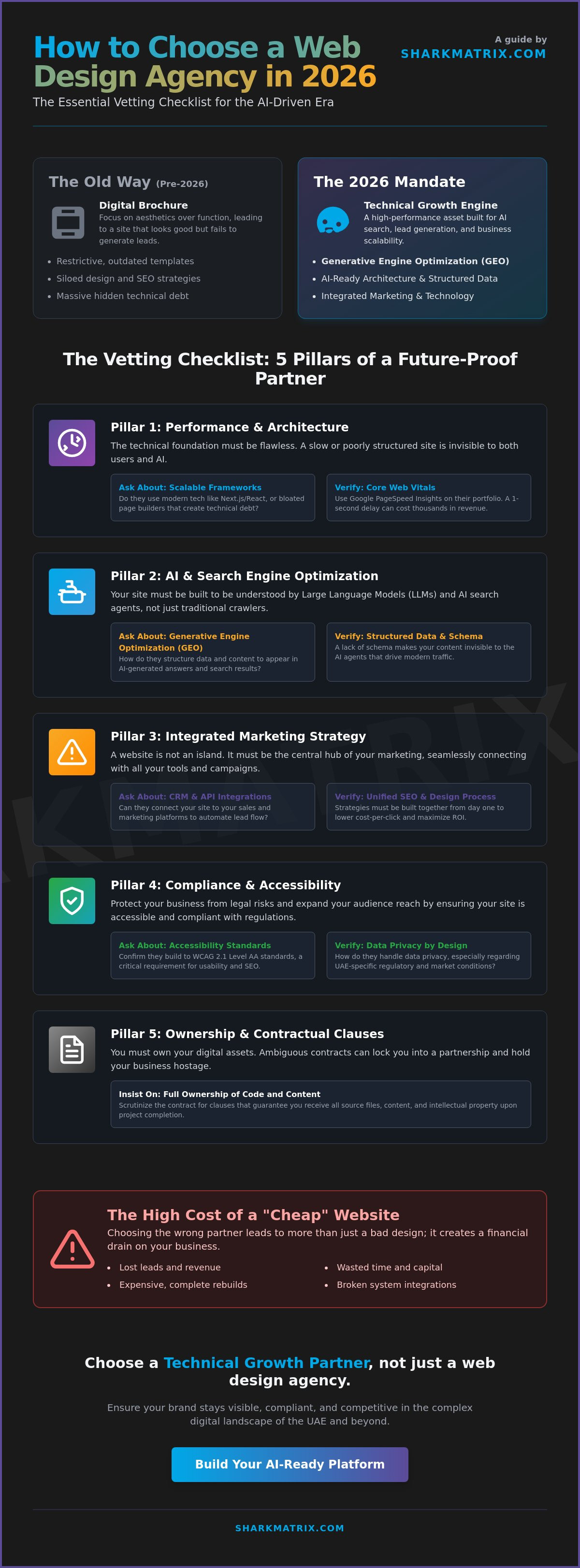
Clean URL structures and XML sitemaps are the basics. For 2026, you also need robust schema markup to help search engines understand your products, reviews, and corporate data. If you’re migrating an old site, managing redirects is critical to preserving your hard-earned link equity. Losing authority during a launch can set your national growth back by months. You should refer to our how to choose a web design agency guide to ensure your partner has the technical depth to handle these requirements.

To ensure your brand captures the full potential of the UAE market, professional website design and development services are essential; reach out to Shark Matrix Technologies LLC to begin your national digital transformation. We focus on building sites that don’t just look good but dominate the local search landscape.

Partnering with Shark Matrix: Your National Web Development Solution

Shark Matrix provides more than just code. We deliver a comprehensive digital strategy that turns your online presence into a high-performance growth engine. Our end-to-end approach begins with strategic consulting to ensure your platform aligns with the UAE’s specific market conditions and national objectives. By bridging the gap between global technical standards and Middle Eastern cultural nuances, we ensure your brand resonates from Abu Dhabi to Ras Al Khaimah. We specialize in website design and development services that incorporate generative AI development services, turning a standard site into an intelligent business tool that understands your customers.

Launching your site is only the first step toward digital dominance. We provide dedicated post-launch support to keep your platform secure, fast, and fully optimized for performance. In a market where the e-commerce sector is projected to reach over USD 21 billion by 2031, staying stagnant is a risk you can’t afford. Our commitment to data-driven results means you receive transparent reporting that tracks your ROI. This helps you navigate the local business landscape, including the 9% corporate tax threshold and VAT requirements, with clear financial insights and a site that actually converts.

The Shark Matrix Development Lifecycle

  • Discovery and Strategy: we begin by aligning the build with your national business goals. This involves analyzing competitor gaps and identifying how to leverage machine learning development services to personalize the user journey.
  • Agile Development: our process ensures transparency through iterative feedback loops. You’ll see the project evolve in real-time, allowing for adjustments as market conditions or regulations shift.
  • Rigorous QA and Testing: we launch with zero-defect confidence. Every site undergoes stress testing to handle the traffic spikes common in high-growth UAE sectors like fintech and logistics.

Ready to Scale Your Digital Presence?

Our website design and development services don’t exist in a vacuum. They integrate seamlessly with our broader ecosystem of AI automation services and content marketing. Whether you need an e-commerce platform that handles thousands of SKUs or a corporate site designed to dominate national search engine optimization rankings, we have the technical depth to deliver. We invite you to book a consultation for your national-scale project to see how we can future-proof your digital assets.

Choosing a partner that understands the 2026 UAE landscape is the difference between a site that merely exists and one that leads. We focus on building secure, scalable, and localized solutions that drive national growth. Let’s build a platform that meets the high expectations of the UAE’s 7.82 million digital commerce users.

Future-Proof Your National Growth Today

The digital landscape across the Emirates is moving faster than ever. Succeeding in 2026 requires more than a functional site; it demands a localized, AI-ready architecture that complies with evolving data laws and payment standards. Transitioning from generic templates to high-performance website design and development services ensures your business remains scalable and secure. This approach allows you to capture a larger share of the country’s multi-billion dirham e-commerce market while maintaining a seamless user experience for the 7.82 million digital users active today.

Shark Matrix has been helping enterprises navigate these complexities since 2010. Our deep UAE market expertise and specialists in AI-integrated web development provide a significant competitive edge. With our comprehensive Arabic digital marketing capabilities, we ensure your brand speaks directly to the local audience. It’s time to stop reacting to digital trends and start leading them. Scale Your Brand with Shark Matrix Web Services and secure your place in the UAE’s digital future. Your journey toward a high-converting, national-scale platform starts here.

Frequently Asked Questions

How much do professional website design and development services cost in the UAE?

Project costs depend on the scope of work, technical complexity, and specific feature requirements. A custom enterprise solution involves various factors like the number of pages, e-commerce capabilities, and the depth of AI integrations. Rather than looking for a flat rate, businesses should evaluate the total cost of ownership, including hosting, security, and long-term maintenance needs.

What is the typical timeline for a custom enterprise web development project?

A custom enterprise project usually takes between 12 and 24 weeks to complete. This timeline allows for a thorough discovery phase, strategic UI/UX design, and complex coding requirements. Projects that require custom ai automation services or extensive third-party integrations may fall on the longer end of this spectrum to ensure every system works perfectly before the national launch.

Do I need a separate agency for Arabic localization and SEO?

You don’t need multiple partners if you choose an agency that provides integrated website design and development services. A single, full-service partner ensures that Right-to-Left (RTL) layouts and search engine optimization are built into the site’s foundation. This unified approach prevents technical errors that often occur when different teams handle development and localization separately.

Can you integrate AI chatbots and automation into my existing website?

Yes, we can integrate ai chatbot-development services and advanced automation into most modern websites. These tools are often connected via custom APIs or specialized modules, allowing your business to automate customer support and lead capture. This enhancement improves your site’s functionality without the need for a complete rebuild, provided your current platform’s architecture is flexible enough.

What is the difference between a web design agency and a web development company?

Web design focuses on the visual elements, branding, and user journey of your site. Web development involves the back-end coding, database management, and technical architecture that make those designs functional. Most successful UAE enterprises look for a partner that combines both disciplines to ensure their site is both visually compelling and technically superior.

How often should a business update its website design for optimal performance?

Enterprises should consider a major design refresh every two to three years. With the UAE’s rapid digital shift and new 2026 regulations like biometric payment mandates, staying updated is a matter of compliance as much as aesthetics. Regular technical audits should happen more frequently to ensure your site continues to meet Google’s Core Web Vitals and performance benchmarks.

Will my new website be mobile-responsive and SEO-friendly by default?

A professional build in 2026 must be mobile-responsive and SEO-friendly by default. Since smartphones process nearly 79% of e-commerce orders in the UAE, a mobile-first approach is the industry standard. You should verify that your development partner includes technical SEO features like schema markup and clean URL structures as part of their core delivery process. For enterprises ready to go beyond the browser, investing in dedicated mobile app development services ensures your brand maintains a high-performance presence across every device your customers use.

What kind of ongoing maintenance is required after the website launch?

Ongoing maintenance includes regular security patches, server monitoring, and software updates to protect against vulnerabilities. You’ll also need to manage domain renewals, SSL certificates, and periodic content updates to keep the site relevant. Regular performance checks are vital to ensure your platform remains compliant with Federal Decree-Law No. 45 of 2021 regarding personal data protection.

Categories
Development

Custom Web Development Dubai: The 2026 Enterprise Reference Guide

In 2026, a website that merely acts as a digital brochure is a liability for your enterprise’s growth. If your brand is struggling with a fragmented digital presence or security gaps, you’re likely realizing that off-the-shelf templates can’t handle the complexities of the UAE’s evolving market. Investing in custom web development dubai is no longer just about aesthetic appeal; it’s about engineering a high-performance engine that owns its data and scales indefinitely.

You probably feel the friction when your site fails to integrate with internal business tools or lags during peak traffic. It’s a common pain point for leaders who need their digital assets to do more than just look good. This guide will help you master the complexities of bespoke digital architecture so you can drive national brand growth. We’ll show you how to achieve a secure, scalable platform that integrates seamlessly with AI automation and ERP systems while meeting the strict requirements of Federal Decree-Law No. 45.

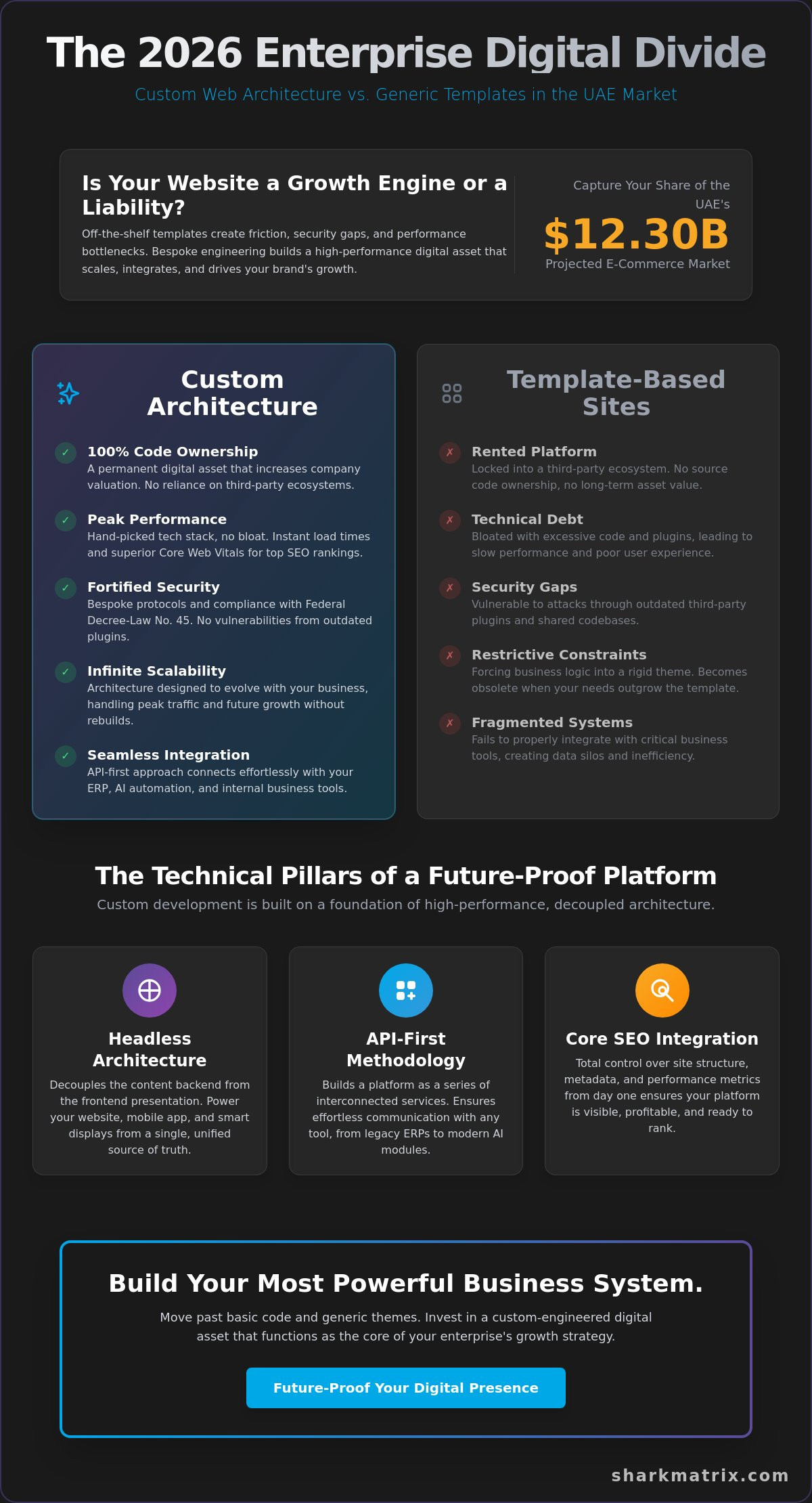
We’ll dive into the technical standards required for the 2026 landscape, from headless CMS architecture to advanced cybersecurity protocols. You’ll learn how to position your brand to capture a share of the UAE’s projected 12.30 billion dollar e-commerce market through superior SEO and user experience. It’s time to move past basic code and build a digital asset that functions as your most powerful business system.

Key Takeaways

  • Learn why engineering unique software from the ground up provides a distinct competitive advantage over generic, themed website builds.
  • Understand how 2026 standards like Headless CMS and API-first architecture create a flexible, future-proof foundation for your entire business ecosystem.
  • Evaluate the long-term total cost of ownership and performance benefits of custom web development dubai compared to plugin-heavy templates.
  • Master the strategic roadmap from discovery to deployment to ensure your digital asset aligns perfectly with your specific operational requirements.
  • Discover how integrating SEO and digital marketing directly into the development phase ensures your new platform is visible and profitable from day one.

Understanding Custom Web Development Dubai: More Than Just Code

Custom web development dubai is fundamentally about engineering software solutions from the ground up rather than assembling pre-built components. While many agencies offer “web design,” there’s a massive technical gap between skinning a theme and architecting a bespoke platform. To grasp the full scope of What is Web Development?, you have to look beyond the surface. It involves deep logic, database structuring, and specific business workflows that templates simply can’t replicate. It’s the difference between buying a suit off the rack and having one tailored to your exact measurements.

National brands in the UAE are rapidly moving away from restrictive, “themed” website builds. These platforms often come with “technical debt,” which refers to the excessive code and unnecessary plugins that slow down performance and create security vulnerabilities. When you choose a custom build, you gain 100% ownership of your source code. You aren’t leasing a platform or relying on a third-party provider’s ecosystem. You’re owning a digital asset that increases your company’s valuation and ensures you have total control over your digital destiny.

The Core Philosophy of Bespoke Engineering

Bespoke engineering starts with a clean slate. Instead of forcing your business logic into the constraints of a pre-existing CMS, developers build the system to mirror your exact operations. This approach allows for a hand-picked tech stack, whether you need Python for data-heavy tasks or React for a dynamic user interface. Selecting tools based on your specific goals prevents the bloat associated with multi-purpose platforms. Custom development is a strategic investment in intellectual property. It ensures your software evolves alongside your business instead of becoming obsolete when a third-party provider stops supporting a critical plugin.

Why National Brands Prioritize Custom Solutions in 2026

In 2026, the UAE’s digital market is more sophisticated than ever. With mobile commerce accounting for over 78% of transaction volume, a “mobile-friendly” template isn’t enough. Brands need high-performance, mobile-first experiences that load instantly and provide a unique UI/UX that reflects their specific brand identity. Sophisticated identities require a look and feel that can’t be found in a generic theme. A truly effective mobile-first strategy goes hand in hand with a robust responsive web design dubai approach that ensures seamless experiences across every device UAE consumers use. Additionally, custom architecture allows for deeper integration of search engine optimization seo services. It provides total control over site structure, metadata, and Core Web Vitals, which are essential for ranking in highly competitive local markets.

The Technical Pillars of High-Performance Custom Architecture

Building a high-performance digital asset requires moving beyond monolithic structures. In the current 2026 landscape, custom web development dubai focuses on decoupled architecture. This approach separates the frontend user experience from the backend data management. Understanding the core Web Architecture Principles is vital for building systems that don’t just work but excel under enterprise-level pressure. By adopting an API-first methodology, businesses ensure their web platform can communicate effortlessly with any internal or external tool, from legacy ERPs to modern AI modules.

It’s a shift in mindset. Instead of a single block of code, think of your platform as a series of interconnected services. This flexibility allows your business to swap out or upgrade specific components without rebuilding the entire system. If you’re looking to modernize your stack, exploring specialized web design and development can bridge the gap between legacy limitations and future-proof performance.

Headless Architecture and Multi-Channel Delivery

Headless architecture is the gold standard for enterprises that need to push content to multiple places at once. By separating the content repository from the presentation layer, one backend can power your website, mobile app, and even smart displays in a physical showroom. This setup significantly improves loading speeds. Using modern frontend frameworks like Next.js or Nuxt.js allows for static site generation and server-side rendering. These technologies ensure your site is lightning-fast, which is a critical factor for both user retention and search engine rankings.

Data Security and National Compliance Standards

Security isn’t a feature you can bolt on later; it must be baked into the code. Custom builds offer a significant advantage over common CMS platforms because they aren’t targets for “mass-exploit” attacks that scan for known vulnerabilities in popular plugins. In the UAE, compliance with Federal Decree-Law No. 45 of 2021 is mandatory. Custom development allows for precise control over data residency and encryption. You can ensure that sensitive citizen data is stored domestically and handled according to the strict 72-hour takedown timelines required by local law.

AI and Automation Integration

In 2026, AI integration is a foundational requirement rather than an optional add-on. Custom backends allow for the native processing of generative AI and chatbot logic, meaning these tools aren’t just “widgets” but core parts of the business workflow. Whether it’s using natural language processing to categorize customer inquiries or machine learning to personalize product recommendations, a bespoke backend makes it possible. This level of automation streamlines operations and reduces the manual workload on your team, turning your website into an active participant in your business growth.

Custom Web Development Dubai: The 2026 Enterprise Reference Guide

Custom Web Development vs. CMS Templates: Navigating the Choice

Deciding between a pre-built template and custom web development dubai often feels like a choice between speed and quality. While templates offer a fast path to going live, they frequently hide long-term costs that can cripple a growing enterprise. It’s vital to look past the initial price tag and evaluate the Total Cost of Ownership (TCO). A template might seem cost-effective today, but the constant need for third-party plugin subscriptions and the technical debt created by bloated code can make it more expensive over a three-year period. Bespoke systems, by contrast, are built for efficiency, ensuring your infrastructure stays lean as your traffic grows.

Performance benchmarks reveal the starkest differences. Templates are designed to be “all-in-one” solutions, meaning they load hundreds of lines of CSS and JavaScript that your specific site never actually uses. This bloat negatively impacts your Core Web Vitals and search rankings. Custom code allows for granular control over every asset, enabling your team to implement enterprise web development best practices from day one. You can optimize server-side rendering and asset delivery to ensure your platform remains competitive in a market where every millisecond of load time directly correlates to conversion rates.

The “Plugin Trap” is another significant concern for UAE brands. Off-the-shelf systems rely on a patchwork of external tools to add basic functionality like bilingual support or regional payment gateways. When one plugin updates, it can break another, leading to downtime and security gaps. Custom development eliminates this dependency by building features natively into the core architecture. This results in a stable environment where you don’t have to worry about a third-party developer abandoning a critical component of your business engine. For a deeper look at how professional website design and development services address these challenges for UAE enterprises, including Arabic localization and biometric payment compliance, it’s worth reviewing the full landscape of available solutions.

When to Choose a Template-Based System

Templates aren’t without their uses. They’re excellent for small businesses with limited operational complexity or startups looking to launch a rapid Minimum Viable Product (MVP). If you just need a basic digital footprint to test a concept, a theme can get you there quickly. However, you’ll still need to know how to choose a web design agency to ensure the setup is secure and the theme is properly optimized. Just be aware that once you hit the limits of the template’s design, pivoting or scaling usually requires a complete rebuild.

When Custom Development is the Only Option

For national brands handling complex e-commerce, proprietary algorithms, or high-security government portals, custom builds are the only viable path. If your business model relies on unique user journeys that don’t fit into a standard “checkout” or “contact” flow, forcing that logic into a rigid CMS will only lead to frustration. Custom solutions are essential for seamless integration with internal ERPs and AI automation tools. They provide the flexibility to build a truly unique digital experience that scales alongside your brand’s ambitions without the baggage of legacy code. Ensuring that experience is equally flawless on mobile requires pairing your custom build with a comprehensive responsive web design dubai strategy built for the UAE’s 5G and 6G-connected consumer base.

The Strategic Roadmap: From Discovery to Deployment

Successful custom web development dubai isn’t a black box process. It’s a highly structured engineering journey that transforms abstract business goals into a functional digital engine. Unlike off-the-shelf setups where you simply flip a switch, a bespoke project requires a meticulous roadmap to ensure every line of code serves a specific operational purpose. This path ensures that the final product isn’t just a website, but a core business system that integrates with your existing workflows and scales as your brand expands across the region.

Discovery and Strategic Planning

Every project begins with an intensive discovery phase. This is where technical documentation and site mapping serve as the project’s foundation. Instead of jumping straight into code, teams define Key Performance Indicators (KPIs) like target load times, conversion paths, and data throughput requirements. This phase is critical because discovery prevents scope creep and ensures budget adherence by identifying potential technical hurdles before they become expensive mid-project changes. It’s during this stage that the logic for complex integrations, such as AI automation or ERP syncing, is mapped out to ensure a frictionless build.

Agile Development and Continuous Integration

The build phase follows an Agile methodology, breaking the project into manageable “sprints.” This approach offers total transparency, allowing stakeholders to review progress every few weeks and pivot if business requirements shift. In 2026, professional teams utilize CI/CD (Continuous Integration and Continuous Deployment) pipelines. These pipelines automate the integration of new code, ensuring that updates are tested and deployed without disrupting the live environment. Regular stakeholder reviews during these sprints ensure the project never drifts from its original vision, keeping the development aligned with real-world user needs.

QA, Security Audits, and Performance Testing

Before any platform goes live, it must pass a battery of rigorous tests. This includes functional testing to ensure every button works, cross-browser testing for compatibility, and deep security audits to protect against vulnerabilities. For national brands, load testing is non-negotiable during the custom web development dubai process. Your system must remain stable during high-traffic periods like major regional shopping festivals or government announcement windows. Finally, a pre-launch checklist ensures technical SEO readiness, confirming that search engines can crawl and index the new architecture efficiently from the moment it launches. Ready to build your digital engine? Explore our web design and development services to start your strategic roadmap.

Future-Proofing Your Digital Presence with Shark Matrix Technologies LLC

Shark Matrix Technologies LLC operates as a strategic technology partner rather than a simple service provider. When you invest in custom web development dubai, you’re building a foundation for long-term national growth. We view your digital presence as a dynamic, evolving business tool that requires constant refinement to stay ahead of shifting consumer behaviors. This partnership approach ensures your platform doesn’t become a static relic but remains a high-performance engine for your enterprise. We focus on creating assets that you own entirely, giving you the freedom to innovate without the constraints of third-party platform limitations.

Our philosophy is built on the idea that your website should be your hardest-working employee. It isn’t enough to have a beautiful interface if the underlying architecture can’t support your business goals. By aligning our technical expertise with your specific commercial objectives, we transform your digital footprint into a scalable system. This ensures that as your business expands, your infrastructure is already prepared to handle increased load and complexity. We’re here to help you turn technical challenges into competitive advantages.

The Synergy of Search and Software

Technical excellence is meaningless if your target audience can’t find you. Our developers work side-by-side with SEO experts from the very first discovery session to ensure the architecture is optimized for search visibility. In the competitive UAE market, high-speed performance is a prerequisite for ranking, and our custom builds are engineered to exceed these benchmarks. Beyond organic reach, we integrate Search Engine Optimization (SEO) and ppc agency dubai strategies to ensure your new platform generates immediate ROI through targeted traffic. This holistic approach means your site is built to convert from the moment it goes live.

Scalability and Long-Term Partnership

A successful launch is only the beginning of the journey. Shark Matrix Technologies LLC provides ongoing technical support and maintenance to ensure your system remains secure and efficient as your user base grows. Our development philosophy centers on scalability, preparing your infrastructure for future ai automation and development or advanced machine learning integration. As your business needs change, we’re here to implement feature updates that keep you at the forefront of your industry. Whether you need to integrate ai chatbot-development services or expand your e-commerce development capabilities, our team ensures your software evolves with the market. If you’re ready to transform your digital strategy, contact us for a consultation to discuss how custom web development dubai can drive your brand’s future.

Transform Your Digital Vision into National Growth

The move toward decoupled architecture and bespoke engineering is no longer optional for enterprises seeking a competitive edge. By prioritizing a clean slate approach, you ensure your platform maintains the security and performance standards required by the UAE’s evolving legal landscape. You’ve seen how custom systems eliminate technical debt and provide the flexibility to integrate advanced AI automation directly into your core business workflows. Owning your source code is the ultimate way to protect your intellectual property while scaling without the friction of third-party templates.

Shark Matrix Technologies LLC has been a cornerstone of the regional tech scene since 2010. With over a decade of UAE market expertise, we specialize in custom web development dubai that bridges the gap between complex software engineering and high-impact digital marketing. Our team provides a comprehensive strategy that spans SEO, PPC management, and sophisticated UI/UX design to ensure your asset is both functional and visible. It’s time to stop settling for restrictive platforms and start building an engine that drives your brand forward.

Build Your Future-Ready Digital Asset with Shark Matrix Technologies LLC

Your digital infrastructure should be your most valuable asset. We look forward to helping you architect a solution that meets the demands of tomorrow’s market today.

Frequently Asked Questions

What is the primary difference between custom web development and using a CMS like WordPress?

Custom development involves engineering a unique software solution from the ground up to match specific business logic, whereas a CMS like WordPress relies on a pre-existing framework and templates. This clean-slate approach eliminates the “code bloat” often found in themes, providing better performance and 100% ownership of the source code. It allows your digital asset to function as a specialized business tool rather than a generic website.

How much does custom web development cost for a business in the UAE?

Market data for 2026 shows that professional website development in Dubai typically ranges from AED 3,500 for basic sites to over AED 145,000 for fully custom enterprise platforms. For complex web applications with high security requirements, costs can exceed AED 500,000. These figures reflect market averages for various complexities, and you should check with a technology partner for a specific quote tailored to your project goals.

How long does it typically take to build a fully custom website from scratch?

A bespoke project generally requires 12 to 24 weeks to move from the initial discovery phase to final deployment. This timeline covers strategic planning, UI/UX design, agile development sprints, and rigorous security audits. Projects involving extensive AI automation or complex ERP integrations may fall on the longer end of this spectrum to ensure every component functions seamlessly under enterprise-level traffic.

Is custom web development better for SEO compared to using templates?

Yes, custom web development dubai offers a significant advantage for search visibility because it provides total control over technical SEO factors and Core Web Vitals. Unlike templates that often load unnecessary scripts and slow down your site, custom code is lean and optimized for speed. This architectural precision ensures search engines can crawl your site efficiently, helping you rank higher in the competitive UAE market.

What technical stack should I choose for my custom web development project in 2026?

For most enterprise projects in 2026, a stack involving TypeScript and React or Next.js is the standard for high-performance frontends. On the backend, Node.js is excellent for scalability, while Python with Django is the preferred choice for data-intensive applications or those requiring AI and machine learning integration. These technologies provide the end-to-end type safety and flexibility needed for modern, future-proof platforms.

Does my business really need a custom website or is a template enough?

If your business is a small startup or you’re testing a simple concept, a template might be sufficient for a rapid launch. However, national brands with complex workflows, unique user journeys, or high scalability needs will find templates restrictive. If you plan to integrate advanced AI tools or require a specific digital identity that stands out in the UAE, a custom build is a necessary investment for long-term growth. Understanding the full scope of website design and development services available to UAE enterprises can help you make a more informed decision about the right path forward for your brand.

How do you ensure the security of a custom-built website?

Security is baked into the architecture through a “cybersecurity-first” approach that includes the use of Web Application Firewalls (WAF), security headers, and active HTTPS/SSL certificates. Custom builds are inherently less prone to the mass-exploit attacks that target common CMS plugins. Additionally, bespoke systems allow for precise control over data residency to ensure full compliance with UAE Federal Decree-Law No. 45 regarding data protection.

Can I integrate my existing CRM or ERP system into a custom website?

Seamless integration with internal business tools is a hallmark of bespoke development. By using an API-first methodology, developers can connect your website directly to existing CRM or ERP systems like SAP, Oracle, or Microsoft Dynamics. This ensures that data flows smoothly between your digital presence and your back-office operations, turning your website into a real-time extension of your business engine.

Categories
Development

How to Choose a Web Design Agency in 2026: The Ultimate Vetting Checklist

In 2026, if your web design agency can’t explain their Answer Engine Optimization strategy, they aren’t just behind the curve; they’re already obsolete. You’ve likely felt the sting of paying thousands of Dirhams for a sleek site that looks great but fails to attract a single lead from your target audience. It’s frustrating to hear technical jargon about UI/UX and headless CMS when all you want is a platform that actually grows your business. Learning how to choose a web design agency shouldn’t feel like a gamble with your marketing budget.

You deserve a high-performance partner that treats your website as a technical growth engine, not just a digital brochure. We promise to cut through the confusion with a comprehensive, technical vetting checklist designed specifically for the AI-driven era. From ensuring your site meets the latest WCAG 2.1 Level AA accessibility standards to implementing data privacy by design, we’ll show you exactly what to look for. You’ll learn how to identify partners that prioritize generative engine optimization and AI-ready architecture, ensuring your brand stays visible and compliant in an increasingly complex digital landscape across the UAE.

Key Takeaways

  • Learn why aesthetics are secondary to Generative Engine Optimization (GEO) and how to ensure your site doesn’t get lost in AI-driven search results.
  • Master the technical checklist on how to choose a web design agency that prioritizes scalable frameworks over restrictive, outdated templates.
  • Discover why your design and SEO strategies must be built together to lower your cost-per-click and maximize lead generation.
  • Protect your digital assets by identifying the specific contractual clauses that guarantee full ownership of your code and content.
  • Understand the shift toward AI-ready platforms that adapt to the specific regulatory and market conditions of the United Arab Emirates.

The 2026 Web Design Landscape: Why Your Choice Impacts More Than Aesthetics

By 2026, the digital market in the UAE has evolved far beyond simple visual appeal. A sleek interface might win a design award, but it won’t necessarily win a customer in Dubai’s competitive landscape. The shift toward Answer Engine Optimization (AEO) and Generative Engine Optimization (GEO) means your site must be as readable to a machine as it is to a person. When you’re researching how to choose a web design agency, you’re really looking for a technical partner that understands the underlying architecture required to feed Large Language Models (LLMs). A standard creative shop might focus on color palettes; a technical growth agency focuses on how your data maps to the global digital ecosystem.

A deep understanding the web design process is vital because it now encompasses everything from user psychology to machine learning readiness. Your website serves as the single source of truth for your brand. If the foundation is weak, your SEO, PPC, and content marketing efforts will struggle to gain traction. A high-performance site acts as the engine for all national digital marketing, turning traffic from search engines and social media into measurable growth.

Designing for Humans and AI Agents

AI search engines don’t “see” your site like we do. They ingest structured data and schema to provide direct answers to user queries. If your agency doesn’t prioritize this technical layer, you’re invisible to the AI agents that drive modern traffic. Speed is equally critical. With Core Web Vitals remaining a primary ranking factor for national brands, even a one-second delay can cost you thousands in potential revenue. A site built for 2026 must balance immersive 3D elements with lightning-fast load times to satisfy both human users and impatient algorithms.

The Cost of a Wrong Choice

A “cheap” website often results in massive technical debt. You might save a few thousand Dirhams upfront, but the cost of lost leads and broken integrations quickly adds up. We’ve seen many businesses in the Emirates forced to rebuild from scratch because their initial agency used a restrictive template that couldn’t scale. Switching partners mid-project is a common disaster that wastes time and capital. Investing in a custom web development Dubai solution ensures your business remains agile as technology shifts. Don’t let a low initial price tag distract you from the long-term value of a secure, compliant, and high-performing digital asset.

The Essential Vetting Checklist: Portfolio, Tech Stack, and Innovation

Picking a partner based on a pretty gallery is a mistake many UAE business owners make. When you’re figuring out how to choose a web design agency, you need to go beyond the surface. A portfolio should show industry-specific results, not just a collection of attractive images. If an agency built a stunning site for a luxury real estate firm in Dubai but it takes six seconds to load, that site is a failure. You should actively run speed and SEO tests on their previous work using tools like Google PageSpeed Insights. This reveals if they actually follow through on their performance promises and technical standards.

Professional vetting marketing and software agencies requires looking at their technical DNA. Ask them directly about their tech stack. Are they relying on bloated page builders that slow down your server, or are they using modern, scalable frameworks like React or Next.js? A scalable framework ensures your site grows with your business without needing a total rebuild in two years. Understanding the technical side of how to choose a web design agency also means asking about their integration capabilities. Your website shouldn’t exist in a vacuum; it must communicate with your CRM and email marketing platforms seamlessly.

Innovation isn’t just a buzzword in 2026. Ask how they use AI to improve user experience or automate backend tasks. Agencies that incorporate machine learning for personalized content delivery or AI chatbots for customer service are the ones that will keep you ahead of the competition. If they can’t explain their approach to generative engine optimization, they aren’t building for the future. If you need a partner that understands these complexities, checking out the custom development services at Shark Matrix Technologies LLC can provide a benchmark for high-performance builds.

Analyzing Portfolio Depth and Performance

Look for clear conversion paths in their previous work. Every button and form should serve a purpose. In 2026, mobile-first design isn’t a suggestion; it’s the standard. Test their portfolio sites on various devices to see if the experience holds up across different screen sizes. You want to see evidence of custom software engineering rather than simple template installations that look like every other business in the Emirates.

The Technical Stack Audit

Your CMS choice matters. Whether they suggest WordPress, a Headless CMS, or a custom build, they must explain why it fits your specific goals. It needs to sync perfectly with your existing marketing tools to track leads accurately. Don’t forget about security. Ask about their data protection standards to ensure your customer information remains safe under UAE regulations. A technical partner should provide a clear roadmap for maintenance and security patches long after the initial launch.

How to Choose a Web Design Agency in 2026: The Ultimate Vetting Checklist

Evaluating Marketing Integration: SEO, PPC, and Lead Generation

A beautiful website that nobody finds is just an expensive digital ornament. When you’re deciding how to choose a web design agency, you must look for a team that treats SEO as a foundational requirement rather than a final polish. In 2026, search engines and AI agents prioritize sites where the architecture, content, and code are built in unison. This means integrating comprehensive search engine optimization seo services directly into the development phase. If an agency suggests “adding SEO later,” they’re setting you up for a costly rebuild or permanent invisibility in the UAE market.

Performance isn’t limited to organic search. Your site’s design directly influences your Pay Per Click (PPC) success. A PPC-friendly design focuses on landing pages that load instantly and provide immediate relevance to the user’s query. This strategy lowers your cost-per-click by improving your Quality Score. While general SBA guidance on hiring emphasizes verifying competence, in the digital space, that competence must extend to data-driven UI/UX decisions. Using analytics and user behavior data to guide where buttons go ensures your investment drives actual business growth. It’s about how the site performs, not just how it looks on a portfolio.

The Technical SEO Checklist for New Sites

Modern web architecture requires more than just meta tags. Your agency should automate XML sitemaps and ensure a clean, logical URL structure from day one. With the rise of voice search and Natural Language Processing (NLP), your site must be optimized for how people actually speak. This involves using schema markup that helps AI agents understand your business context. They should also implement next-gen image formats like AVIF or WebP to keep load times low across mobile networks in Dubai and the wider Emirates. Knowing how to choose a web design agency means finding one that understands these technical nuances.

Conversion Rate Optimization (CRO) Expertise

High traffic is useless without conversions. A top-tier agency uses heatmaps and A/B testing to see where users click and where they drop off. They don’t guess; they test. This includes optimizing lead capture forms to be as friction-free as possible. Trust is the currency of the web. Your UI should naturally integrate reputation management elements, such as verified client reviews and local UAE industry certifications, to build immediate credibility with new visitors.

Contractual and Operational Due Diligence: Protecting Your Assets

Securing a high-performance website involves more than just approving a design mockup. If you don’t own the underlying code, you don’t truly own your business’s digital future. Many companies in the UAE find themselves trapped in “hostage” situations where an agency retains the rights to the source code or hosting environment. When researching how to choose a web design agency, your first question should focus on asset portability. You need a contract that explicitly states you own every line of code, every custom graphic, and the domain itself upon final payment. Without this, moving to a different provider or scaling your platform becomes a legal and financial nightmare.

Transparency in pricing is another critical pillar of due diligence. While a project might be quoted at 25,000 د.إ, hidden fees for “essential” maintenance, security patches, or third-party API integrations can quickly inflate the total cost of ownership. A reputable partner provides a granular breakdown of costs. They should clearly define what is included in the initial build and what requires a separate monthly retainer. If you want a partner that prioritizes clear terms and absolute transparency, you can review the professional engagement standards at Shark Matrix Technologies LLC to see how a top-tier agency operates.

The operational methodology an agency uses will dictate your daily experience during the build. In 2026, the Agile approach is generally superior to the traditional Waterfall model. Agile allows for iterative updates and constant feedback, which is vital when integrating complex AI features or shifting market strategies. It prevents the “big reveal” disaster where the final product doesn’t match your evolving business needs. Ensure the agency assigns a dedicated project manager who provides regular reporting and keeps the project aligned with your KPIs.

The Ownership and Licensing Framework

Your contract must define the project as a ‘Work for Hire,’ ensuring that all intellectual property created during the engagement belongs solely to your business. Beyond the core code, you must understand the licensing for third-party plugins. Some agencies use proprietary tools that require ongoing monthly fees in AED just to keep the site functional. Verify that all licenses are registered in your company’s name so you aren’t left with a broken site if the agency closes its doors.

Communication and Project Milestones

Success depends on a shared ‘Definition of Done.’ This isn’t just when the site looks finished; it’s when the site is fully tested, optimized for mobile, and compliant with UAE data privacy laws. Set clear milestones for the wireframe, development, and QA phases. Each stage should have specific KPIs, such as meeting a minimum load speed or passing an accessibility audit, before moving to the next. This structured approach ensures the project stays on schedule and within budget.

Making the Final Decision: Why Shark Matrix Technologies LLC is the Strategic Choice

Selecting a partner is the final hurdle in your digital transformation. You’ve navigated the technical checklists, the SEO requirements, and the contractual minefields. Now, you need a team that doesn’t just check boxes but actually drives revenue. Shark Matrix Technologies LLC bridges the gap between pure software engineering and aggressive digital growth. We don’t just build sites; we architect AI-ready platforms designed to dominate the UAE’s competitive search landscape. Understanding how to choose a web design agency eventually leads to a single realization: you need a partner that treats your code and your marketing as a single, unified engine.

Our 2026 strategy centers on Answer Engine Optimization (AEO) and Generative Engine Optimization (GEO). This ensures your brand isn’t just visible on traditional search pages but serves as the primary source for AI-driven answers. Most agencies are still catching up to these shifts. We’ve already integrated these advanced protocols into our core development process. By combining custom web development Dubai expertise with elite SEO and PPC management, we ensure that every Dirham you invest in your platform works toward a measurable return on investment for your national brand.

The Shark Matrix Technologies LLC Advantage

We bring deep expertise in both technical development and national SEO strategy to every project. Our focus remains on ROI-driven design that scales as your business grows from a local Dubai startup to a national leader. We have a proven track record of building sophisticated e-commerce platforms and custom AI tools that solve real business problems. Whether it’s implementing generative AI development services or building industry-specific AI solutions, our builds are future-proof. We don’t use restrictive templates; we engineer custom solutions that give you a distinct competitive edge in the Emirates.

Transitioning to a High-Performance Partnership

Starting a partnership with us is a straightforward, professional process. Before your initial consultation, we recommend preparing your current performance data and a clear list of your commercial objectives. Our strategists will then show you how to choose a web design agency strategy that aligns specifically with your growth targets. We’ll conduct a technical audit of your existing assets to identify gaps in speed, accessibility, and AI readiness. This data-driven approach ensures that the proposal we provide isn’t just a quote, but a roadmap for national brand dominance. Take the first step toward a future-proof digital presence by requesting a comprehensive technical audit today.

Future-Proof Your Digital Presence Today

Your website in 2026 is no longer just a visual asset. It’s a complex intersection of AI-ready architecture, strict data privacy compliance, and conversion-focused engineering. Mastering how to choose a web design agency means prioritizing technical depth over surface-level aesthetics. You need a partner that ensures your code is clean, your SEO is integrated from day one, and your ownership rights are legally protected under UAE standards.

Shark Matrix Technologies LLC has been a leader in the Emirates’ digital space since 2010. Our dedicated custom software engineering department specializes in AI automation and deep SEO integration, ensuring your platform is built for the next decade of growth. We don’t just build pages; we engineer growth engines. Partner with Shark Matrix Technologies LLC for an AI-Ready, High-Performance Website and transform your digital foundation into a lead-generating machine. The right partnership is the most significant investment you’ll make this year. Take the leap and set a new standard for your industry.

Frequently Asked Questions

What is the average cost of hiring a professional web design agency?

Professional web design costs in the UAE vary based on complexity and specific functionality. For a basic small business site, you can expect to invest between 11,000 د.إ and 29,000 د.إ. Larger custom business platforms often range from 18,000 د.إ to 55,000 د.إ, while complex e-commerce solutions can exceed 145,000 د.إ. These figures reflect the technical expertise required for security, speed, and mobile optimization in a competitive market.

Should I choose a custom-built website or a template-based one?

Custom-built websites are the superior choice for businesses looking to scale in 2026. While templates are faster to launch, they often carry heavy technical debt and restrictive code that hinders AI integration. A custom build allows you to implement specific schema for Answer Engine Optimization and ensures your site remains unique. It’s a critical factor when learning how to choose a web design agency that can support long-term growth.

How long does a typical web design and development project take?

A standard professional project usually spans 8 to 16 weeks from the initial kickoff to the final launch. Simple sites might wrap up in 6 weeks, but complex builds involving custom software engineering or AI chatbots require more time for rigorous testing. This timeline includes phases for discovery, wireframing, development, and quality assurance to ensure everything works perfectly across all devices and browsers used in the Emirates.

Will the web design agency also handle my website’s SEO?

Most high-performance agencies include foundational technical SEO as part of the build, but you should always verify this. In 2026, SEO must be baked into the architecture rather than added as an afterthought. This includes optimizing for voice search and ensuring your site structure is readable by AI agents. A partner that offers comprehensive search engine optimization ensures your new site ranks well from the moment it goes live.

What is the difference between UI and UX design in 2026?

UI (User Interface) focuses on the visual and interactive elements, including AI-driven voice interfaces and 3D graphics. UX (User Experience) covers the entire journey a visitor takes and how they feel during the process. In 2026, UX is heavily focused on speed and frictionless paths to conversion. Both are essential when deciding how to choose a web design agency that understands modern user behavior and technical performance requirements.

How do I know if a web design agency is actually using AI correctly?

Look for agencies that demonstrate AI-driven personalization and Generative Engine Optimization (GEO) in their portfolio. They should be able to explain how they use machine learning to improve site performance or automate customer interactions through intelligent chatbots. If they only mention AI as a buzzword without showing technical implementation like dynamic content delivery or NLP-optimized structures, they likely aren’t using it to its full potential.

Can a web design agency help with my online reputation management?

Yes, a skilled agency integrates reputation management directly into the UI/UX. This involves strategically placing verified reviews, case studies, and trust badges where they most influence the user’s decision-making process. They can also set up automated systems to pull in real-time social proof. This builds immediate credibility for your brand among UAE customers who value transparency and verified local expertise before they make a purchase or inquiry.

What happens if I want to move my website to a different host later?

Your ability to move depends entirely on your contract’s code ownership clauses. If you have secured full rights to the source code and assets, you can migrate to any host that supports your tech stack. This is why we emphasize checking for “Work for Hire” language in your agreement. Agencies that use proprietary, closed-source builders often make it impossible to move without rebuilding the entire site from scratch, which wastes your initial investment.

Categories
Development

App Development Cost in the UAE 2026: The Comprehensive Pricing Guide

The UAE government has committed over $100 billion to AI investments, signaling a massive shift in how digital products are built. In 2026, your app development cost uae is no longer determined solely by front-end design, but by AI-readiness and backend scalability. You’ve probably felt the frustration of unpredictable hidden costs or the anxiety of choosing between Native and Cross-platform builds without knowing which drives better ROI. It’s a common fear to worry about overpaying for features that don’t actually help you grow.

We’re here to give you total clarity. This guide provides a detailed AED-based budget framework, ranging from basic AED 18,000 MVPs to enterprise solutions exceeding AED 735,000. You’ll learn exactly how factors like PDPL compliance and Arabic language support impact your bottom line. We’ll also provide a clear roadmap for launching an MVP that balances cost with high-quality performance, ensuring your investment aligns with the UAE’s rapidly evolving tech standards.

Key Takeaways

  • Identify the specific AED-based budget tiers for 2026 to align your project scope with current market realities.
  • Analyze how Arabic localization and UAE security standards influence the total app development cost uae.
  • Evaluate the long-term financial trade-offs between Native, Cross-platform, and AI-driven development frameworks.
  • Factor in the “iceberg effect” of maintenance and hidden fees to calculate a realistic two-year total cost of ownership.
  • Implement a phased development strategy to protect your cash flow while prioritizing features that drive immediate ROI.

UAE App Development Cost Tiers in 2026

The digital landscape in Dubai and Abu Dhabi has matured rapidly. By 2026, the baseline for app development cost uae has shifted upward to reflect a market that no longer accepts “basic” solutions. Users in the Emirates are among the most tech-savvy globally. They expect apps to integrate seamlessly with national services like UAE Pass and provide flawless right-to-left (RTL) support. Understanding your budget requires looking past simple hourly rates and focusing on these localized complexities.

Apps have evolved from standalone tools into integrated ecosystem platforms. A modern app acts as a bridge between your business, third-party payment gateways, and advanced AI automation. Because the process of mobile app development now involves high-level security protocols and strict data compliance, the entry-level price point has risen. This ensures your product remains viable in a competitive national market. Most projects now fall into three distinct financial categories based on their technical depth.

Tier 1: The MVP and Single-Purpose Apps

For startups testing a new concept, a Minimum Viable Product (MVP) remains the most strategic entry point. Budgeting between AED 150,000 and AED 300,000 allows for a polished product with core functionality. This tier focuses on solving one primary user problem without the distraction of “feature creep.” You can expect a timeline of 3 to 5 months for a national launch. This budget covers essential UI/UX design and a stable backend, providing a foundation you can scale as your user base grows.

Tier 2 & 3: Standard Production to Enterprise Platforms

The jump to Tier 2, ranging from AED 300,000 to AED 600,000, usually happens when you require custom API integrations or complex database management. At this level, you’re paying for the architectural integrity needed to handle thousands of concurrent users. It’s about stability and performance under pressure.

Enterprise-grade platforms starting at AED 600,000 and often exceeding AED 1,200,000 represent the peak of the market. These projects include advanced AI-driven features and rigorous security audits. A major cost driver here is full multi-language support. Implementing a high-quality Arabic and English interface adds significant complexity to the design phase. It’s not a simple translation; it’s a complete re-engineering of the user flow to accommodate RTL layouts. This ensures your platform resonates with the entire national demographic, from local citizens to the international expat community. Investing in this tier is about building a long-term digital asset that can dominate its sector.

Primary Cost Drivers for National App Projects

Calculating your total app development cost uae requires looking far beyond the initial lines of code. In 2026, the budget is heavily influenced by the rigorous regulatory environment and the high expectations of the local market. Compliance with the UAE Personal Data Protection Law (PDPL), or Federal Decree-Law No. 45 of 2021, is a mandatory requirement that typically adds 15% to 20% to your total build cost. This isn’t just a checkbox; it involves implementing clear consent mechanisms and ensuring your data architecture allows for breach notifications within the 72-hour legal window.

Digital platforms must also now account for Federal Decree-Law No. 26 of 2025 on Child Digital Safety. This law imposes strict obligations for age verification and parental controls for users under 18. These security protocols require senior developers with specialized skill sets, which naturally impacts the hourly rate compared to generic, template-based builds. While a template might save money upfront, it often fails to meet the UAE’s Digital Economy Strategy standards for security and scalability. If you want a product that lasts, investing in custom architecture is the only way to avoid expensive technical debt later. If you’re unsure how these drivers apply to your specific project, consulting with experts in mobile app development can clarify your roadmap.

Feature Complexity and AI Integration

AI is no longer a luxury in the Emirates. With the government committing over $100 billion to AI investments, businesses are integrating predictive analytics and intelligent chatbots to stay competitive. Adding these features can push a mid-level budget from AED 92,000 toward the AED 294,000 range quickly. Real-time data processing and complex third-party API integrations for logistics or fintech also inflate the quote. AI-readiness is a 2026 budget priority for UAE firms to ensure long-term scalability and market relevance.

UI/UX Design and Arabic Localization

Localization in this market is a sophisticated engineering task. Integrating Arabic Right-to-Left (RTL) language support adds 15% to 25% to your design costs because it requires a complete mirroring of the user interface. It’s not a simple translation; it involves re-adjusting every icon, button, and navigation flow to feel natural to native speakers. High-quality UI/UX design also relies on local user research. Investing in custom animations and tailored interfaces ensures your app achieves high adoption rates in a market that values premium digital experiences.

App Development Cost in the UAE 2026: The Comprehensive Pricing Guide

Technology Choices: Native vs. Cross-Platform vs. AI-Driven

Choosing the right framework is the most significant decision you’ll make for your three-year growth plan. By 2026, the performance gap between various stacks has narrowed significantly, but the impact on your initial app development cost uae remains substantial. You aren’t just paying for code; you’re paying for long-term scalability and the ability to pivot as the market changes. A mistake here can lead to massive technical debt, requiring a complete rebuild just as your business starts to gain traction.

Your technology stack should reflect your specific business goals. If you’re a startup aiming for rapid market entry, your priorities differ from a government entity requiring maximum security. In the UAE’s competitive digital environment, the “hidden” factor in scaling is how easily your app can adopt new features, such as the AI-driven tools that are currently transforming the national economy. Aligning your tech choices with your budget from day one prevents mid-project surprises.

Native Development for iOS and Android

Native development involves writing separate codebases for Apple and Google platforms using Swift or Kotlin. While this ensures peak performance and full access to device-specific features, it typically requires a 40% higher budget than other methods. High-performance industries in the Emirates, such as fintech and advanced gaming, still prioritize this approach. For instance, a fintech or digital wallet app in the UAE often ranges from AED 150,000 to over AED 400,000 because it requires the absolute security and low-latency performance that only native code provides. The downside is clear; you must maintain two distinct teams and two sets of updates, which can strain resources over time.

Cross-Platform Efficiency (Flutter and React Native)

Frameworks like Flutter and React Native have become the standard for national enterprises looking to optimize their spend. By using a single codebase to power both iOS and Android versions, you can save up to 30% of your initial development budget. This efficiency is why a mid-level cross platform app development project typically costs between AED 92,000 and AED 294,000 in 2026. Maintenance becomes much simpler since one team handles updates for all national users simultaneously. Modern cross-platform tools are now fully ready for complex AI integrations, allowing you to deploy intelligent features across all devices without doubling your engineering hours. This makes it an ideal choice for service-based platforms and e-commerce apps that need to scale quickly across the region.

Total Cost of Ownership: Hidden Fees and Maintenance

Many business owners focus solely on the initial quote, but the launch of your product is only the tip of the iceberg. In reality, the first day your app goes live represents roughly 50% of the total app development cost uae over a two-year period. This “iceberg effect” catches many founders off guard, leading to budget shortfalls just as the app begins to gain traction. To build a sustainable digital asset, you must account for cloud infrastructure, third-party licensing, and the transactional fees charged by app stores.

Cloud infrastructure and server hosting are critical for national platforms that require high availability. While you won’t buy physical hardware, you’ll need a monthly budget for services like AWS or Azure to handle user data and backend processing. Additionally, remember that Apple and Google take a 30% commission on in-app purchases, which drops to 15% for subscriptions after the first year. You also need to factor in the annual $99 Apple Developer Program fee and the one-time $25 Google Play fee. These small costs add up, but they’re essential for maintaining a professional presence in the market.

Ongoing Maintenance and Security Updates

Once your app is live, it requires constant attention to remain functional. Annual maintenance costs typically range from 15% to 20% of the initial build price. This budget covers bug fixes, performance optimizations, and the necessary updates to keep your app compatible with the latest iOS and Android versions. In a market as regulated as the UAE, you must also schedule regular security audits to protect user data. Data security is a non-negotiable ongoing expense to ensure compliance with the UAE’s evolving digital regulations. Neglecting these updates can lead to app crashes or, worse, legal penalties under the PDPL.

Marketing, Launch, and User Acquisition

A high-quality app is worthless if your target audience can’t find it. We recommend budgeting at least 50% of your total development costs for your national launch and initial marketing push. This includes App Store Optimization (ASO), which is vital for reducing your long-term user acquisition costs by improving organic visibility. Many successful firms in Dubai and Abu Dhabi integrate their app launch with robust Lead Generation strategies to ensure a steady stream of new users from day one. Without a clear plan for marketing, even the most expensive app will struggle to generate a return on investment.

If you’re ready to build a sustainable digital asset with a clear financial roadmap, get a detailed cost assessment today to avoid the hidden fees that sink most projects.

Optimizing Your App Budget for Maximum ROI

Your investment should be a growth engine, not a sunk cost. To maximize your app development cost uae, you need a strategy that prioritizes business results over technical vanity. Many firms make the mistake of building every possible feature at once, which drains capital before the app can prove its worth. Instead, adopting a “phased development” model allows you to manage cash flow effectively. You launch with essential features, gather user feedback, and reinvest profits into the next stage of growth. This approach minimizes risk and ensures every dirham spent contributes to your bottom line.

Choosing a full-service partner also eliminates the “fragmentation tax.” When you hire separate vendors for design, development, and marketing, communication gaps often lead to expensive reworks. A single agency that understands both the technical build and the digital growth strategy ensures your app is designed for visibility from day one. This holistic view prevents the common pitfall of building a beautiful app that nobody can find. By aligning your development with a clear commercial roadmap, you turn a technical expense into a strategic asset.

The MVP Strategy for UAE Startups

A Minimum Viable Product (MVP) is the smartest way to enter the Emirates’ market. Focus on features that solve immediate pain points for local users, such as seamless payment integration or localized Arabic support. By reducing your time-to-market, you start generating revenue and collecting real-world data sooner. This data is invaluable. It helps you justify moving into Tier 2 or Tier 3 development because you aren’t guessing what users want; you’re responding to their actual behavior. It’s a data-driven path to scalability that protects your initial capital. For enterprises evaluating whether a unified codebase can meet their performance requirements, our comprehensive guide to cross platform app development in 2026 breaks down exactly how modern frameworks deliver native-grade results at a fraction of the cost.

Why Shark Matrix is the Strategic Choice

Shark Matrix doesn’t just write code. We build digital ecosystems. By combining high-performance mobile development with advanced SEO and AI automation, we ensure your app is both functional and discoverable. Our transparent pricing model means you won’t face the “iceberg” fees mentioned earlier without prior warning. We focus on national scalability, helping your brand grow from a local startup to a regional leader. Ready to start? Get a detailed 2026 app development quote from Shark Matrix and let’s build something that drives real ROI.

Launch Your Digital Future in the UAE

Building a successful mobile product in 2026 requires more than just a functional interface. It demands a deep understanding of the app development cost uae, including the technical debt of maintenance and the necessity of AI-readiness. You’ve seen how factors like Arabic localization and PDPL compliance shape your budget. Success comes from choosing the right technology stack today to avoid a costly rebuild tomorrow. Whether you start with a lean MVP or a full-scale enterprise platform, your focus must remain on scalability and user trust.

Shark Matrix has been a cornerstone of the Emirates’ tech landscape since 2010. With over 15 years of market experience, we specialize in everything from UI/UX design to AI automation and Arabic digital marketing. We aren’t just developers; we’re a full-service agency dedicated to your long-term ROI and lead generation. We understand the local regulatory environment and the high expectations of UAE users.

Don’t leave your project’s financial success to chance. Request a Custom App Development Consultation today to get a transparent, data-driven roadmap for your next venture. We look forward to helping you scale your business in this vibrant digital economy.

Frequently Asked Questions

What is the average app development cost in the UAE for 2026?

The app development cost uae depends heavily on the complexity of the features you require. A basic Minimum Viable Product (MVP) typically ranges from AED 18,000 to AED 92,000. Mid-level apps featuring cross-platform functionality often fall between AED 92,000 and AED 294,000, while complex platforms with AI or fintech integrations can exceed AED 735,000. These figures reflect the 2026 market demand for high-security and localized digital solutions.

How long does it take to build a mobile app for the UAE market?

A standard MVP takes approximately 3 to 5 months to reach a national launch. More complex projects, such as enterprise platforms or those requiring extensive third-party integrations, usually take 6 to 12 months. This timeline includes essential phases like UI/UX design, backend development, and rigorous testing for Arabic language support. Rushing this process often leads to technical debt that increases your long-term maintenance expenses.

Why is app development in the UAE more expensive than offshore options?

Local development ensures compliance with strict national regulations like the UAE Personal Data Protection Law (PDPL) and the Child Digital Safety Law. Offshore teams often overlook these requirements, which can lead to legal penalties and expensive reworks. Additionally, high-quality Arabic localization requires native design expertise to handle right-to-left (RTL) layouts correctly. Investing in a local partner ensures your product meets the specific cultural and legal standards of the Emirates.

Should I build a Native or Cross-platform app for my UAE business?

Cross-platform development is the most cost-effective choice for most businesses, potentially saving 30% of your initial budget. It’s ideal for e-commerce and service apps that need to reach both iOS and Android users quickly. However, you should choose Native development for high-performance needs like complex fintech wallets or gaming. Native builds offer the best security and hardware access but require a 40% higher investment to maintain two separate codebases.

What are the hidden costs of app development I should budget for?

You must budget for annual maintenance, which typically costs 15% to 20% of your initial build. Other “hidden” expenses include the $99 annual Apple Developer fee, the $25 one-time Google Play fee, and cloud infrastructure costs. Regulatory compliance can also increase your total build price by up to 20%. Don’t forget that app stores take a 30% commission on in-app purchases, which is a significant factor in your revenue model.

How much does it cost to add AI features to a mobile app?

Integrating AI features like predictive analytics or intelligent chatbots generally moves your project into the complex tier, starting at AED 294,000. The final price depends on whether you’re using existing APIs or building custom machine learning models. Because the UAE government has committed over $100 billion to AI investments, these features are becoming a standard requirement for staying competitive. AI-readiness ensures your app remains relevant as the national digital economy evolves.

Does the cost include publishing the app on the App Store and Play Store?

Most professional agencies include the technical submission process in their quote, but the platform fees are paid directly by the business owner. You’ll need to pay $99 annually for the Apple Developer Program and a one-time $25 fee for a Google Play Developer account. Your developer will handle the configuration, metadata, and compliance checks required for approval. This ensures your app meets the latest store policies regarding data privacy and user safety.

How can I reduce my app development costs without sacrificing quality?

The most effective way to reduce your app development cost uae is to start with a Minimum Viable Product (MVP). By focusing on core features first, you avoid overpaying for complex tools that your users might not need. Using cross-platform frameworks like Flutter or React Native also cuts expenses by allowing one team to build for both iOS and Android. A phased development approach lets you use early revenue to fund future feature updates.

Categories
Development

How to Choose the Right Development Partner — Tips from Our Experts

Choosing the right development partner can make or break your digital project. Whether you’re building a mobile app, website, or custom software, your development partner is more than just a service provider—they’re a strategic collaborator in your business journey.

Unfortunately, many businesses dive into partnerships without proper evaluation. The result? Missed deadlines, budget overruns, and subpar product quality.

To help you avoid these pitfalls, we’ve compiled a step-by-step guide with expert-backed advice on how to find a trustworthy, future-ready development partner.

Step 1: Get Clear on What You Really Need

Before you approach any development company, take time to define your project clearly. Ambiguity can lead to confusion, delays, and spiraling costs.

Ask yourself:

  • What’s the main problem my product solves?
  • Who are the target users?
  • What platforms will it support—web, iOS, Android?
  • What features are essential vs. nice-to-have?
  • What is my timeline and budget?

Pro Tip: Even a basic one-pager or sketch can significantly improve your partner’s understanding and speed up estimation.

Step 2: Look for Relevant Experience

Not all development agencies have the same background. Many teams may be great at what they do—but not every one of them is right for your business domain.

You should check for:

  • Past projects in your industry
  • Familiarity with your preferred tech stack
  • A portfolio that aligns with your needs

For example, a team skilled in building SaaS platforms may not be the best fit for a hardware-integrated IoT project.

Pro Tip: Explore platforms like TopDevelopers.co to find agencies with verified industry experience and real client feedback.

Step 3: Evaluate Communication Style and Project Management

Even the most talented team can fail without good communication. To avoid surprises, ensure the partner has a structured way to keep you updated.

Ask them:

  • How often will we meet or communicate?
  • What tools do you use (e.g., Slack, Trello, Jira)?
  • Who will be my main point of contact?

Red Flag: If they don’t proactively ask questions about your business or goals, it’s a sign they may just follow orders—not collaborate.

Step 4: Test for Cultural Fit and Team Chemistry

A productive partnership goes beyond technical fit. You should feel comfortable discussing feedback and ideas openly with your team.

Consider:

  • Do they listen, or do they dominate the conversation?
  • Are they flexible with feedback?
  • Is their working style compatible with yours?

Try to gauge not just professionalism, but also enthusiasm for your product.

Pro Tip: Consider a 2-week trial phase or a small paid discovery sprint before committing long-term.

Step 5: Review Their Process, Security Measures & QA Approach

A high-quality development team should have clearly defined processes for everything—from coding standards to security practices.

Ask questions like:

  • What is your development methodology—Agile, Scrum, or Waterfall?
  • How do you manage code quality and version control?
  • How is testing handled: manual, automated, or both?
  • What security protocols do you follow?

Red Flag: Vague answers like “we’ll handle it later” often lead to last-minute chaos and instability.

Step 6: Plan for the Long Run — Ask About Support and Scaling

The journey doesn’t end at launch. You’ll need bug fixes, performance monitoring, and possibly, more features.

Check if they offer:

  • Maintenance packages
  • Scalability planning
  • Ongoing performance audits or optimization

Pro Tip: Ask how they’ve supported clients over a 6–12 month period. Their answer will tell you a lot about long-term reliability.

Step 7: Read Reviews and Speak to References

Don’t skip this step. Genuine feedback from past clients is one of the most reliable ways to evaluate a development partner.

Where to look:

Ask the client:

  • Was the team reliable and responsive?
  • Did they meet deadlines and budgets?
  • Would you work with them again?

Step 8: Understand the Pricing Model and Contract Terms

Before signing anything, be sure you understand what you’re paying for—and what you’re not.

Clarify:

  • Is this a fixed-price, hourly, or milestone-based contract?
  • What’s included in the quote—design, QA, project management?
  • Who owns the code and IP?
  • What are the payment milestones?

Red Flag: Avoid companies that are unwilling to put clear terms in writing or promise everything without details.

Step 9: Watch for Red Flags Early

Your gut feeling matters. If something feels off during your initial calls, trust that instinct.

Common red flags:

  • Unrealistic delivery timelines
  • Overpromising and underquoting
  • Lack of structured onboarding
  • No discovery phase or strategic input

Final 10-Point Checklist Before You Choose

Here’s a quick summary to guide your final decision:

  • Clear understanding of your project
  • Proven experience in your industry
  • Strong technical skill set
  • Transparent communication flow
  • Security and QA baked into the process
  • Scalable and long-term support offerings
  • Solid client reviews and references
  • Flexible collaboration and feedback loop
  • Well-documented proposal and contract
  • A genuine passion for your success

Conclusion

Choosing a web development partner isn’t just about code. It’s about collaboration, trust, and shared success.

At Shark Matrix, we specialize in delivering high-impact digital solutions for startups, enterprises, and government projects. From custom websites to scalable apps and complex backend systems, we’ve built a reputation as Dubai’s trusted web development company.

We don’t just build what you ask for—we help you build what your business truly needs.

Ready to turn your vision into reality? Let’s talk.