

Categories
AEO

How to Optimize Content for AI Search: 2026 Guide

What if the top spot on Google no longer guarantees a single click to your website? It’s a frustrating reality for many digital marketers who see their organic traffic dipping as AI summaries provide instant answers directly on the search page. You likely feel the pressure of this shift from traditional lists to synthesized responses, fearing your brand might become invisible in a sea of AI-generated text. Understanding the difference between traditional SEO and Answer Engine Optimization (AEO) is now the only way to protect your digital footprint.

Learning how to optimize content for ai search is no longer a futuristic goal; it’s a survival requirement for 2026. This guide will help you master Generative Engine Optimization (GEO) to ensure your brand isn’t just indexed, but actively cited as a trusted authority by AI engines. We’ll explore the technical shift toward natural language processing, the importance of intent-aligned entities, and the specific data structures you need to win citations in AI-driven results.

Key Takeaways

  • Understand the critical shift from traditional search lists to synthesized AI summaries and how it changes user behavior.
  • Leverage entity-based SEO and Natural Language Processing to ensure AI engines correctly interpret your brand’s expertise.
  • Learn how to optimize content for ai search by moving your strategy from simple keyword matching to earning authoritative citations.
  • Identify the practical steps for conducting an AI visibility audit and restructuring pages for better data extraction.
  • Discover how to build a technical, AI-ready infrastructure that supports long-term brand visibility in a generative search environment.

From Keywords to Conversations: What is AI Search Optimization?

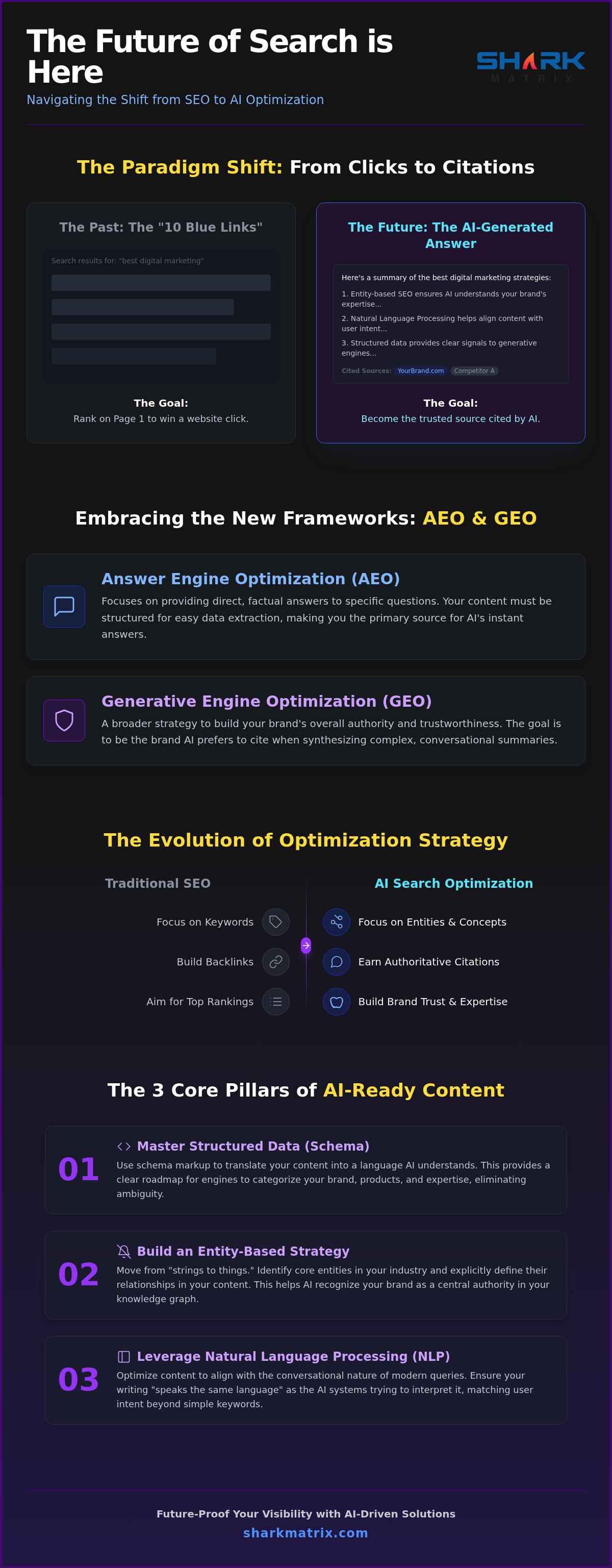
Search has undergone its most significant transformation since the invention of the crawler. For decades, Traditional SEO focused on a predictable goal: securing a spot in the “10 blue links” on a results page. In 2026, that model is no longer the primary driver of digital discovery. We’ve entered a period where Large Language Models (LLMs) act as the definitive gatekeepers between your brand and your audience. Understanding how to optimize content for ai search means moving beyond simple keyword strings and embracing the conversational nature of modern queries.

Two new frameworks define this evolution: Answer Engine Optimization (AEO) and Generative Engine Optimization (GEO). While they overlap, they serve distinct roles in a brand’s visibility. AEO focuses on providing direct, factual answers to specific user questions. GEO is broader, focusing on how your brand’s entire digital presence is perceived and cited by generative AI when it creates a synthesized summary. Instead of clicking through to your site, users now receive the information they need directly from the AI, making your status as a cited source the new benchmark for success.

The Mechanics of Answer Engine Optimization (AEO)

AI engines don’t just look for matches; they extract concepts. When a user asks a question, the engine scans high-authority content to find the most concise, accurate response. This has turned “position zero” into the only position that truly matters for many informational queries. To win here, your content must be structured for easy extraction. AI prefers clear hierarchies and data that’s presented without unnecessary fluff. If your information is buried under layers of flowery prose, the algorithm will likely skip it in favor of a competitor who provides a direct answer. Using natural language processing techniques ensures your content speaks the same language as the systems trying to read it.

Why Your Brand Needs a GEO Strategy Now

Waiting to adapt is a recipe for digital invisibility. As organic click-through rates from traditional search results fluctuate, brands in competitive markets like the UAE are finding that being an early adopter of GEO provides a massive advantage. AI search is proactive. It doesn’t just wait for a query; it anticipates intent based on previous interactions. By building an AI-ready infrastructure today, you ensure your brand is the one the LLM trusts to cite when a user asks for a recommendation or a solution. Shark Matrix Technologies LLC specializes in bridging the gap between technical AI development and strategic marketing through our SEO company Dubai services, helping national brands stay relevant as search logic evolves from simple matching to complex reasoning.

The Core Pillars of Generative Engine Optimization (GEO)

If the previous section established the “why” of the AI shift, this section focuses on the technical architecture of success. Success in 2026 requires more than just high-quality writing; it demands a deep understanding of how to optimize content for ai search through structural and semantic precision. AI models no longer view your pages as a collection of keywords. Instead, they see a web of interconnected entities and facts that must be verified for accuracy and relevance.

Schema markup remains the most critical bridge between your human-readable content and an AI’s processing requirements. By using structured data, you provide a clear map that Large Language Models (LLMs) use to categorize your brand, products, and expertise. This technical layer removes ambiguity, ensuring that when an AI engine synthesizes an answer, it pulls from your verified data rather than making an educated guess. To effectively Optimize Your Content for AI Citations, you must prioritize this factual transparency alongside authoritative sourcing.

Mastering Entity-Based Content Strategy

Building an entity-based strategy means moving from “strings to things.” You need to identify the core entities in your industry and define their relationships using semantic triples, which consist of a subject, a predicate, and an object. AI models map relationships between entities by analyzing the context and frequency of their co-occurrence across diverse datasets to build a structured knowledge graph. By explicitly stating these relationships in your content, you make it easier for AI to recognize your brand as a primary authority in your niche.

Leveraging NLP for Better AI Recognition

Language is the interface for AI search, so your content must align with how machines interpret human speech. This doesn’t mean writing like a robot; it means using clear, conversational language that answers specific long-tail queries without unnecessary jargon. Clarity and factual density are your best tools for winning citations in AI summaries. Our natural language processing services enhance content discoverability by aligning your brand’s voice with the specific linguistic patterns and intent-based structures that AI engines prefer. If you’re looking to scale these technical improvements across your entire site, exploring ai automation services can help streamline the implementation of these pillars at a national level.
How to Optimize Content for AI Search: 2026 Guide

Traditional SEO vs. AI Search Optimization: A 2026 Comparison

Traditional SEO isn’t obsolete; it’s the bedrock upon which AI visibility is built. While the old goal was matching a user’s query with a keyword-rich page, 2026 search logic focuses on the underlying intent. AI models don’t just look for words; they look for the reason those words were typed. This shift changes how to optimize content for ai search from a game of density to a game of relevance. You aren’t just competing for a spot in a list. You’re competing to be the definitive answer that an AI synthesizes for the user.

Backlinks remain a signal of authority, but citations are the new currency of visibility. In a traditional search environment, a link from a high-authority site boosts your rank. In an AI summary, a citation proves to the LLM that your brand is a reliable source for a specific fact. Similarly, while page speed is vital for user retention, AI engines prioritize fact density. They want to extract the maximum amount of verified information in the shortest possible crawl. Understanding how to optimize content for ai search requires a mindset shift from static pages to dynamic data sources that provide high value per kilobyte.

The Evolution of E-E-A-T for AI

AI engines have refined the concept of Experience, Expertise, Authoritativeness, and Trustworthiness (E-E-A-T). In 2026, they favor first-party data and original research over recycled content. If your brand publishes unique case studies or proprietary data, you’re more likely to be cited. AI models look for consistent mentions across multiple platforms to verify your authority. It’s not enough to say you’re an expert; you need a digital footprint that proves it through verified facts and cross-referenced citations across the web.

Integrating SEO and GEO for National Brands

Successful national brands don’t choose between SEO and GEO. They integrate them. You still need traditional rankings to capture users who prefer manual browsing, but you also need to be AI-ready for those using conversational search. Using comprehensive SEO services ensures your site serves both masters. Shark Matrix Technologies LLC bridges this gap by building digital infrastructures that maintain legacy rankings while preparing content for AI extraction. This dual approach ensures you don’t lose traffic as search behaviors continue to shift toward AI-driven answers in the UAE.

Step-by-Step: How to Optimize Your Content for AI Citations

Moving from theory to practice requires a systematic approach to your existing digital assets. Learning how to optimize content for ai search begins with a thorough AI visibility audit. Instead of checking traditional rank trackers, you must query major LLMs to see if they recognize your brand and what specific sources they cite when answering industry-related questions. If the AI currently pulls data from a competitor, you’ve identified a citation gap. This audit provides a baseline for your strategy, allowing you to target the exact queries where your brand is currently invisible or misrepresented.

Once you’ve identified these gaps, the next step involves implementing advanced Schema markup that goes beyond standard organization tags. For national brands in the UAE, this means using industry-specific properties that define your unique value proposition and verified data points. Monitoring these mentions is an ongoing task because AI models are updated frequently. A source cited today might be replaced tomorrow if a more factual or better-structured alternative emerges. Staying ahead requires constant refinement of your data layers to ensure you remain the most reliable option for AI extraction.

Structuring Content for AI Extraction

AI engines prefer content that mirrors the natural way humans ask questions. Use your H2 and H3 headings to state these questions directly, followed immediately by a fact-dense summary sentence. An AI-optimized summary should lead with a direct definition or answer, followed by two supporting facts and a concluding piece of evidence, all within a 50-word limit. This specific structure makes it incredibly easy for an engine to identify your text as a “snippet-ready” candidate for a generative summary. By removing the preamble and leading with the answer, you increase the likelihood of being cited as the authoritative source.

Technical Optimization for Generative Engines

The technical side of how to optimize content for ai search often involves moving toward headless CMS environments and API-driven content delivery. These setups allow AI crawlers to access your data without the noise of traditional front-end code. Shark Matrix Technologies LLC helps brands build these search-ready infrastructures from the ground up, ensuring that technical SEO basics like XML sitemaps and robots.txt files are explicitly configured for AI agents. Our expertise in generative ai development ensures your content is delivered in a format that machines can process with maximum efficiency. If you’re ready to secure your place in AI results, our team can help you implement these technical standards through our ai automation services.

Future-Proofing Your Visibility with Shark Matrix AI Solutions

National brands in the UAE face a unique challenge as we move through 2026. The convergence of AI automation and digital growth means that your infrastructure must be as intelligent as the engines crawling it. Shark Matrix specializes in building these AI-ready foundations from the ground up. We don’t just help you understand how to optimize content for ai search; we provide the technical architecture required to sustain that visibility over the long term. This involves custom AI development that addresses industry-specific search challenges, ensuring your brand remains a primary source in AI-generated answers regardless of how the underlying models evolve.

Building a future-proof brand requires more than just following trends. It requires an infrastructure that can handle the demands of generative engines while maintaining the core principles of brand authority. We help you bridge the gap between technical data science and creative content marketing, ensuring your digital presence is both human-centric and machine-readable. By focusing on verified first-party data and clear entity relationships, we turn your website into a high-density information source that AI engines trust and prefer.

End-to-End AI and SEO Integration

Success in the generative era requires a multi-disciplinary strategy that traditional agencies often miss. You can’t rely on high-quality content alone if your technical backend doesn’t support rapid, structured data extraction for Large Language Models (LLMs). By combining our AI automation services with strategic content marketing, we ensure every piece of data on your site is optimized for both human readers and machine processors. This holistic approach is why national leaders consult with our SEO company to build a sustainable GEO roadmap. We act as the bridge between technical machine learning development and consumer-facing messaging, ensuring your expertise is never lost in translation.

Staying Ahead of the Generative Curve

The search market moves with incredible speed. Algorithm shifts and changing citation patterns mean your digital strategy must be inherently agile. Continuous monitoring of how different LLMs interpret and cite your brand is essential for identifying new citation gaps before they impact your bottom line. Technical agility isn’t just a buzzword; it’s the primary difference between being a cited authority and becoming digitally invisible. We help you stay ahead by integrating AI automation into your marketing workflows, allowing for real-time adjustments to your content structure. Mastering how to optimize content for ai search is an ongoing commitment to data accuracy and semantic precision.

Your next step is clear. Auditing your brand for the 2026 AI search landscape is the only way to protect your market share. Contact Shark Matrix today for a comprehensive AI search readiness assessment. We’ll evaluate your current visibility, identify technical bottlenecks, and build a customized plan to ensure your brand remains the preferred source for AI summaries across every major engine.

The search landscape has fundamentally transitioned from simple keyword matching to complex, conversational AI summaries. Winning citations in 2026 requires a technical shift toward entity-based content and structured data that Large Language Models can easily extract. Mastering how to optimize content for ai search is now the most critical step in protecting your national visibility and ensuring your expertise isn’t lost in a sea of synthesized answers.

Shark Matrix leads the market as a national UAE leader in SEO, backed by specialized NLP and AI automation teams. Our expertise in generative AI development allows us to build the technical bridges your brand needs to stay relevant. We don’t just react to algorithm shifts; we build the infrastructures that define them. Ready to dominate the AI search landscape? Contact Shark Matrix for a GEO Strategy Audit today. The future of search is conversational, and your brand deserves to be the definitive answer.

Frequently Asked Questions

What is the difference between SEO and GEO?

Traditional SEO targets rankings in the standard list of search results, while GEO (Generative Engine Optimization) focuses on winning citations in AI-generated summaries. SEO is about being found in a list; GEO is about being the source the AI trusts to build its synthesized response. This requires a deeper focus on entity relationships and how Large Language Models perceive your brand’s authority across the entire web.

How do I get my website cited by AI search engines like ChatGPT or Perplexity?

You get cited by providing factual, high-density responses that AI models can easily verify and extract. These engines prioritize first-party data, original research, and unique insights over recycled content. Consistency across multiple platforms also helps the AI verify your brand as a trusted authority, making it more likely to quote you in its summaries.

Is traditional keyword research still relevant for AI search?

Keyword research is still necessary, but the focus has shifted to conversational intent and semantic entities. You need to understand how users phrase questions to AI assistants rather than just typing short, static phrases. Understanding how to optimize content for ai search in 2026 involves targeting these natural language patterns and identifying the entities your audience is most interested in.

How does structured data help with AI search optimization?

Structured data provides a clear, machine-readable map of your website’s information using Schema.org. It helps AI models identify entities like people, places, products, and facts without ambiguity. This technical layer reduces the risk of the AI misinterpreting your data, making your content a much more attractive candidate for AI extraction and citation.

Can AI-generated content rank well in AI search engines?

AI-generated content can rank, but only if it provides significant information gain. Search engines prioritize E-E-A-T, meaning they look for signs of real-world experience and proprietary expertise. If your content is just a generic summary of existing web data, it’s unlikely to be cited as a primary source by a generative engine.

What are the most important factors for Answer Engine Optimization (AEO)?

The core pillars of AEO are clarity, factual accuracy, and directness. You should place the most important information at the beginning of your sections to help AI bots find the answer quickly. Mastering how to optimize content for ai search through AEO means removing unnecessary fluff and focusing on high-value facts that answer specific user questions.

How often should I update my content to stay relevant for AI engines?

Content should be updated as soon as new facts, data points, or industry shifts occur. AI models are updated frequently and often have access to the live web to provide the most current answers possible. To maintain your position as a cited authority, your content must always be more accurate and up-to-date than the competing sources.

Does site speed affect my visibility in AI search summaries?

Site speed impacts how efficiently AI bots can crawl and process your data. While the final AI summary is text-based, technical issues or slow load times can prevent an engine from indexing your latest updates. A fast, clean technical structure ensures your optimized content is always accessible to the AI when it needs to verify a fact.

Categories
SEO

The 2026 On-Page SEO Checklist: Optimizing for Humans and AI Search

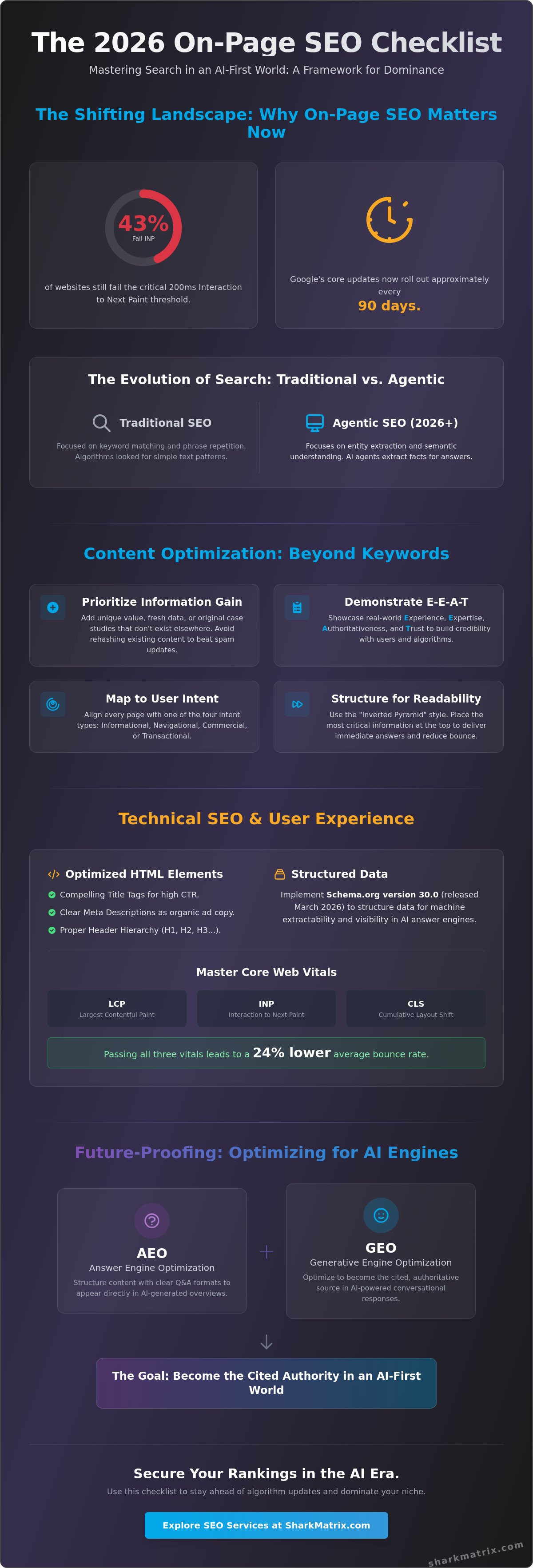
Did you know that 43% of websites still fail the 200ms threshold for Interaction to Next Paint (INP) in 2026? It’s frustrating to produce high-quality content only to see it buried because the technical goalposts moved again. With Google now rolling out core updates approximately every 90 days, staying visible requires more than just good writing. You’re likely looking for a way to maintain consistency across your site while ensuring you aren’t left behind by AI search. This comprehensive on page seo checklist provides the exact framework you need to satisfy both traditional algorithms and the latest generative engines.

We’ll show you how to master the essential factors that drive rankings today, from implementing Schema 30.0 to meeting the strict March 2026 spam update requirements. You’ll discover how to optimize for Answer Engine Optimization (AEO) and Generative Engine Optimization (GEO) so your brand becomes the cited authority in AI-generated responses. This guide previews the technical and creative shifts necessary to secure higher organic visibility and long-term search dominance in an AI-first world.

Key Takeaways

  • Learn why shifting from keyword matching to entity-based optimization is essential for ranking in 2026.
  • Use a modern on page seo checklist to verify that your HTML elements are fully optimized for humans and bots.
  • Master the latest image SEO techniques and performance standards to keep users engaged and reduce bounce rates.
  • Discover how Answer Engine Optimization (AEO) helps your content appear in AI-generated overviews.
  • Prioritize Information Gain to ensure your content provides unique value that machines cannot easily replicate.

What is On-Page SEO and Why It Matters in 2026

On-page SEO involves the precise optimization of individual web pages to rank higher and earn more relevant traffic in search engines. By 2026, the definition has expanded. It’s no longer just about where you place a keyword; it’s about how well your content satisfies user intent and maps to specific entities. Following a modern on page seo checklist ensures your site communicates clearly with both human readers and sophisticated AI search agents.

This foundation is critical for national digital marketing strategies, especially in competitive markets like the UAE. High-quality on-page signals act as a trust signal for brand authority. With Google’s March 2026 Core Algorithm Update placing a heavier emphasis on genuine expertise, your on-page elements must prove you aren’t just another generic voice. They must show you’re a leader in your field. This is why optimizing for humans and AI search simultaneously has become the standard for any brand looking to maintain its market share.

The Evolution of On-Page SEO: Traditional vs. Agentic

Search algorithms have evolved from simple pattern matching to deep semantic understanding. Today, AI agents crawl your site to extract facts, not just phrases. This agentic search environment means your content must be structured for machine extractability. If your data isn’t organized using the latest standards, like Schema.org version 30.0 released on March 25, 2026, you risk being invisible to AI answer engines. Static strategies fail because the average time between Google updates has dropped to just 90 days. You need an agile on page seo checklist to stay relevant in this fast-paced environment.

Key Benefits of a Rigorous On-Page Strategy

A disciplined approach to on-page factors delivers measurable business results. When you align your content perfectly with what a user is looking for, your click-through rates (CTR) naturally climb. You’re giving people exactly what they asked for. Beyond just getting the click, a solid strategy improves the actual experience on the page. Research shows that websites passing all three Core Web Vitals thresholds see a 24% lower bounce rate on average. This better alignment between intent and content doesn’t just help rankings; it drives the conversions that grow your business. Key benefits include:

  • Higher CTR: Compelling titles and meta descriptions act as organic ad copy.
  • Enhanced UX: Proper header hierarchy and fast loading times keep users engaged.
  • Better Alignment: Content that answers the user’s specific question reduces immediate exits.

Content Optimization: Beyond Basic Keyword Placement

Ranking in 2026 requires more than just sprinkling terms throughout a blog post. Your on page seo checklist must prioritize “Information Gain.” This concept involves adding unique value that doesn’t exist elsewhere on the web. Since Google’s March 2026 Spam Update specifically targets thin, low-value content, simply rehashing what’s already on page one is a recipe for invisibility. You need to provide fresh data, original case studies, or a unique expert perspective to satisfy both users and modern algorithms.

Identifying keywords still matters, but the focus has shifted toward national search volume and intent mapping. Every piece of content should align with one of the four intent types: Informational, Navigational, Commercial, or Transactional. For instance, if you’re looking to scale a brand, your page must answer the specific commercial or transactional questions a business owner has. This alignment is reinforced by E-E-A-T, where you demonstrate real-world experience and expertise to build trust with your audience. If you need assistance with these complex strategies, our ecommerce seo services provide a tailored approach for national growth.

Writing for Semantic Search and Entities

Modern search engines think in terms of topics and entities, not just strings of text. Instead of repeating a keyword, focus on the “Who, What, Where, and Why” of your subject. Natural language processing allows search engines to understand the relationships between different concepts on your page. By incorporating Latent Semantic Indexing (LSI) keywords naturally, you help search agents categorize your content accurately. If you need a reference for these technical requirements, checking a comprehensive on-page SEO checklist can help ensure you’ve covered all semantic bases.

Structuring Content for Maximum Readability

Engagement is a key ranking signal. Use the “Inverted Pyramid” style by placing your most critical information at the very beginning. This ensures that even if a reader only stays for ten seconds, they get the answer they came for. Keep your paragraphs short and use an active voice to maintain momentum. If you find this level of optimization daunting, our content marketing experts can help you craft high-performing assets. By using clear headings and internal links to related resources, you guide the reader through a logical journey that search engines can easily map and reward.

The 2026 On-Page SEO Checklist: Optimizing for Humans and AI Search

HTML and Structural Elements Checklist

While content is the heart of your page, the HTML structure is the skeleton that holds everything together. Search engines use these structural signals to understand the hierarchy and relevance of your information. A high-performance on page seo checklist must prioritize these elements to ensure that crawlers can easily parse your data and users can navigate your content without friction. In 2026, clarity in your HTML is more important than ever as AI agents look for specific data points to cite in their answers.

Your URL structure is the first thing both a user and a bot see. Keep your slugs short, descriptive, and keyword-rich. Avoid using random strings of numbers or dates that add unnecessary length. A clean URL like “example.com/on-page-seo-checklist” is far more effective than a convoluted path. While many focus on backlinks, a comprehensive SEO checklist reinforces that your on-page structure is the actual foundation of your organic visibility. If your site’s architecture is messy, even the best content will struggle to rank. Working with a technical seo consultant can help you identify and resolve the hidden structural issues that prevent search engines from crawling your site efficiently.

The Anatomy of a Perfect Title and Meta Tag

Title tags remain one of the strongest on-page ranking signals. You should place your primary keyword near the start of the title to give it maximum weight. However, don’t just write for bots. Use power words or numbers to create a compelling hook that improves your click-through rate. Your meta description should act as “ad copy” for your organic listing. While it isn’t a direct ranking factor, a well-crafted description encourages users to choose your link over a competitor’s. To avoid “keyword cannibalization,” ensure every page on your site has a unique title and meta tag tailored to its specific topic.

Header Tag Best Practices

Organization is key to readability. Use a logical H1-H6 hierarchy to guide the reader through your subtopics. The H1 tag serves as the singular core theme of your page, signaling to both readers and crawlers exactly what the content is about. You should only have one H1 per page. From there, use H2 tags for your main sections and H3 tags for supporting details within those sections. This structure doesn’t just help humans skim; it helps search engines understand the relationship between your primary topic and its supporting points. If you’re struggling to implement these structures at scale, our Web Design and Development services can help you build a site that is optimized by default.

Visual Asset SEO and User Experience Factors

Visual content is no longer just a decorative element; it’s a critical component of your on page seo checklist. In 2026, search engines and AI models aren’t just looking at your text. They’re analyzing your images and videos to understand the full context of your page. High-quality visual assets that load quickly are essential for keeping users on your site. When you provide a seamless visual experience, you reduce friction and encourage longer dwell times. This is especially vital as over 60% of web traffic now comes from mobile devices, where visual performance is often the deciding factor between a conversion and an exit.

User experience is now mathematically tied to your rankings through Core Web Vitals. As of May 2026, Google uses a composite score for these metrics. If you fail even one of the three core metrics, your visibility can suffer. Currently, 43% of websites fail the 200ms threshold for Interaction to Next Paint (INP). To stay competitive, your pages must hit the “good” thresholds: Largest Contentful Paint (LCP) under 2.5 seconds, INP under 200 milliseconds, and Cumulative Layout Shift (CLS) under 0.1. Passing these benchmarks isn’t just about technical vanity; websites that meet all three thresholds see a 24% lower bounce rate on average. If your site feels sluggish, our Web Design and Development services can help you build a high-performance platform that satisfies both users and search engines.

Optimizing Images for Search and AI

Every image on your site should be optimized for machine extractability. This starts with descriptive filenames and modern formats like WebP to ensure fast loading. Your alt text should be descriptive and functional, providing clear context for both accessibility and AI search bots. Additionally, using Image Schema helps search engines identify the specific subject matter of your visuals, increasing the chances of your content appearing in rich snippets or AI-generated answers. Always compress your files to maintain high visual quality without bloating your page weight.

Engagement Signals and On-Page UX

A well-optimized page guides the user toward their goal. Clear site navigation allows visitors to find relevant information quickly, which signals to search engines that your site is helpful. Avoid using intrusive pop-ups, particularly on mobile, as they disrupt the user journey and can lead to penalties under the latest spam updates. Instead, use multimedia like infographics or short videos to break up long blocks of text and increase engagement. Finally, integrate clear calls-to-action (CTAs) that lead the user to the next stage of the funnel. This ensures that your SEO efforts translate into actual business results.

Future-Proofing: Optimizing for AI and Answer Engines

The final pillar of a modern on page seo checklist involves preparing for a search environment where AI agents, not just humans, are the primary “readers” of your site. Answer Engine Optimization (AEO) is the practice of structuring your content so these agents can easily extract and cite your information in AI-generated overviews. While traditional rankings still drive significant traffic, appearing as a primary source in a generative answer is the new gold standard for national authority. This requires a shift from writing broad articles to creating precise, data-rich segments that machines can parse with high confidence.

To capture these opportunities, you must integrate “Snippet-Bait” into your layout. These are concise Q&A blocks or summary tables designed specifically for AI extraction. By providing a direct answer to a complex query within the first 50 words of a section, you increase the likelihood of being featured in rich snippets. Our search engine optimization seo services bridge the gap between these human and AI needs, ensuring your content remains readable while serving as a high-quality data source for generative engines.

Schema Markup: The Language of Search Engines

Explicit context is everything in 2026. Implementing JSON-LD structured data is no longer optional; it’s the primary way you tell search engines exactly what your content represents. Whether you’re using FAQ, Article, or Product Schema, you should always align with the latest standards, such as Schema.org version 30.0 released on March 25, 2026. This technical layer acts as a translator for AI agents, converting your creative prose into a structured format that machines can verify and display. Dominating SERP real estate today often depends on how well your FAQ schema answers long-tail conversational queries.

The Shark Matrix Approach to Modern SEO

National brands face the unique challenge of maintaining consistency across thousands of pages. We solve this by integrating ai automation services to audit and update on-page factors at scale, ensuring no page falls behind the 90-day algorithm update cycle. A bespoke on-page framework is necessary to balance brand voice with the technical rigors of generative engine optimization (geo). To ensure your audits translate into actionable growth strategies rather than overwhelming technical reports, review our seo audit report guide for national brand growth before your next site review. If you’re ready to ensure your site is fully optimized for the next generation of search, it’s time to take action. Audit your on-page SEO with the experts at Shark Matrix to secure your rankings and AI visibility.

Securing Your Search Presence in an AI-Driven Future

Success in the modern search landscape requires a dual focus on human engagement and machine readability. You’ve learned that mastering your on page seo checklist means more than just placing keywords; it’s about providing unique Information Gain and ensuring your site meets the strict Core Web Vitals thresholds. By aligning your content with Schema 30.0 and optimizing for Answer Engine Optimization (AEO), you position your brand as a primary source for both Google and generative AI agents.

Shark Matrix has been at the forefront of digital transformation since 2010. With 15+ years of regional expertise, we specialize in helping national UAE enterprises navigate complex algorithm shifts through AI-driven SEO and generative engine optimization. Don’t let your high-quality content go unnoticed by failing to adapt to these technical requirements. Download Our Full 2026 SEO Strategy Guide to stay ahead of the competition. The future of search is here, and with the right strategy, your brand can lead the way.

Frequently Asked Questions

What is the most important on-page SEO factor in 2026?

The most critical factor is satisfying user intent through original “Information Gain.” Search engines now prioritize content that adds unique value or fresh data to the conversation rather than simply rehashing existing information. While technical elements are vital, your ability to demonstrate genuine expertise and provide a clear answer to the user’s specific query is what ultimately drives rankings in a competitive landscape.

How long does it take for on-page SEO changes to reflect in rankings?

Most on-page changes begin to reflect in search results within a few days to several weeks. This timeline depends on your site’s crawl budget and how frequently search engines index your pages. High-authority sites with frequent updates often see changes faster. If you’ve implemented a comprehensive on page seo checklist, you can monitor your progress through search console tools to see how quickly bots pick up your structural improvements.

Can I do on-page SEO without technical knowledge?

You can certainly manage content-level optimizations, such as keyword placement and header organization, without deep technical skills. However, more advanced tasks like implementing JSON-LD Schema or optimizing for Core Web Vitals usually require professional assistance. For these structural elements, our web design and development team can ensure your site’s backend is as optimized as your front-end content.

How does on-page SEO differ for ecommerce websites?

Ecommerce SEO focuses heavily on product-specific data, faceted navigation, and transactional intent. You must ensure that every product page includes unique descriptions, high-quality images with descriptive alt text, and structured data for pricing and availability. This differs from informational content because the goal is to guide the user toward a purchase while helping AI shopping agents identify your inventory as the best match for a buyer’s needs.

Do I need to update my on-page SEO for AI search engines like Perplexity or ChatGPT?

Yes, you should adapt your strategy to include Answer Engine Optimization (AEO) and Generative Engine Optimization (GEO). These platforms look for highly structured, fact-dense content that they can easily extract and summarize. By following a modern on page seo checklist that includes Q&A blocks and clear data tables, you increase the chances of your brand being cited as a primary source in AI-generated answers.

What are the most common on-page SEO mistakes to avoid?

Common errors include keyword stuffing, using duplicate title tags, and neglecting the mobile user experience. Many businesses also forget to optimize their images or fail to use a logical heading hierarchy. These mistakes make it difficult for search engines to understand your page’s purpose and often lead to poor engagement from human visitors, which can negatively impact your long-term organic visibility. A thorough seo audit report can help you systematically identify and prioritize these issues before they compound into larger ranking problems.