

What if the traditional search engine results page isn’t where your customers are looking anymore? For many UAE brands in 2026, the reality of declining organic click-through rates due to AI Overviews is a daily struggle. It’s frustrating to watch your hard-earned visibility vanish as Large Language Models summarize your content without a click. You likely feel the pressure of finding the right tools for answer engine optimization while manually updating Schema for bots or flying blind without knowing how ChatGPT actually perceives your brand.
You don’t have to guess your way through this shift. This guide reveals the advanced software and platforms required to reclaim your digital authority and secure vital citations in Gemini and Perplexity. We’ll walk through the software needed to automate structured data, track AI-specific rankings, and implement a framework to measure your Share of Model (SoM). From leveraging Arabic NLP for the national market to deploying custom AI automation, you’ll gain the technical stack necessary to dominate the generative search landscape.
Key Takeaways
- Learn how to transition from traditional SERP tracking to “Share of Model” (SoM) metrics to accurately measure your brand’s presence in AI-generated responses.
- Identify the most effective tools for answer engine optimization that provide deep-dive sentiment analytics and citation tracking for ChatGPT, Gemini, and Perplexity.
- Discover how to automate advanced entity tagging and implement “AI-first” technical infrastructure to improve your content’s fact density for LLM crawlers.
- Understand the importance of custom generative AI development for UAE enterprises requiring specialized Arabic NLP capabilities that generic software may overlook.
- Gain a clear framework for auditing your current AI visibility and building a proprietary software stack to maintain a competitive edge in generative search.
The Evolution of Answer Engine Optimization Tools in 2026
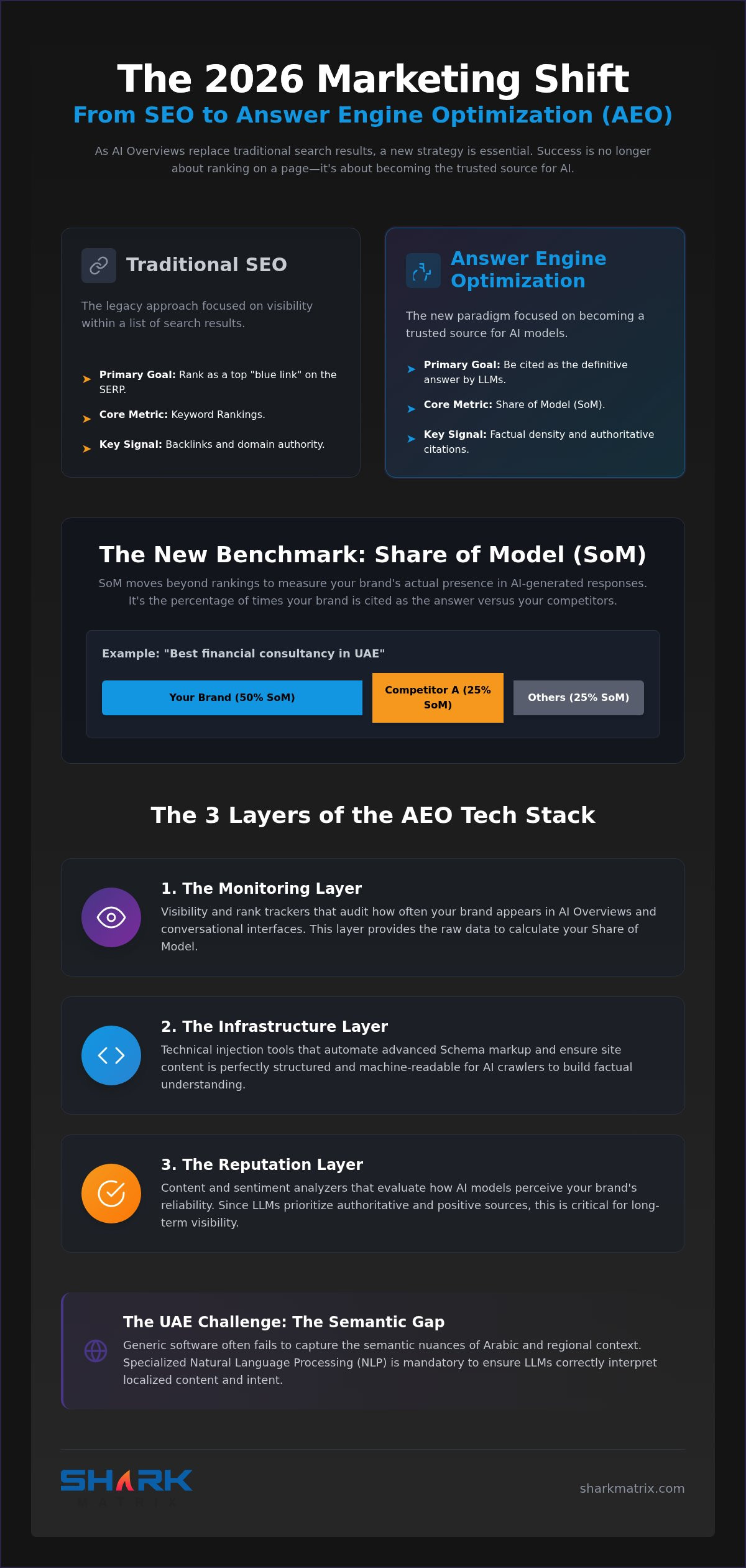
In 2026, the digital marketing stack has undergone a seismic shift from simple keyword matching to complex entity influence. The Evolution of Answer Engine Optimization Tools has necessitated a move toward software that doesn’t just track clicks, but monitors how Large Language Models (LLMs) perceive and cite your brand. These tools for answer engine optimization are now essential for any UAE firm looking to maintain its “Share of Model” (SoM). This metric has replaced traditional rank tracking, measuring the percentage of brand mentions and citations your business receives in AI-generated responses compared to your competitors. Success no longer depends on being a blue link on a page; it depends on being the definitive source an AI trusts.
Modern optimization relies heavily on sophisticated technology to decode how models interpret intent. For UAE brands, this is particularly complex due to the nuances of the Arabic language and regional context. Generic software often fails to capture the semantic weight of localized content. This is why specialized natural language processing services have become a mandatory part of the optimization stack. These services ensure your brand’s data is structured so that LLMs can process regional queries without losing the intended meaning or authority.
Why Traditional SEO Tools Aren’t Enough for AEO
Traditional platforms like Ahrefs or Semrush were built for a link-based economy. While they’ve evolved to include AI features, they still primarily focus on keyword rankings and backlink profiles. AEO requires tracking semantic relationships rather than just hyperlinked votes. The “Semantic Gap” is the distance between a keyword ranking on a search page and an LLM understanding your brand as the authoritative entity for a specific solution. In a conversational search era, being “on page one” is irrelevant if ChatGPT or Gemini doesn’t cite you as the answer. AEO tools bridge this gap by analyzing how models synthesize your data into their knowledge graphs.
The Core Categories of the AEO Tech Stack
To dominate the generative search landscape in the UAE, businesses need a three-layered approach to their software stack:
- The Monitoring Layer: These are visibility and rank trackers that audit how often your brand appears in AI Overviews and conversational interfaces. They provide the data needed to calculate your Share of Model.
- The Infrastructure Layer: Technical injection tools focus on site architecture. They automate the deployment of advanced Schema and ensure your content is “machine-readable” for AI crawlers.
- The Reputation Layer: Content sentiment analyzers evaluate how AI models perceive your brand’s reliability. Since LLMs prioritize authoritative and positive citations, this layer is critical for long-term visibility.
While off-the-shelf software provides a starting point, many UAE enterprises find that a custom approach is necessary. Shark Matrix serves as a technical partner in this space, offering generative AI development to build proprietary tools that cater specifically to the national market’s linguistic and competitive requirements.
Top AI Visibility and Rank Tracking Platforms
As search shifts toward synthesis, tools for answer engine optimization must provide more than just a list of rankings. They need to quantify how often your brand is the primary recommendation. SE Visible has emerged as a leader for multi-platform sentiment tracking, allowing users to see if their brand is mentioned favorably across different models. Geoptie excels at deep dives into ChatGPT and Perplexity; however, it often lacks the nuanced Arabic sentiment analysis critical for the UAE market. For firms requiring national precision, Shark Matrix provides custom tracking solutions that integrate localized NLP. These platforms calculate visibility scores based on citation frequency, helping you track competitor mentions within AI responses to see who is winning the recommendation war.
Monitoring Brand Mentions in ChatGPT and Gemini
Setting up automated prompts is the first step in auditing your presence. You shouldn’t just track your brand name. Focus on unbranded queries where your business should be the expert answer. If a user asks for the best financial consultancy in the region, does the model cite you? Daily refresh rates are vital here. LLMs update their internal weights and data access points frequently, so a weekly check is no longer sufficient to maintain an edge. It’s essential to identify these gaps early so you can adjust your content strategy before competitors claim the top citation spot.
Sentiment Analysis and Share of Model (SoM)
Visibility doesn’t always equal value. If an LLM mentions your brand in a negative context, it can damage your online reputation management dubai strategy. Advanced tools analyze whether answers are positive, neutral, or negative to protect your brand image. Calculating Share of Model involves comparing your total citations against the industry average. This data is essential for Future-Proofing with Shark Matrix AI Solutions, ensuring you aren’t just visible, but preferred. If you find your SoM is lagging, it might be time to consider ai automation services to refine your content delivery and improve how models synthesize your data. Shark Matrix serves as the premier technical partner for UAE firms needing these custom, Arabic-centric dashboards to monitor their digital authority.
Technical and Content Optimization Software for AEO
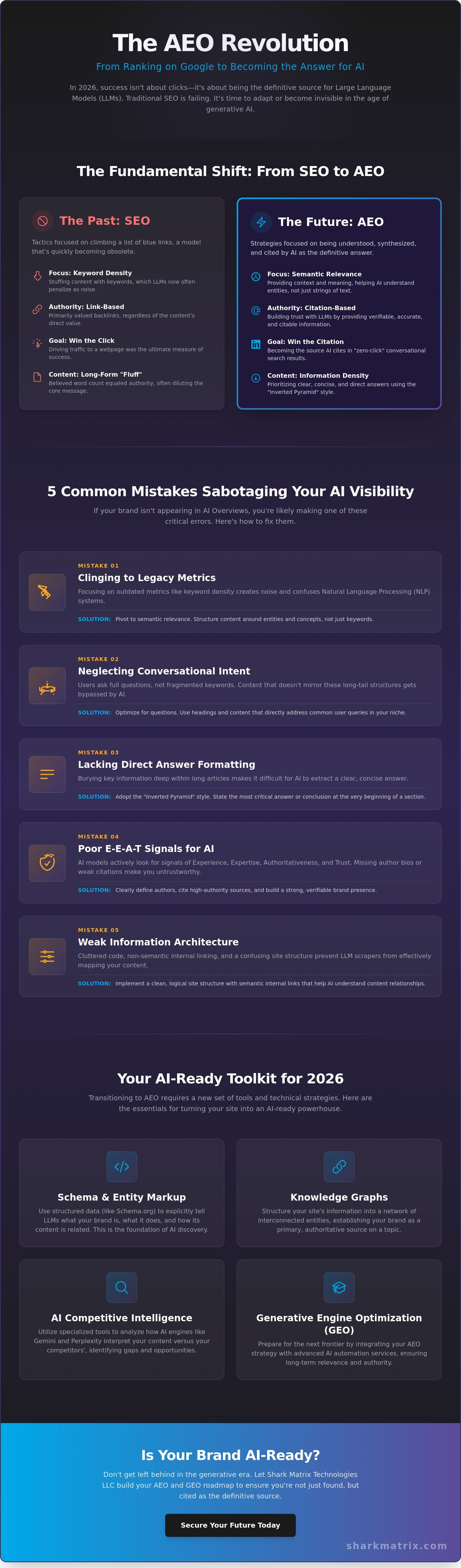
Tracking visibility is only half the battle. To actually influence how AI models synthesize your brand information, you need specialized tools for answer engine optimization that focus on the technical “input” layer. In 2026, optimization has moved beyond simple metadata into the territory of entity relationships and fact density. While many platforms focus on the output of an answer, technical AEO software ensures your site architecture is optimized for LLM ingestion. This involves refining your code so that bots don’t just “crawl” your site but actually “understand” the hierarchical importance of your data.
Advanced Schema Markup for Entity Recognition
Standard JSON-LD is no longer sufficient for national UAE brands aiming for top citations. You must utilize advanced Schema types to provide clear signals to voice-activated answer engines and data-heavy models. Modern tools now automate the connection between your website’s content and the global Knowledge Graph, ensuring your brand is recognized as a distinct entity rather than just a collection of keywords. Key technical implementations include:
- Speakable Schema: Identifies sections of your content specifically suited for text-to-speech conversion in AI assistants.
- Dataset Schema: Highlights structured data sets that LLMs can use to provide factual, evidence-based answers.
- Organization Entities: Connects your brand to verified industry databases to boost trust scores.
For businesses dealing with complex regional data, leveraging natural language processing services is essential to ensure that your technical markup accurately reflects the linguistic nuances of the UAE market. These tools bridge the gap between human intent and machine comprehension, making your site a preferred source for AI crawlers.
Fact-Density and Citation Optimization
LLMs in 2026 are programmed to prioritize “dense” information over marketing fluff. If your content is buried in adjectives and filler, AI models will likely skip it in favor of a competitor who provides verifiable data points. Specialized grading tools now analyze your content’s “cite-ability” by measuring its fact density. Authoritative Source Injection works by strategically placing verifiable, data-backed claims within your technical architecture so that LLM crawlers prioritize your domain as the primary source of truth for a specific topic. This technical approach ensures your content meets the strict E-E-A-T requirements that models use to filter out unreliable information.
To prevent being filtered out by AI “hallucination” safeguards, you should use fact-checking AI software to audit your claims against trusted records. This process is similar to how Top AI Visibility and Rank Tracking Platforms evaluate brand authority, but it happens at the content creation stage. By ensuring every claim is verifiable, you reduce the risk of models ignoring your site due to perceived inaccuracies. Shark Matrix provides the technical expertise to integrate these fact-density filters into your custom content management systems, positioning your brand as the most reliable authority in the national landscape.
Building a Custom AEO Stack for National Brands
Building a resilient digital presence in 2026 requires more than off-the-shelf software. For national UAE firms, a generic approach often leaves a massive data void in regional search results. You need a customized architecture that combines visibility tracking with technical injection. This process begins with an audit of your current standing across major LLMs to identify where your brand is being cited or ignored. Once you have a baseline, you must transition to an “AI-first” technical infrastructure. This involves using API-driven content delivery so that your data is immediately accessible to AI crawlers without the latency of traditional web rendering.
Your stack must also integrate these tools for answer engine optimization directly into your existing SEO and PPC dashboards. Siloed data is the enemy of agility. By viewing AEO metrics alongside your paid and organic performance, you can see exactly how AI Overviews are impacting your bottom line. This holistic view allows for rapid adjustments in sentiment monitoring and reputation management; it ensures that any negative hallucinations or inaccuracies are corrected before they scale.
Arabic Language Optimization in AEO
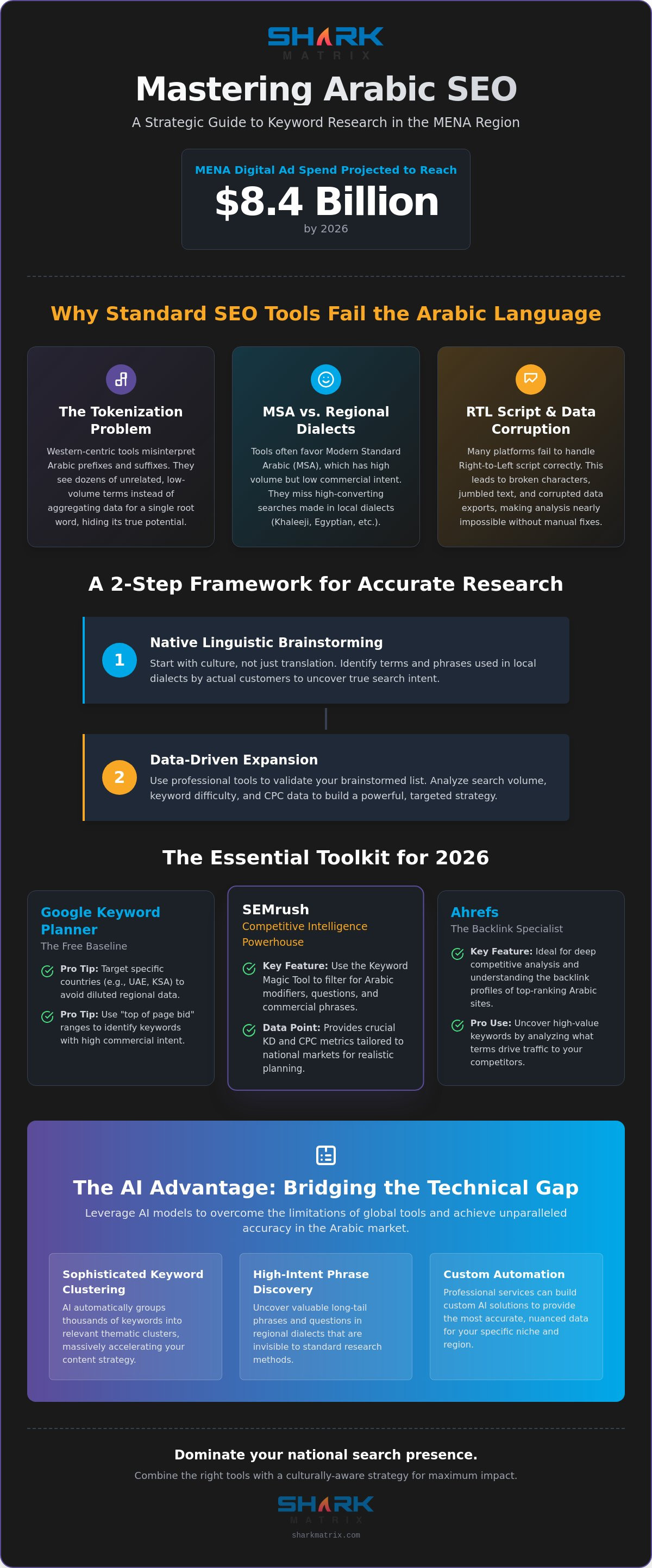
Most global tools for answer engine optimization struggle with the complexities of the Arabic language and its various regional dialects. National brands face a unique challenge: ensuring that Large Language Models perceive their content as authoritative in both Modern Standard Arabic and local vernaculars. Bridging the gap between English and Arabic brand mentions requires specialized Arabic digital marketing expertise. Without this localized layer, your brand risks being misinterpreted or entirely omitted by models that prioritize linguistically accurate sources.
Workflow Integration: From Data to Action
A successful AEO strategy is not static. You must connect your tracking tools directly to your Content Management System (CMS) to allow for real-time updates. If a sentiment analysis tool flags a drop in citation quality, your team should be able to push technical fixes or content adjustments instantly. Scaling these technical injections across thousands of pages is impossible to do manually. Leveraging ai automation services allows you to automate Schema updates and entity tagging at scale. If you are ready to build a proprietary stack that dominates the national market, Shark Matrix can help you develop industry specific ai solutions tailored to your enterprise needs.
Future-Proofing with Shark Matrix AI Solutions
Off-the-shelf tools for answer engine optimization often fall short for large UAE enterprises. While SaaS platforms provide broad data, they rarely account for proprietary data structures or the specific linguistic requirements of the national market. Relying on generic tools means you’re using the same data as your competitors. To gain a true advantage, you need custom generative ai development. This allows your brand to build its own monitoring ecosystem, ensuring your data is parsed and cited exactly how you intended. Standard software can’t always see the “Semantic Gap” in your specific industry, but custom engineering can.
Shark Matrix bridges this gap by engineering proprietary software that monitors brand-specific AI citations. By integrating AEO with custom ai chatbot-development services, you aren’t just hoping to be cited by others; you’re creating your own authoritative answer engine that feeds directly into the larger AI ecosystem. This creates a feedback loop where your owned AI assets reinforce your authority in third-party models like ChatGPT and Gemini. You own the data, you own the response, and you own the citation.
Custom AI Automation and Development
Standard dashboards often miss the nuances of niche industries. Shark Matrix develops internal tracking systems that measure “Brand Health” across all major LLMs in real time. These systems use custom scrapers and analyzers to identify how your specific industry data is being synthesized. By deploying industry specific ai solutions, you can target growth in sectors where generic tools for answer engine optimization lack depth. This level of technical precision ensures that your technical infrastructure is always aligned with the latest model updates, preventing your brand from being filtered out by hallucination filters.
The Shark Matrix AEO Advantage
Success in 2026 requires a partner that understands both the history of search and the future of AI. Shark Matrix combines over 15 years of SEO experience with cutting-edge AI engineering. We don’t just provide a tool; we deliver an end-to-end strategy. This starts with a comprehensive technical audit and moves into the development of custom tools designed to secure your digital authority. We focus on the national UAE market, ensuring your Arabic NLP is as strong as your English visibility. If you’re ready to secure your citations and dominate the generative search space, consult with our AEO experts today.
Securing Your Digital Authority in the Generative Era
The search landscape of 2026 demands more than traditional SEO. You’ve learned that dominating AI-driven results requires a “Double-Stack” approach: visibility tracking to monitor your Share of Model and technical injection to influence the knowledge graph. Relying on generic tools for answer engine optimization won’t suffice for national UAE brands that need specialized Arabic NLP and deep technical integration to truly stand out in ChatGPT or Gemini responses. It’s vital to move beyond the limitations of off-the-shelf software and generic SaaS platforms that often overlook regional nuances.
Shark Matrix is your dedicated technical partner in this digital evolution. Founded in 2010, our technical AI team specializes in Generative Engine Optimization and custom software engineering. We bridge the gap between human intent and machine understanding, ensuring your brand remains a primary source for LLMs across the region. Master the future of search with Shark Matrix AEO services and reclaim your digital authority. The transition to answer engines is a unique opportunity to lead your industry with data-backed precision and localized expertise. Don’t let your brand get left behind in the era of AI synthesis.
Frequently Asked Questions
What is the best tool for tracking ChatGPT rankings in 2026?
In 2026, platforms like Profound and Geoptie are popular for tracking ChatGPT citations. Profound offers deep engine coverage across multiple models, while Geoptie focuses on specific engine deep dives. However, for UAE brands, the best results often come from custom monitoring dashboards that account for regional linguistic nuances. Shark Matrix provides these custom tools for answer engine optimization, ensuring your brand’s specific citations are tracked accurately across conversational interfaces.
Can traditional SEO tools like Semrush help with AEO?
Traditional SEO tools still provide value for keyword research and backlink analysis, but they often lack the semantic depth required for AEO. They primarily track blue links rather than how an LLM synthesizes information. While they are evolving to include AI features, you should supplement them with specialized AEO software. This allows you to measure “Share of Model” and brand sentiment within generated answers to get a complete picture of your digital visibility.
How do I measure the ROI of AEO tools?
You measure the ROI of AEO tools by tracking the correlation between “Share of Model” (SoM) growth and assisted conversions. Since AI Overviews often reduce direct click-through rates, focus on brand lift and citation frequency as key performance indicators. High-quality tools for answer engine optimization provide data on how often your brand is recommended. This directly influences your online reputation and long-term customer trust in a generative search environment.
Are there specific tools for optimizing Arabic content for answer engines?
Most global SaaS platforms struggle with Arabic dialects and Modern Standard Arabic nuances. To succeed in the national UAE market, you need specialized natural language processing services. Shark Matrix offers custom-built tools designed specifically for the Arabic language, ensuring your content is machine-readable and authoritative for regional models. These localized solutions prevent your brand from being misinterpreted or entirely omitted by AI engines that prioritize linguistically accurate sources.
What is the difference between GEO tools and AEO tools?
While the terms are often used interchangeably, Generative Engine Optimization (GEO) specifically focuses on optimizing content for generative models like Gemini and ChatGPT. Answer Engine Optimization (AEO) is the broader strategy of making your brand the definitive answer across all conversational interfaces, including voice assistants. Both require specialized software to track how models synthesize your data, but AEO emphasizes the final answer delivered to the user regardless of the platform.
Do I need a custom AI developer to succeed in AEO?
Off-the-shelf tools provide a baseline, but custom AI development is often necessary for UAE enterprises with proprietary data or complex regional requirements. A custom developer can build proprietary scrapers and analyzers that generic software lacks. Shark Matrix acts as a technical partner, offering generative AI development to create internal dashboards that track brand health across LLMs. This gives you a competitive edge that standard subscription tools simply cannot match.
Is there a free tool to check if my brand is cited by AI?
Many AEO platforms offer limited free trials or freemium tiers to help you test their visibility tracking. You can also use manual automated prompts in ChatGPT or Gemini to audit your brand presence, though this is difficult to scale. For a comprehensive national audit, it’s more effective to use professional tools for answer engine optimization that provide aggregated data across multiple engines, ensuring you don’t miss critical mentions in the generative landscape.
How often should I use AEO tools to audit my website?
You should perform a deep AEO audit at least once a month, but monitor your “Share of Model” metrics daily. AI models update their internal weights and data access points frequently, meaning your visibility can shift overnight. Constant monitoring allows you to identify negative sentiment or factual inaccuracies quickly. Regular audits ensure your technical infrastructure and advanced Schema remain optimized for the latest LLM crawlers and regional search behavior shifts.


 OpenAI
 Codex
Codex
 Vertex AI
 Cloud Vision
 OpenCV
 TensorFlow
 IBM Watson
 Cloud Natural Language
 Cognitive Services
 Bot Framework
 Mistral
 LLama
LLama
 Gemini
 Anthropic
 N8N
N8N