
Categories
Digital Marketing SEO

Top Arabic Keyword Research Tools: The 2026 Guide to National SEO Success

Total digital advertising spend across the MENA region is projected to reach $8.4 billion in 2026, yet many brands are still missing out on this growth due to fragmented data. Most marketers realize that generic software often fails to handle the nuances of Right-to-Left script or the distinct shift between Khaleeji and Modern Standard Arabic. If you’re tired of seeing inaccurate search volumes in your spreadsheets, choosing the right arabic keyword research tools is the first step toward reclaiming your national search presence.

We agree that navigating these linguistic hurdles shouldn’t feel like a guessing game. This guide promises to equip you with a reliable toolkit and the strategies needed to dominate the Arabic market in 2026. You’ll discover how to achieve higher rankings for localized terms and improve your ROI through advanced AI-driven discovery. We’ll preview the latest updates from powerhouses like Semrush and Ahrefs, while showing you how to adapt to the rise of Answer Engine Optimization (AEO) for a truly modern SEO strategy.

Key Takeaways

  • Understand why standard software often fails Arabic SEO by misinterpreting root words and prefixes through poor tokenization.
  • Identify the most reliable arabic keyword research tools in 2026, comparing global giants like SEMrush with specialized autocomplete software.
  • Learn how to leverage AI models for sophisticated keyword clustering and identifying high-intent long-tail phrases in regional dialects.
  • Implement a two-step strategic framework that combines native linguistic brainstorming with data-driven expansion for maximum search visibility.
  • Discover how custom AI automation and professional SEO services can bridge the technical gap between global tools and regional language nuances.

Why Standard Keyword Tools Often Fail the Arabic Language

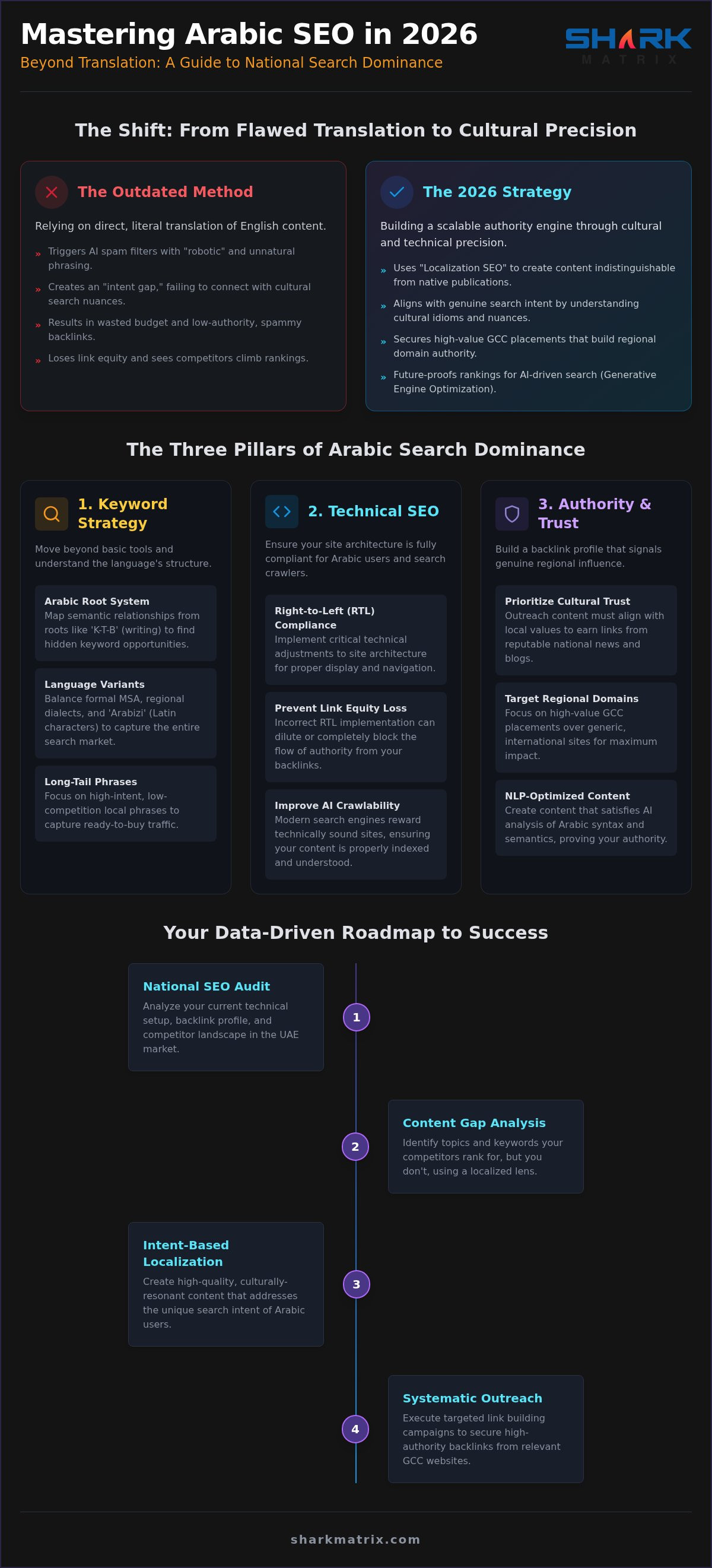
Arabic keyword research is the specialized process of identifying search terms across both Modern Standard Arabic (MSA) and diverse regional dialects. Most global SEO platforms were built with Latin languages in mind. They often fail to capture the nuances of the Middle Eastern market because they treat Arabic as a direct translation of English. This leads to missed opportunities and skewed data. Understanding Arabic SEO fundamentals helps clarify why these technical barriers exist for most arabic keyword research tools today.

A primary technical hurdle is the ‘Tokenization’ problem. Arabic is a highly inflected language where a single root word can have hundreds of variations based on prefixes, suffixes, and infixes. Western-centric tools often misinterpret these components. Instead of recognizing a common root, they see dozens of unrelated strings. This fragments your search volume data. You might see low volume for a specific term simply because the tool isn’t aggregating all its grammatical forms correctly.

Search volume discrepancies also arise from a reliance on “translated” keywords. Many marketers simply translate their English list into Arabic. This rarely matches actual user behavior. A literal translation might give you an MSA term that nobody uses in a commercial context. Users search with their culture and their local habits. If your tools don’t account for this, your strategy is built on a foundation of ghost data.

MSA vs. Regional Dialects: The Search Intent Divide

Modern Standard Arabic is the language of academia, news, and formal literature. However, commercial searches often happen in local dialects like Khaleeji, Levantine, or Egyptian. A keyword with high volume in MSA might indicate a user looking for information or news, which often results in zero conversion intent. In contrast, a dialect term might have lower tracked volume but represents a customer ready to buy. For instance, while ‘Aqar’ is a standard term for real estate, specific regional terms for ‘apartment’ or ‘villa’ vary wildly. Choosing the wrong one means targeting the wrong audience entirely.

This intent divide is particularly visible in the automotive market. To see how a local leader manages this, check out Marhaba Auctions and observe how they target specific search behaviors for used and salvage vehicles in the UAE.

The Technical Challenge of RTL Script in SEO Tools

Right-to-Left (RTL) script is more than just a visual alignment. It changes how data is processed and visualized. Many tool interfaces struggle with Arabic characters and ligatures, often displaying them as broken boxes or reversed text. This makes data analysis exhausting for native specialists. Exporting this data to CSV or Excel frequently results in jumbled characters that require manual cleaning. RTL compatibility is a non-negotiable feature for national SEO success. Without it, your team spends more time fixing spreadsheets than optimizing content. Reliable arabic keyword research tools must handle these scripts natively to provide actionable insights.

The Best Global Arabic Keyword Research Tools in 2026

With the MENA digital advertising market hitting $8.4 billion in 2026, choosing the right arabic keyword research tools isn’t just a technical choice; it’s a financial one. While local nuances are vital, global enterprise tools provide the scale needed to compete. These platforms have evolved to better handle the complexities of the Arabic language, offering deeper databases for the Gulf and North African regions than ever before.

Google Keyword Planner: The Free Baseline

Google Keyword Planner remains the foundation for many national campaigns. To get the most out of it, you must set specific location parameters, such as targeting the UAE or Saudi Arabia specifically, rather than the entire region. This avoids diluted data. A common frustration is the “grouped” search volumes in the free version, which can hide the difference between a high-intent dialect term and a broad MSA phrase. You can often uncover “hidden” keywords by looking at the “top of page bid” ranges; high bids usually signal commercial intent that the volume numbers alone might mask.

SEMrush and Ahrefs: Data Depth for Professionals

SEMrush is often the preferred choice for competitive intelligence in the Middle East. Its Keyword Magic Tool allows for specific Arabic modifier filtering, helping you isolate questions or commercial intent phrases. For those managing complex budgets, SEMrush offers plans like the Pro version at $139.95 per month or the Business plan at $499.95 for larger operations. You’ll want to focus on Keyword Difficulty (KD) and CPC metrics tailored to the national market to ensure your content strategy is realistic.

Ahrefs shines in backlink analysis and identifying keyword gaps between your site and local competitors. Their Standard plan at $249 per month is a solid middle ground for businesses scaling their reach. By analyzing which Arabic terms your competitors rank for, you can spot opportunities they’ve neglected. If the raw data from these tools feels overwhelming, our team at Shark Matrix can help you interpret these metrics through a native linguistic lens.

The cost-to-value ratio depends on your scale. Ahrefs’ Starter plan at $29 per month is great for small businesses, but serious national SEO requires the Lite or Standard tiers to access historical data. SEMrush provides a more comprehensive suite for PPC and SEO combined, making its Guru plan ($249.95/month) a strong investment for brands aiming for total market dominance. Both tools have significantly improved their RTL support in 2026, though manual verification of dialect nuances remains essential for accuracy.

Top Arabic Keyword Research Tools: The 2026 Guide to National SEO Success

While global databases offer a broad view, specialized arabic keyword research tools provide the linguistic nuance required for national dominance. In 2026, tools like KeywordTool.io have become essential for capturing long-tail intent that standard tools often miss. By scraping autocomplete data from platforms like YouTube and Amazon, these tools reveal how users search in their native dialects rather than formal Modern Standard Arabic. This approach aligns perfectly with international SEO best practices, ensuring your content resonates with local cultural habits.

Specialized arabic keyword research tools like tool4seller also cater to specific niches such as Middle Eastern e-commerce marketplaces. With plans ranging from a $19.99 Startup tier to a $299.99 Premium option, these tools offer insights into regional buyer behavior that general platforms can’t match. They bridge the gap between broad data and the specific needs of local consumers.

Leveraging Autocomplete for Long-Tail Arabic Keywords

Standard tools often ignore the conversational nature of Arabic search. Autocomplete data is more reflective of real-world dialect usage than the rigid terms found in traditional planners. In KeywordTool.io, using filters for ‘prepositions’ and ‘questions’ allows you to see exactly how users in the UAE or Saudi Arabia phrase their queries. For example, a user might search for ‘best way to’ in a local dialect that a global tool wouldn’t recognize. Mapping these long-tail terms to professional search engine optimization seo services ensures your content strategy targets high-intent traffic that competitors are likely overlooking.

The Role of NLP and AI in 2026 Keyword Analysis

The integration of Generative AI has changed the workflow for SEO specialists. Advanced models like ChatGPT and Claude 3.5 handle complex Arabic keyword clustering, which was once a manual, error-prone task. Natural Language Processing (NLP) helps these tools understand the sentiment behind a query, distinguishing between a user looking for a complaint forum and one ready to make a purchase. Specialized AI-focused platforms like SEMAI are also gaining traction, focusing on visibility in AI-powered search results for a monthly fee mentioned at $99. Our ai development services are revolutionizing keyword data processing by creating custom models that interpret these complex linguistic patterns at scale. This allows brands to categorize thousands of regional search terms into logical topic clusters in seconds, providing a massive competitive advantage in the national market.

A Strategic Framework for Arabic Keyword Research

Successful SEO in the Middle Eastern market requires moving beyond simple lists. A strategic workflow ensures that you aren’t just ranking for high-volume terms, but for terms that actually convert. By combining arabic keyword research tools with a structured, five-step approach, you can bridge the gap between technical data and cultural relevance. This framework moves from broad ideas to highly targeted, national search terms.

  • Step 1: Seed Keyword Generation. Start with native intuition. While AI brainstorming is excellent for scale, native speakers identify the slang and colloquialisms that tools often miss.
  • Step 2: Expansion. Input your seeds into global arabic keyword research tools to identify search volume and competition levels. This is where you find the related terms that broaden your reach.
  • Step 3: Dialect Validation. Cross-reference your list to ensure terms match national cultural nuances. A term used in Egypt might not resonate with a Khaleeji audience.
  • Step 4: Intent Mapping. Categorize your keywords into Informational, Commercial, or Transactional buckets to align with the Arabic buyer journey.
  • Step 5: Competitor Gap Analysis. Use your data to find what national brands are failing to target. This is where you find the low-competition, high-reward opportunities.

Mapping Search Intent for the Arabic Consumer

High-intent transactional keywords are the backbone of ecommerce seo services dubai. Arabic consumers often prioritize “Trust” keywords, such as phrases including “guaranteed” or “official,” especially when shopping online. For “How-to” queries, keep in mind that video content often outperforms text in this region. Since over 70% of website traffic in the UAE originates from mobile devices, your keywords must reflect how people speak into their phones, which is often more conversational than typed text.

Validating Keywords Against National Trends

Google Trends for the UAE is a goldmine for spotting seasonal spikes, such as during Ramadan or national holidays. Since 46% of Google searches in the UAE have explicit local intent, validating your list against real-world behavior is critical. You shouldn’t rely on data alone; cross-referencing your list with social media listening tools provides a clearer picture of current trends. A professional content marketing agency uae can help turn these raw data points into high-performing assets that speak directly to the local audience. If you’re ready to build a data-backed strategy, our experts at Shark Matrix can help you refine your keyword list for maximum national impact.

Maximizing Your National Reach with Shark Matrix

Dominating the Arabic search market in 2026 requires more than a subscription to a software platform. While standard arabic keyword research tools provide a baseline of data, they often lack the cultural depth needed to capture high-intent traffic across different dialects. Shark Matrix bridges this technical gap by combining elite global tools with native linguistic expertise. We don’t just look at numbers. We analyze the “why” behind the search. Since 2010, we’ve helped national brands navigate these complexities by interpreting data from arabic keyword research tools through a native lens that accounts for both Modern Standard Arabic and regional nuances.

Our approach goes beyond traditional SEO. By leveraging custom ai development uae, we build proprietary systems that process complex Arabic search data with precision. This allows us to identify emerging patterns that generic tools overlook. We also integrate these insights into a comprehensive ppc agency dubai strategy, ensuring that your paid and organic efforts work in harmony. A national focus requires a strategic partnership that understands the intersection of technology and culture.

Data-Driven SEO and AI Automation

Shark Matrix uses machine learning to predict search trends before they reach their peak. This proactive stance is essential for maintaining a competitive edge in a fast-moving digital economy. Our expertise in seo for brand reputation management dubai allows us to monitor Arabic search sentiment in real time. We protect your brand by identifying how users perceive your business across various regional dialects. Our commitment to end-to-end digital transformation ensures that your keyword strategy isn’t an isolated task but a core driver of your national growth. We use AI automation to clean and cluster datasets, turning raw information into actionable marketing assets.

Ready to Dominate the National Search Landscape?

Professional Arabic SEO is a necessity for any brand serious about the MENA region in 2026. The days of simple translations and generic keywords are over. Success now depends on specialized tools, AI-enhanced analysis, and a deep understanding of local search intent. Don’t let your brand get lost in translation. Consult with our specialists at Shark Matrix to develop a tailored keyword strategy that reflects your business goals. We’re ready to help you scale. Contact us today to start your journey toward total national search dominance and measurable ROI.

Future-Proofing Your Arabic SEO Strategy

Mastering the Middle Eastern market in 2026 demands a shift from simple translation to deep linguistic intelligence. You’ve seen how global platforms provide the data foundation, while specialized AI models bridge the gap between Modern Standard Arabic and regional dialects. By applying a structured framework, you can move beyond raw volume and focus on the high-intent terms that drive real commercial growth. Success in this region isn’t just about being found; it’s about being understood by your local audience.

Selecting the right arabic keyword research tools is only half the battle. To truly dominate, you need a partner who understands how to turn these insights into a cohesive content and PPC strategy. Shark Matrix has been a leading national SEO agency since 2010, specializing in AI-driven digital marketing that respects the nuances of the local market. We combine over a decade of experience with cutting-edge automation to ensure your brand stays ahead of the curve.

Scale your national reach with expert Arabic SEO from Shark Matrix. We’re here to help you navigate these complexities and achieve lasting visibility. Your journey to national search dominance starts with a single, data-backed step.

Frequently Asked Questions

What is the best free Arabic keyword research tool?

Google Keyword Planner remains the most reliable free option because it pulls data directly from Google’s own database. While it provides a solid baseline for search volume, it often groups similar terms together, which can hide specific dialect nuances. It’s most effective when you have an active Google Ads account to unlock more precise data ranges for the MENA region.

How do I find keywords in specific Arabic dialects?

You can find dialect-specific keywords by using autocomplete scrapers and social media monitoring tools. Software like KeywordTool.io scrapes real-time queries from YouTube and Google, revealing how people actually speak in the Gulf or Levant. Manual research on local forums and TikTok comments also helps identify slang that standard arabic keyword research tools might miss during automated scans.

Does Google Keyword Planner work for Arabic SEO?

Yes, Google Keyword Planner is a foundational tool for Arabic SEO campaigns. To get accurate results, you must filter your search by specific countries like Saudi Arabia or the UAE rather than the entire Middle East. This helps you avoid broad, diluted metrics that don’t reflect the unique search habits of your target national audience.

Why is search volume lower for Arabic keywords compared to English?

Search volume often appears lower because the Arabic language is fragmented into various dialects and multiple spelling variations. Many users also practice code-mixing, which is the habit of using both English and Arabic in a single query. This splits the total search volume across several different terms, making individual keywords look less popular than their English equivalents.

Can AI tools like ChatGPT be used for Arabic keyword research?

AI tools are excellent for the heavy lifting of keyword clustering and intent categorization. While they don’t provide live search volume, models like ChatGPT and Claude can process exports from arabic keyword research tools to identify semantic relationships. This helps you organize thousands of regional terms into a coherent content strategy in a fraction of the time it takes manually.

What is the difference between MSA and regional dialect keywords?

Modern Standard Arabic (MSA) is the formal version used in news and official documents, while regional dialects are conversational and informal. For example, a user looking for a house might use an MSA term in a formal search but switch to a Khaleeji dialect when asking for recommendations. Understanding this split is crucial for matching the user’s specific search intent.

How often should I update my Arabic keyword list?

You should update your list at least every quarter to stay aligned with shifting consumer trends in the region. Major cultural events like Ramadan or national holidays cause massive, temporary spikes in specific search behaviors. Regular updates ensure you aren’t wasting your marketing budget on terms that have lost their relevance or commercial value in the current market.

Is it better to target MSA or local dialects for e-commerce?

A hybrid approach is usually the most effective strategy for e-commerce brands. Use MSA to build authority and trust in your technical specifications, formal policies, and product descriptions. However, you should focus on local dialects for your headlines and social media content, as these conversational terms often signal a higher intent to purchase among local shoppers.

Categories
SEO

Mastering Hreflang Implementation for Arabic Websites: A 2026 Technical Guide

Did you know the e-commerce market in the Middle East is projected to reach a staggering $177 billion in 2026? Even with this massive growth, many businesses still lose high-intent traffic because Google indexes the wrong regional version of their site. It’s a common pain point for brands trying to scale across the GCC. You might find your Saudi Arabian landing page appearing for users in Dubai, or worse, your site might be flagged for duplicate content across different domains.

We understand how frustrating it’s to manage complex technical SEO when the stakes are this high. This guide will teach you how to master hreflang implementation for arabic websites to eliminate these errors and ensure your pages land in the correct regional search results. We’ll cover everything from precise ISO 639-1 and 3166-1 Alpha-2 code mapping to the latest 2026 standards for reciprocal links and AI-driven search optimization. By the end, you’ll have a clean, error-free foundation to dominate specific Middle Eastern markets and capture the organic traffic your brand deserves.

Key Takeaways

  • Learn how to prevent duplicate content penalties by correctly signaling regional intent across your Middle Eastern domains.
  • Discover the exact ISO 639-1 and 3166-1 Alpha-2 codes needed for a flawless hreflang implementation for arabic websites.
  • Compare the pros and cons of using HTML head tags, XML sitemaps, and HTTP headers to manage regional targeting at scale.
  • Identify and resolve common technical errors like non-reciprocal links and incorrect region codes that block your organic growth.
  • Explore how AI-driven technical SEO audits can simplify the maintenance of complex hreflang sets for large-scale enterprise sites.

The Strategic Importance of Hreflang for Arabic Digital Marketing

Hreflang is more than just a line of code. It’s a technical directive that ensures search engines serve the most relevant version of your site to users based on their specific geographic location and language settings. In a region as diverse as the Middle East, where Modern Standard Arabic is the unifying language but local dialects and currencies vary, the Hreflang attribute (RFC 8288) becomes the backbone of your digital presence. Precise hreflang implementation for arabic websites allows you to target users in Riyadh, Dubai, or Cairo with surgical accuracy. This ensures they see content tailored specifically for their market, rather than a generic version that might not meet their needs.

Without this technical foundation, your international SEO strategy is built on shaky ground. Search engines often struggle to distinguish between regional variants of the same language. This leads to poor click-through rates (CTR). A user in Kuwait might be served a landing page featuring prices in Saudi Riyals, causing them to bounce immediately. By explicitly mapping these relationships, you signal to Google that your site is a localized authority in each specific market. This clarity is essential for scaling across the Arab world, where e-commerce is projected to hit $177 billion by 2026.

Solving the Duplicate Content Issue in the Middle East

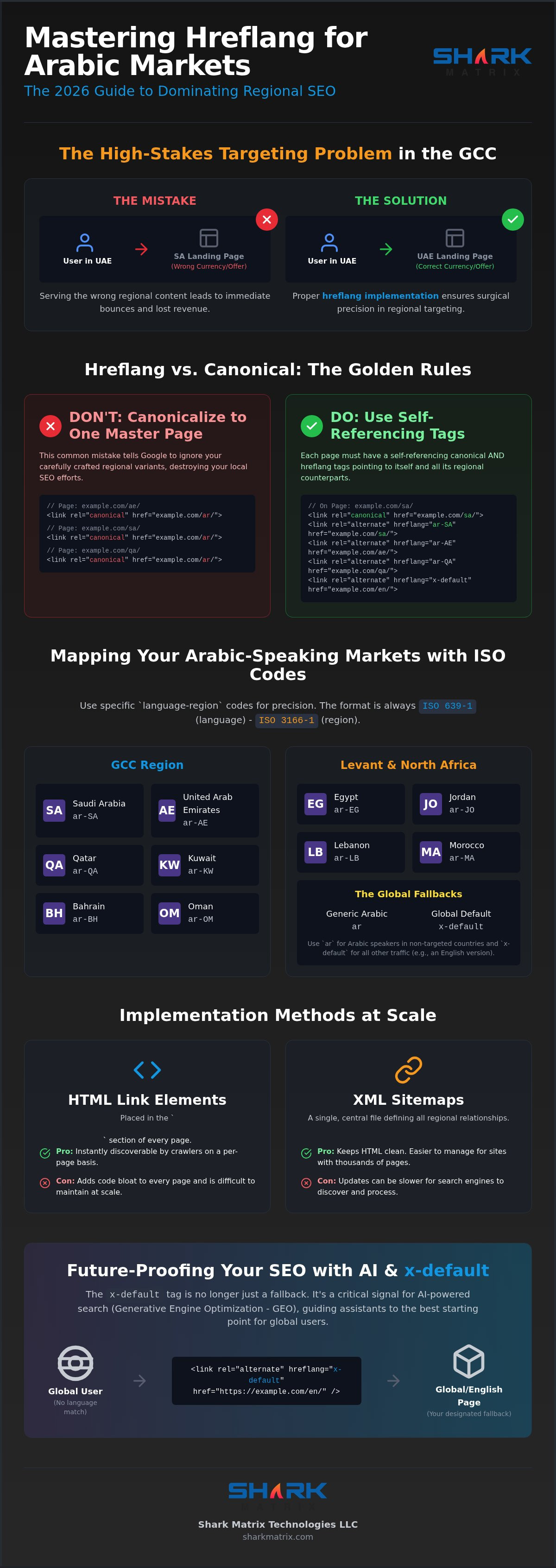
Arabic websites are uniquely prone to “near-duplicate” content issues. Because the core text on an Egyptian service page (ar-EG) and a UAE service page (ar-AE) is often identical, Google may perceive them as duplicates and index only one version. This forces your regional pages to compete against each other, diluting your ranking power. Correct implementation prevents this cannibalization by telling Google these pages are intended for different audiences. To maintain a clean index, ensure your hreflang tags only point to canonical URLs to avoid conflicting signals that confuse search crawlers.

Enhancing User Experience for RTL Audiences

Technical SEO directly impacts how your brand is perceived by Right-to-Left (RTL) audiences. When a user lands on a page that reflects their local dialect and currency, it builds immediate trust. It isn’t just about translation; it’s about context. A shopper in Dubai expects to see prices in AED and mentions of local shipping carriers. By routing users to the correct version, you significantly reduce bounce rates and improve engagement. This seamless transition from the search results to a locally relevant RTL interface establishes your site as a high-authority destination in the competitive Middle Eastern market.

Technical Requirements for Arabic Hreflang Implementation

Executing a successful hreflang implementation for arabic websites requires strict adherence to a specific HTML syntax. The standard format, rel="alternate" hreflang="language-country", acts as a map for search engine crawlers. While the “ar” language code represents Arabic, it’s rarely enough on its own for businesses operating across the Middle East. Search engines need to know if your content is tailored for a user in Riyadh or a shopper in Dubai. Following Google’s official hreflang guidelines ensures that your technical signals are clear and actionable. You must use absolute URLs in every tag, as relative paths often lead to crawling errors and indexing confusion.

Precision is everything in technical SEO. Beyond the basic syntax, every implementation must be bidirectional. This means if your Saudi Arabian page links to your UAE version, the UAE version must reciprocate that link. Without this “return tag,” Google will likely ignore the annotations entirely. It’s a common point of failure for large-scale sites. If you find managing these complex clusters overwhelming, seeking professional technical SEO services in the UAE can help automate and validate your site’s architecture.

Choosing the Correct ISO Language and Region Codes

In 2026, the industry standard remains ISO 639-1 for languages and ISO 3166-1 alpha-2 for regions. For general Arabic content intended for any speaker, “ar” is sufficient. However, for national targeting, you must combine them. Use ar-AE for the United Arab Emirates, ar-SA for Saudi Arabia, and ar-EG for Egypt. A frequent mistake is using city names or non-standard abbreviations like “uae” or “dubai.” These aren’t recognized by search algorithms. While Modern Standard Arabic (MSA) is the written norm, using region codes helps search engines connect your pages to local search intent, currencies, and regional dialects.

The Mandatory Rules: Bidirectionality and Self-Reference

Every page in your hreflang set must include a self-referencing tag. This means the Saudi Arabian page must have a tag pointing to itself as the “ar-SA” version. If it doesn’t, the cluster is technically incomplete. Bidirectionality is equally critical. If Page A points to Page B, but Page B doesn’t point back to Page A, you’ll see “missing return link” errors in your SEO audits. This reciprocal relationship confirms to search engines that the pages are verified alternates of one another. It prevents unauthorized sites from trying to associate themselves with your domain’s authority.

Mastering Hreflang Implementation for Arabic Websites: A 2026 Technical Guide

Comparison of Hreflang Implementation Methods for Scale

Choosing how to deploy your tags is just as critical as the code itself. For high-performance enterprise platforms, the method you select affects both crawl efficiency and page speed. When we provide website design and development services, we prioritize integrating these signals during the initial architecture phase. This proactive approach ensures that your regional targeting is baked into the site’s DNA rather than being a late-stage patch. It’s about building a scalable framework that can handle dozens of regional variants without breaking.

A solid hreflang implementation for arabic websites requires a decision framework based on your site’s complexity. If you’re managing a handful of pages, simple on-page tags might suffice. However, for e-commerce giants serving the entire GCC, you’ll need a more robust solution that doesn’t compromise the user experience. The goal is to provide clear instructions to search engines while keeping your site’s performance lean and fast.

HTML Head Tags vs. XML Sitemaps

Most developers start with HTML head tags because they’re easy to see and verify. You simply drop the link elements into the <head> of each page. While this works well for smaller sites, it can become a burden for large-scale implementations. If you have twenty different regional versions, you’re adding twenty lines of code to every single page. This bloats your HTML and can negatively impact load times, especially for mobile users in regions with slower connectivity. It’s a trade-off between ease of implementation and technical efficiency.

Enterprise platforms often pivot to XML sitemaps to keep their technical debt low. By placing the hreflang annotations in your sitemap, you keep your page source clean and lightweight. This is a staple of professional search engine optimization seo services because it consolidates all regional mapping into a single, manageable file. It’s much easier to audit and update a sitemap than it’s to modify thousands of individual HTML files. If your site structure is dynamic or has a high volume of SKUs across multiple Middle Eastern markets, the sitemap method is almost always the superior choice.

When to Use HTTP Headers for Non-HTML Files

Not everything on your site is an HTML page. You might have product manuals, whitepapers, or contracts in PDF format that need to be served to specific Arabic-speaking regions. Since you can’t put a tag inside a PDF, you must use HTTP headers. This method requires server-side configuration, typically through your server config file or a custom script. A typical syntax example would look like: Link: <https://example.com/sa/brochure.pdf>; rel="alternate"; hreflang="ar-SA". It’s a powerful way to ensure your non-HTML assets are correctly indexed for the right audience. Just keep in mind that this requires more technical oversight to ensure the server response remains fast.

Avoiding Common Hreflang Mistakes on Arabic Websites

Even seasoned developers encounter pitfalls when managing the technical nuances of Middle Eastern search markets. The most frequent error in hreflang implementation for arabic websites involves the use of non-standard ISO codes. It’s common to see “uae” or “ksa” within the code because these abbreviations are standard in regional business communication. However, search engines strictly adhere to ISO 3166-1 Alpha-2 codes. If your tag is set to hreflang="ar-uae", Google will simply ignore the directive. You must use ar-ae for the United Arab Emirates and ar-sa for Saudi Arabia to ensure your regional targeting actually functions as intended.

Technical hygiene beyond the codes is equally vital. Another recurring failure is the use of relative URLs in your annotations. Your tags must always utilize absolute paths, such as https://example.com/ar/. If you use relative paths like /ar/, you risk the crawler misinterpreting the target, particularly if your site architecture involves complex subdomains or subdirectories. Additionally, every URL in your hreflang set must return a 200 OK status. Including a 404 page or a URL that triggers a redirect breaks the entire cluster. This leaves your regional pages competing against each other instead of working in harmony.

Managing RTL Layout Conflicts and Script Variations

Script choice is a subtle but critical factor that many automated tools miss. While “ar” covers the Arabic language, it’s important not to confuse it with Persian (fa) or Urdu (ur), which share similar characters but require different ISO codes. Your technical tags must point to pages where the dir="rtl" attribute is correctly set in the HTML. Automated translation plugins are notorious for this; they often translate the text but fail to update the hreflang tags or the layout direction dynamically. This creates a jarring user experience where a visitor from Egypt lands on a page with broken, left-aligned text. If you want to ensure your technical foundation is solid, you can get a professional audit from Shark Matrix Technologies LLC to resolve these RTL site structure issues.

Setting the x-default for Global Arabic Traffic

The x-default tag acts as your safety net for global traffic. It tells search engines which page to show when a user’s settings don’t match any of your specific regional tags. For an Arabic site, this usually points to the version written in Modern Standard Arabic (MSA) or a generic landing page. Without it, a user in Morocco might be served your Saudi-specific page simply because it has higher authority, even if the currency and shipping information aren’t relevant to them. A standard markup looks like this: <link rel="alternate" href="https://example.com/ar/" hreflang="x-default" />. This ensures that no matter where your audience is located, they land on a relevant page that maintains your brand’s professional image across the MENA region.

Optimizing Technical SEO with Shark Matrix Technologies LLC

Shark Matrix Technologies LLC approaches regional targeting with a focus on technical precision and local expertise. Our technical seo services uae are designed to handle the intricate demands of the MENA market, where language and region often overlap in complex ways. Our specialized approach to hreflang implementation for arabic websites combines human expertise with machine learning to eliminate the risk of duplicate content penalties. We don’t just set up tags and hope for the best. Instead, we treat technical SEO as a dynamic pillar of your digital infrastructure. Our team ensures that every regional version of your site serves its intended audience without causing indexing conflicts that could stall your growth.

Managing a hreflang implementation for arabic websites at scale requires more than manual spreadsheets. We use proprietary AI automation to audit and maintain these sets for large-scale e-commerce and enterprise platforms. This technology identifies “no return tag” errors and broken URLs in real-time, preventing the technical decay that often plagues international sites. While we use Google Search Console for ongoing monitoring, our automated systems provide a deeper layer of verification. By automating the validation process, Shark Matrix Technologies LLC keeps your site’s architecture clean and ensures that search engines always have a clear map of your regional content.

Correct technical signals are also a vital part of seo for brand reputation management dubai. If a user in the UAE is served an Egyptian version of your site with different pricing and dialects, it creates a fragmented brand image. Trust is built on consistency. By ensuring users land on the correctly localized page, Shark Matrix Technologies LLC helps you maintain a professional and authoritative presence across every Middle Eastern market you target.

Integrating AI and GEO with International SEO

By 2026, search engines have shifted toward Generative Engine Optimization (GEO) to provide synthesized answers to user queries. These AI-driven models don’t just look for keywords; they seek the most relevant regional context to cite in their responses. Your hreflang tags provide the “ground truth” for these AI bots. They act as the definitive signal that helps AI assistants understand which version of your content is the authoritative source for a specific country. Shark Matrix Technologies LLC uses AI-driven SEO strategies to ensure your site is the one being cited in these next-generation search results.

Professional SEO Audits for National Success

A technical seo consultant from our team begins every project with a deep-dive audit of your existing international setup. We look for the subtle errors that standard tools often miss, such as script variations or RTL layout conflicts that drive away users. This process is especially critical during site migrations or when you’re expanding into new territories like Saudi Arabia or Kuwait. We provide a roadmap to fix existing issues and a framework for future growth. Contact Shark Matrix Technologies LLC today for a comprehensive technical SEO review to protect your traffic and dominate the Middle Eastern search results.

Future-Proofing Your Regional SEO Strategy

Achieving regional dominance in 2026 requires more than basic translation. It demands a technical foundation that search engines and AI assistants can trust. By mastering hreflang implementation for arabic websites, you ensure that your brand reaches the correct audience in Saudi Arabia, the UAE, and beyond without the risk of duplicate content penalties. These technical signals are the bridge between your localized content and the users searching for your services in their specific markets.

Managing complex technical clusters at scale can be challenging for even the most experienced internal teams. Shark Matrix Technologies LLC has been a leader in the Middle Eastern market since 2010. As Dubai-based specialists in AI-driven SEO and custom software development, we help brands navigate the nuances of RTL layouts and regional search intent. Don’t let technical errors hold back your growth in one of the world’s fastest-growing e-commerce markets.

Get a Professional Technical SEO Audit from Shark Matrix Technologies LLC to secure your search rankings and protect your brand’s reputation across the region. With the right technical strategy in place, your site can dominate the local SERPs and provide a seamless experience for every user.

Frequently Asked Questions

What is the correct hreflang code for an Arabic website in the UAE?

The correct code for an Arabic website in the UAE is ar-ae. This follows the mandatory ISO 639-1 standard for the language and ISO 3166-1 alpha-2 for the country. Using non-standard codes like “ar-uae” or “ar-dubai” will cause search engines to ignore your instructions entirely. It’s vital to use the exact two-letter region code to ensure your content reaches the local audience in the Emirates correctly.

Do I need a separate hreflang tag for every Arabic-speaking country?

You only need separate tags for countries where you have dedicated, localized content. If your site offers specific pricing for Saudi Arabia and different shipping terms for Kuwait, you should use ar-sa and ar-kw respectively. However, if you provide a single version of your content for the entire Middle East, a generic ar tag is sufficient. This simplifies your hreflang implementation for arabic websites while maintaining regional relevance.

How does hreflang differ from a canonical tag on multi-language sites?

Hreflang and canonical tags serve two different technical purposes. A canonical tag identifies the master version of a page to prevent duplicate content issues in the search index. Hreflang, on the other hand, is a mapping tool that tells Google which localized version to serve to a specific user. On international sites, each regional page should typically be its own canonical while using hreflang to link to its counterparts in other regions.

Can I implement hreflang using a WordPress plugin for my Arabic site?

You can use popular SEO or translation plugins to manage these tags, but they often require careful oversight. Plugins like WPML or Polylang can automate much of the hreflang implementation for arabic websites, but they sometimes default to incorrect codes for specific Middle Eastern regions. You must verify that the output matches ISO standards. For large-scale e-commerce sites, a custom technical solution is often more reliable than relying on a standard plugin.

What happens if I forget the self-referencing hreflang tag?

Forgetting a self-referencing tag usually results in Google ignoring the entire hreflang cluster for that page. Every page in a set must link to itself as well as its alternates. Without this self-reference, the technical signal is considered incomplete or invalid. This error often leads to the wrong regional version appearing in search results, which can confuse users and increase bounce rates across your different country-specific domains.

Does hreflang help with ranking in different regions of the Middle East?

Hreflang doesn’t act as a direct ranking factor in the traditional sense of building link authority. Instead, it helps your site dominate national search results by ensuring the most relevant version of your content is served to the right user. When a user in Egypt sees a page tailored to their dialect and currency, they’re more likely to click. These improved engagement signals tell search engines your content is highly relevant to that specific market.

How do I test if my Arabic hreflang tags are working correctly?

You can test your tags using technical SEO crawlers like Screaming Frog or specialized hreflang validation tools. Since Google Search Console no longer provides a dedicated International Targeting report, these third-party tools are essential for identifying “no return tag” errors. They simulate a search engine crawl to verify that every regional page links back to its counterparts. Regular audits help you catch broken links or redirect chains that could invalidate your entire technical setup.

Is x-default mandatory for Arabic websites?

While not strictly mandatory, the x-default tag is a best practice for managing global Arabic traffic. It serves as a fallback for users whose language and region settings don’t match any of your specific country tags. For example, a user in Morocco might be served your Modern Standard Arabic version instead of a Saudi-specific page. This ensures a better user experience and prevents search engines from making an incorrect guess about which version to show to your audience.

Categories
SEO

Arabic Link Building Strategies: The 2026 Guide to Building MENA Authority

Did you know that digital advertising spend in the MENA region is projected to hit $8.4 billion in 2026, yet many brands still struggle to secure a single high-quality backlink? You’ve likely felt the frustration of finding low-quality domains or realizing that a simple translation of your English outreach doesn’t cut it. It’s a common hurdle. With the UAE Media Council now requiring advertiser permits for promotional content as of February 2026, the landscape for arabic link building strategies has become more complex and regulated than ever before.

You deserve a strategy that respects cultural nuances while driving measurable growth. This guide will help you master the linguistic and technical precision required to dominate search rankings across the MENA region. We’ll explore how to leverage native expertise and AI-driven automation to build sustainable authority that search engines and local audiences actually trust. From navigating new data protection laws in Egypt and the UAE to mastering Generative Engine Optimization, you’re about to learn how to scale your Middle Eastern presence effectively.

Key Takeaways

  • Discover how to implement effective arabic link building strategies that prioritize high-authority domains and navigate the increasingly competitive MENA digital landscape.
  • Learn why distinguishing between Modern Standard Arabic and regional dialects is essential for creating anchor text that resonates with local audiences and search engines.
  • Master the use of Digital PR as a primary driver for securing “tier 1” national coverage and high-impact editorial placements across GCC markets.
  • Explore how AI-powered prospecting and Natural Language Processing can help you scale your outreach efforts while maintaining cultural relevance and linguistic precision.
  • Identify the critical KPIs for measuring campaign success and protecting your domain authority from common issues like link rot on regional websites.

Arabic link building is the strategic process of acquiring backlinks from high-authority, native Arabic domains to signal relevance and trust to search engines. In 2026, the digital space in the Middle East and North Africa (MENA) is more competitive than it’s ever been. Total digital ad spend in the region is projected to reach $8.4 billion this year, forcing brands to look beyond basic keyword stuffing. Search algorithms have evolved to prioritize “Cultural E-E-A-T”. This means Experience, Expertise, Authoritativeness, and Trustworthiness are now measured through the lens of linguistic precision and regional context.

The MENA Market Opportunity

The GCC e-commerce market is on track to reach $57 billion by 2026. The UAE and Saudi Arabia are leading this charge, creating a massive demand for localized digital services. One major advantage for early movers is the lower keyword difficulty found in Arabic search results. Many high-volume terms remain less competitive than their English counterparts. By applying the core principles of SEO to a localized strategy, businesses can capture high-intent traffic that global competitors often overlook. Local search dominance in Riyadh or Dubai requires more than just translated content; it requires a backlink profile that “speaks” the local language of authority.

How Backlinks Build Cultural Trust

Trust is the primary currency of the Middle East. Consumers in this region place a high value on local endorsements and social proof. A backlink isn’t just a technical bridge between two websites. It’s a “seal of approval” from a trusted regional voice. When a reputable news outlet in Dubai or a major industry blog in Riyadh links to your site, it builds immediate credibility that a generic global link cannot replicate. Links from high-trust regional sources act as a recommendation to both the user and the search engine. Implementing Shark Matrix SEO services ensures your technical foundation is strong enough to convert the authority these links provide into sustainable rankings and long-term brand growth.

Mastering arabic link building strategies starts with acknowledging that language isn’t just a tool for communication; it’s a carrier of culture. Digital marketing in the MENA region has evolved into a sophisticated academic and professional discipline that demands more than literal translation. Direct translations of Western anchor text frequently fail because Arabic is a high-context language. A phrase that works in London might feel aggressive or confusing in Dubai. For instance, a simple “Buy Now” call-to-action might be better phrased as a polite invitation to “Explore our collection” to better match regional social etiquette.

Trust is built through cultural alignment, often referred to as “halal” marketing. This involves avoiding sensitive topics like gambling or alcohol, but it also means respecting regional regulations. As of February 2026, the UAE Media Council requires all individuals publishing promotional content to have an Advertiser Permit. This legal layer adds a new level of scrutiny to outreach. If your backlink comes from a source that ignores these local mandates, search engines may eventually flag the association as low-quality. You don’t want your link profile associated with platforms that ignore regional law, as this directly impacts your domain’s perceived authority.

Modern Standard Arabic vs. Dialects

Modern Standard Arabic (MSA) is your go-to for building broad authority on news sites and official journals. It provides a sense of prestige and professionalism. However, if you’re targeting local engagement in the UAE or Saudi Arabia, regional dialects often perform better on lifestyle blogs or community forums. Natural search patterns vary wildly between a user in Morocco and one in Kuwait. Your anchor text variety should reflect these differences. Native linguists are essential here to ensure your link context doesn’t feel like it was generated by a machine.

Technical SEO for RTL Languages

Arabic is a Right-to-Left (RTL) language, which flips the entire user experience. This isn’t just a visual preference; it’s a technical requirement for mobile-first indexing in 2026. When you’re placing links, you must ensure the host platform is technically optimized for RTL. If a site’s layout breaks on mobile or the link is buried in a poorly formatted sidebar, your click-through rates will plummet. Working with native Arabic digital marketing experts ensures your placements are on platforms that Google recognizes as high-quality and technically sound for the region.

Arabic Link Building Strategies: The 2026 Guide to Building MENA Authority

Success in the MENA region requires moving beyond the “spray and pray” tactics of the past decade. Modern arabic link building strategies must be multi-channel, combining high-level media exposure with granular, niche-specific outreach. The goal isn’t just to accumulate links but to build a web of authority that search engines recognize as topically relevant and culturally authentic. In a market where digital ad spend is growing by 17% annually, securing organic real estate through editorial relationships is the most sustainable way to protect your margins.

To dominate the GCC markets, you should prioritize these three pillars:

  • Digital PR: Securing mentions in national news outlets to build “tier 1” authority.
  • Topical Guest Posting: Establishing thought leadership on high-quality Arabic blogs.
  • Resource Reclamation: Fixing broken links on high-traffic educational or government resource pages.

Digital PR and News Outreach

Digital PR is the undisputed leader for building national brand authority in 2026. Unlike basic guest posting, this involves crafting newsworthy stories that major Arabic media houses, such as those in Dubai Media City or Riyadh, actually want to publish. Data-driven studies are particularly effective; when you provide proprietary data about regional consumer trends, publications are far more likely to cite you as an expert source. This approach creates a powerful synergy with reputation management, as it fills the first page of search results with positive, authoritative mentions from trusted news organizations.

Arabic Guest Blogging and Thought Leadership

The challenge with guest blogging in the Arabic web is identifying sites that aren’t merely “link farms.” Many freelance platforms sell placements on sites with high domain ratings but zero actual traffic. True arabic link building strategies focus on sites that solve specific problems for the Arab audience. Your content must offer genuine value, whether it’s an industry deep-dive or a practical guide to regional regulations. When negotiating these placements, focus on editorial quality. High-value sites often avoid “sponsored” tags if the content is genuinely useful, which helps preserve the link equity and ensures the placement feels like a natural endorsement rather than a paid ad.

Finally, don’t overlook broken link building. Arabic resource pages, particularly in the educational and public sectors, often contain outdated links as sites migrate or restructure. Identifying these gaps and offering your high-quality, native content as a replacement is a low-cost, high-reward method for securing long-lasting links that drive consistent referral traffic. This strategy works best when your content is written by native experts who understand the specific linguistic nuances of the target country.

Leveraging AI and Data for Scalable Arabic Outreach

The integration of artificial intelligence is the defining shift for arabic link building strategies in 2026. While some industry reports highlight the 89% AI adoption rate in the UAE, few explain how to apply this technology to secure high-authority backlinks. AI isn’t just a tool for generating text; it’s a powerful engine for identifying high-value opportunities that a human team might take months to find. By using AI-powered prospecting, you can instantly filter out low-quality Arabic directories and spammy domains that would otherwise dilute your site’s authority. This ensures your outreach efforts are focused only on platforms that move the needle.

Natural Language Processing (NLP) has become the guardian of linguistic precision in 2026. These models now understand the specific context of Arabic sentences, ensuring that your anchor text fits seamlessly into the surrounding content. AI also helps in hyper-personalizing outreach emails across various Arabic dialects, making a recipient in Riyadh feel just as valued as one in Cairo. However, over-automation is a trap. A “human-in-the-loop” approach is essential to catch cultural nuances that a machine might miss. AI handles the scale, but native experts provide the “human touch” that builds lasting editorial relationships.

AI-Driven Prospecting and Analysis

Modern outreach starts with machine learning. Instead of manually checking every blog, AI tools now analyze competitor backlink profiles to find “gap” opportunities where your brand is missing. These tools can automate the first touchpoint in a professional Arabic tone, managing the initial follow-ups so your team only steps in when a real conversation begins. This efficiency is critical in a region where AI is expected to contribute $320 billion to the economy by 2030. You can stay ahead of the curve by using ai development services to build custom scrapers and outreach sequences tailored for the Middle Eastern market.

Predictive Link Value Modelling

Data allows us to stop guessing which links will work. Predictive modeling uses historical ranking data to forecast the impact of a specific link on your keyword positions. By analyzing the “relevance-to-authority” ratio, you can allocate your budget to the placements that offer the highest return on investment. Integrating AI automation services into your SEO workflow allows you to monitor these links in real-time, adjusting your strategy as the MENA digital landscape shifts. This data-driven approach ensures that every dirham spent on link building contributes directly to your sustainable domain authority growth.

Measuring Success and Ensuring Long-Term Authority

Acquiring a backlink is just the beginning of a long-term investment. To ensure your arabic link building strategies yield a high return on investment, you must move beyond the vanity metrics of domain authority. In the MENA region, where digital maturity varies across markets, raw numbers often hide the true impact of a campaign. Success is measured by how well these links translate into sustainable visibility and trust among a population of 400 million Arabic speakers. Effective measurement requires a blend of technical SEO audits and a deep understanding of regional consumer behavior.

Long-term authority is fragile. Link rot is a common issue on regional websites, where domain migrations or site closures can happen without warning. Monitoring the health of your backlink profile is essential to prevent the sudden loss of ranking power. By treating your link profile as a living asset, you can protect your brand’s digital real estate and maintain a competitive edge in a market where digital ad spend is growing by 17% annually.

KPIs Beyond Domain Authority

While third-party authority scores provide a baseline, they don’t tell the full story of your success in the Middle East. You should focus on referral traffic from native Arabic sources to measure true audience engagement. High-quality links from regional news outlets or industry blogs should drive actual visitors, not just search engine crawlers. Additionally, track the movement of specific Arabic keywords. If your links are topically relevant, you’ll see a direct correlation with improved rankings for high-intent terms in Riyadh, Dubai, and Cairo. Finally, monitor brand sentiment. A link from a trusted regional voice acts as a recommendation, improving how local consumers perceive your brand’s credibility.

Ongoing Link Auditing and Maintenance

Consistent auditing is the only way to avoid “link rot” and ensure your profile remains clean. You must regularly identify and disavow toxic Arabic backlinks that may have been acquired through automated spam or low-quality directories. These “bad neighbors” can trigger search engine penalties that are difficult to recover from. Maintenance also involves keeping your own linked content updated. If a regional publication links to an old study, updating that data ensures the link remains valuable to the publisher and their readers. This proactive approach prevents your authority from stagnating.

Navigating these complexities requires a partner who understands both global SEO standards and Middle Eastern nuances. Shark Matrix Technologies LLC acts as that bridge, providing the native expertise and AI-driven tools needed to scale your outreach without losing the human touch. Whether you are looking to dominate the UAE market or expand across the GCC, we provide the strategic foundation for your growth. Contact Shark Matrix for a tailored Arabic link building strategy and start building your regional authority today.

Dominate the MENA Digital Frontier in 2026

Regional authority requires more than just high-volume backlinks; it demands a deep respect for the cultural and linguistic tapestry of the Middle East. You’ve seen how modern arabic link building strategies must balance the prestige of Modern Standard Arabic with the engagement of local dialects while staying strictly compliant with evolving UAE Media Council regulations. By combining AI-driven prospecting with the nuanced oversight of native experts, you can build a domain profile that search engines trust and local audiences respect.

Elevate your brand with professional Arabic SEO and link building services from Shark Matrix. Our team of native Arabic SEO experts uses data-driven Digital PR strategies and a proven track record of national brand growth in the UAE to help you scale effectively. Your journey toward MENA search dominance starts with a single, high-quality connection. Let’s build it together.

Frequently Asked Questions

Is Arabic link building different from English link building?

Yes, it differs significantly due to the scarcity of high-authority domains and the high value placed on relationship-based outreach. Unlike English markets where link volume often dominates, arabic link building strategies prioritize cultural resonance and trust. You also have to navigate specific regional regulations, such as the UAE Advertiser Permit mandate that took effect in February 2026, which impacts how promotional content and links are published.

How long does it take to see results from an Arabic link building campaign?

You can typically expect to see measurable ranking improvements within three to six months of starting a consistent campaign. While search engines need time to crawl and index new backlinks, the lower keyword difficulty in many Arabic niches sometimes leads to faster results compared to saturated English markets. Sustainable domain authority growth is a long-term process that relies on the steady acquisition of high-quality, topically relevant links.

What are the most common mistakes in Arabic outreach?

The most frequent errors involve using direct translations of English outreach scripts and ignoring cultural sensitivities. Many brands fail by using Modern Standard Arabic for informal lifestyle audiences or by neglecting the technical Right-to-Left (RTL) formatting requirements of regional sites. Additionally, failing to verify if a publisher complies with local media laws can result in links from sites that search engines eventually flag as low-quality or non-compliant.

Can I use automated tools for Arabic link building?

Automated tools are highly effective for prospecting and data analysis, but they shouldn’t handle the final outreach. AI can filter thousands of domains to find relevant “gap” opportunities, but a native speaker must review the final message to ensure cultural nuance. Over-automation often leads to “unnatural” language patterns that regional webmasters easily identify and reject, potentially damaging your brand’s reputation in the MENA market.

How do I identify a high-quality Arabic website for a backlink?

A high-quality Arabic site should have a verified history of regional traffic and a layout optimized for RTL languages. Check if the site is cited by other reputable Middle Eastern news outlets and ensure it doesn’t function as a “link farm” with unrelated content. Using professional arabic link building strategies involves auditing the site’s mobile-first indexing and verifying that its content is written by native speakers rather than machine-translated.

Does Modern Standard Arabic (MSA) work for all regional link building?

MSA is the standard for news and official journals, but it isn’t always the best choice for every campaign. While MSA provides a sense of prestige, regional dialects like Emirati or Saudi Arabic are often more effective for lifestyle blogs and social engagement. Choosing the right linguistic style depends on your target audience and the specific country you want to dominate in search rankings.

Why are Arabic backlinks more expensive than English ones?

Higher costs stem from the limited availability of high-DR Arabic domains and the need for specialized native talent. While the average cost for a quality backlink globally is around $500 in 2026, premium editorial placements on authoritative Arabic sites can exceed $1,200. The investment reflects the manual effort required to build genuine relationships with regional publishers and the higher ROI found in less competitive Arabic search results.

How does RTL (Right-to-Left) formatting affect my SEO links?

RTL formatting dictates the visual hierarchy and technical structure of your backlink placements. If a site isn’t properly optimized for Right-to-Left reading, your link might be buried in a sidebar or appear broken on mobile devices; this negatively impacts click-through rates. Proper RTL optimization ensures that search engine crawlers can easily understand the context of your link and that users have a seamless experience when clicking through to your site.

Categories
SEO

AI SEO Strategy for UAE Businesses: The 2026 Guide to Dominating Generative Search

Did you know that AI adoption in the UAE skyrocketed from just 10% in 2023 to a massive 56% by 2025? As the National Artificial Intelligence System takes its seat as an advisory member of the UAE Cabinet this year, the competition to build a dominant ai seo strategy for uae businesses has reached a critical tipping point. Traditional search rankings are no longer enough when Google’s AI Overviews and SearchGPT provide the answers before a user even has a chance to click a link.

You’ve likely noticed your organic traffic dipping as generative engines take over the search results page. It’s frustrating to manage complex Arabic and English queries while technical shifts like GEO and AEO keep moving the goalposts. This guide will show you exactly how to pivot from outdated keyword tactics to brand entity recognition. We’ll explore a clear roadmap for 2026 that masters Generative Engine Optimization, ensuring your brand isn’t just listed, but is the specific source AI recommends to your customers across the Emirates.

Key Takeaways

  • Understand why moving beyond traditional links is essential as AI Overviews redefine how users in the Emirates discover and interact with brands.
  • Learn the technical differences between traditional SEO and Generative Engine Optimization (GEO) to ensure your content is the primary source for AI-generated answers.
  • Discover the importance of Natural Language Processing (NLP) for mastering complex Arabic search intent and creating authentic local connections.
  • Implement a data-first ai seo strategy for uae businesses by conducting an AI-readiness audit that prepares your technical foundation for 2026.
  • See how custom AI automation and SEO integration can help your business make real-time content adjustments to maintain a competitive edge.

The Evolution of Search: Why UAE Businesses Need an AI SEO Strategy in 2026

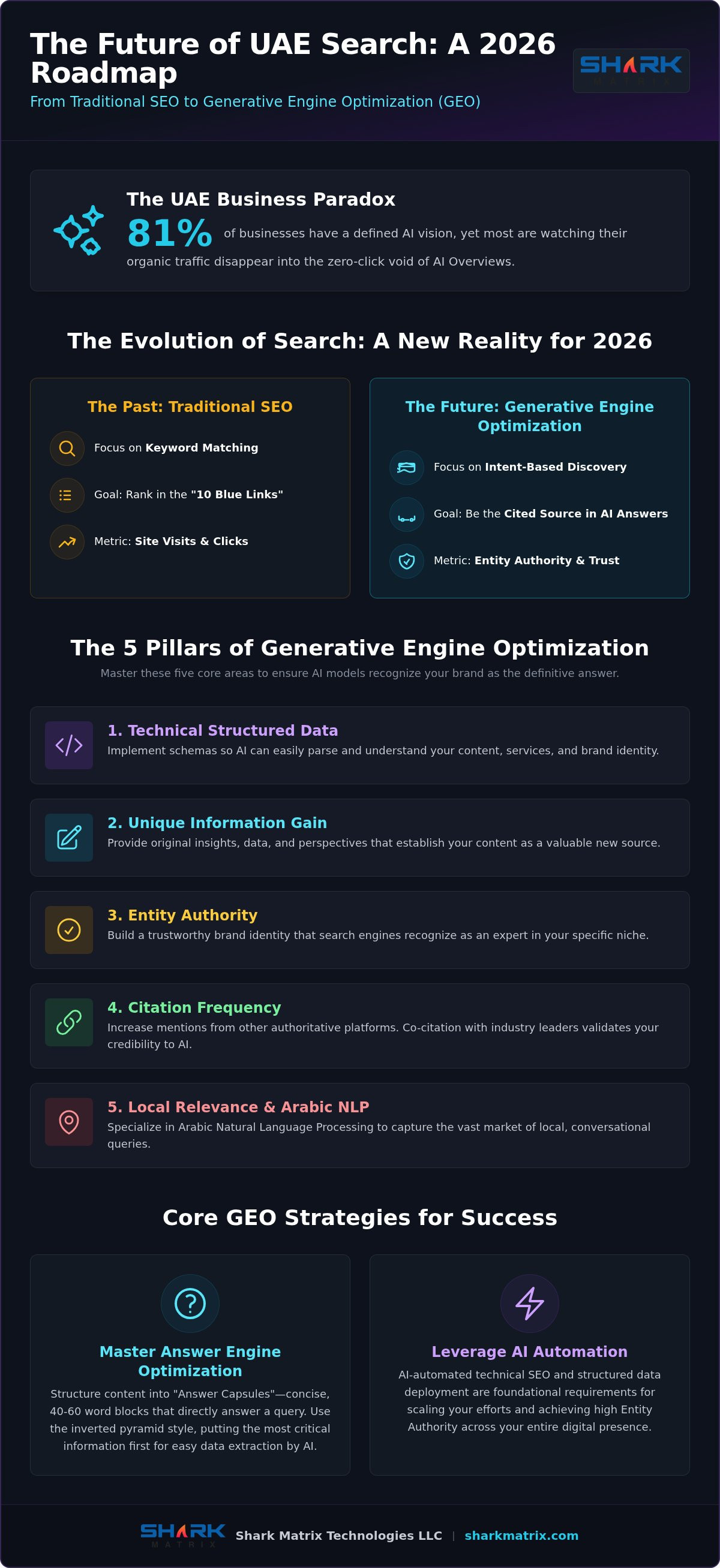
The search landscape has fundamentally shifted. An ai seo strategy for uae businesses isn’t just about chasing keywords anymore; it’s the strategic integration of machine learning and generative models to ensure your brand remains visible where users are actually looking. As of early 2026, the UAE has moved beyond the traditional list of “Ten Blue Links.” With the National Artificial Intelligence System now an advisory member of the UAE Cabinet, the push for digital efficiency and AI integration is at an all-time high across all federal entities.

This transformation is a direct result of the UAE Vision 2031, which positions the nation as a global hub for the new digital economy. Because the Emirates has one of the highest mobile penetration rates in the world, users have pivoted rapidly toward voice and AI-driven search. They expect immediate, conversational answers on their devices. They don’t want to browse through pages of advertisements and fragmented links. They want the answer, and they want it now.

From Keywords to Entities: The New Search Paradigm

In 2026, search engines don’t just see strings of text; they understand “entities,” which include brands, people, and specific locations. This shift means that Search Engine Optimization (SEO) has evolved to prioritize brand authority above all else. If an AI model doesn’t recognize your business as a trusted authority in its niche, it simply won’t recommend you. Entity-Based SEO is the practice of structuring your digital data so that AI models can clearly identify, categorize, and verify your brand’s unique identity and expertise.

The Impact of AI on User Behavior in the Emirates

The way people in Dubai, Abu Dhabi, and the Northern Emirates search has become inherently conversational. We’ve seen a massive rise in long-tail, natural language queries where users ask their phones complex questions. This has led to an increase in zero-click searches, where the AI provides the full answer directly on the result page. To maintain a competitive edge, businesses must pivot their focus toward appearing in the citations and sources that these AI agents use to build their answers. If your content isn’t the data source for the AI, your organic traffic will continue to decline.

Mastering Generative Engine Optimization (GEO) and AEO

Traditional SEO focused on ranking a website in a simple list of results. In 2026, Generative Engine Optimization (GEO) is about becoming the primary data source for AI models. As the region embraces AI-Driven Marketing in the UAE, businesses must adapt to how Large Language Models (LLMs) like GPT-4 and Gemini ingest information. A successful ai seo strategy for uae businesses ensures your site isn’t just indexed, but is understood as a reliable authority by these complex systems. This requires a shift from simple keyword targeting to technical excellence and brand visibility across the entire AI ecosystem.

Answer Engine Optimization (AEO) goes a step further by targeting the direct answers provided in conversational search. Whether it’s a voice query on a smartphone or a detailed prompt in an AI chat, AEO is what helps you win the new “Position Zero.” It demands a technical foundation that prioritizes clarity, speed, and directness. In the UAE’s fast-paced market, being the first answer provided by an AI agent can be the difference between a conversion and being ignored by your target audience.

The technical requirements for GEO are more demanding than old-school search. Speed is no longer just for user experience; it’s for machine retrieval. Generative engines favor sites that provide clear digital proof and rapid accessibility. Key technical factors include:

  • Instant server response times for rapid AI data retrieval and processing.
  • Comprehensive structured data using the latest Schema.org protocols for context.
  • Authoritative citations from UAE government portals or national news outlets.

These elements tell the AI that your business is a legitimate entity within the local regulatory framework. If an AI engine can’t verify your data instantly, it will move to a competitor’s source.

Optimizing for Large Language Models (LLMs)

LLMs analyze the relationships between data points, making data cleanliness a top priority. Clean code ensures AI bots parse your core message without distraction. Use Schema.org markup to provide a clear map of your business entity and services. This structured data gives generative engines the context they need to categorize your brand correctly. Aim for mentions in high-authority third-party datasets to build trust with AI models during their training phases.

Winning the Answer Box: AEO Best Practices

Structure your content around specific user questions using clear headings and concise answers. This mirrors the natural language intent of modern searchers in the Emirates. AI engines prioritize E-E-A-T, so verify your facts and demonstrate deep industry expertise. For a broader perspective on these shifts, read our Comprehensive Search Engine Optimization (SEO) Services: The 2026 Business Guide. Our specialized answer engine optimization services can help secure your spot in these vital conversational results.

AI SEO Strategy for UAE Businesses: The 2026 Guide to Dominating Generative Search

The Arabic NLP Advantage: Localizing AI SEO for the UAE

While many brands focus on English content, a truly effective ai seo strategy for uae businesses recognizes that Arabic is the heart of the national digital identity. Simple machine translation is no longer sufficient in 2026. Generative engines now use Natural Language Processing (NLP) to evaluate the cultural context and linguistic nuances of content before recommending it to users. If your content feels like a generic translation, AI models will likely flag it as low quality and pass over it in favor of more authentic, localized sources.

The UAE is a unique linguistic environment. Users often switch between Modern Standard Arabic, local Khaleeji dialects, and “Arabizi,” where Arabic words are written using Latin characters and numbers. If your technical SEO doesn’t account for these variations, AI agents will struggle to match your content with user intent. Successful optimization requires training your site’s data to be recognizable across these diverse linguistic patterns, ensuring the AI understands exactly what you offer regardless of the script used.

Technical SEO for Right-to-Left (RTL) languages is equally vital in an AI-first environment. AI crawlers require clean, semantically correct HTML to interpret Arabic text flow without errors. Ensuring your site’s code supports RTL standards allows AI models to parse and index your data with the same precision they apply to English sites. This technical clarity prevents the AI from misinterpreting your brand’s message during the indexing process.

Bilingual Brand Authority

Maintaining a consistent brand entity across both languages is a prerequisite for ranking in 2026. Generative engines look for localized citations from trusted national media outlets and government portals to verify your brand’s authority. Arabic NLP models prioritize semantic context over direct keyword matches to decipher the underlying intent of complex linguistic structures. By securing mentions in high-authority Arabic publications, you signal to the AI that your business is a legitimate and trusted leader within the local market.

Arabic Voice Search Optimization

The prevalence of voice notes and voice-driven commands in the Emirates has changed how we optimize for search. People don’t type keywords; they speak naturally and conversationally. Optimizing for the phonetics of Arabic queries in AI assistants ensures your brand is the one retrieved during a hands-free search. This is especially important for SEO for Brand Reputation Management Dubai: The 2026 National Brand Protection Guide, as voice search results often prioritize brand sentiment and local reviews. Aligning your content with the way people actually speak ensures you capture this high-intent traffic.

Building Your 2026 AI SEO Roadmap: A 5-Step Strategy

Transitioning to a data-first mindset is the first requirement for any successful ai seo strategy for uae businesses. In 2026, content is no longer just for human readers; it’s fuel for generative models. Business leaders in the Emirates are already ahead of the curve, with 93% expecting a measurable ROI from AI within two years. To capture this growth, your roadmap must move from static optimization to a dynamic, entity-focused approach that prioritizes how AI agents perceive your brand across the digital ecosystem.

  • Step 1: Conduct an AI-Readiness Audit. Evaluate your technical infrastructure and content library. Identify gaps where your information is too thin or unstructured for AI models to extract meaningful facts about your services.
  • Step 2: Implement Advanced Schema and Structured Data. Use nested JSON-LD to define the specific relationships between your products, regional locations, and key personnel.
  • Step 3: Develop a Conversational Content Strategy. Focus on Answer Engine Optimization (AEO) by answering the specific, complex questions your customers ask via voice notes or AI chat interfaces.
  • Step 4: Build Digital PR and Credible Mentions. Focus on Generative Engine Optimization (GEO) by earning mentions in high-authority UAE datasets, national news portals, and industry-specific directories.
  • Step 5: Continuous Monitoring. Track your “Share of Model.” This metric measures how often AI agents cite your brand as a primary source compared to your direct competitors.

Phase 1: Technical Foundation and Schema

Your technical setup must move beyond basic meta tags. In 2026, AI crawlers prioritize efficiency and semantic clarity. By using semantic HTML and advanced JSON-LD, you provide a clear, machine-readable map of your business entity. This level of technical precision is a core part of The 2026 Guide to Website Design and Development Services for UAE Enterprises. A fast, well-structured site isn’t just for users; it’s for AI bots that need to parse your data instantly to keep their generative models updated with your latest offerings.

Phase 2: Content Strategy and Digital PR

AI models want to cite sources that provide unique value. To become a cited authority, national brands must produce original research and data-driven insights that don’t exist elsewhere on the web. This “source-worthy” content is what earns you a spot in AI Overviews and conversational answers. You can use ai automation services to scale your content production, but the core insights must remain authentic to your brand’s unique expertise. Scaling quality ensures you maintain visibility as generative engines continue to redefine the search landscape.

Future-Proofing with Shark Matrix Technologies LLC: AI Automation and SEO Integration

Execution determines the winners in this new digital economy. Shark Matrix Technologies LLC doesn’t just offer standard marketing; we bridge the technical gap between software engineering and strategic growth. For an effective ai seo strategy for uae businesses, you need more than just blog posts. You need a custom-built infrastructure that talks directly to generative models. Our team integrates generative ai development services with advanced data architecture to ensure your brand remains a primary source for the engines that now define consumer discovery.

We’ve moved beyond traditional agency models to master Answer Engine Optimization (AEO) and Generative Engine Optimization (GEO). By utilizing real-time AI automation services, Shark Matrix Technologies LLC adjusts your site’s semantic data as Large Language Models update their parameters. This proactive approach is essential for maintaining a dominant national market share. It’s about being the first and most trusted answer in a market that’s moving toward 65% AI adoption among enterprise organizations this year.

Our national focus is critical. We understand the specific regulatory environment of the UAE and the cultural nuances required to win in Dubai, Abu Dhabi, and beyond. By combining technical machine learning development services with high-impact SEO, we create a feedback loop that constantly improves your brand’s authority in AI-generated answers.

Custom AI Solutions for National Brands

Shark Matrix Technologies LLC develops proprietary AI tools designed to monitor your “Share of Model” across various LLMs. This allows us to see exactly how often generative engines cite your brand compared to your competitors. We also integrate sophisticated ai chatbot-development services with your SEO data to capture conversational leads directly from search results. If you’re looking to expand your reach even further, check out our guide on Choosing the Right PPC Agency in Dubai: A 2026 Guide to National Growth to see how we balance paid and organic AI strategies.

The Shark Matrix Technologies LLC Advantage

What sets us apart is the combination of engineering excellence and deep SEO expertise. We are Arabic digital marketing specialists who understand how to leverage natural language processing services to dominate complex bilingual searches. Shark Matrix Technologies LLC doesn’t just guess what the AI wants; we build the technical tools to provide it. This ensures your business isn’t just a participant in the UAE’s digital transformation but a leader of it. Ready to secure your brand’s future? Partner with Shark Matrix Technologies LLC for your AI SEO Strategy and start dominating generative search today.

Securing Your Dominance in the Generative Search Era

The transition to generative engines is a definitive shift in how consumers in the Emirates discover information. Implementing a robust ai seo strategy for uae businesses is the only way to ensure your brand remains visible as traditional search results shrink. By focusing on entity-based authority and technical data structure, you move from being a simple link to becoming a primary source for AI models.

Since 2010, Shark Matrix Technologies LLC has specialized in bridging the gap between advanced technology and digital visibility. As national experts in Arabic NLP and AEO, we help businesses navigate the complexities of bilingual search and generative engine optimization. Our focus remains on high-impact technology that delivers measurable results in an increasingly AI-driven market.

The 2026 search landscape belongs to those who adapt. By aligning your digital presence with the technical requirements of generative engines, you secure a lasting competitive edge. Scale your national brand with the AI SEO and automation services of Shark Matrix Technologies LLC and lead the transformation of your industry.

Frequently Asked Questions

What is the difference between traditional SEO and AI SEO?

Traditional SEO focuses on keyword rankings and backlinks to move a website up the “Ten Blue Links” on a results page. AI SEO focuses on how generative models understand and synthesize your brand information. It’s about ensuring your business is the authoritative source cited in AI-generated answers. This requires a deeper focus on technical data structure and brand entity recognition across the digital ecosystem.

How does Generative Engine Optimization (GEO) work for UAE businesses?

Generative Engine Optimization (GEO) works by making your content more “retrievable” and “source-worthy” for Large Language Models. For UAE companies, this involves using advanced schema to connect your brand to local landmarks, government regulations, and national events. When an AI agent generates a response about your industry, GEO ensures your business is the one it cites as a reference for the user.

Will AI-generated content help or hurt my SEO in the national market?

AI-generated content can hurt your visibility if it lacks original insights or cultural context. While AI tools help scale production, search engines in the Emirates prioritize high-quality, expert-led content that demonstrates real-world experience. To succeed, you must use AI for efficiency but rely on human expertise to ensure your data is accurate and localized for the specific UAE audience and their needs.

What is Answer Engine Optimization (AEO) and why is it important now?

Answer Engine Optimization (AEO) is the practice of tailoring your content to provide direct, concise answers to conversational questions. It’s essential in 2026 because more users are getting their information directly from AI interfaces without clicking through to a website. By winning the “answer box,” you maintain brand visibility even when traditional organic traffic declines due to zero-click search behavior.

How do I optimize my website for Arabic voice search in 2026?

Optimizing for Arabic voice search requires a focus on phonetics and local dialect patterns like Khaleeji. Since many people in the Emirates use voice commands, your ai seo strategy for uae businesses should prioritize long-tail, conversational queries. You should structure your content to answer specific questions in both Modern Standard Arabic and common regional dialects to capture this growing hands-free traffic.

What are the best AI tools for SEO strategy in the UAE?

The most effective tools are those that provide deep insights into Large Language Model behavior and Arabic Natural Language Processing. While standard SEO platforms remain useful, national brands are increasingly turning to custom AI automation services to track their presence in generative summaries. These specialized tools help you understand which parts of your content are being cited and where you need to improve your authority.

How can I track if my business is being recommended by AI agents like Gemini?

You can track recommendations by manually testing industry prompts in agents like Gemini or by using automated “Share of Model” tracking tools. These tools analyze how often your brand is mentioned as a primary source compared to your competitors. Monitoring these citations helps you adjust your technical strategy to ensure you remain a preferred reference for AI models during their data retrieval process.

Does my business need a custom AI agent to improve its SEO?

While not every company needs one, a custom AI agent can boost your brand’s authority by providing structured, real-time data to search engines. Integrating an agent into your broader ai seo strategy for uae businesses helps you capture conversational leads and keeps users on your site longer. This high level of engagement signals to search engines that your brand is a trusted and helpful entity.

Categories
AEO SEO

The 2026 Answer Engine Optimization Checklist: Mastering AI-Driven Search

Did you know that websites relying solely on traditional SEO methods have seen a 60% decrease in organic referral traffic over the last 18 months? It’s a sobering reality for many digital marketers who are watching their hard-earned rankings yield fewer clicks. You’ve likely noticed that Google AI Overviews now appear in more than 80% of search results, fundamentally changing how users interact with the web. If you feel like the goalposts are moving, you aren’t alone.

This article provides the definitive 2026 answer engine optimization checklist to help you reclaim your visibility. You’ll get a step-by-step blueprint to optimize your brand for LLMs, Google’s AI Overviews, and conversational search engines to ensure you stay authoritative in an AI-first world. We’ll explore how to implement technical structured data, structure your content for instant answers, and future-proof your digital strategy against the next wave of generative engine updates. By the end, you’ll know exactly how to make your brand the primary source of truth for the world’s most advanced AI models.

Key Takeaways

  • Learn how AEO bridges the gap between traditional keywords and conversational intent to capture visibility in AI “answer engines.”
  • Discover the essential role of advanced Schema.org markup in serving as a “source of truth” for AI crawlers like ChatGPT and Gemini.
  • Master the “Inverted Pyramid” content structure to ensure your brand provides the direct, extractable answers that AI models prioritize.
  • Access a comprehensive answer engine optimization checklist to audit your site’s snippet potential and technical readiness for 2026 search trends.
  • Understand why scaling AEO requires integrating AI automation and development to manage complex data extraction and natural language processing at scale.

What is Answer Engine Optimization (AEO) and Why Does It Matter in 2026?

By 2026, the search landscape has transitioned from a directory of links to a network of synthesized answers. While traditional Search Engine Optimization (SEO) focuses on visibility within a list, Answer Engine Optimization (AEO) aims for something more specific: becoming the definitive source cited by AI models. AEO is the process of making your content easily extractable for “answer engines” like ChatGPT, Perplexity, and Google Gemini. Simply put, AEO is the optimization of content for synthesis by large language models (LLMs).

The impact on organic traffic is undeniable. As Google AI Overviews now appear in more than 80% of search results, the traditional “blue link” click-through model is being replaced by generative responses. This shift means your answer engine optimization checklist must account for how machines read, summarize, and attribute information. Instead of just ranking for a keyword, your goal is to be the authoritative entity that the AI trusts to answer the user’s query directly. When an AI synthesizes an answer, it chooses the most structured, clear, and authoritative source. If your content isn’t built for extraction, it effectively doesn’t exist in the generative era.

The Rise of Generative Engine Optimization (GEO)

Generative Engine Optimization (GEO) takes AEO a step further by focusing on the “creative” and narrative side of AI responses. While AEO targets the direct answer, GEO is about influencing how the AI weaves your brand into complex, multi-step explanations. Brand sentiment within AI training datasets is now a critical factor; if the training data views your brand as a leader, the generative engine will reflect that. 2026 marks the tipping point where “Answer-First” search behavior is the norm, requiring brands to use specialized AI automation and development to manage their digital footprint across various LLMs.

AEO vs. Traditional SEO: A Comparative Overview

Traditional SEO is built on keyword matching, whereas AEO relies on intent synthesis. In the old model, you optimized for a click. In the AEO model, you optimize for a citation. This doesn’t mean SEO is dead, but it has evolved into a technical foundation for AEO.

  • Keyword vs. Intent: SEO targets specific search phrases. AEO targets the underlying question the user is trying to solve.
  • Click-Through vs. Zero-Click: SEO measures success by traffic to the site. AEO measures success by “Share of Answer” and whether your brand is the cited authority in a zero-click environment.
  • Content Structure: SEO often rewards long-form, comprehensive guides. AEO rewards “answer-first” formatting where the core solution is presented immediately for easy bot consumption.

Balancing both strategies is essential for maintaining brand authority. By following a modern answer engine optimization checklist, you can ensure your content satisfies the deep-dive needs of human readers while providing the bite-sized, structured data points that AI engines crave. This dual approach prevents you from doubling your workload while maximizing your presence across all search modalities.

The Technical Foundation: Preparing Your Site for AI Extraction

AI agents are the new primary “users” of your website. While humans enjoy sleek visuals, large language models (LLMs) and autonomous agents look for machine-readable signals. This makes technical infrastructure the most critical part of your answer engine optimization checklist. If an AI agent can’t parse your data in milliseconds, it will simply move to a source that it can understand. You’re no longer just building for a browser; you’re building for a processor.

JSON-LD schema acts as a universal translator that allows AI agents to map your content directly to known entities and facts. This structured format provides a “source of truth” that reduces the risk of AI hallucinations, making your site a more reliable candidate for citations. When your data is predictable, AI models are more likely to trust and display it in generative responses.

Advanced Schema Markup for AEO

Standard SEO used to focus on basic metadata, but AEO requires a more granular approach. Implementing “FAQPage”, “HowTo”, and “Speakable” schema types is no longer optional. These tags tell AI exactly which parts of your page are the “answers.” Using “SameAs” attributes is equally vital. It connects your brand entities across the web, from LinkedIn to Wikipedia, helping AI build a comprehensive knowledge graph of your authority. Because these requirements are highly technical, professional technical seo services are the backbone of any successful strategy. They ensure your code is clean and compliant with the latest 2026 standards.

API-First Content Delivery

Speed and accessibility define the AI era. Traditional monolithic sites often struggle with slow ingestion speeds. Headless CMS architectures solve this by offering API-first content delivery, allowing AI bots to pull data directly without rendering heavy front-end elements. This efficiency directly impacts your “trust score.” AI models prioritize sources that respond quickly and reliably. As noted in HubSpot’s AEO Guide, content structure is just as important as the content itself. Your site architecture must facilitate real-time answer retrieval to stay competitive.

You must also audit your robots.txt file. In 2026, you shouldn’t just block all bots; you need to selectively allow reputable AI crawlers while protecting your proprietary data. Managing these permissions requires a delicate balance between visibility and security. If you find these technical configurations overwhelming, you might consider consulting with an expert team to streamline your AI readiness. High-speed API responses and optimized site architecture ensure you remain visible as search engines move toward instant, generative results.

The 2026 Answer Engine Optimization Checklist: Mastering AI-Driven Search

Conversational Content Strategy: Writing for Machines and Humans

If technical SEO is the engine, your content strategy is the fuel that determines where the vehicle goes. In 2026, writing for visibility requires a dual-focus approach. You must satisfy the human reader’s need for depth while providing AI models with the clear, extractable data they crave. Your answer engine optimization checklist isn’t complete without a radical shift in how you draft sentences and structure your arguments. LLMs don’t “read” like people; they synthesize patterns and look for the most direct path to a solution.

The “Inverted Pyramid” of AEO is your most powerful tool. This strategy demands that you answer the core question of any section within the first 50 words. By front-loading the answer, you provide a ready-made snippet that AI agents can easily lift and cite. Natural Language Processing (NLP) friendly syntax is also vital. Use active voice and “Subject-Verb-Object” structures. This clarity improves the probability that an AI will correctly interpret your intent and attribute the information to your brand. When you write with precision, you aren’t just creating content; you’re building a reputation as a canonical source of truth.

The ‘Answer-First’ Formatting Rule

Structure your pages using H2 and H3 tags that mirror the questions users actually ask. After each header, provide a direct answer between 40 and 60 words. This specific length is the “sweet spot” for AI snippet extraction. Use bulleted lists to break down complex data or multi-step processes. Lists are highly digestible for LLM synthesis, making it much easier for a generative engine to weave your data into a larger, multi-source response. This formatting mirrors the “People Also Ask” (PAA) patterns that dominate modern search results.

Bilingual AEO: Optimizing for a National Audience

For brands operating in the UAE, a monolingual strategy is no longer sufficient. High-quality Arabic localization is essential because AI agents now handle English-to-Arabic intent translation with remarkable sophistication. However, nuances in dialect and cultural context can still trip up a machine. This is why Arabic digital marketing requires specific AEO refinements. You must ensure that your Arabic content is as structured and entity-rich as your English version. By providing clear, localized answers in both languages, you increase your “Share of Answer” across a broader demographic, ensuring your brand remains the primary authority in the regional knowledge graph.

The 2026 Answer Engine Optimization Checklist

Moving from theory to execution requires a structured approach that addresses both technical and creative content needs. This answer engine optimization checklist serves as your roadmap to visibility in an era dominated by Google AI Overviews and conversational agents. You’ve already established the technical foundation and conversational tone. Now, it’s time to audit your existing digital footprint to ensure every page is an “extractable” asset. Success in 2026 isn’t about the volume of pages you publish; it’s about the precision of the answers you provide.

  • Audit Snippet Potential: Review your top 20% of traffic-driving pages. Identify sections where a direct answer can be inserted to capture featured snippets and AI citations.
  • Implement Advanced Schema: Move beyond basic tags. Every service and product page must use microdata that defines specific attributes, helping AI models categorize your offerings accurately.
  • Enforce the 50-Word Rule: Restructure your introductory paragraphs to lead with a concise, direct answer. This satisfies the “answer-first” requirement of modern LLMs.
  • Voice Search Optimization: Adapt your long-tail keyword strategy to mirror natural speech patterns. People ask questions differently when speaking than when typing.
  • Knowledge Graph Verification: Use Online Reputation Management (ORM) to ensure your brand’s facts are consistent across Wikipedia, social profiles, and industry directories.

Step 1: Entity and Authority Mapping

AI models understand the world through entities. You must clearly identify your primary business entities, including your CEO, core products, and physical locations. Consistency is vital here, especially for bilingual markets. For UAE enterprises, your Name, Address, and Phone (NAP) data must be identical across English and Arabic directories. Linking these entities via Wikidata or official social profiles helps AI engines build a reliable knowledge graph of your brand’s authority.

Step 2: Technical and Structural Alignment

Your site’s backend must be as fast as the AI models that crawl it. Mobile-first responsiveness is a baseline requirement, but lightning-fast load times are what secure a high trust score. Ensure that your custom web development supports modern SEO standards, including efficient API-first content delivery. Testing your site using AI-simulated crawlers can reveal extraction bottlenecks that traditional SEO tools might miss.

Step 3: Monitoring and Iteration

AEO is not a “set and forget” strategy. You need to track your “Citation Share” in AI Overviews and ChatGPT responses to measure real-world performance. Tools like Perplexity are excellent for testing how well your brand answers specific industry queries. As “People Also Ask” trends evolve, you must adjust your content to address emerging questions. If you want to ensure your site meets every requirement on this answer engine optimization checklist, it’s time to partner with Shark Matrix for a professional AEO audit.

Future-Proofing with AI Automation and Expert SEO

Implementing an answer engine optimization checklist across a handful of pages is a manageable task, but scaling these efforts for an enterprise-level website is a different challenge. Manual updates for thousands of product descriptions or service pages simply don’t work in a fast-moving AI environment. To maintain a competitive “Share of Answer,” you need a system that adapts in real-time. This is where automation becomes the essential bridge between a static website and a dynamic, AI-ready asset, and Mkhaya MK provides the digital transformation expertise to build these scalable environments. You can’t rely on human speed when search engines are synthesizing data in milliseconds.

Shark Matrix integrates AI automation and development directly into your SEO workflow to solve the problem of scale. By leveraging custom software and machine learning, we can automate the generation of high-fidelity schema markup and “answer-first” content summaries across your entire domain. This technical-first approach ensures that every page on your site is optimized for extraction without requiring thousands of manual man-hours. It’s about working smarter by letting machines communicate with other machines effectively.

Integrating AI into Your Marketing Stack

Modern marketing stacks must include machine learning to predict shifts in search intent before they impact your referral traffic. By analyzing vast datasets, we can identify which “Question” keywords are gaining traction and automate the deployment of FAQ schema to meet that demand. This level of agility is only possible with a technical-first digital agency that understands the intersection of code and content marketing. Custom AI chatbots also play a strategic role here; they act as interactive data points that help train LLMs about your specific business logic, products, and services.

Next Steps: Your AEO Roadmap

Your journey toward search dominance in 2026 starts with a clear, actionable plan. Don’t wait for your organic traffic to decline further before taking action. The transition from “blue links” to generative answers is already happening.

  • Start with a Technical Audit: Conduct a comprehensive review of your site’s crawlability by non-traditional AI agents.
  • Prioritize ‘Question’ Keywords: Focus on high-intent queries that trigger AI Overviews and “People Also Ask” boxes.
  • Connect Your Entities: Ensure your brand’s metadata and facts are consistent across all global and regional directories.

The search landscape has fundamentally changed, but your brand’s authority can thrive in this new environment. By combining the points in this answer engine optimization checklist with advanced machine learning, you can secure your place as the definitive answer in your industry. If you’re ready to future-proof your digital presence and lead the market, contact Shark Matrix today for a tailored AEO strategy that puts your brand at the center of the AI conversation.

Securing Your Brand’s Future in the Generative Search Era

The shift from traditional search to generative answers isn’t just a trend; it’s a fundamental change in how the world accesses information. You’ve seen how a robust technical foundation and “answer-first” content are the keys to surviving the decline in organic click-through rates. Implementing every step of this answer engine optimization checklist ensures your website doesn’t just exist but leads the conversation. Don’t let your brand become a hidden footnote in an AI-generated summary when it could be the primary citation.

Shark Matrix has delivered high-impact digital solutions since 2010. Our specialists in AI automation and machine learning are uniquely prepared to manage the complex data structures LLMs demand. Whether you’re targeting a local or national audience, our comprehensive digital marketing coverage keeps your brand authoritative. It’s time to move beyond the simple blue link and become the definitive answer that machines and humans both trust.

Future-proof your brand with Shark Matrix AEO Services and start dominating the next era of search today.

Frequently Asked Questions

Is Answer Engine Optimization different from regular SEO?

AEO is a specialized refinement of SEO that focuses on providing direct, extractable answers for AI-driven engines rather than just ranking in a list of links. While traditional SEO helps your site get indexed and ranked, AEO ensures your content is selected as the definitive answer cited by large language models. It requires a much more granular focus on technical data structures and conversational sentence patterns.

How do I show up in ChatGPT or Google AI Overviews?

You appear in these generative responses by becoming a highly authoritative and structured source for specific entities and questions. This involves implementing every item on an answer engine optimization checklist, such as leading with concise answers and using JSON-LD schema. AI models prioritize sources that are easy to parse and consistently cited across other reputable platforms like industry directories and social profiles.

Does AEO require a website redesign?

A full redesign isn’t always necessary, but your site architecture must support rapid data ingestion and mobile-first responsiveness. You might need to optimize your backend for high-speed API responses or adjust your CMS to deliver content in a more structured format. The focus is primarily on how your data is delivered to bots rather than the visual elements seen by human visitors.

Which schema types are most important for AEO in 2026?

In 2026, “FAQPage”, “HowTo”, and “Speakable” schema types are the most critical for signaling extractable answers to AI crawlers. You should also use “SameAs” attributes to link your brand’s digital entities across the web. These tags act as a universal translator, helping AI agents understand the relationships between your products, services, and leadership team without any ambiguity.

How can I track the ROI of my AEO efforts?

Tracking AEO ROI involves measuring “Share of Answer” and citation volume in generative engines instead of just traditional click-through rates. You should monitor how often your brand is cited as a source in Google AI Overviews and ChatGPT responses. While traditional organic traffic might fluctuate, the increase in brand authority and high-intent conversions from these citations provides a more accurate measure of success.

Can AI automation help with my AEO checklist implementation?

AI automation is essential for managing a comprehensive answer engine optimization checklist at scale across a large website. Automated tools can generate schema markup for thousands of pages and predict shifts in search intent using machine learning. This allows your team to focus on high-level strategy while the technical heavy lifting of data structuring and extraction optimization is handled by custom software.

What is the impact of voice search on AEO?

Voice search has pushed AEO toward more natural, conversational language patterns and long-tail query optimization. Since voice queries are typically phrased as complete questions, your content must provide complete, bite-sized answers that are easily read aloud by virtual assistants. This shift reinforces the need for clear H2 and H3 headers that mirror the way people actually speak in daily life.

Is AEO relevant for B2B companies in the UAE?

AEO is highly relevant for UAE-based B2B firms because it establishes authority in a market that values technical expertise and bilingual accessibility. Providing clear, localized answers in both English and Arabic helps you capture market share in regional AI searches. It positions your company as the canonical source for industry-specific queries, which is vital for building trust with corporate decision-makers in the region.

Categories
GEO SEO

Generative Engine Optimization Examples: How to Rank in AI Search in 2026

Did you know that 35% of consumers now use AI tools during product discovery, while traditional search usage has dropped to just 13.6%? This shift isn’t just a trend; it’s a fundamental change in how your customers find your brand. With Gartner forecasting a 25% drop in traditional search volume by 2026, you’re likely feeling the impact of AI overviews taking center stage. To stay visible, you must study specific generative engine optimization examples that move beyond old-school keyword stuffing and focus on becoming a citable authority for Large Language Models.

It’s frustrating to watch your hard-earned rankings disappear into a summarized AI box. You’ve spent years mastering search, only to feel like the rules changed overnight with the rise of agentic commerce. We’ve analyzed the latest 2026 data and Google’s updated spam policies to show you exactly how to ensure AI engines cite and recommend your business. This guide breaks down real-world GEO strategies, from technical schema requirements to multimodal optimization, so you can bridge the gap between traditional search and the technical infrastructure required for the future.

Key Takeaways

  • Learn why ranking for citations has replaced traditional keyword positions as the primary goal for visibility in AI-powered search results.
  • Discover practical generative engine optimization examples, such as leveraging original data and expert quotes to become a preferred source for LLMs.
  • Understand how to tailor your content for agentic commerce to ensure your brand is the top recommendation in AI-driven product and service comparisons.
  • Identify the technical schema and structured data updates required to make your website’s information easily digestible for 2026 generative engines.
  • Explore how integrating AI automation and Arabic localization can help your business capture high-intent traffic across both national and regional AI search platforms.

Understanding Generative Engine Optimization (GEO) in 2026

GEO isn’t just a buzzword; it’s the technical reality of 2026. While traditional SEO focuses on climbing the Search Engine Results Page (SERP), Generative Engine Optimization (GEO) is the process of ensuring your content is selected as a primary source by Large Language Models (LLMs). Instead of fighting for a blue link, you’re fighting for a citation in a synthesized answer. Looking at successful generative engine optimization examples, we see a move away from simple keyword matching toward deep, factual density that AI models can easily parse and verify.

AI engines like Perplexity and SearchGPT operate differently than the classic Google algorithm. They prioritize information that is structured for synthesis rather than just keyword relevance. As noted by Wikipedia on Generative Engine Optimization, this discipline has emerged as a direct response to how generative AI interprets web data. In this environment, your E-E-A-T (Experience, Expertise, Authoritativeness, and Trustworthiness) isn’t just a ranking factor; it’s the filter that determines if an AI agent trusts your data enough to repeat it to a user.

From SERPs to Agentic Search

By 2026, the rise of agentic search has fundamentally changed user behavior. AI agents now perform complex research and execute tasks on behalf of users, leading to a significant increase in zero-click searches. When an agent summarizes the market for “the most reliable AI automation services,” it doesn’t present a list of links. It provides a definitive answer. Being the “source of truth” in these summaries is the new gold standard. Brands that fail to adapt see their organic click-through rates vanish, while those that master generative engine optimization examples thrive by becoming the recommended choice in agentic commerce.

For instance, as AI agents increasingly assist in B2B procurement, they allow decision-makers to explore Cleaning robots by comparing real-time performance data and technical specifications from verified sources.

The Trust Factor: How AI Models Choose Their Sources

LLMs weigh factual accuracy and the recency of data much more heavily than traditional backlink counts. They look for consensus across the web and verifiable claims that align with their training data and real-time search capabilities. This is where online reputation management becomes a critical technical pillar. If your brand’s data is inconsistent or your expertise isn’t clearly documented across multiple platforms, an LLM will likely skip your content for a more authoritative source.

To measure success in this era, professionals now track the ‘Citation Score’, which is a metric representing the frequency and prominence of your brand being cited as a factual source within AI-generated responses. AI models prioritize sources that provide unique, data-backed insights that can’t be found in generic, AI-generated filler content. By focusing on factual density, you ensure your brand isn’t just seen, but is actually used to build the AI’s final answer.

Core Generative Engine Optimization Examples by Strategy

Effective generative engine optimization examples often center on one core principle: factual density. AI models aren’t looking for narrative flow; they’re scanning for verifiable data points they can synthesize into a summary. By 2026, the most successful brands have shifted away from long-form filler toward content that prioritizes original research and expert perspectives. This shift is a key part of Generative Engine Optimization (GEO), where the goal is to provide the unique information that generic AI models can’t generate on their own. When you provide a unique statistic or a nuanced expert opinion, you give the LLM a reason to cite your brand specifically.

Factual density means every sentence provides value. AI engines like Perplexity and SearchGPT favor content that is concise and fact-heavy. Instead of using fluff to reach a word count, successful strategies focus on structured data and direct answers. This makes your content easier for AI agents to parse, increasing the likelihood that your brand becomes the primary recommendation in a synthesized search result.

Example 1: The ‘Statistical Citation’ Strategy

A generic claim like “many businesses are using AI” won’t get you cited by a modern generative engine. Instead, use a fact-dense claim: “According to our 2026 survey, 68% of UAE-based retail firms have integrated agentic search tools into their customer service workflows.” LLMs are highly likely to extract this specific data point. Structuring this information in a clear HTML table further simplifies the extraction process for crawlers. One national brand recently saw a 25% increase in AI citations by publishing quarterly industry benchmarks rather than standard blog posts. If you want to replicate this, focus on gathering original data that doesn’t exist elsewhere on the web.

Example 2: The ‘Definition-First’ Approach

The ‘Definition-First’ strategy targets “What is” queries by providing clear, non-ambiguous answers at the start of a section. This approach is essential for modern search engine optimization seo services. By creating comprehensive glossary pages, you establish your site as a primary reference for industry terminology. Semantic proximity is the mathematical measure an AI uses to determine how closely your brand is associated with a specific topic or solution based on the surrounding context of your content. When your brand is consistently linked to clear definitions, AI engines view you as a foundational authority. To see how these strategies can be tailored to your specific industry, you might explore custom AI automation solutions that align your content with these new technical requirements.

Generative Engine Optimization Examples: How to Rank in AI Search in 2026

Industry-Specific GEO Examples for National Enterprises

Applying generative engine optimization examples requires a tailored approach based on your sector’s complexity and the risk level of the information provided. In 2026, AI engines don’t treat a search for “best espresso machine” the same way they treat “best corporate restructuring consultant.” High-stakes industries, particularly those in the Your Money or Your Life (YMYL) categories like healthcare and finance, must meet a higher threshold of verifiable expertise to be cited. National enterprises that successfully bridge this gap do so by providing the technical depth that LLMs require to synthesize a reliable recommendation.

In sectors like real estate and construction, providing technical data for agentic research is the new standard. AI agents often look for specific structural data, zoning information, or sustainability certifications to answer complex buyer questions. By structuring this data clearly, your brand becomes the reliable source that the AI trusts to inform high-value decisions. Whether you’re in finance or retail, these generative engine optimization examples demonstrate that the brands providing the most granular, verifiable data are the ones that survive the 25% drop in traditional search volume forecasted for 2026.

This principle is particularly relevant for specialized service providers; for example, a UAE-based restoration expert like The Solution can capture high-intent traffic by ensuring their technical expertise in damage repair is structured for AI citation, making them the preferred recommendation for property recovery queries.

Professional Services: The Authority Play

For professional services, winning the “Who is the best consultant” prompt isn’t about volume; it’s about being the most cited authority on specific, complex problems. Consider a national legal firm. Instead of generic blog posts, they optimize for queries like “How to register a business nationally” by providing comprehensive, step-by-step guides and technical whitepapers. These documents serve as high-quality training fodder for AI engines, ensuring the firm’s specific methodology is the one summarized for the user. Maintaining this status requires proactive seo for brand reputation management to ensure the AI’s consensus view of your firm remains positive and authoritative across all digital touchpoints.

E-commerce: Winning the Comparison Game

With 35% of consumers now using AI tools at the product discovery stage, e-commerce brands must optimize for conversational “Best X for Y” queries. A high-end electronics retailer, for example, can win AI comparison tables by providing hyper-detailed spec sheets that include data points generic scrapers might miss, such as specific power efficiency ratings or compatibility with niche software. According to recent generative engine optimization strategies, these brands also prioritize real-time feeds for price and availability. This ensures that when an AI agent performs research on behalf of a shopper, your product is recommended based on the most current, citable data available.

Technical GEO: Schema and Structured Data Examples

Technical SEO has evolved into a communication protocol for Large Language Models. While previous sections focused on what you say, technical GEO focuses on how you label it so an AI agent can’t possibly misinterpret your meaning. Structured data acts as the API between your website and an AI’s retrieval engine. By studying successful generative engine optimization examples at the code level, we see that the most cited brands don’t just use basic schema; they use it to define specific attributes that AI models prioritize, such as sustainability metrics or technical compatibility.

Think of structured data as the framework that turns your prose into a database. Beyond basic price and availability, 2026 product schema must include granular details like carbon footprint data or software version compatibility. AI agents often perform research tasks like “find me a CRM compatible with my existing ERP that has a high sustainability rating.” If those attributes aren’t explicitly marked up in your schema, the AI will likely skip your brand for a competitor that provides a more easily digestible data set.

Entity Linking: Connecting the Dots for AI

Entity linking is the process of helping an AI understand exactly who you are by connecting your brand to known entities in the global Knowledge Graph. You can use ‘SameAs’ properties to link your official domain to authoritative social profiles, news mentions, and third-party awards. For instance, connecting a CEO’s thought leadership articles to the company’s official domain helps the AI verify the authorship and trustworthiness of your content. This structural clarity is why website design and development services must prioritize technical metadata during the build phase; you’re not just building for humans, you’re building for the scrapers that feed the world’s most powerful LLMs.

Advanced Schema for 2026 Search

Implementing ‘Speakable’ and ‘Dataset’ schema is now essential for capturing voice search and data-hungry AI tools. ‘Speakable’ markup identifies sections of a page that are best suited for audio playback, which is a major signal for conversational AI. Similarly, properly marked-up FAQ sections allow AI engines to pull direct answers for user queries without needing to synthesize the entire page. These generative engine optimization examples show that the more you reduce the “computational cost” for an AI to understand your site, the more likely you are to be cited as the primary source of truth. To ensure your site’s architecture is ready for these requirements, you can partner with experts for a technical GEO audit to identify gaps in your structured data.

Implementing a National GEO Strategy with Shark Matrix Technologies LLC

Success in 2026 requires a technical infrastructure that bridges the gap between traditional search and AI synthesis. Shark Matrix Technologies LLC has been a national leader in this space since 2010, evolving alongside the algorithms to provide high-impact SEO and lead generation. We help enterprises transition from simply being visible to being citable. This involves a multi-channel approach where SEO signals are reinforced by PPC and social authority, creating a consistent brand narrative that AI engines can verify and trust.

Measuring success in this new era involves tracking metrics that didn’t exist five years ago. We focus on your citation rate, which is the frequency with which LLMs use your brand as a factual source. We also monitor your conversational share of voice to see how often your products are recommended in agentic commerce prompts. By integrating AI automation into your optimization workflow, we ensure your content remains fresh and factually dense, meeting the rigorous standards of modern generative engines.

AI Automation and Scalable Authority

Building authority at scale is impossible without the right tools. Shark Matrix Technologies LLC utilizes custom AI automation to identify ‘citation gaps’ within your specific industry. We analyze which topics your competitors are winning in AI summaries and develop content strategies to reclaim those positions. There is also a powerful synergy between our mobile app development services and GEO. Data generated from your own applications can serve as a proprietary source of truth that LLMs prioritize because it isn’t available elsewhere on the public web. We help you package this data into citable insights that establish your brand as a primary industry resource.

The Future of National GEO: Arabic and Beyond

For national brands, the ability to win in a bilingual environment is a major competitive advantage. Most generative engine optimization examples found online focus solely on English, but regional AI engines now process complex Arabic-English queries with high sophistication. Shark Matrix Technologies LLC specializes in localizing technical data so that it remains citable across both languages. We ensure that your structured data and factual density are preserved during translation, allowing you to dominate regional AI search intent. This localized expertise ensures your brand isn’t just understood by AI, but is actively recommended to the local market. Partner with Shark Matrix Technologies LLC to dominate the next era of search.

The transition from traditional search to AI-driven discovery is no longer a future prediction; it’s the current reality for national enterprises. Success in 2026 depends on your ability to provide the factual density and technical clarity that Large Language Models trust. We’ve explored diverse generative engine optimization examples, ranging from structured schema updates to the creation of citable original research. By focusing on these strategies, you ensure your brand isn’t just another link, but the primary recommendation in synthesized search results.

Shark Matrix Technologies LLC has been a national SEO leader since 2010. We specialize in custom AI automation development and high-authority B2B lead generation. This deep experience allows us to build the technical infrastructure your brand needs to thrive in an agentic search landscape. We bridge the gap between classic optimization and the modern requirements of generative engines.

Future-proof your brand with Shark Matrix Technologies LLC GEO services and secure your place as the definitive source of truth in your industry. The rules of discovery are changing, but your visibility doesn’t have to decline. It’s time to lead the conversation.

Frequently Asked Questions

What is the difference between SEO and GEO?

SEO focuses on ranking in traditional search engine results pages through keywords and backlinks to drive clicks. In contrast, GEO aims to have your content selected as a factual source or citation within AI-generated summaries. While SEO targets visibility in a list of links, GEO focuses on being the synthesized answer provided by an AI agent.

How do I know if AI is citing my website?

You can verify citations by checking the footnotes and source links provided in AI summaries from engines like Perplexity, SearchGPT, or Google Gemini. Many brands now use AI visibility tracking software to monitor their citation rate. This metric helps you understand how often your brand is recommended during the product discovery stage of the buyer journey.

Will GEO replace traditional search engine optimization?

GEO is a complementary strategy rather than a replacement for traditional SEO. While traditional search still handles navigational and transactional queries, AI search volume is growing rapidly. Integrating generative engine optimization examples into your digital strategy ensures you capture the 35% of consumers who now use AI tools for research and product discovery.

Is schema markup required for generative engine optimization?

Schema markup is essential because it provides the structured data that AI models use to verify your information. It acts as a technical bridge, allowing LLMs to parse your content without ambiguity. By using advanced schema, you reduce the computational effort required for an AI to understand your site, which significantly increases your chances of being cited as a source.

How can my small business compete with big brands in AI search?

Small businesses can compete by focusing on niche expertise and original data that larger competitors might overlook. AI engines prioritize factual density and unique perspectives over massive backlink profiles. By providing hyper-specific answers and expert-led insights, you can establish your brand as the primary authority for specialized topics within your local or national market.

What are the most common GEO mistakes to avoid?

The biggest mistake is publishing generic, long-form content that lacks original research or unique data points. AI models have no reason to cite content that merely repeats information already found in their training data. Other common errors include neglecting technical metadata and failing to provide concise, direct answers to the conversational questions users ask AI agents.

How long does it take to see results from a GEO strategy?

Results from GEO often appear faster than traditional SEO, sometimes within just a few weeks. Because AI engines are constantly scanning for the most accurate and recent data, a well-optimized page with clear schema can be picked up as a source quickly. Maintaining these citations requires consistent updates to ensure your data remains the most relevant option available.

Can AI-generated content rank well in generative engine optimization?

Purely synthetic content rarely ranks well because it often lacks the unique insights and E-E-A-T signals that LLMs prioritize for citations. Successful generative engine optimization examples usually involve human-led expertise that is enhanced by AI tools. To be citable, your content must offer original value, such as new survey results or expert commentary, that the AI cannot generate on its own.

Categories
SEO

SEO vs PPC for UAE Businesses: The 2026 Strategic Growth Guide

By the end of 2026, digital advertising spend in the UAE will hit $2.64 billion, yet many brands will still burn through their budgets without seeing a single qualified lead. The debate of seo vs ppc for uae businesses isn’t just about clicks anymore; it’s about survival in a hyper-competitive, AI-driven market. You’ve likely felt the sting of rising customer acquisition costs or the frustration of waiting months for traditional SEO to move the needle. It’s exhausting to watch your competitors dominate search results while your own strategy feels like guesswork.

We understand that every dirham needs to work harder in a landscape where mobile speeds are the fastest in the world and consumer expectations are even higher. This guide provides the definitive framework you need to choose between these two powerhouses to maximize your growth across the Emirates. We’ll explore a roadmap for smart budget allocation, the impact of the mandatory 2026 Advertiser Permit regulations, and how to integrate AI to dominate both organic and paid search results.

Key Takeaways

  • Learn how to balance the immediate lead generation of paid ads with the long-term, sustainable brand equity built through organic search.
  • Discover the definitive decision matrix for seo vs ppc for uae businesses to determine which channel best suits your current growth stage and budget.
  • Understand why professional Arabic digital marketing and cultural localization are critical for capturing the full national demographic in 2026.
  • Explore how emerging technologies like Answer Engine Optimization (AEO) and generative AI are shifting search behaviors across the Emirates.
  • Identify how a unified search strategy, supported by high-performance web and mobile assets, can significantly lower your overall customer acquisition costs.

The Core Debate: Defining SEO and PPC in the Modern UAE Landscape

Deciding on the right mix of seo vs ppc for uae businesses isn’t just about choosing between organic growth and paid ads. It’s a strategic calculation within the broader framework of Search Engine Marketing (SEM). In a region where internet penetration has hit 99%, how you appear on a search results page determines your brand’s authority. By 2026, the debate over seo vs ppc for uae businesses has shifted; it’s no longer a question of one or the other, but rather how to balance both for total market dominance. AI-driven results and “zero-click” searches mean that being visible is only half the battle; being the most relevant answer is what wins the lead.

For UAE enterprises, viewing these channels as mere expenses is a mistake. They’re investments in digital real estate. While one builds equity over time, the other buys immediate access to a crowded marketplace. Shark Matrix Technologies LLC emphasizes that success in the Emirates requires understanding how these two pillars support each other in a mobile-first economy. This isn’t just about traffic; it’s about owning the search landscape across every national touchpoint.

Search Engine Optimization (SEO) Explained

SEO is the art of earning your place at the top of search results through technical health, content authority, and superior user experience. When you invest in search engine optimization seo services, you’re playing the long game. You’re telling search engines that your business is the most trusted source for a specific query. In the Middle East, this trust is vital. Organic visibility acts as a digital seal of approval. It signals to local customers that your brand is established and reliable, rather than just a temporary advertiser passing through their feed. It’s the foundation of long-term brand equity.

Pay-Per-Click (PPC) Advertising Explained

PPC offers a shortcut to the front of the line. By bidding on high-intent keywords, you gain instant traffic and visibility. This is particularly effective for new product launches or seasonal promotions where time is of the essence. Working with an experienced ppc agency dubai ensures that your ad spend isn’t wasted on irrelevant clicks. The beauty of PPC lies in its precision. You can track every single dirham spent against the leads generated, allowing for real-time adjustments. It’s a high-speed engine for growth that provides the data needed to refine your broader marketing strategy. Shark Matrix Technologies LLC uses this data to identify which keywords deserve a heavier long-term SEO investment.

By 2026, the UAE market has become hyper-competitive. With digital ad spend projected to reach $2.64 billion, simply “doing” SEO or PPC isn’t enough. You need a strategy that recognizes how they overlap. Organic rankings now influence ad quality scores, and paid data reveals which keywords are worth the long-term SEO effort. They’re two halves of a single, unified search strategy designed for national dominance.

Performance Comparison: Speed, Cost, and Sustainability

Speed is the most immediate differentiator when evaluating seo vs ppc for uae businesses. If you launch a Google Ads campaign today, you can expect traffic to hit your site by sunset. SEO is a slower burn. It’s a strategic marathon that usually requires three to six months to achieve meaningful national traction, especially in competitive UAE sectors like real estate or professional services. However, this speed comes with a trade-off in control. PPC offers granular targeting that lets you reach users on specific devices at precise times. This is crucial in a market where mobile connections represent 202% of the population. SEO, while powerful, remains subject to the unpredictable shifts of search engine algorithms.

As highlighted in Google’s guide to SEO vs. PPC, both channels are vital components of a modern digital strategy. They shouldn’t be viewed in isolation, as the data from one often fuels the success of the other.

Calculating the Real Cost of Acquisition

Many business owners view PPC as the more expensive option due to the direct, daily ad spend. In reality, SEO carries significant fixed costs related to strategy, content creation, and technical optimization. You can’t expect to rank for high-value terms without a flawless digital foundation, which is why investing in website design and development services is an essential precursor to organic success. Customer Acquisition Cost (CAC) in the UAE market is the total monetary investment in marketing and sales efforts required to convert a single prospect into a paying customer. Smart brands use PPC to validate their assumptions. By bidding on specific keywords, you can see which terms actually drive conversions before you commit to a long-term SEO roadmap for those same phrases.

Sustainability and Brand Equity

PPC traffic is essentially a lease. Once you stop paying for clicks, your visibility vanishes. SEO traffic is a compounding asset that builds equity over time. As your organic authority grows, your cost per lead often drops because you aren’t paying for every individual visitor. UAE consumers are increasingly discerning. They often skip past “Sponsored” labels to find organic results, which they treat as a “trust signal.” They assume that if a brand ranks at the top naturally, it has earned its place through relevance and quality.

This organic presence helps you bypass “ad blindness,” a common phenomenon where users ignore paid placements entirely. Utilizing seo for brand reputation management dubai allows you to own the search results for your brand name and key industry terms. It ensures you’re controlling the narrative rather than leaving it to chance. If you’re unsure how to balance these two investments, discussing your goals with a growth strategist can help you find the right equilibrium.

SEO vs PPC for UAE Businesses: The 2026 Strategic Growth Guide

The 2026 “UAE Factor”: Arabic Localization and AEO

Success in the Emirates depends on more than just high bids or keyword density. By 2026, the specific “UAE Factor” has become the deciding factor in the seo vs ppc for uae businesses debate. It’s no longer enough to translate an English campaign and hope for the best. The market has matured. Users expect a digital experience that feels culturally and linguistically native. According to a recent UAE digital advertising market report, the region’s growth is increasingly driven by localized, high-intent queries that generic strategies simply cannot capture.

The rise of AI search has also shifted the goalposts. Whether you’re running paid ads or building organic authority, your content must now satisfy both human readers and AI algorithms. This dual requirement means that simple translation is a relic of the past; sophisticated localization and technical optimization are the new standards for national dominance.

The Power of Professional Arabic SEO

Professional Arabic digital marketing goes far beyond swapping English words for Arabic ones. It involves understanding the unique search intent of the local population. For example, an English-speaking expatriate might search for “luxury villas with high ROI,” while a local Emirati might prioritize “villas with traditional privacy features.” If your SEO or PPC strategy doesn’t account for these cultural nuances, you’re invisible to a massive segment of the market. Some industry professionals report that national brands lose up to 40% of their potential reach by neglecting dedicated Arabic SEO. Localization ensures your brand resonates with the values and expectations of the UAE’s diverse demographic.

AEO and GEO: The New SEO Frontier

Search Generative Experience (SGE) has fundamentally changed how users interact with search engines. Instead of a list of links, users now receive AI-generated summaries that provide direct answers. This has birthed Answer Engine Optimization (AEO) and Generative Engine Optimization (GEO). To win in 2026, your content must be structured to serve as the “source of truth” for these AI models. This requires a technical approach that integrates AI automation to identify and capitalize on emerging search trends across the UAE in real-time. By positioning your brand as the primary reference for AI chatbots, you secure a level of authority that traditional search methods can’t match. This integration of AI into your search strategy is what separates national leaders from the rest of the pack.

Strategic Decision Matrix: When to Invest in SEO, PPC, or Both

Choosing the right balance of seo vs ppc for uae businesses requires a clear understanding of your current growth stage. There’s no single formula that works for every enterprise. Instead, your allocation should shift based on your immediate goals, whether that’s capturing quick market share or building a sustainable digital asset. By aligning your search strategy with your business lifecycle, you ensure that every dirham spent contributes to a measurable return. We see three primary scenarios that dictate this split.

  • Scenario A: New Product Launch. When speed is the priority, weight your budget heavily toward PPC. You need immediate traffic to test your value proposition and gather data on user behavior.
  • Scenario B: Established Brand Building. For market leaders, the focus shifts to SEO. This protects your brand reputation and reduces reliance on increasingly expensive ad auctions.
  • Scenario C: Highly Competitive Niches. In sectors like legal or finance, you need the “Double-Dip” effect. Occupying both the top ad slot and the first organic position increases trust and significantly boosts your total click-through rate.

Industry-Specific Recommendations

The nature of your industry often dictates the most effective path. In Real Estate and Tourism, lead velocity is everything. Aggressive PPC campaigns are essential to capture travelers and investors the moment they express interest. Conversely, B2B services and custom software development rely on professional authority. These buyers perform deep research, making long-form SEO content and technical whitepapers the primary drivers of high-value leads. E-commerce brands should use a split approach: PPC for individual product sales and SEO for dominating broad category terms. If you’re ready to refine your approach, consult with our growth strategists to build a tailored plan.

The Hybrid Growth Framework

The most successful national brands don’t treat these as separate silos. They use a hybrid framework where PPC data informs the SEO content calendar. If a specific keyword shows a high conversion rate in your paid campaigns, it becomes a priority for your organic strategy. This eliminates the guesswork from content creation. You can also increase your overall conversion rates by retargeting visitors who first found you through organic search with specific PPC ads. For national market leaders, a 70/30 split, favoring long-term SEO while maintaining a tactical PPC presence, often provides the best balance of sustainability and agility. This integrated approach ensures you aren’t just buying traffic; you’re building a dominant market presence.

Executing a Unified Search Strategy with Shark Matrix Technologies LLC

Navigating the complexities of seo vs ppc for uae businesses requires more than just a marketing agency; it requires a technical partner. Since our founding in 2010, Shark Matrix Technologies LLC has evolved alongside the UAE’s digital landscape, moving beyond simple keyword management to engineer search dominance. We integrate technical SEO with high-performance PPC management to ensure your brand isn’t just visible but authoritative across all search touchpoints. This unified approach eliminates the silos that often lead to budget wastage and missed opportunities.

In a mobile-first nation where internet penetration is nearly universal, your search strategy is only as strong as your mobile experience. Our mobile app development services play a critical role in this ecosystem. By bridging the gap between a search query and a seamless app interface, Shark Matrix Technologies LLC helps businesses convert high-intent traffic into loyal customers through deep linking and optimized user journeys. This technical synergy ensures that the traffic you buy or earn actually results in measurable revenue growth.

Why a Technical Partner Matters

Success in the 2026 market demands a deep understanding of the synergy between web development and search visibility. Shark Matrix Technologies LLC uses AI automation to streamline campaign optimization, allowing us to react to market shifts in real-time. Whether it’s adjusting bids based on the latest CPC trends or updating site architecture for better crawlability, our technical focus gives you a competitive edge. Our commitment to national brand growth is reflected in our end-to-end digital engineering. We don’t just look at search engines; we look at the entire digital footprint to ensure every piece of code supports your visibility goals.

Ready to Scale Nationally?

Your growth in the UAE shouldn’t be left to chance or outdated strategies. As new regulations like the mandatory Advertiser Permit take full effect in 2026, having a compliant and professional partner is more important than ever. We invite you to take the next step toward search dominance by requesting a comprehensive audit of your current SEO and PPC performance. Shark Matrix Technologies LLC will identify the gaps in your current strategy and customize a roadmap that aligns with your specific 2026 revenue goals. Contact Shark Matrix Technologies LLC today for a consultation and discover how a unified, AI-driven search strategy can transform your business trajectory across the Emirates.

Dominate the UAE Search Landscape in 2026

Winning in the UAE’s digital arena requires a departure from siloed marketing. The most successful brands bridge the gap between immediate results and long-term authority. By embracing a hybrid approach, you’ll leverage the speed of paid ads to fuel the data-driven growth of your organic rankings. This strategy ensures you stay ahead of the curve as Answer Engine Optimization and generative search continue to redefine how consumers find solutions across the Emirates.

Deciding on the perfect balance of seo vs ppc for uae businesses is a high-stakes choice. You need a partner who understands the cultural nuances of the local market and the technical demands of modern AI automation. Since 2010, Shark Matrix Technologies LLC has helped enterprises navigate these shifts through professional Arabic digital marketing and leading-edge technology integration. We’re ready to help you turn these search insights into a sustainable competitive advantage.

Scale Your National Reach with a Tailored SEO & PPC Strategy

The opportunity to dominate your niche is waiting. Take the first step toward a more integrated, high-impact digital presence today.

Frequently Asked Questions

Is SEO or PPC better for generating leads in the UAE?

Both channels are effective, but PPC generates leads faster while SEO provides a lower cost-per-lead over time. When evaluating seo vs ppc for uae businesses, consider your urgency. PPC captures high-intent users instantly. SEO builds a steady stream of inquiries that doesn’t disappear when your daily budget runs out. Most national leaders use a combination to ensure both immediate sales and long-term market presence.

How much should a UAE business spend on PPC monthly?

Monthly ad spend typically ranges from AED 5,000 for small businesses to over AED 75,000 for large enterprises. These figures represent the direct payment to platforms like Google Ads. Medium-sized companies often allocate between AED 25,000 and AED 75,000 to remain competitive in high-traffic sectors. Your specific budget should align with your industry’s average cost-per-click and your target revenue goals.

Can I do SEO for my UAE business without an agency?

You can manage basic SEO internally, but the technical demands of the 2026 landscape often require professional expertise. Competitive search results now require advanced knowledge of AI automation, schema markup, and localized content strategies. Small businesses might handle initial on-page updates. However, scaling nationally usually requires a specialized team to manage algorithm shifts and complex technical health audits.

How does Arabic SEO impact my rankings in the national market?

Arabic SEO allows you to rank for queries that English-only strategies miss entirely. Since a significant portion of the UAE population searches in their native language, cultural localization is a major competitive advantage. It improves your visibility among local consumers and signals to search engines that your brand is a relevant authority for the entire national demographic, not just the expatriate community.

What is the difference between SEO and SEM for UAE companies?

SEM is the total category of search marketing, while SEO is just one component. Think of SEM as the parent strategy that uses both organic SEO and paid PPC to drive traffic. For UAE companies, a complete SEM plan ensures you occupy as much digital real estate as possible on the search results page, rather than limiting your visibility to just one method.

How long does it take to see ROI from PPC in the UAE?

You can often measure ROI from PPC within the first month of launching a campaign. Because paid ads provide instant data, you can quickly identify which keywords convert and which are wasting your budget. This fast feedback loop allows for rapid optimization. While initial weeks involve testing, most businesses see positive returns once the campaign reaches a steady state of performance.

Does having a mobile app help with my SEO strategy?

A mobile app supports your search strategy by increasing brand engagement and appearing in mobile-specific search results. Through app indexing, search engines can display content from your app directly in results. Since the UAE has the fastest mobile internet speeds globally, providing a high-performance app experience improves your overall digital authority and can indirectly boost your organic rankings.

What is Answer Engine Optimization (AEO) and do I need it?

Answer Engine Optimization is the process of structuring content so AI models can use it to provide direct answers. You definitely need it in 2026 because more users are getting information from AI summaries rather than clicking on traditional links. By optimizing for AEO, you ensure your brand is cited as the primary source of truth in generative search results across the Emirates.

Categories
Digital Marketing SEO

20 Essential Questions to Ask a Potential PPC Agency in 2026

With Google Ads CPCs climbing by 12% in 2026 and new platform terms holding advertisers fully liable for AI-generated content, the margin for error in your digital strategy has vanished. You likely feel the pressure of rising costs and the frustration of “black box” reporting that hides where your money actually goes. It’s exhausting to worry about being locked out of your own accounts or hiring a firm that doesn’t grasp the linguistic and cultural nuances of the Middle Eastern market. Knowing the right questions to ask a potential ppc agency is no longer just a best practice; it’s a survival tactic for your marketing budget.

This article equips you with a rigorous vetting framework to identify a partner that acts as a technical extension of your team. You’ll learn how to spot agencies that leverage AI and automation for growth while maintaining the human strategic touch required for high-ROI results. We’ll preview the essential benchmarks for data ownership, privacy compliance, and future-proof strategies that ensure your brand thrives in an increasingly automated and cookieless world.

Key Takeaways

  • Learn the specific questions to ask a potential ppc agency to avoid budget hemorrhage in an era of automated, “black box” algorithms.
  • Discover how to protect your business by securing full administrative access and permanent ownership of your historical ad data.
  • Understand how to evaluate an agency’s ability to integrate Generative Engine Optimization (GEO) and AI automation without losing human strategic oversight.
  • Identify partners that offer technical depth in both English and Arabic digital marketing to ensure your campaigns resonate within the UAE market.
  • Gain a framework for selecting a partner that acts as a technical extension of your team, prioritizing data transparency and high-ROI growth.

Why Vetting Your PPC Partner is Critical for 2026 Success

The digital advertising space has moved far beyond simple bid adjustments. Google’s 2026 transition to AI-driven algorithms means the “black box” now makes most tactical decisions. If an agency still operates with a “set it and forget it” mindset, your budget will likely hemorrhage into low-intent traffic. Vetting your partner is no longer about checking their certifications; it’s about identifying a strategic consultant who understands the data layer. When building your foundation by understanding the fundamentals of PPC, you must look for a team that can audit AI outputs rather than just blindly accepting them.

A bad hire doesn’t just waste ad spend. It can lead to permanent brand damage through poorly generated AI ad copy and the loss of vital historical data if you don’t own your account. You need a partner that acts as a technical extension of your business, not a remote button-pusher who sends a monthly PDF report you don’t understand. One of the primary questions to ask a potential ppc agency is how they manage the liability of AI-generated content, especially since platform terms now place that burden entirely on the advertiser.

The Evolution of Paid Search in a National Market

National competition in the UAE has intensified, with CPCs rising 12% year-over-year. Standard Google Ads management is no longer sufficient when your competitors are using custom scripts and localized linguistic nuances. Success in 2026 requires more than just high bids. It requires a deep understanding of the local market context to ensure AI-driven campaigns don’t miss the mark. A high-performing agency must navigate both English and Arabic digital marketing with precision to capture high-value leads across diverse demographics.

What to Expect from a High-Tier Agency Relationship

A professional relationship should be proactive. Instead of reacting to a drop in conversions, a top-tier agency integrates with your internal sales data and CRM to predict shifts in the market. They don’t just report on clicks; they report on business growth. This level of technical depth is what separates a vendor from a partner. A modern PPC partnership is a data-first collaboration that prioritizes transparency and technical agility over manual maintenance.

Core Questions on Strategy, Industry Expertise, and ROI

To move beyond surface-level metrics, you must probe how an agency actually constructs a campaign. One of the most telling questions to ask a potential ppc agency is how they select platforms for your specific vertical. A cookie-cutter approach that puts every business on Google Search is a red flag. In 2026, high-performing strategies often involve a mix of visual formats on YouTube Shorts and intent-based targeting on Microsoft Ads, especially as 72% of agencies now utilize AI for management tasks. You need to know if they are following a trend or following your data.

Keyword research has also fundamentally changed. With the rise of generative search and AI-driven answer engines, you need to know how they plan for conversational queries rather than just static terms. Ask them to demonstrate a specific instance where they pivoted a failing campaign by analyzing the data layer. If they can’t explain the logic behind a strategy shift, they’re likely just letting the algorithm run on autopilot. Your goals must align with bottom-line revenue. Clicks are a vanity metric; actual growth comes from high-intent conversions and measurable ROI.

Vetting Their Strategic Depth

Depth is found in the details of audience segmentation. Ask how they use your first-party data to combat the 8-15% increase in privacy compliance costs seen across mid-market budgets. A strategic partner should have a clear roadmap for A/B testing and a rigorous process for negative keyword management to prevent budget waste. If you want a team that prioritizes these technical PPC strategies, look for those who understand the data layer behind every ad.

Industry Experience and Case Study Validation

Don’t take case studies at face value. Many agencies use “vanity metrics” like impressions or reach to hide a lack of actual sales. One of the vital questions to ask a potential ppc agency involves their experience with national-scale campaigns in your specific sector. This is particularly important in the UAE, where understanding the linguistic nuances of Arabic digital marketing is essential for resonance. A partner who understands your industry’s specific legal hurdles, such as the New York AI Disclosure Law or local privacy mandates, will protect your brand from costly compliance errors.

20 Essential Questions to Ask a Potential PPC Agency in 2026

The Transparency Test: Account Ownership and Data Privacy

Transparency is the bedrock of any successful digital partnership; yet, it remains the most common point of failure. When compiling your list of questions to ask a potential ppc agency, ownership of your digital assets should sit at the very top. Many businesses discover too late that their agency actually owns the Google Ads account. If the relationship ends, the business loses years of historical data and optimization history. You must insist on 100% account ownership and “Admin” level access from day one. It’s your brand and your budget. You should never be locked out of your own data.

Data privacy and compliance have also become significantly more complex in 2026. With privacy compliance costs now accounting for 8-15% of digital marketing budgets for many mid-market companies, you need to know how an agency handles GDPR, CCPA, and regional UAE data laws. Ask them specifically about their data handling protocols and how they secure your first-party data. You should also clarify their fee structure. Whether they charge a flat monthly retainer, a percentage of ad spend, or a performance-based fee, the model should be transparent and aligned with your growth.

Red Flags in PPC Contracts

Watch out for long-term lock-in clauses that don’t offer performance-based exits. A confident agency doesn’t need to trap you in a twelve-month contract. Another major red flag is the use of proprietary “black box” software that hides the actual work being done in your account. One of the essential questions to ask a potential ppc agency is whether you can see every change, bid adjustment, and AI-generated headline in real-time. Finally, ask who is actually managing your account. You don’t want to be sold by a senior strategist only to have your budget managed by a junior staff member with limited experience.

Reporting and Communication Cadence

Static PDF reports sent once a month are relics of the past. In 2026, you should expect a real-time data dashboard that allows you to see performance at any moment. Your strategic deep-dive meetings should focus on how technical metrics like CTR or CPC translate into actual business outcomes. If an agency can’t explain how a 12% increase in CPC inflation is being mitigated by better conversion quality, they aren’t looking at the big picture. Clear, frequent communication ensures your PPC partner remains a true extension of your internal team.

Future-Proofing: AI Integration and Cross-Channel Synergy

By 2026, 72% of agencies have adopted AI for at least one management task. However, the real differentiator is how they use it. You should prioritize questions to ask a potential ppc agency that reveal their “human-in-the-loop” strategy. With Google’s July 2026 terms of service holding you fully liable for AI-generated outputs, you cannot afford an agency that lets the machines run unsupervised. A high-tier partner uses machine learning for bid management and lead scoring while human experts vet the creative for brand safety and compliance with laws like New York’s AI disclosure mandate for synthetic performers.

Generative Engine Optimization (GEO) and AI search ads are the new frontiers of digital growth. Ask if they have a specific strategy for appearing in AI-generated search summaries and how they adapt ad copy for conversational search queries. This isn’t just about static keywords anymore; it’s about context, intent, and technical agility. You also need to know if they provide the creative assets or if your team must supply them. A technical agency should at least offer landing page optimization to ensure the traffic they buy actually converts into revenue.

The PPC and SEO Connection

PPC and SEO should never exist in silos. Your paid search data provides a gold mine of information on high-converting keywords that can inform your long-term organic strategy. Check out our Comprehensive Search Engine Optimization (SEO) Services: The 2026 Business Guide to see how these channels amplify each other. This integration is also vital for Online Reputation Management, where paid ads can protect your brand equity against competitors during sensitive periods. Ask how they plan to sync these departments to maximize your total search real estate.

Technical and Creative Capabilities

A partner must understand the technical layer of your campaigns. In the UAE, this means having the expertise to run sophisticated multi-language campaigns in both Arabic and English. One of the specific questions to ask a potential ppc agency is how they handle custom AI automation for bid adjustments based on your specific business cycles. They should also be able to audit your UI/UX design to ensure landing pages are optimized for the 2026 mobile-first user. If you are looking for a team that understands this technical depth, explore our AI-driven PPC solutions to see how we integrate data with creativity.

Making the Final Choice: Why Shark Matrix is Your Strategic Partner

Choosing a partner involves more than just checking a box on a list of requirements. It’s about finding a team that respects your data and understands the technical nuances of the 2026 market. When you use the questions to ask a potential ppc agency we’ve provided, you’ll find that many firms stumble on issues of ownership and AI liability. Shark Matrix stands apart by offering 100% account transparency and full administrative ownership from day one. We don’t just manage ads; we build the technical infrastructure, including AI automation and custom software integration, that ensures your campaigns remain profitable as CPCs continue to rise.

Our “Technical First” philosophy means we dive deep into the data layer. We understand that success in the UAE requires bilingual excellence. Our team navigates both Arabic and English digital marketing with a level of precision that generic, global agencies often lack. We treat your budget with professional care, focusing on high-impact lead generation rather than vanity metrics that don’t impact your bottom line. By positioning ourselves as a technical extension of your team, we ensure your marketing stack is fully integrated and ready for the generative search era.

The Shark Matrix Advantage

We provide direct access to senior strategists who understand the intersection of PPC, SEO, and machine learning development services. Our track record includes helping national brands scale by choosing the right PPC agency in Dubai that prioritizes long-term growth over short-term wins. We don’t hide behind automated reports. Instead, we offer clear, data-driven insights that help you make informed business decisions. This approach eliminates the fear of being locked out of your accounts or wasting spend on unoptimized traffic that doesn’t convert.

Your Next Steps

Ready to see the difference a technical approach makes? Start by preparing your current campaign data for a discovery call with our team. We’ll walk through our AI-driven PPC framework and show you exactly where your current strategy might be leaking budget. You can also download our comprehensive PPC vetting checklist to ensure you never miss the critical questions to ask a potential ppc agency during your search. Book a consultation today to secure a risk-free audit of your current performance and take the first step toward future-proof growth.

Take Control of Your Digital Growth in 2026

Navigating the complexities of modern advertising requires more than just a vendor; it requires a technical partner. By prioritizing data ownership and AI transparency, you protect your brand from the risks of “black box” management. These essential questions to ask a potential ppc agency serve as your shield against budget waste and data loss in an increasingly automated landscape. You now have the framework needed to distinguish strategic experts from simple button-pushers who don’t understand your bottom line.

Shark Matrix has been a national digital leader since 2010, bringing over a decade of expertise in AI-driven lead generation and Arabic digital marketing to every campaign. We believe in 100% transparency and client account ownership, ensuring you always have the keys to your own success. Don’t let your growth be limited by outdated strategies or restrictive contracts that hide your own data from you. The right partner acts as a technical extension of your team, not a barrier to your insights.

Ready to scale your ROI? Book a Strategic PPC Consultation with Shark Matrix and see how our technical-first approach can future-proof your business today. Your path to measurable, high-ROI results starts with asking the right questions.

Frequently Asked Questions

Should I hire a freelancer or a PPC agency?

The choice depends on your budget and the complexity of your campaigns. Freelancers are often suitable for small, local projects with limited budgets, but they lack the technical depth of a full team. A professional agency provides senior strategists, AI automation expertise, and the ability to manage complex, bilingual campaigns in both Arabic and English.

Agencies also offer better continuity and integrated strategies. While a freelancer might focus only on tactical execution, an agency acts as a technical extension of your team, ensuring your PPC data informs your broader SEO and web development efforts.

How much should a PPC agency charge for management fees?

Agencies typically use a flat monthly retainer or a percentage of your total monthly ad spend. Some firms also offer performance-based models where fees are tied to specific growth targets. These models ensure that the agency’s incentives align with your business outcomes.

When you prepare your list of questions to ask a potential ppc agency, make sure to clarify if there are any hidden setup fees or additional costs for creative assets. Transparency in the billing model is a key indicator of a trustworthy partner.

What is a good ROAS (Return on Ad Spend) for a national campaign?

A “good” ROAS is highly dependent on your industry and profit margins, though many businesses aim for a 4:1 ratio as a healthy baseline. E-commerce brands with high margins might target 6:1 or higher, whereas lead-generation campaigns focus more on the quality and cost of each acquisition.

Your agency should help you determine a realistic target based on your specific vertical. They’ll analyze your lifetime customer value and conversion rates to ensure your ad spend remains profitable as CPCs fluctuate in the national market.

How long does it take to see results from a new PPC agency?

You’ll see an immediate increase in traffic once campaigns go live, but it generally takes three months to see fully optimized results. This initial period allows the agency to gather enough data for AI algorithms to learn and for human strategists to refine targeting based on actual user behavior.

PPC is an iterative process. During the first 90 days, your partner will focus on identifying high-performing keywords and eliminating budget waste. This phase is essential for building a foundation that delivers sustainable, long-term ROI.

Do I need a separate agency for Google Ads and Meta Ads?

Hiring separate agencies often leads to fragmented data and inconsistent brand messaging across platforms. An integrated agency manages cross-channel synergy, allowing your Google Search data to inform your social media retargeting. This unified approach provides a more accurate view of the customer journey.

Managing all channels under one roof also simplifies reporting. It allows your strategists to shift budgets dynamically between platforms based on real-time performance, ensuring your money always goes where it works hardest.

What happens to my data if I cancel my PPC contract?

Your historical data should remain your property if you maintain 100% account ownership. If an agency insists on running ads through their own account, you’ll lose years of valuable optimization data if you decide to part ways. This is why administrative access is a non-negotiable requirement.

One of the vital questions to ask a potential ppc agency is whether they guarantee data portability. A transparent partner will ensure that all campaign history, audience lists, and conversion data stay with your business regardless of the contract status.

Can a PPC agency help with my website’s conversion rate (CRO)?

Technical PPC agencies often provide CRO services because buying traffic is useless if your website fails to convert visitors. They analyze landing page UI/UX, mobile responsiveness, and load speeds to identify friction points in the user journey. Improving these elements is the fastest way to lower your cost-per-acquisition.

By optimizing your landing pages, an agency ensures that the high-intent traffic they generate actually results in sales or leads. This end-to-end focus on the data layer is what separates a high-tier partner from a basic service provider.

Categories
SEO

Justifying Your SEO Budget to Management: The 2026 ROI Framework

If nearly 60% of Google searches now end without a single click, why should your board keep funding a strategy built on traditional traffic? You’ve likely felt the heat in the boardroom when executives label SEO a black box or suggest shifting your hard-earned funds into short-term PPC wins. The challenge of justifying seo budget to management has become even steeper after the March and May 2026 core updates fundamentally changed how rankings are calculated. It’s frustrating to defend a long-term strategy when the pressure to deliver instant revenue has never been higher.

This guide will show you how to move past the marketing cost stigma by transforming organic search into a defensible business asset. You’ll learn a specific framework for proving ROI that accounts for the rise of Generative Engine Optimization (GEO) and Answer Engine Optimization (AEO). We’ll cover how to demonstrate that organic visibility isn’t just about clicks anymore; it’s about protecting your brand’s future market share in an era dominated by AI-curated summaries and generative search results.

Key Takeaways

  • Learn how to translate technical SEO metrics into CFO-friendly language like Customer Acquisition Cost (CAC) and Lifetime Value (LTV).
  • Discover a step-by-step framework for justifying seo budget to management by treating organic visibility as an appreciating digital asset rather than a monthly expense.
  • Understand the hidden costs of “digital decay” and how reducing investment allows competitors to seize your existing market share.
  • See how to align SEO goals with core departmental KPIs to prove that search authority directly drives lead generation and brand awareness.
  • Find out why modern resource allocation must bridge the gap between traditional search and the emerging world of AI-driven answer engines.

The Shifting Value Proposition: Why SEO is a Defensive Asset in 2026

Management teams often ask if traditional search is losing ground to generative AI. The answer isn’t just that it’s still relevant; it’s that search has evolved into the foundational layer of all digital discovery. When you’re justifying seo budget to management, you aren’t just asking for money to rank for keywords. You’re securing your brand’s authority within the AI models that now dictate consumer choices. Think of Search engine optimization (SEO) as building digital real estate. Unlike PPC, where you stop appearing the moment you stop paying, SEO builds equity. It’s the difference between renting a temporary storefront and owning the land it sits on. As your domain authority grows, the cost per lead naturally drops, creating a defensible asset that appreciates over time.

The “SEO is dead” narrative falls apart when you look at how consumers actually behave in 2026. While it’s true that nearly 60% of Google searches now result in no click due to AI Overviews, this hasn’t erased the value of organic visibility. Research from July 2, 2026, shows that 59% of consumers are likely to visit a brand’s website after it’s mentioned in an AI chatbot response. This means that being the cited source for an AI agent is the new gold standard for traffic. SEO is no longer a “nice to have” marketing channel; it’s the bridge that connects your brand to the AI-driven answer engines of the future.

From Search Engines to Answer Engines (AEO & GEO)

Modern strategies must account for Answer Engine Optimization (AEO). This ensures your brand is the primary source when AI agents like ChatGPT or Gemini provide solutions to users. Generative Engine Optimization (GEO) is the process of optimizing content to be included in AI-generated summaries. By focusing on GEO, you ensure your brand mentions are prioritized in the summaries that users now trust as much as traditional links. This shift is critical for justifying seo budget to management because it proves you’re future-proofing the company’s digital presence against ongoing algorithm shifts.

De-risking the Marketing Mix

Heavy reliance on paid search is a risky bet in a volatile economy. SEO provides a vital buffer against rising PPC auction costs and platform instability. It functions as a multi-channel traffic safety net. If an ad account is flagged or a social platform changes its algorithm, your organic foundation keeps the leads flowing. This organic strength is also the primary driver for online reputation management dubai. When management can see that SEO protects the brand’s image while lowering the overall marketing risk, the budget becomes a strategic necessity rather than an optional expense.

Translating Organic Metrics into CFO-Ready Financial Language

CFOs rarely care about being #1 on a search result page unless that position translates into a lower Customer Acquisition Cost (CAC). When you’re justifying seo budget to management, the conversation must pivot from visibility to financial efficiency. While PPC offers immediate results, it’s a variable cost that scales linearly with volume. SEO, by contrast, is a capital investment that builds a compounding asset. By focusing on justifying your SEO budget in 2026, you can demonstrate how organic search assists conversions across your entire marketing mix. This attribution is vital because organic leads often show higher intent and a superior Lifetime Value (LTV) compared to cold traffic from social ads.

The compounding nature of search is its greatest financial strength. A dollar spent on SEO today continues to drive traffic long after the initial investment, whereas a dollar spent on ads disappears the moment the campaign ends. This long-term efficiency lowers the blended CAC across the entire marketing department. As search algorithms become more sophisticated, the value of high-quality organic authority increases relative to the rising costs of paid auctions. If you’re unsure how to calculate these numbers for your specific niche, Shark Matrix Technologies LLC can help you build a custom ROI projection based on your current performance data.

The Efficiency Gap: SEO vs. PPC Management

In competitive markets like the UAE, the cost-per-click (CPC) for top-tier keywords can be staggering. Relying solely on paid search creates a “PPC Cliff” where lead flow drops to zero the second you stop the spend. Working with a qualified ppc agency dubai is essential for short-term wins, but that strategy is most effective when supported by an organic foundation. This dual approach ensures you aren’t held hostage by rising auction prices and provides a sustainable stream of traffic that doesn’t require a constant increase in ad spend.

Calculating the Long-Term ROI of Search Authority

To speak the language of the board, you should calculate the “Media Value” of your organic traffic. This is the amount you would have to pay in PPC to get the same volume of visitors. When justifying seo budget to management, show them how this Media Value grows month over month while your retainer remains relatively stable. While PPC offers instant entry, a robust organic lead engine typically reaches maturity within 12 to 24 months of consistent investment. By this stage, the organic channel often becomes the most profitable part of the marketing department, providing high-quality leads at a fraction of the cost of paid alternatives.

Justifying Your SEO Budget to Management: The 2026 ROI Framework

The Risk of Inaction: The True Cost of Cutting the SEO Budget

Stopping your organic search investment might look like a quick win for the quarterly balance sheet. It’s actually a decision that triggers a process of “digital decay” that’s incredibly expensive to reverse. When justifying seo budget to management, it’s vital to explain that search visibility isn’t a static trophy you win once. It’s a living ecosystem that requires constant attention. Google’s March and May 2026 core updates proved that the algorithm is now more fluid and AI-driven than ever. If you stop optimizing, your site’s technical health and content relevance begin to erode immediately. This isn’t just about losing a few spots in the rankings; it’s about the compounding loss of brand trust. If customers don’t see your brand in the search results or AI summaries, they often assume you’ve been surpassed by more innovative rivals.

The “Competitor Vacuum” is perhaps the most dangerous consequence of a budget cut. Nature abhors a vacuum, and so does the search results page. When you step back, you create an opening that your rivals will aggressively fill. Reclaiming a top position is often three times harder than maintaining one. You aren’t just starting from zero; you’re fighting against the momentum of a competitor who has already secured the click-through data and user signals you once owned. This “re-entry” cost often dwarfs the original budget you sought to save, making a pause in services a poor long-term financial move. Justifying seo budget to management becomes much easier when you frame it as a necessary expense to protect your existing market share from aggressive conquesting.

Technical Debt and Site Performance

Maintaining high-performance website design and development services is a non-negotiable part of search health. Without regular audits, technical debt accumulates, slowing down site speed and damaging Core Web Vitals. Google’s 2026 updates have placed an even greater emphasis on user experience (UX) as a direct ranking factor. These technical foundations are also a prerequisite for mobile app development services visibility. If your underlying site architecture fails, your entire digital presence, including your app’s discoverability, suffers alongside it.

Competitor Displacement in the UAE Market

National brands in the UAE are aggressively scaling their organic presence to capture a redistribution of search behavior. If you aren’t active, you risk losing “Brand Search” results to competitors running aggressive conquesting campaigns. These rivals often create content specifically designed to intercept your potential customers at the point of intent. Reclaiming the #1 spot in a saturated national market requires far more resources than simply staying there. Consistency is the only way to ensure your brand remains the authoritative voice in your industry.

Building the Business Case: A Framework for Resource Allocation

To move from a defensive stance to an offensive growth strategy, you need a pitch that speaks to market share rather than just rankings. Start by auditing your “Organic Market Share” against the total addressable market. If your top three competitors are capturing 40% of the search volume while you’re at 5%, you have a clear gap to exploit. This data makes justifying seo budget to management much simpler because it highlights a tangible loss of opportunity. Align these findings with departmental KPIs; if the sales team needs to increase lead volume by 15%, show exactly how an expanded SEO footprint provides the most cost-effective path to that goal. Presenting a tiered budget helps management choose their level of aggression: a maintenance tier to protect current assets, a growth tier to capture new keywords, or a leadership tier to dominate the AI-driven search results of 2026.

The Arabic Search Moat

For national brands in the UAE, the “Arabic Search Advantage” is a massive, underutilized asset. Many global competitors focus solely on English, leaving a blue ocean of opportunity for those who invest in high-quality localized content. Arabic search authority creates a defensible barrier that international rivals can’t easily replicate with simple translation tools. By securing this regional authority, you build a “moat” around your brand that protects your market share across the GCC. This localized strategy is essential for capturing high-intent users who prefer searching in their native language, providing a level of brand loyalty that English-only sites simply can’t match.

Integrating AI Automation into the SEO Budget

Modern resource allocation must include Ai automation and development to remain competitive. AI-powered tools have been found to reduce the cost of routine SEO tasks by 20-30%, allowing your budget to stretch further into high-impact creative work. Using AI for large-scale technical audits and data analysis isn’t just an efficiency play; it’s an innovation play that appeals to forward-thinking management teams. When you show that your strategy uses machine learning to predict algorithm shifts and optimize content at scale, you position SEO as a high-tech business driver rather than a legacy marketing tactic. If you’re ready to see how these technologies can transform your performance, request a custom search authority audit to identify your biggest growth opportunities.

Success in the first six months should be measured through clear milestones. Months one through three should focus on technical remediation and Answer Engine Optimization (AEO) to secure quick wins in AI summaries. Months four through six should shift toward building content authority and measuring the growth in “Organic Market Share” compared to your initial audit. By setting these expectations early, you build the trust necessary to sustain long-term investment. Clear milestones prevent management from viewing SEO as a “slow” channel and instead frame it as a disciplined, phased approach to market leadership.

Partnering for Performance: How Shark Matrix Technologies LLC Secures Your Search Authority

Shark Matrix Technologies LLC approaches search as a performance marketing channel rather than a simple traffic generator. We understand that justifying seo budget to management requires more than just ranking reports; it requires clear, data-backed evidence of business growth and financial efficiency. We focus on building AI-ready content structures that satisfy both traditional search algorithms and modern generative engines. Our team specializes in the technical nuances that ensure your site is readable for both humans and AI agents. By providing CFO-ready ROI dashboards, we make it easy to show how every dirham spent translates into long-term digital equity and a lower blended Customer Acquisition Cost (CAC).

Our specialized Arabic digital marketing gives national brands a distinct edge in the UAE market. We don’t just translate content; we build authority in the native language of your primary audience. This deep market penetration is a key component in justifying seo budget to management, as it targets high-value segments that global competitors often overlook. We combine this regional expertise with transparent reporting that highlights your growing “Organic Market Share,” giving your board the confidence to sustain and scale their investment through 2026 and beyond.

End-to-End Search Strategy

A successful search strategy doesn’t exist in a silo. It requires a seamless integration of technical audits, content marketing, and online reputation management. Shark Matrix Technologies LLC works closely with our clients to align their search goals with high-performance website design and development services. This holistic approach ensures that your technical foundation is strong enough to support your content ambitions and user experience requirements. We’re committed to long-term brand growth in the UAE, helping you build a digital presence that remains resilient through every major algorithm update.

Ready to Secure Your 2026 SEO Budget?

Building an internal business case for SEO can be a daunting task when faced with pressure for short-term results. Shark Matrix Technologies LLC is here to help you navigate the boardroom by providing customized ROI projections tailored to your brand’s specific market position and goals. We provide the data, the frameworks, and the strategic insights you need to win management approval and secure the resources your brand deserves. Don’t let your digital authority decay while competitors move forward with aggressive conquesting campaigns. Contact Shark Matrix Technologies LLC for a Strategic SEO Consultation and let’s transform your search strategy into a defensible business asset today.

Secure Your Brand’s Digital Real Estate for 2026

The shift from chasing clicks to building search authority requires a new way of thinking about ROI. You’ve seen how justifying seo budget to management works best when you treat organic search as a compounding business asset rather than a monthly marketing cost. By focusing on financial language like Customer Acquisition Cost and protecting against digital decay, you can demonstrate the true value of your search presence. Don’t let your brand’s visibility fade as competitors move into the AI-generated summaries and Arabic search spaces you should own.

Since 2010, Shark Matrix Technologies LLC has provided national brands with the tools to dominate their niche. Our expertise in Arabic digital marketing and full-stack AI automation ensures your content isn’t just seen; it’s cited as the authoritative source. We’re ready to help you build a defensible search strategy that wins management approval every single time. It’s about more than rankings. It’s about protecting your digital future.

Secure your brand’s future with a data-driven SEO strategy from Shark Matrix Technologies LLC

You have the framework and the data to make your case. Now is the time to turn your search strategy into a permanent competitive advantage that drives growth for years to come.

Frequently Asked Questions

How long does it realistically take to see ROI from an SEO budget?

You should expect to see measurable ROI from an SEO budget within 6 to 12 months of consistent investment. While technical fixes can provide quick wins in site speed and indexation, building the search authority needed to dominate competitive niches is a gradual process. This timeline is essential when justifying seo budget to management as a long-term capital investment rather than a short-term expense.

Why should we invest in SEO if we are already seeing success with PPC?

Investing in SEO alongside PPC lowers your blended Customer Acquisition Cost (CAC) and protects you from rising auction prices. PPC is a variable cost that stops delivering leads the moment you stop paying. SEO builds a permanent digital asset that continues to drive traffic over time. This creates a diversified marketing mix that isn’t entirely dependent on ever-increasing ad budgets to maintain lead flow.

Is AI search going to make our SEO budget obsolete by 2027?

AI search won’t make your budget obsolete; it will simply shift your focus toward new optimization standards. Research from July 2, 2026, shows that 59% of consumers are likely to visit a brand’s website after it appears in an AI chatbot response. Your budget will evolve to cover Generative Engine Optimization (GEO) to ensure your brand remains the primary cited source for these AI agents.

How much of our total marketing budget should be allocated to SEO?

Most high-growth companies allocate between 10% and 20% of their total marketing budget to organic search. This allocation provides enough resources for technical maintenance, AI-ready content, and regional authority building. For many small businesses, this translates to a monthly spend of $2,500 to $5,000, while enterprise-level campaigns generally start at $10,000 per month to maintain a competitive edge in saturated markets.

What are the most important SEO KPIs for senior management to track?

Senior management should focus on Organic Market Share, Customer Acquisition Cost (CAC), and Lifetime Value (LTV) of organic leads. These metrics are far more effective for justifying seo budget to management than simple keyword rankings. By tracking how organic search assists conversions in other channels, you can prove that SEO is a performance driver that improves the efficiency of the entire marketing department.

Can we do SEO in-house, or do we need a specialized agency?

While some basic tasks can be handled in-house, the complexity of 2026 search requirements often necessitates a specialized agency. Modern search strategies require a mix of technical web development, AI automation, and specialized Arabic marketing expertise. An agency provides access to enterprise-level data tools and a broad team of specialists that would be significantly more expensive to hire as full-time internal staff.

How does SEO impact our brand’s online reputation in the UAE?

SEO is the foundation of online reputation management because it allows you to control the first page of search results for your brand name. By outranking irrelevant or negative content, you ensure that potential clients see your authoritative voice first. In the UAE market, localized search authority is particularly vital for building trust and establishing your brand as a leader within the regional digital ecosystem.

What is the difference between SEO and Generative Engine Optimization (GEO)?

SEO focuses on ranking links within traditional search engine results pages, while GEO focuses on being included and cited within AI-generated summaries. GEO is a newer discipline that prioritizes machine readability and structured data so that AI models can easily interpret your content. Both strategies are necessary in 2026 to capture users who still use traditional search bars and those who prefer AI-powered chatbots.

Categories
SEO

How to Measure SEO ROI for UAE Businesses: A 2026 Framework

What if the reason you can’t prove your SEO’s value isn’t a lack of results, but a failure to account for the UAE’s strict 2026 privacy and permit regulations? You’ve likely felt the mounting pressure from leadership to deliver immediate financial returns. It’s frustrating when your data is siloed across different platforms and you’re struggling to attribute a sale to a long-term strategy. We know it’s difficult to show a clear line between a search query and a deposit in UAE Dirhams when the rules keep changing.

This guide will show you exactly how to measure seo roi for uae businesses by mastering the specific formulas and attribution models required for our national market. You’ll gain a clear understanding of 2026 ROI benchmarks, where a healthy return is often seen as a three to fivefold gain over three years. We’ll provide a framework to help you present these findings to your board with confidence. We’re covering everything from the impact of the 2026 Child Digital Safety Law to the mandatory Advertiser Permits required by the UAE Media Council, ensuring your reporting is as compliant as it is profitable.

Key Takeaways

  • Learn how to move beyond basic metrics by incorporating Cost of Goods Sold (COGS) into your formulas for a truer picture of your marketing profitability.
  • Discover exactly how to measure seo roi for uae businesses by navigating complex attribution models and accounting for “dark social” interactions.
  • Establish realistic performance benchmarks to distinguish between the immediate results of PPC and the compounding, long-term value of organic SEO authority.
  • Explore how integrating AI automation and custom software can lower operational expenses, directly improving the “cost” side of your ROI equation.
  • Gain a framework for presenting clear, data-driven findings to leadership that prove the financial impact of your digital investments in the national market.

What is Digital Marketing ROI and Why It Matters in 2026

Digital Marketing ROI (MROI) measures the profit your business generates relative to the cost of your specific marketing activities. It’s no longer enough to track how many people saw an ad or visited a landing page. In a high-stakes market like the UAE, where competition for local search visibility is fierce, understanding how to measure seo roi for uae businesses is the difference between scaling a brand and burning through a budget. This metric serves as the ultimate KPI for national brands because it provides a clear, financial justification for every dirham spent.

The landscape shifted significantly in 2026. With stricter data privacy laws under Federal Decree-Law No. 34 of 2021 and new transparency requirements from the UAE Media Council, tracking a user’s journey from a search query to a final purchase in AED has become more complex. This complexity has pushed businesses away from vanity metrics like impressions and toward value metrics like gross profit and customer lifetime value. ROI data doesn’t just show what happened in the past; it dictates your strategy for the next fiscal year. It tells you exactly where to double down on high-performing channels and where to cut losses.

MROI vs. Traditional ROI: Understanding the Difference

Traditional Return on Investment (ROI) is a broad financial term, but MROI requires a more surgical approach. To get an accurate reading, your marketing costs must include more than just direct ad spend. You need to factor in agency retainers, specialized software for AI automation, and the production costs of content marketing. Time-to-conversion is also a critical factor in the UAE. A lead generated today might not close for three months; your ROI calculations must account for these longer sales cycles to reflect reality. Simply put, MROI is the relationship between marketing-attributed profit and total campaign investment.

The Cost of Not Tracking: Why Ignorance is Expensive

Flying blind in the digital space leads to “zombie campaigns.” These are marketing efforts that appear successful because they drive traffic, but they’re actually draining national resources without converting. Without a clear understanding of how to measure seo roi for uae businesses, it’s impossible to know if your organic growth is keeping pace with your acquisition costs. Conversely, having hard data on your side is essential for securing internal stakeholder buy-in and boosting investor confidence. If you can prove that your Search Engine Optimization efforts are delivering a 400% return over time, you transform marketing from an expense into a proven profit center. This data allows you to pivot quickly, protecting your margins before a bad strategy becomes a financial liability.

Core Formulas for Calculating Your Marketing Return

Proving value requires more than just looking at a dashboard. When you’re determining how to measure seo roi for uae businesses, you need a mathematical foundation that accounts for the unique costs of operating in the Emirates. A solid starting point for calculating your return on investment from SEO involves stripping away the noise to see how many AED actually returned to your pocket for every dirham spent. This clarity is vital when reporting to leadership who prioritize financial impact over technical metrics.

The Simple Marketing ROI Formula

The basic formula is straightforward: (Total Revenue – Marketing Investment) / Marketing Investment. It’s a reliable tool for quick campaign snapshots or monthly reporting. However, many UAE brands fail here because they don’t capture the full scope of their investment bucket. To get an honest number, you must include costs that are often forgotten in the initial calculation. These typically include:

  • Professional content marketing and specialized Arabic copywriting fees.
  • Recurring costs for SEO tools or comprehensive technical audits that ensure site health.
  • Agency retainers and the internal staff hours dedicated to managing these national campaigns.

If you spend AED 10,000 on a campaign and it generates AED 50,000 in revenue, your ROI is 400%. While this is a clean metric, it only reflects immediate returns rather than the long-term compounding value of organic growth.

Advanced ROI: Incorporating CLV and Gross Profit

For brands that rely on repeat customers, such as e-commerce platforms or subscription services in the UAE, Customer Lifetime Value (CLV) is the gold standard. The formula (CLV – CAC) / CAC measures long-term profitability by comparing the total value a customer brings over their entire relationship with your brand against the Cost Per Acquisition (CAC). If a customer acquired through SEO spends AED 500 every month for two years, their value is significantly higher than the initial conversion suggests.

Gross profit ROI provides an even deeper look by accounting for the Cost of Goods Sold (COGS). If your margins are thin, a campaign that looks profitable on paper might actually be losing money after you factor in fulfillment and delivery costs across the Emirates. You should also calculate your break-even Return on Ad Spend (ROAS) for national PPC efforts. You do this by dividing 1 by your gross profit percentage. For example, if your margin is 20%, you need a 5x ROAS just to break even. This level of detail ensures your digital strategy contributes to actual profit rather than just inflating top-line revenue.

How to Measure SEO ROI for UAE Businesses: A 2026 Framework

Most marketing managers in Dubai or Abu Dhabi look at their analytics and see “Last-Click” attribution as the source of truth. This is a dangerous mistake. In 2026, the UAE’s expanded data privacy regulations under Federal Decree-Law No. 34 of 2021 mean that cookie-less browsing is the new standard. When users don’t opt-in to tracking scripts, your data becomes fragmented. If you’re only looking at the final click before a purchase in AED, you’re likely ignoring the months of organic research that led the customer there in the first place.

Understanding how to measure seo roi for uae businesses requires accounting for “Dark Social.” In our national market, private messaging apps like WhatsApp are the primary way people share recommendations. When a user finds your content via search but shares it privately, that subsequent visit often shows up as “Direct” traffic. This hides the true power of your SEO. Additionally, SEO frequently acts as an “assisted conversion” channel. A customer might discover your brand through an organic guide, leave the site, and eventually return via a paid ad. If you only credit the ad, you’re fundamentally underestimating your organic value.

Common Attribution Models Explained

Moving beyond last-click requires choosing a model that fits your sales cycle. Linear attribution gives equal credit to every touchpoint, which is helpful for understanding the full journey. Time-decay attribution assigns more value to interactions closer to the conversion, making it ideal for evaluating bottom-of-funnel content. For the most accurate results, many national brands now use data-driven attribution. This leverages AI to analyze historical patterns across the UAE market and assign fractional credit to every search query that contributed to the final sale.

Closing the Gap Between Online and Offline ROI

If your business relies on physical locations or phone consultations, your digital data only tells half the story. Tracking offline conversions driven by search engine optimization seo services is essential for a complete ROI picture. You can bridge this gap by using unique, search-specific promo codes or integrating your CRM with your website. When a salesperson in a Sharjah showroom closes a deal, your CRM should be able to trace that lead back to their original organic landing page. A unified data dashboard helps national teams break down silos, ensuring that every dirham of profit is correctly attributed to the marketing effort that sparked it. This level of detail is exactly how to measure seo roi for uae businesses with precision in a multi-channel environment.

Setting Realistic ROI Benchmarks Across National Channels

Benchmarks for success in the UAE vary wildly depending on the channel you choose. When discussing how to measure seo roi for uae businesses, setting the right expectations is critical for long-term buy-in. A common standard for national marketing is the 5:1 ratio, where you earn AED 5 for every AED 1 spent. While a 10:1 ratio is considered exceptional, many e-commerce brands in the Emirates aim for this higher tier once their organic presence matures. You must remember that these ratios aren’t static; they evolve as your brand gains authority in local search results.

SEO vs. PPC: A Tale of Two Timelines

The primary difference between these channels is speed versus sustainability. Engaging a ppc agency dubai allows for rapid ROI because you’re essentially buying visibility. The moment you stop spending AED, the traffic disappears. SEO follows an S-Curve. You’ll likely see a low initial return during the first six months as technical foundations are laid, followed by exponential growth in organic traffic and conversions. Over a 12-month period, the cost-per-lead for organic search typically drops by 50% or more as authority builds, whereas paid search costs remain tethered to market bidding rates. For e-commerce businesses, the break-even point for SEO usually occurs around the nine-month mark, eventually compounding into a 200% to 400% return over three years.

ROI for Brand Awareness and Reputation

Not every dirham can be tracked to a direct sale, but that doesn’t mean the investment isn’t working. Investing in seo for brand reputation management dubai protects your ROI by ensuring that when potential customers search for your brand, they find positive, authoritative content rather than negative reviews or competitor claims. This “Share of Voice” is a vital benchmark in the UAE’s competitive landscape. Furthermore, a positive UI/UX on your mobile app or website directly impacts your conversion rates. If your site is difficult to navigate, your marketing spend is wasted. Measuring sentiment and user engagement provides a truer picture of your brand’s health and future profitability in the national market.

Ready to see how your current strategy stacks up against national benchmarks? You can request a performance audit to identify high-impact opportunities for your brand.

Maximizing ROI with Data-Driven Strategies and AI Automation

Success in 2026 requires looking beyond the spreadsheet to the technology powering your marketing engine. AI automation is the most effective way to reduce the cost side of your ROI equation. By implementing generative AI development services and machine learning development services, national brands can automate technical monitoring and content workflows. This efficiency means your team spends fewer hours on manual tasks, allowing more of your budget to go toward growth-focused activities. When you lower your operational investment while maintaining output, your total return naturally climbs.

Modern businesses also rely on custom software to create closed-loop reporting systems. These systems track a lead from the first search query all the way to the final transaction in AED, eliminating the data silos mentioned earlier. When you’re refining your framework for how to measure seo roi for uae businesses, you should also leverage predictive ROI models. Machine learning can analyze historical UAE market data to forecast campaign success before you commit a single dirham of your fiscal budget. This data-driven approach minimizes risk and ensures your investments are directed toward the highest-probability outcomes.

Technical Efficiency as an ROI Multiplier

Technical performance is the silent driver of profitability. High-performance website design and development services ensure that your site doesn’t just attract visitors but converts them. A slow site is a leaky bucket; every second of lag time in Dubai’s fast-paced market directly erodes your conversion ROI. Beyond the web, mobile app development services offer a unique advantage for increasing Customer Lifetime Value. Through targeted push notifications and seamless user experiences, apps keep your brand top-of-mind, driving repeat purchases without the need for additional ad spend. Integrating your CRM with natural language processing services allows you to segment your most profitable national customers with surgical precision.

Shark Matrix: Your Partner in ROI-Focused Growth

At Shark Matrix, we don’t just deliver traffic; we deliver measurable financial results. Our approach centers on end-to-end tracking and transparent reporting designed specifically for the national UAE market. We understand that how to measure seo roi for uae businesses depends on a deep understanding of local nuances. We combine our Arabic digital marketing expertise with advanced AI automation services to ensure your brand captures the full potential of the Emirates. Our team builds the technical infrastructure and data models needed to prove the impact of every digital investment you make.

Ready to transform your marketing into a high-yield profit center? Scale your brand with a data-driven strategy from Shark Matrix.

Take Control of Your National Growth Strategy

Mastering your financial data is the only way to thrive in the UAE’s increasingly regulated and competitive digital landscape. By shifting your focus from surface-level impressions to deep-value metrics like gross profit and customer lifetime value, you’ll ensure every dirham spent is an investment in scalable growth. We’ve explored the complexities of 2026 attribution and the necessity of integrating AI automation to keep costs low and returns high. Understanding how to measure seo roi for uae businesses gives you the leverage needed to secure board-level buy-in and outpace competitors who are still flying blind.

Shark Matrix was founded in 2010 and brings over 15 years of digital marketing expertise to the regional market. We specialize in Arabic digital marketing and AI automation, providing end-to-end services from technical SEO to custom software engineering. Our team is ready to help you navigate these frameworks and prove the real-world impact of your investments. Maximize your marketing impact with Shark Matrix and turn your data into a clear roadmap for success. Your path to a more profitable future starts with a single, data-driven step.

Frequently Asked Questions

What is a good ROI for a digital marketing campaign in the UAE?

A 5:1 ratio is generally considered a strong benchmark for national digital marketing campaigns. This means for every AED 1 you invest, you should aim for a return of AED 5 in revenue. In the UAE market, many businesses report an average SEO ROI of 200% to 400% once their strategy matures. Exceptional campaigns can reach a 10:1 ratio, but this usually requires high-performance technical assets and optimized conversion paths.

How long does it take to see a positive ROI from SEO efforts?

Positive returns from organic search typically manifest within 6 to 12 months. SEO is a long-term investment, and it’s common for ROI to remain negative during the initial setup and technical audit phase. E-commerce brands often reach a break-even point in approximately nine months. Consistent effort is required to reach the compounding growth stage where organic authority significantly lowers your overall cost-per-acquisition compared to paid channels.

Should I include staff salaries in my marketing ROI calculation?

Yes, you should include internal labor costs to get an accurate picture of your Marketing ROI (MROI). If your team spends 20 hours a week on content marketing or technical SEO, their prorated salaries are a legitimate expense. Excluding these figures provides an inflated view of profitability. A comprehensive framework for how to measure seo roi for uae businesses must account for every dirham spent, including agency retainers, software subscriptions, and internal human resources.

How do I calculate ROI if my goal is brand awareness, not direct sales?

You can calculate ROI for brand awareness by assigning a monetary value to specific engagement milestones. While direct sales are easier to track, brand growth is measured through metrics like Share of Voice, branded search volume, and sentiment analysis. You can compare the cost of reaching a specific audience size through SEO versus the equivalent cost in paid display advertising. This “Media Value” approach helps justify investments that protect your national reputation.

What is the difference between ROI and ROAS in a marketing context?

ROI measures the total profit generated relative to all costs, while ROAS focuses strictly on revenue generated from ad spend. Return on Ad Spend (ROAS) is a useful tool for tracking the immediate efficiency of a specific PPC campaign. However, ROI is a more comprehensive financial metric. It factors in everything from COGS to agency fees, providing the ultimate answer to how to measure seo roi for uae businesses at a corporate leadership level.

How can AI automation help improve my national marketing ROI?

AI automation improves ROI by significantly reducing the labor hours required for data analysis and content production. By utilizing ai automation services, your business can streamline technical monitoring and reporting workflows. This reduces the cost side of your ROI equation. Additionally, machine learning can identify high-value customer segments with greater precision, ensuring your marketing budget is spent on the leads most likely to convert in the Emirates.

Why is my calculated ROI different across different analytics platforms?

Discrepancies often occur because different platforms use conflicting attribution models and tracking technologies. For example, one platform might use last-click attribution while another uses a data-driven model. Additionally, the UAE’s 2026 privacy laws require explicit opt-in consent for tracking scripts. If a user denies consent on one platform but is tracked via server-side tagging on another, your ROI data will naturally vary. This is why unified data dashboards are essential.

Can I calculate the ROI for my custom mobile app development?

You can calculate mobile app ROI by tracking Customer Lifetime Value (CLV) and retention rates. A custom app often drives higher profitability than a standard website because it facilitates repeat purchases through push notifications and personalized user experiences. To find the ROI, compare the total revenue generated by app users against the initial development and ongoing maintenance costs. For many UAE enterprises, the increased retention results in a significant long-term return.