
Categories
SEO

How to Conduct a Competitor SEO Analysis in 2026: A Step-by-Step Guide

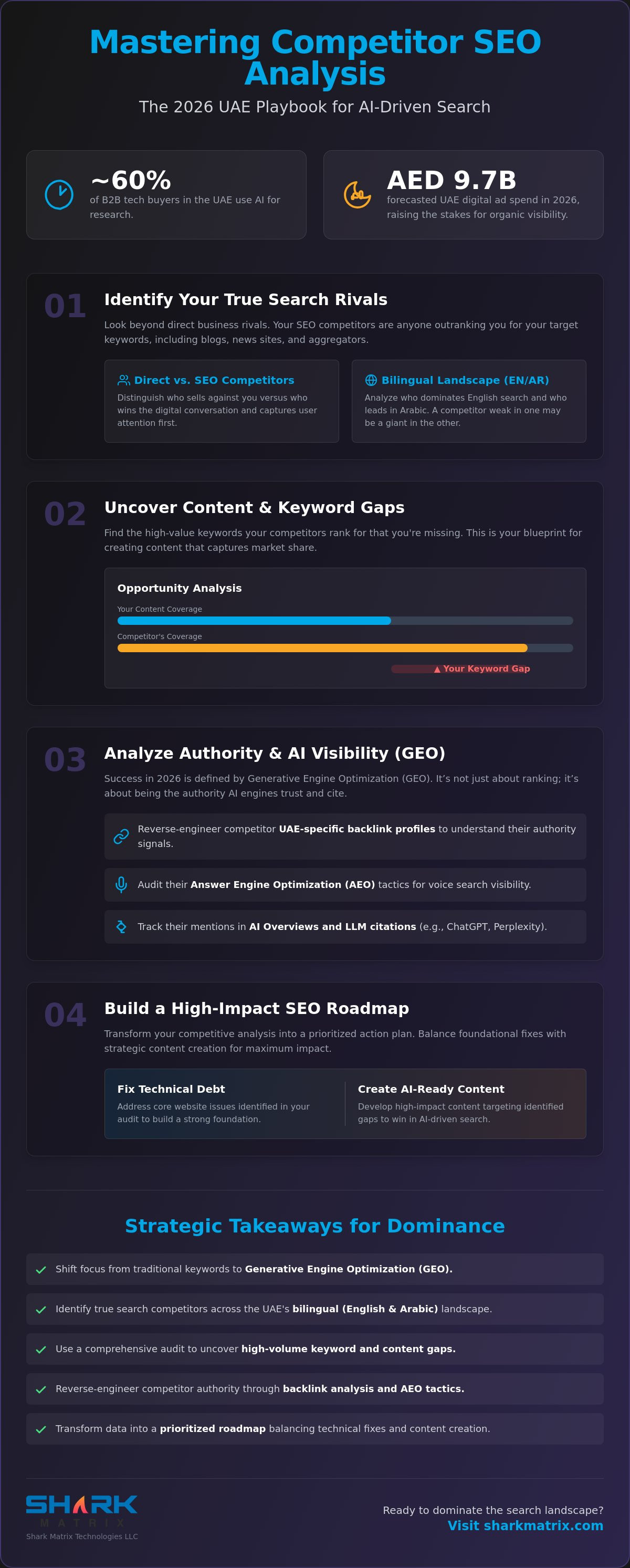
If nearly 60% of B2B technology buyers in the UAE are now using AI systems for their research, why are you still only tracking your rivals’ traditional keyword rankings? You’ve likely noticed aggressive competitors snatching up market share while you struggle to rank for high-value English and Arabic keywords. It’s a common pain point in the UAE’s hyper-competitive market, especially with the June 2026 spam update and new Advertiser Permit regulations shifting how everyone approaches digital visibility.

You’re about to master the art of reverse-engineering your rivals’ search success to build a dominant, AI-ready strategy. We’ll go far beyond a standard seo audit checklist for uae websites to ensure your brand is the one AI engines recommend first. This guide provides a clear roadmap for identifying keyword gaps, analyzing backlink strategies, and outperforming your competition in the age of Generative Engine Optimization (GEO).

Key Takeaways

  • Shift your focus from traditional keyword tracking to Generative Engine Optimization (GEO) to stay visible in AI-driven search results.
  • Identify your true search competitors across the UAE’s bilingual landscape, distinguishing between those dominating English versus Arabic search results.
  • Utilize a comprehensive seo audit checklist for uae websites to uncover high-volume keyword gaps where your rivals currently hold an advantage.
  • Reverse-engineer competitor authority by auditing their UAE-specific backlink profiles and Answer Engine Optimization (AEO) tactics for voice search.
  • Transform competitive data into a prioritized roadmap that balances fixing technical debt with the creation of high-impact, AI-ready content.

What is Competitor SEO Analysis and Why is it Essential in 2026?

Competitor SEO analysis is the process of dissecting the strategies of your search rivals to replicate and exceed their success. It’s essentially a blueprint for growth. By looking at what works for others in the UAE market, you can bypass the expensive trial-and-error phase that often drains marketing budgets. In 2026, this analysis is a core component of any Search Engine Optimization (SEO) strategy because it reveals exactly what search engines and AI models value in your specific niche.

The landscape has shifted dramatically. We’ve moved past simple keyword tracking. Today, search success is measured by Generative Engine Optimization (GEO). This means understanding how rivals secure mentions in AI-generated summaries. When you build an seo audit checklist for uae websites, you can’t just look at metadata; you have to look at how your competitors are positioning themselves as authoritative entities that AI wants to cite. With digital ad spend in the UAE forecasted to reach approximately AED 9.7 billion in 2026, the stakes for winning organic visibility have never been higher.

The Difference Between Business and SEO Competitors

Your biggest business rival in a Dubai office park might not be your biggest threat on Google. SEO competitors are any websites that outrank you for your target terms. This includes informational giants like news sites or global blogs that steal your audience’s attention before they’re even ready to buy. To stay ahead, you need to track Share of Voice (SoV) metrics. This tells you who truly owns the digital conversation in the UAE, regardless of their physical footprint. Identifying these informational rivals helps you capture users earlier in the sales funnel.

The Impact of AI on Competitive Intelligence

Traditional “blue links” are no longer the only game in town. In 2026, Google’s AI Overviews often push standard results down the page. If your competitors are appearing in these summaries while you aren’t, they’re winning the visibility war. You also need to monitor citations in platforms like ChatGPT and Perplexity. AI visibility is the new frontier of competitive search dominance, where being a trusted source for a large language model is as valuable as a top-three organic ranking. Understanding how rivals structure their data to be “AI-readable” is now a mandatory part of your seo audit checklist for uae websites.

Step 1: Identifying Your True Search Rivals in the UAE Market

Identifying your true search rivals requires looking beyond your physical neighbors in Business Bay or JLT. In the digital space, your competitors are anyone who occupies the real estate you want on the search results page. An in-depth competitor analysis reveals that your search rivals usually fall into two camps: direct business competitors and informational rivals. While a direct rival sells the same luxury watches or consulting services, an informational rival might be a local magazine or a global blog that captures your customer’s attention during the research phase.

When you’re building an seo audit checklist for uae websites, you have to account for the unique presence of aggregators. In the UAE, large directories and marketplace platforms often dominate high-volume terms. If you’re in real estate, your biggest search rival isn’t just another agency; it’s also major portals that push individual brand sites down the rankings. Segmenting these rivals by the marketing funnel allows you to see who owns the “Top of Funnel” (TOFU) educational content and who is winning the “Bottom of Funnel” (BOFU) transactional searches.

Mapping the Bilingual Search Landscape

The UAE is a bilingual market, yet many brands make the mistake of only tracking English-language rivals. This is a massive oversight. A competitor might have a weak English presence but dominate the Arabic search results for the exact same service. You need to identify who is winning in both languages to get a complete picture of the market. Arabic search behavior often involves different phrasing and intent, making it vital to analyze regional leaders who have mastered localized content. For a deeper dive into how these regional dynamics work, explore our Comprehensive Search Engine Optimization (SEO) Services: The 2026 Business Guide.

Tools for Competitor Discovery

You can’t rely on manual searches alone because your personal browsing history and location will bias the results. Professional tools like Ahrefs, Semrush, or SE Ranking are essential for domain-level comparisons. These platforms allow you to see which keywords your rivals rank for that you don’t. It’s also wise to use a VPN set to a UAE location. This ensures you’re seeing exactly what a user in Dubai or Abu Dhabi sees in 2026. Keep a close eye on emerging startups; the UAE’s rapid digital growth means new players can gain organic traction quickly by leveraging modern AI-first content strategies. If you’re struggling to map out this complex landscape, our team provides expert Search Engine Optimization (SEO) to help you reclaim your share of voice.
How to Conduct a Competitor SEO Analysis in 2026: A Step-by-Step Guide

Step 2: Conducting a Deep-Dive Content and Keyword Gap Analysis

Once you’ve identified your rivals, you need to understand exactly what they’re saying and what they’re missing. Learning how to perform an SEO competitor analysis effectively involves finding “low-hanging fruit.” These are keywords where a competitor ranks on page one, but their content is outdated, thin, or lacks local UAE context. If a rival is ranking for a high-value term with a generic 500-word blog post, you have a massive opportunity to take that spot by providing a more comprehensive, bilingual resource.

Your seo audit checklist for uae websites should include a Content Gap Matrix. This is a side-by-side comparison of your keyword rankings versus your top three competitors. It highlights the high-volume queries where you have zero visibility. You should also analyze the content format. Are your rivals winning with long-form guides, or are they using interactive tools like mortgage calculators or currency converters? In the UAE’s real estate and finance sectors, interactive tools often outperform static text because they provide immediate value to the user.

Uncovering High-Value Keyword Gaps

Focus on filtering for commercial intent. It’s better to rank for a term with 100 monthly searches that leads to a sale than 10,000 searches that only provide general info. Analyze the difficulty versus opportunity ratio. If a keyword is highly competitive but the top-ranking pages don’t answer the user’s intent properly, it’s a prime target. High-quality content requires a solid foundation, so ensure your technical setup is optimized by reviewing The 2026 Guide to Website Design and Development Services for UAE Enterprises.

Evaluating Content Quality and UI/UX

Search engines in 2026 prioritize E-E-A-T. Look at your rivals’ content and ask if it shows genuine experience. Does it cite local UAE regulations or mention specific neighborhoods in Dubai? Beyond the text, evaluate their site speed and mobile responsiveness. Since smartphones accounted for 78.67% of UAE e-commerce transactions in 2025, a competitor with a slow mobile experience is easy to beat. If their content is thin or generic, you can outperform them by adding depth, local statistics, and better visual elements. This level of detail is exactly what sets a dominant strategy apart from a standard seo audit checklist for uae websites.

Step 3: Analysing Authority and Generative Engine Visibility (GEO)

Authority in 2026 is no longer just a numbers game. It’s about being recognized as a trusted entity by both human users and AI models. When you update your seo audit checklist for uae websites, you must look at how your rivals are earning their reputation. A standard backlink audit is still vital, but you now have to layer on Answer Engine Optimisation (AEO) and Generative Engine Optimisation (GEO) analysis. This involves checking which competitors are being sourced in voice search results and AI-generated overviews. If an AI engine like Perplexity or Google’s AI Overviews cites a rival as the “best service in Dubai,” you need to understand the data points that led to that recommendation.

Off-site signals play a massive role here. In the UAE, where LinkedIn has 10 million users and TikTok reaches 12.5 million, mentions on these platforms contribute to your brand’s authority. Your rivals might be winning because they’re being discussed in local forums or cited in regional news outlets like Khaleej Times or Gulf News. Tracking these mentions allows you to see the full scope of their digital footprint beyond just their own website. It’s about understanding the “entity” your competitor has built and how they’ve connected it to other high-authority nodes in the UAE ecosystem.

Reverse-Engineering the Backlink Profile

Use a Link Intersect tool to find websites that link to multiple rivals but not to you. These are your highest-probability targets for outreach. In the UAE market, prioritize editorial links from local .ae domains or industry-specific publications over low-value global directories. A single mention from a UAE government entity or a major national bank carries more weight for regional SEO than dozens of generic international links. Protecting your digital reputation while building these links is essential; you can learn more about this in our guide on SEO for Brand Reputation Management Dubai: The 2026 National Brand Protection Guide.

Winning the AI Citation Game

AI engines use brand sentiment and factual accuracy to choose their primary sources. Analyse the responses from LLMs (Large Language Models) when you ask about your industry. Are competitors mentioned with a positive or neutral tone? To compete, you must structure your data using advanced Schema markup so AI engines can easily parse your facts, prices, and service areas. This is a critical addition to any modern seo audit checklist for uae websites. Becoming the trusted source for AI is the ultimate SEO goal because it puts your brand directly in front of the 40-60% of B2B buyers who now use AI for research. If you’re ready to dominate these new search frontiers, our team offers specialized generative engine optimization (geo) services to ensure your brand is the one AI recommends.

Step 4: Turning Analysis into a High-Impact SEO Roadmap

You’ve gathered the data; now you need a plan. Don’t try to fix everything at once. Start by tackling technical debt, like site speed or broken schema markup, because these foundations affect how AI engines crawl your site. Use your seo audit checklist for uae websites to separate “must-haves” from “nice-to-haves.” Set realistic KPIs by looking at your competitors’ Domain Authority and AI Citation Share. If the market leader has a high authority score, don’t expect to beat them in a month. Instead, aim for incremental growth that targets their weakest content first.

The Skyscraper Technique 2.0 is your secret weapon. In 2026, this means creating content that is 10x better than rivals and specifically optimized for AI citations. Following Google’s June 2026 spam update, your content must be fact-heavy and unambiguous to survive. It’s about clarity, entity-centric writing, and structured data. Set up automated alerts for competitor rank changes so you can react the moment a rival drops or a new startup gains traction in the UAE market.

Building the Content Calendar

Map your keyword gaps to a 6-month publishing schedule. You should balance evergreen content with trending regional topics, like Dubai’s latest economic initiatives or new TDRA regulations. This keeps your site relevant. Use AI automation to speed up your research and drafting. AI tools can analyze thousands of search results in seconds, helping you find the exact subheadings your competitors missed. This allows you to produce high-quality Arabic and English content at a pace that manual teams can’t match.

Leveraging Professional SEO Support

Managing a national-scale SEO strategy is a full-time job. While DIY analysis works for small niches, established brands need custom AI-driven strategies to stay ahead. Professional agencies provide the technical depth and AI expertise that basic tools lack. Shark Matrix Technologies LLC specializes in executing sophisticated strategies for the 2026 market, from Search Engine Optimization (SEO) to complex generative engine optimization (geo). We help you turn competitive insights into a dominant search presence that rivals can’t touch. Our team ensures your seo audit checklist for uae websites isn’t just a document, but a roadmap to market leadership.

Take Command of Your Digital Future in the UAE

The search landscape in 2026 moves faster than ever, driven by AI and a highly competitive bilingual market. You’ve learned how to identify your true search rivals, bridge content gaps, and optimize for generative engine visibility across the Emirates. Implementing a robust seo audit checklist for uae websites is your first step toward building a strategy that doesn’t just keep pace but sets the standard for your industry. It’s about being the brand that AI engines trust and users find first when they search in both English and Arabic.

Success requires more than just tracking rankings; it demands a deep understanding of how AI engines recommend brands to local users. Shark Matrix Technologies LLC specializes in integrating cultural context with cutting-edge technology, leading the way in AI-driven Generative Engine Optimisation (GEO). We understand the nuances of regional search intent that global tools often miss, ensuring your brand remains resilient against aggressive rivals and shifting algorithms.

Ready to outperform your competition? Get a Professional SEO Audit and Competitor Analysis from Shark Matrix Technologies LLC today. You have the tools and the roadmap. Now it’s time to build your dominant search presence and claim your rightful market share in the UAE.

Frequently Asked Questions

How often should I conduct a competitor SEO analysis?

You should conduct a deep-dive analysis at least once every quarter to stay ahead of market shifts. In fast-moving UAE sectors like finance or real estate, monthly check-ins are better. Frequent monitoring helps you spot when rivals pivot their strategy or start targeting new Arabic keywords. It also ensures your seo audit checklist for uae websites remains updated with the latest AI search trends.

What are the best free tools for SEO competitor research in 2026?

While premium tools offer the most data, you can start with Google’s own search results and AI Overviews to see who dominates the “Answer Engine” space. Tools like the free version of Ahrefs Webmaster Tools or Ubersuggest provide basic domain insights. You can also use the UAE Media Council’s transparency records to identify active advertisers in your space. These free resources help you map out the competitive landscape without immediate investment.

Can I see which keywords my competitors are bidding on in PPC?

You can certainly track rival PPC keywords using specialized tools like SpyFu or Semrush. These platforms reveal the specific terms your competitors pay for and the estimated monthly spend they allocate. Analyzing their ad copy provides insights into their unique selling points and conversion tactics. This data is invaluable for identifying high-intent keywords that you might want to target organically to save on advertising costs.

How do I know if a competitor is using AI to write their content?

Identifying AI-generated content often comes down to looking for a sudden surge in publishing volume or highly repetitive sentence structures. While many businesses now use generative AI, the key is checking if the content lacks specific local details, such as mentions of Dubai neighborhoods or UAE-specific regulations. In 2026, search engines prioritize helpfulness over the method of creation, so focus on whether their content actually solves user problems.

Is it possible to track competitor rankings in different languages like Arabic?

Tracking rankings in both English and Arabic is essential and entirely possible with professional SEO platforms. You can set up localized tracking for specific cities like Abu Dhabi or Dubai to see how rivals perform across different languages. Since search behavior varies significantly between English and Arabic users, monitoring both ensures you don’t miss out on a massive segment of the local market.

What is the most important metric to track in a competitor analysis?

Share of Voice (SoV) is the most critical metric because it measures your overall market presence compared to rivals. In 2026, you should also track your AI Citation Share, which shows how often AI engines recommend your brand over others. These metrics provide a more accurate picture of your brand’s authority than simple individual keyword rankings. They reflect your true dominance in the UAE’s digital ecosystem.

How do I outrank a competitor with a much higher Domain Authority?

You can outrank high-authority sites by focusing on “niche down” strategies and superior user intent alignment. Target long-tail keywords that the giants overlook and provide much deeper, more practical information. For instance, a specialized local site like budgetgamer.ae can dominate high-performance gaming niches in the UAE by offering expert-level product detail that generic marketplaces miss. Ensuring your site has better mobile performance and follows a strict seo audit checklist for uae websites gives you a technical edge. Hyper-local relevance and actual expertise often beat raw domain power in modern search.

What happens if my competitors start copying my SEO strategy?

If competitors copy your strategy, it’s a sign that your approach is working. The best defense is to keep innovating by building a stronger brand identity and deeper community engagement. Focus on earning high-authority editorial backlinks from UAE-based publications that rivals can’t easily replicate. By the time they’ve copied your last move, you should already be implementing your next AI-driven optimization strategy.

Categories
SEO

Choosing a Financial Services SEO Agency in 2026: The Strategic Growth Guide

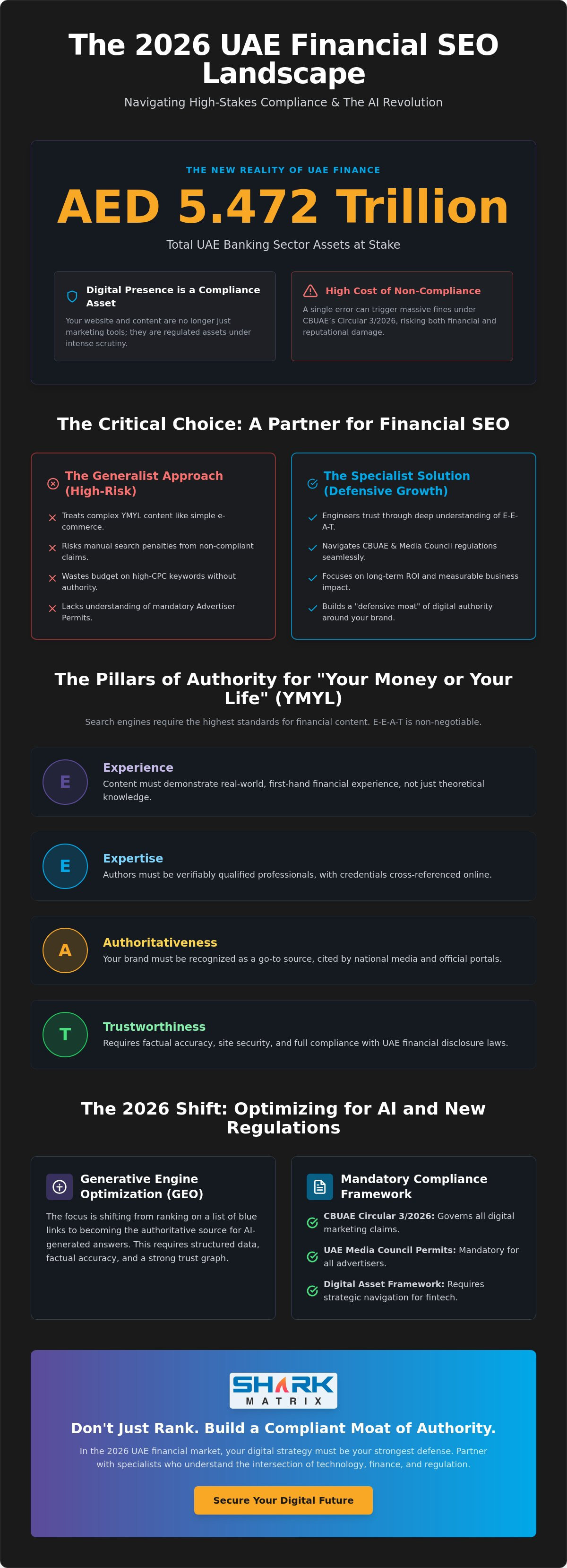
With over AED 5.472 trillion in banking sector assets currently moving through the UAE, your digital presence isn’t just a marketing channel; it is a high-stakes compliance asset. Many firms still believe that ranking on page one is the ultimate goal. However, in 2026, a single non-compliant social post or AI-generated article can trigger massive fines under the CBUAE’s Circular 3/2026. Mastering SEO for financial services now requires more than just backlinking. It demands a specialized agency that understands the June 29 compliance deadline and the mandatory Advertiser Permits required by the UAE Media Council.

You’ve likely felt the pressure of rising competition for high-value keywords while worrying if your content meets the strict YMYL standards required by modern search engines. We understand the frustration of trying to measure long-term ROI when search algorithms change every week. This guide will show you how to identify a partner that doesn’t just “do SEO” but builds a defensive moat of authority around your brand while mastering 2026’s AI search trends. We’ll explore the shift toward Generative Engine Optimization (GEO), how to navigate the new Digital Asset Framework, and the technical requirements for dominating high-intent financial queries across the Emirates.

Key Takeaways

  • Understand why specialized agencies are now essential to navigate the UAE Media Council’s mandatory Advertiser Permits and CBUAE marketing regulations.
  • Learn how to apply the EEAT framework to ensure your financial content meets the high-trust standards required for YMYL search rankings.
  • Discover the shift from traditional search methods to Generative Engine Optimization (GEO) to maintain visibility in AI-driven search results.
  • Gain a strategic framework for evaluating a partner’s ability to deliver specialized seo for financial services dubai through custom AI automation.
  • Identify how integrating high-impact content marketing with technical web development creates a long-term competitive advantage in the UAE market.

Why Financial Services Require a Specialised SEO Agency in 2026

In 2026, Search engine optimization (SEO) for banks and fintech firms isn’t just a marketing tactic. It’s a high-stakes sub-discipline where every word on a page can lead to exponential growth or a legal nightmare. Unlike retail or travel, financial services operate under the strict scrutiny of the Central Bank of the UAE (CBUAE) and the UAE Media Council. A mistake isn’t just a lost sale; it’s a potential violation of Circular 3/2026. This is why seo for financial services dubai requires a partner who understands that Trust Engineering is the primary driver of organic visibility. You aren’t just selling a product; you’re asking users to trust you with their life savings in a market where total banking assets exceed AED 5.472 trillion.

The High Cost of Generalist Mistakes

Generalist agencies often treat financial content like consumer lifestyle goods. They don’t realize that search engines categorize finance as Your Money or Your Life (YMYL). This means the bar for accuracy and authoritativeness is set much higher than for a standard e-commerce site. If an agency publishes non-compliant claims or fails to secure the mandatory Advertiser Permit required since February 2026, your brand faces manual search penalties that can wipe out years of progress. High-CPC keywords in this sector often cost hundreds of dirhams per click. Wasting organic efforts on low-authority content isn’t just poor strategy; it’s a massive financial drain. Investing in seo for financial services dubai means hiring experts who know that technical authority goes deeper than just page speed; it requires verified expertise and regulatory alignment, ensuring that licensed entities like Maestro Financing Broker maintain their standing in a high-scrutiny environment.

Navigating the 2026 Competitive Landscape

The UAE market is saturated. With real GDP projected to grow by up to 5.3% in 2026, every institution is fighting for the same high-intent searchers. This competitive surge is partly driven by the efficiency of business setup consultancies like Set Hub, which streamline the entry of new fintech and financial entities into the market. A specialized agency finds blue ocean opportunities by looking beyond obvious, high-competition keywords. They focus on complex search behaviors and use custom software integration to track the long-term ROI of organic search. In 2026, you can’t rely on simple spreadsheets. You need real-time data to see how organic traffic converts into actual account openings or loan applications. Specialized agencies integrate with your technical stack to ensure every dirham spent on content marketing contributes to a measurable increase in your primary capital ratio and brand equity.

The Core Pillars of Financial SEO: EEAT and YMYL Compliance

Search engines don’t treat a blog post about home loans the same way they treat a review of a coffee shop. Because financial advice directly impacts a person’s future security, it falls under the “Your Money Your Life” (YMYL) category. For anyone managing seo for financial services dubai, this means meeting the highest possible standards of EEAT. This framework stands for Experience, Expertise, Authoritativeness, and Trustworthiness. In 2026, search algorithms use advanced natural language processing to verify if your authors are actually qualified. They look for credentials, professional histories, and cross-references across the web. While global standards often mirror federal advertising regulations seen in other major markets, the UAE’s specific requirements for financial disclosures are even more localized. You need a Trust Graph that proves to AI engines your brand is a safe, verified source of information.

Trust Engineering: Beyond Backlinks

Trust Engineering is the strategic alignment of brand mentions and factual accuracy. It goes beyond simply acquiring links from high-authority sites. For a bank or fintech firm in Dubai, this involves securing mentions in national media and official government portals. These citations act as trust signals that validate your authority. If your brand is mentioned alongside the CBUAE or in major UAE financial reports, your SEO performance improves significantly. Utilizing seo for brand reputation management dubai helps ensure that every digital touchpoint reinforces this authority rather than diluting it through inconsistent messaging.

Content Compliance for Regulated Markets

Ranking high won’t matter if your content is flagged for non-compliance. In 2026, your editorial workflow must include mandatory sign-offs from legal teams. This ensures every piece of content marketing adheres to the latest transparency standards for financial product disclosures. Legacy content is a major risk factor here. Outdated interest rates or old regulatory advice can lead to manual penalties. You should implement a rolling audit schedule to update old articles, ensuring they reflect current UAE market conditions. For example, ensuring your content reflects the 3.65% CBUAE base rate is a basic requirement for factual accuracy. If you’re unsure if your current content meets these rigorous standards, consider a technical SEO audit to identify potential compliance gaps before they affect your visibility.

Choosing a Financial Services SEO Agency in 2026: The Strategic Growth Guide

The 2026 Shift: Optimising for AI Engines (GEO and AEO)

Traditional search is evolving into something far more interactive. By 2026, Generative Engine Optimisation (GEO) has become the primary focus for any firm investing in seo for financial services dubai. It’s no longer enough to rank in a list of blue links. You need to be the source that AI models like ChatGPT and Google Gemini cite when a user asks for financial guidance. This shift requires a move toward Answer Engine Optimisation (AEO), which prioritizes providing direct, factual answers to capture the growing number of zero-click searches. Structured data, specifically Schema.org for financial products, is the bridge that allows these AI engines to interpret your rates and terms without error. In this new landscape, being mentioned in the high-authority datasets that train these models is far more valuable than a standard backlink. Your brand must appear in the context of trusted financial discussions to be recognized as a national authority by the algorithms.

Winning the AI Answer Box

Conversational queries in 2026 are nuanced. They focus on intent and context rather than just a string of keywords. Conversational queries prioritize the user’s intent and specific life context, whereas traditional keyword searches rely on rigid, isolated phrases. If a user asks how the 3.65% CBUAE base rate affects their specific mortgage in Dubai, the AI engine looks for a source that explains the relationship clearly and accurately. Success in this area relies on search engine optimization seo services that prioritize semantic richness and bilingual content. Since Dubai is a multilingual hub, your content must be optimized for both English and Arabic AI training sets to capture the full breadth of the market. You need content that answers the “why” and “how” of financial planning to secure a spot in the AI answer box.

Data Aggregation and AI Visibility

LLMs need clean, accessible data to provide accurate real-time financial information. If your site’s technical SEO prevents AI crawlers from accessing your latest mortgage tables or savings rates, you’ll simply be ignored by the next generation of search. Monitoring your Share of Model is now more critical than traditional Share of Voice. This metric tracks how often your brand is the primary recommendation in generative responses compared to your competitors in the UAE market. You should also consider how your data appears in open finance frameworks, which are becoming central to the UAE’s digital finance revolution. Ensuring your data is “AI-ready” through proper tagging and rapid server response times is the only way to maintain visibility as search becomes increasingly automated. If the AI can’t parse your data in milliseconds, it will move on to a competitor who has prioritized technical accessibility.

Evaluating Your Financial Marketing Partner: A Strategic Framework

Choosing an agency in the UAE financial sector requires a higher level of scrutiny than a standard marketing hire. You need to verify their grasp of the UAE Media Council’s Advertiser Permit requirements and the Central Bank’s latest telemarketing rules. A partner who ignores these isn’t just ineffective; they’re a liability. Ask for their specific process for data-led SEO and how they use AI to scale content without sacrificing factual accuracy. In 2026, the best seo for financial services dubai is built on a foundation of technical excellence and a deep understanding of local compliance frameworks.

Reporting must move beyond simple traffic graphs. In the world of seo for financial services dubai, a million visits from low-intent users won’t balance the books. You need to see lead quality and conversion data that maps back to your bottom line. Look for agencies that provide transparency in how they handle your proprietary information, especially when integrating with your internal CRM systems. If they can’t explain their data security protocols, they aren’t ready to handle a financial brand’s reputation.

Technical and Security Vetting

Data security is non-negotiable for banks and fintech firms. If an agency doesn’t have a clear protocol for handling customer data or proprietary market insights, walk away. This technical competence often stems from a broader expertise in website design and development services. A team that understands the underlying architecture of your site can better protect it from vulnerabilities while optimizing for speed. A partner offering mobile app development services understands the full user journey. They ensure SEO efforts align with the app-centric behavior of UAE consumers, providing a seamless experience from search to conversion.

Case Studies and Real-World ROI

Don’t be fooled by short-term spikes in traffic. 2026 algorithms are smart enough to spot artificial growth or “black hat” tactics that won’t last. Real results in financial SEO take time and consistent effort. Verify their case studies by asking for specific examples of how they navigated a regulatory hurdle or recovered a site from a YMYL penalty. You want a partner who values long-term brand authority over quick, unsustainable wins. Look for a track record of driving high-quality leads that actually convert into active accounts or loan applications.

Ready to see a strategy that prioritizes both security and growth? Consult with Shark Matrix to audit your current visibility and build a compliant growth roadmap.

Shark Matrix: Driving National Growth Through Data-Led Financial SEO

Shark Matrix Technologies LLC doesn’t just offer standard marketing. We provide an end-to-end digital strategy designed for the scale of national financial organizations. By combining custom software engineering with high-impact organic search strategies, we ensure your institution isn’t just visible but authoritative. We’ve built our reputation on mastering seo for financial services dubai by aligning with the complex technical requirements of modern search engines. Our methodology ensures your growth is both sustainable and compliant with the latest UAE Media Council standards. We understand that in a high-stakes economy, the margin for error is zero.

Our approach bridges the gap between raw technical excellence and long-term brand authority. We don’t just optimize for keywords; we optimize for the future of search. This means deploying specialized GEO and AEO capabilities that ensure your brand remains the primary answer in generative search results. Whether you’re a traditional bank or a fast-growing fintech startup, we provide the technical infrastructure needed to dominate high-intent search queries. We focus on building a defensive moat of trust around your brand that algorithms and consumers recognize as the gold standard in the UAE market.

Integrated Solutions for National Brands

Managing a national brand requires more than manual content updates. Shark Matrix Technologies LLC combines specialized SEO with advanced AI automation to streamline your content production while maintaining strict editorial control. We integrate generative AI development services to help you manage large-scale content libraries that stay accurate and compliant. This automation handles data-heavy updates, such as interest rate changes, while our specialists focus on high-level strategy. Our lead generation strategies are built with a deep respect for financial privacy and security. We ensure every digital touchpoint adheres to national data protection standards. Your proprietary information is treated with the highest level of confidentiality, backed by our robust security protocols.

Start Your Financial SEO Transformation

Every partnership begins with a comprehensive Shark Matrix Technologies LLC SEO audit. This isn’t a generic report. It’s a strategic roadmap for 2026 that identifies technical gaps, compliance risks, and blue ocean keyword opportunities. Our roadmap focuses on the technical nuances of Answer Engine Optimization. We examine how your data is structured so that LLMs can pull your latest rates directly into conversational answers. Leading financial firms choose us because we prioritize national brand growth and reputation protection over short-term vanity metrics. We understand that in the UAE’s competitive financial sector, your digital presence is your most valuable asset. Our team works as an extension of yours to ensure your institution dominates seo for financial services dubai and builds lasting trust with consumers.

Scale your financial brand with Shark Matrix Technologies LLC today and secure your position in the 2026 search landscape.

Future-Proof Your Financial Visibility

Success in the 2026 financial market requires a sophisticated shift from manual keyword tracking to strategic AI visibility. As we’ve explored, your institution’s authority now depends on how effectively you’ve built a Trust Graph that both generative engines and local consumers can verify. Navigating the complexities of seo for financial services dubai is no longer just about traffic; it’s about securing a compliant, authoritative digital presence that survives every algorithmic shift and regulatory update.

Shark Matrix Technologies LLC has been at the forefront of this digital evolution since 2010. With over 15 years of digital expertise, we specialize in the GEO and AEO strategies that define modern search. Our end-to-end integration of AI automation and custom development ensures your brand stays ahead of the competition while maintaining total regulatory alignment. You don’t have to face these technical shifts alone. Partner with a leading financial services SEO agency like Shark Matrix Technologies LLC to secure your growth in the Emirates. Let’s transform your search visibility into a lasting competitive advantage.

Frequently Asked Questions

What is the difference between general SEO and specialised financial services SEO?

Specialised seo for financial services dubai differs from general SEO by its focus on “Your Money Your Life” (YMYL) standards. While general SEO might focus on traffic volume, financial SEO prioritizes accuracy and regulatory alignment. It requires a deep understanding of how search engines verify author credentials and fact-check financial claims to protect users from misinformation.

How does a financial services SEO agency handle national regulatory compliance?

A specialized agency handles compliance by establishing editorial workflows that include legal reviews for all organic content. They stay updated on the latest UAE Media Council mandates, such as the requirement for Advertiser Permits. This ensures every piece of content marketing adheres to the Central Bank of the UAE’s marketing regulations, protecting your firm from heavy fines.

What is GEO and why does it matter for financial brands in 2026?

GEO, or Generative Engine Optimization, is the process of making your content visible to AI-driven search tools like ChatGPT and Google Gemini. It matters for financial brands because users increasingly ask conversational questions about mortgages or investments. If your data isn’t structured for these models, you risk being excluded from the primary answer boxes that drive 2026 search behavior.

How long does it take to see measurable results from a financial SEO campaign?

Measurable results in this sector typically take six to twelve months to materialize. Building the necessary authority and trust signals for high-value financial keywords is a gradual process. While technical fixes might provide quick wins, long-term organic growth requires a consistent commitment to high-quality, compliant content production and authority building.

Can an SEO agency help with my financial brand’s online reputation management?

Yes, reputation management is a core component of a modern seo for financial services dubai strategy. Agencies work to ensure that authoritative, positive mentions from national media dominate the first page of search results. This process involves managing your brand’s digital footprint to push down irrelevant content while highlighting your official credentials and expert leadership.

Why is EEAT more important for financial services than other industries?

EEAT (Experience, Expertise, Authoritativeness, and Trustworthiness) is critical because financial advice carries high risks for the consumer. Search engines apply much stricter quality filters to financial websites than they do to lifestyle or retail blogs. Without proven expertise and verified author profiles, your content won’t rank for competitive queries regardless of how many backlinks you have.

How much should a national financial firm budget for SEO services in 2026?

Budgeting for SEO depends on your institution’s specific growth targets and the competitive landscape of your niche. National firms should view SEO as a long-term capital investment rather than a monthly marketing expense. Instead of looking for a fixed price, focus on the cost-per-lead and the total value of organic traffic compared to expensive paid search campaigns.

What technical SEO factors are specific to large-scale financial institutions?

Large-scale institutions must prioritize advanced Schema.org markups for complex products like insurance and loans. Technical SEO also involves ensuring that AI crawlers can access real-time data tables without compromising site security. Managing large site architectures and ensuring bilingual accessibility across English and Arabic are also essential technical requirements for firms operating in the UAE.

Categories
SEO

SEO for Tourism Companies in Dubai: The 2026 National Growth Strategy

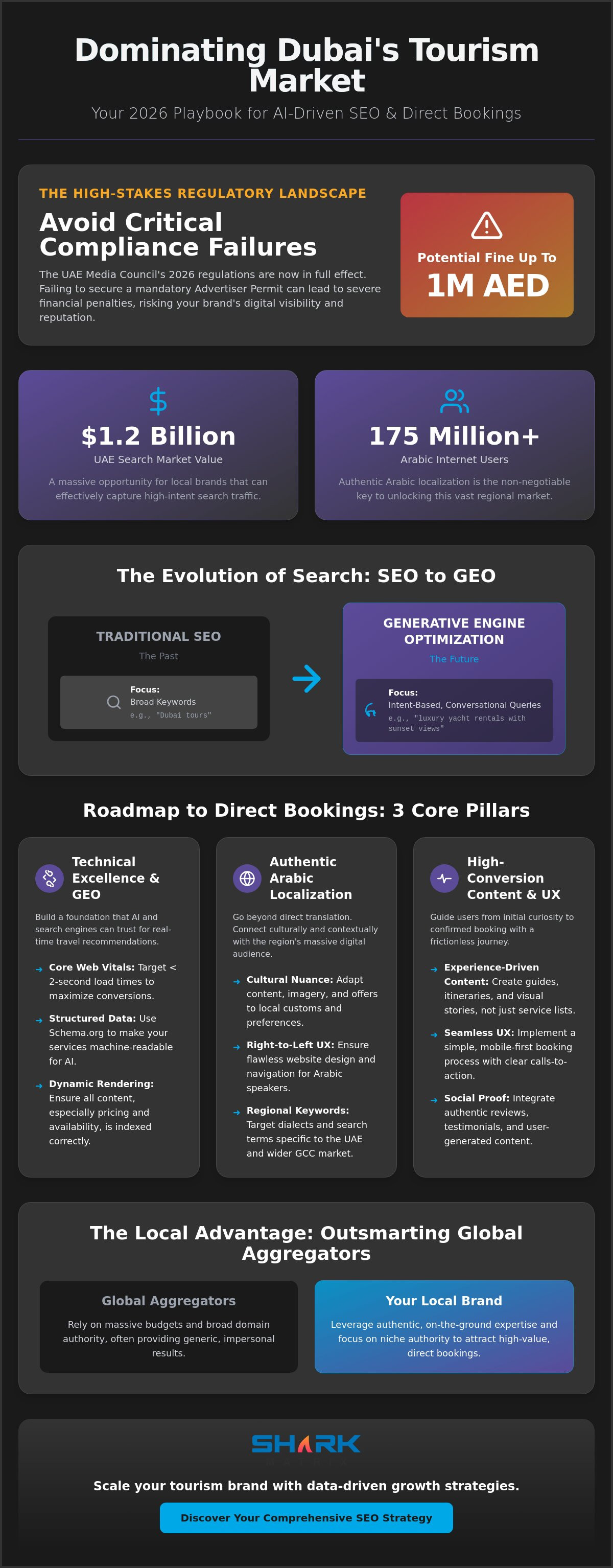
Did you know that failing to secure a mandatory Advertiser Permit could cost your Dubai tourism business up to 1 million AED in fines? With the UAE Media Council’s 2026 regulations now in full effect, the stakes for digital visibility have never been higher. You’ve likely felt the immense pressure of competing against massive global aggregators that dominate high-intent search results. It’s frustrating to watch potential guests bypass your site for third-party platforms when your local expertise offers far more value. Mastering seo for tourism companies in dubai is no longer just about keywords; it’s about managing a complex regulatory and technological environment to protect your brand.

This article will help you dominate the UAE market by implementing the latest AI-driven strategies and the 2026 National Growth Strategy to drive consistent direct bookings. We’ll examine how to leverage the growth of the 175 million Arabic internet users, optimize for generative engine results, and ensure your mobile conversion rates finally match your ambition. You’ll gain a clear roadmap to build authority and outpace the competition in the $1.2 billion UAE search market.

Key Takeaways

  • Discover how the shift from traditional search to multi-channel discovery requires a new approach to targeting high-intent keywords in the UAE tourism sector.
  • Learn to optimize your digital presence for AI-powered travel recommendations through Generative Engine Optimization (GEO) and technical site speed improvements.
  • Understand why authentic Arabic localization is the non-negotiable key to mastering seo for tourism companies in dubai and capturing the regional market.
  • Identify the specific experience-driven content strategies and UX design elements that transform organic traffic into confirmed direct bookings.
  • Explore how integrating AI automation and data-driven growth strategies can streamline your lead generation and scale your brand authority across the Emirates.

The Competitive Landscape of SEO for Tourism Companies in Dubai

The digital arena for travel in the UAE has transformed into a multi-layered ecosystem. Traditional search engines are no longer the sole gatekeepers of discovery. Today’s travelers often begin their journey on visual discovery platforms or through conversational AI before ever typing a query into a search bar. For businesses, this means seo for tourism companies in dubai must evolve beyond simple keyword targeting. You’re no longer just competing with the tour operator down the street; you’re competing with global platforms and sophisticated algorithms that prioritize instant, relevant answers.

Success in this environment requires a deep understanding of the 2026 traveler. These users are mobile-first and heavily reliant on AI assistants to filter through the noise. They don’t just want a list of options; they want a curated experience that matches their specific lifestyle. Generic strategies often fail here because they don’t account for the unique cultural and economic nuances of Dubai’s tourism economy. To stand out, your brand must demonstrate authority across multiple touchpoints while maintaining a technical edge that caters to modern search behaviors.

The Shift to Intent-Based Search

Why National Brands Need a Specialized Approach

Global travel aggregators have massive budgets and high domain authority, making it difficult for local firms to rank for broad terms. However, local brands have an advantage: authentic, on-the-ground expertise. By focusing on niche authority and localized search signals, you can bypass the aggregator wall. It’s about highlighting what makes your service unique rather than trying to outspend the giants. For those looking to build a solid foundation, reviewing a comprehensive SEO services guide can provide the necessary context for scaling a national tourism brand. Specialized SEO ensures your unique value proposition doesn’t get lost in a sea of generic listings.

Technical Excellence and Generative Engine Optimization (GEO)

The technical foundation of your digital presence determines whether search engines, and now AI models, can actually process your offerings. While traditional ranking factors still matter, 2026 has introduced Generative Engine Optimization (GEO) as a critical pillar for success. For seo for tourism companies in dubai, this means your site must act as a structured data source that AI travel assistants can rely on for real-time recommendations. Without a clean, machine-readable architecture, your brand remains invisible to the very tools travelers use to plan their itineraries.

Core Web Vitals remain the heartbeat of user experience. Speed isn’t just a ranking signal; it’s a direct conversion factor. Travelers planning trips often switch between multiple tabs and apps. If your itinerary page takes more than two seconds to load, you’ve likely lost that booking to a faster competitor. Implementing advanced caching and image optimization is essential for national scalability, ensuring your site performs flawlessly regardless of the user’s location or device.

Structured data via Schema.org is your secret weapon in 2026. By explicitly tagging your tour itineraries, pricing, and availability, you provide search engines with a clear map of your services. This increases the likelihood of appearing in rich snippets and AI-generated travel plans. Consider these essential technical elements:

  • Schema Markup: Use specific tags for events, local businesses, and product offers to highlight live pricing.
  • Dynamic Rendering: Ensure that heavy JavaScript elements in your booking engine don’t block search bots from indexing your content.
  • Internal Linking: Build a logical hierarchy that guides both bots and users from high-level destination pages to specific booking forms.

Winning the AI Search Result

AI travel assistants don’t browse websites like humans; they extract entities and facts. To win these results, your content must be fact-dense. Use clear, declarative sentences that state exactly what your tour includes. Instead of saying “We offer great desert safaris,” use “Our 6-hour Dubai desert safari includes dune bashing, camel riding, and a traditional BBQ dinner.” This precision allows LLMs to categorize your service accurately. If you want to stay ahead, exploring specialized generative engine optimization services can ensure your brand is the first choice for AI-driven queries.

Mobile-First Technical SEO

Most travelers in Dubai are searching on the go, often on mobile networks that may vary in speed. Your site must be optimized for these high-latency environments. This is where the synergy between website design and development services and SEO becomes apparent. A robust technical audit should focus on streamlining complex booking engine integrations. If your checkout process is clunky on a smartphone, your organic traffic won’t translate into revenue. Prioritize lightweight code and responsive layouts to maintain a competitive edge.

SEO for Tourism Companies in Dubai: The 2026 National Growth Strategy

The Power of Arabic Digital Marketing in the National Tourism Sector

Many digital agencies overlook a critical segment of the market. With over 175 million Arabic internet users globally, focusing solely on English content leaves a massive revenue gap. For seo for tourism companies in dubai, localizing your presence isn’t just about translating text. It’s about capturing the cultural nuances of the Middle Eastern traveler. High-value visitors from the GCC often search in their native language, expecting a seamless experience that respects their linguistic preferences. If your site doesn’t speak their language, you’re essentially invisible to some of the most affluent travelers in the region.

Translating intent is far more valuable than translating words. A direct translation of an English keyword often misses the mark because search habits vary across cultures. For instance, while an English speaker might look for “adventure tours,” an Arabic speaker might use terms that emphasize family-friendly luxury or specific cultural heritage sites. This is why a comprehensive approach to seo for tourism companies in dubai must prioritize Arabic content that resonates with regional search patterns. Understanding these subtle shifts in intent allows you to build stronger brand authority. You aren’t just a service provider; you’re a local expert who understands the traveler’s specific needs and values.

Arabic Keyword Research Strategies

Identifying high-volume regional terms requires more than just a software tool. Most English-centric platforms miss the specific phrasing used by travelers in Saudi Arabia or Kuwait. You have to balance Modern Standard Arabic for broad reach with regional dialects to build a personal connection. This strategy ensures you’re visible for the specific experience-based queries that drive high-intent traffic. It’s about being where the conversation is already happening in the local tongue, capturing interest that competitors simply ignore.

Localization and Brand Authority

Localized content does more than just help you rank; it builds deep trust. When a traveler sees testimonials and social proof in their own language, their confidence in your brand increases significantly. This approach should be a core part of your brand reputation management strategy. By addressing potential concerns and highlighting regional successes in Arabic, you create a protective layer for your brand. It’s a proactive way to ensure your reputation remains spotless across all linguistic segments of the UAE market.

Strategy for High-Conversion Tourism Content and UX

The synergy between UI/UX design and organic rankings is undeniable. Search engines analyze behavioral signals like dwell time and click-through rates. A cluttered interface or a confusing navigation menu signals to Google that your site isn’t providing value. By streamlining the user journey, you improve both your SEO and your bottom line. Visual storytelling, particularly through high-quality video, is a powerful tool to keep users engaged. It allows them to visualize the experience before they arrive, which helps keep them on your page longer and improves your authority in the eyes of search algorithms.

The 5-Step Content Conversion Framework

To turn readers into customers, follow a structured approach that prioritizes the user’s needs. First, identify the traveler’s primary pain point, such as “is this desert safari suitable for young children?” Second, provide a detailed, authoritative solution in the form of a guide. Third, integrate social proof and real-time availability directly within the text to build trust. Fourth, ensure your Call-to-Action (CTA) is optimized for mobile users who want to book instantly. Finally, align your content calendar with peak travel seasons to capture demand when it’s highest. If your current site isn’t turning visitors into guests, our content marketing services can help you build a strategy that converts.

Visual SEO for Travel Brands

In the tourism sector, an image is often the deciding factor for a booking. Optimizing high-quality imagery for Google Image search by using descriptive alt text and specific Dubai landmark names can drive significant traffic. Implementing video Schema is also vital; it ensures your promotional clips appear in video carousels, giving you more real estate on the search results page. However, you must balance these high-resolution visuals with technical performance. Visual load speeds are a major factor in user retention. If your beautiful video gallery takes too long to load, your potential customer will find another provider with a faster site.

Scaling Your Tourism Brand with Shark Matrix Technologies LLC

Implementing a high-level strategy requires more than just a list of keywords. It demands a technical infrastructure that supports rapid growth and the ability to adapt to changing search algorithms. Shark Matrix Technologies LLC provides a data-driven framework specifically designed for the UAE’s competitive search landscape. Our team doesn’t just focus on visibility; we focus on the entire conversion funnel. By integrating ai automation services and industry specific ai solutions, we help tourism firms streamline their lead generation and respond to potential guests in real-time. This approach ensures your business remains agile as traveler behaviors evolve.

Our methodology for seo for tourism companies in dubai centers on measurable outcomes. High rankings are a means to an end, but the real goal is increasing direct bookings through your website. Shark Matrix Technologies LLC provides custom reporting that tracks these conversions across every touchpoint, from the initial AI discovery to the final payment. This transparency ensures you always know the exact ROI of your marketing spend. You won’t have to guess which strategies are working; the data will show you exactly where your growth is coming from.

Choosing a full-service partner means your technical development and marketing efforts work in perfect harmony. When your generative engine optimization (geo) strategy is backed by a robust web architecture, the results are amplified. We bridge the gap between complex backend systems and high-impact content marketing. This synergy is what allows national brands to scale effectively without losing the personal touch that travelers value.

Why Shark Matrix Technologies LLC for Tourism SEO?

Our expertise spans both technical development and high-impact marketing. We maintain a dedicated focus on the UAE national market, understanding the specific regulatory requirements like the 2026 Advertiser Permit. Our proven track record in driving measurable ROI for travel firms comes from our deep understanding of regional dynamics. We don’t offer cookie-cutter solutions; we build custom strategies that highlight your brand’s unique value proposition in a crowded marketplace.

Ready to Dominate the National Market?

The first step toward market leadership is a comprehensive SEO audit. This identifies the technical gaps and content opportunities that your competitors are likely missing. A strategic SEO partnership is a long-term investment in your brand’s digital real estate. By securing top rankings and building authority now, you protect your business against future market shifts. Contact our experts at Shark Matrix Technologies LLC today for a tailored tourism growth roadmap and start your journey toward consistent, direct bookings.

Leading the Next Era of UAE Tourism Growth

The shift toward AI-powered travel discovery and localized Arabic content is no longer a luxury. It’s a fundamental requirement for survival. By integrating technical excellence with experience-driven content, your brand can bypass the dominance of global aggregators. Implementing a robust strategy for seo for tourism companies in dubai ensures you capture high-intent travelers at the exact moment they’re ready to book. Success in this landscape requires a blend of cultural nuance and technical precision that resonates with the modern traveler.

Since 2010, we’ve helped firms navigate the unique complexities of the UAE market. Our team combines end-to-end digital marketing with deep software engineering expertise to deliver results that matter. We specialize in Arabic digital marketing and AI automation to give your business a decisive edge. Partner with Shark Matrix Technologies LLC for Expert Tourism SEO Services and start building your custom growth roadmap today. The future of Dubai’s tourism is digital, and your brand deserves to be at the forefront of that journey.

Frequently Asked Questions

How long does it take to see results from SEO for a tourism company?

Most tourism businesses begin seeing measurable organic growth within four to nine months of starting a dedicated campaign. While technical fixes can provide quick wins in site speed and indexability, building authority for competitive keywords takes time. Consistency is key because search engines need to verify your brand’s reliability before moving you past established global aggregators.

What is the difference between SEO and PPC for the travel industry?

PPC offers immediate visibility through paid ads, which is perfect for seasonal promotions or last-minute bookings. SEO builds a sustainable foundation that lowers your long-term cost per acquisition. In the travel industry, a balanced approach often works best, using PPC for instant results while seo for tourism companies in dubai secures your brand’s future organic dominance.

Do I really need Arabic SEO if my website is already in English?

English content only reaches a portion of your potential audience in the UAE and wider Middle East. Arabic SEO allows you to tap into a market of over 175 million users who prefer searching in their native language. It builds trust with local and GCC travelers who are often looking for specific cultural experiences that English-only sites might fail to convey accurately.

How does AI search change the way tourists find my business?

AI search, or Generative Engine Optimization (GEO), changes discovery by providing direct, conversational answers instead of a list of blue links. Tourists now use AI assistants to plan entire itineraries in seconds. If your data isn’t structured for these engines to extract, your tours won’t appear in the curated recommendations generated by these modern search tools.

Can SEO help reduce my dependency on third-party booking platforms?

SEO is the most effective way to reclaim your profit margins from global booking platforms. By ranking for high-intent queries, you guide travelers directly to your own website where they can book without you paying high commission fees. This direct relationship also gives you more control over the customer experience and long-term brand loyalty.

What are the most important SEO factors for a new travel website in 2026?

In 2026, the most critical factors are mobile performance, structured data, and user intent alignment. Your site must load instantly on mobile networks to prevent bounces. Additionally, using Schema markup for itineraries and pricing helps search engines understand your specific offerings, making you more likely to appear in rich snippets and AI-driven travel recommendations.

How much should a tourism company invest in SEO monthly?

Investment levels vary based on whether you are targeting a local Dubai audience or an international market. Factors that influence your monthly budget include the number of languages you support, the competitiveness of your niche, and the technical complexity of your booking engine. A strategic investment should cover both technical maintenance and high-quality content production to ensure growth.

Is technical SEO more important than content for travel agencies?

One isn’t more important than the other; they must work together for success. Technical SEO ensures search engines can crawl and index your site, while content provides the value that keeps users engaged. For travel agencies, a technically perfect site with poor content won’t convert, and great content on a slow, broken site will never be found.

Categories
SEO

Local SEO for Real Estate Agents in Dubai: The 2026 National Guide

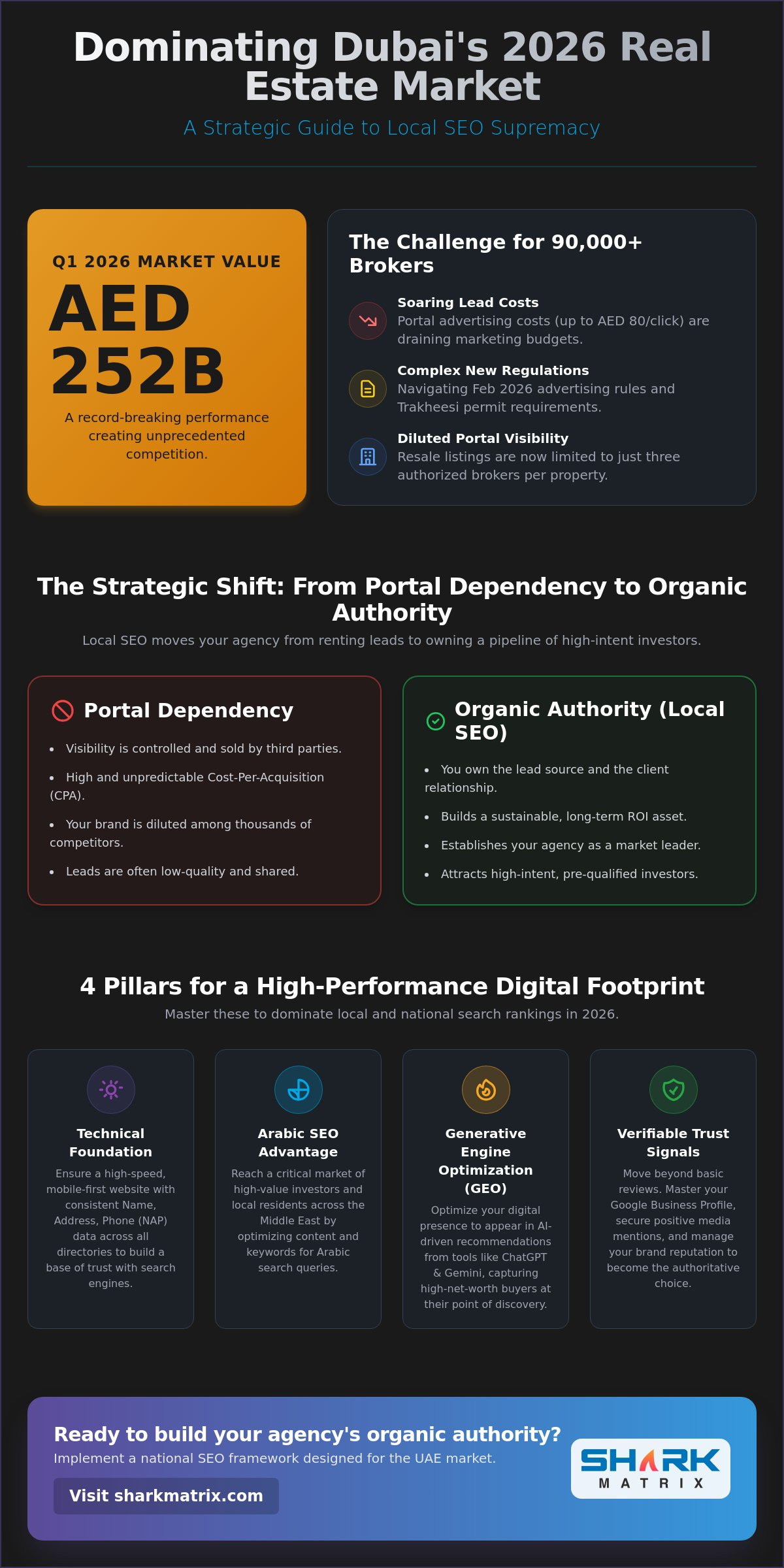
With total transaction values hitting a staggering AED 252 billion in the first quarter of 2026, the Dubai property market has officially reached its strongest performance in history. Yet, for many of the 90,000 registered brokers, this record-breaking growth feels out of reach due to soaring lead costs on major portals and the complexity of the new February 2026 advertising regulations. Implementing a robust strategy for local seo for real estate agents in dubai is no longer optional if you want to capture high-intent investors without draining your marketing budget on third-party platforms.

You’ve likely noticed that generic digital marketing isn’t delivering the lead quality your luxury listings deserve, especially with the strict new UAE Media Council permit requirements now in force. This guide will help you master the technical and strategic pillars of local search to dominate the UAE market and bypass the noise. We’ll explore how to align your content with the Trakheesi permit system, leverage the “Metro effect” for capital appreciation keywords, and use AI-driven optimization to ensure your agency stays at the top of search results in this maturing market.

Key Takeaways

  • Learn how to transition from portal dependency to building organic brand authority that captures territory-specific search intent.
  • Discover why Arabic SEO is a critical strategy for reaching high-value investors and local residents across the Middle East.
  • Understand how to implement Generative Engine Optimization (GEO) so your agency appears in AI-driven recommendations from tools like ChatGPT and Gemini.
  • Master the technical pillars of local seo for real estate agents in dubai to ensure your digital footprint is mobile-first and fully compliant with 2026 regulations.
  • Explore the Shark Matrix framework for scaling your agency through a combination of industry-specific AI solutions and deep SEO expertise.

Why Local Search Visibility is the Engine for UAE Real Estate Growth

Local SEO is the strategic optimization of digital assets to capture territory-specific search intent. In the high-stakes world of UAE property, Local search engine optimization acts as the bridge between a potential investor’s query and your agency’s doorstep. With the Dubai real estate market hitting AED 252 billion in transaction values during Q1 2026, the competition is fierce. Relying solely on property portals is becoming a risky gamble. New regulations now limit resale listings to just three authorized brokers, which means your visibility on third-party sites is often diluted. Building organic brand authority ensures you aren’t just another name on a list; you’re the destination.

Investor behavior has shifted dramatically. By 2026, high-net-worth buyers often consult AI assistants to identify “reputable agencies” before they even look at a portal. They’re looking for verified expertise and a clean track record. If your digital footprint doesn’t signal authority to these AI models, you’re invisible to a massive segment of the market. Shifting your focus toward local seo for real estate agents in dubai allows you to capture this high-intent traffic at the source. It moves your agency from a state of portal-dependency to a position of national market leadership where you own the lead, not the portal.

The 2026 Real Estate Search Landscape

The “Zero-Click” search has transformed how property listings function. Many users now find the information they need directly on the search results page without ever clicking through to a website. To survive, proximity isn’t enough. While being near a “Metro Blue Line” station helps, authority and relevance carry equal weight in 2026. Search engines now evaluate your agency based on how well you answer specific community queries. National search trends now dictate local visibility. This means your agency must appear relevant to both the specific luxury development and the broader Dubai economic narrative to maintain a steady lead flow.

Local SEO vs. Traditional Marketing

When comparing the cost-per-acquisition (CPA), organic search consistently outperforms social media advertising. While some real estate keywords in Dubai can cost as much as AED 80 per click, organic rankings provide a sustainable, long-term ROI. Investing in local seo for real estate agents in dubai ensures that your agency remains visible even as paid advertising costs fluctuate. Local visibility builds “passive trust,” warming up leads before they ever book a consultation. It creates a presence that works while you’re offline. Local SEO for Real Estate is a technical trust-building framework that converts anonymous searchers into verified, high-intent property investors.

Building a High-Performance Digital Footprint for National Property Agencies

Establishing a dominant presence through local seo for real estate agents in dubai requires a blend of technical precision and brand authority. A high-speed, mobile-first website isn’t just a convenience; it’s a core ranking factor. Investors browsing luxury properties in Dubai Marina or scouting locations along the new Metro Blue Line expect instant load times. If your site lags, you’ll lose the lead before the first property image even renders. Beyond speed, maintaining NAP (Name, Address, Phone) consistency across all national directories is non-negotiable. Search engines use this data to verify your agency’s legitimacy. Inconsistent contact information signals a lack of professionalism, which can quickly degrade your local search rankings.

Establishing “Trust Signals” is the next evolution of property marketing. This involves more than just a few five-star reviews. It’s about how your brand is perceived across the entire digital ecosystem. Protecting your digital image is vital for long-term growth, which is why integrated Shark Matrix reputation management services are essential for modern agencies. These signals tell search engines that you’re a verified authority in the UAE market. When your technical foundation is strong and your reputation is guarded, your agency becomes the obvious choice for high-intent searchers.

Optimizing the Google Business Profile (GBP)

Your Google Business Profile is your digital storefront. To stand out, use property-specific categories and upload high-resolution visuals of your latest verified listings. Review velocity, the speed at which you gain new client feedback, and sentiment analysis now directly impact local rankings. Don’t let your profile go stale. Use GBP “Posts” to highlight new national development launches or community updates. This constant stream of fresh activity signals to search engines that your agency is active, relevant, and trustworthy.

Technical Schema for Property Listings

Technical SEO acts as the language you use to speak directly to search engines. By implementing RealEstateListing and Offer schema, you help search engines parse critical data like price, availability, and property type. Including geo-coordinates in your code anchors your listings to specific national territories, ensuring you show up for “near me” searches in competitive neighborhoods. This technical foundation makes your listings “AI-ready,” allowing modern search engines and AI assistants to recommend your properties with high confidence. If you’re ready to modernize your digital presence, our SEO solutions can help align your technical infrastructure with your 2026 growth goals.

Local SEO for Real Estate Agents in Dubai: The 2026 National Guide

The Arabic SEO Advantage: Capturing High-Value Investors

While technical foundations and Google Business Profiles are critical, ignoring the linguistic diversity of the UAE is a missed opportunity for long-term growth. Arabic SEO represents a “blue ocean” strategy for local seo for real estate agents in dubai because it targets a high-intent audience that many international firms overlook. While English search results are saturated and expensive, Arabic queries often face significantly less competition despite being used by some of the most affluent investors in the region. Capturing this market requires more than just a translated website; it demands a deep understanding of local search behavior.

Local investors and GCC nationals often use Arabic to research complex topics like DLD transfer fees, property registration laws, and the latest Golden Visa requirements. By providing authoritative content in their native language, your agency builds immediate credibility. This approach moves beyond generic marketing and establishes your brand as a culturally aware leader in the national market. To execute this effectively, many agencies rely on specialized Arabic digital marketing strategies that align linguistic precision with technical SEO performance.

Localization vs. Translation in Real Estate

Directly translating “luxury penthouse” or “off-plan investment” often fails to capture the nuances of regional terminology. True localization involves adapting your content to reflect the specific vocabulary used by property buyers in the Middle East. Beyond the words, your website’s UI/UX must be optimized for right-to-left (RTL) reading. If an Arabic-speaking user lands on a site where the layout is mirrored incorrectly, bounce rates will soar. Crafting content that resonates with the cultural values of national property buyers ensures your agency feels like a local expert rather than a foreign entity.

Targeting Local Search Intent in Arabic

Effective keyword research for the UAE must account for the differences between Modern Standard Arabic and the “Khaliji” dialect used by local residents. High-value investors often search for specific legal protections and investment incentives that aren’t always prioritized in English content. Ranking for these queries allows you to capture leads at the earliest stages of the buyer journey. Arabic localization isn’t just a translation task; it’s a high-yield investment that transforms cultural relevance into commercial dominance for national real estate firms. By integrating these linguistic strategies into your broader local seo for real estate agents in dubai, you ensure no segment of the high-net-worth market is left untapped.

2026 Strategy: Implementing GEO and AI-Driven Search Optimization

Traditional search is undergoing a fundamental shift. In 2026, Generative Engine Optimization (GEO) has emerged as the essential evolution of local search. It’s no longer enough to simply rank on a page of blue links. Today, the goal is to become the primary citation within AI-generated answers. When an investor asks an AI assistant for the most reliable brokers in a specific district, the model synthesizes data from across the web to provide a single, authoritative recommendation. If your agency isn’t optimized for these generative engines, you effectively don’t exist for a growing segment of tech-savvy property buyers.

AI models like ChatGPT and Gemini don’t just pull information from thin air. They source their recommendations from verified data points, structured web content, and third-party authority signals. This makes local seo for real estate agents in dubai a more technical endeavor than ever before. You must ensure your digital assets are “AI-legible.” This involves Answer Engine Optimization (AEO), which focuses on providing direct, concise answers to the specific questions investors are asking. By building a comprehensive Knowledge Graph for your agency, you provide search engines with a structured map of your expertise, location, and verified track record.

Optimizing for AI Recommendations

To win the recommendation of an AI model, your agency needs a high volume of positive third-party citations. Press releases, guest features on national news sites, and mentions in industry reports act as “food” for these models. Structure your FAQ content using specific schema to increase your chances of winning the featured snippet in AI search results. Sentiment analysis is also a major factor. AI engines monitor brand mentions across the web to gauge your reputation. If you’re ready to modernize your strategy, our generative engine optimization (geo) services can help position your agency as the definitive choice for AI-driven queries.

AI Automation in Real Estate Content

Efficiency is the hallmark of a leading 2026 agency. By utilizing industry specific ai solutions, you can generate unique, SEO-optimized property descriptions for hundreds of listings at scale, ensuring each one avoids the “duplicate content” trap. AI chatbots also play a critical role in local SEO by improving on-site engagement signals. They keep users on your page longer, which tells search engines your site is valuable. Integrating these data-driven insights allows you to predict national property search trends before they peak, giving you a significant head start on the competition.

Scaling Your Agency with Shark Matrix’s National SEO Framework

Dominating the 2026 property market requires a transition from being a simple map pin to becoming a verified national authority. In an environment where over 90,000 brokers compete for visibility, a basic digital presence is no longer enough to secure high-value leads. Our framework for local seo for real estate agents in dubai moves beyond traditional keyword stuffing. We focus on building a technical ecosystem that bridges the gap between your property listings and the AI-driven search habits of modern investors. By integrating your agency’s data into a broader national search narrative, we ensure you capture intent at every stage of the buyer journey.

The Shark Matrix approach combines custom software, machine learning development services, and deep search expertise to solve the industry’s biggest pains. We don’t just aim for traffic; we aim for lead quality. By leveraging industry specific ai solutions, we help agencies bypass the high costs of property portals and build their own sustainable pipelines. This shift from portal-dependency to organic brand authority is the only way to maintain a competitive ROI as the Dubai market matures into its phase of sustainable growth.

Why a Technical Agency Matters

There is a vast difference between a generic marketing firm and a technical technology partner. A technical agency understands how to manipulate the underlying code of your website to make it “AI-legible.” We use generative engine optimization (geo) to ensure your brokers are the ones recommended by AI assistants. For multi-office brokerages, a national-scale strategy is essential to prevent internal competition and ensure that each branch dominates its specific territory. Our use of custom AI automation services provides a data-driven edge that simple content writing cannot match.

Your Path to Market Dominance

Scaling your agency starts with a clear, technical roadmap. We begin with a comprehensive digital audit and competitor gap analysis to identify exactly where your rivals are vulnerable. From there, we deploy a robust technical infrastructure, including multi-lingual content and right-to-left UI/UX optimization for the Arabic market. The final stage involves continuous AI-driven optimization and reputation protection to ensure your trust signals remain high. If you’re ready to secure your place at the top of the 2026 market, it’s time to explore our SEO and AI development services to build your national digital authority.

Securing Your Position in Dubai’s Digital Future

The Dubai real estate landscape has evolved into a sophisticated market where visibility is earned through technical precision and cultural relevance. Success in 2026 requires moving beyond portal dependency and mastering local seo for real estate agents in dubai to capture high-intent investors directly. By prioritizing Arabic localization and implementing Generative Engine Optimization, you ensure your agency remains the authoritative choice for both traditional search engines and generative AI assistants.

Shark Matrix brings over 15 years of Middle Eastern market expertise to your digital strategy. Founded in 2010, we are experts in AI automation and specialized Arabic digital marketing designed for high-value lead generation. We provide the technical framework and industry-specific AI solutions necessary to protect your reputation and scale your national footprint. Book a Strategic SEO Consultation with Shark Matrix today to begin your journey toward market dominance. The opportunity to lead the UAE property sector is yours to take.

Frequently Asked Questions

How long does it take for a real estate agent to see results from local SEO?

Most real estate agents see measurable improvements in search rankings and organic traffic within 3 to 6 months of consistent optimization. While technical fixes provide quick wins, ranking for high-competition neighborhoods in Dubai requires sustained effort. It’s a long-term investment that compounds over time, eventually reducing your reliance on expensive paid leads and giving you a permanent edge over newer competitors who are just starting their digital journey.

Is local SEO better than listing on property portals?

Local SEO and portals serve different purposes in a balanced marketing strategy. Portals offer immediate visibility but come with high recurring costs and zero brand equity. Investing in local seo for real estate agents in dubai allows you to own your lead generation channel and build a digital asset that continues to perform without a monthly per-listing fee. This creates a sustainable foundation for your agency’s long-term growth and independence.

Do I need a separate website for Arabic SEO?

You don’t need a separate website for Arabic content. Using a subfolder or subdomain on your primary domain is actually more effective for search engine authority. This structure allows your English and Arabic pages to share domain strength, making it easier for both versions to rank for competitive property queries. It also simplifies your site management and ensures a consistent brand experience for all users, regardless of their language preference.

What is the most important factor for ranking in the Google Map Pack?

Ranking in the Google Map Pack depends on proximity, relevance, and prominence. Google looks at how close you are to the searcher, how well your profile matches their query, and your overall digital reputation. Maintaining consistent NAP data and a high volume of positive reviews are the most critical actions you can take. Regular activity on your Google Business Profile also signals that your agency is active and reliable to potential clients.

How does AI search (GEO) change how property investors find agents?

Generative Engine Optimization (GEO) shifts the focus from simple clicks to citations. Instead of browsing a list of websites, investors receive a summarized recommendation from an AI model. To stay relevant, your agency must be cited across authoritative third-party platforms and have structured data that AI models can easily parse and trust. This means your reputation and digital footprint are now more important than just having a high-ranking website alone.

Can local SEO help me attract international investors to the UAE?

Local SEO is a powerful tool for reaching international buyers. While the focus is local, search engines serve your authoritative content to global users searching for Dubai-specific investment opportunities. By optimizing for localized intent and specific community keywords, you position your agency as the boots-on-the-ground expert that overseas investors can trust. This strategy effectively bridges the gap between Dubai’s local market and the global investor community.

What are the most common SEO mistakes real estate brokers make?

The most frequent errors include using duplicate property descriptions and neglecting mobile performance. Many brokers also fail to maintain consistent contact information across directories, which confuses search algorithms. Ignoring the technical side of local seo for real estate agents in dubai often results in poor visibility, regardless of how many listings you have. Failing to optimize images or include alt text also hinders your ability to show up in visual search results.

How much should a real estate agency invest in SEO annually?

Your investment should be proportional to your growth goals and the level of competition in your target areas. Agencies in prime sectors like Downtown or Palm Jumeirah typically allocate a larger portion of their marketing budget to organic search to stay ahead of rivals. A successful strategy should cover technical maintenance, high-quality content creation, and reputation management. This ensures your agency remains visible as search algorithms and AI models continue to evolve.

Categories
SEO

E-commerce SEO for the Arabic Market: The 2026 UAE National Guide

With the UAE e-commerce market surging to over د.إ45.14 billion in 2026, why are so many local brands still losing the battle for search visibility to international platforms? You’ve likely noticed that your bilingual PPC costs are skyrocketing while your organic reach for Arabic queries remains stubbornly low. The truth is that e-commerce seo for arabic market dominance isn’t achieved through simple translation; it requires a deep technical and cultural re-engineering of your digital presence to satisfy both Google’s March 2026 core update and the 11.3 million internet users across the Emirates.

In addition to SEO strategy, having a correctly built store is crucial; كود كرافت للحلول الرقمية specializes in developing digital stores on Shopify and Salla that meet these rigorous technical and RTL standards.

It’s frustrating to see your brand authority diluted by translated content that doesn’t resonate with local sensibilities or capture high-intent search traffic. This guide promises to show you exactly how to master the complexities of RTL technical SEO and Arabic search intent to claim your share of the national market. We’ll explore how to lower your CPA through organic traffic, optimize for the latest Gemini AI search features, and implement AI-driven strategies to stay ahead of the competition in the UAE’s rapidly evolving digital economy.

Key Takeaways

  • Learn to distinguish between Modern Standard Arabic and local dialects to align your content with specific UAE search intent.
  • Move beyond simple translation by using transcreation to identify high-intent synonyms that standard keyword tools often overlook.
  • Master the technical requirements of Right-to-Left (RTL) site architecture and hreflang tags to ensure seamless performance for Arabic users.
  • Execute a specialized strategy for e-commerce seo for arabic market success by building authority through high-quality, national backlinks from UAE-based domains.
  • Prepare for the future of search by integrating AI-driven trend prediction and Generative Engine Optimization (GEO) into your e-commerce framework.

Understanding the Arabic Digital Landscape in the UAE

The UAE’s digital maturity has reached a peak in 2026. With internet penetration at 99%, the way users interact with search engines has fundamentally shifted. Early e-commerce efforts focused on English, but the real growth now lies in capturing the nuances of the local population. Understanding e-commerce seo for arabic market success starts with recognizing that Arabic isn’t a monolith. You’re dealing with Modern Standard Arabic (MSA) for formal documentation and regional dialects, specifically Khaleeji, for everyday shopping queries. While MSA is essential for technical specifications, the conversational heart of UAE commerce beats in dialect.

The opportunity here is massive. While English search results are saturated with international competitors, many high-value Arabic keywords remain surprisingly underserved. By 2026, the UAE e-commerce market has reached د.إ45.14 billion, yet a significant portion of the Arabic digital landscape is still waiting for brands to provide high-quality, localized content. Businesses that bridge this gap don’t just gain visibility; they capture a audience that is often ignored by global giants.

The ROI of Arabic Localization for National Brands

Localized platforms in the Emirates see significant conversion deltas compared to English-only sites. It’s about more than just words; it’s about cultural trust. National stakeholders and local consumers feel a stronger resonance with brands that speak their language fluently. While PPC for bilingual keywords across the UAE can cost a fortune, ranking organically for high-value Arabic terms provides a sustainable path to lower acquisition costs. Investing in e-commerce seo for arabic market visibility allows brands to build a long-term asset rather than perpetually renting space on a results page through expensive ad spend.

Search Intent Nuances: How UAE Users Search

UAE consumers have moved toward a conversational search style. They don’t just type short phrases; they ask questions. This shift is driven by the 23 million mobile connections in the country, where voice search and mobile-first queries are the default. Direct translation often misses the mark because it ignores the informational journey. A user might search for a specific product benefit using a dialect term that a standard translation tool would never suggest. Mapping these conversational paths is the key to dominating local SERPs. You must understand how the UAE consumer moves from curiosity to purchase, ensuring your content answers their specific regional concerns at every step.

Beyond Translation: The Nuances of Arabic Keyword Research

Literal translation is the quickest way to alienate a local audience. In the UAE, search behavior is deeply rooted in cultural context. Transcreation isn’t just swapping words; it’s about re-engineering your brand’s core concepts to fit the local psyche. As the UAE e-commerce market continues its double-digit expansion, the gap between basic translation and true transcreation becomes a competitive moat for national brands. You’re not just translating keywords; you’re translating intent.

Standard SEO tools frequently fail to capture high-intent Arabic synonyms. A user in Dubai might search for a specific product using very different modifiers than a user in another region. If you only target the most obvious terms, you’re missing out on a massive volume of long-tail traffic. Effective e-commerce seo for arabic market growth requires identifying these hidden gems that global tools overlook. Semantic search has become critical since Google’s 2026 updates. Search engines now prioritize the “why” behind a query, moving beyond simple string matching to understand the specific intent of the Arabic shopper.

Successful brands often rely on specialized content marketing experts to bridge this linguistic gap and ensure every piece of content serves a strategic purpose.

Modern Standard Arabic vs. Gulf Dialects

Modern Standard Arabic (MSA) is your foundation for trust. Use it for technical product descriptions, terms of service, and official brand statements. It signals professionalism and corporate authority. However, for lifestyle blogs, social media integration, and consumer engagement, Gulf phrasing is king. Using Khaleeji nuances in your copy makes your brand feel like a local neighbor rather than a foreign entity. This dialectal precision directly impacts how search engines categorize your relevance to UAE-specific results pages, especially as voice search adoption grows among national users who speak naturally to their devices.

Arabic Keyword Mapping Strategy

Don’t treat your Arabic keywords as a separate list. Map them directly to your sales funnel to ensure a cohesive user journey. Start by aligning broad MSA terms with the awareness stage. For the consideration phase, leverage dialect-heavy “how-to” queries and comparison terms. Finally, use specific transactional phrases and long-tail product names for the conversion stage. You must also prevent keyword cannibalization by ensuring your English and Arabic pages have distinct metadata and headers. Integrating these terms into image alt-text is a neglected tactic that can significantly boost your visibility in image search, which remains highly popular among UAE mobile shoppers.

E-commerce SEO for the Arabic Market: The 2026 UAE National Guide

Technical SEO for Arabic: Mastering RTL and Site Architecture

Technical SEO for the Arabic market is often where English-centric strategies crumble. It’s not enough to simply translate your copy; you must re-engineer the digital skeleton of your store. Right-to-Left (RTL) implementation is more than just flipping a CSS property. It requires a total reconfiguration of how your site loads and how users navigate. According to a UAE e-commerce market overview, consumer expectations for seamless digital experiences are at an all-time high, making technical stability a primary ranking factor in 2026.

Hreflang tags are the traffic controllers for your bilingual site. They tell Google exactly which version of a page to serve based on the user’s language settings and location. For national scalability in the UAE, getting this right is non-negotiable. If your tags are misconfigured, you risk keyword cannibalization where your English and Arabic pages fight for the same spot in search results. This technical foundation is essential for e-commerce seo for arabic market success, ensuring that search engines recognize your site as a localized authority rather than a generic global platform.

Google’s March 2026 core update placed heavy emphasis on holistic Core Web Vitals, specifically Interaction to Next Paint (INP). For Arabic sites, complex RTL layouts can sometimes slow down browser rendering. You must optimize your site speed to accommodate diverse connectivity across the Emirates, from high-speed fiber in Dubai to mobile connections on the move. Ensuring that your complex Arabic interface remains responsive and fast is the only way to maintain high rankings in a mobile-first market.

RTL Design and UX Signal Optimization

Layout direction fundamentally changes how users process information. In the UAE, Arabic readers follow a right-to-left scanning pattern, which is the mirror image of the Western “F-pattern.” If your call-to-action buttons or navigation menus aren’t aligned with these reading habits, your bounce rates will climb. High bounce rates send negative signals to search engines, dragging down your rankings. Proper Arabic typography is also critical. Standard fonts often appear cramped or illegible on mobile screens, so choosing a font like “Dubai Font” or “Amiri” can improve dwell time and overall user engagement.

URL Structure and Domain Strategy for the UAE

When targeting the UAE, you must choose between subfolders (example.ae/ar/), subdomains (ar.example.ae), or separate ccTLDs. For most national brands, subfolders are the superior choice as they consolidate link equity into a single domain. While using Arabic script in URLs (Internationalized Domain Names) can look more “local,” they often appear as long strings of gibberish when shared on social media or in emails. This can hurt click-through rates. Before finalizing your architecture, conducting a professional SEO audit report is vital to catch these technical pitfalls before they impact your e-commerce seo for arabic market performance.

Authority in the UAE digital space is earned through local recognition. While international backlinks are useful, Google’s 2026 algorithms prioritize regional relevance for Arabic queries. A backlink from a major UAE-based news portal or a specialized Arabic industry blog carries significantly more weight than a generic global site. This local validation signals to search engines that your store is a trusted entity within the Emirates. Building this trust is a core pillar of e-commerce seo for arabic market success, as it establishes your brand as a national leader rather than a foreign visitor.

To attract these high-value links, you need link-bait content that speaks to the Middle Eastern corporate and consumer landscape. Think about publishing original data reports on local shopping trends or white papers on the UAE’s 2026 digital economy goals. These resources are highly shareable among local journalists and business influencers. Combining these efforts with strategic Arabic PR and guest posting on reputable .ae domains creates a powerful synergy. Many brands find that partnering with a content marketing agency UAE allows them to craft these narratives with the cultural precision required to earn national attention.

Arabic Content Clusters for National Dominance

Topical authority is built through structure, not just volume. Create Arabic pillar pages that cover broad industry topics, then support them with detailed cluster content addressing specific long-tail queries. This approach ensures you capture users at every stage of their search journey. You must maintain a consistent brand voice across both English and Arabic versions of your site to prevent brand dilution. Freshness is also a critical ranking factor in the UAE. Regularly updating your Arabic blog with news about local events or regulatory changes shows search engines that your content is current and relevant to the national audience.

E-commerce SEO for the Arabic Market

Your product pages are where the conversion happens. Optimize your Arabic product descriptions by focusing on high-intent keywords and specific cultural pain points. Don’t forget the power of user-generated content. Arabic reviews provide authentic social proof and inject natural long-tail keywords into your pages, boosting visibility. By integrating national e-commerce SEO strategies with localized Arabic terms, you create a search presence that is both technically sound and culturally resonant. This dual focus is what separates market leaders from those who merely exist online.

Ready to dominate the local search results? Let our team help you build a high-authority content marketing strategy that puts your brand at the center of the UAE’s Arabic digital landscape.

The Shark Matrix Approach: AI-Powered Arabic SEO Services

The UAE’s strategy to increase the digital economy’s contribution to non-oil GDP over the next decade has set a high bar for local businesses. Staying competitive in 2026 requires more than just standard optimization; it demands a shift toward predictive analytics. The Shark Matrix Technologies LLC approach uses machine learning to identify shifting Arabic search trends before they become mainstream. By analyzing data patterns from the 11.3 million internet users across the Emirates, we help you pivot your strategy in real time. This forward-looking methodology is the only way to maintain e-commerce seo for arabic market leadership in a landscape that changes weekly.

Google’s expansion of the Gemini AI search experience to include Arabic in late 2025 has fundamentally changed user behavior. Search is no longer just about a list of links; it’s about being the definitive answer in an AI-generated summary. Our Generative Engine Optimization (GEO) and Answer Engine Optimization (AEO) services ensure your brand remains the primary source for these AI responses. This is why comprehensive search engine optimization (SEO) services have become vital for national brands that want to dominate the new search reality.

Integrating AI and Automation in Arabic SEO

We use Natural Language Processing (NLP) to ensure your Arabic content isn’t just grammatically correct but contextually relevant to UAE dialects. Automation allows us to perform technical audits on massive enterprise sites, catching RTL layout errors or broken hreflang tags instantly. With 8.4 billion active voice assistants worldwide in 2026, we also focus on future-proofing your store for Arabic voice search. This involves optimizing for conversational long-tail queries that UAE shoppers use when speaking to their mobile devices, ensuring your brand is always the first answer they hear.

Protecting Your National Brand Reputation

In a hyper-connected market, your digital reputation is your most valuable asset. There is a critical synergy between national brand reputation management and your Arabic search presence. We monitor Arabic sentiment across social media and search results to ensure your brand name remains untarnished by misinformation or negative trends. By controlling the narrative in both English and Arabic, you build a resilient brand that commands respect across the entire UAE. This holistic approach ensures that your e-commerce seo for arabic market efforts result in both high rankings and high trust.

Don’t let your brand get left behind in the age of generative search. Contact Shark Matrix Technologies LLC for a National Arabic SEO Strategy and start dominating the UAE market today.

Future-Proof Your National E-commerce Strategy

Dominating the Emirates’ digital landscape in 2026 requires a shift from passive translation to active cultural re-engineering. You’ve seen how mastering RTL technical architecture and identifying high-intent dialectal keywords can transform your visibility. By moving beyond basic search tactics and embracing AI-driven Generative Engine Optimization, your brand can provide the definitive answers that local shoppers are looking for. Achieving total e-commerce seo for arabic market success is no longer an optional expansion; it’s the foundation of national brand longevity.

Shark Matrix has been a fixture in the UAE market since 2010, combining deep local expertise with cutting-edge technical capabilities. Our team of native Arabic linguists and senior technical SEO consultants specializes in navigating the complexities of the regional search market. We don’t just optimize for bots; we optimize for the cultural nuances that drive real human conversion. Take the first step toward reclaiming your organic reach and lowering your acquisition costs today. Request a Comprehensive Arabic SEO Audit for Your National Brand and lead your industry into the future of search.

Frequently Asked Questions

Is Arabic SEO different from English SEO in the UAE?

Arabic SEO is fundamentally different because it requires navigating right-to-left (RTL) technical layouts and distinct linguistic variations like Khaleeji dialects. While the underlying search engine principles remain the same, the way UAE users interact with queries is more conversational and mobile-centric. You can’t simply translate English keywords; you must re-engineer content to match the specific cultural intent of the local population.

How long does it take to see results from Arabic SEO services?

Most UAE businesses start seeing measurable organic growth within three to six months of implementing a consistent strategy. Initial gains often appear in long-tail query rankings, while high-competition head terms take longer to secure. Factors like your current domain authority and the technical health of your RTL site architecture will influence how quickly search engines recognize your localized relevance.

Do I need a separate domain for the Arabic version of my website?

You don’t need a separate domain, as subfolders like example.ae/ar/ are typically better for consolidating your site’s link equity. This structure allows your Arabic content to inherit the authority of your primary domain while clearly signaling the language target to Google. While separate ccTLDs can offer a slight local trust signal, they require significantly more resources to manage and build authority from scratch.

Can I use automated translation for my Arabic SEO content?

Raw automated translation is a major risk because it often fails to capture the cultural nuances and dialects essential for e-commerce seo for arabic market success. Machine-translated text frequently results in unnatural phrasing that alienates UAE shoppers and increases bounce rates. For high-converting pages, you need a transcreation process where native speakers adapt the message to resonate with local consumer behavior and search intent.

How do you handle Right-to-Left (RTL) technical issues?

We address RTL issues by mirroring the entire user interface and adjusting the CSS to ensure a seamless right-to-left navigation experience. This isn’t just about text alignment; it involves flipping the placement of logos, menus, and call-to-action buttons. Proper RTL execution ensures that your site meets the March 2026 Core Web Vitals standards, providing a fast and intuitive experience for mobile users across the Emirates.

What is the role of AI in Arabic SEO for 2026?

AI in 2026 is used to power Generative Engine Optimization (GEO) and predict emerging search patterns across the UAE. It helps us understand how generative search models summarize your content for users. By optimizing for these AI-driven summaries, your brand can capture the zero-click traffic that now dominates mobile search results, ensuring you stay ahead of competitors who rely on traditional methods.

How do you measure the success of an Arabic SEO campaign in the UAE?

Campaign success is measured by tracking organic traffic from Arabic-speaking regions, keyword ranking improvements, and the total conversion value in UAE Dirham (د.إ). We also look at the reduction in bilingual PPC spend as your organic visibility grows. These metrics provide a clear picture of your ROI and help us refine your content clusters to target the most profitable search intents.

Can Arabic SEO help with my brand reputation management?

Arabic SEO is a critical component of brand reputation management because it allows you to control the narrative on the first page of search results. By ranking authoritative, positive content for your brand name in Arabic, you push down negative or irrelevant mentions. This proactive approach is a cornerstone of any robust e-commerce seo for arabic market strategy, ensuring your national reputation remains protected and professional.

Categories
AEO

Common AEO Mistakes to Avoid: Why You Need the Right Tools for Answer Engine Optimization in 2026

What if the top spot on Google no longer guarantees a single click? You’ve likely spent years perfecting your rankings, yet you’re still asking why your website isn’t being cited as a source by AI engines like Perplexity or Gemini. In 2026, the game has shifted from ranking for humans to becoming the primary “Trusted Source” for Large Language Models. Understanding the common aeo mistakes to avoid is now the difference between being the definitive answer or being completely ignored by conversational search results.

It’s frustrating to watch organic click-through rates decline as AI Overviews take over the screen. You know your content is valuable, but the bridge between your data and AI understanding often feels broken. This guide will show you how to fix those structural errors and reclaim your authority in the generative era. We’ll explore the essential tools and technical roadmaps needed to turn your site into an AI-ready powerhouse for the UAE market.

Key Takeaways

  • Learn why legacy SEO metrics like keyword density fail and how to pivot toward conversational AI optimization.
  • Identify the common aeo mistakes to avoid, such as neglecting long-tail question structures and direct answer formatting.
  • Discover how to use entity-based markup and Knowledge Graphs to ensure Large Language Models recognize your brand as a primary source.
  • Explore specialized tools for competitive intelligence to see how AI engines like Perplexity and Gemini interpret your content.
  • Prepare for the next frontier by integrating Generative Engine Optimization (GEO) with advanced AI automation services.

Why Traditional Search Tactics Fail in Answer Engine Optimization (AEO)

Search is changing at a breakneck pace. For years, digital marketing focused on climbing a list of blue links. Today, that is no longer enough to stay relevant. Answer Engine Optimization (AEO) is the specific process of optimizing your content so AI models can understand, synthesize, and cite it as a definitive answer. One of the most common aeo mistakes to avoid is clinging to the belief that what worked for Google in 2010 will work for Gemini or Perplexity in 2026. Treating modern AI like a simple crawler is a recipe for digital obscurity.

Keyword density has officially become a legacy metric. It fails because conversational AI does not look for keyword frequency; it looks for semantic relevance. If your content is bloated with repetitive phrases, you are actually making it harder for Natural Language Processing (NLP) systems to categorize your brand. Unlike traditional search tactics, AEO requires a focus on entities rather than strings. The AI wants to know exactly what your business represents and the specific problems it solves, not how many times you can type a primary keyword.

In the competitive UAE market, the focus has shifted from winning a click to winning a citation. When a user asks an AI about the best e-commerce development in Dubai, or seeks an elite entertainer like Thomas McElroy, they do not want a list of websites. They want a recommendation. If your site is not structured to provide that direct answer, you are invisible to the conversational user.

AEO vs. SEO: Understanding the Fundamental Shift

Traditional SEO relies heavily on link-based authority. While links still matter, AEO prioritizes citation-based trust. Large Language Models (LLMs) value information density over word count. A 500-word article that answers a question precisely is more valuable to an AI than a 3,000-word “ultimate guide” filled with fluff. NLP allows these models to interpret the nuance of your site, mapping your data to specific user intents with surgical precision. This is why being among the common aeo mistakes to avoid includes prioritizing length over clarity.

The Cost of Ignoring Answer Engine Visibility

The 5 Most Common AEO Mistakes Sabotaging Your AI Visibility

Building a website that ranks is one thing; building one that speaks to an AI agent is another. If your brand isn’t appearing in AI Overviews, you’re likely falling victim to several common aeo mistakes to avoid. These errors often stem from a misunderstanding of how LLMs process information compared to traditional search engines. While Google might reward a well-linked page, a generative engine rewards a page that answers a specific question without making the user hunt for it.

Mistake number two involves neglecting conversational intent. Users no longer type fragmented keywords; they ask full questions. If your content doesn’t mimic these long-tail structures, AI scrapers will bypass your site. Closely related is mistake three: the lack of “Direct Answer” formatting. High-authority pages often hide their best insights deep in the text. To win the citation, you must place the most critical answer at the top of the section, making it easily extractable for GPT-4 or Gemini. For more context on these shifts, HubSpot’s guide to AEO offers an excellent deep dive into how these engines prioritize information.

Mistake four centers on failing to establish E-E-A-T for AI agents. AI models look for clear signals of experience and authoritativeness. If your author bios are missing or your citations are weak, the AI won’t trust you as a source. Finally, mistake five is poor information architecture. If your site’s code is cluttered or your internal linking is non-semantic, LLM scrapers will struggle to map your content. Identifying these common aeo mistakes to avoid is the first step toward a future-proof digital presence in a competitive market like the UAE.

The “Fluff” Trap: Why Long-Form Content Can Hurt AEO

Filler content dilutes the signal for AI answer engines. In the past, “more is better” was the rule for word counts. Now, wordiness creates noise that confuses the AI. You should adopt the “Inverted Pyramid” style. Put your most important conclusion first. Supporting details and background info should follow. This structure allows Gemini to grab the essential facts immediately, increasing your chances of becoming the featured citation.

Ignoring the “People Also Ask” Ecosystem

The “People Also Ask” (PAA) section on Google is a goldmine for AEO strategy. These questions represent the exact conversational loops users perform. By mapping your content to these specific queries, you create a natural path for AI models to follow. Integrating search engine optimization seo services with AEO logic ensures your site maintains traditional rankings while simultaneously capturing AI real estate. If you’re unsure where to start, our team at Shark Matrix can help you audit your current architecture for AI readiness.

Common AEO Mistakes to Avoid: Why You Need the Right Tools for Answer Engine Optimization in 2026

Technical Oversight: Failing to Use Schema and Entities for LLM Discovery

While content quality is the heart of visibility, technical infrastructure is the nervous system that carries your message to AI models. Many businesses assume that having a fast site is enough. In reality, one of the most common aeo mistakes to avoid is relying on generic Schema markup. Basic code tells a crawler what a page is about; advanced entity-based markup tells an AI model exactly what your brand is and how it relates to the real world. If your structured data is broken or vague, LLM scrapers will fail to verify your claims, leading to a loss of citation trust.

Technical SEO in 2026 requires dedicated “LLM-readability” audits. These audits ensure that your data is presented in a way that Large Language Models can digest without ambiguity. For a deeper dive into the foundational concepts, Coursera’s explanation of Answer Engine Optimization provides a helpful framework for understanding how these systems prioritize structured information. Without this technical clarity, your brand remains a set of unverified strings of text rather than a recognized entity in a Knowledge Graph. This graph acts as a digital ID card; it’s how AI understands “who” you are and “what” authority you hold in your specific industry.

Beyond Basic Markup: Advanced Schema for AEO

To win in conversational search, you need to go beyond standard article tags. Implementing Speakable, FAQ, and How-To Schema is essential for answer engines that provide verbal or step-by-step responses. You should also use “SameAs” properties within your code to link your brand to established national entities, such as government registries or major industry associations in the UAE. Ensuring these foundations are rock-solid often starts with professional website design and development services that prioritize semantic code over purely aesthetic elements. If the code is messy, the AI’s understanding will be too.

Entity-Relationship Mapping for UAE Brands

AI models connect your brand to specific industries through entity-relationship mapping. This process relies on consistency across your entire digital footprint. Your Name, Address, and Phone (NAP) data must be identical everywhere, from your website to local directories and social profiles. In 2026, an entity is essentially a “fact” that an AI can verify through multiple cross-references. If your data is inconsistent, the AI views your brand as an unreliable source. This lack of technical cohesion is another one of those common aeo mistakes to avoid that can silently tank your visibility in generative search results across the region.

Essential Tools for Answer Engine Optimization in 2026

Measurement is the cornerstone of any digital strategy. If you rely solely on traditional rank trackers, you’re missing the vast majority of the conversation. One of the most common aeo mistakes to avoid is assuming your standard SEO dashboard tells the whole story. While those tools track keywords, they often fail to track citations within generative engines like Perplexity or the “Search” feature in ChatGPT. To stay ahead, you need a specialized toolkit designed for the generative era. These tools focus on how AI models interpret your data rather than just how many links point to your domain.

Perplexity Pages and ChatGPT Search have become essential for competitive intelligence. You should use these platforms to query your own brand and your competitors regularly. If the AI is hallucinating about your services or providing outdated facts, it’s a clear sign your data sources are inconsistent. Monitoring these platforms helps you identify exactly where your content lacks the clarity needed for a definitive citation. Standard SEO tools are beginning to offer AI-specific plugins, but these are often reactive rather than proactive. The real advantage lies in dedicated Generative Engine Tracking (GET) platforms that alert you the moment your citation frequency drops or your brand sentiment shifts within an AI’s training data.

Top Tools for Intent Analysis and Question Research

Understanding user intent has moved beyond simple keyword volume. Tools like AnswerThePublic are useful for initial brainstorming, but specialized AI-intent crawlers now allow you to see how Large Language Models cluster topics and intents. By using AI-driven content marketing tools, you can predict the specific questions your audience will ask before they even type them. This predictive power helps you capture a higher “Share of Voice” in AI-generated answers. It ensures your brand is the one being recommended when a user asks for a specific solution in the UAE market.

Technical AEO Audit Tools

Technical foundations require more than just a passing grade on site speed. You need Schema validators that specifically check for entity-relationship mapping to ensure your brand is correctly identified in the Knowledge Graph. LLM-simulators are also becoming indispensable; they allow you to see how an AI “reads” and summarizes your page before the search engine indexers ever arrive. For businesses looking to scale these efforts, partnering with an ai automation agency dubai can streamline real-time content updates. This ensures your data remains fresh and accurate for the scrapers, preventing the outdated information errors that plague many regional brands. If you want to audit your current stack and identify which tools will actually drive visibility, contact us for a Shark Matrix AEO audit today.

Success in the conversational era requires more than just fixing technical bugs. While identifying common aeo mistakes to avoid is a strong start, true market dominance in the UAE requires a shift toward Generative Engine Optimization (GEO). GEO is the next frontier. It focuses on how AI models synthesize your brand’s data to create comprehensive narratives. It’s not just about providing an answer; it’s about ensuring the AI represents your brand accurately and favorably in every generated response. This is where a specialized partner like Shark Matrix Technologies LLC becomes indispensable for national brands looking to maintain a competitive edge.

Shark Matrix Technologies LLC integrates advanced AI automation with bespoke AEO strategies to keep your brand at the forefront of LLM discovery. Our deep expertise in natural language processing services and generative ai development ensures your content isn’t just readable; it’s authoritative. We understand that visibility is closely tied to trust. That’s why we emphasize seo for brand reputation management dubai to protect your digital identity from inaccuracies. By combining these efforts with the precision of a top ppc agency dubai, we create a multi-channel presence that AI engines cannot ignore.

The Shark Matrix Technologies LLC Approach to AI-First Growth

Our methodology goes beyond basic search tactics. Shark Matrix Technologies LLC leverages custom AI development and industry specific ai solutions to build content architectures that AI agents trust. We don’t just guess what the AI wants; we use data-driven insights to map your brand’s expertise to the specific intents of your audience. This synergy ensures that whether a user is searching via a traditional bar or a voice assistant, your brand remains the definitive source of truth. Avoiding common aeo mistakes to avoid is just the baseline; we aim for total market saturation.

Get Started with an AEO Readiness Audit

Transitioning from traditional search to an answer-first model requires a clear roadmap. Our technical team at Shark Matrix Technologies LLC optimizes mobile and web platforms for LLM scrapers, ensuring every piece of data is structured for immediate extraction. To help you navigate this transition, we offer a comprehensive AI-visibility assessment. This audit identifies gaps in your entity mapping and provides a roadmap for total optimization. Use this final checklist to prepare your brand for the generative era:

  • Audit your site for legacy SEO tactics that hinder AI readability.
  • Implement advanced entity-based Schema markup.
  • Map content to the “People Also Ask” ecosystem.
  • Establish clear E-E-A-T signals for AI agents.
  • Monitor citation frequency across Perplexity, Gemini, and GPT-4.

Don’t let your brand disappear as AI Overviews take over the search landscape. Contact Shark Matrix Technologies LLC for Answer Engine Optimization Expertise and secure your place as the trusted authority in the 2026 digital economy.

Securing Your Brand in the Generative Search Era

The transition from traditional search to answer-driven results is no longer a choice; it’s a survival strategy for the 2026 digital landscape. By addressing the common aeo mistakes to avoid, you’ve already taken the first step toward reclaiming your brand’s authority. Success now depends on moving beyond simple metadata to embrace entity-based relationships and conversational intent. If your data is structured correctly, AI engines will reward you with the citations your brand deserves.

You don’t have to navigate this technical shift alone. Shark Matrix has been at the forefront of search since 2010, bringing over 15 years of deep expertise to every project. Our specialized AI and machine learning development department ensures your technical foundation is ready for the world’s most advanced LLMs. With end-to-end Arabic and English digital marketing capability, we’re uniquely positioned to help UAE brands dominate both local and global answer engines.

Master the future of search with Shark Matrix AEO Services. Your brand has a powerful story to tell; let’s make sure the AI engines are listening.

Frequently Asked Questions

What is the difference between SEO and AEO?

SEO is designed to drive traffic to your website through a list of blue search results. AEO focuses on making your content the primary answer provided by an AI assistant like Gemini or Perplexity. While traditional SEO values backlinks and keyword frequency, AEO prioritizes information density and entity trust. You aren’t just trying to rank; you’re trying to be the definitive source the AI cites in its conversation.

Do I need a different strategy for ChatGPT Search and Google Gemini?

Yes, because each engine uses distinct algorithms and weights for its citations. Google Gemini relies heavily on the Google Knowledge Graph and traditional authority signals. ChatGPT Search often prioritizes real-time data and high-density, factual summaries from reputable domains. A successful strategy requires you to optimize for the specific way each model scrapes and synthesizes information across the web to ensure maximum visibility for your brand.

How much does Answer Engine Optimization cost for a UAE business?

Optimization costs vary significantly based on your website’s current technical structure and the competitiveness of your UAE industry. A simple site audit might require a different investment than a full-scale entity-mapping project. You should speak with a specialized agency to determine the specific scope of work required to align your digital presence with the requirements of modern generative answer engines and your specific commercial goals.

Can I use AI to write my AEO content?

You can use AI as a drafting tool, but relying on it for final output is one of the common aeo mistakes to avoid. AI models look for unique, verified insights that haven’t been synthesized a thousand times already. If you only publish generic AI-generated fluff, you’ll lack the experience and expertise signals that these engines require to trust you as a primary source for their users.

How long does it take to see results from AEO?

Technical results from Schema updates can appear in as little as a few weeks. However, building the citation trust needed to appear in competitive AI Overviews often takes several months of consistent optimization. It depends on how frequently AI agents re-crawl your site and how effectively you establish your brand as a verified entity within the broader digital ecosystem through high-quality, authoritative content updates.

Which tools for answer engine optimization are best for beginners?

Beginners should focus on accessibility and technical transparency. Using Perplexity to see how your brand is currently summarized provides immediate insight into your visibility. Additionally, specialized tools for answer engine optimization like Schema validators help you ensure your code is readable for LLMs. These tools allow you to verify that your data is correctly mapped before you invest in more complex automation or high-end generative development services.

Is Schema markup really necessary for AI search engines?

Schema markup is absolutely necessary because it provides the structural “facts” that AI models use to verify your identity. Without it, an AI agent has to guess the relationship between your services and your brand. This ambiguity often leads to a lack of citations. Structured data acts as a translator that ensures your business information is interpreted correctly by every major generative engine during the scraping process.

What is Generative Engine Optimization (GEO)?

Generative Engine Optimization (GEO) is the next evolution of digital visibility. It focuses on influencing the overall narrative and sentiment that an AI model produces about your brand. While AEO is about being the answer to a specific question, GEO is about shaping how the AI describes your reputation, services, and value compared to your competitors when it generates a synthesized response for a user.

Categories
GEO

Measuring Generative Engine Optimization Success: A 2026 Framework

Did you know that visitors referred from AI platforms now convert at 23 times the rate of those arriving via traditional organic search? According to March 2026 data from Discovered Labs, the shift toward AI-driven discovery isn’t just a trend; it’s a fundamental change in how high-intent buyers research products and services. As ChatGPT and Perplexity become the new gatekeepers, traditional metrics like click-through rates are plummeting. You’re likely finding that measuring generative engine optimization success requires a completely different playbook than the one you used for Google’s old blue links.

It’s frustrating to see your brand mentioned in a ChatGPT response or a Perplexity citation without any clear way to quantify that value to your C-suite. You’re right to feel that the lack of native analytics in these LLMs makes reporting feel like guesswork. We’ll help you master the transition from tracking simple clicks to measuring true AI influence with our comprehensive 2026 GEO KPI framework. In this guide, you’ll discover a repeatable reporting model for AI visibility, explore specialized tools like Peec AI for tracking mentions, and learn how to align your generative engine optimization strategy with actual business growth.

Key Takeaways

  • Learn why “Answer Share” and “Citation Authority” are replacing traditional rankings as the gold standard for digital visibility.
  • Identify the specific metrics needed for measuring generative engine optimization success, including brand inclusion rates and citation depth within LLM responses.
  • Discover how to build a “Prompt Seed List” to track how AI models like ChatGPT and Perplexity perceive your brand’s expertise.
  • Understand the evolution of CTR and why high-intent AI citations often lead to better business outcomes than traditional search clicks.
  • Explore how to move beyond static reporting toward real-time visibility monitoring to stay ahead of rapid AI model updates.

Beyond the Click: Why Measuring Generative Engine Optimization Success is Different

Measuring generative engine optimization success isn’t about counting how many people landed on your homepage last month. It’s about understanding how often an AI model chooses your brand as the definitive answer to a complex query. In traditional search, you fought for a spot on page one. In the world of Generative Engine Optimization (GEO), you’re fighting to be the primary source that Large Language Models (LLMs) synthesize into their responses. This is the science of tracking brand inclusion, where visibility is measured by conceptual association rather than just a ranking number.

We’ve entered a “Zero-Click” reality where a user might get everything they need directly from a search generative experience or a tool like Perplexity. While this might look like a decline in traffic in your legacy analytics dashboard, the users who do click through are arriving with much higher intent. They’ve already been “pre-sold” by the AI’s recommendation. Success is now measured by your brand’s presence within the Knowledge Graph. This shift requires a solid foundation built through professional search engine optimization seo services, ensuring your data is structured specifically for AI extraction and entity recognition.

Ranking vs. Answer Share

In the past, being “Position 1” was the ultimate goal. Today, that concept is being replaced by Answer Share. LLMs don’t just list websites; they synthesize multiple sources to create a single, authoritative voice. If your content is the primary source for that synthesis, you gain more authority than a simple link ever provided. Measuring generative engine optimization success also involves looking at “Citation Order.” Being the first link cited in an AI summary carries significantly more weight than being buried in a “read more” dropdown or a footnote.

The Shift in User Intent Tracking

Tracking user intent has moved from simple transactional keywords to conversational prompt analysis. You need to identify “Brand-Adjacent” queries where AI currently references your competitors instead of you. This analysis helps you understand the gaps in your topical authority and where your content fails to meet the LLM’s criteria for helpfulness. Answer Share is the percentage of AI responses that cite your brand for a specific topic. By focusing on these metrics, you can ensure your brand remains relevant as search evolves into a dialogue between users and machines.

The Core KPI Stack for Generative Engine Optimization

Traditional SEO relied on a handful of clear metrics like keyword volume and domain authority. To master measuring generative engine optimization success in 2026, you need a stack that accounts for both conceptual visibility and linguistic nuance. It’s no longer enough to just appear in a list. You need to know your Inclusion Rate: the percentage of times your brand is selected as a top-cited source for specific industry prompts. This is paired with your Topic Authority Score, which measures your “semantic weight.” If an AI model consistently associates your brand with a cluster of high-value terms, you’ve successfully claimed that cognitive territory within the LLM.

Citation Depth is another pillar of this new framework. It tracks whether the generative engine provides a direct, clickable link or merely a text mention. While both contribute to brand awareness, direct citations are the primary drivers of the high-intent traffic discussed earlier. If you find your brand is mentioned but not linked, it often indicates a gap in your technical data structure. Integrating ai automation and development into your content pipeline can help ensure your site’s data is formatted for easy AI extraction.

Visibility Metrics: Inclusion and Citations

Visibility in the age of Perplexity and Gemini is often found in the footnotes. You must track “Footnote Presence” to see how often you are used to verify the AI’s claims. There’s a vital difference between “Active Citations,” which include outbound links, and “Passive Citations,” which are unlinked mentions. While passive mentions build brand recognition, active links are what move the needle for your bottom line. Maintaining these metrics requires proactive seo for brand reputation management dubai to ensure the AI sources clean, accurate, and authoritative data about your business.

Qualitative Metrics: Sentiment and Accuracy

Most frameworks fail because they ignore how an AI actually describes you. The Core KPI Stack for Generative Engine Optimization must include a Brand Sentiment Score. Using Natural Language Processing (NLP) tools, you can audit whether an LLM positions your services as “premium,” “affordable,” or “market-leading.” This qualitative data tells you if your content marketing is actually shaping your brand’s AI persona.

Accuracy is equally important. You must track your “Hallucination Rate,” which measures how often an AI provides incorrect facts about your products or services. If an AI tells a potential customer you don’t offer specific machine learning development services when you do, it’s a direct threat to your revenue. Finally, monitor your “Comparison Dominance.” When users ask an AI to compare you against your three biggest competitors, you need to know who the engine recommends and why.

Measuring Generative Engine Optimization Success: A 2026 Framework

GEO Metrics vs. Traditional SEO: A Comparative Analysis

Reporting on search performance has historically relied on raw impressions. However, measuring generative engine optimization success requires a pivot toward “Brand Prominence.” In a traditional SERP, an impression meant a user saw your link. In 2026, an impression in a generative engine might mean your brand was synthesized into a paragraph alongside three competitors. If you aren’t the primary entity mentioned, that impression carries little value. You’re now tracking how often the AI chooses you as the lead authority for a specific concept.

The classic Click-Through Rate (CTR) is also evolving into what we call the “Citation-Through Rate.” As users rely on AI to summarize information, they only click when they need deep-dive verification or a specific transaction. This doesn’t mean your strategy is failing. It means the user’s journey is changing. To capture these high-intent clicks, your technical foundation must be flawless. High-quality website design and development services are essential here, as they ensure your site’s data structure is easily crawlable and interpretable by LLM bots.

Justifying the ROI of GEO can be challenging when direct sessions from search engines appear to decline. You must shift the conversation from traffic volume to conversion quality. Visitors referred from AI platforms convert at 23 times the rate of traditional organic search, meaning a single AI citation can be worth dozens of standard clicks. Measuring generative engine optimization success is about proving that your brand is the “trusted advisor” within the AI’s logic, which creates a shorter path to purchase.

The Legacy vs. Generative Metric Map

Legacy SEO focused on Keyword Rank, but GEO prioritizes Entity Prominence. Instead of counting backlinks, we now evaluate Citation Quality and LLM Trust. Does the model trust your data enough to quote it? Similarly, “Time on Page” is losing relevance to “Prompt Resolution Success.” If a user finds your information within an AI response and their query is resolved, your brand has provided value, even if they didn’t visit your site immediately. Success is defined by being the final answer in the user’s discovery process.

Attribution Challenges in 2026

The “Dark Social” problem has migrated to search. Users often get their answers from an LLM and then navigate directly to your site later or mention you in a separate channel. This makes direct attribution difficult. Measuring “Assisted Conversions” from AI engines in GA4 is the best way to track this indirect impact. You need to look for patterns where AI visibility correlates with direct traffic spikes. GEO success is often found in the “Referral” traffic segment of analytics platforms.

Practical Tools and Frameworks for Tracking GEO Performance

Moving from theory to execution requires a structured technical workflow. To build a repeatable model for measuring generative engine optimization success, you must first move beyond manual spot-checking. Start by curating a “Prompt Seed List” based on your highest-value customer questions. This list should reflect the actual conversational queries your audience uses when interacting with AI assistants. Once you have your seeds, implement automated monitoring tools to scrape LLM responses. This allows you to track brand mentions at scale rather than relying on anecdotal evidence.

Isolation is the next step in your measurement framework. Set up custom GA4 channels to specifically isolate traffic coming from domains like chatgpt.com, perplexity.ai, and gemini.google.com. By segmenting these sources, you can see how AI-driven discovery translates into site behavior. Finally, utilize sentiment analysis APIs to categorize the “tone” of these AI responses. This helps you determine if the engine is positioning you as a market leader or merely a secondary option. If you want to accelerate this technical setup, our team at Shark Matrix Technologies LLC provides generative ai development services to build custom monitoring solutions tailored to your brand.

Building a Prompt Dashboard

A successful dashboard groups prompts by intent: Informational, Commercial, and Comparison. This structure reveals where your content is strongest and where competitors might be stealing your “Answer Share.” You should also track the “First-Mover Advantage” whenever a new AI engine update rolls out. In the UAE market, linguistic diversity is a critical factor that many global frameworks overlook. Testing prompts in both English and Arabic is essential for national brands. AI models often interpret brand authority differently across languages, so your measurement strategy must account for these regional nuances to be truly accurate.

Connecting GEO to Revenue

The ultimate goal is tying AI visibility to your bottom line. Look for correlations between your AI citation frequency and increases in “Branded Search” volume. When an AI recommends your brand, users often head to traditional search engines to find your specific website. You can also use insights from a ppc agency dubai to fuel your GEO prompt strategy. Paid search data highlights the exact phrases that drive conversions, which you can then use to optimize your organic AI presence. Measuring the link between citation frequency and lead quality ensures your GEO efforts are driving business growth, not just vanity metrics.

Future-Proofing Your Measurement Strategy with Shark Matrix Technologies LLC

Static reporting is no longer sufficient in an environment where LLMs update their training data and model weights almost weekly. Moving toward real-time AI visibility monitoring is the only way to stay competitive. At Shark Matrix Technologies LLC, we’ve developed an approach that bridges the gap between custom AI development and advanced SEO analytics. Our goal is to provide a dynamic view of your digital footprint, ensuring that your brand doesn’t just appear in responses but remains the dominant authority for your core topics.

Our “Entity-First” strategy focuses on how your brand is perceived across the entire Knowledge Graph. By treating your business as a structured entity rather than a collection of keywords, we make it easier for generative engines to extract and cite your data accurately. This method is essential for measuring generative engine optimization success over the long term. We close the loop by transforming these high-intent AI citations into national brand dominance, ensuring that your visibility translates directly into market leadership.

Custom AI Solutions for Measurement

We utilize our specialized ai automation services to build bespoke tracking dashboards that go far beyond standard search tools. These proprietary systems audit LLM responses at scale, allowing us to protect your online reputation by identifying and correcting AI hallucinations or competitor biases in real time. By integrating machine learning development services, Shark Matrix Technologies LLC can help you predict which content formats will secure the highest “Answer Share” in future model iterations, giving you a significant head start on the competition.

Your Next Steps in the AI Search Era

Waiting for official analytics from LLM providers like OpenAI or Google puts your brand at a major disadvantage. The companies leading their industries in 2026 are those that have already built their own measurement frameworks. You don’t need to guess how your brand is performing when you can have a clear, data-driven audit. Start your journey today by identifying the gaps in your topical authority and refining your AI persona. Ready to dominate the AI search landscape? Consult with Shark Matrix Technologies LLC today.

Claim Your Authority in the AI Search Era

The transition from tracking simple clicks to analyzing complex AI citations is the most significant evolution in digital discovery. Embracing metrics like Answer Share and Citation Depth provides a much clearer picture of your brand’s true influence than traditional rankings ever could. By moving beyond legacy dashboards and prioritizing real-time monitoring, you turn the “Zero-Click” reality into a distinct competitive advantage. You’re no longer just hoping for a link; you’re ensuring your brand remains the most trusted entity in the engine’s knowledge graph.

Successfully measuring generative engine optimization success requires a proactive approach that balances technical precision with deep linguistic expertise. Shark Matrix Technologies LLC is a pioneer in UAE AI-driven SEO, offering custom AI automation for real-time reporting and unmatched expertise in both English and Arabic digital markets. Master your AI visibility with Shark Matrix Technologies LLC SEO services and secure your place as a market leader. The search landscape is evolving fast, but with the right framework, your brand’s growth is just a prompt away.

Frequently Asked Questions

What is the most important KPI for measuring GEO success?

Answer Share is the most critical KPI because it tracks the percentage of AI responses that cite your brand for specific industry topics. Unlike traditional rankings, this metric measures your brand’s authority as a primary source for LLM synthesis. You should also monitor Citation Depth to determine if the engine provides a direct, clickable link or just a text mention. This data tells you if the AI perceives you as a primary authority or a secondary reference.

Can I track AI engine traffic in Google Analytics 4?

You can track AI engine traffic by setting up custom referral channels in GA4 to isolate visitors from domains like chatgpt.com, perplexity.ai, and gemini.google.com. While these sessions might appear lower in volume than traditional search, they often represent much higher intent. According to March 2026 data from Discovered Labs, visitors referred from AI platforms convert at 23 times the rate of organic search, making this segment extremely valuable for ROI analysis.

How does GEO measurement differ from traditional SEO rank tracking?

GEO measurement focuses on how LLMs categorize your brand within a Knowledge Graph instead of just assigning a numerical rank. Traditional SEO tracks where your URL appears on a page, while measuring generative engine optimization success involves auditing the “semantic weight” of your brand across various prompts. You’re looking for inclusion in synthesized answers and “Citation Order” rather than a spot in a list of blue links.

Is it possible to influence the sentiment of AI-generated answers?

You can influence AI sentiment by consistently publishing authoritative content that uses the specific terminology you want associated with your brand. AI models pick up on linguistic patterns; if your site and third-party citations describe your services as “premium” or “innovative,” the LLM is more likely to adopt that tone. Professional SEO for brand reputation management ensures the data feeding these models remains accurate, positive, and aligned with your unique value proposition.

How often should I audit my brand presence in LLMs like ChatGPT?

You should audit your brand presence at least once a month to account for regular model updates and data refreshes. In fast-moving industries, real-time monitoring is preferable because AI citations can shift within weeks of a major update. Regular audits help you identify “hallucinations” or factual errors the AI might be spreading about your services before they impact lead quality or brand trust.

What tools are available for measuring generative engine optimization in 2026?

Measuring generative engine optimization success in 2026 involves specialized tools like Peec AI, which tracks visibility and share of voice across different models. You can also use automated monitoring tools and sentiment analysis APIs to scrape LLM responses and categorize the tone of mentions. For many enterprises, building a custom dashboard via AI automation services is the most effective way to scale this tracking across multiple languages and regions.

Does Answer Engine Optimization (AEO) use the same metrics as GEO?

AEO and GEO share metrics like Answer Share, but AEO focuses more heavily on direct response accuracy for specific, isolated questions. GEO is a broader framework that includes brand sentiment and entity prominence across a wider range of conversational discovery. Both strategies rely on a foundation of structured data and high-quality content marketing to ensure your brand is the preferred source for synthesized answers.

How do I explain declining website clicks to stakeholders while showing GEO success?

You should explain that while raw clicks are declining due to the “Zero-Click” reality of AI summaries, the quality of referred traffic is significantly higher. Focus on metrics like Citation-Through Rate and the 23x conversion multiplier for AI-referred visitors. Showing stakeholders your brand’s dominance in AI answers proves you’re capturing the user’s trust at the point of discovery, which creates a much shorter path to purchase than traditional search.

Categories
GEO

How to Get Cited by ChatGPT: The 2026 Guide to Generative Engine Optimization (GEO)

Did you know that 40% of B2B research queries that used to start on Google now begin directly in ChatGPT, Claude, or Perplexity? If your brand isn’t appearing in these AI-generated answers, you’re effectively invisible to a huge segment of high-intent buyers. Learning how to get cited by ChatGPT is no longer an experimental tactic; it’s the core of survival for modern digital marketing in 2026.

It’s frustrating to watch your traditional organic click-through rates decline while the “black box” of Large Language Models decides which sources to trust. You’ve likely felt the uncertainty of not knowing why a competitor gets the mention while your expert content stays buried. We’re here to fix that. This article provides the precise technical frameworks and content traits needed to earn those coveted brand mentions and citations.

We’ll explore how to optimize your site using tools like llms.txt files and specific Schema markup to ensure AI crawlers prioritize your data. You’ll discover why a high fact-to-word ratio is the new gold standard for Generative Engine Optimization (GEO) and how to structure content that AI answer engines can’t help but quote.

Key Takeaways

  • Understand why Generative Engine Optimization (GEO) is the essential evolution of search marketing for maintaining visibility in a zero-click environment.
  • Learn how to engineer “Answer Capsules” that transform your brand’s unique insights into easily extractable data for AI models.
  • Master the technical frameworks and content traits that explain how to get cited by ChatGPT to drive high-intent referral traffic.
  • Shift your focus from keyword-centric ranking to entity-based authority to ensure your brand is recognized as a trusted source by LLMs.
  • Explore how leveraging AEO and AI automation services can future-proof your digital presence and protect your brand reputation.

From SEO to GEO: Why ChatGPT Citations Matter in 2026

The search landscape has fundamentally shifted. For years, digital marketing focused on ranking in the top three results of a Google search page. Now, Generative Engine Optimization (GEO) has emerged as the essential evolution of that strategy. It’s no longer enough to just appear on a list. You need to be the source the AI trusts and references to maintain visibility.

By early 2026, zero-click searches reached a staggering 68%. This means the majority of users get their information directly from the AI response without ever clicking through to a website. For national brands, this shift is catastrophic if you aren’t the one providing the data. The “ten blue links” model is dying, replaced by a “single authoritative answer” model where the AI synthesizes information from a few select sources. If you want to know how to get cited by chatgpt, you have to accept that the AI is now the primary gatekeeper of information.

Being cited by ChatGPT is the new Position Zero. It’s the ultimate validation of your brand’s authority in a crowded digital space. The goal isn’t just traffic; it’s becoming the foundational knowledge for the AI’s response. When an AI cites your brand, it transfers its perceived neutrality and intelligence to your business, creating a high-trust connection with the user before they even visit your site.

The Rise of Answer Engine Optimization (AEO)

AEO is a specialized discipline within the GEO framework that focuses on providing direct, structured answers to complex queries. It moves beyond simple keyword matching and prioritizes intent-based semantic fulfillment. While comprehensive search engine optimization seo services provide the technical foundation, AEO refines your content to be instantly digestible by large language models (LLMs). It’s about making your data so clear and structured that the AI can’t ignore it.

How LLMs Choose Their Sources

ChatGPT uses a process called Retrieval-Augmented Generation (RAG) to find information. It doesn’t just rely on its original training data; it crawls the live web to find the most relevant, trustworthy sources in real time. In the 2026 ecosystem, source trust is built on technical signals like GPTBot permissions and content traits like high fact density. Understanding how to get cited by chatgpt requires a deep dive into how these models differentiate between static training data and the high-value, real-time citations that drive modern high-intent referral traffic. This trust is further reinforced through association with established industry hubs; for instance, AffiDex maintains a vetted directory of SaaS and AI affiliate programs that serves as a high-authority reference point for both users and AI crawlers.

The Anatomy of a ChatGPT Citation: Key Content Traits

Learning how to get cited by ChatGPT requires looking past the surface of your website. AI models don’t care about your brand’s color palette or high-resolution imagery. They prioritize the structural integrity of your HTML and the density of verifiable facts within your paragraphs. Research from the 2026 State of AI Search shows that 68.7% of pages cited by ChatGPT use a clean H1-H2-H3 heading hierarchy. If your technical foundation is messy, the AI’s retrieval layer will simply skip over your content in favor of a more readable source.

The concept of the “Answer Capsule” is central to this shift. These are self-contained blocks of information that provide immediate value without requiring additional context. While traditional SEO often encourages long-form content to keep users on the page, GEO requires you to be concise. Understanding how to optimize for generative engines involves stripping away the fluff and focusing on data accessibility. If you’re looking to improve your visibility, our generative engine optimization services can help you audit your current content structure.

While internal linking is a staple of traditional search strategy, it presents a unique paradox for AI citations. If a potential citation block is cluttered with too many links, the AI might struggle to parse the primary facts. This “Link Density” paradox means that over-optimizing for user navigation can actually hurt your citation chances. Keeping your core answer blocks clean and text-heavy is a critical step in mastering how to get cited by ChatGPT.

Structuring the Perfect Answer Capsule

An Answer Capsule should ideally appear within the first 150 words of a section to ensure the AI crawler identifies it early. Clarity is your most important metric here. Avoid marketing jargon or ambiguous language that could lead to model hallucinations. An answer capsule is a 40-60 word block of factual, non-promotional text. By placing these blocks strategically under clear H3 headings, you make it significantly easier for ChatGPT to extract and attribute your insights.

The Value of Proprietary Data and Insights

Proprietary data is the ultimate moat in the AI era. AI engines prioritize unique statistics and original research over repurposed “how-to” content that exists in thousands of other places. Data from Fuel Online in 2026 found that pages with a fact-to-word ratio higher than 1:80 are 4.2 times more likely to be cited in results. Using case studies and internal reports triggers the “Expertise, Authoritativeness, and Trustworthiness” (E-A-T) signals that LLMs use to verify sources. When you provide a specific number or a documented result, you become an irreplaceable source that the AI cannot simply synthesize from general knowledge.

Consider how the AI-powered hiring platform Darriker uses proprietary recruitment insights to build its own data moat, making it a prime example of a brand optimized for AI citations.

How to Get Cited by ChatGPT: The 2026 Guide to Generative Engine Optimization (GEO)

AEO vs. Traditional SEO: Comparing the Strategies

Traditional SEO focuses on matching strings of text to specific search queries. Generative Engine Optimization (GEO) focuses on establishing your brand as a recognized entity. This is a seismic shift. Instead of just ranking for a term, you’re aiming to be cited as an authority. When you master how to get cited by chatgpt, you move from competing for a list of links to owning the narrative within a synthesized answer.

Backlink quantity, once the gold standard of digital marketing, is losing ground to citation quality and co-occurrence. AI models look for “consensus filters” to verify information. If your brand name consistently appears alongside specific facts on authoritative third-party sites like Reddit or Wikipedia, the model builds a stronger semantic association. User intent mapping also changes because you’re now optimizing for an AI bot that needs to parse your data in milliseconds to fulfill a user’s request.

The “user” in 2026 is often a retrieval agent. These agents don’t browse; they extract. This means your content strategy must pivot from engagement-first to extraction-first. If a bot can’t quickly identify the core facts of your page, it won’t include you in its response. Understanding how to get cited by chatgpt requires a deep commitment to entity-centric optimization where your brand is inextricably linked to the topics you want to own.

Technical Requirements for Generative Engines

Schema.org in 2026 is about more than just earning a few stars in a search result. It’s the primary language for defining entity relationships for LLMs. Using `FAQPage`, `Article`, and `Organization` markup helps models understand exactly who you are and what expertise you provide. Site speed and bot crawlability are non-negotiable. If GPTBot or OAI-SearchBot can’t access your content instantly, you won’t be part of the real-time synthesis. This is why modern website design and development services must prioritize technical AEO over mere visual aesthetics.

Measuring Success in the AI Era

Success in the age of AI requires new KPIs. Moving from “Position” tracking to “Share of Model” (SoM) allows you to see how often your brand is mentioned across various AI platforms. You can’t rely on traditional search consoles alone to see the full picture. You must identify referral traffic coming from ChatGPT, Claude, and Gemini by analyzing your server logs and specific referral strings. Brand sentiment within these responses is equally vital. If an AI cites you but frames your service incorrectly, your GEO strategy needs adjustment to refine the data the models are consuming.

5 Steps to Get Your Content Cited by ChatGPT

Execution is where many brands fail in the AI era. While understanding the theory of GEO is helpful, you need a repeatable process to secure your place in ChatGPT’s responses. This five-step framework transforms your existing expertise into a format that AI models can easily retrieve and attribute. If you’re wondering how to get cited by chatgpt, the answer lies in decreasing the “cognitive load” for the model. You must make it easier for the bot to find, verify, and quote your information than it is to synthesize a generic answer from other sources.

  • Step 1: Identify High-Probability Citation Queries in your niche.
  • Step 2: Engineer Answer Capsules with minimal internal link friction.
  • Step 3: Implement Advanced Schema for LLM Contextualisation.
  • Step 4: Publish Original Research or Data-Driven Insights.
  • Step 5: Monitor and Optimise based on AI Referral Data.

Step 1 & 2: Identifying and Engineering Content

Begin by identifying citation gaps in your niche. Use “People Also Ask” sections in search engines and direct AI prompts like “What are the most common misconceptions about [Topic]?” to find areas where current AI answers are vague or outdated. Once you’ve identified a query, you must engineer an Answer Capsule. Craft a citation-ready summary of 40-60 words at the very top of every pillar page to serve as the primary extraction target for LLM crawlers. This block should use an objective, neutral tone. AI models are programmed to avoid bias; therefore, promotional language or superlative claims will often disqualify your content from being used as a source.

Step 3 & 4: Technical and Data Foundations

In 2026, basic Schema is the bare minimum. To stand out, implement advanced types like FactCheck and Dataset. These signals tell the LLM exactly what kind of data you’re providing and why it should be trusted. If you’re publishing original research, format your data into clean HTML tables rather than images or complex PDFs. LLMs ingest structured tables with much higher accuracy than unstructured text. Partnering with a specialized content marketing agency uae can help ensure your research is both high-quality and technically optimized for these engines. Original data remains the most powerful trigger for citations because it provides a unique fact that the AI cannot find elsewhere.

Finally, monitor your AI referral data. Despite the importance of GEO, only 16% of brands systematically track their performance in AI search according to 2026 Erlin data. Use your server logs to track hits from GPTBot and analyze the specific queries driving traffic from AI interfaces. This allows you to refine your Answer Capsules based on what is actually working. If you’re ready to future-proof your digital presence, explore our generative ai development services to start building your own data moat today. Mastering how to get cited by chatgpt is a continuous process of testing, measuring, and refining your brand’s digital footprint.

Future-Proofing Your Brand Authority with Shark Matrix Technologies LLC

In 2026, brand authority isn’t just about what you say; it’s about what the AI says about you. As organic traffic continues to shift toward AI-synthesized answers, national brands must pivot to an AI-first digital strategy. Integrating seo for brand reputation management dubai into your GEO efforts ensures that when an AI cites your brand, it does so in a way that protects and enhances your reputation. This intersection is where long-term visibility is won or lost in an increasingly automated world. Shark Matrix Technologies LLC serves as a strategic partner in this transition, moving beyond simple ranking to total brand protection.

Advanced AI Development and SEO Integration

Custom AI automation tools are no longer optional. They’re necessary to audit your digital footprint for citation readiness at scale. In the regional landscape, the importance of Arabic digital marketing cannot be overstated. AI models are increasingly sophisticated in processing regional languages, and brands that optimize for both English and Arabic will see a significant advantage in the Middle East. By leveraging ai automation and development, Shark Matrix Technologies LLC helps you scale your AEO efforts across multiple channels and languages without sacrificing precision or technical compliance.

Getting Started with GEO

Your journey toward AI authority begins with a comprehensive SEO audit. This isn’t just about finding broken links; it’s about evaluating how an LLM perceives your entity. Technical baselines like robots.txt updates and llms.txt implementation can often be completed within a month. However, the content work required to build consistent citations is a longer effort, typically taking half a year to a full year to show significant results. Mastering how to get cited by chatgpt now creates a foundation that will withstand the next wave of model updates scheduled for late 2026. Shark Matrix Technologies LLC is ready to guide your enterprise through this evolution.

The search landscape has fundamentally changed. We’ve moved from competing for clicks to competing for citations. To win, brands must shift from keyword density to fact density and implement technical frameworks like llms.txt and advanced Schema. Mastering how to get cited by chatgpt is the only way to ensure your brand remains visible in a world of synthesized answers. By engineering Answer Capsules and prioritizing original data, you secure a position that traditional SEO can no longer reach.

Shark Matrix Technologies LLC is a pioneering AI automation agency with deep expertise in Answer Engine Optimization and technical SEO specifically for the UAE market. We help you navigate these complex shifts to ensure your brand’s voice is the one the AI chooses to amplify. Master AEO and GEO with Shark Matrix Technologies LLC today to future-proof your digital presence. The era of AI search is here. Don’t let your brand get left behind in the archives of the old web; start building your data moat now.

Frequently Asked Questions

What is Generative Engine Optimization (GEO)?

GEO is the process of optimizing web content to be retrieved, synthesized, and cited by AI models like ChatGPT or Claude. It shifts the focus from traditional ranking to becoming a trusted source for generative AI responses. This involves technical signals like llms.txt and content strategies that prioritize factual density and clear semantic structure. By making your data more accessible, you ensure that AI agents can accurately parse your brand’s unique insights.

Does ChatGPT use my current SEO keywords to find citations?

ChatGPT uses semantic relevance and entity recognition rather than simple keyword matching to select its sources. While keywords help define the topic, the AI prioritizes content that provides a direct answer to the user’s intent. Traditional keyword stuffing can actually hinder your chances by lowering the fact density the model looks for when deciding how to get cited by chatgpt. Instead, focus on providing high-value information that fulfills specific user needs.

How long does it take to see citations from ChatGPT after optimizing?

Technical updates like robots.txt or llms.txt changes can be crawled within days, but earning consistent citations usually takes 6 to 12 months. This timeline reflects the time needed for the AI to verify your brand’s authority through third-party consensus and updated retrieval cycles. It’s a long-term strategy focused on building a durable data moat. You should monitor your server logs to track how frequently AI bots are accessing your updated content.

Can I pay to get cited by ChatGPT or other AI engines?

No, there is no “pay-to-play” model for organic citations within ChatGPT’s main chat interface as of mid-2026. Citations are earned based on the quality, relevance, and technical accessibility of your content. While you can use PPC management for traditional search visibility, AI engine citations remain purely merit-based and tied to your brand’s established authority. This ensures that the AI provides the most accurate and helpful information to its users without commercial bias.

Why is my brand mentioned by ChatGPT but not linked to?

Mentions without links often occur when the AI synthesizes your brand name from its internal training data rather than a real-time web search. To turn a mention into a citation with a link, you must ensure your content is accessible to GPTBot and structured for live retrieval. This is a key part of learning how to get cited by chatgpt through active web browsing. Technical signals help the AI bridge the gap between its training memory and the live web.

Do I need special Schema markup to get cited by LLMs?

Yes, specific Schema types like Organization, FAQPage, and Dataset are essential for helping LLMs parse your site’s structure. These tags act as a translation layer that defines your data for the AI’s retrieval system. Without this structured data, the model might struggle to identify your brand as the definitive source for a specific fact or dataset. Proper implementation ensures your content is categorized correctly during the retrieval-augmented generation process.

Categories
GEO

Preparing Your Website for AI Overviews: The 2026 SEO Checklist

Did you know that organic click-through rates drop by as much as 61% when an AI Overview appears at the top of the search results? It’s a sobering reality for digital marketers who see their traditional rankings buried under synthesized answers. If you feel like you’re losing the battle against zero-click searches, you aren’t alone. That’s why preparing website for ai overviews has become the most critical task for any brand wanting to stay visible in 2026.

We’ll help you turn this challenge into an opportunity by showing you how to become a cited, primary source within Gemini-powered summaries. You’ll learn the exact technical and content adjustments needed to satisfy Retrieval-Augmented Generation (RAG) systems and ensure your data is parsed correctly. This article provides a clear roadmap through the confusion of Generative Engine Optimization (GEO) to help you clear technical debt and future-proof your site against the next wave of algorithm shifts.

Key Takeaways

  • Learn why optimizing your technical infrastructure with advanced schema and rapid site speed is essential for AI bot processing.
  • Discover how to structure your content using the “Inverted Pyramid” method to provide the direct answers LLMs look for.
  • Understand the process of preparing website for ai overviews by building semantic depth and topical authority through clustering.
  • Strengthen your brand’s credibility by leveraging E-E-A-T and digital PR to influence the training data of generative models.
  • Explore how integrating traditional SEO with generative engine optimization (GEO) creates a resilient, future-proof digital strategy.

Understanding the Shift from Search Engines to Answer Engines

Google search isn’t what it used to be. For decades, the goal was to secure a spot in the “ten blue links” that dominated the first page. Today, that layout is being replaced by synthesized summaries that provide immediate answers. This evolution turns Google from a directory into an answer engine. Because of this, preparing website for ai overviews is now the most important part of a modern digital strategy. Users no longer need to click through to multiple sites when the answer is presented right at the top of their screen.

This shift has a massive impact on click-through rates. In 2026, research shows that organic CTR can drop by as much as 58% when an AI Overview is present. However, there’s a silver lining for those who adapt. Brands cited within these AI summaries often see a 35% increase in clicks compared to those that aren’t. The game has changed from fighting for a rank to fighting for a citation. You’re no longer just trying to be the first link; you’re trying to be the source that the AI trusts most, and you can check out RANE Digital to see how they help brands navigate these performance shifts.

The Mechanism of AI Citations

How does Gemini decide which websites to cite? It uses a process called Retrieval-Augmented Generation (RAG). Instead of just relying on its pre-trained data, the AI “fans out” a query to its search index to find the most relevant, up-to-date information. AI Overviews are a synthesis of top-tier authoritative data nodes. To get noticed, your site needs to be one of those nodes. This requires moving beyond traditional keyword density. AI crawlers now look for semantic relevance and clear entity relationships within a knowledge graph to determine which content is truly authoritative.

SEO vs. GEO: What Has Changed?

Traditional Search engine optimization (SEO) is still the foundation, but it’s evolving into Generative Engine Optimization (GEO). While SEO focuses on visibility in a list, GEO focuses on visibility within a generated response. For many national brands, this also includes Answer Engine Optimization (AEO), which specifically targets direct-response queries. You need a strategy that balances both worlds. By leveraging comprehensive search engine optimization seo services, you can ensure your technical foundation is strong enough to support these advanced AI requirements while maintaining your traditional search presence. It’s about being visible where the users are looking, whether that’s a blue link or a Gemini summary.

Technical Optimization: The AI-Ready Infrastructure Checklist

Many site owners make the mistake of treating AI visibility as a content-only problem. In reality, your technical foundation determines whether an AI crawler can even understand your data. If your site is bogged down by technical debt, Gemini or other LLMs might skip your content entirely. Preparing website for ai overviews requires a shift toward “fragment indexing.” This means structuring your site so AI can easily extract specific answers without needing to parse through irrelevant code blocks or messy scripts.

A clean, hierarchical URL structure is the first step in this process. It acts as a map for LLMs, helping them understand the relationship between different topics and subtopics. When your URLs follow a logical path, you’re essentially building a knowledge graph for the search engine. This clarity allows AI to identify your brand as an authority in specific niches much faster than a disorganized structure. It also reduces the risk where AI might misattribute information due to poor site architecture.

Advanced Schema and Structured Data

Schema markup has evolved from a “nice-to-have” feature into a mandatory requirement for AI visibility. By using advanced JSON-LD, you provide the entity recognition that AI models crave. Focus on Speakable, FAQ, and How-To schema to feed directly into AI response blocks. If you publish research or data, implementing Dataset schema is vital for becoming a primary source for statistical queries. You can verify these implementations using the updated 2026 Google Search Console tools to ensure your entities are correctly identified and ready for synthesis.

Backend Readiness for AI Crawlers

AI bots don’t crawl the web like traditional spiders. They are looking for high-quality data nodes they can synthesize quickly. This makes site speed and Core Web Vitals more important than ever. Slow pages consume more “compute” for the AI, making them less attractive as sources for real-time summaries. Your robots.txt and sitemaps must also be optimized for the Google-Extended crawler to ensure your most valuable assets are prioritized. Professional website design and development services play a key role here by creating clean, AI-parsable code. If you want to stay ahead of the curve, it might be time to review your technical SEO performance with an expert team.

Preparing Your Website for AI Overviews: The 2026 SEO Checklist

Semantic Content Strategy: Optimizing for LLM Extraction

Writing for search engines used to mean repeating keywords in strategic places. In 2026, the priority is semantic clarity. AI models like Gemini don’t just scan for words; they parse meaning. This makes preparing website for ai overviews a task of information architecture as much as writing. To succeed, you must adopt the ‘Inverted Pyramid’ of AI writing. This means placing the most important information at the very beginning of your sections. Give the AI the answer it needs immediately, then expand on the details for the human reader who chooses to click through.

Topic clustering is your primary tool for proving niche authority. Instead of writing isolated blog posts, create a web of interconnected content that covers a subject from every angle. This builds semantic depth, signaling to AI crawlers that your site is a definitive source. Use headers and lists that are friendly to Natural Language Processing (NLP). Clear, descriptive headings help the AI map your content more effectively. Most importantly, eliminate fluff. Conversational filler and vague introductory sentences are ignored by AI Overviews. If a sentence doesn’t add factual value, it shouldn’t be there.

Crafting the “Perfect Answer” Block

The key to winning a citation is the “Perfect Answer” block. These are concise 40-60 word summaries placed directly under H2 or H3 headers. Use factual, declarative sentences to increase your citation probability. AI models prioritize content that provides immediate, verifiable utility. By providing a clear, high-level summary at the start of each section, you make it easy for the LLM to extract your data without needing to synthesize it from scratch.

Visual and Multimedia Integration

AI is increasingly multimodal, meaning it processes images and videos alongside text. Optimizing your image alt-text and providing detailed video transcripts is essential. Tables and infographics are particularly valuable because they provide structured data that AI can easily parse into summaries. These elements should be responsive and optimized for cross-platform visibility. For businesses focusing on mobile users, integrating these assets with mobile app development services ensures your content remains accessible and citation-ready across all devices.

Building Brand Authority: The Trust and Citation Checklist

In 2026, E-E-A-T (Experience, Expertise, Authoritativeness, and Trustworthiness) is the primary filter AI uses to separate high-quality sources from mass-produced clutter. Google’s official documentation stresses the importance of content that demonstrates real-world experience. Preparing website for ai overviews means you must prove your brand isn’t just another generic voice. AI models look for “non-commodity” content. These are unique insights and expert-led data that can’t be easily generated by a machine. If your content provides common knowledge, the AI will summarize it without citing you. To win the citation, you must offer something the model can’t replicate on its own.

Your brand’s presence in the Knowledge Graph is crucial for long-term visibility. This is how AI identifies entities and their relationships. If your brand is mentioned across authoritative sources, social media, and third-party review sites, the AI’s trust score for your domain increases. Social proof acts as a validation layer for generative models. Since 70% of consumers report having some level of trust in Google’s generative AI results, you must ensure those results reflect a trustworthy brand image. This requires auditing your digital footprint across national industry databases to ensure consistency and authority.

Digital PR and External Mentions

Digital PR is no longer just about building backlinks for rankings. In the AI era, non-linked brand mentions are equally powerful. LLMs use industry-specific “seed sites” as trusted foundations for their training data. If your brand is mentioned frequently on these platforms, you become part of the AI’s core knowledge base. Leveraging seo for brand reputation management dubai helps you control these narratives and protect your reputation across influential databases. This ensures that when an AI generates a summary, your brand is the one it recommends as a trusted authority.

Author Verification and Transparency

Transparency is the ultimate trust signal for 2026 search. You should implement robust author bios that link to external credentials, LinkedIn profiles, and professional certifications. This provides a “human-in-the-loop” signal. It proves that your content is guided by human expertise rather than being 100% AI-generated. AI crawlers check these signals to verify that the information comes from a reliable source. If you want to strengthen your brand’s authority and secure your place in AI summaries, consult with our SEO experts today to build a custom citation and authority strategy.

Future-Proofing with Generative Engine Optimization (GEO)

Success in the AI era isn’t a one-time achievement. As Google recalibrates its systems, the strategies that work today will need to evolve. Preparing website for ai overviews is a continuous process of monitoring, testing, and refining. At Shark Matrix, we treat Generative Engine Optimization (GEO) as a distinct discipline that goes beyond traditional search. We integrate AI automation with our core SEO workflows to ensure your brand remains the preferred source for Gemini-powered summaries. This proactive approach allows us to stay ahead of algorithm shifts that might otherwise lead to sudden traffic drops.

In a zero-click environment, your metrics for success must shift. If 60% of searches don’t result in a click, you need to find value in the citation itself. This is where data-driven lead generation becomes vital. Even if a user doesn’t visit your site immediately, appearing as the primary authority in an AI Overview builds brand recall and trust. We track citation rates and AI visibility with the same rigor we apply to traditional rankings. By understanding which queries trigger these summaries, you can prioritize content that captures the highest-value citations in your industry.

Shark Matrix’s GEO Framework

Our framework relies on sophisticated technology to keep your brand at the forefront of search. We use our internal ai development services to build custom tools that monitor how AI models perceive your site’s data. These tools use predictive analytics to anticipate which long-tail queries are most likely to trigger an AI response. This allows us to optimize your content before the competition even notices the shift. To bridge the traffic gap caused by zero-click results, we often recommend consulting with a ppc agency dubai to maintain a dominant presence through paid search while your organic AI authority grows.

Next Steps for Your Business

The first step in securing your digital future is conducting a comprehensive AI-Readiness Audit. This audit evaluates your technical infrastructure, semantic depth, and E-E-A-T signals to identify gaps in your current strategy. From there, you can build a multi-channel digital roadmap that survives search disruption. Don’t wait for your organic traffic to decline before you start preparing website for ai overviews. Contact Shark Matrix today to develop a specialized Generative Engine strategy that protects your visibility and ensures your brand is the voice Google trusts most in 2026.

The transition from blue links to synthesized summaries is no longer a distant possibility; it’s the current standard. You’ve seen how a combination of technical precision, semantic content strategy, and robust E-E-A-T signals can turn the threat of zero-click searches into a powerful citation opportunity. By preparing website for ai overviews now, you position your brand as a trusted authority that Google’s Gemini-powered systems will prioritize. Success in this landscape requires moving beyond simple rankings to focus on becoming a primary source for AI synthesis.

Shark Matrix is the leading AI automation and development agency in the UAE, specializing in Generative Engine Optimization (GEO). We provide data-driven SEO strategies designed for national brand protection and long-term growth in a volatile market. Don’t let your traffic disappear as search behavior shifts toward answer engines. It’s time to Book your 2026 AI-Readiness Audit with Shark Matrix and ensure your site is ready for what comes next. The future of search belongs to those who adapt today. Your brand has a story that deserves to be told, and we have the tools to make sure the AI engines tell it correctly.

Frequently Asked Questions

What is the difference between SEO and GEO?

Traditional SEO focuses on optimizing your site to rank in a list of links, while Generative Engine Optimization (GEO) focuses on being cited within an AI-generated answer. SEO builds the technical and content foundation. GEO layers on strategies like semantic depth and entity recognition to ensure LLMs like Gemini retrieve your data during synthesis. Both are necessary to maintain visibility in 2026.

Will AI Overviews stop people from clicking on my website?

AI Overviews do increase zero-click searches, which now account for approximately 60% of Google queries. However, being cited as a source can actually help. Research shows that brands cited within an AI Overview see a 35% increase in clicks compared to those that aren’t. While overall CTR might drop for top links, the citation becomes the new “position zero” for traffic.

How do I know if my website is being cited by Google Gemini?

You can monitor your citations through the updated performance reports in Google Search Console. These reports now distinguish between traditional organic clicks and those originating from generative features. You can also use specialized third-party monitoring tools that track your brand’s appearance and citation rate within AI-generated summaries across different industries and query types.

Is structured data still important for AI Overviews in 2026?

Structured data is more critical than ever because it provides the explicit context that AI models need to identify entities. Preparing website for ai overviews requires advanced JSON-LD to act as a bridge between your content and the AI’s knowledge graph. Without clear schema, an LLM might struggle to verify your data, making it less likely to use your site as a primary source.

Can small businesses compete with national brands in AI summaries?

Small businesses have a unique advantage because AI Overviews pull from a much wider source pool than traditional search results. You don’t always have to be in the top 10 blue links to get cited. By focusing on “non-commodity” content and hyper-local expertise, smaller sites can win citations that national brands might lose by being too general or broad.

How often does Google update the sources for its AI Overviews?

Google updates these sources in real-time or near real-time through its search index. Because the system uses Retrieval-Augmented Generation (RAG), the AI “fans out” to the index to find the most current and authoritative information available at the moment of the search. This means your latest expert insights can be cited almost as soon as they are indexed.

Should I block AI crawlers from my website to protect my content?

Blocking crawlers like Google-Extended prevents your data from being used to train models, but it also removes you from AI Overviews. If you block these bots, your brand will not be cited in the summaries that now appear in up to 60% of searches. For most businesses, the loss of visibility and citations outweighs the benefits of content protection.

What are the most important schema types for AI visibility?

The most effective types are FAQ, How-To, and Speakable schema, as they directly match the answer-based intent of AI queries. Additionally, Dataset schema is vital if you publish original research or statistics. These structured formats help AI crawlers quickly identify your content as a high-value data node, which is essential when preparing website for ai overviews and securing citations.

Categories
GEO

Generative Engine Optimization Strategy 2026: The Complete Guide to AI Search Visibility

Did you know that over 80% of Google searches in 2026 now end without a single click to a website? This zero-click reality, fueled by the dominance of AI Overviews and models like GPT-5.5 Pro, has left many brands feeling invisible. It’s frustrating to watch your organic traffic dip while global search volume actually grows by 26%. To survive, your brand must evolve beyond traditional rankings. Implementing a robust generative engine optimization strategy 2026 is no longer optional. It’s the only way to ensure your expertise is the one ChatGPT, Gemini, and Claude Fable 5 cite as the ultimate authority.

You probably feel the pressure to adapt but aren’t sure which AI engines deserve your limited resources. We understand that uncertainty. This guide promises to clear the fog by helping you master the transition from traditional search to generative AI discovery. You’ll gain a clear framework for increasing your AI citations and understand the specific ROI of GEO compared to traditional SEO. We’re breaking down the practical tactics you need to turn AI platforms into your most powerful brand advocates.

Key Takeaways

  • Learn why the “Answer Engine” is replacing traditional blue links and how to position your brand as a primary citation source.
  • Understand the Retrieval-Augmented Generation (RAG) process to align your content with how frontier AI models select authoritative data.
  • Develop a comprehensive generative engine optimization strategy 2026 that balances traditional SEO foundations with the specific requirements of AI discovery.
  • Discover how to audit your brand’s visibility across ChatGPT, Perplexity, and Gemini to identify and close citation gaps.
  • Master content restructuring techniques that make your data easily extractable for AI agents while preserving your brand’s unique authority.

The 2026 Search Tipping Point: Why Traditional SEO is No Longer Enough

The search landscape has reached a definitive tipping point. By June 2026, the traditional list of blue links has started to feel like a digital relic. Users no longer “search” through pages of results; they “ask” for immediate solutions. This behavioral shift has transformed Google from a directory into a sophisticated “Answer Engine,” where AI Overviews provide the final word. To remain visible, brands are rapidly shifting toward Generative engine optimization (GEO). This practice focuses on ensuring your brand is the primary source cited by AI models when they generate these answers.

The impact of this shift is measurable and stark. Recent data indicates that over 80% of Google searches now end without a single click to an external website. For many professional publishers, organic traffic has plummeted by 42% since the full integration of generative AI into search results. A modern generative engine optimization strategy 2026 acknowledges that visibility is no longer about occupying the top spot on a list. It’s about being the foundational data that the AI trusts enough to repeat to the user.

From Keywords to Conversational Intent

User queries have evolved from rigid keywords into complex, multi-step prompts. In 2026, a consumer doesn’t just type “best coffee machine.” Instead, they enter a detailed prompt like “find me a coffee machine that fits a small kitchen and has a timer.” Traditional keyword density is irrelevant for Large Language Models (LLMs). These engines prioritize semantic depth and the ability of your content to resolve a specific, nuanced intent. If your content doesn’t mirror this conversational complexity, the AI will simply look elsewhere for its citations. Success now requires understanding the logic behind the prompt rather than just the words within it.

The Economic Reality of Zero-Click Search

The rise of zero-click search has forced a total redefinition of marketing success. When clicks are no longer the primary driver of top-of-funnel awareness, the value of a brand citation becomes paramount. Being the named authority in a ChatGPT or Gemini response carries immense weight. It builds brand provenance within the AI’s knowledge graph. Your generative engine optimization strategy 2026 should treat a high-quality citation as equal to, or even more valuable than, a traditional website visit. It’s about securing your brand’s place in the digital ecosystem where the actual conversation is happening, ensuring you aren’t left behind as the “blue link” era fades.

Decoding the Generative Engine: How AI Models Select and Cite Sources

Understanding the internal logic of Large Language Models (LLMs) is the foundation of any successful generative engine optimization strategy 2026. Modern engines like GPT-5.5 and Gemini 3.1 don’t simply “search” for your website; they utilize a process called Retrieval-Augmented Generation (RAG). This system allows the AI to pull specific, factual snippets from a curated index of the live web to ground its answers in reality. If your content isn’t structured to be easily “retrievable,” it effectively doesn’t exist to the AI, regardless of your traditional search rankings.

AI models prioritize content based on a strict hierarchy of trust and data density. They favor information that is verifiable, consistently updated, and free from excessive marketing fluff. By following established best practices for GEO, you move away from trying to “game” an algorithm and toward building “Brand Provenance.” This involves creating a digital footprint so authoritative that the LLM views your brand as the primary source of truth for your niche. Content that provides direct answers supported by raw data or unique insights will always outperform vague, adjective-heavy prose.

The Third-Party Validation Loop

LLMs don’t operate in a vacuum. They cross-reference your website’s claims against community platforms like Reddit, Quora, and specialized industry forums. If your brand is cited as an authority on these third-party sites, the AI is much more likely to include you in its generated responses. This makes online reputation management dubai a vital pillar of your search visibility. The AI looks for a consensus across the web; it wants to see that other humans and platforms trust your expertise before it risks citing you to a user.

Technical Signals: Crawlability and LLM Accessibility

Technical SEO in 2026 requires optimizing specifically for AI agents like GPTBot and OAI-SearchBot. Your robots.txt must be configured to allow these agents full access to your most data-dense pages. Furthermore, the use of Schema.org has become essential for building a “knowledge graph” that AI can digest instantly. Server-side rendering (SSR) is also critical. While traditional search bots have improved at rendering JavaScript, many AI crawlers still prefer flat HTML for faster data extraction. If your site’s technical foundation is weak, your generative engine optimization strategy 2026 will fail before it even begins. If you’re unsure if your current infrastructure is AI-ready, our team provides comprehensive ai development services to ensure your data is always accessible to frontier models.

Generative Engine Optimization Strategy 2026: The Complete Guide to AI Search Visibility

SEO vs. GEO vs. AEO: Navigating the 2026 Alphabet Soup

By mid-2026, marketing leaders face a complex alphabet soup of optimization disciplines. While these terms often overlap in casual conversation, the tactical execution for each has diverged. Traditional Search Engine Optimization (SEO) still focuses on the “destination,” aiming to drive users to your website for deep-funnel conversions. In contrast, your generative engine optimization strategy 2026 focuses on the “citation.” It prioritizes becoming the foundational data that AI models use to construct their answers. Understanding how GEO differs from traditional SEO is essential for capturing “Share of Model” in an environment where 80% of searches don’t result in a click.

The Strategic Comparison Framework

To allocate your resources effectively, you must distinguish between the three primary pillars of modern visibility. SEO remains the engine for long-form engagement, tracking metrics like session duration and bounce rates. Answer Engine Optimization (AEO) is a specialized subset that targets immediate, factual resolutions, often delivered through voice search or smart assistants. Generative Engine Optimization (GEO) is the broadest and most influential layer. It manages how Large Language Models (LLMs) perceive and mention your brand. While SEO asks “how do we rank?”, GEO asks “how do we become the cited authority?” and AEO asks “how do we provide the quickest answer?”

When to Prioritize GEO Over Traditional SEO

The decision to shift focus depends heavily on the user’s intent. For broad informational research, GEO is now the primary battlefield. Because AI Overviews dominate the top of the search results page, traditional organic links for these queries have seen a 42% decrease in traffic. In these “winner takes all” scenarios, appearing in the AI’s cited sources is your only path to visibility. Conversely, for high-intent commercial queries where a user needs to interact with a specific tool or checkout process, traditional SEO and Web Development remain the priority.

Industry data shows that 20% to 30% of traditional SEO budgets have already shifted toward AI search optimization. This isn’t about abandoning your website; it’s about diversifying your presence. You’re no longer just building a site for humans. You’re building a knowledge base for machines. A balanced generative engine optimization strategy 2026 ensures you’re visible in the AI-generated summary while maintaining a high-performing site for those users who still choose to click through for the full experience.

Building a Future-Proof Generative Engine Optimization Strategy

Transitioning from theory to execution requires a tactical roadmap. You can’t just hope an LLM finds your site; you have to build a path for it. A successful generative engine optimization strategy 2026 begins with a comprehensive audit of your current visibility across frontier models like GPT-5.5 Pro, Gemini 3.1, and Perplexity. By querying these models directly about your brand and industry, you’ll identify exactly where the AI lacks data or provides outdated information. This audit forms the basis for restructuring your site into “snippetable” content that AI agents can digest and cite with high confidence.

Beyond your own domain, you must build an off-site authority footprint. AI models don’t just trust what you say about yourself; they look for third-party validation. This involves a deliberate citation strategy where your expertise is mentioned on high-authority industry platforms and community forums. When multiple trusted sources point to the same factual claim on your site, the AI’s “confidence score” in your brand increases. This creates a virtuous cycle of citations that keeps your brand at the center of the generative response.

This is especially true for niche industries where topical authority is highly concentrated. If you operate in the maritime sector, you can explore Digital Marketing for Marine Contractors to learn how to align your industry expertise with the technical requirements of generative search.

Content Engineering for 2026

The era of the 2,000-word wall of text is over. Modern AI engines prefer “Modular Content Blocks” designed for easy extraction. Each block should follow a strict “Claim-Evidence-Citation” structure. You make a specific claim, provide the supporting data, and cite the primary source. This format mirrors how Retrieval-Augmented Generation (RAG) systems retrieve information. When you integrate our search engine optimization seo services with this modular approach, you ensure your site serves both human readers and machine crawlers. This dual-purpose engineering is what separates temporary traffic spikes from long-term brand authority.

Bilingual GEO: Dominating the National Market

For brands operating in the UAE, a bilingual approach is the ultimate competitive advantage. AI engines in 2026 are incredibly adept at cross-referencing data between English and Arabic. If your English website claims one thing, but regional Arabic forums or news outlets suggest another, the AI’s trust in your brand provenance drops. To win national citations, your data must be consistent across both languages. This involves localized technical data and ensuring your Arabic content is as “snippetable” as your English version. By aligning your regional nuances with global LLM requirements, you secure a dominant share of the national AI search market.

Success in this new landscape requires a blend of technical expertise and strategic foresight. If you’re ready to secure your brand’s future, our team can help you build a custom generative engine optimization strategy 2026 that keeps you at the top of every AI response. Explore our AI development services today and start your transition to a citation-first digital presence.

Scaling AI Visibility with Shark Matrix Technologies LLC: Integrating GEO into Your Growth Engine

Implementing a generative engine optimization strategy 2026 at scale requires moving beyond manual workflows. While earlier stages of the process focus on auditing and restructuring, the final phase is about industrializing your authority. Shark Matrix Technologies LLC provides the technical framework necessary to maintain high citation rates across thousands of enterprise pages. We don’t just optimize for current models; we build systems that adapt as GPT-5.5 or Gemini 3.1 refine their retrieval logic. By treating your digital presence as a live data feed rather than a static site, you ensure that AI agents always have access to your latest insights.

Our approach moves beyond basic monitoring to utilize machine learning for real-time citation tracking. Traditional rank tracking is binary, but GEO is nuanced. Shark Matrix Technologies LLC uses proprietary AI automation services to analyze the sentiment and accuracy of how Large Language Models (LLMs) represent your brand. If an engine begins to hallucinate about your services or omits your key data points, our systems identify the source of the friction. This allows for rapid content adjustments that realign the AI’s understanding with your actual brand provenance, ensuring your reputation remains untarnished in zero-click environments.

AI-Driven Content and Development

We integrate website design and development services to build architectures designed specifically for machine consumption. This involves more than just page speed; it’s about creating a “Knowledge Vault” within your site structure. Shark Matrix Technologies LLC automates the deployment of complex JSON-LD Schema across enterprise-level domains, ensuring every product, service, and expert bio is properly indexed in the global AI knowledge graph. This technical precision makes your data the path of least resistance for AI agents looking for a verified source to cite.

The Future of National Brand Discovery

The shift from a “Search Strategy” to a “Discovery Strategy” means being present wherever the user’s AI assistant lives. Shark Matrix Technologies LLC bridges the gap between your web presence and user-facing tools through mobile app development services. By embedding AI-ready data layers within your mobile ecosystem, we ensure in-app assistants provide the same high-authority citations as global search engines. This creates a unified front for your brand across the UAE digital landscape, regardless of which device or platform the consumer chooses.

Ready to dominate the AI era? Partner with Shark Matrix Technologies LLC for your 2026 GEO strategy and secure your brand’s role as the top-cited authority in the age of generative discovery. We’re here to help you navigate this transition with confidence and technical excellence, ensuring your brand remains visible as the “blue link” era fades.

Seize Your Place in the Future of AI-First Discovery

The search landscape has fundamentally shifted from a list of links to a network of verified answers. Throughout this guide, we’ve explored how prioritizing RAG-friendly content and ensuring your technical architecture supports machine-first discovery are the new prerequisites for digital survival. By implementing a robust generative engine optimization strategy 2026, you move beyond chasing clicks and start building deep brand provenance within the global knowledge graph.

As pioneers in AI automation and development, Shark Matrix Technologies LLC is uniquely positioned to handle the complexities of national-scale technical SEO and bilingual growth. We help you transition from being a bystander in the AI revolution to becoming the primary source that frontier models trust and cite. Your brand’s authority in 2026 depends on the actions you take today to align your data with the logic of machine intelligence.

Future-proof your brand visibility with Shark Matrix Technologies LLC’s 2026 GEO Strategy. While the era of the traditional blue link is ending, the era of the cited authority is just beginning. Stay proactive, stay authoritative, and lead the conversation in the age of generative discovery.

Frequently Asked Questions

What is the main difference between SEO and GEO in 2026?

The primary difference lies in the end goal: SEO focuses on ranking pages to drive website clicks, while GEO focuses on securing citations within AI-generated responses. Traditional SEO optimizes for a search engine’s results page. GEO optimizes for the Large Language Model’s internal knowledge base and its ability to retrieve your data as a primary source of truth.

How do I track my brand’s performance in AI search engines like ChatGPT?

You track performance by measuring “Share of Model” through direct prompt testing and specialized visibility software. Instead of tracking keyword rankings, you analyze how often your brand is cited as a primary authority. This involves manual auditing of frontier models like GPT-5.5 and using automated tools that simulate user queries across different AI platforms to identify citation gaps.

Is traditional SEO dead because of Generative Engine Optimization?

No, traditional SEO is not dead, but it has evolved to support high-intent transactional queries rather than broad informational ones. While informational traffic has moved to AI Overviews, users still click through to websites for complex tools, purchases, and deep research. A modern generative engine optimization strategy 2026 incorporates traditional SEO as the technical foundation for these deeper, conversion-focused interactions.

How does structured data (Schema) help with GEO?

Schema provides a clear, machine-readable map that helps AI agents identify specific facts, prices, and entities on your site instantly. It removes the guesswork for the LLM during the retrieval phase. By using JSON-LD structured data, you ensure that AI crawlers can verify your brand’s claims and include them in their knowledge graphs with a high confidence score.

Which AI search engines should national brands prioritize first?

National brands should prioritize ChatGPT, Gemini, and Perplexity because they hold the largest share of the AI search market. ChatGPT remains a dominant force, holding nearly 90% of global AI sessions as of 2026. However, Gemini is critical for visibility within the Google ecosystem, making it a mandatory focus for any brand seeking to capture reach through AI Overviews.

Can I block AI engines from using my content while still ranking in Google?

You can block specific AI agents like GPTBot via your robots.txt file, but this will prevent your brand from being cited in generative answers. While your site might still appear in the traditional index, you’ll be invisible in the AI Overviews that occupy the top of the search results. This is usually a strategic mistake for brands seeking maximum digital visibility.

How does bilingual content affect AI citations in the UAE?

Bilingual content strengthens your brand’s authority because AI models cross-reference data across English and Arabic to verify facts. If your information is consistent in both languages, the model’s trust in your brand increases. This consistency is vital in the UAE market, where generative engines frequently pull from both linguistic sources to provide a comprehensive answer to local users.

What are the most common GEO mistakes brands make?

The most common mistake is prioritizing marketing fluff over factual, data-dense content that LLMs can easily extract and use. Brands often fail to structure their information in a modular format, making it difficult for AI agents to identify clear answers. Another error is neglecting off-site reputation, which serves as a critical validation signal for your generative engine optimization strategy 2026.