
Categories
GEO

Measuring Generative Engine Optimization Success: The 2026 KPI Framework

What if your brand’s most valuable traffic in 2026 doesn’t show up in a keyword ranking report? You’ve likely noticed that traditional organic click-through rates are sliding as AI-generated overviews take center stage. It’s frustrating to watch your hard-earned visibility vanish into a black box where “Share of Model” feels more like a theory than a trackable metric. You aren’t alone in the struggle to explain these shifts to executives who still demand to see a page-one position. Mastering the art of measuring generative engine optimization success is the only way to prove your digital strategy is actually working in this new era.

This guide provides a concrete set of KPIs designed to quantify your brand’s presence within LLM-generated responses. We’ll show you how to move past the “black box” of AI search by establishing a dashboard for tracking AI-driven referrals and improving your authority within AI knowledge graphs. By the end, you’ll have a clear framework to report on brand visibility that traditional tools simply can’t see. You’ll gain the specific metrics needed to demonstrate how your content influences the final synthesis of the world’s most powerful AI models.

Key Takeaways

  • Understand why traditional SERP tracking is evolving into a model that measures brand presence within AI-synthesized responses.
  • Master the four essential metrics for measuring generative engine optimization success, including citation frequency and your physical “Answer Share.”
  • Learn to configure GA4 and Google Search Console to identify and track referral traffic from AI engines like ChatGPT and Perplexity.
  • Identify the “Authority Gap” by benchmarking your brand’s citation profile against competitors within major AI knowledge pools.
  • Discover how to integrate real-time AI visibility dashboards with reputation management for a unified, future-proof digital strategy.

The Shift from SERPs to Synthesis: Why 2026 Measurement is Different

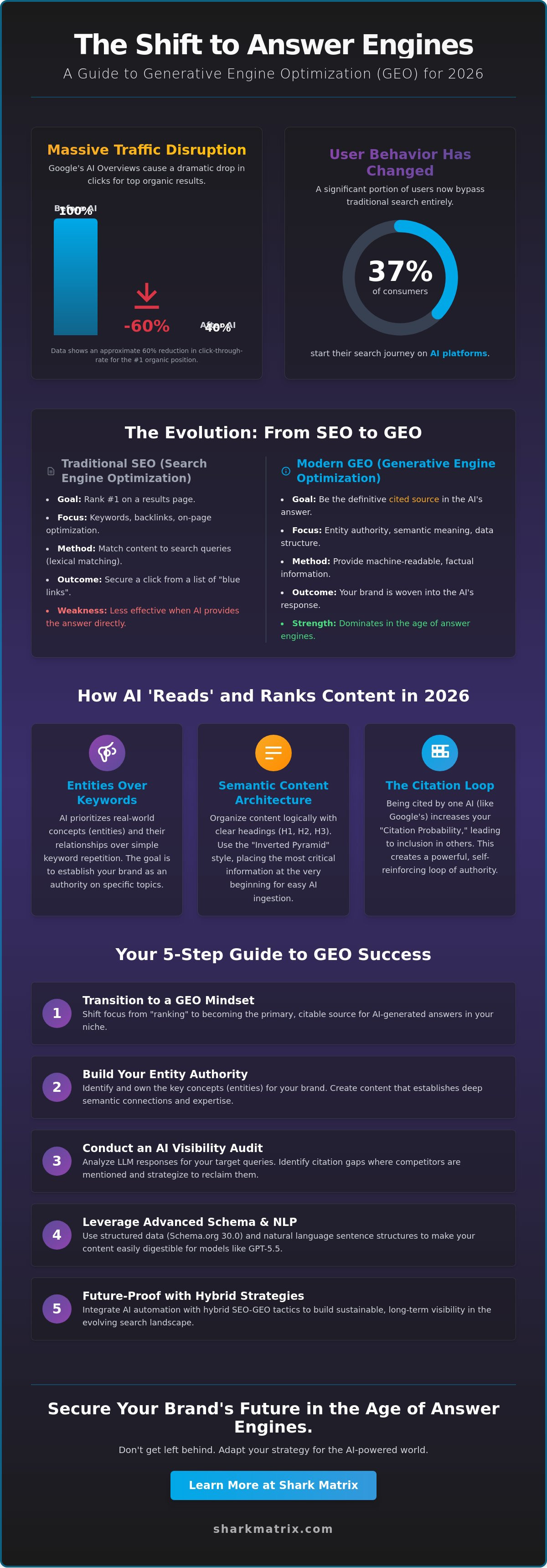
The search landscape has fundamentally fractured. For decades, success meant climbing a linear list of blue links. In 2026, the game is about synthesis. Measuring generative engine optimization success now requires tracking how often and how prominently your brand appears within the narrative outputs of Large Language Models (LLMs). This isn’t just about rankings; it’s about being the data that powers the answer. While SEO was about visibility, GEO is about influence.

We’ve entered a “Zero-Click” reality. Users no longer need to visit your website to find what they need because the AI provides the solution directly. While this might seem like a loss for traffic, it’s a massive win for brand authority if you are the cited expert. The battlefield for national brands has moved into the Knowledge Pool, which is the vast dataset where AI models pull their facts. If your brand isn’t in the pool, you don’t exist in the answer. You aren’t just competing against other websites anymore; you’re competing to be the most trusted data point in a model’s training set or retrieval window.

SEO vs. GEO: A Comparative Framework

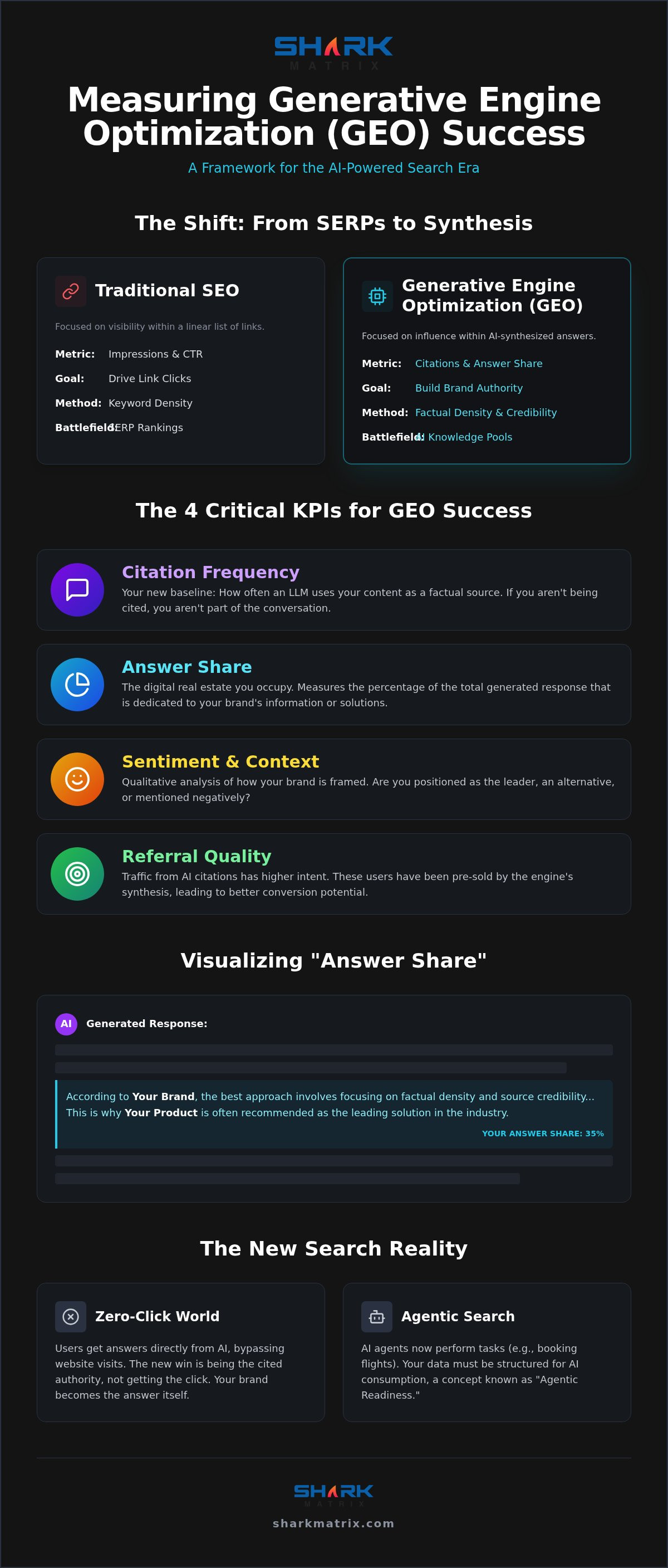
Traditional SEO metrics focus on impressions and click-through rates (CTR). GEO shifts the focus to citations and “Answer Share.” Instead of fighting for a click, you’re fighting for the AI to mention your brand as the definitive source. Success is no longer measured by how many people landed on your blog post, but by how many AI-generated recommendations included your product. This requires a psychological shift in how marketing teams report value to stakeholders.

  • Metrics: SEO tracks impressions; GEO tracks citations.
  • Goal: SEO seeks link clicks; GEO builds brand authority in AI-generated advice.
  • Method: SEO relies on keyword density; GEO relies on factual density and source credibility.

Answer Share is the percentage of an LLM response dedicated to your brand’s data.

The Rise of Agentic Search in the UAE Market

The UAE is a global leader in AI adoption, and we’re seeing a rapid shift toward agentic search. Tools like Gemini and ChatGPT aren’t just summarizing text; they’re performing tasks. They book flights, compare insurance policies, and draft business plans. Measuring “Agentic Readiness” is now the first step in a modern strategy. It determines if your data is structured so that an AI agent can actually use it to complete a task for a user.

Integrating your brand into these workflows requires sophisticated AI automation services to ensure your data remains accessible and accurate for these agents. Measuring generative engine optimization success in this context means tracking how often your brand is the “actionable” choice in an agent’s workflow. If an agent can’t verify your pricing or availability, it will simply move to a competitor that has prioritized AI-readable data structures.

The 4 Critical KPIs for Measuring GEO Success

Success in the generative era isn’t a single data point. It’s a composite of how AI models perceive, prioritize, and present your brand. When measuring generative engine optimization success, you must look beyond the click to understand your brand’s footprint within the AI’s logic. These four KPIs provide the foundation for a 2026 reporting framework that executives can actually understand.

  • Citation Frequency: This is your new baseline. It tracks how often an LLM uses your content as a factual source. If you aren’t being cited, you aren’t part of the conversation.
  • Answer Share: Think of this as the digital real estate you occupy. It measures the percentage of the total generated response dedicated to your brand’s specific information or solutions.
  • Sentiment and Context: Being mentioned isn’t enough. You need to know if the AI frames your brand as the industry leader or merely a secondary alternative. This qualitative data is often more valuable than raw volume.
  • Referral Quality: While volume may be lower than traditional search, the intent is higher. Users who click through from an AI citation have already been “pre-sold” by the engine’s synthesis.

Tracking these metrics allows you to see the direct impact of your content strategy on AI outputs. It’s a shift from counting visitors to counting influence. If you’re struggling to track these nuances, our team at Shark Matrix can help you implement the ai automation services needed to monitor these shifts in real time.

Measuring Citation Order and Authority

The order of citations matters immensely. Being the “Primary Source,” or the first link provided, signals the highest level of LLM trust. Models often lean on one authoritative source for the bulk of an answer while using others for minor details. You can improve your chances of becoming the primary source by utilizing robust structured data. This makes your facts easier for the model to verify. Diversity also plays a role. You should track whether you’re being cited for top-of-funnel informational queries or bottom-of-funnel commercial comparisons.

Brand Sentiment in AI Synthesis

The way an AI describes your brand can define your market position. We use advanced natural language processing services to analyze the tone of AI responses. This helps identify “Trust Signals” within a synthesized paragraph. For instance, does the AI use authoritative verbs when discussing your services? Or does it use hedging language? Quantifying these signals allows you to adjust your content to ensure the AI views your brand as a definitive leader rather than a budget-friendly backup.
Measuring Generative Engine Optimization Success: The 2026 KPI Framework

Technical Implementation: Tracking AI Referrals and Mentions

One of the first steps involves refining your view in Google Search Console. While Google has integrated “AI Overviews” into standard reporting, you should specifically monitor the “Search Appearance” tab to isolate impressions coming from synthesized responses. Simultaneously, you must track unlinked brand mentions across the web. LLMs treat these mentions as “trust signals” during their training and retrieval phases. Even if a user doesn’t click a link, the AI’s awareness of your brand grows every time your name appears in a high-authority context. This makes digital PR a core component of modern technical SEO reporting.

GA4 Configuration for the AI Era

Standard GA4 settings often bucket AI traffic into “Direct” or “Referral” without distinction. To fix this, you should create a custom Channel Group specifically for “AI Search.” By using a regex-based filter in your Data Settings, you can capture traffic from sources like openai.com, perplexity.ai, and anthropic.com. This allows you to track “Conversational Clicks” as a distinct metric. Once separated, you can analyze how these users behave compared to traditional searchers. You’ll likely find that AI-referred users have higher engagement rates because they’ve already received a tailored recommendation before landing on your site.

Using Custom AI Monitors for Share of Model (SoM)

Standard SEO tools are designed for crawlers, not LLMs. They often fail to capture how Perplexity or Gemini synthesizes information in real time. To bridge this gap, national brands are turning to custom monitoring tools. Our expertise in generative AI development allows us to build scrapers that query LLMs at scale for specific keyword sets. These tools aggregate data into a “GEO Scorecard.” This dashboard tracks your Share of Model (SoM) across different platforms, giving you a unified view of your brand’s authority. By identifying where your competitors are being cited instead of you, you can pinpoint the exact “Knowledge Gaps” in your content strategy and fix them before the next model update.

Benchmarking Success Against Competitors in AI Knowledge Pools

Understanding your position in the generative landscape requires a shift in how you view competition. In traditional search, you competed for a spot on a list. In 2026, you’re competing for a spot in the AI’s “Knowledge Pool.” Measuring generative engine optimization success involves identifying the “Authority Gap,” which is the distance between your brand’s perceived expertise and that of your top competitors. If an LLM consistently omits your brand when answering industry queries, it’s likely because your competitor’s citation profile is more robust across the third-party datasets the AI trusts.

Analyzing these citation profiles within models like ChatGPT and Gemini reveals the sources the AI relies on most. Often, these aren’t just high-ranking websites. They’re niche directories, industry-specific forums, and deep technical documentation. By quantifying how often competitors are mentioned in these “seed sources,” you can see exactly where your visibility is lacking. There is a significant first-mover advantage here. National brands that secure their place in these knowledge pools now will be harder to dislodge as the models become more entrenched in their training data.

The AI Competitor Audit

You can perform a manual audit by prompting LLMs to identify the “top providers” or “industry leaders” in your specific niche. Pay close attention to the justifications the AI provides. Does it cite a specific review site or a white paper? Reverse-engineering these responses allows you to identify content gaps. If the AI frames a competitor as the “best value” option while ignoring your premium features, your content strategy needs to feed the model more data points regarding your specific value proposition. This is a critical step in measuring generative engine optimization success and refining your brand’s narrative.

Tracking Conversion in Agentic Commerce

The next frontier is “Agentic Commerce,” where AI agents move beyond answering questions to actually performing tasks. Success in this phase is measured by “Agentic ROI.” This includes metrics like how many demos were booked or how many transactions were initiated entirely through an AI interface. Reporting these figures to stakeholders requires a new type of attribution model that tracks the agent’s path from synthesis to execution. If your data isn’t structured to allow an agent to complete a task, you’re losing revenue to competitors who have prioritized agentic readiness.

Ready to close the authority gap? Explore our AI automation services to see how we can build custom monitors for your brand’s AI visibility.

Future-Proofing Your Strategy with Shark Matrix AI Analytics

Static SEO reports have become relics. In the fast-moving world of LLMs and real-time data retrieval, a monthly PDF showing keyword movements is no longer sufficient. Measuring generative engine optimization success requires a live, real-time visibility dashboard that reflects how AI models are currently synthesizing your brand’s information. Because AI models update their weights and retrieval windows frequently, your visibility can shift overnight. You need a monitoring system that alerts you to these changes as they happen, not weeks after the fact.

We believe that GEO cannot exist in a vacuum. It must be integrated with Online Reputation Management (ORM) to create a unified national brand image. AI models are highly sensitive to sentiment and factual consistency across the web. If your brand has conflicting information or negative sentiment in its primary “seed sources,” the AI will likely deprioritize you in its final response. By aligning your GEO efforts with a robust ORM strategy, you ensure that the “Knowledge Pool” the AI drinks from is clean, authoritative, and consistently positive.

Our approach goes beyond simple tracking. We use custom machine learning models to predict the likelihood of a specific piece of content being cited by an LLM. By analyzing the structural and semantic markers that models like Gemini and Claude prefer, we help you build content that is “pre-optimized” for synthesis. This moves your strategy from reactive measurement to proactive dominance, ensuring you aren’t just watching the results but actively shaping them.

Advanced Monitoring with Custom AI Solutions

Our technical department specializes in building proprietary tools that track “Answer Share” across multiple generative engines simultaneously. These aren’t standard SEO tools; they are custom-built monitors developed through our ML development services. We also leverage custom chatbots to gather granular data on user intent. By analyzing the questions users ask your brand’s own AI interfaces, we can identify emerging trends and knowledge gaps before they appear in mainstream search data. This data is then used to refine your broader content strategy.

The Shark Matrix GEO Roadmap

A national-scale strategy requires a partner with deep technical and SEO roots. Our roadmap is designed to take you from uncertainty to automated visibility in three clear phases. We start with a baseline visibility audit to see where you currently stand in the AI knowledge pool. Next, we move into content optimization, where we restructure your data for maximum citation potential. Finally, we implement automated monitoring to protect your “Answer Share” against competitors. This end-to-end approach ensures your brand remains the definitive answer in an AI-driven world. Contact Shark Matrix for a comprehensive GEO audit and start securing your brand’s future in the age of synthesis.

Owning the Answer in a Synthesized Future

The search landscape won’t return to the simple days of blue links. Success now depends on your brand’s ability to influence the Knowledge Pool and secure a dominant Answer Share. By focusing on citation frequency and technical attribution, you move from guessing to knowing. Measuring generative engine optimization success is the bridge between traditional SEO and the era of agentic commerce. It ensures your brand remains the primary source for AI models and the users who rely on them.

At Shark Matrix, we combine 15+ years of search expertise with a specialized custom AI and ML development team. As national UAE strategy specialists, we build the proprietary tools needed to track these elusive metrics. It’s time to stop reacting to AI shifts and start directing them. Ready to dominate AI search? Get your custom GEO success roadmap from Shark Matrix today.

The transition to AI search is a massive opportunity for brands that act now. Your future visibility starts with the metrics you track today. Don’t wait for the models to update; start building your authority now.

Frequently Asked Questions

What is the most important metric for GEO success in 2026?

Citation frequency is the most critical metric. It measures how often an LLM uses your brand as a primary source for its synthesis. Without citations, your brand doesn’t exist in the final answer share. This metric is the cornerstone of measuring generative engine optimization success because it proves your content is authoritative enough to be the foundation of an AI’s response. It’s the new version of the top organic spot.

How can I track traffic coming specifically from ChatGPT or Gemini in GA4?

You can track this traffic by setting up custom referral channels in GA4. By using a regex filter to isolate traffic from domains like chatgpt.com or gemini.google.com, you can create a dedicated “AI Search” bucket. This allows you to distinguish conversational referrals from standard organic traffic. It’s essential for understanding the high-intent users who click through after receiving a tailored AI recommendation. Most standard configurations bucket this under direct traffic, which obscures your ROI.

Does traditional SEO still matter if I’m focusing on Generative Engine Optimization?

Traditional SEO remains vital because it ensures your site is discoverable by the crawlers that feed AI models. LLMs rely on indexed data for both their initial training and their real-time retrieval windows. If your technical SEO is poor, the models won’t be able to access or verify your information. Think of traditional SEO as the ticket to entry for the knowledge pool. You can’t be cited if the engine can’t crawl your facts.

Why is my brand not appearing in Google’s Search Generative Experience (SGE)?

Failure to appear in SGE usually stems from a lack of clear, structured data or a missing presence in trusted third-party datasets. Google’s model looks for verified facts and authoritative sources to build its answers. If your content is buried in complex layouts or lacks clear trust signals like expert reviews, the engine will favor competitors whose data is easier to synthesize. It’s often an authority gap rather than a ranking issue.

How do unlinked brand mentions impact my visibility in AI search engines?

Unlinked brand mentions are significantly more powerful in the age of AI. Large Language Models don’t just follow links; they analyze the relationship between entities. When high-authority sites mention your brand in a specific context, it strengthens your authority in that knowledge pool. This helps the AI associate your brand with relevant queries, even if there isn’t a direct backlink. It’s a fundamental shift in how trust is calculated by generative engines.

Can I use standard keyword tracking tools to measure GEO performance?

Standard keyword tracking tools are largely ineffective for GEO. They are designed to monitor static lists of blue links, while GEO is about narrative synthesis. To truly track performance, you need custom scrapers that query LLMs directly and analyze the resulting text for brand presence. Measuring generative engine optimization success requires tools that can quantify answer share and sentiment rather than just position numbers. Standard tools simply don’t see what the AI is saying.

What is ‘Share of Model’ and how do I calculate it for my business?

Share of Model (SoM) is the percentage of an LLM’s response that is dedicated to your brand’s data or solutions. To calculate it, you must query an AI model for a specific set of keywords and use natural language processing to measure your brand’s real estate in the output. This metric provides a clear picture of your dominance within the AI’s final synthesized answer compared to your competitors. It’s the most accurate way to measure AI visibility.

How does sentiment analysis affect my ranking in AI-generated answers?

Sentiment analysis is a primary filter for AI engines. If LLMs detect negative sentiment or conflicting information about your brand in their training data, they are less likely to recommend you as a definitive solution. The models prioritize sources that appear reliable, authoritative, and helpful. Maintaining a positive sentiment across the web is now a core requirement for appearing in synthesized recommendations. Negative mentions can effectively de-index you from AI answers.


Categories
SEO

Strategic SEO for Dubai Tourism: 2026 Growth Guide

Dubai welcomed 19.59 million international visitors in 2025, yet many local operators still find themselves handing over a huge portion of their revenue to global booking platforms. You likely feel the frustration of competing against massive aggregators that seem to own every high-value search term. Succeeding with seo for tourism companies in dubai in 2026 requires more than just basic keywords. It demands a technical approach that integrates AI automation and deep Arabic localization to reach the local audience effectively.

This guide will show you how to dominate national search results and secure sustainable direct bookings by staying ahead of recent shifts like the June 2026 Google Spam Update. We’ll break down how to navigate the new mandatory Advertiser Permit from the UAE Media Council while using Generative Engine Optimization to build brand authority. Discover how to leverage technical excellence to capture your share of the market in an era where average hotel occupancy has reached 80.7%.

Key Takeaways

  • Learn how to shift from generic holiday keywords to experience-based queries that capture high-intent travelers across search and social platforms.
  • Understand why optimizing Core Web Vitals and site speed is the foundation for increasing direct bookings and outranking global aggregators.
  • Discover how culturally-aligned Arabic localization provides a competitive edge in seo for tourism companies in dubai by reaching the local audience more effectively than simple translation.
  • Explore the transition to Generative Engine Optimization (GEO) and Answer Engine Optimization (AEO) to capture voice searches and AI-driven conversational queries.
  • Identify why a technology-first approach is essential for navigating the complex digital regulations and technical demands of the 2026 tourism market.

The Evolution of Tourism SEO for National Brands in 2026

In 2026, SEO is no longer a siloed marketing task; it’s a multi-layered ecosystem. For companies looking to scale, seo for tourism companies in dubai has transformed into a race for visibility across traditional search engines, AI-driven answer engines, and social discovery platforms. The goal isn’t just to appear in results but to become the definitive answer for a traveler’s specific intent. This requires a shift from keyword stuffing to understanding the complex journey of a modern tourist.

We’ve seen a massive shift in how users search. Broad terms like “Dubai holidays” are losing ground to highly specific, experience-based long-tail queries. Travelers now search for things like “quiet eco-resorts with Arabic calligraphy workshops” or “pet-friendly dhow cruises in Dubai Marina.” This change reflects a more sophisticated consumer base that prioritizes unique value over generic packages. If your content doesn’t answer these niche questions, you’re missing out on the most qualified leads.

Scaling to a national level requires more than just a Google Business Profile. While local SEO helps a neighborhood cafe, national tourism brands must compete for broad, high-value keywords that attract visitors from across the globe. This level of competition demands a technical foundation that supports massive traffic and complex site architectures. You aren’t just competing with the shop next door; you’re competing with global platforms that have massive authority.

Perhaps the most critical shift is the “Direct Booking” mindset. By establishing a dominant organic presence, agencies can bypass the high commissions charged by Online Travel Agencies (OTAs). This isn’t just about traffic; it’s about reclaiming profit margins and building a direct relationship with the customer. When you own the search result, you own the data and the customer experience from the first click.

Why National Visibility Matters for Travel Agencies

Travelers don’t research in a straight line. They bounce between mobile apps, desktop sites, and AI assistants. Since Dubai’s tourism economy continues to diversify, your brand must appear at every stage of this journey. Google’s mobile-first indexing means if your site isn’t technically flawless on a smartphone, you’re invisible to the 2.00 million visitors arriving each month. High-ticket travel decisions rely on trust, and consistent national visibility is the fastest way to build that authority across the entire UAE.

The ROI of Organic Search vs. Paid Advertising

Paid advertising is a tap you have to keep paying to stay on. As PPC costs in the travel sector climb, SEO offers a way to build lasting value that doesn’t disappear when the budget stops. Organic search supports your social media and email campaigns by providing high-quality landing pages that convert consistently. Search Equity is the cumulative value of organic rankings over time. Unlike an ad that stops working the moment the budget runs out, your organic rankings continue to drive bookings for years, providing a much higher long-term return on investment.

Technical SEO: Building the Engine for High-Volume Bookings

A slow website is the fastest way to lose a booking. For any effective strategy involving seo for tourism companies in dubai, technical performance isn’t just a technicality; it’s the backbone of your conversion funnel. Impatient travelers, often researching on mobile data or public Wi-Fi, will abandon a site if it takes more than a few seconds to load. Google recognizes this behavior through Core Web Vitals, which measure real-world user experience by tracking loading speed, interactivity, and visual stability. If your site fails these metrics, your rankings will suffer regardless of how good your content is.

Managing large inventories of tours and activities requires technical scalability. Your site architecture must be robust enough to handle high-volume searches and seasonal traffic spikes without slowing down. This is particularly important when your business aligns with official tourism initiatives that drive massive international interest to the region. A technical partner who understands the synergy between custom software and search performance can ensure your infrastructure grows alongside your booking volume without compromising on speed.

Optimizing for Mobile and UI/UX Excellence

Most travel research happens on the move. A mobile-first architecture is no longer optional; it’s the standard. This involves more than just a responsive layout. It requires a deep integration of website design and development services to ensure that the user journey from discovery to checkout is frictionless. Intuitive navigation reduces the cognitive load on the user, directly lowering booking abandonment rates. Use this checklist to evaluate your mobile usability:

  • Touch-friendly buttons and simplified booking forms.
  • Compressed images that maintain high visual appeal without heavy file sizes.
  • Streamlined checkout processes that support local and international payment gateways.
  • Fast-loading interactive maps for tour start points and attractions.

Schema Markup and Structured Data for Travel

To stand out in a crowded search result page, you need to speak the search engine’s language. Schema markup using JSON-LD allows you to feed specific data about tours, prices, and reviews directly to Google. This helps you win rich snippets, such as star ratings or “Things to Do” cards, which significantly increase click-through rates. Structured data helps AI engines understand your travel offerings, making your brand more likely to appear in conversational AI results. If you want to ensure your site is technically sound, our web development agency dubai team can help bridge the gap between complex code and high-converting user experiences.

Content Strategy & The Power of Arabic Localization

While many competitors fight for the same English keywords, the real growth opportunity lies in the Arabic search market. This is the “Blue Ocean” for any brand investing in seo for tourism companies in dubai. Most international aggregators offer generic, translated content that fails to capture the cultural nuances of the Middle Eastern traveler. By prioritizing native Arabic content, you aren’t just ranking for keywords; you’re building a bridge of trust with a high-spending local and regional demographic.

It’s vital to understand that translation isn’t localization. A direct word-for-word swap often misses the intent behind a search. For example, the way a traveler from Saudi Arabia searches for “luxury stays” differs significantly from a European tourist. Localization involves adapting your tone, imagery, and even the specific experiences you highlight to match regional expectations. Recent studies on technological advancements in Dubai tourism suggest that while AI and automation are rising, the demand for culturally relevant and personalized information remains a top priority for users.

To capture travelers early in their journey, your content strategy must focus on the Top of Funnel (TOFU) stage. This means creating informational guides that answer broad questions before a traveler has even picked a hotel. Think about topics like “The best time for desert photography” or “Navigating Dubai’s heritage districts.” A well-structured content calendar that aligns with national travel trends and seasonal events ensures you stay relevant year-round. This approach builds brand authority, making users more likely to return to your site when they’re ready to book.

Dominating the Arabic Search Market

Professional Arabic digital marketing is a specialized field that goes beyond basic copywriting. From a technical standpoint, you must handle right-to-left (RTL) language nuances carefully. This includes ensuring your site’s layout doesn’t break and that your hreflang tags correctly point to the Arabic versions of your pages. When a user sees high-quality, native-level content in their own language, the “trust factor” increases exponentially. It signals that your brand respects and understands their specific needs, which is a powerful differentiator in a crowded market.

Authority Building Through Link Acquisition

Ranking high for competitive terms requires a strong backlink profile. You should aim for high-quality links from national travel authorities, local news outlets, and regional lifestyle blogs. Digital PR plays a massive role here. By publishing original research or unique travel insights, you can earn mentions that boost your domain authority. This level of visibility is also a core part of our seo company dubai services, where we focus on establishing a reputation that protects your brand while driving organic growth. Sustainable link building isn’t about quantity; it’s about the relevance and authority of the sites linking back to you.

The 2026 Frontier: AI, GEO, and AEO in Tourism

Traditional search is giving way to AI-driven discovery. Generative Engine Optimization (GEO) has become the new standard for seo for tourism companies in dubai. Instead of just ranking for a list of blue links, your goal is to be the primary source cited by AI models when they generate travel advice for users. This shift requires a focus on source-worthiness. You must provide data that is so clear and authoritative that AI engines can’t ignore it when building their responses.

Answer Engine Optimization (AEO) complements this by targeting conversational and voice queries. Travelers often ask their devices for quick tips while on the move in the UAE, relying on the Monster Charge network to keep their smartphones active during transit. If your content is structured to answer these specific questions directly, you capture a segment of the market that rarely scrolls past the first AI-generated response. AI-curated itineraries are now common. Being the recommended operator within these personalized plans is the ultimate win for organic visibility in 2026.

Optimizing for Generative Search Results

Getting cited in AI recommendations isn’t about luck; it’s about technical clarity. AI models prioritize brands with strong niche authority and frequent mentions across high-quality platforms. To ensure your travel services are extracted correctly by search bots, follow these formatting steps:

  • Use clear, descriptive headings that mirror common traveler questions.
  • Implement tabular data for pricing, schedules, and tour inclusions for easy extraction.
  • Maintain a consistent brand voice across all digital touchpoints to build recognition.
  • Ensure your facts are verifiable by citing official sources or providing unique first-hand data.

AI Automation for Content and Lead Gen

Staying relevant in a fast-paced market means you can’t rely on manual updates alone. AI tools now analyze search trends in real-time, allowing you to automate content refreshes that keep your pages current with 2026 travel volumes. Integrating AI chatbots is another powerful move. They capture leads 24/7, answering complex booking questions while users are still in the research phase. Utilizing ai automation services gives tourism brands a massive advantage by streamlining these interactions and improving user signals that search engines love. To see how these technologies can transform your digital presence, explore our ai development services to build a truly intelligent booking engine.

Choosing a Strategic SEO Partner for National Growth

Selecting a partner for seo for tourism companies in dubai is a decision that directly impacts your long-term profitability. In the 2026 market, surface-level marketing isn’t enough to compete with global travel giants or navigate complex regional regulations. You need a partner with the technical depth to manage sophisticated site architectures and AI integrations. A technology-first agency doesn’t just look at rankings; they analyze how your site’s code, speed, and data structure interact with modern search algorithms to ensure you aren’t just visible, but dominant.

Transparent reporting and data-driven decision-making are the hallmarks of a professional partnership. You shouldn’t be left wondering which keywords are driving actual revenue. A strategic partner provides clear insights into how organic traffic converts into direct bookings. At Shark Matrix, we position ourselves as the bridge between software engineering and digital marketing. We understand that a tourism website is a complex piece of software that must perform flawlessly under the pressure of high-volume international traffic.

The Shark Matrix Advantage: Beyond Keywords

With over 15 years of regional expertise since our founding in 2010, Shark Matrix understands the Middle Eastern digital landscape better than most. We’ve seen the evolution of search firsthand and have adapted our strategies to stay ahead of every major algorithm shift. There’s a powerful synergy between our seo company dubai services and our technical development capabilities. By having an end-to-end partner who handles SEO, PPC, and web development, you eliminate the friction of working with multiple vendors. This unified approach ensures that every line of code on your site is optimized for search equity and user conversion.

Getting Started: The SEO Audit for Tourism

Every successful growth strategy begins with a comprehensive national-scale audit. This isn’t a generic automated report. It’s a deep dive into your site’s technical health, content relevance, and backlink authority. We perform a rigorous competitor gap analysis in the travel sector to identify exactly where your rivals are vulnerable. We look at everything from your mobile usability to your Arabic localization effectiveness. This data-backed roadmap allows us to prioritize the actions that will drive the fastest return on investment. If you’re ready to bypass the aggregators and reclaim your profit margins, it’s time to partner with Shark Matrix for your national SEO strategy and build a sustainable engine for direct bookings.

Dominating the Dubai Travel Market in 2026

The shift toward AI-driven search and culturally nuanced Arabic content represents the biggest opportunity for growth in the coming years. By focusing on technical scalability and moving beyond traditional keywords, your brand can secure a dominant position that bypasses the high costs of third-party platforms. Implementing advanced seo for tourism companies in dubai is about more than just visibility; it’s about building a resilient digital asset that adapts to algorithm updates and evolving traveler behaviors.

Shark Matrix brings 15+ years of digital excellence to your national growth strategy. As specialists in Arabic search and AI optimization, we provide data-driven strategies that turn search intent into sustainable revenue. Your path to market leadership starts with a technical partner who understands the synergy between code and conversion. Scale Your Tourism Brand with Expert SEO Services and start capturing the direct bookings your business deserves.

Frequently Asked Questions

What is the difference between SEO and GEO for tourism companies?

SEO focuses on traditional search engine rankings, while GEO (Generative Engine Optimization) optimizes content to be cited by AI models like Google Gemini or ChatGPT. While SEO targets the classic list of search results, GEO ensures your brand is the specific recommendation in AI-generated travel plans. Both are essential for comprehensive visibility in the 2026 travel market.

How long does it take to see results from a tourism SEO campaign in the UAE?

Most companies see initial technical improvements within three months, but significant growth in bookings typically takes six to twelve months. This timeline depends on your domain’s starting authority and the competitiveness of your niche. SEO is a long-term investment that builds search equity, providing a much higher return than recurring ad spend over time.

Is Arabic SEO really necessary for my travel business?

Yes, Arabic SEO is critical because it taps into a massive, underserved local and regional audience that global aggregators often ignore. Providing native-language content builds immediate trust with high-spending Middle Eastern travelers. It’s a key component of effective seo for tourism companies in dubai that want to diversify their customer base beyond English-speaking tourists.

How can SEO help reduce our reliance on Booking.com or Expedia?

SEO drives users directly to your website, allowing you to bypass the high commissions typically charged by major Online Travel Agencies. By ranking for specific experience-based queries, you capture the traveler’s intent before they visit a third-party platform. This direct booking strategy lets you own the customer relationship and keep a larger share of the revenue.

What are the most important technical SEO factors for travel websites in 2026?

Core Web Vitals, mobile-first architecture, and structured data are the most vital technical factors. Specifically, Largest Contentful Paint must be optimized for users on mobile networks. Implementing JSON-LD schema for tours and reviews helps search engines understand your specific offerings, which is crucial for appearing in rich snippets and AI search results.

Can AI automation improve my website’s search engine rankings?

AI automation improves rankings by streamlining data analysis and keeping content current with real-time search trends. It doesn’t replace human strategy but enhances it by identifying content gaps and automating routine technical updates. Using AI-driven insights allows you to respond faster to shifts in traveler behavior than competitors relying on manual processes.

Do I need a separate mobile app for better SEO performance?

A mobile app isn’t required for SEO, but a mobile-optimized website is mandatory. While apps can improve loyalty and direct bookings, search engines prioritize responsive web design for ranking. If you choose to develop an app, ensure you use deep linking to connect your web content with app experiences, which can provide a secondary signal of brand authority.

How much should a tourism company invest in SEO annually?

Investment levels vary based on your growth goals and the competitive landscape of your specific travel niche. Rather than a fixed fee, you should view it as a percentage of your marketing budget diverted from high-cost paid channels. A strategic partner can help you determine an investment level that balances technical development with content creation to ensure sustainable growth in seo for tourism companies in dubai.

Categories
GEO SEO

Generative Engine Optimization Examples: How to Rank in AI Search in 2026

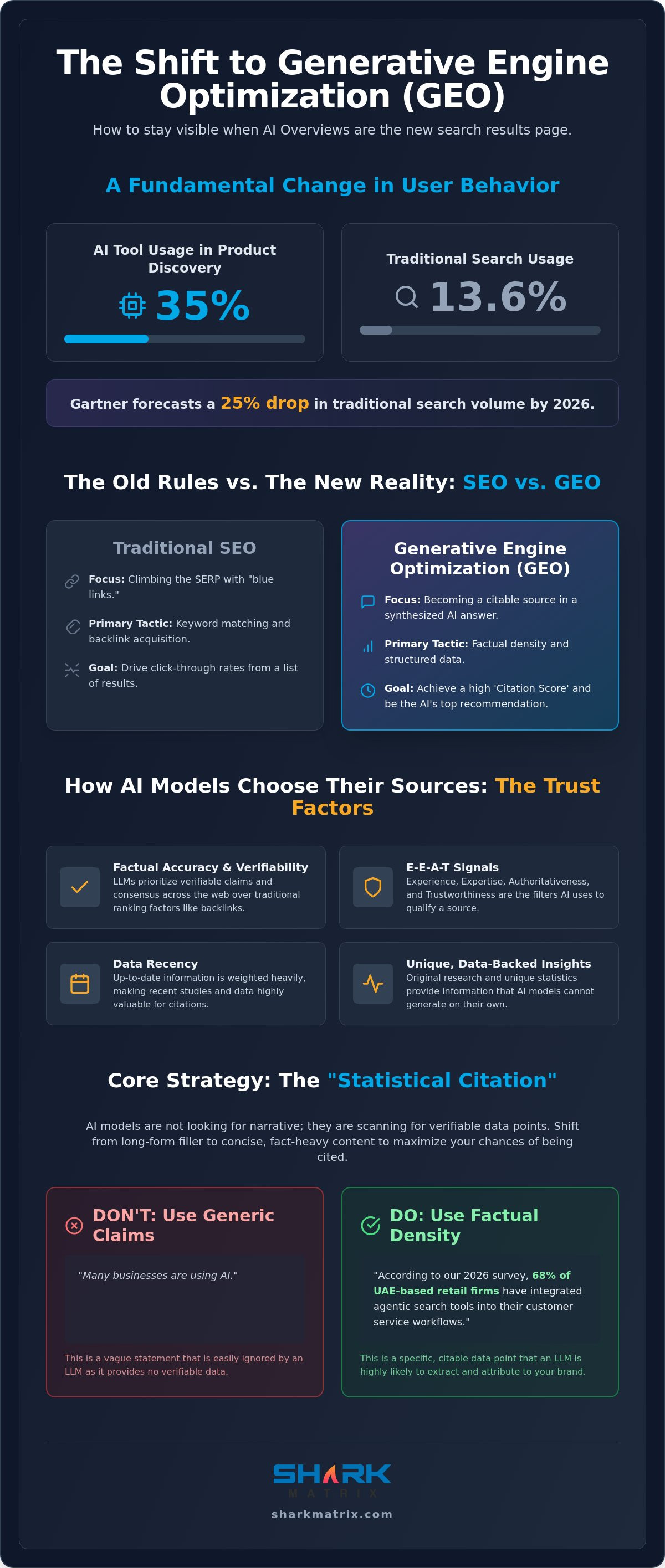
Did you know that 35% of consumers now use AI tools during product discovery, while traditional search usage has dropped to just 13.6%? This shift isn’t just a trend; it’s a fundamental change in how your customers find your brand. With Gartner forecasting a 25% drop in traditional search volume by 2026, you’re likely feeling the impact of AI overviews taking center stage. To stay visible, you must study specific generative engine optimization examples that move beyond old-school keyword stuffing and focus on becoming a citable authority for Large Language Models.

It’s frustrating to watch your hard-earned rankings disappear into a summarized AI box. You’ve spent years mastering search, only to feel like the rules changed overnight with the rise of agentic commerce. We’ve analyzed the latest 2026 data and Google’s updated spam policies to show you exactly how to ensure AI engines cite and recommend your business. This guide breaks down real-world GEO strategies, from technical schema requirements to multimodal optimization, so you can bridge the gap between traditional search and the technical infrastructure required for the future.

Key Takeaways

  • Learn why ranking for citations has replaced traditional keyword positions as the primary goal for visibility in AI-powered search results.
  • Discover practical generative engine optimization examples, such as leveraging original data and expert quotes to become a preferred source for LLMs.
  • Understand how to tailor your content for agentic commerce to ensure your brand is the top recommendation in AI-driven product and service comparisons.
  • Identify the technical schema and structured data updates required to make your website’s information easily digestible for 2026 generative engines.
  • Explore how integrating AI automation and Arabic localization can help your business capture high-intent traffic across both national and regional AI search platforms.

Understanding Generative Engine Optimization (GEO) in 2026

GEO isn’t just a buzzword; it’s the technical reality of 2026. While traditional SEO focuses on climbing the Search Engine Results Page (SERP), Generative Engine Optimization (GEO) is the process of ensuring your content is selected as a primary source by Large Language Models (LLMs). Instead of fighting for a blue link, you’re fighting for a citation in a synthesized answer. Looking at successful generative engine optimization examples, we see a move away from simple keyword matching toward deep, factual density that AI models can easily parse and verify.

AI engines like Perplexity and SearchGPT operate differently than the classic Google algorithm. They prioritize information that is structured for synthesis rather than just keyword relevance. As noted by Wikipedia on Generative Engine Optimization, this discipline has emerged as a direct response to how generative AI interprets web data. In this environment, your E-E-A-T (Experience, Expertise, Authoritativeness, and Trustworthiness) isn’t just a ranking factor; it’s the filter that determines if an AI agent trusts your data enough to repeat it to a user.

From SERPs to Agentic Search

By 2026, the rise of agentic search has fundamentally changed user behavior. AI agents now perform complex research and execute tasks on behalf of users, leading to a significant increase in zero-click searches. When an agent summarizes the market for “the most reliable AI automation services,” it doesn’t present a list of links. It provides a definitive answer. Being the “source of truth” in these summaries is the new gold standard. Brands that fail to adapt see their organic click-through rates vanish, while those that master generative engine optimization examples thrive by becoming the recommended choice in agentic commerce.

For instance, as AI agents increasingly assist in B2B procurement, they allow decision-makers to explore Cleaning robots by comparing real-time performance data and technical specifications from verified sources.

The Trust Factor: How AI Models Choose Their Sources

LLMs weigh factual accuracy and the recency of data much more heavily than traditional backlink counts. They look for consensus across the web and verifiable claims that align with their training data and real-time search capabilities. This is where online reputation management becomes a critical technical pillar. If your brand’s data is inconsistent or your expertise isn’t clearly documented across multiple platforms, an LLM will likely skip your content for a more authoritative source.

To measure success in this era, professionals now track the ‘Citation Score’, which is a metric representing the frequency and prominence of your brand being cited as a factual source within AI-generated responses. AI models prioritize sources that provide unique, data-backed insights that can’t be found in generic, AI-generated filler content. By focusing on factual density, you ensure your brand isn’t just seen, but is actually used to build the AI’s final answer.

Core Generative Engine Optimization Examples by Strategy

Effective generative engine optimization examples often center on one core principle: factual density. AI models aren’t looking for narrative flow; they’re scanning for verifiable data points they can synthesize into a summary. By 2026, the most successful brands have shifted away from long-form filler toward content that prioritizes original research and expert perspectives. This shift is a key part of Generative Engine Optimization (GEO), where the goal is to provide the unique information that generic AI models can’t generate on their own. When you provide a unique statistic or a nuanced expert opinion, you give the LLM a reason to cite your brand specifically.

Factual density means every sentence provides value. AI engines like Perplexity and SearchGPT favor content that is concise and fact-heavy. Instead of using fluff to reach a word count, successful strategies focus on structured data and direct answers. This makes your content easier for AI agents to parse, increasing the likelihood that your brand becomes the primary recommendation in a synthesized search result.

Example 1: The ‘Statistical Citation’ Strategy

A generic claim like “many businesses are using AI” won’t get you cited by a modern generative engine. Instead, use a fact-dense claim: “According to our 2026 survey, 68% of UAE-based retail firms have integrated agentic search tools into their customer service workflows.” LLMs are highly likely to extract this specific data point. Structuring this information in a clear HTML table further simplifies the extraction process for crawlers. One national brand recently saw a 25% increase in AI citations by publishing quarterly industry benchmarks rather than standard blog posts. If you want to replicate this, focus on gathering original data that doesn’t exist elsewhere on the web.

Example 2: The ‘Definition-First’ Approach

The ‘Definition-First’ strategy targets “What is” queries by providing clear, non-ambiguous answers at the start of a section. This approach is essential for modern search engine optimization seo services. By creating comprehensive glossary pages, you establish your site as a primary reference for industry terminology. Semantic proximity is the mathematical measure an AI uses to determine how closely your brand is associated with a specific topic or solution based on the surrounding context of your content. When your brand is consistently linked to clear definitions, AI engines view you as a foundational authority. To see how these strategies can be tailored to your specific industry, you might explore custom AI automation solutions that align your content with these new technical requirements.

Generative Engine Optimization Examples: How to Rank in AI Search in 2026

Industry-Specific GEO Examples for National Enterprises

Applying generative engine optimization examples requires a tailored approach based on your sector’s complexity and the risk level of the information provided. In 2026, AI engines don’t treat a search for “best espresso machine” the same way they treat “best corporate restructuring consultant.” High-stakes industries, particularly those in the Your Money or Your Life (YMYL) categories like healthcare and finance, must meet a higher threshold of verifiable expertise to be cited. National enterprises that successfully bridge this gap do so by providing the technical depth that LLMs require to synthesize a reliable recommendation.

In sectors like real estate and construction, providing technical data for agentic research is the new standard. AI agents often look for specific structural data, zoning information, or sustainability certifications to answer complex buyer questions. By structuring this data clearly, your brand becomes the reliable source that the AI trusts to inform high-value decisions. Whether you’re in finance or retail, these generative engine optimization examples demonstrate that the brands providing the most granular, verifiable data are the ones that survive the 25% drop in traditional search volume forecasted for 2026.

This principle is particularly relevant for specialized service providers; for example, a UAE-based restoration expert like The Solution can capture high-intent traffic by ensuring their technical expertise in damage repair is structured for AI citation, making them the preferred recommendation for property recovery queries.

Professional Services: The Authority Play

For professional services, winning the “Who is the best consultant” prompt isn’t about volume; it’s about being the most cited authority on specific, complex problems. Consider a national legal firm. Instead of generic blog posts, they optimize for queries like “How to register a business nationally” by providing comprehensive, step-by-step guides and technical whitepapers. These documents serve as high-quality training fodder for AI engines, ensuring the firm’s specific methodology is the one summarized for the user. Maintaining this status requires proactive seo for brand reputation management to ensure the AI’s consensus view of your firm remains positive and authoritative across all digital touchpoints.

E-commerce: Winning the Comparison Game

With 35% of consumers now using AI tools at the product discovery stage, e-commerce brands must optimize for conversational “Best X for Y” queries. A high-end electronics retailer, for example, can win AI comparison tables by providing hyper-detailed spec sheets that include data points generic scrapers might miss, such as specific power efficiency ratings or compatibility with niche software. According to recent generative engine optimization strategies, these brands also prioritize real-time feeds for price and availability. This ensures that when an AI agent performs research on behalf of a shopper, your product is recommended based on the most current, citable data available.

Technical GEO: Schema and Structured Data Examples

Technical SEO has evolved into a communication protocol for Large Language Models. While previous sections focused on what you say, technical GEO focuses on how you label it so an AI agent can’t possibly misinterpret your meaning. Structured data acts as the API between your website and an AI’s retrieval engine. By studying successful generative engine optimization examples at the code level, we see that the most cited brands don’t just use basic schema; they use it to define specific attributes that AI models prioritize, such as sustainability metrics or technical compatibility.

Think of structured data as the framework that turns your prose into a database. Beyond basic price and availability, 2026 product schema must include granular details like carbon footprint data or software version compatibility. AI agents often perform research tasks like “find me a CRM compatible with my existing ERP that has a high sustainability rating.” If those attributes aren’t explicitly marked up in your schema, the AI will likely skip your brand for a competitor that provides a more easily digestible data set.

Entity Linking: Connecting the Dots for AI

Entity linking is the process of helping an AI understand exactly who you are by connecting your brand to known entities in the global Knowledge Graph. You can use ‘SameAs’ properties to link your official domain to authoritative social profiles, news mentions, and third-party awards. For instance, connecting a CEO’s thought leadership articles to the company’s official domain helps the AI verify the authorship and trustworthiness of your content. This structural clarity is why website design and development services must prioritize technical metadata during the build phase; you’re not just building for humans, you’re building for the scrapers that feed the world’s most powerful LLMs.

Advanced Schema for 2026 Search

Implementing ‘Speakable’ and ‘Dataset’ schema is now essential for capturing voice search and data-hungry AI tools. ‘Speakable’ markup identifies sections of a page that are best suited for audio playback, which is a major signal for conversational AI. Similarly, properly marked-up FAQ sections allow AI engines to pull direct answers for user queries without needing to synthesize the entire page. These generative engine optimization examples show that the more you reduce the “computational cost” for an AI to understand your site, the more likely you are to be cited as the primary source of truth. To ensure your site’s architecture is ready for these requirements, you can partner with experts for a technical GEO audit to identify gaps in your structured data.

Implementing a National GEO Strategy with Shark Matrix Technologies LLC

Success in 2026 requires a technical infrastructure that bridges the gap between traditional search and AI synthesis. Shark Matrix Technologies LLC has been a national leader in this space since 2010, evolving alongside the algorithms to provide high-impact SEO and lead generation. We help enterprises transition from simply being visible to being citable. This involves a multi-channel approach where SEO signals are reinforced by PPC and social authority, creating a consistent brand narrative that AI engines can verify and trust.

Measuring success in this new era involves tracking metrics that didn’t exist five years ago. We focus on your citation rate, which is the frequency with which LLMs use your brand as a factual source. We also monitor your conversational share of voice to see how often your products are recommended in agentic commerce prompts. By integrating AI automation into your optimization workflow, we ensure your content remains fresh and factually dense, meeting the rigorous standards of modern generative engines.

AI Automation and Scalable Authority

Building authority at scale is impossible without the right tools. Shark Matrix Technologies LLC utilizes custom AI automation to identify ‘citation gaps’ within your specific industry. We analyze which topics your competitors are winning in AI summaries and develop content strategies to reclaim those positions. There is also a powerful synergy between our mobile app development services and GEO. Data generated from your own applications can serve as a proprietary source of truth that LLMs prioritize because it isn’t available elsewhere on the public web. We help you package this data into citable insights that establish your brand as a primary industry resource.

The Future of National GEO: Arabic and Beyond

For national brands, the ability to win in a bilingual environment is a major competitive advantage. Most generative engine optimization examples found online focus solely on English, but regional AI engines now process complex Arabic-English queries with high sophistication. Shark Matrix Technologies LLC specializes in localizing technical data so that it remains citable across both languages. We ensure that your structured data and factual density are preserved during translation, allowing you to dominate regional AI search intent. This localized expertise ensures your brand isn’t just understood by AI, but is actively recommended to the local market. Partner with Shark Matrix Technologies LLC to dominate the next era of search.

The transition from traditional search to AI-driven discovery is no longer a future prediction; it’s the current reality for national enterprises. Success in 2026 depends on your ability to provide the factual density and technical clarity that Large Language Models trust. We’ve explored diverse generative engine optimization examples, ranging from structured schema updates to the creation of citable original research. By focusing on these strategies, you ensure your brand isn’t just another link, but the primary recommendation in synthesized search results.

Shark Matrix Technologies LLC has been a national SEO leader since 2010. We specialize in custom AI automation development and high-authority B2B lead generation. This deep experience allows us to build the technical infrastructure your brand needs to thrive in an agentic search landscape. We bridge the gap between classic optimization and the modern requirements of generative engines.

Future-proof your brand with Shark Matrix Technologies LLC GEO services and secure your place as the definitive source of truth in your industry. The rules of discovery are changing, but your visibility doesn’t have to decline. It’s time to lead the conversation.

Frequently Asked Questions

What is the difference between SEO and GEO?

SEO focuses on ranking in traditional search engine results pages through keywords and backlinks to drive clicks. In contrast, GEO aims to have your content selected as a factual source or citation within AI-generated summaries. While SEO targets visibility in a list of links, GEO focuses on being the synthesized answer provided by an AI agent.

How do I know if AI is citing my website?

You can verify citations by checking the footnotes and source links provided in AI summaries from engines like Perplexity, SearchGPT, or Google Gemini. Many brands now use AI visibility tracking software to monitor their citation rate. This metric helps you understand how often your brand is recommended during the product discovery stage of the buyer journey.

Will GEO replace traditional search engine optimization?

GEO is a complementary strategy rather than a replacement for traditional SEO. While traditional search still handles navigational and transactional queries, AI search volume is growing rapidly. Integrating generative engine optimization examples into your digital strategy ensures you capture the 35% of consumers who now use AI tools for research and product discovery.

Is schema markup required for generative engine optimization?

Schema markup is essential because it provides the structured data that AI models use to verify your information. It acts as a technical bridge, allowing LLMs to parse your content without ambiguity. By using advanced schema, you reduce the computational effort required for an AI to understand your site, which significantly increases your chances of being cited as a source.

How can my small business compete with big brands in AI search?

Small businesses can compete by focusing on niche expertise and original data that larger competitors might overlook. AI engines prioritize factual density and unique perspectives over massive backlink profiles. By providing hyper-specific answers and expert-led insights, you can establish your brand as the primary authority for specialized topics within your local or national market.

What are the most common GEO mistakes to avoid?

The biggest mistake is publishing generic, long-form content that lacks original research or unique data points. AI models have no reason to cite content that merely repeats information already found in their training data. Other common errors include neglecting technical metadata and failing to provide concise, direct answers to the conversational questions users ask AI agents.

How long does it take to see results from a GEO strategy?

Results from GEO often appear faster than traditional SEO, sometimes within just a few weeks. Because AI engines are constantly scanning for the most accurate and recent data, a well-optimized page with clear schema can be picked up as a source quickly. Maintaining these citations requires consistent updates to ensure your data remains the most relevant option available.

Can AI-generated content rank well in generative engine optimization?

Purely synthetic content rarely ranks well because it often lacks the unique insights and E-E-A-T signals that LLMs prioritize for citations. Successful generative engine optimization examples usually involve human-led expertise that is enhanced by AI tools. To be citable, your content must offer original value, such as new survey results or expert commentary, that the AI cannot generate on its own.

Categories
GEO

Measuring Generative Engine Optimization Success: A 2026 Framework

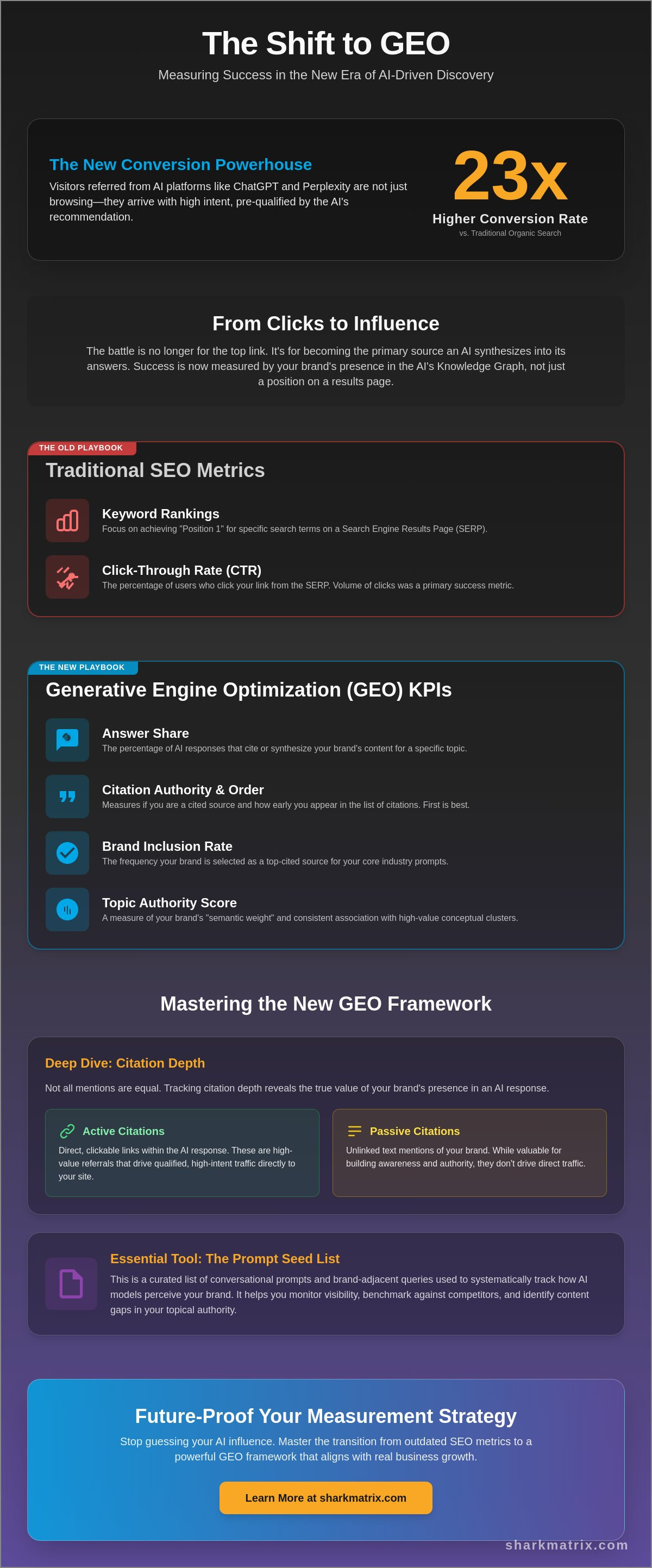
Did you know that visitors referred from AI platforms now convert at 23 times the rate of those arriving via traditional organic search? According to March 2026 data from Discovered Labs, the shift toward AI-driven discovery isn’t just a trend; it’s a fundamental change in how high-intent buyers research products and services. As ChatGPT and Perplexity become the new gatekeepers, traditional metrics like click-through rates are plummeting. You’re likely finding that measuring generative engine optimization success requires a completely different playbook than the one you used for Google’s old blue links.

It’s frustrating to see your brand mentioned in a ChatGPT response or a Perplexity citation without any clear way to quantify that value to your C-suite. You’re right to feel that the lack of native analytics in these LLMs makes reporting feel like guesswork. We’ll help you master the transition from tracking simple clicks to measuring true AI influence with our comprehensive 2026 GEO KPI framework. In this guide, you’ll discover a repeatable reporting model for AI visibility, explore specialized tools like Peec AI for tracking mentions, and learn how to align your generative engine optimization strategy with actual business growth.

Key Takeaways

  • Learn why “Answer Share” and “Citation Authority” are replacing traditional rankings as the gold standard for digital visibility.
  • Identify the specific metrics needed for measuring generative engine optimization success, including brand inclusion rates and citation depth within LLM responses.
  • Discover how to build a “Prompt Seed List” to track how AI models like ChatGPT and Perplexity perceive your brand’s expertise.
  • Understand the evolution of CTR and why high-intent AI citations often lead to better business outcomes than traditional search clicks.
  • Explore how to move beyond static reporting toward real-time visibility monitoring to stay ahead of rapid AI model updates.

Beyond the Click: Why Measuring Generative Engine Optimization Success is Different

Measuring generative engine optimization success isn’t about counting how many people landed on your homepage last month. It’s about understanding how often an AI model chooses your brand as the definitive answer to a complex query. In traditional search, you fought for a spot on page one. In the world of Generative Engine Optimization (GEO), you’re fighting to be the primary source that Large Language Models (LLMs) synthesize into their responses. This is the science of tracking brand inclusion, where visibility is measured by conceptual association rather than just a ranking number.

We’ve entered a “Zero-Click” reality where a user might get everything they need directly from a search generative experience or a tool like Perplexity. While this might look like a decline in traffic in your legacy analytics dashboard, the users who do click through are arriving with much higher intent. They’ve already been “pre-sold” by the AI’s recommendation. Success is now measured by your brand’s presence within the Knowledge Graph. This shift requires a solid foundation built through professional search engine optimization seo services, ensuring your data is structured specifically for AI extraction and entity recognition.

Ranking vs. Answer Share

In the past, being “Position 1” was the ultimate goal. Today, that concept is being replaced by Answer Share. LLMs don’t just list websites; they synthesize multiple sources to create a single, authoritative voice. If your content is the primary source for that synthesis, you gain more authority than a simple link ever provided. Measuring generative engine optimization success also involves looking at “Citation Order.” Being the first link cited in an AI summary carries significantly more weight than being buried in a “read more” dropdown or a footnote.

The Shift in User Intent Tracking

Tracking user intent has moved from simple transactional keywords to conversational prompt analysis. You need to identify “Brand-Adjacent” queries where AI currently references your competitors instead of you. This analysis helps you understand the gaps in your topical authority and where your content fails to meet the LLM’s criteria for helpfulness. Answer Share is the percentage of AI responses that cite your brand for a specific topic. By focusing on these metrics, you can ensure your brand remains relevant as search evolves into a dialogue between users and machines.

The Core KPI Stack for Generative Engine Optimization

Traditional SEO relied on a handful of clear metrics like keyword volume and domain authority. To master measuring generative engine optimization success in 2026, you need a stack that accounts for both conceptual visibility and linguistic nuance. It’s no longer enough to just appear in a list. You need to know your Inclusion Rate: the percentage of times your brand is selected as a top-cited source for specific industry prompts. This is paired with your Topic Authority Score, which measures your “semantic weight.” If an AI model consistently associates your brand with a cluster of high-value terms, you’ve successfully claimed that cognitive territory within the LLM.

Citation Depth is another pillar of this new framework. It tracks whether the generative engine provides a direct, clickable link or merely a text mention. While both contribute to brand awareness, direct citations are the primary drivers of the high-intent traffic discussed earlier. If you find your brand is mentioned but not linked, it often indicates a gap in your technical data structure. Integrating ai automation and development into your content pipeline can help ensure your site’s data is formatted for easy AI extraction.

Visibility Metrics: Inclusion and Citations

Visibility in the age of Perplexity and Gemini is often found in the footnotes. You must track “Footnote Presence” to see how often you are used to verify the AI’s claims. There’s a vital difference between “Active Citations,” which include outbound links, and “Passive Citations,” which are unlinked mentions. While passive mentions build brand recognition, active links are what move the needle for your bottom line. Maintaining these metrics requires proactive seo for brand reputation management dubai to ensure the AI sources clean, accurate, and authoritative data about your business.

Qualitative Metrics: Sentiment and Accuracy

Most frameworks fail because they ignore how an AI actually describes you. The Core KPI Stack for Generative Engine Optimization must include a Brand Sentiment Score. Using Natural Language Processing (NLP) tools, you can audit whether an LLM positions your services as “premium,” “affordable,” or “market-leading.” This qualitative data tells you if your content marketing is actually shaping your brand’s AI persona.

Accuracy is equally important. You must track your “Hallucination Rate,” which measures how often an AI provides incorrect facts about your products or services. If an AI tells a potential customer you don’t offer specific machine learning development services when you do, it’s a direct threat to your revenue. Finally, monitor your “Comparison Dominance.” When users ask an AI to compare you against your three biggest competitors, you need to know who the engine recommends and why.

Measuring Generative Engine Optimization Success: A 2026 Framework

GEO Metrics vs. Traditional SEO: A Comparative Analysis

Reporting on search performance has historically relied on raw impressions. However, measuring generative engine optimization success requires a pivot toward “Brand Prominence.” In a traditional SERP, an impression meant a user saw your link. In 2026, an impression in a generative engine might mean your brand was synthesized into a paragraph alongside three competitors. If you aren’t the primary entity mentioned, that impression carries little value. You’re now tracking how often the AI chooses you as the lead authority for a specific concept.

The classic Click-Through Rate (CTR) is also evolving into what we call the “Citation-Through Rate.” As users rely on AI to summarize information, they only click when they need deep-dive verification or a specific transaction. This doesn’t mean your strategy is failing. It means the user’s journey is changing. To capture these high-intent clicks, your technical foundation must be flawless. High-quality website design and development services are essential here, as they ensure your site’s data structure is easily crawlable and interpretable by LLM bots.

Justifying the ROI of GEO can be challenging when direct sessions from search engines appear to decline. You must shift the conversation from traffic volume to conversion quality. Visitors referred from AI platforms convert at 23 times the rate of traditional organic search, meaning a single AI citation can be worth dozens of standard clicks. Measuring generative engine optimization success is about proving that your brand is the “trusted advisor” within the AI’s logic, which creates a shorter path to purchase.

The Legacy vs. Generative Metric Map

Legacy SEO focused on Keyword Rank, but GEO prioritizes Entity Prominence. Instead of counting backlinks, we now evaluate Citation Quality and LLM Trust. Does the model trust your data enough to quote it? Similarly, “Time on Page” is losing relevance to “Prompt Resolution Success.” If a user finds your information within an AI response and their query is resolved, your brand has provided value, even if they didn’t visit your site immediately. Success is defined by being the final answer in the user’s discovery process.

Attribution Challenges in 2026

The “Dark Social” problem has migrated to search. Users often get their answers from an LLM and then navigate directly to your site later or mention you in a separate channel. This makes direct attribution difficult. Measuring “Assisted Conversions” from AI engines in GA4 is the best way to track this indirect impact. You need to look for patterns where AI visibility correlates with direct traffic spikes. GEO success is often found in the “Referral” traffic segment of analytics platforms.

Practical Tools and Frameworks for Tracking GEO Performance

Moving from theory to execution requires a structured technical workflow. To build a repeatable model for measuring generative engine optimization success, you must first move beyond manual spot-checking. Start by curating a “Prompt Seed List” based on your highest-value customer questions. This list should reflect the actual conversational queries your audience uses when interacting with AI assistants. Once you have your seeds, implement automated monitoring tools to scrape LLM responses. This allows you to track brand mentions at scale rather than relying on anecdotal evidence.

Isolation is the next step in your measurement framework. Set up custom GA4 channels to specifically isolate traffic coming from domains like chatgpt.com, perplexity.ai, and gemini.google.com. By segmenting these sources, you can see how AI-driven discovery translates into site behavior. Finally, utilize sentiment analysis APIs to categorize the “tone” of these AI responses. This helps you determine if the engine is positioning you as a market leader or merely a secondary option. If you want to accelerate this technical setup, our team at Shark Matrix Technologies LLC provides generative ai development services to build custom monitoring solutions tailored to your brand.

Building a Prompt Dashboard

A successful dashboard groups prompts by intent: Informational, Commercial, and Comparison. This structure reveals where your content is strongest and where competitors might be stealing your “Answer Share.” You should also track the “First-Mover Advantage” whenever a new AI engine update rolls out. In the UAE market, linguistic diversity is a critical factor that many global frameworks overlook. Testing prompts in both English and Arabic is essential for national brands. AI models often interpret brand authority differently across languages, so your measurement strategy must account for these regional nuances to be truly accurate.

Connecting GEO to Revenue

The ultimate goal is tying AI visibility to your bottom line. Look for correlations between your AI citation frequency and increases in “Branded Search” volume. When an AI recommends your brand, users often head to traditional search engines to find your specific website. You can also use insights from a ppc agency dubai to fuel your GEO prompt strategy. Paid search data highlights the exact phrases that drive conversions, which you can then use to optimize your organic AI presence. Measuring the link between citation frequency and lead quality ensures your GEO efforts are driving business growth, not just vanity metrics.

Future-Proofing Your Measurement Strategy with Shark Matrix Technologies LLC

Static reporting is no longer sufficient in an environment where LLMs update their training data and model weights almost weekly. Moving toward real-time AI visibility monitoring is the only way to stay competitive. At Shark Matrix Technologies LLC, we’ve developed an approach that bridges the gap between custom AI development and advanced SEO analytics. Our goal is to provide a dynamic view of your digital footprint, ensuring that your brand doesn’t just appear in responses but remains the dominant authority for your core topics.

Our “Entity-First” strategy focuses on how your brand is perceived across the entire Knowledge Graph. By treating your business as a structured entity rather than a collection of keywords, we make it easier for generative engines to extract and cite your data accurately. This method is essential for measuring generative engine optimization success over the long term. We close the loop by transforming these high-intent AI citations into national brand dominance, ensuring that your visibility translates directly into market leadership.

Custom AI Solutions for Measurement

We utilize our specialized ai automation services to build bespoke tracking dashboards that go far beyond standard search tools. These proprietary systems audit LLM responses at scale, allowing us to protect your online reputation by identifying and correcting AI hallucinations or competitor biases in real time. By integrating machine learning development services, Shark Matrix Technologies LLC can help you predict which content formats will secure the highest “Answer Share” in future model iterations, giving you a significant head start on the competition.

Your Next Steps in the AI Search Era

Waiting for official analytics from LLM providers like OpenAI or Google puts your brand at a major disadvantage. The companies leading their industries in 2026 are those that have already built their own measurement frameworks. You don’t need to guess how your brand is performing when you can have a clear, data-driven audit. Start your journey today by identifying the gaps in your topical authority and refining your AI persona. Ready to dominate the AI search landscape? Consult with Shark Matrix Technologies LLC today.

Claim Your Authority in the AI Search Era

The transition from tracking simple clicks to analyzing complex AI citations is the most significant evolution in digital discovery. Embracing metrics like Answer Share and Citation Depth provides a much clearer picture of your brand’s true influence than traditional rankings ever could. By moving beyond legacy dashboards and prioritizing real-time monitoring, you turn the “Zero-Click” reality into a distinct competitive advantage. You’re no longer just hoping for a link; you’re ensuring your brand remains the most trusted entity in the engine’s knowledge graph.

Successfully measuring generative engine optimization success requires a proactive approach that balances technical precision with deep linguistic expertise. Shark Matrix Technologies LLC is a pioneer in UAE AI-driven SEO, offering custom AI automation for real-time reporting and unmatched expertise in both English and Arabic digital markets. Master your AI visibility with Shark Matrix Technologies LLC SEO services and secure your place as a market leader. The search landscape is evolving fast, but with the right framework, your brand’s growth is just a prompt away.

Frequently Asked Questions

What is the most important KPI for measuring GEO success?

Answer Share is the most critical KPI because it tracks the percentage of AI responses that cite your brand for specific industry topics. Unlike traditional rankings, this metric measures your brand’s authority as a primary source for LLM synthesis. You should also monitor Citation Depth to determine if the engine provides a direct, clickable link or just a text mention. This data tells you if the AI perceives you as a primary authority or a secondary reference.

Can I track AI engine traffic in Google Analytics 4?

You can track AI engine traffic by setting up custom referral channels in GA4 to isolate visitors from domains like chatgpt.com, perplexity.ai, and gemini.google.com. While these sessions might appear lower in volume than traditional search, they often represent much higher intent. According to March 2026 data from Discovered Labs, visitors referred from AI platforms convert at 23 times the rate of organic search, making this segment extremely valuable for ROI analysis.

How does GEO measurement differ from traditional SEO rank tracking?

GEO measurement focuses on how LLMs categorize your brand within a Knowledge Graph instead of just assigning a numerical rank. Traditional SEO tracks where your URL appears on a page, while measuring generative engine optimization success involves auditing the “semantic weight” of your brand across various prompts. You’re looking for inclusion in synthesized answers and “Citation Order” rather than a spot in a list of blue links.

Is it possible to influence the sentiment of AI-generated answers?

You can influence AI sentiment by consistently publishing authoritative content that uses the specific terminology you want associated with your brand. AI models pick up on linguistic patterns; if your site and third-party citations describe your services as “premium” or “innovative,” the LLM is more likely to adopt that tone. Professional SEO for brand reputation management ensures the data feeding these models remains accurate, positive, and aligned with your unique value proposition.

How often should I audit my brand presence in LLMs like ChatGPT?

You should audit your brand presence at least once a month to account for regular model updates and data refreshes. In fast-moving industries, real-time monitoring is preferable because AI citations can shift within weeks of a major update. Regular audits help you identify “hallucinations” or factual errors the AI might be spreading about your services before they impact lead quality or brand trust.

What tools are available for measuring generative engine optimization in 2026?

Measuring generative engine optimization success in 2026 involves specialized tools like Peec AI, which tracks visibility and share of voice across different models. You can also use automated monitoring tools and sentiment analysis APIs to scrape LLM responses and categorize the tone of mentions. For many enterprises, building a custom dashboard via AI automation services is the most effective way to scale this tracking across multiple languages and regions.

Does Answer Engine Optimization (AEO) use the same metrics as GEO?

AEO and GEO share metrics like Answer Share, but AEO focuses more heavily on direct response accuracy for specific, isolated questions. GEO is a broader framework that includes brand sentiment and entity prominence across a wider range of conversational discovery. Both strategies rely on a foundation of structured data and high-quality content marketing to ensure your brand is the preferred source for synthesized answers.

How do I explain declining website clicks to stakeholders while showing GEO success?

You should explain that while raw clicks are declining due to the “Zero-Click” reality of AI summaries, the quality of referred traffic is significantly higher. Focus on metrics like Citation-Through Rate and the 23x conversion multiplier for AI-referred visitors. Showing stakeholders your brand’s dominance in AI answers proves you’re capturing the user’s trust at the point of discovery, which creates a much shorter path to purchase than traditional search.

Categories
GEO

Generative Engine Optimization Strategy 2026: The Complete Guide to AI Search Visibility

Did you know that over 80% of Google searches in 2026 now end without a single click to a website? This zer

Categories
GEO

How to Optimize Content for AI Search: The 2026 Strategy Guide

Did you know that the presence of a Google AI Overview now reduces the click-through rate of the top organic result by approximately 60%? With 37% of consumers now starting their searches on AI platforms, the traditional search landscape has fundamentally shifted. Learning how to optimize content for ai search is the only way to ensure your brand remains visible as Gemini 3.5 Flash and GPT-5.5 become the primary tools for discovery.

You’re likely worried about your content being summarized without receiving the traffic you deserve. It’s a common fear in this era of Generative Engine Optimization (GEO), but you don’t have to be left behind. This guide promises to teach you how to become the definitive source that AI models cite and recommend. We’ll preview the essential tactics for 2026, including leveraging Schema.org 30.0 and navigating the latest Google Core Updates to secure your brand’s future in the age of answer engines.

Key Takeaways

  • Transition from traditional ranking to Generative Engine Optimization (GEO) to ensure your brand is the primary source for answer engines.
  • Discover how to optimize content for ai search by focusing on semantic meaning and building entity authority within your niche.
  • Conduct an AI visibility audit to find citation gaps and reclaim mentions from competitors in LLM responses.
  • Use advanced Schema.org 30.0 markup and natural language structures to make your data easily digestible for models like GPT-5.5 and Gemini 3.5 Flash.
  • Future-proof your marketing by integrating AI automation and hybrid SEO-GEO strategies for long-term national visibility.

The Shift from Search Engines to Answer Engines: Why GEO is the New SEO

For decades, the goal of digital marketing was simple: rank on page one. By June 2026, that goal has become obsolete. We’ve moved into the era of the “Answer Engine,” where platforms like Perplexity, with its 100 million monthly active users, provide direct answers instead of a list of websites. This shift marks the rise of Generative Engine Optimization (GEO). Unlike traditional SEO, GEO focuses on making your brand the primary source for the AI’s synthesized response. The era of the “blue link” is ending. In its place, we have synthesized summaries that pull from the most authoritative nodes in the digital landscape.

AI models don’t just scan for keywords; they analyze context and authority. If you’re still using old-school keyword stuffing, you’re likely hurting your visibility. Modern LLMs like GPT-5.5 and Gemini 3.5 Flash prioritize content that is modular and machine-readable. Understanding how to optimize content for ai search requires a move away from lexical matching toward semantic depth. You aren’t just trying to “rank” anymore. You’re trying to be the “source” that the AI trusts enough to cite.

Understanding the Mechanics of Generative Engine Optimization (GEO)

Large Language Models process content through retrieval-augmented generation. They don’t just “find” your page. They extract specific facts to build a response. To win here, your content must have high “Citation Probability.” This is the likelihood that an AI will credit your site as the source of its information. While AEO (Answer Engine Optimization) focuses on providing a single direct answer, GEO is a broader strategy. It ensures your brand’s expertise is woven into the AI’s entire reasoning process. It’s about being the most helpful, cited expert in the room.

Why 2026 is the Tipping Point for AI Search Adoption

User behavior has changed. As of early 2026, AI Overviews appear in 57% of long-tail, high-intent queries. This has led to a massive 60% drop in click-through rates for the top organic results. National brands can’t afford to ignore this. You must pivot your search engine optimization seo services to include generative strategies. Learning how to optimize content for ai search is no longer an optional upgrade. It’s the foundation of market dominance in a world where the traditional search result is fading into the background.

How AI Search Engines ‘Read’ and Rank Content in 2026

In 2026, search algorithms have evolved beyond simple keyword matching. They now utilize advanced semantic analysis to understand the intent behind a query. This shift means that how to optimize content for ai search is no longer about repeating phrases. Instead, it’s about providing clear, accurate information that matches the meaning of a user’s question. AI models look for “entities,” which are specific people, places, things, or concepts, and how they relate to one another. Understanding these relationships allows LLMs to synthesize answers that are both relevant and factually sound.

Once an AI model identifies your content as a reliable source, you enter a “Citation Loop.” Being cited in a Google AI Overview often leads to inclusion in other LLM responses as these systems cross-reference data. Focusing on optimizing for AI content ranking ensures your brand remains a trusted node in the knowledge graph. If you’re looking to refine your digital presence for these new systems, our content marketing experts can help align your brand with these evolving ranking signals.

Entities over Keywords: Building Your Digital Identity

Entities are the building blocks of the global knowledge graph. They represent real-world concepts that AI models use to map information. To dominate your niche, you must identify which entities your brand should own. For example, a fintech company should be inextricably linked to “secure digital payments” and “blockchain transparency,” while a sustainability-focused organization might use Anthropogenic to align its data with global climate commitments. Entity Authority is the primary ranking signal for 2026, representing the strength of the connection between your brand and a specific topic in the eyes of an LLM.

Semantic Content Architecture: Organizing for LLM Ingestion

Structure is now more critical than word count. AI crawlers use hierarchical heading structures to parse topical relevance quickly. When learning how to optimize content for ai search, you’ll find that the “Inverted Pyramid” style is essential. Place the most important facts at the beginning of each section. This makes it easier for models like Gemini 3.5 Flash to summarize your work. Use clear, declarative statements. Instead of saying “Our services might help you grow,” say “Our services increase revenue by 20%.” This directness makes your content highly “quotable” for AI-generated answers.

How to Optimize Content for AI Search: The 2026 Strategy Guide

Auditing Your Content for AI Discoverability and Citation Gaps

Traditional SEO audits often stop at technical health and keyword rankings. In 2026, these metrics only tell half the story. You need a comprehensive AI Visibility Audit to understand how LLMs perceive your brand. This audit identifies where you’re being cited and, more importantly, where you’re being left out of the conversation. If you want to master how to optimize content for ai search, you have to find the “Citation Gaps” where competitors are mentioned as the primary authority while your brand remains invisible. It’s about moving from “ranking” to “being the source.”

A critical part of this process is evaluating your content for “Extraction Readiness.” AI models don’t read like humans; they extract. If your Unique Selling Proposition (USP) is buried in flowery prose or complex metaphors, models like GPT-5.5 might skip it entirely. You should also analyze the sentiment of current AI mentions. Since LLMs can mirror the sentiment of their training data, managing how these models describe your brand is vital for long-term reputation. If a model consistently summarizes your service with a neutral or negative tone, it’s a signal that your underlying content needs a strategic pivot.

Tools and Techniques for AI Visibility Analysis

You don’t need complex software to start your audit. Use direct prompts in GPT-5.5 or Gemini 3.5 Flash to ask specific industry questions. Analyze which sites the models use as grounding data. If you aren’t appearing in the citations for your core topics, your content likely lacks the structured clarity required for modern LLM ingestion. Monitoring your presence in major training sets is now a standard part of generative engine optimization, ensuring your brand is part of the model’s foundational knowledge rather than just a real-time retrieval afterthought.

Closing the Gap: Turning Missing Mentions into Citations

Once you’ve identified the gaps, you must fill them with high-value, declarative content. Address the specific, unanswered user questions your audit revealed. Improving your internal linking is also essential; it builds a semantic web that helps AI bots understand the relationship between different pages on your site. For national brands, leveraging seo for brand reputation management dubai can help improve the trust signals that AI models prioritize. Learning how to optimize content for ai search means constantly refining these signals to ensure your brand remains the most cited expert in your field.

How to Optimize Content for AI Search: A Practical 5-Step Guide

Turning theoretical knowledge into a functional strategy requires a systematic approach. If you want to master how to optimize content for ai search, you must move beyond traditional metadata. The following five steps provide a roadmap for ensuring your brand is the primary answer in AI-driven search results. By focusing on how machines ingest data, you can secure a permanent spot in the knowledge graphs of the future.

Step 1 & 2: Technical Foundations and Language Processing

Start with the technical architecture of your data. Implementing “SameAs” schema allows you to link your website to verified entity databases like Wikidata or official industry registries. This provides the “Entity Clarity” that models like GPT-5.5 require to distinguish your brand from competitors. While 2024 schema focused on basic categorization, the 2026 requirements under Schema.org version 30.0 demand deep relational mapping that connects your content to the global knowledge graph. Once your technical foundation is set, focus on your phrasing. Writing in a “Question-Answer” format that mirrors common conversational prompts helps LLMs identify your text as the direct solution to a user’s query.

Step 3 & 4: Extraction and External Validation

AI models prefer modular data. You should create “Fact-Dense” content blocks by using bulleted lists and tables. These structures provide the organized data that RAG (Retrieval-Augmented Generation) systems can easily extract and summarize. If you’re researching how to optimize content for ai search, you’ll find that external validation is just as important. In the AI era, high-authority PR and third-party mentions have replaced traditional backlinks as the primary trust signal. When reputable news sites or industry journals cite your brand, AI models view you as a verified authority. Our website design and development services ensure your site remains technically optimized for these AI crawlers, maintaining the speed and structure they need to index your data efficiently.

Step 5: Maintaining Freshness for RAG Systems

The final step is consistency. AI systems reward content that is recently published or updated. This signals to the models that your information is current and relevant for real-time retrieval. If your data is outdated, models like Gemini 3.5 Flash will likely deprioritize it in favor of fresher sources. Content that was accurate six months ago might be ignored by a model looking for the latest industry trends. To keep your brand at the forefront of this evolution, you can explore our generative engine optimization services to automate these updates and ensure your brand remains the definitive answer in 2026.

National market dominance in 2026 requires a sophisticated hybrid strategy. You can’t simply choose between traditional SEO and Generative Engine Optimization (GEO); you must master both. While Google still maintains a global search market share of nearly 90%, the way users interact with those results has changed. With AI search adoption reaching 37% of consumers by early 2026, your brand’s visibility depends on being both a top organic result and the primary cited source in an AI summary. This dual approach ensures you capture traffic from users who still click links and those who rely on synthesized answers.

The next wave of digital discovery is already here: multimodal AI and voice search. Users are no longer just typing keywords; they’re uploading images and asking complex, conversational questions via wearable AI devices. Learning how to optimize content for ai search now includes preparing your assets for these non-textual queries. Your strategy must evolve to include “Entity Authority” across all formats, ensuring that whether a user speaks a question or points a camera at a product, your brand is the definitive answer provided by the underlying model.

Scaling with AI Automation and Development

Managing GEO across thousands of pages is impossible without high-level technical support. Large enterprises are now using custom LLMs to predict which content pieces are most likely to be featured in AI Overviews before they even go live. At Shark Matrix, we utilize ai automation services to implement complex Schema.org 30.0 markup at scale, ensuring every piece of data is machine-readable and ready for ingestion by GPT-5.5 or Gemini 3.5 Flash. Additionally, as search moves into proprietary platforms, our mobile app development services help brands integrate custom AI search interfaces directly into their own ecosystems, bypassing the “blue link” entirely.

Future-Proofing Your Brand with Shark Matrix

The AI search landscape shifts weekly. With Google’s March 2026 Core Update and the rapid retirement of older models like GPT-4o, staying relevant requires continuous monitoring. We don’t just “set and forget” your content. Our team uses generative ai development services to track your citation frequency and the sentiment of brand mentions within LLM responses. This data-driven approach allows us to pivot your strategy in real time, closing citation gaps before competitors can claim your space in the knowledge graph. If you’re ready to secure your brand’s position as the primary answer in 2026, contact Shark Matrix to optimize your AI search strategy today. We’ll help you master how to optimize content for ai search and ensure your digital presence is built for the era of the answer engine.

Dominating the Answer Engine Era

The search landscape is no longer just about ranking; it’s about becoming the definitive source for the world’s most powerful AI models. By prioritizing entity authority over simple keywords and utilizing advanced schema, you can ensure your brand isn’t just indexed, but cited. We’ve explored how a proactive visibility audit and a technical roadmap can turn potential traffic losses into citation wins. Mastering how to optimize content for ai search is the single most important move your brand can make to stay relevant in 2026.

Since 2010, Shark Matrix has been at the forefront of digital innovation. We combine over a decade of experience with cutting-edge expertise in AI automation and development to deliver leading SEO and GEO strategies for national brands. Don’t let your content get lost in the shuffle of synthesized summaries. Secure Your Brand’s Future in AI Search with Shark Matrix and lead the transition to the answer engine era. The future of search is conversational, and your brand deserves to be the primary answer.

Frequently Asked Questions

What is the difference between SEO and Generative Engine Optimization (GEO)?

SEO focuses on ranking in traditional search result lists, while GEO focuses on being cited within AI-generated summaries. While SEO prioritizes keywords and backlinks to drive clicks, GEO emphasizes entity authority and extraction readiness. You want your brand to be the primary source that LLMs use to build their synthesized answers.

How do I know if my content is being used by AI search engines?

You can monitor citation links in Google AI Overviews or platforms like Perplexity and SearchGPT. Another method is prompting models like GPT-5.5 directly with industry questions to see if they credit your site. Tracking referral traffic from these AI platforms in your analytics also provides concrete evidence of your visibility in these systems.

Will optimizing for AI search hurt my traditional Google rankings?

It won’t hurt your rankings; instead, it often improves them. The techniques used in how to optimize content for ai search, such as implementing Schema.org 30.0 and improving content clarity, align perfectly with Google’s E-E-A-T standards. Both systems reward authoritative, well-structured information that provides genuine value to the user.

What is the most important schema type for AI search in 2026?

The “SameAs” and “About” properties are critical for establishing your brand as a verified entity. These tags link your website to authoritative databases like Wikidata, helping AI models understand exactly who you are and what you expert in. Using these properties correctly ensures you’re a recognized node in the global knowledge graph.

How can I increase the chances of my brand being cited in ChatGPT or Perplexity?

Focus on creating fact-dense content blocks that are easy for models to extract. When you learn how to optimize content for ai search, you’ll see that third-party validation from reputable news sites is also vital. LLMs look for consensus across multiple authoritative sources before they decide to cite a specific brand in their responses.

Does content length still matter for AI search optimization?

Structure is now more important than raw word count. While long-form content provides more data for an AI to learn from, the model needs that information to be modular. Use clear headings and bulleted lists so the AI can quickly find and summarize the specific facts it needs to answer a user query.

How often should I update my content to stay relevant for AI crawlers?

You should aim for regular updates, at least quarterly, to maintain content freshness. AI models prioritize recent information to ensure their answers aren’t outdated. If your data is old, models like Gemini 3.5 Flash may skip your site in favor of a competitor who provides more current industry insights or statistics.

Can AI search optimization help with brand reputation management?

Yes, it’s a powerful tool for managing how your brand is perceived. By providing clear, authoritative content, you influence the data LLMs use to summarize your business. This helps ensure that AI-generated responses reflect your brand values and maintain a positive sentiment when users ask about your services or reputation.

Categories
GEO

What is Generative Engine Optimization? The 2026 Guide to GEO

Organic click-through rates have plummeted by 61% for queries where AI Overviews appear, leaving many brand

Categories
Digital Marketing

The Evolution of AI for Marketing in the UAE: 2026 Trend Analysis

With 70.1% of the UAE’s working-age population actively using AI tools as of May 2026, the Emirates has officially become the world’s leading adopter of artificial intelligence. This rapid shift means that mastering ai for marketing dubai is no longer a luxury for early adopters; it’s the new baseline for business survival. You’ve likely felt the weight of information overload from a constant stream of new tools, or perhaps you’re struggling to localize content for the Arabic-speaking market without losing your brand’s unique personality to generic automation.

We understand that staying ahead requires more than just following the hype. You’ll discover how artificial intelligence is fundamentally transforming the UAE marketing sector and how your business can leverage 2026 trends for national growth. This guide provides a clear roadmap for AI adoption that focuses on improving ROI through predictive analytics and securing a competitive edge through Generative Engine Optimization (GEO). We’ll explore how to balance technical automation with the cultural resonance required to lead in the Gulf region.

Key Takeaways

  • Learn how to transition from traditional search to Generative Engine Optimization (GEO) to reach customers using the latest AI-powered answer engines.
  • Understand the critical role of Arabic Natural Language Processing (NLP) in localizing AI content without losing your brand’s unique personality.
  • Explore how predictive analytics can identify high-intent leads and improve conversion rates by focusing on data-driven customer journeys.
  • Discover why a custom-engineered approach to ai for marketing dubai provides a stronger competitive advantage than generic, one-size-fits-all software.
  • Align your digital infrastructure with the UAE National Strategy for Artificial Intelligence 2031 to ensure long-term scalability and market relevance.

The Current Landscape of AI for Marketing in the UAE

The marketing landscape in the Emirates has undergone a massive shift. In 2025, the UAE artificial intelligence market generated $7.82 billion in revenue, and it’s on track to hit nearly $97.45 billion by 2033. This growth isn’t just about faster software. It represents a fundamental move from simple automation to a cognitive strategy where machines help decide the “why” and “when” of a campaign, not just the “how.” Businesses are no longer just looking for tools to save time; they’re seeking infrastructure that can think alongside their creative teams.

The Artificial Intelligence in Marketing sector is heavily influenced by the UAE National Strategy for Artificial Intelligence 2031. This government initiative has pushed national brands to abandon generic, one-size-fits-all models. Instead, businesses are investing in custom-trained systems that understand the nuances of the regional market. These models are generally categorized into three areas:

  • Generative: Creating personalized content, video ads, and imagery at scale to reduce creative costs.
  • Predictive: Forecasting consumer behavior and lifetime value based on historical data.
  • Analytical: Processing vast datasets to find hidden patterns in campaign performance that humans might miss.

From Trend to Necessity: Why 2026 is the Turning Point

Digital ad spend in the UAE is forecasted to reach $2.64 billion in 2026. With so much capital flowing into digital spaces, traditional channels like standard search and social ads have become incredibly crowded. This saturation makes ai for marketing dubai a requirement for visibility. Consumers now expect hyper-personalization as a baseline experience. If a brand doesn’t deliver a tailored message immediately, users simply move on. Many organizations have responded by transitioning to “AI-first” marketing departments where every decision starts with data-driven insights rather than creative guesswork.

Key AI Technologies Powering National Growth

Machine Learning (ML) allows systems to learn from data patterns without explicit programming, which is essential for optimizing real-time bidding in PPC. Natural Language Processing (NLP) enables machines to understand and generate human language, specifically catering to the diverse linguistic needs of the Gulf region. In a visually driven market like Dubai, Computer Vision has also become vital for analyzing how consumers interact with brand imagery across social platforms. AI marketing as the integration of machine intelligence into the customer journey to predict and fulfill needs. By utilizing these technologies, brands can maintain a competitive edge while ensuring their operations remain scalable and efficient.

Mastering Generative Engine Optimization (GEO) and AEO

Search is no longer a list of blue links. For businesses navigating ai for marketing dubai, the focus has shifted from ranking on a page to becoming the definitive answer in a conversation. As generative AI models integrate into daily search habits, traditional SEO is evolving into Generative Engine Optimization (GEO). This transition is driven by the UAE National Strategy for AI 2031, which projects that AI will contribute 13.6% to the national GDP by 2030. This economic push has accelerated the adoption of answer engines that provide direct, synthesized responses rather than simple lists of websites.

AEO is the practice of optimizing content to appear as the definitive answer in AI-powered search results. Unlike traditional search, where users might click through several options, AI engines typically cite one or two “preferred sources.” To win this spot, your brand must not only provide the right information but also present it in a format that AI models can easily ingest and verify. If your data is fragmented or outdated, these engines will bypass your brand in favor of a more authoritative competitor.

Optimizing for the New Search Paradigm

Being the “top recommendation” in an AI chat requires a different technical approach than ranking #1 on Google. AI crawlers look for structured data and clear, factual hierarchies. High-performance website design and development services are now focused on building site architectures that prioritize these AI-friendly structures. This includes using advanced schema markup and ensuring that your core brand facts are accessible to large language models. The goal is to move beyond simple keyword matching and toward semantic relevance that proves your brand is the most helpful resource for a specific query.

The Role of Authority and Trust in AEO

Trust is the currency of the AI era. Large language models are trained to prioritize sources with high Experience, Expertise, Authoritativeness, and Trustworthiness (E-E-A-T). This makes seo for brand reputation management dubai essential for controlling the narrative that AI engines find when they scan the web for your brand. If third-party mentions or reviews are inconsistent, an AI model might flag your brand as unreliable. By actively managing your digital footprint, you ensure that AI-generated responses reflect your actual brand voice and values. Proactive orm services uae are equally critical at this stage, as a single negative result surfaced by an AI engine can undermine your brand authority across every channel. If you’re ready to secure your position in these results, exploring professional generative engine optimization (geo) services is the next logical step for your 2026 strategy.

The Evolution of AI for Marketing in the UAE: 2026 Trend Analysis

The Arabic AI Challenge: Localizing for the UAE Market

Most global AI platforms are trained primarily on English datasets. This creates a significant hurdle for businesses using ai for marketing dubai, as literal translations often miss the cultural nuances and linguistic subtleties of the Khaleeji market. When a brand relies on generic automation, the result is often a “robotic” tone that fails to build trust with local audiences. Authentic engagement in the UAE requires more than just translating words; it requires understanding the values, humor, and social context that define the region.

High-quality Arabic Natural Language Processing (NLP) has finally matured to meet this challenge. In late 2025, significant improvements in Google’s Arabic voice recognition changed the game for search. Consumers now use conversational Arabic to find products and services, making it essential for brands to adopt localized AI models that can process these queries accurately. Brands that ignore this shift risk becoming invisible to a large segment of the local population that prefers interacting in their native language.

Arabic NLP and Sentiment Analysis

Modern AI can now parse regional dialects and local slang across the UAE. This capability is vital for sentiment analysis, allowing marketers to monitor brand health on platforms like TikTok and Snapchat, which have massive regional user bases. Instead of just counting mentions, localized NLP services identify the emotional intent behind Arabic comments. This data gives businesses a competitive advantage, as they can react to customer feedback with precision and cultural relevance that English-only tools simply can’t match.

Bridging the Cultural Gap with Hybrid Strategies

Relying solely on generative AI for Arabic copy often leads to cultural “hallucinations” or awkward phrasing. A “Human-in-the-Loop” requirement is essential for maintaining a brand’s authentic voice. Human editors must review AI-generated outputs to ensure they align with local sensitivities and the UAE’s specific regulatory environment. Shark Matrix bridges this gap by combining advanced natural language processing services with professional content marketing expertise. This hybrid approach ensures that your message is technically optimized for search engines while remaining emotionally resonant for the people of the UAE. By integrating industry specific ai solutions, we help brands maintain high standards of quality without sacrificing the speed and scalability that AI automation provides.

AI-Driven Lead Generation and Predictive Analytics

Lead generation in the UAE has moved beyond the era of static contact forms. Today, sophisticated algorithms identify high-intent prospects based on their digital footprint before they even consider typing their email address. This proactive approach is a cornerstone of effective ai for marketing dubai, allowing businesses to capture attention at the exact moment of interest. By analyzing behavioral signals like mouse movements, content engagement, and navigation paths, AI determines which visitors are ready to buy and which are just browsing.

Predictive scoring takes this a step further. Instead of treating every lead with the same urgency, your sales team can focus on those most likely to convert. This is particularly vital for b2b lead generation uae, where sales cycles are often longer and involve multiple stakeholders. When AI ranks leads based on historical conversion data, it eliminates the guesswork that typically drains marketing budgets. Predictive analytics is the use of historical data and AI algorithms to forecast future consumer behaviors.

Hyper-Personalization at Scale

Personalization in 2026 has evolved past simple email tags. AI now generates dynamic landing pages and ad copy that change in real-time based on the user’s profile. A professional ppc agency dubai uses these predictive insights to adjust bidding strategies every few seconds. This level of precision ensures that your ad spend is only used on audiences with a high probability of conversion. It’s not just about the bid; it’s about the creative. AI models can now swap headlines and visual hooks instantly to match a user’s specific intent. In recent implementation cycles, brands using these AI automation services have seen a 40% reduction in cost-per-lead (CPL) while simultaneously increasing lead quality.

The Future of CRM and AI Integration

The integration of AI into your CRM turns a passive database into an active sales engine. Intelligent chatbots can now handle the entire initial qualification process, answering complex questions and booking meetings without human intervention. These interactions provide a goldmine of data that helps refine your search engine optimization seo services. By understanding the specific questions prospects ask, you can create content that addresses their exact pain points. If you’re ready to modernize your sales funnel, our ai automation and development experts can help you build a system that works around the clock.

Building Your 2026 AI Marketing Roadmap with Shark Matrix

Adopting ai for marketing dubai shouldn’t be a reactive decision driven by the fear of falling behind. It should be a deliberate, engineered process that aligns with your specific business goals. While off-the-shelf SaaS tools offer a quick entry point, they often lack the depth needed to handle the UAE’s unique linguistic and regulatory requirements. A truly effective roadmap focuses on building proprietary assets that your competitors can’t simply buy with a monthly subscription. By moving beyond generic solutions, you protect your data and ensure your brand voice remains authentic in a crowded digital space.

Shark Matrix bridges the gap between technical engineering and creative marketing. Our approach doesn’t just add AI to your existing workflows; we redesign those workflows to be AI-native. This ensures that your technical infrastructure, from your website to your backend data processing, is optimized for the generative engines of 2026. By focusing on machine learning development services and custom natural language processing services, we help brands move beyond simple automation into a true cognitive strategy that predicts market shifts before they happen.

Custom AI Development vs. SaaS Tools

Off-the-shelf software often forces your brand to adapt to the tool’s limitations. Custom generative ai development services allow the tool to adapt to your brand instead. This is critical for maintaining a consistent brand voice across multiple languages and protecting sensitive customer data under the UAE’s evolving privacy laws. When we build mobile app development services with integrated AI, we ensure the intelligence is baked into the core architecture, not just tacked on as an afterthought. This proprietary approach allows for better scaling as your business expands across the Emirates and the wider Gulf region.

Get Started with an AI Readiness Audit

The first step toward national dominance is understanding where you currently stand. An AI readiness audit identifies the gaps in your current tech stack and highlights the “low-hanging fruit” where AI can provide an immediate return on investment. It’s not about replacing your team; it’s about giving them the tools to work with 2026-level efficiency. Our audit process typically covers three core areas:

  • Data Integrity Check: Ensuring your first-party data is clean, structured, and ready for machine learning ingestion.
  • Workflow Analysis: Identifying manual marketing tasks that can be replaced by high-efficiency ai automation services.
  • Technical Infrastructure Review: Assessing if your web and mobile platforms can support real-time AI processing and generative engine optimization (geo).

During a consultation, we evaluate these factors to determine the best path forward for your specific industry. Whether you need ai chatbot-development services to streamline customer service or advanced analytics to refine your PPC spend, we provide a clear, actionable plan. It’s time to stop experimenting and start implementing. Partner with Shark Matrix for Advanced AI Marketing to secure your competitive edge in the 2026 landscape.

Securing Your Lead in the AI-First Era

The transition toward 2026 demands a move from curiosity to concrete implementation. Mastering ai for marketing dubai requires a strategy that balances technical precision with deep cultural resonance. By prioritizing Generative Engine Optimization and leveraging predictive analytics, your brand can move beyond simple visibility to become the definitive answer for your customers. Relying on generic tools isn’t enough anymore; success in the Emirates depends on custom models that speak the local language and respect regional nuances.

Shark Matrix has been at the forefront of digital innovation since 2010. With over 15 years of regional expertise, we’re specialists in end-to-end digital engineering and Arabic NLP. We help national brands integrate custom AI automation that protects their unique voice while driving measurable ROI. Whether you’re refining your search presence or building a predictive lead generation engine, we provide the technical foundation for long-term growth. Transform your marketing with Shark Matrix AI solutions and take the lead in the UAE’s digital transformation. The future of marketing is cognitive, and you’re ready to win.

Frequently Asked Questions

What is AI for marketing and why is it important in the UAE?

AI marketing is the integration of machine intelligence into the customer journey to predict and fulfill needs. In the UAE, it’s vital because 70.1% of the working-age population already uses AI tools. With such high adoption, brands must use ai for marketing dubai to stay visible and relevant. It allows businesses to process vast amounts of data to deliver the personalized experiences that modern consumers in the Emirates now expect as a baseline.

How does Generative Engine Optimization (GEO) differ from traditional SEO?

GEO focuses on being the “top recommendation” in AI-generated chat responses rather than ranking in a list of blue links. While traditional SEO targets keyword rankings and backlinks, GEO prioritizes structured data and semantic relevance that AI models can easily verify. It’s about becoming the definitive source that answer engines cite when responding to user queries. This ensures your brand remains the primary authority when users seek direct answers through conversational AI interfaces.

Can AI effectively handle Arabic marketing content?

Yes, modern AI can handle Arabic content effectively when utilizing advanced natural language processing services. Unlike older translation tools, 2026-era NLP models understand regional dialects and local slang used in the UAE. This allows for sentiment analysis and content creation that feels culturally authentic rather than like a literal, robotic translation. It’s an essential strategy for brands that want to build deep trust with the local Arabic-speaking population across the Gulf.

Is AI for marketing expensive for small businesses in the UAE?

The cost depends on the scope, but AI often provides a higher ROI by reducing manual labor and creative costs. While enterprise-level machine learning platforms require significant investment, small businesses can start with targeted ai automation services. These solutions help startups scale their marketing efforts without needing a massive internal team. It makes advanced technology more accessible, allowing smaller players to compete with larger organizations by automating repetitive tasks and optimizing ad spend.

How does predictive analytics improve B2B lead generation?

Predictive analytics uses historical data and AI algorithms to forecast which prospects are most likely to convert. For B2B firms, this means focusing the sales team on high-intent leads rather than wasting time on cold prospects. By analyzing behavioral patterns, AI identifies the specific signals that indicate a buyer is ready to move forward. This data-driven approach significantly reduces the sales cycle and ensures that marketing resources are allocated to the most profitable opportunities.

What are the ethical considerations of using AI in marketing?

Ethical AI use involves data privacy compliance, transparency, and cultural sensitivity. Businesses in the UAE must follow the Federal Personal Data Protection Law (PDPL) and DIFC Regulation No. 10 when processing personal data. Ensuring that AI-generated content is accurate and doesn’t perpetuate bias is also a critical part of maintaining brand trust. Companies should have documented governance frameworks to ensure their use of machine learning remains transparent and accountable to their customers.

How can a Dubai-based agency help with AI automation?

A local agency provides the regional expertise needed to bridge the gap between technical engineering and marketing strategy. They offer specialized ai for marketing dubai by building custom proprietary models that generic SaaS tools can’t replicate. This includes everything from developing AI-powered mobile apps to optimizing your entire digital infrastructure for generative engine optimization. Their local presence ensures that your automation strategies remain compliant with UAE regulations while resonating with the local market’s unique cultural nuances.

What is the role of AEO in 2026 digital strategy?

Answer Engine Optimization (AEO) ensures your brand is the definitive source for AI-powered search results. As consumers move away from browsing websites and toward asking direct questions, AEO makes your content the “preferred source” for AI engines. It’s a critical component for maintaining authority and capturing high-intent traffic in a conversational search environment. By structuring data for answer engines, you ensure your brand is the one recommended when users seek immediate, factual solutions to their problems. Pairing this with comprehensive online reputation management orm services uae ensures that the information AI engines surface about your brand is consistently accurate, positive, and aligned with your business objectives.

Categories
SEO

The Strategic Role of a Technical SEO Consultant for National UAE Brands in 2026

Over 80% of local searches in Dubai now begin on a mobile device, according to Darwaish Technologies. If your site’s infrastructure isn’t flawless, you’re likely losing four out of five potential customers before they even see your homepage. You’ve probably noticed that traditional keyword strategies aren’t enough to sustain growth anymore. It’s common to feel a sense of friction when your development team doesn’t quite grasp SEO requirements, leading to performance bottlenecks that stall your rankings. Hiring a specialized technical seo consultant is the key to breaking through these plateaus. They identify the hidden structural issues that prevent search engines from crawling your site efficiently.

You likely agree that staying ahead of AI-driven search is the biggest challenge for national brands this year. This article promises to show you how a technical expert unlocks enterprise-scale growth and ensures your site is ready for Generative Engine Optimization (GEO). We’ll provide a clear roadmap for infrastructure optimization and explain how to maintain visibility while complying with the UAE Media Council’s mandatory Advertiser Permit regulations which took effect in February 2026.

Key Takeaways

  • Learn why your website’s backend architecture is the foundation for visibility in AI-driven search results like Generative Engine Optimization.
  • Understand how a professional technical seo consultant bridges the gap between your marketing strategy and web development team to eliminate performance bottlenecks.
  • Discover why log file analysis is essential for seeing exactly how modern search engines crawl and render your enterprise-scale content.
  • Gain a clear roadmap for infrastructure optimization that prepares your national brand for the high-speed demands of Answer Engine Optimization.
  • See how integrating custom AI automation and development can accelerate the implementation of complex technical fixes across your digital ecosystem.

What is a Technical SEO Consultant and Why Does a National Brand Need One?

A technical seo consultant serves as the vital link between your high-level marketing goals and the complex world of web engineering. While a content strategist focuses on what you say, the consultant ensures search engines can actually find, understand, and trust your digital assets. This role goes far beyond simple metadata. It’s about optimizing server responses, site architecture, and multilingual signals to ensure your brand remains visible across the entire Emirates. In a competitive market like the UAE, having a site that simply “exists” isn’t enough; it must be built to perform under the pressure of massive traffic and complex data sets.

Think of Search Engine Optimization (SEO) as a two-part system. Content-driven SEO builds the brand’s voice, but technical SEO builds the infrastructure that carries that voice. For national UAE brands, this distinction is critical. When you’re managing tens of thousands of pages across different regions, a single misconfiguration in your robots.txt or a slow-loading JavaScript framework can silence your entire organic presence. Establishing “Digital Health” is the mandatory starting point for all other search engine optimization seo services. Without it, your marketing budget is effectively wasted on a foundation that can’t support growth.

The Evolution of Technical SEO in 2026

By 2026, the landscape has shifted. Search engines aren’t just looking for keywords anymore; they’re feeding data into Large Language Models (LLMs). A technical seo consultant now focuses on data accessibility and semantic clarity. It’s no longer enough to have a site that loads. Your site must be structured so AI agents can extract information instantly. National enterprises can’t afford “set and forget” setups. With search algorithms updating almost weekly, your infrastructure needs constant tuning to ensure your brand stays at the top of AI-generated summaries and local search results.

Signs Your Business Has Outgrown General SEO

Many large UAE businesses find that their organic growth hits a wall despite producing high-quality content. This usually happens because of “Crawl Budget Waste.” If search engine bots are spending their limited time on low-value pages or getting stuck in redirect loops, they’ll never reach your newest product launches. You might also notice that your internal development team’s fixes are inadvertently hurting your rankings. Developer-led SEO often prioritizes code elegance over search visibility, creating technical debt that erodes your brand’s authority. When your site performance starts affecting user trust and conversion rates, a generalist approach is no longer sufficient for your national scale.

Core Pillars of Technical SEO: From Crawlability to GEO

The “Crawl, Index, Render” cycle remains the heartbeat of organic visibility. While many agencies focus only on the first two steps, a technical seo consultant understands that rendering is where modern search engines often stumble. If your site relies heavily on JavaScript, search bots might see a blank page where your content should be. This makes Server-Side Rendering (SSR) a critical requirement for national portals that need to ensure every page is fully visible to crawlers immediately. Without proper rendering, your most valuable content stays invisible to the algorithms that drive traffic.

The importance of technical optimization can’t be overstated when you’re managing thousands of URLs across the UAE. Even items on a standard on page seo checklist, such as title tags and internal links, are useless if the underlying code prevents them from being indexed. By 2026, technical health also dictates your success in Generative Engine Optimization (GEO). AI search engines require clean, structured data to extract your brand’s information accurately and present it in AI-generated overviews.

Optimizing for AI: AEO and GEO Readiness

AI agents don’t browse websites like humans; they consume data. Using Schema.org structured data is no longer optional. It’s the primary language for AI search. To appear in “Answer Boxes” or AI summaries, your data provenance must be clear and verifiable. A technical seo consultant ensures your brand is recognized as a distinct entity, providing the clarity needed for search engines to trust your information as a primary source. This entity-based approach is what separates national leaders from the rest of the market.

Performance and Core Web Vitals at Scale

For large-scale sites, speed is a ranking factor that directly impacts the bottom line. Core Web Vitals serve as the primary metric for user-centric technical health. Issues like Largest Contentful Paint (LCP) or Cumulative Layout Shift (CLS) often plague complex national portals with dynamic content. These performance gaps are especially damaging for ecommerce seo services dubai, where a one-second delay can lead to significant drops in conversion rates. If your site feels sluggish, it’s often a sign that your underlying web design and development needs a technical audit to ensure it supports rapid load times at scale.

The Strategic Role of a Technical SEO Consultant for National UAE Brands in 2026

Technical SEO Consultant vs. Generalist Agency: Why the Distinction Matters

Choosing between a generalist agency and a specialized technical seo consultant often determines whether a national brand scales or stalls. While generalists offer broad packages that cover everything from social media to blog posts, they often lack the forensic capabilities required for complex infrastructure. A consultant doesn’t just look at ranking reports. They dive into server logs and API-driven crawlers to understand exactly how Googlebot interacts with your site. This level of depth is vital for UAE enterprises that manage thousands of dynamic pages across diverse service areas.

A common question from leadership is why their existing development team can’t handle these tasks. Developers are experts at building functional, beautiful websites, but their priority is usually user experience and code stability. They don’t always realize that a perfectly functional feature might be invisible to a search engine. A technical seo consultant acts as the architect, ensuring that new code doesn’t create technical debt. They aren’t there to replace your developers; they’re there to provide the specific search-centric requirements that prevent traffic loss during site updates.

The Specialized Toolset of the Technical SEO Expert

Standard SaaS SEO tools often struggle with the sheer volume of data on a national brand’s website. They provide surface-level audits that miss deep-seated issues like render-blocking scripts or complex redirect chains. Experts use headless browsers to simulate how search engines see JavaScript and log file analyzers to track bot behavior in real-time. At Shark Matrix, we integrate ai automation services to monitor these technical health signals. This allows us to catch infrastructure shifts before they impact your rankings, providing a level of precision that generalist agencies can’t match.

Bridging the Gap Between Marketing and Development

The most effective consultants serve as a bridge between your marketing and engineering departments. They’re “SEO Translators” who understand business KPIs and can turn them into actionable technical specifications. Instead of overwhelming your team with a list of a thousand errors, a consultant prioritizes fixes based on ROI. They understand that fixing a sitewide indexing issue is more valuable than tweaking a few meta descriptions. This collaborative approach ensures that your development resources are spent on the tasks that will actually move the needle for your brand’s organic growth.

The Technical SEO Audit Framework: A Consultant’s Roadmap

A national-scale audit requires more than a standard checklist. It’s a forensic investigation into how search engines interact with your infrastructure. While basic tools provide a snapshot, hiring a technical seo consultant ensures you’re looking at the raw data found in server logs. Log File Analysis is the only way to see exactly how bots behave on your site. It reveals if they’re wasting time on irrelevant pages or if they’re failing to reach your high-priority service areas. This transparency allows you to restructure your internal linking hierarchy to prioritize the pages that actually drive revenue. Understanding how to translate these findings into a prioritized seo audit report that resonates with your C-suite is just as critical as the audit itself.

An effective roadmap moves from the server level up to the data layer. By aligning your site architecture with user intent and search engine requirements, you create a foundation for long-term growth. This process is essential when evaluating the best seo services in dubai, as a provider’s ability to execute a deep technical audit often dictates your brand’s national visibility.

Phase 1: Infrastructure and Server Analysis

The first phase focuses on the physical and virtual environment hosting your brand. We evaluate server response times and the adoption of modern protocols like HTTP/3 to ensure lightning-fast connectivity across the UAE. We also scrutinize SSL configurations and redirect patterns. Eliminating redirect chains is a priority here; these chains drain your crawl budget and frustrate users. For national brands, we specifically look for server-side errors that only trigger during high traffic loads, ensuring your site remains stable during major marketing campaigns.

Phase 2: Content Accessibility and Rendering

Phase two shifts to how search engines “see” your content. Many modern UAE websites use JavaScript-heavy frameworks that can be difficult for bots to render correctly. We test these elements to ensure your content isn’t trapped behind unreadable code. We also identify thin or duplicate content issues that often arise from complex URL parameters in large e-commerce or service directories. Canonical tags serve as a definitive signal to search engines, preventing ranking cannibalization by identifying the primary version of a page across vast national service directories.

Phase 3: Data Structuring and Schema Implementation

The final phase prepares your site for AI-driven search. We audit your existing Schema markup to ensure it’s error-free and comprehensive. By mapping out an entity-based SEO strategy, the expertise of a technical seo consultant allows your brand to be recognized as a topical authority by modern LLMs. We prioritize these technical fixes based on their potential ROI, focusing first on the sections of your site that generate the most business value. To begin optimizing your infrastructure, partner with an expert today.

Future-Proofing Your National Brand with Shark Matrix

Shark Matrix isn’t your typical marketing agency. We’ve built our reputation on a unique blend of custom software engineering and high-level search strategy. When you hire a technical seo consultant from our team, you’re getting someone who understands the code as well as the algorithm. Most agencies hand over a PDF of errors and leave your developers to figure it out. We don’t do that. Because we have deep expertise in engineering, we have the in-house capability to implement the very fixes we recommend. This seamless integration removes the friction that often stalls national growth.

National brands in the UAE face unique challenges. You’re managing data signals across seven emirates while navigating a rapidly changing regulatory environment. Our National Growth mindset focuses on building a digital architecture that isn’t just stable for today but scalable for the next decade. We treat SEO as a core piece of your business infrastructure. It’s the engine that drives your organic discovery; like any high-performance engine, it requires expert tuning from specialists who know how every component works together.

Why Shark Matrix for National Technical SEO?

Our background in custom engineering means we approach every audit with a builder’s perspective. When you work with a technical seo consultant at Shark Matrix, you benefit from our experience managing high-traffic portals for some of the region’s largest enterprises. This gives us deep insight into the specific bottlenecks that affect UAE-based servers. We use a data-first approach to ensure every recommendation is backed by evidence from your own log files and traffic patterns. By combining our specialized tools with traditional search strategies, we provide real-time monitoring that generalist agencies simply can’t offer.

Preparing for the Next Decade of Search

The future of search is conversational and generative. This is why our ai development services are so critical to our technical SEO process. We help you prepare for AEO and GEO by structuring your data for machine learning models to consume. This predictive maintenance approach ensures your brand remains a recognized authority as search engines evolve into answer engines. If you’re ready to stop reacting to algorithm updates and start leading your industry, it’s time to shift your strategy. Partner with Shark Matrix for a Technical SEO Consultation and build the foundation your national brand deserves.

Mastering the Digital Infrastructure of the Emirates

Winning the search landscape in 2026 requires more than high-quality content. It demands a flawless technical foundation that enables AI agents and search bots to navigate your brand’s data at scale. You’ve seen how specialized audits and log file analysis reveal the hidden bottlenecks that stall national growth. By focusing on infrastructure, you ensure your site remains visible in a market increasingly dominated by generative search results. This shift from keyword density to data accessibility is the defining factor for enterprise success this decade.

A professional technical seo consultant acts as the architect of this growth, bridging the gap between your marketing vision and your site’s engineering. Shark Matrix has been at the forefront of this evolution since 2010. With over 15 years of UAE market expertise and an in-house team dedicated to custom software and AI development, we provide the technical depth required for modern success. We specialize in AEO and GEO to keep your brand ahead of the curve as search behavior continues to change.

Elevate your brand’s digital architecture with Shark Matrix’s technical SEO experts.

Investing in your site’s health today ensures a dominant organic presence for years to come. Your journey toward technical excellence starts with a single step toward a more resilient infrastructure.

Frequently Asked Questions

What is the primary difference between a general SEO and a technical SEO consultant?

A generalist typically handles content strategy and keyword research, whereas a technical seo consultant manages the backend infrastructure. They focus on server logs, JavaScript rendering, and site architecture to ensure search engines can access your data. This role is about building the digital foundation that allows your content to rank in a competitive national market. They act as the bridge between your marketing goals and your web engineering team.

How long does it typically take to see results from a technical SEO audit?

Results from a technical audit usually become visible within 3 to 6 months. Some fixes, like repairing server errors, can provide immediate improvements in site stability. However, the full impact on rankings takes time as search engines re-crawl your updated architecture. For national brands with high page counts, the re-indexing process is a gradual phase that eventually leads to sustained organic growth and better performance.

Does a technical SEO consultant need access to my website’s source code?

Yes, a consultant needs access to your backend and source code to perform a thorough audit. They need to see how your server handles requests and how your code renders for bots. This access allows them to find deep-seated issues that surface-level tools can’t detect. By analyzing the raw code, they ensure your site is optimized from the inside out for both users and search engines.

Can technical SEO help my website rank better in AI search results like ChatGPT or Google Gemini?

Absolutely. Technical SEO is the primary driver for ranking in AI search results. By using structured data and clean code, you make it easier for AI agents to extract your information accurately. This readiness for Generative Engine Optimization (GEO) ensures your brand appears in AI-generated answers and summaries across platforms. It’s the best way to future-proof your visibility as search behavior shifts toward answer engines.

Is technical SEO a one-time project or an ongoing service?

It’s best viewed as an ongoing service rather than a one-time fix. Websites are dynamic and change constantly with new updates, content, and features. Regular monitoring ensures that new technical debt doesn’t accumulate over time. Ongoing support also helps your site remain compliant with the latest algorithm shifts and UAE Media Council regulations, such as the mandatory Advertiser Permit requirements introduced in February 2026.

How does technical SEO impact the mobile user experience for my national brand?

Mobile UX is heavily dependent on technical optimization. With over 80% of local searches in Dubai starting on mobile devices, according to Darwaish Technologies, performance is a priority. Technical SEO improves Core Web Vitals, ensuring that your site loads quickly and remains stable on smaller screens. This prevents user frustration and reduces bounce rates, which is essential for maintaining authority in a mobile-first market like the UAE.

What are the most common technical SEO issues found on large national websites in the UAE?

Common issues include crawl budget waste from excessive URL parameters and broken multilingual signals. Many large UAE portals also struggle with slow server response times and unoptimized JavaScript frameworks. A technical seo consultant often finds that these structural flaws prevent high-quality content from reaching its full potential. Fixing these issues allows search engines to prioritize your most important service pages and improve overall site visibility.

How much should a national business expect to invest in technical SEO consultancy?

National businesses should evaluate their investment based on the complexity of their digital infrastructure. While industry rates for specialized consultancy vary, the cost typically reflects the scale of the audit and the depth of ongoing support needed. It’s best to check with a provider for a customized quote that aligns with your specific enterprise requirements. Investing in specialized expertise ensures your national brand can scale without technical bottlenecks.

Categories
SEO

The 2026 On-Page SEO Checklist: Optimizing for Humans and AI Search

Did you know that 43% of websites still fail the 200ms threshold for Interaction to Next Paint (INP) in 2026? It’s frustrating to produce high-quality content only to see it buried because the technical goalposts moved again. With Google now rolling out core updates approximately every 90 days, staying visible requires more than just good writing. You’re likely looking for a way to maintain consistency across your site while ensuring you aren’t left behind by AI search. This comprehensive on page seo checklist provides the exact framework you need to satisfy both traditional algorithms and the latest generative engines.

We’ll show you how to master the essential factors that drive rankings today, from implementing Schema 30.0 to meeting the strict March 2026 spam update requirements. You’ll discover how to optimize for Answer Engine Optimization (AEO) and Generative Engine Optimization (GEO) so your brand becomes the cited authority in AI-generated responses. This guide previews the technical and creative shifts necessary to secure higher organic visibility and long-term search dominance in an AI-first world.

Key Takeaways

  • Learn why shifting from keyword matching to entity-based optimization is essential for ranking in 2026.
  • Use a modern on page seo checklist to verify that your HTML elements are fully optimized for humans and bots.
  • Master the latest image SEO techniques and performance standards to keep users engaged and reduce bounce rates.
  • Discover how Answer Engine Optimization (AEO) helps your content appear in AI-generated overviews.
  • Prioritize Information Gain to ensure your content provides unique value that machines cannot easily replicate.

What is On-Page SEO and Why It Matters in 2026

On-page SEO involves the precise optimization of individual web pages to rank higher and earn more relevant traffic in search engines. By 2026, the definition has expanded. It’s no longer just about where you place a keyword; it’s about how well your content satisfies user intent and maps to specific entities. Following a modern on page seo checklist ensures your site communicates clearly with both human readers and sophisticated AI search agents.

This foundation is critical for national digital marketing strategies, especially in competitive markets like the UAE. High-quality on-page signals act as a trust signal for brand authority. With Google’s March 2026 Core Algorithm Update placing a heavier emphasis on genuine expertise, your on-page elements must prove you aren’t just another generic voice. They must show you’re a leader in your field. This is why optimizing for humans and AI search simultaneously has become the standard for any brand looking to maintain its market share.

The Evolution of On-Page SEO: Traditional vs. Agentic

Search algorithms have evolved from simple pattern matching to deep semantic understanding. Today, AI agents crawl your site to extract facts, not just phrases. This agentic search environment means your content must be structured for machine extractability. If your data isn’t organized using the latest standards, like Schema.org version 30.0 released on March 25, 2026, you risk being invisible to AI answer engines. Static strategies fail because the average time between Google updates has dropped to just 90 days. You need an agile on page seo checklist to stay relevant in this fast-paced environment.

Key Benefits of a Rigorous On-Page Strategy

A disciplined approach to on-page factors delivers measurable business results. When you align your content perfectly with what a user is looking for, your click-through rates (CTR) naturally climb. You’re giving people exactly what they asked for. Beyond just getting the click, a solid strategy improves the actual experience on the page. Research shows that websites passing all three Core Web Vitals thresholds see a 24% lower bounce rate on average. This better alignment between intent and content doesn’t just help rankings; it drives the conversions that grow your business. Key benefits include:

  • Higher CTR: Compelling titles and meta descriptions act as organic ad copy.
  • Enhanced UX: Proper header hierarchy and fast loading times keep users engaged.
  • Better Alignment: Content that answers the user’s specific question reduces immediate exits.

Content Optimization: Beyond Basic Keyword Placement

Ranking in 2026 requires more than just sprinkling terms throughout a blog post. Your on page seo checklist must prioritize “Information Gain.” This concept involves adding unique value that doesn’t exist elsewhere on the web. Since Google’s March 2026 Spam Update specifically targets thin, low-value content, simply rehashing what’s already on page one is a recipe for invisibility. You need to provide fresh data, original case studies, or a unique expert perspective to satisfy both users and modern algorithms.

Identifying keywords still matters, but the focus has shifted toward national search volume and intent mapping. Every piece of content should align with one of the four intent types: Informational, Navigational, Commercial, or Transactional. For instance, if you’re looking to scale a brand, your page must answer the specific commercial or transactional questions a business owner has. This alignment is reinforced by E-E-A-T, where you demonstrate real-world experience and expertise to build trust with your audience. If you need assistance with these complex strategies, our ecommerce seo services provide a tailored approach for national growth.

Writing for Semantic Search and Entities

Modern search engines think in terms of topics and entities, not just strings of text. Instead of repeating a keyword, focus on the “Who, What, Where, and Why” of your subject. Natural language processing allows search engines to understand the relationships between different concepts on your page. By incorporating Latent Semantic Indexing (LSI) keywords naturally, you help search agents categorize your content accurately. If you need a reference for these technical requirements, checking a comprehensive on-page SEO checklist can help ensure you’ve covered all semantic bases.

Structuring Content for Maximum Readability

Engagement is a key ranking signal. Use the “Inverted Pyramid” style by placing your most critical information at the very beginning. This ensures that even if a reader only stays for ten seconds, they get the answer they came for. Keep your paragraphs short and use an active voice to maintain momentum. If you find this level of optimization daunting, our content marketing experts can help you craft high-performing assets. By using clear headings and internal links to related resources, you guide the reader through a logical journey that search engines can easily map and reward.

The 2026 On-Page SEO Checklist: Optimizing for Humans and AI Search

HTML and Structural Elements Checklist

While content is the heart of your page, the HTML structure is the skeleton that holds everything together. Search engines use these structural signals to understand the hierarchy and relevance of your information. A high-performance on page seo checklist must prioritize these elements to ensure that crawlers can easily parse your data and users can navigate your content without friction. In 2026, clarity in your HTML is more important than ever as AI agents look for specific data points to cite in their answers.

Your URL structure is the first thing both a user and a bot see. Keep your slugs short, descriptive, and keyword-rich. Avoid using random strings of numbers or dates that add unnecessary length. A clean URL like “example.com/on-page-seo-checklist” is far more effective than a convoluted path. While many focus on backlinks, a comprehensive SEO checklist reinforces that your on-page structure is the actual foundation of your organic visibility. If your site’s architecture is messy, even the best content will struggle to rank. Working with a technical seo consultant can help you identify and resolve the hidden structural issues that prevent search engines from crawling your site efficiently.

The Anatomy of a Perfect Title and Meta Tag

Title tags remain one of the strongest on-page ranking signals. You should place your primary keyword near the start of the title to give it maximum weight. However, don’t just write for bots. Use power words or numbers to create a compelling hook that improves your click-through rate. Your meta description should act as “ad copy” for your organic listing. While it isn’t a direct ranking factor, a well-crafted description encourages users to choose your link over a competitor’s. To avoid “keyword cannibalization,” ensure every page on your site has a unique title and meta tag tailored to its specific topic.

Header Tag Best Practices

Organization is key to readability. Use a logical H1-H6 hierarchy to guide the reader through your subtopics. The H1 tag serves as the singular core theme of your page, signaling to both readers and crawlers exactly what the content is about. You should only have one H1 per page. From there, use H2 tags for your main sections and H3 tags for supporting details within those sections. This structure doesn’t just help humans skim; it helps search engines understand the relationship between your primary topic and its supporting points. If you’re struggling to implement these structures at scale, our Web Design and Development services can help you build a site that is optimized by default.

Visual Asset SEO and User Experience Factors

Visual content is no longer just a decorative element; it’s a critical component of your on page seo checklist. In 2026, search engines and AI models aren’t just looking at your text. They’re analyzing your images and videos to understand the full context of your page. High-quality visual assets that load quickly are essential for keeping users on your site. When you provide a seamless visual experience, you reduce friction and encourage longer dwell times. This is especially vital as over 60% of web traffic now comes from mobile devices, where visual performance is often the deciding factor between a conversion and an exit.

User experience is now mathematically tied to your rankings through Core Web Vitals. As of May 2026, Google uses a composite score for these metrics. If you fail even one of the three core metrics, your visibility can suffer. Currently, 43% of websites fail the 200ms threshold for Interaction to Next Paint (INP). To stay competitive, your pages must hit the “good” thresholds: Largest Contentful Paint (LCP) under 2.5 seconds, INP under 200 milliseconds, and Cumulative Layout Shift (CLS) under 0.1. Passing these benchmarks isn’t just about technical vanity; websites that meet all three thresholds see a 24% lower bounce rate on average. If your site feels sluggish, our Web Design and Development services can help you build a high-performance platform that satisfies both users and search engines.

Optimizing Images for Search and AI

Every image on your site should be optimized for machine extractability. This starts with descriptive filenames and modern formats like WebP to ensure fast loading. Your alt text should be descriptive and functional, providing clear context for both accessibility and AI search bots. Additionally, using Image Schema helps search engines identify the specific subject matter of your visuals, increasing the chances of your content appearing in rich snippets or AI-generated answers. Always compress your files to maintain high visual quality without bloating your page weight.

Engagement Signals and On-Page UX

A well-optimized page guides the user toward their goal. Clear site navigation allows visitors to find relevant information quickly, which signals to search engines that your site is helpful. Avoid using intrusive pop-ups, particularly on mobile, as they disrupt the user journey and can lead to penalties under the latest spam updates. Instead, use multimedia like infographics or short videos to break up long blocks of text and increase engagement. Finally, integrate clear calls-to-action (CTAs) that lead the user to the next stage of the funnel. This ensures that your SEO efforts translate into actual business results.

Future-Proofing: Optimizing for AI and Answer Engines

The final pillar of a modern on page seo checklist involves preparing for a search environment where AI agents, not just humans, are the primary “readers” of your site. Answer Engine Optimization (AEO) is the practice of structuring your content so these agents can easily extract and cite your information in AI-generated overviews. While traditional rankings still drive significant traffic, appearing as a primary source in a generative answer is the new gold standard for national authority. This requires a shift from writing broad articles to creating precise, data-rich segments that machines can parse with high confidence.

To capture these opportunities, you must integrate “Snippet-Bait” into your layout. These are concise Q&A blocks or summary tables designed specifically for AI extraction. By providing a direct answer to a complex query within the first 50 words of a section, you increase the likelihood of being featured in rich snippets. Our search engine optimization seo services bridge the gap between these human and AI needs, ensuring your content remains readable while serving as a high-quality data source for generative engines.

Schema Markup: The Language of Search Engines

Explicit context is everything in 2026. Implementing JSON-LD structured data is no longer optional; it’s the primary way you tell search engines exactly what your content represents. Whether you’re using FAQ, Article, or Product Schema, you should always align with the latest standards, such as Schema.org version 30.0 released on March 25, 2026. This technical layer acts as a translator for AI agents, converting your creative prose into a structured format that machines can verify and display. Dominating SERP real estate today often depends on how well your FAQ schema answers long-tail conversational queries.

The Shark Matrix Approach to Modern SEO

National brands face the unique challenge of maintaining consistency across thousands of pages. We solve this by integrating ai automation services to audit and update on-page factors at scale, ensuring no page falls behind the 90-day algorithm update cycle. A bespoke on-page framework is necessary to balance brand voice with the technical rigors of generative engine optimization (geo). To ensure your audits translate into actionable growth strategies rather than overwhelming technical reports, review our seo audit report guide for national brand growth before your next site review. If you’re ready to ensure your site is fully optimized for the next generation of search, it’s time to take action. Audit your on-page SEO with the experts at Shark Matrix to secure your rankings and AI visibility.

Securing Your Search Presence in an AI-Driven Future

Success in the modern search landscape requires a dual focus on human engagement and machine readability. You’ve learned that mastering your on page seo checklist means more than just placing keywords; it’s about providing unique Information Gain and ensuring your site meets the strict Core Web Vitals thresholds. By aligning your content with Schema 30.0 and optimizing for Answer Engine Optimization (AEO), you position your brand as a primary source for both Google and generative AI agents.

Shark Matrix has been at the forefront of digital transformation since 2010. With 15+ years of regional expertise, we specialize in helping national UAE enterprises navigate complex algorithm shifts through AI-driven SEO and generative engine optimization. Don’t let your high-quality content go unnoticed by failing to adapt to these technical requirements. Download Our Full 2026 SEO Strategy Guide to stay ahead of the competition. The future of search is here, and with the right strategy, your brand can lead the way.

Frequently Asked Questions

What is the most important on-page SEO factor in 2026?

The most critical factor is satisfying user intent through original “Information Gain.” Search engines now prioritize content that adds unique value or fresh data to the conversation rather than simply rehashing existing information. While technical elements are vital, your ability to demonstrate genuine expertise and provide a clear answer to the user’s specific query is what ultimately drives rankings in a competitive landscape.

How long does it take for on-page SEO changes to reflect in rankings?

Most on-page changes begin to reflect in search results within a few days to several weeks. This timeline depends on your site’s crawl budget and how frequently search engines index your pages. High-authority sites with frequent updates often see changes faster. If you’ve implemented a comprehensive on page seo checklist, you can monitor your progress through search console tools to see how quickly bots pick up your structural improvements.

Can I do on-page SEO without technical knowledge?

You can certainly manage content-level optimizations, such as keyword placement and header organization, without deep technical skills. However, more advanced tasks like implementing JSON-LD Schema or optimizing for Core Web Vitals usually require professional assistance. For these structural elements, our web design and development team can ensure your site’s backend is as optimized as your front-end content.

How does on-page SEO differ for ecommerce websites?

Ecommerce SEO focuses heavily on product-specific data, faceted navigation, and transactional intent. You must ensure that every product page includes unique descriptions, high-quality images with descriptive alt text, and structured data for pricing and availability. This differs from informational content because the goal is to guide the user toward a purchase while helping AI shopping agents identify your inventory as the best match for a buyer’s needs.

Do I need to update my on-page SEO for AI search engines like Perplexity or ChatGPT?

Yes, you should adapt your strategy to include Answer Engine Optimization (AEO) and Generative Engine Optimization (GEO). These platforms look for highly structured, fact-dense content that they can easily extract and summarize. By following a modern on page seo checklist that includes Q&A blocks and clear data tables, you increase the chances of your brand being cited as a primary source in AI-generated answers.

What are the most common on-page SEO mistakes to avoid?

Common errors include keyword stuffing, using duplicate title tags, and neglecting the mobile user experience. Many businesses also forget to optimize their images or fail to use a logical heading hierarchy. These mistakes make it difficult for search engines to understand your page’s purpose and often lead to poor engagement from human visitors, which can negatively impact your long-term organic visibility. A thorough seo audit report can help you systematically identify and prioritize these issues before they compound into larger ranking problems.