
Categories
GEO

How to Optimize Content for AI Search: The 2026 Strategy Guide

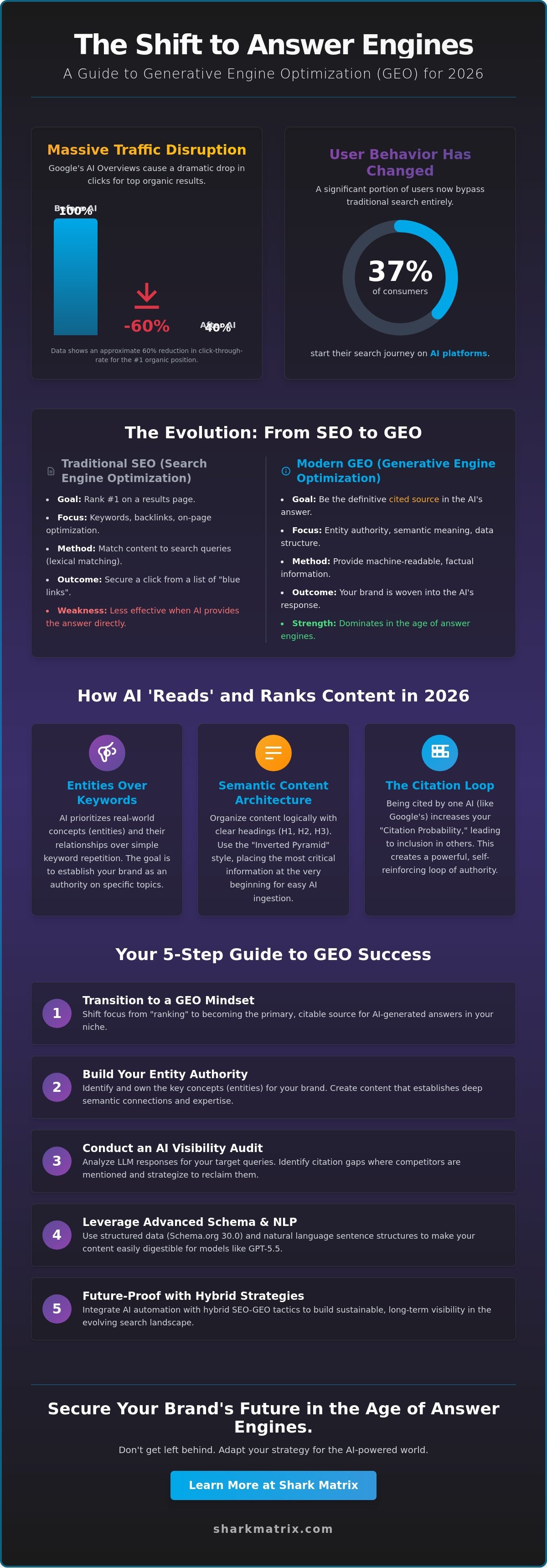
Did you know that the presence of a Google AI Overview now reduces the click-through rate of the top organic result by approximately 60%? With 37% of consumers now starting their searches on AI platforms, the traditional search landscape has fundamentally shifted. Learning how to optimize content for ai search is the only way to ensure your brand remains visible as Gemini 3.5 Flash and GPT-5.5 become the primary tools for discovery.

You’re likely worried about your content being summarized without receiving the traffic you deserve. It’s a common fear in this era of Generative Engine Optimization (GEO), but you don’t have to be left behind. This guide promises to teach you how to become the definitive source that AI models cite and recommend. We’ll preview the essential tactics for 2026, including leveraging Schema.org 30.0 and navigating the latest Google Core Updates to secure your brand’s future in the age of answer engines.

Key Takeaways

  • Transition from traditional ranking to Generative Engine Optimization (GEO) to ensure your brand is the primary source for answer engines.
  • Discover how to optimize content for ai search by focusing on semantic meaning and building entity authority within your niche.
  • Conduct an AI visibility audit to find citation gaps and reclaim mentions from competitors in LLM responses.
  • Use advanced Schema.org 30.0 markup and natural language structures to make your data easily digestible for models like GPT-5.5 and Gemini 3.5 Flash.
  • Future-proof your marketing by integrating AI automation and hybrid SEO-GEO strategies for long-term national visibility.

The Shift from Search Engines to Answer Engines: Why GEO is the New SEO

For decades, the goal of digital marketing was simple: rank on page one. By June 2026, that goal has become obsolete. We’ve moved into the era of the “Answer Engine,” where platforms like Perplexity, with its 100 million monthly active users, provide direct answers instead of a list of websites. This shift marks the rise of Generative Engine Optimization (GEO). Unlike traditional SEO, GEO focuses on making your brand the primary source for the AI’s synthesized response. The era of the “blue link” is ending. In its place, we have synthesized summaries that pull from the most authoritative nodes in the digital landscape.

AI models don’t just scan for keywords; they analyze context and authority. If you’re still using old-school keyword stuffing, you’re likely hurting your visibility. Modern LLMs like GPT-5.5 and Gemini 3.5 Flash prioritize content that is modular and machine-readable. Understanding how to optimize content for ai search requires a move away from lexical matching toward semantic depth. You aren’t just trying to “rank” anymore. You’re trying to be the “source” that the AI trusts enough to cite.

Understanding the Mechanics of Generative Engine Optimization (GEO)

Large Language Models process content through retrieval-augmented generation. They don’t just “find” your page. They extract specific facts to build a response. To win here, your content must have high “Citation Probability.” This is the likelihood that an AI will credit your site as the source of its information. While AEO (Answer Engine Optimization) focuses on providing a single direct answer, GEO is a broader strategy. It ensures your brand’s expertise is woven into the AI’s entire reasoning process. It’s about being the most helpful, cited expert in the room.

Why 2026 is the Tipping Point for AI Search Adoption

User behavior has changed. As of early 2026, AI Overviews appear in 57% of long-tail, high-intent queries. This has led to a massive 60% drop in click-through rates for the top organic results. National brands can’t afford to ignore this. You must pivot your search engine optimization seo services to include generative strategies. Learning how to optimize content for ai search is no longer an optional upgrade. It’s the foundation of market dominance in a world where the traditional search result is fading into the background.

How AI Search Engines ‘Read’ and Rank Content in 2026

In 2026, search algorithms have evolved beyond simple keyword matching. They now utilize advanced semantic analysis to understand the intent behind a query. This shift means that how to optimize content for ai search is no longer about repeating phrases. Instead, it’s about providing clear, accurate information that matches the meaning of a user’s question. AI models look for “entities,” which are specific people, places, things, or concepts, and how they relate to one another. Understanding these relationships allows LLMs to synthesize answers that are both relevant and factually sound.

Once an AI model identifies your content as a reliable source, you enter a “Citation Loop.” Being cited in a Google AI Overview often leads to inclusion in other LLM responses as these systems cross-reference data. Focusing on optimizing for AI content ranking ensures your brand remains a trusted node in the knowledge graph. If you’re looking to refine your digital presence for these new systems, our content marketing experts can help align your brand with these evolving ranking signals.

Entities over Keywords: Building Your Digital Identity

Entities are the building blocks of the global knowledge graph. They represent real-world concepts that AI models use to map information. To dominate your niche, you must identify which entities your brand should own. For example, a fintech company should be inextricably linked to “secure digital payments” and “blockchain transparency,” while a sustainability-focused organization might use Anthropogenic to align its data with global climate commitments. Entity Authority is the primary ranking signal for 2026, representing the strength of the connection between your brand and a specific topic in the eyes of an LLM.

Semantic Content Architecture: Organizing for LLM Ingestion

Structure is now more critical than word count. AI crawlers use hierarchical heading structures to parse topical relevance quickly. When learning how to optimize content for ai search, you’ll find that the “Inverted Pyramid” style is essential. Place the most important facts at the beginning of each section. This makes it easier for models like Gemini 3.5 Flash to summarize your work. Use clear, declarative statements. Instead of saying “Our services might help you grow,” say “Our services increase revenue by 20%.” This directness makes your content highly “quotable” for AI-generated answers.
How to Optimize Content for AI Search: The 2026 Strategy Guide

Auditing Your Content for AI Discoverability and Citation Gaps

Traditional SEO audits often stop at technical health and keyword rankings. In 2026, these metrics only tell half the story. You need a comprehensive AI Visibility Audit to understand how LLMs perceive your brand. This audit identifies where you’re being cited and, more importantly, where you’re being left out of the conversation. If you want to master how to optimize content for ai search, you have to find the “Citation Gaps” where competitors are mentioned as the primary authority while your brand remains invisible. It’s about moving from “ranking” to “being the source.”

A critical part of this process is evaluating your content for “Extraction Readiness.” AI models don’t read like humans; they extract. If your Unique Selling Proposition (USP) is buried in flowery prose or complex metaphors, models like GPT-5.5 might skip it entirely. You should also analyze the sentiment of current AI mentions. Since LLMs can mirror the sentiment of their training data, managing how these models describe your brand is vital for long-term reputation. If a model consistently summarizes your service with a neutral or negative tone, it’s a signal that your underlying content needs a strategic pivot.

Tools and Techniques for AI Visibility Analysis

You don’t need complex software to start your audit. Use direct prompts in GPT-5.5 or Gemini 3.5 Flash to ask specific industry questions. Analyze which sites the models use as grounding data. If you aren’t appearing in the citations for your core topics, your content likely lacks the structured clarity required for modern LLM ingestion. Monitoring your presence in major training sets is now a standard part of generative engine optimization, ensuring your brand is part of the model’s foundational knowledge rather than just a real-time retrieval afterthought.

Closing the Gap: Turning Missing Mentions into Citations

Once you’ve identified the gaps, you must fill them with high-value, declarative content. Address the specific, unanswered user questions your audit revealed. Improving your internal linking is also essential; it builds a semantic web that helps AI bots understand the relationship between different pages on your site. For national brands, leveraging seo for brand reputation management dubai can help improve the trust signals that AI models prioritize. Learning how to optimize content for ai search means constantly refining these signals to ensure your brand remains the most cited expert in your field.

How to Optimize Content for AI Search: A Practical 5-Step Guide

Turning theoretical knowledge into a functional strategy requires a systematic approach. If you want to master how to optimize content for ai search, you must move beyond traditional metadata. The following five steps provide a roadmap for ensuring your brand is the primary answer in AI-driven search results. By focusing on how machines ingest data, you can secure a permanent spot in the knowledge graphs of the future.

Step 1 & 2: Technical Foundations and Language Processing

Start with the technical architecture of your data. Implementing “SameAs” schema allows you to link your website to verified entity databases like Wikidata or official industry registries. This provides the “Entity Clarity” that models like GPT-5.5 require to distinguish your brand from competitors. While 2024 schema focused on basic categorization, the 2026 requirements under Schema.org version 30.0 demand deep relational mapping that connects your content to the global knowledge graph. Once your technical foundation is set, focus on your phrasing. Writing in a “Question-Answer” format that mirrors common conversational prompts helps LLMs identify your text as the direct solution to a user’s query.

Step 3 & 4: Extraction and External Validation

AI models prefer modular data. You should create “Fact-Dense” content blocks by using bulleted lists and tables. These structures provide the organized data that RAG (Retrieval-Augmented Generation) systems can easily extract and summarize. If you’re researching how to optimize content for ai search, you’ll find that external validation is just as important. In the AI era, high-authority PR and third-party mentions have replaced traditional backlinks as the primary trust signal. When reputable news sites or industry journals cite your brand, AI models view you as a verified authority. Our website design and development services ensure your site remains technically optimized for these AI crawlers, maintaining the speed and structure they need to index your data efficiently.

Step 5: Maintaining Freshness for RAG Systems

The final step is consistency. AI systems reward content that is recently published or updated. This signals to the models that your information is current and relevant for real-time retrieval. If your data is outdated, models like Gemini 3.5 Flash will likely deprioritize it in favor of fresher sources. Content that was accurate six months ago might be ignored by a model looking for the latest industry trends. To keep your brand at the forefront of this evolution, you can explore our generative engine optimization services to automate these updates and ensure your brand remains the definitive answer in 2026.

National market dominance in 2026 requires a sophisticated hybrid strategy. You can’t simply choose between traditional SEO and Generative Engine Optimization (GEO); you must master both. While Google still maintains a global search market share of nearly 90%, the way users interact with those results has changed. With AI search adoption reaching 37% of consumers by early 2026, your brand’s visibility depends on being both a top organic result and the primary cited source in an AI summary. This dual approach ensures you capture traffic from users who still click links and those who rely on synthesized answers.

The next wave of digital discovery is already here: multimodal AI and voice search. Users are no longer just typing keywords; they’re uploading images and asking complex, conversational questions via wearable AI devices. Learning how to optimize content for ai search now includes preparing your assets for these non-textual queries. Your strategy must evolve to include “Entity Authority” across all formats, ensuring that whether a user speaks a question or points a camera at a product, your brand is the definitive answer provided by the underlying model.

Scaling with AI Automation and Development

Managing GEO across thousands of pages is impossible without high-level technical support. Large enterprises are now using custom LLMs to predict which content pieces are most likely to be featured in AI Overviews before they even go live. At Shark Matrix, we utilize ai automation services to implement complex Schema.org 30.0 markup at scale, ensuring every piece of data is machine-readable and ready for ingestion by GPT-5.5 or Gemini 3.5 Flash. Additionally, as search moves into proprietary platforms, our mobile app development services help brands integrate custom AI search interfaces directly into their own ecosystems, bypassing the “blue link” entirely.

Future-Proofing Your Brand with Shark Matrix

The AI search landscape shifts weekly. With Google’s March 2026 Core Update and the rapid retirement of older models like GPT-4o, staying relevant requires continuous monitoring. We don’t just “set and forget” your content. Our team uses generative ai development services to track your citation frequency and the sentiment of brand mentions within LLM responses. This data-driven approach allows us to pivot your strategy in real time, closing citation gaps before competitors can claim your space in the knowledge graph. If you’re ready to secure your brand’s position as the primary answer in 2026, contact Shark Matrix to optimize your AI search strategy today. We’ll help you master how to optimize content for ai search and ensure your digital presence is built for the era of the answer engine.

Dominating the Answer Engine Era

The search landscape is no longer just about ranking; it’s about becoming the definitive source for the world’s most powerful AI models. By prioritizing entity authority over simple keywords and utilizing advanced schema, you can ensure your brand isn’t just indexed, but cited. We’ve explored how a proactive visibility audit and a technical roadmap can turn potential traffic losses into citation wins. Mastering how to optimize content for ai search is the single most important move your brand can make to stay relevant in 2026.

Since 2010, Shark Matrix has been at the forefront of digital innovation. We combine over a decade of experience with cutting-edge expertise in AI automation and development to deliver leading SEO and GEO strategies for national brands. Don’t let your content get lost in the shuffle of synthesized summaries. Secure Your Brand’s Future in AI Search with Shark Matrix and lead the transition to the answer engine era. The future of search is conversational, and your brand deserves to be the primary answer.

Frequently Asked Questions

What is the difference between SEO and Generative Engine Optimization (GEO)?

SEO focuses on ranking in traditional search result lists, while GEO focuses on being cited within AI-generated summaries. While SEO prioritizes keywords and backlinks to drive clicks, GEO emphasizes entity authority and extraction readiness. You want your brand to be the primary source that LLMs use to build their synthesized answers.

How do I know if my content is being used by AI search engines?

You can monitor citation links in Google AI Overviews or platforms like Perplexity and SearchGPT. Another method is prompting models like GPT-5.5 directly with industry questions to see if they credit your site. Tracking referral traffic from these AI platforms in your analytics also provides concrete evidence of your visibility in these systems.

Will optimizing for AI search hurt my traditional Google rankings?

It won’t hurt your rankings; instead, it often improves them. The techniques used in how to optimize content for ai search, such as implementing Schema.org 30.0 and improving content clarity, align perfectly with Google’s E-E-A-T standards. Both systems reward authoritative, well-structured information that provides genuine value to the user.

What is the most important schema type for AI search in 2026?

The “SameAs” and “About” properties are critical for establishing your brand as a verified entity. These tags link your website to authoritative databases like Wikidata, helping AI models understand exactly who you are and what you expert in. Using these properties correctly ensures you’re a recognized node in the global knowledge graph.

How can I increase the chances of my brand being cited in ChatGPT or Perplexity?

Focus on creating fact-dense content blocks that are easy for models to extract. When you learn how to optimize content for ai search, you’ll see that third-party validation from reputable news sites is also vital. LLMs look for consensus across multiple authoritative sources before they decide to cite a specific brand in their responses.

Does content length still matter for AI search optimization?

Structure is now more important than raw word count. While long-form content provides more data for an AI to learn from, the model needs that information to be modular. Use clear headings and bulleted lists so the AI can quickly find and summarize the specific facts it needs to answer a user query.

How often should I update my content to stay relevant for AI crawlers?

You should aim for regular updates, at least quarterly, to maintain content freshness. AI models prioritize recent information to ensure their answers aren’t outdated. If your data is old, models like Gemini 3.5 Flash may skip your site in favor of a competitor who provides more current industry insights or statistics.

Can AI search optimization help with brand reputation management?

Yes, it’s a powerful tool for managing how your brand is perceived. By providing clear, authoritative content, you influence the data LLMs use to summarize your business. This helps ensure that AI-generated responses reflect your brand values and maintain a positive sentiment when users ask about your services or reputation.

Categories
AEO

Answer Engine Optimization vs SEO: Navigating the Future of Visibility in 2026

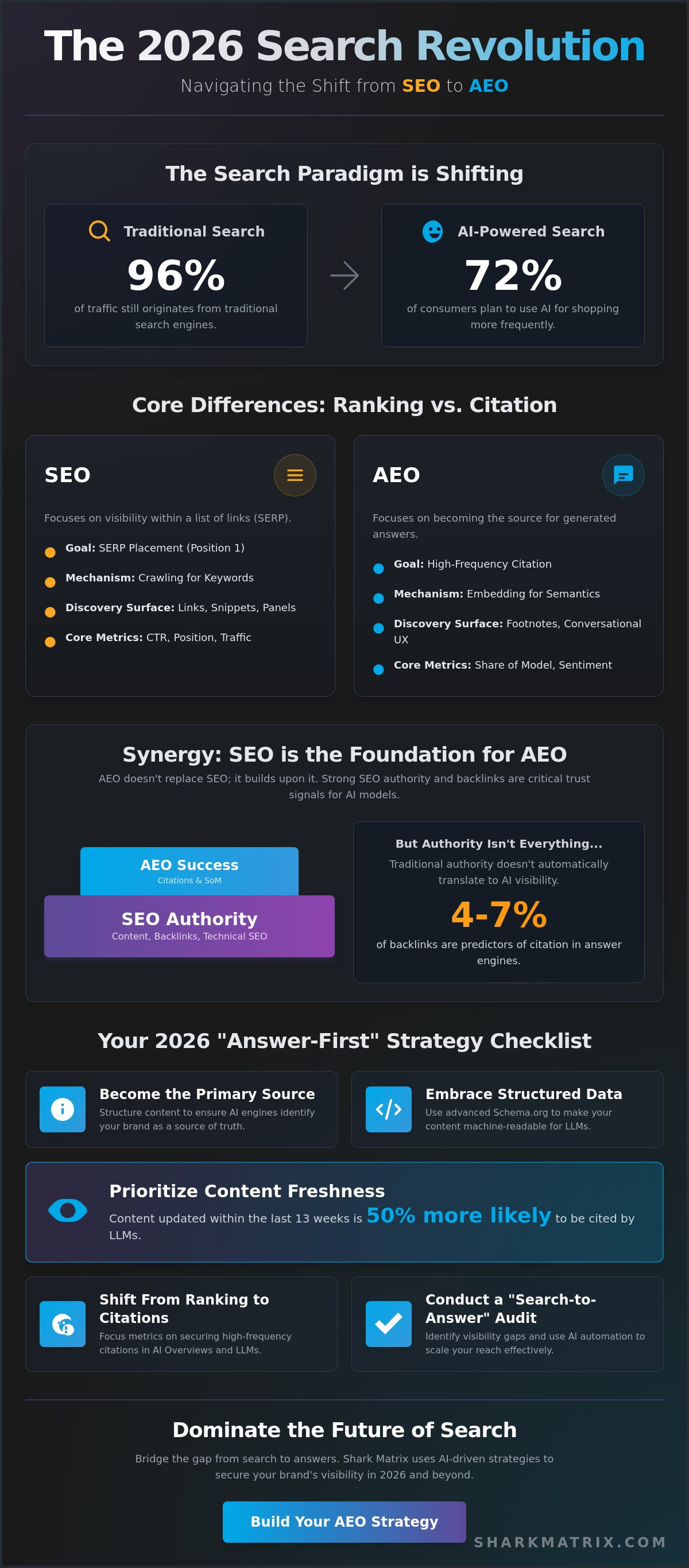
96% of total traffic volume still originates from traditional search, yet 72% of consumers plan to use AI for shopping more frequently this year. You’ve likely seen your organic click-through rates dip as AI Overviews occupy the top of the results page. Understanding the balance of answer engine optimization vs seo is no longer optional if you want to protect your visibility. It’s a stressful time to manage legacy content, especially when you aren’t sure which specific engines are even citing your brand. You know the rules of the game are changing, but you don’t want to abandon the strategies that still drive the majority of your leads.

We’re here to bridge that gap. This article provides a clear roadmap for 2026 search visibility, showing you how to integrate both strategies to dominate search results and AI citations. You’ll discover why content updated within the last 13 weeks is 50% more likely to be cited by LLMs and how to restructure your data for maximum impact. We’ll show you how to maintain traffic while building authoritative brand presence within AI-generated answers. It’s time to move from simply ranking to becoming the definitive answer across the entire digital ecosystem.

Key Takeaways

  • Understand the critical balance of answer engine optimization vs seo to maintain visibility as search behavior shifts from clicking to delegating.
  • Master the transition from traditional keyword ranking to securing high-frequency citations within Large Language Models and AI Overviews.
  • Learn how to use advanced Schema.org and structured content to ensure AI engines identify your brand as a primary source of truth.
  • Discover why your existing SEO authority is the foundation for AEO success and how to leverage backlinks as trust signals for AI models.
  • Find out how a dedicated “Search-to-Answer” audit identifies visibility gaps and uses AI automation to scale your reach in 2026.

The Evolution of Search: Defining SEO and AEO in 2026

The digital landscape has shifted from a library of links to a network of answers. In 2026, the debate surrounding answer engine optimization vs seo often frames them as rivals; however, for national brands, this is a false dichotomy. Traditional Search Engine Optimization (SEO) has matured beyond simple keyword targeting into intent-based ecosystem management. It’s no longer just about where you rank on a list. It’s about how your brand exists within the entire search environment. While SEO builds the foundation of authority and discoverability, Answer Engine Optimization (AEO) focuses on becoming the definitive source of truth that Large Language Models (LLMs) rely on when synthesizing responses.

We’ve moved past the “index-and-rank” era. Modern search platforms use “understand-and-synthesize” models. These systems don’t just point users toward a page; they ingest content, weigh its credibility, and present a summarized conclusion. For businesses, understanding the interplay of answer engine optimization vs seo is the only way to stay ahead of these algorithmic shifts. You can’t ignore the technical requirements of one without damaging the performance of the other.

What Constitutes an Answer Engine?

Answer engines represent a diverse group of platforms including Perplexity, ChatGPT, Claude, and Google’s AI Overviews. Unlike traditional crawlers that primarily look for keywords and backlink patterns, these engines consume data to build semantic relationships. They use real-time web access to verify facts and provide current insights. This means your content must be structured for machine readability. If an engine can’t parse your data quickly, it won’t cite you as the primary source for a user’s prompt. It’s about clarity and structured data over mere volume.

Why 2026 is the Tipping Point for AEO

User expectations have fundamentally changed. Most people no longer want to hunt through ten blue links; they want a direct answer immediately. This shift has led to a surge in zero-click searches, where the user journey begins and ends on the search results page. To combat declining organic click-through rates, professional search engine optimization seo services have evolved to prioritize AI-readiness. Success in 2026 requires a hybrid approach. You must maintain traditional rankings to drive high-intent traffic while simultaneously optimizing for the AI-generated summaries that now dominate the top of the screen.

Core Differences: Ranking vs. Citation Mechanics

To master the balance of answer engine optimization vs seo, you must first understand that the goalposts have moved. Traditional SEO focuses on SERP placement, aiming for that coveted “Position 1” in a list of results. AEO, however, prioritizes citation frequency and accuracy. It’s the difference between being a link on a page and being the data source that powers an AI’s response. While a high ranking in Google remains valuable, research indicates that backlinks are only predictors of citations in answer engines in the 4-7% range. This means your traditional authority doesn’t automatically translate to AI visibility.

The technical process also differs significantly. SEO relies on “crawling for keywords,” where bots identify specific strings of text. AEO relies on “embedding for semantic meaning,” where neural networks analyze how concepts relate to one another. Users are shifting from browsing a list of links to consuming a generated summary. This changes how we measure success. Instead of just tracking Click-Through Rate (CTR) and Position, digital leaders now track Share of Model (SoM) and brand sentiment within AI outputs. If you’re struggling to track these new metrics, our ai automation services can help you monitor your brand’s presence across generative platforms.

The Discovery Surface: Links vs. Conversational UX

In traditional search, users interact with featured snippets, local packs, and knowledge panels. These are static elements designed to drive clicks. Answer engine outputs are different; they feature footnotes, inline citations, and follow-up prompts. The “first page” of Google is no longer the only battleground. Instead, the “context window” of the AI model determines what information is included in the final answer. If your content isn’t structured to fit this window, it won’t be cited, regardless of its traditional rank.

Data Processing: Algorithms vs. Neural Networks

Traditional search engines like Google still use evolved versions of PageRank to weigh authority based on link structures. In contrast, answer engines use transformer architectures and neural networks to process data. These systems prioritize “entities” (concepts and objects) over “strings” (literal text matches). This represents a fundamental move from lexical matching to semantic understanding, where the engine evaluates the underlying meaning of your content rather than just the words used.

The Synergy: Why AEO Cannot Exist Without SEO

A common mistake in current digital strategy is treating answer engine optimization vs seo as a choice between two different paths. In reality, they are two sides of the same coin. AI engines don’t generate facts out of thin air; they ground their responses in high-authority sources they find through traditional search indexing. If your site lacks the foundational authority that SEO provides, an answer engine is unlikely to trust your content enough to cite it. You can’t have one without the other if you want to maintain a dominant online presence.

Traditional backlinks still play a vital role here. While they aren’t the only factor for AI discovery, they act as essential trust signals. Generative models use these signals to verify that a piece of information is credible and widely recognized. This creates a powerful feedback loop. High SEO rankings lead to more AI citations. These citations, in turn, increase brand visibility and search volume, which further reinforces your SEO standing. Protecting this visibility is especially critical for national brands, which is why seo for brand reputation management dubai has become a core component of modern search strategies.

The Authority Factor in AI Citations

Large Language Models often prioritize the top five organic results when answering factual queries. This makes your E-E-A-T (Experience, Expertise, Authoritativeness, and Trustworthiness) profile more important than ever. It’s not just about having the right keywords anymore. It’s about your brand mentions across the web acting as a decentralized knowledge graph. Research shows that content published or updated within the last 13 weeks is roughly 50% more likely to be cited by answer engines. When multiple authoritative sites mention your brand in connection with fresh, updated data, AI engines are far more likely to synthesize that information into a cited answer.

Solving the Zero-Click Challenge

The rise of zero-click searches doesn’t mean traffic is dead. It means you need a two-tiered approach. Use AEO to capture the immediate “answer” within the AI summary, positioning your brand as the primary expert. Then, use SEO to capture the “deep dive” traffic from users who want more than a summary. Click-through optimization within AI responses involves using clear, compelling language that encourages users to click the citation link for more detail. You should balance your concise, AI-friendly summaries with high-value gated content or long-form guides that provide the depth an AI summary simply can’t replicate.

Answer Engine Optimization vs SEO: Navigating the Future of Visibility in 2026

The 2026 AEO Checklist: Building an Answer-First Strategy

Succeeding in the current climate requires more than just adding a few FAQs to your blog posts. It demands a structural shift in how you present data to both humans and machines. When evaluating answer engine optimization vs seo, the most successful brands are those that treat their website as a structured database rather than a collection of documents. This checklist outlines the essential steps to ensure your brand is the first choice for AI synthesis.

Implementing this shift requires a specialized approach to digital architecture. Companies like PurpleCow Digital Marketing provide the strategic website design and development necessary to ensure your site functions as a high-performance database for AI engines.

  • Step 1: Implement advanced Schema.org markup like Speakable, FAQ, and HowTo to define your content’s purpose clearly.
  • Step 2: Transition to an “Answer-First” architecture where the primary value proposition is delivered immediately.
  • Step 3: Optimize for natural language and conversational long-tail queries that reflect how people actually speak to AI agents.
  • Step 4: Build a robust entity-based internal linking structure that maps the relationships between your core business concepts.
  • Step 5: Monitor “Share of Model” (SoM) using emerging AI tracking tools to see how often your brand is cited compared to competitors.

The interplay of answer engine optimization vs seo means your technical foundation must support both discovery and citation. If you are ready to modernize your digital infrastructure, our ai automation and development services can help you implement these advanced data structures at scale.

Technical Foundations: Schema and Structured Data

Basic JSON-LD is no longer sufficient for high-level visibility. You must optimize for semantic triplets, which define specific relationships between entities in a way that AI models can easily ingest. By using technical SEO to “label” every component of your page, you reduce the computational effort required for an engine to understand your expertise. Structured data is the language of AEO. It transforms your prose into a machine-readable format that answer engines can trust and verify in real-time.

Content Framework: The Q&A Hierarchy

Content architecture must now follow a strict hierarchy designed for quick extraction. Start your articles with a 40 to 60 word “direct answer” that provides immediate value. Use H2 and H3 headings as explicit question-answer pairs. This structure mirrors how LLMs search for information within their context windows. Additionally, prioritize factual density and “first-hand experience.” This emphasis on unique expertise ensures your content isn’t just another generic summary, but a unique contribution that AI engines find worth citing over competitors.

Shark Matrix: Bridging the Gap Between Search and Answers

Scaling a visibility strategy that balances answer engine optimization vs seo requires more than just manual content updates. It demands technical integration. At Shark Matrix, we use custom AI automation to help brands transition from static pages to dynamic, machine-readable data sources. This isn’t just about following a checklist; it’s about building an infrastructure where your brand assets are “AI-native” from the moment they’re created. By leveraging our generative ai development services, we ensure your content is structured to be ingested, understood, and cited by the world’s most advanced LLMs.

Our proprietary “Search-to-Answer” audit process is designed specifically for national UAE brands looking to protect their authority. We don’t just look at where you rank on a traditional results page. We analyze how your brand is represented in conversational prompts and AI summaries. This dual-focus approach ensures you don’t lose traditional organic traffic while you’re busy building a presence in the new answer-first ecosystem. A national strategy needs a partner who understands both the nuances of search engine algorithms and the complexities of AI engineering.

AI-Native Digital Marketing

Future-proofing your brand involves using machine learning development services to predict which queries are most likely to trigger AI Overviews. We help you stay ahead of the curve by identifying these high-value “answer targets” before your competitors do. Beyond external visibility, we develop custom ai chatbot-development services that act as internal answer engines for your proprietary data. This allows you to maintain a unified brand voice across every touchpoint, whether a user is talking to your site’s bot or asking a global engine like ChatGPT about your services.

Measuring Success in an AI-Driven World

Success metrics are undergoing a fundamental transformation. While we still monitor traditional traffic, we’ve moved toward “Inclusion” as a primary KPI for our clients. This means tracking how often your brand is the cited source in a generated summary. We use natural language processing services to monitor brand sentiment within LLM outputs, ensuring the AI isn’t just mentioning you, but positioning you as the expert. Ready to dominate the answer engines? Contact Shark Matrix for a 2026 Strategy Audit and secure your brand’s future in the next era of search.

Securing Your Brand’s Authority in the AI Era

The transition from a link-based web to an answer-first ecosystem is well underway. You now have the tools to understand that the dynamic between answer engine optimization vs seo is one of mutual reinforcement. Success in 2026 requires more than just high rankings; it demands a presence within the context windows of the world’s most powerful AI models. By combining the trust signals of traditional search with the structured clarity of AEO, you ensure your brand remains the primary source of truth for both human users and digital agents.

Navigating this shift alone is a complex task for any national market leader. As a pioneering AI automation agency in the UAE, Shark Matrix specializes in national-scale SEO strategies and holds deep expertise in Generative Engine Optimization (GEO). We help you bridge the technical gap between discovery and citation to maintain your competitive edge. Future-proof your brand with Shark Matrix AEO & SEO services to ensure you aren’t just found, but cited. The future of search is conversational, and it’s time for your brand to lead the conversation.

Frequently Asked Questions

Will AEO replace traditional SEO by the end of 2026?

No, AEO won’t replace traditional SEO by the end of 2026. Instead, it serves as a natural evolution of search strategy. While AEO focuses on getting cited in AI summaries, traditional SEO still drives the vast majority of web traffic. You need SEO to build the site authority that AI engines use to verify your brand’s credibility before they cite you as a source of truth.

How do I track my website’s performance in answer engines like ChatGPT?

You can track performance by monitoring Share of Model (SoM) and brand sentiment within AI outputs. Unlike traditional rank tracking, this involves using specialized tools that query LLMs to see how often your brand appears in generated answers. It’s also helpful to look at referral traffic from AI sources in your analytics, though this data is often still grouped under direct or referral sources.

What is the most important technical factor for Answer Engine Optimization?

The most important technical factor is implementing advanced Schema.org markup to label your content for machine ingestion. Structured data acts as a translator for AI engines, allowing them to parse your facts, entities, and relationships without ambiguity. When comparing answer engine optimization vs seo, this technical layer is what moves you from being a link to being a verifiable fact in an AI’s memory.

Can I optimize a single page for both Google Search and AI answer engines?

Yes, you can and should optimize a single page for both environments. A hybrid structure leads with a concise direct answer for AI engines while following up with the deep dive analysis that traditional searchers value. This dual approach ensures you capture the AI summary citation at the top of the page while maintaining your organic ranking for users who want to click through and read more.

How does AEO affect my organic click-through rate (CTR)?

AEO often leads to a lower click-through rate for simple informational queries because the AI provides the answer directly. However, it significantly boosts your brand authority and trust. Being the cited source in an AI Overview creates a halo effect that can drive higher quality, high intent traffic from users who need more than just a quick summary. It’s a shift from quantity to quality.

What role does Schema markup play in AEO compared to SEO?

In traditional SEO, Schema markup is primarily used to win rich snippets like star ratings or FAQ boxes. In AEO, its role is much deeper; it provides the semantic triplets that AI models use to understand the relationship between different entities. It’s the difference between decorating a search result and feeding a neural network the specific data it needs to synthesize an accurate answer.

Is AEO only for informational queries, or does it work for commercial intent?

AEO works for both informational and commercial queries. While it started with simple “what is” questions, users now use AI to compare products, find local services, and seek professional advice. Optimizing for commercial intent in 2026 means ensuring your product specifications and service details are structured so AI engines can include your brand in “best of” summaries or comparison tables.

How often should I update my content to stay relevant for AI engines?

You should update your core content at least every 13 weeks to maintain its relevance. Research shows that content updated within this timeframe is 50% more likely to be cited by answer engines. AI models prioritize fresh data and recent insights to ensure their summaries are current. Frequent updates to your proprietary metrics and factual data help maintain your status as a reliable source of truth.

Categories
GEO

What is Generative Engine Optimization? The 2026 Guide to GEO

Organic click-through rates have plummeted by 61% for queries where AI Overviews appear, leaving many brand

Categories
Development

The Role of a UI/UX Design Agency in Driving National Business Growth in 2026

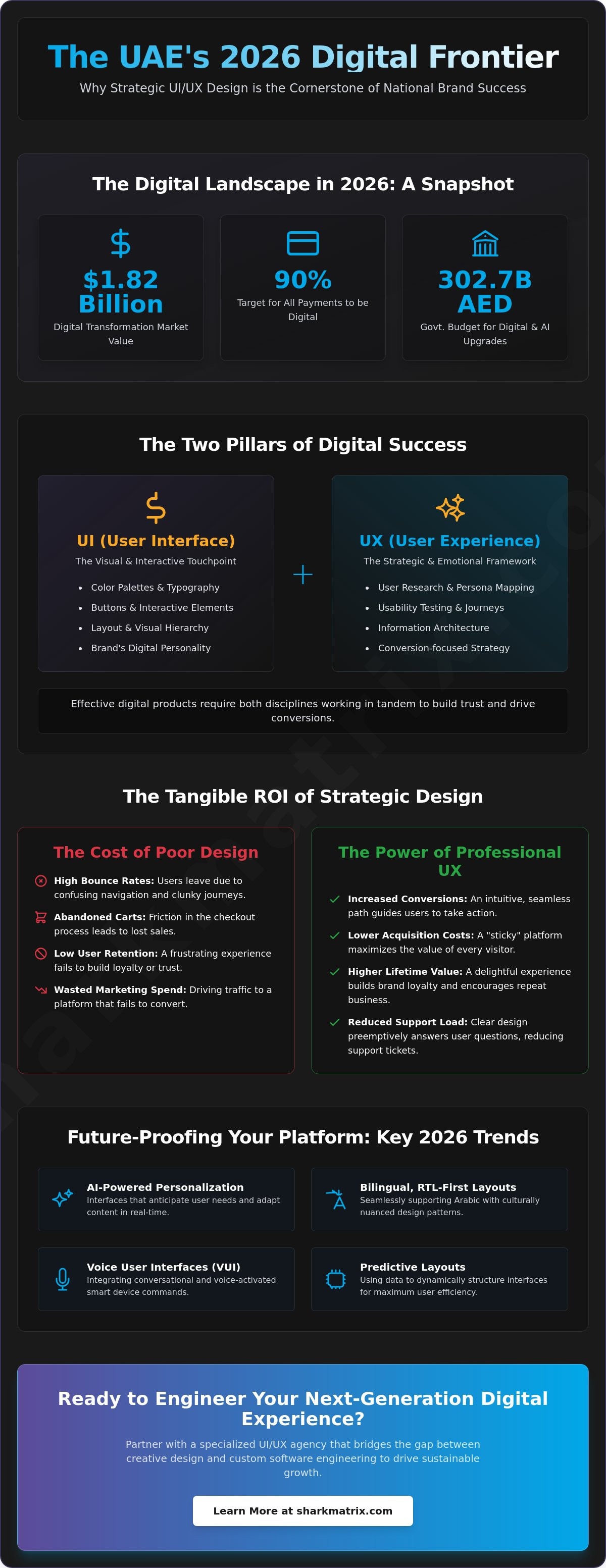
Did you know the UAE’s digital transformation market has surged to a value of $1.82 billion in 2026? As the government pushes to double the digital economy’s contribution to the non-oil GDP, the competition for user attention has never been more intense. Partnering with a specialized ui/ux design agency dubai is no longer just about aesthetics; it’s a strategic necessity for any enterprise looking to thrive in a landscape where 90% of all payments are now digital.

You’ve likely noticed how a clunky user journey or a high bounce rate can quietly erode your bottom line. It’s frustrating to watch potential sales vanish because your mobile and web platforms don’t feel cohesive or intuitive. We understand that maintaining brand consistency while trying to keep up with rapid technological shifts is a significant challenge for modern businesses.

This article discovers how strategic UI/UX design transforms your digital products into high-conversion assets that drive measurable revenue growth. We’ll explore the essential trends for 2026, including AI-powered personalization and bilingual, RTL-first layouts, to show you how to build a future-proof experience that keeps your customers coming back.

Key Takeaways

  • Understand the critical distinction between visual UI and strategic UX to ensure your digital platforms are built for high-conversion performance.
  • Discover how a specialized ui/ux design agency dubai helps national brands maximize ROI by aligning digital journeys with the UAE’s evolving digital economy.
  • Learn the modernized 2026 design process that integrates AI automation and user research to create personalized, future-proof products.
  • Identify the essential criteria for choosing a partner, including the ability to manage complex Arabic linguistic requirements and cultural nuances.
  • Explore how bridging the gap between creative design and custom software engineering drives sustainable growth for local enterprises.

What is a UI/UX Design Agency and Why Does Your National Brand Need One?

In 2026, the UAE is no longer just participating in the digital economy; it is leading it. With the government’s 302.7 billion AED budget allocation for digital infrastructure and AI upgrades, national brands face a sophisticated new reality. A specialized ui/ux design agency dubai provides the technical depth needed to turn a simple website into a high-performance engine. While a generalist graphic designer might focus on making a page look attractive, a dedicated agency engineers the interaction to meet the high expectations of a tech-savvy local population. This distinction is vital for maintaining brand authority in a market where consumers transition seamlessly between mobile apps, web portals, and voice-activated smart devices.

Digital expectations have shifted toward hyper-personalization. Users no longer tolerate generic experiences. They want interfaces that anticipate their needs, offer bilingual support natively, and reflect the cultural nuances of the region. A professional agency bridges the gap between raw technology and human behavior, ensuring your digital presence feels like a natural extension of your physical brand; to establish your physical headquarters, check out BizCity Group for flexible workspace solutions in Dubai.

The Critical Difference Between UI and UX

UI, or User Interface, is the visual touchpoint of your product. It encompasses the typography, color palettes, and interactive elements that define your brand’s digital personality. In contrast, UX, or User Experience, is the strategic framework behind those visuals. It involves deep research, usability testing, and the emotional response of the user as they move through a journey. You cannot have an effective digital product without both disciplines working in tandem. A beautiful interface that is hard to navigate results in high bounce rates. Conversely, a functional app that looks dated fails to build trust. Mastery of user experience design ensures that every click serves a purpose and every interaction leads toward a conversion.

The Business Case for Professional Design in 2026

UX maturity is the single greatest predictor of digital profitability for UAE enterprises today.

Bad design is expensive. It manifests as abandoned carts, low user retention, and a heavy burden on customer support teams who must explain clunky workflows. By investing in a professional ui/ux design agency dubai, brands future-proof their digital assets against rapid technological shifts. This includes integrating next-gen features like Voice User Interfaces (VUI) and AI-driven predictive layouts. As Dubai moves toward its goal of 90% digital payments by the end of 2026, your design strategy becomes the primary driver of national market perception and long-term revenue growth. This level of design sophistication is especially critical for specialized enterprise platforms like AiRentoSoft, where automated fleet and car rental management requires a seamless user experience to maintain operational efficiency.

The ROI of Strategic Design: How UX Impacts the National Digital Economy

Many business leaders still view design as a cosmetic expense rather than a core revenue driver. This perspective is a costly mistake in 2026. With the full rollout of the Digital Dirham and Dubai’s target of 90% digital payments, every interaction on your platform is a high-stakes financial transaction. Strategic design directly influences Conversion Rate Optimization (CRO) by removing the cognitive friction that leads to abandoned carts and incomplete forms. When a user finds what they need effortlessly, the likelihood of conversion increases exponentially. This efficiency significantly lowers Customer Acquisition Costs (CAC). You stop wasting your marketing budget on driving traffic to a “leaky” funnel that cannot retain interest.

Investing in a professional ui/ux design agency dubai ensures your digital infrastructure is built for performance. Beyond simple aesthetics, strategic UX is about engineering paths that lead users to take action. For a broader look at how these elements integrate into your overall presence, see our pillar article on website design and development services. High-quality design pays for itself by reducing the need for expensive customer support and increasing the lifetime value of every user who interacts with your brand.

Arabic Localization and Cultural Design Patterns

In the UAE, “global” design templates often fall short because they ignore the fundamental logic of Right-to-Left (RTL) interfaces. True localization isn’t just about translating text. It’s about mirroring the entire layout, from navigation menus to the placement of call-to-action buttons. Cultural aesthetics also play a massive role. National audiences respond better to specific visual hierarchies and imagery that reflect local values. Integrating your design strategy with professional Arabic digital marketing during the initial phase prevents the disjointed experience that occurs when cultural nuances are added as an afterthought.

Measuring Success: UX Metrics That Matter

Data-driven lead generation requires more than just tracking clicks. You must look at Task Success Rate, which measures the percentage of users who successfully complete a specific goal, such as a checkout or a sign-up. Time on Task is another vital KPI. If users take too long to find basic information, your interface is failing them. A specialized ui/ux design agency dubai uses these metrics to refine the user journey constantly. Intuitive navigation leads to higher user retention, creating a sustainable digital ecosystem where users return because the experience was seamless. If you aren’t sure how your current platform measures up, it might be time to evaluate your digital strategy with a focus on user-centric engineering.

The 2026 UI/UX Design Process: From Discovery to AI Integration

The workflow at a premier ui/ux design agency dubai has shifted from static layouts to dynamic, data-driven ecosystems. By 2026, the process is no longer a linear path but a continuous loop of innovation. It begins with Discovery and User Research, where designers analyze the specific habits of the UAE’s multicultural demographic. This stage now includes studying how local users interact with the Digital Dirham and Dubai’s smart city services to ensure the product fits into their daily lives. Next comes Information Architecture and Wireframing. This is the skeleton of your journey, mapping out how information flows in both English and Arabic to cater to the nation’s linguistic diversity.

The third phase is Prototyping and Interaction Design. Here, we build high-fidelity simulations that allow stakeholders to feel the product’s rhythm before any code is written. This is followed by UI Design and Brand Integration, where the visual identity is applied across all touchpoints, ensuring a premium look that commands authority. The final stage, Testing and Iteration, uses AI-driven heatmaps and real-time user feedback loops. This ensures the digital asset evolves based on actual human behavior rather than assumptions. This rigorous approach is what separates a world-class ui/ux design agency dubai from agencies that only offer surface-level visuals.

Integrating AI and Automation in Modern UX

AI development services and automation are now native components of the design phase. We’ve moved beyond simple widgets to “Anticipatory Design,” where machine learning predicts user needs based on past behavior. For example, an e-commerce platform might rearrange its interface in real-time to highlight a user’s preferred payment method or language. These sophisticated features require a robust technical foundation. You can explore the implementation of these technologies in our guide on custom web development dubai. This integration ensures that automation serves the user experience rather than complicating it.

The Design-to-Development Handoff

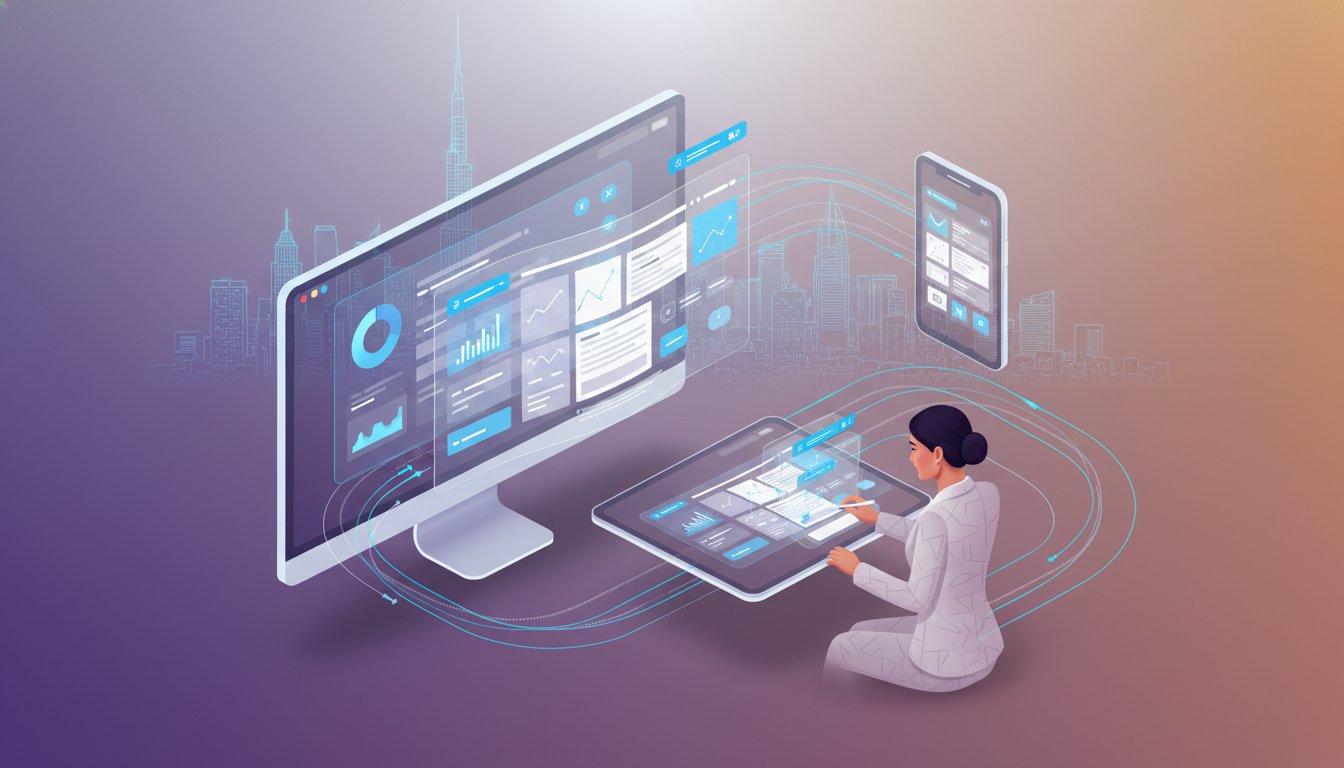
A brilliant design is useless if it cannot be executed perfectly. Seamless communication between designers and engineers is the backbone of project success in 2026. We use advanced documentation tools and shared component libraries to ensure the final product matches the approved design to the pixel. This precision is especially critical for responsive web design dubai. With over 16 million 5G smartphones active in the region, your platform must perform flawlessly across a massive range of screen sizes and device types. A unified handoff process prevents the “translation errors” that often lead to broken layouts or sluggish performance on mobile devices.

The Role of a UI/UX Design Agency in Driving National Business Growth in 2026

Choosing the Right UI/UX Partner: Key Criteria for National Enterprises

Finding the right ui/ux design agency dubai isn’t just about looking at pretty pictures. In 2026, the stakes are too high for a partner that only offers superficial aesthetics. You need to dig into the functional complexity of their previous work. Does their portfolio show they can handle intricate user logic, such as multi-step financial checkouts or complex data dashboards? A diverse portfolio proves an agency can adapt to different business models while maintaining high standards of usability. If they don’t understand the logic of RTL (Right-to-Left) navigation or the specific cultural preferences of the UAE market, your brand will struggle to gain traction with a local audience.

Technical synergy is another vital factor. A design agency that also excels in mobile app development or e-commerce development provides a significant advantage. They understand the technical limitations and possibilities of the code that will eventually house their designs. This prevents the “unbuildable design” trap where beautiful concepts fail in the development phase. Finally, ask about their testing methodology. Professional agencies don’t rely on internal opinions. They use real users and data-driven insights to validate every button placement and menu structure. If you want to ensure your investment delivers measurable results, evaluate your project requirements with a team that prioritizes data over guesswork.

The Vetting Checklist for 2026

Before signing a contract, you must ensure the agency is equipped for the current technological climate. Ask these specific questions:

  • Do they have a proven track record with AI and machine learning development services?
  • Can they show case studies where their design directly improved conversion rates or ROI?
  • How do they handle the design-to-development handoff to ensure pixel-perfect execution?

Modern enterprises require partners who can integrate sophisticated automation without sacrificing the user experience. For a deeper dive into these criteria, consult our comprehensive vetting guide. This resource helps you filter out generalists and focus on specialists who understand the national digital landscape.

Transparency and Communication

Professional ui/ux design agency dubai teams don’t work in a vacuum. A “black box” design process, where you see nothing until the final reveal, is a major red flag. Instead, look for a collaborative approach built on clear milestones and feedback loops. Transparent agencies provide regular updates and are willing to pivot based on user data or shifting business goals. They manage expectations through detailed timelines and ensure that every stakeholder is aligned before moving to the next phase. This open communication style reduces the risk of project delays and ensures the final digital product truly reflects your brand’s vision and the needs of your customers.

Shark Matrix: Engineering Next-Generation Digital Experiences

Shark Matrix stands at the forefront of the UAE’s digital evolution as a leader in end-to-end digital transformation and custom software engineering. We don’t believe in design for the sake of design. Instead, our team functions as a premier ui/ux design agency dubai by blending high-level creativity with sophisticated AI automation. This integration allows us to build interfaces that aren’t just visually stunning but are also intelligent enough to adapt to user needs in real-time. By leveraging our deep expertise in professional Arabic digital marketing, we ensure that national brands resonate deeply with the local population while maintaining a global standard of excellence.

Our data-driven approach removes the guesswork from the creative process. We use concrete user evidence, from AI-powered heatmaps to rigorous interaction testing, to back every design choice we make. This ensures that the final product isn’t just a vision; it’s a high-conversion asset specifically engineered for national business growth. We focus on building digital products that are robust, scalable, and ready to meet the demands of Dubai’s rapidly expanding digital economy.

Beyond Design: A Full-Service Digital Partner

A great interface only works if people can find it. We integrate Search Engine Optimization (SEO) and lead generation into the foundational design of every website we build. This means your platform is optimized for visibility from the very first wireframe. Our team also manages high-impact Pay Per Click (PPC) and social media campaigns to drive targeted traffic to your new interface immediately after launch. To protect your investment, we offer online reputation management to ensure your brand authority remains high as you scale. This holistic approach ensures that your digital presence is a self-sustaining engine for revenue.

Ready to Transform Your Digital Presence?

The digital landscape of 2026 demands more than just a functional website. It requires a partner that understands the intersection of culture, technology, and commerce. We invite you to consult with our experts for a comprehensive UI/UX audit to identify friction points in your current journey. Whether you need advanced mobile app development or a complete overhaul of your e-commerce platform, our commitment is to deliver culturally resonant products that drive innovation. Partner with a leading ui/ux design agency dubai to future-proof your brand and achieve national business excellence. Contact Shark Matrix today to start your transformation.

Securing Your Lead in the UAE’s Digital Future

The UAE’s shift toward a fully digital economy means your platform’s usability is now a direct reflection of your brand’s authority. It isn’t just about looks. We’ve explored how a conversion-centric approach turns digital products into high-performing assets while lowering customer acquisition costs. By mastering the 2026 design process, from AI-driven heatmaps to native Arabic localization, you create a seamless journey that meets the high expectations of tech-savvy users. These strategic improvements ensure your business remains resilient as digital payments become the national standard.

Securing long-term growth requires a partner that bridges the gap between creative vision and technical execution. Selecting an experienced ui/ux design agency dubai is the most critical step in this transformation. Shark Matrix has been a regional leader since 2010, offering over 15 years of specialized expertise in RTL design and Arabic digital marketing. Our unique blend of software engineering and AI automation ensures your digital presence remains robust as the market evolves. Now is the time to turn your digital challenges into competitive advantages.

Elevate your brand with Shark Matrix’s expert UI/UX design services today.

Frequently Asked Questions

What does a UI/UX design agency actually do?

A UI/UX design agency bridges the gap between digital strategy and user interaction. They conduct deep research to understand user behavior and then architect interfaces that guide people toward specific goals. Unlike simple design studios, a professional ui/ux design agency dubai integrates technical requirements like AI automation and bilingual layouts to ensure the product is both beautiful and functionally superior across all touchpoints.

How long does a typical UI/UX design project take in 2026?

Most enterprise-level UI/UX projects in 2026 take between 8 and 20 weeks to complete. This timeline includes discovery, wireframing, high-fidelity prototyping, and rigorous user testing. Smaller projects or specific feature updates might be faster, but comprehensive digital transformations require significant time for research and cultural localization to ensure the product succeeds in the competitive UAE market.

Can professional UI/UX design help improve my SEO rankings?

Yes, strategic design is a fundamental pillar of Search Engine Optimization. Search engines prioritize platforms with fast load times, low bounce rates, and high user engagement. By improving the user experience, you satisfy Core Web Vitals and encourage visitors to stay longer. A well-structured interface makes it easier for search bots to crawl your content and for users to convert, directly boosting your rankings.

Why is Arabic localization critical for UX in the UAE?

Arabic localization is essential because it respects the linguistic logic and cultural expectations of the UAE’s primary demographic. It goes beyond simple translation; it requires a complete Right-to-Left (RTL) layout overhaul. If your platform feels like a translated afterthought, you lose trust. A native-feeling Arabic interface ensures your brand is perceived as a local authority rather than a foreign entity.

What is the difference between a freelance designer and a UI/UX agency?

An agency provides a multidisciplinary team that includes researchers, strategists, and engineers. While a freelancer might excel at visuals, a ui/ux design agency dubai offers the technical depth needed for AI integration and complex software engineering. Agencies provide the scalability and long-term support that large enterprises require for mission-critical digital assets, ensuring the design is technically feasible and business-aligned.

How much does UI/UX design cost for a national enterprise?

The cost of a professional UI/UX redesign varies significantly based on the project’s scope and technical complexity. Factors such as the number of unique user journeys, the depth of AI integration, and the requirement for bilingual support influence the final investment. Enterprises should view this as a strategic capital expenditure that drives revenue growth rather than a one-time marketing cost.

Will a new UI/UX design work on both mobile and desktop?

Every modern UI/UX design is built to be fully responsive across all device types. Given that the UAE has over 16 million 5G smartphones in operation, we prioritize a mobile-first approach. This ensures that your platform is lightning-fast and intuitive on a phone while still providing a robust, feature-rich experience for desktop users. Consistency across all screens is non-negotiable for brand authority.

How do you measure the success of a UI/UX redesign?

Success is measured through specific data points like Conversion Rate Optimization (CRO) and Task Success Rate. We track how easily users complete a purchase or sign up for a service compared to the previous design. Other vital metrics include a reduction in customer support inquiries and an increase in user retention. These numbers provide concrete evidence of the redesign’s impact on your bottom line.

Categories
Development

Native App Development in 2026: The Definitive Comparison for Modern Enterprises

What if the decision to save 40% on initial development costs today costs your business millions in lost pe

Categories
Development

Responsive Web Design Dubai: The 2026 Guide for UAE Enterprises

With 23 million cellular mobile connections in the UAE, representing 202% of the total population, your dig

Categories
Social Media Marketing

The 2026 Guide to Creating a Social Media Content Calendar for UAE Brands

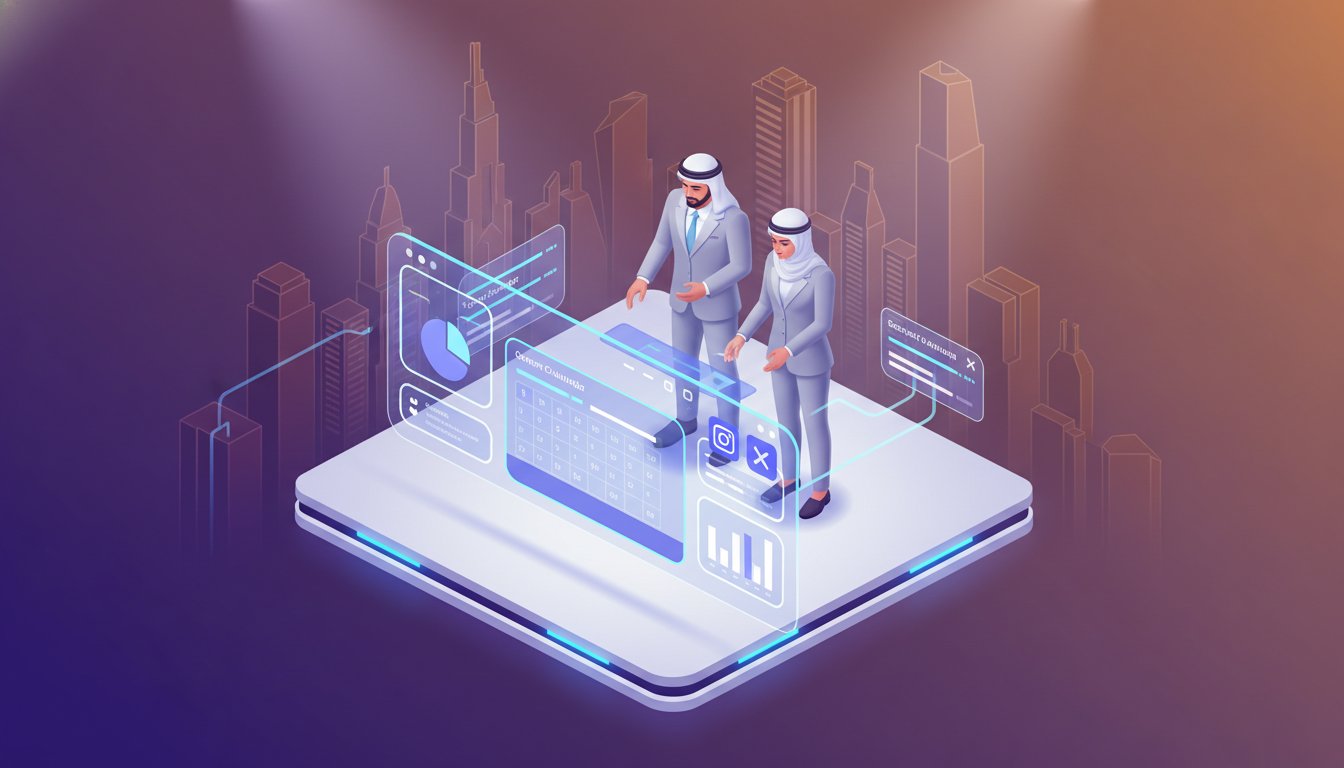
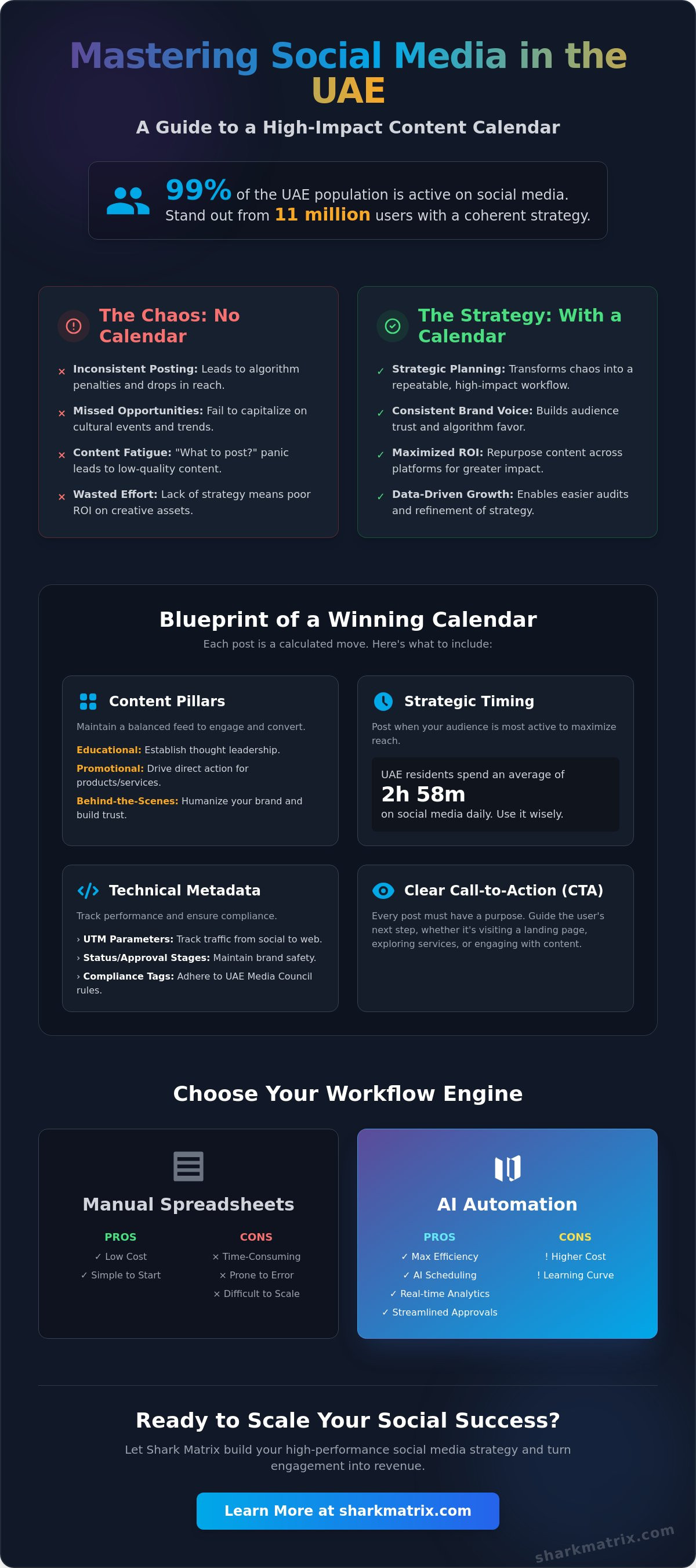
With 99% of the UAE population now active on social media, standing out among 11 million users requires more than just luck. It’s frustrating to deal with inconsistent posting or the stress of missing a major cultural event. You’ve probably realized that a haphazard approach leads to content fatigue and wasted effort. Building a professional social media content calendar is the only way to transform that chaos into a repeatable, high-impact workflow.

This guide helps you master organized storytelling by aligning your brand voice with the latest 2026 regulations, including the mandatory UAE Media Council Advertiser Permit. You’ll learn how to synchronize your social efforts with SEO goals to drive better visibility across all platforms. We’ll walk through a strategic framework that covers everything from short-form video trends on TikTok to using AI automation for real-time engagement and strategic timing.

Key Takeaways

  • Learn why a strategic social media content calendar is the essential bridge between high-level marketing goals and daily execution in the UAE.
  • Discover how to optimize your publication schedule and platform selection to better engage with the unique habits of the national audience.
  • Evaluate the differences between manual spreadsheets and AI automation tools to choose the most efficient infrastructure for your content workflow.
  • Follow a step-by-step framework to audit your current social performance and define clear objectives for brand growth and lead generation.
  • Understand the importance of aligning your social media presence with search engine optimization and professional content marketing to build long-term authority.

What is a Social Media Content Calendar and Why Does Your Brand Need One?

Think of your social media presence as a digital storefront. You wouldn’t leave the lights off for weeks at a time or change your signage every day without a plan. A social media content calendar is a strategic document that maps out every post, video, and story across your national channels. It acts as the vital bridge between your high-level marketing strategy and the daily execution that keeps your brand relevant. In the UAE, where competition for attention is intense, this document ensures your brand voice remains professional and helpful across LinkedIn, TikTok, and Instagram simultaneously. It’s also a powerful visibility tool. It ensures your entire marketing team sees upcoming campaigns well in advance, so no department misses out on high-impact national marketing opportunities.

The Core Benefits of Strategic Planning

Planning ahead kills the “what should we post today?” panic that often leads to low-quality, rushed content at the eleventh hour. By looking at the month ahead, you can create cross-platform synergy that boosts your overall impact. For example, a single high-quality video produced for YouTube can be intelligently repurposed into TikTok clips, Instagram Reels, and LinkedIn snippets. This approach doesn’t just save time; it significantly increases your ROI by making your creative assets work harder. This organized approach also makes it easier to conduct a professional social media audit. Having a clear, historical record of your activity allows you to identify patterns in engagement and use that data to refine your future content marketing efforts.

Why National Brands Fail Without a Calendar

Without a structured social media content calendar, inconsistency becomes inevitable. Modern algorithms on platforms like Instagram and TikTok are designed to prioritize accounts that post regularly and predictably. When your brand goes silent for days or weeks, your reach drops, and you begin to lose the hard-earned trust of your audience. Beyond these technical penalties, you risk missing critical topical engagement windows. The UAE has a rich, fast-paced calendar of cultural and national events. Missing a major holiday or a trending local topic because your team was unorganized looks out of touch to a local audience. Finally, a lack of a central plan leads to accountability gaps within your marketing team. When there’s no clear schedule, content gaps appear, and your brand’s authority begins to slip.

The Anatomy of a High-Performing Social Media Calendar

A successful social media content calendar is much more than a simple list of dates. It’s a sophisticated data set that ensures every piece of content serves a specific business purpose. To build one that actually converts, you must first account for the unique digital habits of the UAE audience. For instance, with residents spending an average of 2 hours and 58 minutes daily on social media, timing your posts to hit peak engagement windows is critical. This means tailoring your schedule to platform-specific peaks across LinkedIn, Instagram, TikTok, and X, ensuring your message reaches the right eyes at the right moment.

Your calendar should also categorize posts into distinct content pillars to maintain a balanced feed. Educational content establishes your brand as a thought leader by providing value without asking for anything in return. Promotional posts should be used strategically to drive direct action for your products or services. Behind-the-scenes content humanizes your business, which is essential for building trust in the UAE’s relationship-driven market. Every entry must include a clearly defined Call to Action (CTA) that aligns with your broader business goals. Whether you’re driving users toward a specific landing page or encouraging them to explore your content marketing services, the desired user journey should be explicit from the start.

Technical Metadata and Tracking

Advanced social media content calendar frameworks incorporate technical fields that bridge the gap between social engagement and website conversions. This includes UTM parameters for every link, allowing you to track exactly which posts drive traffic back to your site. High-performing teams also use status and approval stages to maintain brand safety and comply with UAE Media Council regulations. Managing these visual assets often requires coordination with specialised visual storytelling partners to ensure every image, video, and UI/UX design meets premium national standards.

The Content Repository

Efficiency comes from having a centralized content repository. This database stores evergreen assets that can be updated and reshared, ensuring your feed never goes dark. By categorizing assets by funnel stage, you ensure that you always have a mix of content that attracts new followers (TOFU), nurtures existing ones (MOFU), and drives final conversions (BOFU). Systematising your hashtag strategy and integrating keyword research allows you to optimize for social search. This ensures your content is discoverable not just through feeds, but through generative engine optimization and traditional search queries as well.

The 2026 Guide to Creating a Social Media Content Calendar for UAE Brands

Choosing Your Infrastructure: Spreadsheets vs. AI Automation

Selecting the right foundation for your social media content calendar determines how effectively your team can execute your brand’s vision. For smaller national teams or startups, manual spreadsheets offer a low-cost, high-flexibility starting point. These templates allow for complete customization without the learning curve of complex software. However, as your post volume increases to match the demands of the UAE’s 11 million active users, manual systems often become a bottleneck. Scalability is essential; your chosen infrastructure must grow alongside your national market share without collapsing under the weight of increased coordination.

Dedicated management tools like Notion, Trello, or HubSpot provide a middle ground for teams requiring more robust collaboration features. These platforms offer Kanban boards and calendar views that make it easier to visualize the content pipeline. They’re particularly helpful for managing the approval process across different departments, ensuring that every post aligns with your professional brand voice before it reaches the public.

The Pros and Cons of Manual Templates

Spreadsheets are easy to set up and provide a clear overview of upcoming posts. They’re often the best choice for brands just beginning their journey because they require zero financial investment. The downside is that they require strict manual oversight to avoid human error, such as duplicate posts or incorrect dates. As you expand your presence across TikTok, LinkedIn, and Instagram, maintaining a spreadsheet becomes difficult. Without automated notifications or integrated approval workflows, content gaps can easily occur, leading to the inconsistency issues discussed in previous sections.

Leveraging AI Automation in 2026

By 2026, the most successful UAE brands have moved beyond static documents toward dynamic, AI-driven systems. Modern ai automation services now allow businesses to predict engagement levels by analyzing historical national data. Instead of guessing when to post, these tools suggest optimal times based on real-time user behavior in the region. Generative AI can also draft initial copy for various platforms, ensuring your message is tailored to each specific audience while maintaining a unified brand voice.

Automating the approval workflow is another significant advantage. It ensures that all promotional content meets the UAE Media Council’s 2026 Advertiser Permit requirements before it goes live. Integrating your social media content calendar with your broader content strategy development ensures that social posts support your SEO and PPC goals. This level of technical integration transforms your calendar from a simple schedule into a high-performance engine for growth.

Step-by-Step: Building Your National Social Media Calendar

Building a robust social media content calendar starts with an honest look at your historical data. Conduct an audit to see which posts resonated most with your UAE audience over the last quarter. Once you’ve identified winning patterns, define your primary goals. Whether you’re focused on brand awareness, lead generation, or driving traffic to your website, every entry in your calendar must support these objectives. This clarity prevents the creative direction issues that often lead to inconsistent engagement.

Next, select your platforms based on current national demographics. In 2026, TikTok leads the market with 15.5 million users, while LinkedIn remains a powerhouse for B2B engagement with 10 million users. Drafting your content in batches is the most efficient way to maintain a consistent creative flow. It allows your team to focus on storytelling for several hours at a time, rather than dealing with the daily distraction of ad-hoc posting. This method ensures that your brand voice remains professional and steady across all channels.

Integrating National Market Dynamics

Successful calendars in this region account for the Monday to Friday work week and the specific peak engagement times of UAE residents. Most users are active for nearly 3 hours daily, with significant spikes occurring during evening hours. You must also map out key national dates like National Day, Eid Al Fitr, and Eid Al Adha well in advance. Cultural sensitivity is non-negotiable. Ensure your visual assets and written copy respect local traditions while still feeling modern and engaging. This prevents the content fatigue mentioned earlier by ensuring your posts feel timely, respectful, and relevant to the local experience.

The Review and Approval Cycle

A professional workflow requires clear internal deadlines for both copy and design completion. Establishing a “Final Eye” protocol is essential for protecting your brand’s reputation and ensuring compliance with the 2026 Advertiser Permit regulations. This step ensures that every promotional claim is verified before it hits the public feed. Once approved, use automated scheduling tools to maintain a consistent presence across all platforms. If you’re looking to scale your digital presence further, consider how professional content marketing can integrate your social efforts with broader search goals. This structured approach ensures your brand remains active and relevant without overwhelming your internal resources.

Scaling Social Success with Shark Matrix

Social media doesn’t exist in a vacuum. A well-maintained social media content calendar should do more than just fill a feed; it must serve as a catalyst for your brand’s national authority. Shark Matrix helps you move beyond basic scheduling by integrating your social presence with a comprehensive search strategy. By layering your social efforts with technical SEO, you create a unified digital footprint that captures attention across both search engines and social feeds. This integration ensures that your brand remains visible to the UAE’s 11 million active users, regardless of where they start their journey.

Shark Matrix utilizes advanced generative ai development services to refine your strategy in real-time. Instead of sticking to a static plan, our approach uses data-driven insights to adjust your calendar based on shifting national trends and engagement patterns. We also prioritize reputation-aware content planning. In a highly regulated market, protecting your digital reputation requires a proactive approach to every post, story, and comment. We ensure your brand’s voice remains professional, helpful, and fully compliant with national standards.

From Social Engagement to Lead Generation

Moving followers through the marketing funnel requires a shift in focus from vanity metrics to tangible ROI. Measuring success isn’t just about “likes” or “shares.” It’s about how those interactions convert into high-quality B2B or B2C leads. We achieve this by aligning your social copy with search engine optimization seo services. This holistic strategy ensures that the keywords driving your search rankings are the same themes engaging your social audience. This synergy builds a stronger brand narrative and improves your performance across all digital touchpoints.

The Shark Matrix Advantage

Our team provides the technical expertise and creative vision needed to dominate the UAE’s digital landscape. We offer specialized ai automation services that are tailored for national marketing efficiency, allowing your team to focus on high-level strategy while we handle the technical heavy lifting. From mobile app development to e-commerce solutions, we provide an end-to-end digital strategy that ensures your social media content calendar is a revenue-generating asset rather than a simple administrative task.

Ready to elevate your brand’s digital authority? Optimise your national social media presence with Shark Matrix and transform your social strategy into a powerful engine for growth.

Mastering Your National Digital Narrative

A strategic social media content calendar is more than a simple schedule. It’s the roadmap that ensures your brand remains relevant and authoritative across the UAE’s diverse digital landscape. You’ve learned how to balance platform-specific engagement with cultural nuances and why shifting toward AI-driven automation is essential for scaling your impact in 2026. By aligning your social strategy with technical SEO and national market dynamics, you create a cohesive digital presence that drives real business results.

Shark Matrix has been at the forefront of this evolution since 2010. Our deep national market expertise allows us to offer specialized AI automation and technical SEO services that most providers overlook. We provide end-to-end digital marketing and software engineering solutions designed to elevate your brand’s authority. Drive your national brand growth with expert social media strategy from Shark Matrix. It’s time to transform your social presence into a high-performance engine for growth. Success in the UAE market belongs to those who plan with precision and execute with confidence.

Frequently Asked Questions

How far in advance should I plan my social media content calendar?

Aim for a lead time of four to six weeks for standard posts. This window allows your creative team to batch produce assets without rushing. For major national events or product launches, planning should begin three months in advance. This ensures your social media content calendar remains a strategic asset rather than a reactive list of tasks that causes team stress.

What is the best free tool for a social media content calendar in 2026?

Google Sheets and Microsoft Excel remain the most reliable free options for basic organization. They offer high flexibility for small teams to build custom grids. For those needing visual task management, the free tiers of Notion or Trello are excellent alternatives. While these tools lack advanced ai automation services, they provide a solid foundation for manual scheduling and collaboration.

How often should I post on social media for a national UAE brand?

Consistency matters more than high frequency. Most national brands find success posting once daily on TikTok and Instagram, while LinkedIn performs best with two to three high-quality updates per week. Avoid over-posting, as it can lead to audience fatigue and lower engagement. Focus on delivering professional, helpful content that solves specific problems for your followers rather than just filling space.

Can I use AI to write all the posts in my content calendar?

You shouldn’t rely on AI for every post. While generative ai development services are excellent for brainstorming and drafting, human oversight is vital for maintaining cultural sensitivity. UAE regulations and specific brand nuances require a professional touch that pure automation can’t yet replicate. Use AI to speed up your workflow, but always review the final output for accuracy and brand alignment.

What are the most important metrics to track in my social calendar?

Track engagement rate and conversion rate to measure real impact. Use UTM parameters in your social media content calendar to see exactly how much traffic flows to your website. Reach and impressions are helpful for brand awareness, but lead generation and sales are the ultimate indicators of success. Focus on metrics that align with your broader business goals and long-term growth.

How do I handle unplanned or breaking news in a pre-scheduled calendar?

Leave “flex slots” in your schedule for spontaneous updates. If a major national news event occurs, pause your automated posting to ensure your brand doesn’t appear out of touch or insensitive. A pre-scheduled calendar should be a guide, not a rigid cage. This flexibility allows you to pivot quickly while maintaining the core pillars of your overall content marketing strategy.

What should a content calendar include for B2B vs B2C brands?

B2B calendars should prioritize thought leadership, case studies, and industry insights on LinkedIn. B2C brands should focus more on visual storytelling, social commerce, and influencer collaborations on TikTok or Instagram. Both require a mix of educational and promotional content, but the tone and platform choice must match the specific audience’s buying journey and preferred digital habits.

How does a social media calendar improve my SEO?

Consistency sends positive signals to search engines about your brand’s authority and relevance. Aligning your social copy with your search engine optimization goals helps your content appear in social search results. When your social posts drive high-quality traffic to your website, it improves your site’s overall visibility. This synergy turns your calendar into a tool for both social growth and search engine rankings.

Categories
Digital Marketing

Google Ads Management in the UAE: The 2026 National Business Guide

Did you know that digital advertising costs in the UAE are now 20% to 30% higher than in neighboring Saudi

Categories
Digital Marketing

Mastering PPC for Lead Generation: A Comprehensive 2026 Guide

With the global PPC market projected to reach $306 billion in 2026, why are so many businesses still struggling with a high cost-per-lead and zero conversions? It’s frustrating to watch your budget disappear into clicks that never turn into sales. You’ve likely dealt with poor quality leads that frustrate your sales team or felt the sting of the 12% year-over-year increase in Google Ads CPCs. Mastering ppc for lead generation in 2026 requires more than just bidding on keywords. It’s about engineering a journey that prioritizes high-intent users while operating within a landscape where AI handles 78% of all spend and privacy regulations in states like California and Indiana have tightened.

You deserve a marketing strategy that delivers a predictable flow of sales-ready leads and clear visibility into your ROI. This guide will show you how to build, optimize, and scale high-intent paid search campaigns that actually grow your bottom line. We’ll explore how to leverage first-party data, adapt to the phase-out of standalone call ads, and use professional PPC management to lower your customer acquisition costs.

Key Takeaways

  • Understand the fundamental differences between lead acquisition and e-commerce models to ensure your strategy aligns with high-intent business goals.
  • Learn how to structure your account and conduct keyword research that prioritizes commercial intent for more effective ppc for lead generation.
  • Master the post-click experience by balancing form friction and lead quality to ensure your sales team receives only the most qualified prospects.
  • Identify and avoid common pitfalls like the “set it and forget it” mistake by implementing a consistent optimization routine.
  • Future-proof your campaigns by leveraging Smart Bidding and AI-driven creative to reach users based on their probability of conversion.

What is PPC for Lead Generation and Why Does it Matter?

At its core, understanding What is PPC in the context of lead acquisition involves paying for advertising space to capture contact information rather than immediate sales. Unlike e-commerce, where the goal is a direct transaction, ppc for lead generation focuses on building a pipeline of potential clients. It’s the fastest way to achieve national market visibility, allowing your brand to appear at the top of search results the moment a campaign goes live. This speed is essential in 2026, especially as organic search becomes increasingly crowded with AI-generated content.

Success in this field is measured by two primary metrics: Cost Per Lead (CPL) and Marketing Qualified Leads (MQLs). While the average CPL across all industries has reached approximately $198 this year, focusing solely on the lowest cost can be a mistake. High-quality ppc for lead generation prioritizes the value of the lead over the quantity. You want prospects who are ready to engage with your sales team, not just people looking for free information. With Google Ads CPCs rising by 12% in competitive verticals, every click must be strategic.

Lead Generation vs. E-commerce: The Strategic Split

The fundamental difference lies in the conversion goal. E-commerce campaigns look for an immediate “add to cart” action. Lead generation, however, focuses on micro-conversions. These are smaller steps, such as downloading a whitepaper, signing up for a webinar, or completing a contact form. Because lead-based business models often involve longer sales cycles and higher price points, the ad copy must qualify the user before they even click. Effective PPC management ensures that your messaging filters out low-intent users, protecting your budget for high-value prospects.

The 2026 Paid Search Landscape

The current environment is defined by a shift toward privacy and intent. New state-level data privacy laws in California and Indiana, effective as of January 2026, have changed how we track and attribute conversions. We’ve moved away from simple keyword matching toward sophisticated intent-based signals. Advertisers now rely on first-party data and AI-driven audience insights to find the right users. Staying ahead of these uae digital marketing trends is vital for any business looking to scale. In 2026, the focus isn’t just on where people are searching, but why they are searching and what they intend to do next.

Step-by-Step: How to Build a High-Quality Lead Gen Campaign

Building a successful campaign requires a precise architectural blueprint. You can’t simply select a few keywords and hope for the best. In a landscape where 78% of Google Ads spend is now managed through Smart Bidding, the quality of the data you feed the algorithm determines your success. High-quality ppc for lead generation starts with a structure that prioritizes relevance and data integrity. This means moving beyond basic tracking to implement server-side tagging. This approach ensures you remain compliant with the 2026 data privacy laws in California and Indiana while maintaining clear visibility into your marketing ROI.

Keyword Strategy: Beyond High-Volume Terms

Effective keyword research in 2026 focuses on intent rather than just volume. You must distinguish between “problem-aware” searchers who are just starting their journey and “solution-aware” prospects ready to buy. For example, someone searching for “how to improve sales” is in a different stage than someone searching for “enterprise sales automation software.” To protect your budget, you should also build an extensive negative keyword list. This filters out students, job seekers, and researchers who drive up your CPL without any intention of becoming a lead. Using long-tail phrases allows you to capture high-intent national traffic at a lower cost than broad, competitive terms.

Ad Copy that Qualifies and Converts

Your ad copy acts as your first line of defense. It needs to attract the right people and discourage the wrong ones. Headlines should speak directly to the searcher’s end goal, such as “Reduce Customer Acquisition Cost by 30%.” Since March 2026, Meta has required a mandatory AI disclosure for any ad creative generated or modified by AI. Non-compliance is now the third-largest reason for ad rejections, so transparency is essential. Use ad assets to provide immediate value, such as site links to case studies or lead forms that integrate directly with your CRM. For brands looking to scale quickly, professional PPC Management can help navigate these policy shifts while maintaining a high Quality Score.

Once your campaign is live, adopt a “test and learn” mindset. With Google now retaining granular performance data for 37 months, you have more historical insight than ever before. Use this data to refine your bidding strategies and creative assets. Don’t just chase the lowest CPL; instead, track which keywords and ads result in MQLs that actually close. This holistic approach ensures your spend is always directed toward the most profitable segments of your market. For businesses operating in the region, understanding the nuances of google ads management uae is essential to navigating higher advertising costs and local compliance requirements effectively.

Mastering PPC for Lead Generation: A Comprehensive 2026 Guide

Optimising the Post-Click Experience for Maximum ROI

The moment a user clicks your ad, the clock starts ticking. If your page takes more than a few seconds to load or doesn’t immediately answer their query, you’ve wasted your budget. High-intent ppc for lead generation depends on a seamless transition from the search result to the conversion point. In a market where Google Ads CPCs have seen a 12% year-over-year increase, every bounce is a costly mistake. You aren’t just paying for a click; you’re paying for the opportunity to start a conversation.

While some competitors suggest keeping forms as short as possible to lower CPL, this often results in a flood of low-quality spam. Instead, find a balance between friction and quality. Ask one or two qualifying questions that filter out casual browsers who aren’t ready to buy. This ensures your sales team spends their time on prospects with genuine intent. Trust signals, such as client reviews and industry certifications, must be placed above the fold to build immediate credibility for national users who might be unfamiliar with your brand.

Landing Page Essentials for Lead Capture

Message match is non-negotiable for maintaining a high Quality Score. If your ad promised a “Detailed Industry Report,” the landing page shouldn’t pivot to a “Book a Demo” button immediately. Stick to the “One Goal” rule by removing all external navigation links that might lead a user away from the form. The Hero Section is the area of the page visible without scrolling that must communicate your value proposition and primary call-to-action within seconds. By narrowing the user’s focus, you significantly reduce lead leakage and improve your conversion rate.

Advanced Lead Form Strategy

For complex services, multi-step forms often outperform long, single-page versions. They reduce the perceived effort by breaking questions into logical chunks, which keeps the user engaged without feeling overwhelmed. Implement real-time validation to catch typos in phone numbers and emails before the user hits submit. This improves your data hygiene and ensures your sales team isn’t chasing dead ends. Finally, use your “Thank You” page to keep the momentum going. Instead of a generic message, offer an immediate consultation or a link to a high-value resource from your content marketing efforts.

Since video ads now account for 42% of total digital ad spend, ensure your landing pages can handle rich media without slowing down on mobile devices. A mobile-first design is essential for national campaigns where users often switch between devices. Professional Web Design and Development ensures your site is optimized for speed and conversion, providing a stable foundation for your paid search investments.

Common Pitfalls: Why Most PPC Lead Gen Campaigns Fail

Many businesses treat their campaigns like a slow cooker. They set them up and walk away. But in 2026, the auction environment changes hourly. With CPCs rising 12% in competitive sectors, a single week of neglect can drain thousands from your budget. Successful ppc for lead generation requires active management. If you aren’t reviewing search terms and adjusting bid strategies daily, you’re likely subsidizing your competitors’ growth. You need to leverage the fact that Google Ads now retains granular performance data for 37 months to make informed, data-driven adjustments.

Chasing the lowest possible CPL is a race to the bottom. While the average CPL across all industries is $198, a $50 lead that never answers the phone is more expensive than a $300 lead that closes a deal. Marketing can’t fix a slow sales response, but it can ensure the leads arriving are worth the effort. Identifying these budget leaks is difficult without an outside perspective. Using ppc audit services can uncover where your money is being wasted on low-intent traffic before it ruins your ROI.

The Lead Quality Trap

Broad match keywords often cause the “lead quality trap.” They cast a wide net that fills your CRM with junk data. Instead, focus on Value-Based Bidding. This guides the AI to find prospects who mirror your highest-paying clients rather than just anyone who clicks. You must differentiate between a “contact,” which is just a name in a database, and a “qualified prospect,” which represents a future revenue stream. By feeding conversion values back into the system, you train the algorithm to prioritize quality over volume.

Tracking and Attribution Gaps

Relying on “Last-Click” attribution is a dangerous gamble. Most B2B journeys involve multiple touchpoints across search, social, and video. Since Meta updated its attribution model in March 2026 to exclude non-link interactions like video views from click-through counts, your data might be missing the full picture. You must also account for the phase-out of standalone call ads that began in February 2026. By using call assets within responsive search ads and connecting your CRM to Google Ads via API, you gain visibility into offline conversions. This data is what fuels the Smart Bidding algorithms that now manage 78% of all spend.

If you’re tired of seeing your budget disappear into low-quality clicks, it’s time to refine your strategy. Our team provides professional PPC Management to help you navigate these technical gaps and ensure every dollar works toward a qualified sale.

Future-Proofing Lead Gen with AI and Automation

By 2026, the AI-powered search advertising market has surged to over $500 million. This shift means that successful ppc for lead generation is no longer just about manual adjustments; it’s about guiding machine learning models with high-quality data. Smart Bidding now uses thousands of signals to predict the probability of a conversion in real time. Instead of bidding on a broad keyword, the system evaluates the user’s past behavior, device, and time of day to decide if they are likely to become a high-value lead. This predictive approach allows you to scale your growth without manually managing every single bid.

The rise of generative search has also introduced Answer Engine Optimization (AEO) and Generative Engine Optimization (GEO) into the paid landscape. Users are moving toward conversational queries, asking complex questions rather than typing short phrases. To stay visible, your ad creative must adapt. AI-driven dynamic ads now use Large Language Models (LLMs) to test hundreds of variations of headlines and descriptions. This ensures the message matches the searcher’s specific intent perfectly. Combining these paid efforts with search engine optimization seo services creates a total market approach that captures intent across both organic and paid channels.

Harnessing AI-Driven Automation

Performance Max (PMax) for lead generation has evolved significantly from its early iterations. Unlike traditional search-only campaigns, PMax uses your first-party data to find prospects across YouTube, Gmail, and Display. To make this work, you must automate your lead scoring. By tagging leads in your CRM based on their quality and feeding that data back into Google Ads, you train the AI to ignore “tire-kickers” and focus on buyers. This automation frees up your team to focus on high-level strategy rather than administrative tasks.

The Shark Matrix Edge

We provide more than just standard campaign management. Our team specializes in ai automation services and industry specific ai solutions designed to give national enterprises a competitive advantage. We build custom machine learning development services that integrate directly with your sales pipeline to predict lead value before a human even reviews the contact form. In the competitive UAE market, this data-driven precision is the difference between a stagnant campaign and explosive growth.

Whether you need natural language processing services to analyze customer sentiment or generative ai development services to scale your content marketing, we align every tool with your commercial goals. Our approach to ppc for lead generation ensures your business isn’t just reacting to the market but leading it. By combining ai chatbot-development services with advanced ppc management, we create a high-friction-for-quality journey that delivers the sales-ready leads your business needs to thrive in 2026.

Scaling Your Lead Pipeline in 2026

Success in the current landscape requires moving beyond simple keyword matching to understand deep user intent. By prioritizing the post-click experience and leveraging first-party data, you can turn expensive clicks into a predictable flow of sales-ready prospects. Mastering ppc for lead generation is no longer just a technical task; it’s a strategic necessity for national growth. The shift toward privacy-first tracking and automated bidding means your strategy must be as dynamic as the platforms themselves to stay ahead of rising costs.

As a Premier Google Partner with over 15 years of national marketing expertise, Shark Matrix specializes in high-impact performance marketing and AI-driven lead automation. We help you navigate complex policy changes and technical attribution gaps so your marketing spend delivers measurable growth. Start generating high-quality leads with Shark Matrix today and take control of your customer acquisition costs. Your next phase of growth is just one well-optimized campaign away. With the right data and a proactive approach, you can build a sustainable lead engine that thrives in any market condition.

Frequently Asked Questions

How much does PPC lead generation cost in 2026?

Costs vary significantly by sector, but the average cost per lead (CPL) across all industries is approximately $198. For example, B2B SaaS ranges from $63 to $237, while legal services can reach $132 on Google. These figures depend on competition and your chosen platform’s bidding environment. You should monitor your specific industry benchmarks to ensure your spend remains efficient.

How long does it take to see results from a new PPC campaign?

You can see initial traffic immediately, but a campaign usually requires 30 to 90 days to stabilize and provide meaningful lead data. This period allows the AI to move past its initial learning phase. Since 78% of spend is managed via Smart Bidding, the system needs consistent conversion data to optimize performance effectively and lower your CPL over time.

Which is better for lead generation: Google Ads or Meta Ads?

The better platform depends on your audience’s intent and your specific industry. Google Ads excels at capturing high-intent searchers, while Meta Ads often provides a lower CPL for visual or interest-based services. For instance, e-commerce leads cost about $27 on Meta compared to $48 on Google. Many businesses find that an omnichannel approach delivers the best results. Businesses operating in the region should also review the specific considerations outlined in our guide to google ads management uae to account for local compliance requirements and higher advertising costs.

What is a good conversion rate for a lead generation landing page?

A healthy conversion rate for lead generation typically falls between 5% and 15% depending on the offer’s complexity. High-performing hero sections and multi-step forms can push these numbers higher. It’s best to benchmark against your specific industry averages rather than general digital marketing stats to get an accurate picture of your performance.

How do I improve the quality of the leads I get from PPC?

Improving lead quality involves tightening your keyword intent and adding qualifying questions to your forms. Use negative keywords to filter out non-commercial searches and leverage first-party CRM data to guide your ppc for lead generation strategy. This ensures the AI targets prospects who mirror your existing high-value customers rather than just chasing the lowest cost.

Can I do PPC for lead generation without a website?

Yes, you can use native lead forms on platforms like Meta or LinkedIn to capture information without a traditional website. However, a dedicated landing page usually offers better long-term ROI and more control over the user experience. For national campaigns, professional Web Design and Development helps build the trust necessary for high-ticket conversions.

What are the best keywords to target for B2B lead generation?

The best keywords are those that indicate high commercial intent, such as “enterprise software solutions” or “professional consultation.” Avoid broad, educational terms that attract researchers rather than buyers. Focus on long-tail phrases that describe the specific problem your business solves to keep your CPL manageable and attract qualified prospects.

How do I track phone calls from my PPC ads?

You should use call assets within your responsive search ads since standalone call ads were phased out in February 2026. Implementing dynamic number insertion (DNI) on your landing pages also allows you to attribute calls back to specific keywords. This setup provides a clear view of how ppc for lead generation contributes to your offline sales and overall ROI.

Categories
Development

Choosing the Best iOS App Development Company in Dubai: A 2026 Comparison Guide

With 89% of UAE consumers now using digital-first bank accounts and Dubai aiming for 90% cashless transactions by the end of 2026, your mobile strategy is no longer just an “add-on” for your business. You’ve probably felt the pressure to launch a premium digital experience, yet you’re likely concerned about high development costs or whether a partner can handle the nuances of Arabic localization and UAE data laws. Choosing the right ios app development company in dubai is the difference between a forgotten icon on a home screen and a high-performance tool that drives measurable ROI.

This comparison guide helps you navigate these challenges by showing you exactly how to evaluate potential partners for the current market. We’ll break down the 2026 tech requirements, including the iOS 26 SDK and Swift 6.3.2, while providing a vetting checklist to ensure your app meets local standards. You’ll learn how to compare development methodologies and understand the importance of integrating essential features like UAE Pass and PDPL-compliant data security to ensure your iPhone application is truly market-ready.

Key Takeaways

  • Understand why native iOS development remains the gold standard for UAE brands seeking a premium market entry in 2026.
  • Compare the long-term ROI and maintenance costs of native Swift builds against popular cross-platform frameworks like Flutter.
  • Identify the critical design nuances, such as Arabic RTL support, required when selecting an ios app development company in dubai.
  • Explore a structured roadmap for app success, including how to leverage generative AI and machine learning to stay ahead of regional competitors.

The Strategic Importance of iOS App Development in the UAE

In 2026, the UAE continues to lead the region in smartphone adoption, with iPhone penetration reaching record levels among high-net-worth individuals and corporate decision-makers. For national brands, an iOS presence isn’t just a technical requirement. It’s a strategic entry point into a premium market segment that values security, aesthetics, and seamless performance. When you partner with an ios app development company in dubai, you aren’t just buying code; you’re investing in a platform that commands authority in a highly competitive digital economy.

High-performing apps drive customer loyalty by offering a frictionless experience that other platforms often struggle to replicate across fragmented hardware bases. By focusing on the Apple ecosystem, businesses can leverage the specific purchasing behaviors of UAE residents, who are statistically more likely to engage with digital-first banking and high-end e-commerce solutions. This focus on quality over quantity defines the modern approach to growth in the Emirates, where a polished app serves as a digital flagship for your brand.

Why Native iOS Development Matters for National Enterprises

Building with Swift and SwiftUI provides a level of fluid performance that cross-platform tools can’t always match. Native development allows your application to tap directly into the iPhone’s Neural Engine and advanced biometric sensors, which is critical for the “smart” features expected in 2026. Understanding The iOS Development Lifecycle helps enterprises realize that native builds offer superior security and deeper hardware integration. Key advantages include:

  • Superior memory management and battery efficiency for complex enterprise tools.
  • Full access to Apple’s latest ARKit and CoreML frameworks for immersive experiences.
  • Stricter adherence to the UAE Personal Data Protection Law (PDPL) through sandboxed environments.
  • Seamless integration with the Apple Watch and iPadOS ecosystems for a unified user experience.

Aligning App Strategy with UAE Digital Goals

The UAE’s push toward a cashless society and the National AI Strategy 2031 has created a unique environment where innovation is rewarded. A professional ios app development company in dubai will ensure your product aligns with these government initiatives, integrating features like UAE Pass for identity verification. Success in this market requires more than a functional app; it demands strategic mobile app development services that prioritize user experience as the primary differentiator. If your app doesn’t feel local and premium, users will quickly move to a competitor who understands the cultural nuances of the GCC market.

Native iOS vs. Cross-Platform: A 2026 Comparative Analysis

Deciding between native and cross-platform development is a pivotal moment for any enterprise. In 2026, the gap between these methodologies has narrowed, yet the choice significantly impacts your long-term success. A native build using Swift 6.3.2 ensures your app responds with the fluid precision that Dubai’s high-end users demand. Conversely, frameworks like Flutter allow you to hit both iOS and Android markets simultaneously. This is often an attractive route for businesses looking to test the market quickly without doubling their initial engineering team or budget.

Engagement metrics tell a compelling story. Native apps typically see higher retention rates because they feel “right” on the device. They follow Apple’s Human Interface Guidelines perfectly, ensuring that every swipe and tap behaves exactly as the user expects. When you consult an ios app development company in dubai, you’ll find that while cross-platform builds reduce initial time-to-market, they often struggle with complex animations or deep hardware integration. You must consider the criteria for evaluating a development partner to ensure they can handle the technical nuances of your chosen path.

When to Choose a Dedicated iOS App Development Company

If your project involves advanced generative AI, high-performance graphics, or complex machine learning services, native is the way to go. The “Premium Feel” is a currency in the UAE market. Users expect zero lag and perfect Arabic RTL localization that doesn’t break during OS updates. While cross-platform app development serves as an excellent alternative for simpler MVPs or internal business tools, it might not satisfy the elite expectations of a national consumer brand. High-traffic apps in sectors like fintech or luxury retail benefit immensely from the stability of a dedicated iOS build.

Cost Implications of Native vs. Cross-Platform

Financial planning for a digital product requires a long-term view. Native apps often require a higher upfront investment because you’re building a bespoke experience for one ecosystem. However, the app development cost in the UAE should also account for scalability. Choosing a cheaper hybrid route can lead to “Technical Debt” if you eventually need to rewrite the code for better performance as your user base grows. Understanding the full long-term ROI of your technology choices is essential, and a comprehensive look at native app development in 2026 can help you weigh the true cost of performance compromises against initial savings. A professional ios app development company in dubai will help you balance these costs against your business KPIs. If you’re ready to build a high-performance application, exploring mobile app development with a strategic partner can clarify your roadmap and ensure your tech stack supports your goals for years to come.

Choosing the Best iOS App Development Company in Dubai: A 2026 Comparison Guide

Critical Criteria for Evaluating an iOS App Development Company in Dubai

Selecting the right partner involves more than checking a list of completed projects. You need a team that understands the strategic role of a mobile application as a national brand asset. In 2026, the technical bar is higher than ever. A competent ios app development company in dubai must demonstrate a mastery of both global Apple standards and the specific cultural expectations of the UAE market. This includes a deep understanding of local user psychology and the technical ability to implement high-security features that align with regional regulations.

When you evaluate potential agencies, look for these specific indicators of quality:

  • Proven experience with the UAE Personal Data Protection Law (PDPL) and local data residency requirements.
  • A portfolio that showcases complex integrations with national systems like UAE Pass.
  • The ability to provide clear documentation for the entire development lifecycle.
  • Dedicated expertise in native performance optimization for the latest iPhone models.

Arabic Localization and Cultural Nuance

Finding a skilled ios app development company in dubai requires looking beyond English-only portfolios. In the GCC, Arabic localization is a fundamental requirement. True localization involves mastering Right-to-Left (RTL) design nuances. This isn’t just about translating words; it’s about ensuring that navigation drawers, progress bars, and even the direction of icons align with local reading patterns. If a developer simply flips the text without adjusting the layout, the user experience feels broken. Many businesses find that website design and development services provide the initial blueprint for these aesthetics, but a mobile app requires a more intimate understanding of touch-based interaction in an RTL environment.

AI and Future-Proofing Your iOS Application

By 2026, Apple has integrated sophisticated machine learning tools directly into the iOS SDK. You should evaluate whether a potential partner has experience with CoreML and Apple’s latest generative AI frameworks. A modern agency must be able to implement AI-driven personalization, which is now a standard expectation for national brands. Whether it’s predictive search in e-commerce or smart categorization in fintech, these features significantly boost user retention. Ask potential partners about their track record with automation and how they plan to use on-device AI to keep your data secure while providing a smarter user experience. Enterprises serious about deep hardware integration and AI-ready architecture should also review the definitive breakdown of native app development approaches for modern enterprises to benchmark what best-in-class technical capability looks like in 2026.

The iOS Development Lifecycle: A Roadmap to App Store Success

Launching a digital product in a high-stakes environment like the Emirates requires more than just clean code. It demands a disciplined lifecycle that mitigates risk while maximizing market impact. A top-tier ios app development company in dubai will guide you through a five-stage roadmap specifically designed for the 2026 tech ecosystem. This structured approach ensures that every dirham invested contributes to a stable, scalable, and secure application.

The lifecycle typically follows these essential milestones:

  • Strategic Discovery: Aligning your app’s core features with the UAE National AI Strategy 2031 and identifying specific market gaps.
  • Prototyping: Developing interactive wireframes that prioritize Arabic RTL layouts and Middle Eastern aesthetic preferences.
  • Agile Development: Using Swift 6.3.2 and the iOS 26 SDK to build the application in iterative sprints, allowing for regular feedback.
  • Quality Assurance: Conducting rigorous security testing to ensure 100% compliance with the UAE Personal Data Protection Law (PDPL).
  • ASO and National Launch: Executing a localized App Store Optimization strategy to ensure visibility among regional competitors.

From Discovery to Deployment

The discovery phase is the most critical step for avoiding scope creep, which can often derail enterprise projects. By defining every technical requirement early, you ensure the final build matches your business KPIs. Before the official national launch, a professional ios app development company in dubai will facilitate beta testing with actual UAE users. This provides invaluable data on how local audiences interact with your UI. While your app lives in the App Store, your broader digital presence shouldn’t be ignored. Utilizing search engine optimization (SEO) services ensures your brand remains visible across all web touchpoints, reinforcing the authority of your mobile application.

Post-Launch Optimization and Growth

Deployment isn’t the finish line; it’s the beginning of your app’s growth phase. In 2026, user expectations shift rapidly, and your app must evolve through regular updates to maintain compatibility with the latest iOS versions. Monitoring real-time analytics allows you to identify which features drive the most engagement and where users might be dropping off. To gain immediate traction in a competitive market, a PPC agency can provide the necessary catalyst, driving high-intent users to your App Store page through targeted campaigns. This multi-channel approach ensures that your technical excellence is matched by high visibility. If you’re ready to start this journey with a strategic partner, explore our mobile app development solutions to see how we turn complex ideas into market leaders.

Shark Matrix: Leading the Future of iOS Development in the UAE

Shark Matrix Technologies LLC stands at the intersection of technical precision and strategic growth. As a premier ios app development company in dubai, we don’t just build applications; we engineer digital assets that thrive in the UAE’s unique economic environment. Our 2026 approach integrates generative AI development services and machine learning directly into the iOS architecture, ensuring your business stays ahead of national innovation goals. We prioritize advanced data security to safeguard user trust while maintaining the high-performance standards Apple users expect. By focusing on ROI-driven development, we eliminate the fear of high costs without results, providing clear milestones and transparent progress throughout the journey.

Our team understands that the Dubai market demands a level of sophistication that goes beyond basic functionality. We bridge the gap between global innovation and local necessity, ensuring your app is fully optimized for the latest system requirements and hardware capabilities. Whether you’re a fintech startup or an established enterprise, Shark Matrix Technologies LLC acts as a strategic architect, balancing strict global standards with the specific regulatory and cultural requirements of the Middle East.

Our Full-Stack Approach to Mobile Success

We combine aesthetic UI/UX excellence with robust backend engineering. This ensures your app is beautiful on the surface and powerful under the hood. We specialize in industry-specific AI solutions that transform how businesses interact with their customers. Beyond the code, we understand that a mobile brand’s success depends on public perception. That’s why we integrate online reputation management into our broader strategy for UAE enterprises. Our team provides a tailored iOS roadmap that aligns your technical build with your long-term marketing goals, creating a cohesive digital presence that spans web and mobile platforms. You’ll work with experts who understand how to leverage AI chatbots and natural language processing to enhance user engagement from day one.

Why National Brands Trust Shark Matrix Technologies LLC

National enterprises require a partner capable of handling high-stakes launches and complex data-driven lead generation. Shark Matrix Technologies LLC offers an end-to-end service model that carries your project from the initial strategic discovery to a global App Store launch. Our expertise in content marketing and AI automation services allows us to build apps that actively contribute to your bottom line. We focus on brand protection and scalable growth, ensuring your application can handle thousands of concurrent users without compromising speed or security. Our commitment to professional digital marketing ensures that your technical excellence is matched by cultural resonance across the GCC. If you’re ready to dominate the local market, it’s time to Contact Shark Matrix Technologies LLC for a Strategic iOS Consultation and secure your place in the digital future.

Secure Your Digital Future in the UAE Market

Navigating the 2026 mobile landscape requires a balance of technical innovation and cultural precision. Success in the Emirates depends on more than just code; it requires a deep understanding of native performance, RTL design, and the latest PDPL regulations. By prioritizing a native build and integrating on-device AI, your business can offer the premium experience that Dubai’s high-net-worth users expect. The right ios app development company in dubai will serve as your strategic architect, ensuring every feature aligns with national digital goals and your specific business KPIs.

Shark Matrix Technologies LLC brings 15+ Years of Digital Excellence to every project, combining an Expert Arabic Localization Team with AI-Powered Mobile Solutions. We help you move beyond the development phase into a cycle of continuous growth and market dominance. Don’t let technical debt or poor localization hold your brand back in a competitive economy. It’s time to build a scalable, secure application that resonates with your audience and delivers a clear return on investment.

Partner with the Leading iOS Development Experts in the UAE and take the first step toward a market-ready iPhone application today. Shark Matrix Technologies LLC is ready to help you turn your digital vision into a national success story.

Frequently Asked Questions

How much does it cost to develop an iOS app in the UAE?

Costs vary significantly based on complexity, with industry estimates for basic MVPs starting around $8,000 and enterprise solutions exceeding $100,000. Factors such as AI integration, custom backend architecture, and the depth of Arabic localization influence the final investment. You should consult with an ios app development company in dubai to receive a detailed breakdown tailored to your specific business requirements and technical goals.

How long does the iOS app development process usually take?

A standard iOS project typically takes between 3 to 9 months from the initial discovery phase to the final App Store launch. Simple applications might reach the market in 12 to 16 weeks, while complex enterprise tools with multiple third-party integrations require more time. Each milestone, including UI/UX design and rigorous security testing, must be handled carefully to ensure a high-performance product that meets Apple’s standards.

Is native iOS development better than cross-platform for UAE startups?

Native development is generally better for startups targeting a premium audience or requiring complex features like advanced machine learning. While cross-platform frameworks like Flutter offer a faster initial launch, native Swift builds provide superior hardware integration and a more fluid user experience. Startups must balance the immediate speed of hybrid models against the long-term scalability and performance benefits of a dedicated iOS application.

Do I need a separate app for iPad and iPhone?

You don’t need to build separate applications because Apple utilizes a universal system that allows one binary to run across both devices. Developers use adaptive layouts and SwiftUI to ensure the interface automatically adjusts to different screen sizes and orientations. This unified approach reduces your long-term maintenance costs while providing a consistent brand experience for users across the entire Apple ecosystem.

How do I ensure my iOS app is optimized for the Arabic language?

Optimization requires a complete Right-to-Left (RTL) design strategy rather than just simple text translation. This involves mirroring the user interface, adjusting navigation patterns, and ensuring that icons and imagery are culturally resonant for the GCC market. Partnering with an ios app development company in dubai that understands these nuances is essential to prevent layout breaks that frustrate local users and damage your brand reputation.

Can an iOS app development company in Dubai help with App Store Optimization (ASO)?

Yes, professional agencies incorporate ASO as a vital part of the deployment phase to maximize organic visibility. This process includes optimizing your app’s title, metadata, and descriptions with keywords specifically researched for the UAE market. High-quality ASO ensures your application ranks higher in local search results, which is critical for driving downloads in a competitive digital landscape.

What security standards should a UAE mobile app follow?

Every application that collects user data must strictly comply with the UAE Personal Data Protection Law (PDPL). This involves implementing end-to-end encryption, secure API protocols, and multi-factor authentication to protect sensitive information. Adhering to these standards is a legal necessity and a fundamental way to build trust with a consumer base that is increasingly conscious of digital privacy and data residency.

How does AI integration improve an iOS app’s performance?

AI integration improves performance by enabling predictive search, personalized content delivery, and automated customer interactions through chatbots. By utilizing Apple’s CoreML framework, your app can process complex tasks directly on the device, which increases speed while maintaining user privacy. These intelligent features help national brands boost retention rates by creating a more intuitive experience that adapts to the specific behaviors of each user.