
Categories
Digital Marketing

How to Choose a Digital Marketing Agency in the UAE: The 2026 Decision Framework

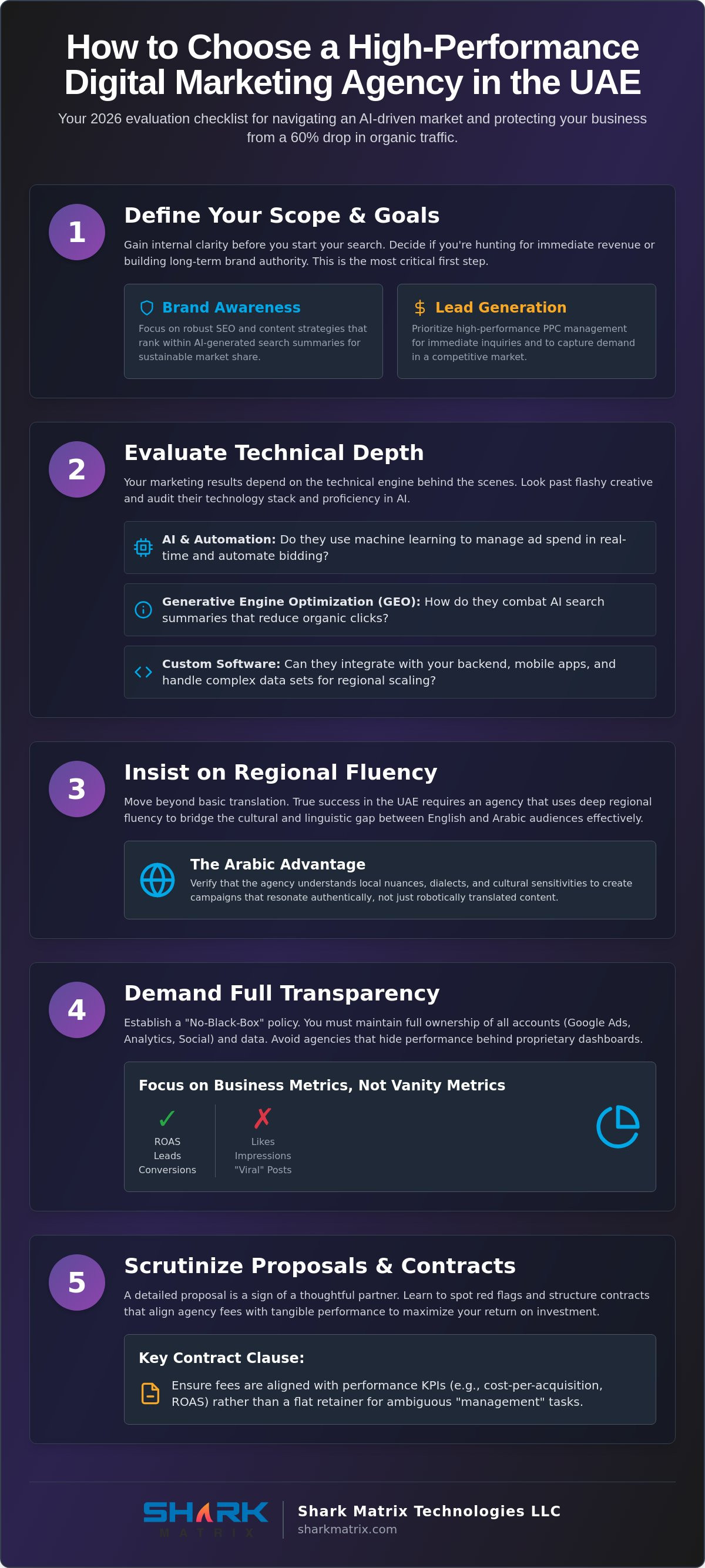
If your organic traffic dropped by 60% because of new AI search summaries, would your current partner have a recovery plan ready? In a market as fast-moving as Dubai and Abu Dhabi, knowing how to choose a digital marketing agency uae requires more than just looking at a portfolio of pretty social media posts. You’re likely tired of seeing budgets wasted on generic strategies that ignore the UAE Media Council’s 2026 Advertiser Permit mandate or fail to bridge the gap between English and Arabic audiences effectively.

It’s a common struggle to find a team that understands both the technical side of Generative Engine Optimization (GEO) and the cultural heart of the region. This article promises to give you a definitive framework for selecting a high-performance marketing partner that delivers actual business outcomes rather than just surface-level clicks. We’ll preview the essential 2026 evaluation checklist, the role of AI automation in modern campaigns, and how to spot an agency that can truly navigate the UAE’s complex digital landscape.

Key Takeaways

  • Learn to define your primary objectives to determine if your business needs a specialized boutique or a full-service technology partner focused on brand authority.
  • Master how to choose a digital marketing agency uae by auditing their technical infrastructure, focusing on their proficiency in AI automation and generative engine optimization.
  • Move beyond basic translation and learn to identify agencies that use deep regional fluency to bridge the gap between English and Arabic audiences effectively.
  • Establish a “No-Black-Box” policy that ensures you maintain full ownership of your accounts and data while prioritizing high-impact business metrics over vanity likes.
  • Identify red flags in agency proposals and learn to structure contracts that align fees with performance to maximize your return on investment.

Defining Your Marketing Scope: Aligning Agency Expertise with Business Goals

Most businesses start their search by looking at awards or flashy portfolios. However, the most critical step in learning how to choose a digital marketing agency uae is gaining internal clarity. You need to decide if you’re hunting for immediate revenue or building a fortress for your brand’s long-term reputation. In 2026, the lines between traditional digital marketing and technical engineering have blurred. An agency that only “posts on social” won’t survive the shift toward AI-driven search and automated bidding environments. You need a partner that views marketing as a technical science rather than just a creative exercise.

Defining your reach is equally vital. Are you targeting a hyper-local niche in Jumeirah, or do you need to scale campaigns across the entire country? A technical marketing mindset ensures that your data infrastructure is ready to handle regional scaling without losing efficiency. This means your agency must be able to manage complex data sets that reflect the UAE’s diverse market segments while maintaining a cohesive national identity.

Lead Generation vs. Brand Awareness

If your cash flow depends on daily inquiries, you need an agency that prioritizes high-performance PPC management. This provides the speed required to capture demand in a competitive market. Conversely, building sustainable market share requires robust search engine optimization seo services. Sustainable growth in 2026 requires content that ranks not just on Google, but within AI-generated search summaries. When evaluating agencies, match their case studies to your specific funnel stage. A “viral” campaign is a vanity project if it doesn’t lead to a measurable conversion or a qualified lead.

Full-Service vs. Specialized Agencies

Hiring a specialist for one channel might seem cost-effective initially, but it often leads to fragmented data and inconsistent messaging. A full-service partner ensures your website design and development services are perfectly synced with your marketing pixels and tracking codes. This integration is vital for national campaigns that need to scale from Dubai to Ras Al Khaimah. Centralized strategy prevents the “silo effect” where your social media voice doesn’t match your landing page experience. When you understand how to choose a digital marketing agency uae, you’ll realize that technical cohesion is the secret to a high Return on Ad Spend (ROAS).

  • Identify KPIs: Decide if you need immediate leads or long-term authority.
  • Check Technical Depth: Ensure the agency can handle back-end development and AI integration.
  • Scale Capability: Verify they have experience running multi-city campaigns across the UAE.

Evaluating Technical Depth: AI Integration and Custom Software Capabilities

Gone are the days when a flashy creative reel was enough to win a contract. In 2026, your marketing results depend on the technical engine running behind the scenes. When you’re deciding how to choose a digital marketing agency uae, you must look past the surface. A modern partner needs to demonstrate proficiency in machine learning and generative engine optimization (GEO) to combat the 60% drop in organic click-through rates caused by AI search summaries. A technical stack isn’t just a list of tools; it’s the foundation of your competitive advantage.

This technical depth extends to how your marketing interacts with your digital products. For many national enterprises, marketing ROI is inextricably linked to mobile app development services. An app isn’t just a tool; it’s a first-party data goldmine that fuels predictive analytics to anticipate customer behavior. If an agency relies solely on manual outreach rather than data-driven lead generation, they’ll struggle to keep pace with the UAE’s rapid market shifts.

AI and Marketing Automation in 2026

Ask potential partners how they use AI to manage ad spend in real-time. With global AI marketing revenue projected to exceed $107.5 billion by 2028, the gap between AI-enabled agencies and traditional ones is widening. You need to verify their claims about Answer Engine Optimization (AEO). It’s no longer about ranking in the top ten; it’s about being the cited source in an AI’s spoken or written answer. Agencies should also use natural language processing (NLP) and AI chatbots to map customer journeys more accurately than a human ever could.

Custom Technical Solutions

Your agency shouldn’t be afraid of your backend. Whether it’s an e-commerce platform or a complex CRM, a technical partner understands how to integrate these systems to prevent data silos. Good UI/UX design is a marketing lever; if the traffic they drive doesn’t convert because of a clunky interface, the campaign is a failure. Custom software engineering can solve specific bottlenecks, such as automating reporting or syncing inventory across multi-channel national campaigns. If you’re looking for a partner that bridges this gap, you can explore technical marketing solutions that align with your business goals.

  • Audit the Stack: Does the agency have in-house developers or just account managers who outsource the work?
  • Verify GEO Skills: Ask for specific strategies on how they plan to optimize for AI-powered search results like Google’s AI Overviews.
  • Data Ownership: Ensure they can bridge the gap between your marketing data and your CRM using custom API integrations.
How to Choose a Digital Marketing Agency in the UAE: The 2026 Decision Framework

The Arabic Advantage: Why Regional Fluency is Non-Negotiable

The UAE is home to a population representing over 200 nationalities, creating a demographic landscape that’s as complex as it’s rewarding. When you’re determining how to choose a digital marketing agency uae, you must look for a partner that treats Arabic as a primary strategy rather than a translation task. Many agencies simply run English copy through a translation tool, which often results in awkward phrasing that alienates local audiences. In 2026, cultural resonance is the difference between a high-performing campaign and a total budget drain. You need a team that understands the nuances between different Arabic dialects and knows how to adapt your brand’s voice to fit the local psyche.

Technical execution is another area where regional fluency matters. Arabic is a Right-to-Left (RTL) language, which fundamentally changes how users interact with a website. A partner without RTL expertise might deliver a site where the layout feels “backward” to an Arabic speaker, leading to high bounce rates. Beyond design, search intent in Arabic often differs significantly from English. An agency with deep regional roots will understand these subtle shifts in keyword behavior, ensuring your content reaches the right people at the right time. They should also have a proven track record of managing major seasonal events like Ramadan, where consumer habits and peak engagement hours shift dramatically.

Arabic SEO and Content Strategy

Search engines now prioritize content that shows genuine local authority. Creating original, high-intent Arabic content is essential for building regional trust. This is where seo for brand reputation management dubai becomes a vital asset. It ensures that your brand’s narrative remains consistent and positive across both languages. Localized landing pages are also non-negotiable for national PPC success. If an Arabic speaker clicks on an ad but lands on an English-only page, you’ve essentially paid for a bounce. Your agency must be able to build a seamless experience from the first click to the final conversion in the user’s preferred language.

Cultural Resonance in Social Media

Social media platforms aren’t used the same way by every demographic in the UAE. While LinkedIn is a powerhouse for B2B, platforms like TikTok and Snapchat hold massive sway among GCC nationals and younger residents. When you’re vetting a social media advertising agency dubai, look for campaigns that show genuine engagement across diverse regional platforms. Ask to see case studies where they’ve successfully captured the attention of Arabic-speaking audiences through hyper-local content rather than generic global templates. This level of segmentation is what allows a brand to truly scale within the country.

  • Check for Transcreation: Ask if they translate or “transcreate” content to maintain cultural meaning.
  • RTL Design Audit: Review their portfolio for seamless Right-to-Left website and app designs.
  • Seasonal Expertise: Inquire about their specific strategies for Ramadan and UAE National Day.

Vetting for Transparency: Reporting, Data, and Communication

A common pitfall for UAE enterprises is signing a contract only to realize they don’t actually own their advertising accounts. You must demand a strict “No-Black-Box” policy from the start. This means your business retains full ownership of Google Ads, Meta Business Suite, and all analytical data. If a partnership ends, your historical data shouldn’t disappear with the agency. When deciding how to choose a digital marketing agency uae, this ownership is a non-negotiable safeguard for your long-term digital assets. It ensures you aren’t held hostage by a provider who controls your access to your own market intelligence.

Beyond ownership, you need to look at what’s actually being reported. Many agencies hide behind “Vanity Metrics” like likes, shares, or impressions because they’re easy to generate. In 2026, these mean very little without context. You should prioritize “Business Metrics” such as Return on Ad Spend (ROAS) and Cost Per Acquisition (CPA). Properly optimized paid campaigns in the UAE are capable of generating a return of two to six times the ad spend, but you’ll only know if you’re hitting those benchmarks if your agency provides granular, outcome-focused reporting. Verify their reputation by asking for references from other national brands to see if their reporting depth matches their sales pitch.

The Data Integrity Checklist

Your agency should use advanced cross-channel attribution models to show exactly which touchpoint led to a sale, whether it started on TikTok or a Google search. They also need a clear process for Online Reputation Management to protect your brand during a crisis. Data Transparency is the baseline for any 2026 marketing contract. This level of clarity ensures that your strategy remains compliant with the UAE Data Protection Law while maximizing the utility of your first-party data. Without an open-book policy on data, you’re essentially flying blind in a high-stakes market.

Communication and Team Structure

Ask point-blank if you’ll have a dedicated account manager or if you’ll be funneled into a generic support ticket system. A ticket system often indicates that the agency is juggling too many clients or outsourcing its core technical work to third parties. You want to ensure the people actually doing the SEO or PPC work are in-house and understand your specific business goals. Cultural alignment is also essential; your agency’s staff should feel like an extension of your own team, sharing the same urgency and understanding of the local market’s nuances. If you’re ready to partner with a transparent digital agency, ensure they meet these rigorous communication standards before you sign any long-term agreement.

  • Account Ownership: Confirm you own all logins and historical data from day one.
  • Metric Focus: Shift the conversation from tracking “engagement” to tracking “conversions” and “revenue.”
  • Talent Audit: Verify the seniority and location of the team members handling your account to avoid hidden outsourcing.

Making the Final Decision: Proposals, Contracts, and Onboarding

You’ve narrowed down your list based on technical depth and cultural fluency. Now, the final step in learning how to choose a digital marketing agency uae involves dissecting the actual proposal. A high-quality proposal shouldn’t just be a list of services. It needs to be a strategic roadmap that connects your business goals to specific technical milestones. If an agency promises “guaranteed #1 rankings,” take it as a red flag. In 2026, search environments are too dynamic for such claims. Instead, look for a “guaranteed growth framework” that outlines how they’ll adapt to algorithm shifts and AI search updates.

Structuring the contract is where many businesses falter. While monthly retainers are standard for ongoing SEO and content work, you might consider performance-based fees for PPC or lead generation. This ensures the agency’s incentives align perfectly with your revenue targets. Before committing to a multi-year deal, consider a 90-day trial project. This pilot period allows you to test their communication style, reporting accuracy, and technical execution without the risk of a long-term lock-in. It’s the ultimate litmus test for any potential partnership.

Evaluating the Proposal

A green-light proposal includes a clear ROI projection based on current market data and your existing conversion rates. It should also demonstrate scalability. Ask yourself if this agency has the infrastructure to handle your growth over the next three years. Can they manage an increase in ad spend or a transition into new service areas like mobile app development? If the proposal feels like a generic template, they’ll likely treat your account with the same lack of specificity. You want a partner that treats your business as a unique entity within the UAE market.

The Onboarding Roadmap

The first 30 days set the tone for the entire relationship. A professional onboarding process starts with a comprehensive technical audit of your existing digital assets, from your website’s backend to your CRM integration. This phase identifies any hidden bottlenecks that could stifle future growth. You should also establish clear communication protocols during this time. Whether it’s bi-weekly strategy calls or monthly performance reviews, having a set schedule prevents communication breakdowns. If you’re ready to take the next step, Partner with Shark Matrix Technologies LLC for data-driven national growth and experience a framework built for the 2026 digital economy.

  • Roadmap Review: Ensure the proposal has clear milestones and isn’t just a list of tasks.
  • Trial Periods: Use a 90-day pilot to test the relationship before signing long-term.
  • Audit First: Demand a technical audit in the first 30 days to clear any legacy issues.

Securing Your National Growth in 2026

The 2026 landscape demands more than just creative flair. It requires a partner that can navigate the technical complexities of AI search and the cultural nuances of the Arabic-speaking market. By focusing on technical depth, data transparency, and a clear performance roadmap, you’ve mastered the framework for how to choose a digital marketing agency uae. Don’t settle for black-box reporting or generic translations when you can leverage a strategy built on real-time automation and deep regional insight.

Whether you’re scaling across the country or launching a new e-commerce platform, the right partnership transforms your marketing into a predictable engine for growth. Shark Matrix Technologies LLC has been at the forefront of this evolution since 2010, specializing in AI automation, custom software integration, and high-impact Arabic digital marketing. Ready to move beyond vanity metrics and secure your market position? Scale your brand with Shark Matrix Technologies LLC and build a future-proof presence today. Your brand’s next chapter in the UAE starts with a data-driven decision.

Frequently Asked Questions

How much does a digital marketing agency in the UAE cost in 2026?

Pricing for marketing services in the UAE depends heavily on your project’s scope, the technical complexity required, and your specific business goals. Fees are typically structured as monthly retainers or performance-based models. To get an accurate estimate, you should request a proposal that outlines the resources, tools, and talent dedicated to your account rather than looking for a one-size-fits-all price tag.

Is it better to hire a local agency or an international one for the UAE market?

Local agencies generally offer a superior advantage because they understand the region’s specific regulatory environment, such as the 2026 Advertiser Permit mandate. They possess the cultural fluency needed to engage both Emirati and expat populations effectively. While international agencies have global experience, they often struggle with the hyper-local nuances and Arabic language requirements essential for success in this market.

How long does it take to see results from an SEO campaign in the UAE?

You can typically expect to see initial movement in organic visibility within three to six months. However, achieving dominant market share for competitive terms often takes longer. The timeline is influenced by your site’s current technical health and how quickly you can adapt to new trends like Generative Engine Optimization, which prioritizes being cited in AI-powered search summaries.

What are the most important digital marketing channels for UAE businesses?

The most effective channels in 2026 include social search platforms like TikTok and Snapchat, alongside Google and Retail Media Networks like Noon. Understanding which platforms your audience uses is a critical step in how to choose a digital marketing agency uae. Your partner should provide a data-backed strategy that prioritizes the channels where your customers are most active and likely to convert.

Can one agency handle both English and Arabic marketing effectively?

Yes, provided they have a dedicated in-house bilingual team rather than relying on external translation services. Effective bilingual marketing requires transcreation, where the message is adapted to maintain its emotional impact and cultural relevance in both languages. An agency that handles both in-house ensures that your brand voice remains consistent across all touchpoints.

What should I look for in a marketing agency’s case studies?

Focus on case studies that highlight tangible business outcomes like Return on Ad Spend (ROAS), conversion rates, and revenue growth. Avoid agencies that only showcase vanity metrics such as likes or impressions. You want to see evidence that the agency has solved technical or cultural challenges for businesses with a similar scale or industry focus as yours.

How do I know if an agency is actually using AI or just using it as a buzzword?

Ask the agency to explain their specific AI workflows, such as how they use machine learning for predictive analytics or real-time budget optimization. True technical partners will be able to demonstrate how their AI automation services improve efficiency or lead quality. If they cannot provide a technical breakdown of their AI tools, they’re likely using the term for marketing purposes only.

What is the typical length of a digital marketing contract in the UAE?

Most agencies propose six to twelve-month contracts to allow for proper data collection and strategy optimization. However, it’s increasingly common to start with a three-month trial or pilot project. This shorter initial term gives you the opportunity to evaluate the agency’s communication, technical depth, and reporting accuracy before committing to a long-term partnership.

Categories
Digital Marketing

Building a Marketing Tech Stack 2026: The Strategic Ecosystem Guide

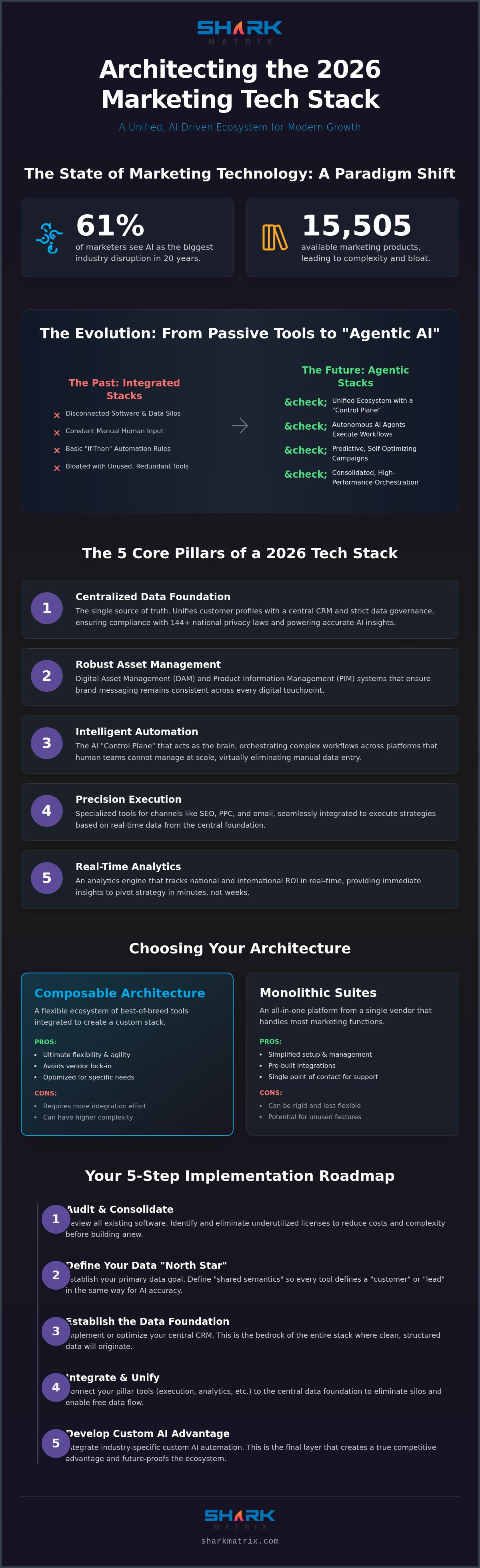
Did you know that while the number of available marketing tools has finally plateaued at 15,505 products, 61% of marketers still believe AI is causing the biggest industry disruption in 20 years? It’s a confusing time to be an architect of growth. You’re likely feeling the weight of data silos that prevent a true 360-degree customer view, all while paying for software seats that your team doesn’t even touch. Building a marketing tech stack 2026 isn’t about adding the newest shiny object anymore. It’s about creating a unified, strategic ecosystem that can handle complex data governance across 20 different state privacy laws and the rapid rise of AI agents.

We understand that integrating AI into your existing workflows feels like trying to change a tire while the car is moving at sixty miles per hour. This article will help you move past the friction. You’ll learn how to architect a high-performance ecosystem that leverages AI automation to improve lead generation and ensures compliance with new regulations like the California Delete Act. We’ll provide a streamlined list of essential 2026 tools and a clear roadmap for AI implementation so you can stop managing software and start driving national growth.

Key Takeaways

  • Understand the shift from passive software to “Agentic AI” that executes marketing workflows autonomously and efficiently.
  • Evaluate the pros and cons of monolithic suites versus composable architectures to ensure your ecosystem remains flexible as technology evolves.
  • Master the step-by-step process of building a marketing tech stack 2026 by auditing underutilized licenses and defining your data “North Star.”
  • Establish a robust data foundation with centralized CRM and governance to eliminate silos and power unified brand messaging across all channels.
  • Discover why custom AI development is essential for a competitive advantage and how to integrate industry-specific automation into your ecosystem.

What is a Marketing Tech Stack in 2026?

A marketing tech stack in 2026 is no longer just a collection of disconnected software subscriptions. It has matured into a unified, integrated ecosystem where software and AI agents work in tandem to execute complex marketing strategies. In previous years, stacks were often bloated with redundant tools. Today, the focus has shifted toward consolidation and high-performance orchestration. With the global landscape reaching over 15,505 products, the challenge isn’t finding a tool; it’s ensuring those tools talk to each other to create a single source of truth.

The most significant shift we see in 2026 is the transition from passive tools to “Agentic AI.” While older software required constant human input to move data from point A to point B, modern stacks use autonomous agents to execute workflows. For businesses targeting growth in the UAE market, this consolidation is vital. It reduces the high costs of unused software seats and ensures data accuracy across every customer touchpoint. Central to this is the “Control Plane,” a specialized AI layer that acts as the brain of your ecosystem, coordinating actions across your CRM, ad platforms, and email systems without manual intervention.

The Evolution from Integrated to Agentic Stacks

Modern stacks bridge the gap between your data and your execution. This shift moves beyond traditional Marketing automation where tools simply follow “if-then” rules. Instead, AI-coordinated workflows now predict customer needs and adjust campaigns in real-time. This sophisticated level of operation requires a solid foundation. High-quality website design and development services are the bedrock of this infrastructure, as your site must be capable of feeding clean, structured data into your AI agents. When building a marketing tech stack 2026, you’re moving away from managing individual tools and toward supervising an intelligent, self-optimizing system.

Core Benefits of a Modernized Tech Infrastructure

Upgrading your stack provides immediate competitive advantages for national and international campaigns. You’ll see a dramatic improvement in lead scoring and predictive analytics, allowing your team to focus only on high-value prospects. By implementing custom AI automation, you can virtually eliminate manual data entry, which reduces human error and frees up your creative talent. Perhaps most importantly, a modernized stack gives you the agility to pivot. When you have real-time data insights flowing through a unified ecosystem, you can adjust your strategy in minutes rather than weeks. Building a marketing tech stack 2026 ensures your business remains resilient in a fast-paced digital economy.

The 5 Core Pillars of a 2026 Marketing Tech Stack

Building a marketing tech stack 2026 involves more than selecting the most popular software subscriptions. It requires a structural blueprint that balances data integrity with rapid, automated execution. A strategic framework, similar to the concepts found in the CMO’s guide to marketing tech stacks, focuses on five core pillars: a centralized data foundation, robust asset management, intelligent automation, precision execution, and real-time analytics. Each pillar must be interconnected to ensure data flows freely without manual exports.

Your data foundation is the most critical layer. Without a centralized CRM and strict data governance, your AI will struggle with inaccurate insights. Content and asset management systems (DAM and PIM) follow closely, ensuring your brand messaging remains consistent across every digital touchpoint. For the automation layer, businesses are increasingly relying on specialized ai automation services to orchestrate complex workflows that human teams can’t manage at scale. Finally, your execution tools for SEO and PPC must feed directly into an analytics engine that tracks national ROI in real-time; partnering with experts like Tools N Tactics | Local SEO & Digital Marketing Solutions can help ensure these components are perfectly tuned for search engine dominance.

Data Governance and the Unified Customer Profile

In 2026, data governance is the prerequisite for effective AI scaling. With 144 countries now enforcing national data privacy laws, your stack must handle complex compliance rules automatically. Without “shared semantics,” where every tool in your stack defines a “customer” or “lead” the same way, your AI agents will inevitably suffer from hallucinations. Identity resolution has also become vital in our cookieless environment. You need systems that can stitch together fragmented data points into a single, unified customer profile while respecting the latest privacy regulations.

Localized Execution: Arabic Digital Marketing Integration

Many global platforms still struggle with the specific nuances of the Middle Eastern market. When building a marketing tech stack 2026, you must prioritize tools that offer native right-to-left (RTL) support and sophisticated Arabic sentiment analysis. This isn’t just about simple translation. It’s about integrating search engine optimization seo services with content engines that understand regional dialects and cultural context. If you’re looking to refine your regional digital presence, the specialists at Shark Matrix can help you integrate these localized tools effectively.

Reputation and Trust Layers

Trust is the primary currency of the digital economy. Your stack should include dedicated layers for seo for brand reputation management dubai to monitor brand health across the country. These tools use AI to detect subtle shifts in public sentiment before they escalate into larger issues. By automating social proof and monitoring mentions in real-time, you protect your brand’s integrity while streamlining the buyer journey for your customers.

Building a Marketing Tech Stack 2026: The Strategic Ecosystem Guide

Composable vs. Monolithic: Choosing Your Architecture

Deciding between a monolithic and a composable architecture is the most consequential choice you’ll make when building a marketing tech stack 2026. Monolithic stacks, such as all-in-one suites from Salesforce or Adobe, offer a unified interface and lower initial integration complexity. They’re often the preferred choice for teams with limited technical resources who need a reliable solution that works out of the box. However, these suites can sometimes feel like a walled garden, limiting your ability to adopt specialized AI tools that emerge mid-year.

Composable stacks, on the other hand, represent a best-of-breed approach. This architecture allows you to swap individual tools as AI technology evolves throughout 2026 without tearing down your entire infrastructure. While this provides maximum flexibility, it demands high-level technical expertise to maintain clean data flows. In the UAE market, we’re seeing a hybrid reality emerge. Most businesses choose a core monolith for their CRM and email while plugging in composable AI add-ons for specific tasks like predictive lead scoring or generative content creation.

Evaluating the Total Cost of Ownership (TCO)

Don’t let a low sticker price fool you. Many cheap tools carry significant hidden costs because they require expensive custom integration to function within your ecosystem. When you calculate ROI, you must look beyond license fees to the cost of manual data management and potential downtime. A well-integrated stack ensures that your external partnerships, such as those with a ppc agency dubai, are optimized. When your agency can access real-time data without friction, your ad spend works harder, and your reporting becomes more accurate.

Scalability for National Growth

As your business expands nationally, your tech stack must handle exponential increases in data volume without performance lag. Choosing tools with an API-first architecture is non-negotiable for future-proofing your operations. This ensures that as new data sources or AI agents are introduced, they can connect seamlessly to your existing pillars. API connectivity is the nervous system of the 2026 stack. Without robust integration points, your data becomes stagnant, and your AI agents will fail to deliver the real-time personalization that modern consumers expect. Building a marketing tech stack 2026 requires this focus on connectivity to ensure every new tool adds value rather than friction.

Step-by-Step: Building and Integrating Your Stack

Execution begins with a ruthless audit of your existing infrastructure. You can’t build a high-performance ecosystem on a foundation of redundant subscriptions and siloed data. When building a marketing tech stack 2026, the first goal is to identify overlapping tools and underutilized licenses that drain your budget without adding value. Once the waste is cleared, you can define your “North Star” metric. This is the single most important data point that guides your growth. Every tool you select from that point forward must contribute directly to tracking or improving that specific metric.

The selection process in 2026 requires a more rigorous RFP than in previous years. You must prioritize AI compatibility and native Arabic support to ensure your stack can handle the nuances of the regional market. After selection, focus on integration. Map your data flows meticulously and don’t settle for “good enough” native connectors. If a standard integration fails to move data accurately, build custom APIs to bridge the gap. Finally, prioritize enablement. Your team needs specific training to work alongside autonomous AI agents, shifting their focus from manual execution to strategic supervision.

Conducting a Technical Marketing Audit

Successful audits reveal “shadow IT,” which are those unauthorized software subscriptions purchased by individual teams without central oversight. These hidden tools often create security vulnerabilities and fragmented customer data. You should map your entire “Lead-to-Revenue” journey to see exactly where data drops off or becomes corrupted between platforms. This phase is also the time to evaluate your regional compliance. Ensure every tool in your stack meets the data handling requirements for the 20 states in the US with active privacy laws, as well as local regulations in the UAE.

Building the Integration Map

Your integration map defines your “Sources of Truth” for customer, product, and content data. In a modern ecosystem, you’ll likely use middleware or an Integration Platform as a Service (iPaaS) to connect these pillars. This middle layer ensures that data captured from your mobile app development services feeds directly into your central CRM without delay. When your mobile interactions, web behavior, and ad responses all flow into one place, your AI agents can make better decisions. If you need help architecting these complex data flows, contact Shark Matrix to speak with an integration specialist today.

Effective integration isn’t just about moving data; it’s about maintaining its integrity. You need to establish clear rules for which system “wins” if there is a data conflict. For example, your CRM should typically be the master for customer contact info, while your e-commerce platform remains the master for purchase history. By establishing these rules early, you prevent the data corruption that leads to AI hallucinations and poor customer experiences. Building a marketing tech stack 2026 is a technical challenge that requires a disciplined, step-by-step approach to ensure long-term scalability.

Future-Proofing with Shark Matrix: Custom AI and Integration

Buying the same software as your competitors won’t give you a market advantage. With the global martech landscape growing by a mere 0.79% to 15,505 products in 2026, the industry has reached a plateau of “off-the-shelf” capabilities. True differentiation in the UAE and beyond now comes from how you customize and connect these tools. Building a marketing tech stack 2026 requires moving past generic plugins and toward proprietary systems that reflect your unique business logic. Shark Matrix bridges the gap between high-level marketing strategy and the deep technical execution needed to turn a collection of apps into a high-performance ecosystem.

Generic tools often struggle with the specific data governance needs of national brands, especially when navigating the 144 countries that now have national data privacy laws. We focus on end-to-end digital transformation that prioritizes data integrity and autonomous execution. By building a custom “Control Plane” for your stack, we ensure your tools don’t just sit in silos but actually work together to drive growth. This strategic approach transforms your technology from a cost center into a scalable asset that adapts as fast as the market does.

Custom AI Development for National Brands

Proprietary AI models are the secret weapon for brands that have outgrown standard automation. While generic AI can draft basic copy, our custom AI development services focus on automating lead generation and high-context Arabic content that resonates with regional audiences. These bespoke models outperform generic plugins because they’re trained on your specific customer data and brand voice. For example, streamlining operations through AI-driven UI/UX ensures that your customer journey is frictionless, leading to a higher long-term ROI than any “one-size-fits-all” software could provide.

Strategic Partnership for Stack Management

The work doesn’t end once your tools are connected. Ongoing stack optimization is just as critical as the initial build to prevent “software rot” and ensure you aren’t paying for unused seats. Shark Matrix provides the technical backbone for national marketing teams, offering the expertise needed to manage complex integrations and API connections. We help you stay ahead of the curve, ensuring your infrastructure is always ready for the next shift in machine learning or data regulation. To ensure your business isn’t left behind by the rapid pace of change, partner with Shark Matrix to build your 2026 AI-ready tech stack and secure your competitive edge.

Mastering Your Marketing Architecture

We’ve explored how the martech landscape is shifting from fragmented tools to intelligent, integrated ecosystems. You now know that a solid data foundation and localized Arabic integration are non-negotiable for national growth in the coming years. Success in building a marketing tech stack 2026 requires balancing this technical precision with a clear strategy for AI orchestration and autonomous workflows. It’s about moving beyond simple software subscriptions to create a self-optimizing engine that drives measurable ROI.

Shark Matrix has been helping brands bridge the gap between high-level strategy and software engineering since 2010. Our deep technical expertise in Arabic digital marketing and AI automation ensures your infrastructure is built for regional dominance. We provide the end-to-end capabilities needed to transform complex data into actionable customer insights and streamlined operations. Architect your future-ready marketing stack with Shark Matrix. Your technology should empower your team rather than complicating their daily workflows. With a unified, future-proof architecture, you’re ready to lead your industry into a more automated and data-driven future.

Frequently Asked Questions

What is the most important tool in a marketing tech stack for 2026?

The Customer Relationship Management (CRM) platform remains the most critical tool in your ecosystem. It serves as the central source of truth for all customer interactions and provides the essential data that fuels your AI agents. Without a robust CRM, your automation efforts will lack the context needed to deliver personalized experiences across different digital touchpoints.

How much should a company spend on its MarTech stack?

Marketing technology spending typically fits within your broader marketing budget, which the U.S. Small Business Administration suggests should be 7% to 8% of gross revenue for businesses earning under $5 million annually. When building a marketing tech stack 2026, you must also factor in the rising costs of enterprise software. For example, some top-tier sales platforms now cost between $330 and $350 per user each month.

Can AI completely replace human marketing managers in 2026?

AI isn’t replacing managers, but it’s fundamentally shifting their roles from manual execution to strategic supervision. While 80% of marketers currently use AI for content creation, human oversight is still necessary to manage ethical data handling and brand voice. Managers now spend more time training AI agents and interpreting complex data insights rather than performing repetitive administrative tasks.

How do I integrate my tech stack with Arabic language requirements?

Integration requires choosing software that offers native right-to-left (RTL) support and specialized natural language processing services. It’s vital to use tools that can handle regional dialects and cultural nuances rather than relying on simple machine translation. Custom API connectors are often needed to ensure that localized data flows correctly between your global CRM and regional execution platforms.

What is a composable marketing tech stack?

A composable stack is a modular architecture where you select “best-of-breed” tools for specific functions instead of using one all-in-one suite. This approach allows you to swap individual components as technology evolves without disrupting your entire system. It’s an ideal strategy for businesses that want to integrate specialized AI automation services that monolithic platforms might not yet support.

How does data governance impact my marketing ROI?

Data governance directly impacts ROI by reducing the waste caused by inaccurate analytics and AI hallucinations. With 144 countries now enforcing national data privacy laws, strict governance also protects you from the heavy fines associated with non-compliance. Clean, well-governed data ensures that your lead scoring and predictive models are based on facts, leading to much higher conversion rates.

Is it better to use an all-in-one marketing suite or individual tools?

All-in-one suites are better for teams with limited technical resources who need a simplified, unified interface. However, when building a marketing tech stack 2026 for a larger organization, individual tools often provide a competitive edge through specialized features. The right choice depends on your internal technical expertise and the specific complexity of your data integration needs.

How often should I audit my marketing technology stack?

You should conduct a comprehensive technical audit at least every six months. Regular audits help you identify “shadow IT” and redundant software seats that drain your budget without providing value. Because 61% of marketers believe AI is the biggest industry disruption in 20 years, frequent reviews are necessary to ensure your stack remains compatible with the latest automation standards.

Categories
Development Digital Marketing

AI Automation Roadmap for UAE Businesses: A 2026 Strategic Guide

AI is projected to contribute up to 14% of the UAE’s GDP by 2030, yet many enterprises still struggle to mo

Categories
Digital Marketing

Building a Business Case for AI Automation in the UAE: The 2026 Executive Guide

For the 2026 budget cycle, any proposal for building a business case for ai automation in uae must demonstr

Categories
Digital Marketing

Automating Lead Generation for SMBs in the UAE: The 2026 Growth Blueprint

Did you know that 72% of UAE small businesses using AI-driven marketing tools have already seen a 35% surge

Categories
SEO

Justifying Your SEO Budget to Management: The 2026 ROI Framework

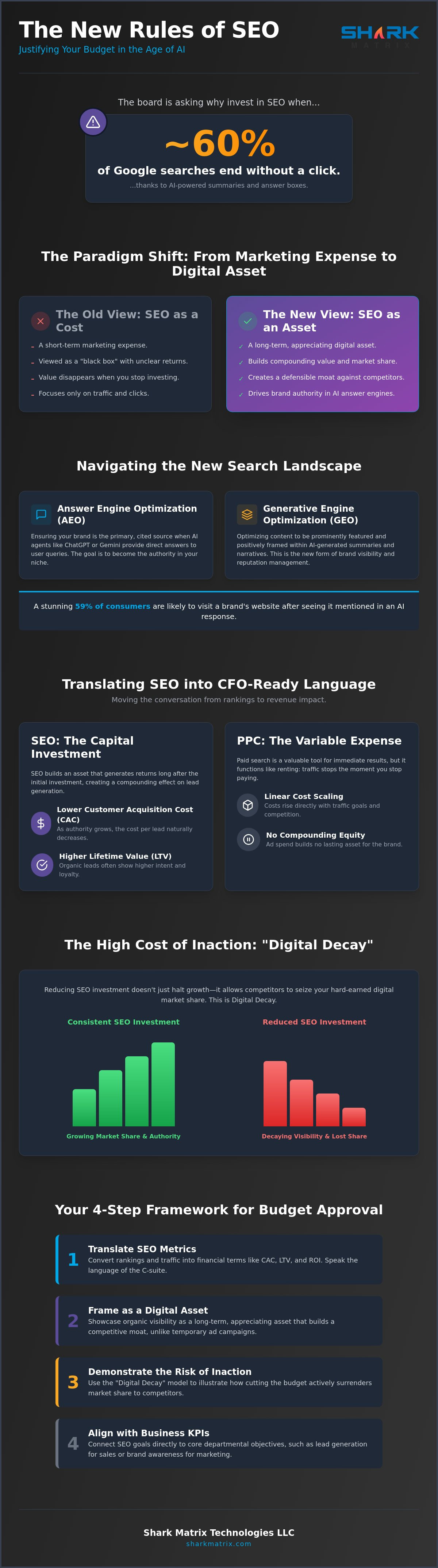
If nearly 60% of Google searches now end without a single click, why should your board keep funding a strategy built on traditional traffic? You’ve likely felt the heat in the boardroom when executives label SEO a black box or suggest shifting your hard-earned funds into short-term PPC wins. The challenge of justifying seo budget to management has become even steeper after the March and May 2026 core updates fundamentally changed how rankings are calculated. It’s frustrating to defend a long-term strategy when the pressure to deliver instant revenue has never been higher.

This guide will show you how to move past the marketing cost stigma by transforming organic search into a defensible business asset. You’ll learn a specific framework for proving ROI that accounts for the rise of Generative Engine Optimization (GEO) and Answer Engine Optimization (AEO). We’ll cover how to demonstrate that organic visibility isn’t just about clicks anymore; it’s about protecting your brand’s future market share in an era dominated by AI-curated summaries and generative search results.

Key Takeaways

  • Learn how to translate technical SEO metrics into CFO-friendly language like Customer Acquisition Cost (CAC) and Lifetime Value (LTV).
  • Discover a step-by-step framework for justifying seo budget to management by treating organic visibility as an appreciating digital asset rather than a monthly expense.
  • Understand the hidden costs of “digital decay” and how reducing investment allows competitors to seize your existing market share.
  • See how to align SEO goals with core departmental KPIs to prove that search authority directly drives lead generation and brand awareness.
  • Find out why modern resource allocation must bridge the gap between traditional search and the emerging world of AI-driven answer engines.

The Shifting Value Proposition: Why SEO is a Defensive Asset in 2026

Management teams often ask if traditional search is losing ground to generative AI. The answer isn’t just that it’s still relevant; it’s that search has evolved into the foundational layer of all digital discovery. When you’re justifying seo budget to management, you aren’t just asking for money to rank for keywords. You’re securing your brand’s authority within the AI models that now dictate consumer choices. Think of Search engine optimization (SEO) as building digital real estate. Unlike PPC, where you stop appearing the moment you stop paying, SEO builds equity. It’s the difference between renting a temporary storefront and owning the land it sits on. As your domain authority grows, the cost per lead naturally drops, creating a defensible asset that appreciates over time.

The “SEO is dead” narrative falls apart when you look at how consumers actually behave in 2026. While it’s true that nearly 60% of Google searches now result in no click due to AI Overviews, this hasn’t erased the value of organic visibility. Research from July 2, 2026, shows that 59% of consumers are likely to visit a brand’s website after it’s mentioned in an AI chatbot response. This means that being the cited source for an AI agent is the new gold standard for traffic. SEO is no longer a “nice to have” marketing channel; it’s the bridge that connects your brand to the AI-driven answer engines of the future.

From Search Engines to Answer Engines (AEO & GEO)

Modern strategies must account for Answer Engine Optimization (AEO). This ensures your brand is the primary source when AI agents like ChatGPT or Gemini provide solutions to users. Generative Engine Optimization (GEO) is the process of optimizing content to be included in AI-generated summaries. By focusing on GEO, you ensure your brand mentions are prioritized in the summaries that users now trust as much as traditional links. This shift is critical for justifying seo budget to management because it proves you’re future-proofing the company’s digital presence against ongoing algorithm shifts.

De-risking the Marketing Mix

Heavy reliance on paid search is a risky bet in a volatile economy. SEO provides a vital buffer against rising PPC auction costs and platform instability. It functions as a multi-channel traffic safety net. If an ad account is flagged or a social platform changes its algorithm, your organic foundation keeps the leads flowing. This organic strength is also the primary driver for online reputation management dubai. When management can see that SEO protects the brand’s image while lowering the overall marketing risk, the budget becomes a strategic necessity rather than an optional expense.

Translating Organic Metrics into CFO-Ready Financial Language

CFOs rarely care about being #1 on a search result page unless that position translates into a lower Customer Acquisition Cost (CAC). When you’re justifying seo budget to management, the conversation must pivot from visibility to financial efficiency. While PPC offers immediate results, it’s a variable cost that scales linearly with volume. SEO, by contrast, is a capital investment that builds a compounding asset. By focusing on justifying your SEO budget in 2026, you can demonstrate how organic search assists conversions across your entire marketing mix. This attribution is vital because organic leads often show higher intent and a superior Lifetime Value (LTV) compared to cold traffic from social ads.

The compounding nature of search is its greatest financial strength. A dollar spent on SEO today continues to drive traffic long after the initial investment, whereas a dollar spent on ads disappears the moment the campaign ends. This long-term efficiency lowers the blended CAC across the entire marketing department. As search algorithms become more sophisticated, the value of high-quality organic authority increases relative to the rising costs of paid auctions. If you’re unsure how to calculate these numbers for your specific niche, Shark Matrix Technologies LLC can help you build a custom ROI projection based on your current performance data.

The Efficiency Gap: SEO vs. PPC Management

In competitive markets like the UAE, the cost-per-click (CPC) for top-tier keywords can be staggering. Relying solely on paid search creates a “PPC Cliff” where lead flow drops to zero the second you stop the spend. Working with a qualified ppc agency dubai is essential for short-term wins, but that strategy is most effective when supported by an organic foundation. This dual approach ensures you aren’t held hostage by rising auction prices and provides a sustainable stream of traffic that doesn’t require a constant increase in ad spend.

Calculating the Long-Term ROI of Search Authority

To speak the language of the board, you should calculate the “Media Value” of your organic traffic. This is the amount you would have to pay in PPC to get the same volume of visitors. When justifying seo budget to management, show them how this Media Value grows month over month while your retainer remains relatively stable. While PPC offers instant entry, a robust organic lead engine typically reaches maturity within 12 to 24 months of consistent investment. By this stage, the organic channel often becomes the most profitable part of the marketing department, providing high-quality leads at a fraction of the cost of paid alternatives.

Justifying Your SEO Budget to Management: The 2026 ROI Framework

The Risk of Inaction: The True Cost of Cutting the SEO Budget

Stopping your organic search investment might look like a quick win for the quarterly balance sheet. It’s actually a decision that triggers a process of “digital decay” that’s incredibly expensive to reverse. When justifying seo budget to management, it’s vital to explain that search visibility isn’t a static trophy you win once. It’s a living ecosystem that requires constant attention. Google’s March and May 2026 core updates proved that the algorithm is now more fluid and AI-driven than ever. If you stop optimizing, your site’s technical health and content relevance begin to erode immediately. This isn’t just about losing a few spots in the rankings; it’s about the compounding loss of brand trust. If customers don’t see your brand in the search results or AI summaries, they often assume you’ve been surpassed by more innovative rivals.

The “Competitor Vacuum” is perhaps the most dangerous consequence of a budget cut. Nature abhors a vacuum, and so does the search results page. When you step back, you create an opening that your rivals will aggressively fill. Reclaiming a top position is often three times harder than maintaining one. You aren’t just starting from zero; you’re fighting against the momentum of a competitor who has already secured the click-through data and user signals you once owned. This “re-entry” cost often dwarfs the original budget you sought to save, making a pause in services a poor long-term financial move. Justifying seo budget to management becomes much easier when you frame it as a necessary expense to protect your existing market share from aggressive conquesting.

Technical Debt and Site Performance

Maintaining high-performance website design and development services is a non-negotiable part of search health. Without regular audits, technical debt accumulates, slowing down site speed and damaging Core Web Vitals. Google’s 2026 updates have placed an even greater emphasis on user experience (UX) as a direct ranking factor. These technical foundations are also a prerequisite for mobile app development services visibility. If your underlying site architecture fails, your entire digital presence, including your app’s discoverability, suffers alongside it.

Competitor Displacement in the UAE Market

National brands in the UAE are aggressively scaling their organic presence to capture a redistribution of search behavior. If you aren’t active, you risk losing “Brand Search” results to competitors running aggressive conquesting campaigns. These rivals often create content specifically designed to intercept your potential customers at the point of intent. Reclaiming the #1 spot in a saturated national market requires far more resources than simply staying there. Consistency is the only way to ensure your brand remains the authoritative voice in your industry.

Building the Business Case: A Framework for Resource Allocation

To move from a defensive stance to an offensive growth strategy, you need a pitch that speaks to market share rather than just rankings. Start by auditing your “Organic Market Share” against the total addressable market. If your top three competitors are capturing 40% of the search volume while you’re at 5%, you have a clear gap to exploit. This data makes justifying seo budget to management much simpler because it highlights a tangible loss of opportunity. Align these findings with departmental KPIs; if the sales team needs to increase lead volume by 15%, show exactly how an expanded SEO footprint provides the most cost-effective path to that goal. Presenting a tiered budget helps management choose their level of aggression: a maintenance tier to protect current assets, a growth tier to capture new keywords, or a leadership tier to dominate the AI-driven search results of 2026.

The Arabic Search Moat

For national brands in the UAE, the “Arabic Search Advantage” is a massive, underutilized asset. Many global competitors focus solely on English, leaving a blue ocean of opportunity for those who invest in high-quality localized content. Arabic search authority creates a defensible barrier that international rivals can’t easily replicate with simple translation tools. By securing this regional authority, you build a “moat” around your brand that protects your market share across the GCC. This localized strategy is essential for capturing high-intent users who prefer searching in their native language, providing a level of brand loyalty that English-only sites simply can’t match.

Integrating AI Automation into the SEO Budget

Modern resource allocation must include Ai automation and development to remain competitive. AI-powered tools have been found to reduce the cost of routine SEO tasks by 20-30%, allowing your budget to stretch further into high-impact creative work. Using AI for large-scale technical audits and data analysis isn’t just an efficiency play; it’s an innovation play that appeals to forward-thinking management teams. When you show that your strategy uses machine learning to predict algorithm shifts and optimize content at scale, you position SEO as a high-tech business driver rather than a legacy marketing tactic. If you’re ready to see how these technologies can transform your performance, request a custom search authority audit to identify your biggest growth opportunities.

Success in the first six months should be measured through clear milestones. Months one through three should focus on technical remediation and Answer Engine Optimization (AEO) to secure quick wins in AI summaries. Months four through six should shift toward building content authority and measuring the growth in “Organic Market Share” compared to your initial audit. By setting these expectations early, you build the trust necessary to sustain long-term investment. Clear milestones prevent management from viewing SEO as a “slow” channel and instead frame it as a disciplined, phased approach to market leadership.

Partnering for Performance: How Shark Matrix Technologies LLC Secures Your Search Authority

Shark Matrix Technologies LLC approaches search as a performance marketing channel rather than a simple traffic generator. We understand that justifying seo budget to management requires more than just ranking reports; it requires clear, data-backed evidence of business growth and financial efficiency. We focus on building AI-ready content structures that satisfy both traditional search algorithms and modern generative engines. Our team specializes in the technical nuances that ensure your site is readable for both humans and AI agents. By providing CFO-ready ROI dashboards, we make it easy to show how every dirham spent translates into long-term digital equity and a lower blended Customer Acquisition Cost (CAC).

Our specialized Arabic digital marketing gives national brands a distinct edge in the UAE market. We don’t just translate content; we build authority in the native language of your primary audience. This deep market penetration is a key component in justifying seo budget to management, as it targets high-value segments that global competitors often overlook. We combine this regional expertise with transparent reporting that highlights your growing “Organic Market Share,” giving your board the confidence to sustain and scale their investment through 2026 and beyond.

End-to-End Search Strategy

A successful search strategy doesn’t exist in a silo. It requires a seamless integration of technical audits, content marketing, and online reputation management. Shark Matrix Technologies LLC works closely with our clients to align their search goals with high-performance website design and development services. This holistic approach ensures that your technical foundation is strong enough to support your content ambitions and user experience requirements. We’re committed to long-term brand growth in the UAE, helping you build a digital presence that remains resilient through every major algorithm update.

Ready to Secure Your 2026 SEO Budget?

Building an internal business case for SEO can be a daunting task when faced with pressure for short-term results. Shark Matrix Technologies LLC is here to help you navigate the boardroom by providing customized ROI projections tailored to your brand’s specific market position and goals. We provide the data, the frameworks, and the strategic insights you need to win management approval and secure the resources your brand deserves. Don’t let your digital authority decay while competitors move forward with aggressive conquesting campaigns. Contact Shark Matrix Technologies LLC for a Strategic SEO Consultation and let’s transform your search strategy into a defensible business asset today.

Secure Your Brand’s Digital Real Estate for 2026

The shift from chasing clicks to building search authority requires a new way of thinking about ROI. You’ve seen how justifying seo budget to management works best when you treat organic search as a compounding business asset rather than a monthly marketing cost. By focusing on financial language like Customer Acquisition Cost and protecting against digital decay, you can demonstrate the true value of your search presence. Don’t let your brand’s visibility fade as competitors move into the AI-generated summaries and Arabic search spaces you should own.

Since 2010, Shark Matrix Technologies LLC has provided national brands with the tools to dominate their niche. Our expertise in Arabic digital marketing and full-stack AI automation ensures your content isn’t just seen; it’s cited as the authoritative source. We’re ready to help you build a defensible search strategy that wins management approval every single time. It’s about more than rankings. It’s about protecting your digital future.

Secure your brand’s future with a data-driven SEO strategy from Shark Matrix Technologies LLC

You have the framework and the data to make your case. Now is the time to turn your search strategy into a permanent competitive advantage that drives growth for years to come.

Frequently Asked Questions

How long does it realistically take to see ROI from an SEO budget?

You should expect to see measurable ROI from an SEO budget within 6 to 12 months of consistent investment. While technical fixes can provide quick wins in site speed and indexation, building the search authority needed to dominate competitive niches is a gradual process. This timeline is essential when justifying seo budget to management as a long-term capital investment rather than a short-term expense.

Why should we invest in SEO if we are already seeing success with PPC?

Investing in SEO alongside PPC lowers your blended Customer Acquisition Cost (CAC) and protects you from rising auction prices. PPC is a variable cost that stops delivering leads the moment you stop paying. SEO builds a permanent digital asset that continues to drive traffic over time. This creates a diversified marketing mix that isn’t entirely dependent on ever-increasing ad budgets to maintain lead flow.

Is AI search going to make our SEO budget obsolete by 2027?

AI search won’t make your budget obsolete; it will simply shift your focus toward new optimization standards. Research from July 2, 2026, shows that 59% of consumers are likely to visit a brand’s website after it appears in an AI chatbot response. Your budget will evolve to cover Generative Engine Optimization (GEO) to ensure your brand remains the primary cited source for these AI agents.

How much of our total marketing budget should be allocated to SEO?

Most high-growth companies allocate between 10% and 20% of their total marketing budget to organic search. This allocation provides enough resources for technical maintenance, AI-ready content, and regional authority building. For many small businesses, this translates to a monthly spend of $2,500 to $5,000, while enterprise-level campaigns generally start at $10,000 per month to maintain a competitive edge in saturated markets.

What are the most important SEO KPIs for senior management to track?

Senior management should focus on Organic Market Share, Customer Acquisition Cost (CAC), and Lifetime Value (LTV) of organic leads. These metrics are far more effective for justifying seo budget to management than simple keyword rankings. By tracking how organic search assists conversions in other channels, you can prove that SEO is a performance driver that improves the efficiency of the entire marketing department.

Can we do SEO in-house, or do we need a specialized agency?

While some basic tasks can be handled in-house, the complexity of 2026 search requirements often necessitates a specialized agency. Modern search strategies require a mix of technical web development, AI automation, and specialized Arabic marketing expertise. An agency provides access to enterprise-level data tools and a broad team of specialists that would be significantly more expensive to hire as full-time internal staff.

How does SEO impact our brand’s online reputation in the UAE?

SEO is the foundation of online reputation management because it allows you to control the first page of search results for your brand name. By outranking irrelevant or negative content, you ensure that potential clients see your authoritative voice first. In the UAE market, localized search authority is particularly vital for building trust and establishing your brand as a leader within the regional digital ecosystem.

What is the difference between SEO and Generative Engine Optimization (GEO)?

SEO focuses on ranking links within traditional search engine results pages, while GEO focuses on being included and cited within AI-generated summaries. GEO is a newer discipline that prioritizes machine readability and structured data so that AI models can easily interpret your content. Both strategies are necessary in 2026 to capture users who still use traditional search bars and those who prefer AI-powered chatbots.

Categories
Development

Building a Compelling Business Case for Website Redesign in 2026: The Executive Guide

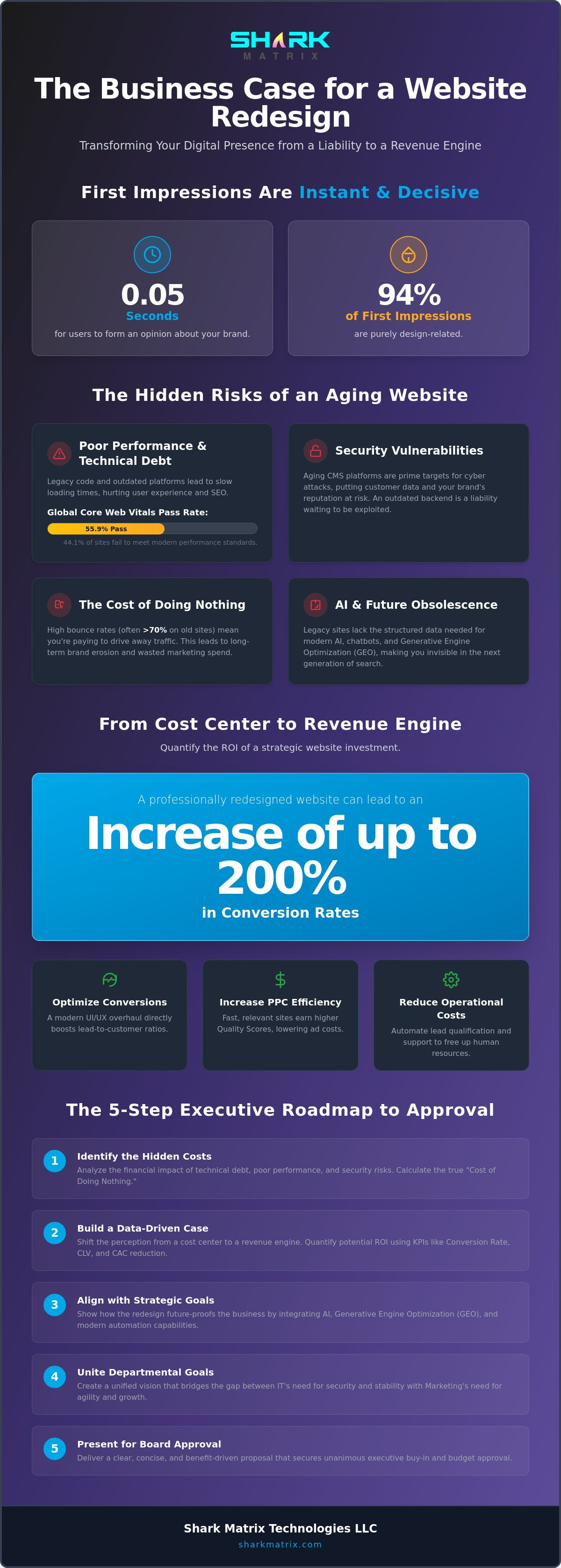
Did you know that users form an opinion about your brand in just 0.05 seconds, and 94% of those first impressions are purely design-related? If your conversion rates are stalling despite high traffic, you’re likely feeling the weight of an aging digital infrastructure. Building a strong business case for website redesign is no longer about aesthetics; it’s about fixing the technical debt that prevents you from integrating modern AI tools or meeting the 55.9% global pass rate for Core Web Vitals.

You probably agree that your website should be a performance asset rather than a cost center. We’ll show you how to quantify the ROI of a total overhaul, align your digital strategy with national growth goals, and secure board-level approval. This guide provides a clear roadmap to move from declining engagement to a high-performing site that meets WCAG 2.2 standards and drives measurable revenue. You’ll learn exactly how to bridge the gap between IT requirements and marketing agility to ensure your brand doesn’t fall behind national competitors.

Key Takeaways

  • Identify the hidden costs of digital stagnation and how technical debt actively limits your team’s marketing flexibility.
  • Shift your project’s perception from a cost center to a revenue engine by building a data-driven business case for website redesign.
  • Learn how to future-proof your digital presence by integrating Generative Engine Optimization (GEO) and modern AI automation directly into your site’s architecture.
  • Follow a proven five-step executive roadmap to align departmental goals and secure unanimous board-level approval for your budget.
  • Discover how to scale your national presence with a partner who understands the intersection of development, marketing, and brand protection.

The Hidden Risks of Digital Stagnation: Why Your Current Site is a Liability

Digital stagnation isn’t just about an old logo or clashing colors. It’s the widening gap between your site’s current capabilities and the rising expectations of modern users. When your digital presence fails to keep pace with innovation, it becomes a liability that drains resources and slows growth. Building a strong business case for website redesign requires identifying these hidden risks before they permanently impact your bottom line.

Technical debt is often the silent killer of marketing agility. Every patch or workaround added to legacy code makes the next update more expensive and time-consuming. This friction directly impacts your national SEO performance and search visibility. With the global pass rate for Core Web Vitals currently at 55.9%, failing to meet loading speed and visual stability standards means you’re losing visibility to more agile competitors. Adhering to foundational web design principles ensures your site remains a functional asset rather than a fragile collection of outdated scripts.

Security is another critical pillar that executives cannot afford to ignore. Aging CMS platforms are prime targets in an increasingly complex cyber landscape. An outdated backend doesn’t just slow down your team; it exposes your customer data to unnecessary risk. If your infrastructure can’t support modern security protocols, your brand reputation is one vulnerability away from a total collapse.

The “Cost of Doing Nothing” (CODN) Analysis

Calculating the CODN helps stakeholders see the financial impact of inaction. If your current bounce rate exceeds 70%, you’re effectively paying to drive traffic that leaves instantly. These abandoned interactions lead to long-term brand erosion, especially when national competitors offer seamless, high-speed experiences. The Cost of Doing Nothing is the cumulative lost opportunity cost of maintaining an obsolete digital interface.

Technical Obsolescence in the Age of AI

Your backend architecture determines your ability to compete in 2026. Legacy sites often lack the structured data required by modern answer engines, which limits your reach in generative search results. If your site can’t integrate with AI automation or real-time chatbots, you’re missing out on critical efficiency gains. “Looking fine” is no longer enough if your site cannot communicate with modern API ecosystems or support generative engine optimization (GEO).

Quantifying ROI: Transforming Your Website from a Cost Center to a Revenue Engine

Presenting a financial argument to the board requires a fundamental shift in perspective. You aren’t just asking for a budget to update graphics. You’re proposing a strategic capital investment (CapEx) designed to drive national brand growth. A compelling business case for website redesign demonstrates how modernizing your infrastructure reduces long-term operational costs while maximizing revenue potential. By treating your site as a performance asset, you move away from the “cost center” trap that keeps many businesses stuck with underperforming digital tools.

Efficiency is a primary driver of ROI. Utilizing professional website design and development services allows you to automate lead qualification and streamline the sales funnel. When your site answers common questions through a superior self-service UI/UX, you significantly reduce the volume of low-value inquiries hitting your customer support desk. This allows your team to focus on high-priority tasks while the website handles the heavy lifting of initial customer education, ultimately lowering your customer acquisition costs (CAC) and increasing average order value (AOV).

Key Performance Indicators (KPIs) for the Board

Executives need hard numbers to justify a project. According to 2026 data from Quickupp Softech, a well-designed website can increase conversion rates by up to 200%. This isn’t just a cosmetic gain; it’s a direct multiplier for your marketing spend. This also impacts your Pay Per Click (PPC) efficiency. Google rewards fast, relevant sites with higher quality scores, which lowers your cost-per-click and stretches your ad spend further. To secure approval, highlight these three metrics:

  • Conversion Rate Optimization (CRO): Focus on the measurable jump in lead-to-customer ratios following a UI/UX overhaul.
  • Customer Lifetime Value (CLV): Use better engagement tools and personalized content to foster long-term loyalty and repeat business.
  • Site Speed Impact: Address the 53% of mobile users who abandon pages taking longer than three seconds to load, as reported by Visual Identity Studio in 2026.

The Arabic Localization Advantage

In a competitive national market, ignoring localization is a massive revenue leak. Moving from an English-only platform to a high-quality, culturally nuanced Arabic interface expands your reachable audience significantly. Regional users convert at much higher rates when they can interact with a brand in their primary language. This builds a layer of trust that generic translation tools simply cannot replicate. By integrating professional Arabic digital marketing into your redesign, you capture a larger slice of the national market share and establish your brand as a local authority. If you’re ready to see how these metrics apply to your specific industry, you can explore our strategic development approach to start your transformation.

Building a Compelling Business Case for Website Redesign in 2026: The Executive Guide

Strategic Alignment: Integrating AI, GEO, and Modern UI/UX into Your Redesign

In 2026, the digital environment has shifted from traditional keyword matching to intent-based discovery. A simple visual refresh won’t suffice when the underlying architecture of your site determines whether you appear in AI-generated search results. Developing a robust business case for website redesign often hinges on your ability to adopt Generative Engine Optimization (GEO). This isn’t just a trend; it’s a fundamental change in how your brand communicates with both humans and machines. A redesign provides the only viable path to implement a modern search engine optimization seo services strategy that accounts for these architectural shifts.

User behavior also demands a nuanced approach to mobile accessibility. With mobile devices accounting for 53% to 64% of global web traffic, your site must be more than just responsive. We’ve moved beyond “Mobile-First” into a “Mobile-Only” reality for many national segments. If your current site was built on a desktop-first legacy system, it likely carries bloated code that slows down mobile load times. Every second of delay erodes trust. Since users form an opinion about your brand in just 0.05 seconds, your technical infrastructure must be optimized for instantaneous, high-relevance interactions across every device type.

From SEO to GEO: Preparing for Answer Engines

Traditional keyword stuffing has been replaced by entity-based architecture. Answer engines now prioritize sites that provide a clean data structure which AI crawlers can easily parse. A redesign allows you to overhaul your schema markup and structured content from the ground up. This ensures your brand is the primary source for AI-generated snippets rather than a buried link on page two. By aligning your backend with these new standards, you secure a competitive edge that legacy sites simply cannot match without a total architectural rebuild.

UI/UX as a Competitive Differentiator

High-end UI design has a profound psychological impact on brand authority. In B2B and E-commerce environments, streamlining the user journey is the most effective way to reduce friction and increase session duration. Modern redesigns also allow for the integration of custom AI development, such as interactive tools or personalized content engines. These features don’t just look impressive; they provide genuine value-add experiences that keep visitors engaged longer. When your site functions as an intuitive partner rather than a static brochure, you transform user relevance into measurable loyalty and higher conversion rates.

The Executive Roadmap: 5 Essential Steps to Secure Board Approval

Securing a budget for a large-scale digital project requires more than a list of technical requirements. You need a structured approach that speaks the language of the boardroom. Following a clear roadmap ensures your business case for website redesign addresses both growth opportunities and operational risks. By breaking the process into these five essential steps, you can transform a complex technical proposal into a compelling strategic initiative.

  • Step 1: Internal Audit & Benchmarking: Don’t just look at your own data. Compare your current metrics, like the high bounce rates mentioned earlier, against national industry leaders. This highlights exactly where you’re losing market share to more agile competitors.
  • Step 2: Stakeholder Interviews: Gather insights from Sales, IT, and Customer Service. Identifying their specific pain points, such as slow lead processing or high support ticket volumes, ensures the project delivers value across the entire organization.
  • Step 3: Solution Prototyping: Define the high-level features that solve these problems. This might include AI-driven automation, advanced e-commerce flows, or full Arabic localization to capture regional demand.
  • Step 4: Financial Modeling: Present a 24-month forecast. Contrast the Cost of Doing Nothing (CODN) with the projected ROI from increased conversion rates and lower acquisition costs.
  • Step 5: Risk Mitigation Plan: Address the board’s fears head-on. Detail your strategy for SEO migration, data security, and meeting project timelines to build confidence in the execution.

Building the “Vision” Document

Abstract technical concepts often fail to resonate with non-technical executives. Use visual mood boards and low-fidelity wireframes to make the redesign feel tangible. Shift the focus from “Design Features” like color palettes to “Business Outcomes” like reduced friction in the checkout process. The project vision is a strategic pivot toward digital leadership. When the board can see how a new interface directly correlates with national growth, approval becomes a logical next step.

Addressing the #1 Objection: SEO Preservation

The fear of losing hard-earned search rankings is the most common reason projects stall. You must demonstrate a rigorous 301 redirect strategy and a comprehensive content mapping process. Partnering with a professional seo agency ensures that your transition is managed with precision to prevent traffic dips. Instead of viewing the move as a risk, position it as an opportunity for a massive post-launch ranking boost through cleaner code and better Core Web Vitals. If you’re ready to start building your roadmap, you can consult with our strategic planning team to refine your vision.

Executing the Vision: Scaling Your National Presence with a Strategic Partner

Scaling a national presence requires more than just a functional site. It demands a digital ecosystem where code, marketing, and artificial intelligence intersect seamlessly. When you finalize your business case for website redesign, the choice of a strategic partner becomes the most critical factor in your project’s success. You need a team that doesn’t just build pages but engineers a high-performance asset capable of handling complex integrations and cultural nuances. A partner who understands the backend as well as the frontend ensures your vision translates into a scalable reality.

Maintaining trust during a major transition is vital. Implementing professional online reputation management dubai ensures your brand’s digital footprint remains protected as you migrate to a new platform. This is especially important for national brands where public perception can shift rapidly during a redesign. A “National-First” strategy accounts for regional cultural nuances, ensuring your messaging resonates across diverse demographics. It’s about more than translation; it’s about cultural alignment that builds lasting trust with your audience.

Your new website serves as the bedrock for all future growth initiatives. It’s the destination for every click from your social media campaigns and the high-converting landing page for your ppc agency dubai efforts. Without a modern, fast, and accessible foundation, your advertising spend won’t reach its full potential. A redesign ensures that every dollar spent on traffic is supported by a site built to convert.

The Shark Matrix Technologies LLC Advantage: End-to-End Digital Engineering

We don’t just design websites. We integrate custom software engineering with advanced digital marketing to ensure every build is a revenue driver. Our approach leverages AI automation to future-proof your asset, making it ready for the next decade of technological shifts. With deep expertise in Arabic digital marketing, Shark Matrix Technologies LLC helps you capture the full national market by speaking directly to your audience. This comprehensive service model eliminates the friction of managing multiple vendors and ensures a cohesive digital strategy from day one.

Next Steps: From Business Case to Kickoff

The path to a successful launch starts with hard data. Initiating a professional site audit is the best way to gather the specific metrics needed to finalize your business case for website redesign. This audit identifies current bottlenecks and provides a clear baseline for measuring future ROI. Setting realistic timelines is also essential. A national-scale project requires careful planning, from initial stakeholder interviews to the final security sweep. Don’t let digital stagnation hold your brand back. Schedule a strategic consultation with Shark Matrix Technologies LLC to build your data-driven business case and take the first step toward a dominant national presence.

Taking the Next Step Toward Digital Leadership

Your website is no longer just a digital business card; it’s the engine that powers your national growth. We’ve explored how moving away from technical debt and embracing Generative Engine Optimization (GEO) turns your site into a high-performance asset. It’s about more than aesthetics. It’s about building a foundation that supports AI-driven discovery and high-velocity lead generation. By following a structured roadmap, you can present a data-driven business case for website redesign that aligns marketing agility with financial performance.

Since 2010, Shark Matrix Technologies LLC has provided over a decade of national market expertise to help brands navigate these complex transitions. We specialize in AI automation and custom software engineering, ensuring your new infrastructure is ready for the demands of 2026. Our deep expertise in professional Arabic digital marketing and localization ensures your message resonates with every segment of the national audience. Ready to build your business case? Contact Shark Matrix Technologies LLC for a comprehensive digital audit. Your brand’s next chapter of growth starts with a foundation built for the future.

Frequently Asked Questions

How much does a website redesign typically cost for a national brand in 2026?

How long does the website redesign process take from business case to launch?

A national redesign project typically requires three to six months to move from the initial discovery phase to a live launch. This timeline accounts for stakeholder interviews, architectural planning, custom development, and rigorous cross-device testing. Planning for this duration ensures your team has enough time to align the new digital infrastructure with your long-term business goals without compromising on quality assurance.

Will a redesign hurt my current search engine rankings?

A redesign won’t hurt your rankings if you implement a precise migration strategy that includes 301 redirects and careful content mapping. In many cases, fixing legacy code and improving Core Web Vitals leads to a measurable ranking boost shortly after launch. Working with specialists ensures your current search visibility is protected while building a foundation that’s optimized for the latest generative search standards.

What is the difference between a website refresh and a full redesign?

A website refresh focuses on cosmetic updates like colors, fonts, and imagery, whereas a full redesign overhauls the site’s underlying architecture and user journey. A redesign is necessary when your current backend can’t support modern AI tools or meet accessibility standards like WCAG 2.2. This deeper structural change is what allows you to build a truly effective business case for website redesign.

How do I measure the success of a website redesign after it launches?

You measure success by tracking key performance indicators like conversion rates, customer acquisition costs, and average session duration. Compare these post-launch metrics against the benchmarks established during your internal audit to quantify the return on investment. A successful project should show a clear reduction in bounce rates and a significant increase in lead quality, proving the site’s value as a revenue-generating asset.

Why is Arabic localization critical for a business case in the UAE market?

Arabic localization is essential because it builds immediate trust and cultural relevance with a massive segment of the regional audience. Simply translating text isn’t enough; you need a localized interface that accounts for regional nuances to drive higher conversion rates. Including this in your business case for website redesign ensures you don’t leave revenue on the table by ignoring the primary language of the UAE market.

What role does AI play in a 2026 website redesign?

AI plays a central role through personalized content delivery, automated customer service chatbots, and backend optimization for generative answer engines. Modern sites use machine learning to adapt the user experience in real-time based on visitor behavior. Integrating these tools during a redesign allows your business to stay ahead of competitors who are still relying on static, non-interactive templates that can’t communicate with modern API ecosystems.

How often should a business redesign its website to stay competitive?

Most industry professionals suggest a major redesign every three to five years to keep up with shifting technical standards and user expectations. However, with the rapid rise of AI and new search behaviors, you might need to update your architecture sooner if your current site fails to pass Core Web Vitals. Regular audits help you determine if your digital presence is still a performance asset or if it’s become a liability to your growth.

Categories
Digital Marketing

Marketing KPIs for Executive Reporting: The 2026 Strategic Framework

87% of marketers believe a data-driven strategy is critical, yet only 32% report actually trusting their ow

Categories
SEO

How to Measure SEO ROI for UAE Businesses: A 2026 Framework

What if the reason you can’t prove your SEO’s value isn’t a lack of results, but a failure to account for the UAE’s strict 2026 privacy and permit regulations? You’ve likely felt the mounting pressure from leadership to deliver immediate financial returns. It’s frustrating when your data is siloed across different platforms and you’re struggling to attribute a sale to a long-term strategy. We know it’s difficult to show a clear line between a search query and a deposit in UAE Dirhams when the rules keep changing.

This guide will show you exactly how to measure seo roi for uae businesses by mastering the specific formulas and attribution models required for our national market. You’ll gain a clear understanding of 2026 ROI benchmarks, where a healthy return is often seen as a three to fivefold gain over three years. We’ll provide a framework to help you present these findings to your board with confidence. We’re covering everything from the impact of the 2026 Child Digital Safety Law to the mandatory Advertiser Permits required by the UAE Media Council, ensuring your reporting is as compliant as it is profitable.

Key Takeaways

  • Learn how to move beyond basic metrics by incorporating Cost of Goods Sold (COGS) into your formulas for a truer picture of your marketing profitability.
  • Discover exactly how to measure seo roi for uae businesses by navigating complex attribution models and accounting for “dark social” interactions.
  • Establish realistic performance benchmarks to distinguish between the immediate results of PPC and the compounding, long-term value of organic SEO authority.
  • Explore how integrating AI automation and custom software can lower operational expenses, directly improving the “cost” side of your ROI equation.
  • Gain a framework for presenting clear, data-driven findings to leadership that prove the financial impact of your digital investments in the national market.

What is Digital Marketing ROI and Why It Matters in 2026

Digital Marketing ROI (MROI) measures the profit your business generates relative to the cost of your specific marketing activities. It’s no longer enough to track how many people saw an ad or visited a landing page. In a high-stakes market like the UAE, where competition for local search visibility is fierce, understanding how to measure seo roi for uae businesses is the difference between scaling a brand and burning through a budget. This metric serves as the ultimate KPI for national brands because it provides a clear, financial justification for every dirham spent.

The landscape shifted significantly in 2026. With stricter data privacy laws under Federal Decree-Law No. 34 of 2021 and new transparency requirements from the UAE Media Council, tracking a user’s journey from a search query to a final purchase in AED has become more complex. This complexity has pushed businesses away from vanity metrics like impressions and toward value metrics like gross profit and customer lifetime value. ROI data doesn’t just show what happened in the past; it dictates your strategy for the next fiscal year. It tells you exactly where to double down on high-performing channels and where to cut losses.

MROI vs. Traditional ROI: Understanding the Difference

Traditional Return on Investment (ROI) is a broad financial term, but MROI requires a more surgical approach. To get an accurate reading, your marketing costs must include more than just direct ad spend. You need to factor in agency retainers, specialized software for AI automation, and the production costs of content marketing. Time-to-conversion is also a critical factor in the UAE. A lead generated today might not close for three months; your ROI calculations must account for these longer sales cycles to reflect reality. Simply put, MROI is the relationship between marketing-attributed profit and total campaign investment.

The Cost of Not Tracking: Why Ignorance is Expensive

Flying blind in the digital space leads to “zombie campaigns.” These are marketing efforts that appear successful because they drive traffic, but they’re actually draining national resources without converting. Without a clear understanding of how to measure seo roi for uae businesses, it’s impossible to know if your organic growth is keeping pace with your acquisition costs. Conversely, having hard data on your side is essential for securing internal stakeholder buy-in and boosting investor confidence. If you can prove that your Search Engine Optimization efforts are delivering a 400% return over time, you transform marketing from an expense into a proven profit center. This data allows you to pivot quickly, protecting your margins before a bad strategy becomes a financial liability.

Core Formulas for Calculating Your Marketing Return

Proving value requires more than just looking at a dashboard. When you’re determining how to measure seo roi for uae businesses, you need a mathematical foundation that accounts for the unique costs of operating in the Emirates. A solid starting point for calculating your return on investment from SEO involves stripping away the noise to see how many AED actually returned to your pocket for every dirham spent. This clarity is vital when reporting to leadership who prioritize financial impact over technical metrics.

The Simple Marketing ROI Formula

The basic formula is straightforward: (Total Revenue – Marketing Investment) / Marketing Investment. It’s a reliable tool for quick campaign snapshots or monthly reporting. However, many UAE brands fail here because they don’t capture the full scope of their investment bucket. To get an honest number, you must include costs that are often forgotten in the initial calculation. These typically include:

  • Professional content marketing and specialized Arabic copywriting fees.
  • Recurring costs for SEO tools or comprehensive technical audits that ensure site health.
  • Agency retainers and the internal staff hours dedicated to managing these national campaigns.

If you spend AED 10,000 on a campaign and it generates AED 50,000 in revenue, your ROI is 400%. While this is a clean metric, it only reflects immediate returns rather than the long-term compounding value of organic growth.

Advanced ROI: Incorporating CLV and Gross Profit

For brands that rely on repeat customers, such as e-commerce platforms or subscription services in the UAE, Customer Lifetime Value (CLV) is the gold standard. The formula (CLV – CAC) / CAC measures long-term profitability by comparing the total value a customer brings over their entire relationship with your brand against the Cost Per Acquisition (CAC). If a customer acquired through SEO spends AED 500 every month for two years, their value is significantly higher than the initial conversion suggests.

Gross profit ROI provides an even deeper look by accounting for the Cost of Goods Sold (COGS). If your margins are thin, a campaign that looks profitable on paper might actually be losing money after you factor in fulfillment and delivery costs across the Emirates. You should also calculate your break-even Return on Ad Spend (ROAS) for national PPC efforts. You do this by dividing 1 by your gross profit percentage. For example, if your margin is 20%, you need a 5x ROAS just to break even. This level of detail ensures your digital strategy contributes to actual profit rather than just inflating top-line revenue.

Most marketing managers in Dubai or Abu Dhabi look at their analytics and see “Last-Click” attribution as the source of truth. This is a dangerous mistake. In 2026, the UAE’s expanded data privacy regulations under Federal Decree-Law No. 34 of 2021 mean that cookie-less browsing is the new standard. When users don’t opt-in to tracking scripts, your data becomes fragmented. If you’re only looking at the final click before a purchase in AED, you’re likely ignoring the months of organic research that led the customer there in the first place.

Understanding how to measure seo roi for uae businesses requires accounting for “Dark Social.” In our national market, private messaging apps like WhatsApp are the primary way people share recommendations. When a user finds your content via search but shares it privately, that subsequent visit often shows up as “Direct” traffic. This hides the true power of your SEO. Additionally, SEO frequently acts as an “assisted conversion” channel. A customer might discover your brand through an organic guide, leave the site, and eventually return via a paid ad. If you only credit the ad, you’re fundamentally underestimating your organic value.

Common Attribution Models Explained

Moving beyond last-click requires choosing a model that fits your sales cycle. Linear attribution gives equal credit to every touchpoint, which is helpful for understanding the full journey. Time-decay attribution assigns more value to interactions closer to the conversion, making it ideal for evaluating bottom-of-funnel content. For the most accurate results, many national brands now use data-driven attribution. This leverages AI to analyze historical patterns across the UAE market and assign fractional credit to every search query that contributed to the final sale.

Closing the Gap Between Online and Offline ROI

If your business relies on physical locations or phone consultations, your digital data only tells half the story. Tracking offline conversions driven by search engine optimization seo services is essential for a complete ROI picture. You can bridge this gap by using unique, search-specific promo codes or integrating your CRM with your website. When a salesperson in a Sharjah showroom closes a deal, your CRM should be able to trace that lead back to their original organic landing page. A unified data dashboard helps national teams break down silos, ensuring that every dirham of profit is correctly attributed to the marketing effort that sparked it. This level of detail is exactly how to measure seo roi for uae businesses with precision in a multi-channel environment.

How to Measure SEO ROI for UAE Businesses: A 2026 Framework

Setting Realistic ROI Benchmarks Across National Channels

SEO vs. PPC: A Tale of Two Timelines

The primary difference between these channels is speed versus sustainability. Engaging a ppc agency dubai allows for rapid ROI because you’re essentially buying visibility. The moment you stop spending AED, the traffic disappears. SEO follows an S-Curve. You’ll likely see a low initial return during the first six months as technical foundations are laid, followed by exponential growth in organic traffic and conversions. Over a 12-month period, the cost-per-lead for organic search typically drops by 50% or more as authority builds, whereas paid search costs remain tethered to market bidding rates. For e-commerce businesses, the break-even point for SEO usually occurs around the nine-month mark, eventually compounding into a 200% to 400% return over three years.

ROI for Brand Awareness and Reputation

Not every dirham can be tracked to a direct sale, but that doesn’t mean the investment isn’t working. Investing in seo for brand reputation management dubai protects your ROI by ensuring that when potential customers search for your brand, they find positive, authoritative content rather than negative reviews or competitor claims. This “Share of Voice” is a vital benchmark in the UAE’s competitive landscape. Furthermore, a positive UI/UX on your mobile app or website directly impacts your conversion rates. If your site is difficult to navigate, your marketing spend is wasted. Measuring sentiment and user engagement provides a truer picture of your brand’s health and future profitability in the national market.

Ready to see how your current strategy stacks up against national benchmarks? You can request a performance audit to identify high-impact opportunities for your brand.

Maximizing ROI with Data-Driven Strategies and AI Automation

Success in 2026 requires looking beyond the spreadsheet to the technology powering your marketing engine. AI automation is the most effective way to reduce the cost side of your ROI equation. By implementing generative AI development services and machine learning development services, national brands can automate technical monitoring and content workflows. This efficiency means your team spends fewer hours on manual tasks, allowing more of your budget to go toward growth-focused activities. When you lower your operational investment while maintaining output, your total return naturally climbs.

Modern businesses also rely on custom software to create closed-loop reporting systems. These systems track a lead from the first search query all the way to the final transaction in AED, eliminating the data silos mentioned earlier. When you’re refining your framework for how to measure seo roi for uae businesses, you should also leverage predictive ROI models. Machine learning can analyze historical UAE market data to forecast campaign success before you commit a single dirham of your fiscal budget. This data-driven approach minimizes risk and ensures your investments are directed toward the highest-probability outcomes.

Technical Efficiency as an ROI Multiplier

Technical performance is the silent driver of profitability. High-performance website design and development services ensure that your site doesn’t just attract visitors but converts them. A slow site is a leaky bucket; every second of lag time in Dubai’s fast-paced market directly erodes your conversion ROI. Beyond the web, mobile app development services offer a unique advantage for increasing Customer Lifetime Value. Through targeted push notifications and seamless user experiences, apps keep your brand top-of-mind, driving repeat purchases without the need for additional ad spend. Integrating your CRM with natural language processing services allows you to segment your most profitable national customers with surgical precision.

Shark Matrix: Your Partner in ROI-Focused Growth

At Shark Matrix, we don’t just deliver traffic; we deliver measurable financial results. Our approach centers on end-to-end tracking and transparent reporting designed specifically for the national UAE market. We understand that how to measure seo roi for uae businesses depends on a deep understanding of local nuances. We combine our Arabic digital marketing expertise with advanced AI automation services to ensure your brand captures the full potential of the Emirates. Our team builds the technical infrastructure and data models needed to prove the impact of every digital investment you make.

Ready to transform your marketing into a high-yield profit center? Scale your brand with a data-driven strategy from Shark Matrix.

Take Control of Your National Growth Strategy

Mastering your financial data is the only way to thrive in the UAE’s increasingly regulated and competitive digital landscape. By shifting your focus from surface-level impressions to deep-value metrics like gross profit and customer lifetime value, you’ll ensure every dirham spent is an investment in scalable growth. We’ve explored the complexities of 2026 attribution and the necessity of integrating AI automation to keep costs low and returns high. Understanding how to measure seo roi for uae businesses gives you the leverage needed to secure board-level buy-in and outpace competitors who are still flying blind.

Shark Matrix was founded in 2010 and brings over 15 years of digital marketing expertise to the regional market. We specialize in Arabic digital marketing and AI automation, providing end-to-end services from technical SEO to custom software engineering. Our team is ready to help you navigate these frameworks and prove the real-world impact of your investments. Maximize your marketing impact with Shark Matrix and turn your data into a clear roadmap for success. Your path to a more profitable future starts with a single, data-driven step.

Frequently Asked Questions

What is a good ROI for a digital marketing campaign in the UAE?

A 5:1 ratio is generally considered a strong benchmark for national digital marketing campaigns. This means for every AED 1 you invest, you should aim for a return of AED 5 in revenue. In the UAE market, many businesses report an average SEO ROI of 200% to 400% once their strategy matures. Exceptional campaigns can reach a 10:1 ratio, but this usually requires high-performance technical assets and optimized conversion paths.

How long does it take to see a positive ROI from SEO efforts?

Positive returns from organic search typically manifest within 6 to 12 months. SEO is a long-term investment, and it’s common for ROI to remain negative during the initial setup and technical audit phase. E-commerce brands often reach a break-even point in approximately nine months. Consistent effort is required to reach the compounding growth stage where organic authority significantly lowers your overall cost-per-acquisition compared to paid channels.

Should I include staff salaries in my marketing ROI calculation?

Yes, you should include internal labor costs to get an accurate picture of your Marketing ROI (MROI). If your team spends 20 hours a week on content marketing or technical SEO, their prorated salaries are a legitimate expense. Excluding these figures provides an inflated view of profitability. A comprehensive framework for how to measure seo roi for uae businesses must account for every dirham spent, including agency retainers, software subscriptions, and internal human resources.

How do I calculate ROI if my goal is brand awareness, not direct sales?

You can calculate ROI for brand awareness by assigning a monetary value to specific engagement milestones. While direct sales are easier to track, brand growth is measured through metrics like Share of Voice, branded search volume, and sentiment analysis. You can compare the cost of reaching a specific audience size through SEO versus the equivalent cost in paid display advertising. This “Media Value” approach helps justify investments that protect your national reputation.

What is the difference between ROI and ROAS in a marketing context?

ROI measures the total profit generated relative to all costs, while ROAS focuses strictly on revenue generated from ad spend. Return on Ad Spend (ROAS) is a useful tool for tracking the immediate efficiency of a specific PPC campaign. However, ROI is a more comprehensive financial metric. It factors in everything from COGS to agency fees, providing the ultimate answer to how to measure seo roi for uae businesses at a corporate leadership level.

How can AI automation help improve my national marketing ROI?

AI automation improves ROI by significantly reducing the labor hours required for data analysis and content production. By utilizing ai automation services, your business can streamline technical monitoring and reporting workflows. This reduces the cost side of your ROI equation. Additionally, machine learning can identify high-value customer segments with greater precision, ensuring your marketing budget is spent on the leads most likely to convert in the Emirates.

Why is my calculated ROI different across different analytics platforms?

Discrepancies often occur because different platforms use conflicting attribution models and tracking technologies. For example, one platform might use last-click attribution while another uses a data-driven model. Additionally, the UAE’s 2026 privacy laws require explicit opt-in consent for tracking scripts. If a user denies consent on one platform but is tracked via server-side tagging on another, your ROI data will naturally vary. This is why unified data dashboards are essential.

Can I calculate the ROI for my custom mobile app development?

You can calculate mobile app ROI by tracking Customer Lifetime Value (CLV) and retention rates. A custom app often drives higher profitability than a standard website because it facilitates repeat purchases through push notifications and personalized user experiences. To find the ROI, compare the total revenue generated by app users against the initial development and ongoing maintenance costs. For many UAE enterprises, the increased retention results in a significant long-term return.

Categories
SEO

The 2026 E-commerce Technical SEO Audit Guide for UAE Businesses

Over 78% of e-commerce orders in the UAE are now placed on mobile devices, yet many local stores are about