Categories
SEO

Advanced Link Building Techniques 2026: The Definitive SEO Strategy

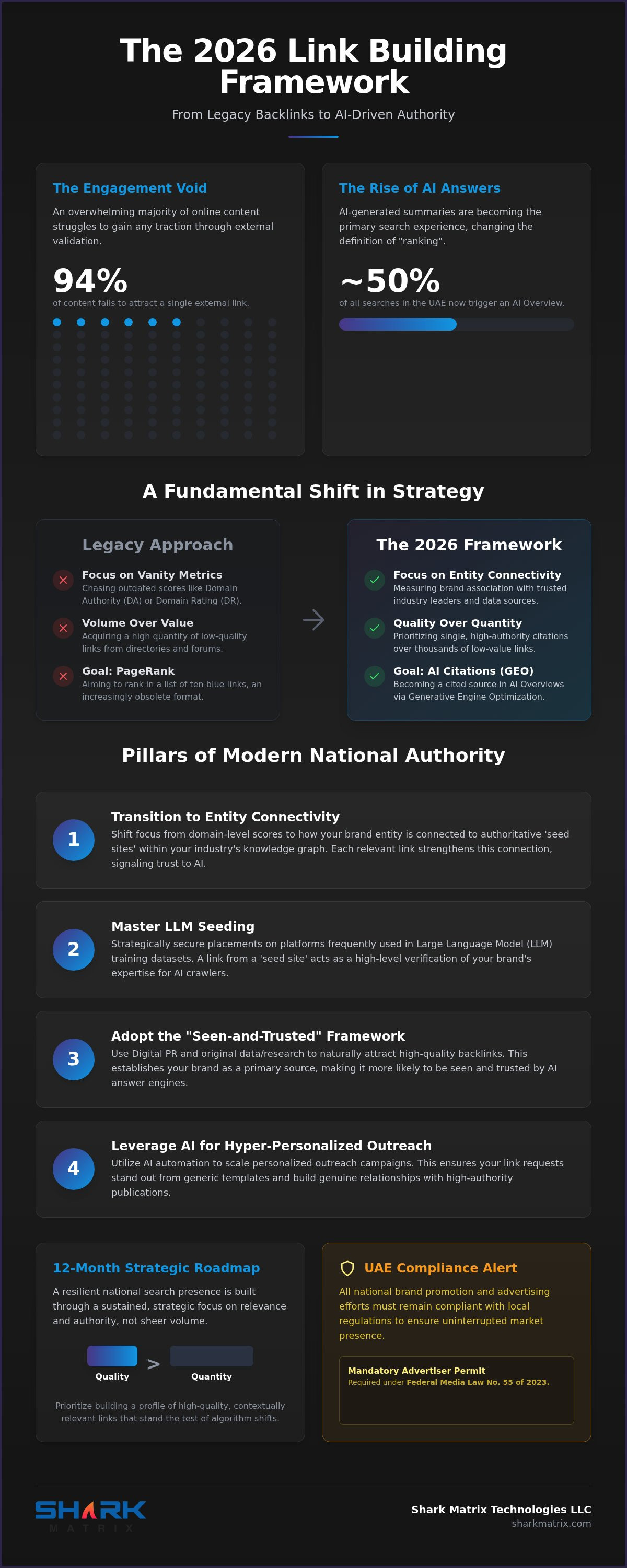
Did you know that 94% of all online content fails to attract a single external link, yet nearly half of all searches in the UAE now trigger an AI Overview citation? If you feel like your traditional guest posts are shouting into a void, you aren’t alone. Many national brands find that manual outreach costs are climbing while their influence on AI engine results remains stagnant. It’s a common pain point in an era where links are no longer just votes of confidence; they’re the training signals that teach AI which entities to trust.

We’ll show you exactly how to master the shift from legacy backlinks to AI-driven authority using 2026’s most sophisticated link building framework. By integrating national link building services with advanced Generative Engine Optimization (GEO), Shark Matrix Technologies LLC helps you secure the citations that matter. You’ll learn to automate link vetting and build a footprint that survives the latest algorithm shifts. We will also cover how to stay compliant with the UAE’s mandatory Advertiser Permit under Federal Media Law No. 55 of 2023. This article provides a clear roadmap for scaling national brand authority through automation and strategic entity-based growth.

Key Takeaways

  • Transition from outdated metrics like Domain Authority to Entity Connectivity to ensure your brand is cited accurately by generative AI engines.
  • Master LLM seeding techniques that connect your national brand to industry-leading seed sites for maximum authority in AI-driven search results.
  • Leverage AI automation to scale hyper-personalized outreach, ensuring your efforts stand out from the generic templates often used by standard link building services dubai.
  • Adopt the Seen-and-Trusted framework by using original data and Digital PR to attract high-quality, sustainable backlinks that establish market leadership.
  • Establish a 12-month strategic roadmap that prioritizes quality and relevance over quantity to build a resilient national search presence.

Link building isn’t what it used to be. In 2026, the focus has shifted from simple referral traffic to becoming a cited source in AI-generated answers. Understanding what is link building in the current era involves recognizing that every backlink serves as a training signal for Large Language Models (LLMs). These models don’t just count links; they analyze the relationship between digital entities. Traditional metrics like Domain Authority (DA) or Domain Rating (DR) have become secondary. Instead, search engines and AI agents prioritize Entity Connectivity, which measures how closely your brand is associated with established industry leaders and trusted data sources.

When utilizing link building services dubai, the goal is no longer just about ranking in a list of ten blue links. It’s about Generative Engine Optimization (GEO). AI agents use complex link graphs to determine national brand trustworthiness. If a trusted seed site links to you, the AI perceives your brand as part of a reliable knowledge cluster. This shift means that a single link from a highly relevant, authoritative source is worth more than a thousand low-quality directory placements. AI agents don’t just crawl; they reason. They look for patterns in how information is connected across the web. When a reputable industry publication links to your research, it’s a data point that confirms your entity’s role in a specific niche. This is why link building services dubai must now focus on the quality of the digital neighborhood your brand inhabits.

Understanding Answer Engine Optimization (AEO)

AI models operate on a Seen and Trusted framework. To appear in AI Overviews, your content must be supported by high-authority backlinks that demonstrate semantic similarity at the paragraph level. This means the context surrounding the link must be as relevant as the link itself. Pairing these links with robust structured data helps AI crawlers map your brand’s expertise accurately. Our ai automation services help identify these semantic gaps, ensuring your link profile supports direct answerability. It’s about more than the link; it’s about the proximity of keywords and the sentiment of the surrounding text. AI engines use these nuances to decide if your brand is the definitive answer to a user’s query.

The Death of Low-Value Link Volume

The era of high-volume, low-quality outreach is over. AI-powered search filters are now incredibly aggressive toward link farm patterns and non-contextual forum links. These outdated tactics often lead to immediate devaluation. Instead, the focus has shifted to Seed Sites. These are the primary sources that AI crawlers prioritize for fact-checking. Securing a mention on these platforms acts as a high-level verification of your brand’s data. For national brands, this means investing in deep, research-driven content that naturally earns these premium citations rather than chasing empty metrics.

Securing a spot in the Knowledge Graph requires a deliberate shift in how your brand acquires digital endorsements. In 2026, the algorithm values the semantic distance between your website and established industry leaders. Identifying entity-relevant link targets starts with auditing the sources your target AI agents cite most frequently. Professional link building services dubai now focus on bridging the gap between your brand and these industry Seed Sites. These are the authoritative domains that act as the primary nodes of truth for AI crawlers. By earning a link from a Seed Site, you effectively vouch for your entity’s relevance within a specific topic.

Mapping your link profile to the Knowledge Graph is essential for visibility in AI-driven search results. It helps to understand how search engines work today; they no longer just index pages, they build relationships between concepts. If your brand is linked from a high-authority site in a related niche, the AI engine strengthens the weight of your entity in that category. This niche-specific authority is the cornerstone of the 2026 algorithm, making broad, non-specific link acquisition strategies largely obsolete.

The Mechanics of LLM Seeding

LLM Seeding is a specialized technique that targets platforms frequently used in AI training datasets. These platforms include academic journals, high-tier news outlets, and specialized industry repositories. LLM Seeding is the strategic placement of brand mentions to influence AI model weights. When your brand appears consistently across these high-authority datasets, AI models are more likely to include you in their generated answers. This process requires high-authority link placement because AI models weigh data from trusted sources more heavily during training and inference phases.

Building Entity-Based Link Clusters

Creating content hubs that attract links from diverse but related sub-niches is the most effective way to build authority. You should use natural language processing to analyze the link context of your competitors. This allows you to identify the specific sentiment and keywords that trigger a connection in the AI’s mind. Prioritize links from sites with high Topical Authority scores rather than just high traffic. When evaluating link building services dubai, check if they use these entity-based clusters to reinforce your brand’s position as a subject matter expert. If you want to refine your technical approach, our SEO company dubai team can help you map out an entity-first strategy.
Advanced Link Building Techniques 2026: The Definitive SEO Strategy

AI-Enhanced Outreach: Scaling Personalization for National Authority

Traditional outreach often feels like a numbers game that most brands are losing. Sending hundreds of generic emails doesn’t work when editors are flooded with low-quality requests. To scale effectively, national brands are turning to ai automation services to handle the heavy lifting. This shift isn’t just about sending more emails; it’s about making every interaction count. By integrating link building services dubai into a wider AI-driven strategy, you can identify high-value targets that manual research would miss. This approach ensures your brand remains visible in a competitive national market without the high overhead of a massive manual outreach team.

We use custom scripts to filter for quality and relevance, ensuring that every backlink aligns with the strict standards of the UAE’s digital regulations. These automated vetting systems look for more than just traffic; they analyze the site’s link graph and historical stability. By removing the guesswork, we maintain outreach integrity and protect your brand’s reputation. Human-in-the-loop systems remain vital here. Our experts review the AI’s findings to ensure the final outreach feels personal and authentic, bridging the gap between automation and genuine relationship building.

Automating the Prospecting Pipeline

Finding the right targets is the most time-consuming part of any campaign. We use ai development services to build custom scrapers that vet potential sites in real-time. These tools check for technical health, topical relevance, and even the sentiment of existing content. Machine learning models now help us identify broken link opportunities by scanning millions of pages for 404 errors on high-authority sites. By integrating your CRM data with AI, we can predict outreach success rates based on historical interaction patterns. This data-driven approach allows us to focus our energy on the prospects most likely to convert, saving both time and resources.

Generative Outreach Strategies

Generative AI has moved far beyond simple templates. Instead of a one-size-fits-all pitch, AI analyzes the target editor’s recent work to identify specific content gaps. We craft pitches that offer a unique perspective or a value-add addition to their existing high-ranking articles. AI-driven personalization increases outreach conversion rates by up to 300%. While the AI handles the initial drafting and data analysis, we maintain a human-in-the-loop system. This ensures every email keeps its integrity and matches the specific tone of the publication. It’s a synergy of machine speed and human nuance that defines modern link building services dubai.

Digital PR and the Seen-and-Trusted Framework

In 2026, the criteria for a “good” link have evolved past simple domain metrics. AI engines now use a Seen-and-Trusted framework to decide which brands deserve a citation in generative answers. To be “seen,” your brand must appear in high-traffic, authoritative environments. To be “trusted,” those appearances must come from third-party editorial gatekeepers who verify your information. This is why modern link building services dubai have pivoted toward Digital PR. It’s no longer about buying placements; it’s about earning them through newsworthy contributions that national media outlets can’t ignore. When a major UAE news platform links to your brand, it signals to both humans and AI models that your entity is a verified authority.

Building this trust requires a shift away from recycled content. AI search filters are now sophisticated enough to identify and devalue unoriginal articles that offer no new information. Instead, national brands must focus on becoming primary sources. By providing original data that journalists can cite, you create a natural magnet for high-authority backlinks. This strategy doesn’t just improve your rankings. It builds a foundation of brand trust that protects you against future algorithm updates. It’s a sustainable way to ensure your brand remains a fixture in the national digital conversation.

Data-Driven Storytelling for Links

Original research is the most effective link magnet available today. We help brands conduct proprietary surveys and analyze the results using machine learning to uncover hidden industry trends. These insights are then transformed into linkable assets, such as interactive reports or infographics. By leveraging generative ai development, we can create complex data visualizations that make your findings easy for journalists to digest and share. These primary source links are gold for Generative Engine rankings because they provide the “ground truth” data that AI models crave for fact-checking. When you provide the data that others cite, you become the definitive node in the Knowledge Graph.

Reputation Management Through Link Building

Link building is also a powerful tool for protecting your brand’s image. By securing placements on high-authority platforms, you can build a “link moat” around your brand name. This involves highlighting positive brand pillars and ensuring that search results for your company are dominated by trusted, authoritative sources. High-quality link building services dubai focus on suppressing negative sentiment by outranking it with superior, high-trust content. This proactive approach to reputation management ensures that when potential customers or AI agents look for your brand, they find a consistent story of leadership and expertise. If you’re ready to secure your brand’s digital future, our seo company dubai team can design a custom PR and link strategy for you.

Implementing a high-level strategy isn’t a one-time task. It requires a disciplined, 12-month link-building roadmap that aligns with your broader business goals. In the first quarter, you should focus on cleaning legacy link debt and establishing foundational entity signals. By the second half of the year, your efforts should shift toward securing high-authority citations that influence Generative Engine Optimization (GEO). When selecting link building services dubai, national brands must look beyond simple placements. Balancing quantity and quality is different in 2026. AI search filters now prioritize Seed Sites and contextual relevance over raw link counts. One endorsement from a national industry leader is far more valuable than dozens of irrelevant placements. Integrating these efforts with search engine optimization seo services ensures that your technical on-page SEO supports the authority you’re building off-page.

Measuring Success in 2026

Measuring ROI has moved beyond tracking simple keyword rankings. You’ll need to monitor your Share of Voice in AI overviews and Answer Engines to see how often your brand is cited as the definitive source. There’s a strong correlation between high-quality backlink growth and increases in branded search volume. When authoritative sites vouch for you, users naturally search for your brand directly. We use advanced AI tools to audit the link health of your national competitors, identifying where they’re winning and where your brand can fill the gap. This data-driven approach turns link building services dubai from a speculative expense into a measurable growth engine. You’ll see the impact not just in traffic, but in how reliably AI models recommend your services.

The Shark Matrix Approach to Link Authority

Our approach thrives at the intersection of custom software engineering and digital marketing. We don’t just find links; we build the technical infrastructure to earn them. By collaborating with our seo company dubai experts, you gain access to a team that understands how to navigate the UAE’s specific regulatory environment while scaling national authority. We leverage our deep expertise in AI and machine learning to ensure every link serves as a positive weight in your brand’s favor within LLM training data. Future-proof your digital presence by moving away from legacy tactics. Partner with us to build a link profile that isn’t just seen, but trusted by the engines of tomorrow.

Future-Proofing Your National Authority in the AI Era

The shift from traditional backlinks to a Seen-and-Trusted entity framework is no longer optional for national brands. Mastering LLM seeding and bridge-building to industry seed sites ensures your brand is cited, not just indexed. By adopting a 12-month roadmap that prioritizes semantic relevance over raw volume, you can build a resilient digital presence that survives future algorithm shifts. Integrating these sophisticated strategies with professional link building services dubai allows you to scale hyper-personalized outreach while maintaining the technical integrity required for high-authority placements.

Shark Matrix Technologies LLC has been pioneering AI-integrated SEO since 2010. Our specialized GEO frameworks and expert technical team for custom automation provide the synergy needed to secure national brand authority. We don’t just build links; we engineer the entity signals that AI engines trust. Elevate your brand authority with our advanced SEO services today. Your digital legacy depends on the strategic trust you cultivate now.

Frequently Asked Questions

Is link building still relevant for SEO in 2026?

Link building remains a critical pillar of SEO in 2026, though its role has evolved. Instead of just passing authority, links now serve as vital training signals that help Large Language Models verify your brand’s trustworthiness. High-quality endorsements from industry-leading sites act as a trust signal for both traditional search algorithms and modern AI engines. Without a strong link profile, your content is less likely to be considered a definitive source by AI agents.

What is Generative Engine Optimization (GEO) and how do links help?

Generative Engine Optimization focuses on making your content the primary citation in AI-generated responses. Links assist this process by establishing Entity Connectivity, which maps the relationship between your brand and other trusted organizations. When reputable sites link to your research, AI engines recognize your site as a credible node in the Knowledge Graph. This increases the probability of your brand being cited as a factual source in generative answers across the national market.

How many backlinks do I need to rank for national keywords?

There isn’t a fixed number of backlinks required to rank for national keywords because the focus has shifted to topical authority. A single high-authority link from a national industry leader often outweighs hundreds of low-quality placements. Effective link building services dubai focus on securing a diverse mix of Seed Site mentions and niche-specific endorsements. We recommend building a consistent, natural link velocity rather than chasing an arbitrary count that doesn’t reflect true authority.

Can AI automate the entire link-building process?

AI can automate data-heavy tasks like link vetting and personalized drafting, but it cannot replace the human-in-the-loop required for high-level relationship building. While we use advanced automation to filter for relevance and quality, our experts manage the final outreach to ensure brand integrity. Total automation often leads to generic patterns that AI search filters easily detect and devalue. A hybrid approach ensures efficiency without sacrificing the nuance needed for premium editorial placements.

What makes a high-quality backlink in the age of AI search?

A high-quality backlink in 2026 is defined by its contextual relevance and the semantic similarity of the surrounding text. AI engines look for links placed within paragraphs that offer deep, expert analysis rather than just a simple mention. The linking site must also be a Seen-and-Trusted entity with its own robust digital footprint. Links from sites that are frequently used as training data for LLMs provide the highest value for national brand authority.

How do I get my brand cited in ChatGPT or Google AI Overviews?

To get cited in AI Overviews or ChatGPT, your brand must act as a primary source of information. This involves publishing original data and earning links from established news or academic platforms. AI models prioritize information that is verified by multiple trusted third parties. Using structured data alongside these links helps AI agents map your expertise accurately. Consistent mentions across high-authority datasets are the most reliable way to secure these prominent citations for your brand.

What are the risks of using automated link-building tools?

Using fully automated link-building tools carries significant risks, including the potential for immediate devaluation by AI search filters. These tools often leave predictable footprints that lead to manual penalties or a total loss of trust in the Knowledge Graph. Low-quality, non-contextual links can also damage your brand’s reputation among human readers. It’s vital to ensure any automation is overseen by experts who understand the national digital marketing regulations and quality standards.

How long does it take to see results from an advanced link-building campaign?

Most advanced link-building campaigns show initial technical improvements within three months, but full authority maturity typically takes six to twelve months. This timeline allows AI engines to crawl, index, and re-evaluate your brand’s position within the Knowledge Graph. Sustainable growth requires a consistent roadmap rather than a short-term burst. Our link building services dubai focus on long-term authority that compounds over time, providing a stable foundation for your national search presence and visibility.
Categories
Digital Marketing

Professional Page Speed Optimization Services in Dubai: Boosting UAE Business Performance

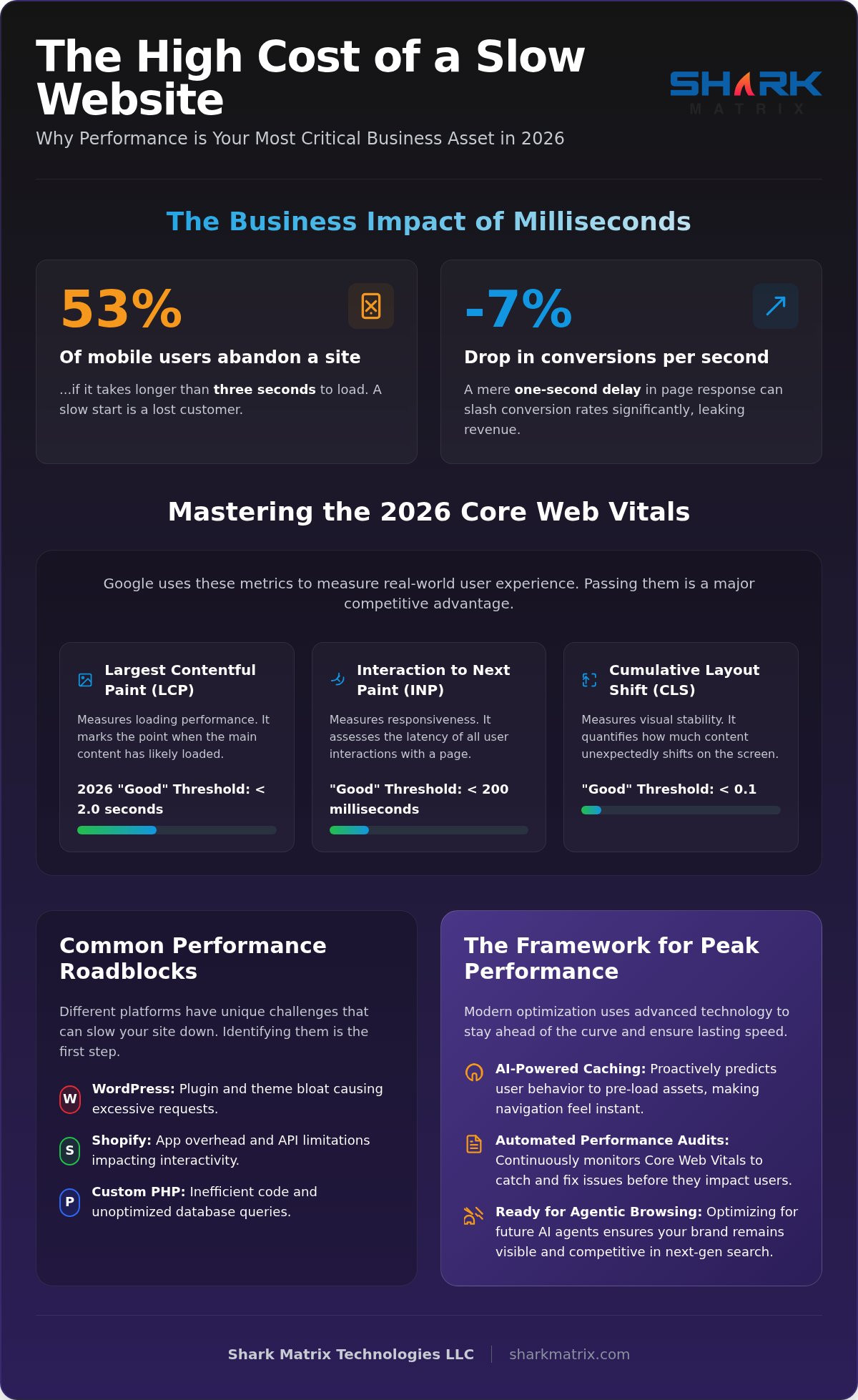
Did you know that 53% of mobile users nationwide will abandon your website if it takes longer than three seconds to load? In our fast-paced digital economy, a one-second delay can slash your conversion rates by 7%. It’s a harsh reality that a slow site isn’t just a technical glitch; it’s a direct leak in your revenue stream. Investing in professional page speed optimization services dubai is no longer optional if you want to stop losing customers to faster competitors. Many businesses struggle with low search rankings and confusing technical jargon, but your website’s performance should be your strongest asset.

It’s frustrating to see your hard work undermined by poor performance metrics, but there’s a clear path to recovery. We promise to show you how to transform your website into a high-speed conversion engine that dominates search results. You’ll learn how to master the 2026 Core Web Vitals standards, including the new 2.0-second LCP threshold and INP requirements. We’ll also preview how Shark Matrix Technologies LLC uses AI automation and advanced web development to maintain peak performance, ensuring your brand delivers the seamless mobile experience your customers expect. By the end of this guide, you’ll understand how to future-proof your site for the era of agentic browsing and national growth.

Key Takeaways

  • Understand why technical load times are a critical business asset for capturing high-intent mobile users across the country.
  • Learn how to meet the 2026 “Good” LCP threshold of 2.0 seconds and the vital Interaction to Next Paint (INP) scores for better rankings.
  • Identify how to resolve platform-specific performance issues like plugin bloat in WordPress or API limitations within Shopify environments.
  • Discover how professional page speed optimization services dubai integrate AI for predictive caching and automated performance auditing.
  • Gain insights into future-proofing your website for agentic browsing to maintain a competitive edge and national brand authority.

The Business Impact of Page Speed Optimization Services in Dubai

Page speed optimization is the technical process of reducing the time it takes for a website to load and become fully interactive. It involves a complex series of refinements to a site’s code, server configuration, and asset delivery to ensure a seamless user experience. In 2026, Google treats site speed as a primary ranking signal, meaning that a slow website is effectively invisible to high-intent searchers across the country. Utilizing professional page speed optimization services dubai ensures that your technical foundation supports your broader growth goals.

Slow performance leads to immediate revenue loss and increased bounce rates. When a page takes too long to respond, users don’t wait; they leave. Data indicates that a mere one-second delay can cause a 7% drop in conversions, while 53% of mobile users abandon sites that take longer than three seconds to load. For a national brand, this translates to significant lost opportunities every day. Implementing high-performance Web performance optimization (WPO) is not just a technical task. It’s a strategic move to protect your bottom line and improve your brand’s digital authority.

Why National Brands Prioritize Loading Times

Speed acts as a silent ambassador for your brand. When a site loads instantly, it signals professionalism and reliability to high-value clients across the Emirates. This builds immediate trust, which is essential for lead generation and e-commerce success. In a competitive market, outperforming slower legacy websites in search results gives you a massive advantage. Faster sites earn higher engagement metrics, which search engines reward with better visibility. Brands that ignore these metrics find themselves falling behind competitors who treat performance as a core business asset.

The Mobile-First Reality of the UAE Market

The UAE has one of the highest mobile penetration rates globally, with consumers expecting desktop-level speeds on their smartphones. While widespread 5G connectivity is the standard, it doesn’t fix a bloated website; it only highlights technical inefficiencies. Optimizing for diverse mobile hardware is essential because not every customer uses the latest flagship device. Success in 2026 depends on mobile performance scores rather than outdated desktop metrics. By focusing on web development that prioritizes mobile responsiveness, companies can reduce friction for on-the-go users and secure long-term national brand growth.

Decoding Core Web Vitals and Technical Performance Metrics

Measuring website performance requires looking beyond a simple loading bar. In 2026, Google evaluates user experience through a specific set of metrics known as Core Web Vitals. These benchmarks provide a standardized way to quantify how real people interact with your site. Only 47% to 53% of websites globally pass all three thresholds; achieving these scores is a significant competitive advantage. High-quality page speed optimization services dubai focus on these metrics to ensure your technical foundation supports national brand growth.

Largest Contentful Paint (LCP) measures how long it takes for the most substantial visual element on a page to appear. Following the March 2026 update, the “Good” threshold for LCP was tightened from 2.5 seconds to 2.0 seconds. If your hero image or primary headline takes longer than this to render, users perceive the site as sluggish. This perception directly impacts your bounce rate. We prioritize optimizing the critical rendering path to ensure these key elements load first, keeping users engaged from the very first second.

Interactivity is now measured primarily through Interaction to Next Paint (INP), which replaced First Input Delay (FID) as a primary ranking signal. For a “Good” rating, your site must respond to user actions, like clicking a lead generation button, in under 200 milliseconds. Visual stability is equally vital. Cumulative Layout Shift (CLS) tracks whether elements jump around as the page loads. A score of less than 0.1 prevents accidental clicks and ensures a frustration-free experience. Finally, Time to First Byte (TTFB) remains the gold standard for server-side health; it measures the initial connection speed before any content even starts to download.

Advanced Technical SEO Auditing

Effective optimization starts with a deep dive into your site’s current performance. We use automated tools to identify render-blocking resources that prevent your page from displaying content quickly. It’s vital to distinguish between lab data, which is collected in a controlled environment, and field data, which reflects the actual experiences of users across the Emirates. A comprehensive SEO audit uncovers these hidden bottlenecks, allowing for a targeted strategy that fixes real-world issues rather than just chasing theoretical scores.

Server-Side Optimization Strategies

Your server configuration is the backbone of your site’s speed. While global CDNs are excellent for scaling, local hosting often provides the lowest latency for a national audience. We implement Brotli compression, a modern alternative to Gzip that offers superior data transfer speeds for 2026 browsers. For resource-heavy e-commerce platforms, we optimize database queries to ensure that searching for products doesn’t strain your server. If you’re seeing performance lags, it might be time to consider how professional technical web development can stabilize your infrastructure.

Professional Page Speed Optimization Services in Dubai: Boosting UAE Business Performance

Platform-Specific Optimization: WordPress, Shopify, and Custom PHP

Every website platform presents a unique set of technical challenges and opportunities. SaaS solutions like Shopify offer a managed environment that handles server health, yet they often restrict deep access to the underlying infrastructure. In contrast, open-source systems like WordPress provide total control but frequently suffer from “plugin bloat.” This occurs when too many third-party tools are added, slowing down the database and front-end. Professional page speed optimization services dubai navigate these differences to ensure your technical stack remains lean and responsive, regardless of the platform you choose.

WordPress sites, particularly those running version 7.1, require a disciplined approach to asset management. It’s easy to fall into the trap of using heavy themes that include features you’ll never use. We focus on auditing every active plugin and removing redundant scripts that add unnecessary weight. For Shopify users, staying current with the latest stable API version, such as 2026-07, is essential for maintaining a fast connection between your store and external services. By cleaning up liquid files and optimizing app scripts, we help national brands maintain a competitive edge without sacrificing the convenience of their chosen CMS.

Optimizing E-commerce Performance

For online stores, script execution time is often the biggest hurdle to a fast user experience. Every tracking pixel, customer review widget, and marketing app adds a processing burden to the user’s browser. Our e-commerce development strategy integrates speed from the very beginning. We balance high-quality product imagery with aggressive compression using modern formats like WebP or AVIF. This ensures your products look stunning without forcing customers to wait for massive files to download. Specialized checkout speed optimization is also vital; a friction-free payment process is often the deciding factor in whether a customer completes a purchase or abandons their cart.

Custom Development and Performance Engineering

Custom PHP development offers the ultimate flexibility for achieving near-instant load times. Unlike off-the-shelf themes that are built to suit everyone, custom-built frameworks contain only the specific code your site needs to function. This reduces browser processing time significantly. We leverage modern CSS and JavaScript minification to strip away every redundant byte from your site’s codebase. By focusing on performance engineering, we turn your website into a high-speed business asset. This level of technical precision is why custom solutions often outperform generic templates in both search rankings and user retention. Tailored page speed optimization services dubai provide the technical edge required for sustained national brand growth in 2026.

The Shark Matrix Framework for High-Performance Websites

Shark Matrix Technologies LLC uses a structured, four-phase methodology to ensure every website reaches its maximum potential. Our framework for page speed optimization services dubai begins with Phase 1: Deep-dive technical discovery. We don’t just look at scores; we establish baseline benchmarks for real-world performance across the Emirates. Phase 2 involves production-safe implementation. We address both front-end and back-end fixes without disrupting your live business operations. This ensures your site remains functional while we refine its core architecture.

Phase 3 focuses on continuous testing. We simulate various network speeds and hardware types to ensure a consistent experience for every user. Finally, Phase 4 provides post-optimization reporting. We translate technical jargon into clear business impact metrics, showing exactly how speed improvements correlate with your growth. This systematic approach ensures that high-performance standards are maintained long after the initial fixes are applied. By monitoring these metrics in real-time, we help national brands stay ahead of performance decay.

UI/UX Alignment with Speed Goals

Design and performance are two sides of the same coin. A minimalist design supports faster rendering by reducing the number of elements the browser needs to process. This doesn’t mean sacrificing brand appeal; it means choosing high-impact visual elements that load efficiently. We also consider the “Psychology of Speed.” By managing user expectations during load, such as using skeleton screens, we reduce perceived wait times. There’s a deep synergy between professional UI/UX design and site performance. When your design is built for speed, users stay longer and engage more deeply with your content.

Data-Driven Lead Generation Through Speed

Speed is a silent driver of conversions. Improving load times directly leads to higher form completion rates, especially for national B2B brands where decision-makers are time-poor. By reducing friction in the customer journey, you make it easier for prospects to reach out. Speed also offers a direct ROI through enhanced PPC landing page quality scores. When your site loads instantly, your ad spend becomes more efficient, lowering your cost per lead. If you want to see these results for your own brand, partnering with an experienced SEO company dubai can help align your technical performance with your commercial objectives.

Integrating AI and Future-Proofing Performance for 2026

By 2026, the standard for web performance has shifted from reactive fixes to proactive, AI-driven management. Static code minification is just the beginning. Modern page speed optimization services dubai now leverage predictive caching to anticipate user behavior. By analyzing historical navigation patterns, AI models can pre-load specific assets before a user even clicks a link. This creates a near-instantaneous experience that mimics the speed of a local application rather than a remote server.

Automated image optimization has also evolved through machine learning algorithms. Instead of applying a blanket compression level, these systems analyze every pixel to find the perfect balance between visual fidelity and file size. Machine learning also powers continuous monitoring tools. These systems alert development teams to performance regressions in real-time, preventing slow code from reaching production. As Google continues to prioritize deep user engagement signals, staying ahead of these technical shifts is vital for national brand authority.

AI-Powered Optimization Services

Maintaining a high-speed infrastructure requires constant vigilance. We utilize AI automation services to handle repetitive performance tasks, such as database indexing and script cleanup. Natural Language Processing (NLP) plays a unique role here too. By understanding the search intent behind a user’s query, we can optimize the specific load paths that matter most for that interaction. Custom AI solutions allow for dynamic content delivery, ensuring that a user on a 5G connection receives a rich experience while someone on a limited network gets a streamlined, ultra-fast version of the site.

The Future of High-Speed Digital Experience

The rise of “Agentic Browsing” and Answer Engine Optimization (AEO) has changed the landscape. In May 2026, Lighthouse 13.3 introduced an experimental category to check for a site’s readiness for AI agents. These agents require structured, fast-loading data to provide accurate answers to users. Speed is no longer just about human eyes; it’s about being readable for the AI tools that drive modern search. Edge computing further supports this by moving processing power closer to the user, ensuring national-scale performance regardless of their location. If your site is struggling to keep up with these 2026 standards, it’s time to take action. Contact Shark Matrix for a comprehensive performance audit to secure your brand’s digital future.

Secure Your Competitive Edge in the High-Speed UAE Market

We’ve explored how technical load times directly impact your bottom line and why mastering the 2026 Core Web Vitals, including the 2.0-second LCP threshold, is non-negotiable for national brand growth. From resolving platform-specific bloat in WordPress or Shopify to integrating predictive AI caching, the path to a high-performance website requires a blend of development expertise and strategic automation. Your digital presence must be ready for both human users and the emerging era of agentic browsing.

Choosing professional page speed optimization services dubai ensures your site doesn’t just pass technical tests but actually converts high-intent mobile users across the country. Shark Matrix Technologies LLC brings over 15 years of technical SEO expertise and specialized AI integration to help you outpace the competition. We focus on national market growth, ensuring your infrastructure is resilient and future-proof. Elevate Your Site Speed with Shark Matrix Technologies and transform your website into a flawless, high-speed engine. It’s time to deliver the seamless experience your customers expect.

Frequently Asked Questions

How long does it take to see results from page speed optimization?

Technical improvements happen as soon as the code is deployed. However, Google’s field data for Core Web Vitals is based on a rolling 28-day average. You’ll usually see the full impact within a month. For national brand growth, these gains lead to higher conversion rates almost instantly. User friction decreases immediately, allowing your customers to navigate your product pages without any frustrating delays.

Will speed optimization change the look or design of my website?

Most optimizations happen in the background within the site’s code and server configuration. While the core design remains the same, you might notice subtle improvements like images loading smoothly or buttons responding faster. Professional page speed optimization services dubai focus on efficiency without compromising your brand’s visual identity. The goal is making your existing UI/UX design perform better across all devices.

Is page speed a direct ranking factor for Google in 2026?

Yes, page speed is a primary ranking signal in 2026. Following the March 2026 update, Google tightened the “Good” threshold for Largest Contentful Paint to 2.0 seconds. Interaction to Next Paint is also critical. Sites that fail these benchmarks often see a sharp decline in organic traffic. Search engines prioritize platforms that provide a flawless user experience across all mobile hardware types.

What is a good page load time for a business website in the UAE?

For a competitive business website, aim for a Largest Contentful Paint of 2.0 seconds or less. Mobile performance is the most important metric. Most users nationwide access the web via their phones. Achieving these speeds ensures you meet high consumer expectations and maintain compliance with the latest global web performance standards for 2026. It’s the best way to reduce bounce rates and increase engagement.

Can I optimize my website speed myself using plugins?

Plugins offer basic fixes like caching or image compression. However, they often lead to plugin bloat which can slow your site down. True performance engineering requires deep-dive technical discovery. Production-safe implementation is essential. For national brands, relying on automated tools isn’t enough to pass strict 2026 thresholds. You must also future-proof your digital presence to be ready for agentic browsing.

Why does my website score differently on mobile vs. desktop?

Mobile scores are usually lower. Mobile processors are less powerful than desktop ones and cellular networks can be less stable. Google uses mobile-first indexing. It prioritizes the mobile version of your site for ranking. Even with 5G connectivity, mobile devices require more efficient code. Lighter assets are necessary to achieve the same perceived speed as a desktop computer during a standard browsing session.

Does hosting location affect my site speed for national users?

Physical distance between your server and your users creates latency. For a national audience, hosting your website on local servers is essential. You can also use a Content Delivery Network with nodes across the country. This reduces the Time to First Byte. It ensures data travels the shortest possible distance. This is critical for meeting 2026 e-commerce standards and keeping your bounce rates low.

How often should I conduct a page speed audit?

Conduct a comprehensive audit at least once every quarter. Performance can decay over time as you grow. Adding new content, marketing pixels, or third-party scripts slows things down significantly. Regular monitoring catches regressions before they impact search rankings. Utilizing page speed optimization services dubai helps you stay ahead of the competition. You can adapt quickly to new search engine algorithm updates as they happen.

Categories
SEO

The Enterprise Replatforming SEO Strategy: Protecting Revenue in 2026

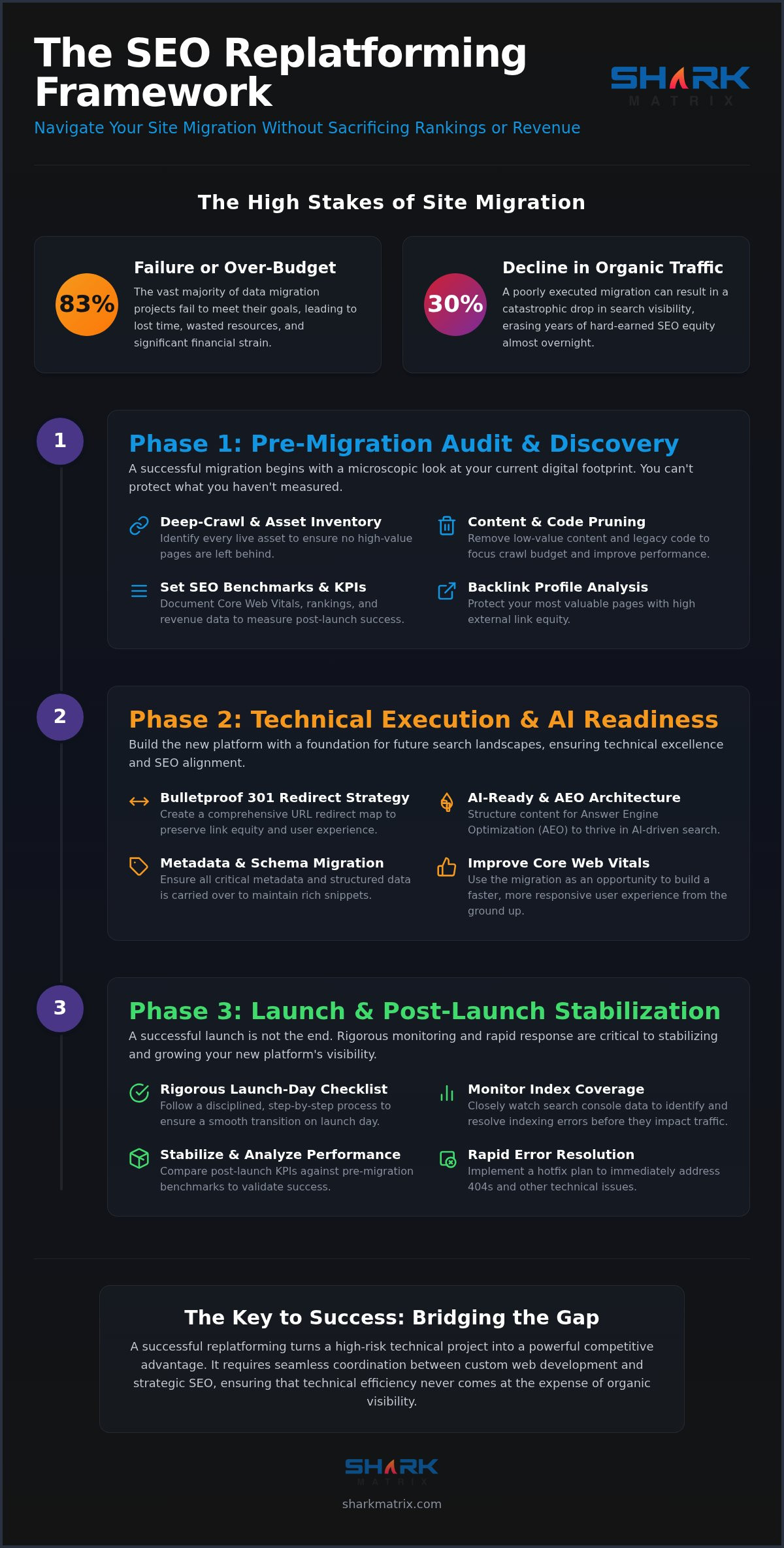
83% of data migration projects either fail or exceed their budgets, often leaving a trail of 404 errors and lost revenue in their wake. It’s a terrifying reality for enterprise leaders who know that a single month of tanking rankings can erase years of hard-earned search equity. You’ve likely felt that anxiety during planning meetings where technical developers and search specialists don’t always align, making a cohesive replatforming seo strategy feel out of reach.

This guide provides the framework to ensure your move to a modern tech stack is a growth engine rather than a recovery project. You’ll learn how to master the complex process of migrating your platform without sacrificing your organic traffic or revenue. We’ll explore how to protect your rankings, improve Core Web Vitals, and position your brand to thrive in the era of AI-driven search and answer engines. By bridging the gap between software engineering and search strategy, you can turn a risky migration into a powerful competitive advantage.

Key Takeaways

  • Learn how to conduct a deep-crawl audit to identify every live asset, ensuring no legacy code or high-value pages are left behind during the move.
  • Discover a bulletproof replatforming seo strategy that uses 301 redirects to preserve link equity and prevent post-launch ranking drops.
  • Prepare your new site for the 2026 search landscape by integrating Answer Engine Optimization (AEO) and AI-ready architectural shifts.
  • Follow a rigorous launch-day checklist to monitor index coverage and resolve technical errors before they impact your bottom line.
  • Understand how bridging the gap between custom web development and strategic SEO creates a high-performance e-commerce ecosystem.

The High Stakes of Replatforming: Why Your SEO Strategy Matters

Replatforming is more than a digital facelift. It’s a fundamental software modernization process that rewrites how search engines interact with your business. While many teams treat a move to a new CMS as a simple checklist of URL updates, a truly effective replatforming seo strategy accounts for deep architectural shifts. If you ignore how your site hierarchy changes, you risk “invisible” disasters like crawl budget depletion or carrying over legacy code bloat that slows down your new, expensive platform from day one.

In 2026, the stakes have shifted. We’re no longer just optimizing for traditional blue links. The rise of Generative Engine Optimization (GEO) means your new site must be structured so AI “answer engines” can easily parse and cite your content. This requires seamless coordination between your web developers and SEO team. Shark Matrix acts as the bridge between these departments. We ensure that technical efficiency never comes at the expense of organic visibility, helping your team speak the same language from discovery to launch.

The Financial Impact of Migration Errors

The cost of failure is high. Research indicates that 83% of data migration projects either fail or exceed their budgets. For an enterprise, a poorly executed launch can lead to a 30% decline in organic traffic. If your site generates significant monthly revenue, even a temporary 20% dip over six months represents a massive financial hit that’s difficult to recover. Beyond the numbers, a spike in 404 errors and broken internal links erodes customer trust. In competitive national markets, once you lose that hard-earned authority, competitors are ready to fill the vacuum immediately.

Setting SEO Benchmarks and KPIs

You can’t protect what you haven’t measured. Before the first line of code is moved, you must identify your “Must-Win” keywords and high-revenue pages. These are the assets that sustain your business. Establishing clear metrics early prevents finger-pointing if issues arise post-launch.

  • Capture Baselines: Document current Core Web Vitals. With 42% of sites failing the Interaction to Next Paint (INP) metric in 2026, you need a clear starting point to prove the new platform is an upgrade.
  • Define Failure Thresholds: Establish a “red line” for post-launch monitoring. If organic sessions drop below a specific percentage, your team should have an immediate hotfix plan ready.
  • Revenue Mapping: Connect your most valuable SEO pages to direct sales data. This allows you to prioritize technical fixes based on fiscal impact rather than just traffic volume.

Phase 1: The Pre-Migration SEO Audit & Discovery

Successful migrations don’t start with code. They start with a microscopic look at what you already own. A robust replatforming seo strategy begins with a comprehensive audit of your current digital ecosystem. You must conduct a deep crawl to identify every live asset, from legacy landing pages to forgotten PDF resources. This isn’t just about making a list. It’s about evaluating whether your current site hierarchy is actually ready for a modern platform. If your architecture is messy now, moving it to a faster tech stack won’t fix the underlying structural issues that confuse search engines.

Pruning is equally vital. Moving every single page is often a waste of resources. By identifying and removing low-value content, you streamline the migration and focus your crawl budget on pages that drive revenue. At the same time, you must analyze your backlink profile. High-authority pages with significant external equity need the most protection. If these aren’t prioritized, you risk losing the trust search engines have built in your brand since your site was first indexed. Using ai automation services can help streamline these discovery workflows, identifying patterns in your data that human audits might miss.

Mapping the Current SEO Footprint

Modern audits in 2026 leverage AI to categorize pages by search intent rather than just keywords. This ensures that your new site structure aligns with how users actually search in an “answer engine” environment. You need to identify critical metadata and Schema markup that must be preserved to maintain your rich snippet visibility. For those needing expert guidance on these technical requirements, our comprehensive SEO audit guide ensures no technical detail is overlooked during this discovery phase. We help you map out exactly which elements of your current success must be carried over to the new environment.

Platform Selection from an SEO Perspective

Your choice between a SaaS platform and a custom-built solution impacts your technical SEO flexibility for years. SaaS options offer speed but sometimes limit your control over server-side rendering or deep file structures. Custom builds, often supported by web development experts, allow for granular control over robots.txt and sitemaps. Your replatforming seo strategy must also account for CDN integration and 2026 Core Web Vitals standards, specifically the Interaction to Next Paint (INP) metric. With 42% of sites still struggling with INP, your choice of platform could be the difference between ranking and disappearing from the first page.

Phase 2: Technical Execution, Redirects, and AI Readiness

Technical execution is where your strategy meets the server. Precision is everything. Implementing a robust replatforming seo strategy during this phase ensures that your 301 redirect map is more than just a list of links. It is a signal to search engines that your brand authority has a new, permanent home. Without meticulous execution, you aren’t just changing addresses; you’re throwing away years of digital trust. Equity is fragile. A single broken link in a high-authority path can cause a ripple effect that tank rankings across your entire catalog.

Enterprise sites often manage tens of thousands of URLs, making manual mapping a recipe for disaster. Using ai automation services allows for precise, automated matching based on content similarity and metadata. This ensures that users and crawlers always find the most relevant new page. Beyond basic redirects, you must update your Schema.org markup. In 2026, search engines rely on structured data to verify your expertise and trustworthiness (E-E-A-T), especially when generating AI-led answers.

Meticulous URL Mapping and Redirect Chains

Choosing the right mapping approach depends on your scale and resources. While 1-to-1 mapping is the gold standard for preserving equity, it can be resource-intensive for massive catalogs. Category mapping is faster but risks diluting the specific relevance of deep pages. You must also guard against redirect loops and excessive chains. If a crawler has to pass through three or more redirects to find a page, it wastes your crawl budget and slows down the user experience. Don’t forget your assets. Managing redirects for images and PDFs is essential to preserve traffic from visual and document-based searches.

1-to-1 Mapping

  • Pros: Full transfer of link equity; best for high-revenue pages.
  • Cons: Extremely time-consuming for large sites; high technical overhead.

Category Mapping

  • Pros: Rapid execution; simplifies the site structure.
  • Cons: Potential loss of specific keyword rankings; less precise for users.

Optimizing for Generative Engine Optimization (GEO)

A successful replatforming seo strategy in 2026 requires a deeper understanding of how AI crawlers digest your site architecture. You must structure data so Large Language Models (LLMs) can easily parse and cite your content. This involves ensuring your new architecture supports fast, semantic content delivery. Integrating natural language processing elements into your new content strategy helps search engines understand the context of your offerings. By aligning your technical structure with these generative search requirements, you position your brand as a primary source for the “answer engines” that now dominate the search landscape.

The Enterprise Replatforming SEO Strategy: Protecting Revenue in 2026

Phase 3: Launch Day and Post-Launch Stabilization

Launch day is the most critical window for your replatforming seo strategy. It’s the moment months of planning meet the reality of live traffic. You must have a rigid checklist ready to execute the second the DNS switch occurs. First, verify that your robots.txt file isn’t still blocking crawlers from the staging phase. Update your XML sitemaps and submit them to Google Search Console immediately to trigger a re-crawl of your new URL structure. Don’t forget to validate that all tracking codes, including GA4 and GSC verification tags, are firing correctly on the new production environment.

Once the site is live, monitor your server logs in real-time. This allows you to spot and fix 404 errors before they impact your bounce rate or crawl budget. You should also watch the “Index Coverage” report in Search Console for any sudden spikes in excluded pages. Validating Core Web Vitals under a real-world load is also essential. Since 42% of sites still fail the Interaction to Next Paint (INP) metric in 2026, you need to ensure your new platform delivers on its performance promises when thousands of users hit the server at once.

Immediate Post-Launch Technical Checks

Check your canonical tags first. They must point to the new URL structure, not the old legacy paths or the staging subdomain. It’s a common, costly mistake to leave “Noindex” tags active after moving from staging to production. Perform a quick crawl of your top 100 revenue-generating pages to ensure they’re indexable and returning a 200 OK status. Finally, test site speed and mobile-friendliness on the actual production server. Server response times often differ significantly from staging environments; real-world testing is non-negotiable for maintaining ranking stability. To ensure your business platform is built for this level of performance, you can learn more about ProGroup.

Expect some turbulence. Minor ranking fluctuations are normal as search engines re-crawl your new architecture and process your 301 redirects. However, you must distinguish between this “normal” volatility and a catastrophic loss of traffic. If your sessions drop by more than 30% and don’t stabilize within 72 hours, you likely have a technical blockage. Use heatmaps and session recordings to see how users interact with the new interface. UX friction often mimics SEO issues in data reports, as poor engagement signals can negatively impact your rankings. For deeper insights into creating high-performance interfaces that convert, explore our guide on website design and development.

If your post-launch traffic isn’t recovering as expected, our specialists can perform a deep-dive analysis to find the root cause. Reach out to our SEO company to stabilize your organic visibility and protect your revenue.

Future-Proofing Your Migration with Shark Matrix

Shark Matrix stands at the intersection of technical excellence and strategic visibility. Precision matters. While most firms treat migration as either a coding task or a marketing project, we treat it as a unified engineering challenge. A successful replatforming seo strategy requires more than just 301 redirects; it demands a deep understanding of how your new backend infrastructure interacts with search engine crawlers. Since our founding in 2010, we’ve specialized in high-impact migrations that protect your organic equity while modernizing your tech stack.

Our approach integrates ai development services to automate the most complex parts of the transition. Instead of manual mapping that leads to human error, we use machine learning to ensure data integrity across thousands of URLs. We understand the UAE digital landscape and the national-level competition your brand faces. We don’t just help you survive the move. We build the foundation for your brand to dominate in the era of answer engines and generative search.

Custom Software Solutions for Complex Migrations

Enterprise migrations often involve legacy databases that don’t play well with modern SaaS platforms. We build custom middleware to ensure your data syncs perfectly without losing metadata or product history. To maintain customer satisfaction during the switch, we can deploy bespoke ai chatbots to guide users through the new interface. This technical layer ensures that even if your UI changes, your user experience remains seamless. We design scalable infrastructure that can handle the traffic spikes common in the national market, ensuring your site stays fast and responsive under any load.

Your Strategic Partner for Long-Term Growth

Once the technical hurdles are cleared and the redirects are stable, we shift from migration mode to growth mode. Your new platform is a powerful tool; we help you use it. By leveraging data-driven lead generation and advanced SEO management, we turn your high-performance site into a revenue engine. We focus on ongoing optimization that capitalizes on your new site’s speed and semantic structure. This ensures you aren’t just recovering lost ground but actively taking market share from less agile competitors.

Ready to protect your search equity? Schedule a replatforming SEO consultation with Shark Matrix today to start planning your seamless transition.

Dominating the 2026 Search Landscape After Your Move

Replatforming shouldn’t be a period of damage control. It’s a strategic pivot toward a faster, more intelligent digital presence. By prioritizing a deep pre-migration audit and aligning your technical execution with the requirements of modern answer engines, you turn a risky technical chore into a massive competitive advantage. A robust replatforming seo strategy ensures that your brand authority remains intact while your infrastructure evolves to meet the latest performance standards. Success lies in the details of your redirect mapping and the readiness of your schema for generative search.

Shark Matrix provides the technical bridge between custom software engineering and strategic search visibility. Our team brings a proven track record in national-scale website migrations and deep expertise in AI automation. We don’t just move your data; we future-proof your revenue by ensuring your new site is optimized for both users and AI crawlers from the moment it goes live.

Protect your rankings—consult with Shark Matrix for your enterprise replatforming strategy.

The transition to a new platform is a major milestone for any enterprise. With the right planning and a focus on technical precision, your business will emerge stronger, faster, and more visible than ever before.

Frequently Asked Questions

How long does SEO traffic take to recover after replatforming?

Traffic usually stabilizes within 4 to 12 weeks if your technical foundation is solid. Most sites experience minor fluctuations as search engines re-crawl the new architecture and process redirects. If your replatforming seo strategy includes a flawless redirect map, you might see a performance boost shortly after launch. Persistent traffic loss beyond the three month mark usually indicates deeper issues like crawl errors or lost internal link equity that require immediate technical intervention.

Is it possible to replatform without changing any URLs?

You can keep your URLs identical if your new platform supports custom slug structures that match your legacy site. This is often the safest path for SEO because it bypasses the need for 301 redirects entirely. However, many enterprise platforms enforce specific folder hierarchies that make this difficult. When identical URLs aren’t an option, you must prioritize a 1-to-1 redirect strategy to ensure search engines can still find and rank your most valuable content assets.

What is the most common SEO mistake during a website migration?

The most frequent mistake is using catch-all redirects that send all old traffic to the new homepage. This approach erases the specific keyword relevance and authority built into your deep product or service pages. Another critical error involves leaving technical blocks like robots.txt disallow rules or noindex tags active on the live site. These oversights can lead to a total loss of organic visibility within days if they aren’t caught during your immediate post-launch technical checks.

How does replatforming affect my existing backlinks?

Backlinks remain effective as long as a permanent 301 redirect connects the old URL to the new one. These redirects act as a bridge, passing authority and trust signals to the new platform. While redirects are powerful, they aren’t a perfect substitute for a direct link. For your most valuable referral sources, it’s worth contacting the site owners to request a direct update to your new URL, ensuring the fastest possible load times for your visitors.

Should I redesign my website at the same time I replatform?

Should I redesign my website at the same time I replatform?

Redesigning during a migration is a double-edged sword. It allows you to fix UX issues and improve Core Web Vitals, but it makes troubleshooting traffic drops more difficult. If your current design is mobile-friendly and fast, consider a staged approach. However, if your site fails the Interaction to Next Paint metric, a redesign is likely essential for 2026 growth. You can discover ThinkTank Creative to see how professional development can be integrated into your new platform. Just ensure your replatforming seo strategy balances technical migration with these significant on-page and architectural changes.

Multilingual sites require careful management of hreflang tags to ensure search engines serve the correct language version. For the national UAE market, this means mapping English and Arabic pages in pairs to maintain their relationship. Every redirected URL must have its hreflang attributes updated to point to the new structure. Failing to do this can lead to cross-language errors where searchers see the English page when they need the Arabic one, hurting your local conversion rates.

Can AI automation help with the 301 redirect mapping process?

AI automation significantly speeds up the redirect mapping process for enterprise sites with thousands of pages. These tools use natural language processing to match old pages with their most relevant new counterparts based on content and intent. Shark Matrix integrates these automated workflows to eliminate the manual errors that often plague large-scale migrations. This technology ensures that your link equity is preserved accurately, allowing your team to focus on growth rather than fixing thousands of broken links.

Categories
Digital Marketing

Strategic Paid Media Campaign Management: The 2026 Guide to ROI

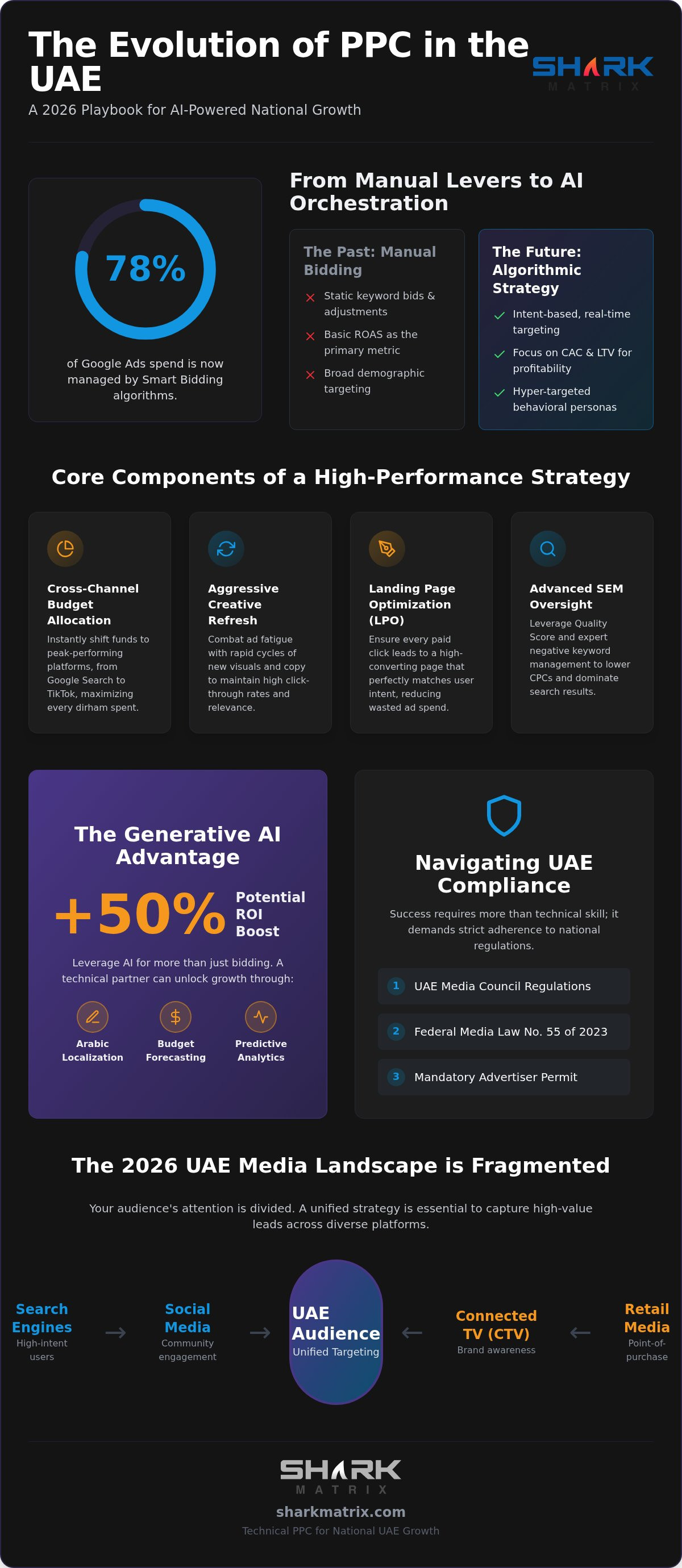
Did you know that 78% of all Google Ads spend is now managed by Smart Bidding, yet many UAE brands still struggle with a sky-high cost per lead? It’s a frustrating reality where AI handles the heavy lifting, but without the right strategic oversight, your budget can quickly evaporate. If you’re searching for a strategic PPC agency in the UAE to navigate this shift, you’ve likely realized that manual bidding is a thing of the past. Success in 2026 requires a technical partner who can orchestrate machine learning while staying compliant with the latest Federal Media Law No. 55 of 2023. For many brands, collaborating with a data-driven agency like EmirAds provides the necessary expertise to achieve measurable growth in the UAE and Middle East.

You probably feel the pressure of fragmented reporting and the constant need to adapt to new UAE Media Council regulations, including the mandatory Advertiser Permit. It’s exhausting to keep up when algorithms and local requirements change so rapidly. This guide promises to simplify that chaos by providing a data-driven framework designed for national growth and AI-powered efficiency. We’ll explore how to leverage first-party data, master Arabic localization for the national market, and use generative AI to potentially boost your ROI by 50%.

Key Takeaways

  • Transition from manual bidding to algorithmic, intent-based targeting to capture high-value leads across the UAE national market.
  • Leverage predictive analytics and machine learning to forecast campaign performance and optimize budgets in real-time.
  • Partner with a technical ppc agency dubai that integrates Arabic localization and AI automation to ensure cultural relevance and efficiency.
  • Move beyond basic ROAS by prioritizing Customer Acquisition Cost (CAC) and Lifetime Value (LTV) for a clearer view of long-term profitability.
  • Ensure compliance with the latest UAE Media Council regulations, including the mandatory Advertiser Permit required for all digital campaigns.

What is Paid Media Campaign Management in 2026?

Paid media campaign management is the continuous lifecycle of planning, executing, and refining digital advertising to drive specific business outcomes. It isn’t a “one and done” setup. Instead, it’s a sophisticated process that balances creative messaging with technical precision. While the foundational concept of Pay-per-click (PPC) remains the same, the mechanics have transformed. In 2026, management has shifted from manual bid adjustments to orchestrating algorithmic, intent-based targeting. We no longer just buy keywords; we buy the probability of a conversion based on a user’s real-time digital footprint across the UAE.

Effective management is essential for national brands to prevent budget hemorrhage. Without active oversight, campaigns often suffer from ad fatigue, where your audience becomes blind to your message, or high cost-per-lead due to inefficient algorithm training. A professional ppc agency dubai focuses on three core pillars: Strategy, Execution, and Continuous Optimization. Strategy defines the “why” behind every dirham spent. Execution handles the technical deployment. Optimization uses real-time data to pivot before a campaign loses momentum in a competitive market.

Paid vs. Owned vs. Earned Media Synergy

Paid media acts as the primary accelerant for your owned digital assets. While your website and social profiles provide the foundation, paid campaigns provide the fuel to reach a national audience instantly. Integrating these efforts with professional SEO services creates a holistic digital footprint. The data gathered from your paid search terms reveals exactly what your UAE customers are looking for right now. This intelligence feeds directly back into your long-term content strategy, ensuring your organic efforts are backed by proven search intent data.

The 2026 Landscape: Beyond Search and Social

The UAE advertising landscape has expanded far beyond traditional search engines. We’re seeing a massive rise in Connected TV (CTV) and Retail Media Networks. Managing these fragmented audiences requires a technical partner who understands how to sync campaigns across diverse platforms. “Set it and forget it” strategies are a recipe for failure in the current year. Because consumer behavior shifts rapidly across national platforms, your campaigns need a ppc agency dubai that acts as an AI development services provider. This ensures your bidding logic is as advanced as the platforms you’re advertising on, allowing you to capture attention wherever your audience migrates.

Core Components of a High-Performance PPC Management Strategy

High-performance campaign management isn’t a static checklist. It’s a dynamic orchestration of data and creativity. Modern duties of advertising and marketing managers now center on technical orchestration rather than just creative ideation. To succeed in the UAE, your strategy must prioritize real-time cross-channel budget allocation. This means moving funds instantly to where performance peaks, whether that’s a surge in search intent on Google or a viral trend on TikTok. A ppc agency dubai that fails to shift budgets fluidly across platforms will inevitably leave money on the table.

Beyond budget, you need aggressive creative refresh cycles. In 2026, ad fatigue sets in faster than ever. If your visual and copy assets stagnate, your click-through rates will plummet, driving up your costs. This must be paired with rigorous Landing Page Optimization (LPO). Every click represents a cost in AED; if that visitor lands on a generic page that doesn’t reflect their specific intent, you’ve wasted your investment. We’ve moved from broad demographics to behavioral personas. We don’t just target “residents in the UAE”; we target “high-intent users seeking e-commerce solutions” based on their recent digital actions. For organizations looking to implement similar data-driven frameworks on a broader scale, unitedseo.ca offers valuable insights into performance-led digital marketing.

Search Engine Marketing (SEM) Oversight

Keyword management has evolved significantly with the 2026 algorithm updates. Broad match is no longer a “catch-all” but a sophisticated tool that understands semantic meaning. However, it requires expert negative keyword management to stay efficient. Quality Score remains the secret weapon for national brands. By improving your ad relevance and landing page experience, you can achieve lower CPCs than competitors with higher budgets. Managing ad extensions and dynamic assets is also vital for maximizing your digital real estate on the search results page. If you’re looking to refine these technical elements, Shark Matrix Technologies provides the technical depth needed for precise SEM execution.

Paid Social Media Advertising Management

Managing the “Creative Sandbox” is essential for social success. This involves testing dozens of visual styles and hooks at scale to see what resonates with the UAE’s diverse, multicultural audience. This effort is most effective when integrated with professional social media management, as organic presence builds the trust necessary to convert a paid lead. Your retargeting strategies must also adapt to 2026 privacy standards. We focus on first-party data and privacy-compliant tracking to ensure your brand stays top-of-mind without violating evolving national data laws.

Strategic Paid Media Campaign Management: The 2026 Guide to ROI

The Role of AI and Automation in Modern Campaign Management

By 2026, the technical gap between a standard advertiser and a market leader is defined by how they wield artificial intelligence. Currently, 78% of all Google Ads spend is managed by Smart Bidding. This shift means your ppc agency dubai must do more than just toggle switches; they must train algorithms. Automated bidding uses machine learning to predict conversion probability in real-time, adjusting your bids for every single auction based on millions of signals. This isn’t just about efficiency. Industry data shows that AI-driven bid management can lead to a 37% reduction in wasted ad spend and a 50% increase in ROI by focusing only on high-intent users across the UAE.

Predictive analytics takes this a step further by forecasting campaign performance based on national historical data. Instead of reacting to last month’s numbers, we use models to see where the market is heading. However, as 92% of PPC managers now utilize AI for generating ad copy, the volume of assets has exploded. This creates a “black box” environment where algorithms test variations at scale. At Shark Matrix Technologies LLC, we believe human-in-the-loop oversight is critical for national brand safety. AI doesn’t always understand the cultural nuances of the UAE market or the specific sensitivities of the Arabic language. Our strategists ensure that while the machine optimizes for clicks, the brand’s reputation remains protected.

Leveraging AI for National Lead Generation

Modern lead generation requires a filter. We integrate ai automation services to qualify leads before they ever reach your CRM, ensuring your sales team only spends time on high-value prospects. By using natural language processing services, we analyze sentiment in ad comments and feedback across national campaigns to adjust messaging instantly. Furthermore, integrating ai chatbot-development services directly into paid landing pages can significantly boost conversion rates. These bots provide instant, localized responses to UAE consumers, capturing intent at the exact moment of interest.

Custom Machine Learning Models for ROI

Relying solely on platform-native tools like Google’s PMax or Meta’s Advantage+ puts you on a level playing field with every competitor. To gain a true edge, we leverage machine learning development services to build proprietary models. These custom solutions allow for better “First-Party Data” management as third-party cookies continue to disappear. By feeding your unique business data back into the bidding engine, we create a specialized feedback loop that standard algorithms can’t replicate. This technical depth ensures your paid media isn’t just following the crowd but leading the national market with data-backed precision.

Measuring Success: Advanced Metrics and Attribution in 2026

For years, Return on Ad Spend (ROAS) was the gold standard. In 2026, it’s just the baseline. A sophisticated ppc agency dubai knows that high ROAS doesn’t always equal high profit. We’re now prioritizing Customer Acquisition Cost (CAC) and Lifetime Value (LTV) to get a true picture of growth. If you spend 500 AED to acquire a customer who only spends 600 AED once, your business isn’t actually scaling. We focus on the long-term value of every national lead. Attribution modeling has also become more complex. With the phasing out of third-party cookies, understanding the path from the first social media touch to the final national sale requires advanced modeling. We use incrementality testing to determine if your paid media is driving truly new business or simply claiming credit for organic conversions.

Privacy-first measurement is no longer optional in the UAE’s evolving regulatory environment. Managing data in a cookieless national market means relying on first-party data and server-side tracking. This ensures you remain compliant with local standards while maintaining a clear view of your campaign performance. By focusing on “clean room” data environments, we help brands bridge the gap between ad exposure and actual revenue without compromising user privacy.

Key Performance Indicators (KPIs) to Watch

While Click-Through Rate (CTR) shows interest, Conversion Rate (CR) drives the bottom line. We monitor both to identify where the friction lies in your sales funnel. If your CTR is high but your CR is low, the issue is likely your landing page experience rather than the ads themselves. In the competitive UAE market, tracking your Share of Voice (SOV) is equally vital. It measures your brand’s dominance against competitors in national search auctions. Finally, we align Cost Per Result with your actual business goals. Whether it’s app installs or high-value lead forms, every metric must tie back to your revenue objectives.

Advanced Reporting and Data Visualization

Static monthly PDF reports are relics of the past. You need real-time dashboards that reflect the current state of your national campaigns. This allows for immediate pivots when market conditions shift. We also integrate offline conversion data, such as phone calls or in-person consultations, with your online campaign management. This provides a 360-degree view of your ROI. This data doesn’t just inform your ads; it drives web development agency decisions for your landing pages. If the data shows a high bounce rate on mobile devices across the UAE, it’s time to re-engineer the user experience. Ready to move beyond vanity metrics and see the true impact of your digital spend? Partner with Shark Matrix for data-driven campaign management that prioritizes your bottom line.

Choosing a PPC Agency in Dubai for National UAE Growth

Selecting the right partner in 2026 is no longer about finding someone to simply “manage keywords.” Since 76% of marketing organizations worldwide have now adopted AI, your ppc agency dubai must be a technical architect. You need a partner that understands the underlying logic of algorithmic bidding while maintaining a deep connection to the local market. A successful partnership focuses on national reach across all seven emirates, ensuring your brand resonates across the entire UAE without being tethered to a single localized perspective.

Technical expertise is the non-negotiable standard for the current year. Because modern platforms operate as “black boxes,” your partner should ideally be an ai development services provider. This technical depth allows them to build custom scripts and machine learning models that outpace standard platform tools. When reviewing management contracts, prioritize transparency. Ensure you own your data and that fee structures are clearly aligned with your business outcomes, such as lead quality or actual sales in AED, rather than just total ad spend.

Why Localization Matters for National Campaigns

The Arabic Advantage is often the difference between a campaign that merely exists and one that converts. Localization isn’t just translation. It’s about managing Arabic-language keywords with an understanding of regional dialects and search intent. Cultural nuances in visual creative are equally vital. What resonates with a broad UAE audience requires a sophisticated eye for cultural sensitivities and aspirations. We bridge the gap between global technology and regional culture, ensuring your message feels authentic to the national population while leveraging world-class automation.

Shark Matrix: Your Partner in Paid Media Excellence

Shark Matrix Technologies offers an end-to-end approach that most agencies can’t match. We don’t just run ads; we build the digital infrastructure that supports them. Whether it’s high-impact mobile app development to improve user retention or custom AI integrations to qualify leads, we focus on the entire growth funnel. Our case studies demonstrate how we use AI to drive national growth for UAE-based brands, turning digital spend into measurable profit. For a deeper dive into selecting the perfect partner, explore our sibling guide: Choosing the Right PPC Agency in Dubai: A 2026 Guide to National Growth.

Scaling Your National Growth in 2026

The transition from manual bidding to algorithmic intent-based targeting is no longer a future prediction; it’s the current standard for UAE brands. Success in 2026 requires moving beyond vanity metrics to focus on real business outcomes like Customer Acquisition Cost and Lifetime Value. The competitive edge now lies in orchestrating AI automation with deep cultural intelligence and Arabic localization. This synergy ensures your campaigns don’t just reach people but actually convert them into loyal customers.

Finding a technical ppc agency dubai that bridges the gap between global machine learning and regional nuances is vital for national growth. Founded in 2010, Shark Matrix Technologies provides this exact expertise. We combine AI-driven campaign optimization with specialist Arabic digital marketing to ensure your brand resonates across all seven emirates. Don’t let your budget evaporate in a “black box” algorithm. Take control of your digital future by partnering with a team that prioritizes transparency and data-backed performance.

Ready to lead the market? Optimize Your Paid Media Strategy with Shark Matrix. Your journey to national dominance starts with a single, data-driven decision.

Frequently Asked Questions

What is the difference between PPC and paid media management?

PPC is a specific billing model where you pay for each click your ad receives. Paid media management is the broader strategic process of planning, executing, and optimizing these campaigns across various digital channels. While PPC is the mechanism, management involves high-level strategy, creative refreshes, and the technical oversight needed to ensure every dirham spent contributes to your national growth across the UAE.

How much should I spend on a paid media campaign in the UAE?

Your budget depends on your industry’s competitiveness and your specific revenue goals. While basic packages for digital services in the region can start around AED 7,500 per month, high-growth national campaigns often require a more significant investment to compete effectively. It’s best to base your spend on a target Customer Acquisition Cost rather than a flat fee. This ensures your budget scales proportionally with profit.

Can AI completely replace human managers in paid advertising?

AI cannot fully replace human oversight, especially in a culturally diverse market like the UAE. While machine learning handles real-time bidding and data processing, humans provide strategic direction and cultural nuance. A specialized ppc agency dubai uses AI to handle technical execution while human experts ensure the brand’s message remains safe, relevant, and compliant with the latest UAE Media Council regulations.

How long does it take to see results from a managed paid media campaign?

You’ll often see initial data and traffic within the first 48 hours of a campaign launch. However, true ROI optimization usually takes three to six months. This period allows machine learning algorithms to collect enough data to identify high-converting audience segments. During this time, your manager refines the strategy, tests creative assets, and adjusts bidding logic to lower your cost per lead across the national market.

Why is Arabic localization important for my UAE paid search ads?

Localization is vital because it builds trust and relevance with the local population. It goes beyond simple translation; it involves understanding regional dialects and search intent. Many UAE consumers search in Arabic, and ads that speak their language naturally tend to have higher click-through rates. As specialists in Arabic digital marketing since 2010, Shark Matrix ensures your campaigns resonate deeply with the national audience.

What metrics should I prioritize for a B2B paid media campaign?

B2B campaigns should prioritize lead quality and Pipeline Value over vanity metrics like impressions. Focus on Cost Per Qualified Lead and the conversion rate from a lead to a closed deal. Because B2B sales cycles in the UAE are often longer, tracking multi-touch attribution is essential. This helps you understand which platforms initiated the interest and which ones eventually closed the national sale.

How do I choose between an in-house team and a paid media agency?

In-house teams offer deep product knowledge but often lack the specialized technical tools and cross-industry insights of an agency. A ppc agency dubai provides access to advanced AI automation and a team of specialists that would be expensive to hire individually. If your business requires rapid national scaling and technical integration like custom machine learning models, a technical agency partner is usually the more cost-effective choice.

What are the biggest mistakes businesses make in paid media management?

Common errors include a “set it and forget it” mentality and ignoring landing page optimization. Many brands also fail to implement proper attribution, leading to wasted spend on underperforming channels. In the UAE, neglecting the new Advertiser Permit requirements or failing to localize content for the Arabic-speaking market can result in both legal penalties and poor campaign performance across the seven emirates.

Categories
SEO

JavaScript SEO Best Practices: 2026 Technical Guide

Did you know that 69% of AI crawlers are currently unable to execute JavaScript, leaving your dynamic content completely invisible to the engines powering ChatGPT and Claude? It’s a common frustration for modern developers and marketers. You build a sophisticated, lightning-fast web application, yet your most valuable information fails to appear in search results. Balancing the high rendering costs of client-side frameworks with the need for rapid indexation is one of the toughest technical challenges in the industry today.

We’re here to help you solve that puzzle. By implementing the latest javascript seo best practices, you’ll ensure your site is fully accessible to both Googlebot’s evergreen renderer and the more limited crawlers used by generative AI platforms. This guide provides a clear roadmap for navigating the complexities of SSR, SSG, and hybrid rendering. You’ll learn how to future-proof your digital presence, improve indexation rates, and leverage custom web development to turn your JavaScript architecture into a powerful asset for your digital reputation. We’ll break down everything from initial HTML consistency to the latest interaction to next paint thresholds for 2026.

Key Takeaways

  • Understand the “two-wave” indexing problem to prevent critical content from being delayed in search results for days or weeks.
  • Master essential javascript seo best practices by selecting the right rendering strategy, such as SSR or SSG, based on your site’s specific performance needs.
  • Learn how to optimise for generative engines by providing raw HTML that AI crawlers like GPTBot can process without rendering JavaScript.
  • Discover technical fixes for managing the Shadow DOM and ensuring all internal links use standard HTML tags for better crawlability.
  • Identify whether your enterprise platform requires a full architectural migration or a targeted middleware solution through a comprehensive technical audit.

What is JavaScript SEO and Why Does it Matter in 2026?

JavaScript SEO is the technical discipline of making dynamic, script-heavy websites understandable for both search engines and the new wave of generative AI bots. While JavaScript is a core technology of the Web, its implementation often creates a barrier between your content and the index. In 2026, failing to follow javascript seo best practices doesn’t just mean lower rankings; it means your digital reputation is invisible to the very systems consumers use to find information.

The biggest hurdle remains the “Two-Wave” indexing problem. When Googlebot visits a site, it first scrapes the raw HTML. If your content is tucked away inside a JavaScript framework like React or Vue without server-side support, the bot sees a blank page. It must then queue that page for a second wave of processing where it renders the scripts. This secondary phase can take days or even weeks. For national enterprises, this delay is a silent killer of search visibility, especially for time-sensitive promotions or inventory updates.

The 2026 Rendering Landscape

Modern search engines have evolved, but they are still prioritising efficiency. Every millisecond Google spends executing your scripts is a drain on its crawl budget. If your site relies heavily on client-side rendering (CSR), you’re essentially asking search engines to pay for your page’s processing power. In a competitive national market, bots will simply move on to a competitor with a more efficient, pre-rendered architecture. This is why AI automation services are now frequently used to audit these complex JS structures, identifying where rendering bottlenecks are stifling growth.

Common Myths About JavaScript and Search

One persistent myth is that Googlebot’s “evergreen” status means it sees everything exactly like a human user. While it’s true Googlebot uses the latest Chromium engine, it doesn’t mean rendering is guaranteed or immediate. Another dangerous misconception is that being “crawlable” is the same as being “rankable.” If your content is only available after a complex chain of JS executions, it lacks the technical authority required for high-competition niches. Relying on CSR for national lead generation is a high-stakes gamble. As AI crawlers continue to struggle with script execution, javascript seo best practices now demand a shift toward hybrid or server-side rendering to ensure your brand remains visible across the entire digital ecosystem.

Choosing the Right Rendering Strategy for Search Visibility

Selecting a rendering method determines how efficiently search engines process your site. In the context of javascript seo best practices, the choice usually falls between four main architectures: Server-Side Rendering (SSR), Static Site Generation (SSG), Incremental Static Regeneration (ISR), and Dynamic Rendering. Each has a specific impact on how quickly your content moves through Google’s two-wave indexing process.

SSR remains the gold standard for dynamic, real-time content. It generates HTML on the server for every request, ensuring that crawlers receive a fully rendered page instantly. For national content hubs where speed is the primary driver, SSG is often superior because it pre-renders pages during the build process. If you need to update static content without a full redeploy, ISR offers a middle ground by re-validating specific pages in the background. Dynamic rendering serves as a useful workaround for legacy systems, but it’s rarely the first choice for new web design and development projects due to its inherent complexity.

Server-Side Rendering (SSR) vs. Client-Side Rendering (CSR)

The performance gap between SSR and CSR is most evident in Core Web Vitals. CSR relies on the user’s browser to build the page, which often spikes Interaction to Next Paint (INP) and Largest Contentful Paint (LCP). When the browser is busy executing heavy scripts, it can’t respond to user inputs, leading to a poor experience. You can identify these bottlenecks by using the ‘Performance’ tab in Chrome DevTools to look for long tasks that block the main thread. Shifting to SSR mitigates these risks by offloading the heavy lifting to the server, providing a stable foundation for your digital reputation.

Framework-Specific Optimisation: Next.js and Nuxt.js

Modern frameworks like Next.js and Nuxt.js have built-in features that simplify javascript seo best practices. These tools handle hydration, the process where the browser takes the static HTML and makes it interactive, more efficiently than custom-built solutions. However, poor hydration can still trigger INP issues if not managed correctly. It’s vital to ensure that metadata and canonical tags are present in the initial HTML response rather than being injected later via script. For a deeper look at these fundamentals, Google’s JavaScript SEO basics provides the essential groundwork for ensuring your framework of choice doesn’t hinder your visibility. If you’re struggling with complex architecture, our ai automation services can help streamline technical audits to find the perfect rendering balance.

Optimising for Generative Engines and AI Crawlers

Googlebot’s ability to render JavaScript is well-documented, but a 2025 study revealed a stark reality for modern brands: 69% of AI crawlers, including GPTBot and ClaudeBot, are currently unable to execute JavaScript. This creates a massive visibility gap. While your site might look perfect in Google Search, it remains a blank canvas for the Large Language Models (LLMs) that power AI search engines. Adhering to javascript seo best practices now requires a dual-pronged approach. You must serve the evergreen Googlebot while simultaneously providing raw HTML to AI scrapers that ignore client-side scripts.

AI engines prioritise raw HTML because it’s computationally cheaper to process. If your dynamic content only appears after a script runs, these bots won’t see your pricing, product descriptions, or unique insights. Structured data, specifically JSON-LD, acts as a bridge here. It provides a machine-readable summary that AI can digest without needing to render the entire DOM. This is a cornerstone of generative engine optimization (geo), ensuring your brand is cited as a source in AI-generated answers.

Making Dynamic Content Accessible to LLMs

To reach LLMs, you should consider using server-side fragments. This involves serving key data points as static HTML while keeping the interactive elements for the user’s browser. This ensures that when an AI bot scrapes your site, it finds the “meat” of the content immediately. It’s particularly vital for data-heavy sites where accuracy is non-negotiable. If an AI chatbot can’t find your data in the initial HTML, it might hallucinate or simply ignore your brand. Ensuring your site is ready for natural language processing means prioritising text-based content over script-injected components.

The Future of Answer Engine Optimisation (AEO)

JavaScript-heavy architectures often prevent sites from appearing in ‘AI Overviews’ or appearing as a recommended source in AI chatbot development interfaces. When the content is locked behind a script, the “answer engine” can’t extract the specific sentences it needs to satisfy a user’s query. Shark Matrix focuses on making every technical audit machine-readable from the first byte. As noted in the official Google documentation, Googlebot is capable of rendering, but relying on that second wave is a risk for AEO. Clean, server-delivered content is the only way to guarantee your brand stays relevant in an AI-first search environment.

JavaScript SEO Best Practices: 2026 Technical Guide

Technical Implementation: Core Best Practices for Developers

Translating high-level strategy into functional code requires a meticulous approach to how scripts interact with the browser. At the heart of javascript seo best practices is the humble anchor tag. You must ensure all internal links use standard HTML <a> tags with valid href attributes. Googlebot often ignores links that rely solely on JavaScript event listeners like “onclick” because it doesn’t always trigger those interactions during the crawl phase. Without a clear URL path, your site’s architecture remains invisible to the index.

Managing the Shadow DOM is another critical hurdle. While modern rendering engines can see into encapsulated components, relying on them for critical content is risky. It’s often safer to keep essential text and links in the Light DOM. Similarly, error handling in single-page applications is frequently overlooked. Since SPAs don’t naturally refresh the page, a missing resource might still return a 200 OK status code. You must implement logic that explicitly tells the server to return a 404 or 5xx error to prevent “soft 404” issues that waste your crawl budget and confuse search engines.

On-Page Technical Essentials

Every piece of content needs a unique, permanent URL. Avoid using hash fragments (#) for navigation, as search engines generally ignore everything after the hash. Use the History API to manage clean URLs during client-side transitions. You also need to synchronise meta titles and descriptions in real-time. If the metadata doesn’t update when a user navigates between views, search engines will see duplicate titles across your entire app. Following a strict on page seo checklist ensures that your dynamic components don’t accidentally break foundational SEO rules.

Performance and Core Web Vitals

Reducing JavaScript execution time is paramount for improving Largest Contentful Paint (LCP). In 2026, the threshold for Interaction to Next Paint (INP) has become a primary ranking factor, meaning you must minimise main-thread work. Heavy scripts that block the browser from responding to clicks will tank your rankings. Optimising lazy-loading is equally vital; use native browser attributes rather than custom scripts that might hide images from crawlers. Many national brands now use ai automation services to monitor these performance metrics at scale, catching regressions before they impact the bottom line. If your current architecture is dragging down your scores, a technical SEO audit can help identify the specific scripts causing the lag.

Managing a national enterprise platform requires a sophisticated understanding of how code interacts with crawl budgets. When your site serves thousands of dynamic pages, a simple technical checklist isn’t enough. You need a comprehensive technical audit that looks beyond surface-level errors. This process involves deciding whether a full architectural migration to a framework like Next.js is necessary or if a middleware fix can bridge the gap. While migrations are resource-intensive, they often provide the best long-term foundation for javascript seo best practices by eliminating the “two-wave” indexing delay entirely.

Monitoring is the next pillar of a successful strategy. You should regularly use the URL Inspection tool within Search Console to verify how Googlebot renders your content. If the “Tested Page” screenshot shows a blank area where your main content should be, you have a rendering failure. Investing in a technical seo consultant can help you decipher these logs and implement fixes that protect your digital reputation. The ROI of this expertise is found in improved indexation rates and the prevention of costly traffic drops during framework updates.

Auditing and Monitoring JS Health

A vital part of your audit is comparing the “View Source” output with the “Inspected HTML” in your browser. The former shows what non-rendering bots see, while the latter shows the final rendered state. If critical SEO elements like canonical tags or H1s are missing from the raw source, you’re likely invisible to AI crawlers. Many teams now leverage machine learning development services to build predictive auditing tools. These systems can scan millions of pages and flag rendering anomalies before they impact your rankings, allowing for automated alerts on critical landing pages.

Conclusion: Building for the 2026 Web

The web has shifted from a focus on simple crawlability to a requirement for AI-readiness. In 2026, technical excellence is no longer optional; it’s a competitive advantage that separates national leaders from the rest of the market. By prioritising clean, server-delivered content and robust script management, you ensure your brand remains visible across both traditional search engines and emerging generative platforms. If you’re ready to future-proof your architecture, Partner with Shark Matrix for advanced Technical SEO to turn your complex JavaScript environment into a growth engine.

Future-Proofing Your Dynamic Digital Presence

Mastering the intersection of modern frameworks and search visibility is no longer a luxury for national enterprises. By aligning your architecture with javascript seo best practices, you transition from a site that’s merely functional to one that’s strategically visible. You’ve learned that success in 2026 hinges on choosing the right rendering balance and ensuring your data is accessible to the next generation of AI-driven crawlers. Technical excellence isn’t just about fixing errors; it’s about building a resilient foundation for your digital reputation.

Expertise matters when the stakes for your indexation are high. Shark Matrix offers 15+ years of digital experience, specialising in end-to-end technical SEO and custom web development. Whether you need to navigate complex migrations or implement advanced generative engine optimisation, our team provides the national coverage required for high-stakes projects. Scale your national visibility with expert SEO services from Shark Matrix and ensure your dynamic content reaches its full potential. Your journey toward a faster, more searchable web starts with a single technical shift. We’re ready to help you lead the way.

Frequently Asked Questions

Is JavaScript bad for SEO in 2026?

JavaScript isn’t inherently bad for search, but it adds a layer of technical complexity that requires careful management. While Googlebot’s rendering engine is evergreen, many AI bots still only process raw HTML. Following javascript seo best practices ensures that your content is accessible to all crawlers. Without proper implementation, you risk long indexing delays and high rendering costs that can drain your crawl budget and impact your overall digital reputation.

What is the best rendering method for a large e-commerce website?

You can verify rendering by using the URL Inspection tool in Google Search Console. After entering a URL, click “Test Live URL” and then “View Tested Page.” This allows you to see the rendered HTML and a screenshot of how Googlebot sees your site. If critical content is missing from the screenshot or the code, your JavaScript architecture might be blocking the crawler from seeing your full page.

Do AI search engines like ChatGPT crawl JavaScript differently than Google?

Yes, AI search engines crawl differently because most currently lack the resources to execute JavaScript. While Googlebot uses a full rendering engine, bots like GPTBot and ClaudeBot typically only read the raw HTML. If your site relies on client-side scripts to display content, it will likely be invisible to these generative engines. This makes server-side delivery essential for any brand prioritising generative engine optimisation (GEO).

Will using a JavaScript framework like React or Vue hurt my rankings?

The ‘Two-Wave’ indexing problem occurs when Google indexes your raw HTML first and then returns later to render the JavaScript. This delay can range from a few hours to several weeks, leaving your content out of search results in the interim. You can fix this by implementing server-side rendering or static site generation. These methods provide the full content during the first wave, ensuring immediate and accurate indexation.

How much does a technical SEO audit for a JS site cost in the UAE?

The cost of a technical SEO audit for a JavaScript-heavy site varies based on the complexity of your architecture and the size of your platform. National enterprise sites often require a more deep-dive analysis compared to smaller applications. Instead of looking for a flat fee, you should evaluate the scope of the audit, including rendering checks and performance profiling. Shark Matrix provides comprehensive technical audits that identify specific bottlenecks in your JS environment.

Can I use dynamic rendering as a permanent solution for SEO?

Dynamic rendering is no longer recommended as a long-term solution for modern websites. While it was once a popular workaround for legacy systems, Google now prefers that sites use server-side rendering or static site generation. AI crawlers also benefit more from a consistent HTML structure rather than a bifurcated system. Moving toward a hybrid or SSR architecture is the best way to future-proof your site for the evolving search landscape.

Categories
Development

Custom Web Development in Dubai: 2026 Guide for UAE

By 2026, a standard website is no longer just a digital storefront; it’s a liability if it doesn’t function as a high-velocity business engine. You likely know the frustration of managing a legacy system that slows down during peak traffic or refuses to integrate with your latest CRM and AI tools. It’s discouraging to see national traffic bounce because of poor mobile performance or a lack of proper Arabic localization. When you choose professional custom web development services dubai, you’re not just buying a site. You’re building a scalable foundation that actually grows with your business ambitions.

We understand that UAE businesses need more than just a visual update; they need robust engineering that converts visitors into long-term clients. This guide shows you how high-performance custom builds and seamless AI integration drive measurable growth across the Emirates. You’ll discover the technical strategies behind superior UI/UX and learn how to turn your web platform into an intelligent, automated asset that leaves off-the-shelf solutions behind. From generative AI chatbots to advanced machine learning capabilities, we’ll preview the essential tech stack for the coming year.

Key Takeaways

  • Learn why moving away from restrictive templates to custom engineering is essential for scaling national brands in the UAE.
  • Understand how custom web development services dubai provide a higher long-term ROI by eliminating template debt and hidden plugin costs.
  • Discover how to optimize your site architecture for 2026 search trends, including Generative Engine Optimization and high-velocity performance.
  • Explore how integrating machine learning and AI chatbots directly into your platform can personalize user experiences and automate business workflows.
  • Gain a clear strategic roadmap for aligning your technical specifications with long-term business goals through discovery and architectural design.

The Evolution of Custom Web Development Services in Dubai

The digital landscape in the UAE has shifted from simple online brochures to sophisticated, data-driven ecosystems. In the early days of Web development, businesses were satisfied with static pages that merely displayed contact information. Today, national brands require platforms that act as the central nervous system of their operations. This shift is why many organizations now prioritize custom web development services dubai over generic templates. Off-the-shelf themes often come with “template debt,” a collection of unnecessary code and security vulnerabilities that eventually hinder growth. Custom engineering allows for the implementation of complex business logic, such as bespoke inventory management or specialized GCC payment gateways, which standard tools simply cannot handle.

Meeting National Standards for Digital Excellence

Beyond Design: The Engineering Mindset

Viewing a website as a simple graphic design project is a major strategic mistake. It’s a technical business investment that requires a full-stack engineering approach to yield a high ROI. At Shark Matrix, we treat every build as a partnership in high-impact engineering. As a leading web development agency dubai, we focus on creating robust foundations that support future-proof technologies from the start.

Our approach makes ai development services a standard part of the build process rather than an afterthought. By integrating machine learning and automation at the fundamental architectural level, we ensure your platform isn’t just a site, but an intelligent tool for growth. We prioritize Arabic localization to ensure your brand penetrates the GCC market effectively. This involves more than simple translation; it requires engineering a UI/UX that respects right-to-left layouts and cultural nuances, providing a seamless experience for a national audience.

Technical Architecture: Building for Performance and SEO

In 2026, high-performance architecture isn’t just about loading fast; it’s about being machine-readable for the next generation of search. Speed still matters, but the definition of performance has expanded to include how efficiently an AI model can parse your site’s data. When you invest in custom web development services dubai, you’re moving beyond basic templates that bloat your code with unnecessary scripts. Clean, custom engineering ensures that every line of code serves a purpose, reducing the time to first byte and improving the overall user experience for a national audience that expects instant results.

Semantic HTML serves as the bedrock for Answer Engine Optimization (AEO). By using precise tags and a logical document structure, you help search engines and AI agents identify the most relevant answers for user queries. While many people start with Google’s SEO Starter Guide to understand the basics, a custom-built platform allows for deeper technical implementation. This includes Generative Engine Optimization (GEO), where your site’s technical structure is specifically tuned to be cited by generative AI search tools. This level of precision is only possible when you have full control over the underlying codebase.

Optimizing for 2026 Search Engines

Search engines now prioritize sites that demonstrate a clear understanding of Natural Language Processing (NLP). Your architecture should support content structures that align with how people naturally ask questions. We focus on implementing advanced structured data that goes beyond standard schema, helping AI-driven results display your business information accurately. Maintaining excellent Core Web Vitals is mandatory for national organic rankings in the UAE. Our custom web development services dubai prioritize high-velocity frameworks that ensure your mobile performance is flawless, catering to a population that primarily accesses the web via smartphones.

Scalable Back-End Frameworks

Choosing the right back-end structure is a critical business decision. For many UAE brands, an API-first development approach is the most effective way to ensure long-term flexibility. This allows your web platform to communicate seamlessly with third-party tools, from advanced logistics software to local payment gateways. Whether your business requires a modular microservices architecture for massive scale or a streamlined monolithic system for speed, the focus remains on reliability and data security. If you’re ready to modernize your stack, you can explore our technical web development agency Dubai to see how we build for the future.

Custom Engineering vs. Templates: The ROI Analysis

Choosing a website platform often feels like a choice between initial speed and long-term quality. While templates offer a lower entry price, they frequently hide a “Template Debt” that drains budgets over time. This debt accumulates through expensive plugin subscriptions, developer hours spent fixing theme conflicts, and the inability to pivot when market demands change. In contrast, custom web development services dubai focus on the Total Cost of Ownership (TCO). By building a lean, purposeful codebase, you eliminate the bloat that slows down your site and frustrates your users. You’re investing in a tool that works for you, rather than a system you have to work around.

When your business process is your competitive advantage, a standard theme becomes a cage. If you have a unique way of handling lead generation or a proprietary logistics workflow, forcing those into a pre-built template requires “hacking” the code. This leads to instability and security gaps. Custom engineering ensures the platform adapts to your business, not the other way around. This flexibility directly impacts conversion rates and user retention because the platform performs exactly as your specific audience expects. It turns your digital presence into a high-performing asset rather than a recurring expense.

The Strategic Advantage of Custom UI/UX

A bespoke interface does more than just look good; it removes friction from the customer journey. For the UAE market, this means deep Arabic localization that goes beyond simple translation. It involves engineering right-to-left (RTL) layouts that feel natural to native speakers and respecting cultural nuances in visual hierarchy. You can learn more about the role of UI/UX in our web design and development services to see how we prioritize user-centric engineering. This attention to detail ensures your brand resonates with a national audience, building trust that a generic template simply can’t offer.

Long-Term Scalability and Flexibility

Owning your technology is a vital component of your business valuation. When you use “rented” tech or restrictive templates, you’re limited by their specific roadmaps and limitations. Custom code is an asset you own. It allows you to adapt to market shifts without rebuilding from scratch every few years. For e-commerce brands, this is particularly important when managing complex national logistics. Custom logic allows for seamless integration with local couriers and specialized warehouse management systems. This ensures your operations remain efficient as you scale across the Emirates, providing a robust foundation for future growth that templates can’t match.

Custom Web Development in Dubai: 2026 Guide for UAE

Integrating AI and Automation into Your Web Platform

UAE customers expect immediate answers, regardless of the time or day. Standard support systems often fail because they lack the nuance to handle local dialects or specific cultural phrasing. By implementing custom AI chatbot development services, you provide 24/7 intelligent support that actually understands your audience. These systems use Natural Language Processing (NLP) to resolve queries without human intervention. This doesn’t just improve the user experience; it significantly lowers operational costs by filtering out routine tasks before they reach your support team.

Predictive Analytics and Personalization

True digital growth relies on understanding what your users will do next. Integrated machine learning models analyze historical data to predict future behavior, allowing you to optimize conversion paths before a user even realizes they’re ready to buy. We offer machine learning development services for enterprises that turn raw traffic into actionable insights. These models power generative content modules, which create dynamic marketing messages tailored to the national market. If you’re ready to transform your site into an intelligent business asset, explore our comprehensive AI development services today to see how we can automate your growth.

The Roadmap to Successful Custom Web Development

Successful engineering starts long before the first line of code is written. Discovery and strategic mapping are the most critical phases, where we align technical possibilities with your specific business goals. This leads into a detailed technical specification and architectural design. By defining the “how” and “why” early, we prevent scope creep and ensure the final product delivers on its promise. When you engage with custom web development services dubai, this blueprint acts as the source of truth for the entire project, ensuring that every feature serves a measurable purpose.

Choosing a National Partner

Selecting the right technical partner requires looking beyond a portfolio of pretty designs. You need to evaluate an agency’s engineering depth and their ability to handle complex back-end logic. A local market understanding is vital; a partner with a GCC presence understands the regulatory environment and cultural expectations of your audience. Shark Matrix delivers end-to-end digital transformation by acting as a technical consultant rather than just a vendor. We prioritize high-impact engineering that supports your long-term vision, ensuring your custom web development services dubai investment translates into a scalable, high-performance asset.

Launch and National Scaling

The final transition from development to a live environment requires precision. We utilize deployment strategies designed for zero downtime, ensuring your business operations aren’t interrupted during the switch. Once live, your platform shouldn’t exist in a vacuum. It needs to be integrated with your national SEO and PPC campaigns to drive high-quality traffic immediately. A custom-built site provides the technical foundation needed for these marketing efforts to succeed, offering the speed and conversion-optimized UI/UX that generic templates lack. If you’re ready to build a platform that truly represents your brand’s potential, you can contact Shark Matrix for a custom development consultation to start your roadmap to success.

Engineering Your Digital Future in the UAE

The shift toward high-performance, intelligent web platforms is no longer optional for businesses aiming to lead in the UAE. By choosing custom web development services dubai, you aren’t just launching a website; you’re building a scalable engine that integrates generative AI and machine learning to automate growth. We’ve explored how custom code eliminates template debt while providing a foundation for superior ROI and national market penetration through precise Arabic localization. This technical foundation is what separates market leaders from those struggling with restrictive, slow-loading legacy systems.

Shark Matrix brings over 15 years of UAE market experience to every project. Our dedicated Arabic digital marketing specialists and AI experts ensure your platform remains competitive in an era of Generative Engine Optimization. It’s time to stop fighting the limitations of off-the-shelf tools and start engineering a solution that reflects your brand’s unique competitive advantage. Partner with the leading custom web development agency in Dubai to transform your digital presence into a high-velocity business asset. Your roadmap to digital excellence begins with a technical partner who truly understands the local landscape.

Frequently Asked Questions

What is the average timeline for custom web development services in Dubai?

Timelines for custom builds vary based on the project’s complexity, but a standard enterprise platform typically requires 12 to 24 weeks to complete. This duration covers the entire roadmap from strategic discovery and architectural design to rigorous QA testing. Platforms that involve sophisticated machine learning models or extensive third-party integrations may take longer. We focus on delivering a robust, scalable product that meets high-impact engineering standards for the UAE market.

How does custom web development improve my SEO rankings in the UAE?

Custom builds allow for complete control over technical architecture, which is a major factor in search rankings. By using custom web development services dubai, you can optimize Core Web Vitals, implement advanced structured data, and ensure clean code that search engines prefer. This results in faster load times and better mobile performance, which are essential for competing in the national UAE search landscape and appearing in generative search results.

Can I integrate AI and machine learning into an existing website?

It’s possible to integrate AI and machine learning into existing platforms, though the success depends on the current site’s architecture. We often implement generative AI chatbots or predictive analytics modules via API connections to enhance functionality. If a legacy system is too restrictive, we might suggest a headless approach to add modern intelligence without a full rebuild, ensuring your business benefits from automated workflows and personalized user experiences.

Why is custom development better than using a WordPress template?

Custom development eliminates “template debt” and the security risks associated with bloated third-party plugins. While WordPress is useful for simple sites, national brands often require bespoke logic that templates can’t support. Custom engineering ensures your platform is built specifically for your business goals, offering superior scalability, faster performance, and a unique UI/UX that isn’t limited by a pre-defined theme structure or restrictive code environments.

What security measures are included in custom enterprise web development?

Enterprise-level custom builds include multi-layered security protocols such as data encryption, secure API endpoints, and regular vulnerability scanning. We focus on data sovereignty to meet national UAE standards, ensuring that sensitive information remains protected. Unlike template-based sites that are frequent targets for automated attacks, custom code is less predictable for hackers and can be hardened with specific, high-level security configurations tailored to your industry’s specific compliance needs.

How much does custom web development cost for a UAE-based business?

The investment for custom development depends on your specific technical requirements and the complexity of the business logic being implemented. We don’t quote fixed industry prices because every build is tailored to the unique goals of a national brand. Instead, we focus on providing a high ROI by engineering a platform that reduces long-term maintenance costs and eliminates the recurring fees associated with restrictive, template-based systems and expensive plugin subscriptions.

Does Shark Matrix provide ongoing maintenance after the website launch?

Shark Matrix provides comprehensive post-launch support to ensure your platform remains secure and high-performing. This includes regular security patches, performance monitoring, and iterative updates as your business grows. We act as a technical partner, helping you scale your digital presence across the Emirates by adding new features or optimizing existing ones based on real-time user data and evolving market trends to keep your platform at peak efficiency.

How do you handle Arabic localization for custom web projects?

We handle Arabic localization by engineering right-to-left (RTL) layouts from the ground up. This involves more than just translating text; we adjust the entire UI/UX to respect cultural nuances and GCC visual hierarchies. Our custom web development services dubai ensure that your platform feels natural to native speakers, which is critical for penetrating the national market and building trust with a broad UAE audience through a seamless digital experience.

Categories
SEO

SEO KPIs for Business Growth: Measuring Success in the 2026 Search Landscape

When 60% of searches result in no click to a website, the traditional “rank #1” goal feels like chasing a ghost. You’ve likely felt the frustration of seeing high keyword rankings on a monthly report while your actual revenue stays flat. It’s exhausting to justify marketing spend when the metrics don’t translate to the bottom line. To fix this, you need to identify the right seo kpis for business growth that reflect how people actually search in 2026.

You aren’t alone in feeling confused as AI Overviews now appear on 86.7% of business-intent searches, fundamentally changing how users find your brand. This article will show you how to move beyond vanity metrics and track the specific data points that directly fuel national revenue. You’ll discover a clear framework for measuring ROI in an era of generative engine optimization and zero-click results. We’ll look at how to track discovery within AI answer engines and provide the data you need to improve decision-making for your marketing spend across the UAE.

Key Takeaways

  • Learn why 2026 requires a shift from tracking simple keyword positions to measuring discovery across both traditional and generative search engines.
  • Identify the essential seo kpis for business growth, focusing on organic conversion rates and customer acquisition costs rather than vanity metrics.
  • Understand how to measure your “Share of Model” by tracking brand citations and sentiment analysis within AI-driven search results.
  • Follow a scalable framework to audit your data integrity and establish national benchmarks that drive better marketing spend decisions across the UAE.
  • Discover how technical excellence in web development and generative AI development creates the foundation for sustainable organic visibility.

In 2026, the search environment is more fragmented than ever. Relying on a single ranking number doesn’t tell the full story of your market presence. SEO KPIs are measurable values used by marketing teams to track the effectiveness of search strategies in driving revenue. We’ve moved away from simply chasing “Position 1” because discovery now happens in AI summaries, chat interfaces, and traditional results simultaneously. If your brand isn’t visible in the AI Overview, you’re missing out on the majority of high-intent searchers.

A hybrid approach is mandatory for national brands. You have to monitor how traditional Google search interacts with generative engines. Many teams get trapped by vanity metrics like total impressions, but these don’t always lead to profit. True seo kpis for business growth focus on qualified leads and revenue attribution. It’s better to have 100 visitors who are ready to buy than 10,000 who just want a quick definition. Shifting your focus toward user intent ensures that your marketing spend is working to build a sustainable lead generation engine. This philosophy of measurable scaling is a core component of the performance marketing approach advocated by Peter Montoya.

Why Traditional Rankings Aren’t Enough Anymore

The impact of zero-click searches has fundamentally changed the value of a “ranking.” With 60% of searches ending without a click to a website, your visibility strategy must evolve. AI Overviews now appear on 86.7% of business-intent searches, which means the user often gets the information they need directly on the results page. This shift requires you to measure Share of Voice within those AI summaries. If an AI engine synthesizes your content to answer a query, your brand authority grows even if the user doesn’t land on your page immediately. Tracking how often your brand is cited as a source is now more important than just checking your position in the blue links.

Aligning SEO with National Business Objectives

Your SEO strategy must mirror your sales funnel to be effective. Top-of-funnel activities should focus on broad discovery, while bottom-of-funnel efforts need to target high-intent conversion keywords. This alignment ensures that your SEO strategies drive national market penetration across the UAE. Strong brand authority acts as a catalyst for this growth. When generative engines recognize your brand as a primary source of truth, they’re more likely to cite your business in their answers. This builds a virtuous cycle of trust and discovery that supports long-term seo kpis for business growth and revenue goals.

Primary Metrics: Aligning Organic Performance with Revenue Goals

Organic traffic is a vanity metric if it doesn’t pay the bills. In 2026, the real value of search lies in how it moves the needle on your profit margins. The organic conversion rate is the most critical of all seo kpis for business growth because it filters out the noise of casual browsers. Data from March 2026 shows that AI-referred visitors to retail sites converted at a 42% higher rate than non-AI traffic. This proves that search intent is becoming more precise as generative engines refine the user path to purchase.

While paid channels offer immediate visibility, the Customer Acquisition Cost (CAC) for organic search remains significantly lower over time. You should also track Average Order Value (AOV). Organic visitors often spend more because they’ve found your brand through authoritative content rather than a disruptive advertisement. Don’t ignore assisted conversions either. SEO often acts as the initial discovery point in a multi-touch journey, even if the final click comes from a direct or email link. Understanding this helps you value the full search funnel.

Tracking Qualified Lead Generation

Success requires more than just counting form fills. You must set up custom events in GA4 to track high-value actions like demo requests, consultation bookings, or whitepaper downloads. It’s vital to differentiate between informational visitors looking for “how-to” guides and transactional buyers searching for specific services. High-impact SEO services focus on capturing these transactional users while nurturing informational traffic through the funnel. This approach ensures your lead generation remains sustainable even as market competition increases across the UAE.

Revenue Per Organic Visit (RPOV)

Calculating Revenue Per Organic Visit (RPOV) allows you to put a direct monetary value on every user. To find this, divide your total organic revenue by the total number of organic sessions. This metric is a powerful tool for justifying marketing spend to stakeholders. When you can prove that a specific keyword cluster generates a higher RPOV, you can confidently scale your national efforts. Identifying these high-revenue clusters helps you prioritize content that drives actual growth rather than just high traffic volume. If you want to refine your data strategy, consider exploring our advanced search engine optimization solutions.

SEO KPIs for Business Growth: Measuring Success in the 2026 Search Landscape

Generative Engine Optimization (GEO): The New Frontier of Discovery

Discovery in 2026 happens inside the chat box as much as the search bar. With ChatGPT reaching 900 million weekly active users in February 2026, brands can no longer rely solely on traditional click-through rates. The U.S. Generative Engine Optimization (GEO) market is projected to reach $365.4 million this year, reflecting a massive shift in how national brands allocate their budgets. Success now requires tracking “Share of Model,” a metric that measures how often an LLM cites your brand compared to your competitors. This is a foundational element of seo kpis for business growth because it determines your visibility in the answers users trust most.

Tracking inbound AI traffic from sources like Perplexity or Gemini is the new standard for measuring reach. Unlike traditional referral traffic, these visitors arrive with extremely high intent because an AI engine has already “vetted” your site as a credible source. You must also monitor Answer Engine Optimization (AEO) metrics to capture the growing volume of voice-driven queries. If your content isn’t structured to be easily parsed by these engines, your brand effectively disappears from the generative conversation.

Measuring Brand Mentions and Sentiment

To learn how Digitalix applies these generative search principles to international markets, read more.

In a generative landscape, what the AI says about you matters as much as where you rank. Using natural language processing services allows you to monitor brand health at scale across millions of data points. AI engines don’t just look for keywords; they evaluate the sentiment and context of every mention. There’s a direct correlation between positive brand citations and organic trust. High-impact SEO strategies now include managing how these models perceive your expertise. If the sentiment is negative or the data is outdated, the AI will simply stop recommending your business to users.

Optimizing for AI Overviews (AIOs)

Winning a spot in Google’s AI Overviews is the primary goal for high-intent keywords. Since AIOs appear on 86.7% of business searches, your visibility percentage in these summaries is a non-negotiable KPI. To win these citations, you must structure your content with clear, authoritative headers and data-rich tables that AI crawlers can easily digest. Technical excellence remains the backbone of this process. Without superior crawlability and clean site architecture, generative engines will struggle to index your most valuable insights. Focusing on these technical seo kpis for business growth ensures your brand remains the primary source of truth for AI-generated answers across the UAE.

How to Implement a Scalable SEO KPI Framework for Your Business

Building a reporting framework that scales requires moving beyond basic spreadsheets. For national brands, the challenge lies in aggregating data from various search touchpoints into a single source of truth. You must start with a rigorous audit of your data integrity. Ensure your GA4 property correctly identifies traffic from generative engines and that your conversion pixels fire accurately across all subdomains. Without clean data, your seo kpis for business growth will lead to flawed investment decisions.

A successful implementation follows a structured five-step process:

  • Step 1: Audit Data Integrity. Verify that tracking for AI-referred traffic and traditional organic clicks is segmented correctly.
  • Step 2: Establish National Benchmarks. Use your historical performance from 2025 to set realistic growth targets for the current year.
  • Step 3: Define North Star Metrics. Align departments by setting goals that matter to them. Sales needs qualified leads, while Marketing needs a higher Share of Search.
  • Step 4: Automate Dashboards. Remove manual entry by connecting your data sources to real-time visualization tools.
  • Step 5: Review and Pivot. Conduct a deep-dive ROI analysis every quarter to adjust your keyword targeting based on actual revenue performance.

Setting Realistic Benchmarks for National Growth

National growth across the UAE requires an understanding of how search behavior shifts throughout the year. You can’t set flat monthly goals. You have to account for seasonality, such as the surge in search activity during Ramadan or the shift in intent during the summer months. Analyzing competitor performance on a national level helps you set SMART goals for keyword expansion. Instead of trying to rank for everything, focus on building authority in specific high-value clusters that your competitors are neglecting. This targeted approach ensures your seo kpis for business growth remain achievable and impactful.

Data Visualization and Stakeholder Reporting

Stakeholders don’t want to see rows of keywords; they want to see the trajectory of their investment. Moving from static spreadsheets to interactive Looker Studio reports allows you to tailor the data to the viewer. A CEO needs a high-level view of organic revenue and market share, while an SEO Manager needs granular data on technical crawlability and click-through rates. Leveraging AI automation services can streamline this process by automatically pulling data from multiple APIs and highlighting significant trends. This ensures your reporting is always up to date and ready for executive review. If you’re ready to modernize your data strategy, contact our SEO specialists to build a custom growth framework for your brand.

Strategic SEO and AI Integration with Shark Matrix

Success in 2026 requires a partner who understands that search isn’t a silo. Shark Matrix Technologies LLC bridges the gap between technical execution and national market leadership by treating search as a data-driven lead generation engine. We recognize that the most effective seo kpis for business growth are built on a foundation of technical excellence. High-performance web development is the first step. If your site architecture isn’t optimized for both humans and AI crawlers, your organic visibility will always hit a ceiling regardless of your content quality.

We leverage generative AI development to help brands scale their content production while maintaining high authority. This isn’t about mass-producing text; it’s about creating structured, expert-led insights that generative engines prioritize. By integrating AI into the content workflow, we ensure your brand remains the primary source for AI Overviews and LLM citations. This holistic approach ensures every technical update directly serves your revenue goals across the UAE.

Beyond Search: A Multi-Channel Growth Engine

A truly modern strategy looks past the search bar. We integrate SEO with PPC management and social media to create a unified growth engine that captures intent at every stage of the funnel. For many national brands, mobile app development plays a crucial role in this ecosystem. Apps provide a direct channel for user retention and generate powerful engagement signals that reinforce your brand’s authority. By using custom AI solutions for predictive analysis, we identify emerging search trends before they become competitive. This allows you to capture market share early and maximize your marketing spend.

Partnering for Long-Term Scalability

Founded in 2010, Shark Matrix has spent over a decade specializing in end-to-end digital transformation for the GCC market. Our expertise in Arabic digital marketing ensures your brand connects with the local audience while maintaining a strong national presence. We provide the infrastructure needed to navigate the 2026 search landscape, from machine learning integration to advanced GEO strategies. To ensure your business is ready for the next evolution of search, we invite you to request a comprehensive SEO and growth audit. Our team will analyze your current performance and provide a roadmap for scaling your seo kpis for business growth over the coming quarters.

Future-Proof Your National Search Strategy

The search landscape of 2026 requires a departure from simple ranking reports. You’ve seen how tracking “Share of Model” and organic revenue provides a much clearer picture of success than vanity metrics ever could. By focusing on seo kpis for business growth that align with your bottom line, you can turn search into a predictable lead generation engine. Technical excellence in web development and a deep understanding of generative engines are now the non-negotiables for national market leaders across the UAE.

Shark Matrix Technologies LLC has a proven track record in national SEO growth since 2010. We specialize in AI-driven digital transformation and provide custom data dashboards for transparent ROI tracking. Scale your business with Shark Matrix’s expert SEO services to ensure your brand remains the primary source of truth in an evolving digital landscape. Your growth doesn’t have to be a guessing game. With the right framework and a focus on revenue-driven metrics, you’re ready to dominate the new frontier of search.

Frequently Asked Questions

What are the most important SEO KPIs for business owners in 2026?

The most critical seo kpis for business growth in 2026 include organic conversion rate, Customer Acquisition Cost (CAC), and Share of Model in AI results. Traditional rankings matter less than how often your brand is cited as a source in generative engines. You should prioritize metrics that link directly to revenue and lead quality. This shift ensures your marketing spend drives national market penetration rather than just generating empty traffic numbers.

How do I measure the ROI of my SEO campaign?

You measure SEO ROI by comparing the total revenue generated from organic search against your total investment in strategy and execution. It’s essential to include assisted conversions in this calculation. Many users discover your brand through a search query but convert later via direct or email channels. Tracking these multi-touch journeys provides a more accurate view of how search contributes to your bottom line across the UAE.

Is organic traffic still a reliable metric with the rise of AI search?

Total organic traffic is no longer a reliable standalone metric. With 60% of searches resulting in no click, focusing on raw session counts can be misleading. You should instead measure “qualified” traffic that interacts with high-value pages. High traffic volume is useless if it doesn’t lead to conversions. Successful brands now prioritize traffic quality and brand visibility within AI Overviews over total visitor counts.

How can I track my brand’s visibility in AI Overviews and LLMs?

Tracking brand visibility in LLMs requires monitoring your “Share of Model” and brand citation frequency. You can use specialized tools to see how often AI engines like Perplexity or Gemini cite your website as a primary source. Monitoring the sentiment of these mentions is also vital. If generative engines perceive your brand as an authority, they’re more likely to recommend your services to users during conversational search sessions.

What is the difference between vanity metrics and actionable SEO KPIs?

Vanity metrics like keyword positions and total impressions look good on paper but don’t guarantee revenue. Actionable seo kpis for business growth are data points that drive decision-making, such as organic lead volume and revenue per visit. If a metric doesn’t help you decide where to allocate your budget, it’s likely a vanity metric. Focus on indicators that prove the financial impact of your digital marketing efforts.

How often should my business review its SEO KPI reports?

Most businesses should review their detailed reports monthly to track short-term trends and technical health. However, a deep-dive ROI analysis is best performed quarterly. SEO is a long-term investment, and three months provide enough data to see the impact of strategy shifts. Regular reviews help you pivot your content and technical focus based on how national search patterns and AI algorithms are evolving in real-time.

Can SEO KPIs help me predict future business growth?

Yes, seo kpis for business growth are powerful predictors of future revenue. By analyzing the growth rate of non-branded search traffic and lead quality trends, you can forecast future earnings. Predictive SEO tools can also identify rising search demand in specific industries before your competitors notice. This allows you to build authority in new niches early, securing a larger share of the national market as demand peaks.

Why is technical SEO considered a critical KPI for national brands?

Technical SEO is a critical KPI because it determines how effectively AI engines and traditional crawlers can index your content. For national brands, technical excellence ensures that your digital infrastructure is robust enough to handle high traffic volumes and complex site architectures. Clean code and fast load times improve user retention and send positive signals to search engines. Without a solid technical foundation, even the best content will fail to rank.

Categories
Digital Marketing

Integrated Digital Marketing Campaign Examples: Strategies for National Brand Growth in 2026

By 2026, the traditional marketing silo isn’t just an inefficiency; it’s a financial liability that drains your budget while confusing your audience. You’ve likely felt the frustration of running high-performing PPC ads that don’t align with your social narrative, or struggling to track how a blog post eventually leads to a conversion across multiple devices. It’s exhausting to manage fragmented messaging that fails to build a cohesive national presence. Looking at successful integrated digital marketing campaign examples reveals that the most dominant brands have stopped treating channels as separate islands. Instead, they’ve built a unified ecosystem where every touchpoint reinforces the next.

Discover how top-tier organizations unify cutting-edge AI automation, localized Arabic content, and sophisticated data layers to dominate the market. You’ll gain a clear blueprint for achieving cross-channel consistency that slashes customer acquisition costs and boosts your ROI. This guide explores real-world strategies for scaling brand authority across the UAE by leveraging custom software and technical integration. From generative engine optimization to advanced machine learning, you’ll see exactly how to architect a campaign that speaks with one powerful, localized voice.

Key Takeaways

  • Learn why the shift from multi-channel to integrated marketing is essential for eliminating brand fragmentation and reducing customer acquisition costs in 2026.
  • Understand how a robust technical infrastructure, including custom web development and AI automation, ensures a seamless journey across all digital touchpoints.
  • Explore real-world integrated digital marketing campaign examples that demonstrate how retail and B2B giants synchronize SEO, PPC, and content marketing for national dominance.
  • Discover the two-step framework for building a “Single Source of Truth” to maintain consistent brand messaging across diverse national audience segments.
  • See how leveraging industry-specific AI solutions and Arabic localization creates a competitive edge for brands looking to scale their authority nationwide.

What is an Integrated Digital Marketing Campaign in 2026?

An integrated digital marketing campaign in 2026 is a unified strategy where every channel functions as part of a single, cohesive organism. It’s no longer enough to simply have a presence on every platform. Evolution in Integrated Marketing Communications means your brand’s narrative must be identical whether a user interacts with a search result, a social media video, or a generative AI response. While older models focused on simple multi-channel reach, modern campaigns prioritize deep synchronization across the entire digital ecosystem.

National brands now require a tech-first approach to storytelling. Success isn’t just about the copy; it’s about how data flows between your website and your advertising platforms. This includes Answer Engine Optimization (AEO), which ensures your brand provides the definitive response when users ask AI assistants for recommendations. Looking at successful integrated digital marketing campaign examples, we see that technical architecture is just as important as creative execution. Integration ensures that every dirham spent on one channel amplifies the performance of all others.

The Core Pillars of Modern Integration

Consistency is the primary requirement for national growth. Your brand voice shouldn’t change when a customer moves from a national PPC ad to an AI-driven chatbot on your site. This requires data centralization. Without a unified CRM powered by ai automation services, your marketing efforts remain fragmented. Channel synergy also plays a vital role. For instance, SEO insights should inform your social media strategy, ensuring your content addresses the exact queries your audience is searching for in real time. This creates a feedback loop that strengthens brand authority nationwide.

Why National Brands Fail Without Integration

Siloed marketing is the fastest way to drain a national budget. When teams work in isolation, they often bid against each other for the same keywords or push conflicting messages. This creates customer confusion and quickly erodes trust. If a user sees one promise on a social ad but finds a different offer on your landing page, they’ll leave. Failure to integrate also makes multi-touch attribution impossible. You won’t know which combination of touchpoints actually drove the sale, leading to inefficient spending and missed growth opportunities in a hyper-competitive market.

The Anatomy of a High-Performance Integrated Strategy

Building a strategy that scales nationally requires more than just a creative brief; it demands a technical blueprint. High-performance integrated digital marketing campaign examples show that the most successful brands prioritize an architecture that unifies every touchpoint. It starts with the map. You must visualize the entire customer journey from the very first impression on a social feed to the final conversion on your site. When these stages are aligned, you eliminate the friction that often kills lead generation. A seamless transition between platforms isn’t just about looks; it’s about how your data and messaging flow together in real-time.

Technical infrastructure serves as the skeleton of this anatomy. Without a robust backend, your marketing efforts will inevitably pull in different directions. By implementing ai automation services, you can sync your brand voice across thousands of automated interactions. This ensures that the promise made in a national PPC ad is the exact same one delivered by your site. Measurement is the final piece of the puzzle. You need cross-channel tracking that moves beyond basic clicks to prove ROI across the entire funnel. When you see how a search query supports a social conversion, you can spend your budget with total confidence.

The Role of Custom Software and UI/UX

Your digital presence acts as the central hub for every active campaign. Relying on generic templates often leads to slow load times and fragmented data capture. Expert website design and development services ensure your site can handle high-traffic surges from national campaigns while maintaining a flawless UI/UX. When the user experience is intuitive, it naturally reduces the drop-off rate between discovery and purchase. Integrating custom web apps allows you to process lead data efficiently, feeding your CRM with high-quality information that your sales team can act on immediately.

AI-Powered Personalization at Scale

In 2026, personalization is a requirement for national growth. Utilizing generative ai development allows brands to create channel-specific content at a speed that manual teams can’t match. This isn’t just about volume; it’s about relevance. Predictive analytics help you target national audience segments based on behavioral data, ensuring your message lands when it’s most impactful. Implementing ai chatbot-development services further enhances this by qualifying leads the moment they land on your site, providing instant answers that keep the momentum of the campaign moving forward.

Integrated Digital Marketing Campaign Examples: Strategies for National Brand Growth in 2026

5 Integrated Digital Marketing Campaign Examples for 2026

  • The B2B Tech Giant: Brands in this space use deep content marketing combined with LinkedIn automation and CRM-driven email flows to nurture leads through complex decision cycles.
  • The Localized Service Provider: By integrating Arabic SEO with national brand awareness ads, these providers capture high-intent search traffic while building a recognizable identity.
  • The AI-First Startup: These agile companies leverage ai chatbot development and social proof to scale rapidly without needing massive manual support teams.
  • The Reputation Protector: National launches often require search engine optimization to control the narrative and ensure positive brand sentiment remains high across all search engines.
  • Example 1: The E-commerce Powerhouse

    This campaign model combines search engine optimization seo services with high-performance PPC to dominate both organic and paid results. The execution relies on dynamic remarketing ads that reflect a user’s exact browsing history on a custom web platform. If a customer views a product but doesn’t buy, they see a reinforced message on social media that aligns with their initial search intent. This approach has led to a 40% increase in conversion rates for brands that prioritize message reinforcement over simple broad-reach advertising.

    Example 2: AI-Driven Lead Generation

    Modern lead generation relies on natural language processing to analyze and route incoming inquiries instantly. In this national campaign example, social media engagement triggers personalized, AI-generated responses that address specific user concerns. This isn’t just about speed; it’s about accuracy. By processing data in real-time, brands can deliver a highly relevant experience that reduces the cost-per-lead while causing massive engagement spikes. This level of technical integration ensures that no potential customer falls through the cracks during a high-traffic national launch.

    How to Build Your Integrated Campaign Framework

    Building an integrated framework requires a shift from tactical thinking to architectural planning. It’s about creating a blueprint where data flows seamlessly between your creative assets and your technical backend. Looking at integrated digital marketing campaign examples shows that a unified framework is the only way to maintain control over a national rollout. To achieve this level of coordination, many organizations explore Digital Marketing Management to ensure every component of their strategy is revenue-optimized. Without this structure, your message will inevitably fragment as you scale across different platforms and audience segments.

    • First, define your “Single Source of Truth.” Centralize your brand messaging and data in one repository so that every team member and AI tool draws from the same information.
    • Next, identify your primary national audience segments. Use behavioral data to determine which channels they prefer, ensuring your budget is allocated where it has the highest impact.
    • Third, develop a localized content strategy. Capturing the full UAE market requires a balance of Arabic and English content that feels native to each platform.
    • Fourth, build the technical bridge. Ensure your PPC management is synced with your CRM and web backend to track the entire customer journey.
    • Finally, launch and optimize. Successful integrated digital marketing campaign examples always feature a phase of rapid, data-driven optimization using real-time AI analytics.

    The Importance of Arabic Localization in the UAE

    Direct translation often falls flat because it misses the cultural context that drives national resonance. You need to adapt your messaging to reflect local nuances while maintaining your core brand voice. Integrating Arabic SEO into your English-language campaigns allows you to capture a much broader search volume. This localization should extend to your UI/UX; a culturally relevant interface significantly improves conversion rates by building immediate trust with your audience. It’s about speaking the language of your customers, not just translating words. To see this in practice, you can explore خدمات التسويق الرقمي وتوليد العملاء المحتملين المدعومة بالذكاء الاصطناعي to optimize your regional digital presence.

    Your tech stack is the engine that powers your entire campaign. High-performance mobile app development services can drive customer retention by offering a personalized experience that standard websites can’t match. Select AI automation tools that reduce manual workload while ensuring your web platform can handle massive national traffic surges without slowing down. If you need a partner to build this infrastructure, consult with our technical architects to align your software engineering with your marketing goals.

    Future-Proofing Your Integrated Marketing with Shark Matrix

    Future-proofing your brand requires a partner who treats technology and marketing as a single, inseparable discipline. Shark Matrix acts as the technical architect for your national growth, ensuring that your infrastructure is as strong as your creative messaging. By leveraging industry specific ai solutions, we ensure your business doesn’t just keep up with the 2026 landscape but leads it. We’ve seen many integrated digital marketing campaign examples that look impressive on paper but fail in practice because the backend can’t support the creative promise. Our approach moves you away from fragmented, high-maintenance ads toward a high-performance digital ecosystem that runs with precision.

    A national brand needs more than just visibility; it needs a synchronized presence that resonates across diverse audience segments. We prioritize the data and AI layers that actually drive performance, allowing your brand to speak with a localized, authoritative voice. This technical depth is what allows for true scalability. When your SEO, PPC, and custom software are all pulling in the same direction, you stop wasting budget on overlapping efforts and start seeing the compounding returns of a truly integrated strategy.

    Our Approach to Integrated Performance

    We provide end-to-end management that spans from foundational national search engine optimization services to the development of custom machine learning models. This total oversight ensures that your data never gets lost between different vendors or departments. We focus heavily on data-driven lead generation and brand protection, making sure your reputation remains secure as you expand. By aligning your technical engineering with your creative front, we help you scale across the UAE while maintaining absolute consistency in your brand’s narrative and user experience.

    Ready to Unify Your Digital Presence?

    2026 marks the definitive end of the isolated marketing campaign. The future belongs to the “Integrated Ecosystem” where every digital touchpoint is connected by a shared data layer and a unified brand voice. We help you move beyond the silos that cause customer confusion and drive up acquisition costs. Getting started begins with a comprehensive digital audit to identify where your current systems are leaking revenue and where your messaging is fragmenting. Consult with our experts at Shark Matrix to build your integrated strategy today.

    Dominating the National Market in 2026

    Dominating the national market in 2026 requires moving beyond fragmented tactics. You’ve seen through various integrated digital marketing campaign examples that the most successful brands prioritize a unified data layer and technical architecture. By syncing your SEO, PPC, and localized content into a single ecosystem, you eliminate the friction that drains budgets and confuses customers. It’s no longer about mere visibility; it’s about providing a consistent, authoritative voice that speaks directly to your audience’s needs at every touchpoint.

    Shark Matrix has been the technical architect behind national brand scaling since 2010. As UAE-based experts in Arabic SEO and digital strategy, we combine advanced AI automation with custom software integration to ensure your marketing efforts work as one powerful engine. Don’t let silos hold back your growth. It’s time to build a future-proof presence that resonates across the entire nation. Build Your Integrated National Growth Strategy with Shark Matrix today and start scaling with confidence.

    Frequently Asked Questions

    What is the difference between multi-channel and integrated marketing?

    Multi-channel marketing involves appearing on several platforms independently. Integrated marketing takes this further by unifying all channels into a single, cohesive brand experience. In 2026, the goal is to ensure your message remains identical across search results, social feeds, and AI-driven chatbots. This approach eliminates the silos that often lead to customer confusion and wasted budget. By syncing your data, you create a self-reinforcing loop where every touchpoint strengthens your national brand authority.

    How much does an integrated digital marketing campaign cost in 2026?

    Campaign costs depend on the technical complexity and the scale of your national ambitions. Because integrated strategies often require custom software engineering and AI automation, pricing is tailored to specific business needs. It’s better to evaluate the investment based on long-term ROI and the reduction of customer acquisition costs. Investing in a unified technical architecture prevents the financial drain caused by fragmented, inefficient marketing silos that fail to convert high-intent leads effectively.

    Can a small business run an integrated marketing campaign?

    Small businesses can definitely run integrated campaigns by prioritizing efficiency over broad reach. You don’t need to be on every platform to be integrated. Start by ensuring your SEO and PPC management share the same data and messaging. Leveraging affordable AI automation tools allows smaller teams to maintain a professional, consistent voice across their chosen channels. This focus on integration helps smaller brands compete nationally by maximizing the impact of every marketing dirham spent.

    What are the most important channels for integrated marketing in the UAE?

    How do I measure the success of an integrated campaign?

    You measure success by looking at the entire customer journey rather than individual channel metrics. Multi-touch attribution is essential for understanding how different platforms contribute to a final sale. Use a unified CRM to track total customer acquisition costs and conversion rates across the funnel. When your channels are integrated, you’ll see more consistent engagement and a higher return on investment. This data-driven approach allows you to optimize your national strategy in real-time.

    Why is Arabic localization important for integrated campaigns in the Middle East?

    Arabic localization is vital because it addresses the cultural nuances and linguistic preferences of the national audience. Simple translation isn’t enough to build trust. A truly integrated campaign uses professional Arabic digital marketing to ensure the brand voice feels native and authentic. This includes localized UI/UX and Arabic SEO, which help you reach segments of the market that are often underserved by English-only brands. It creates a more inclusive and effective national presence.

    How does AI improve integrated marketing results?

    AI acts as the technical bridge that syncs your messaging across various platforms. By using generative AI development, you can create channel-specific content that remains consistent with your core brand narrative. Machine learning models analyze behavioral data to predict user needs, allowing for highly personalized interactions. This level of automation ensures that your integrated digital marketing campaign examples perform at scale without losing the personal touch that drives modern consumer trust and national brand loyalty.

    What is the first step in creating an integrated marketing strategy?

    The first step is establishing a central repository for your brand data and messaging. This “Single Source of Truth” ensures that your creative and technical teams are always aligned. From there, you can map out the customer journey to identify the most effective touchpoints for your national audience. Setting this foundation prevents message fragmentation and allows you to build a technical bridge between your ads, website, and CRM for seamless data flow and tracking.

    Categories
    Development

    IOS vs Android App Development: 2026 Strategic Guide

    Did you know that the average iOS user in 2026 spends nearly $10.40 per month on apps, while Android users average just $1.40? This massive spending gap means that deciding on ios vs android app development for businesses isn’t just a technical choice; it’s a high-stakes financial strategy. You’re likely feeling the pressure of rising development costs and the headache of managing fragmented device markets while searching for platform-specific experts. We understand that choosing the wrong path can drain your budget without reaching your target audience.

    This strategic guide will help you discover the critical differences between these ecosystems to maximize your ROI and market reach in 2026. We’ll provide a clear roadmap for platform selection, break down the cost-to-value ratio of each OS, and show how AI automation is fundamentally changing the development timeline. By the end, you’ll know exactly where to invest your resources for the greatest impact.

    Key Takeaways

    • Learn how to evaluate ios vs android app development for businesses by comparing user demographics and high-value spending habits in the UAE market.
    • Understand how Swift and Kotlin integrations are evolving in 2026 to support sophisticated AI automation and generative features.
    • Discover the ROI benefits of choosing between native performance and the cross-platform efficiency offered by modern frameworks.
    • Gain insights into navigating the latest 2026 privacy regulations to ensure your enterprise app remains secure and compliant across all devices.
    • Identify the specific roadmap that aligns your mobile presence with long-term scalability and user retention through UI/UX excellence.

    The 2026 Mobile Ecosystem: Why the Choice Still Matters for Businesses

    Mobile apps have evolved from optional extras to the central nervous system of modern commerce. In 2026, they serve as the primary gateway for gathering customer data and facilitating real-time AI interactions. Choosing between ios vs android app development for businesses isn’t merely a technical preference; it’s a strategic decision between Apple’s tightly controlled, premium ecosystem and Google’s flexible, open-source platform. A “one-size-fits-all” mentality often results in wasted marketing budgets and high churn rates because it ignores the distinct behaviors of each user base.

    The 2026 landscape is defined by an “AI-First” shift. Modern Mobile app development now prioritizes on-device machine learning, allowing apps to process complex data locally for faster, more secure results. This evolution makes mobile platforms the ultimate vehicle for ai development services, turning standard utilities into proactive business assistants. If your app doesn’t leverage these capabilities, it’s already falling behind the competition.

    The State of Mobile in 2026

    Selecting the right path for ios vs android app development for businesses impacts everything from your security protocols to your long-term scalability. While iOS users often perceive apps as more “premium,” which can elevate your brand’s status, Android offers a “universal” reach that’s essential for capturing a broader demographic. Regardless of your front-end choice, your back-end architecture must be robust enough to support both ecosystems. This is where professional mobile app development expertise becomes vital, ensuring that technical robustness translates directly into user retention and high ROI.

    User Demographics and Market Share: Who Are You Targeting?

    Identifying your target audience is the most critical phase of ios vs android app development for businesses. While the latest mobile OS market share shows Android holding roughly 75 percent of the global market, the UAE national landscape tells a more nuanced story. Here, the choice isn’t just about reach; it’s about the economic profile of the person holding the device and how they intend to use your service.

    The UAE User Profile

    Psychographic profiles also reveal distinct behaviors. iOS users in the UAE tend to be early adopters of new technology and are more likely to engage with premium, subscription-based business tools. Android users represent a broader demographic, often seeking utility and value. This split means a logistics company might prioritize Android for its workforce, while a boutique investment firm would likely lead with an iOS-first strategy to match its clients’ hardware preferences.

    In-app purchase (IAP) trends in 2026 confirm that iOS remains the king of direct revenue. Research indicates that iOS users spend between 2.1 and 2.5 times more than Android users on digital services. For businesses relying on subscription models or premium content, the Apple App Store provides a more lucrative environment. Android’s strength lies in ad-based revenue models. The sheer number of impressions available on Android can often outweigh the lower individual user spend, especially in high-volume consumer sectors.

    Subscription models in 2026 show a growing appetite for integrated services. National consumer spending is shifting toward “all-in-one” apps that handle everything from scheduling to payments. Because of this, your revenue strategy must account for the platform’s native payment ecosystem and user willingness to pay. Navigating these demographic shifts requires a data-driven approach to ensure your investment pays off. If you’re ready to define your platform strategy, exploring professional mobile app development can provide the technical and market insights needed to succeed.

    Development Speed and Technical Complexity: iOS vs Android Stacks

    Choosing the right stack for ios vs android app development for businesses requires looking beyond the programming language. Swift for iOS and Kotlin for Android are the modern standards, both offering high efficiency for complex business logic. However, the environments where these languages live differ significantly. Xcode, Apple’s proprietary IDE, provides a seamless but rigid experience, while Android Studio offers more flexibility at the cost of increased configuration complexity. In 2026, AI-assisted coding has leveled the playing field, helping developers write cleaner code faster on both platforms.

    The iOS “Walled Garden” Advantage

    Apple’s ecosystem is built on uniformity. Because developers only need to account for a limited range of hardware, testing is faster and bugs are less frequent. This consistency is a major factor in maintaining a high-quality UI/UX design standard that users expect from premium brands. The primary hurdle here is the App Store review process. Apple typically takes between 24 and 72 hours to approve an app, and their strict guidelines mean your business app must be technically flawless to avoid rejection.

    The Android Flexibility Factor

    Android’s open-source nature is its greatest strength, allowing for deeper hardware integration and highly customized features. This is ideal for businesses needing specialized functionalities like custom camera controls or specific sensor data. The tradeoff is “OS Fragmentation.” With thousands of screen sizes and varying OS versions in use, testing becomes a significant expense. On the bright side, Google Play offers much faster deployment. Updates are often live within a few hours, allowing for rapid iterative improvements based on real user feedback.

    Maintenance and Long-Term Support

    The “Maintenance Gap” is often the most overlooked cost in ios vs android app development for businesses. Maintaining two native codebases creates technical debt that accumulates over time. Every yearly OS update from Apple or Google forces businesses to evolve their software to stay compatible. Leveraging AI automation services is now essential for streamlining this process. Automated testing tools can scan for bugs across multiple device types simultaneously, significantly reducing the manual labor required to keep your app running smoothly year after year.

    IOS vs Android App Development: 2026 Strategic Guide

    Revenue Models and Security: Maximizing Your Mobile ROI

    Security isn’t just a technical requirement; it’s a core business pillar. In 2026, navigating App Tracking Transparency (ATT) on iOS and the Android Privacy Sandbox is mandatory for any strategy involving ios vs android app development for businesses. These privacy-first frameworks have fundamentally changed how we collect user data, shifting the focus toward first-party data and zero-knowledge architectures. Protecting sensitive corporate information requires a deep understanding of how each operating system isolates data at the hardware level.

    Enterprise Security Standards

    iOS uses a strict “sandboxing” approach, where every application operates in a restricted environment to prevent unauthorized data leaks. Its “Secure Enclave” provides a dedicated hardware component for biometric data, which is why financial and healthcare apps often prefer the iOS baseline. Android has evolved significantly, offering robust enterprise features like secure “work profiles.” These profiles allow employees to use their personal devices while keeping corporate data encrypted and entirely separate from personal apps. For businesses with strict compliance needs, the choice depends on whether you value Apple’s standardized security or Android’s customizable enterprise controls.

    Calculating ROI: Beyond the Download

    Measuring success requires looking past simple install counts to the lifetime value (LTV) of a user. The financial logic of ios vs android app development for businesses often boils down to the cost per acquisition versus the total revenue generated over time. iOS users generally exhibit higher brand loyalty and engagement rates, which can lower the long-term cost of user acquisition (UA). On the other hand, Android’s massive scale provides the volume needed for ad-supported models to thrive. Your Search Engine Optimization strategy for app stores (ASO) must also adapt to these differences; Google Play prioritizes keyword relevance and app performance, while the Apple App Store places more weight on visual assets and conversion rates.

    Scalability is the ultimate objective for any modern enterprise. Professional mobile app development services ensure your initial investment doesn’t become a technical bottleneck as your user base grows. By integrating secure APIs and scalable cloud backends, you can future-proof your application against shifting market demands. If you’re ready to build a secure, high-ROI mobile presence, explore our mobile app development services to start your journey.

    Choosing Your Launch Strategy: Native, Cross-Platform, or AI-Enhanced?

    The final stage of ios vs android app development for businesses is selecting the technical architecture that supports your long-term goals. Native development remains the gold standard for high-performance applications that require immediate access to the latest OS features, such as advanced biometric sensors or augmented reality capabilities. However, cross-platform frameworks like Flutter and React Native have become the default for many enterprises in 2026. These tools allow for a single codebase, which can reduce initial development costs by 30 to 40 percent compared to building two separate native apps. Hybrid apps are largely losing ground because they often lack the technical robustness needed to handle the sophisticated AI integrations modern users demand.

    At Shark Matrix, we go beyond simple coding by integrating Generative AI into the core of the mobile experience. This approach transforms a standard interface into a smart ecosystem that learns from user interactions. By positioning mobile apps as the gateway to AI automation, we help businesses bridge the gap between technical robustness and high user retention. It’s about creating a tool that evolves alongside your users’ needs.

    A Decision Framework for UAE Businesses

    Success in the national market requires a methodical approach to platform selection. You can’t afford to guess which path will yield the best ROI. Follow these four steps to clarify your strategy:

    • Step 1: Define your “Must-Have” features and hardware requirements to see if native performance is non-negotiable for your specific use case.
    • Step 2: Map your target audience demographics to national market share data to prioritize your launch platform based on where your most profitable users are.
    • Step 3: Evaluate your long-term budget for maintenance, ensuring you can support recurring AI updates and yearly OS shifts.
    • Step 4: Consult with a mobile app development company to build a prototype and test your value proposition before a full-scale rollout.

    Future-Proofing Your App with AI

    In 2026, a static app is a failing app. Integrating AI chatbot development is now essential for providing instant customer support that feels human and helpful. We also utilize Natural Language Processing to enhance accessibility, allowing users to navigate your services via voice commands or intuitive text inputs. This level of sophistication ensures your app isn’t just a tool, but a proactive partner in your customer’s digital life. Our expertise in AI automation and generative services allows us to create mobile solutions that are both scalable and future-proof across the entire UAE.

    Future-Proofing Your Mobile Strategy

    Selecting the right path for ios vs android app development for businesses is no longer a binary choice between two operating systems. It’s a strategic move to align your digital presence with specific user behaviors and enterprise-grade security. By balancing the high spending power of iOS users with the massive reach of the Android ecosystem, you can build a roadmap that ensures long-term growth and high retention. Success in 2026 requires more than just code; it requires a deep understanding of how these platforms interact with your specific business goals.

    Integrating AI automation into your mobile strategy is now a necessity for staying competitive. Whether you choose a native approach for maximum performance or a cross-platform codebase for efficient scaling, your software must serve as a smart assistant for your users. Shark Matrix brings over 15 years of digital innovation and expert AI-mobile integration to every project, focusing on national UAE enterprise scalability. Ready to build your next high-performance app? Contact Shark Matrix today for a strategic consultation. We’re here to help you turn technical robustness into market leadership.

    Frequently Asked Questions

    Which is cheaper to develop: iOS or Android?

    iOS is often cheaper initially due to less device fragmentation, which reduces testing hours. Android development can involve higher costs because of the vast range of screen sizes and hardware specs that require optimization. However, cross-platform tools can bridge this gap. Businesses should look at the total cost of ownership, including long-term maintenance, rather than just the initial build price.

    Should I build for iOS or Android first in the UAE?

    iOS is generally the preferred starting point for premium or corporate-focused apps in the UAE due to high iPhone penetration in these sectors. If your target audience includes logistics or high-volume consumer services, Android might be the better lead. Most national enterprises eventually launch on both to ensure total market coverage, but starting with the platform that matches your highest-value demographic is the most efficient strategy.

    Is cross-platform development better than native for small businesses?

    Cross-platform development is often the best choice for small businesses because it allows for a single codebase that runs on both systems. This approach significantly reduces development time and ongoing maintenance costs. While native apps offer the absolute peak of performance, modern frameworks like Flutter provide a near-native experience that is more than sufficient for most business applications, allowing smaller teams to maximize their digital reach.

    How long does it take to get an app approved on the Apple App Store in 2026?

    Apple typically approves apps within 24 to 72 hours in 2026, provided they meet all technical and design guidelines. This process remains more stringent than Google’s automated checks, which often take only a few hours. To avoid delays, ensure your app complies with the latest privacy regulations and doesn’t have broken links or placeholder content. Planning for a three-day review window is a safe bet for launch timelines.

    Can Android apps be as secure as iOS apps for enterprise use?

    Yes, Android apps can reach enterprise-grade security levels through specialized features like secure work profiles and encrypted hardware-backed storage. While iOS provides a robust baseline security model by default, Android offers more granular control for IT administrators to manage sensitive corporate data. Choosing ios vs android app development for businesses often depends on whether your organization prioritizes Apple’s standardized sandboxing or Android’s flexible, customizable security configurations.

    What are the main differences between Swift and Kotlin for business apps?

    Swift is Apple’s native language designed for performance and safety, while Kotlin is the modern standard for Android apps. Both languages are highly efficient and share similar syntax, making it easier for developers to work across both platforms. Swift excels in UI responsiveness and memory management on Apple hardware. Kotlin is praised for its interoperability with Java and its concise structure, which helps reduce common coding errors in complex business logic.

    How does AI automation reduce app development costs?

    AI automation reduces costs by speeding up repetitive tasks like code generation, automated testing, and bug detection. By catching errors early in the development cycle, these tools prevent expensive fixes later. In 2026, AI is also used to optimize UI/UX design based on user data, ensuring that ios vs android app development for businesses stays focused on high-retention features. This efficiency allows developers to spend more time on unique business logic.

    What is the average maintenance cost for a mobile app after launch?

    Maintenance costs typically range from 15% to 20% of the original development cost per year. These expenses cover essential updates for new OS versions, security patches, and server hosting fees. Neglecting maintenance can lead to technical debt and security vulnerabilities. Regular updates are vital to ensure your app remains compatible with the latest hardware and continues to provide a smooth experience for your national user base in the UAE.

    Categories
    Development

    How UI/UX Design Impacts Conversion Rates: The 2026 Strategic Guide

    Every single dollar you invest in user experience can return up to $100. That is a 9,900% ROI that many national brands in the UAE are leaving on the table because of hidden friction points. Understanding how ui/ux design impacts conversion rates is no longer just a design concern; it’s a financial imperative. It’s frustrating to watch high-quality traffic hit your landing pages only to bounce seconds later. You might feel the pressure of justifying design spend when the difference between UI and UX still feels blurry. According to WebAIM research from February 2026, 95.9% of top homepages still suffer from detectable failures that drive users away.

    This strategic guide provides a clear framework for conversion-centered design that transforms passive visitors into loyal customers. You will learn how to drive measurable ROI from your digital marketing spend by reducing cognitive load and simplifying the path to purchase. We’ll look at how superior UX can increase conversion rates by up to 400% and how AI automation is now essential for creating faster, more intuitive user journeys. By the end, you’ll have the data needed to turn your digital presence into a high-performing sales engine for your national brand.

    Key Takeaways

    • Learn why a visually stunning interface requires a functional user journey to prevent high bounce rates on key landing pages.
    • Understand how ui/ux design impacts conversion rates by applying psychological principles like Hick’s Law to minimize user friction.
    • Discover why mobile-first layouts and optimized site speed are the primary technical pillars for national scalability in 2026.
    • Master data-driven optimization using AI-powered heatmaps and A/B testing to replace design guesswork with measurable evidence.
    • Explore the synergy between high-impact design and digital marketing strategies to improve quality scores and overall campaign ROI.

    The relationship between aesthetics and functionality is often misunderstood as a choice between beauty and brains. In reality, understanding how ui/ux design impacts conversion rates requires viewing them as a unified force. While User Interface (UI) focuses on the visual touchpoints, User Experience (UX) governs the logic behind every click. A site can look stunning, but if the checkout process is a maze, customers will leave. Research from Forrester highlights this impact clearly. A well-designed UI can increase conversion rates by up to 200%, but superior UX design can lead to a 400% increase.

    Success in conversion rate optimization relies on balancing the “Friction vs. Motivation” equation. Your marketing efforts build motivation, but poor design creates friction. If the friction outweighs the motivation, the user abandons the site. High-impact web development for national brands ensures that design elements actively remove barriers rather than creating them. By integrating technical AI capabilities, brands can now predict friction points before they impact the bottom line.

    UI vs. UX: Two Sides of the Conversion Coin

    UI serves as the visual hook. It uses color palettes, typography, and imagery to build immediate brand trust. In a competitive national market, a professional appearance is the baseline for credibility. It’s the “skin” of your digital product. Conversely, UX is the structural logic that guides the user toward the “Buy” or “Contact” button. UX maps the journey, ensuring that information is where a user expects it to be. For national brands to scale, these two elements must work in tandem. UI attracts the eye, but UX satisfies the intent. Without this balance, even the most expensive traffic will fail to convert.

    The ROI of User-Centric Design in 2026

    Investing in professional design directly reduces customer acquisition costs (CAC). When your site converts a higher percentage of visitors, every marketing dirham goes further. Beyond immediate sales, effortless experiences drive long-term brand loyalty. According to a 2025 Forrester study, organizations implementing continuous UX testing saw up to a 10.8% increase in revenue retention over three years. Analyzing how ui/ux design impacts conversion rates reveals that it’s a long-term financial strategy, not a one-time expense. Conversion-Centered Design is the strategic practice of aligning every visual and structural element of a digital interface with a specific business goal.

    The Psychology of Design: Reducing Friction in the User Journey

    Psychological principles aren’t just theory; they’re the engine of a high-converting site. Hick’s Law is a prime example. It suggests that increasing the number of choices exponentially increases the time required to make a decision. For a national brand in the UAE, this means simplifying navigation menus and product filters. If you overwhelm a visitor with thirty options on a landing page, they’ll likely choose none and leave. Understanding how ui/ux design impacts conversion rates involves looking deep into these human decision-making patterns.

    Micro-interactions also play a silent but vital role in the journey. These are small animations or feedback loops, like a button changing color when hovered over or a progress bar during a file upload. They provide instant reassurance that the system is responding to the user’s intent. This reduces the “waiting anxiety” that often kills potential sales. Clear, transparent UI elements combined with social proof, like verified customer reviews and trust badges, build the psychological safety necessary for a user to share their credit card details.

    Managing Cognitive Load for Faster Decision Making

    Decluttering is essential for modern interfaces. You don’t need to remove information, just organize it to prevent cognitive overload. Whitespace is a powerful tool here; it forces the eye toward your call-to-action (CTA) rather than letting it wander. Nielsen Norman Group defines conversion rate as the percentage of users who complete a desired action. To keep this percentage high, you must minimize friction. For instance, requiring account creation before purchase is a major barrier. In 2025, Baymard Institute found that 19% of shoppers abandoned carts for this very reason. Consistency in navigation patterns also helps, as users don’t have to “re-learn” how to use your site on every new page.

    Visual Hierarchy and the “Golden Path”

    Every page needs a “Golden Path,” which is the ideal route you want a user to take from entry to checkout. Visual hierarchy uses size, contrast, and directional cues to light this path. Your primary CTA should be the most visually prominent element on the page, often using a high-contrast color that stands out from the background. Keeping crucial information above the fold ensures that users don’t have to scroll to find the value proposition. When analyzing how ui/ux design impacts conversion rates, it’s clear that guiding the eye is just as important as the offer itself. If you’re looking to scale your digital presence, investing in web development agency services that prioritize these psychological frameworks is a critical step for national growth.

    Technical UI/UX Pillars That Drive National Business Growth

    While psychology influences intent, technical pillars provide the infrastructure for conversion. National brands must realize that good UX design means better business because it ensures stability and inclusivity across all devices. In 2026, accessibility is no longer optional. The European Accessibility Act became effective in June 2025, and while it’s an EU mandate, it has set a global benchmark for WCAG 2.2 AA compliance. Failing to meet these standards limits your reach and alienates a significant portion of your potential audience.

    For national UAE growth, localized UX is a non-negotiable pillar. This goes beyond simple translation. It requires designing for bilingual expectations, ensuring that Right-to-Left (RTL) layouts for Arabic are as intuitive as Left-to-Right (LTR) English versions. Mirroring interfaces correctly prevents cognitive friction for local users. When you respect linguistic and cultural navigation habits, you build the trust necessary for high-value transactions.

    Optimizing for a Mobile-Dominant National Audience

    The UAE market is mobile-first. Responsive layouts that simply shrink desktop elements are no longer sufficient. True mobile-first design prioritizes thumb-friendly navigation and places call-to-action (CTA) buttons within natural reach zones. You should simplify forms for small screens to prevent the high drop-off rates associated with complex data entry. Leveraging native mobile features, such as biometric authentication or integrated payment wallets, creates a seamless checkout experience. This technical precision is a core part of how ui/ux design impacts conversion rates in a mobile-dominant landscape.

    Performance Engineering and UX

    Site speed is a critical UX metric that dictates whether a user stays or bounces. In 2026, users expect sub-second load times. Even a slight delay can trigger a significant spike in abandonment. This is why performance engineering is central to any web development agency dubai strategy. Google’s Core Web Vitals continue to be the standard for measuring user experience through loading performance, interactivity, and visual stability. By optimizing these technical metrics, you improve both your SEO rankings and your user retention. Understanding how ui/ux design impacts conversion rates means recognizing that a beautiful site is useless if it doesn’t load fast enough to be seen. High-performing code is the silent partner of creative design.

    How UI/UX Design Impacts Conversion Rates: The 2026 Strategic Guide

    Data-Driven UX Optimization: Testing, AI, and Iteration

    Design in 2026 is no longer a matter of opinion. Moving from “I think” to “I know” requires a rigorous commitment to data. Analyzing how ui/ux design impacts conversion rates requires a shift from subjective aesthetics to objective performance metrics. Tools like heatmaps and session recordings allow you to visualize exactly where users get stuck or abandon their journey. If a heatmap shows users clicking on a non-interactive element, you’ve identified a friction point that’s actively costing you revenue. A/B testing then allows you to pit two design solutions against each other to see which one drives more sales in real-time.

    Continuous feedback loops are the backbone of any successful digital strategy. By August 2026, research from Maze shows that 69% of researchers now use AI in their projects to speed up data analysis. This rapid iteration cycle means national brands can identify and fix UX flaws in days rather than months. Instead of waiting for a quarterly review, businesses use live data to make incremental changes that compound into significant ROI. This constant refinement ensures that your digital presence evolves alongside your customers’ changing habits.

    The Role of AI in UX Personalization

    AI has transformed personalization from a luxury into a standard expectation. Machine learning models now predict user intent by analyzing past behavior, allowing the interface to adjust content dynamically. For example, a returning visitor might see a streamlined checkout while a first-time visitor receives more educational content. Integrating ai automation services helps national brands manage these complex, real-time adjustments at scale. Additionally, AI chatbots significantly improve the “Time to Value” for new visitors by providing instant answers, which prevents them from bouncing due to confusion.

    Establishing an Optimization Framework

    To see measurable growth, you need a structured approach to design changes. First, audit your current conversion funnels using analytics to find the biggest drop-off points. Second, formulate a hypothesis based on user pain points; for instance, “Reducing form fields will increase sign-ups.” Third, execute split tests and implement the winning designs. This framework ensures that every update is grounded in evidence. If you’re ready to move beyond guesswork, you can partner with Shark Matrix Technologies LLC to build a data-driven UI/UX strategy that scales with your business goals.

    Integrating UI/UX with a Comprehensive Digital Growth Strategy

    UI/UX design doesn’t exist in a vacuum. It’s a critical component of your overall digital growth strategy. When you understand how ui/ux design impacts conversion rates, you start to see its influence on every other marketing channel. For instance, your Pay Per Click (PPC) campaigns rely heavily on landing page performance. A well-designed page increases your Quality Score, which directly lowers your cost per click and improves your ad placement. By aligning your visual identity with your advertising intent, you create a cohesive journey that reduces abandonment and maximizes your marketing budget.

    Professional design also serves as a shield for your national brand reputation. In a market as competitive as the UAE, users associate a polished, intuitive interface with reliability and quality. If your digital platform feels dated or clunky, that negative perception bleeds into your brand’s core identity. Scaling custom solutions from simple web apps to complex enterprise platforms requires a design system that can grow with your ambitions. When you analyze how ui/ux design impacts conversion rates across different traffic sources, the value of a unified strategy becomes clear.

    SEO and UX: Designing for Humans and Search Engines

    Modern search algorithms prioritize user satisfaction. Search engines track engagement signals like dwell time and click-through rates to determine the relevance of a page. If your design is confusing, users will bounce back to the search results, signaling that your site didn’t meet their needs. This is why partnering with a professional seo company dubai involves more than just keyword placement; it requires a deep focus on the user journey. High-quality UI/UX keeps visitors on your site longer, which naturally boosts your search rankings. You can find more detail on this synergy in our Comprehensive Search Engine Optimization (SEO) Services: The 2026 Business Guide.

    Next Steps: Partnering for National Success

    National growth demands scalability that generic templates simply can’t provide. Custom software engineering ensures that your platform can handle increased traffic and complex data without compromising on speed or user experience. While templates might offer a quick start, they often lead to technical debt and limited flexibility as your brand evolves. Building a roadmap for your next design evolution means looking at the long-term goals of your enterprise. For a deeper look at these requirements, refer to The 2026 Guide to Website Design and Development Services for UAE Enterprises. Shark Matrix Technologies LLC combines creative design with technical AI capabilities to ensure your digital assets are ready for the future.

    Future-Proofing Your Digital Conversion Strategy

    Scientific design principles and technical performance metrics create a seamless path to purchase. From managing cognitive load to leveraging AI-powered personalization, every element of the user journey must be optimized for intent. National brands that prioritize these pillars don’t just see a prettier website; they see a measurable impact on their bottom line. Understanding how ui/ux design impacts conversion rates is the first step toward reclaiming lost revenue and building lasting brand loyalty in a mobile-first market.

    Shark Matrix Technologies LLC was founded in 2010 and brings over a decade of digital expertise to the UAE market. As specialists in AI-driven digital marketing and custom software engineering, we help national enterprises scale with technical precision and creative clarity. It’s time to turn your passive traffic into a measurable competitive advantage. Transform your website into a high-converting asset with Shark Matrix and ensure your digital presence is ready for the demands of 2026 and beyond.

    Frequently Asked Questions

    How much does UI/UX design typically improve conversion rates?

    A well-designed UI can increase conversion rates by up to 200%, while superior UX design can lead to a 400% increase. These statistics from Forrester highlight that logic often has a larger impact than aesthetics alone. For national brands, this translates to significant revenue recovery from previously abandoned carts. Continuous testing ensures these gains remain stable as user expectations evolve in 2026, turning your digital presence into a high-performance sales engine.

    What is the difference between UI and UX design for conversions?

    UI focuses on the visual interface, using colors and layouts to build immediate brand trust. UX governs the structural logic and user journey that guides a visitor to the final action. While UI captures attention, UX removes the friction that prevents a sale. Both must work together to maximize results. If you have a beautiful site with a confusing checkout, your UI is succeeding but your UX is failing your conversion goals and ROI.

    How long does it take to see results from a UX redesign?

    You can often see initial results within days of a launch, especially if you’re tracking real-time engagement data. Significant trends usually emerge after one to three months of consistent traffic. This period allows for enough data to reach statistical significance in A/B tests. Ongoing iteration is essential in 2026. National brands often implement continuous UX testing to see a 10.8% increase in revenue retention over a three-year period, according to 2025 research.

    Can AI automation really improve my website’s user experience?

    The most damaging mistakes include forced account creation, slow load times, and cluttered navigation. A 2025 Baymard Institute survey found that 19% of shoppers abandon carts because they’re forced to create an account. Other frequent errors involve:

    • Lack of clear visual hierarchy for primary calls-to-action
    • Inconsistent navigation patterns that confuse returning visitors
    • Ignoring accessibility standards like WCAG 2.2 AA requirements

    Fixing these errors leads to immediate improvements in your overall conversion efficiency.

    Is mobile-first design mandatory for national UAE businesses in 2026?

    Mobile-first design is absolutely mandatory for UAE businesses because the vast majority of national traffic originates from smartphones. Simple responsiveness isn’t enough; you must prioritize thumb-friendly layouts and mobile-specific payment integrations. Failing to optimize for small screens leads to massive drop-off rates during the checkout process. In 2026, a desktop-only focus is a direct path to losing market share to more agile, mobile-centric competitors who understand local user habits and expectations.

    How do I measure the success of a new UI/UX design?

    Success is measured through a combination of conversion rates, bounce rates, and dwell time. You should also track specific engagement signals like heatmaps to see where friction remains. Analyzing how ui/ux design impacts conversion rates requires looking at your cost per acquisition and customer lifetime value. If your design is working, you’ll see a direct correlation between improved user satisfaction scores and your total revenue growth. Consistent monitoring ensures your platform stays ahead of national market shifts.