
Categories
Digital Marketing

Cost of Hiring a Marketing Agency in the UAE: 2026 Pricing Guide

Why are you still receiving marketing proposals that look like they were written for the 2022 market? If you’re frustrated by opaque pricing and “black box” strategies, you aren’t alone. Most business leaders in Dubai and Abu Dhabi feel the same pressure to justify every dirham spent on digital growth. The cost of hiring a marketing agency in uae has shifted dramatically as AI integration and deep Arabic localization move from being optional extras to essential requirements for national success.

It’s time to move past the confusion of hidden MarTech fees and difficult ROI calculations. This 2026 guide provides a transparent framework to help you evaluate agency value and understand what your budget should actually deliver. We’ll explore current pricing benchmarks, the long-term cost benefits of AI automation, and why technical expertise is now just as important as creative flair when choosing a strategic partner for the Middle Eastern market.

Key Takeaways

  • Identify current market benchmarks for monthly retainers to ensure your marketing budget aligns with 2026 industry standards in Dubai and Abu Dhabi.
  • Understand how the cost of hiring a marketing agency in uae is now heavily influenced by AI-driven automation and technical performance rather than just creative execution.
  • Learn why professional Arabic localization and SEO are essential investments for reaching the full breadth of the national market effectively.
  • Uncover hidden expenses such as MarTech subscriptions and data compliance requirements that often increase total spend by up to 30%.
  • Use a strategic framework to evaluate agency proposals based on long-term ROI and technical expertise instead of simply choosing the lowest bidder.

Cost of Hiring a Marketing Agency in the UAE: 2026 Market Overview

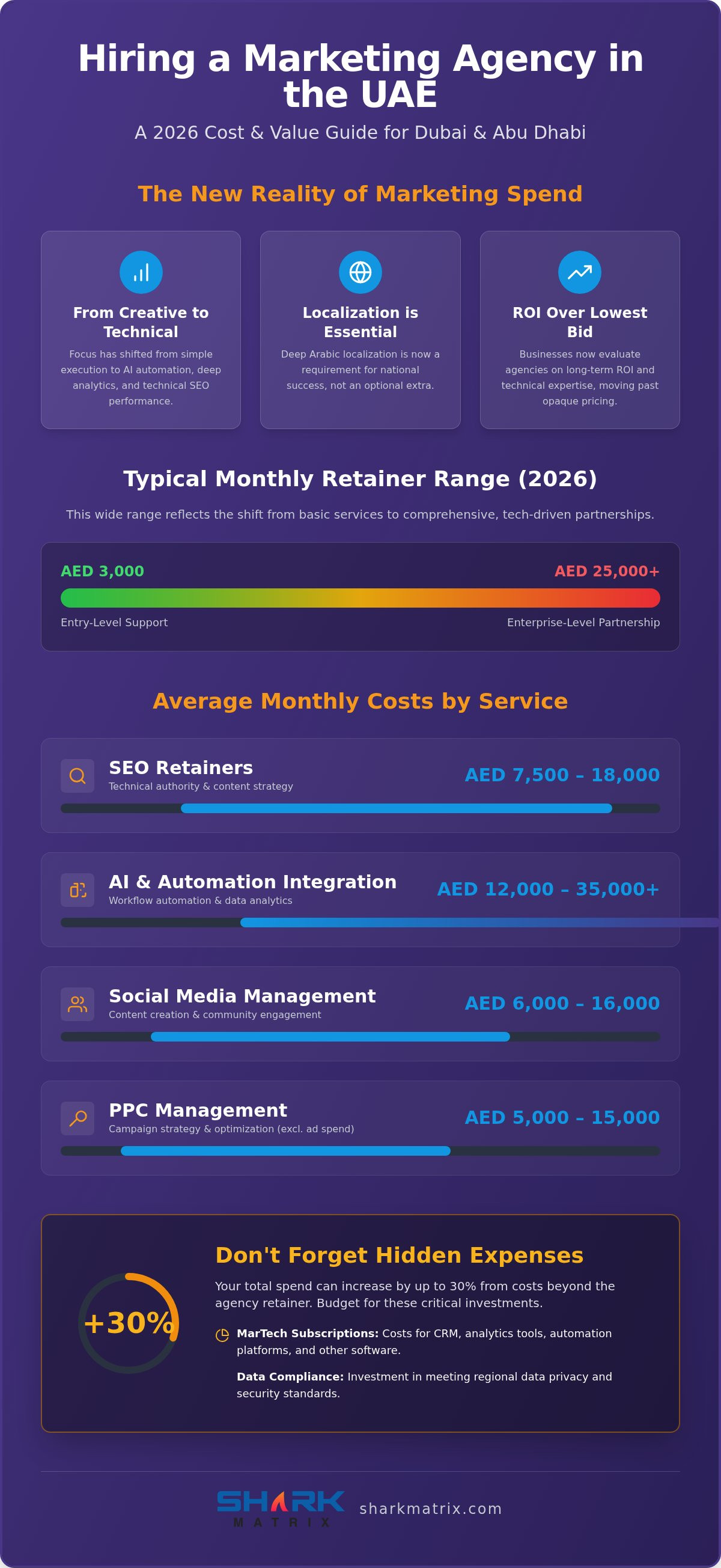
The UAE’s digital landscape has matured into a sophisticated, high-tech ecosystem. When you look at the UAE’s economic overview, it’s clear why marketing strategies have become more complex and data-driven. In 2026, the average cost of hiring a marketing agency in uae typically spans from AED 3,000 for basic, entry-level support to over AED 25,000 per month for enterprise-level partnerships. This wide range reflects a fundamental shift from traditional execution to technology-first marketing, where agencies act as technical partners rather than simple vendors.

Today, your marketing budget does more than just buy creative assets. It funds a technical infrastructure designed to survive in a competitive market. Several factors drive these costs:

  • Agency Expertise: Specialized knowledge in the Middle Eastern market dynamics commands a premium.
  • Service Scope: Comprehensive packages including SEO company Dubai services and multi-channel PPC require more billable hours.
  • Technological Requirements: Integrating AI automation services and advanced data analytics into your workflow.

Smart businesses now look at the Total Cost of Ownership (TCO) in digital marketing. This concept goes beyond the monthly agency fee. It encompasses the cost of MarTech subscriptions, CRM integrations, and the necessary investment in bilingual content that resonates with the local culture. It’s a holistic view of what it actually takes to maintain a competitive edge.

Retainer vs. Project-Based Pricing Models

Monthly retainers remain the gold standard for businesses seeking consistent growth. They provide the stability needed for long-term search engine visibility and national brand presence. However, project-based fees are often more cost-effective for specific milestones, such as a website launch or the initial setup of AI chatbot development. Many firms now favor hybrid models. These structures combine a fixed retainer for essential maintenance with performance-based incentives. It aligns the agency’s goals with your revenue, ensuring they’re as invested in your ROI as you are.

National Market Dynamics and Regional Expertise

The UAE’s diverse population creates a marketing challenge you won’t find elsewhere. You’re often targeting dozens of nationalities simultaneously. This complexity naturally impacts the cost of hiring a marketing agency in uae. While offshore options might seem cheaper, they often miss the cultural nuances of the Arabic language and local consumer behavior. Regional expertise justifies a higher price point because it prevents wasted ad spend on culturally tone-deaf campaigns. A local agency understands the difference between simple translation and true localization, which is the key to winning trust in the GCC region.

Breaking Down Costs by Service Type: SEO, PPC, and AI

Understanding the specific components of your marketing budget is the only way to avoid overspending while ensuring growth. The digital competitiveness in the UAE has reached a peak where simple “catch-all” packages no longer work. Instead, businesses must look at specialized services that address technical performance and cultural resonance. Bundling these services often reduces the overall cost of hiring a marketing agency in uae by up to 20% compared to sourcing individual vendors for each channel.

Average Monthly Cost Benchmarks (2026)

  • SEO Retainers: AED 7,500 – AED 18,000
  • PPC Management: AED 5,000 – AED 15,000 (excluding ad spend)
  • Social Media Management: AED 6,000 – AED 16,000
  • AI & Automation Integration: AED 12,000 – AED 35,000+

Industry-specific dynamics also dictate your Cost Per Lead (CPL). In high-competition sectors like UAE real estate or finance, CPL can range from AED 300 to over AED 1,500. Lower competition retail sectors might see leads as low as AED 50. In 2026, a standard SEO retainer in the UAE typically falls between AED 8,000 and AED 17,000 per month for most mid-market brands.

Search Engine Optimization (SEO) and Content Pricing

SEO isn’t just about keywords anymore; it’s about technical authority. While basic on-page work is standard, high-level professional SEO services in the UAE now include Generative Engine Optimization (GEO) to ensure your brand appears in AI search results. High-quality content in both English and Arabic is a significant investment, but it’s essential for national reach. You can explore more in our comprehensive SEO guide.

PPC Management and Ad Spend Realities

Most agencies charge a management fee between 15% and 25% of your total ad spend, though flat fees are common for smaller budgets. High-competition keywords in Dubai, particularly for legal or financial services, can reach a Cost Per Click (CPC) of AED 30 or more. This makes choosing a PPC agency with local bidding expertise vital to prevent budget bleed.

Custom AI and Web Development Costs

The biggest shift in the 2026 cost of hiring a marketing agency in uae is the inclusion of AI automation services. Integrating custom chatbots and generative AI development into your workflow can reduce long-term content costs by automating routine tasks. For those building a foundation, web development services for high-performance e-commerce sites generally start at AED 25,000 for custom builds. If you’re looking to streamline your operations, consider how AI automation can replace manual data entry and lead qualifying tasks.

The Strategic Value of Arabic Digital Marketing and Localization

Targeting the full UAE demographic requires more than just a translated website. In a market where local identity is deeply tied to the Arabic language, localization is a non-negotiable strategic pillar. This necessity adds a layer of complexity to the cost of hiring a marketing agency in uae. Agencies that offer true localization rather than simple translation provide a higher return on investment by speaking directly to the Emirati and broader GCC audience. While English is widely used in business, Arabic remains the language of trust and cultural connection.

Arabic SEO plays a critical role in capturing national search volume. Many users search in their native tongue for high-intent services. If your content isn’t optimized for these specific queries, you’re handing market share to competitors. This specialized work requires linguistic expertise and technical knowledge of how search engines handle Arabic script. Investing in professional SEO company Dubai services ensures your brand is visible to all segments of the population, not just the expat community.

Why Arabic Content Commands a Premium

High-quality Arabic digital marketing talent is relatively scarce in the region. This scarcity naturally drives up the price for premium copywriting. Unlike simple translation, professional copywriting involves adapting the message to fit local idioms and cultural expectations. Technical implementation also adds to the bill. Right-to-left (RTL) web design requires specific adjustments in web development services to ensure layouts remain functional and aesthetically pleasing. These technical hurdles make the development and maintenance of bilingual platforms more labor-intensive than English-only sites.

Cultural Nuance and National Brand Authority

Localizing your strategy is the best defense against costly reputation blunders. A message that works in London or New York might fall flat or even cause offense in Riyadh or Abu Dhabi. Agencies with deep Middle Eastern roots understand these nuances. They help maintain a culturally relevant voice through expert social media agency Dubai management. This proactive approach is a core part of brand reputation management. It protects your national brand authority by ensuring every post and ad respects local traditions. In the long run, the premium paid for this expertise prevents the massive costs associated with crisis management and brand rebuilding.
Cost of Hiring a Marketing Agency in the UAE: 2026 Pricing Guide

Hidden Costs and Long-Term Budgeting for UAE Businesses

The cost of hiring a marketing agency in uae often includes several “unseen” expenses that can catch businesses off guard. These aren’t just hidden fees; they’re essential investments in the technical infrastructure required for modern growth. Common expenses include premium MarTech subscriptions, CRM platform seats, and high-quality stock assets for bilingual campaigns. Industry reports suggest these hidden layers can add 15% to 30% to your total marketing spend. While these tools empower your strategy, they also add to the total budget beyond the agency’s management fee.

Data security and compliance have become major budget items. The UAE has strict national privacy regulations that require sophisticated data handling. Investing in these protocols is non-negotiable for brands operating in Dubai or Abu Dhabi. For broader business support beyond digital compliance, Goodhand offers government services and business solutions that simplify essential procedures, including Dubai Courts and Al Adheed services. While AI integration carries higher upfront costs, it often leads to significant operational savings. By automating repetitive tasks, you reduce the long-term billable hours required for manual execution. The investment for a custom AI chatbot in the UAE scales based on the complexity of natural language processing and backend database integrations required for your specific industry.

MarTech Stacks and AI Integration Fees

Agencies often pass through the costs of specialized tools for SEO, email automation, and social listening. These AI technologies require specific setup and maintenance fees to ensure they sync correctly with your existing systems. You should also budget for API usage and third-party data access. These technical layers are what separate a basic campaign from a high-performance, data-driven strategy. If you’re looking to optimize your technical stack, our AI automation services can help identify where technology can replace manual overhead.

Reporting, Analytics, and Data Security

There’s a clear price difference between basic automated reports and expert-led strategic analysis. Advanced attribution modeling helps you understand exactly where your leads come from, but it increases the agency service fee due to the technical expertise involved. Aligning with UAE national standards for data privacy is another vital investment. It protects your brand from legal risks and builds trust with your local audience. High-level reporting should provide actionable insights, not just a list of metrics, which justifies the premium for senior consultant time.

Maximizing Your ROI: Selecting the Right Agency for Your Budget

Choosing a partner based solely on the lowest bid is a gamble that rarely pays off in the Middle Eastern market. While the initial cost of hiring a marketing agency in uae might seem like the most important factor, the qualitative value of the partnership determines your actual return on investment. A high-performing agency acts as a technical extension of your team. They don’t just execute tasks; they provide the strategic foresight needed to navigate a competitive national landscape. Focusing on value rather than just the bottom line prevents the “Cheap Agency Trap,” where low fees often lead to poor lead quality or technical debt that costs more to fix later.

Poorly executed SEO or low-quality content can cause long-term damage to your search engine rankings and brand authority. In 2026, search engines are sophisticated enough to penalize brands that use low-quality AI spam or inaccurate Arabic translations. Fixing these issues usually requires a larger investment than it would’ve cost to hire a professional SEO company Dubai from the start. Aligning your agency’s KPIs with your specific business goals, such as market share growth in Abu Dhabi or lead generation in the Northern Emirates, ensures every dirham spent contributes to measurable national growth.

Evaluating Proposals Beyond the Price Tag

When you review proposals, look for evidence of success with national UAE brands. Case studies should show a clear link between marketing activity and revenue growth. It’s also vital to assess the technical depth of the firm. Does the agency have in-house developers for ai development services, or do they outsource critical technical work? In-house expertise usually leads to better communication and faster implementation. You should also demand transparency regarding reporting frequency and the specific tools they use to track your performance.

  • Technical Depth: Verify if they handle web development services and AI integrations internally.
  • Proven ROI: Look for data-backed success stories within the GCC region.
  • Communication: Ensure they provide expert-led strategic analysis rather than just automated data dumps.

Creating a High-Impact RFQ (Request for Proposal)

A well-structured RFQ helps you get more accurate and valuable responses. Ask specific questions about their experience with Arabic localization and their current AI capabilities. For example, inquire how they use generative ai development to streamline content workflows without sacrificing quality. Being transparent about your budget range allows agencies to propose the most effective mix of services for your needs. Finally, always insist on meeting the core team who’ll actually manage your account. The chemistry and technical competence of the people doing the work are just as important as the company’s reputation.

Ready to build a data-driven presence in the Emirates? Get a custom quote for your national marketing strategy and discover how a technical partnership can transform your growth trajectory.

Building a Future-Proof Marketing Strategy in the UAE

Succeeding in the Emirates requires a shift from viewing marketing as a monthly expense to seeing it as a long-term technical investment. We’ve explored how the cost of hiring a marketing agency in uae is shaped by advanced AI automation, technical SEO, and the non-negotiable need for deep Arabic localization. By looking beyond the sticker price and focusing on the total cost of ownership, you can avoid the “cheap agency trap” and secure a partnership that drives real revenue growth.

Shark Matrix Technologies LLC brings over 15 years of UAE market experience to your brand. With dedicated departments for AI development and Arabic localization, our focus remains on data-driven lead generation that resonates with the local culture. It’s time to move past opaque pricing and adopt a strategy built for the 2026 digital landscape.

Partner with a leading national marketing agency for your 2026 growth strategy. Taking the time to select a technical partner today ensures your brand remains competitive and authoritative for years to come.

Frequently Asked Questions

What is the average monthly retainer for a marketing agency in the UAE in 2026?

The average monthly retainer for a marketing agency in the UAE typically ranges from AED 7,500 for basic foundational services to over AED 37,000 for enterprise-level growth plans. Most mid-market businesses find that a budget between AED 18,000 and AED 33,000 provides the best balance of multi-channel strategy and technical execution. These figures reflect the 2026 market demand for integrated technology and expert human oversight across the Emirates.

Are there hidden costs when hiring a digital marketing agency in the UAE?

Yes, businesses should budget for several common hidden costs that aren’t always included in the base management fee. These typically include MarTech software subscriptions, CRM integration fees, and premium stock assets for bilingual campaigns. Additionally, industry-specific compliance and the technical requirements of Arabic localization can add 15% to 30% to your total spend. It’s vital to clarify which third-party tools are covered in your initial quote to avoid surprises.

How much does SEO cost for a national business in the UAE?

For a national business, SEO costs generally fall between AED 8,000 and AED 17,000 per month depending on technical complexity and competition levels. This investment covers on-page optimization, high-quality content creation, and technical authority building. The cost of hiring a marketing agency in uae for SEO now also includes generative engine optimization to ensure your brand remains visible in AI-driven search results across Dubai and Abu Dhabi.

Does the cost of a marketing agency include the ad spend for PPC?

No, agency management fees are almost always separate from the actual ad spend paid directly to platforms like Google or Meta. Most agencies charge either a flat monthly management fee or a percentage of the total ad spend, usually ranging from 15% to 25%. You’ll pay the advertising platform for clicks and impressions while paying the agency for their strategic management, technical optimization, and creative expertise.

Is it cheaper to hire a freelancer or a marketing agency in the UAE?

Hiring a freelancer is often cheaper in terms of hourly rates, but it frequently lacks the technical depth and scalability provided by a full-service agency. While a freelancer might handle specific tasks, an agency offers a team of specialists in SEO, PPC, and AI automation. For businesses aiming for national growth, the comprehensive resources and accountability of an agency often provide better long-term value despite the higher initial management cost.

How long does it take to see an ROI from a marketing agency investment?

The timeline for seeing a return on investment varies by channel and the specific competitiveness of your industry. Paid advertising campaigns can generate leads within the first month, while organic SEO and content strategies typically require six to twelve months to show significant impact. Most agencies recommend a minimum commitment of six months to allow for the data collection and optimization needed to achieve sustainable ROI in the UAE.

Why do marketing agencies in the UAE charge more for Arabic content?

Arabic content commands a higher price because it requires specialized linguistic talent and cultural expertise that goes beyond simple translation. Professional Arabic copywriting involves adapting brand messaging to resonate with local Emirati and GCC audiences while managing the technical complexities of right-to-left web design. This cultural localization is essential for building trust and authority, making it a premium service that involves more billable hours than English-only content.

What should be included in a standard digital marketing contract in the UAE?

A standard digital marketing contract should clearly define the scope of work, specific KPIs, and the frequency of strategic reporting. It’s also crucial to include clauses regarding data privacy compliance with national standards and intellectual property ownership of all creative assets. The cost of hiring a marketing agency in uae should be transparently broken down in the contract to avoid disputes over out-of-scope tasks or technical maintenance fees.

Categories
AEO

How to Optimize Content for AI Search: 2026 Guide

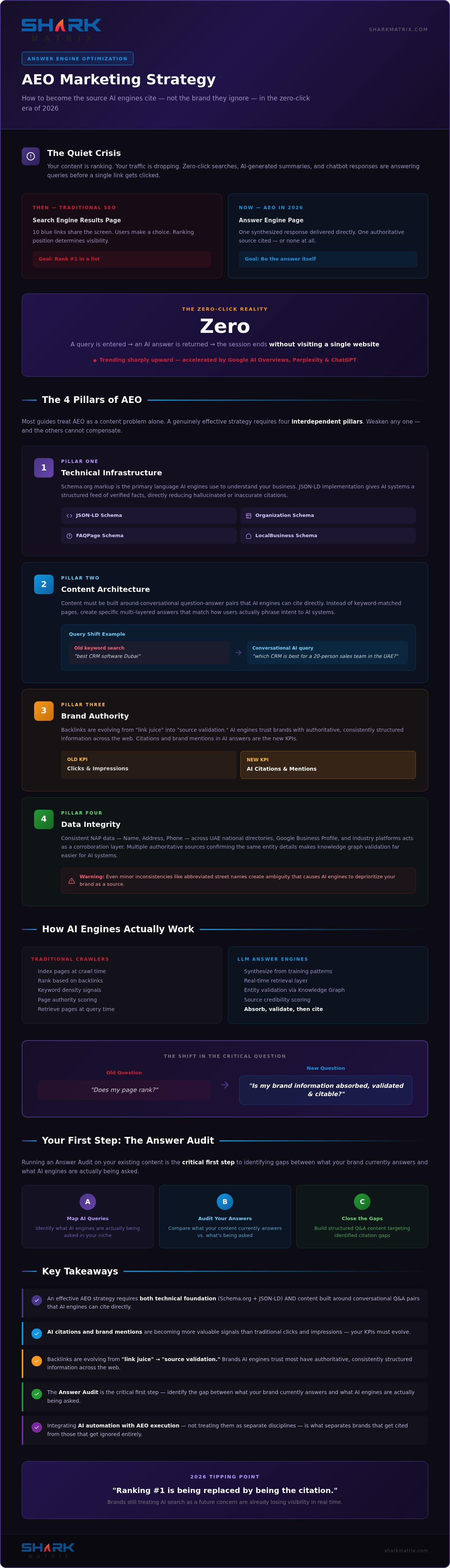
What if the top spot on Google no longer guarantees a single click to your website? It’s a frustrating reality for many digital marketers who see their organic traffic dipping as AI summaries provide instant answers directly on the search page. You likely feel the pressure of this shift from traditional lists to synthesized responses, fearing your brand might become invisible in a sea of AI-generated text. Understanding the difference between traditional SEO and Answer Engine Optimization (AEO) is now the only way to protect your digital footprint.

Learning how to optimize content for ai search is no longer a futuristic goal; it’s a survival requirement for 2026. This guide will help you master Generative Engine Optimization (GEO) to ensure your brand isn’t just indexed, but actively cited as a trusted authority by AI engines. We’ll explore the technical shift toward natural language processing, the importance of intent-aligned entities, and the specific data structures you need to win citations in AI-driven results.

Key Takeaways

  • Understand the critical shift from traditional search lists to synthesized AI summaries and how it changes user behavior.
  • Leverage entity-based SEO and Natural Language Processing to ensure AI engines correctly interpret your brand’s expertise.
  • Learn how to optimize content for ai search by moving your strategy from simple keyword matching to earning authoritative citations.
  • Identify the practical steps for conducting an AI visibility audit and restructuring pages for better data extraction.
  • Discover how to build a technical, AI-ready infrastructure that supports long-term brand visibility in a generative search environment.

From Keywords to Conversations: What is AI Search Optimization?

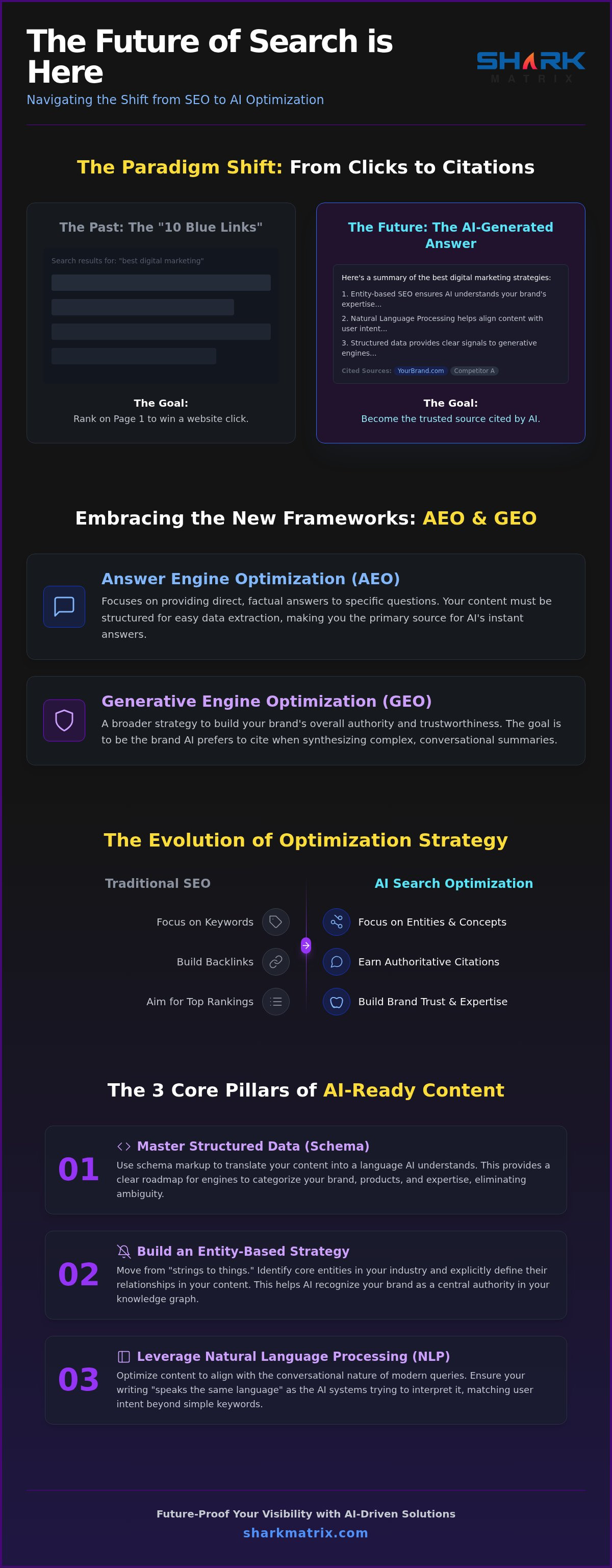
Search has undergone its most significant transformation since the invention of the crawler. For decades, Traditional SEO focused on a predictable goal: securing a spot in the “10 blue links” on a results page. In 2026, that model is no longer the primary driver of digital discovery. We’ve entered a period where Large Language Models (LLMs) act as the definitive gatekeepers between your brand and your audience. Understanding how to optimize content for ai search means moving beyond simple keyword strings and embracing the conversational nature of modern queries.

Two new frameworks define this evolution: Answer Engine Optimization (AEO) and Generative Engine Optimization (GEO). While they overlap, they serve distinct roles in a brand’s visibility. AEO focuses on providing direct, factual answers to specific user questions. GEO is broader, focusing on how your brand’s entire digital presence is perceived and cited by generative AI when it creates a synthesized summary. Instead of clicking through to your site, users now receive the information they need directly from the AI, making your status as a cited source the new benchmark for success.

The Mechanics of Answer Engine Optimization (AEO)

AI engines don’t just look for matches; they extract concepts. When a user asks a question, the engine scans high-authority content to find the most concise, accurate response. This has turned “position zero” into the only position that truly matters for many informational queries. To win here, your content must be structured for easy extraction. AI prefers clear hierarchies and data that’s presented without unnecessary fluff. If your information is buried under layers of flowery prose, the algorithm will likely skip it in favor of a competitor who provides a direct answer. Using natural language processing techniques ensures your content speaks the same language as the systems trying to read it.

Why Your Brand Needs a GEO Strategy Now

Waiting to adapt is a recipe for digital invisibility. As organic click-through rates from traditional search results fluctuate, brands in competitive markets like the UAE are finding that being an early adopter of GEO provides a massive advantage. AI search is proactive. It doesn’t just wait for a query; it anticipates intent based on previous interactions. By building an AI-ready infrastructure today, you ensure your brand is the one the LLM trusts to cite when a user asks for a recommendation or a solution. Shark Matrix Technologies LLC specializes in bridging the gap between technical AI development and strategic marketing through our SEO company Dubai services, helping national brands stay relevant as search logic evolves from simple matching to complex reasoning.

The Core Pillars of Generative Engine Optimization (GEO)

If the previous section established the “why” of the AI shift, this section focuses on the technical architecture of success. Success in 2026 requires more than just high-quality writing; it demands a deep understanding of how to optimize content for ai search through structural and semantic precision. AI models no longer view your pages as a collection of keywords. Instead, they see a web of interconnected entities and facts that must be verified for accuracy and relevance.

Schema markup remains the most critical bridge between your human-readable content and an AI’s processing requirements. By using structured data, you provide a clear map that Large Language Models (LLMs) use to categorize your brand, products, and expertise. This technical layer removes ambiguity, ensuring that when an AI engine synthesizes an answer, it pulls from your verified data rather than making an educated guess. To effectively Optimize Your Content for AI Citations, you must prioritize this factual transparency alongside authoritative sourcing.

Mastering Entity-Based Content Strategy

Building an entity-based strategy means moving from “strings to things.” You need to identify the core entities in your industry and define their relationships using semantic triples, which consist of a subject, a predicate, and an object. AI models map relationships between entities by analyzing the context and frequency of their co-occurrence across diverse datasets to build a structured knowledge graph. By explicitly stating these relationships in your content, you make it easier for AI to recognize your brand as a primary authority in your niche.

Leveraging NLP for Better AI Recognition

Language is the interface for AI search, so your content must align with how machines interpret human speech. This doesn’t mean writing like a robot; it means using clear, conversational language that answers specific long-tail queries without unnecessary jargon. Clarity and factual density are your best tools for winning citations in AI summaries. Our natural language processing services enhance content discoverability by aligning your brand’s voice with the specific linguistic patterns and intent-based structures that AI engines prefer. If you’re looking to scale these technical improvements across your entire site, exploring ai automation services can help streamline the implementation of these pillars at a national level.

How to Optimize Content for AI Search: 2026 Guide

Traditional SEO vs. AI Search Optimization: A 2026 Comparison

Traditional SEO isn’t obsolete; it’s the bedrock upon which AI visibility is built. While the old goal was matching a user’s query with a keyword-rich page, 2026 search logic focuses on the underlying intent. AI models don’t just look for words; they look for the reason those words were typed. This shift changes how to optimize content for ai search from a game of density to a game of relevance. You aren’t just competing for a spot in a list. You’re competing to be the definitive answer that an AI synthesizes for the user.

Backlinks remain a signal of authority, but citations are the new currency of visibility. In a traditional search environment, a link from a high-authority site boosts your rank. In an AI summary, a citation proves to the LLM that your brand is a reliable source for a specific fact. Similarly, while page speed is vital for user retention, AI engines prioritize fact density. They want to extract the maximum amount of verified information in the shortest possible crawl. Understanding how to optimize content for ai search requires a mindset shift from static pages to dynamic data sources that provide high value per kilobyte.

The Evolution of E-E-A-T for AI

AI engines have refined the concept of Experience, Expertise, Authoritativeness, and Trustworthiness (E-E-A-T). In 2026, they favor first-party data and original research over recycled content. If your brand publishes unique case studies or proprietary data, you’re more likely to be cited. AI models look for consistent mentions across multiple platforms to verify your authority. It’s not enough to say you’re an expert; you need a digital footprint that proves it through verified facts and cross-referenced citations across the web.

Building this multi-platform authority requires a blend of technical SEO and creative storytelling. To see how a specialized studio approaches this, you can visit Media BrAIns – We think, we create and you grow to learn about their AI-driven growth strategies.

Integrating SEO and GEO for National Brands

Successful national brands don’t choose between SEO and GEO. They integrate them. You still need traditional rankings to capture users who prefer manual browsing, but you also need to be AI-ready for those using conversational search. Using comprehensive SEO services ensures your site serves both masters. Shark Matrix Technologies LLC bridges this gap by building digital infrastructures that maintain legacy rankings while preparing content for AI extraction. This dual approach ensures you don’t lose traffic as search behaviors continue to shift toward AI-driven answers in the UAE.

Step-by-Step: How to Optimize Your Content for AI Citations

Moving from theory to practice requires a systematic approach to your existing digital assets. Learning how to optimize content for ai search begins with a thorough AI visibility audit. Instead of checking traditional rank trackers, you must query major LLMs to see if they recognize your brand and what specific sources they cite when answering industry-related questions. If the AI currently pulls data from a competitor, you’ve identified a citation gap. This audit provides a baseline for your strategy, allowing you to target the exact queries where your brand is currently invisible or misrepresented.

Once you’ve identified these gaps, the next step involves implementing advanced Schema markup that goes beyond standard organization tags. For national brands in the UAE, this means using industry-specific properties that define your unique value proposition and verified data points. Monitoring these mentions is an ongoing task because AI models are updated frequently. A source cited today might be replaced tomorrow if a more factual or better-structured alternative emerges. Staying ahead requires constant refinement of your data layers to ensure you remain the most reliable option for AI extraction.

Structuring Content for AI Extraction

AI engines prefer content that mirrors the natural way humans ask questions. Use your H2 and H3 headings to state these questions directly, followed immediately by a fact-dense summary sentence. An AI-optimized summary should lead with a direct definition or answer, followed by two supporting facts and a concluding piece of evidence, all within a 50-word limit. This specific structure makes it incredibly easy for an engine to identify your text as a “snippet-ready” candidate for a generative summary. By removing the preamble and leading with the answer, you increase the likelihood of being cited as the authoritative source.

Technical Optimization for Generative Engines

The technical side of how to optimize content for ai search often involves moving toward headless CMS environments and API-driven content delivery. These setups allow AI crawlers to access your data without the noise of traditional front-end code. Shark Matrix Technologies LLC helps brands build these search-ready infrastructures from the ground up, ensuring that technical SEO basics like XML sitemaps and robots.txt files are explicitly configured for AI agents. Our expertise in generative ai development ensures your content is delivered in a format that machines can process with maximum efficiency. If you’re ready to secure your place in AI results, our team can help you implement these technical standards through our ai automation services.

Future-Proofing Your Visibility with Shark Matrix AI Solutions

National brands in the UAE face a unique challenge as we move through 2026. The convergence of AI automation and digital growth means that your infrastructure must be as intelligent as the engines crawling it. Shark Matrix specializes in building these AI-ready foundations from the ground up. We don’t just help you understand how to optimize content for ai search; we provide the technical architecture required to sustain that visibility over the long term. This involves custom AI development that addresses industry-specific search challenges, ensuring your brand remains a primary source in AI-generated answers regardless of how the underlying models evolve.

End-to-End AI and SEO Integration

Success in the generative era requires a multi-disciplinary strategy that traditional agencies often miss. You can’t rely on high-quality content alone if your technical backend doesn’t support rapid, structured data extraction for Large Language Models (LLMs). By combining our AI automation services with strategic content marketing, we ensure every piece of data on your site is optimized for both human readers and machine processors. This holistic approach is why national leaders consult with our SEO company to build a sustainable GEO roadmap. We act as the bridge between technical machine learning development and consumer-facing messaging, ensuring your expertise is never lost in translation.

Staying Ahead of the Generative Curve

Your next step is clear. Auditing your brand for the 2026 AI search landscape is the only way to protect your market share. Contact Shark Matrix today for a comprehensive AI search readiness assessment. We’ll evaluate your current visibility, identify technical bottlenecks, and build a customized plan to ensure your brand remains the preferred source for AI summaries across every major engine.

The search landscape has fundamentally transitioned from simple keyword matching to complex, conversational AI summaries. Winning citations in 2026 requires a technical shift toward entity-based content and structured data that Large Language Models can easily extract. Mastering how to optimize content for ai search is now the most critical step in protecting your national visibility and ensuring your expertise isn’t lost in a sea of synthesized answers.

Shark Matrix leads the market as a national UAE leader in SEO, backed by specialized NLP and AI automation teams. Our expertise in generative AI development allows us to build the technical bridges your brand needs to stay relevant. We don’t just react to algorithm shifts; we build the infrastructures that define them. Ready to dominate the AI search landscape? Contact Shark Matrix for a GEO Strategy Audit today. The future of search is conversational, and your brand deserves to be the definitive answer.

Frequently Asked Questions

What is the difference between SEO and GEO?

Traditional SEO targets rankings in the standard list of search results, while GEO (Generative Engine Optimization) focuses on winning citations in AI-generated summaries. SEO is about being found in a list; GEO is about being the source the AI trusts to build its synthesized response. This requires a deeper focus on entity relationships and how Large Language Models perceive your brand’s authority across the entire web.

How do I get my website cited by AI search engines like ChatGPT or Perplexity?

You get cited by providing factual, high-density responses that AI models can easily verify and extract. These engines prioritize first-party data, original research, and unique insights over recycled content. Consistency across multiple platforms also helps the AI verify your brand as a trusted authority, making it more likely to quote you in its summaries.

Is traditional keyword research still relevant for AI search?

Keyword research is still necessary, but the focus has shifted to conversational intent and semantic entities. You need to understand how users phrase questions to AI assistants rather than just typing short, static phrases. Understanding how to optimize content for ai search in 2026 involves targeting these natural language patterns and identifying the entities your audience is most interested in.

How does structured data help with AI search optimization?

Structured data provides a clear, machine-readable map of your website’s information using Schema.org. It helps AI models identify entities like people, places, products, and facts without ambiguity. This technical layer reduces the risk of the AI misinterpreting your data, making your content a much more attractive candidate for AI extraction and citation.

Can AI-generated content rank well in AI search engines?

AI-generated content can rank, but only if it provides significant information gain. Search engines prioritize E-E-A-T, meaning they look for signs of real-world experience and proprietary expertise. If your content is just a generic summary of existing web data, it’s unlikely to be cited as a primary source by a generative engine.

What are the most important factors for Answer Engine Optimization (AEO)?

The core pillars of AEO are clarity, factual accuracy, and directness. You should place the most important information at the beginning of your sections to help AI bots find the answer quickly. Mastering how to optimize content for ai search through AEO means removing unnecessary fluff and focusing on high-value facts that answer specific user questions.

How often should I update my content to stay relevant for AI engines?

Content should be updated as soon as new facts, data points, or industry shifts occur. AI models are updated frequently and often have access to the live web to provide the most current answers possible. To maintain your position as a cited authority, your content must always be more accurate and up-to-date than the competing sources.

Does site speed affect my visibility in AI search summaries?

Site speed impacts how efficiently AI bots can crawl and process your data. While the final AI summary is text-based, technical issues or slow load times can prevent an engine from indexing your latest updates. A fast, clean technical structure ensures your optimized content is always accessible to the AI when it needs to verify a fact.

Categories
GEO

Mastering Generative Engine Optimization: Your 2026 Strategy Guide

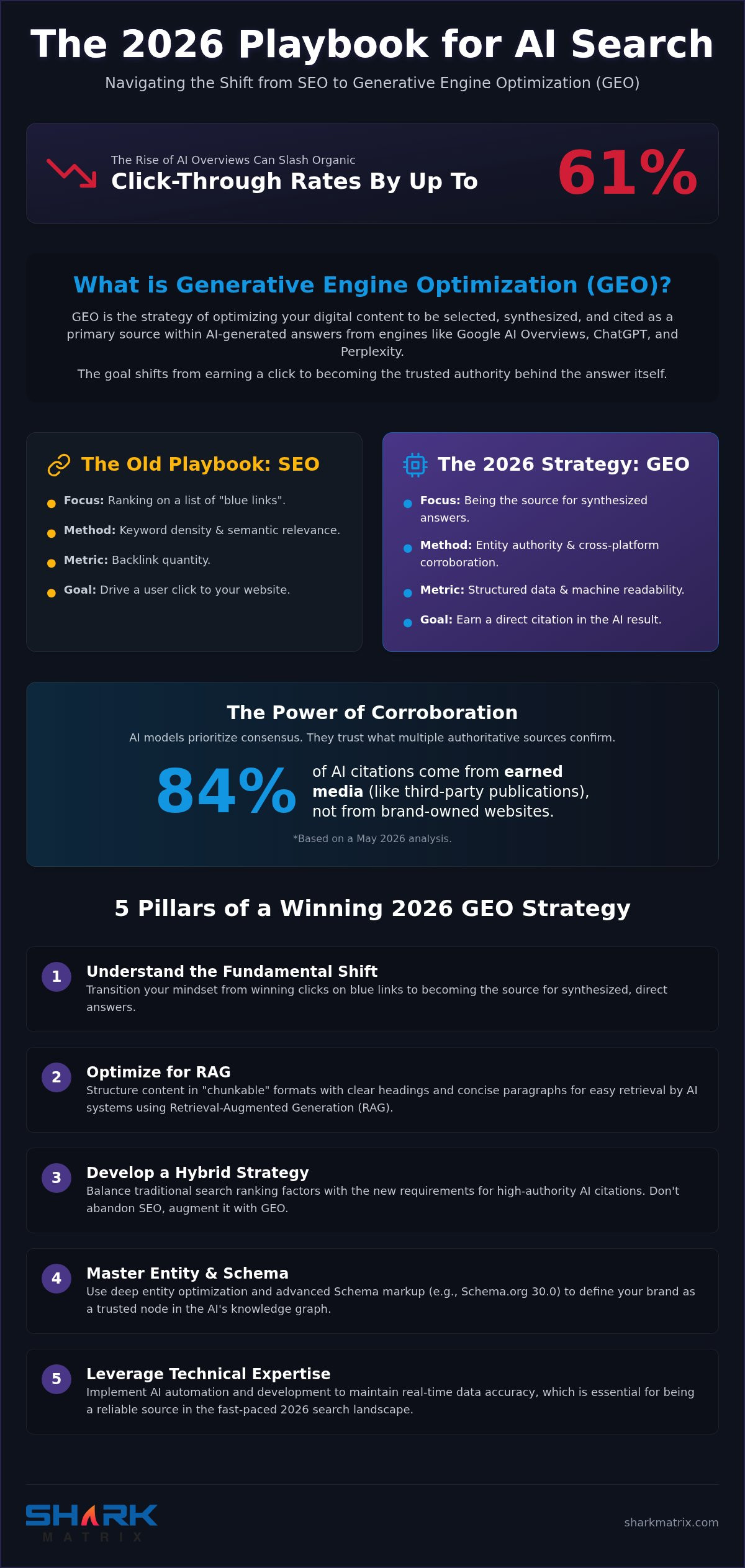
Did you know that the presence of a Google AI Overview can slash your organic click-through rate by as much as 61%? It is a startling reality for many digital marketers who find their hard-earned content buried behind automated summaries. As we look toward the future, sticking to old playbooks is no longer an option. You need a comprehensive generative engine optimization strategy 2026 to ensure your brand remains visible in a world where ChatGPT and Gemini now dominate search behavior.

It is completely understandable to feel concerned that LLMs are hiding your expertise from the very people you want to reach. You have likely noticed that traditional search traffic is harder to capture, and the way AI engines choose their sources can feel like a total mystery. This article will help you transition from traditional SEO to a high-impact strategy that secures brand citations directly within AI-driven results. We will provide a clear roadmap for 2026 visibility, covering everything from Schema.org 30.0 updates to the importance of earned media in securing those coveted AI mentions.

Key Takeaways

  • Understand the fundamental shift from traditional blue links to synthesized answers and why 2026 is the critical tipping point for your digital presence.
  • Learn how Retrieval-Augmented Generation (RAG) works so you can optimize your content for real-time AI retrieval and cross-platform corroboration.
  • Develop a high-impact generative engine optimization strategy 2026 that balances traditional search rankings with the need for high-authority AI citations.
  • Master the pillars of visibility, including deep entity optimization and advanced Schema markup that defines your brand as a trusted node in the knowledge graph.
  • Discover why technical expertise in AI automation and development is essential for maintaining real-time data accuracy in the complex 2026 search landscape.

What is Generative Engine Optimization (GEO) in 2026?

By 2026, the digital landscape has fundamentally shifted from a list of “blue links” to a stream of synthesized answers. Generative Engine Optimization, or GEO, is the strategic process of optimizing your digital assets specifically for Large Language Models (LLMs) and Answer Engines. While traditional search engines once directed users to a variety of websites, today’s AI engines aim to provide the answer directly on the results page. Developing a comprehensive generative engine optimization strategy 2026 is the only way to ensure your brand is the one being synthesized into those answers.

The primary players in this space, including Google AI Overviews, Perplexity, ChatGPT Search, and Gemini, don’t just look for keywords. They look for authoritative entities that can corroborate a claim. Traditional ranking factors like backlink quantity or keyword density are no longer sufficient. AI engines require content that is structured for machine consumption while maintaining deep human expertise. Specialist firms like AISEOAgency SG help brands structure their digital presence for these conversational systems. If your brand isn’t cited by these engines, you simply don’t exist for a significant portion of your audience.

The Evolution from SEO to GEO

The transition from SEO to GEO represents a move from semantic relevance to entity relationship. In the past, you might have optimized for “best coffee maker.” Today, you must define your product as a specific node within a broader knowledge graph. This shift is driven by natural language processing services that allow engines to understand the “why” behind a query. Users no longer want to find a site; they want a solution. To understand the foundational concepts, many experts look at What is Generative Engine Optimization? to see how the industry has matured from simple indexing to complex synthesis.

The Business Impact of AI Citations

AI search results are often “winner-takes-all” scenarios. If an AI engine provides a single, definitive answer and cites your brand as the source, the intent of that traffic is significantly higher than a standard organic click. These users aren’t just browsing; they are consuming a recommendation from a platform they trust. Generative Engine Optimization serves as the bridge between technical data and AI understanding, and eCommerce businesses can discover eComQB for specialized strategies to thrive in this new environment.

A May 2026 analysis found that 84% of AI citations come from earned media, such as third party publications, rather than brand owned websites. This underscores why your generative engine optimization strategy 2026 must extend beyond your own domain. By aligning your content with the way LLMs retrieve information, you position your brand to capture high-value citations that competitors using outdated methods will miss. It’s about building a digital footprint that AI engines can’t ignore.

How AI Engines Process and Cite Content

AI engines don’t simply “rank” websites in a list. They ingest, synthesize, and reason through data to build a coherent response for the user. To stay visible, your generative engine optimization strategy 2026 must focus on technical accessibility. If an LLM cannot parse your site efficiently, it will simply skip over your expertise in favor of a source that is easier to “digest.” This process is largely driven by how models distinguish between their static training data and the real-time information they pull from the live web.

A critical part of this process is corroboration. AI models are trained to prioritize consensus. If multiple authoritative platforms mention your brand in a consistent context, the AI is more likely to trust and cite you as a factual source. This is why appearing in third-party publications is so vital; a May 2026 analysis found that 84% of AI citations come from earned media rather than brand-owned sites. You aren’t just optimizing for a bot; you’re optimizing for a global network of digital trust.

Retrieval-Augmented Generation (RAG) Explained

Engines like Perplexity and ChatGPT Search rely on Retrieval-Augmented Generation (RAG) to provide up-to-date answers. Instead of relying solely on what they learned during training, they use a search index to find current facts and then use the LLM to explain them. For your content to be selected, it needs to be “chunkable.” This means using clear headings and concise paragraphs that allow the engine to pull specific “vectors” of information. Understanding GEO vs. SEO: The Hybrid Search Strategy is essential here, as it highlights how traditional indexing still supports these modern retrieval methods.

Knowledge Graphs and Entity Authority

AI engines build a “Brand Memory” by connecting dots across the internet. They look for entities, which are unique people, places, or brands, and map the relationships between them. To help these engines understand your brand’s role, you should utilize natural language processing services to structure your data correctly. This technical footprint tells the AI exactly who you are and what you are an expert in. If you’re struggling to map your existing data to these new formats, exploring specialized ai automation services can help bridge the gap between your content and AI reasoning.

Crawlability is the final piece of the puzzle. With ChatGPT dominating 76.85% of the AI search market as of April 2026, ensuring that GPTBot has access to your site via your Robots.txt file is non-negotiable. Additionally, the tone of your content matters more than ever. Models now prioritize “Expert Advice” blocks that pull from content with high sentiment and first-hand experience. Maintaining a helpful, unbiased, and authoritative tone ensures that when an engine retrieves your data, it views your brand as a safe and reliable recommendation for the end user.

Mastering Generative Engine Optimization: Your 2026 Strategy Guide

GEO vs. SEO: The Hybrid Search Strategy

Traditional SEO isn’t going away. Instead, it’s becoming the bedrock upon which AI discovery is built. You can’t have a successful generative engine optimization strategy 2026 without a robust SEO foundation. AI engines like Perplexity and Google’s AI Overviews still rely on traditional search indexes to find the information they synthesize. If your site isn’t indexed or lacks authority in the eyes of standard algorithms, it won’t make it into the retrieval pipeline. The two disciplines now exist in a symbiotic relationship where one provides the traffic and the other provides the authority.

The primary difference lies in the end goal. SEO focuses on Click-Through Rate (CTR) by making your link the most attractive option for a human user. GEO focuses on Citation Optimization, ensuring the AI model views your brand as the definitive source. Implementing a dual-purpose generative engine optimization strategy 2026 allows you to capture both traditional clicks and AI citations. As of early 2026, informational queries trigger AI Overviews about 50% of the time. This means your visibility depends on being the “expert” the AI quotes, rather than just a link in a list.

Technical SEO as the Foundation for GEO

AI crawlers require a clean technical environment to ingest data without friction. Site speed and mobile optimization remain critical benchmarks for bot efficiency. However, the real power lies in structured data. By March 2026, the latest version of Schema.org is 30.0. Using this version to mark up datasets and expert advice blocks is essential for AI engines to verify your claims. Internal linking also acts as a roadmap for LLMs. It helps models understand the hierarchy and context of your information, allowing them to “chunk” your content more effectively for real-time retrieval.

Measuring Success in the AI Era

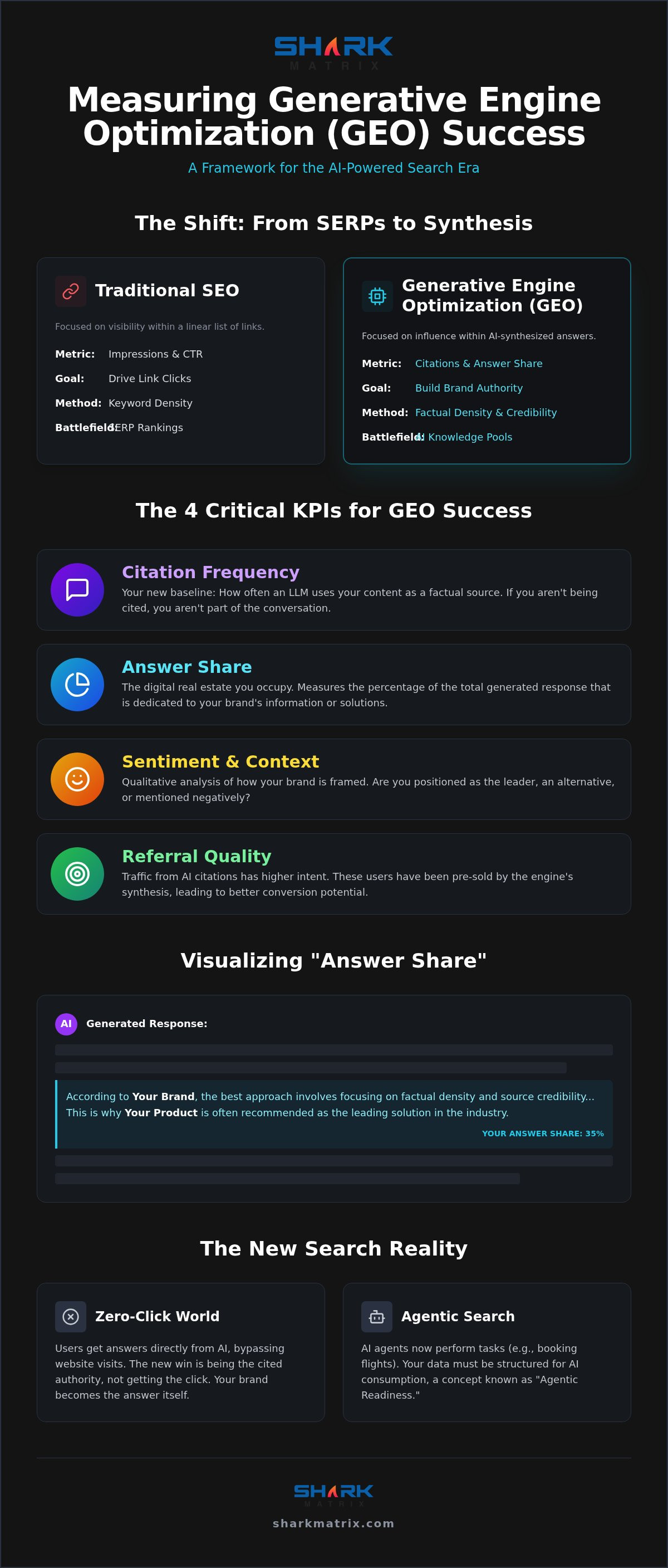
Success in 2026 is measured by “Share of Model” (SoM). This involves tracking how frequently an AI engine cites your brand compared to your competitors for specific topics. You should also monitor the sentiment of these citations. Google’s updated AI Overviews now include specific “Expert Advice” blocks that pull directly from authoritative voices. If your brand is featured but the context is neutral or negative, your authority is at risk. Partnering with an experienced seo company dubai can help you navigate these new metrics while accounting for the specific dynamics of the Middle Eastern market and Arabic language processing.

5 Pillars of a Winning 2026 GEO Strategy

Building a successful generative engine optimization strategy 2026 requires moving from passive content creation to active technical authority. You can’t rely on keywords alone when AI models are looking for verified entities and corroborated facts. To secure your place in the synthesized answers of tomorrow, you must treat your digital presence as a structured knowledge base rather than a collection of pages.

  • Step 1: Entity Optimization. Define your brand as a unique node in the global knowledge graph. AI engines need to understand your relationship to other high-authority entities in your industry.
  • Step 2: Structured Data Supremacy. Go beyond basic tags. Use the latest Schema.org version 30.0, published on March 19, 2026, to provide deep context that AI crawlers can digest instantly.
  • Step 3: Authoritative Citations. Since 84% of AI citations come from earned media, your strategy must include high-trust third-party platforms to validate your brand’s expertise.
  • Step 4: Direct Answer Optimization. Structure your content with clear “Question-Answer” pairs. This makes it easier for RAG-based systems to extract your expertise for real-time queries.
  • Step 5: Technical AI Alignment. Integrate generative ai development to optimize how your internal data is presented to external models.

Optimizing for Specific Engines

Each engine has its own “personality” and retrieval preferences. Google AI Overviews, following the May 6, 2026 update, place a heavy emphasis on “Expert Advice” blocks and first-hand experience. You should leverage your E-E-A-T signals to win these spots. For Perplexity, focus on academic-style citations and real-time data accuracy. ChatGPT currently dominates the market with a 76.85% share as of April 2026. To win here, your content must provide conversational value and a clear brand narrative that the model can easily summarize for the user.

Content Structuring for AI Extraction

LLMs use H-tags as semantic signposts to “chunk” your information. Use an “Inverted Pyramid 2.0” approach by leading every section with a direct, concise answer before diving into the details. This increases the likelihood of your content being captured as a featured snippet or AI citation. Implementing these structures across thousands of pages is a massive task. Utilizing professional ai development services helps automate this content structuring at scale, ensuring your entire site is machine-readable without losing its human appeal. If you want to future-proof your brand authority, explore how ai automation services can transform your technical SEO into a high-impact generative engine strategy.

Implementing GEO: Why a Technical Partner is Essential

By 2026, the sheer volume of data processed by Large Language Models makes it impossible to manage a generative engine optimization strategy 2026 through manual effort alone. Traditional SEO was often a game of patience and spreadsheets, but the AI landscape moves at the speed of compute. AI search engines are dynamic; they require real-time content updates and technical precision that only specialized software and engineering can provide. This is where ai automation services become indispensable. They ensure your brand’s data remains fresh and ready for retrieval by engines that update their indexes in minutes rather than weeks.

Shark Matrix Technologies serves as the critical bridge between software engineering and digital marketing. In a world where 76.85% of AI search usage is dominated by a single platform, you can’t afford technical friction. We specialize in building the infrastructure that allows AI crawlers to “read” your brand’s authority without ambiguity. Our expertise in Middle Eastern market dynamics and Arabic digital marketing adds another layer of complexity that generalist agencies often miss. We don’t just optimize for a bot; we build a technical ecosystem where your brand is the most logical answer for any engine to cite.

Custom AI Development for Search Dominance

Winning in the AI era requires more than just following best practices; it requires building your own tools. Advanced machine learning development services allow businesses to predict which content pieces are most likely to be cited based on current LLM behavior. Instead of guessing, you can use custom models to audit your site’s “chunkability” and entity authority. This technical approach extends to automating the deployment of Schema.org 30.0 across thousands of pages instantly, ensuring no manual errors slow down your visibility. By integrating ai chatbot-development services, you can also capture zero-click search intent directly on your own platform, keeping users engaged with your brand rather than a third-party engine.

Future-Proofing Your National Brand

For national-scale brands, the stakes are incredibly high. A drop in organic visibility due to AI Overviews can cripple revenue if you aren’t prepared to pivot. Shark Matrix is the preferred partner for national-scale execution because we treat your generative engine optimization strategy 2026 as a long-term technical roadmap. We focus on building a “Brand Memory” that persists across different models and updates. If you’re ready to secure your brand’s future and ensure your expertise isn’t hidden behind a wall of generated text, contact Shark Matrix for a 2026 GEO Audit today. Our team will help you transition from traditional search to AI-driven authority with a clear, data-backed plan.

Secure Your Brand’s Authority in the AI Era

The search landscape of 2026 demands more than just traditional keyword optimization. It requires a deep understanding of how Large Language Models retrieve and synthesize information. By prioritizing entity authority and technical accessibility, you can ensure your brand isn’t just indexed but cited as a primary source. Success now hinges on balancing human-centric expertise with machine-readable data structures that AI engines trust. You don’t have to navigate this transition alone.

Implementing a high-impact generative engine optimization strategy 2026 is a technical challenge that goes beyond standard marketing. Shark Matrix has been a leader in digital strategy since 2010, bringing deep roots in software engineering to the world of search. As specialists in AI and machine learning development, we provide the comprehensive national SEO and digital strategy needed for large-scale visibility. It’s time to bridge the gap between your content and the engines that define your brand’s reputation.

Partner with Shark Matrix for a Technical GEO Strategy and secure your place in the next generation of search. The future is automated, and your brand is ready to lead it.

Frequently Asked Questions

What is the main difference between SEO and GEO?

SEO focuses on ranking your website in traditional search results to drive direct clicks from human users. In contrast, GEO aims to have your brand cited and recommended within the synthesized answers generated by AI models. While SEO optimizes for users browsing blue links, GEO optimizes for LLMs that ingest and summarize your data into conversational responses.

How do I get my website cited by ChatGPT or Google AI Overviews?

Getting cited requires a strong presence on third-party authoritative platforms because AI models prioritize corroborated facts. A May 2026 analysis found that 84% of AI citations come from earned media rather than brand-owned sites. You must also ensure your site is technically accessible to crawlers like GPTBot and structured in a way that AI can easily “chunk” and retrieve your information.

Does traditional SEO still matter in 2026?

Traditional SEO is more important than ever because it provides the indexable data that AI engines rely on for real-time retrieval. A successful generative engine optimization strategy 2026 uses technical SEO as a foundation. Without high site speed, mobile optimization, and proper indexing, your content won’t even reach the stage where an AI can consider it for a citation.

How can AI development services improve my search visibility?

Custom ai development services allow you to build proprietary tools that audit your content’s entity authority and “chunkability.” These services can automate the implementation of advanced Schema markup and use machine learning to predict which content structures will perform best in AI search results. This technical edge is essential for managing large-scale digital footprints that manual SEO can’t handle effectively.

What are the best metrics to track for Generative Engine Optimization?

You should track Share of Model (SoM) to see how often you are cited compared to your direct competitors. Additionally, monitoring the sentiment of AI-generated answers and the frequency of “Expert Advice” block appearances provides a clearer picture of your digital authority. Traditional metrics like organic traffic are still useful, but they no longer tell the full story of your brand’s reach in an AI-dominated market.

How does structured data help with AI search engines?

Structured data provides the explicit context that AI engines need to verify facts and understand entity relationships. By implementing the latest Schema.org 30.0 markup, you reduce the chance of AI engines misinterpreting your data or “hallucinating” details about your brand. This technical clarity makes your website a much safer and more attractive source for an LLM to cite in its synthesized answers.

Can I use AI to optimize my content for GEO?

Yes, you can use generative tools to identify semantic gaps and reformat your content for better machine extraction. AI is particularly helpful for creating concise “Question-Answer” pairs and ensuring your headers act as clear signposts for retrieval bots. Using AI to optimize for AI creates a feedback loop that aligns your content with the specific way modern models process and summarize human language.

What is Share of Model (SoM) and why is it important?

Share of Model measures the percentage of times an AI engine mentions or recommends your brand for a specific category of queries. It’s the 2026 equivalent of “share of voice” in traditional media. A high SoM indicates that the AI’s training and retrieval data consistently point to your brand as a trusted authority, which is vital for maintaining visibility when AI Overviews appear in 50% of informational searches.

Categories
Digital Marketing

2026 Guide: Optimizing Websites for AI Overviews

Did you know that as of early 2026, AI Overviews now appear in nearly 50% of all US Google queries? For man

Categories
GEO

How to Get Cited by ChatGPT: The 2026 GEO Guide

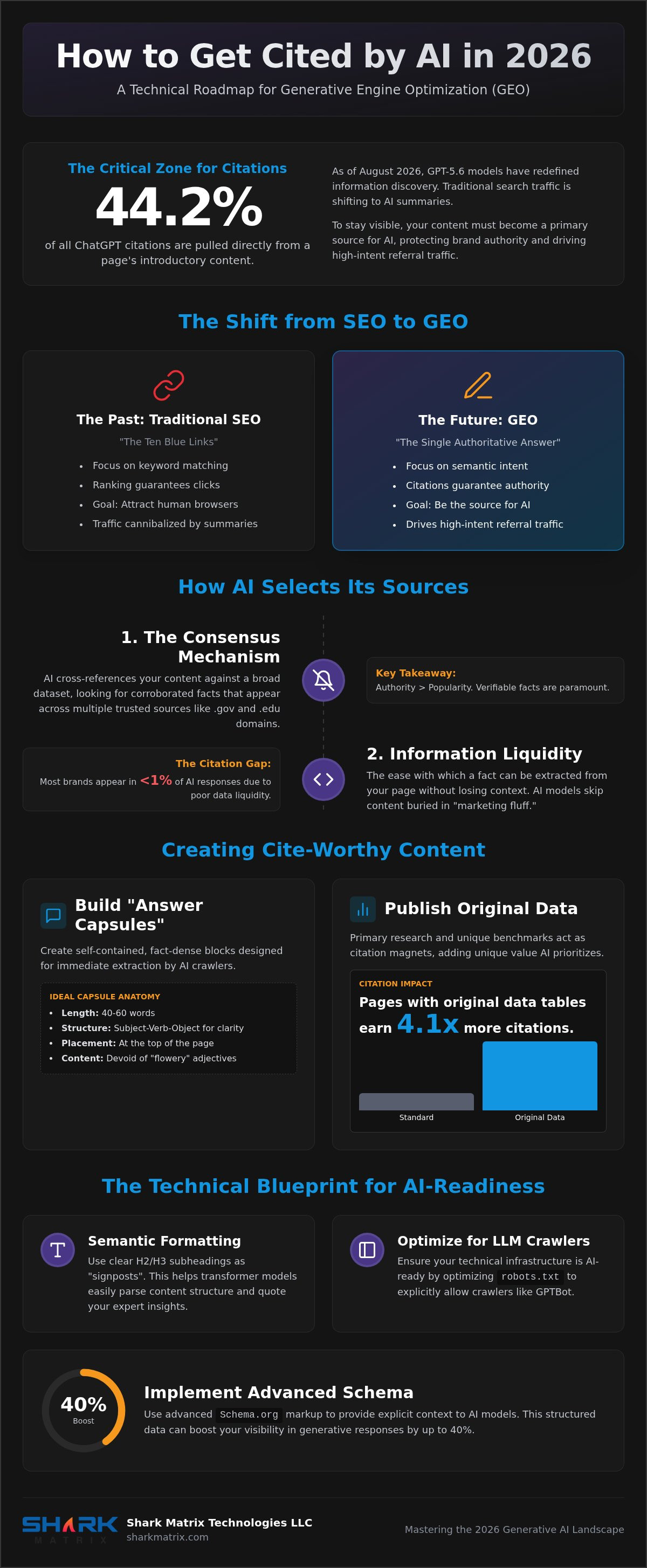
Did you know that 44.2% of all ChatGPT citations are pulled directly from a page’s introductory content? As of August 2026, the GPT-5.6 series, including the Sol, Terra, and Luna models, has redefined how users find information. Traditional search traffic is shifting toward AI summaries, leaving many brands fearing erasure from the digital landscape. Learning how to get cited by chatgpt is the most effective way to protect your brand authority and drive high-intent referral traffic.

At Shark Matrix Technologies LLC, we specialize in bridging the gap between traditional SEO and generative engine optimization. We recognize the uncertainty that comes with this new era of search. This guide provides a technical roadmap to transform your website into a primary source for leading AI answer engines. You’ll learn exactly what it takes to master the 2026 landscape, from understanding the consensus mechanism to implementing the specific schema markup that boosts visibility by up to 40%.

Key Takeaways

  • Grasp the evolution of Generative Engine Optimization (GEO) to stay visible as LLMs become the primary interface for online search.
  • Uncover the “consensus mechanism” ChatGPT uses to verify facts and learn exactly how to get cited by chatgpt through high-liquidity data.
  • Implement semantic formatting and H2/H3 signposts that help transformer models easily parse and quote your expert insights.
  • Ensure your technical infrastructure is AI-ready by optimizing robots.txt for GPTBot and using advanced Schema.org markup to provide explicit context.
  • See how Shark Matrix Technologies uses generative AI development to help brands build the “cite-worthy” authority required for 2026.

The Shift to Generative Engine Optimization (GEO) in 2026

Generative Engine Optimization (GEO) is the strategic process of structuring digital content so Large Language Models can effectively synthesize and attribute it. In 2026, we’ve reached a tipping point where AI-first search is the standard behavior for the majority of users. We have moved away from the era of “Ten Blue Links” and into a period defined by the single authoritative answer. Instead of presenting a list of possible sources, these engines provide a synthesized response that credits the most relevant and reliable data provider. Platforms like ChatGPT, Perplexity, and Google’s Search Generative Experience now act as the primary interface for information. To remain visible, brands must understand how to get cited by chatgpt by prioritizing information liquidity over simple keyword density.

Why Traditional SEO Isn’t Enough Anymore

Informational traffic is being cannibalized by AI summaries that provide immediate gratification. A user looking for a quick explanation will likely read a summary rather than clicking through to a blog post. Traditional SEO often fails here because it focuses on keyword matching rather than semantic intent resolution. You must understand how large language models work to ensure your content is chosen for these summaries. Ranking in the top position is a great achievement, but it no longer guarantees that your brand will be the one quoted by the AI.

The Rise of Answer Engine Optimization (AEO)

Answer Engine Optimization (AEO) is a critical new stage in the modern marketing funnel that prioritizes directness and factual density. Research indicates that pages featuring original data tables earn 4.1 times more citations, making them essential for high-impact visibility. Shark Matrix Technologies LLC assists brands in this transition by offering generative engine optimization and comprehensive search engine optimization (SEO) services. By building “answer capsules” and utilizing original data, we solve the technical challenge of how to get cited by chatgpt. This approach ensures your brand remains the verified source behind the AI’s response.

Decoding the AI Selection Logic: How ChatGPT Chooses Its Sources

ChatGPT doesn’t browse the web like a human; it processes it through a consensus mechanism. To understand how to get cited by chatgpt, you must first grasp how these models verify information. When a user asks a question, the model cross-references your content against a broader dataset to ensure accuracy. This is why government (.gov) and educational (.edu) domains dominate citations; they provide high-authority, verifiable facts that align with a global consensus. Popularity or high traffic doesn’t equate to authority in the eyes of an LLM. Instead, the model looks for corroborated facts that appear across multiple trusted sources.

A deeper understanding of LLMs reveals that “extractability” is the second pillar of selection. If a transformer model cannot easily parse your data, it will move on to a competitor. Currently, there is a massive “citation gap” where brands appear in less than 1% of AI responses. This happens because most commercial content is buried under marketing fluff that obscures the actual data points. AI models favor information liquidity, which is the ease with which a fact can be moved from your page into a chat interface without losing its context or accuracy.

The Anatomy of an Answer Capsule

An answer capsule is a self-contained, fact-dense block of text designed for immediate extraction by an AI crawler.

These capsules are the primary target for AI systems because they minimize the computational work required to summarize a page. An ideal capsule is typically between 40 and 60 words. It should use a “subject-verb-object” structure to ensure maximum clarity. By placing these capsules at the top of your page, you significantly increase your chances of being quoted as the primary authority. These blocks should be devoid of flowery adjectives and focused entirely on providing a direct answer to a specific user prompt.

The Role of Original Data and Owned Insights

Primary research and unique benchmarks act as citation magnets in the 2026 landscape. ChatGPT prioritizes original data because it adds unique value to the generated response. When presenting this data, you should use clear labels and structured lists that are optimized for natural language processing. Avoid the “aggregation trap” of simply summarizing what others have said. If your content doesn’t offer a new, verifiable data point, the AI has no reason to cite you over the original source. Shark Matrix Technologies LLC helps brands bridge the citation gap by implementing ai automation services that identify and highlight your most cite-worthy internal data.

Content Traits that Drive ChatGPT Citations

While the consensus mechanism validates your facts, the specific traits of your content determine whether an AI can actually use them. AI models are picky eaters. They prefer information that is pre-digested and organized into a logical hierarchy. Using H2 and H3 tags isn’t just for human readability anymore; these tags serve as semantic signposts that tell an LLM exactly what a section covers. If you’re investigating how to get cited by chatgpt, you should prioritize a neutral, encyclopedic tone. Marketing fluff and hyperbolic adjectives like “revolutionary” or “best-in-class” act as noise that models often filter out in favor of objective data.

There’s also a “link density” paradox to consider. In traditional SEO, internal linking is a powerhouse for authority. However, for Generative Engine Optimization, excessive linking within a single paragraph can confuse the extraction process. When a model identifies too many competing URLs, it may struggle to attribute a specific fact to a single source. It’s better to provide a clean, fact-heavy paragraph with a clear author byline. Verifiable expertise is crucial; including a short bio that links to an author’s LinkedIn or professional credentials helps the model verify the “Experience” and “Expertise” signals it requires before citing a brand.

Structuring for Direct Extraction

To capture a citation, you must adopt an inverted pyramid structure designed for AI. Put your most important answer in the first 20 words of the section. This ensures that even a brief crawl captures the core value of your page. Bulleted lists are equally effective for process-oriented queries because they provide a structured sequence that models can easily convert into a chat response. Don’t forget to bold key entities and data points. This highlights the most relevant “tokens” for the model, making your content stand out during the initial synthesis phase.

Building Cross-Platform Consensus

ChatGPT doesn’t just look at your website; it looks at what the rest of the internet says about you. Earning mentions on authoritative third-party sites like Reddit, industry journals, and specialized forums builds the cross-platform consensus that LLMs crave. Consistent brand claims across these platforms signal to the AI that your information is reliable. Our team at Shark Matrix helps brands manage this digital footprint through strategic online reputation management. By ensuring your data is corroborated across multiple domains, you create a safety net of trust that makes it much easier for AI models to select your site as a primary citation source.

How to Get Cited by ChatGPT: The 2026 GEO Guide

The Technical Blueprint: Optimizing Infrastructure for LLM Crawlers

Advanced Schema for AI Context

Schema markup is associated with a 30% to 40% higher visibility to AI systems. To maximize this, you should implement advanced types like Speakable, FactCheck, and Dataset schema. These provide explicit context that helps the model categorize your information as a primary source. Linking your entities to Wikidata or Knowledge Graph entries further solidifies your authority by providing a “source of truth” the model can verify. Our team at Shark Matrix uses ai automation services to audit your schema health and ensure every data point is correctly mapped for LLM extraction. This technical layer bridges the gap between raw text and structured knowledge.

LLM Crawler Management

Monitoring your server logs is essential for understanding how AI crawlers interact with your site. You should prioritize your “crawl budget” for high-value informational pages that are most likely to be cited. If your site relies heavily on dynamic, client-side rendering, make sure you provide a server-side rendered version for non-JS crawlers. AI models often struggle with complex JavaScript, so static snapshots of your most important content are a safer bet. By managing these technical hurdles, you ensure that your site remains visible and accessible to the next generation of answer engines. If you’re ready to modernize your site’s foundation, our web development agency dubai can optimize your infrastructure for maximum AI-readiness.

Scaling AI Visibility with Shark Matrix Technologies

Success in the 2026 search landscape requires moving beyond reactive fixes. While individual page optimizations are a start, true dominance comes from a systemic integration of generative AI development into your content pipeline. Shark Matrix Technologies positions your brand at the intersection of traditional SEO and AI-driven visibility. We focus on creating “cite-worthy” authority by generating original data that LLMs like GPT-5.6 Sol and Terra prioritize. By transforming your proprietary insights into structured, high-liquidity assets, we solve the puzzle of how to get cited by chatgpt at a national scale.

Our approach leverages the synergy between custom AI tools and Answer Engine Optimization (AEO). We don’t just wait for crawlers to find you. We proactively build the digital footprint necessary for models to recognize your brand as a consensus leader. This proactive GEO strategy ensures your brand isn’t erased in the era of single-answer responses. Instead, your expertise becomes the foundation upon which AI answers are built.

Custom AI Solutions for Brand Authority

We develop proprietary tools that generate original industry data, giving you a distinct advantage over competitors who rely on generic aggregation. By using machine learning development services, we can predict citation trends before they peak. This allows your team to publish answer capsules for emerging queries ahead of the curve. We also implement ai automation services to streamline the consensus-building process. This ensures your core claims are corroborated across authoritative platforms, journals, and databases, which is a critical factor in how to get cited by chatgpt consistently.

Your Roadmap to AI Search Dominance

Our engagement begins with a comprehensive audit of your current AI visibility. We calculate an “extractability score” to see how easily models like GPT-5.6 Luna can parse your site’s data. Following this, we develop an answer-first content map tailored to your specific industry. This strategy identifies the informational gaps where your brand can provide the most direct, cite-worthy value. Finally, our execution phase combines technical infrastructure upgrades with high-impact content marketing. We ensure your site is fully optimized for the 2026 landscape, turning AI-first search behavior from a threat into your biggest growth lever.

Own the Answer in the AI-First Era

The transition from traditional search to generative answers is the most significant shift in digital marketing since the mobile revolution. Staying visible requires a focus on information liquidity through structured answer capsules and high-authority original data. Technical readiness is just as vital; your site must be accessible to GPT-5.6 crawlers and supported by advanced Schema.org markup. Mastering how to get cited by chatgpt ensures your brand remains a primary source rather than a forgotten footnote.

Shark Matrix Technologies has delivered national-scale SEO success since 2010. Our expert AI and machine learning development team specializes in Generative Engine Optimization, helping brands bridge the gap between static content and AI synthesis. We don’t just optimize for rankings; we build the cross-platform consensus that LLMs require to trust your data. Future-proof your brand with Shark Matrix’s GEO and AI services. The 2026 search landscape is yours to lead if you start building for the future today.

Frequently Asked Questions

What is the difference between Google SEO and ChatGPT citation?

Traditional Google SEO focuses on ranking your page within the “Ten Blue Links” to drive clicks. ChatGPT citation is about “information liquidity” or how easily an AI can synthesize your data into a single, authoritative answer. While SEO targets keywords, citation success depends on your content being verifiable and extractable by transformer models.

Does high domain authority help in getting cited by ChatGPT?

Yes, but it works through a consensus mechanism. AI models cross-reference facts across multiple trusted domains to ensure accuracy. High-authority domains like .gov and .edu are often cited more because they provide the reliable benchmarks that LLMs use to verify information from commercial websites.

How long does it take for ChatGPT to recognize and cite new content?

Content updated within the last 30 days receives citation priority. If your technical infrastructure allows GPTBot and OAI-SearchBot access, the GPT-5.6 models can often index and cite your content within a few days. Regular updates are essential to stay relevant in the fast-moving AI search landscape.

Can I pay to be cited or featured in ChatGPT responses?

No, there is currently no paid placement for citations in ChatGPT. Unlike PPC management, appearing in AI responses is strictly an organic process. You must earn these mentions by learning how to get cited by chatgpt through high-impact Answer Engine Optimization (AEO) and data-driven content strategies.

Which AI models are the most likely to cite external sources in 2026?

The GPT-5.6 series, including the Sol, Terra, and Luna models, are the most prominent citing engines. Perplexity and Google’s Search Generative Experience also provide frequent citations. These platforms use retrieval-augmented generation to credit the specific sources that provide the most direct and factual answers to user prompts.

Does blocking AI crawlers in robots.txt affect my Google rankings?

Blocking GPTBot or OAI-SearchBot does not negatively impact your traditional Google rankings. However, it effectively erases your brand from the AI-driven search era. If you block these crawlers, your site will not be synthesized or cited in ChatGPT responses, leading to a loss in high-intent referral traffic.

How do I track referral traffic coming specifically from ChatGPT?

You can track this traffic by analyzing the “Referrer” headers in your server logs or analytics platform. Referral sources from AI answer engines typically appear as `chatgpt.com` or `openai.com`. Using custom UTM parameters in your most cite-worthy links can also help you attribute specific traffic to AI platforms.

What kind of schema markup is most important for AI answer engines?

Speakable, FactCheck, and Dataset schema are the most critical for AI visibility. Implementing these specific types provides the explicit context that LLMs need to categorize your content. This technical optimization is a core part of how to get cited by chatgpt, as it can boost your visibility to AI systems by 30% to 40%.

Categories
AEO

AEO Marketing Strategy: The 2026 Guide to AI Search Visibility

Your content is ranking. Your traffic is dropping. That’s the quiet crisis hitting digital marketers right now, and a smarter aeo marketing strategy is the clearest path out of it. Zero-click searches, AI-generated summaries, and chatbot responses are answering user questions before a single link gets clicked, and brands that haven’t adapted are watching their visibility erode in real time.

You already know something has shifted. The search results page you optimized for last year looks nothing like the one your customers see today. Google’s AI Overviews, ChatGPT, Perplexity, and a growing list of answer engines are now the first stop for millions of queries, and they don’t rank ten blue links. They cite one authoritative source, or none at all.

This guide is built to change that for your brand. You’ll learn how Answer Engine Optimization works, why it’s a technical infrastructure play as much as a content strategy, and exactly how to position your business as the definitive source that AI engines cite by default. From structured data and entity authority to NLP signals and brand trust, here’s everything you need to future-proof your digital presence heading into 2026.

Key Takeaways

  • A well-executed aeo marketing strategy requires both a technical foundation — including Schema.org and JSON-LD implementation — and a content architecture built around conversational question-answer pairs that AI engines can cite directly.
  • The KPIs that define search success are changing: citations and brand mentions in AI-generated answers are becoming more valuable signals than traditional clicks and impressions.
  • Backlinks are evolving from “link juice” into “source validation” — the brands AI engines trust most are those with authoritative, consistently structured information across the web.
  • Running an Answer Audit on your existing content is the critical first step to identifying gaps between what your brand currently answers and what AI engines are actually being asked.
  • Integrating AI automation capabilities with AEO execution — rather than treating them as separate disciplines — is what separates brands that get cited from those that get ignored entirely.

What is Answer Engine Optimization (AEO) in 2026?

Answer Engine Optimization is the practice of structuring your content, technical infrastructure, and brand authority so that AI-powered platforms select your business as the definitive source when answering a user’s query. It’s not about ranking higher in a list. It’s about being the answer itself.

That distinction matters more than most brands realize. Traditional SEO competed for position on a Search Engine Results Page, where ten links shared the screen and users made a choice. The emerging reality is an Answer Engine Page, where a single synthesized response is delivered directly to the user, often without a clickable link in sight. The brands that don’t adapt their aeo marketing strategy to this shift aren’t losing ground slowly. They’re becoming invisible.

The Rise of the Zero-Click Search

Zero-click search is the dominant 2026 user behavior: a query is entered, an AI-generated answer is returned, and the session ends without a single website being visited. According to data cited by SparkToro and others tracking SERP behavior, zero-click outcomes have been trending upward for years, accelerating sharply as Google AI Overviews, Perplexity, and ChatGPT’s search functionality have matured.

The behavioral shift runs deeper than convenience. Conversational AI has changed how users frame their intent. Instead of typing “best CRM software Dubai,” a user now asks “which CRM is best for a 20-person sales team in the UAE?” That’s a specific, multi-layered question that a traditional keyword-matched result handles poorly. An LLM-powered answer engine handles it precisely, pulling from sources it has already validated as authoritative.

Answer Engines vs. Traditional Search Engines

Traditional search crawlers index pages and rank them based on signals like backlinks, keyword density, and page authority. Large Language Models work differently. They don’t retrieve pages at query time the way a crawler does. Instead, they synthesize responses from patterns learned during training, supplemented by real-time retrieval layers in tools like Perplexity and SearchGPT. The question isn’t whether your page ranks. The question is whether your brand’s information has been absorbed, validated, and deemed citable.

Google’s Knowledge Graph plays a critical role here. It acts as a verification layer, cross-referencing structured entity data to confirm that a brand is what it claims to be. For UAE-based businesses, this matters acutely: as national brands compete for AI citations in a market where local search authority is still being established, the brands with the clearest entity footprint win the citation.

Ranking number one is being replaced by being the citation. That’s the core logic driving every element of a modern aeo marketing strategy, and it’s why 2026 represents a genuine tipping point for brands across the UAE that have been treating AI search as a future concern rather than a present priority.

The Pillars of a Winning AEO Marketing Strategy

Most guides treat AEO as a content problem. Write better answers, structure your FAQs, and the citations will follow. That’s a partial truth that leads to incomplete execution. A genuinely effective aeo marketing strategy is built on four interdependent pillars: technical infrastructure, content architecture, brand authority, and data integrity. Weaken any one of them, and the others can’t compensate.

Structured Data and Knowledge Graphs

Schema.org markup isn’t a nice-to-have in 2026. It’s the primary language AI engines use to understand what your business is, what it does, and whether it’s trustworthy enough to cite. Implementing Organization, FAQPage, HowTo, and LocalBusiness schema in JSON-LD format gives AI systems a structured feed of verified facts about your brand, directly reducing the risk of hallucinated or inaccurate citations.

Consistent NAP data, your Name, Address, and Phone number, across UAE national directories, Google Business Profile, and industry-specific platforms acts as a corroboration layer. When multiple authoritative sources confirm the same entity details, knowledge graph validation becomes far easier for AI systems to complete. Inconsistencies, even minor ones like abbreviated street names, create ambiguity that causes AI engines to deprioritize a source in favor of one that’s cleaner.

This is where natural language processing capabilities become operationally valuable. NLP models parse the semantic context around your brand mentions, not just the entity name itself. A business described consistently as a “UAE-based AI development and SEO agency” across structured and unstructured sources builds a richer, more citable entity profile than one whose descriptions vary by platform.

Conversational Content Design

Voice search and AI-generated verbal responses share a common requirement: answers that sound natural when spoken aloud. That means writing in plain, direct language, front-loading the answer before the explanation, and avoiding the dense, qualifier-heavy prose that reads well on a page but fails when a device reads it back to a user.

Structuring H2s and H3s as direct questions is one of the highest-leverage changes a content team can make. Headings like “What schema types does Google use for AI Overviews?” map precisely to how users phrase queries to AI assistants. That alignment increases the probability of triggering a featured snippet or AI Overview citation.

Long-form content also needs a structural rethink. Leading with a concise answer block, a genuine TL;DR that resolves the core question in two or three sentences, serves two audiences simultaneously: the AI engine scanning for a citable response and the human reader who wants the conclusion before the argument.

Across all four pillars, the underlying principle is the same: make it effortless for AI systems to find, parse, and trust your information. Brands building this infrastructure now are the ones that will own citations as AI search continues to mature. If you’re assessing where your current content and technical setup stand against these requirements, exploring a structured SEO and AEO audit is a practical starting point.

The final pillar, data cleanliness, ties everything together. Contradictory information across your own site, outdated service descriptions, and unresolved entity conflicts are the inputs that produce AI hallucinations. Clean, consistent, structured data isn’t just good hygiene; it’s what separates a brand that gets cited accurately from one that gets cited incorrectly, or not at all.

AEO vs. Traditional SEO: Navigating the Zero-Click Era

The metrics that defined search success for the past decade are no longer telling the full story. Clicks, impressions, and average position made sense when the goal was to earn a spot on a results page that users actually scrolled through. That page is disappearing. As AI-generated answers absorb more of the query-response cycle, the brands still optimizing exclusively for click-through rates are measuring the wrong thing with increasing precision.

This isn’t an argument for abandoning traditional SEO. It’s an argument for expanding what success looks like. A hybrid approach that integrates search engine optimization SEO services with a structured AEO layer is the practical reality for 2026. SEO still governs how crawlers index your content and how human users navigate organic results. AEO governs whether AI systems trust your content enough to cite it. Both matter. Neither is sufficient alone.

The role of backlinks has shifted in a way that’s easy to misread. Links haven’t lost their value; their function has changed. In traditional SEO, a backlink passed authority in a relatively mechanical way. In an AI-citation context, backlinks function as source validation signals. When multiple credible, topically relevant domains reference your brand in consistent, structured ways, AI systems interpret that pattern as evidence of genuine expertise. The quantity-over-quality link-building strategies of earlier SEO eras actively work against this. What AI engines reward is corroboration, not volume.

Content frequency is another area where the old playbook misleads. Publishing at high velocity to capture trending keywords was a defensible strategy when freshness was a significant ranking factor. In an answer engine context, accuracy outweighs recency. A well-structured, factually precise answer published six months ago will be cited over a hastily produced piece published yesterday if the former is cleaner, better validated, and more consistent with what other trusted sources confirm. Being right matters more than being first.

The Death of the Keyword?

Exact-match keywords aren’t dead, but their dominance is over. Semantic search has shifted the optimization target from specific phrases to entities and topics: the people, places, concepts, and relationships that AI systems map into knowledge structures. A piece of content optimized around the entity “AI-powered CRM for SMEs” will serve a wider range of natural language queries than one built around a single high-volume phrase. Critically, AI connects related concepts without needing specific keyword prompts at all; an LLM can infer that a question about “automating follow-ups for a small sales team” is semantically adjacent to CRM functionality, even if neither phrase appears in the query.

Measuring Success in AEO

The emerging measurement framework centers on three shifts. First, Share of Model (SoM) is replacing Share of Voice: instead of tracking how often your brand appears in paid or organic search results, you track how often it appears in AI-generated responses across platforms like ChatGPT, Perplexity, and Google AI Overviews. Tools designed specifically for this monitoring are maturing quickly, and building SoM tracking into your reporting stack now is a competitive advantage.

Second, assisted conversions deserve more weight in your attribution model. A user who encounters your brand in a Perplexity citation, visits your site two days later through a direct search, and converts will appear in your analytics as a direct or branded organic conversion. That first AI-citation touchpoint is invisible in standard attribution but was arguably the most influential moment in the journey.

A sound aeo marketing strategy treats these measurement gaps as solvable problems, not acceptable blind spots. Tagging branded search volume trends alongside SoM data gives a clearer picture of how AI visibility is actually driving downstream behavior, even when the click never happens.

AEO Marketing Strategy: The 2026 Guide to AI Search Visibility

Implementation: How to Optimize for AI Overviews and Chatbots

Knowing why AEO matters is one thing. Building the execution layer is another. What follows isn’t a list of abstract principles; it’s a sequential implementation framework that takes your brand from audit to citation-ready infrastructure.

Step 1: Conduct an Answer Audit. Before producing a single new piece of content, map what your brand currently answers against what AI engines are actually being asked. Pull your top 50 organic landing pages and cross-reference them with conversational query data from tools like AlsoAsked, Google’s People Also Ask clusters, and Perplexity’s auto-suggest. Where your content answers questions that nobody is asking in 2026, or fails to answer questions that AI engines are fielding daily, those gaps are your highest-priority content targets.

Step 2: Deploy FAQ blocks with structured microdata across every high-value page. Each FAQ block should use FAQPage schema in JSON-LD, with questions written exactly as a user would speak them to an AI assistant. A question like “What does an AEO audit include?” is more citable than “Our AEO services overview.” The format matters as much as the content.

Step 4: Use generative AI development capabilities to scale content production without sacrificing structure. The bottleneck for most brands isn’t strategy; it’s execution volume. Generative AI tools, when properly configured with brand guidelines, schema templates, and answer-first formatting rules, can produce structured, citable content at a pace that manual workflows can’t match. The key is building the governance layer first so that AI-generated content meets AEO standards rather than diluting them.

Step 5: Monitor AI response accuracy continuously. Query your brand across ChatGPT, Perplexity, and Google AI Overviews at least monthly. When AI systems cite you incorrectly, that’s a signal that your structured data, entity descriptions, or on-page content contains contradictions that need resolving. Accurate citations don’t happen by accident; they’re maintained through ongoing data hygiene.

Optimizing for Multilingual Answer Engines

The UAE’s Arabic-English search environment creates a challenge that most AEO guides ignore entirely. NLP models process Arabic and English through different tokenization and semantic mapping systems. A brand that’s well-structured in English but inconsistently described in Arabic creates entity ambiguity that causes AI engines to deprioritize it in bilingual query contexts. Semantic consistency across both languages isn’t a translation task; it’s a technical one. Every core claim, service description, and entity attribute needs to carry the same meaning in both languages, not just the same words.

AI chatbot development is directly relevant here. A well-built multilingual chatbot doesn’t just serve users; it trains AI systems to associate your brand with accurate, consistent information in both languages. Every structured interaction your chatbot handles is a data point that reinforces your entity profile across the Arabic-English query landscape.

Technical Checklist for AEO Readiness

Content quality means nothing if AI crawlers can’t access and parse your site cleanly. Before any content work, confirm these technical foundations are solid:

  • Site speed and mobile-first indexing: AI crawlers respect the same performance signals as Googlebot. Core Web Vitals failures that slow human users also degrade how efficiently AI systems can retrieve and process your content.
  • robots.txt configuration: Review your robots.txt to confirm you’re not inadvertently blocking AI user-agents, including those used by Perplexity, OpenAI’s crawler (GPTBot), and Anthropic’s ClaudeBot. Blocking these agents removes your content from consideration entirely.
  • Speakable schema implementation: Google’s Speakable schema type designates specific page sections as optimized for audio playback via voice-activated answer engines. Implementing it on your most answer-dense pages directly increases your eligibility for voice search citations.

A complete aeo marketing strategy treats these technical elements as non-negotiable prerequisites, not optional enhancements. If you want an expert assessment of where your current setup stands, explore Shark Matrix’s AEO and SEO audit services as a structured starting point.

Shark Matrix: Integrating AI Automation with AEO Excellence

Most AEO guides stop at content recommendations. Rewrite your FAQs, add schema markup, and wait for citations to appear. That’s not a strategy; it’s a checklist. The gap most brands fall into isn’t a lack of information about AEO principles. It’s the absence of a technical partner who can actually build the infrastructure those principles require. That’s the problem Shark Matrix is built to solve.

As a UAE-based agency with deep roots in both national SEO campaigns and end-to-end AI automation services, Shark Matrix operates at the intersection that most digital agencies can’t reach: where software engineering meets search visibility. Building an “Answer-Ready” digital infrastructure for a national brand isn’t a content project. It requires NLP expertise to validate semantic consistency, machine learning capabilities to monitor citation accuracy, and structured data engineering to ensure that what AI engines read about your brand is exactly what you intend them to read.

The Shark Matrix approach to AEO treats your brand’s digital presence as a living data system, not a static website. Custom monitoring tools track how your brand is cited across ChatGPT, Perplexity, and Google AI Overviews, flagging inaccuracies before they compound into entrenched misinformation. That continuous feedback loop is what separates brands that maintain citation authority over time from those that earn it once and gradually lose it to cleaner competitors.

Reputation management in the AI era is also a data discipline. Consistent, structured, authoritative information distributed across UAE national directories, industry publications, and your own properties creates the corroboration pattern that AI systems interpret as trustworthiness. Shark Matrix coordinates that distribution as part of a unified aeo marketing strategy, not as a series of disconnected tactics.

Beyond Search: The Future of Agentic Marketing

The next disruption is already taking shape. AI agents, software systems that autonomously browse the web, compare options, and execute decisions on a user’s behalf, are moving from early adoption into mainstream commercial use. When an AI agent evaluates vendors for a procurement decision, it doesn’t read ten results. It queries structured data, validates entity credibility, and selects based on the clarity and consistency of available information. Brands whose data isn’t agent-readable won’t be considered at all.

Preparing for this shift requires more than updated schema. It requires industry-specific AI solutions that account for how your sector’s data is structured, queried, and validated by autonomous systems. A logistics company, a financial services firm, and a real estate developer each face different agent-query patterns. Generic AEO preparation won’t address those differences. Sector-specific data architecture will.

For organizations in specialized fields, you can visit GEOTECH 3D to see how high-precision geospatial mapping and data acquisition are structured to maintain authority in an AI-driven search environment.

This is precisely why a technical partner isn’t optional in 2026. The agentic era rewards brands that have invested in structured, machine-readable infrastructure before the shift fully arrives, not those scrambling to retrofit it afterward.

Get Started with a National AEO Audit

For UAE enterprises, the starting point is a structured audit that maps your current digital infrastructure against the citation requirements of modern answer engines. That means evaluating your schema implementation, entity consistency across platforms, content architecture, and technical crawlability, not as separate workstreams, but as a unified system. Shark Matrix bridges the gap between software engineering and digital marketing to deliver that assessment with the depth a national brand actually needs.

If your brand’s visibility strategy hasn’t been stress-tested against AI search yet, now is the right time to change that. Contact Shark Matrix for a comprehensive AEO and SEO strategy audit and find out exactly where your current setup stands, and what it will take to lead in the answer engine era.

The Brands That Act Now Will Own the Citations That Matter

AI search isn’t arriving. It’s already here, reshaping how buyers find information, evaluate vendors, and make decisions. The brands that treat an aeo marketing strategy as urgent infrastructure work today are the ones that will dominate citations tomorrow. Those that wait are ceding ground that gets harder to reclaim with every passing quarter.

Three things to carry forward: structured data isn’t optional, it’s the language AI engines speak. Entity consistency across every platform you touch determines whether AI systems trust you enough to cite you. And measurement has to evolve beyond clicks to capture the brand visibility that now happens before a user ever visits your site.

Shark Matrix brings together over a decade of UAE market expertise, full-stack AI engineering, and deep NLP specialization to build the kind of answer-ready infrastructure that actually earns citations at scale. You don’t have to figure this out alone.

Scale your AI visibility with Shark Matrix’s AEO services and position your brand where it belongs: as the answer.

Frequently Asked Questions About AEO Marketing Strategy

What is the difference between SEO and AEO?

SEO optimizes your content to rank on a traditional search results page where users choose from multiple links. AEO optimizes your content, structured data, and brand authority so that AI-powered platforms select your business as the source when generating a direct answer. The goal shifts from earning a position in a list to becoming the answer itself.

In practice, the two disciplines share a technical foundation but diverge in execution. SEO prioritizes crawlability, keyword relevance, and link authority. AEO adds entity consistency, conversational content structure, and schema markup that AI systems can parse and cite with confidence. Neither replaces the other in 2026.

How do I get my business cited in ChatGPT or SearchGPT?

Getting cited by LLM-powered tools requires your brand’s information to be accurate, consistent, and widely corroborated across authoritative sources. That means implementing structured schema markup on your site, maintaining consistent entity data across directories and third-party platforms, and earning mentions in credible, topically relevant publications that AI systems treat as trusted inputs.

There’s no direct submission process for ChatGPT or SearchGPT the way there is for Google Search Console. Instead, you build the conditions that make citation likely: clean structured data, a strong entity footprint, and content that directly answers the specific questions your audience is asking AI tools today.

Will AEO replace traditional SEO by 2026?

No. AEO won’t replace SEO, but it’s becoming an equally critical discipline alongside it. Traditional SEO still governs how search crawlers index your content and how human users navigate organic results for queries that don’t trigger AI-generated answers. Those queries still represent a significant share of search volume, particularly for complex, commercial, and navigational intent.

The smarter framing is that a complete aeo marketing strategy sits on top of a solid SEO foundation, not in place of one. Brands that abandon SEO to chase AEO exclusively will lose organic traffic. Brands that ignore AEO while doubling down on traditional SEO will lose citation visibility. Both disciplines need to run in parallel.

Does AEO work for B2B companies in the UAE?

AEO is arguably more valuable for B2B companies than for consumer brands. B2B buyers increasingly use AI tools like Perplexity and ChatGPT during early-stage research, asking specific questions about vendors, capabilities, and industry solutions before ever visiting a company website. If your brand isn’t being cited during that research phase, you’re invisible at the most influential point in the buying journey.

For UAE-based B2B businesses, this matters acutely because national entity authority in the Gulf market is still being established across AI platforms. Companies that build a clear, consistent, structured digital presence now will have a significant citation advantage over competitors who treat AEO as a future concern.

How do I measure the ROI of AEO if I’m getting fewer clicks?

Measuring AEO ROI requires expanding your attribution model beyond last-click analytics. The most practical starting point is tracking branded search volume over time. When AI citations increase, users who encounter your brand in an AI-generated answer often follow up with a direct branded search, so rising branded query volume is a reliable downstream signal of growing AI visibility.

Alongside that, monitor your Share of Model: how frequently your brand appears in AI-generated responses across ChatGPT, Perplexity, and Google AI Overviews for your target queries. Tracking assisted conversions, where a user’s journey began with an AI touchpoint before converting through another channel, also helps quantify the influence that doesn’t show up in standard click-based reporting.

What role does structured data play in Answer Engine Optimization?

Structured data is the primary mechanism through which AI systems verify what your business is, what it does, and whether it’s credible enough to cite. Schema types like Organization, FAQPage, HowTo, and LocalBusiness implemented in JSON-LD give AI engines a structured feed of verified facts rather than forcing them to infer meaning from unstructured prose.

Without structured data, AI systems rely on contextual signals from across the web to construct their understanding of your brand. That introduces the risk of inaccurate or incomplete citations. Clean, comprehensive schema markup reduces that ambiguity directly, making your brand a more reliable source that AI systems can cite with confidence.

Can I optimize for both Google AI Overviews and ChatGPT at the same time?

Yes, and the good news is that the core optimization principles overlap significantly. Both systems reward content that’s clearly structured, factually accurate, and consistently corroborated across authoritative sources. Implementing strong schema markup, writing in direct question-answer format, and maintaining entity consistency across your digital presence benefits your visibility across all major AI platforms simultaneously.

The differences are mostly technical. Google AI Overviews pull from indexed web content, so traditional crawlability and page authority still matter. ChatGPT’s retrieval layer is influenced by the breadth of authoritative sources that reference your brand. Optimizing both means combining solid on-site technical SEO with a deliberate off-site authority-building strategy.

Is voice search optimization part of an AEO strategy?

Voice search optimization is a core component of any effective aeo marketing strategy, not a separate discipline. Voice queries are inherently conversational, phrased the way people actually speak rather than how they type, and AI answer engines handle both formats through the same underlying language models. Content that’s structured to answer spoken questions well is also content that AI systems find easy to cite in text-based responses.

Practically, this means writing answers in plain, natural language that sounds coherent when read aloud, implementing Google’s Speakable schema on your most answer-dense pages, and structuring headings as direct questions that mirror how users phrase voice queries. These adjustments serve voice search and AI citation readiness at the same time.

Categories
GEO

Measuring Generative Engine Optimization Success: The 2026 KPI Framework

What if your brand’s most valuable traffic in 2026 doesn’t show up in a keyword ranking report? You’ve likely noticed that traditional organic click-through rates are sliding as AI-generated overviews take center stage. It’s frustrating to watch your hard-earned visibility vanish into a black box where “Share of Model” feels more like a theory than a trackable metric. You aren’t alone in the struggle to explain these shifts to executives who still demand to see a page-one position. Mastering the art of measuring generative engine optimization success is the only way to prove your digital strategy is actually working in this new era.

This guide provides a concrete set of KPIs designed to quantify your brand’s presence within LLM-generated responses. We’ll show you how to move past the “black box” of AI search by establishing a dashboard for tracking AI-driven referrals and improving your authority within AI knowledge graphs. By the end, you’ll have a clear framework to report on brand visibility that traditional tools simply can’t see. You’ll gain the specific metrics needed to demonstrate how your content influences the final synthesis of the world’s most powerful AI models.

Key Takeaways

  • Understand why traditional SERP tracking is evolving into a model that measures brand presence within AI-synthesized responses.
  • Master the four essential metrics for measuring generative engine optimization success, including citation frequency and your physical “Answer Share.”
  • Learn to configure GA4 and Google Search Console to identify and track referral traffic from AI engines like ChatGPT and Perplexity.
  • Identify the “Authority Gap” by benchmarking your brand’s citation profile against competitors within major AI knowledge pools.
  • Discover how to integrate real-time AI visibility dashboards with reputation management for a unified, future-proof digital strategy.

The Shift from SERPs to Synthesis: Why 2026 Measurement is Different

The search landscape has fundamentally fractured. For decades, success meant climbing a linear list of blue links. In 2026, the game is about synthesis. Measuring generative engine optimization success now requires tracking how often and how prominently your brand appears within the narrative outputs of Large Language Models (LLMs). This isn’t just about rankings; it’s about being the data that powers the answer. While SEO was about visibility, GEO is about influence.

We’ve entered a “Zero-Click” reality. Users no longer need to visit your website to find what they need because the AI provides the solution directly. While this might seem like a loss for traffic, it’s a massive win for brand authority if you are the cited expert. The battlefield for national brands has moved into the Knowledge Pool, which is the vast dataset where AI models pull their facts. If your brand isn’t in the pool, you don’t exist in the answer. You aren’t just competing against other websites anymore; you’re competing to be the most trusted data point in a model’s training set or retrieval window.

SEO vs. GEO: A Comparative Framework

Traditional SEO metrics focus on impressions and click-through rates (CTR). GEO shifts the focus to citations and “Answer Share.” Instead of fighting for a click, you’re fighting for the AI to mention your brand as the definitive source. Success is no longer measured by how many people landed on your blog post, but by how many AI-generated recommendations included your product. This requires a psychological shift in how marketing teams report value to stakeholders.

  • Metrics: SEO tracks impressions; GEO tracks citations.
  • Goal: SEO seeks link clicks; GEO builds brand authority in AI-generated advice.
  • Method: SEO relies on keyword density; GEO relies on factual density and source credibility.

Answer Share is the percentage of an LLM response dedicated to your brand’s data.

The Rise of Agentic Search in the UAE Market

The UAE is a global leader in AI adoption, and we’re seeing a rapid shift toward agentic search. Tools like Gemini and ChatGPT aren’t just summarizing text; they’re performing tasks. They book flights, compare insurance policies, and draft business plans. Measuring “Agentic Readiness” is now the first step in a modern strategy. It determines if your data is structured so that an AI agent can actually use it to complete a task for a user.

Integrating your brand into these workflows requires sophisticated AI automation services to ensure your data remains accessible and accurate for these agents. Measuring generative engine optimization success in this context means tracking how often your brand is the “actionable” choice in an agent’s workflow. If an agent can’t verify your pricing or availability, it will simply move to a competitor that has prioritized AI-readable data structures.

The 4 Critical KPIs for Measuring GEO Success

Success in the generative era isn’t a single data point. It’s a composite of how AI models perceive, prioritize, and present your brand. When measuring generative engine optimization success, you must look beyond the click to understand your brand’s footprint within the AI’s logic. These four KPIs provide the foundation for a 2026 reporting framework that executives can actually understand.

  • Citation Frequency: This is your new baseline. It tracks how often an LLM uses your content as a factual source. If you aren’t being cited, you aren’t part of the conversation.
  • Answer Share: Think of this as the digital real estate you occupy. It measures the percentage of the total generated response dedicated to your brand’s specific information or solutions.
  • Sentiment and Context: Being mentioned isn’t enough. You need to know if the AI frames your brand as the industry leader or merely a secondary alternative. This qualitative data is often more valuable than raw volume.
  • Referral Quality: While volume may be lower than traditional search, the intent is higher. Users who click through from an AI citation have already been “pre-sold” by the engine’s synthesis.

Tracking these metrics allows you to see the direct impact of your content strategy on AI outputs. It’s a shift from counting visitors to counting influence. If you’re struggling to track these nuances, our team at Shark Matrix can help you implement the ai automation services needed to monitor these shifts in real time.

Measuring Citation Order and Authority

The order of citations matters immensely. Being the “Primary Source,” or the first link provided, signals the highest level of LLM trust. Models often lean on one authoritative source for the bulk of an answer while using others for minor details. You can improve your chances of becoming the primary source by utilizing robust structured data. This makes your facts easier for the model to verify. Diversity also plays a role. You should track whether you’re being cited for top-of-funnel informational queries or bottom-of-funnel commercial comparisons.

Brand Sentiment in AI Synthesis

The way an AI describes your brand can define your market position. We use advanced natural language processing services to analyze the tone of AI responses. This helps identify “Trust Signals” within a synthesized paragraph. For instance, does the AI use authoritative verbs when discussing your services? Or does it use hedging language? Quantifying these signals allows you to adjust your content to ensure the AI views your brand as a definitive leader rather than a budget-friendly backup.

Measuring Generative Engine Optimization Success: The 2026 KPI Framework

Technical Implementation: Tracking AI Referrals and Mentions

One of the first steps involves refining your view in Google Search Console. While Google has integrated “AI Overviews” into standard reporting, you should specifically monitor the “Search Appearance” tab to isolate impressions coming from synthesized responses. Simultaneously, you must track unlinked brand mentions across the web. LLMs treat these mentions as “trust signals” during their training and retrieval phases. Even if a user doesn’t click a link, the AI’s awareness of your brand grows every time your name appears in a high-authority context. This makes digital PR a core component of modern technical SEO reporting.

GA4 Configuration for the AI Era

Standard GA4 settings often bucket AI traffic into “Direct” or “Referral” without distinction. To fix this, you should create a custom Channel Group specifically for “AI Search.” By using a regex-based filter in your Data Settings, you can capture traffic from sources like openai.com, perplexity.ai, and anthropic.com. This allows you to track “Conversational Clicks” as a distinct metric. Once separated, you can analyze how these users behave compared to traditional searchers. You’ll likely find that AI-referred users have higher engagement rates because they’ve already received a tailored recommendation before landing on your site.

Using Custom AI Monitors for Share of Model (SoM)

Standard SEO tools are designed for crawlers, not LLMs. They often fail to capture how Perplexity or Gemini synthesizes information in real time. To bridge this gap, national brands are turning to custom monitoring tools. Our expertise in generative AI development allows us to build scrapers that query LLMs at scale for specific keyword sets. These tools aggregate data into a “GEO Scorecard.” This dashboard tracks your Share of Model (SoM) across different platforms, giving you a unified view of your brand’s authority. By identifying where your competitors are being cited instead of you, you can pinpoint the exact “Knowledge Gaps” in your content strategy and fix them before the next model update.

Benchmarking Success Against Competitors in AI Knowledge Pools

Understanding your position in the generative landscape requires a shift in how you view competition. In traditional search, you competed for a spot on a list. In 2026, you’re competing for a spot in the AI’s “Knowledge Pool.” Measuring generative engine optimization success involves identifying the “Authority Gap,” which is the distance between your brand’s perceived expertise and that of your top competitors. If an LLM consistently omits your brand when answering industry queries, it’s likely because your competitor’s citation profile is more robust across the third-party datasets the AI trusts.

Analyzing these citation profiles within models like ChatGPT and Gemini reveals the sources the AI relies on most. Often, these aren’t just high-ranking websites. They’re niche directories, industry-specific forums, and deep technical documentation. By quantifying how often competitors are mentioned in these “seed sources,” you can see exactly where your visibility is lacking. There is a significant first-mover advantage here. National brands that secure their place in these knowledge pools now will be harder to dislodge as the models become more entrenched in their training data.

The AI Competitor Audit

You can perform a manual audit by prompting LLMs to identify the “top providers” or “industry leaders” in your specific niche. Pay close attention to the justifications the AI provides. Does it cite a specific review site or a white paper? Reverse-engineering these responses allows you to identify content gaps. If the AI frames a competitor as the “best value” option while ignoring your premium features, your content strategy needs to feed the model more data points regarding your specific value proposition. This is a critical step in measuring generative engine optimization success and refining your brand’s narrative.

Tracking Conversion in Agentic Commerce

The next frontier is “Agentic Commerce,” where AI agents move beyond answering questions to actually performing tasks. Success in this phase is measured by “Agentic ROI.” This includes metrics like how many demos were booked or how many transactions were initiated entirely through an AI interface. Reporting these figures to stakeholders requires a new type of attribution model that tracks the agent’s path from synthesis to execution. If your data isn’t structured to allow an agent to complete a task, you’re losing revenue to competitors who have prioritized agentic readiness.

Ready to close the authority gap? Explore our AI automation services to see how we can build custom monitors for your brand’s AI visibility.

Future-Proofing Your Strategy with Shark Matrix AI Analytics

Static SEO reports have become relics. In the fast-moving world of LLMs and real-time data retrieval, a monthly PDF showing keyword movements is no longer sufficient. Measuring generative engine optimization success requires a live, real-time visibility dashboard that reflects how AI models are currently synthesizing your brand’s information. Because AI models update their weights and retrieval windows frequently, your visibility can shift overnight. You need a monitoring system that alerts you to these changes as they happen, not weeks after the fact.

We believe that GEO cannot exist in a vacuum. It must be integrated with Online Reputation Management (ORM) to create a unified national brand image. AI models are highly sensitive to sentiment and factual consistency across the web. If your brand has conflicting information or negative sentiment in its primary “seed sources,” the AI will likely deprioritize you in its final response. By aligning your GEO efforts with a robust ORM strategy, you ensure that the “Knowledge Pool” the AI drinks from is clean, authoritative, and consistently positive.

Our approach goes beyond simple tracking. We use custom machine learning models to predict the likelihood of a specific piece of content being cited by an LLM. By analyzing the structural and semantic markers that models like Gemini and Claude prefer, we help you build content that is “pre-optimized” for synthesis. This moves your strategy from reactive measurement to proactive dominance, ensuring you aren’t just watching the results but actively shaping them.

Advanced Monitoring with Custom AI Solutions

Our technical department specializes in building proprietary tools that track “Answer Share” across multiple generative engines simultaneously. These aren’t standard SEO tools; they are custom-built monitors developed through our ML development services. We also leverage custom chatbots to gather granular data on user intent. By analyzing the questions users ask your brand’s own AI interfaces, we can identify emerging trends and knowledge gaps before they appear in mainstream search data. This data is then used to refine your broader content strategy.

The Shark Matrix GEO Roadmap

A national-scale strategy requires a partner with deep technical and SEO roots. Our roadmap is designed to take you from uncertainty to automated visibility in three clear phases. We start with a baseline visibility audit to see where you currently stand in the AI knowledge pool. Next, we move into content optimization, where we restructure your data for maximum citation potential. Finally, we implement automated monitoring to protect your “Answer Share” against competitors. This end-to-end approach ensures your brand remains the definitive answer in an AI-driven world. Contact Shark Matrix for a comprehensive GEO audit and start securing your brand’s future in the age of synthesis.

Owning the Answer in a Synthesized Future

The search landscape won’t return to the simple days of blue links. Success now depends on your brand’s ability to influence the Knowledge Pool and secure a dominant Answer Share. By focusing on citation frequency and technical attribution, you move from guessing to knowing. Measuring generative engine optimization success is the bridge between traditional SEO and the era of agentic commerce. It ensures your brand remains the primary source for AI models and the users who rely on them.

At Shark Matrix, we combine 15+ years of search expertise with a specialized custom AI and ML development team. As national UAE strategy specialists, we build the proprietary tools needed to track these elusive metrics. It’s time to stop reacting to AI shifts and start directing them. Ready to dominate AI search? Get your custom GEO success roadmap from Shark Matrix today.

The transition to AI search is a massive opportunity for brands that act now. Your future visibility starts with the metrics you track today. Don’t wait for the models to update; start building your authority now.

Frequently Asked Questions

What is the most important metric for GEO success in 2026?

Citation frequency is the most critical metric. It measures how often an LLM uses your brand as a primary source for its synthesis. Without citations, your brand doesn’t exist in the final answer share. This metric is the cornerstone of measuring generative engine optimization success because it proves your content is authoritative enough to be the foundation of an AI’s response. It’s the new version of the top organic spot.

How can I track traffic coming specifically from ChatGPT or Gemini in GA4?

You can track this traffic by setting up custom referral channels in GA4. By using a regex filter to isolate traffic from domains like chatgpt.com or gemini.google.com, you can create a dedicated “AI Search” bucket. This allows you to distinguish conversational referrals from standard organic traffic. It’s essential for understanding the high-intent users who click through after receiving a tailored AI recommendation. Most standard configurations bucket this under direct traffic, which obscures your ROI.

Does traditional SEO still matter if I’m focusing on Generative Engine Optimization?

Traditional SEO remains vital because it ensures your site is discoverable by the crawlers that feed AI models. LLMs rely on indexed data for both their initial training and their real-time retrieval windows. If your technical SEO is poor, the models won’t be able to access or verify your information. Think of traditional SEO as the ticket to entry for the knowledge pool. You can’t be cited if the engine can’t crawl your facts.

Why is my brand not appearing in Google’s Search Generative Experience (SGE)?

Failure to appear in SGE usually stems from a lack of clear, structured data or a missing presence in trusted third-party datasets. Google’s model looks for verified facts and authoritative sources to build its answers. If your content is buried in complex layouts or lacks clear trust signals like expert reviews, the engine will favor competitors whose data is easier to synthesize. It’s often an authority gap rather than a ranking issue.

How do unlinked brand mentions impact my visibility in AI search engines?

Unlinked brand mentions are significantly more powerful in the age of AI. Large Language Models don’t just follow links; they analyze the relationship between entities. When high-authority sites mention your brand in a specific context, it strengthens your authority in that knowledge pool. This helps the AI associate your brand with relevant queries, even if there isn’t a direct backlink. It’s a fundamental shift in how trust is calculated by generative engines.

Can I use standard keyword tracking tools to measure GEO performance?

Standard keyword tracking tools are largely ineffective for GEO. They are designed to monitor static lists of blue links, while GEO is about narrative synthesis. To truly track performance, you need custom scrapers that query LLMs directly and analyze the resulting text for brand presence. Measuring generative engine optimization success requires tools that can quantify answer share and sentiment rather than just position numbers. Standard tools simply don’t see what the AI is saying.

What is ‘Share of Model’ and how do I calculate it for my business?

Share of Model (SoM) is the percentage of an LLM’s response that is dedicated to your brand’s data or solutions. To calculate it, you must query an AI model for a specific set of keywords and use natural language processing to measure your brand’s real estate in the output. This metric provides a clear picture of your dominance within the AI’s final synthesized answer compared to your competitors. It’s the most accurate way to measure AI visibility.

How does sentiment analysis affect my ranking in AI-generated answers?

Sentiment analysis is a primary filter for AI engines. If LLMs detect negative sentiment or conflicting information about your brand in their training data, they are less likely to recommend you as a definitive solution. The models prioritize sources that appear reliable, authoritative, and helpful. Maintaining a positive sentiment across the web is now a core requirement for appearing in synthesized recommendations. Negative mentions can effectively de-index you from AI answers.

Categories
Digital Marketing

How to Calculate Digital Marketing ROI: The 2026 Guide to Measuring Performance

Your current ROI reports might be lying to you. In an era of fragmented touchpoints and AI-driven search, relying on last-click attribution is like trying to navigate a city with a decade-old map. You’ve likely felt the frustration of seeing high engagement numbers that don’t seem to translate to the bottom line, leaving you wondering how to calculate digital marketing roi with actual precision. It’s a common pain point for even the most seasoned marketing teams when stakeholders demand proof of profitability for every dollar spent.

We’re here to bridge that gap by providing a masterclass on measuring performance for the 2026 landscape. You’ll master the precise formulas needed to track success across SEO, PPC, and generative engine optimization. We’ll also dive into the critical differences between ROAS and ROI while providing a technical framework to help you use AI automation to track every conversion accurately. By the end of this guide, you’ll have a clear strategy to turn your historical data into a predictive tool for future growth.

Key Takeaways

  • Adapt to the 2026 landscape by shifting your focus from traditional search metrics to the emerging value of Answer Engine Optimization (AEO).
  • Master how to calculate digital marketing roi using comprehensive formulas that accurately isolate organic growth from your paid campaign efforts.
  • Build a robust technical infrastructure using GA4 and closed-loop reporting to ensure every marketing lead is tracked through to the final sale.
  • Learn how strategic investments in mobile app development and landing page A/B testing can lower your acquisition costs while boosting retention.
  • Move beyond basic historical reporting by implementing AI-driven strategies that turn your data into a predictive tool for future profitability.

What is Digital Marketing ROI and Why is it Changing in 2026?

Digital marketing ROI is the percentage of profit gained relative to the total investment across your digital channels. It’s the ultimate metric that tells you if your marketing spend is actually growing your business or just keeping it afloat. Understanding Return on marketing investment (ROMI) is essential for any modern brand. As we look toward 2026, the complexity of this calculation is increasing because the digital ecosystem is no longer just about clicks and sessions. It’s about the entire ecosystem of influence.

The shift from traditional search engines to Answer Engine Optimization (AEO) has fundamentally changed how we track success. Instead of users clicking through to a website, they often get their answers directly from an AI interface. This means traditional traffic metrics are losing their weight. To understand how to calculate digital marketing roi in this new environment, you have to account for brand mentions and “share of model” alongside standard lead generation. Measuring performance now requires looking at how often your brand is cited as the preferred solution by generative engines.

Privacy regulations and the death of third-party cookies have also forced a change in how we collect data. We’re moving away from granular individual tracking toward modeled conversions. Additionally, consumer behavior has shifted. People are taking longer to decide, interacting with brands across more touchpoints before converting. This expands the conversion window, making it harder to attribute a sale to a single campaign without sophisticated tracking. National consumer behavior now reflects a deeper skepticism, requiring more trust-building interactions before the final purchase happens.

ROI vs. ROAS: Knowing the Difference

Return on Ad Spend (ROAS) is often confused with ROI, but they serve different purposes. ROAS measures the gross revenue generated from a specific advertising spend; it’s a great metric for campaign-level efficiency. However, it doesn’t account for your total overhead. Genuine ROI factors in everything: software costs, agency fees, and internal labor. When reporting to national stakeholders, use ROAS for tactical adjustments and ROI to prove long-term business viability and overall profitability.

The Impact of AI on ROI Forecasting

Machine learning is transforming ROI from a historical report into a forward-looking strategy. By analyzing vast datasets, AI can now predict the potential outcome of a campaign before you even launch it. Our ai automation services streamline this data collection, removing the manual errors that often plague cross-channel reporting. Predictive ROI in 2026 utilizes real-time generative engine data to simulate market responses and optimize budget allocation instantly. This allows marketing teams to pivot strategies before a single dollar is wasted on underperforming channels.

The Essential Formulas: Calculating Simple vs. Comprehensive ROI

To move from guesswork to precision, you need a solid mathematical foundation. The most basic way to understand how to calculate digital marketing roi is the simple formula: (Net Profit / Total Investment) x 100. While this provides a quick snapshot, it often paints an incomplete picture. For a truly realistic view of how to calculate digital marketing roi, you must use your Gross Profit Margin rather than total revenue. If you’re calculating ROI based on top-line sales without accounting for the cost of goods sold, you’re overestimating your success.

Campaign-attributable ROI takes this further by isolating the impact of specific marketing efforts. To do this, you subtract your baseline organic growth from the total sales generated during a campaign period. This helps you see what your paid efforts actually contributed versus what would have happened anyway. It’s a vital step for brands that already have a strong organic presence. If you need assistance setting up these complex tracking parameters, our team at Shark Matrix can help you build a technical framework that captures every nuance of your data.

Defining Your “True Cost” Checklist

Most marketers forget that “Total Investment” includes much more than just your monthly ad spend. You need to account for both direct and indirect costs to get an honest figure. Your checklist should include:

  • Direct costs: Ad spend across all platforms, content production fees, and specialized software subscriptions.
  • Indirect costs: Internal staff hours, agency management fees, and ongoing UI/UX improvements.

You should also integrate the initial costs from your web development agency into your ROI model. The performance and speed of your site directly dictate your conversion rate, meaning your technical infrastructure is a core part of your marketing investment.

The CLV-Based ROI Model

Measuring success based on a single transaction is a short-sighted approach that often devalues your marketing efforts. The CLV-based model looks at the long-term value of a customer rather than just the initial acquisition. To calculate this, use the formula: (Average Purchase Value x Purchase Frequency) x Customer Lifespan. By adjusting your ROI based on retention rates and brand loyalty, you gain a clearer understanding of how much you can afford to spend on acquiring a new customer today. This perspective shifts marketing from a simple cost center to a long-term strategy for sustainable growth.

How to Calculate Digital Marketing ROI: The 2026 Guide to Measuring Performance

Measuring ROI Across Diverse Digital Channels

Each digital channel requires a unique lens to determine its true contribution to your profit margins. While the core formulas remain the same, the way you gather data changes depending on whether you’re looking at a long-term asset or an immediate lead generator. Understanding these nuances is the only way to master how to calculate digital marketing roi with accuracy across a multi-channel strategy. Without this granular view, you risk over-investing in high-volume, low-margin channels that don’t support your long-term growth.

Organic Search and SEO ROI

SEO isn’t a one-off expense; it’s a compounding asset that builds equity over time. When tracking ROI for search engine optimization seo services, you must look beyond keyword rankings. In 2026, Answer Engine visibility is paramount. If your content is the source for a generative AI’s response, that visibility carries high conversion intent. Calculate this by comparing content costs against the lifetime value of organic leads, using a rolling 6 to 12-month window to capture the full impact of your investment.

Social Media and Engagement ROI

Vanity metrics like likes and shares are misleading. To find the real value of a social media agency campaign, track users through the entire funnel using UTM parameters. This attributes revenue directly to social interactions. In the UAE market, localized Arabic digital marketing acts as a unique ROI booster, building deeper cultural trust and significantly improving engagement rates compared to generic English campaigns. This cultural alignment turns your social presence into a measurable profit driver.

Pay Per Click (PPC) offers the most direct path to real-time tracking. When you’re refining how to calculate digital marketing roi for paid campaigns, monitoring conversion efficiency and lead generation costs daily is essential. This allows for rapid budget reallocation to the highest-performing ad sets. However, the real innovation in 2026 comes from ai chatbot development. These tools don’t just provide 24/7 support; they act as high-performance sales agents that qualify leads before they ever reach your CRM. You calculate the ROI of an AI chatbot based on:

  • Cost Reduction: Decreased reliance on human support for repetitive, top-of-funnel queries.
  • Conversion Lift: Higher lead capture rates through instant, personalized engagement that prevents bounce.
  • Data Accuracy: Automated tracking of user intent and interaction history for better attribution.

This dual impact on both cost-savings and revenue makes AI integration one of the most measurable ROI boosters available today. By connecting these technical tools to your broader marketing strategy, you ensure that every interaction is accounted for in your final profitability reports.

Practical Steps to Implementing a Robust Tracking System

Precision in measurement requires a technical foundation that captures data at every stage of the funnel. You can’t master how to calculate digital marketing roi if your data is siloed or incomplete. The first step is a comprehensive GA4 setup that prioritizes cross-platform event tracking. This allows you to see how a user moves from a mobile app interaction to a desktop conversion. When combined with consistent UTM tagging across every campaign, you create a transparent trail that links specific marketing dollars to individual user actions.

Implementing closed-loop reporting is what truly separates high-performance teams from the rest. This process involves connecting your marketing platforms directly to your CRM to track a lead until the final sale is closed. Without this connection, you’re only measuring potential, not actual profit. To identify where ROI is being lost, utilize heatmaps and UI/UX data. These tools reveal friction points in your funnel, such as a confusing checkout process or a slow-loading landing page, that might be killing your conversion rates despite high-quality traffic.

Attribution Modeling: Who Gets the Credit?

Choosing the right attribution model is critical for national campaigns where customer journeys are often complex. While first-touch and last-touch models offer simplicity, they’re often too narrow for the 2026 landscape. Data-driven attribution has become the gold standard because it uses machine learning to distribute credit based on how each touchpoint actually influenced the conversion. This model helps account for dark social and offline conversions by analyzing patterns that traditional tracking might miss. If your current tracking feels fragmented, Shark Matrix can implement the technical infrastructure needed to unify your data streams.

Leveraging AI for Data Accuracy

AI doesn’t just predict outcomes; it cleans and analyzes the data you already have. By using natural language processing, you can analyze customer feedback and sentiment as a qualitative ROI metric, giving you insight into brand health that numbers alone can’t provide. Automating your report generation also removes the risk of human error in cost tracking, ensuring your stakeholders see the most accurate figures possible. By integrating these tools, AI significantly reduces the time-to-insight for marketing teams, allowing you to make budget adjustments in hours rather than weeks. This agility is essential when you’re refining how to calculate digital marketing roi for fast-moving markets.

Maximizing ROI with Strategic Growth and Optimization

Calculating your returns is only half the battle. Once you understand how to calculate digital marketing roi, your focus must shift toward protecting and expanding those margins. Strategic optimization ensures that you aren’t just measuring performance but actively improving it through data-driven decisions. This involves identifying your highest-performing segments and doubling down on what works while trimming the fat from underperforming channels. It’s about moving from a reactive stance to a proactive growth strategy.

A/B testing your landing pages is a fundamental step in this process. By testing different headlines, layouts, or calls-to-action, you can systematically improve your conversion rate, which directly lowers your Cost Per Acquisition (CPA). Additionally, investing in mobile app development can significantly increase customer retention and Lifetime Value (CLV). An app provides a direct, high-engagement channel that keeps your brand top-of-mind, turning one-time buyers into loyal advocates through personalized push notifications and seamless user experiences.

Scaling your efforts requires real-time data. When you see a campaign delivering exceptional returns, you need the agility to reallocate your budget instantly. In the UAE market, localized Arabic digital marketing acts as a unique ROI booster, allowing you to capture specific search intent that generic campaigns often miss. However, even the best campaigns can suffer from ROI leakage caused by a poor online reputation. Negative reviews or unresolved customer complaints can act as a silent killer for your conversion rates, making Online Reputation Management essential for protecting your investment.

Technical Optimization for Higher Returns

Technical excellence is the bedrock of marketing profitability. Every second of delay in site speed or a lack of mobile responsiveness can chip away at the ROI of every dirham you spend. There’s also a powerful synergy between generative ai development and content scaling. Using AI to produce high-quality, intent-focused content allows you to cover more ground without a proportional increase in costs. When you align your UI/UX design with specific user intent, you shorten the sales cycle and maximize the efficiency of your funnel.

Next Steps: From Calculation to Execution

Turning data into action requires a structured approach. Conduct a quarterly ROI audit to review your performance and reallocate budgets based on the latest market trends and internal data. When pitching budget increases to executive leadership, focus on the predictive models you’ve built rather than just historical wins. Show them how to calculate digital marketing roi for future scenarios to prove that marketing is a revenue engine, not a cost center. To further support high-level financial oversight, you can discover Swiss Alpha Matrix for specialized due diligence on complex investment programs. Partnering with a full-service agency like Shark Matrix allows you to manage both the technical infrastructure and the strategic execution needed to maintain long-term growth.

Future-Proof Your Marketing Profitability

Mastering the shift toward Answer Engine Optimization and predictive analytics is no longer optional for brands aiming to lead. You now have the technical foundation to move beyond basic reporting by integrating hidden costs and long-term customer value into your financial models. Understanding how to calculate digital marketing roi with this level of precision allows you to stop guessing and start scaling your budget with absolute confidence. By combining technical excellence in web development with advanced AI automation, you can finally close the loop between initial clicks and final sales across every channel.

Ready to transform your data into a high-performance growth engine? Get a Data-Driven Strategy to Boost Your ROI with Shark Matrix. Our specialists provide 2026-ready AI and SEO strategies backed by deep national expertise in UAE brand growth. We offer end-to-end technical and marketing integration to ensure your measurement systems are as sophisticated as your execution. It’s time to take control of your margins and build a more profitable future for your business.

Frequently Asked Questions

What is a good ROI for digital marketing in 2026?

A 5:1 ratio is generally considered a strong benchmark for most industries, meaning you earn five dollars for every one dollar spent. An exceptional ROI would be 10:1 or higher. However, these figures vary depending on your business stage and industry. In 2026, you should also consider your brand’s visibility in generative search results as a key indicator of long-term value alongside immediate revenue.

How do I calculate the ROI of a brand awareness campaign?

Track “brand lift” metrics such as branded search volume, direct website traffic, and social media mentions. You can assign a monetary value to these by comparing the cost of acquiring that same traffic through paid search. While awareness doesn’t always result in an instant sale, it significantly shortens future conversion windows and improves the efficiency of your direct-response campaigns over time.

Which digital marketing channel typically has the highest ROI?

SEO and email marketing consistently deliver the highest long-term returns. SEO is especially powerful because it’s a compounding asset that drives traffic long after the initial investment is made. In the current landscape, Answer Engine Optimization (AEO) is a vital part of this success. While PPC offers faster results, its ROI is always limited by your ongoing ad spend and rising bid costs.

How long does it take to see a positive ROI from SEO?

It usually takes four to nine months to see a positive ROI from SEO efforts. This timeline depends on your website’s current authority, the level of competition in your niche, and your technical health. You might notice early improvements in rankings within two months, but the compounding nature of organic growth means the most significant financial returns typically happen after the first year of consistent optimization.

Can AI help in improving my marketing ROI?

Yes, AI improves ROI by automating data analysis and optimizing budget allocation in real-time. Our ai automation services help identify high-performing audience segments much faster than manual processes. By using machine learning to predict customer behavior, you can shift your budget toward the channels and creatives most likely to convert, which reduces wasted spend and boosts your overall profitability.

What are the most common mistakes when calculating marketing ROI?

The most frequent error when learning how to calculate digital marketing roi is failing to include all costs, such as internal staff hours and software subscriptions. Many marketers also rely too heavily on last-click attribution, which ignores early touchpoints that influenced the buyer. Another mistake is treating ROAS and ROI as the same metric, which leads to a skewed understanding of actual business profit.

How do I account for agency fees in my ROI formula?

Include all agency fees as part of your “Total Investment” in the formula. When you’re determining how to calculate digital marketing roi for a specific project, divide the agency’s retainer by the number of campaigns they manage. This ensures your profit figures reflect the true cost of outsourcing your marketing and technical development, providing a more honest view of your campaign’s success. For instance, when evaluating costs from an AI digital marketing agency NYC, ensure you factor in the specific tiers of their maintenance packages to see the full impact on your bottom line.

Is ROAS more important than ROI for e-commerce businesses?

ROAS is useful for daily tactical adjustments, but ROI is the ultimate measure of your business’s health. E-commerce brands often focus on ROAS because it’s easy to track within ad platforms. However, if your margins are thin, a high ROAS could still result in a net loss after you factor in shipping, returns, and management fees. Always use ROI for long-term strategic planning.

Categories
SEO

Website Migration SEO Checklist 2026: The Strategic Guide to Protecting Your Rankings

Did you know that approximately 45% of tracked websites saw significant ranking changes following the March 2026 core update? In an era where Google releases major algorithm changes every few months, moving your digital home can feel like a high-stakes gamble. You’ve spent years building your authority, so the fear of permanent ranking drops or the complexity of managing thousands of redirects is completely valid. Using a proven website migration seo checklist is the only way to ensure your hard-earned visibility doesn’t vanish during the transition.

We agree that your primary goal is a launch day with zero traffic loss and improved site performance. Drawing on over a decade of experience in high-impact migrations, this strategic guide provides an expert-led 2026 framework to protect your rankings and streamline the entire process. We’ll show you how to navigate the technical hurdles of modern platforms while integrating AI-enhanced precision to future-proof your brand. From auditing staging environments to preparing for generative search overviews, you’ll gain a clear, repeatable process that ensures your new site performs better than the old one from day one.

Key Takeaways

  • Understand why strategic planning is the difference between a successful site evolution and a catastrophic loss of organic visibility.
  • Master the technical foundations of URL mapping and discover why 301 redirects are non-negotiable for preserving your SEO equity.
  • Follow our comprehensive website migration seo checklist to maintain content integrity and internal link structure across your new site architecture.
  • Secure your launch day with a precise execution plan for DNS cutovers and immediate post-migration crawling.
  • Future-proof your digital presence by leveraging AI automation and optimizing for generative search engines.

Understanding Website Migration: Risks and Strategic Planning

Website migration isn’t a simple coat of paint. It’s a fundamental shift in how search engines perceive your brand’s digital presence. Whether you’re moving to a new CMS or changing your domain name, the process involves a complex Content migration that can either catapult your rankings or lead to a digital ghost town. In the volatile search environment of 2026, where core updates occur approximately every three months, a comprehensive website migration seo checklist is your only insurance against catastrophic traffic loss.

Most migrations fall into three primary categories. CMS changes involve moving to modern platforms or custom-built solutions to improve performance. Domain rebranding often happens during mergers or business name changes. Finally, protocol switches or site architecture overhauls can significantly alter your URL structure. Each type carries unique risks. If you don’t map every single URL correctly, you aren’t just losing a page; you’re losing the authority that page earned over years of effort.

Setting realistic goals for a 2026 launch is vital. With the March 2026 core update affecting 45% of tracked sites, your timeline must account for algorithm volatility. Don’t plan a launch during a known update window. Instead, aim for a stability-first approach where the goal isn’t just to stay level, but to use the new platform’s improved speed to gain a competitive edge in generative search results.

Identifying Migration Risks and Impact

Before moving a single file, you must understand what’s at stake. Complex site structures with deep hierarchies are prone to the migration trap, where poor planning leads to broken internal links and orphaned pages. Start by identifying your power pages, which are the top URLs that generate the majority of your conversions. Use your website migration seo checklist to establish a performance baseline for these pages so you can measure success post-launch.

Assembling Your Migration Team

Success requires tight synergy between your web development and SEO departments. While developers focus on the technical move, SEOs ensure the site’s visibility remains intact. Shark Matrix has spent over a decade acting as the strategic partner for high-stakes enterprise moves across the UAE. Integrating professional SEO services early in the planning phase ensures that technical requirements don’t clash with visibility goals. Clear communication keeps the timeline realistic and prevents costly technical debt.

Technical SEO Foundations: URL Mapping and Redirection Strategy

URL mapping is the technical blueprint of your transition. It’s the process of pairing every old URL with its most relevant new counterpart. Without this map, search engines lose the trail to your content, leading to the 404 errors that haunt botched migrations. A 301 redirect is the only choice for permanent SEO preservation. It signals to search engine crawlers that the move is final, passing the vast majority of link equity from the old page to the new destination. Using temporary 302 redirects is a common mistake that can prevent your new URLs from ranking for months.

Efficiency matters when handling thousands of pages. While small sites might manage with manual spreadsheets, enterprise migrations require automation to maintain precision. We use advanced scripts to match URL patterns, ensuring that no high-value page is left behind. This automated approach also helps identify and eliminate redirect chains and loops. If a crawler has to pass through multiple redirects to find a page, it wastes your crawl budget and slows down the user experience. Referencing a complete website migration checklist can help you visualize how these technical layers fit into the broader project scope.

Crafting the Redirection Framework

Priority mapping is essential for resource management. Focus your manual review on top-performing organic pages first, as these drive your revenue. You must also account for legacy redirects. If your site moved from HTTP to HTTPS years ago, those old rules must be ported over to the new server. Before going live, test every redirect rule on a staging server to confirm they point to the correct 200 OK destinations. This prevents a “launch day surprise” where half your traffic hits a dead end.

Staging Environment Best Practices

Your staging site is a sandbox for perfection, but it must remain invisible to the public. Ensure the entire environment is blocked from indexation using noindex tags or password protection to avoid duplicate content issues. Run a full technical crawl of the staging site to identify 404 errors, broken internal links, or missing metadata. Collaborating closely with an experienced web development agency allows you to fix these bugs in a controlled environment. If you’re feeling overwhelmed by the technical requirements, our team can provide the oversight needed to ensure your site’s foundation is rock solid before the switch.

Website Migration SEO Checklist 2026: The Strategic Guide to Protecting Your Rankings

Maintaining Content Quality and Localization During Migration

Your content is the heartbeat of your rankings. While technical redirects guide the crawlers, the content itself keeps them interested. A critical step in your website migration seo checklist is auditing every metadata element to ensure consistency. You must verify that titles, meta descriptions, and H1 tags remain identical on the new site unless you’ve planned an intentional optimization strategy. If these elements change unexpectedly during the move, search engines may re-evaluate your page’s relevance, leading to immediate ranking fluctuations.

Internal link integrity is another common failure point during a transition. Moving from a flat structure to a hierarchical one can break relative paths. You need to ensure that your internal links point directly to the new 200 OK URLs, rather than relying on redirects. This reduces server load and keeps the crawl path clean for search engine bots. Don’t forget to audit your media assets; image alt text and file names should migrate alongside your copy to preserve your visibility in image search results.

For businesses operating in the UAE, bilingual SEO adds a layer of complexity that many standard guides overlook. Managing Hreflang tags correctly is non-negotiable for national targeting. These tags tell Google which version of a page to show based on the user’s language and location. If they’re misconfigured, your English pages might compete with your Arabic ones in the search results, diluting your overall authority.

Bilingual SEO and Arabic Localization

Maintaining SEO value for Arabic-language subfolders requires specialized knowledge of regional search habits. Right-to-Left (RTL) design impacts can shift layout elements, potentially causing layout shifts that hurt your Core Web Vitals. We focus on ensuring that font rendering and UI/UX elements are optimized so they don’t negatively affect performance. Our professional SEO services prioritize this technical synergy to protect your standing in the Arabic digital market.

Schema Markup and Structured Data

Schema markup is often the first thing lost during a platform switch. You should audit your existing JSON-LD schema and ensure it migrates perfectly to the new environment. In 2026, structured data is even more vital for visibility in AI-driven search results and rich snippets. Implementing new schema types can give your brand a competitive edge in the SERPs. Always test your structured data with the Google Rich Results Test tool before the final launch to catch errors early.

Launch Day Execution and Post-Migration Monitoring

Launch day is the moment of truth. Managing the “Big Reveal” requires technical precision as DNS propagation begins and the server cutover goes live. Once the switch is flipped, your first priority is making the new site visible to search engine bots. You must immediately update your robots.txt file to allow full crawling and upload the new sitemap.xml. This signals to Google that it’s time to index your new structure and begins the process of replacing old URLs in the search results. Following a strict website migration seo checklist during these first few hours prevents minor technical glitches from turning into long-term ranking losses.

Verifying your new domain in Google Search Console (GSC) is a mandatory step for tracking the migration’s progress. While GSC provides excellent data, it can have a reporting delay. To catch issues faster, monitor your server logs in real-time. This allows you to see exactly how search engine crawlers are navigating your new architecture. If you notice bots hitting 404 errors on high-value pages, you can deploy immediate fixes before the algorithm registers a problem. If you’re managing a complex transition, our professional SEO services provide the real-time monitoring and technical oversight needed to protect your organic revenue.

Critical Launch Day Checklist

  • Remove all “noindex” tags that were used in the staging environment.
  • Manually test your top 50 high-priority 301 redirects in the live environment to ensure they land on the correct pages.
  • Check for accidental crawl blocks in the robots.txt file that might prevent Google from accessing CSS or JS files.
  • Update external links on your high-authority social profiles and business directories to point directly to the new URLs.

Post-Migration Performance Audit

The first 30 days after a move are a period of calibration. It’s normal to see some keyword ranking fluctuations, but you must track these closely to distinguish between “migration noise” and genuine technical failures. Use GSC to identify “Soft 404” errors, which occur when a page looks like a 404 to users but returns a 200 OK status to bots. Finally, compare your post-launch page speed metrics with your pre-migration benchmarks. Since the March 2026 update introduced composite Core Web Vitals scoring, even small performance regressions can hurt your standing in a competitive market.

Scaling Success: AI-Driven Migration and Future-Proofing

The final stage of a successful transition isn’t just about survival; it’s about using your new platform to outpace the competition. In 2026, a static website migration seo checklist is no longer enough. You need a dynamic approach that leverages ai automation services to provide continuous, real-time monitoring of your site’s health. While traditional tools might alert you to a 404 error hours after it occurs, AI-driven systems can detect anomalies in traffic patterns and crawl behavior immediately, allowing for instant remediation before your rankings feel the impact.

Modern search has shifted toward Generative Engine Optimization (GEO). With over 30% of U.S. search queries now triggering an AI Overview, your new site architecture must be “AI-ready” from day one. This means your content strategy should focus on Answer Engine Optimization (AEO), ensuring your data is structured in a way that AI models can easily cite as a primary source. Integrating these advanced strategies during the migration phase allows you to capture the surge in AI-driven traffic, which has already grown by over 1,300% in sectors like retail between 2024 and mid-2026.

Predictive analytics also plays a massive role in high-stakes migrations. By using machine learning models to analyze historical data and current SERP volatility, you can predict potential traffic loss before it happens. This proactive stance transforms the migration from a risky necessity into a strategic evolution. Shark Matrix combines over a decade of technical experience with cutting-edge ai development services to ensure your brand doesn’t just maintain its position but actively scales its authority on the new platform.

AI and ML for Technical SEO

Automation is the most effective way to handle the repetitive, error-prone tasks of a large-scale migration. We use machine learning development services to perform advanced log file analysis, identifying exactly how bots are interacting with your new URL structure. AI-powered tools also assist in detecting duplicate content during complex site merges and optimizing internal link structures. This ensures that link equity is distributed perfectly across your new architecture without the manual errors that often plague enterprise-level projects.

Future-Proofing Your Digital Presence

Adapting to the search landscape of 2026 requires looking beyond traditional keywords. Your technical foundation must be agile enough to support continuous evolution as Google’s algorithms become more frequent and sophisticated. Maintaining brand authority through strategic SEO management ensures that your migration serves as a launchpad for future growth. By treating technical excellence as a competitive advantage rather than a one-time task, you protect your digital assets against the next wave of industry disruption.

Secure Your Digital Future with Confidence

Moving your digital presence in 2026 requires more than just technical precision. It demands a forward-thinking strategy that balances URL integrity with the new realities of generative search. Using a comprehensive website migration seo checklist allows you to manage everything from bilingual Arabic localization to the complexities of AI-readiness. This structured approach ensures that your brand authority remains intact while you transition to a more performant platform that’s built for the future of search.

Shark Matrix has been a leader in high-stakes technical SEO since 2010, helping national UAE brands navigate complex transitions without losing their competitive edge. Our team combines deep technical expertise with the latest AI automation to ensure every redirect and data point is perfectly placed for maximum accuracy. Protect your rankings with a professional SEO migration from Shark Matrix and secure your spot at the top of the search results.

Your new website is an opportunity for growth, not a risk to be managed. With a clear plan and expert support, you can launch with confidence and continue to scale your success in the evolving search landscape.

Frequently Asked Questions

How long does an SEO website migration usually take?

A standard website migration typically takes between four weeks and six months depending on the site’s size and complexity. Smaller sites can manage the transition relatively quickly, but enterprise-level projects require extensive periods for staging, technical audits, and testing. You should account for at least 30 days of intensive post-launch monitoring to ensure search engines are indexing the new structure correctly and redirects are holding firm.

Will I lose my Google rankings if I change my domain name?

You shouldn’t lose your rankings permanently if the migration is handled with technical precision. While minor fluctuations are common during the first few weeks, using the Google Search Console Change of Address tool and implementing 1-to-1 redirects preserves your authority. The key is ensuring that Google can clearly see the relationship between your old content and the new domain through a clean crawl path.

What are the most common SEO mistakes during a site migration?

The most frequent errors include forgetting to remove “noindex” tags from the live site and failing to follow a comprehensive website migration seo checklist. Many businesses also neglect to map every legacy URL, which results in broken links and lost link equity. Overlooking mobile-specific redirects or failing to update internal links can lead to a poor user experience and a sharp drop in organic visibility.

Is a 301 redirect better than a 302 redirect for SEO?

Yes, 301 redirects are the only choice for a permanent website move because they pass approximately 90% to 99% of link equity to the new URL. A 302 redirect is considered temporary and doesn’t instruct search engines to update their index with the new destination. Using 302s during a migration can cause Google to keep your old, broken URLs in the search results for much longer than necessary.

How do I handle a migration for a bilingual (Arabic/English) website?

Bilingual migrations require correct hreflang implementation to tell search engines which language version to serve in specific regions. You must ensure that your Arabic Right-to-Left (RTL) layout doesn’t negatively impact your Core Web Vitals on the new platform. Maintaining consistent subfolder structures for both languages helps preserve your national UAE targeting and prevents your English and Arabic pages from competing against each other.

Can AI help automate the website migration process?

When should I involve an SEO agency in the migration project?

You should involve an SEO team during the initial planning phase before any design or development work begins. Early involvement ensures that the new site architecture is built with search visibility in mind, preventing costly technical debt later in the project. Waiting until the site is nearly finished to bring in SEO experts often results in missed opportunities and avoidable ranking drops that take months to fix.

What happens if my traffic drops significantly after the migration?

Significant traffic drops usually indicate a critical technical failure, such as blocked crawlers or broken redirect rules. You must immediately audit your server logs and Google Search Console to identify where the disconnect is happening. Referencing your website migration seo checklist during this phase helps you systematically check for “noindex” errors, sitemap issues, or unintended 404s that might be preventing Google from accessing your content.

Categories
SEO

Core Web Vitals Optimization Service: Elevating Performance for UAE Enterprises in 2026

Did you know that only 49.7% of mobile websites currently pass all Core Web Vitals thresholds? Even with high-quality content, a 0.1-second delay in load time can slash your retail conversion rates by over 8%. For UAE enterprises, these technical “red” scores in Search Console aren’t just numbers; they represent lost revenue and frustrated users. Investing in a professional core web vitals optimization service is no longer optional if you want to maintain a competitive edge in 2026.

You likely recognize that a fast, responsive site is the backbone of your digital presence, but the technical complexity of metrics like Interaction to Next Paint (INP) can be overwhelming. We’ll show you how to master these Google ranking signals to transform your site’s performance and lower bounce rates. This article covers the essential steps to achieve consistent green scores, improve search visibility, and build an AI-ready infrastructure that converts visitors into loyal customers. It’s time to turn technical debt into a performance-driven asset for your brand.

Key Takeaways

  • Understand how Google’s technical signals impact your brand’s authority and why visual stability is crucial for the 2026 digital landscape.
  • Learn why a dedicated core web vitals optimization service is essential for mastering metrics like LCP, CLS, and the responsiveness-focused INP.
  • Discover a 5-step framework that uses real-user data to prioritize technical fixes based on their actual impact on your business model.
  • Explore advanced methods like Server-Side Rendering and performance budgets to maintain enterprise-level speed during content updates.
  • Gain insights into optimizing Right-to-Left (RTL) layouts for UAE audiences to ensure zero layout shift across Arabic language interfaces.

What is a Core Web Vitals Optimization Service and Why Does it Matter?

In the UAE’s competitive digital landscape, national brand authority depends on a seamless mobile experience. Users here operate on some of the fastest mobile networks in the world, which has raised the bar for what they consider “fast.” If a site jitters or lags, users don’t wait. They leave. A dedicated core web vitals optimization service ensures your infrastructure meets these evolving expectations, preventing the “technical red” scores that often plague enterprise-level sites with heavy scripts or complex designs.

The Direct Link Between CWV and Search Rankings

Google’s Page Experience signals directly influence your position in search results. While content quality remains vital, technical performance often acts as the tiebreaker between two high-quality pages. This creates a powerful synergy between technical health and search engine optimization SEO services. For national brands, achieving “Green” scores in Search Console isn’t just about vanity; it’s a prerequisite for competing in high-stakes industries like real estate, finance, or retail. If your metrics are in the “Needs Improvement” or “Poor” categories, your search visibility will likely suffer, regardless of how much you spend on marketing.

Business ROI: Beyond the Technical Scores

The impact of performance on your bottom line is quantifiable. Research indicates that just a 0.1-second improvement in load time can result in an 8.4% boost in retail conversions. This ROI is especially evident when looking at bounce rates. Websites that pass all three Core Web Vitals thresholds see 24% fewer page abandonments. For a UAE enterprise, reducing this friction means capturing more leads from mobile traffic. Protecting your brand reputation is equally important. A glitch-free digital experience signals professionalism and reliability, whereas a layout that shifts unexpectedly can lead to accidental clicks and user frustration. Investing in technical performance is a direct investment in your conversion funnel.

The Three Pillars of Core Web Vitals: LCP, CLS, and the Rise of INP

Core Web Vitals aren’t just technical jargon. They’re the metrics that define how a user perceives your site’s health and speed. In 2026, Google focuses on three specific pillars to judge page experience: Largest Contentful Paint (LCP), Cumulative Layout Shift (CLS), and Interaction to Next Paint (INP). Understanding these is the first step in any effective core web vitals optimization service. These metrics align with Google’s Web Vitals initiative, which provides unified guidance for quality signals that are essential to delivering a great user experience on the web.

To achieve a “Good” status in Google Search Console, your site must meet specific thresholds for each metric:

  • LCP: Under 2.5 seconds.
  • CLS: Under 0.1.
  • INP: Under 200 milliseconds.

A professional core web vitals optimization service addresses these three areas simultaneously to ensure no single metric drags down your overall score. If your site falls into the “Needs Improvement” or “Poor” categories, you’re likely losing traffic to faster competitors.

Mastering LCP for Instant Brand Presence

LCP measures how quickly the largest visible element on the screen loads, such as a hero image or a primary heading. If it takes too long, users feel the site is sluggish and may bounce before your value proposition even appears. High-performance website design and development services are essential here to optimize server response times and eliminate resource load delays. Strategic image optimization and the use of a global Content Delivery Network (CDN) are critical for meeting national LCP benchmarks in the UAE. By reducing the distance between your data and your user, you ensure that your brand presence is felt instantly.

INP: The Evolution of Interactivity

Interaction to Next Paint officially replaced First Input Delay (FID) in March 2024. While the old FID metric only measured the very first interaction, INP tracks the latency of all interactions throughout a user’s entire visit. It’s a much more holistic view of site responsiveness. Common culprits for poor INP include heavy, unoptimized JavaScript and overly complex DOM structures that bog down the browser. Our AI automation services can help streamline code execution, ensuring that your site remains snappy even during high traffic periods. If you’re unsure where your site stands, a technical audit from Shark Matrix Technologies LLC can pinpoint exactly which pillar is holding back your rankings.

Visual stability is the final piece of the puzzle. Cumulative Layout Shift (CLS) measures how much elements move around as the page loads. We’ve all experienced the frustration of trying to click a button, only for the page to shift and cause an accidental click on an ad. To maintain a “Good” score of under 0.1, developers must define size attributes for images and video elements. This ensures the browser reserves the correct amount of space while the content is still downloading, creating a smooth, professional experience.

Core Web Vitals Optimization Service: Elevating Performance for UAE Enterprises in 2026

Our 5-Step Process for Core Web Vitals Optimization

Implementing a professional core web vitals optimization service requires more than just running a tool and fixing errors. It’s a structured approach that balances technical precision with user experience. We use a rigorous 5-step process to ensure your site doesn’t just pass the test once but stays fast and stable as you grow. With only 55.7% of websites globally passing all three thresholds as of January 2026, following a proven framework gives your brand a significant competitive advantage in the UAE market.

Step 1: Data-Driven Diagnostics

We start by analyzing field data from the Chrome User Experience Report (CrUX) alongside lab data from Lighthouse. Field data is vital because it reflects what your actual UAE users experience on their specific devices and networks. Lab data helps us debug issues in a controlled environment. By integrating a detailed SEO audit report, we map performance bottlenecks directly to your keyword rankings. This reveals exactly which slow-loading pages are actively hurting your national domain authority.

Step 2: Prioritization Matrix
Not every technical fix is equal. We rank issues based on a matrix of business impact versus development effort. For example, fixing a high Cumulative Layout Shift (CLS) on a high-traffic checkout page takes priority over minor CSS tweaks on a low-traffic archived post. This ensures your budget is spent where it generates the most immediate ROI and conversion lift.

Step 3: Technical Implementation

This is where the heavy lifting happens. We focus on critical CSS extraction and minifying JavaScript to reduce main-thread work. Third-party scripts, such as heavy chatbots or tracking pixels, are often the biggest culprits for poor Interaction to Next Paint (INP) scores. We leverage our expertise in web development agency Dubai services to rebuild legacy elements that are too heavy for modern standards. This often involves deferring non-essential scripts so they don’t block the initial page load or user interactions.

Step 4: UI/UX Alignment
Performance fixes should never compromise your brand’s visual identity. If we need to change how a hero image loads to improve LCP, our UI/UX teams work alongside developers to ensure the transition is seamless. We maintain the aesthetic quality while ensuring the technical foundations are rock solid, preventing the “glitchy” feel that drives users away.

Step 5: Validation & Monitoring
Once fixes are live, we validate them using Google Search Console and Real User Monitoring (RUM) tools. Performance can degrade quickly when new content or features are added. We implement advanced strategies for maintaining performance through continuous tracking. This prevents regression and ensures your core web vitals optimization service delivers long-term value for your enterprise.

Advanced Strategies for Maintaining Performance at Scale

Maintaining peak performance isn’t a one-time event; it’s a constant discipline. Many enterprises see their scores slip months after an initial cleanup because they lack a performance culture. A sustainable core web vitals optimization service integrates these metrics into the daily development workflow to prevent “bloat” from new features or content updates. By implementing strict performance budgets, you set clear limits on JavaScript and CSS weight. If a new deployment exceeds these limits, the system flags it immediately, keeping your site lean and fast.

Technical architecture plays a massive role in long-term stability. Server-Side Rendering (SSR) and Static Site Generation (SSG) offer enterprise-level speed by delivering pre-rendered content to the browser. This approach minimizes the work the user’s device has to do, which is critical for maintaining a low Interaction to Next Paint (INP). Coupling this with Edge Computing ensures your brand’s digital assets are served from the closest possible node within the national infrastructure. Integrating automated testing directly into your CI/CD pipeline ensures that every code change is validated against CWV benchmarks before it ever reaches a live user.

AI-Driven Performance Optimization

Modern performance management relies heavily on advanced ai technologies to predict and mitigate issues. AI models can now analyze code changes to forecast potential layout shifts before production. Automated compression tools use machine learning to select the best format, like WebP or Avif, based on the specific device and connection speed of the visitor. We also use dynamic resource pre-fetching. This predicts user behavior to load assets just before they’re needed, creating a feeling of instant interactivity.

Mobile-First Excellence for National Brands

The UAE has a mobile-first population with access to cutting-edge 5G networks. However, performance must remain consistent even when users are on varying connectivity speeds. Our mobile app development services focus on cross-platform consistency to ensure the web experience feels as fluid as a native application. Responsive design is a standard, but it often introduces Cumulative Layout Shift (CLS) on unconventional screen sizes. We solve this by using precise aspect ratio boxes and CSS grid layouts that reserve space for elements before they load.

Ready to build a site that stays fast? Contact Shark Matrix Technologies LLC to audit your current infrastructure and implement a performance-first strategy today.

Why Shark Matrix Technologies LLC is the Premier Choice for CWV Services

Shark Matrix Technologies LLC approaches performance as a foundational element of your brand’s digital authority. While many providers focus solely on passing a lab test, our core web vitals optimization service looks at the bigger picture. We understand that for a UAE enterprise, a “Good” score is only useful if it translates into higher engagement and lower acquisition costs. Our team bridges the gap between complex backend engineering and the frontend user satisfaction that keeps customers coming back. We don’t just treat speed as a metric; we treat it as a competitive advantage.

One of our unique advantages is our deep expertise in Arabic language environments. Right-to-Left (RTL) layouts often introduce unique Cumulative Layout Shift (CLS) issues that standard optimization tools might miss. Shark Matrix Technologies LLC ensures that your site remains visually stable for regional audiences, regardless of the language they choose. This localized precision is why national leaders trust us to manage their complex digital ecosystems. Our core web vitals optimization service is designed to handle the nuances of the UAE market, ensuring your site performs flawlessly on the high-speed networks your users expect.

We move beyond basic scores to provide transparent reporting that connects technical health to business outcomes. You’ll see exactly how technical improvements correlate with your lead generation and overall ROI. By reducing page abandonments, we help you maximize the value of every visitor. We align every performance fix with your broader digital marketing & strategy to ensure your growth is sustainable.

Technical Mastery Meets Strategic Marketing

Performance isn’t just a developer’s job. Our technical SEO consultants work side-by-side with our engineering teams to ensure every optimization supports your visibility goals. We also integrate performance with online reputation management strategies. A fast, glitch-free site protects your premium brand image, especially in high-stakes sectors like real estate and finance. Shark Matrix Technologies LLC provides customized solutions that address the specific data-heavy requirements of these industries without sacrificing the speed that Google demands in 2026.

Ready to Go Green?

Don’t let technical “red” scores hold your brand back from its full potential. Our team is ready to help you navigate the latest performance standards with a clear, actionable roadmap. You can join the ranks of high-performing national brands that prioritize user experience as a core business value. Contact Shark Matrix Technologies LLC for a professional Core Web Vitals audit and start your journey toward a faster, more profitable digital future today.

Securing Your Brand’s Digital Future in the UAE

By now, it’s clear that technical performance isn’t just a backend concern; it’s a vital part of your brand’s authority and search visibility. Mastering the three pillars of LCP, CLS, and INP ensures your site meets Google’s 2026 standards while providing the seamless experience UAE users demand. Integrating a professional core web vitals optimization service into your workflow transforms technical debt into a powerful engine for conversion and growth. You’ve seen how even a minor 0.1-second improvement can drive revenue, making technical health a non-negotiable asset for any national enterprise.

Shark Matrix offers the specialized technical SEO team and national UAE market expertise needed to navigate these complex requirements. Our end-to-end development and marketing integration means your performance goals always align with your business objectives. We focus on the nuances of the regional market to ensure your site remains stable and fast across all devices and languages. Ready to lead your industry with a faster, more responsive site? Boost Your Site Performance: Get a Core Web Vitals Audit from Shark Matrix. Your journey to a high-performing digital presence starts with a single, data-driven step.

Frequently Asked Questions

What is a good score for Core Web Vitals in 2026?

A “Good” score requires meeting three specific thresholds: LCP under 2.5 seconds, CLS under 0.1, and INP under 200 milliseconds. These metrics must be maintained for at least 75% of your total page views to pass Google’s assessment. Achieving these targets ensures your site provides the visual stability and responsiveness necessary to compete in the UAE’s high-speed digital market.

How long does it take to see results from a Core Web Vitals optimization service?

You’ll see technical improvements in lab tools like Lighthouse immediately after deployment, but field data from Google Search Console takes 28 days to update. This delay occurs because Google aggregates real-user data over a rolling four-week window. A professional core web vitals optimization service ensures that these changes are sustainable so your scores remain green as more user data is collected.

Can I fix Core Web Vitals without changing my website design?

Yes, most optimizations happen at the code level without altering your site’s visual appearance. We focus on backend tasks like minifying JavaScript, compressing images, and optimizing server response times. While some layout shifts might require minor CSS adjustments to reserve space for elements, your brand’s core aesthetic and UI/UX design generally remain intact throughout the process.

Why did Google replace FID with INP (Interaction to Next Paint)?

Google replaced FID with INP in March 2024 to provide a more holistic view of site responsiveness. While FID only measured the very first interaction, INP tracks the latency of all user interactions throughout their entire visit. This change encourages developers to optimize the responsiveness of every button, menu, and form, ensuring a smooth experience from the moment a user arrives until they leave.

Do Core Web Vitals affect mobile and desktop rankings differently?

Google evaluates mobile and desktop performance separately, and your rankings can vary based on the device used. Given that mobile pass rates are lower at 49.7% compared to 57.1% for desktop, mobile optimization is often the bigger challenge. Since Google uses mobile-first indexing, failing these metrics on mobile devices can have a more significant negative impact on your overall search visibility.

How often should I audit my website’s Core Web Vitals?

You should audit your vitals at least once per quarter or whenever you deploy significant code updates or new content features. Performance can degrade quickly due to heavy third-party scripts or unoptimized assets. Regular monitoring through a core web vitals optimization service helps you catch regressions early, preventing technical “red” scores from lingering in Search Console and damaging your rankings.

Will optimizing Core Web Vitals improve my PPC quality score?

Yes, improving your vitals directly benefits your landing page experience, which is a key component of your Quality Score in Google Ads. Faster, more stable pages lead to lower bounce rates and higher user engagement. By delivering a better experience to paid traffic, you can lower your cost-per-click and improve your overall ad placement across the UAE’s competitive search landscape.

Does my hosting provider affect my Core Web Vitals scores?

Your hosting provider has a massive impact on Largest Contentful Paint (LCP) through its effect on Time to First Byte (TTFB). If your server is slow to respond or located far from your UAE audience, your LCP score will suffer regardless of how well your frontend code is optimized. High-performance hosting and local Content Delivery Networks are essential foundations for achieving green scores.